
Jeremiah 15:4

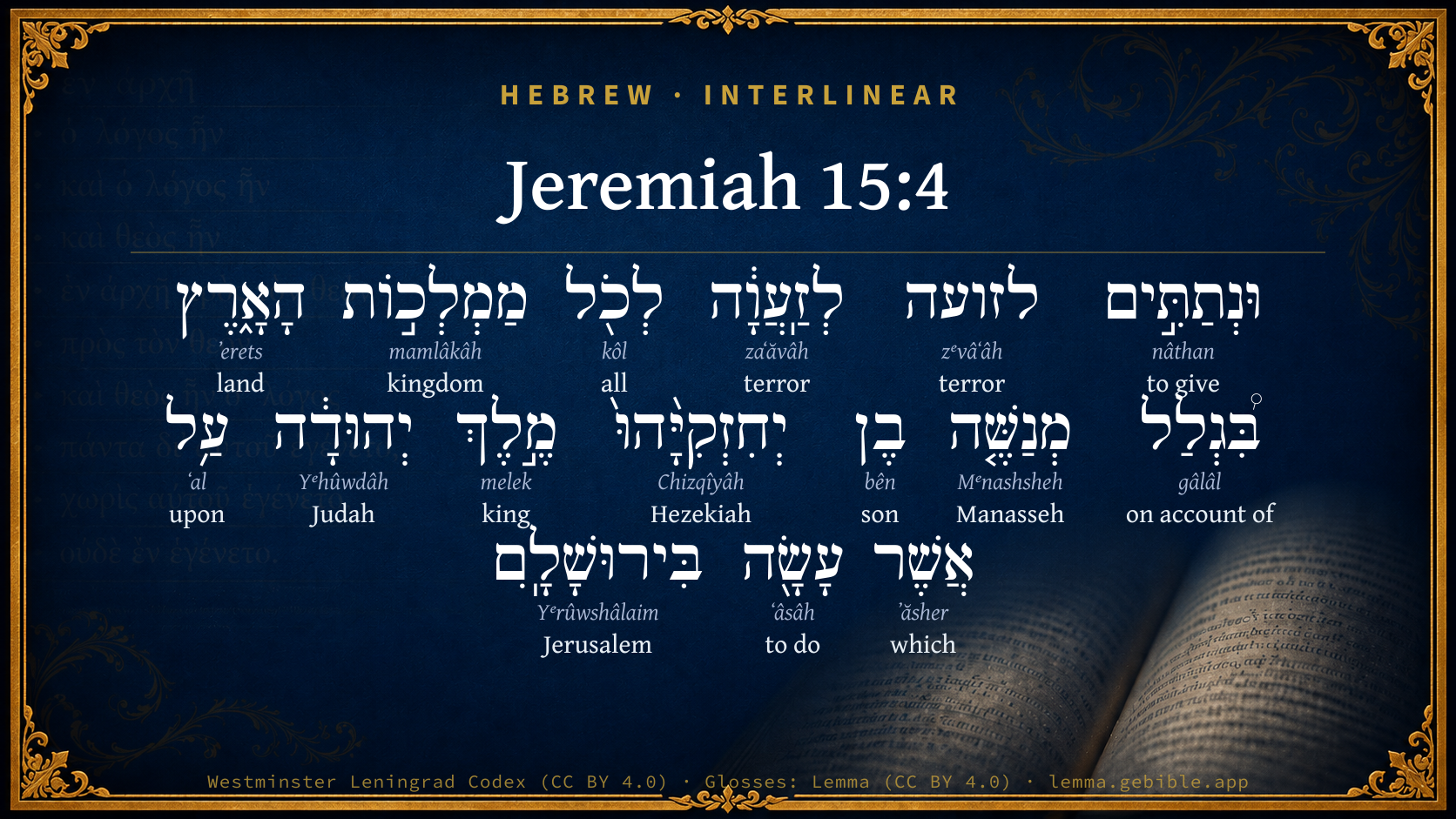
Hebrew (Westminster Leningrad Codex) Jeremiah 15:4 appears in the Hebrew Old Testament. The text above is from the Westminster Leningrad Codex. Each word links to its Strong’s number, a concise gloss, and parsing drawn from the Open Scriptures Hebrew Bible morphology. Click any word for its full Brown-Driver-Briggs (BDB) entry.
Download image
Cite this verse

Jeremiah 15:4 (World English Bible). Public Domain. Lemma interlinear Bible study tool, https://lemma.gebible.app/v/jeremiah/15/4.

Show BibTeX & RIS
BibTeX
RIS
English Translation
I will cause them to be tossed back and forth among all the kingdoms of the earth, because of Manasseh, the son of Hezekiah, king of Judah, for that which he did in Jerusalem.
World English Bible · Public Domain
Download a study sheet

One document with this verse’s original text, its word-by-word gloss line, the meaning frame, cross-references with their text, attributed commentary, and full source and license credits — printable, and it pastes into notes with its structure intact.

This verse Autodidact and up

Study sheet (.html) Plain text (.txt)

A passage Seminary Student

Up to 50 verses in one chapter. A passage sheet keeps up to 6 commentary sources and 12 cross-references per verse, in the order this page ranks them, and says so on the sheet whenever that leaves anything out. Ask for a single verse and you get the Autodidact verse sheet above.

Everything on this page stays free to read, with no account — the sheet is a download of what is already on screen, not access to it.

Want to remove ads? Support Godless Engineer
Compare translations 3

The same verse in 3 English versions, stacked beneath the original-language interlinear above. Click any original word for its lexicon entry.

Each is an independent rendering of the whole verse — the interlinear is not word-aligned to these translations.

Highlighted words mark where these versions differ — a whole-verse word diff, not a word-by-word alignment.

  • World English Bible Public Domain
    I will cause them to be tossed back and forth among all the kingdoms of the earth, because of Manasseh, the son of Hezekiah, king of Judah, for that which he did in Jerusalem.
  • King James Version Public Domain
    And I will cause them to be removed into all kingdoms of the earth, because of Manasseh the son of Hezekiah king of Judah, for that which he did in Jerusalem.
  • unfoldingWord Literal Text CC BY-SA 4.0
    And I will make them a terror for all kingdoms of the earth, because of Manasseh son of Hezekiah, king of Judah, for what he did in Jerusalem.

unfoldingWord Literal Text — © unfoldingWord, licensed CC BY-SA 4.0. Word-aligned USFM3 via Door43 (git.door43.org/unfoldingWord/en_ult).

Versions to compare (up to 4)

3 of 4 selected

Show all 18 translations

Every available English version of this verse, each an independent rendering of the whole verse.

  • World English Bible Public Domain
    I will cause them to be tossed back and forth among all the kingdoms of the earth, because of Manasseh, the son of Hezekiah, king of Judah, for that which he did in Jerusalem.
  • Berean Standard Bible Public Domain
    I will make them a horror to all the kingdoms of the earth because of what Manasseh son of Hezekiah king of Judah did in Jerusalem.
  • Majority Standard Bible Public Domain
    I will make them a horror to all the kingdoms of the earth because of what Manasseh son of Hezekiah king of Judah did in Jerusalem.
  • King James Version Public Domain
    And I will cause them to be removed into all kingdoms of the earth, because of Manasseh the son of Hezekiah king of Judah, for that which he did in Jerusalem.
  • American Standard Version (1901) Public Domain
    And I will cause them to be tossed to and fro among all the kingdoms of the earth, because of Manasseh, the son of Hezekiah, king of Judah, for that which he did in Jerusalem.
  • Revised Version (1885) Public Domain
    And I will cause them to be tossed to and fro among all the kingdoms of the earth, because of Manasseh the son of Hezekiah king of Judah, for that which he did in Jerusalem.
  • Geneva Bible (1599) Public Domain
    I will scatter them also in all kingdomes of the earth, because of Manasseh the sonne of Hezekiah King of Iudah, for that which he did in Ierusalem.
  • Douay-Rheims (1899) Public Domain
    And I will give them up to the rage of all the kingdoms of the earth: because of Manasses the son of Ezechias the king of Juda, for all that he did in Jerusalem.
  • Young's Literal Translation Public Domain
    And I have given them for a trembling To all kingdoms of the earth, Because of Manasseh son of Hezekiah king of Judah, For that which he did in Jerusalem.
  • Literal Standard Version CC BY-SA 4.0
    And I have given them for a trembling || To all kingdoms of the earth, || Because of Manasseh son of Hezekiah king of Judah, || For that which he did in Jerusalem.
  • Unlocked Literal Bible CC BY-SA 4.0
    I will make of them a horrifying thing to all the kingdoms of the earth, because of what Manasseh son of Hezekiah, king of Judah, did in Jerusalem.
  • unfoldingWord Literal Text CC BY-SA 4.0
    And I will make them a terror for all kingdoms of the earth, because of Manasseh son of Hezekiah, king of Judah, for what he did in Jerusalem.
  • Darby Bible Public Domain
    And I will give them over to be driven hither and thither amongst all the kingdoms of the earth, because of Manasseh the son of Hezekiah, king of Judah, for that which he did in Jerusalem.
  • World Messianic Bible Public Domain
    I will cause them to be tossed back and forth among all the kingdoms of the earth, because of Manasseh, the son of Hezekiah, king of Judah, for that which he did in Jerusalem.
  • Webster's Bible Public Domain
    And I will cause them to be removed into all kingdoms of the earth, because of Manasseh the son of Hezekiah king of Judah, for that which he did in Jerusalem.
  • Free Bible Version CC BY-SA 4.0
    I will make all the kingdoms of the world horrified by them, because of the evil things Manasseh, son of Hezekiah, king of Judah did in Jerusalem.
  • Bible in Basic English Public Domain
    And I will make them a cause of fear to all the kingdoms of the earth, because of Manasseh, the son of Hezekiah, king of Judah, and what he did in Jerusalem.
  • JPS Tanakh (1917) Public Domain
    And I will cause them to be a horror among all the kingdoms of the earth, because of Manasseh the son of Hezekiah king of Judah, for that which he did in Jerusalem.

Literal Standard Version (2020), Covenant Press — licensed CC BY-SA 4.0. Text via the HelloAO Bible API (eBible.org). Unlocked Literal Bible (unfoldingWord) — licensed CC BY-SA 4.0. Text via the HelloAO Bible API (eBible.org). unfoldingWord Literal Text — © unfoldingWord, licensed CC BY-SA 4.0. Word-aligned USFM3 via Door43 (git.door43.org/unfoldingWord/en_ult). Free Bible Version, Dr. Jonathan Gallagher — licensed CC BY-SA 4.0. Text via the HelloAO Bible API (eBible.org).

Word by word

More ways to search: Search by grammar → Find every occurrence → Compare this word →

Practice this passage: Drill this verse → Learn its vocabulary →

לְזַֽעֲוָ֔ה
zaʻăvâh
H2189
“to/for · terror”
Preposition + Noun, Common, Feminine, Singular, Absolute
Part of Speech
Preposition + Noun
Type
Common
Gender
Feminine
Number
Singular
State
Absolute
Full BDB Definition

Origin: by transposition for H2113

TWOT: 540a

a horror, trembling, object of terror or trembling
  1. וּנְתַתִּ֣ים nâthan H5414 “and · to give · them” Conjunction + Verb, Qal, Sequential Perfect, 1st Person, Common, Singular + Suffix, Personal, 3rd Person, Masculine, Plural
  2. לזועה zᵉvâʻâh H2113 “to/for · terror” Preposition + Noun, Common, Feminine, Singular, Absolute
  3. לְכֹ֖ל kôl H3605 “to/for · all of” Preposition + Noun, Common, Masculine, Singular, Construct
  4. מַמְלְכ֣וֹת mamlâkâh H4467 “kingdoms of” Noun, Common, Feminine, Plural, Construct
  5. הָאָ֑רֶץ ʼerets H776 “the · land” Particle, Definite Article + Noun, Common, Both, Singular, Absolute
  6. בִּ֠גְלַל gâlâl H1558 “in/at · on account of of” Preposition + Noun, Common, Masculine, Singular, Construct
  7. מְנַשֶּׁ֤ה Mᵉnashsheh H4519 “Manasseh” Noun, Proper
  8. בֶן bên H1121 “son of” Noun, Common, Masculine, Singular, Construct
  9. יְחִזְקִיָּ֨הוּ֙ Chizqîyâh H2396 “Hezekiah” Noun, Proper
  10. מֶ֣לֶךְ melek H4428 “king of” Noun, Common, Masculine, Singular, Construct
  11. יְהוּדָ֔ה Yᵉhûwdâh H3063 “Judah” Noun, Proper
  12. עַ֥ל ʻal H5921 “upon” Preposition
  13. אֲשֶׁר ʼăsher H834 “which” Particle, Relative
  14. עָשָׂ֖ה ʻâsâh H6213 “to do” Verb, Qal, Perfect, 3rd Person, Masculine, Singular
  15. בִּירוּשָׁלִָֽם Yᵉrûwshâlaim H3389 “in/at · Jerusalem” Preposition + Noun, Proper

About this verse

These counts appear in no published source. They are computed here, from the morphology-tagged text and Lemma’s own curated glosses. What Lemma adds →

16
words
16
distinct lemmas
Prophets
section

Notable vocabulary

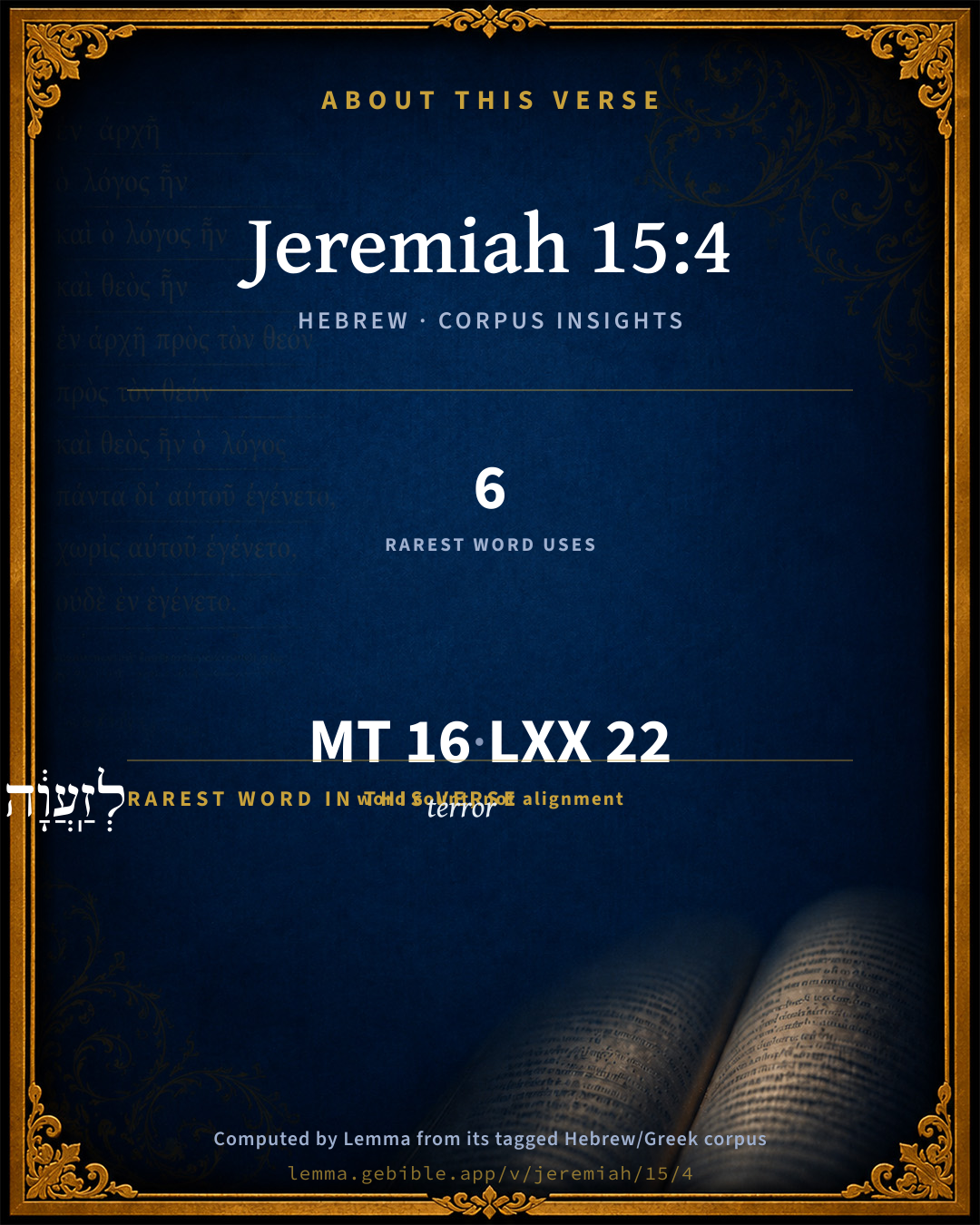
The rarest word here is לְזַֽעֲוָ֔ה terror H2189 — appearing just 6 times in the whole Hebrew Bible.

Shared distinctive vocabulary

לְזַֽעֲוָ֔ה terror H2189 occurs in 6 verses of the Hebrew Bible. Also found in:

Grammatical profile

  • 2 verbs
  • 12 nouns
  • 1 preposition
  • 1 particle

Verb forms

  • וּנְתַתִּ֣ים Qal · Sequential Perfect
  • עָשָׂ֖ה Qal · Perfect

Hebrew & Septuagint length

In the original languages it is 16 Hebrew tokens and 22 Greek tokens — but the two are counted differently (Hebrew bundles its prefixes and suffixes into one token; the Greek is in lemma form), so that isn’t a like-for-like length.

Cross-references

14

Topical passages linked to Jeremiah 15:4 in the Treasury of Scripture Knowledge — connected by theme and wording, ordered by reader-vote popularity; previews shown in the World English Bible.

  • Jeremiah 24:9 I will even give them up to be tossed back and forth among all the kingdoms of the earth for evil; to be a reproach and a proverb, a taunt and a curse, in all places where I shall drive them.
  • 2 Kings 21:11–13 Because Manasseh king of Judah has done these abominations, and has done wickedly above all that the Amorites did, who were before him, and has made Judah also to sin with his idols;
  • 2 Kings 21:16–17 Moreover Manasseh shed innocent blood very much, until he had filled Jerusalem from one end to another; besides his sin with which he made Judah to sin, in doing that which was evil in the sight of Yahweh.
  • 2 Kings 23:26–27 Notwithstanding, Yahweh didn't turn from the fierceness of his great wrath, with which his anger was kindled against Judah, because of all the provocation with which Manasseh had provoked him.
  • 2 Kings 24:3–4 Surely at the commandment of Yahweh came this on Judah, to remove them out of his sight, for the sins of Manasseh, according to all that he did,
  • Deuteronomy 28:25 Yahweh will cause you to be struck before your enemies; you shall go out one way against them, and shall flee seven ways before them: and you shall be tossed back and forth among all the kingdoms of the earth.
  • Jeremiah 29:18 I will pursue after them with the sword, with the famine, and with the pestilence, and will deliver them to be tossed back and forth among all the kingdoms of the earth, to be an object of horror, and an astonishment, and a hissing, and a reproach, among all the nations where I have driven them;
  • Ezekiel 23:46 For thus says the Lord Yahweh: I will bring up a company against them, and will give them to be tossed back and forth and robbed.
  • Leviticus 26:33 I will scatter you among the nations, and I will draw out the sword after you: and your land will be a desolation, and your cities shall be a waste.
  • 2 Kings 21:2 He did that which was evil in the sight of Yahweh, after the abominations of the nations whom Yahweh cast out before the children of Israel.
  • Jeremiah 34:17 Therefore thus says Yahweh: you have not listened to me, to proclaim liberty, every man to his brother, and every man to his neighbor: behold, I proclaim to you a liberty, says Yahweh, to the sword, to the pestilence, and to the famine; and I will make you to be tossed back and forth among all the kingdoms of the earth.
  • Deuteronomy 28:64 Yahweh will scatter you among all peoples, from the one end of the earth even to the other end of the earth; and there you shall serve other gods, which you have not known, you nor your fathers, even wood and stone.
  • Jeremiah 9:16 I will scatter them also among the nations, whom neither they nor their fathers have known; and I will send the sword after them, until I have consumed them.
  • Lamentations 1:8 Jerusalem has grievously sinned; therefore she is become as an unclean thing; All who honored her despise her, because they have seen her nakedness: Yes, she sighs, and turns backward.

Cross-references courtesy of OpenBible.info (CC BY 4.0).

Hebrew and Greek witnesses Masoretic Hebrew ↔ Greek Septuagint

The same verse in the two great witnesses to the Old Testament, shown verse-for-verse.

These are two independent witnesses, not word-aligned to each other, and the Septuagint is shown in lemma (dictionary) form.

Hebrew Jeremiah 15:4 Masoretic · Westminster Leningrad Codex

וּנְתַתִּ֣ים לזועה לְזַֽעֲוָ֔ה לְכֹ֖ל מַמְלְכ֣וֹת הָאָ֑רֶץ בִּ֠גְלַל מְנַשֶּׁ֤ה בֶן יְחִזְקִיָּ֨הוּ֙ מֶ֣לֶךְ יְהוּדָ֔ה עַ֥ל אֲשֶׁר עָשָׂ֖ה בִּירוּשָׁלִָֽם

I will cause them to be tossed back and forth among all the kingdoms of the earth, because of Manasseh, the son of Hezekiah, king of Judah, for that which he did in Jerusalem.

World English Bible · Public Domain

Greek LXX Structure differs

In the Septuagint, Jeremiah is about an eighth shorter than the Hebrew and arranges its material differently — the Oracles Against the Nations (Hebrew chapters 46–51) appear in the middle of the Greek book, after 25:13. Because the chapter and verse boundaries do not line up, a verse-for-verse comparison with the Hebrew is not shown.

A verse-for-verse comparison isn’t shown here because the chapters and verses don’t line up. Switch to the LXX edition with the MT / LXX toggle above to read the Greek directly.

On this verse, Haydock's Catholic Bible Commentary discusses the Septuagint’s reading. Read the note in Commentary ↓

Hebrew: Westminster Leningrad Codex (CC BY 4.0). Greek: Septuagint (public domain); English from a public-domain English Septuagint. How the Septuagint differs from the Hebrew →

Targum (Aramaic paraphrase)

1

The Targum is the ancient Jewish Aramaic paraphrase of the Hebrew Scriptures — an interpretive translation, not the Hebrew text itself. Onkelos (literal) and Pseudo-Jonathan (expansive) render the Torah, and Jonathan the Prophets. Coverage is partial: where no permissively-licensed English translation exists for a verse, only the Aramaic is shown. This is verse-level text, not a word-by-word alignment to the Hebrew.

  1. Targum Jonathan Prophets (Joshua–Malachi)
    וְאֶתְּנִינוּן לִזְיַע לְכָל מַלְכְּוַת אַרְעָא עַל דְלָא תָבוּ כִּמְנַשֶׁה בַר יְחִזְקִיָה מְלַךְ שִׁבְטָא דְבֵית יְהוּדָה עַל דְאַסְגֵי לְמֶעְבַּד בִּירוּשְׁלֵם:

    (no public-domain English translation for this verse)

    Targum Jonathan — Aramaic: “Mikraot Gedolot” (public domain). English: “Sefaria Community Translation” (CC0 1.0 (public-domain dedication)); “London "Chaldee Paraphrase," 1871” (public domain). Text via Sefaria.

Commentary

Notes on Jeremiah 15:4 from classic Christian and Jewish commentators (each source and its license shown beneath its notes). The classic Christian expositions comment on the surrounding passage and are grouped to its opening verse, so a note may address several verses; the Jewish commentaries on the Tanakh (Rashi and others) are per-verse, so they appear only where the commentator wrote on this verse.

Lemma curates 59 commentaries, every one of them public domain or Creative Commons licensed, each selected and text-cleaned for this edition rather than reprinted as found. About our sources →

Trapp's Complete Commentary

John Trapp

Jer 15:4 And I will cause them to be removed into all kingdoms of the earth, because of Manasseh the son of Hezekiah king of Judah, for [that] which he did in Jerusalem.

Ver. 4. Because of Manasseh.] Because of his sins, idolatry and bloodshed especially, wherein the people partook and persisted, and were therefore justly punished.

The son of Hezekiah.] But altogether degenerate. He was therefore the worse, because he should have been better, and yet the worse again, because he was author publicae corruptelae, a ringleader of rebellion to others, as was Jeroboam.

John Trapp, A Commentary or Exposition upon All the Books of the Old and New Testament (1647–1656) — public domain. Text from a community e-Sword module.

Tyndale Open Study Notes

Tyndale Open Resources

15:4 Judah’s apostasy could be traced back to Manasseh son of Hezekiah, the king who reigned 697–642 BC (see 2 Kgs 21:1-18; 2 Chr 33:1-20).

Tyndale Open Study Notes — © Tyndale Open Resources, licensed CC BY-SA 4.0. Text via the HelloAO Bible API.

Geneva Bible (1599)

Geneva Bible translators

Not that the people was punished for the king’s sin only, but for their own sins also, because they consented to his wickedness, 2 Kings 21:9.

The word signifieth to run to and fro for fear, and unquietness of conscience, as did Cain.

Geneva Bible (1599) marginal notes — public domain. Text via Bolls.life.

Jamieson, Fausset & Brown

Robert Jamieson, A. R. Fausset & David Brown

cause . . . to be removed-- (Deu 28:25; Eze 23:46). Rather, "I will give them up to vexation," I will cause them to wander so as nowhere to have repose [CALVIN]; (Ch2 29:8, "trouble;" Margin, "commotion").

because of Manasseh--He was now dead, but the effects of his sins still remained. How much evil one bad man can cause! The evil fruits remain even after he himself has received repentance and forgiveness. The people had followed his wicked example ever since; and it is implied that it was only through the long-suffering of God that the penal consequences had been suspended up to the present time (compare Kg1 14:16; Kg2 21:11; Kg2 23:26; Kg2 24:3-4).

Jamieson, Fausset & Brown — Commentary Critical and Explanatory on the Whole Bible (1871) — public domain (CC PDM 1.0). Text via the HelloAO Bible API.

Adam Clarke's Commentary

Verse 4. I will cause them to be removed into an kingdoms of the earth] This seems to have respect to the succeeding state of the Jews in their different generations; and never was there a prophecy more literally fulfilled; and it is still a standing monument of Divine truth. Let infidelity cast its eyes on the scattered Jews whom it may meet with in every civilized nation of the world; and then let it deny the truth of this prophecy, if it can. The Jews are scattered through every nation, and yet are not a nation; nor do they form even a colony on any part of the face of the earth. Behold the truth and the justice of God!

Adam Clarke's Commentary on the Bible (1810–1826) — public domain. Text from a community e-Sword/MySword module.

John Calvin's Commentaries

Jeremiah speaks now of exile. He had hitherto spoken of the sword and famine, and mentioned also other punishments, that their carcases would be dragged about by dogs, and also devoured by wild beasts and ravenous birds; but he now refers to one kind of punishment only — that God would drive them into exile. And he seems to have taken these words from Moses, for so he speaks in Deuteronomy 28, except that ו, vau, is placed before ע, ain, in the word “commotion,” but such a change is common. In other respects there is a perfect agreement.

I will set them, he says, for a commotion to all the kingdoms of the earth; that is, I will cause them to wander in constant fear and trembling. He amplifies the grievousness of exile by the circumstance that they should have no safe rest. They who leave their country for exile do at least find some corner where they take breath; but God declares that the Jews would be everywhere unsettled and wanderers, so that no place would receive them. And hence God’s vengeance became more fully manifest, for these miserable men never found an asylum when scattered through various countries. Though they had habitations in those parts allotted to them by the king of Babylon, they were yet everywhere without any rest. It was not therefore in vain that Moses threatened them with such a punishment, nor was it to no purpose that Jeremiah repeated what had been said by Moses.

He adds the cause, On account of Manasseh But Manasseh was now dead, why then did God transfer the vengeance which he merited to posterity? And this seems inconsistent with another passage found in Ezekiel,

“The soul that sinneth it shall die.” (Ezekiel 18:8)

But doubtless God justly punished the wickedness of the people even after the death of that ungodly king, for they ceased not to accumulate evils on evils; as however their impiety appeared especially at that time, he particularly noticed it, that the Jews might understand that they had been long worthy of destruction, and that punishment was not delayed except through the great mercy of God, who had not immediately treated them as they deserved. The Prophet therefore commends the long forbearance of God because their ruin was suspended until that time. And, on the other hand, he shews that they were not so severely treated but that they were worthy of greater and more atrocious punishment; for such had been their obstinacy that they did all they could to draw upon themselves destruction many times.

But another question arises: Manasseh pretended repentance, and God seemed to have forgiven him and the whole people, (2 Kings 21:2 Chronicles 33:12) why does he now declare that he would take vengeance on sins which had been already buried? But the answer is evident, for the Jews from that time had been in no way better. As then they had continued to pursue the same sinful courses with Manasseh, it was right that they should at length be rewarded as they deserved; for, had they become really changed, there would have been a change in God’s dealings with them, but inasmuch as their impiety had ever remained the same, and as they gave themselves up to the same vices, a heavier judgment was nigh them, and justly so, because they had abused God’s forbearance, who had spared the king as well as themselves on the condition of receiving the pardon offered to them. But since they had hardened themselves, it was riglit to take such account of their ingratitude and perverseness as to treat them with greater severity.

Farther, Manasseh is called the son of Hezekiah, and that for the purpose of enhancing his crime. For as religion had been reformed in the time of Hezekiah, and as that pious king, with great labor and toil, exerted all his powers to restore the true worship of God, it was the duty of Manasseh to follow his example. But he not only built altars to idols, and polluted the whole land with superstitions, but also defiled the very Temple of God. It was thus a horrible, and wholly a diabolical madness in the son, when the right way of worshipping God had been delivered unto him, to be of such a reprobate mind as immediately to overthrow what his father with great labor has so faithfully established. This then was the reason why Jeremiah mentioned to his dishonor the name of his father. And hence we learn that they are worthy of a heavier punishment, who have been religiously brought up from their childhood, and become afterwards degenerated, who, having had pious and godly parents, afterwards abandon themselves to every wickedness. Hence a heavier judgment awaits those who depart from the examples of godly fathers. And this we gather from the very words of the Prophet, who here, by way of reproach, calls Manasseh the son of Hezekiah, which yet would have been to his honor, had he been like his father and followed his piety.

And at the same time there is no doubt but that the Prophet indirectly condemns the whole people; for we know how great opposition pious Hezekiah met with, and how he contended for the faithful worship of God, as though he had been among the Assyrians or the Egyptians. But the perverseness of the people appeared then extreme, when he was put in jeopardy as to the kingdom, because he endeavored to cleanse the land of Judah from its filth and pollutions; their impiety and ingratitude then shewed, and openly discovered themselves. Afterwards Manasseh overturned as it were in an instant the worship of God, and they all, with great exultation, went immediately after superstition. We hence see that the mouths of the Jews were thus closed, so that they could not object and say, that they obeyed the command of their king; for they winingly followed wicked superstitions. They assented to the king of their own accord, while yet they hardly, and with great unwiningness, were led to obey when God’s worship was restored in the time of Hezekiah.

But Manasseh added cruelties to superstitions; for we know that he not only covered the streets of the city with blood, but made it also to flow in streams, as sacred history relates. As, then, the Prophets were so cruelly treated in the time of Manasseh, and as he was not the sole author of this barbarity, but the true servants of God were persecuted to death by the consent of the people, it was hence evident that it was the crime of the whole community. And hence he mentions Jerusalem, in order that the Jews might know that the holy city, in which they gloried, had been for a long time the den of robbers, and that the Temple of God had been polluted by wicked superstitions, and even the whole city by unlawful and barbarous slaughters. It now follows —

John Calvin's Commentaries (1540-1563) — public domain. Text from the Calvin Translation Society English edition (1840s-50s) via the Christian Classics Ethereal Library (ccel.org). Calvin's coverage is partial (roughly two-thirds of the Bible); uncommented books and verses are honest gaps, never fabricated. The 19th-century editor's footnotes and remarks are omitted so the notes are faithfully Calvin's own voice.

Ellicott's Commentary for English Readers

(4) Manasseh the son of Hezekiah.—The horror of that long and evil reign still lingered in the minds of men, and the prophet saw in it the beginning of the evils from which his people were now suffering. The name of Hezekiah may have been inserted as an aggravation of the guilt of his successor.

A Bible Commentary for English Readers, edited by Charles John Ellicott (1878–1897) — public domain. Text from a community e-Sword module.

The Cambridge Bible for Schools and Colleges

gen. ed. J. J. S. Perowne

4. The latter part (“because of … in Jerusalem”) may be a gloss, founded on such passages as 2Ki_21:11 ff. Jeremiah does not elsewhere name Manasseh in connexion with the evil deeds of that reign.

cause them to be tossed to and fro among] to shake is the lit. meaning of the Heb. root, hence, to move in fear, to tremble (Est_5:9). The Heb. substantive here (from that root) thus means consternation, i.e. an object of it, and occurs again in Jer_24:9, Jer_29:18. Thus we should render, I will make them to be a consternation to, etc.

The Cambridge Bible for Schools and Colleges (gen. ed. J. J. S. Perowne; Cambridge University Press, 1878–1918) — public domain. Text from a community e-Sword module.

John Gill's Exposition

And I will cause them to be removed into all kingdoms of the earth,.... Not only into Babylon, but into other countries; which has had its full accomplishment in this their last captivity by the Romans: or "I will give them for a commotion" (z); shaking and trembling; they shall be like Cain, fugitives and vagabonds, and be in fear and trembling everywhere, for what is, or is about to come upon them: or "for horror unto all kingdoms" (a); all that see the calamities and judgments that come upon them will be struck with dread and horror, plainly seeing the hand of the Lord in them:

because of Manasseh the son of Hezekiah king of Judah; because of the idolatry and murder committed by him; and which were the more aggravated, by having so good a parent, and so religious an education, and by his high office and dignity as king of Judah; and though these sins were personally forgiven him, yet, being imitated and continued in by the Jews, captivity is threatened them. The Targum is,

"because they turned not (or were not converted) as Manasseh;''

and so in the Talmud (b), because Manasseh repented, and they did not; but this sense the words will not bear, because of what goes before, of which these are a reason; and because of what follows after, which are connected with them:

for that which he did in Jerusalem; the innocent blood he shed there, and the idolatrous worship he there set up; even where the temple was, the place of God's worship, and which was the metropolis of the nation, and so set an example, which must influence the whole country.

(z) "in commotionem", Calvin, Junius & Tremellius, Piscator. (a) "In horrorem", Cocceius. (b) T. Bab. Sanhedrin, fol. 102. 2.

John Gill's Exposition of the Whole Bible (1746–1763) — public domain (CC PDM 1.0). Text via the HelloAO Bible API.

Albert Barnes' Notes on the Bible

To be removed - Rather, “to be a terror.”

Because of Manasseh the son of Hezekiah - The name of the pious father intensifies the horror at the wickedness of the son.

Albert Barnes' Notes on the Bible (1834–1885) — public domain. Text from a community e-Sword/MySword module.

Haydock's Catholic Bible Commentary

Rage. Hebrew, "agitation." (Calmet) --- Septuagint, "necessities." Protestants, "to be removed into all," &c. (Haydock) This the event verified, Isaias xi. 11. --- Manasses. Though he obtained pardon, the people would not imitate his repentance. A dreadful warning for princes! (Calmet) --- "The people generally perish by the fault of their governors." (St. Jerome)

George Leo Haydock (1774–1849), Haydock's Catholic Family Bible and Commentary, 1859 edition — public domain. Excludes Psalms (Douay-Rheims chapter numbering differs from Protestant) and Deuterocanonical books (Catholic canon only).

Matthew Poole's English Annotations

Though the body of the people were removed into Babylon, yet as it is more than probable that many of them fled into other countries to save themselves, so there is no doubt but the king of Babylon removed them into several kingdoms belonging to his large empire. What Manasseh did may be read 2Ki 21:11,16, He did wickedly, above all that the Amorites did that were before him, and made also Judah to sin with his idols. Moreover, he shed innocent blood very much, till he had filled Jerusalem from one end to another, besides his sin wherewith he made Judah to sin, &c. Some make a question whether God means the personal sins of Manasseh and his ministers, or only the sins of the same kind that the Jews still continued. Manasseh lived fifty-five years, his son Josiah thirty-one years, it was now the time of Jehoiakim, the son of Josiah, who reigned but eleven years, and it is probable this was his fifth year, for in that year he proclaimed the fast for the drought, (as is supposed,) Jer 36:9. Though the people were bad enough still, yet it is no way probable that they were so bad as in the time of Manasseh. We know all Josiah’s time, the father of this prince, was a time of reformation, though it be certain much of their old leaven of idolatry and superstition was yet in them. Whatever therefore some think, God undoubtedly meaneth the guilt that Manasseh and his subjects contracted forty years before this time: nor do I see any reason why any should question, whether it be consistent with the justice of God to punish the sins of parents upon their posterity, when it is no more than we see done every day in the punishments of traitors and felons, by the seizing the estates of their children, and in wars, upon the taking of cities and fortified places; and it is no more than God hath threatened in the second commandment, Exo 20, and declared it as a piece of his name, Exo 34:5, and done in a multitude of Scriptural instances. Manasseh is here named as the son of Hezekiah for his shame, because of his degeneracy from so good a parent; it is expressly said, 2Ki 23:26, that notwithstanding Josiah’s reformation, yet the Lord turned not from the fierceness of his wrath kindled against Judah for the provocations of Manasseh.

Matthew Poole's English Annotations on the Holy Bible (1683–1685) — public domain. Text from a community e-Sword/MySword module.

Whedon's Commentary on the Bible

Daniel D. Whedon

4. Removed — Rather, a terror. Furst, Nagelsbach, Keil, Syriac, render it maltreated.

Manasseh — See 2Ki_21:1-16. The name of the pious and illustrious father sets off with terrible emphasis that of his godless and unworthy son. Though Manasseh lived a hundred years before this, the evil consequences of his wicked reign were still extant.

Daniel D. Whedon (gen. ed.), Commentary on the Old and New Testaments (1874–1909) — public domain. Text from a community e-Sword module.

The Pulpit Commentary

Cause them to be removed into; rather, make them a shuddering unto. So in the Deuteronomic curses for disobedience. (Deu_28:25)

The sins of the fathers visited upon the children.

This verse contains an explicit declaration that such is God"s rule. The calamities about to fall on Judah and Jerusalem were "because of Manasseh the son of," etc. No doubt the sins of Manasseh were flagrant in the extreme, and they were the more aggravated because he was the son of the godly Hezekiah. No doubt his reign was one of dark disgrace and disaster. The sacred writers dismiss it with a few short statements, hurrying over its long stretch of years it was the longest reign of all the kings of Judah as if they were (as they were) a period too melancholy and shameful to be dwelt upon. But why should we find that his guilt and sin were to fall upon those who were unborn at the time, and who therefore could have had no share therein?

I SUCH VISITATION IS AN UNDOUBTED FACT. It is plainly declared to be a Divine rule, and that once and again (cf. Exodus 20, etc.). And apart from the Bible in the manifest law of heredity there is the dread fact patent to all. Workhouses, prisons, hospitals, asylums, all attest the visitation of God for the fathers" sins.

II IT IS A GREAT MYSTERY. It is one branch of that all-pervading mystery into which all other mysteries sooner or later run up the mystery of evil. There is nothing to be done, so far as its present solution is concerned, but to "trust," and so "not be afraid.

III BUT NOT WITHOUT ALLEVIATIONS; e.g.

1. If the sins of the fathers are visited on their descendants, yet more are God"s mercies. The sins descend to "the third and fourth generation," but the mercies to "thousands" of generations for this is meant.

2. The descent is not entire. The sins come down, it is true, upon the descendants, but in their fruits rather than in their roots. A father cannot force on his child his wickedness, though he may his diseases and tendencies.

3. The entail may be cut off in its worst part at any moment, and very often is. Coming to Christ may not deliver me from physical suffering, but it will from sin. Grafted into Christ a new life will begin, the whole tendency of which in me and in mine is to counteract and undo the results of the former evil life.

4. And the visitation of the fathers" sins is but rarely because of the fathers" sins only. The descendants of the age of Manasseh did their works, and what wonder that they should inherit their woes?

5. And it is a salutary law. Children are a means of grace to tens of thousands of parents. "Out of the mouth of babes," etc. For, for their children"s sakes, parents will exercise a watchfulness and self-restraint, will seek after God and goodness as otherwise they would never have done. The remembrance of what they will inflict on their children by virtue of this law fills them with a holy fear, as God designed it should.

CONCLUSION.

1. Parents. What legacy are you leaving for your children? Shall they have to curse or bless you? O father, mother, "do not sin against" your "child.

2. Children. What have you received? Is it a legacy of evil example, evil tendency, evil habit? God"s grace will help you to break the succession. Refuse it for yourselves, determine you will not hand it on to others. But is it a legacy of holy example, tendencies, and habits? Blessed be God if it be so. What responsibility this involves! What blessing it renders possible for you and those who come after you! C.

The Pulpit Commentary (1880–1919), ed. H.D.M. Spence-Jones & Joseph S. Exell — public domain. Text from a community e-Sword module.

John Wesley's Explanatory Notes

Manasseh - Manasseh is here named as the son of Hezekiah for his shame, because of his degeneracy from so good a parent; it is expressly said, 2 Kings xxiii, 26, that not withstanding Josiah's reformation, yet the Lord turned not from the fierceness of his wrath, kindled against Judah, for the provocations of Manasseh.

John Wesley, Explanatory Notes Upon the Whole Bible (1754–1765) — public domain. Text via the GEBible commentary corpus.

Rashi

Rabbi Shlomo Yitzchaki (Rashi)

a horror from the same root as (Esther 5:9), “And he neither rose nor quaked (זָע).” Similarly, גַּאֲוָה pride, from the root (Isa. 16:6) “Have become very proud (גֵּא).”

to all the kingdoms of the earth Anyone who hears the evil that has befallen you will shudder.

Rashi on the Tanakh — English translations: “The Judaica Press complete Tanach with Rashi, translated by A. J. Rosenberg” (CC BY 4.0); “Pentateuch with Rashi's commentary by M. Rosenbaum and A.M. Silbermann, 1929-1934” (public domain); “The Metsudah Tanach series, Lakewood, N.J” (CC BY 4.0); and “The Book of Joshua, Metsudah Publications, 1997” (CC BY 4.0). Text via Sefaria.

Lesson kit

Teaching starters — assembled from the data on this page, not authored interpretation. Every prompt links to the verse data it draws on. Edit before teaching.

Jeremiah, in the Prophets, opens this verse with 16 words (16 distinct Hebrew lemmas). Its most distinctive word is zaʻăvâh (“terror”). A historical commentator’s framing appears above. Read the whole chapter for the surrounding context.

Discussion questions

  1. What does “terror” (zaʻăvâh) contribute to the verse as a whole?
  2. How does Deuteronomy 28:25, which shares the word «terror», read alongside this verse?
  3. The translations on this page render this verse differently — a whole-verse word diff, not a word-by-word alignment. What might account for the different wordings?
  4. «וּנְתַתִּ֣ים» is a Qal Sequential Perfect verb. How does that grammatical form shape the action described?
  5. Compare how Trapp's Complete Commentary and Tyndale Open Study Notes read this verse. Where do they agree or differ?

Things to notice

Reading settings

Reading text

Shown beneath each verse's original-language words.

Old Testament
Old Testament edition

Read the OT as the Masoretic Hebrew (MT) or the Greek Septuagint (LXX).

English shown for the Greek Septuagint (in the Hebrew ↔ Greek comparison).

Comparing translations? Open the Compare panel on any verse page to stack up to four side by side.