Numbers 36:12

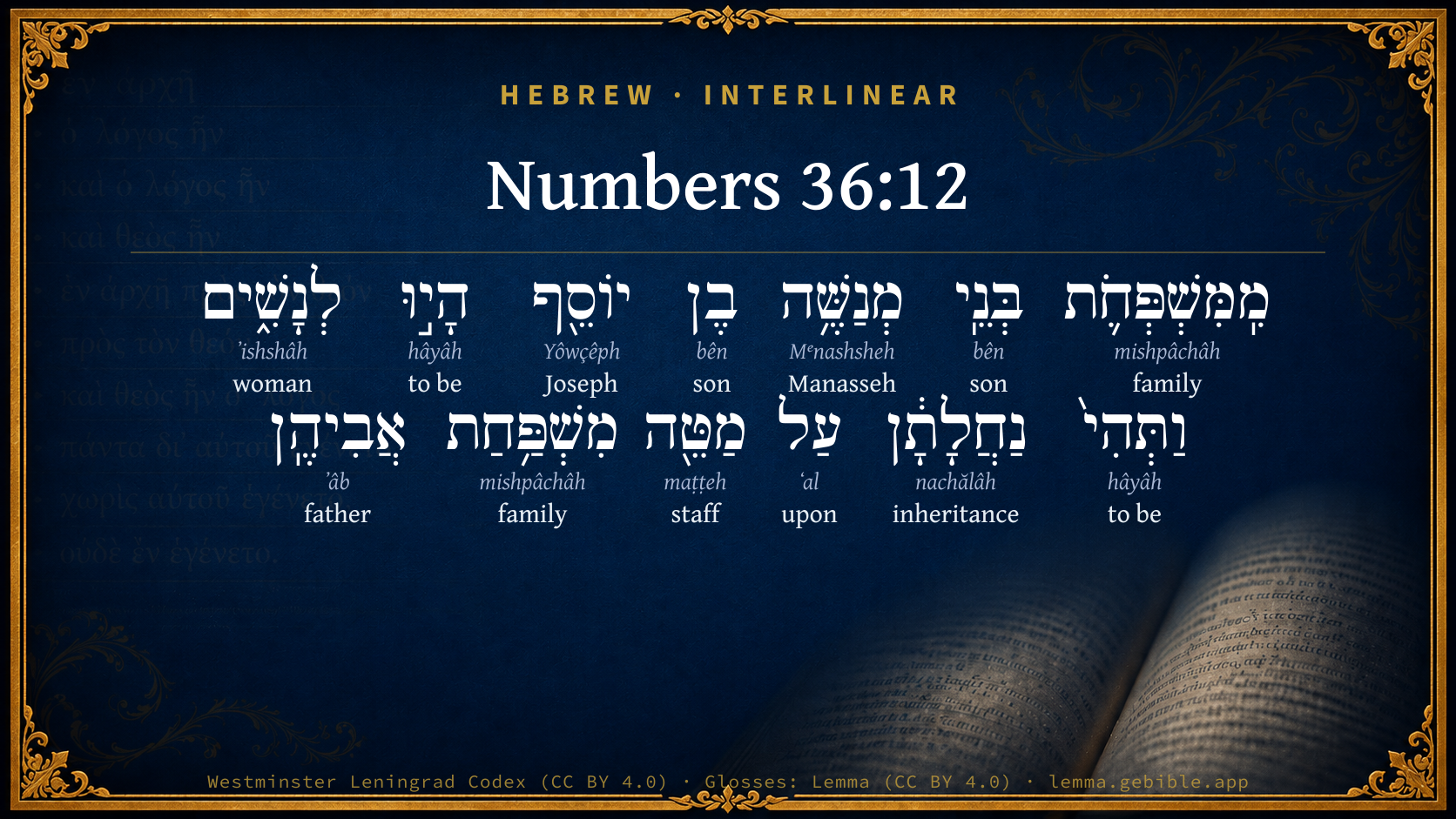
Hebrew (Westminster Leningrad Codex) Numbers 36:12 appears in the Hebrew Old Testament. The text above is from the Westminster Leningrad Codex. Each word links to its Strong’s number, a concise gloss, and parsing drawn from the Open Scriptures Hebrew Bible morphology. Click any word for its full Brown-Driver-Briggs (BDB) entry.
Download image
Cite this verse

Numbers 36:12 (World English Bible). Public Domain. Lemma interlinear Bible study tool, https://lemma.gebible.app/v/numbers/36/12.

Show BibTeX & RIS
BibTeX
RIS
English Translation
They were married into the families of the sons of Manasseh the son of Joseph; and their inheritance remained in the tribe of the family of their father.
World English Bible · Public Domain
Download a study sheet

One document with this verse’s original text, its word-by-word gloss line, the meaning frame, cross-references with their text, attributed commentary, and full source and license credits — printable, and it pastes into notes with its structure intact.

This verse Autodidact and up

Study sheet (.html) Plain text (.txt)

A passage Seminary Student

Up to 50 verses in one chapter. A passage sheet keeps up to 6 commentary sources and 12 cross-references per verse, in the order this page ranks them, and says so on the sheet whenever that leaves anything out. Ask for a single verse and you get the Autodidact verse sheet above.

Everything on this page stays free to read, with no account — the sheet is a download of what is already on screen, not access to it.

Want to remove ads? Support Godless Engineer
Compare translations 3

The same verse in 3 English versions, stacked beneath the original-language interlinear above. Click any original word for its lexicon entry.

Each is an independent rendering of the whole verse — the interlinear is not word-aligned to these translations.

Highlighted words mark where these versions differ — a whole-verse word diff, not a word-by-word alignment.

  • World English Bible Public Domain
    They were married into the families of the sons of Manasseh the son of Joseph; and their inheritance remained in the tribe of the family of their father.
  • King James Version Public Domain
    And they were married into the families of the sons of Manasseh the son of Joseph, and their inheritance remained in the tribe of the family of their father.
  • unfoldingWord Literal Text CC BY-SA 4.0
    They became wives from the clans of the sons of Manasseh, the son of Joseph, and their inheritance was with the tribe of the clan of their father.

unfoldingWord Literal Text — © unfoldingWord, licensed CC BY-SA 4.0. Word-aligned USFM3 via Door43 (git.door43.org/unfoldingWord/en_ult).

Versions to compare (up to 4)

3 of 4 selected

Show all 18 translations

Every available English version of this verse, each an independent rendering of the whole verse.

  • World English Bible Public Domain
    They were married into the families of the sons of Manasseh the son of Joseph; and their inheritance remained in the tribe of the family of their father.
  • Berean Standard Bible Public Domain
    They married within the clans of the descendants of Manasseh son of Joseph, and their inheritance remained within the tribe of their father’s clan.
  • Majority Standard Bible Public Domain
    They married within the clans of the descendants of Manasseh son of Joseph, and their inheritance remained within the tribe of their father’s clan.
  • King James Version Public Domain
    And they were married into the families of the sons of Manasseh the son of Joseph, and their inheritance remained in the tribe of the family of their father.
  • American Standard Version (1901) Public Domain
    They were married into the families of the sons of Manasseh the son of Joseph; and their inheritance remained in the tribe of the family of their father.
  • Revised Version (1885) Public Domain
    They were married into the families of the sons of Manasseh the son of Joseph, and their inheritance remained in the tribe of the family of their father.
  • Geneva Bible (1599) Public Domain
    They were wiues to certaine of the families of the sonnes of Manasseh the sonne of Ioseph: so their inheritance remained in the tribe of the familie of their father.
  • Douay-Rheims (1899) Public Domain
    Of the family of Manasses, who was the son of Joseph: and the possession that had been allotted to them, remained in the tribe and family of their father.
  • Young's Literal Translation Public Domain
    `to men' of the families of the sons of Manasseh, son of Joseph, they have been for wives, and their inheritance is with the tribe of the family of their father.
  • Literal Standard Version CC BY-SA 4.0
    they have been for wives [to men] from the families of the sons of Manasseh, son of Joseph, and their inheritance is with the tribe of the family of their father.
  • Unlocked Literal Bible CC BY-SA 4.0
    They married into the clans of the descendants of Manasseh son of Joseph. In this way, their inheritances remained in the tribe to which their father's clan belonged.
  • unfoldingWord Literal Text CC BY-SA 4.0
    They became wives from the clans of the sons of Manasseh, the son of Joseph, and their inheritance was with the tribe of the clan of their father.
  • Darby Bible Public Domain
    To those that were of the families of the sons of Manasseh the son of Joseph were they married; and their inheritance remained in the tribe of the family of their father.
  • World Messianic Bible Public Domain
    They were married into the families of the sons of Manasseh the son of Joseph. Their inheritance remained in the tribe of the family of their father.
  • Webster's Bible Public Domain
    And they were married into the families of the sons of Manasseh the son of Joseph, and their inheritance remained in the tribe of the family of their father.
  • Free Bible Version CC BY-SA 4.0
    They married within the families of the descendants of Manasseh, son of Joseph, and their land allocation stayed within their father's tribe.
  • Bible in Basic English Public Domain
    And were married into the families of the sons of Manasseh, the son of Joseph, and their property was kept in the tribe of their father's family
  • JPS Tanakh (1917) Public Domain
    They were married into the families of the sons of Manasseh the son of Joseph, and their inheritance remained in the tribe of the family of their father.

Literal Standard Version (2020), Covenant Press — licensed CC BY-SA 4.0. Text via the HelloAO Bible API (eBible.org). Unlocked Literal Bible (unfoldingWord) — licensed CC BY-SA 4.0. Text via the HelloAO Bible API (eBible.org). unfoldingWord Literal Text — © unfoldingWord, licensed CC BY-SA 4.0. Word-aligned USFM3 via Door43 (git.door43.org/unfoldingWord/en_ult). Free Bible Version, Dr. Jonathan Gallagher — licensed CC BY-SA 4.0. Text via the HelloAO Bible API (eBible.org).

Word by word

More ways to search: Search by grammar → Find every occurrence → Compare this word →

Practice this passage: Drill this verse → Learn its vocabulary →

מְנַשֶּׁ֥ה
Mᵉnashsheh
H4519
“Manasseh”
Noun, Proper
Part of Speech
Noun
Type
Proper
Full BDB Definition

Origin: from H5382

TWOT: 1217

Manasseh = "causing to forget" - the eldest son of Joseph and progenitor of the tribe of Manasseh - the tribe descended from Manasseh - the territory occupied by the tribe of Manasseh - son of king Hezekiah of Judah and himself king of Judah; he was the immediate and direct cause for the exile - a descendant of Pahath-moab who put away a foreign wife in the time of Ezra - a descendant of Hashum who put away a foreign wife in the time of Ezra
  1. מִֽמִּשְׁפְּחֹ֛ת mishpâchâh H4940 “from · families of” Preposition + Noun, Common, Feminine, Plural, Construct
  2. בְּנֵֽי bên H1121 “sons of” Noun, Common, Masculine, Plural, Construct
  3. בֶן bên H1121 “son of” Noun, Common, Masculine, Singular, Construct
  4. יוֹסֵ֖ף Yôwçêph H3130 “Joseph” Noun, Proper
  5. הָי֣וּ hâyâh H1961 “to be” Verb, Qal, Perfect, 3rd Person, Common, Plural
  6. לְנָשִׁ֑ים ʼishshâh H802 “to/for · women” Preposition + Noun, Common, Feminine, Plural, Absolute
  7. וַתְּהִי֙ hâyâh H1961 “and · to be” Conjunction + Verb, Qal, Sequential Imperfect, 3rd Person, Feminine, Singular
  8. נַחֲלָתָ֔ן nachălâh H5159 “inheritance · their” Noun, Common, Feminine, Singular, Construct + Suffix, Personal, 3rd Person, Feminine, Plural
  9. עַל ʻal H5921 “upon” Preposition
  10. מַטֵּ֖ה maṭṭeh H4294 “staff of” Noun, Common, Masculine, Singular, Construct
  11. מִשְׁפַּ֥חַת mishpâchâh H4940 “family of” Noun, Common, Feminine, Singular, Construct
  12. אֲבִיהֶֽן ʼâb H1 “father · their” Noun, Common, Masculine, Singular, Construct + Suffix, Personal, 3rd Person, Feminine, Plural

About this verse

These counts appear in no published source. They are computed here, from the morphology-tagged text and Lemma’s own curated glosses. What Lemma adds →

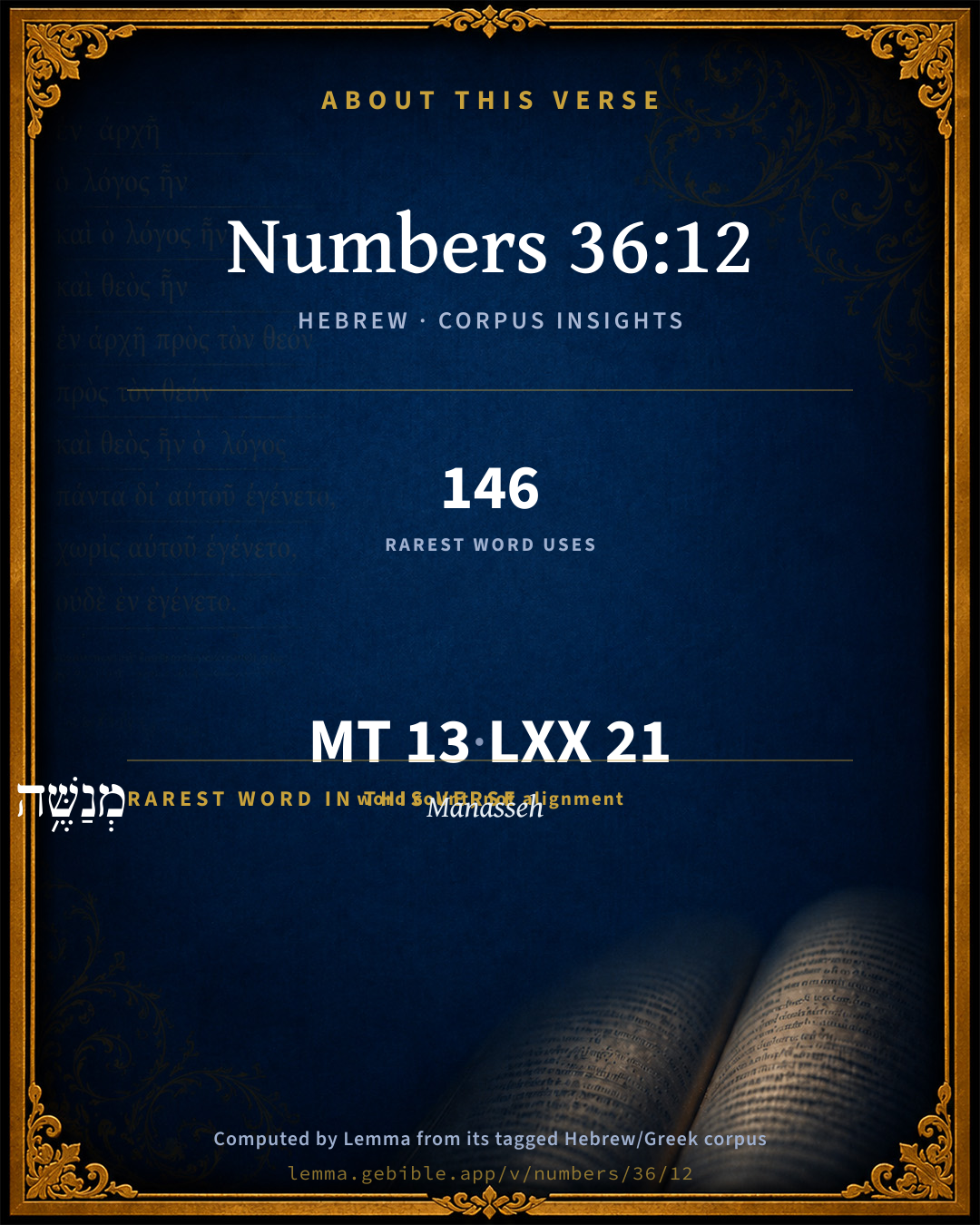
13
words
10
distinct lemmas
Pentateuch
section

Grammatical profile

  • 2 verbs
  • 10 nouns
  • 1 preposition

Verb forms

  • הָי֣וּ Qal · Perfect
  • וַתְּהִי֙ Qal · Sequential Imperfect

Repetition

Words recur within this verse — often emphatic in Hebrew:

  • מִֽמִּשְׁפְּחֹ֛ת family H4940 ×2
  • בְּנֵֽי son H1121 ×2
  • הָי֣וּ to be H1961 ×2

Hebrew & Septuagint length

In English translation the verse runs 28 words from the Hebrew and 27 from the Septuagint (LXX English) — closely comparable.

A rough comparison of the two English renderings, which tokenize alike — not a word-level alignment.

Word counts can differ between the Hebrew and the Greek without any difference in meaning — e.g. the Hebrew direct-object marker אֵת has no separate Greek word, and Greek often adds the article ὁ.

In the original languages it is 13 Hebrew tokens and 21 Greek tokens — but the two are counted differently (Hebrew bundles its prefixes and suffixes into one token; the Greek is in lemma form), so that isn’t a like-for-like length.

Hebrew and Greek witnesses Masoretic Hebrew ↔ Greek Septuagint

The same verse in the two great witnesses to the Old Testament, shown verse-for-verse.

These are two independent witnesses, not word-aligned to each other, and the Septuagint is shown in lemma (dictionary) form.

Hebrew Numbers 36:12 Masoretic · Westminster Leningrad Codex

מִֽמִּשְׁפְּחֹ֛ת בְּנֵֽי מְנַשֶּׁ֥ה בֶן יוֹסֵ֖ף הָי֣וּ לְנָשִׁ֑ים וַתְּהִי֙ נַחֲלָתָ֔ן עַל מַטֵּ֖ה מִשְׁפַּ֥חַת אֲבִיהֶֽן

They were married into the families of the sons of Manasseh the son of Joseph; and their inheritance remained in the tribe of the family of their father.

World English Bible · Public Domain

Greek LXX Numbers 36:12 Septuagint · lemma form

ἐκ ὁ δῆμος ὁ μανασσή υἱός ιωσηφ γίγνομαι γυνή καί γίγνομαι ὁ κληρονομία αὐτός ἐπί ὁ φυλή δῆμος ὁ πατήρ αὐτός

they were married to men of the tribe of Manasse of the sons of Joseph; and their inheritance was attached to the tribe of their father's family.

LXX2012 (modern English Septuagint) · Public Domain

Hebrew: Westminster Leningrad Codex (CC BY 4.0). Greek: Septuagint (public domain); English from LXX2012 (modern English Septuagint) (Public Domain). How the Septuagint differs from the Hebrew →

Targum (Aramaic paraphrase)

2

The Targum is the ancient Jewish Aramaic paraphrase of the Hebrew Scriptures — an interpretive translation, not the Hebrew text itself. Onkelos (literal) and Pseudo-Jonathan (expansive) render the Torah, and Jonathan the Prophets. Coverage is partial: where no permissively-licensed English translation exists for a verse, only the Aramaic is shown. This is verse-level text, not a word-by-word alignment to the Hebrew.

  1. Targum Onkelos Torah (Genesis–Deuteronomy)
    מִזַרְעֲיַת בְּנֵי מְנַשֶׁה בַר יוֹסֵף הֲוָאָה לִנְשִׁין וַהֲוַת אַחֲסַנְתְּהֶן עַל שִׁבְטָא זַרְעִית אֲבוּהֶן

    (no public-domain English translation for this verse)

    Targum Onkelos — Aramaic: “Onkelos Genesis” (public domain); “Onkelos Exodus” (public domain); “Onkelos Leviticus” (public domain); “Onkelos Numbers” (public domain); “Onkelos Deuteronomy” (public domain). English: “Sefaria Community Translation” (CC0 1.0 (public-domain dedication)); “J.W. Etheridge. The Targums of Onkelos and Jonathan Ben Uzziel on the Pentateuch. London: Longmans, Green, 1862” (public domain). Text via Sefaria.

  2. Targum Pseudo-Jonathan Torah (Genesis–Deuteronomy)
    מִגְנִיסַת בְּנֵי מְנַשֶׁה בַּר יוֹסֵף הֲוָאָה לִנְשִׁין וַהֲוַת אַחְסַנְתְּהוֹן עַל שֵׁיבַט גְנִיסַת אֲבוּהֶן

    of the family of the children of Menasheh bar Joseph were they wives, and their inheritance was with the tribe of their father's family.

    Targum Pseudo-Jonathan — Aramaic: “Targum Jonathan on Genesis” (public domain); “Targum Jonathan on Exodus” (public domain); “Targum Jonathan on Leviticus” (public domain); “Targum Jonathan on Numbers” (public domain); “Targum Jonathan on Deuteronomy” (public domain). English: “The Targum of Jonathan ben Uzziel, trans. J. W. Etheridge, London, 1862” (public domain). Text via Sefaria.

Commentary

Notes on Numbers 36:12 from classic Christian and Jewish commentators (each source and its license shown beneath its notes). The classic Christian expositions comment on the surrounding passage and are grouped to its opening verse, so a note may address several verses; the Jewish commentaries on the Tanakh (Rashi and others) are per-verse, so they appear only where the commentator wrote on this verse.

Lemma curates 59 commentaries, every one of them public domain or Creative Commons licensed, each selected and text-cleaned for this edition rather than reprinted as found. About our sources →

Adam Clarke's Commentary

Verse 12. And their inheritance remained in - the family] "By this example, and the law of inheritances in the Holy Land, the people of God," says Ainsworth, "are taught to hold fast their inheritance in his promises, and their right in Christ, which they hold by faith; that as the Father hath made them meet to be partakers of the inheritance among the saints in light, Col 1:12, so they may keep the faith and grace which they have received to the end."

Adam Clarke's Commentary on the Bible (1810–1826) — public domain. Text from a community e-Sword/MySword module.

John Gill's Exposition

These are the commandments and the judgments,.... The judicial laws concerning the division of the land of Canaan, the case of inheritances in it, and the cities of refuge:

which the Lord commanded by, the hand of Moses unto the children of Israel, in the plains of Moab by Jordan near Jericho; where the Israelites had been ever since they were first observed by Balak king of Moab, and where the various things had been done recorded in the preceding chapters from that time.

Next: Deuteronomy Introduction

John Gill's Exposition of the Whole Bible (1746–1763) — public domain (CC PDM 1.0). Text via the HelloAO Bible API.

Sforno

Rabbi Ovadia Sforno

From the families of Menashe. After they saw that the intention of their Creator was that their inheritance should not be transferred, even though He gave them permission to choose on their own volition from any tribe, they chose their cousins out of all of the families, because they were closer in relationship, and their inheritance remained with the tribe of their father’s family, therefore there was no transfer of inheritance even from one family to another.

Sforno on the Tanakh — English translation: “Yalkut, Sifsei Chachomim Chumash, Metsudah Publications, 2009” (CC BY 4.0). Text via Sefaria.

Lesson kit

Teaching starters — assembled from the data on this page, not authored interpretation. Every prompt links to the verse data it draws on. Edit before teaching.

Numbers, in the Pentateuch, opens this verse with 13 words (10 distinct Hebrew lemmas). Its most distinctive word is Mᵉnashsheh (“Manasseh”). A historical commentator’s framing appears above. Read the whole chapter for the surrounding context.

Discussion questions

  1. What does “Manasseh” (Mᵉnashsheh) contribute to the verse as a whole?
  2. “family” occurs 2× in this one verse. What is the effect of the repetition?
  3. These translations render this verse differently. What is at stake in choosing one wording over another?
  4. The verb «הָי֣וּ» is Qal Perfect. How does its form color the action?
  5. Reading how Adam Clarke's Commentary and John Gill's Exposition read this verse, where do the two commentators agree and where do they part?

Things to notice

Reading settings

Reading text

Shown beneath each verse's original-language words.

Old Testament
Old Testament edition

Read the OT as the Masoretic Hebrew (MT) or the Greek Septuagint (LXX).

English shown for the Greek Septuagint (in the Hebrew ↔ Greek comparison).

Comparing translations? Open the Compare panel on any verse page to stack up to four side by side.