
Joshua 13:31

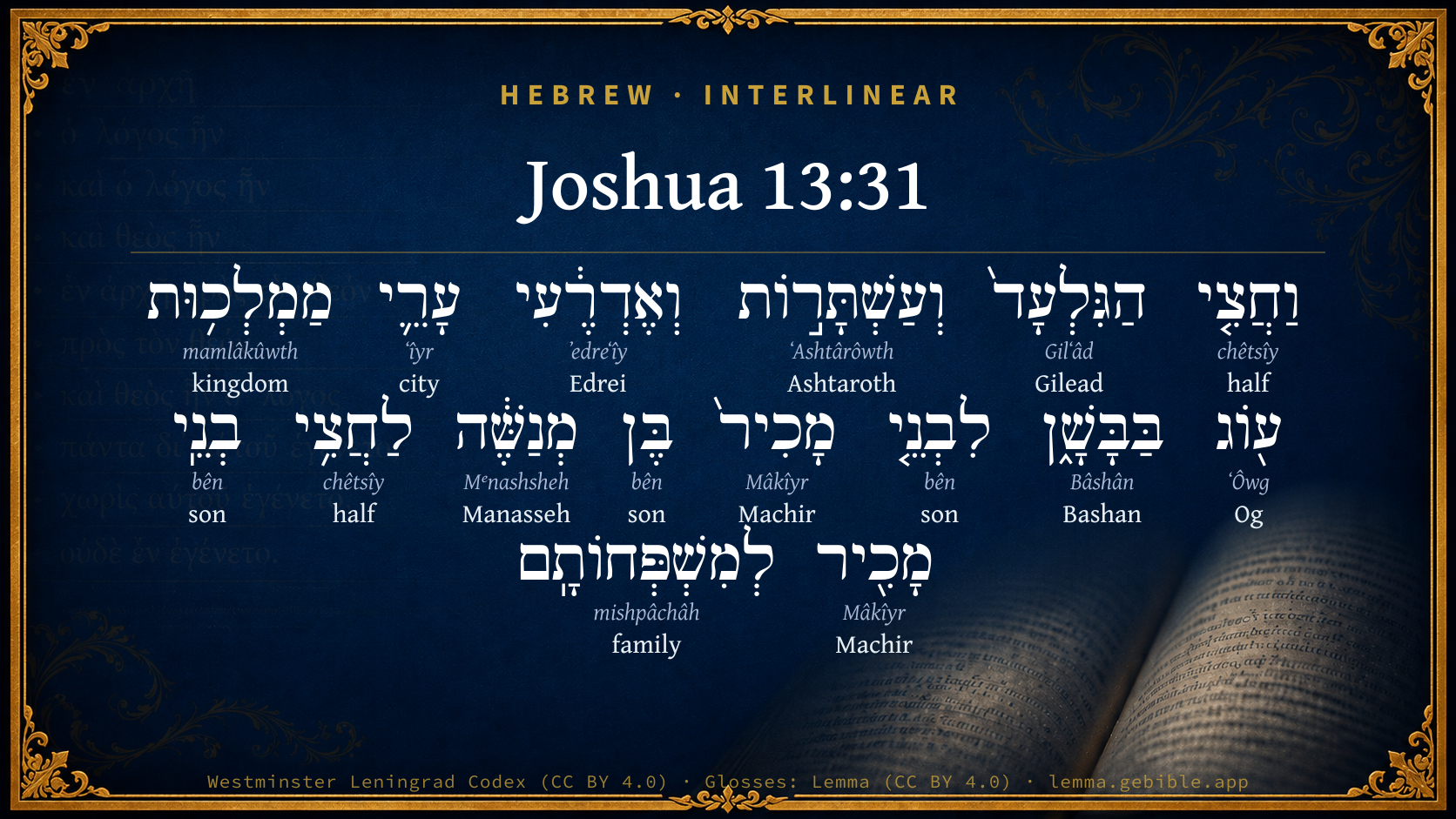
Hebrew (Westminster Leningrad Codex) Joshua 13:31 appears in the Hebrew Old Testament. The text above is from the Westminster Leningrad Codex. Each word links to its Strong’s number, a concise gloss, and parsing drawn from the Open Scriptures Hebrew Bible morphology. Click any word for its full Brown-Driver-Briggs (BDB) entry.
Download image
Cite this verse

Joshua 13:31 (World English Bible). Public Domain. Lemma interlinear Bible study tool, https://lemma.gebible.app/v/joshua/13/31.

Show BibTeX & RIS
BibTeX
RIS
English Translation
and half Gilead, and Ashtaroth, and Edrei, the cities of the kingdom of Og in Bashan, were for the children of Machir the son of Manasseh, even for the half of the children of Machir according to their families.
World English Bible · Public Domain
Download a study sheet

One document with this verse’s original text, its word-by-word gloss line, the meaning frame, cross-references with their text, attributed commentary, and full source and license credits — printable, and it pastes into notes with its structure intact.

This verse Autodidact and up

Study sheet (.html) Plain text (.txt)

A passage Seminary Student

Up to 50 verses in one chapter. A passage sheet keeps up to 6 commentary sources and 12 cross-references per verse, in the order this page ranks them, and says so on the sheet whenever that leaves anything out. Ask for a single verse and you get the Autodidact verse sheet above.

Everything on this page stays free to read, with no account — the sheet is a download of what is already on screen, not access to it.

Want to remove ads? Support Godless Engineer
Compare translations 3

The same verse in 3 English versions, stacked beneath the original-language interlinear above. Click any original word for its lexicon entry.

Each is an independent rendering of the whole verse — the interlinear is not word-aligned to these translations.

Highlighted words mark where these versions differ — a whole-verse word diff, not a word-by-word alignment.

  • World English Bible Public Domain
    and half Gilead, and Ashtaroth, and Edrei, the cities of the kingdom of Og in Bashan, were for the children of Machir the son of Manasseh, even for the half of the children of Machir according to their families.
  • King James Version Public Domain
    And half Gilead, and Ashtaroth, and Edrei, cities of the kingdom of Og in Bashan, were pertaining unto the children of Machir the son of Manasseh, even to the one half of the children of Machir by their families.
  • unfoldingWord Literal Text CC BY-SA 4.0
    And half of Gilead, and Ashtaroth and Edrei (the cities of the kingdom of Og in the Bashan), were to the sons of Machir the son of Manasseh, for half of the sons of Machir according to their clans.

unfoldingWord Literal Text — © unfoldingWord, licensed CC BY-SA 4.0. Word-aligned USFM3 via Door43 (git.door43.org/unfoldingWord/en_ult).

Versions to compare (up to 4)

3 of 4 selected

Show all 18 translations

Every available English version of this verse, each an independent rendering of the whole verse.

  • World English Bible Public Domain
    and half Gilead, and Ashtaroth, and Edrei, the cities of the kingdom of Og in Bashan, were for the children of Machir the son of Manasseh, even for the half of the children of Machir according to their families.
  • Berean Standard Bible Public Domain
    half of Gilead; and Ashtaroth and Edrei, the royal cities of Og in Bashan. All this was for the clans of the descendants of Machir son of Manasseh, that is, half of the descendants of Machir.
  • Majority Standard Bible Public Domain
    half of Gilead; and Ashtaroth and Edrei, the royal cities of Og in Bashan. All this was for the clans of the descendants of Machir son of Manasseh, that is, half of the descendants of Machir.
  • King James Version Public Domain
    And half Gilead, and Ashtaroth, and Edrei, cities of the kingdom of Og in Bashan, were pertaining unto the children of Machir the son of Manasseh, even to the one half of the children of Machir by their families.
  • American Standard Version (1901) Public Domain
    and half Gilead, and Ashtaroth, and Edrei, the cities of the kingdom of Og in Bashan, were for the children of Machir the son of Manasseh, even for the half of the children of Machir according to their families.
  • Revised Version (1885) Public Domain
    and half Gilead, and Ashtaroth, and Edrei, the cities of the kingdom of Og in Bashan, were for the children of Machir the son of Manasseh, even for the half of the children of Machir according to their families.
  • Geneva Bible (1599) Public Domain
    And halfe Gilead, and Ashtaroth, and Edrei, cities of the kingdom of Og in Bashan, were giuen vnto the children of Machir the sonne of Manasseh, to halfe of the children of Machir after their families.
  • Douay-Rheims (1899) Public Domain
    And half Galaad, and Astaroth, and Edrai, cities of the kingdom of Og in Basan: to the children of Machir, the son of Manasses, to one? half of the children of Machir according to their kindreds.
  • Young's Literal Translation Public Domain
    and the half of Gilead, and Ashteroth, and Edrei, cities of the kingdom of Og in Bashan, `are' to the sons of Machir, son of Manasseh, to the half of the sons of Machir, for their families.
  • Literal Standard Version CC BY-SA 4.0
    and half of Gilead, and Ashteroth, and Edrei, cities of the kingdom of Og in Bashan, [are] to the sons of Machir, son of Manasseh, to the half of the sons of Machir, for their families.
  • Unlocked Literal Bible CC BY-SA 4.0
    half of Gilead, and Ashtaroth and Edrei (the royal cities of Og in Bashan). These were assigned to the clan of Machir son of Manasseh—half of the people of Machir, clan by clan.
  • unfoldingWord Literal Text CC BY-SA 4.0
    And half of Gilead, and Ashtaroth and Edrei (the cities of the kingdom of Og in the Bashan), were to the sons of Machir the son of Manasseh, for half of the sons of Machir according to their clans.
  • Darby Bible Public Domain
    And half Gilead, and Ashtaroth, and Edrei, the cities of the kingdom of Og in Bashan, [belonged] to the children of Machir the son of Manasseh, to the one half of the children of Machir according to their families.
  • World Messianic Bible Public Domain
    Half Gilead, Ashtaroth, and Edrei, the cities of the kingdom of Og in Bashan, were for the children of Machir the son of Manasseh, even for the half of the children of Machir according to their families.
  • Webster's Bible Public Domain
    And half Gilead, and Ashtaroth, and Edrei, cities of the kingdom of Og in Bashan, were pertaining to the children of Machir the son of Manasseh, even to the one half of the children of Machir by their families.
  • Free Bible Version CC BY-SA 4.0
    Also included was Gilead, and Ashtaroth and Edrei, the towns of king Og in Bashan. This was the land allotted to the descendants of Machir, son of Manasseh, for half of them, by families.
  • Bible in Basic English Public Domain
    And half Gilead, and Ashtaroth, and Edrei, towns of the kingdom of Og in Bashan, were for the children of Machir, the son of Manasseh, for half of the children of Machir by their families.
  • JPS Tanakh (1917) Public Domain
    and half Gilead, and Ashtaroth, and Edrei, the cities of the kingdom of Og in Bashan, were for the children of Machir the son of Manasseh, even for the half of the children of Machir according to their families.

Literal Standard Version (2020), Covenant Press — licensed CC BY-SA 4.0. Text via the HelloAO Bible API (eBible.org). Unlocked Literal Bible (unfoldingWord) — licensed CC BY-SA 4.0. Text via the HelloAO Bible API (eBible.org). unfoldingWord Literal Text — © unfoldingWord, licensed CC BY-SA 4.0. Word-aligned USFM3 via Door43 (git.door43.org/unfoldingWord/en_ult). Free Bible Version, Dr. Jonathan Gallagher — licensed CC BY-SA 4.0. Text via the HelloAO Bible API (eBible.org).

Word by word

More ways to search: Search by grammar → Find every occurrence → Compare this word →

Practice this passage: Drill this verse → Learn its vocabulary →

וְאֶדְרֶ֔עִי
ʼedreʻîy
H154
“and · Edrei”
Conjunction + Noun, Proper
Part of Speech
Conjunction + Noun
Type
Proper
Full BDB Definition

Origin: from the equivalent of H153

TWOT: None

Edrei = "goodly pasture" - a chief city of Bashan, north of Jabbok river
  1. וַחֲצִ֤י chêtsîy H2677 “and · half of” Conjunction + Noun, Common, Masculine, Singular, Construct
  2. הַגִּלְעָד֙ Gilʻâd H1568 “the · Gilead” Particle, Definite Article + Noun, Proper
  3. וְעַשְׁתָּר֣וֹת ʻAshtârôwth H6252 “and · Ashtaroth” Conjunction + Noun, Proper
  4. עָרֵ֛י ʻîyr H5892 “cities of” Noun, Common, Feminine, Plural, Construct
  5. מַמְלְכ֥וּת mamlâkûwth H4468 “kingdom of” Noun, Common, Feminine, Singular, Construct
  6. ע֖וֹג ʻÔwg H5747 “Og” Noun, Proper
  7. בַּבָּשָׁ֑ן Bâshân H1316 “in/at the · Bashan” Preposition, Determined + Noun, Proper
  8. לִבְנֵ֤י bên H1121 “to/for · sons of” Preposition + Noun, Common, Masculine, Plural, Construct
  9. מָכִיר֙ Mâkîyr H4353 “Machir” Noun, Proper
  10. בֶּן bên H1121 “son of” Noun, Common, Masculine, Singular, Construct
  11. מְנַשֶּׁ֔ה Mᵉnashsheh H4519 “Manasseh” Noun, Proper
  12. לַחֲצִ֥י chêtsîy H2677 “to/for · half of” Preposition + Noun, Common, Masculine, Singular, Construct
  13. בְנֵֽי bên H1121 “sons of” Noun, Common, Masculine, Plural, Construct
  14. מָכִ֖יר Mâkîyr H4353 “Machir” Noun, Proper
  15. לְמִשְׁפְּחוֹתָֽם mishpâchâh H4940 “to/for · families · their” Preposition + Noun, Common, Feminine, Plural, Construct + Suffix, Personal, 3rd Person, Masculine, Plural

About this verse

These counts appear in no published source. They are computed here, from the morphology-tagged text and Lemma’s own curated glosses. What Lemma adds →

16
words
12
distinct lemmas
Historical
section

Notable vocabulary

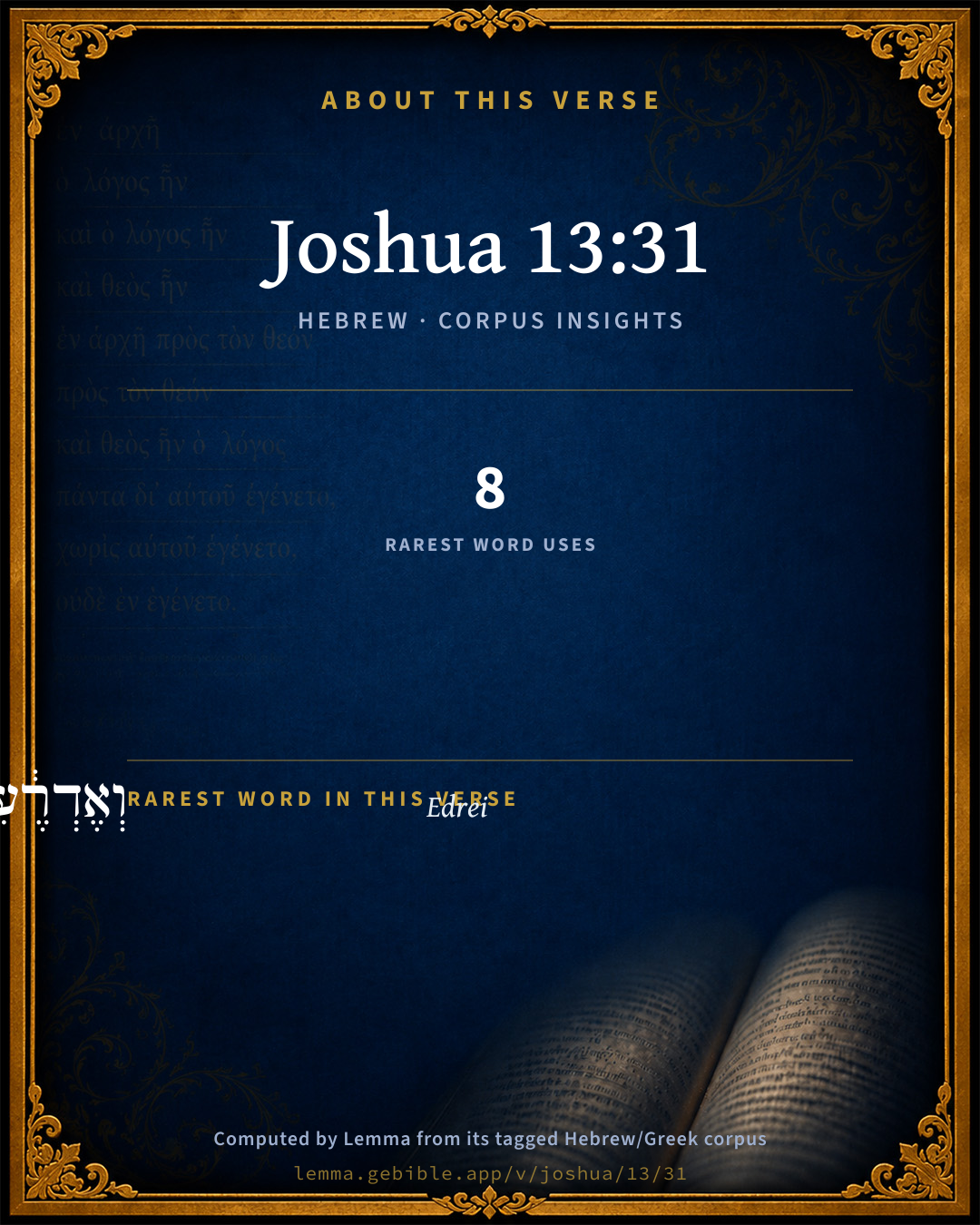
The rarest word here is וְאֶדְרֶ֔עִי Edrei H154 — appearing just 8 times in the whole Hebrew Bible.

Shared distinctive vocabulary

וְאֶדְרֶ֔עִי Edrei H154 occurs in 8 verses of the Hebrew Bible. Also found in:

Grammatical profile

  • 16 nouns

Repetition

Words recur within this verse — often emphatic in Hebrew:

  • לִבְנֵ֤י son H1121 ×3
  • וַחֲצִ֤י half H2677 ×2
  • מָכִיר֙ Machir H4353 ×2

Hebrew & Septuagint length

In English translation the verse runs 39 words from the Hebrew and 46 from the Septuagint (LXX English) — closely comparable.

A rough comparison of the two English renderings, which tokenize alike — not a word-level alignment.

Word counts can differ between the Hebrew and the Greek without any difference in meaning — e.g. the Hebrew direct-object marker אֵת has no separate Greek word, and Greek often adds the article ὁ.

Cross-references

2

Topical passages linked to Joshua 13:31 in the Treasury of Scripture Knowledge — connected by theme and wording, ordered by reader-vote popularity; previews shown in the World English Bible.

  • Joshua 12:4 and the border of Og king of Bashan, of the remnant of the Rephaim, who lived at Ashtaroth and at Edrei,
  • Numbers 32:39–40 The children of Machir the son of Manasseh went to Gilead, and took it, and dispossessed the Amorites who were therein.

Cross-references courtesy of OpenBible.info (CC BY 4.0).

Hebrew and Greek witnesses Masoretic Hebrew ↔ Greek Septuagint

The same verse in the two great witnesses to the Old Testament, shown verse-for-verse.

These are two independent witnesses, not word-aligned to each other, and the Septuagint is shown in lemma (dictionary) form.

Hebrew Joshua 13:31 Masoretic · Westminster Leningrad Codex

וַחֲצִ֤י הַגִּלְעָד֙ וְעַשְׁתָּר֣וֹת וְאֶדְרֶ֔עִי עָרֵ֛י מַמְלְכ֥וּת ע֖וֹג בַּבָּשָׁ֑ן לִבְנֵ֤י מָכִיר֙ בֶּן מְנַשֶּׁ֔ה לַחֲצִ֥י בְנֵֽי מָכִ֖יר לְמִשְׁפְּחוֹתָֽם

and half Gilead, and Ashtaroth, and Edrei, the cities of the kingdom of Og in Bashan, were for the children of Machir the son of Manasseh, even for the half of the children of Machir according to their families.

World English Bible · Public Domain

Greek LXX Joshua 13:31 Septuagint · lemma form

καί ὁ ἥμισυς ὁ γαλαάδ καί ἐν ασταρωθ καί ἐν εδραϊν πόλις βασιλεία ωγ ἐν βασανῖτις καί δίδωμι ὁ υἱός μαχιρ υἱός μανασσή καί ὁ ἥμισυς υἱός μαχιρ υἱός μανασσή κατά δῆμος αὐτός

and the half of Galaad, and in Astaroth, and in Edrain, royal cities of Og in the land of Basan, Moses gave to the sons of Machir the sons of Manasse, even to the half-tribe sons of Machir the sons of Manasse, according to their families.

LXX2012 (modern English Septuagint) · Public Domain

Hebrew: Westminster Leningrad Codex (CC BY 4.0). Greek: Septuagint (public domain); English from LXX2012 (modern English Septuagint) (Public Domain). How the Septuagint differs from the Hebrew →

Targum (Aramaic paraphrase)

1

The Targum is the ancient Jewish Aramaic paraphrase of the Hebrew Scriptures — an interpretive translation, not the Hebrew text itself. Onkelos (literal) and Pseudo-Jonathan (expansive) render the Torah, and Jonathan the Prophets. Coverage is partial: where no permissively-licensed English translation exists for a verse, only the Aramaic is shown. This is verse-level text, not a word-by-word alignment to the Hebrew.

  1. Targum Jonathan Prophets (Joshua–Malachi)
    וּפַלְגוּת אַרְעָא דְגִלְעָד וְעַשְׁתָּרוֹת וְאֶדְרֶעִי קִרְוַיָא מַלְכוּתֵיהּ דְעוֹג בְּמַתְנָן לִבְנֵי מָכִיר בַּר מְנַשֶׁה לְפַלְגוּת בְּנֵי מָכִיר לְזַרְעֲיַתְהוֹן:

    (no public-domain English translation for this verse)

    Targum Jonathan — Aramaic: “Mikraot Gedolot” (public domain). English: “Sefaria Community Translation” (CC0 1.0 (public-domain dedication)); “London "Chaldee Paraphrase," 1871” (public domain). Text via Sefaria.

Commentary

Notes on Joshua 13:31 from classic Christian and Jewish commentators (each source and its license shown beneath its notes). The classic Christian expositions comment on the surrounding passage and are grouped to its opening verse, so a note may address several verses; the Jewish commentaries on the Tanakh (Rashi and others) are per-verse, so they appear only where the commentator wrote on this verse.

Lemma curates 59 commentaries, every one of them public domain or Creative Commons licensed, each selected and text-cleaned for this edition rather than reprinted as found. About our sources →

Trapp's Complete Commentary

John Trapp

Jos 13:31 And half Gilead, and Ashtaroth, and Edrei, cities of the kingdom of Og in Bashan, [were pertaining] unto the children of Machir the son of Manasseh, [even] to the one half of the children of Machir by their families.

Ver. 31. Mackir the son of Manasseh.] Whose children had taken Gilead: and therefore had the like right to it as Jacob had to that portion of ground which he gave to their great-grandfather Joseph.

John Trapp, A Commentary or Exposition upon All the Books of the Old and New Testament (1647–1656) — public domain. Text from a community e-Sword module.

Joseph Benson's Commentary

Jos 13:31. Children of Machir — Whom before he called the children of Manasseh, he now calls the children of Machir, because Machir was the most eminent, and, as it may seem, the only surviving son of Manasseh, Num 26:29; 1Ch 7:14-16.

Joseph Benson's Commentary on the Old and New Testaments (1811–1818) — public domain. Text from a community e-Sword module.

Geneva Bible (1599)

Geneva Bible translators

Meaning, his nephews and posterity.

Geneva Bible (1599) marginal notes — public domain. Text via Bolls.life.

The Cambridge Bible for Schools and Colleges

gen. ed. J. J. S. Perowne

31. Ashtaroth] See ch. Jos_12:4, so called doubtless from being a seat of the worship of Ashtoreth, the principal female divinity of the Phœnicians, the Astarte of the Greeks and Romans. The only trace of the name yet recovered is Tell-Ashterah or Asherah.

and Edrei] See above, ch. Jos_12:4. The northern part of Gilead was given to Machir, the eldest son of the patriarch Manasseh (1Ch_7:14), or rather the half of his male descendants. They consisted of seven families, whose heads are named 1Ch_5:24. So great was their power, that the name of Machir occasionally supersedes that of Manasseh. They took the bold “tract of Argob … sixty great cities (Deu_3:14), among the most difficult, if not the most difficult, district in the whole country.” Thus it is plain that the half tribe of Manasseh occupied by far the largest extent of land on the east of the Jordan. It embraced (a) the inaccessible heights and impassable ravines of Gilead; and (b) the almost impregnable tract of Argob, where “all is stone,” “an ocean of basaltic rocks and boulders tossed about in the wildest confusion.” “The same martial spirit, which fitted the western Manasseh to defend the passes of Esdraelon, fitted ‘Machir, the firstborn of Manasseh, the father of Gilead,’ to defend the passes of Haurân and Anti-Libanus; ‘because he was a man of war, therefore he had Gilead and Bashan.’ ” Stanley’s Lectures, I. 219. Of the development of the tribe subsequently we have a remarkable illustration at the time of the coronation of David at Hebron. On that occasion, “while the western Manasseh sent 18,000, and Ephraim itself but 20,800, the eastern Manasseh, with Gad and Reuben, mustered to the number of 120,000, thoroughly armed—a remarkable demonstration of strength, still more remarkable when we remember the fact that Saul’s house, with the great Abner at its head, was then residing at Mahanaim on the border of Manasseh and Gad.” See Smith’s Bib. Dict. Art. “Manasseh.”

The Cambridge Bible for Schools and Colleges (gen. ed. J. J. S. Perowne; Cambridge University Press, 1878–1918) — public domain. Text from a community e-Sword module.

John Gill's Exposition

These are the countries which Moses did distribute for inheritance in the plains of Moab,.... Which is particularly described, that each might know their proper portion:

on the other side Jordan by Jericho eastward; of the land of Canaan; of Jordan by Jericho; see Gill on Num 22:1.

John Gill's Exposition of the Whole Bible (1746–1763) — public domain (CC PDM 1.0). Text via the HelloAO Bible API.

Matthew Poole's English Annotations

The children of Machir; whom before he called the children of Manasseh, he now calls the children of machir, because Machir was the most eminent, and, as it may seem, the only surviving son of Manasseh, Num 26:29; 1Ch 7:14-16. For the other half of Machir’s or Manasseh’s children, see Jos 17:1, &c.

Matthew Poole's English Annotations on the Holy Bible (1683–1685) — public domain. Text from a community e-Sword/MySword module.

Whedon's Commentary on the Bible

Daniel D. Whedon

31. Half Gilead — The northern half, for the southern was assigned to Gad. Jos_13:25.

Ashtaroth — Generally supposed to be identical with the Ashteroth-karnaim of Gen_14:5. It was doubtless so called from being the seat of worship of the Phenician goddess Ashtoreth, the Greek Astarte. Its ruins are supposed to lie at the modern Tell-Astereh, some fifteen miles east of the Sea of Galilee. Edrei was the other chief city of the kingdom of Bashan, and here King Og was defeated and slain. Num_21:33-35. It was a stronghold among the rocks, and its ruins have been found in the modern Edra, thirty miles or more northeast of the Sea of Galilee. J.L. Porter visited the ruins a few years ago and thus wrote: “The situation is most remarkable; without a single spring of living water; without river or stream; without access, except over rocks and through defiles all but impassable; without tree or garden. In selecting the site everything seems to have been sacrificed to security and strength. The huge masses of shattered masonry could scarcely be distinguished from the rocks that encircled them, and all, ruins and rocks alike, are black as if scathed by lightning.”

Unto the children of Machir — “Because he was a man of war, therefore he had Gilead and Bashan.” Jos_17:1.

Even to the one half — The heads of the families of this half are named in 1Ch_5:24.]

Daniel D. Whedon (gen. ed.), Commentary on the Old and New Testaments (1874–1909) — public domain. Text from a community e-Sword module.

The Pulpit Commentary

The one half of the children of Machir. See this question fully discussed in note on Jos_17:5, Jos_17:6.

The border keep.

"Machir was a "man of war," therefore he had Gilead and Bashan." These cities include the group which form such a striking stronghold in the northern part of the land beyond Jordan. Mr. Porter, in his "Giant Cities of Bashan," has described the surprising strength of the architecture of these cities the failure of even three thousand years of change and wear to render the houses unfit for habitation; and has also described the strange formation of the district of Argob, rendering it a natural fortress of the most formidable kind. Here, by special adaptation of place with people, this district is assigned to the family of Machir. It was wisely so assigned, for through all the succeeding generations the keeping of the frontier in this direction was well done. We may gather one or two hints not altogether valueless from this assignment. Observe

I MACHIR HAS FOR HIS LOT THAT WHICH BY HIS COURAGE HE HAD CONQUERED. From Num_32:39 we learn that, gigantic as were the inhabitants of Gilead, strong as was its cities, impregnable as its natural fortress seemed, the children of Machir "took it," and dispossessed the Amorite that was in it. Now they enjoy that which their unusual valour won. Like Caleb, whose daring made him ask Hebron, even when it was in the hands of the enemy, they chose a difficult spot, and conquering, inherited it. More than any other they had a right to this, for their courage had conquered it. Your best inheritance will always be some Gilead that you conquer for yourself. The truth you discover for yourself will do you most good. The experience you develop for yourself will be your best guide. Even the money you make for yourself will be that which you at once employ and enjoy the best. Conquer what you want to have. By courage, diligence, enduring hardness, achieve what you would like to keep.

II "A MAN OF WAR" IS THE RIGHT MAN FOR FRONTIER DUTY. The Jacobs in the middle; the Esaus are better on the borders of the land. The bravest should be those nearest the foe. They who keep the gates of a kingdom should be those to whom conflict has no terrors. Theologians that keep the frontiers of truth should be brave. Timid Christians that think all the world is going to turn catholic or infidel are not men for warfare on the border. Against assaults there should be placed those who have been through all the fights of faith and unbelief in their own hearts, and who can bring a strenuous, cheerful energy to the task of fighting for the truth. Those strong enough to expect a perpetual victory of truth are those alone fit to deal with the assaults of error. Ministers of religion, keeping the frontier between the Church and the world, should be in a good sense men of war; on their guard against encroachment of worldliness; strong enough to brave opposition and to be above the seductions of the flattery which a compromising spirit may win from the world; strong enough to keep out the intrusions of the secular spirit in all its forms of caste feeling, of cold heartedness, of indifference to the perishing; strong enough to carry the war into the enemy"s country, and secure by extending the kingdom of Christ. On all frontiers there is need of vigour. Wherever the enemy is near, set what is bravest and stoutest in you to watch. The pugnacious element in our nature is very valuable if it operates in Gilead. There is deficiency of it too often; and too often where it is, it is just in some position where it quarrels with its friends instead of with the temptations and the wrongs and the difficulties which are its proper foes. For frontier work of all kinds, courage is the prime qualification. Lastly

III THERE IS NO CITADEL LIKE A FORTRESS WON FROM THE ENEMY. What he won was his reward, but it was something more. It was the best stronghold he could have against the enemy. The conquered fortress makes the best defence. The vigour enough to win it grows stronger and becomes the power to keep it. A victory is always a point of strength and a stronghold conquered, a vantage ground against the foe. The Church differs from all other communities in this, that she is never weaker by extension; each new conquest gives her a better frontier; every Gilead subdued becomes a new line of defence, making her more impregnable against attack. By God"s blessing, conquer a rebellious heart and subdue it to Him, and it becomes a fortified post from which you can assail or defend more powerfully than before. Graces that are easily Gained are easily lost. But those that are won with arduous difficulty are invariably much more securely held. None keep truth like those who have fought hard to get it. None are more generous than those who have fought hard with selfish tendencies within them. None keep elevation of thought and feeling more persistently than those who have reached it by crucifying the flesh. A conquered temptation is a grand fortress in which you are stronger to resist seduction than ever before. A grief conquered by faith becomes a quiet resting place, and one secure against all assaults of despair. Keep making daily some conquest, and so you will perfectly secure all that you have won. G.

The Pulpit Commentary (1880–1919), ed. H.D.M. Spence-Jones & Joseph S. Exell — public domain. Text from a community e-Sword module.

John Wesley's Explanatory Notes

Children of Machir - Whom before he called the children of Manasseh, he now calls the children of Machir, because Machir was the most eminent, and as it may seem, the only surviving son of Manasseh, Num. xxvi, 29; 1 Chron. vii, 14-16.

John Wesley, Explanatory Notes Upon the Whole Bible (1754–1765) — public domain. Text via the GEBible commentary corpus.

Lesson kit

Teaching starters — assembled from the data on this page, not authored interpretation. Every prompt links to the verse data it draws on. Edit before teaching.

Joshua, in the Historical, opens this verse with 16 words (12 distinct Hebrew lemmas). Its most distinctive word is ʼedreʻîy (“Edrei”). A historical commentator’s framing appears above. Read the whole chapter for the surrounding context.

Discussion questions

  1. The word ʼedreʻîy carries the sense “Edrei.” How does it shape the verse?
  2. Numbers 21:33 shares the word «Edrei» with this verse. How do the two illuminate each other?
  3. “son” occurs 3× in this one verse. What is the effect of the repetition?
  4. The translations on this page render this verse differently — a whole-verse word diff, not a word-by-word alignment. What might account for the different wordings?
  5. Reading how Trapp's Complete Commentary and Joseph Benson's Commentary read this verse, where do the two commentators agree and where do they part?

Things to notice

Reading settings

Reading text

Shown beneath each verse's original-language words.

Old Testament
Old Testament edition

Read the OT as the Masoretic Hebrew (MT) or the Greek Septuagint (LXX).

English shown for the Greek Septuagint (in the Hebrew ↔ Greek comparison).

Comparing translations? Open the Compare panel on any verse page to stack up to four side by side.