
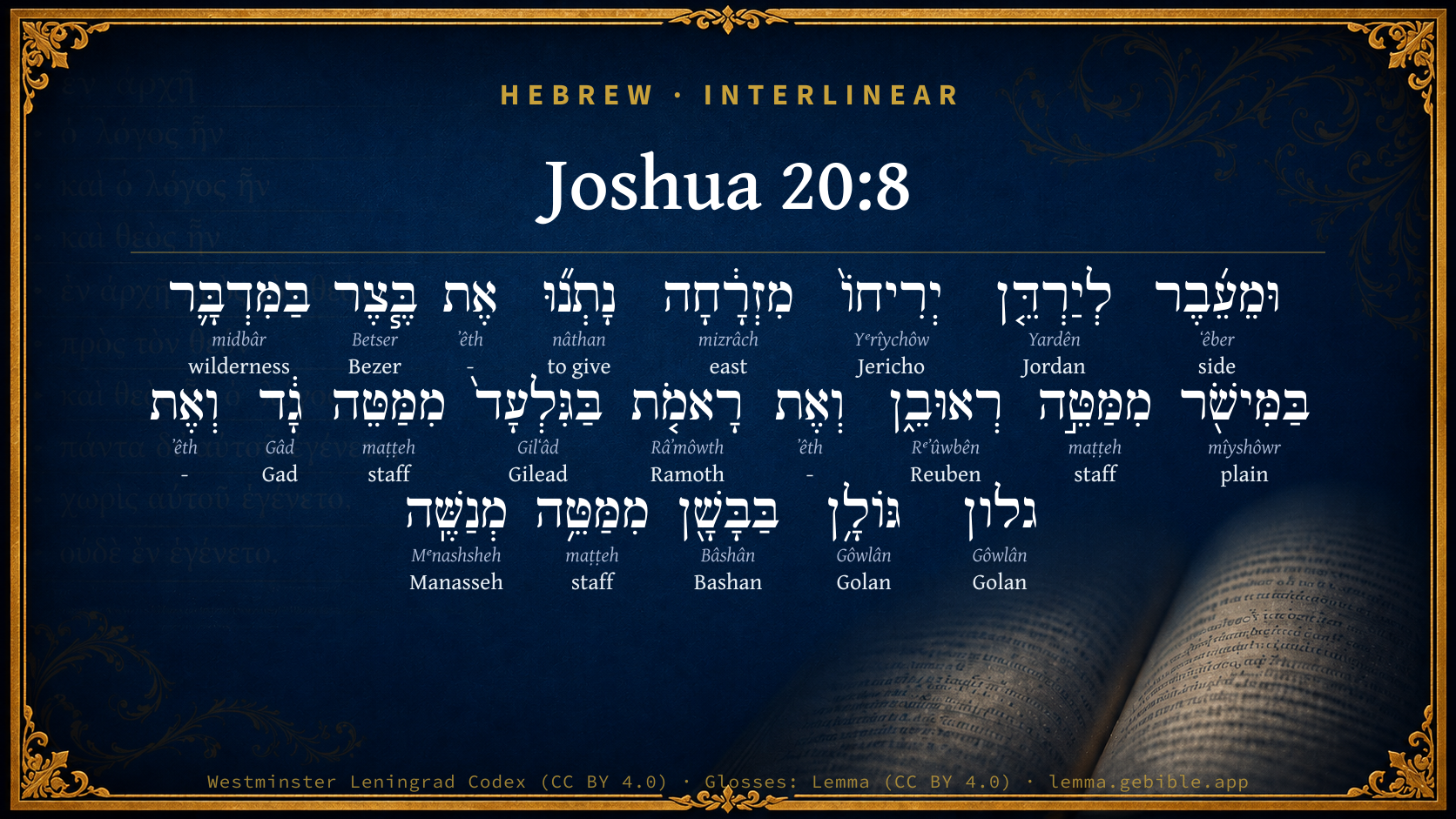
Joshua 20:8

Hebrew (Westminster Leningrad Codex) Joshua 20:8 appears in the Hebrew Old Testament. The text above is from the Westminster Leningrad Codex. Each word links to its Strong’s number, a concise gloss, and parsing drawn from the Open Scriptures Hebrew Bible morphology. Click any word for its full Brown-Driver-Briggs (BDB) entry.
Download image
Cite this verse

Joshua 20:8 (World English Bible). Public Domain. Lemma interlinear Bible study tool, https://lemma.gebible.app/v/joshua/20/8.

Show BibTeX & RIS
BibTeX
RIS
English Translation
Beyond the Jordan at Jericho eastward, they assigned Bezer in the wilderness in the plain out of the tribe of Reuben, and Ramoth in Gilead out of the tribe of Gad, and Golan in Bashan out of the tribe of Manasseh.
World English Bible · Public Domain
Download a study sheet

One document with this verse’s original text, its word-by-word gloss line, the meaning frame, cross-references with their text, attributed commentary, and full source and license credits — printable, and it pastes into notes with its structure intact.

This verse Autodidact and up

Study sheet (.html) Plain text (.txt)

A passage Seminary Student

Up to 50 verses in one chapter. A passage sheet keeps up to 6 commentary sources and 12 cross-references per verse, in the order this page ranks them, and says so on the sheet whenever that leaves anything out. Ask for a single verse and you get the Autodidact verse sheet above.

Everything on this page stays free to read, with no account — the sheet is a download of what is already on screen, not access to it.

Want to remove ads? Support Godless Engineer
Compare translations 3

The same verse in 3 English versions, stacked beneath the original-language interlinear above. Click any original word for its lexicon entry.

Each is an independent rendering of the whole verse — the interlinear is not word-aligned to these translations.

Highlighted words mark where these versions differ — a whole-verse word diff, not a word-by-word alignment.

  • World English Bible Public Domain
    Beyond the Jordan at Jericho eastward, they assigned Bezer in the wilderness in the plain out of the tribe of Reuben, and Ramoth in Gilead out of the tribe of Gad, and Golan in Bashan out of the tribe of Manasseh.
  • King James Version Public Domain
    And on the other side Jordan by Jericho eastward, they assigned Bezer in the wilderness upon the plain out of the tribe of Reuben, and Ramoth in Gilead out of the tribe of Gad, and Golan in Bashan out of the tribe of Manasseh.
  • unfoldingWord Literal Text CC BY-SA 4.0
    And from the other side of the Jordan, to Jericho from the sunrise, they gave Bezer in the wilderness on the plateau from the tribe of Reuben, and Ramoth in Gilead from the tribe of Gad, and Golan in Bashan from the tribe of Manasseh.

unfoldingWord Literal Text — © unfoldingWord, licensed CC BY-SA 4.0. Word-aligned USFM3 via Door43 (git.door43.org/unfoldingWord/en_ult).

Versions to compare (up to 4)

3 of 4 selected

Show all 18 translations

Every available English version of this verse, each an independent rendering of the whole verse.

  • World English Bible Public Domain
    Beyond the Jordan at Jericho eastward, they assigned Bezer in the wilderness in the plain out of the tribe of Reuben, and Ramoth in Gilead out of the tribe of Gad, and Golan in Bashan out of the tribe of Manasseh.
  • Berean Standard Bible Public Domain
    And beyond the Jordan, east of Jericho, they designated Bezer on the wilderness plateau from the tribe of Reuben, Ramoth in Gilead from the tribe of Gad, and Golan in Bashan from the tribe of Manasseh.
  • Majority Standard Bible Public Domain
    And beyond the Jordan, east of Jericho, they designated Bezer on the wilderness plateau from the tribe of Reuben, Ramoth in Gilead from the tribe of Gad, and Golan in Bashan from the tribe of Manasseh.
  • King James Version Public Domain
    And on the other side Jordan by Jericho eastward, they assigned Bezer in the wilderness upon the plain out of the tribe of Reuben, and Ramoth in Gilead out of the tribe of Gad, and Golan in Bashan out of the tribe of Manasseh.
  • American Standard Version (1901) Public Domain
    And beyond the Jordan at Jericho eastward, they assigned Bezer in the wilderness in the plain out of the tribe of Reuben, and Ramoth in Gilead out of the tribe of Gad, and Golan in Bashan out of the tribe of Manasseh.
  • Revised Version (1885) Public Domain
    And beyond the Jordan at Jericho eastward, they assigned Bezer in the wilderness in the plain out of the tribe of Reuben, and Ramoth in Gilead out of the tribe of Gad, and Golan in Bashan out of the tribe of Manasseh.
  • Geneva Bible (1599) Public Domain
    And on the other side Iorden toward Iericho Eastward, they appoynted Bezer in the wildernesse vpon the plaine, out of the tribe of Reuben, and Ramoth in Gilead, out of the tribe of Gad, and Golan in Bashan, out of the tribe of Manasseh.
  • Douay-Rheims (1899) Public Domain
    And beyond the Jordan to the east of Jericho, they appointed Bosor, which is upon the plain of the wilderness of the tribe of Ruben, and Ramoth in Galaad of the tribe of Cad, and Gaulon in Basan of the tribe of Manasses.
  • Young's Literal Translation Public Domain
    and beyond the Jordan, `at' Jericho eastward, they have given Bezer in the wilderness, in the plain, out of the tribe of Reuben, and Ramoth in Gilead out of the tribe of Gad, and Golan in Bashan out of the tribe of Manasseh.
  • Literal Standard Version CC BY-SA 4.0
    and beyond the Jordan, [at] Jericho eastward, they have given Bezer in the wilderness, in the plain, out of the tribe of Reuben, and Ramoth in Gilead out of the tribe of Gad, and Golan in Bashan out of the tribe of Manasseh.
  • Unlocked Literal Bible CC BY-SA 4.0
    Beyond the Jordan east of Jericho, they selected Bezer in the wilderness on the plateau from the tribe of Reuben; Ramoth Gilead, from the tribe of Gad; and Golan in Bashan, from the tribe of Manasseh.
  • unfoldingWord Literal Text CC BY-SA 4.0
    And from the other side of the Jordan, to Jericho from the sunrise, they gave Bezer in the wilderness on the plateau from the tribe of Reuben, and Ramoth in Gilead from the tribe of Gad, and Golan in Bashan from the tribe of Manasseh.
  • Darby Bible Public Domain
    And beyond the Jordan from Jericho eastward, they assigned Bezer in the wilderness, in the plateau, out of the tribe of Reuben, and Ramoth in Gilead out of the tribe of Gad, and Golan in Bashan of the tribe of Manasseh.
  • World Messianic Bible Public Domain
    Beyond the Jordan at Jericho eastward, they assigned Bezer in the wilderness in the plain out of the tribe of Reuben, Ramoth in Gilead out of the tribe of Gad, and Golan in Bashan out of the tribe of Manasseh.
  • Webster's Bible Public Domain
    And on the other side of Jordan by Jericho eastward, they assigned Bezer in the wilderness upon the plain out of the tribe of Reuben, and Ramoth in Gilead out of the tribe of Gad, and Golan in Bashan out of the tribe of Manasseh.
  • Free Bible Version CC BY-SA 4.0
    On the other side of the Jordan, east of Jericho, they assigned: Bezer, in the wilderness on the plateau, from the tribe of Reuben; Ramoth in Gilead, from the tribe of Gad; and Golan in Bashan, from the tribe of Manasseh.
  • Bible in Basic English Public Domain
    And on the east side of Jordan at Jericho, they made selection of Bezer in the waste land, in the table-land, out of the tribe of Reuben, and Ramoth in Gilead out of the tribe of Gad, and Golan in Bashan out of the tribe of Manasseh.
  • JPS Tanakh (1917) Public Domain
    And beyond the Jordan at Jericho eastward, they assigned Bezer in the wilderness in the table-land out of the tribe of Reuben, and Ramoth in Gilead out of the tribe of Gad, and Golan in Bashan out of the tribe of Manasseh.

Literal Standard Version (2020), Covenant Press — licensed CC BY-SA 4.0. Text via the HelloAO Bible API (eBible.org). Unlocked Literal Bible (unfoldingWord) — licensed CC BY-SA 4.0. Text via the HelloAO Bible API (eBible.org). unfoldingWord Literal Text — © unfoldingWord, licensed CC BY-SA 4.0. Word-aligned USFM3 via Door43 (git.door43.org/unfoldingWord/en_ult). Free Bible Version, Dr. Jonathan Gallagher — licensed CC BY-SA 4.0. Text via the HelloAO Bible API (eBible.org).

Word by word

More ways to search: Search by grammar → Find every occurrence → Compare this word →

Practice this passage: Drill this verse → Learn its vocabulary →

רָאמֹ֤ת
Râʼmôwth
H7216
“Ramoth”
Noun, Proper
Part of Speech
Noun
Type
Proper
Full BDB Definition

Origin: pl. of H7215

TWOT: None

Ramoth = "heights" - a place in Gilead; site dubious - a Levitical city in Issachar
  1. וּמֵעֵ֜בֶר ʻêber H5676 “and · from · side” Conjunction + Preposition + Noun, Common, Masculine, Singular, Absolute
  2. לְיַרְדֵּ֤ן Yardên H3383 “to/for · Jordan” Preposition + Noun, Proper
  3. יְרִיחוֹ֙ Yᵉrîychôw H3405 “Jericho” Noun, Proper
  4. מִזְרָ֔חָה mizrâch H4217 “east · toward” Noun, Common, Masculine, Singular, Absolute + Suffix, Demonstrative
  5. נָתְנ֞וּ nâthan H5414 “to give” Verb, Qal, Perfect, 3rd Person, Common, Plural
  6. אֶת ʼêth H853 “-” Particle, Direct Object
  7. בֶּ֧צֶר Betser H1221 “Bezer” Noun, Proper
  8. בַּמִּדְבָּ֛ר midbâr H4057 “in/at the · wilderness” Preposition, Determined + Noun, Common, Masculine, Singular, Absolute
  9. בַּמִּישֹׁ֖ר mîyshôwr H4334 “in/at the · plain” Preposition, Determined + Noun, Common, Masculine, Singular, Absolute
  10. מִמַּטֵּ֣ה maṭṭeh H4294 “from · staff of” Preposition + Noun, Common, Masculine, Singular, Construct
  11. רְאוּבֵ֑ן Rᵉʼûwbên H7205 “Reuben” Noun, Proper
  12. וְאֶת ʼêth H853 “and · -” Conjunction + Particle, Direct Object
  13. בַּגִּלְעָד֙ Gilʻâd H1568 “in/at the · Gilead” Preposition, Determined + Noun, Proper
  14. מִמַּטֵּה maṭṭeh H4294 “from · staff of” Preposition + Noun, Common, Masculine, Singular, Construct
  15. גָ֔ד Gâd H1410 “Gad” Noun, Proper
  16. וְאֶת ʼêth H853 “and · -” Conjunction + Particle, Direct Object
  17. גלון Gôwlân H1474 “Golan” Noun, Proper
  18. גּוֹלָ֥ן Gôwlân H1474 “Golan” Noun, Proper
  19. בַּבָּשָׁ֖ן Bâshân H1316 “in/at the · Bashan” Preposition, Determined + Noun, Proper
  20. מִמַּטֵּ֥ה maṭṭeh H4294 “from · staff of” Preposition + Noun, Common, Masculine, Singular, Construct
  21. מְנַשֶּֽׁה Mᵉnashsheh H4519 “Manasseh” Noun, Proper

About this verse

These counts appear in no published source. They are computed here, from the morphology-tagged text and Lemma’s own curated glosses. What Lemma adds →

22
words
17
distinct lemmas
Historical
section

Notable vocabulary

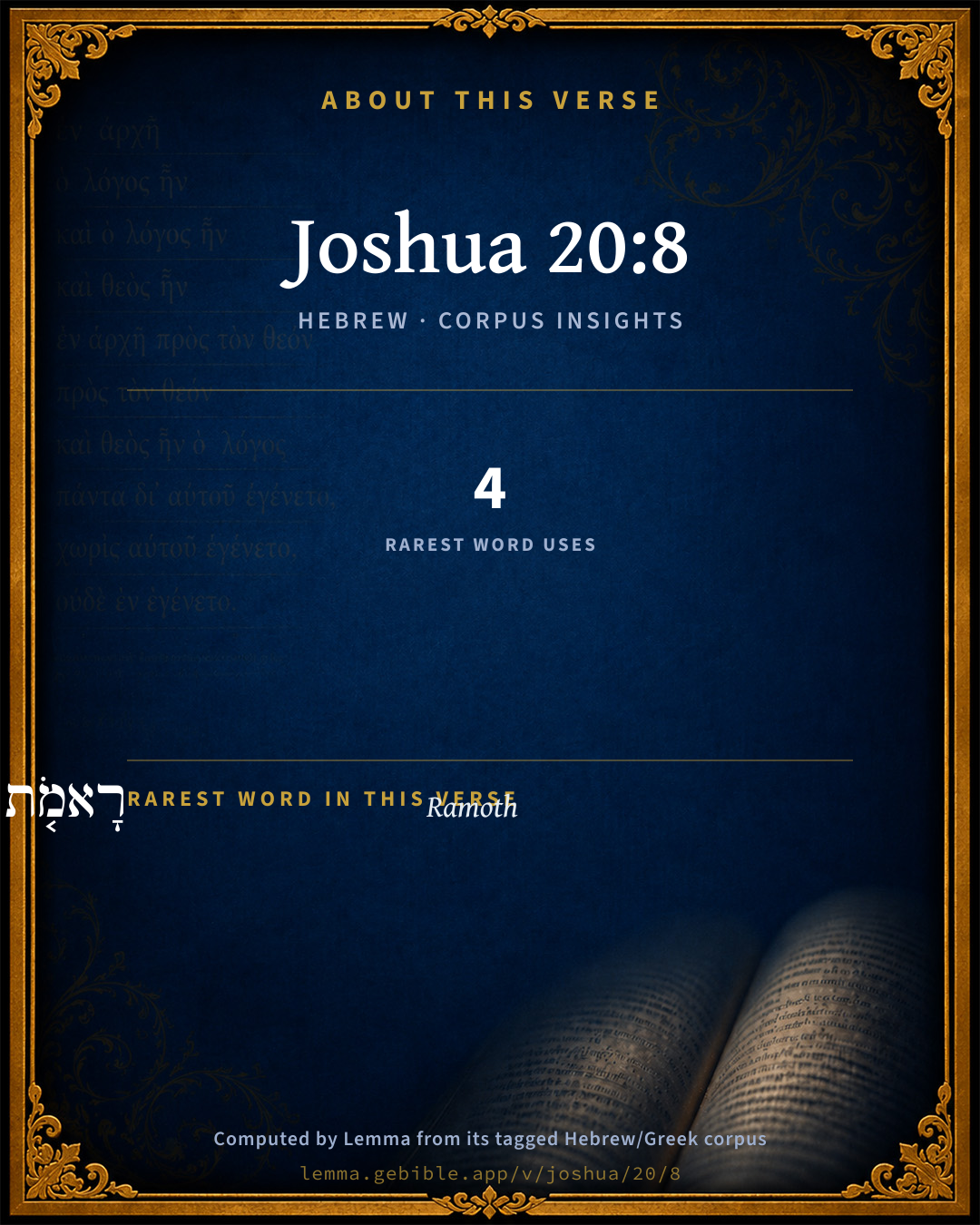
The rarest word here is רָאמֹ֤ת Ramoth H7216 — appearing just 4 times in the whole Hebrew Bible.

Shared distinctive vocabulary

רָאמֹ֤ת Ramoth H7216 occurs in 4 verses of the Hebrew Bible. Also found in:

Grammatical profile

  • 1 verb
  • 18 nouns
  • 3 particles

Verb forms

  • נָתְנ֞וּ Qal · Perfect

Repetition

Words recur within this verse — often emphatic in Hebrew:

  • מִמַּטֵּ֣ה staff H4294 ×3
  • גלון Golan H1474 ×2

Cross-references

8

Topical passages linked to Joshua 20:8 in the Treasury of Scripture Knowledge — connected by theme and wording, ordered by reader-vote popularity; previews shown in the World English Bible.

  • Joshua 21:36 Out of the tribe of Reuben, Bezer with its suburbs, and Jahaz with its suburbs,
  • 1 Chronicles 6:78 and beyond the Jordan at Jericho, on the east side of the Jordan, [were given them], out of the tribe of Reuben, Bezer in the wilderness with its suburbs, and Jahzah with its suburbs,
  • Joshua 21:27 To the children of Gershon, of the families of the Levites, out of the half-tribe of Manasseh [they gave] Golan in Bashan with its suburbs, the city of refuge for the manslayer, and Be-eshterah with its suburbs; two cities.
  • Joshua 21:38 Out of the tribe of Gad, Ramoth in Gilead with its suburbs, the city of refuge for the manslayer, and Mahanaim with its suburbs,
  • Deuteronomy 4:43 [namely], Bezer in the wilderness, in the plain country, for the Reubenites; and Ramoth in Gilead, for the Gadites; and Golan in Bashan, for the Manassites.
  • 1 Kings 22:3–4 The king of Israel said to his servants, "You know that Ramoth-gilead is ours, and we are still, and don't take it out of the hand of the king of Syria?"
  • 1 Kings 22:6 Then the king of Israel gathered the prophets together, about four hundred men, and said to them, Shall I go against Ramoth-gilead to battle, or shall I forbear? They said, Go up; for the Lord will deliver it into the hand of the king.
  • 1 Chronicles 6:80 and out of the tribe of Gad, Ramoth in Gilead with its suburbs, and Mahanaim with its suburbs,

Cross-references courtesy of OpenBible.info (CC BY 4.0).

Hebrew and Greek witnesses Masoretic Hebrew ↔ Greek Septuagint

The same verse in the two great witnesses to the Old Testament, shown verse-for-verse.

These are two independent witnesses, not word-aligned to each other, and the Septuagint is shown in lemma (dictionary) form.

Hebrew Joshua 20:8 Masoretic · Westminster Leningrad Codex

וּמֵעֵ֜בֶר לְיַרְדֵּ֤ן יְרִיחוֹ֙ מִזְרָ֔חָה נָתְנ֞וּ אֶת בֶּ֧צֶר בַּמִּדְבָּ֛ר בַּמִּישֹׁ֖ר מִמַּטֵּ֣ה רְאוּבֵ֑ן וְאֶת רָאמֹ֤ת בַּגִּלְעָד֙ מִמַּטֵּה גָ֔ד וְאֶת גלון גּוֹלָ֥ן בַּבָּשָׁ֖ן מִמַּטֵּ֥ה מְנַשֶּֽׁה

Beyond the Jordan at Jericho eastward, they assigned Bezer in the wilderness in the plain out of the tribe of Reuben, and Ramoth in Gilead out of the tribe of Gad, and Golan in Bashan out of the tribe of Manasseh.

World English Bible · Public Domain

Hebrew: Westminster Leningrad Codex (CC BY 4.0). Greek: Septuagint (public domain); English from a public-domain English Septuagint. How the Septuagint differs from the Hebrew →

Targum (Aramaic paraphrase)

1

The Targum is the ancient Jewish Aramaic paraphrase of the Hebrew Scriptures — an interpretive translation, not the Hebrew text itself. Onkelos (literal) and Pseudo-Jonathan (expansive) render the Torah, and Jonathan the Prophets. Coverage is partial: where no permissively-licensed English translation exists for a verse, only the Aramaic is shown. This is verse-level text, not a word-by-word alignment to the Hebrew.

  1. Targum Jonathan Prophets (Joshua–Malachi)
    וּמֵעִיבְרָא לְיַרְדְנָא דִירִיחוֹ מַדִינְחָא יְהָבוּ יַת בֶּצֶר בְּמַדְבְּרָא בְּמֵישְׁרָא מִשִׁבְטָא דִרְאוּבֵן וְיַת רָאמוֹת בְּגִלְעָד מִשִׁבְטָא דְגָד וְיַת גוֹלָן בְּמַתְנָן מִשִׁבְטָא דִמְנַשֶׁה:

    (no public-domain English translation for this verse)

    Targum Jonathan — Aramaic: “Mikraot Gedolot” (public domain). English: “Sefaria Community Translation” (CC0 1.0 (public-domain dedication)); “London "Chaldee Paraphrase," 1871” (public domain). Text via Sefaria.

Commentary

Notes on Joshua 20:8 from classic Christian and Jewish commentators (each source and its license shown beneath its notes). The classic Christian expositions comment on the surrounding passage and are grouped to its opening verse, so a note may address several verses; the Jewish commentaries on the Tanakh (Rashi and others) are per-verse, so they appear only where the commentator wrote on this verse.

Lemma curates 59 commentaries, every one of them public domain or Creative Commons licensed, each selected and text-cleaned for this edition rather than reprinted as found. About our sources →

Trapp's Complete Commentary

John Trapp

Jos 20:8 And on the other side Jordan by Jericho eastward, they assigned Bezer in the wilderness upon the plain out of the tribe of Reuben, and Ramoth in Gilead out of the tribe of Gad, and Golan in Bashan out of the tribe of Manasseh.

Ver. 8. They assigned Bezer.] That is, They confirmed and ratified them according as Moses had assigned, and set them apart for such a use.

John Trapp, A Commentary or Exposition upon All the Books of the Old and New Testament (1647–1656) — public domain. Text from a community e-Sword module.

Joseph Benson's Commentary

Jos 20:8-9. On the other side Jordan they assigned — Or had assigned, or given; for these cities were assigned by Moses before he died, Deu 4:41. They were not, however, properly speaking, invested with the privilege till now, when they were applied to the use for which Moses had designed them. The stranger — Not only proselytes, but others also; because this was a matter of common right, that a distinction should be made between casual man-slayers and wilful murderers.

Joseph Benson's Commentary on the Old and New Testaments (1811–1818) — public domain. Text from a community e-Sword module.

Geneva Bible (1599)

Geneva Bible translators

Out of the half tribe of Manasseh beyond Jordan.

Geneva Bible (1599) marginal notes — public domain. Text via Bolls.life.

The Cambridge Bible for Schools and Colleges

gen. ed. J. J. S. Perowne

8. Bezer] was the most southerly of the cities chosen on the east of the Jordan. It was in the same latitude as Jericho.

in the wilderness upon the plain] On or near the upland “downs” of Reuben, probably not far from Heshbon. With the other two cities on the east of Jordan Bezer had been selected by Moses for this purpose at the time of the conquest of Gilead and Bashan (Deu_4:43).

Ramoth in Gilead] is called Ramath-mizpeh in ch. Jos_13:26. This town (= the heights of Gilead) was one of the great fortresses on the east of Jordan, and commanded the region of Argob and the towns of Jair (see above, ch. Jos_13:26). It is probable also it was the spot where Jacob made his covenant with Laban (Gen_31:43-53). For subsequent notices of it see (a) 1Ki_4:13; (b) 1Ki_15:17-22; (c) 2Ki_9:14.

Golan in Bashan] was the most northerly city chosen on the east of the Jordan (Deu_4:43). Its very site is now unknown, though once a place of great power and influence, which gave its name to a province, Gaulanitis, east of Galilee, = the modern Jaulân. The district was once densely populated, but is now almost completely deserted.

The Cambridge Bible for Schools and Colleges (gen. ed. J. J. S. Perowne; Cambridge University Press, 1878–1918) — public domain. Text from a community e-Sword module.

John Gill's Exposition

And on the other side Jordan by Jericho eastward,.... In the country possessed by the tribes of Reuben and Gad, and the half tribe of Manasseh:

they assigned Bezer in the wilderness, upon the plain, out of the tribe of Reuben, and Ramoth in Gilead out of the tribe of Gad, and Golan in Bashan out of the tribe of Manasseh; of these places, and the signification of their names, and of the application of them to Christ, the antitype of the cities of refuge; see Gill on Deu 4:43. These last cities were not appointed now, they were appointed in the times of Moses, and severed by him, Deu 4:41; nor are they here said to be appointed, but to be assigned or "given" (c); they were now delivered up into the hands of the Levites for cities of refuge, for they were before severed for that use; they were not, according to the Jews (d), made use of as such, until the other three were appointed.

(c) "dederunt", Pagninus, Montanus, Junius & Tremellius, Piscator. (d) Misn. Maccot, c. 2. sect. 4. Maimon. Hilchot Rotzeach, c. 8. sect. 2, 3.

John Gill's Exposition of the Whole Bible (1746–1763) — public domain (CC PDM 1.0). Text via the HelloAO Bible API.

Matthew Poole's English Annotations

They assigned, or gave, or had assigned, or

given; for they were given by Moses, Deu 4:41, &c.; or they confirmed Moses’s grant, and applied them to that use to which Moses designed and separated them.

Matthew Poole's English Annotations on the Holy Bible (1683–1685) — public domain. Text from a community e-Sword/MySword module.

Whedon's Commentary on the Bible

Daniel D. Whedon

8. By Jericho — Literally, Beyond Jordan, Jericho eastward. The sense is, the side of Jordan opposite from Jericho. These eastern cities were appointed by Moses. See at Deu_4:41-43. On Ramoth, see Jos_13:26, note. The sites of the other two cities are now unknown.

Daniel D. Whedon (gen. ed.), Commentary on the Old and New Testaments (1874–1909) — public domain. Text from a community e-Sword module.

The Pulpit Commentary

By Jericho eastward. Or, eastward of Jericho. This, of course, only refers to Bezer. The plain. The Mishor, or table land. (see Jos_3:16 Jos_9:1, and notes) Our version, by its renderings, obscures the beautiful precision with which our historian never fails to hit off the physical geography of the country. Thus, the plain of Bashan, Gilead, and Reuben is always the Mishor; the strip of land between the mountains and the Mediterranean is always the Shephelah; the depression of the Jordan Valley and the country south of the Dead Sea is invariably the Arabah; wide plains shut in between ranges of hills or situated on their slopes are distinguished by the title of Emek; while narrow waterless ravines are known by the name of Ge. We may quote here the emphatic words with which Canon Tristram concludes his "Land of Israel," "While on matters of science the inspired writers speak in the ordinary language of their times (the only language which could have been understood), I can bear testimony to the minute truth of innumerable incidental allusions in Holy Writ to the facts of nature, of climate, of geographical position corroborations of Scripture which, though trifling in themselves, reach to minute details that prove the writers to have lived when and where they are asserted to have lived; which attest their scrupulous accuracy in recording what they saw and observed around them; and which, therefore, must increase our confidence in their veracity, where we cannot have the like means of testing it. I can find no discrepancies between their geographical or physical statements and the evidence of present facts. I can find no standpoint here for the keenest advocate against the full inspiration of the scriptural record. The Holy Land not only elucidates but bears witness to the truth of the Holy Book." Ramoth in Gilead. See Jos_13:26, where it is called Ramoth Mizpeh; also with Jos_21:38. All these cities of refuge were Levitical cities. It is famous as the headquarters of Jehu"s rebellion, in which he clearly had the support of the priestly party. (2Ki 9) The key to his subsequent conduct is found in this fact. His "zeal for the Lord," displayed so ostentatiously to Jonadab, who we may suppose, as being of the "family of the scribes," to have become identified with the Levites, (cf. 1Ch_2:55 with Jud_1:16, and 1Ch_27:32 Ezr_7:12,jer Ezr_8:8) was simply a stroke of policy, to bind to his interest the sacerdotal party, to whom, with the army, he owed his throne. Just such a policy commended itself to the worldly wisdom of our own Lancastrian princes, and led to the enactment of the infamous statute de heretico comburendo in the fifteenth century. Jehu, we find, was contented with the one vast sacrifice of idolaters, for whom he cared nothing, and gave himself no further trouble to secure purity of worship for his people. The one great value of the geographical and political details in the book of Joshua is that when carefully studied they supply us with the key to many a mystery in the after history of Israel, which, but for their aid, we should scarcely have unravelled.

The Pulpit Commentary (1880–1919), ed. H.D.M. Spence-Jones & Joseph S. Exell — public domain. Text from a community e-Sword module.

John Wesley's Explanatory Notes

They assigned - Or, had assigned or given; for they were given by Moses, Deut. iv, 41, &c. or, they applied them to that use to which Moses designed them.

John Wesley, Explanatory Notes Upon the Whole Bible (1754–1765) — public domain. Text via the GEBible commentary corpus.

Rashi

Rabbi Shlomo Yitzchaki (Rashi)

And on the other side of the Jordan, from Yericho eastward. [These cities were set aside] during the days of Moshe, as it is said, “Betzer in the wilderness.”

Rashi on the Tanakh — English translations: “The Judaica Press complete Tanach with Rashi, translated by A. J. Rosenberg” (CC BY 4.0); “Pentateuch with Rashi's commentary by M. Rosenbaum and A.M. Silbermann, 1929-1934” (public domain); “The Metsudah Tanach series, Lakewood, N.J” (CC BY 4.0); and “The Book of Joshua, Metsudah Publications, 1997” (CC BY 4.0). Text via Sefaria.

Lesson kit

Teaching starters — assembled from the data on this page, not authored interpretation. Every prompt links to the verse data it draws on. Edit before teaching.

Joshua, in the Historical, opens this verse with 22 words (17 distinct Hebrew lemmas). Its most distinctive word is Râʼmôwth (“Ramoth”). A historical commentator’s framing appears above. Read the whole chapter for the surrounding context.

Discussion questions

  1. What does “Ramoth” (Râʼmôwth) contribute to the verse as a whole?
  2. Deuteronomy 4:43 shares the word «Ramoth» with this verse. How do the two illuminate each other?
  3. “staff” occurs 3× in this one verse. What is the effect of the repetition?
  4. These translations render this verse differently; the difference is in the English rendering, not the original. What questions does that raise?
  5. The verb «נָתְנ֞וּ» is Qal Perfect. How does its form color the action?
  6. Reading how Trapp's Complete Commentary and Joseph Benson's Commentary read this verse, where do the two commentators agree and where do they part?

Things to notice

Reading settings

Reading text

Shown beneath each verse's original-language words.

Old Testament
Old Testament edition

Read the OT as the Masoretic Hebrew (MT) or the Greek Septuagint (LXX).

English shown for the Greek Septuagint (in the Hebrew ↔ Greek comparison).

Comparing translations? Open the Compare panel on any verse page to stack up to four side by side.