
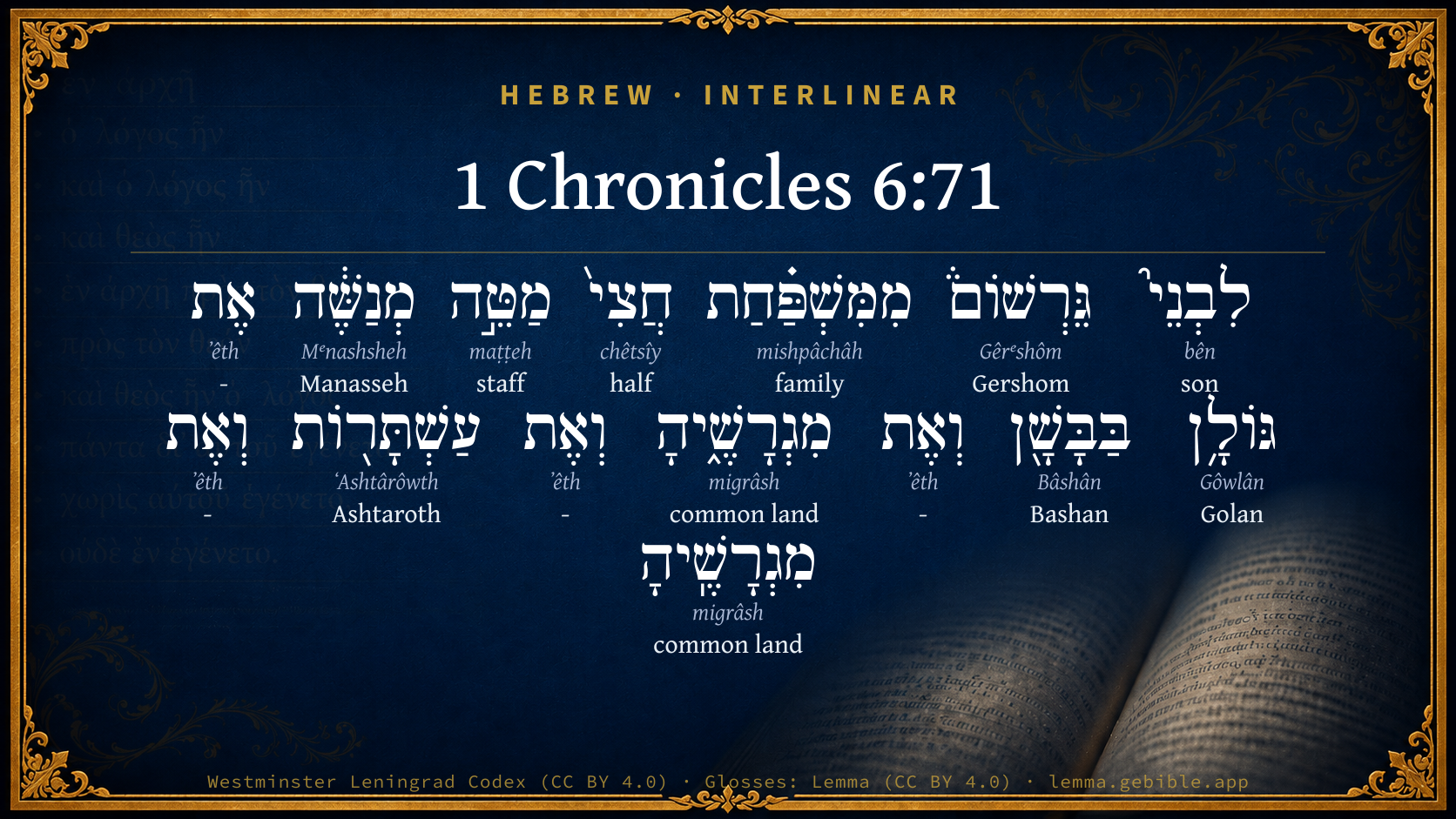
1 Chronicles 6:71

Hebrew (Westminster Leningrad Codex) 1 Chronicles 6:71 appears in the Hebrew Old Testament. The text above is from the Westminster Leningrad Codex. Each word links to its Strong’s number, a concise gloss, and parsing drawn from the Open Scriptures Hebrew Bible morphology. Click any word for its full Brown-Driver-Briggs (BDB) entry.
Download image
Cite this verse

1 Chronicles 6:71 (World English Bible). Public Domain. Lemma interlinear Bible study tool, https://lemma.gebible.app/v/1-chronicles/6/71.

Show BibTeX & RIS
BibTeX
RIS
English Translation
To the sons of Gershom [were given], out of the family of the half-tribe of Manasseh, Golan in Bashan with its suburbs, and Ashtaroth with its suburbs;
World English Bible · Public Domain
Download a study sheet

One document with this verse’s original text, its word-by-word gloss line, the meaning frame, cross-references with their text, attributed commentary, and full source and license credits — printable, and it pastes into notes with its structure intact.

This verse Autodidact and up

Study sheet (.html) Plain text (.txt)

A passage Seminary Student

Up to 50 verses in one chapter. A passage sheet keeps up to 6 commentary sources and 12 cross-references per verse, in the order this page ranks them, and says so on the sheet whenever that leaves anything out. Ask for a single verse and you get the Autodidact verse sheet above.

Everything on this page stays free to read, with no account — the sheet is a download of what is already on screen, not access to it.

Want to remove ads? Support Godless Engineer
Compare translations 3

The same verse in 3 English versions, stacked beneath the original-language interlinear above. Click any original word for its lexicon entry.

Each is an independent rendering of the whole verse — the interlinear is not word-aligned to these translations.

Highlighted words mark where these versions differ — a whole-verse word diff, not a word-by-word alignment.

  • World English Bible Public Domain
    To the sons of Gershom [were given], out of the family of the half-tribe of Manasseh, Golan in Bashan with its suburbs, and Ashtaroth with its suburbs;
  • King James Version Public Domain
    Unto the sons of Gershom were given out of the family of the half tribe of Manasseh, Golan in Bashan with her suburbs, and Ashtaroth with her suburbs:
  • unfoldingWord Literal Text CC BY-SA 4.0
    To the sons of Gershon, from the clans of the half tribe of Manasseh: Golan in Bashan and its pasturelands and Ashtaroth and its pasturelands.

unfoldingWord Literal Text — © unfoldingWord, licensed CC BY-SA 4.0. Word-aligned USFM3 via Door43 (git.door43.org/unfoldingWord/en_ult).

Versions to compare (up to 4)

3 of 4 selected

Show all 18 translations

Every available English version of this verse, each an independent rendering of the whole verse.

  • World English Bible Public Domain
    To the sons of Gershom [were given], out of the family of the half-tribe of Manasseh, Golan in Bashan with its suburbs, and Ashtaroth with its suburbs;
  • Berean Standard Bible Public Domain
    The Gershomites received the following: From the clan of the half-tribe of Manasseh they were given Golan in Bashan and also Ashtaroth, together with their pasturelands.
  • Majority Standard Bible Public Domain
    The Gershomites received the following: From the clan of the half-tribe of Manasseh they were given Golan in Bashan and also Ashtaroth, together with their pasturelands.
  • King James Version Public Domain
    Unto the sons of Gershom were given out of the family of the half tribe of Manasseh, Golan in Bashan with her suburbs, and Ashtaroth with her suburbs:
  • American Standard Version (1901) Public Domain
    Unto the sons of Gershom `were given', out of the family of the half-tribe of Manasseh, Golan in Bashan with its suburbs, and Ashtaroth with its suburbs;
  • Revised Version (1885) Public Domain
    Unto the sons of Gershom were given, out of the family of the half tribe of Manasseh, Golan in Bashan with her suburbs, and Ashtaroth with her suburbs:
  • Geneva Bible (1599) Public Domain
    Vnto the sonnes of Gershom out of the familie of the halfe tribe of Manasseh, Golan in Bashan, and her suburbes, and Ashtaroth with her suburbes,
  • Douay-Rheims (1899) Public Domain
    And to the sons of Gersom, out of the kindred of the half tribe of Manasses, Gaulon, in Basan, and its suburbs, and Astharoth with its suburbs.
  • Young's Literal Translation Public Domain
    To the sons of Gershom from the family of the half of the tribe of Manasseh `are' Golan in Bashan and its suburbs, and Ashtaroth and its suburbs;
  • Literal Standard Version CC BY-SA 4.0
    To the sons of Gershom from the family of the half of the tribe of Manasseh: Golan in Bashan and its outskirts, and Ashtaroth and its outskirts;
  • Unlocked Literal Bible CC BY-SA 4.0
    To Gershon's descendants out of the clans of the half tribe of Manasseh, they gave Golan in Bashan with its pasturelands and Ashtaroth with its pasturelands.
  • unfoldingWord Literal Text CC BY-SA 4.0
    To the sons of Gershon, from the clans of the half tribe of Manasseh: Golan in Bashan and its pasturelands and Ashtaroth and its pasturelands.
  • Darby Bible Public Domain
    To the children of Gershom [were given] out of the family of the half tribe of Manasseh: Golan in Bashan and its suburbs, and Ashtaroth and its suburbs;
  • World Messianic Bible Public Domain
    To the sons of Gershom were given, out of the family of the half-tribe of Manasseh, Golan in Bashan with its pasture lands, and Ashtaroth with its pasture lands;
  • Webster's Bible Public Domain
    To the sons of Gershom were given out of the family of the half tribe of Manasseh, Golan in Bashan with its suburbs, and Ashtaroth with its suburbs:
  • Free Bible Version CC BY-SA 4.0
    The descendants of Gershon received the following. From the family of the half-tribe of Manasseh: Golan in Bashan, and Ashtaroth, together with their pasturelands;
  • Bible in Basic English Public Domain
    To the sons of Gershom were given, out of the family of the half-tribe of Manasseh, Golan in Bashan with its outskirts, and Ashtaroth with its outskirts;
  • JPS Tanakh (1917) Public Domain
    (6-56) Unto the sons of Gershom were given, out of the family of the half-tribe of Manasseh, Golan in Bashan with the open land about it, and Ashtaroth with the open land about it;

Literal Standard Version (2020), Covenant Press — licensed CC BY-SA 4.0. Text via the HelloAO Bible API (eBible.org). Unlocked Literal Bible (unfoldingWord) — licensed CC BY-SA 4.0. Text via the HelloAO Bible API (eBible.org). unfoldingWord Literal Text — © unfoldingWord, licensed CC BY-SA 4.0. Word-aligned USFM3 via Door43 (git.door43.org/unfoldingWord/en_ult). Free Bible Version, Dr. Jonathan Gallagher — licensed CC BY-SA 4.0. Text via the HelloAO Bible API (eBible.org).

Word by word

More ways to search: Search by grammar → Find every occurrence → Compare this word →

Practice this passage: Drill this verse → Learn its vocabulary →

גּוֹלָ֥ן
Gôwlân
H1474
“Golan”
Noun, Proper
Part of Speech
Noun
Type
Proper
Full BDB Definition

Origin: from H1473

TWOT: None

Golan = "their captivity: their rejoicing" - a town of Manasseh in the heights of Bashan east of the Jordan; a city of refuge
  1. לִבְנֵי֮ bên H1121 “to/for · sons of” Preposition + Noun, Common, Masculine, Plural, Construct
  2. גֵּרְשׁוֹם֒ Gêrᵉshôm H1647 “Gershom” Noun, Proper
  3. מִמִּשְׁפַּ֗חַת mishpâchâh H4940 “from · family of” Preposition + Noun, Common, Feminine, Singular, Construct
  4. חֲצִי֙ chêtsîy H2677 “half of” Noun, Common, Masculine, Singular, Construct
  5. מַטֵּ֣ה maṭṭeh H4294 “staff of” Noun, Common, Masculine, Singular, Construct
  6. מְנַשֶּׁ֔ה Mᵉnashsheh H4519 “Manasseh” Noun, Proper
  7. אֶת ʼêth H853 “-” Particle, Direct Object
  8. בַּבָּשָׁ֖ן Bâshân H1316 “in/at the · Bashan” Preposition, Determined + Noun, Proper
  9. וְאֶת ʼêth H853 “and · -” Conjunction + Particle, Direct Object
  10. מִגְרָשֶׁ֑יהָ migrâsh H4054 “common lands · her” Noun, Common, Masculine, Plural, Construct + Suffix, Personal, 3rd Person, Feminine, Singular
  11. וְאֶת ʼêth H853 “and · -” Conjunction + Particle, Direct Object
  12. עַשְׁתָּר֖וֹת ʻAshtârôwth H6252 “Ashtaroth” Noun, Proper
  13. וְאֶת ʼêth H853 “and · -” Conjunction + Particle, Direct Object
  14. מִגְרָשֶֽׁיהָ migrâsh H4054 “common lands · her” Noun, Common, Masculine, Plural, Construct + Suffix, Personal, 3rd Person, Feminine, Singular

About this verse

These counts appear in no published source. They are computed here, from the morphology-tagged text and Lemma’s own curated glosses. What Lemma adds →

15
words
11
distinct lemmas
Historical
section

Notable vocabulary

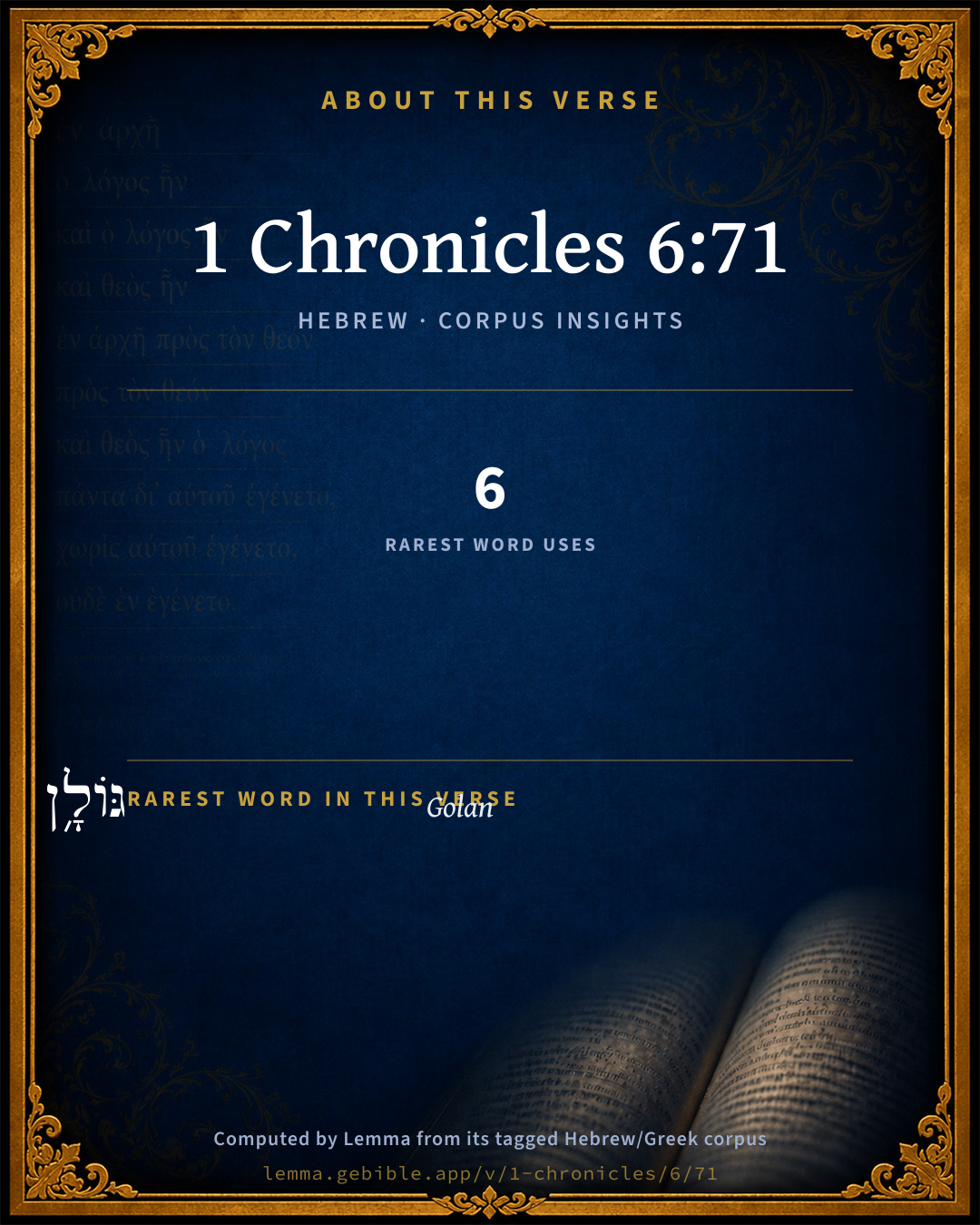
The rarest word here is גּוֹלָ֥ן Golan H1474 — appearing just 6 times in the whole Hebrew Bible.

Shared distinctive vocabulary

גּוֹלָ֥ן Golan H1474 occurs in 4 verses of the Hebrew Bible. Also found in:

Grammatical profile

  • 11 nouns
  • 4 particles

Repetition

A word recurs within this verse — often emphatic in Hebrew:

  • מִגְרָשֶׁ֑יהָ common land H4054 ×2

Hebrew & Septuagint length

In English translation the verse runs 27 words from the Hebrew and 26 from the Septuagint (LXX English) — closely comparable.

A rough comparison of the two English renderings, which tokenize alike — not a word-level alignment.

Word counts can differ between the Hebrew and the Greek without any difference in meaning — e.g. the Hebrew direct-object marker אֵת has no separate Greek word, and Greek often adds the article ὁ.

Cross-references

5

Topical passages linked to 1 Chronicles 6:71 in the Treasury of Scripture Knowledge — connected by theme and wording, ordered by reader-vote popularity; previews shown in the World English Bible.

  • Joshua 21:27 To the children of Gershon, of the families of the Levites, out of the half-tribe of Manasseh [they gave] Golan in Bashan with its suburbs, the city of refuge for the manslayer, and Be-eshterah with its suburbs; two cities.
  • Joshua 9:10 and all that he did to the two kings of the Amorites, who were beyond the Jordan, to Sihon king of Heshbon, and to Og king of Bashan, who was at Ashtaroth.
  • Joshua 20:8 Beyond the Jordan at Jericho eastward, they assigned Bezer in the wilderness in the plain out of the tribe of Reuben, and Ramoth in Gilead out of the tribe of Gad, and Golan in Bashan out of the tribe of Manasseh.
  • Deuteronomy 1:4 after he had struck Sihon the king of the Amorites, who lived in Heshbon, and Og the king of Bashan, who lived in Ashtaroth, at Edrei.
  • Deuteronomy 4:43 [namely], Bezer in the wilderness, in the plain country, for the Reubenites; and Ramoth in Gilead, for the Gadites; and Golan in Bashan, for the Manassites.

Cross-references courtesy of OpenBible.info (CC BY 4.0).

Hebrew and Greek witnesses Masoretic Hebrew ↔ Greek Septuagint

The same verse in the two great witnesses to the Old Testament, shown verse-for-verse.

These are two independent witnesses, not word-aligned to each other, and the Septuagint is shown in lemma (dictionary) form.

Hebrew 1 Chronicles 6:71 Masoretic · Westminster Leningrad Codex

לִבְנֵי֮ גֵּרְשׁוֹם֒ מִמִּשְׁפַּ֗חַת חֲצִי֙ מַטֵּ֣ה מְנַשֶּׁ֔ה אֶת גּוֹלָ֥ן בַּבָּשָׁ֖ן וְאֶת מִגְרָשֶׁ֑יהָ וְאֶת עַשְׁתָּר֖וֹת וְאֶת מִגְרָשֶֽׁיהָ

To the sons of Gershom [were given], out of the family of the half-tribe of Manasseh, Golan in Bashan with its suburbs, and Ashtaroth with its suburbs;

World English Bible · Public Domain

Greek LXX 1 Chronicles 6:71 Septuagint · lemma form
To the sons of Gedson from the families of the half-tribe of Manasse they gave Golan of Basan and her suburbs, and Aseroth and her suburbs.

LXX2012 (modern English Septuagint) · Public Domain

Hebrew: Westminster Leningrad Codex (CC BY 4.0). Greek: Septuagint (public domain); English from LXX2012 (modern English Septuagint) (Public Domain). How the Septuagint differs from the Hebrew →

Commentary

Notes on 1 Chronicles 6:71 from classic Christian and Jewish commentators (each source and its license shown beneath its notes). The classic Christian expositions comment on the surrounding passage and are grouped to its opening verse, so a note may address several verses; the Jewish commentaries on the Tanakh (Rashi and others) are per-verse, so they appear only where the commentator wrote on this verse.

Lemma curates 59 commentaries, every one of them public domain or Creative Commons licensed, each selected and text-cleaned for this edition rather than reprinted as found. About our sources →

Ellicott's Commentary for English Readers

THE CITIES OF THE GERSHONITES.

(Camp. Jos_21:27-33.) 1Ch_6:71-76.

(71) Unto the sons of Gershom.—Supply they gave, from 1Ch_6:67.

Golan in Bashan (comp. the classical Gaulanitis, a district east of the sea of Galilee) was a city of refuge, like Hebron and Shechem.

Ashtaroth.—Images of Ashtoreth (Astarte, queen of heaven); a name like Anathoth (1Ch_6:60), which means “images of Anath,” or Anatum, the consort of Anurn (the sky). The two cities must have been ancient seats of the worship of Ashtoreth and Anath. The names still survive in Tell-Ashtereh and Anâta. Joshua (50100) reads Be’eshterah—perhaps a popular pronunciation of Beth-Ashterah (house of Ashtoreth).

(72) Kedesh means “sanctuary.” Jos_19:20; Jos_21:28 has Kishion, which may have borne the other name, as being the seat of a famous sanctuary.

(73) Ramoth.—In Joshua 21 Jarmuth, but in Jos_19:21 Remeth. Jarmuth occurs in Jos_12:11, and is probably right.

Anem.—Jos_21:29; Jos_19:21 has En-gannim. Jos_15:34 mentions a Judæan city called ha-Enam (the two fountains), and that not far from En-gannim (fount of gardens). Anem is very much like Enam.

(74) Mashal is perhaps a popular pronunciation of Mish’al (Jos_21:30; Jos_19:26). (Comp. Shçlâh = She’çlâh.)

(75) Hukok.—Helkath (Jos_19:25). Hukkôk was a city of Naphtali (Jos_19:34).

(76) Kedesh in Galilee.—A city of refuge (Jos_21:32); the modern Kedes.

Hammon =Haminoth-dor, “hot springs of Dor” (Jos_21:32); also called Hammath (Jos_19:35).

Kirjathaim.—In Jos_21:32 Kartan; a contracted form of the dual of Kereth (=Kirjah), like Dothan for Dothaim. (Dothain, Gen_37:17.)

A Bible Commentary for English Readers, edited by Charles John Ellicott (1878–1897) — public domain. Text from a community e-Sword module.

Geneva Bible (1599)

Geneva Bible translators

Or, Be Eshterah, Josh. 21:27.

Who in the first verse is called also Gershon.

Geneva Bible (1599) marginal notes — public domain. Text via Bolls.life.

Adam Clarke's Commentary

Verse 71. - 77. We shall see from Jos 21:28, c., that several of these cities have different names.

How barren to us is this register, both of incident and interest! and yet, as barren rocks and sandy deserts make integral and necessary parts of the globe so do these genealogical tables make necessary parts of the history of providence and grace in the maintenance of truth, and the establishment of the Church of Christ. Therefore no one that fears God will either despise or lightly esteem them.

Adam Clarke's Commentary on the Bible (1810–1826) — public domain. Text from a community e-Sword/MySword module.

The Cambridge Bible for Schools and Colleges

gen. ed. J. J. S. Perowne

71–76 (= Jos_21:27-32). The thirteen cities of the sons of Gershom

71. Golan] a city of refuge, Jos_21:27. The name of this city is still preserved in Jolan (Jaulan), the name of a district E. of Jordan extending from Hermon to the Jarmuk.

Ashtaroth] mentioned in Jos_9:10 as the capital of Og, king of Bashan.

The Cambridge Bible for Schools and Colleges (gen. ed. J. J. S. Perowne; Cambridge University Press, 1878–1918) — public domain. Text from a community e-Sword module.

Haydock's Catholic Bible Commentary

Astharoth, or Bosra. (Calmet) --- Hebrew Hashtaroth, Josue xxi. 27. (Haydock)

George Leo Haydock (1774–1849), Haydock's Catholic Family Bible and Commentary, 1859 edition — public domain. Excludes Psalms (Douay-Rheims chapter numbering differs from Protestant) and Deuterocanonical books (Catholic canon only).

The Pulpit Commentary

Golan was one of the three cities of refuge east of the Jordan, (Jos_20:8) the other two being Bezer, of the tribe of Reuben, and Ramoth in Gilead, of the tribe of Gad. Ashtaroth, in its previous history, had been closely connected with Og King of Bashan (Deuteronomy. Jos_9:9, 10 12:4, 5 13:12) It is called Beeshterah in Jos_21:27.

The Pulpit Commentary (1880–1919), ed. H.D.M. Spence-Jones & Joseph S. Exell — public domain. Text from a community e-Sword module.

unfoldingWord translationNotes

Door43 World Missions Community

General Information:

See: How to Translate Names

Gershon

See how you translated this man's name in 1 Chronicles 6:1.

Golan ... Ashtaroth ... Kedesh ... Daberath ... Ramoth ... Anem

These are the names of towns. (See: How to Translate Names)

its pasturelands

the land with grass for animals to eat. See how you translated this in 1 Chronicles 5:16.

translationWords

descend

Manasseh

Bashan

Issachar

Kedesh

Ramoth

unfoldingWord translationNotes — © Distant Shores Media and the Door43 World Missions Community, licensed CC BY-SA 4.0. Source: git.door43.org/Door43/en_tn.

Lesson kit

Teaching starters — assembled from the data on this page, not authored interpretation. Every prompt links to the verse data it draws on. Edit before teaching.

1 Chronicles, in the Historical, opens this verse with 15 words (11 distinct Hebrew lemmas). Its most distinctive word is Gôwlân (“Golan”). A historical commentator’s framing appears above. Read the whole chapter for the surrounding context.

Discussion questions

  1. How does “Golan” (Gôwlân) shape what this verse is saying?
  2. How does Deuteronomy 4:43, which shares the word «Golan», read alongside this verse?
  3. What does the repetition of “common land” (2× in this one verse) do in this verse?
  4. These translations render this verse differently; the difference is in the English rendering, not the original. What questions does that raise?
  5. Compare how Ellicott's Commentary for English Readers and Geneva Bible (1599) read this verse. Where do they agree or differ?

Things to notice

Reading settings

Reading text

Shown beneath each verse's original-language words.

Old Testament
Old Testament edition

Read the OT as the Masoretic Hebrew (MT) or the Greek Septuagint (LXX).

English shown for the Greek Septuagint (in the Hebrew ↔ Greek comparison).

Comparing translations? Open the Compare panel on any verse page to stack up to four side by side.