
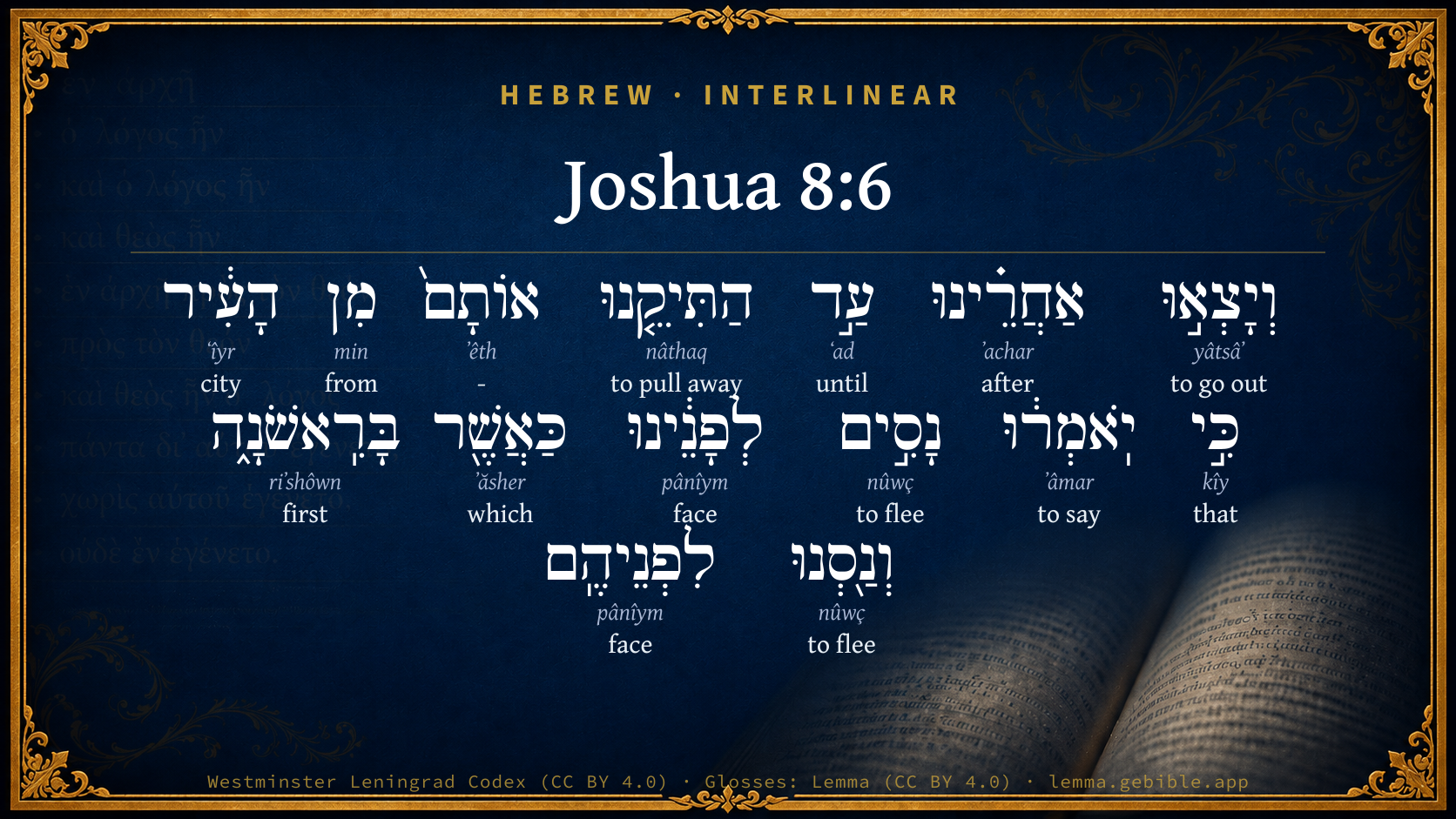
Joshua 8:6

Hebrew (Westminster Leningrad Codex) Joshua 8:6 appears in the Hebrew Old Testament. The text above is from the Westminster Leningrad Codex. Each word links to its Strong’s number, a concise gloss, and parsing drawn from the Open Scriptures Hebrew Bible morphology. Click any word for its full Brown-Driver-Briggs (BDB) entry.
Download image
Cite this verse

Joshua 8:6 (World English Bible). Public Domain. Lemma interlinear Bible study tool, https://lemma.gebible.app/v/joshua/8/6.

Show BibTeX & RIS
BibTeX
RIS
English Translation
and they will come out after us, until we have drawn them away from the city; for they will say, They flee before us, as at the first: so we will flee before them;
World English Bible · Public Domain
Download a study sheet

One document with this verse’s original text, its word-by-word gloss line, the meaning frame, cross-references with their text, attributed commentary, and full source and license credits — printable, and it pastes into notes with its structure intact.

This verse Autodidact and up

Study sheet (.html) Plain text (.txt)

A passage Seminary Student

Up to 50 verses in one chapter. A passage sheet keeps up to 6 commentary sources and 12 cross-references per verse, in the order this page ranks them, and says so on the sheet whenever that leaves anything out. Ask for a single verse and you get the Autodidact verse sheet above.

Everything on this page stays free to read, with no account — the sheet is a download of what is already on screen, not access to it.

Want to remove ads? Support Godless Engineer
Compare translations 3

The same verse in 3 English versions, stacked beneath the original-language interlinear above. Click any original word for its lexicon entry.

Each is an independent rendering of the whole verse — the interlinear is not word-aligned to these translations.

Highlighted words mark where these versions differ — a whole-verse word diff, not a word-by-word alignment.

  • World English Bible Public Domain
    and they will come out after us, until we have drawn them away from the city; for they will say, They flee before us, as at the first: so we will flee before them;
  • King James Version Public Domain
    (For they will come out after us) till we have drawn them from the city; for they will say, They flee before us, as at the first: therefore we will flee before them.
  • unfoldingWord Literal Text CC BY-SA 4.0
    And they will come out after us until we have drawn them from the city. For they will say, ‘They are fleeing to our faces, just as at the first.’ And we will flee to their faces.

unfoldingWord Literal Text — © unfoldingWord, licensed CC BY-SA 4.0. Word-aligned USFM3 via Door43 (git.door43.org/unfoldingWord/en_ult).

Versions to compare (up to 4)

3 of 4 selected

Show all 18 translations

Every available English version of this verse, each an independent rendering of the whole verse.

  • World English Bible Public Domain
    and they will come out after us, until we have drawn them away from the city; for they will say, They flee before us, as at the first: so we will flee before them;
  • Berean Standard Bible Public Domain
    They will pursue us until we have drawn them away from the city, for they will say, ‘The Israelites are running away from us as they did before.’ So as we flee from them,
  • Majority Standard Bible Public Domain
    They will pursue us until we have drawn them away from the city, for they will say, ‘The Israelites are running away from us as they did before.’ So as we flee from them,
  • King James Version Public Domain
    (For they will come out after us) till we have drawn them from the city; for they will say, They flee before us, as at the first: therefore we will flee before them.
  • American Standard Version (1901) Public Domain
    and they will come out after us, till we have drawn them away from the city; for they will say, They flee before us, as at the first: so we will flee before them;
  • Revised Version (1885) Public Domain
    and they will come out after us, till we have drawn them away from the city; for they will say, They flee before us, as at the first; so we will flee before them:
  • Geneva Bible (1599) Public Domain
    For they wil come out after vs, till we haue brought them out of the citie: for they will say, They flee before vs as at the first time: so we will flee before them.
  • Douay-Rheims (1899) Public Domain
    Till they pursuing us be drawn farther from the city: for they will think that we flee as before.
  • Young's Literal Translation Public Domain
    and they have come out after us till we have drawn them out of the city, for they say, They are fleeing before us as at the first, and we have fled before them,
  • Literal Standard Version CC BY-SA 4.0
    and they have come out after us until we have drawn them out of the city, for they say, They are fleeing before us as at the first, and we have fled before them,
  • Unlocked Literal Bible CC BY-SA 4.0
    They will come out after us until we have drawn them away from the city. They will say, 'They are running away from us as they did the last time.' So we will run away from them.
  • unfoldingWord Literal Text CC BY-SA 4.0
    And they will come out after us until we have drawn them from the city. For they will say, ‘They are fleeing to our faces, just as at the first.’ And we will flee to their faces.
  • Darby Bible Public Domain
    And they will come out after us till we have drawn them from the city; for they will say, They flee before us, as at the first; and we will flee before them.
  • World Messianic Bible Public Domain
    They will come out after us until we have drawn them away from the city; for they will say, ‘They flee before us, like the first time.’ So we will flee before them,
  • Webster's Bible Public Domain
    (For they will come out after us) till we have drawn them from the city; for they will say, They flee before us, as at the first: therefore we will flee before them.
  • Free Bible Version CC BY-SA 4.0
    They'll chase after us as we draw them away from the town, because they'll say to each other, ‘They're running away from us just like before.’
  • Bible in Basic English Public Domain
    And they will come out after us, till we have got them away from the town; for they will say, They have gone in flight from us as before; so we will go in flight before them;
  • JPS Tanakh (1917) Public Domain
    And they will come out after us, till we have drawn them away from the city; for they will say: They flee before us, as at the first; so we will flee before them.

Literal Standard Version (2020), Covenant Press — licensed CC BY-SA 4.0. Text via the HelloAO Bible API (eBible.org). Unlocked Literal Bible (unfoldingWord) — licensed CC BY-SA 4.0. Text via the HelloAO Bible API (eBible.org). unfoldingWord Literal Text — © unfoldingWord, licensed CC BY-SA 4.0. Word-aligned USFM3 via Door43 (git.door43.org/unfoldingWord/en_ult). Free Bible Version, Dr. Jonathan Gallagher — licensed CC BY-SA 4.0. Text via the HelloAO Bible API (eBible.org).

Word by word

More ways to search: Search by grammar → Find every occurrence → Compare this word →

Practice this passage: Drill this verse → Learn its vocabulary →

הַתִּיקֵ֤נוּ
nâthaq
H5423
“to pull away · us”
Verb, Hiphil, Infinitive Construct + Suffix, Personal, 1st Person, Common, Plural
Part of Speech
Verb
Stem
Hiphil
Form
Infinitive Construct
Full BDB Definition

Origin: a primitive root

TWOT: 1447

to pull or tear or draw off or away or apart, draw out, pluck up, break, lift, root out - (Qal) - to draw away - to draw or pull off - to pull or tear away - (Niphal) - to be drawn away, be drawn out - to be torn apart or in two, be snapped - to be separated - (Piel) - to tear apart, snap - to tear out, tear up, tear away - (Hiphil) - to draw away - to drag away - (Hophal) to be drawn away
  1. וְיָצְא֣וּ yâtsâʼ H3318 “and · to go out” Conjunction + Verb, Qal, Sequential Perfect, 3rd Person, Common, Plural
  2. אַחֲרֵ֗ינוּ ʼachar H310 “after · us” Preposition + Suffix, Personal, 1st Person, Common, Plural
  3. עַ֣ד ʻad H5704 “until” Preposition
  4. אוֹתָם֙ ʼêth H853 “- · them” Particle, Direct Object + Suffix, Personal, 3rd Person, Masculine, Plural
  5. מִן min H4480 “from” Preposition
  6. הָעִ֔יר ʻîyr H5892 “the · city” Particle, Definite Article + Noun, Common, Feminine, Singular, Absolute
  7. כִּ֣י kîy H3588 “that” Conjunction
  8. יֹֽאמְר֔וּ ʼâmar H559 “to say” Verb, Qal, Imperfect, 3rd Person, Masculine, Plural
  9. נָסִ֣ים nûwç H5127 “fleeing” Verb, Qal, Participle Active, Masculine, Plural, Absolute
  10. לְפָנֵ֔ינוּ pânîym H6440 “to/for · face(s) · our” Preposition + Noun, Common, Both, Plural, Construct + Suffix, Personal, 1st Person, Common, Plural
  11. כַּאֲשֶׁ֖ר ʼăsher H834 “like/as · which” Preposition + Particle, Relative
  12. בָּרִֽאשֹׁנָ֑ה riʼshôwn H7223 “in/at the · first” Preposition, Determined + Adjective, Adjective, Feminine, Singular, Absolute
  13. וְנַ֖סְנוּ nûwç H5127 “and · to flee” Conjunction + Verb, Qal, Sequential Perfect, 1st Person, Common, Plural
  14. לִפְנֵיהֶֽם pânîym H6440 “to/for · face(s) · their” Preposition + Noun, Common, Both, Plural, Construct + Suffix, Personal, 3rd Person, Masculine, Plural

About this verse

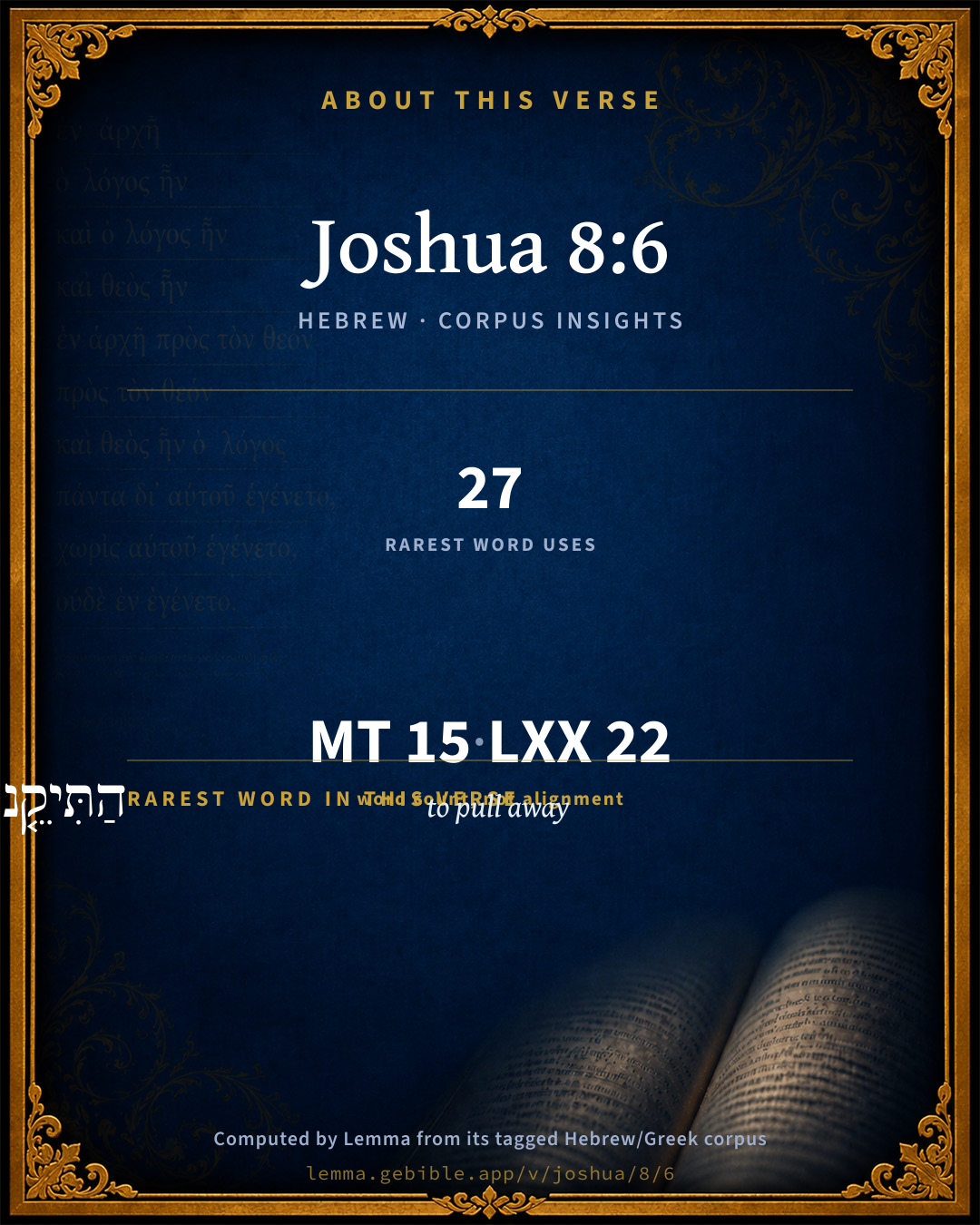
These counts appear in no published source. They are computed here, from the morphology-tagged text and Lemma’s own curated glosses. What Lemma adds →

15
words
13
distinct lemmas
Historical
section

Shared distinctive vocabulary

הַתִּיקֵ֤נוּ to pull away H5423 occurs in 26 verses of the Hebrew Bible. Also found in:

Grammatical profile

  • 5 verbs
  • 3 nouns
  • 1 adjective
  • 3 prepositions
  • 1 conjunction
  • 2 particles

Verb forms

  • וְיָצְא֣וּ Qal · Sequential Perfect
  • הַתִּיקֵ֤נוּ Hiphil · Infinitive Construct
  • יֹֽאמְר֔וּ Qal · Imperfect
  • נָסִ֣ים Qal · Participle Active
  • וְנַ֖סְנוּ Qal · Sequential Perfect

Repetition

Words recur within this verse — often emphatic in Hebrew:

  • נָסִ֣ים to flee H5127 ×2
  • לְפָנֵ֔ינוּ face H6440 ×2

Hebrew & Septuagint length

In English translation the verse runs 34 words from the Hebrew and 29 from the Septuagint (LXX English) — closely comparable.

A rough comparison of the two English renderings, which tokenize alike — not a word-level alignment.

Word counts can differ between the Hebrew and the Greek without any difference in meaning — e.g. the Hebrew direct-object marker אֵת has no separate Greek word, and Greek often adds the article ὁ.

In the original languages it is 15 Hebrew tokens and 22 Greek tokens — but the two are counted differently (Hebrew bundles its prefixes and suffixes into one token; the Greek is in lemma form), so that isn’t a like-for-like length.

Cross-references

5

Topical passages linked to Joshua 8:6 in the Treasury of Scripture Knowledge — connected by theme and wording, ordered by reader-vote popularity; previews shown in the World English Bible.

  • Exodus 14:3 Pharaoh will say of the children of Israel, 'They are entangled in the land. The wilderness has shut them in.'
  • Exodus 15:9 The enemy said, 'I will pursue, I will overtake, I will divide the spoil. My desire shall be satisfied on them. I will draw my sword, my hand shall destroy them.'
  • Judges 20:32 The children of Benjamin said, They are struck down before us, as at the first. But the children of Israel said, Let us flee, and draw them away from the city to the highways.
  • Ecclesiastes 8:11 Because sentence against an evil work is not executed speedily, therefore the heart of the sons of men is fully set in them to do evil.
  • Ecclesiastes 9:12 For man also doesn't know his time. As the fish that are taken in an evil net, and as the birds that are caught in the snare, even so are the sons of men snared in an evil time, when it falls suddenly on them.

Cross-references courtesy of OpenBible.info (CC BY 4.0).

Hebrew and Greek witnesses Masoretic Hebrew ↔ Greek Septuagint

The same verse in the two great witnesses to the Old Testament, shown verse-for-verse.

These are two independent witnesses, not word-aligned to each other, and the Septuagint is shown in lemma (dictionary) form.

Hebrew Joshua 8:6 Masoretic · Westminster Leningrad Codex

וְיָצְא֣וּ אַחֲרֵ֗ינוּ עַ֣ד הַתִּיקֵ֤נוּ אוֹתָם֙ מִן הָעִ֔יר כִּ֣י יֹֽאמְר֔וּ נָסִ֣ים לְפָנֵ֔ינוּ כַּאֲשֶׁ֖ר בָּרִֽאשֹׁנָ֑ה וְנַ֖סְנוּ לִפְנֵיהֶֽם

and they will come out after us, until we have drawn them away from the city; for they will say, They flee before us, as at the first: so we will flee before them;

World English Bible · Public Domain

Greek LXX Joshua 8:6 Septuagint · lemma form

καί ὡς ἄν ἐκἔρχομαι ὀπίσω ἐγώ ἀποσπάω αὐτός ἀπό ὁ πόλις καί εἶπον φεύγω οὗτος ἀπό πρόσωπον ἐγώ ὅς τρόπος καί ἔμπροσθεν

And when they shall come out after us, we will draw them away from the city; and they will say, These men flee from before us, as also before.

LXX2012 (modern English Septuagint) · Public Domain

On this verse, The Pulpit Commentary discusses the Septuagint’s reading. Read the note in Commentary ↓

Hebrew: Westminster Leningrad Codex (CC BY 4.0). Greek: Septuagint (public domain); English from LXX2012 (modern English Septuagint) (Public Domain). How the Septuagint differs from the Hebrew →

Targum (Aramaic paraphrase)

1

The Targum is the ancient Jewish Aramaic paraphrase of the Hebrew Scriptures — an interpretive translation, not the Hebrew text itself. Onkelos (literal) and Pseudo-Jonathan (expansive) render the Torah, and Jonathan the Prophets. Coverage is partial: where no permissively-licensed English translation exists for a verse, only the Aramaic is shown. This is verse-level text, not a word-by-word alignment to the Hebrew.

  1. Targum Jonathan Prophets (Joshua–Malachi)
    וְיִפְקוּן בַּתְרָנָא עַד דְנִגוֹד יַתְהוֹן מִן קַרְתָּא אֲרֵי יֵימְרוּן תְּבִירִין קֳדָמָנָא כִּדְבְּקַדְמֵיתָא וְנִפּוֹךְ קֳדָמֵיהוֹן:

    (no public-domain English translation for this verse)

    Targum Jonathan — Aramaic: “Mikraot Gedolot” (public domain). English: “Sefaria Community Translation” (CC0 1.0 (public-domain dedication)); “London "Chaldee Paraphrase," 1871” (public domain). Text via Sefaria.

Commentary

Notes on Joshua 8:6 from classic Christian and Jewish commentators (each source and its license shown beneath its notes). The classic Christian expositions comment on the surrounding passage and are grouped to its opening verse, so a note may address several verses; the Jewish commentaries on the Tanakh (Rashi and others) are per-verse, so they appear only where the commentator wrote on this verse.

Lemma curates 59 commentaries, every one of them public domain or Creative Commons licensed, each selected and text-cleaned for this edition rather than reprinted as found. About our sources →

Trapp's Complete Commentary

John Trapp

Jos 8:6 (For they will come out after us) till we have drawn them from the city; for they will say, They flee before us, as at the first: therefore we will flee before them.

Ver. 6. Till we have drawn them from the city.] Heb., Pulled them. Saith Bristow in his "Motives," Pull the heretics but out of their stronghold of Scripture proofs, into the open field of fathers and councils, and then you may deal well enough with them.

John Trapp, A Commentary or Exposition upon All the Books of the Old and New Testament (1647–1656) — public domain. Text from a community e-Sword module.

John Gill's Exposition

For they will come out after us,.... Of which there could be no doubt, when they should see them run from them:

till we have drawn them from the city; some distance from it, that they could not return soon enough to save it from the ambush, or prevent their entrance into it, and burning it:

for they will say, they will flee before us, as at the first; they run away as they did before, and let us pursue them and smite them as we did then:

therefore we will flee before them; to draw them out of the city, and make your way easy to get into it,

John Gill's Exposition of the Whole Bible (1746–1763) — public domain (CC PDM 1.0). Text via the HelloAO Bible API.

Whedon's Commentary on the Bible

Daniel D. Whedon

6. For they will come out after us — So infatuated are they over their recent victory that our greater numbers will not be likely to awe them from coming out against us.

They flee before us, as at the first — It is a wise general who makes a former defeat aid him in securing a future victory.

Daniel D. Whedon (gen. ed.), Commentary on the Old and New Testaments (1874–1909) — public domain. Text from a community e-Sword module.

The Pulpit Commentary

For they will come. Literally, "and they will come." We have drawn. Literally, caused to pluck away (see note on Jos_4:18). Luther translates well by reissen, and the LXX by apospaswmen .

The Pulpit Commentary (1880–1919), ed. H.D.M. Spence-Jones & Joseph S. Exell — public domain. Text from a community e-Sword module.

Rashi

Rabbi Shlomo Yitzchaki (Rashi)

Until we have drawn them. הַתִּיקֵנוּ is an expression of תִּיק, a pocket, i.e., until we have drawn them from the pocket of the city. Defaurer in old french. We may also explain it as an expression of נְתִּיקָה, drawing out similar to ‘Draw them out like sheep to the slaughter.’

Rashi on the Tanakh — English translations: “The Judaica Press complete Tanach with Rashi, translated by A. J. Rosenberg” (CC BY 4.0); “Pentateuch with Rashi's commentary by M. Rosenbaum and A.M. Silbermann, 1929-1934” (public domain); “The Metsudah Tanach series, Lakewood, N.J” (CC BY 4.0); and “The Book of Joshua, Metsudah Publications, 1997” (CC BY 4.0). Text via Sefaria.

Lesson kit

Teaching starters — assembled from the data on this page, not authored interpretation. Every prompt links to the verse data it draws on. Edit before teaching.

Joshua, in the Historical, opens this verse with 15 words (13 distinct Hebrew lemmas). Its most distinctive word is nâthaq (“to pull away”). A historical commentator’s framing appears above. Read the whole chapter for the surrounding context.

Discussion questions

  1. How does “to pull away” (nâthaq) shape what this verse is saying?
  2. Leviticus 22:24 shares the word «to pull away» with this verse. How do the two illuminate each other?
  3. “to flee” occurs 2× in this one verse. What is the effect of the repetition?
  4. The translations on this page render this verse differently — a whole-verse word diff, not a word-by-word alignment. What might account for the different wordings?
  5. The verb «וְיָצְא֣וּ» is Qal Sequential Perfect. How does its form color the action?
  6. Reading how Trapp's Complete Commentary and John Gill's Exposition read this verse, where do the two commentators agree and where do they part?

Things to notice

Reading settings

Reading text

Shown beneath each verse's original-language words.

Old Testament
Old Testament edition

Read the OT as the Masoretic Hebrew (MT) or the Greek Septuagint (LXX).

English shown for the Greek Septuagint (in the Hebrew ↔ Greek comparison).

Comparing translations? Open the Compare panel on any verse page to stack up to four side by side.