
Joshua 21:4

Hebrew (Westminster Leningrad Codex) Joshua 21:4 appears in the Hebrew Old Testament. The text above is from the Westminster Leningrad Codex. Each word links to its Strong’s number, a concise gloss, and parsing drawn from the Open Scriptures Hebrew Bible morphology. Click any word for its full Brown-Driver-Briggs (BDB) entry.
Download image
Cite this verse

Joshua 21:4 (World English Bible). Public Domain. Lemma interlinear Bible study tool, https://lemma.gebible.app/v/joshua/21/4.

Show BibTeX & RIS
BibTeX
RIS
English Translation
The lot came out for the families of the Kohathites: and the children of Aaron the priest, who were of the Levites, had by lot out of the tribe of Judah, and out of the tribe of the Simeonites, and out of the tribe of Benjamin, thirteen cities.
World English Bible · Public Domain
Download a study sheet

One document with this verse’s original text, its word-by-word gloss line, the meaning frame, cross-references with their text, attributed commentary, and full source and license credits — printable, and it pastes into notes with its structure intact.

This verse Autodidact and up

Study sheet (.html) Plain text (.txt)

A passage Seminary Student

Up to 50 verses in one chapter. A passage sheet keeps up to 6 commentary sources and 12 cross-references per verse, in the order this page ranks them, and says so on the sheet whenever that leaves anything out. Ask for a single verse and you get the Autodidact verse sheet above.

Everything on this page stays free to read, with no account — the sheet is a download of what is already on screen, not access to it.

Want to remove ads? Support Godless Engineer
Compare translations 3

The same verse in 3 English versions, stacked beneath the original-language interlinear above. Click any original word for its lexicon entry.

Each is an independent rendering of the whole verse — the interlinear is not word-aligned to these translations.

Highlighted words mark where these versions differ — a whole-verse word diff, not a word-by-word alignment.

  • World English Bible Public Domain
    The lot came out for the families of the Kohathites: and the children of Aaron the priest, who were of the Levites, had by lot out of the tribe of Judah, and out of the tribe of the Simeonites, and out of the tribe of Benjamin, thirteen cities.
  • King James Version Public Domain
    And the lot came out for the families of the Kohathites: and the children of Aaron the priest, which were of the Levites, had by lot out of the tribe of Judah, and out of the tribe of Simeon, and out of the tribe of Benjamin, thirteen cities.
  • unfoldingWord Literal Text CC BY-SA 4.0
    And the lot came out for the clans of the Kohathite. And for the sons of Aaron the priest, from the Levites, there were 13 cities by the lot from the tribe of Judah and from the tribe of the Simeonite and from the tribe of Benjamin.

unfoldingWord Literal Text — © unfoldingWord, licensed CC BY-SA 4.0. Word-aligned USFM3 via Door43 (git.door43.org/unfoldingWord/en_ult).

Versions to compare (up to 4)

3 of 4 selected

Show all 18 translations

Every available English version of this verse, each an independent rendering of the whole verse.

  • World English Bible Public Domain
    The lot came out for the families of the Kohathites: and the children of Aaron the priest, who were of the Levites, had by lot out of the tribe of Judah, and out of the tribe of the Simeonites, and out of the tribe of Benjamin, thirteen cities.
  • Berean Standard Bible Public Domain
    The first lot came out for the Kohathite clans. The Levites who were descendants of Aaron the priest received thirteen cities by lot from the tribes of Judah, Simeon, and Benjamin.
  • Majority Standard Bible Public Domain
    The first lot came out for the Kohathite clans. The Levites who were descendants of Aaron the priest received thirteen cities by lot from the tribes of Judah, Simeon, and Benjamin.
  • King James Version Public Domain
    And the lot came out for the families of the Kohathites: and the children of Aaron the priest, which were of the Levites, had by lot out of the tribe of Judah, and out of the tribe of Simeon, and out of the tribe of Benjamin, thirteen cities.
  • American Standard Version (1901) Public Domain
    And the lot came out for the families of the Kohathites: and the children of Aaron the priest, who were of the Levites, had by lot out of the tribe of Judah, and out of the tribe of the Simeonites, and out of the tribe of Benjamin, thirteen cities.
  • Revised Version (1885) Public Domain
    And the lot came out for the families of the Kohathites: and the children of Aaron the priest, which were of the Levites, had by lot out of the tribe of Judah, and out of the tribe of the Simeonites, and out of the tribe of Benjamin, thirteen cities.
  • Geneva Bible (1599) Public Domain
    And the lot came out for the families of the Kohathites: and the children of Aaron ye Priest, which were of the Leuites, had by lot, out of the tribe of Iudah, and out of the tribe of Simeon, and out of the tribe of Beniamin thirteene cities.
  • Douay-Rheims (1899) Public Domain
    And the lot came out for the family of Caath of the children of Aaron the priest out of the tribes of Juda, and of Simeon, and of Benjamin, thirteen cities.
  • Young's Literal Translation Public Domain
    And the lot goeth out for the families of the Kohathite, and there are for the sons of Aaron the priest (of the Levites), out of the tribe of Judah, and out of the tribe of Simeon, and out of the tribe of Benjamin, by lot thirteen cities,
  • Literal Standard Version CC BY-SA 4.0
    and the lot goes out for the families of the Kohathite, and there are for the sons of Aaron the priest (of the Levites), out of the tribe of Judah, and out of the tribe of Simeon, and out of the tribe of Benjamin, thirteen cities by lot,
  • Unlocked Literal Bible CC BY-SA 4.0
    The casting of lots for the clans of the Kohathites gave this result: The priests—the descendants of Aaron who were from the Levites—received thirteen cities given from the tribe of Judah, from the tribe of the Simeon, and from the tribe of Benjamin.
  • unfoldingWord Literal Text CC BY-SA 4.0
    And the lot came out for the clans of the Kohathite. And for the sons of Aaron the priest, from the Levites, there were 13 cities by the lot from the tribe of Judah and from the tribe of the Simeonite and from the tribe of Benjamin.
  • Darby Bible Public Domain
    And the lot came forth for the families of the Kohathites. And the children of Aaron the priest, of the Levites, had by lot out of the tribe of Judah, and out of the tribe of the Simeonites, and out of the tribe of Benjamin, thirteen cities.
  • World Messianic Bible Public Domain
    The lot came out for the families of the Kohathites. The children of Aaron the priest, who were of the Levites, had thirteen cities by lot out of the tribe of Judah, out of the tribe of the Simeonites, and out of the tribe of Benjamin.
  • Webster's Bible Public Domain
    And the lot came out for the families of the Kohathites: and the children of Aaron the priest, who were of the Levites, had by lot out of the tribe of Judah, and out of the tribe of Simeon, and out of the tribe of Benjamin, thirteen cities.
  • Free Bible Version CC BY-SA 4.0
    The lot was cast for the families of the Kothaites. These Levites, descendants of Aaron, were allotted thirteen towns from the tribes of Judah, Simeon, and Benjamin.
  • Bible in Basic English Public Domain
    And the heritage came out for the families of the Kohathites: the children of Aaron the priest, who were of the Levites, were given thirteen towns from the tribes of Judah, Simeon, and Benjamin.
  • JPS Tanakh (1917) Public Domain
    And the lot came out for the families of the Kohathites; and the children of Aaron the priest, who were of the Levites, had by lot out of the tribe of Judah, and out of the tribe of the Simeonites, and out of the tribe of Benjamin, thirteen cities.

Literal Standard Version (2020), Covenant Press — licensed CC BY-SA 4.0. Text via the HelloAO Bible API (eBible.org). Unlocked Literal Bible (unfoldingWord) — licensed CC BY-SA 4.0. Text via the HelloAO Bible API (eBible.org). unfoldingWord Literal Text — © unfoldingWord, licensed CC BY-SA 4.0. Word-aligned USFM3 via Door43 (git.door43.org/unfoldingWord/en_ult). Free Bible Version, Dr. Jonathan Gallagher — licensed CC BY-SA 4.0. Text via the HelloAO Bible API (eBible.org).

Word by word

More ways to search: Search by grammar → Find every occurrence → Compare this word →

Practice this passage: Drill this verse → Learn its vocabulary →

הַשִּׁמְעֹנִ֜י
Shimʻônîy
H8099
“the · Simeonites”
Particle, Definite Article + Noun, Gentilic, Masculine, Singular, Absolute
Part of Speech
Particle + Noun
Type
Gentilic
Gender
Masculine
Number
Singular
State
Absolute
Full BDB Definition

Origin: patronymically from H8095

TWOT: None

Simeonites = see Simeon " harkening" - descendants of Simeon
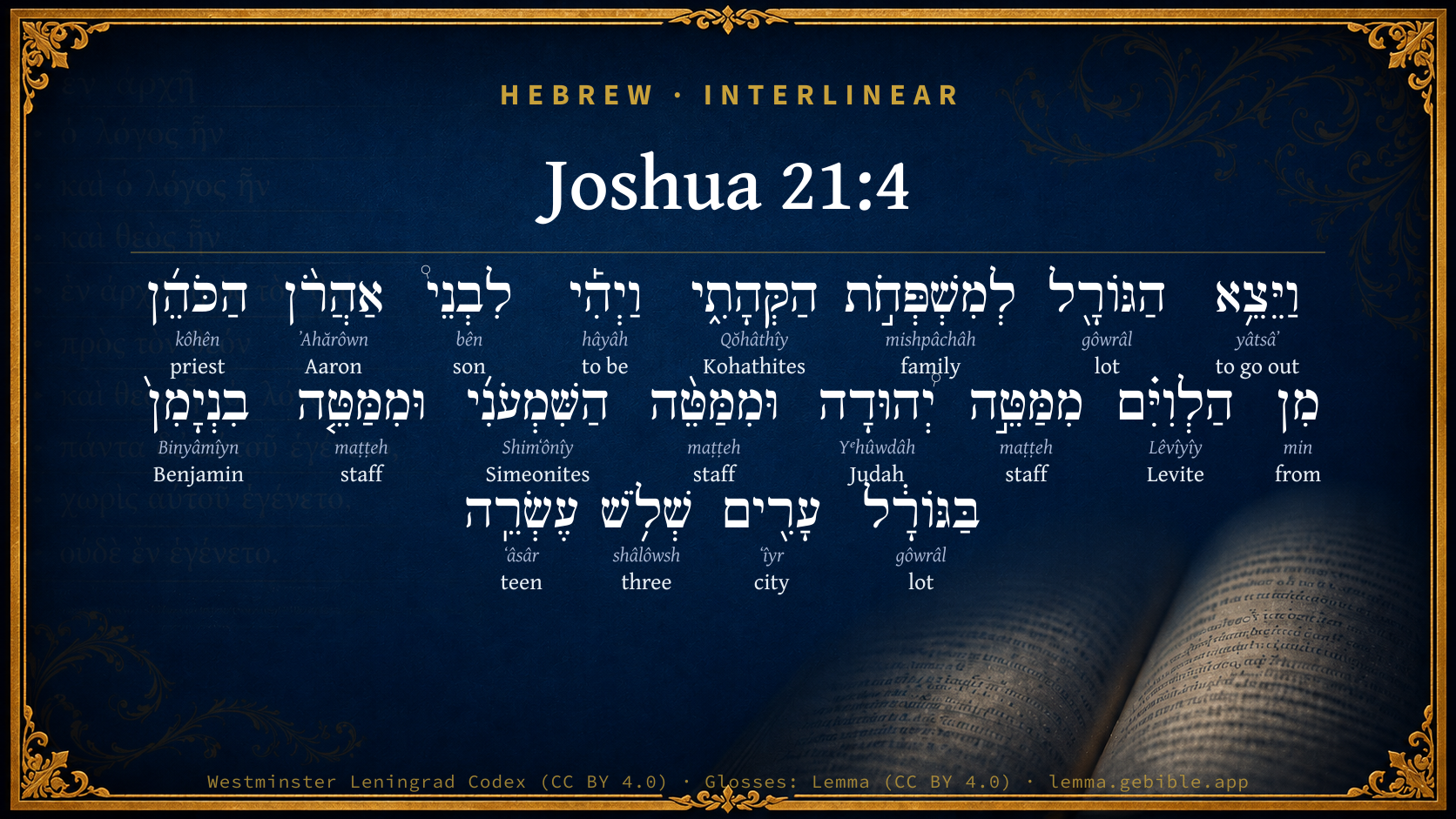
  1. וַיֵּצֵ֥א yâtsâʼ H3318 “and · to go out” Conjunction + Verb, Qal, Sequential Imperfect, 3rd Person, Masculine, Singular
  2. הַגּוֹרָ֖ל gôwrâl H1486 “the · lot” Particle, Definite Article + Noun, Common, Masculine, Singular, Absolute
  3. לְמִשְׁפְּחֹ֣ת mishpâchâh H4940 “to/for · families of” Preposition + Noun, Common, Feminine, Plural, Construct
  4. הַקְּהָתִ֑י Qŏhâthîy H6956 “the · Kohathites” Particle, Definite Article + Noun, Gentilic, Masculine, Singular, Absolute
  5. וַיְהִ֡י hâyâh H1961 “and · to be” Conjunction + Verb, Qal, Sequential Imperfect, 3rd Person, Masculine, Singular
  6. לִבְנֵי֩ bên H1121 “to/for · sons of” Preposition + Noun, Common, Masculine, Plural, Construct
  7. אַהֲרֹ֨ן ʼAhărôwn H175 “Aaron” Noun, Proper
  8. הַכֹּהֵ֜ן kôhên H3548 “the · priest” Particle, Definite Article + Noun, Common, Masculine, Singular, Absolute
  9. מִן min H4480 “from” Preposition
  10. הַלְוִיִּ֗ם Lêvîyîy H3881 “the · Levites” Particle, Definite Article + Noun, Gentilic, Masculine, Plural, Absolute
  11. מִמַּטֵּ֣ה maṭṭeh H4294 “from · staff of” Preposition + Noun, Common, Masculine, Singular, Construct
  12. יְ֠הוּדָה Yᵉhûwdâh H3063 “Judah” Noun, Proper
  13. וּמִמַּטֵּ֨ה maṭṭeh H4294 “and · from · staff of” Conjunction + Preposition + Noun, Common, Masculine, Singular, Construct
  14. וּמִמַּטֵּ֤ה maṭṭeh H4294 “and · from · staff of” Conjunction + Preposition + Noun, Common, Masculine, Singular, Construct
  15. בִנְיָמִן֙ Binyâmîyn H1144 “Benjamin” Noun, Proper
  16. בַּגּוֹרָ֔ל gôwrâl H1486 “in/at the · lot” Preposition, Determined + Noun, Common, Masculine, Singular, Absolute
  17. עָרִ֖ים ʻîyr H5892 “cities” Noun, Common, Feminine, Plural, Absolute
  18. שְׁלֹ֥שׁ shâlôwsh H7969 “three” Adjective, Cardinal number, Feminine, Singular, Absolute
  19. עֶשְׂרֵֽה ʻâsâr H6240 “teen” Adjective, Cardinal number, Feminine, Singular, Absolute

About this verse

These counts appear in no published source. They are computed here, from the morphology-tagged text and Lemma’s own curated glosses. What Lemma adds →

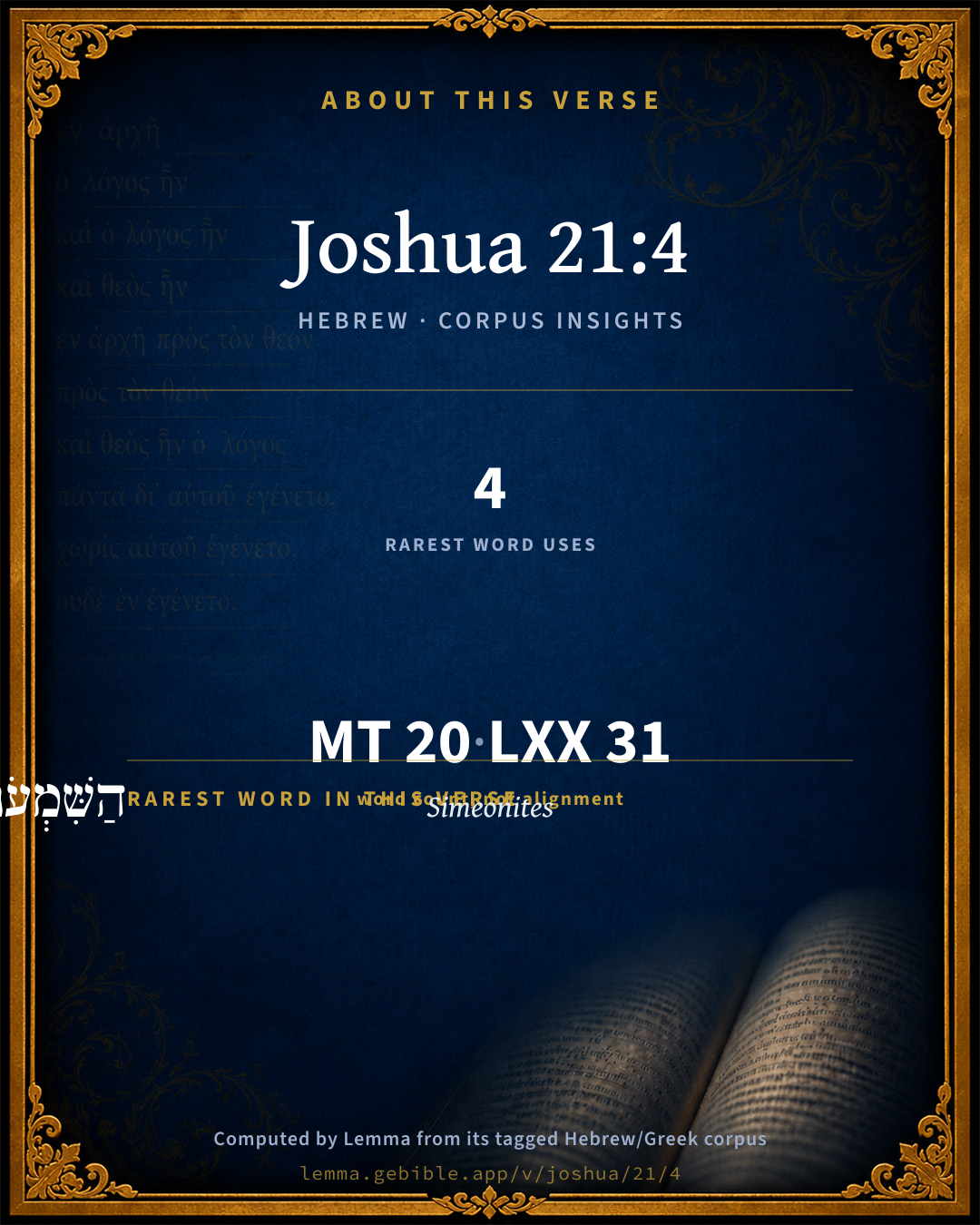
20
words
17
distinct lemmas
Historical
section

Notable vocabulary

The rarest word here is הַשִּׁמְעֹנִ֜י Simeonites H8099 — appearing just 4 times in the whole Hebrew Bible.

Shared distinctive vocabulary

הַשִּׁמְעֹנִ֜י Simeonites H8099 occurs in 4 verses of the Hebrew Bible. Also found in:

Grammatical profile

  • 2 verbs
  • 15 nouns
  • 2 adjectives
  • 1 preposition

Verb forms

  • וַיֵּצֵ֥א Qal · Sequential Imperfect
  • וַיְהִ֡י Qal · Sequential Imperfect

Repetition

Words recur within this verse — often emphatic in Hebrew:

  • מִמַּטֵּ֣ה staff H4294 ×3
  • הַגּוֹרָ֖ל lot H1486 ×2

Hebrew & Septuagint length

In English translation the verse runs 48 words from the Hebrew and 44 from the Septuagint (LXX English) — closely comparable.

A rough comparison of the two English renderings, which tokenize alike — not a word-level alignment.

Word counts can differ between the Hebrew and the Greek without any difference in meaning — e.g. the Hebrew direct-object marker אֵת has no separate Greek word, and Greek often adds the article ὁ.

In the original languages it is 20 Hebrew tokens and 31 Greek tokens — but the two are counted differently (Hebrew bundles its prefixes and suffixes into one token; the Greek is in lemma form), so that isn’t a like-for-like length.

Cross-references

3

Topical passages linked to Joshua 21:4 in the Treasury of Scripture Knowledge — connected by theme and wording, ordered by reader-vote popularity; previews shown in the World English Bible.

  • Joshua 21:8–19 The children of Israel gave by lot to the Levites these cities with their suburbs, as Yahweh commanded by Moses.
  • Joshua 24:33 Eleazar the son of Aaron died; and they buried him in the hill of Phinehas his son, which was given him in the hill-country of Ephraim.
  • 1 Chronicles 6:54–60 Now these are their dwelling-places according to their encampments in their borders: to the sons of Aaron, of the families of the Kohathites (for theirs was the [first] lot),

Cross-references courtesy of OpenBible.info (CC BY 4.0).

Hebrew and Greek witnesses Masoretic Hebrew ↔ Greek Septuagint

The same verse in the two great witnesses to the Old Testament, shown verse-for-verse.

These are two independent witnesses, not word-aligned to each other, and the Septuagint is shown in lemma (dictionary) form.

Hebrew Joshua 21:4 Masoretic · Westminster Leningrad Codex

וַיֵּצֵ֥א הַגּוֹרָ֖ל לְמִשְׁפְּחֹ֣ת הַקְּהָתִ֑י וַיְהִ֡י לִבְנֵי֩ אַהֲרֹ֨ן הַכֹּהֵ֜ן מִן הַלְוִיִּ֗ם מִמַּטֵּ֣ה יְ֠הוּדָה וּמִמַּטֵּ֨ה הַשִּׁמְעֹנִ֜י וּמִמַּטֵּ֤ה בִנְיָמִן֙ בַּגּוֹרָ֔ל עָרִ֖ים שְׁלֹ֥שׁ עֶשְׂרֵֽה

The lot came out for the families of the Kohathites: and the children of Aaron the priest, who were of the Levites, had by lot out of the tribe of Judah, and out of the tribe of the Simeonites, and out of the tribe of Benjamin, thirteen cities.

World English Bible · Public Domain

Greek LXX Joshua 21:4 Septuagint · lemma form

καί ἐκἔρχομαι ὁ κλῆρος ὁ δῆμος κααθ καί γίγνομαι ὁ υἱός ἀαρών ὁ ἱερεύς ὁ λευίτης ἀπό φυλή ιουδα καί ἀπό φυλή συμεων καί ἀπό φυλή βενιαμίν κληρωτί πόλις δέκα τρεῖς

And the lot came out for the children of Caath; and the sons of Aaron, the priests the Levites, had by lot thirteen cities out of the tribe of Juda, and out of the tribe of Symeon, and out of the tribe of Benjamin.

LXX2012 (modern English Septuagint) · Public Domain

Hebrew: Westminster Leningrad Codex (CC BY 4.0). Greek: Septuagint (public domain); English from LXX2012 (modern English Septuagint) (Public Domain). How the Septuagint differs from the Hebrew →

Targum (Aramaic paraphrase)

1

The Targum is the ancient Jewish Aramaic paraphrase of the Hebrew Scriptures — an interpretive translation, not the Hebrew text itself. Onkelos (literal) and Pseudo-Jonathan (expansive) render the Torah, and Jonathan the Prophets. Coverage is partial: where no permissively-licensed English translation exists for a verse, only the Aramaic is shown. This is verse-level text, not a word-by-word alignment to the Hebrew.

  1. Targum Jonathan Prophets (Joshua–Malachi)
    וּנְפַק עַדְבָא לְזַרְעֲיַת קְהָת וַהֲוָה לִבְנֵי אַהֲרֹן כַּהֲנָא מִן לֵוָאֵי מִשִׁבְטָא דִיהוּדָה וּמִשִׁבְטָא דְשִׁמְעוֹן וּמִשִׁבְטָא דְבִנְיָמִין בְּעַדְבָא קִרְוַיָא תְּלַת עַשְׂרֵי:

    (no public-domain English translation for this verse)

    Targum Jonathan — Aramaic: “Mikraot Gedolot” (public domain). English: “Sefaria Community Translation” (CC0 1.0 (public-domain dedication)); “London "Chaldee Paraphrase," 1871” (public domain). Text via Sefaria.

Commentary

Notes on Joshua 21:4 from classic Christian and Jewish commentators (each source and its license shown beneath its notes). The classic Christian expositions comment on the surrounding passage and are grouped to its opening verse, so a note may address several verses; the Jewish commentaries on the Tanakh (Rashi and others) are per-verse, so they appear only where the commentator wrote on this verse.

Lemma curates 59 commentaries, every one of them public domain or Creative Commons licensed, each selected and text-cleaned for this edition rather than reprinted as found. About our sources →

Trapp's Complete Commentary

John Trapp

Jos 21:4 And the lot came out for the families of the Kohathites: and the children of Aaron the priest, [which were] of the Levites, had by lot out of the tribe of Judah, and out of the tribe of Simeon, and out of the tribe of Benjamin, thirteen cities.

Ver. 4. Out of the tribe of Judah, &c.] The priests, by a sweet providence, were placed in those three tribes that were nearest to the tabernacle and temple, that they might do their work with more ease to themselves and content to the people.

John Trapp, A Commentary or Exposition upon All the Books of the Old and New Testament (1647–1656) — public domain. Text from a community e-Sword module.

Joseph Benson's Commentary

Jos 21:4. Judah, Simeon, and Benjamin — Which three tribes were nearest the temple, where their business lay. Thirteen cities — For though the priests were now few enough for one city, yet respect was to be had to their succeeding numbers; this division being made for all future generations. And seeing the Levites might sell their houses until the jubilee, (Lev 25:33,) much more might they let them; and therefore it is probable their cities were not long uninhabited, many being inclined to dwell with them, by virtue of relations contracted with them, or out of respect to the service of God, and the good of their souls.

Joseph Benson's Commentary on the Old and New Testaments (1811–1818) — public domain. Text from a community e-Sword module.

Keil & Delitzsch

C. F. Keil & F. Delitzsch

Number of the cities which the different families of Levi received from each tribe. The tribe of Levi was divided into three branches, - The Gershonites, the Kohathites, and the Merarites (see Num 3 and Exo 6:16-19). The Kohathites again were divided into the four families of Amram, Izhar, Hebron, and Uzziel (Exo 6:18); and the family of Amram into two lines, consisting of the descendants of Moses and Aaron (Exo 6:20). The priesthood was committed to the line of Aaron (Num 18:1-7); but the other descendants of Amram, i.e., the descendants of Moses, were placed on a par with the other descendants of Levi, and numbered among the simple Levites (Num. 3; Ch1 6:1-7). The towns in which the different families of Levi were to dwell were determined by lot; but in all probability the towns which each tribe was to give up to them were selected first of all, so that the lot merely decided to which branch of the Levites each particular town was to belong.

Jos 21:4

The first lot came out for the families of Kohath, and among these again for the sons of Aaron, i.e., the priests. They received thirteen towns from the tribes of Judah, Simeon, and Benjamin. "This did not happen by chance; but God, according to His wonderful counsel, placed them just in that situation which He had determined to select for His own temple" (Calvin).

Jos 21:5

The rest of the Kohathites, i.e., the descendants of Moses, Izhar, Hebron, and Uzziel, received ten towns from Ephraim, Dan, and half Manasseh.

Jos 21:6

The Gershonites received thirteen towns from Issachar, Asher, Naphtali, and half Manasseh in Bashan.

Jos 21:7-8

The Merarites received twelve towns from Reuben, Gad, and Zebulun.

The number of towns thus assigned to the Levites will not appear too large, if we consider, (1) that judging from the number of towns in so small a land, the greater part of them cannot have been very large; (2) that the Levites were not the sole possessors of these towns, but simply received the number of dwelling-houses which they actually required, with meadow land for their cattle in the suburbs of the towns, whilst the rest of the space still belonged to the different tribes; and (3) that if the 23,000 males, the number of the Levites at the second census which was taken in the steppes of Moab, were distributed among the thirty-five towns, it would give 657 males, or 1300 male and female Levites for every town. On the other hand, offence has been taken at the statement, that thirteen towns were given up to the priests; and under the idea that Aaron could hardly have had descendants enough in Joshua's time from his two sons who remained alive to fill even two towns, to say nothing of thirteen, the list has been set down as a document which was drawn up at a much later date (Maurer, etc.). But any one who takes this ground not only attributes to the distribution commission the enormous shortsightedness of setting apart towns for the priests merely to meet their existing wants, and without any regard to the subsequent increase which would take place in their numbers, but also forms too large an estimate of the size of the towns, and too small an estimate of the number of the priests. Moreover, it was never intended that the towns should be filled with priests' families; and the number of priests alive at that time is not mentioned anywhere. But if we bear in mind that Aaron died in the fortieth year of the journeys of the Israelites, at the age of 123 years (Num 33:38), and therefore was eighty-three years old at the time of the exodus from Egypt, his descendants might have entered upon the fourth generation seven years after his death. Now his two sons had twenty-four male descendants, who were the founders of the twenty-four classes instituted by David (1 Chron 24). And if we only reckon six males to each of the next generations, there would be 144 in the third generation, who would be between the ages of twenty-five and thirty-five when the distribution of the land took place, and who might therefore have had 864 male children living at that time; so that the total number of males in the families of the priests might have amounted to more than 1000, that is to say, might have consisted of at least 200 families.

Keil & Delitzsch — Biblical Commentary on the Old Testament (1861–1891) — public domain (CC PDM 1.0). Text via the HelloAO Bible API. (Old Testament only.)

Tyndale Open Study Notes

Tyndale Open Resources

21:4 The descendants of Aaron served as Israel’s priests. The cities they received were allotted by sacred lots. The priestly towns were in the tribal territories closest to Jerusalem, where the Temple was later built.

Tyndale Open Study Notes — © Tyndale Open Resources, licensed CC BY-SA 4.0. Text via the HelloAO Bible API.

Geneva Bible (1599)

Geneva Bible translators

Every tribe gave more or fewer cities according as their inheritance was great or little, Num. 35:8.

He meaneth them that were Priests: for some were but Levites.

Geneva Bible (1599) marginal notes — public domain. Text via Bolls.life.

Jamieson, Fausset & Brown

Robert Jamieson, A. R. Fausset & David Brown

the lot came out for the families of the Kohathites--The Levites were divided into Kohathites, Gershonites, and Merarites. Among the former the family of Aaron were exclusively appointed to the priesthood, and all the rest were ranked in the common order of Levites. The first lot was drawn by the Kohathites; and the first of theirs again by the priests, to whom thirteen cities were granted, and ten to the rest of the Kohathites (Jos 21:5); thirteen to the Gershonites (Jos 21:6), and twelve to the Merarites (Jos 21:7).

Jamieson, Fausset & Brown — Commentary Critical and Explanatory on the Whole Bible (1871) — public domain (CC PDM 1.0). Text via the HelloAO Bible API.

Adam Clarke's Commentary

Verse 4. Out of the tribe of Judah - Simeon, and - Benjamin, thirteen cities.] These tribes furnished more habitations to the Levites in proportion than any of the other tribes, because they possessed a more extensive inheritance; and Moses had commanded, Nu 35:8, From them that have many, ye shall give many; and from them that have few, ye shall give few: every one shall give of his cities unto the Levites, according to his inheritance. It is worthy of remark, that the principal part of this tribe, whose business was to minister at the sanctuary, which sanctuary was afterwards to be established in Jerusalem, had their appointment nearest to that city; so that they were always within reach of the sacred work which God had appointed them.

Adam Clarke's Commentary on the Bible (1810–1826) — public domain. Text from a community e-Sword/MySword module.

John Calvin's Commentaries

4. And the lot came out for the families, etc Here is first described the number of cities of which we shall have to speak by and bye. Secondly, it is distinctly said that the lot fell out to the children of Aaron in the tribe of Judah. This did not happen fortuitously, because God in his admirable counsel placed them in that locality where he had determined to choose a temple for himself. Thirdly, the narrative proceeds to give the exact names of the cities, of which the first mentioned is Hebron, of which Caleb, with great equanimity, allowed himself to be deprived. Should any one object that the first city of all that ought to have been given them was Jerusalem, where they were to have their future station, it is easy to answer, that moderate sized cities were delivered to them as their condition required. Moreover, Jerusalem was not then subjugated, as it continued under the power of the Jebusites. In short, it would have been absurd to assign a royal seat to priests. And their religion and faith was the better proved by this, that they migrated of their own accord from their native soil to devote their attention to sacred things. For no priest performed the office without becoming a stranger. Their weakness, however, was so far indulged by giving them a grant of neighboring cities, that they might not have the fatigue of a long journey in going to perform their function. Moreover, the giving of thirteen cities for a habitation to one family, and that not very numerous, confirms what I have elsewhere said, that the other tribes possessed very many cities, of which no mention is made; in a short time this will be more certainly confirmed.

John Calvin's Commentaries (1540-1563) — public domain. Text from the Calvin Translation Society English edition (1840s-50s) via the Christian Classics Ethereal Library (ccel.org). Calvin's coverage is partial (roughly two-thirds of the Bible); uncommented books and verses are honest gaps, never fabricated. The 19th-century editor's footnotes and remarks are omitted so the notes are faithfully Calvin's own voice.

Ellicott's Commentary for English Readers

(4-8) The order of the distribution—viz., (1) to priests, (2) to Kohathites, (3) to Gershonites, (4) to Merarites—is in strict agreement with the order of priority observed in the exodus. In the camp of Israel there were two squares surrounding the tabernacle: an inner square of priests and Levites, an outer square of the tribes of Israel, three on each side. The inner square was arranged thus:—The priests, with Moses and Aaron, on the east, by the entrance of the tabernacle; the Kohathites on the south, the Gershonites on the west, and the Merarites on the north. On the march the priests were the chief officers of this portion of the army. The Kohathites carried the sacred vessels, the Gershonites the curtains and various fabrics of the tent and tabernacle, and the Merarites the bars and boards. When they received their inheritances in Palestine, the same relative order was preserved.

INHERITANCE OF THE PRIESTS (Jos_21:9-19).

(9) Out of the tribe of . . . Judah . . . and Simeon; and (17) out of the tribe of Benjamin.—It is worthy of notice that, with the exception of a single city in the tribe of Simeon (viz., Ain, Jos_21:16), all the priestly cities are so arranged as to fall ultimately within the kingdom of Judah, of which the capital was Jerusalem, the city which the Lord had chosen out of all the tribes of Israel to put His name there. The Levites also left their cities and their suburbs in the reign of Jeroboam (2Ch_11:14), and came over to Judah. But the fact that all the priests, with the trifling exception noted above, were already settled in that kingdom, must have been a great attraction.

When these facts are observed, it is hardly possible not to be struck with the undesigned agreement between the Book of Joshua and the later history, as well as with the Divine foresight which arranged the distribution of the people thus.

(13) Hebron (El Khalil).

(14) Jattir (Attir).

Eshtemoa (Es Semû’a).

(15) Debir.—Probably identical with the town of this name in Jos_15:49 (Edh. Dhâherîyeh), south-west of Hebron.

(16) Juttah (Yuttah).

Beth-shemesh (Ain Shemes).

(17) Gibeon (El Jib).

Geba (Jeb’a).

(18) Anathoth (‘Anâta).

Almon (’Almit).

(20) The children of Kohath . . . had the cities . . . out of the tribe of Ephraim.—In this instance the most honoured among the families of the Levites (after the house of Aaron) is grouped with the tribe next in honour after Judah. The tribes of Dan and Manasseh (Jos_21:23-25) also were highly honoured, as they received Kohathites to settle among them.

(21) Shechem . . . in mount Ephraim, to be a city of refuge.—The metropolis of Israel for the time being is made a city of refuge; and there is an obvious convenience in this. In the same way Solomon made Jerusalem a city of refuge for Shimei, binding him not to leave the city under penalty of death (1Ki_2:36-46).

Gezer (Tell Jezer).

(22) Kibzaim (Tell el-Kabûs).

Beth-horon (Beit-’Ur).

(23, 24) For these Danite cities, see Jos_19:40-46.

(25) Tanach—i.e., Taanach—a city of Manasseh, in the territory of Isaachar.

(27) Unto the children of Gershon . . . out of the other half tribe of Manasseh . . . in Bashan, and (28) out of the tribe of Issachar, and (30) out of the tribe of Asher.—Each of the four divisions of the house of Levi is made a bond to cement three of the twelve tribes together. Sometimes the association is obvious. In this case the two. sides of Jordan are bound together by the Gershonites.

(28) Dabareh—i.e., Daberath (Debûrieh).

(29) Jarmuth—i.e., Remeth.

En-gannim (Jenin).

(30) Mishal.—See Jos_19:46.

Abdon.—Also mentioned there.

(32) For Kedesh see Jos_19:37. The other two are not identified with any certainty.

(34) Unto the . . . . children of Merari . . . . out of the tribe of Zebulun, and (36) out of the tribe of Reuben, and (38) out of the tribe of Gad.—In the case of the Ger shonites, we saw two tribes on the west of Jordan united to one on the east. The Merarites are employed to connect two tribes on the east of Jordan with one upon the west, and the south-east of the Israelitish territory with the north. Thus “the whole body by joints and bands” was “knit together, that it might grow with a growth of God.” It is not a little interesting to observe that Joshua’s work of dividing the land of Canaan was so much directed to preserve the union of the several parts. The name of Levi (joined) thus received a spiritual emphasis. He was divided in Israel that he might be a bond of union, bringing the tribes of Israel together, and joining all of them to their God.

Jokneam (Tell Keimûn, near Carmel).

(35) Nahalal (‘Ain Mahil).

(43) And the Lord gave unto Israel.—Although the conquest of Canaan was not completed in the time of Joshua, as it was afterwards under David, yet we see by this statement that the expectations of Israel were abundantly satisfied. They received all that they hoped for.

A Bible Commentary for English Readers, edited by Charles John Ellicott (1878–1897) — public domain. Text from a community e-Sword module.

The Cambridge Bible for Schools and Colleges

gen. ed. J. J. S. Perowne

4–8. General Description of the Levitical Cities

4. the lot came out] As in the case of the inheritance of the other tribes, so in the apportioning of their cities to the Levites, recourse was had to the sacred lot. “It had probably been decided beforehand what cities each tribe was to give up, and therefore it only now remained for the lot to determine to which branch of the Levites each city should be given.”

the families of the Kohathites] The Levites were divided into three families, (a) the Gershonites, (b) the Kohathites, (c) the Merarites, so named after the three sons of Levi (Gen_46:11). The family-tree stood as follows:—

The Kohathites held the first rank, as being the family to which Aaron belonged, and while the priesthood was confined to the house of Aaron, the posterity of Moses were reckoned as Levites, on an equality with the rest of the descendants of Levi (Numbers 3; 1Ch_6:48-49). It had been the duty of the Kohathites, during the wanderings, on the removal of the Tabernacle, to bear all the sacred vessels, including the Ark itself, the table of shewbread, the seven-branched candlestick, the altars of incense and of burnt-offering (Num_3:31; Num_4:6; Num_4:9; Num_4:15; Deu_31:25).

and the children of Aaron the priest] As the first lot was drawn by the Kohathites, so again the first of theirs fell to the Aaronites or priests.

out of the tribe of Judah] To the priests of the line of Aaron thirteen cities were assigned out of the tribes of Judah, Simeon, and Benjamin.

The Cambridge Bible for Schools and Colleges (gen. ed. J. J. S. Perowne; Cambridge University Press, 1878–1918) — public domain. Text from a community e-Sword module.

John Gill's Exposition

And the lot came out for the family of the Kohathites,.... The first lot that was drawn out of the pot or urn was for the descendants of Kohath, a son of Levi:

and the children of Aaron the priest, which were of the Levites; who descended from Amram, the eldest son of Kohath, and these were not only Levites, but priests: these

had by lot out of the tribe of Judah, and out of the tribe of Simeon,

and out of the tribe of Benjamin, thirteen cities; which are after mentioned by name; and as these were priests, whose business was to serve in the temple, and at the altar, the cities assigned them by the lot, were, by the wise disposal of divine Providence, ordered them out of those tribes which lay nearest to Jerusalem; the place God had chosen to put his name in, where the temple would be built, and the altars erected for sacrifices and incense.

John Gill's Exposition of the Whole Bible (1746–1763) — public domain (CC PDM 1.0). Text via the HelloAO Bible API.

Albert Barnes' Notes on the Bible

Thirteen cities - This number is said to be too great for the single family of Aaron. But it appears 1 Chr. 24 that the two surviving sons of Aaron, Eleazar and Ithamar, had together 24 sons, the heads of the priestly families. Since Aaron was 123 years old when he died Num 33:39, his sons’ grandchildren and great grandchildren were no doubt living in the elapsing years of Joshua’s course, and had to he provided with dwellings. They might altogether number several thousands. The “cities” of Canaan were for the most part small; as is manifest from the astonishing number of them in proportion to the area of the land, more particularly in the south, where the portion of the priests was situated. The priests or Levites would not occupy the whole of the dwellings in any city, nor all its “fields,” nor necessarily and always all its “villages” (compare Jos 21:12). Non-Levites, to whom the cultivation of their land, and other secular concerns, were entrusted, no doubt resided in the Levitical cities or their precincts. It appears, further, that several of the cities here enumerated were only wrested from the Canaanites at a later date.

Albert Barnes' Notes on the Bible (1834–1885) — public domain. Text from a community e-Sword/MySword module.

Haydock's Catholic Bible Commentary

Thirteen. These three tribes give more cities than any of the others, because their territories were the largest, Numbers xxxv. 8. Juda in particular, had a most extensive portion allotted to him at first; so that a part was afterwards taken away to accommodate Simeon and Dan, and now so many cities are appointed for the priests, (Calmet) who would thus have their residence near the temple, when it should be built. (Haydock) --- God ordered the lots according to the designs of his providence; and gave the priests, though so few in number, more than what fell to the share of all the rest of the family of Caath. (Calmet) --- This family had in all twenty-three cities, lying south of Dor and Bethsan, and leaving the tribe of Issachar on the north. Gerson had thirteen cities among the three other northern tribes, and that of Manasses on the east side of the Jordan; while Merari had twelve, more southward on the same side, in the tribes of Gad and of Ruben, and on the west of the Jordan, in the tribe of Zabulon. Thus these two families were more intermixed. (Haydock)

George Leo Haydock (1774–1849), Haydock's Catholic Family Bible and Commentary, 1859 edition — public domain. Excludes Psalms (Douay-Rheims chapter numbering differs from Protestant) and Deuterocanonical books (Catholic canon only).

Matthew Poole's English Annotations

Which three tribes were nearest to the temple, where their business lay.

Thirteen cities; for though the priests were now few enough for one city, yet respect was to be had to their succeeding numbers; this division being made for all future generations. And seeing the Levites might sell their houses until the jubilee, Lev 25:33, much more might they let them; and therefore it is probable their cities were not very long uninhabited, many being inclined to dwell with them by virtue of relations contracted with them, or dependence upon or expectation from them; or out of respect to the service of God, and the good of their souls.

Matthew Poole's English Annotations on the Holy Bible (1683–1685) — public domain. Text from a community e-Sword/MySword module.

Whedon's Commentary on the Bible

Daniel D. Whedon

4. Kohathites — The first of the families of the Levites among whom the family of Aaron were exclusively appointed to the priesthood. These by virtue of their office had the precedence in the assignment of the lots, and received thirteen cities in contiguous territory; the rest of the Kohathites ten cities, (Jos_21:5,) in tribes also adjoining. There was a divine prescience displayed in so locating the priests that in the future great schism of the State under Rehoboam the seceding tribes found themselves destitute of the divinely-appointed priesthood.

Daniel D. Whedon (gen. ed.), Commentary on the Old and New Testaments (1874–1909) — public domain. Text from a community e-Sword module.

The Pulpit Commentary

And the lot came out. As in the distribution of the land among the tribes, so in the division of the cities among the tribes of Levi, the whole matter was referred to the judgment of God. Thus solemnly placed in His hands, the division would not afterwards become the occasion of jealousy or dispute. The division was first made between the descendants of the three sons of Levi, Gershon, Kohath, and Merari, (see Exo_6:16-25) and then, as regards the Kohathites, between the priests, the descendants of Aaron, and the rest of the Levites. We have remarked above (Jos_19:50) on the disinterestedness of Joshua. We have now to remark on the same characteristic as displayed by Moses. There was no attempt on the part of Moses to "found a family," the object of ambition with most men, whether kings or private persons possessed of wealth. No special privileges belonged to his descendants. They merged in the undistinguished herd of the Levites generally. In this Moses contrasts favourably with most public men in our own day; he stands out prominently before nearly all the great leaders and conquerors before or even after the Christian era. The same may be said of Joshua, his successor. Cincinnatus may be in some measure compared with them, but as a dictator simply in time of danger, his power was by no means so absolute, nor were his temptations so great as those of the two successive leaders of the Israelites. Thirteen cities. It has been contended by Maurer and others that this number of cities was largely in excess of what could possibly be required for the descendants of Aaron in so short a time. But we have to consider

(1) that the cities were probably not, at least at first, inhabited exclusively by the priests;

(2) that the Israelites multiplied rapidly, and that the number of descendants in the fourth generation would probably be nearly a thousand, and in the fifth, above five thousand;

(3) that all the cities were not, as yet, actually taken from the Canaanites at all, and so therefore were in all probability only intended as an eventual possession of the priests, and

(4) that the cities themselves were probably not of any very great size. It may be worthy of remark, as a proof of the accuracy of the writers of the Old Testament, and as a means of approximately ascertaining the date of the Book of Joshua, that Nob, mentioned as a priestly city in 1Sa_22:11, 1Sa_22:19, is not found in the list given here. For the number of priests being sure to increase, it is not surprising that in the course of time additional cities should be assigned to them. And since Nob is not mentioned here, we have good grounds for concluding that the Book of Joshua was not a compilation put together after the reign of Saul Calvin does not fail to remark on the prescience of God here demonstrated. He had fixed upon Jerusalem as the place where he would "put His Name." He therefore directed that the lot of the priests should fall within the limits of the tribes of Judah and Benjamin, on whose borders Jerusalem stood. Simeon is also mentioned, but the territory of that tribe, (Jos_19:1, Jos_19:9) was contained within the borders of Judah. For theirs was the first lot.

Not because Kohath was the firstborn, for this Gershon appears to have been, but because to Aaron and his sons had the priesthood been reserved.

The Pulpit Commentary (1880–1919), ed. H.D.M. Spence-Jones & Joseph S. Exell — public domain. Text from a community e-Sword module.

John Wesley's Explanatory Notes

Judah, Simeon, and Benjamin - Which three tribes were nearest the temple, where their business lay. Thirteen cities - For though the priests were now few enough for one city, yet respect was to be had to their succeeding numbers; this division being made for all future generations. And seeing the Levites might sell their houses until the Jubilee, Lev. xxv, 33, much more might they let them; and therefore it is probable their cities were not long uninhabited, many being inclined to dwell with them by virtue of relations contracted with them; or out of respect to the service of God, and the good of their souls.

John Wesley, Explanatory Notes Upon the Whole Bible (1754–1765) — public domain. Text via the GEBible commentary corpus.

unfoldingWord translationNotes

Door43 World Missions Community

casting of lots

A random method of choosing to remove the choice from the leader's will, often done with the idea that God will decide the outcome. See how you translated this in Joshua 19:1.

Kohathites

This priests in this group were descendants of Levi's son Kohath. A portion of them were also descendants of Aaron, Kohath's grandson. (See: How to Translate Names)

thirteen cities ... ten cities

numbers of cities (See: Numbers)

half tribe

Half the tribe because the other half received their inheritance before crossing the Jordan River.

translationWords

clan

priest

descend

Aaron

Levi

tribe

Judah

Simeon

Benjamin

Ephraim

Dan

Manasseh

unfoldingWord translationNotes — © Distant Shores Media and the Door43 World Missions Community, licensed CC BY-SA 4.0. Source: git.door43.org/Door43/en_tn.

Lesson kit

Teaching starters — assembled from the data on this page, not authored interpretation. Every prompt links to the verse data it draws on. Edit before teaching.

Joshua, in the Historical, opens this verse with 20 words (17 distinct Hebrew lemmas). Its most distinctive word is Shimʻônîy (“Simeonites”). A historical commentator’s framing appears above. Read the whole chapter for the surrounding context.

Discussion questions

  1. How does “Simeonites” (Shimʻônîy) shape what this verse is saying?
  2. How does Numbers 25:14, which shares the word «Simeonites», read alongside this verse?
  3. What does the repetition of “staff” (3× in this one verse) do in this verse?
  4. These translations render this verse differently. What is at stake in choosing one wording over another?
  5. «וַיֵּצֵ֥א» is a Qal Sequential Imperfect verb. How does that grammatical form shape the action described?
  6. Compare how Trapp's Complete Commentary and Joseph Benson's Commentary read this verse. Where do they agree or differ?

Things to notice

Reading settings

Reading text

Shown beneath each verse's original-language words.

Old Testament
Old Testament edition

Read the OT as the Masoretic Hebrew (MT) or the Greek Septuagint (LXX).

English shown for the Greek Septuagint (in the Hebrew ↔ Greek comparison).

Comparing translations? Open the Compare panel on any verse page to stack up to four side by side.