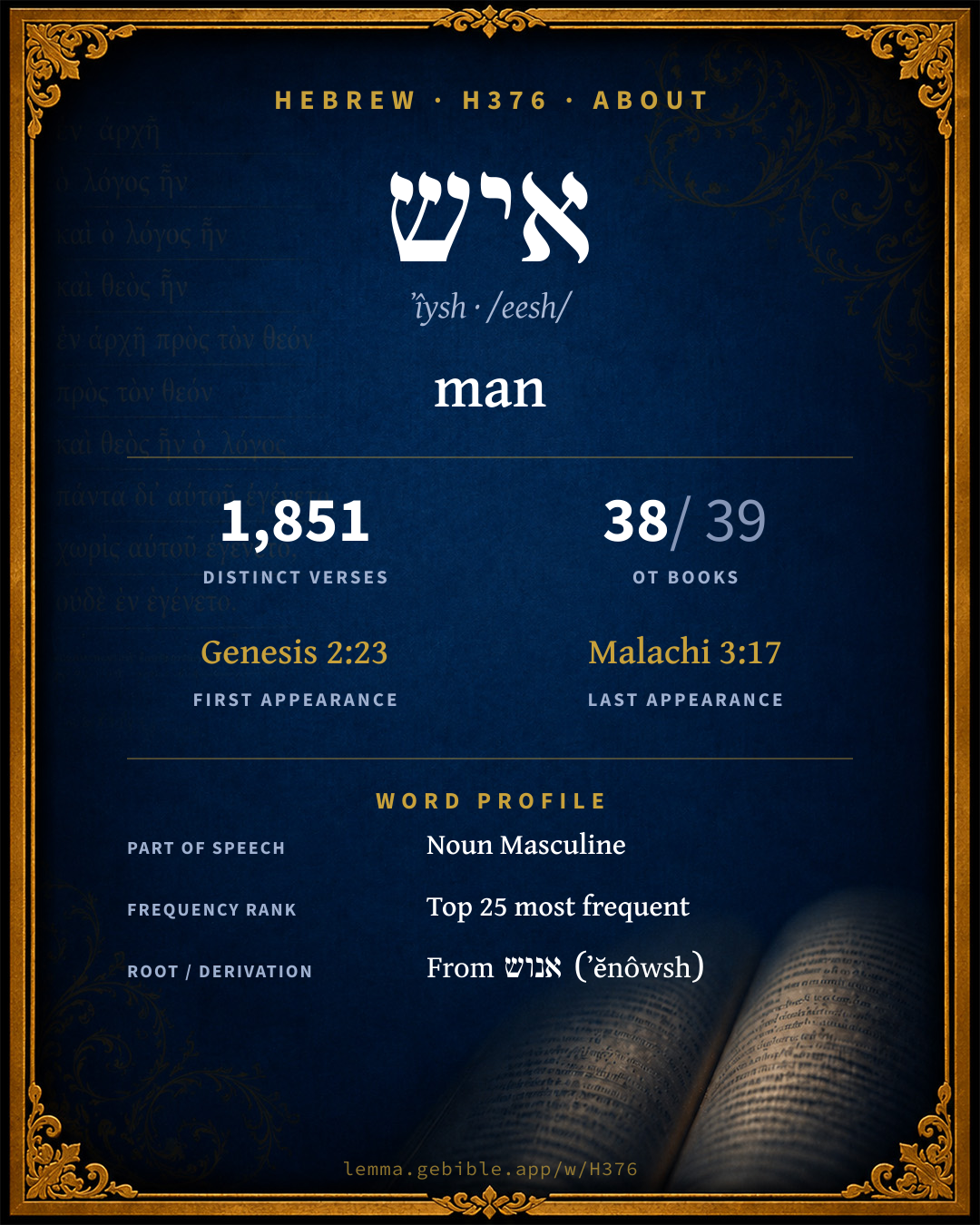
אִישׁ
man
‘man’ is one of 3 main senses fuller range ↓
Full lexicon entry — Brown-Driver-Briggs (BDB)
From Brown-Driver-Briggs (BDB)
Where this word appears
See every Absolute-state word in the Hebrew Bible →
Grammar key — what these labels mean
Part of speech
- Noun
- A naming word — a person, place, thing, or idea.
Noun type
- Common
- A common noun — a general class of person, place, or thing (“king,” “city,” “water”), not a specific name.
State
- Absolute
- The independent form of a noun, not bound to a following word.
- Construct
- A noun bound to a following noun in a possessive / “of” relationship (the construct chain).
Gender
- Masculine
- Grammatically masculine.
Number
- Singular
- One.
- Plural
- More than one (in Hebrew, generally three or more).
43 verses where H376 appears in the Absolute state in the Book of Isaiah. Filtered view — show all forms. Click any verse to open its interlinear word-by-word view. Verse text shown in the World English Bible for context — . Each verse’s Hebrew form is shown with its reference; the English is not keyword-highlighted, since the data carries no word-level English alignment. Use “Compare translations” on any verse to read it across multiple English versions. This concordance covers the Hebrew Bible; Septuagint (Greek Old Testament) occurrences are not indexed here.
Isaiah
- Isaiah 2:9 אִ֑ישׁ n c ms Man is brought low, And mankind is humbled; Therefore don't forgive them.
- Isaiah 2:11 אֲנָשִׁ֑ים n c mp The lofty looks of man will be brought low, The haughtiness of men will be bowed down, And Yahweh alone will be exalted in that day.
- Isaiah 2:17 אֲנָשִׁ֑ים n c mp The loftiness of man shall be bowed down, And the haughtiness of men shall be brought low; And Yahweh alone shall be exalted in that day.
- Isaiah 3:5 אִ֥ישׁ בְּ/אִ֖ישׁ וְ/אִ֣ישׁ n c ms prep + n c ms conj + n c ms The people will be oppressed, Everyone by another, And everyone by his neighbor. The child will behave himself proudly against the old man, And the base against the honorable.
- Isaiah 3:6 אִ֤ישׁ n c ms Indeed a man shall take hold of his brother in the house of his father, saying, "You have clothing, you be our ruler, And let this ruin be under your hand."
- Isaiah 4:1 בְּ/אִ֣ישׁ prep + n c ms Seven women shall take hold of one man in that day, saying, "We will eat our own bread, and wear our own clothing: only let us be called by your name. Take away our reproach."
- Isaiah 5:15 אִ֑ישׁ n c ms So man is brought low, Mankind is humbled, And the eyes of the arrogant ones are humbled;
- Isaiah 6:5 אִ֤ישׁ n c ms Then I said, "Woe is me! For I am undone, because I am a man of unclean lips, and I dwell in the midst of a people of unclean lips: for my eyes have seen the King, Yahweh of Hosts!"
- Isaiah 7:13 אֲנָשִׁ֔ים n c mp He said, "Listen now, house of David: Is it not enough for you to try the patience of men, that you will try the patience of my God also?
- Isaiah 7:21 אִ֛ישׁ n c ms It shall happen in that day that a man shall keep alive a young cow, and two sheep;
- Isaiah 9:19 אִ֥ישׁ n c ms Through the wrath of Yahweh of hosts is the land burnt up; and the people are as the fuel of fire: no man spares his brother.
- Isaiah 9:20 אִ֥ישׁ n c ms One shall snatch on the right hand, and be hungry; and he shall eat on the left hand, and they shall not be satisfied: they shall eat every man the flesh of his own arm:
- Isaiah 13:8 אִ֤ישׁ n c ms and they shall be dismayed; pangs and sorrows shall take hold [of them]; they shall be in pain as a woman in travail: they shall look in amazement one at another; their faces [shall be] faces of flame.
- Isaiah 13:14 אִ֤ישׁ וְ/אִ֥ישׁ n c ms conj + n c ms It shall happen, that as the chased roe, and as sheep that no man gathers, they shall turn every man to his own people, and shall flee every man to his own land.
- Isaiah 14:16 הָ/אִישׁ֙ ptcl def.art + n c ms Those who see you shall gaze at you, they shall consider you, [saying], "Is this the man who made the earth to tremble, who shook kingdoms;
- Isaiah 14:18 אִ֥ישׁ n c ms All the kings of the nations, all of them, sleep in glory, everyone in his own house.
- Isaiah 19:2 אִישׁ וְ/אִ֣ישׁ n c ms conj + n c ms I will stir up the Egyptians against the Egyptians: and they shall fight everyone against his brother, and everyone against his neighbor; city against city, [and] kingdom against kingdom.
- Isaiah 21:9 אִ֔ישׁ n c ms and, behold, here comes a troop of men, horsemen in pairs. He answered, Fallen, fallen is Babylon; and all the engraved images of her gods are broken to the ground.
- Isaiah 29:13 אֲנָשִׁ֖ים n c mp The Lord said, Because this people draw near [to me], and with their mouth and with their lips to honor me, but have removed their heart far from me, and their fear of me is a commandment of men which has been taught [them];
- Isaiah 31:7 אִ֚ישׁ n c ms For in that day they shall cast away every man his idols of silver, and his idols of gold, which your own hands have made to you for a sin.
- Isaiah 31:8 אִ֔ישׁ n c ms The Assyrian shall fall by the sword, not of man; and the sword, not of men, shall devour him; and he shall flee from the sword, and his young men shall become subject to forced labor.
- Isaiah 32:2 אִ֥ישׁ n c ms A man shall be as a hiding-place from the wind, and a covert from the tempest, as streams of water in a dry place, as the shade of a great rock in a weary land.
- Isaiah 36:6 אִישׁ֙ n c ms Behold, you trust on the staff of this bruised reed, even on Egypt, whereon if a man lean, it will go into his hand, and pierce it: so is Pharaoh king of Egypt to all who trust on him.
- Isaiah 36:12 הָ/אֲנָשִׁ֗ים ptcl def.art + n c mp But Rabshakeh said, Has my master sent me to your master, and to you, to speak these words? [has he] not [sent me] to the men who sit on the wall, to eat their own dung, and to drink their own water with you?
- Isaiah 36:16 אִישׁ וְ/אִ֣ישׁ אִ֥ישׁ n c ms conj + n c ms n c ms Don't listen to Hezekiah: for thus says the king of Assyria, Make your peace with me, and come out to me; and eat you everyone of his vine, and everyone of his fig tree, and drink you everyone the waters of his own cistern;
- Isaiah 36:18 אִ֣ישׁ n c ms Beware lest Hezekiah persuade you, saying, Yahweh will deliver us. Has any of the gods of the nations delivered his land out of the hand of the king of Assyria?
- Isaiah 39:3 הָ/אֲנָשִׁ֣ים ptcl def.art + n c mp Then came Isaiah the prophet to king Hezekiah, and said to him, What said these men? and from whence came they to you? Hezekiah said, They are come from a far country to me, even from Babylon.
- Isaiah 40:26 אִ֖ישׁ n c ms Lift up your eyes on high, and see who has created these, who brings out their host by number; he calls them all by name; by the greatness of his might, and because he is strong in power, not one is lacking.
- Isaiah 41:6 אִ֥ישׁ n c ms They help everyone his neighbor; and [every one] says to his brother, Be of good courage.
- Isaiah 41:28 אִ֔ישׁ n c ms When I look, there is no man: even among them there is no counselor who, when I ask of them, can answer a word.
- Isaiah 44:13 אִ֔ישׁ n c ms The carpenter stretches out a line; he marks it out with a pencil; he shapes it with planes, and he marks it out with the compasses, and shapes it after the figure of a man, according to the beauty of a man, to dwell in a house.
- Isaiah 47:15 אִ֤ישׁ n c ms Thus shall the things be to you in which you have labored: those who have trafficked with you from your youth shall wander everyone to his quarter; there shall be none to save you.
- Isaiah 50:2 אִ֗ישׁ n c ms Why, when I came, was there no man? when I called, was there none to answer? Is my hand shortened at all, that it can't redeem? or have I no power to deliver? Behold, at my rebuke I dry up the sea, I make the rivers a wilderness: their fish stink, because there is no water, and die for thirst.
- Isaiah 52:14 מֵ/אִ֖ישׁ prep + n c ms Like as many were astonished at you (his visage was so marred more than any man, and his form more than the sons of men),
- Isaiah 53:3 אִישִׁ֔ים אִ֥ישׁ n c mp n c ms cs He was despised, and rejected by men; a man of suffering, and acquainted with disease: and as one from whom men hide their face he was despised; and we didn't respect him.
- Isaiah 53:6 אִ֥ישׁ n c ms All we like sheep have gone astray; everyone has turned to his own way; and Yahweh has laid on him the iniquity of us all.
- Isaiah 56:11 אִ֥ישׁ n c ms Yes, the dogs are greedy, they can never have enough; and these are shepherds who can't understand: they have all turned to their own way, each one to his gain, from every quarter.
- Isaiah 57:1 אִ֖ישׁ וְ/אַנְשֵׁי n c ms conj + n c mp cs The righteous perishes, and no man lays it to heart; and merciful men are taken away, none considering that the righteous is taken away from the evil [to come].
- Isaiah 59:16 אִ֔ישׁ n c ms He saw that there was no man, and wondered that there was no intercessor: therefore his own arm brought salvation to him; and his righteousness, it upheld him.
- Isaiah 63:3 אִ֣ישׁ n c ms I have trodden the winepress alone; and of the peoples there was no man with me: yes, I trod them in my anger, and trampled them in my wrath; and their lifeblood is sprinkled on my garments, and I have stained all my clothing.
- Isaiah 66:3 אִ֗ישׁ n c ms He who kills an ox is as he who kills a man; he who sacrifices a lamb, as he who breaks a dog's neck; he who offers an offering, [as he who offers] pig's blood; he who burns frankincense, as he who blesses an idol. Yes, they have chosen their own ways, and their soul delights in their abominations:
- Isaiah 66:13 כְּ/אִ֕ישׁ prep + n c ms As one whom his mother comforts, so will I comfort you; and you shall be comforted in Jerusalem.
- Isaiah 66:24 הָ/אֲנָשִׁ֔ים ptcl def.art + n c mp They shall go forth, and look on the dead bodies of the men who have transgressed against me: for their worm shall not die, neither shall their fire be quenched; and they shall be an abhorring to all flesh.
About this entry
At a glance — auto-summarized from this page’s data, not written by a person. Every figure links to its source below. This summary describes the numbers; it doesn’t interpret them.
At its core, איש (ʼîysh) means “man.” The King James Version also renders it “every man,” a usage modern versions have dropped for “man” — see the renderings breakdown. Spanning 1,851 verses in 38 books, it ranks among the most common words of the Hebrew Bible. It first appears in Genesis 2:23. Ranging over 3 senses, it is not a single-sense word. Each statement above links to its evidence; the full detail follows below.
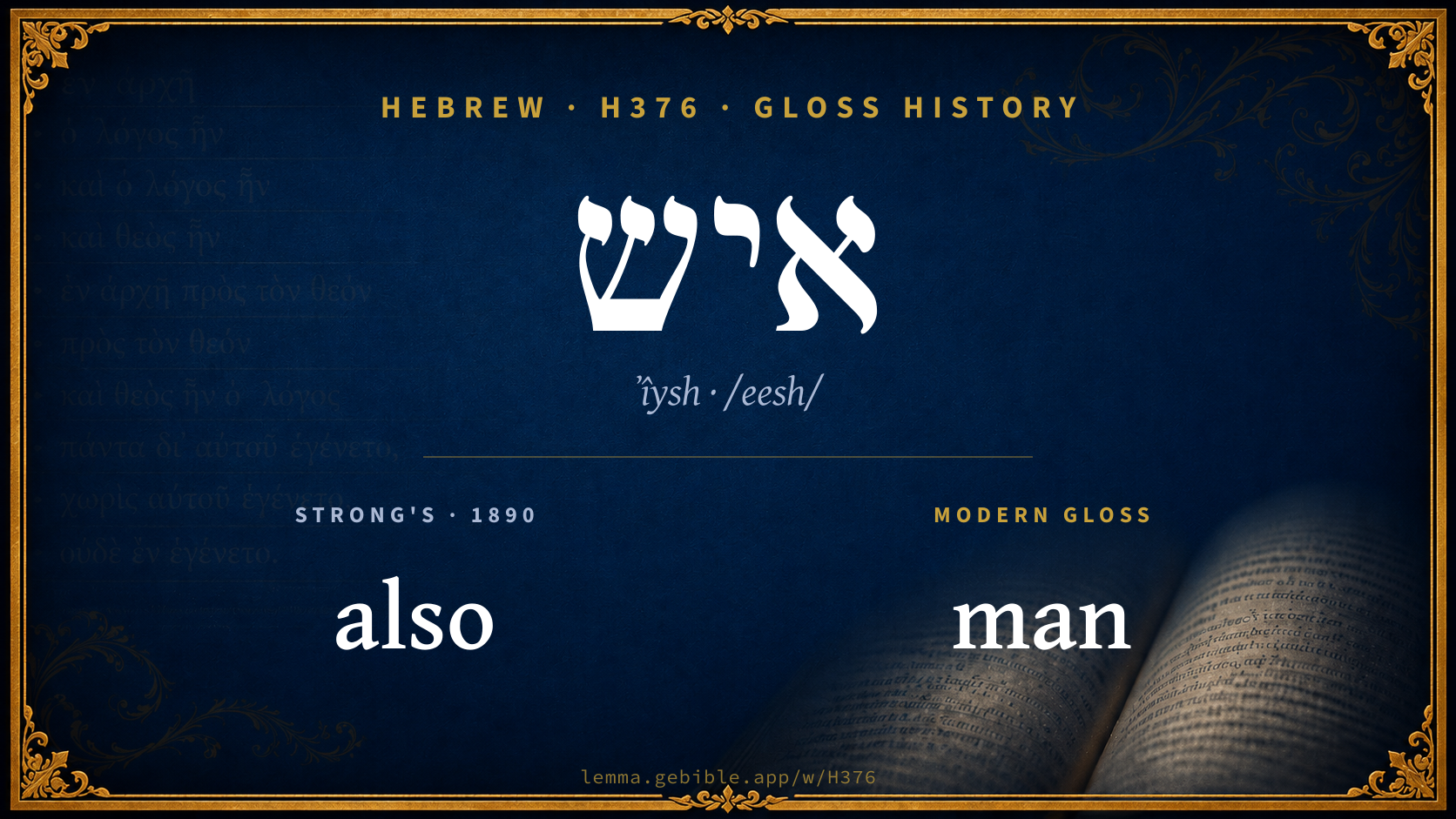
Gloss history
Strong's 1890 vs modern scholarship
About this word
Strong's H376 catalogs a Hebrew word from the Hebrew Old Testament.
These counts are not copied from any lexicon or concordance. They are computed here, from the morphology-tagged Hebrew Old Testament. What Lemma adds →
- 1,851
- distinct verses
- The word appears in 1,851 distinct verses.
- 38 / 39
- OT books
- The word appears in 38 of 39 Old Testament books.
- #19
- by frequency
- Top 25 most frequent Hebrew words (rank 19 of 8,640 Hebrew words by occurrence).
View all 1,851 occurrences in the concordance →
By section of the Old Testament
By traditional corpus
Conventional, traditional groupings — biblical authorship is debated, so this is a traditional corpus grouping, not an authorship claim. Each share is this word’s portion of its verses in that division of the Hebrew canon. Each figure is a share of the word’s 1,851 distinct verses.
- Prophets (Nevi'im) 1,006 verses · 54%
- Torah (Pentateuch) 477 verses · 26%
- Writings (Ketuvim) 368 verses · 20%
How translations render this word
Counts come from each version’s own published word-to-Strong’s tagging or interlinear alignment — an approximate guide to how each version renders this word, not a word-level alignment the data otherwise carries. Because each total is that version’s own tagged count, the per-version totals vary from one another and need not match the appearance or distinct-verse counts above. These counts may also differ from a printed concordance because Lemma counts each distinctly tagged rendering and does not collapse phrase taggings into a single head-word total. This is a fixed set of word-tagged versions (KJV, ASV, BSB, ULT) and does not change with the reading translation you choose elsewhere. Each version’s license is shown beside its name below (and on Sources).
- King James Version: Man 560×, Men 175×, Every man 154×
- American Standard Version: Man 521×, Men 165×, Every man 146×
- Berean Standard Bible: Man 556×, Men 188×, Each 97×
- unfoldingWord Literal Text: Man 921×, Men 425×, Men of 210×
King James Version Public Domain
Renders H376 across 1,623 tagged occurrences — most commonly:
Plus other, less common renderings. Plus 221 renderings that appear only once — usually multi-word phrases or single function words the recovered tagging swept in, not distinct renderings. Not rendered by a distinct English word in 16 further occurrences.
American Standard Version Public Domain
Renders H376 across 1,625 tagged occurrences — most commonly:
Plus other, less common renderings. Plus 297 renderings that appear only once — usually multi-word phrases or single function words the recovered tagging swept in, not distinct renderings. Not rendered by a distinct English word in 1 further occurrence.
Berean Standard Bible Public Domain
Renders H376 across 1,396 tagged occurrences — most commonly:
Plus other, less common renderings. Plus 132 renderings that appear only once — usually multi-word phrases or single function words the recovered tagging swept in, not distinct renderings. Not rendered by a distinct English word in 266 further occurrences.
unfoldingWord Literal Text CC BY-SA 4.0
Renders H376 across 2,256 tagged occurrences — most commonly:
Plus other, less common renderings. Plus 79 renderings that appear only once — usually multi-word phrases or single function words the recovered tagging swept in, not distinct renderings.
Senses in BDB
The 3 senses BDB distinguishes for this word, in lexicon order (not ranked by frequency or importance). The full entry — with sub-senses — is in the Lexicon Entry tab.
- man
- whosoever
- each (adjective)
Word origin
n.m. man (= vir) (MI, SI, Ph. אש, perh. also Sab. אסם cf. Prät l.c., but DHMZMG 1883, 330)—א׳ abs. Gn 2:23 +; cstr. Gn 25:27 +; sf. אִישִׁי Gn 29:32 +, etc.; pl. אִישִׁים ψ 141:4 + 2 textual (Ph. אשם); usually אֲנָשִׁים Gn 12:20 +, fr. √ אנשׁ q.v.; cstr. אַנְשֵׁי Ju 6:27 +; sf. אֲנָשַׁי 1 S 23:12 etc.;—man, opp. woman Gn 2:23, 24 Lv 20:27 Nu 5:6 Dt 17:2f Jos 6:21; 8:25 Je 40:7, emph. on sexual distinction & relation Gn 19:8; 24:16; 38:25 Ex 22:15 Lv 15:16 (שִׁכְבַת זָ֑רַע) v 18 (וְאִשָּׁה אֲשֶׁר יִשְׁכַּב אִישׁ אֹתָהּ שׁ׳־ז׳) 20:10f Nu 5:13f Dt 22:22f Is 4:1 +; thence = husband, especially c. sf. Gn 3:6, 16; 16:3; 29:32, 34 Lv 21:7 Nu 30:7f Dt 28:56 Ju 13:6f Ru 1:3f 1 S 25:19 Je 29:6 Ez 16:45 +; fig. of י׳ as husb. of Isr. אִישִׁי Ho 2:18 (opp. בַּעְלִי); man as procreator, father Ec 6:3; of male child Gn 4:1 cf. זֶרַע אֲנָשִׁים 1 S 1:11, man, opp. beast Ex 11:7 Lv 20:15 (cf. אָדָם); cf. fig. ψ 22:7 but also of male of animals Gn 7:2(×2) (אִישׁ וְאִשְׁתּוֹ); man, opp. God Gn 32:29 Nu 23:19 לֹא אִישׁ אֵל וִיכַזֵּב (‖ וּבֶן־אָדָם וְיִתְנֶחָ֑ם); Jb 9:32; 32:13 Ho 11:9 cf. Is 31:8 Jb 12:10 (רוּחַ כָּל־בְּשַׂר־אִישׁ); hence in phrases to denote ordinary, customary, common שֵׁבֶט אֲנָשִׁים 2 S 7:14 (‖ נִגְעֵי בְּנֵי אָדָם); לֶחֶם אֲנָשִׁים Ez 24:17, 22 (cf. Is 8:1); אֲנָשִׁים Ez 24:17, 22 is textual error; We (ap. Sm) אֲנֻשִׁים; ToyHpt אוֹנִים (Ho 9:4). אַמַּת־אִישׁ Dt 3:11; but also contr. אָדָם ψ 49:3; 62:10; man, as valiant 1 S 4:9(×2) (וִהְיוּ לַאֲנָשִׁים) so 1 K 2:2 cf. 1 S 26:15; so אִישׁ חַיִל 31:12 2 S 24:9 1 K 1:42 +; also אִישׁ מִלְחָמָה Nu 31:49 Dt 2:14, 16 Jos 5:4, 6 +; even of י׳ Ex 15:3 יהוה אִישׁ מִלְחָמָה; oft. prefixed to other nouns in app. הא׳ אָדוֹן Gn 42:30, 33, א׳ שַׂר וְשֹׁפֵט Ex 2:14, א׳ כֹּהֵן Lv 21:9, א׳ סָרִיס Je 38:7; partic. bef. adj. gent. אִישׁ מִצְרִי Gn 39:1 Ex 2:11, 19 cf. Gn 37:28; 38:1, 2; 39:14 1 S 17:12; 30:11, 13 +; a man as resident in, or belonging to a place or people Nu 25:6 Ju 10:1 + (so Ph.); usually pl. אַנְשֵׁי יִשְׂרָאֵל 1 S 7:11; 31:7(×2) cf. Jos 7:4, 5 +; also sg. coll. Dt 27:14 Jos 9:6, 7 Ju 20:11 1 S 11:8 (v. Dr) +; 2 S 10:6, 8 (א׳ טוֹב); (so MI 10. 13); men = retainers, followers, soldiers 1 S 18:27; 23:3f; 24:3; 25:13 + cf. Dt 33:8 sg. coll. v. Di; אִישׁ אֱלֹהִים man of God = proph. Dt 33:1 Jos 14:6 1 S 9:6f 1 K 12:22; 13:1f + (v. אלהים); in phrase sq. abstr. v. supr.; א׳ רִיב Ju 12:2 Je 15:10, א׳ שֵׂיבָה Dt 32:25, א׳ הַדָּמִים 2 S 16:7 cf. v. 8, א׳ הַבְּלִיַּעַל 2 S 16:7, א׳ מָוֶת 1 K 2:26, א׳ חָמָס ψ 140:12 Pr 3:31 +; sq. word of occupation, etc. א׳ שָׂדֶה Gn 25:27, א׳ הָאֲדָמָה Gn 9:20 (cf. Zc 13:5), א׳ הַבֵּנַיִם champion 1 S 17:4 (cf. Dr) v 23, א׳ בְּשֹׂרָה 2 S 18:20, אִישׁ עֲצָתוֹ his counsellor Is 40:13, cf. אִישׁ חֶרְמִי 1 K 20:42, א׳ רֵעִים Pr 18:24; oft. distrib. = each, every Gn 9:5; 10:5; 40:5(×2) Ex 12:3 +; incl. women Jb 42:11 1 Ch 16:3 וַיְחַלֵּק לְכָל־אִישׁ יִשְׂרָאֵל מֵאִישׁ וְעַד אִשָּׁה לְאִישׁ כִּכַּר־לֶחֶם; of inanim. things 1 K 7:30, 36; also אִישׁ אִישׁ Ex 36:4 Nu 4:19, 49 Ez 14:4, 7 +; any one Ex 34:3(×2), 24 +; also אִישׁ אִישׁ Lv 15:2; 22:4, 18 +; of gods 2 K 18:33 = Is 36:18; one … another וְהִרְגוּ אִישׁ־אֶת־אָחִיו וְאִישׁ אֶת־רֵעֵהוּ וְאִישׁ אֶת־קְרֹבוֹ Ex 32:27, אִישׁ … אָחִיו Dt 1:16 Mi 7:2 (v. אָח), אִישׁ … רֵעֵהוּ Gn 11:3, 7 + (v. רֵעַ) of inanimate things Gn 15:10.
— Brown-Driver-Briggs (Oxford 1906, public domain), digitized via Sefaria, supplemented by the OpenScriptures HebrewLexicon (CC BY 4.0). See Sources.
Derived from אנוש (ʼĕnôwsh) (H582) — man.
Jastrow Dictionary
A second Hebrew/Aramaic lexicon for comparison, covering Aramaic and post-biblical (Talmudic, Targumic, Midrashic) usage that the biblical-Hebrew BDB does not. Matched by lemma rather than by Strong’s number, so a lemma may carry more than one Jastrow headword (shown separately below), and the entries cover usage well beyond the Bible.
אִישׁ
- , v. אֱינָשׁ) being, man; husband; lord.—א׳ ירושלים a native or citizen of Jerusalem Aboth I, 4; a. fr.—Yoma I, 7 אִישִׁי כה"ג my lord the High-priest. Sot. 17ᵃ א׳ ואשה husband and wife; a. fr.—Pl. אֲנָשִׁים, v. אֱנוֹשׁ.
A Dictionary of the Targumim, the Talmud Babli and Yerushalmi, and the Midrashic Literature (Marcus Jastrow; London, Luzac, 1903) — Public Domain. Digitized via Sefaria. Digitized via Sefaria. Full attribution on Sources.
Forms in the corpus
The 285 distinct written forms H376 takes in the Hebrew Bible, most frequent first — each parse links to that state’s occurrences in the concordance. Hebrew forms include their vowel points and cantillation, so a single lemma takes many written forms.
The 60 most common forms are shown; 225 rarer forms follow in the full concordance.
Same root — word family
Other BDB entries built from the same root as H376, grouped by Strong’s listed origin. These share a root / origin per the lexicon — not necessarily a shared meaning. Each links to that word’s own entry.
Derives from
Shares the same root
Derived from this word
- איש ʼîysh H377 to be a man
- אישון ʼîyshôwn H380 pupil
- אישחיל ʼÎysh-Chayil H381 a mighty man, valiant man
- אשה ʼishshâh H802 woman
Proper names from this root
People and places named from this root — a name, not an additional meaning of the word.
- אנוש ʼĔnôwsh H583 Enos
- אישבשת ʼÎysh-Bôsheth H378 Ishbosheth
- אישהוד ʼÎyshᵉhôwd H379 Ishod
- אישטוב ʼÎysh-Ṭôwb H382 Ish-tob
- אשבעל ʼEshbaʻal H792 Eshbaal
- בןימיני Ben-yᵉmîynîy H1145 Benjamite
Compare all same-root words → Showing 4 of 13 — not the complete family. 6 of the same-root words are proper names (people or places). They share a root, not necessarily a meaning.
Septuagint verse parallels
This word appears in 1,751 verses that also exist in the Greek Old Testament (Septuagint), out of the 1,851 Hebrew verses it occurs in. You can read those verses in Greek by switching the Old Testament edition to the Septuagint.
Read these verses in the Septuagint
- Genesis 2:23
- Exodus 1:1
- Leviticus 7:8
- Numbers 1:4
- Deuteronomy 1:13
- Joshua 1:5
- Judges 1:4
- Ruth 1:1
- 1 Samuel 1:1
- 2 Samuel 1:2
- 1 Kings 1:5
- 2 Kings 1:6
This is a verse-level parallel only — the same verses exist in both the Hebrew and Greek Old Testaments. No word-level Hebrew↔Greek correspondence is claimed: the data carries no such alignment, so no Greek word is shown as this Hebrew word’s translation. Coverage is not total — the Septuagint omits the deuterocanon and renumbers the Psalms, so some Hebrew verses have no direct Greek parallel.