Isaiah 9:20

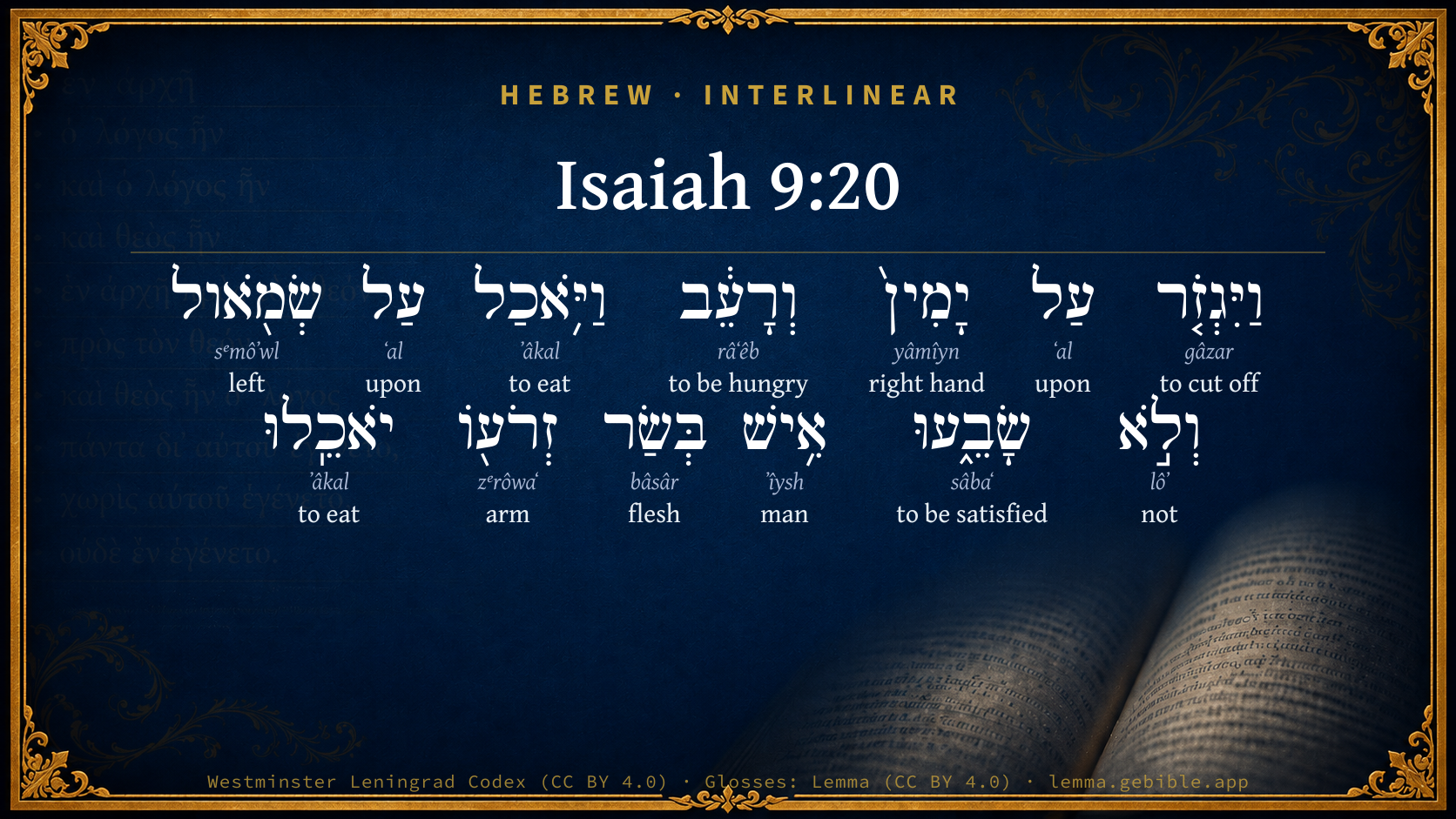
Hebrew (Westminster Leningrad Codex) Isaiah 9:20 appears in the Hebrew Old Testament. The text above is from the Westminster Leningrad Codex. Each word links to its Strong’s number, a concise gloss, and parsing drawn from the Open Scriptures Hebrew Bible morphology. Click any word for its full Brown-Driver-Briggs (BDB) entry.
Download image
Cite this verse

Isaiah 9:20 (World English Bible). Public Domain. Lemma interlinear Bible study tool, https://lemma.gebible.app/v/isaiah/9/20.

Show BibTeX & RIS
BibTeX
RIS
English Translation
One shall snatch on the right hand, and be hungry; and he shall eat on the left hand, and they shall not be satisfied: they shall eat every man the flesh of his own arm:
World English Bible · Public Domain
Download a study sheet

One document with this verse’s original text, its word-by-word gloss line, the meaning frame, cross-references with their text, attributed commentary, and full source and license credits — printable, and it pastes into notes with its structure intact.

This verse Autodidact and up

Study sheet (.html) Plain text (.txt)

A passage Seminary Student

Up to 50 verses in one chapter. A passage sheet keeps up to 6 commentary sources and 12 cross-references per verse, in the order this page ranks them, and says so on the sheet whenever that leaves anything out. Ask for a single verse and you get the Autodidact verse sheet above.

Everything on this page stays free to read, with no account — the sheet is a download of what is already on screen, not access to it.

Want to remove ads? Support Godless Engineer
Compare translations 3

The same verse in 3 English versions, stacked beneath the original-language interlinear above. Click any original word for its lexicon entry.

Each is an independent rendering of the whole verse — the interlinear is not word-aligned to these translations.

Highlighted words mark where these versions differ — a whole-verse word diff, not a word-by-word alignment.

  • World English Bible Public Domain
    One shall snatch on the right hand, and be hungry; and he shall eat on the left hand, and they shall not be satisfied: they shall eat every man the flesh of his own arm:
  • King James Version Public Domain
    And he shall snatch on the right hand, and be hungry; and he shall eat on the left hand, and they shall not be satisfied: they shall eat every man the flesh of his own arm:
  • unfoldingWord Literal Text CC BY-SA 4.0
    And he will cut off on the right, but he will be hungry, and he will eat on the left, but they will not have enough. A man will eat the flesh of his arm:

unfoldingWord Literal Text — © unfoldingWord, licensed CC BY-SA 4.0. Word-aligned USFM3 via Door43 (git.door43.org/unfoldingWord/en_ult).

Versions to compare (up to 4)

3 of 4 selected

Show all 18 translations

Every available English version of this verse, each an independent rendering of the whole verse.

  • World English Bible Public Domain
    One shall snatch on the right hand, and be hungry; and he shall eat on the left hand, and they shall not be satisfied: they shall eat every man the flesh of his own arm:
  • Berean Standard Bible Public Domain
    They carve out what is on the right, but they are still hungry; they eat what is on the left, but they are still not satisfied. Each one devours the flesh of his own offspring.
  • Majority Standard Bible Public Domain
    They carve out what is on the right, but they are still hungry; they eat what is on the left, but they are still not satisfied. Each one devours the flesh of his own offspring.
  • King James Version Public Domain
    And he shall snatch on the right hand, and be hungry; and he shall eat on the left hand, and they shall not be satisfied: they shall eat every man the flesh of his own arm:
  • American Standard Version (1901) Public Domain
    And one shall snatch on the right hand, and be hungry; and he shall eat on the left hand, and they shall not be satisfied: they shall eat every man the flesh of his own arm:
  • Revised Version (1885) Public Domain
    And one shall snatch on the right hand, and be hungry; and he shall eat on the left hand, and they shall not be satisfied: they shall eat every man the flesh of his own arm:
  • Geneva Bible (1599) Public Domain
    And he shall snatch at the right hand, and be hungrie: and he shall eate on the left hand, and shall not be satisfied: euery one shall eate ye flesh of his owne arme.
  • Douay-Rheims (1899) Public Domain
    And he shall turn to the right hand, and shall be hungry: and shall eat on the left hand, and shall not be filled: every one shell eat the flesh of his own arm: Manasses Ephraim, and Ephraim Manasses, and they together shall be against Juda.
  • Young's Literal Translation Public Domain
    And cutteth down on the right, and hath been hungry, And he devoureth on the left, And they have not been satisfied, Each the flesh of his own arm they devour.
  • Literal Standard Version CC BY-SA 4.0
    And cuts down on the right, and has been hungry, || And he devours on the left, || And they have not been satisfied, || They each devour the flesh of his own arm.
  • Unlocked Literal Bible CC BY-SA 4.0
    They will grab food on the right hand but still be hungry; they will eat food on the left hand but will not be satisfied. Each will even eat the flesh of his own arm.
  • unfoldingWord Literal Text CC BY-SA 4.0
    And he will cut off on the right, but he will be hungry, and he will eat on the left, but they will not have enough. A man will eat the flesh of his arm:
  • Darby Bible Public Domain
    and he snatcheth on the right hand, and is hungry, and eateth on the left hand; and they are not satisfied. They eat every man the flesh of his own arm:
  • World Messianic Bible Public Domain
    One will devour on the right hand, and be hungry; and he will eat on the left hand, and they will not be satisfied. Everyone will eat the flesh of his own arm:
  • Webster's Bible Public Domain
    And he shall snatch on the right hand, and be hungry; and he shall eat on the left hand, and they shall not be satisfied: they shall eat every man the flesh of his own arm:
  • Free Bible Version CC BY-SA 4.0
    People destroy others on the right, yet they're still hungry for more; people destroy others on the left, but they're still not satisfied. In the end they even destroy themselves!
  • Bible in Basic English Public Domain
    On the right a man was cutting off bits and was still in need; on the left a man took a meal but had not enough; no man had pity on his brother; every man was making a meal of the flesh of his neighbour.
  • JPS Tanakh (1917) Public Domain
    (9-19) And one snatcheth on the right hand, and is hungry; and he eateth on the left hand, and is not satisfied; they eat every man the flesh of his own arm:

Literal Standard Version (2020), Covenant Press — licensed CC BY-SA 4.0. Text via the HelloAO Bible API (eBible.org). Unlocked Literal Bible (unfoldingWord) — licensed CC BY-SA 4.0. Text via the HelloAO Bible API (eBible.org). unfoldingWord Literal Text — © unfoldingWord, licensed CC BY-SA 4.0. Word-aligned USFM3 via Door43 (git.door43.org/unfoldingWord/en_ult). Free Bible Version, Dr. Jonathan Gallagher — licensed CC BY-SA 4.0. Text via the HelloAO Bible API (eBible.org).

Word by word

More ways to search: Search by grammar → Find every occurrence → Compare this word →

Practice this passage: Drill this verse → Learn its vocabulary →

וַיִּגְזֹ֤ר
gâzar
H1504
“and · to cut off”
Conjunction + Verb, Qal, Sequential Imperfect, 3rd Person, Masculine, Singular
Part of Speech
Conjunction + Verb
Stem
Qal
Form
Sequential Imperfect
Person
3rd Person
Gender
Masculine
Number
Singular
Full BDB Definition

Origin: a primitive root

TWOT: 340

to cut, divide, cut down, cut off, cut in two, snatch, decree - (Qal) - to cut in two, divide - to cut down - to cut off, destroy, exterminate - to decree - (Niphal) - to be cut off, separated, excluded - to be destroyed, cut off - to be decreed
  1. עַל ʻal H5921 “upon” Preposition
  2. יָמִין֙ yâmîyn H3225 “right hand” Noun, Common, Feminine, Singular, Absolute
  3. וְרָעֵ֔ב râʻêb H7456 “and · to be hungry” Conjunction + Verb, Qal, Sequential Perfect, 3rd Person, Masculine, Singular
  4. וַיֹּ֥אכַל ʼâkal H398 “and · to eat” Conjunction + Verb, Qal, Sequential Imperfect, 3rd Person, Masculine, Singular
  5. עַל ʻal H5921 “upon” Preposition
  6. שְׂמֹ֖אול sᵉmôʼwl H8040 “left” Noun, Common, Masculine, Singular, Absolute
  7. וְלֹ֣א lôʼ H3808 “and · not” Conjunction + Particle, Negative
  8. שָׂבֵ֑עוּ sâbaʻ H7646 “to be satisfied” Verb, Qal, Perfect, 3rd Person, Common, Plural
  9. אִ֥ישׁ ʼîysh H376 “man” Noun, Common, Masculine, Singular, Absolute
  10. בְּשַׂר bâsâr H1320 “flesh of” Noun, Common, Masculine, Singular, Construct
  11. זְרֹע֖וֹ zᵉrôwaʻ H2220 “arm · his” Noun, Common, Both, Singular, Construct + Suffix, Personal, 3rd Person, Masculine, Singular
  12. יֹאכֵֽלוּ ʼâkal H398 “to eat” Verb, Qal, Imperfect, 3rd Person, Masculine, Plural

About this verse

These counts appear in no published source. They are computed here, from the morphology-tagged text and Lemma’s own curated glosses. What Lemma adds →

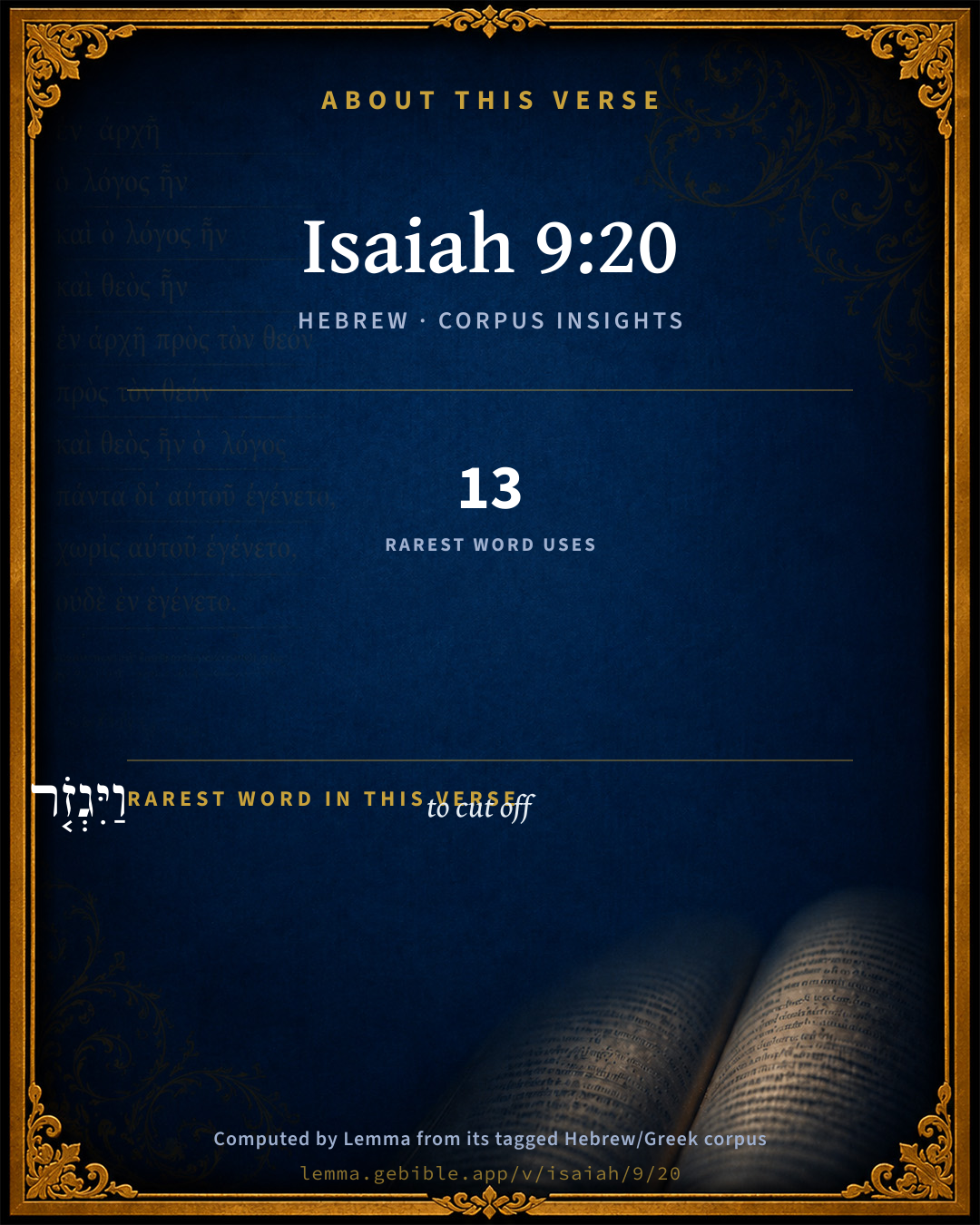
13
words
11
distinct lemmas
Prophets
section

Notable vocabulary

The rarest word here is וַיִּגְזֹ֤ר to cut off H1504 — appearing just 13 times in the whole Hebrew Bible.

Shared distinctive vocabulary

וַיִּגְזֹ֤ר to cut off H1504 occurs in 13 verses of the Hebrew Bible. Also found in:

Grammatical profile

  • 5 verbs
  • 5 nouns
  • 2 prepositions
  • 1 particle

Verb forms

  • וַיִּגְזֹ֤ר Qal · Sequential Imperfect
  • וְרָעֵ֔ב Qal · Sequential Perfect
  • וַיֹּ֥אכַל Qal · Sequential Imperfect
  • שָׂבֵ֑עוּ Qal · Perfect
  • יֹאכֵֽלוּ Qal · Imperfect

Repetition

Words recur within this verse — often emphatic in Hebrew:

  • עַל upon H5921 ×2
  • וַיֹּ֥אכַל to eat H398 ×2

Hebrew & Septuagint length

In English translation the verse runs 35 words from the Hebrew and 37 from the Septuagint (LXX English) — closely comparable.

A rough comparison of the two English renderings, which tokenize alike — not a word-level alignment.

Word counts can differ between the Hebrew and the Greek without any difference in meaning — e.g. the Hebrew direct-object marker אֵת has no separate Greek word, and Greek often adds the article ὁ.

Cross-references

5

Topical passages linked to Isaiah 9:20 in the Treasury of Scripture Knowledge — connected by theme and wording, ordered by reader-vote popularity; previews shown in the World English Bible.

  • Isaiah 49:26 I will feed those who oppress you with their own flesh; and they shall be drunken with their own blood, as with sweet wine: and all flesh shall know that I, Yahweh, am your Savior, and your Redeemer, the Mighty One of Jacob.
  • Jeremiah 19:9 I will cause them to eat the flesh of their sons and the flesh of their daughters; and they shall eat everyone the flesh of his friend, in the siege and in the distress, with which their enemies, and those who seek their life, shall distress them.
  • Leviticus 26:26–29 When I break your staff of bread, ten women shall bake your bread in one oven, and they shall deliver your bread again by weight: and you shall eat, and not be satisfied.
  • Isaiah 8:21 They shall pass through it, sore distressed and hungry; and it shall happen that when they shall be hungry, they shall fret themselves, and curse by their king and by their God, and turn their faces upward:
  • Lamentations 4:10 The hands of the pitiful women have boiled their own children; They were their food in the destruction of the daughter of my people.

Cross-references courtesy of OpenBible.info (CC BY 4.0).

Hebrew and Greek witnesses Masoretic Hebrew ↔ Greek Septuagint

The same verse in the two great witnesses to the Old Testament, shown verse-for-verse.

These are two independent witnesses, not word-aligned to each other, and the Septuagint is shown in lemma (dictionary) form.

Hebrew Isaiah 9:20 Masoretic · Westminster Leningrad Codex

וַיִּגְזֹ֤ר עַל יָמִין֙ וְרָעֵ֔ב וַיֹּ֥אכַל עַל שְׂמֹ֖אול וְלֹ֣א שָׂבֵ֑עוּ אִ֥ישׁ בְּשַׂר זְרֹע֖וֹ יֹאכֵֽלוּ

One shall snatch on the right hand, and be hungry; and he shall eat on the left hand, and they shall not be satisfied: they shall eat every man the flesh of his own arm:

World English Bible · Public Domain

Greek LXX Isaiah 9:20 Septuagint · lemma form

ἐσθίω γάρ μανασσή ὁ ἐφράιμ καί ἐφράιμ ὁ μανασσή ὅτι ἅμα πολιορκέω ὁ ἰούδας ἐπί οὗτος πᾶς οὐ ἀποστρέφω ὁ θυμός ἀλλά ἔτι ὁ χείρ ὑψηλός

But one shall turn aside to the right hand, for he shall be hungry; and shall eat on the left, and a man shall by no means be satisfied with eating the flesh of his own arm.

LXX2012 (modern English Septuagint) · Public Domain

On this verse, Adam Clarke's Commentary discusses the Septuagint’s reading. Read the note in Commentary ↓

Hebrew: Westminster Leningrad Codex (CC BY 4.0). Greek: Septuagint (public domain); English from LXX2012 (modern English Septuagint) (Public Domain). How the Septuagint differs from the Hebrew →

Targum (Aramaic paraphrase)

1

The Targum is the ancient Jewish Aramaic paraphrase of the Hebrew Scriptures — an interpretive translation, not the Hebrew text itself. Onkelos (literal) and Pseudo-Jonathan (expansive) render the Torah, and Jonathan the Prophets. Coverage is partial: where no permissively-licensed English translation exists for a verse, only the Aramaic is shown. This is verse-level text, not a word-by-word alignment to the Hebrew.

  1. Targum Jonathan Prophets (Joshua–Malachi)
    דְבֵית מְנַשֶׁה עִם דְבֵית אֶפְרַיִם וּדְבֵית אֶפְרַיִם עִם דְבֵית מְנַשֶׁה כַּחֲדָא יִתְחַבְּרוּן לְמֵיתֵי עַל דְבֵית יְהוּדָה בְּכָל דָא לָא תָבוּ מֵחוֹבֵיהוֹן דִיתוּב רוּגְזֵיהּ מִנְהוֹן וְעַד כְּעַן מַתְקְפִין מַרְדֵיהוֹן וְעוֹד מְחָתֵיהּ עֲתִידָא לְאִתְפְּרַע מִנְהוֹן:

    Those of the house of Manasseh, with those of the house of Ephraim, and they of the house of Ephraim, with those of the house of Manasseh, shall be joined together as one, to come against them of the house of Judah. For all this they do not turn away from their sins, that His anger might turn away from them; but still they hold fast their rebellion, and yet His stroke is ready to take vengeance on them.

    Targum Jonathan — Aramaic: “Mikraot Gedolot” (public domain). English: “Sefaria Community Translation” (CC0 1.0 (public-domain dedication)); “London "Chaldee Paraphrase," 1871” (public domain). Text via Sefaria.

Commentary

Notes on Isaiah 9:20 from classic Christian and Jewish commentators (each source and its license shown beneath its notes). The classic Christian expositions comment on the surrounding passage and are grouped to its opening verse, so a note may address several verses; the Jewish commentaries on the Tanakh (Rashi and others) are per-verse, so they appear only where the commentator wrote on this verse.

Lemma curates 59 commentaries, every one of them public domain or Creative Commons licensed, each selected and text-cleaned for this edition rather than reprinted as found. About our sources →

Trapp's Complete Commentary

John Trapp

Isa 9:20 And he shall snatch on the right hand, and be hungry; and he shall eat on the left hand, and they shall not be satisfied: they shall eat every man the flesh of his own arm:

Ver. 20. And he shall snatch on the right hand, and be hungry.] Inexplebilem illorum avaritiam et rapacitatem notat. They shall rape and scrape by right or wrong, and yet as sick of a bulimy, or under the curse of dissatisfaction, they shall never have enough. {Ecc 5:10} {See Trapp on "Ecc 5:10"}

They shall eat every man the flesh of his own arm.] That is, They shall make a prey {a} of their nearest allies. Some understand the text of civil wars, which indeed are most unnatural; and concerning which one saith well, Dissidia nostra sunt amicorum dispendia, hostium compendia, et publica irae divinae incendia.

{a} Imbelles damae quid nisi praeda sumus?

John Trapp, A Commentary or Exposition upon All the Books of the Old and New Testament (1647–1656) — public domain. Text from a community e-Sword module.

Joseph Benson's Commentary

Isa 9:20-21. He shall snatch on the right hand — They shall plunder and devour one another, without ever being satisfied, or ceasing. They shall eat every man the flesh, &c. — They shall destroy one another by their intestine wars: see Isa 49:26. But it was literally fulfilled when they were reduced to that extremity that they ate the flesh of their own children, 2Ki 6:28; Jer 19:8-9; a judgment denounced for their sins by Moses, Deu 28:53, where see the note. They together shall fall on Judah — When those tribes have preyed upon and nearly destroyed one another, they shall turn their rage on Judah. The prophet in the above verses describes the infatuation of the Israelites and Jews, who, instead of uniting in a confederacy against their common enemies, the Syrians and Assyrians, with whom they were not singly able to contend, fell out among themselves, and so far destroyed each other, that they became, one after the other, an easy prey to those heathen nations, whom, humanly speaking, they would have been able to have repelled, had they united in a league, and aided each other. But God suffered them to be infatuated, as a punishment of their sins.

Joseph Benson's Commentary on the Old and New Testaments (1811–1818) — public domain. Text from a community e-Sword module.

Geneva Bible (1599)

Geneva Bible translators

Their greediness shall be insatiable, so that one brother shall eat up another, as though he should eat his own flesh.

Geneva Bible (1599) marginal notes — public domain. Text via Bolls.life.

Jamieson, Fausset & Brown

Robert Jamieson, A. R. Fausset & David Brown

hungry--not literally. Image from unappeasable hunger, to picture internal factions, reckless of the most tender ties (Isa 9:19), and insatiably spreading misery and death on every side (Jer 19:9).

eat--not literally, but destroy (Psa 27:2; Job 19:22).

flesh of . . . arm--those nearest akin: their former support (helper) (Isa 32:2) [MAURER].

Jamieson, Fausset & Brown — Commentary Critical and Explanatory on the Whole Bible (1871) — public domain (CC PDM 1.0). Text via the HelloAO Bible API.

Adam Clarke's Commentary

Verse 20. The flesh of his own arm - "The flesh of his neighbour"] "Του βραχιονος του αδελφου αυτου, the Septuagint Alexand. Duplex versio, quarum altera legit רעו reo, quae vox extat, Jer 6:21. Nam רע rea, αδελφος, Ge 43:33. Recte ni fallor." - SECKER. I add to this excellent remark, that the Chaldee manifestly reads רעו reo, his neighbour, not זרעו zeroo, his arm; for he renders it by קריביה karibeyh, his neighbour. And Jeremiah has the very same expression: ואיש בשר רעהו יאכלו veish besar reehu yochelu, "and every one shall eat the flesh of his neighbour," Jer 19:9. This observation, I think, gives the true reading and sense of this place: and the context strongly confirms it by explaining the general idea by particular instances, in the following verse: "Every man shall devour the flesh of his neighbour;" that is, they shall harass and destroy one another. "Manasseh shall destroy Ephraim, and Ephraim, Manasseh;" which two tribes were most closely connected both in blood and situation as brothers and neighbours; "and both of them in the midst of their own dissensions shall agree in preying upon Judah." The common reading, "shall devour the flesh of his own arm," in connexion with what follows, seems to make either an inconsistency, or an anticlimax; whereas by this correction the following verse becomes an elegant illustration of the foregoing. - L.

Adam Clarke's Commentary on the Bible (1810–1826) — public domain. Text from a community e-Sword/MySword module.

The Cambridge Bible for Schools and Colleges

gen. ed. J. J. S. Perowne

20. And one snatched on the right hand and was hungry (still) and devoured on the left hand and they were not satisfied, &c.

every man the flesh of his own arm] The image would be that of men maddened with hunger and gnawing their own flesh. The words are reproduced exactly, with the omission of a single letter, in Jer_19:9, which gives the sense “every man the flesh of his neighbour.” It might be better to assimilate the text here to that reading, since it is the “cruelty of rival factions” that seems to be described.

The Cambridge Bible for Schools and Colleges (gen. ed. J. J. S. Perowne; Cambridge University Press, 1878–1918) — public domain. Text from a community e-Sword module.

John Gill's Exposition

And he shall snatch on the right hand, and be hungry,.... Either with his hand, and rob and plunder all within his reach; or, with his teeth, as cannibals, or beasts of prey, catch at, tear, and rend in pieces, whatever comes in their way; and yet hungry after more, and unsatisfied, as follows:

and he shall eat on the left hand, and they shall not be satisfied; ravage and spoil on every side, and yet not content. The Targum is,

"he shall spoil on the south, and be hungry; and he shall destroy on the north, and not be satisfied:''

they shall eat every man the flesh of his own arm; destroy their near relations, who are their own flesh and blood, or take away their substance from them; so the Targum,

"they shall spoil every man the substance of his neighbour:''

which will give some light to Rev 17:16.

John Gill's Exposition of the Whole Bible (1746–1763) — public domain (CC PDM 1.0). Text via the HelloAO Bible API.

Albert Barnes' Notes on the Bible

And he shall snatch - Hebrew, ‘He shall cut off.’ Many have supposed that this refers to a state of famine; but others regard it as descriptive of a state of faction extending throughout the whole community, dissolving the most tender ties, arid producing a dissolution of all the bonds of life. The context Isa 9:19, Isa 9:21 shows, that the latter is meant; though it is not improbable that it would be attended with famine. When it is said that he ‘would cut off his right hand,’ it denotes a condition of internal anarchy and strife.

And be hungry - And not be satisfied. Such would be his rage, and his desire of blood, that he would be insatiable. The retarder of those on one side of him would not appease his insatiable wrath. His desire of carnage would be so great that it would be like unappeased hunger.

And he shall eat - The idea here is that of contending factions excited by fury, rage, envy, hatred, contending in mingled strife, and spreading death with insatiable desire everywhere around them.

They shall eat - Not literally; but “shall destroy.” To eat the flesh of anyone, denotes to seek one’s life, and is descriptive of blood-thirsty enemies; Psa 27:2 : ‘When the wicked, even mine enemies and foes, came upon me to eat up my flesh, they stumbled and fell;’ Job 19:22 :

Why do ye persecute me as God,

And are not satisfied with my flesh?

Compare Deu 7:16; Jer 10:25; Jer 30:15; Jer 50:17; Hos 7:7; see Ovid’s Metam. 8, 867:

Ipse suos artus lacero divellere morsu

Coepit; et infelix minuendo corpus alebat.

The flesh of his own arm - The Chaldee renders this, ‘Each one shall devour the substance of his neighbor.’ Lowth proposes to read it, ‘The flesh of his neighbor.’ but without sufficient authority. The expression denotes a state of dreadful faction - where the ties of most intimate relationship would be disregarded, represented, here by the appalling figure of a man’s appetite being so rabid that he would seize upon and devour his own flesh. So, in this state of faction and discord, the rage would be so great that people would destroy those who were, as it were, their own flesh, that is, their nearest kindred and friends.

Albert Barnes' Notes on the Bible (1834–1885) — public domain. Text from a community e-Sword/MySword module.

Matthew Poole's English Annotations

Shall snatch; every one shall greedily and violently seize upon any provisions that come in his way; which implies, either great scarcity, or insatiable covetousness, as is manifest from the next clause.

Shall eat every man the flesh of his own arm; either,

1. Properly; so it notes extreme famine; in which case men are apt to eat their own flesh. Compare Jer 19:9. Or,

2. Metaphorically, which seems best to suit with the following verse, the flesh of his brethren by nation and religion, which are as it were our own flesh, and are so called, Isa 58:7; Zec 11:9; and, consequently, the flesh of their arm is in a manner the flesh of our own arm. And one tribe was to another as an arm, i.e. a support or strength, which is called an arm, 2Ch 32:8; Jer 17:5, and elsewhere.

Matthew Poole's English Annotations on the Holy Bible (1683–1685) — public domain. Text from a community e-Sword/MySword module.

Whedon's Commentary on the Bible

Daniel D. Whedon

20. Snatch on the right hand — This figure is a famine view, as the result of inordinate self-will and cruelty in times of anarchy.

Daniel D. Whedon (gen. ed.), Commentary on the Old and New Testaments (1874–1909) — public domain. Text from a community e-Sword module.

The Pulpit Commentary

He shall snatch; rather, one shall devour. A man, i.e. , shall plunder and ravage in one quarter, and yet not be satisfied; then he shall do the same in another, and still desire more. "Increase of appetite shall grow by what it feeds on." There shall be no sense of satiety anywhere. The flesh of his own arm. In a civil war, or a time of anarchy, each man is always "eating the flesh of his own armi.e. injuring his neighbor, who is his own natural protector and defender.

The Pulpit Commentary (1880–1919), ed. H.D.M. Spence-Jones & Joseph S. Exell — public domain. Text from a community e-Sword module.

J. A. Alexander on Isaiah

Joseph Addison Alexander

The horrors of civil war are now presented under the fearful image of insatiable hunger, leading men to devour their own flesh. “And he tears on the right hand and is hungry (still), and devours on the left and (still) they are not satisfied; each the flesh of his (own) arm, they devour.” The words right and left simply denote that the devouring should be mutual and extend in all directions. The special mention of the arm may imply that the mutual destroyers ought to have been mutual protectors.

Joseph Addison Alexander, The Prophecies of Isaiah (1846–1847; New York: Scribner, 1870–1878) — public domain. Text from a community e-Sword module.

unfoldingWord translationNotes

Door43 World Missions Community

They will grab food on the right hand ... on the left hand

This expression means that the people will grab food wherever they can find it. (See: Metonymy)

Each will even eat the flesh of his own arm

Possible meanings are 1) people will be so hungry that they will want to eat or will actually eat their own arms or 2) the word "arm" is a metaphor for the person's neighbor. (See: Metaphor)

In all these things, his anger does not subside; instead, his hand

"Even though all these things have happened, he is still angry, and his hand." See how you translated this in Isaiah 5:25.

his hand is still stretched out

Isaiah speaks as if Yahweh were a person about to hit another person with his fist. This is a metaphor for Yahweh punishing Israel. See how you translated this in Isaiah 5:25. AT: "he will still be ready to punish them" (See: Metaphor)

translationWords

flesh

Manasseh

devour

Ephraim

Judah

Yahweh

anger

hand

unfoldingWord translationNotes — © Distant Shores Media and the Door43 World Missions Community, licensed CC BY-SA 4.0. Source: git.door43.org/Door43/en_tn.

Rashi

Rabbi Shlomo Yitzchaki (Rashi)

Manasseh with Ephraim Manasseh will join Ephraim.

and Ephraim with Manasseh With Manasseh, and together they will unite against Judah.

Rashi on the Tanakh — English translations: “The Judaica Press complete Tanach with Rashi, translated by A. J. Rosenberg” (CC BY 4.0); “Pentateuch with Rashi's commentary by M. Rosenbaum and A.M. Silbermann, 1929-1934” (public domain); “The Metsudah Tanach series, Lakewood, N.J” (CC BY 4.0); and “The Book of Joshua, Metsudah Publications, 1997” (CC BY 4.0). Text via Sefaria.

Ibn Ezra

Rabbi Abraham ibn Ezra

Manasseh, Ephraim, etc. This verse explains the preceding; Manasseh will fight against Ephraim, and both against Judah.

Ibn Ezra on the Tanakh — English translations: “Sefaria Community Translation” (CC0 1.0 (public-domain dedication)); “Yalkut, Sifsei Chachomim Chumash, Metsudah Publications, 2009” (CC BY 4.0); and “Commentary of Ibn Ezra on Isaiah - trans. by M. Friedlander, 1873” (public domain). Text via Sefaria.

Lesson kit

Teaching starters — assembled from the data on this page, not authored interpretation. Every prompt links to the verse data it draws on. Edit before teaching.

Isaiah, in the Prophets, opens this verse with 13 words (11 distinct Hebrew lemmas). Its most distinctive word is gâzar (“to cut off”). A historical commentator’s framing appears above. Read the whole chapter for the surrounding context.

Discussion questions

  1. What does “to cut off” (gâzar) contribute to the verse as a whole?
  2. 1 Kings 3:25 shares the word «to cut off» with this verse. How do the two illuminate each other?
  3. “upon” occurs 2× in this one verse. What is the effect of the repetition?
  4. These translations render this verse differently; the difference is in the English rendering, not the original. What questions does that raise?
  5. The verb «וַיִּגְזֹ֤ר» is Qal Sequential Imperfect. How does its form color the action?
  6. Reading how Trapp's Complete Commentary and Joseph Benson's Commentary read this verse, where do the two commentators agree and where do they part?

Things to notice

Reading settings

Reading text

Shown beneath each verse's original-language words.

Old Testament
Old Testament edition

Read the OT as the Masoretic Hebrew (MT) or the Greek Septuagint (LXX).

English shown for the Greek Septuagint (in the Hebrew ↔ Greek comparison).

Comparing translations? Open the Compare panel on any verse page to stack up to four side by side.