Isaiah 31:7

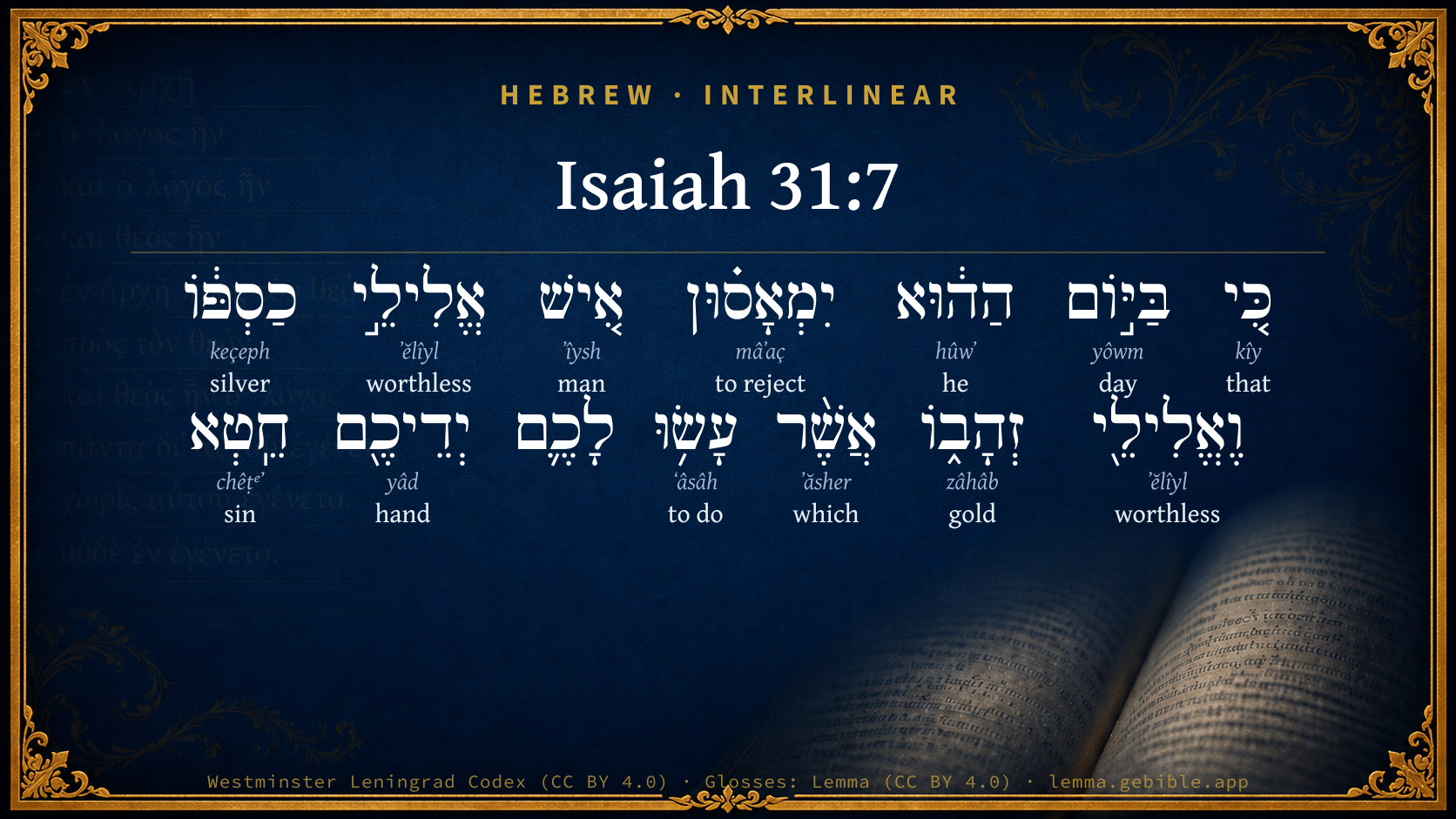
Hebrew (Westminster Leningrad Codex) Isaiah 31:7 appears in the Hebrew Old Testament. The text above is from the Westminster Leningrad Codex. Each word links to its Strong’s number, a concise gloss, and parsing drawn from the Open Scriptures Hebrew Bible morphology. Click any word for its full Brown-Driver-Briggs (BDB) entry.
Download image
Cite this verse

Isaiah 31:7 (World English Bible). Public Domain. Lemma interlinear Bible study tool, https://lemma.gebible.app/v/isaiah/31/7.

Show BibTeX & RIS
BibTeX
RIS
English Translation
For in that day they shall cast away every man his idols of silver, and his idols of gold, which your own hands have made to you for a sin.
World English Bible · Public Domain
Download a study sheet

One document with this verse’s original text, its word-by-word gloss line, the meaning frame, cross-references with their text, attributed commentary, and full source and license credits — printable, and it pastes into notes with its structure intact.

This verse Autodidact and up

Study sheet (.html) Plain text (.txt)

A passage Seminary Student

Up to 50 verses in one chapter. A passage sheet keeps up to 6 commentary sources and 12 cross-references per verse, in the order this page ranks them, and says so on the sheet whenever that leaves anything out. Ask for a single verse and you get the Autodidact verse sheet above.

Everything on this page stays free to read, with no account — the sheet is a download of what is already on screen, not access to it.

Want to remove ads? Support Godless Engineer
Compare translations 3

The same verse in 3 English versions, stacked beneath the original-language interlinear above. Click any original word for its lexicon entry.

Each is an independent rendering of the whole verse — the interlinear is not word-aligned to these translations.

Highlighted words mark where these versions differ — a whole-verse word diff, not a word-by-word alignment.

  • World English Bible Public Domain
    For in that day they shall cast away every man his idols of silver, and his idols of gold, which your own hands have made to you for a sin.
  • King James Version Public Domain
    For in that day every man shall cast away his idols of silver, and his idols of gold, which your own hands have made unto you for a sin.
  • unfoldingWord Literal Text CC BY-SA 4.0
    For in that day they will reject, a man the idols of his silver and the idols of his gold, which your hands have made for yourselves sin.

unfoldingWord Literal Text — © unfoldingWord, licensed CC BY-SA 4.0. Word-aligned USFM3 via Door43 (git.door43.org/unfoldingWord/en_ult).

Versions to compare (up to 4)

3 of 4 selected

Show all 18 translations

Every available English version of this verse, each an independent rendering of the whole verse.

  • World English Bible Public Domain
    For in that day they shall cast away every man his idols of silver, and his idols of gold, which your own hands have made to you for a sin.
  • Berean Standard Bible Public Domain
    For on that day, every one of you will reject the idols of silver and gold that your own hands have sinfully made.
  • Majority Standard Bible Public Domain
    For on that day, every one of you will reject the idols of silver and gold that your own hands have sinfully made.
  • King James Version Public Domain
    For in that day every man shall cast away his idols of silver, and his idols of gold, which your own hands have made unto you for a sin.
  • American Standard Version (1901) Public Domain
    For in that day they shall cast away every man his idols of silver, and his idols of gold, which your own hands have made unto you for a sin.
  • Revised Version (1885) Public Domain
    For in that day they shall cast away every man his idols of silver, and his idols of gold, which your own hands have made unto you for a sin.
  • Geneva Bible (1599) Public Domain
    For in that day euery man shall cast out his idoles of siluer, and his idoles of golde, which your handes haue made you, euen a sinne.
  • Douay-Rheims (1899) Public Domain
    For in that day a man shall cast away his idols of silver, and his idols of gold, which your hands have made for you to sin.
  • Young's Literal Translation Public Domain
    For in that day despise doth each His idols of silver, and his idols of gold, That your hands made to you -- a sin.
  • Literal Standard Version CC BY-SA 4.0
    For in that day each despises His idols of silver, and his idols of gold, || That your hands made to you—a sin.
  • Unlocked Literal Bible CC BY-SA 4.0
    For in that day each one will get rid of his idols of silver and his idols of gold that your own hands have sinfully made.
  • unfoldingWord Literal Text CC BY-SA 4.0
    For in that day they will reject, a man the idols of his silver and the idols of his gold, which your hands have made for yourselves sin.
  • Darby Bible Public Domain
    for in that day every man shall cast away his idols of silver and his idols of gold, which your sinful hands have made unto you.
  • World Messianic Bible Public Domain
    For in that day everyone shall cast away his idols of silver and his idols of gold—sin which your own hands have made for you.
  • Webster's Bible Public Domain
    For in that day every man shall cast away his idols of silver, and his idols of gold, which your own hands have made to you for a sin.
  • Free Bible Version CC BY-SA 4.0
    For at that time every one of you will throw away all the idols of silver and gold made by your own sinful hands.
  • Bible in Basic English Public Domain
    For in that day they will all give up their images of silver and of gold, the sin which they made for themselves.
  • JPS Tanakh (1917) Public Domain
    For in that day they shall cast away every man his idols of silver, and his idols of gold, which your own hands have made unto you for a sin.

Literal Standard Version (2020), Covenant Press — licensed CC BY-SA 4.0. Text via the HelloAO Bible API (eBible.org). Unlocked Literal Bible (unfoldingWord) — licensed CC BY-SA 4.0. Text via the HelloAO Bible API (eBible.org). unfoldingWord Literal Text — © unfoldingWord, licensed CC BY-SA 4.0. Word-aligned USFM3 via Door43 (git.door43.org/unfoldingWord/en_ult). Free Bible Version, Dr. Jonathan Gallagher — licensed CC BY-SA 4.0. Text via the HelloAO Bible API (eBible.org).

Word by word

More ways to search: Search by grammar → Find every occurrence → Compare this word →

Practice this passage: Drill this verse → Learn its vocabulary →

אֱלִילֵ֣י
ʼĕlîyl
H457
“idols of”
Noun, Common, Masculine, Plural, Construct
Part of Speech
Noun
Type
Common
Gender
Masculine
Number
Plural
State
Construct
Full BDB Definition

Origin: apparently from H408

TWOT: 99a

of nought, good for nothing, worthless - of physicians, a shepherd, a divination - of false gods
  1. כִּ֚י kîy H3588 “that” Conjunction
  2. בַּיּ֣וֹם yôwm H3117 “in/at the · day” Preposition, Determined + Noun, Common, Masculine, Singular, Absolute
  3. הַה֔וּא hûwʼ H1931 “the · he” Particle, Definite Article + Pronoun, Personal, 3rd Person, Masculine, Singular
  4. יִמְאָס֗וּן mâʼaç H3988 “to reject” Verb, Qal, Imperfect, 3rd Person, Masculine, Plural + Suffix, n
  5. אִ֚ישׁ ʼîysh H376 “man” Noun, Common, Masculine, Singular, Absolute
  6. כַסְפּ֔וֹ keçeph H3701 “silver · his” Noun, Common, Masculine, Singular, Construct + Suffix, Personal, 3rd Person, Masculine, Singular
  7. וֶאֱלִילֵ֖י ʼĕlîyl H457 “and · idols of” Conjunction + Noun, Common, Masculine, Plural, Construct
  8. זְהָב֑וֹ zâhâb H2091 “gold · his” Noun, Common, Masculine, Singular, Construct + Suffix, Personal, 3rd Person, Masculine, Singular
  9. אֲשֶׁ֨ר ʼăsher H834 “which” Particle, Relative
  10. עָשׂ֥וּ ʻâsâh H6213 “to do” Verb, Qal, Perfect, 3rd Person, Common, Plural
  11. יְדֵיכֶ֖ם yâd H3027 “hands · your” Noun, Common, Both, Dual, Construct + Suffix, Personal, 2nd Person, Masculine, Plural
  12. חֵֽטְא chêṭᵉʼ H2399 “sin” Noun, Common, Masculine, Singular, Absolute

About this verse

These counts appear in no published source. They are computed here, from the morphology-tagged text and Lemma’s own curated glosses. What Lemma adds →

14
words
12
distinct lemmas
Prophets
section

Notable vocabulary

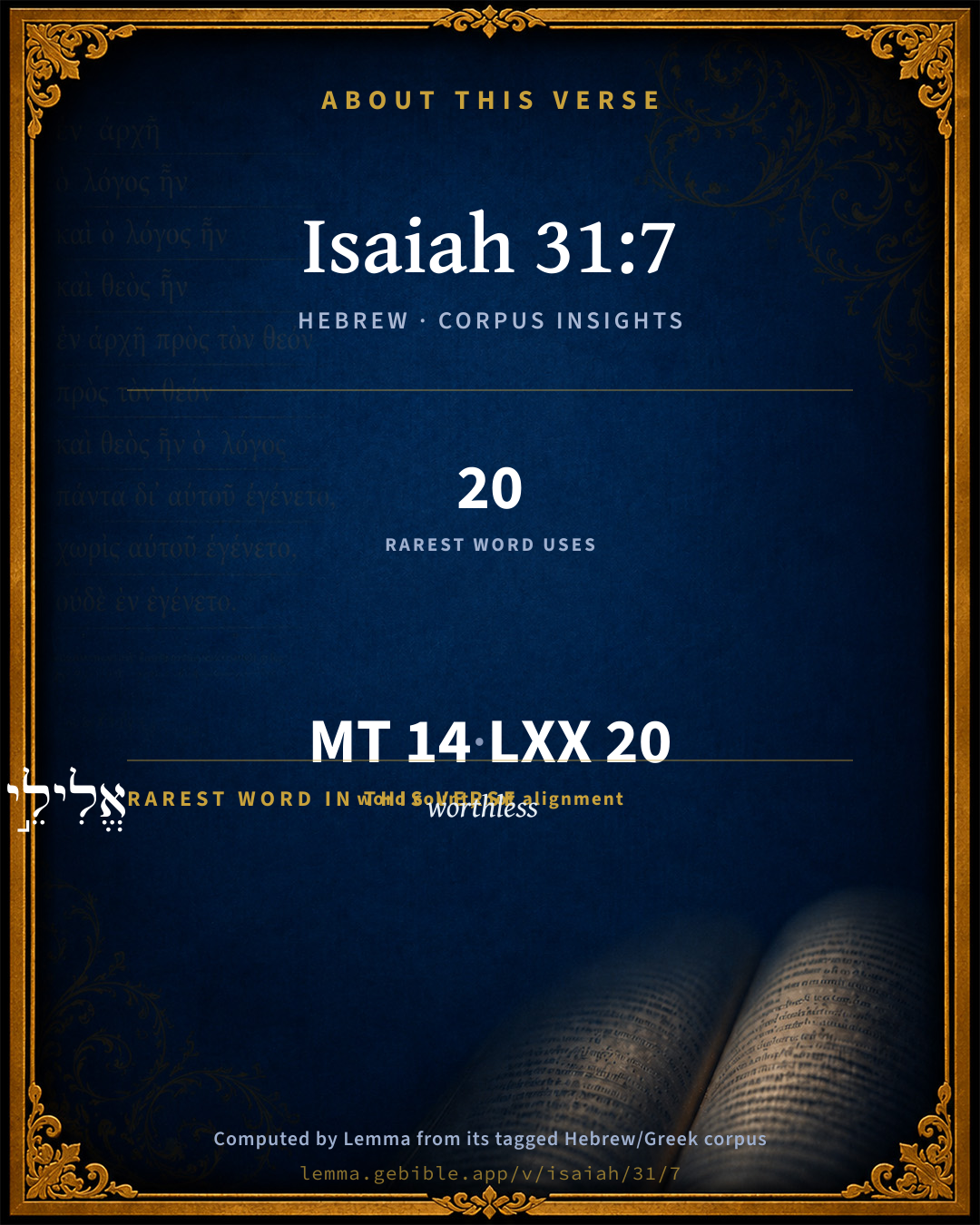
The rarest word here is אֱלִילֵ֣י worthless H457 — appearing just 20 times in the whole Hebrew Bible.

Shared distinctive vocabulary

אֱלִילֵ֣י worthless H457 occurs in 18 verses of the Hebrew Bible. Also found in:

Grammatical profile

  • 2 verbs
  • 8 nouns
  • 1 pronoun
  • 1 preposition
  • 1 conjunction
  • 1 particle

Verb forms

  • יִמְאָס֗וּן Qal · Imperfect
  • עָשׂ֥וּ Qal · Perfect

Repetition

A word recurs within this verse — often emphatic in Hebrew:

  • אֱלִילֵ֣י worthless H457 ×2

Hebrew & Septuagint length

In English translation the verse runs 30 words from the Hebrew and 18 from the Septuagint (LXX English) — the Septuagint runs noticeably shorter here. See the side-by-side →

A rough comparison of the two English renderings, which tokenize alike — not a word-level alignment.

Word counts can differ between the Hebrew and the Greek without any difference in meaning — e.g. the Hebrew direct-object marker אֵת has no separate Greek word, and Greek often adds the article ὁ.

In the original languages it is 14 Hebrew tokens and 20 Greek tokens — but the two are counted differently (Hebrew bundles its prefixes and suffixes into one token; the Greek is in lemma form), so that isn’t a like-for-like length.

Cross-references

7

Topical passages linked to Isaiah 31:7 in the Treasury of Scripture Knowledge — connected by theme and wording, ordered by reader-vote popularity; previews shown in the World English Bible.

  • Isaiah 30:22 You shall defile the overlaying of your engraved images of silver, and the plating of your molten images of gold: you shall cast them away as an unclean thing; you shall tell it, Get you hence.
  • Isaiah 2:20 In that day, men shall cast away their idols of silver, And their idols of gold, Which have been made for themselves to worship, To the moles and to the bats;
  • Ezekiel 36:25 I will sprinkle clean water on you, and you shall be clean: from all your filthiness, and from all your idols, will I cleanse you.
  • Deuteronomy 7:25 The engraved images of their gods shall you burn with fire: you shall not covet the silver or the gold that is on them, nor take it to you, lest you be snared therein; for it is an abomination to Yahweh your God.
  • Hosea 14:8 Ephraim, what have I to do any more with idols? I answer, and will take care of him. I am like a green fir tree; From me your fruit is found."
  • 1 Kings 12:28–30 Whereupon the king took counsel, and made two calves of gold; and he said to them, It is too much for you to go up to Jerusalem: see your gods, Israel, which brought you up out of the land of Egypt.
  • Hosea 8:11 Because Ephraim has multiplied altars for sinning, They became for him altars for sinning.

Cross-references courtesy of OpenBible.info (CC BY 4.0).

Hebrew and Greek witnesses Masoretic Hebrew ↔ Greek Septuagint

The same verse in the two great witnesses to the Old Testament, shown verse-for-verse.

Here the Septuagint runs noticeably shorter than the Hebrew — LXX2012 (modern English Septuagint) 18 words vs World English Bible 30. A rough length comparison of the two English translations, not a word-level alignment — read both below.

These are two independent witnesses, not word-aligned to each other, and the Septuagint is shown in lemma (dictionary) form.

Hebrew Isaiah 31:7 Masoretic · Westminster Leningrad Codex

כִּ֚י בַּיּ֣וֹם הַה֔וּא יִמְאָס֗וּן אִ֚ישׁ אֱלִילֵ֣י כַסְפּ֔וֹ וֶאֱלִילֵ֖י זְהָב֑וֹ אֲשֶׁ֨ר עָשׂ֥וּ לָכֶ֛ם יְדֵיכֶ֖ם חֵֽטְא

For in that day they shall cast away every man his idols of silver, and his idols of gold, which your own hands have made to you for a sin.

World English Bible · Public Domain

Greek LXX Isaiah 31:7 Septuagint · lemma form

ὅτι ὁ ἡμέρα ἐκεῖνος ἀποἀρνέομαι ὁ ἄνθρωπος ὁ χειροποίητος αὐτός ὁ ἀργυροῦς καί ὁ χρυσοῦς ὅς ποιέω ὁ χείρ αὐτός

For in that day men shall renounce their silver idols and their golden idols, which their hands made.

LXX2012 (modern English Septuagint) · Public Domain

On this verse, Adam Clarke's Commentary discusses the Septuagint’s reading. Read the note in Commentary ↓

Hebrew: Westminster Leningrad Codex (CC BY 4.0). Greek: Septuagint (public domain); English from LXX2012 (modern English Septuagint) (Public Domain). How the Septuagint differs from the Hebrew →

Targum (Aramaic paraphrase)

1

The Targum is the ancient Jewish Aramaic paraphrase of the Hebrew Scriptures — an interpretive translation, not the Hebrew text itself. Onkelos (literal) and Pseudo-Jonathan (expansive) render the Torah, and Jonathan the Prophets. Coverage is partial: where no permissively-licensed English translation exists for a verse, only the Aramaic is shown. This is verse-level text, not a word-by-word alignment to the Hebrew.

  1. Targum Jonathan Prophets (Joshua–Malachi)
    אֲרֵי בְעִדָנָא הַהִיא יְרַחֲקוּן גְבַר טַעֲוַת כַּסְפְּהוֹן וְטַעֲוַת דְהַבְהוֹן דַעֲבָדוּ לְכוֹן יְדֵיכוֹן חוֹבָא:

    At that time each man shall abhor the idols of their silver and the idols of their gold, which your hands have made for you for a god.

    Targum Jonathan — Aramaic: “Mikraot Gedolot” (public domain). English: “Sefaria Community Translation” (CC0 1.0 (public-domain dedication)); “London "Chaldee Paraphrase," 1871” (public domain). Text via Sefaria.

Commentary

Notes on Isaiah 31:7 from classic Christian and Jewish commentators (each source and its license shown beneath its notes). The classic Christian expositions comment on the surrounding passage and are grouped to its opening verse, so a note may address several verses; the Jewish commentaries on the Tanakh (Rashi and others) are per-verse, so they appear only where the commentator wrote on this verse.

Lemma curates 59 commentaries, every one of them public domain or Creative Commons licensed, each selected and text-cleaned for this edition rather than reprinted as found. About our sources →

Trapp's Complete Commentary

John Trapp

Isa 31:7 For in that day every man shall cast away his idols of silver, and his idols of gold, which your own hands have made unto you [for] a sin.

Ver. 7. For in that day,] scil., Of your effectual conversion; {Isa 30:22} or, when the Assyrian shall assault you, then you shall see the vanity of your idols, and of all human helps. {Isa 2:20; Isa 2:22}

John Trapp, A Commentary or Exposition upon All the Books of the Old and New Testament (1647–1656) — public domain. Text from a community e-Sword module.

Geneva Bible (1599)

Geneva Bible translators

By these fruits your repentance shall be known, as Isa. 2:20.

Geneva Bible (1599) marginal notes — public domain. Text via Bolls.life.

Jamieson, Fausset & Brown

Robert Jamieson, A. R. Fausset & David Brown

In the day of trial the idols will be found to render no help and will therefore be cast away. Compare as to the future restoration and conversion of Israel simultaneously with the interposition of Jehovah in its defense, Zac 12:9-14; Zac 13:1-2.

for a sin--that is, whereby especially you contracted guilt (Kg1 12:30).

Jamieson, Fausset & Brown — Commentary Critical and Explanatory on the Whole Bible (1871) — public domain (CC PDM 1.0). Text via the HelloAO Bible API.

Adam Clarke's Commentary

Verse 7. Which your own hands have made unto you for a sin - "The sin, which their own hands have made."] The construction of the word חטא chet, sin, in this place is not easy. The Septuagint have omitted it: MSS. Pachom. and I. D. II. and Cod. Marchal. in margine, supply the omission by the word ἁμαρτιαν, sin, or ἁμαρτημα, said to be from Aquila's Version, which I have followed. The learned Professor Schroeder, Institut. Ling. Heb. p. 298, makes it to be in regimine with ידיכם yedeychem, as an epithet, your sinful hands. The Septuagint render the pronoun in the third person, αἱ χειρες αυτων, their hands; and an ancient MS. has, agreeable to that rendering, להם lahem, to them, for לכם lachem, to you; which word they have likewise omitted, as not necessary to complete the sense.

Adam Clarke's Commentary on the Bible (1810–1826) — public domain. Text from a community e-Sword/MySword module.

Ellicott's Commentary for English Readers

(7) In that day every man shall cast away . . .—The act is the same as that of Isa_2:20, but with a marked difference of motive: there it springs from the terror of despair, here from the repentance which is the ground of hope.

A Bible Commentary for English Readers, edited by Charles John Ellicott (1878–1897) — public domain. Text from a community e-Sword module.

The Cambridge Bible for Schools and Colleges

gen. ed. J. J. S. Perowne

7. Comp. Isa_30:22, Isa_17:8, Isa_2:8 and esp. Isa_2:20.

The Cambridge Bible for Schools and Colleges (gen. ed. J. J. S. Perowne; Cambridge University Press, 1878–1918) — public domain. Text from a community e-Sword module.

John Gill's Exposition

For in that day,.... When deliverance shall be wrought; when men shall be convinced of the vanity and insufficiency of their idols to help them, and of their sin in worshipping them; when they shall be brought to repentance for it, and turn to the Lord as an evidence of it:

every man shall cast away his idols of silver, and his idols of gold; with contempt and abhorrence of them, as the word (w) signifies; every man "his" own idol, and even those that were of the greatest value, which were made of gold and silver:

which your own hands have made unto you for a sin; their idols were the work of their own hands, and were made by them in order to commit sin with, the sin of idolatry; or sin may be put for the punishment of sin, which is the issue and consequence of such practices: or it may be rendered, "which your hands of sin", or "sinful hands, have made" (x); it was a sin to make such idols, especially with a view to worship them; it was a sin to worship them; and the fruit of it was deserved punishment.

(w) a "spernere, reprobare." (x) "manus vestrae flagitiosae", Bootius Animadv. Sacr. l. 4. c. 2. sect. 12.

John Gill's Exposition of the Whole Bible (1746–1763) — public domain (CC PDM 1.0). Text via the HelloAO Bible API.

Albert Barnes' Notes on the Bible

For in that day - That is, in the invasion of Sennacherib, and the events that shalt be consequent thereon.

Every man shall cast away his idols - (see the note at Isa 30:22; compare the note at Isa 2:20).

For a sin - Or rather, the sin which your own hands have made. The sense is, that the making of those idols had been a sin, or sin itself. It had been “the” sin, by way of eminence, which was chargeable upon them.

Albert Barnes' Notes on the Bible (1834–1885) — public domain. Text from a community e-Sword/MySword module.

Haydock's Catholic Bible Commentary

Idols. Their worship was afterwards more severely prohibited, chap. xxx. 21.

George Leo Haydock (1774–1849), Haydock's Catholic Family Bible and Commentary, 1859 edition — public domain. Excludes Psalms (Douay-Rheims chapter numbering differs from Protestant) and Deuterocanonical books (Catholic canon only).

Matthew Poole's English Annotations

For when the Assyrian shall invade your land, you shall find the vanity of those idols to which you have trusted; and therefore shall cast them away with indignation, and be forced to seek to me for help. So this is added as an argument to persuade them to practise his counsel of turning to God. Which your own hands have made unto you for a sin; which you have made as instruments of your sin of idolatry. Or, which your sinful hands (by a common Hebraism, called hands of sin) have made for you. Or, the sin (as an idol is called, Deu 9:21) which your hands have made for you. So there is only a transposition of one word, which is very usual in the Hebrew text.

Matthew Poole's English Annotations on the Holy Bible (1683–1685) — public domain. Text from a community e-Sword/MySword module.

Whedon's Commentary on the Bible

Daniel D. Whedon

7, 8. In that day — The day of the surrender of idolatry. Idols of silver…

of gold — By such means idolatry was raised to precious attractiveness.

Daniel D. Whedon (gen. ed.), Commentary on the Old and New Testaments (1874–1909) — public domain. Text from a community e-Sword module.

The Pulpit Commentary

For in that day every man shall cast away his idols. "In that day the day of Assyria"s discomfiture shall the vanity of idols be seen and recognized. They have not helped Assyria. How should they help Judah? (comp. Isa_30:22)

Vers. 7-9. The fire of Jehovah.

I "OUR GOD IS A CONSUMING FINE." He burns from that sacred oracular center in Jerusalem. And his foes are seen melting away before him the Assyrian fleeing from and falling before the sword, the huge rock of his power disappearing, princes falling into panic terror as the rallying signal of Judah is raised. The briars and thorns of iniquity, all the weed-like growth of worldly ways are kindled and devoured.

II OUR GOD IS A LIGHT OF SALVATION. "Light of Israel" goes along with devouring fire". (Isa_10:17) To be enlightened is to know God and our relation to him. It is to know what is not Divine, and what is sinful, and what is worthless in reference to salvation. And so the people, having returned," will be seen respecting their "not-gods of silver and their not-gods of gold," the sinful manufacture of godless art.

III THERE MUST BE BOTH THE FIERY AND THE ILLUMINATING ELEMENT IS TRUE RELIGION. Enthusiasm is needed; without it we have no motive force. Evil will yield to nothing else than to the heart aflame with piety, the tongue of Heaven-kindled fire. Yet blind zeal is mischievous; and therefore the illuminated mind is needed, the discriminating intelligence. The union of intellect with piety, the white heat of zeal kindling all it touches into light-giving flame, what can resist it? J.

The Pulpit Commentary (1880–1919), ed. H.D.M. Spence-Jones & Joseph S. Exell — public domain. Text from a community e-Sword module.

Keil & Delitzsch

C. F. Keil & F. Delitzsch

The first is, that idolatry would one day be recognised in all its abomination, and put away. "For in that day they will abhor every one their silver idols and their gold idols, which your hands have made you for a sin," i.e., to commit sin and repent, with the preponderance of the latter idea, as in Hos 8:11 (compare Kg1 13:34). חטא, a second accusative to עשׂוּ, indicating the result. The prospect is the same as that held out in Isa 30:22; Isa 27:9; Isa 17:8; Isa 2:20.

Keil & Delitzsch — Biblical Commentary on the Old Testament (1861–1891) — public domain (CC PDM 1.0). Text via the HelloAO Bible API. (Old Testament only.)

J. A. Alexander on Isaiah

Joseph Addison Alexander

This acknowledgement you will be constrained to make sooner or later. “For in that day (of miraculous deliverance) they shall reject (cast away with contempt), a man (i.e., each) his idols of silver and his idols of gold, which your sinful hands have made for you, or, which your own hands have made for you as sin, (i.e., as an occasion and a means of sin).” In like manner the golden calves are called the sin of Israel (Deu 9:21; Amo 8:14). For the true construction of his silver and his gold, see the note on Isa 2:20. Trust in idols and reliance upon human helpers are here, and often elsewhere, put together, as identical in principle, and closely connected in the experience of ancient Israel. (See the notes on Isa 2:8).

Joseph Addison Alexander, The Prophecies of Isaiah (1846–1847; New York: Scribner, 1870–1878) — public domain. Text from a community e-Sword module.

Ibn Ezra

Rabbi Abraham ibn Ezra

Your hands. Your workmen.

חטא For a sin; for a sin κατ ἐξοχήν, a sin that surpasses all others.

Ibn Ezra on the Tanakh — English translations: “Sefaria Community Translation” (CC0 1.0 (public-domain dedication)); “Yalkut, Sifsei Chachomim Chumash, Metsudah Publications, 2009” (CC BY 4.0); and “Commentary of Ibn Ezra on Isaiah - trans. by M. Friedlander, 1873” (public domain). Text via Sefaria.

Lesson kit

Teaching starters — assembled from the data on this page, not authored interpretation. Every prompt links to the verse data it draws on. Edit before teaching.

Isaiah, in the Prophets, opens this verse with 14 words (12 distinct Hebrew lemmas). Its most distinctive word is ʼĕlîyl (“worthless”). The Greek Septuagint runs shorter here. A historical commentator’s framing appears above. Read the whole chapter for the surrounding context.

Discussion questions

  1. What does “worthless” (ʼĕlîyl) contribute to the verse as a whole?
  2. Leviticus 19:4 shares the word «worthless» with this verse. How do the two illuminate each other?
  3. “worthless” occurs 2× in this one verse. What is the effect of the repetition?
  4. Compared with the Hebrew, the Septuagint runs shorter here. What questions does that raise?
  5. These translations render this verse differently. What is at stake in choosing one wording over another?
  6. The verb «יִמְאָס֗וּן» is Qal Imperfect. How does its form color the action?
  7. Reading how Trapp's Complete Commentary and Geneva Bible (1599) read this verse, where do the two commentators agree and where do they part?

Things to notice

Reading settings

Reading text

Shown beneath each verse's original-language words.

Old Testament
Old Testament edition

Read the OT as the Masoretic Hebrew (MT) or the Greek Septuagint (LXX).

English shown for the Greek Septuagint (in the Hebrew ↔ Greek comparison).

Comparing translations? Open the Compare panel on any verse page to stack up to four side by side.