
Isaiah 5:15

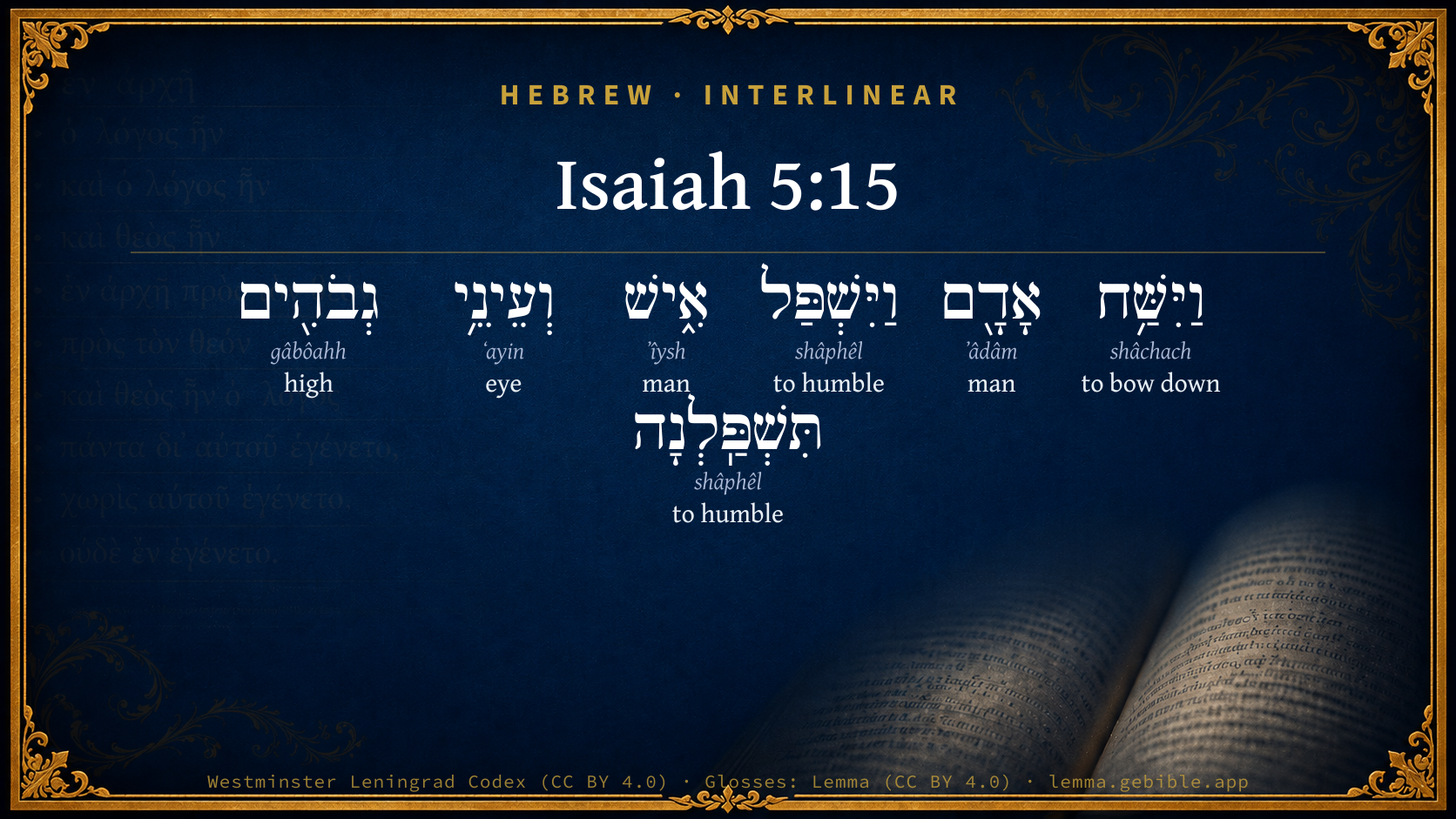
Hebrew (Westminster Leningrad Codex) Isaiah 5:15 appears in the Hebrew Old Testament. The text above is from the Westminster Leningrad Codex. Each word links to its Strong’s number, a concise gloss, and parsing drawn from the Open Scriptures Hebrew Bible morphology. Click any word for its full Brown-Driver-Briggs (BDB) entry.
Download image
Cite this verse

Isaiah 5:15 (World English Bible). Public Domain. Lemma interlinear Bible study tool, https://lemma.gebible.app/v/isaiah/5/15.

Show BibTeX & RIS
BibTeX
RIS
English Translation
So man is brought low, Mankind is humbled, And the eyes of the arrogant ones are humbled;
World English Bible · Public Domain
Download a study sheet

One document with this verse’s original text, its word-by-word gloss line, the meaning frame, cross-references with their text, attributed commentary, and full source and license credits — printable, and it pastes into notes with its structure intact.

This verse Autodidact and up

Study sheet (.html) Plain text (.txt)

A passage Seminary Student

Up to 50 verses in one chapter. A passage sheet keeps up to 6 commentary sources and 12 cross-references per verse, in the order this page ranks them, and says so on the sheet whenever that leaves anything out. Ask for a single verse and you get the Autodidact verse sheet above.

Everything on this page stays free to read, with no account — the sheet is a download of what is already on screen, not access to it.

Want to remove ads? Support Godless Engineer
Compare translations 3

The same verse in 3 English versions, stacked beneath the original-language interlinear above. Click any original word for its lexicon entry.

Each is an independent rendering of the whole verse — the interlinear is not word-aligned to these translations.

Highlighted words mark where these versions differ — a whole-verse word diff, not a word-by-word alignment.

  • World English Bible Public Domain
    So man is brought low, Mankind is humbled, And the eyes of the arrogant ones are humbled;
  • King James Version Public Domain
    And the mean man shall be brought down, and the mighty man shall be humbled, and the eyes of the lofty shall be humbled:
  • unfoldingWord Literal Text CC BY-SA 4.0
    And a human will be humbled, and a man will become low, and the eyes of the haughty will become low.

unfoldingWord Literal Text — © unfoldingWord, licensed CC BY-SA 4.0. Word-aligned USFM3 via Door43 (git.door43.org/unfoldingWord/en_ult).

Versions to compare (up to 4)

3 of 4 selected

Show all 18 translations

Every available English version of this verse, each an independent rendering of the whole verse.

  • World English Bible Public Domain
    So man is brought low, Mankind is humbled, And the eyes of the arrogant ones are humbled;
  • Berean Standard Bible Public Domain
    So mankind will be brought low, and each man humbled; the arrogant will lower their eyes.
  • Majority Standard Bible Public Domain
    So mankind will be brought low, and each man humbled; the arrogant will lower their eyes.
  • King James Version Public Domain
    And the mean man shall be brought down, and the mighty man shall be humbled, and the eyes of the lofty shall be humbled:
  • American Standard Version (1901) Public Domain
    And the mean man is bowed down, and the great man is humbled, and the eyes of the lofty are humbled:
  • Revised Version (1885) Public Domain
    And the mean man is bowed down, and the great man is humbled, and the eyes of the lofty are humbled:
  • Geneva Bible (1599) Public Domain
    And man shalbe brought downe, and man shalbe humbled, euen the eyes of the proude shalbe humbled.
  • Douay-Rheims (1899) Public Domain
    And man shall be brought down, and man shall be humbled, and the eyes of the lofty shall be brought low.
  • Young's Literal Translation Public Domain
    And bowed down is the low, and humbled the high, And the eyes of the haughty become low,
  • Literal Standard Version CC BY-SA 4.0
    And the low is bowed down, and the high humbled, || And the eyes of the haughty become low,
  • Unlocked Literal Bible CC BY-SA 4.0
    Man will be forced to bend down, and mankind will be humbled; the eyes of the lofty will be cast down.
  • unfoldingWord Literal Text CC BY-SA 4.0
    And a human will be humbled, and a man will become low, and the eyes of the haughty will become low.
  • Darby Bible Public Domain
    And the mean man shall be bowed down, and the great man brought low, and the eyes of the lofty shall be brought low;
  • World Messianic Bible Public Domain
    So man is brought low, mankind is humbled, and the eyes of the arrogant ones are humbled;
  • Webster's Bible Public Domain
    And the mean man shall be brought down, and the mighty man shall be humbled, and the eyes of the lofty shall be abased.
  • Free Bible Version CC BY-SA 4.0
    Everyone will be brought down, everyone will be humbled; the proud will lower their eyes in humiliation.
  • Bible in Basic English Public Domain
    And the poor man's head is bent, and the great man goes down on his face, and the eyes of pride are put to shame:
  • JPS Tanakh (1917) Public Domain
    And man is bowed down, and man is humbled, and the eyes of the lofty are humbled;

Literal Standard Version (2020), Covenant Press — licensed CC BY-SA 4.0. Text via the HelloAO Bible API (eBible.org). Unlocked Literal Bible (unfoldingWord) — licensed CC BY-SA 4.0. Text via the HelloAO Bible API (eBible.org). unfoldingWord Literal Text — © unfoldingWord, licensed CC BY-SA 4.0. Word-aligned USFM3 via Door43 (git.door43.org/unfoldingWord/en_ult). Free Bible Version, Dr. Jonathan Gallagher — licensed CC BY-SA 4.0. Text via the HelloAO Bible API (eBible.org).

Word by word

More ways to search: Search by grammar → Find every occurrence → Compare this word →

Practice this passage: Drill this verse → Learn its vocabulary →

וַיִּשַּׁ֥ח
shâchach
H7817
“and · to bow down”
Conjunction + Verb, Niphal, Sequential Imperfect, 3rd Person, Masculine, Singular
Part of Speech
Conjunction + Verb
Stem
Niphal
Form
Sequential Imperfect
Person
3rd Person
Gender
Masculine
Number
Singular
Full BDB Definition

Origin: a primitive root

TWOT: 2361

to bow, crouch, bow down, be bowed down - (Qal) - to be bowed down, be prostrated, be humbled - to bow (in homage) - to bow (of mourner) - to crouch (of wild beast in lair) - (Niphal) to be prostrated, be humbled, be reduced, be weakened, proceed humbly, be bowed down - (Hiphil) to prostrate, lay low, bow down - (Hithpolel) to be cast down, be despairing
  1. אָדָ֖ם ʼâdâm H120 “man” Noun, Common, Masculine, Singular, Absolute
  2. וַיִּשְׁפַּל shâphêl H8213 “and · to humble” Conjunction + Verb, Qal, Sequential Imperfect, 3rd Person, Masculine, Singular
  3. אִ֑ישׁ ʼîysh H376 “man” Noun, Common, Masculine, Singular, Absolute
  4. וְעֵינֵ֥י ʻayin H5869 “and · eyes of” Conjunction + Noun, Common, Both, Dual, Construct
  5. גְבֹהִ֖ים gâbôahh H1364 “high” Adjective, Adjective, Masculine, Plural, Absolute
  6. תִּשְׁפַּֽלְנָה shâphêl H8213 “to humble” Verb, Qal, Imperfect, 3rd Person, Feminine, Plural

About this verse

These counts appear in no published source. They are computed here, from the morphology-tagged text and Lemma’s own curated glosses. What Lemma adds →

7
words
6
distinct lemmas
Prophets
section

Notable vocabulary

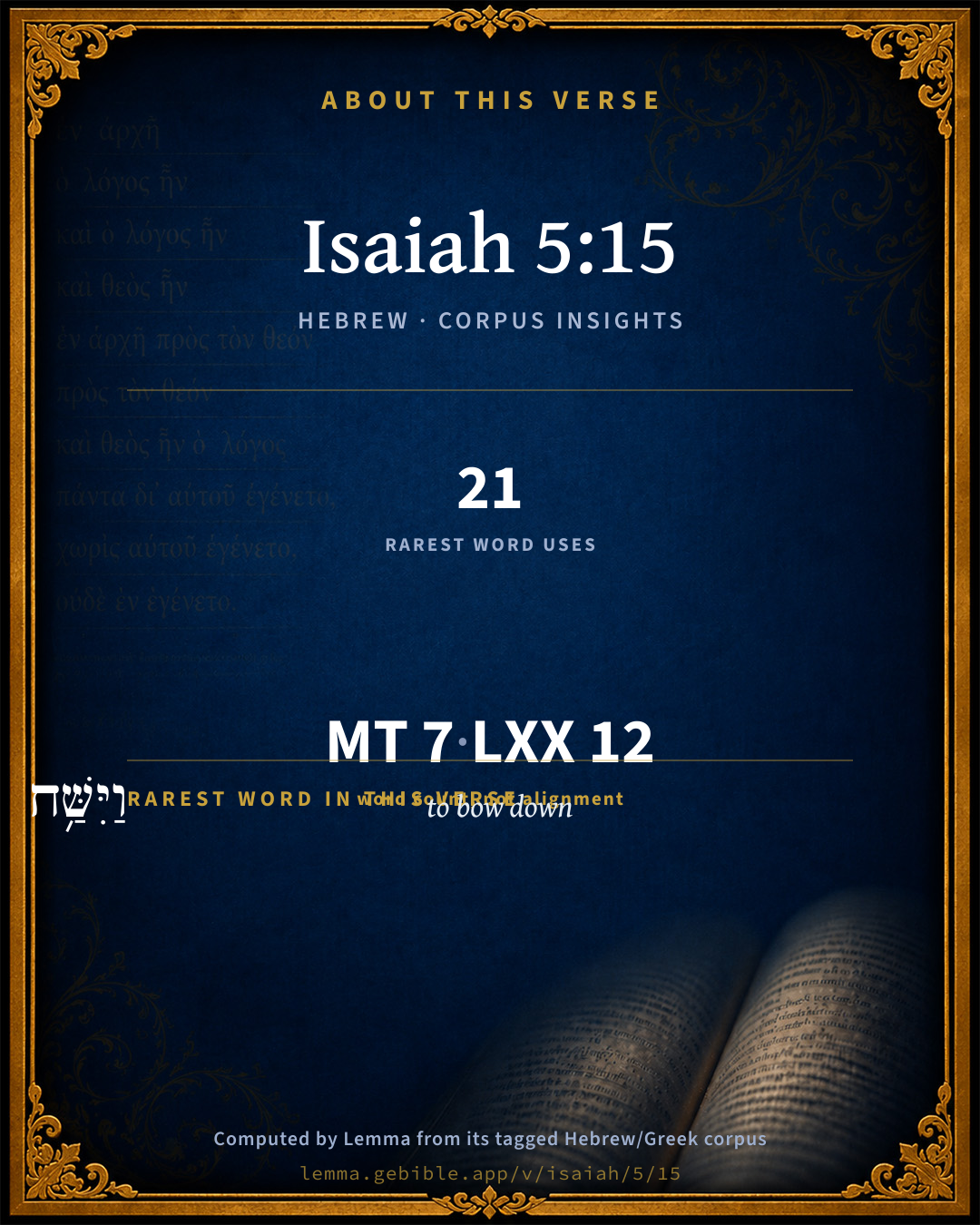
The rarest word here is וַיִּשַּׁ֥ח to bow down H7817 — appearing just 21 times in the whole Hebrew Bible.

Shared distinctive vocabulary

וַיִּשַּׁ֥ח to bow down H7817 occurs in 21 verses of the Hebrew Bible. Also found in:

Grammatical profile

  • 3 verbs
  • 3 nouns
  • 1 adjective

Verb forms

  • וַיִּשַּׁ֥ח Niphal · Sequential Imperfect
  • וַיִּשְׁפַּל Qal · Sequential Imperfect
  • תִּשְׁפַּֽלְנָה Qal · Imperfect

Repetition

A word recurs within this verse — often emphatic in Hebrew:

  • וַיִּשְׁפַּל to humble H8213 ×2

Hebrew & Septuagint length

In English translation the verse runs 17 words from the Hebrew and 23 from the Septuagint (LXX English) — closely comparable.

A rough comparison of the two English renderings, which tokenize alike — not a word-level alignment.

Word counts can differ between the Hebrew and the Greek without any difference in meaning — e.g. the Hebrew direct-object marker אֵת has no separate Greek word, and Greek often adds the article ὁ.

In the original languages it is 7 Hebrew tokens and 12 Greek tokens — but the two are counted differently (Hebrew bundles its prefixes and suffixes into one token; the Greek is in lemma form), so that isn’t a like-for-like length.

Cross-references

19

Topical passages linked to Isaiah 5:15 in the Treasury of Scripture Knowledge — connected by theme and wording, ordered by reader-vote popularity; previews shown in the World English Bible.

  • Isaiah 2:9 Man is brought low, And mankind is humbled; Therefore don't forgive them.
  • Isaiah 2:11 The lofty looks of man will be brought low, The haughtiness of men will be bowed down, And Yahweh alone will be exalted in that day.
  • Jeremiah 5:4–5 Then I said, Surely these are poor; they are foolish; for they don't know the way of Yahweh, nor the law of their God:
  • Exodus 9:17 as you still exalt yourself against my people, that you won't let them go.
  • Job 40:11–12 Pour forth the fury of your anger. Look on everyone who is proud, and bring him low.
  • Psalms 62:9 Surely men of low degree are just a breath, And men of high degree are a lie. In the balances they will go up. They are together lighter than a breath.
  • Isaiah 2:17 The loftiness of man shall be bowed down, And the haughtiness of men shall be brought low; And Yahweh alone shall be exalted in that day.
  • Isaiah 9:14–17 Therefore Yahweh will cut off from Israel head and tail, palm-branch and rush, in one day.
  • Isaiah 10:12 Therefore it shall happen that, when the Lord has performed his whole work on Mount Zion and on Jerusalem, I will punish the fruit of the stout heart of the king of Assyria, and the glory of his high looks.
  • Isaiah 10:33 Behold, the Lord, Yahweh of Hosts, will lop the boughs with terror: and the high of stature shall be hewn down, and the lofty shall be brought low.
  • Isaiah 13:11 I will punish the world for [their] evil, and the wicked for their iniquity: and I will cause the arrogance of the proud to cease, and will lay low the haughtiness of the terrible.
  • Isaiah 24:2–4 It shall be, as with the people, so with the priest; as with the servant, so with his master; as with the maid, so with her mistress; as with the buyer, so with the seller; as with the creditor, so with the debtor; as with the taker of interest, so with the giver of interest to him.
  • Isaiah 37:23 Whom have you defied and blasphemed? and against whom have you exalted your voice and lifted up your eyes on high? [even] against the Holy One of Israel.
  • Isaiah 37:29 Because of your raging against me, and because your arrogance is come up into my ears, therefore will I put my hook in your nose, and my bridle in your lips, and I will turn you back by the way by which you came.
  • Jeremiah 5:9 Shall I not visit for these things? says Yahweh; and shall not my soul be avenged on such a nation as this?
  • Daniel 4:37 Now I, Nebuchadnezzar, praise and extol and honor the King of heaven; for all his works are truth, and his ways justice; and those who walk in pride he is able to abase.
  • James 1:9–11 But let the brother in humble circumstances glory in his high position;
  • 1 Peter 5:5 Likewise, you younger ones, be subject to the elder. Yes, all of you gird yourselves with humility, to subject yourselves to one another; for "God resists the proud, but gives grace to the humble."
  • Revelation 6:15–16 The kings of the earth, the princes, the commanding officers, the rich, the strong, and every slave and free person, hid themselves in the caves and in the rocks of the mountains.

Cross-references courtesy of OpenBible.info (CC BY 4.0).

Hebrew and Greek witnesses Masoretic Hebrew ↔ Greek Septuagint

The same verse in the two great witnesses to the Old Testament, shown verse-for-verse.

These are two independent witnesses, not word-aligned to each other, and the Septuagint is shown in lemma (dictionary) form.

Hebrew Isaiah 5:15 Masoretic · Westminster Leningrad Codex

וַיִּשַּׁ֥ח אָדָ֖ם וַיִּשְׁפַּל אִ֑ישׁ וְעֵינֵ֥י גְבֹהִ֖ים תִּשְׁפַּֽלְנָה

So man is brought low, Mankind is humbled, And the eyes of the arrogant ones are humbled;

World English Bible · Public Domain

Greek LXX Isaiah 5:15 Septuagint · lemma form

καί ταπεινόω ἄνθρωπος καί ἀτιμάζω ἀνήρ καί ὁ ὀφθαλμός ὁ μετέωρος ταπεινόω

And the mean man shall be brought low, and the great man shall be disgraced, and the lofty eyes shall be brought low.

LXX2012 (modern English Septuagint) · Public Domain

Hebrew: Westminster Leningrad Codex (CC BY 4.0). Greek: Septuagint (public domain); English from LXX2012 (modern English Septuagint) (Public Domain). How the Septuagint differs from the Hebrew →

Targum (Aramaic paraphrase)

1

The Targum is the ancient Jewish Aramaic paraphrase of the Hebrew Scriptures — an interpretive translation, not the Hebrew text itself. Onkelos (literal) and Pseudo-Jonathan (expansive) render the Torah, and Jonathan the Prophets. Coverage is partial: where no permissively-licensed English translation exists for a verse, only the Aramaic is shown. This is verse-level text, not a word-by-word alignment to the Hebrew.

  1. Targum Jonathan Prophets (Joshua–Malachi)
    וְיִמְאַךְ אֱנָשָׁא וְיֶחְלַשׁ תְּקוֹף גַבְרִין וְעֵינֵי רְמַיָא יִמְאֲכוּן:

    And the mean man shall be humbled, and the strength of the strong shall be weakened, and the eyes of the lofty shall be humbled.

    Targum Jonathan — Aramaic: “Mikraot Gedolot” (public domain). English: “Sefaria Community Translation” (CC0 1.0 (public-domain dedication)); “London "Chaldee Paraphrase," 1871” (public domain). Text via Sefaria.

Commentary

Notes on Isaiah 5:15 from classic Christian and Jewish commentators (each source and its license shown beneath its notes). The classic Christian expositions comment on the surrounding passage and are grouped to its opening verse, so a note may address several verses; the Jewish commentaries on the Tanakh (Rashi and others) are per-verse, so they appear only where the commentator wrote on this verse.

Lemma curates 59 commentaries, every one of them public domain or Creative Commons licensed, each selected and text-cleaned for this edition rather than reprinted as found. About our sources →

Trapp's Complete Commentary

John Trapp

Isa 5:15 And the mean man shall be brought down, and the mighty man shall be humbled, and the eyes of the lofty shall be humbled:

Ver. 15. And the mean man shall be brought down, &c.] Here the prophet, before he comes to the third denunciation (for this part of the chapter, like Ezekiel’s roll, is full of lamentation, and mourning, and woe, Eze 2:10), inserteth three good effects of the fore-threatened punishments: {a} - 1. That the wicked shall be thereby tamed (in this verse); 2. That God’s glory shall be asserted; {Isa 5:16} and 3. That God’s poor people shall be graciously provided for; {Isa 5:17} see for this verse, Isa 2:9.

And the eyes of the haughty.] See on Isa 2:11.

{a} Piscat.

John Trapp, A Commentary or Exposition upon All the Books of the Old and New Testament (1647–1656) — public domain. Text from a community e-Sword module.

Joseph Benson's Commentary

Isa 5:15-17. And the mean man, &c. — All of them, both high and low, shall be brought to destruction. But the Lord shall be exalted in judgment — By the execution of his just judgment upon his incorrigible enemies. And God that is holy shall be sanctified — Shall appear to be a holy God; in righteousness — That is, by displaying his righteousness, or executing his righteous judgments. Then, &c. — When God shall have finished that work of judgment upon the ungodly, he will extend mercy to the remainder; the lambs — The poor and harmless people, who shall be left in the land, when the rich are carried into captivity, as it happened 2Ki 25:12; shall feed after their manner — Or, without restraint, as Bishop Lowth renders it. And the waste places of the fat ones — The lands left by their owners, the rich and great men, who were either slain or carried into captivity; shall strangers eat — The poor Israelites who were left in the land to be vine-dressers and husbandmen, who are called strangers, because they were so in reference to that land, not being the proper owners of it, nor related to them. Vitringa is of opinion that this verse “refers to the first disciples of Jesus Christ, who, seeing and deploring the destruction of the Jews, should rest safely under the protection of God; while, according to the next clause, the Gentiles should be brought into the communion of the church, and rejoice in those benefits, prerogatives, and privileges, whereof the carnal, rich, and luxurious Jews were deprived.” See Joh 10:16.

Joseph Benson's Commentary on the Old and New Testaments (1811–1818) — public domain. Text from a community e-Sword module.

Jamieson, Fausset & Brown

Robert Jamieson, A. R. Fausset & David Brown

(Compare Isa 2:9, Isa 2:11, Isa 2:17). All ranks, "mean" and "mighty" alike; so "honorable" and "multitude" (Isa 5:13).

Jamieson, Fausset & Brown — Commentary Critical and Explanatory on the Whole Bible (1871) — public domain (CC PDM 1.0). Text via the HelloAO Bible API.

Ellicott's Commentary for English Readers

(15) The mean man shall be brought.—The recurrence of the burden of Isa_2:9; Isa_2:11-12; Isa_2:17, connects Isaiah 5 with the earlier portion of the introduction.

A Bible Commentary for English Readers, edited by Charles John Ellicott (1878–1897) — public domain. Text from a community e-Sword module.

The Cambridge Bible for Schools and Colleges

gen. ed. J. J. S. Perowne

15, 16. A reminiscence of the refrain in ch. Isa_2:9; Isa_2:11; Isa_2:17; but with significant modifications. These verses seem to interrupt the connexion of Isa_5:17 with Isa_5:14, and are either parenthetical or interpolated.

The Cambridge Bible for Schools and Colleges (gen. ed. J. J. S. Perowne; Cambridge University Press, 1878–1918) — public domain. Text from a community e-Sword module.

John Gill's Exposition

And the mean man shall be brought down,.... To hell, or the grave, as well as the rich and noble:

and the mighty man shall be humbled; laid low in the dust, and be equal to the poor; for, in the grave, princes and peasants are alike; or they shall be all alike, in the same low and miserable condition:

and the eyes of the lofty shall be humbled; when famine and distress, ruin and misery, come upon them, then shall the pride of those be abased, as it was; who boasted of their riches and honour, of their descent and parentage, as the children of Abraham, and as being free men, and never in bondage; of their righteousness and good works; not submitting to the righteousness of Christ; but despising it, and looking with disdain upon, and treating with contempt, such as they thought less holy than themselves. The Scribes and Pharisees, the members of the sanhedrim, and rulers of the people, together with the whole body of the nation, are meant; who were all of the same cast and complexion, being conceited of themselves, and proud boasters.

John Gill's Exposition of the Whole Bible (1746–1763) — public domain (CC PDM 1.0). Text via the HelloAO Bible API.

Albert Barnes' Notes on the Bible

And the mean man ... the mighty man - The expressions here mean that “all” ranks would be subdued and punished; see the note at Isa 2:9.

The eyes of the lofty ... - see Isa 2:11, note; Isa 2:17, note.

Shall be exalted in judgment - In his justice; he shall so manifest his justice as to be exalted in the view of tbe people.

Shall be sanctified - Shall be “regarded” as holy. He shall so manifest his righteousness in his dealings, that it shall be seen and felt that he is a holy God.

Albert Barnes' Notes on the Bible (1834–1885) — public domain. Text from a community e-Sword/MySword module.

Matthew Poole's English Annotations

All of them, both high and low, shall be brought to destruction.

Matthew Poole's English Annotations on the Holy Bible (1683–1685) — public domain. Text from a community e-Sword/MySword module.

The Pulpit Commentary

And the mean man, hall be brought down; rather, so the mean man is brought down; i.e. in this way, by the Captivity and the consequent sufferings and deaths, both high and low are brought down and humbled, while God is exalted in man"s sight. The future is throughout spoken of as present. (comp. Isa_2:9, Isa_2:11, Isa_2:17)

The Pulpit Commentary (1880–1919), ed. H.D.M. Spence-Jones & Joseph S. Exell — public domain. Text from a community e-Sword module.

John Wesley's Explanatory Notes

The mighty - All of them, both high and low, shall be brought to destruction.

John Wesley, Explanatory Notes Upon the Whole Bible (1754–1765) — public domain. Text via the GEBible commentary corpus.

Keil & Delitzsch

C. F. Keil & F. Delitzsch

The prophet now repeats a thought which formed one of the refrains of the second prophetic address (Isa 2:9, Isa 2:11, cf., Isa 2:17). It acquires here a still deeper sense, from the context in which it stands. "Then are mean men bowed down, and lords humbled, and the eyes of lofty men are humbled. And Jehovah of hosts shows Himself exalted in judgment, and God the Holy One sanctifies Himself in righteousness." That which had exalted itself from earth to heaven, would be cast down earthwards into hell. The consecutive futures depict the coming events, which are here represented as historically present, as the direct sequel of what is also represented as present in Isa 5:14 : Hades opens, and then both low and lofty in Jerusalem sink down, and the soaring eyes now wander about in horrible depths. God, who is both exalted and holy in Himself, demanded that as the exalted One He should be exalted, and that as the Holy One He should be sanctified. But Jerusalem had not done that; He would therefore prove Himself the exalted One by the execution of justice, and sanctify Himself (nikdash is to be rendered as a reflective verb, according to Eze 36:23; Eze 38:23) by the manifestation of righteousness, in consequence of which the people of Jerusalem would have to give Him glory against their will, as forming part of "the things under the earth" (Phi 2:10). Jerusalem has been swallowed up twice in this manner by Hades; once in the Chaldean war, and again in the Roman. But the invisible background of these outward events was the fact, that it had already fallen under the power of hell. And now, even in a more literal sense, ancient Jerusalem, like the company of Korah (Num 16:30, Num 16:33), has gone underground. Just as Babylon and Nineveh, the ruins of which are dug out of the inexhaustible mine of their far-stretching foundation and soil, have sunk beneath the ground; so do men walk about in modern Jerusalem over the ancient Jerusalem, which lies buried beneath; and many an enigma of topography will remain an enigma until ancient Jerusalem has been dug out of the earth again.

Keil & Delitzsch — Biblical Commentary on the Old Testament (1861–1891) — public domain (CC PDM 1.0). Text via the HelloAO Bible API. (Old Testament only.)

J. A. Alexander on Isaiah

Joseph Addison Alexander

To the description of the punishment the Prophet now adds that of its design and ultimate effect, to wit, the humiliation of man and the exaltation of God (vs. 15, 16). The former is here foretold in terms almost identical with those of Isa 2:9. “And man is brought low and man is cast down and the eyes of the lofty (or haughty) are cast down.” ‘Let a man be ever so high, death will bring him low; ever so mean, death will bring him lower’ (Matthew Henry.)

Joseph Addison Alexander, The Prophecies of Isaiah (1846–1847; New York: Scribner, 1870–1878) — public domain. Text from a community e-Sword module.

unfoldingWord translationNotes

Door43 World Missions Community

Man will be forced to bend down, and mankind will be humbled

The phrases used together mean the same thing and are used together for emphasis. This can be stated in active form. See how you translated similar words in Isaiah 2:9. AT: "God will make every person bow down and be humble" (See: Parallelism and Active or Passive)

Man will be forced to bend down, and mankind will be humbled

Future events are spoken of as if they have already happened. (See: Predictive Past)

Man will be forced to bend down

Bending down often symbolizes being humiliated. (See: Symbolic Action)

the eyes of the lofty will be cast down

Looking down is often a sign of being ashamed. See how you translated similar words in Isaiah 2:11. AT: "the eyes of proud people will look down in shame" or "people who were proud are now ashamed" (See: Metonymy)

the lofty

Here proud, arrogant people are spoken of as if they are high above other people. AT: "proud" (See: Metaphor)

Yahweh of hosts will be exalted in his justice

This can be stated in active form. AT: "People will praise Yahweh of hosts because he is just" (See: Active or Passive)

Yahweh of hosts

See how you translated this in Isaiah 1:9.

will be exalted

Being honored is spoken of as if it were being lifted high. AT: "will be greatly honored" (See: Metaphor)

the sheep will feed as in their own pasture

Yahweh will destroy the city of Jerusalem, which was called a "vineyard" in Isaiah 5:1. It will become good for nothing except for sheep to eat grass there.

graze

eat grass

in the ruins, lambs will graze as foreigners

That is, the lambs will graze there. The land will be worthless for any other use. (See: Simile)

translationWords

humble

Yahweh of hosts

exalt

just

Holy One

righteous

lamb

unfoldingWord translationNotes — © Distant Shores Media and the Door43 World Missions Community, licensed CC BY-SA 4.0. Source: git.door43.org/Door43/en_tn.

Rashi

Rabbi Shlomo Yitzchaki (Rashi)

And man shall be humbled... and the strong of men shall be weakened. [after Jonathan]. According to the Midrashic interpretation (Sotah 48a), this is the Holy One, blessed be He. They caused Him to appear as a man who is stunned. [The expression originates in Jeremiah 14:9]. And so Scripture states (Deut. 32:18): “The Rock that begot you, you have weakened (תֶּשִׁי),” [interpreting the word as originating from תָּשׁ, weak,] and Scripture states [further] (Ecclesiastes 10:18): “Through slothfulness, the One Who frames His upper chambers will become impoverished.”

Rashi on the Tanakh — English translations: “The Judaica Press complete Tanach with Rashi, translated by A. J. Rosenberg” (CC BY 4.0); “Pentateuch with Rashi's commentary by M. Rosenbaum and A.M. Silbermann, 1929-1934” (public domain); “The Metsudah Tanach series, Lakewood, N.J” (CC BY 4.0); and “The Book of Joshua, Metsudah Publications, 1997” (CC BY 4.0). Text via Sefaria.

Ibn Ezra

Rabbi Abraham ibn Ezra

And the mean man, etc. And all men of the nations which surround Judah will be humbled.

Ibn Ezra on the Tanakh — English translations: “Sefaria Community Translation” (CC0 1.0 (public-domain dedication)); “Yalkut, Sifsei Chachomim Chumash, Metsudah Publications, 2009” (CC BY 4.0); and “Commentary of Ibn Ezra on Isaiah - trans. by M. Friedlander, 1873” (public domain). Text via Sefaria.

Lesson kit

Teaching starters — assembled from the data on this page, not authored interpretation. Every prompt links to the verse data it draws on. Edit before teaching.

Isaiah, in the Prophets, opens this verse with 7 words (6 distinct Hebrew lemmas). Its most distinctive word is shâchach (“to bow down”). A historical commentator’s framing appears above. Read the whole chapter for the surrounding context.

Discussion questions

  1. The word shâchach carries the sense “to bow down.” How does it shape the verse?
  2. Job 9:13 shares the word «to bow down» with this verse. How do the two illuminate each other?
  3. “to humble” occurs 2× in this one verse. What is the effect of the repetition?
  4. These translations render this verse differently; the difference is in the English rendering, not the original. What questions does that raise?
  5. The verb «וַיִּשַּׁ֥ח» is Niphal Sequential Imperfect. How does its form color the action?
  6. Reading how Trapp's Complete Commentary and Joseph Benson's Commentary read this verse, where do the two commentators agree and where do they part?

Things to notice

Reading settings

Reading text

Shown beneath each verse's original-language words.

Old Testament
Old Testament edition

Read the OT as the Masoretic Hebrew (MT) or the Greek Septuagint (LXX).

English shown for the Greek Septuagint (in the Hebrew ↔ Greek comparison).

Comparing translations? Open the Compare panel on any verse page to stack up to four side by side.