Isaiah 9:19

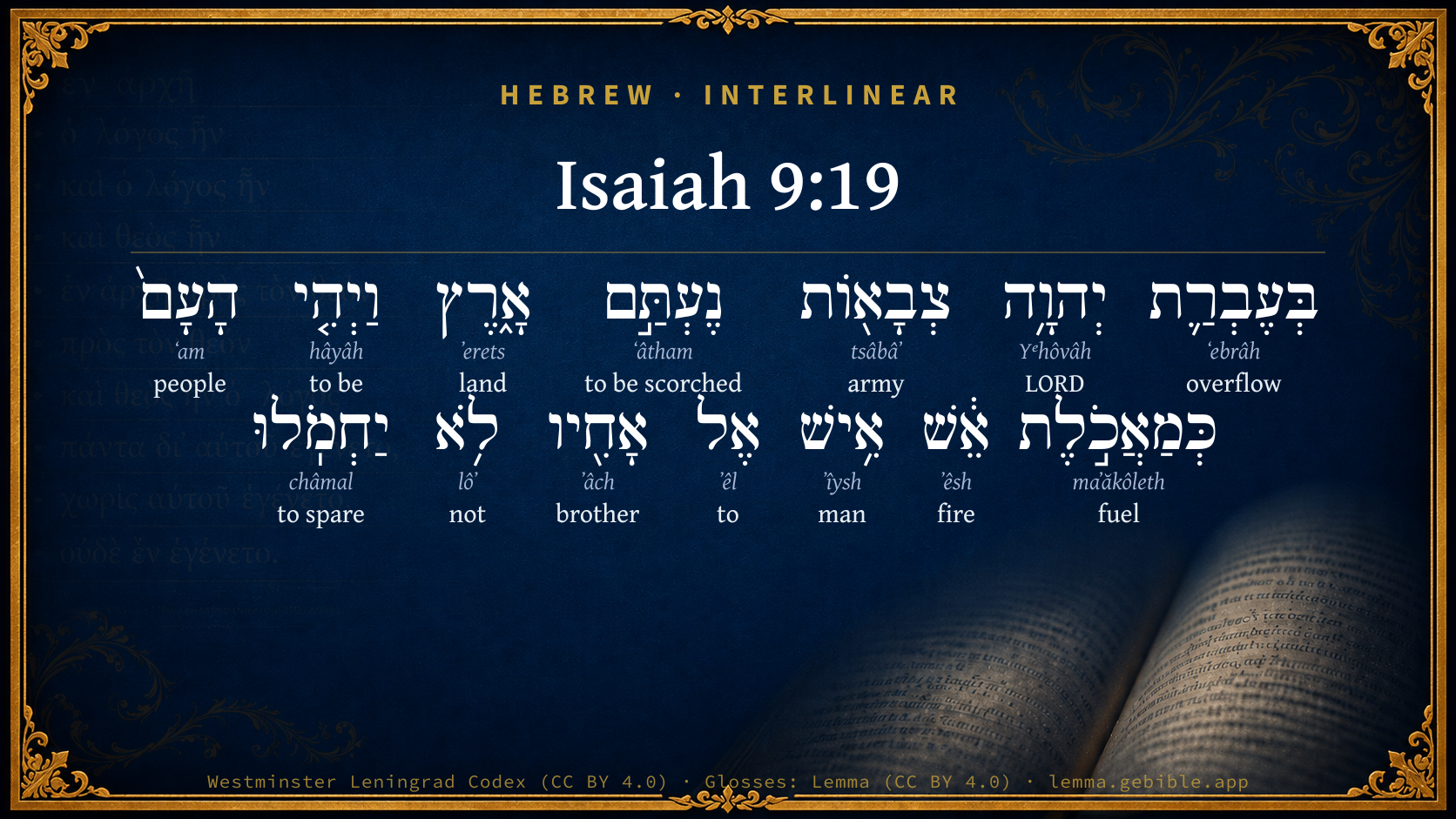
Hebrew (Westminster Leningrad Codex) Isaiah 9:19 appears in the Hebrew Old Testament. The text above is from the Westminster Leningrad Codex. Each word links to its Strong’s number, a concise gloss, and parsing drawn from the Open Scriptures Hebrew Bible morphology. Click any word for its full Brown-Driver-Briggs (BDB) entry.
Download image
Cite this verse

Isaiah 9:19 (World English Bible). Public Domain. Lemma interlinear Bible study tool, https://lemma.gebible.app/v/isaiah/9/19.

Show BibTeX & RIS
BibTeX
RIS
English Translation
Through the wrath of Yahweh of hosts is the land burnt up; and the people are as the fuel of fire: no man spares his brother.
World English Bible · Public Domain
Highlights
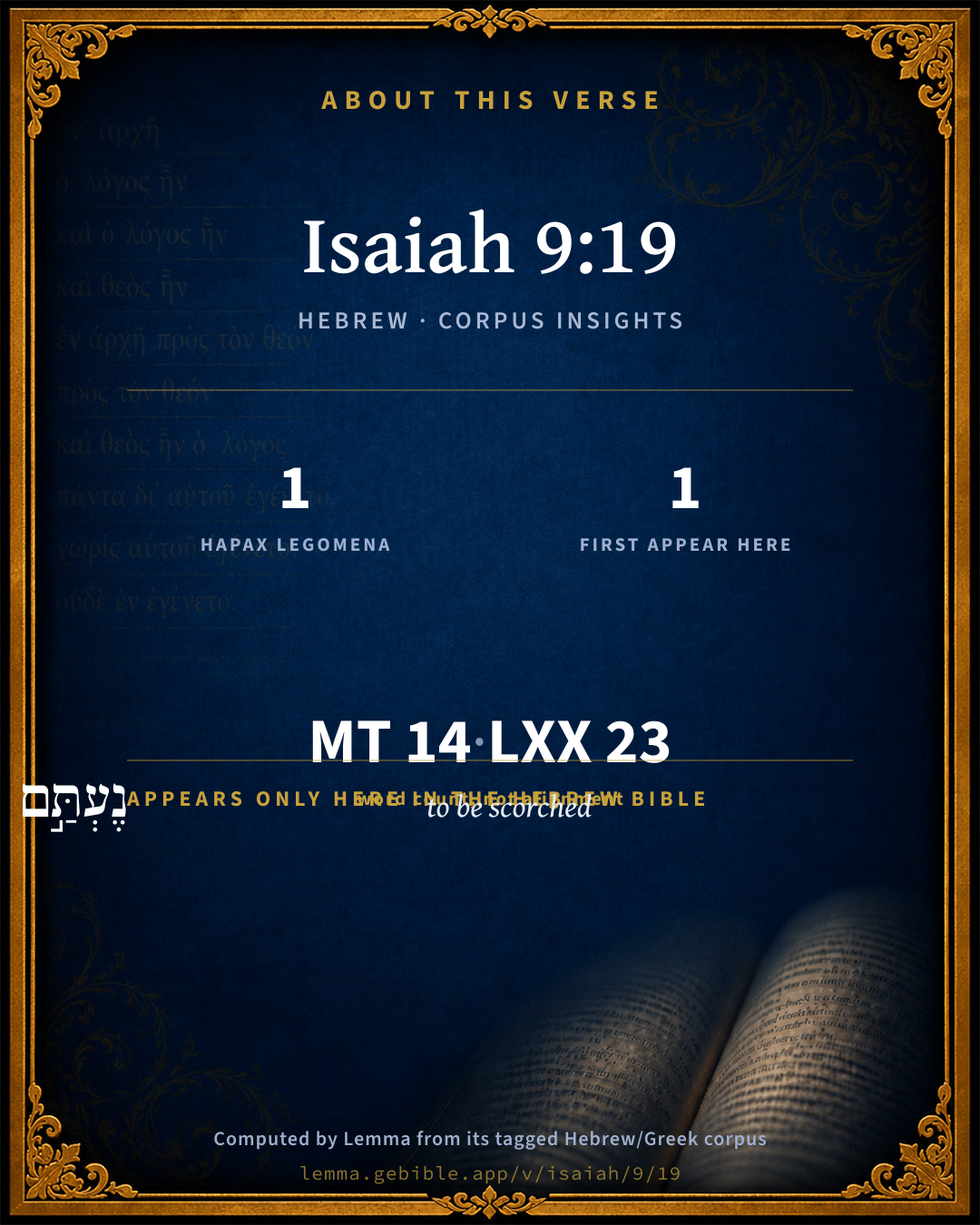
  • 1 hapax legomenon — only here in the Hebrew Bible
  • 1 first appearance in the Hebrew Bible
Full analysis ↓
Download a study sheet

One document with this verse’s original text, its word-by-word gloss line, the meaning frame, cross-references with their text, attributed commentary, and full source and license credits — printable, and it pastes into notes with its structure intact.

This verse Autodidact and up

Study sheet (.html) Plain text (.txt)

A passage Seminary Student

Up to 50 verses in one chapter. A passage sheet keeps up to 6 commentary sources and 12 cross-references per verse, in the order this page ranks them, and says so on the sheet whenever that leaves anything out. Ask for a single verse and you get the Autodidact verse sheet above.

Everything on this page stays free to read, with no account — the sheet is a download of what is already on screen, not access to it.

Want to remove ads? Support Godless Engineer
Compare translations 3

The same verse in 3 English versions, stacked beneath the original-language interlinear above. Click any original word for its lexicon entry.

Each is an independent rendering of the whole verse — the interlinear is not word-aligned to these translations.

Highlighted words mark where these versions differ — a whole-verse word diff, not a word-by-word alignment.

  • World English Bible Public Domain
    Through the wrath of Yahweh of hosts is the land burnt up; and the people are as the fuel of fire: no man spares his brother.
  • King James Version Public Domain
    Through the wrath of the LORD of hosts is the land darkened, and the people shall be as the fuel of the fire: no man shall spare his brother.
  • unfoldingWord Literal Text CC BY-SA 4.0
    By the wrath of Yahweh of Armies, the land is scorched, and the people are like fuel of fire. A man does not have pity on his brother.

unfoldingWord Literal Text — © unfoldingWord, licensed CC BY-SA 4.0. Word-aligned USFM3 via Door43 (git.door43.org/unfoldingWord/en_ult).

Versions to compare (up to 4)

3 of 4 selected

Show all 18 translations

Every available English version of this verse, each an independent rendering of the whole verse.

  • World English Bible Public Domain
    Through the wrath of Yahweh of hosts is the land burnt up; and the people are as the fuel of fire: no man spares his brother.
  • Berean Standard Bible Public Domain
    By the wrath of the LORD of Hosts the land is scorched, and the people are fuel for the fire. No man even spares his brother.
  • Majority Standard Bible Public Domain
    By the wrath of the LORD of Hosts the land is scorched, and the people are fuel for the fire. No man even spares his brother.
  • King James Version Public Domain
    Through the wrath of the LORD of hosts is the land darkened, and the people shall be as the fuel of the fire: no man shall spare his brother.
  • American Standard Version (1901) Public Domain
    Through the wrath of Jehovah of hosts is the land burnt up; and the people are as the fuel of fire: no man spareth his brother.
  • Revised Version (1885) Public Domain
    Through the wrath of the LORD of hosts is the land burnt up: the people also are as the fuel of fire; no man spareth his brother.
  • Geneva Bible (1599) Public Domain
    By the wrath of the Lord of hostes shall the land be darkened, and the people shall be as the meate of ye fire: no man shall spare his brother.
  • Douay-Rheims (1899) Public Domain
    By the wrath of the Lord of hosts the land is troubled, and the people shall be as fuel for the fire: no man shall spare his brother.
  • Young's Literal Translation Public Domain
    In the wrath of Jehovah of Hosts Hath the land been consumed, And the people is as fuel of fire; A man on his brother hath no pity,
  • Literal Standard Version CC BY-SA 4.0
    In the wrath of YHWH of Hosts || The land has been consumed, || And the people is as fuel of fire; A man has no pity on his brother,
  • Unlocked Literal Bible CC BY-SA 4.0
    Through the fury of Yahweh of hosts the land is scorched, and the people are like fuel for the fire. No man spares his brother.
  • unfoldingWord Literal Text CC BY-SA 4.0
    By the wrath of Yahweh of Armies, the land is scorched, and the people are like fuel of fire. A man does not have pity on his brother.
  • Darby Bible Public Domain
    Through the wrath of Jehovah of hosts is the land burned up, and the people is as fuel for fire: a man spareth not his brother;
  • World Messianic Bible Public Domain
    Through the LORD of Hosts’ wrath, the land is burned up; and the people are the fuel for the fire. No one spares his brother.
  • Webster's Bible Public Domain
    Through the wrath of the LORD of hosts is the land darkened, and the people shall be as the fuel of the fire: no man shall spare his brother.
  • Free Bible Version CC BY-SA 4.0
    The anger of the Lord Almighty burns the land. People are like fuel for the fire, and nobody tries to help anyone else.
  • Bible in Basic English Public Domain
    The land was dark with the wrath of the Lord of armies: the people were like those who take men's flesh for food.
  • JPS Tanakh (1917) Public Domain
    (9-18) Through the wrath of the LORD of hosts is the land burnt up; the people also are as the fuel of fire; no man spareth his brother.

Literal Standard Version (2020), Covenant Press — licensed CC BY-SA 4.0. Text via the HelloAO Bible API (eBible.org). Unlocked Literal Bible (unfoldingWord) — licensed CC BY-SA 4.0. Text via the HelloAO Bible API (eBible.org). unfoldingWord Literal Text — © unfoldingWord, licensed CC BY-SA 4.0. Word-aligned USFM3 via Door43 (git.door43.org/unfoldingWord/en_ult). Free Bible Version, Dr. Jonathan Gallagher — licensed CC BY-SA 4.0. Text via the HelloAO Bible API (eBible.org).

Word by word

More ways to search: Search by grammar → Find every occurrence → Compare this word →

Practice this passage: Drill this verse → Learn its vocabulary →

נֶעְתַּ֣ם
ʻâtham
H6272
“to be scorched”
Verb, Niphal, Perfect, 3rd Person, Masculine, Singular
Part of Speech
Verb
Stem
Niphal
Form
Perfect
Person
3rd Person
Gender
Masculine
Number
Singular
Full BDB Definition

Origin: a primitive root

TWOT: 1720

(Niphal) to be burned up, be scorched - meaning dubious
  1. בְּעֶבְרַ֛ת ʻebrâh H5678 “in/at · overflow of” Preposition + Noun, Common, Feminine, Singular, Construct
  2. יְהוָ֥ה Yᵉhôvâh H3068 “LORD” Noun, Proper
  3. צְבָא֖וֹת tsâbâʼ H6635 “armies” Noun, Common, Both, Plural, Absolute
  4. אָ֑רֶץ ʼerets H776 “land” Noun, Common, Both, Singular, Absolute
  5. וַיְהִ֤י hâyâh H1961 “and · to be” Conjunction + Verb, Qal, Sequential Imperfect, 3rd Person, Masculine, Singular
  6. הָעָם֙ ʻam H5971 “the · people” Particle, Definite Article + Noun, Common, Masculine, Singular, Absolute
  7. כְּמַאֲכֹ֣לֶת maʼăkôleth H3980 “like/as · fuel of” Preposition + Noun, Common, Feminine, Singular, Construct
  8. אֵ֔שׁ ʼêsh H784 “fire” Noun, Common, Both, Singular, Absolute
  9. אִ֥ישׁ ʼîysh H376 “man” Noun, Common, Masculine, Singular, Absolute
  10. אֶל ʼêl H413 “to” Preposition
  11. אָחִ֖יו ʼâch H251 “brother · his” Noun, Common, Masculine, Singular, Construct + Suffix, Personal, 3rd Person, Masculine, Singular
  12. לֹ֥א lôʼ H3808 “not” Particle, Negative
  13. יַחְמֹֽלוּ châmal H2550 “to spare” Verb, Qal, Imperfect, 3rd Person, Masculine, Plural

About this verse

These counts appear in no published source. They are computed here, from the morphology-tagged text and Lemma’s own curated glosses. What Lemma adds →

14
words
14
distinct lemmas
Prophets
section

Notable vocabulary

1 hapax legomenon — a word that appears only here in the entire Hebrew Bible:

  • נֶעְתַּ֣ם to be scorched H6272

First appearance in Scripture

This word makes its first canonical appearance in the Hebrew Bible here:

  • נֶעְתַּ֣ם to be scorched H6272

Shared distinctive vocabulary

כְּמַאֲכֹ֣לֶת fuel H3980 occurs in 2 verses of the Hebrew Bible. Also found in:

Grammatical profile

  • 3 verbs
  • 9 nouns
  • 1 preposition
  • 1 particle

Verb forms

  • נֶעְתַּ֣ם Niphal · Perfect
  • וַיְהִ֤י Qal · Sequential Imperfect
  • יַחְמֹֽלוּ Qal · Imperfect

Hebrew & Septuagint length

In English translation the verse runs 26 words from the Hebrew and 31 from the Septuagint (LXX English) — closely comparable.

A rough comparison of the two English renderings, which tokenize alike — not a word-level alignment.

Word counts can differ between the Hebrew and the Greek without any difference in meaning — e.g. the Hebrew direct-object marker אֵת has no separate Greek word, and Greek often adds the article ὁ.

In the original languages it is 14 Hebrew tokens and 23 Greek tokens — but the two are counted differently (Hebrew bundles its prefixes and suffixes into one token; the Greek is in lemma form), so that isn’t a like-for-like length.

Cross-references

18

Topical passages linked to Isaiah 9:19 in the Treasury of Scripture Knowledge — connected by theme and wording, ordered by reader-vote popularity; previews shown in the World English Bible.

  • Micah 7:2 The godly man has perished out of the earth, And there is no one upright among men. They all lie in wait for blood; Every man hunts his brother with a net.
  • Micah 7:6 For the son dishonors the father, The daughter rises up against her mother, The daughter-in-law against her mother-in-law; A man's enemies are the men of his own house.
  • Isaiah 1:31 The strong will be like tinder, And his work like a spark. They will both burn together, And no one will quench them."
  • Isaiah 5:30 They will roar against them in that day like the roaring of the sea. If one looks to the land, behold, darkness and distress. The light is darkened in its clouds.
  • Isaiah 8:22 and they shall look to the earth, and see, distress and darkness, the gloom of anguish; and into thick darkness [they shall be] driven away.
  • Isaiah 13:9 Behold, the day of Yahweh comes, cruel, with wrath and fierce anger; to make the land a desolation, and to destroy the sinners of it out of it.
  • Isaiah 13:13 Therefore I will make the heavens to tremble, and the earth shall be shaken out of its place, in the wrath of Yahweh of hosts, and in the day of his fierce anger.
  • Isaiah 13:18 [Their] bows shall dash the young men in pieces; and they shall have no pity on the fruit of the womb; their eye shall not spare children.
  • Isaiah 24:6 Therefore has the curse devoured the earth, and those who dwell therein are found guilty: therefore the inhabitants of the earth are burned, and few men left.
  • Isaiah 24:11–12 There is a crying in the streets because of the wine; all joy is darkened, the mirth of the land is gone.
  • Isaiah 60:2 For, behold, darkness shall cover the earth, and gross darkness the peoples; but Yahweh will arise on you, and his glory shall be seen on you.
  • Jeremiah 13:16 Give glory to Yahweh your God, before he cause darkness, and before your feet stumble on the dark mountains, and, while you look for light, he turn it into the shadow of death, and make it gross darkness.
  • Ezekiel 9:5 To the others he said in my hearing, Go you through the city after him, and strike: don't let your eye spare, neither have you pity;
  • Joel 2:2 A day of darkness and gloominess, A day of clouds and thick darkness. As the dawn spreading on the mountains, A great and strong people; There has never been the like, Neither will there be any more after them, Even to the years of many generations.
  • Amos 5:18 "Woe to you who desire the day of Yahweh! Why do you long for the day of Yahweh? It is darkness, And not light.
  • Matthew 27:45 Now from the sixth hour there was darkness over all the land until the ninth hour.
  • Acts 2:20 The sun will be turned into darkness, And the moon into blood, Before the great and glorious day of the Lord comes.
  • 2 Peter 2:4 For if God didn't spare angels when they sinned, but cast them down to Tartarus, and committed them to pits of darkness, to be reserved to judgment;

Cross-references courtesy of OpenBible.info (CC BY 4.0).

Hebrew and Greek witnesses Masoretic Hebrew ↔ Greek Septuagint

The same verse in the two great witnesses to the Old Testament, shown verse-for-verse.

These are two independent witnesses, not word-aligned to each other, and the Septuagint is shown in lemma (dictionary) form.

Hebrew Isaiah 9:19 Masoretic · Westminster Leningrad Codex

בְּעֶבְרַ֛ת יְהוָ֥ה צְבָא֖וֹת נֶעְתַּ֣ם אָ֑רֶץ וַיְהִ֤י הָעָם֙ כְּמַאֲכֹ֣לֶת אֵ֔שׁ אִ֥ישׁ אֶל אָחִ֖יו לֹ֥א יַחְמֹֽלוּ

Through the wrath of Yahweh of hosts is the land burnt up; and the people are as the fuel of fire: no man spares his brother.

World English Bible · Public Domain

Greek LXX Isaiah 9:19 Septuagint · lemma form

ἀλλά ἐκκλίνω εἰς ὁ δεξιός ὅτι πεινάω καί ἐσθίω ἐκ ὁ ἀριστερός καί οὐ μή ἐνπίμπλημι ἄνθρωπος ἐσθίω ὁ σάρξ ὁ βραχίων αὐτός

The whole earth is set on fire because of the fierce anger of the Lord, and the people shall be as men burnt by fire: no man shall pity his brother.

LXX2012 (modern English Septuagint) · Public Domain

On this verse, Jamieson, Fausset & Brown discusses the Septuagint’s reading. Read the note in Commentary ↓

Hebrew: Westminster Leningrad Codex (CC BY 4.0). Greek: Septuagint (public domain); English from LXX2012 (modern English Septuagint) (Public Domain). How the Septuagint differs from the Hebrew →

Targum (Aramaic paraphrase)

1

The Targum is the ancient Jewish Aramaic paraphrase of the Hebrew Scriptures — an interpretive translation, not the Hebrew text itself. Onkelos (literal) and Pseudo-Jonathan (expansive) render the Torah, and Jonathan the Prophets. Coverage is partial: where no permissively-licensed English translation exists for a verse, only the Aramaic is shown. This is verse-level text, not a word-by-word alignment to the Hebrew.

  1. Targum Jonathan Prophets (Joshua–Malachi)
    וּבַז מִן דָרוֹמָא וּכְפֵין וְשֵׁיצֵי מִן צִפּוּנָא וְלָא שְׂבַע גְבַר נִכְסֵיהּ קָרִיבֵיהּ יִבְזוּן:

    And he shall spoil on the south, and be hungry; and he shall destroy on the north, and not be satisfied: they shall spoil the substance, every man the substance of his neighbour.

    Targum Jonathan — Aramaic: “Mikraot Gedolot” (public domain). English: “Sefaria Community Translation” (CC0 1.0 (public-domain dedication)); “London "Chaldee Paraphrase," 1871” (public domain). Text via Sefaria.

Commentary

Notes on Isaiah 9:19 from classic Christian and Jewish commentators (each source and its license shown beneath its notes). The classic Christian expositions comment on the surrounding passage and are grouped to its opening verse, so a note may address several verses; the Jewish commentaries on the Tanakh (Rashi and others) are per-verse, so they appear only where the commentator wrote on this verse.

Lemma curates 59 commentaries, every one of them public domain or Creative Commons licensed, each selected and text-cleaned for this edition rather than reprinted as found. About our sources →

Trapp's Complete Commentary

John Trapp

Isa 9:19 Through the wrath of the LORD of hosts is the land darkened, and the people shall be as the fuel of the fire: no man shall spare his brother.

Ver. 19. Through the wrath of the Lord of hosts is the land darkened,] viz., By that pride of smoke, or vast pillar of smoke, mentioned Isa 9:18. Tristem et miseram rerum faciem designat.

No man shall spare his brother.] Wickedness is cruel, and a man had as good deal with a cannibal as with a truly covetous wretch.

John Trapp, A Commentary or Exposition upon All the Books of the Old and New Testament (1647–1656) — public domain. Text from a community e-Sword module.

Geneva Bible (1599)

Geneva Bible translators

Though there were no foreign enemy, yet they shall destroy one another.

Geneva Bible (1599) marginal notes — public domain. Text via Bolls.life.

Jamieson, Fausset & Brown

Robert Jamieson, A. R. Fausset & David Brown

darkened--namely, with smoke (Isa 9:18). The Septuagint and Chaldee render it, "is burnt up," so MAURER, from an Arabic root meaning "suffocating heat."

no man . . . spare . . . brother--intestine discord snapping asunder the dearest ties of nature.

Jamieson, Fausset & Brown — Commentary Critical and Explanatory on the Whole Bible (1871) — public domain (CC PDM 1.0). Text via the HelloAO Bible API.

Ellicott's Commentary for English Readers

(19, 20) Through the wrath of the Lord of hosts is the land darkened . . .—The vision of darkness and famine which had come before the prophet’s eyes in Isa_8:21 appears once again, and here, as there, it is a question whether the words are to be understood literally or figuratively. The definiteness of the language of Isa_9:20 suggests the thoughts of the horrors of a famine like that of Samaria (2Ki_6:28-29), or of Deu_28:53-57; Zec_11:9. But even that scene of horror might be only typical of a state of chaos and confusion pervading the whole order of society, fierce passions, jealousies, rivalries working out the destruction of the nation’s life; such as Thucydides (iii. 82-84) has painted as the result of the Peloponnesian war. The mention of Ephraim and Manasseh as conspicuous in the self-destructive work confirms the figurative interpretation. They were devouring “the flesh of their own arm” when they allowed their old tribal jealousies (Jdg_8:1; Jdg_12:1-4; 2Sa_19:43) to break up the unity of the nation.

And they together shall be against Judah.—This formed the climax of the whole. The only power of union that showed itself in the northern kingdom was to perpetuate the great schism in which it had its origin. The idea that Israel as such was a nation was forgotten. Ephraim and Manasseh could join in a common expedition against Judah when they could join in nothing else. Of this the alliance of Pekah with Rezin was the most striking instance (2Ch_28:6-15). Traces of internal division are found in the conspiracy of the Gileadites of the trans-Jordanic district of Manasseh, against Pekah’s predecessor in Samaria (2Ki_15:25).

A Bible Commentary for English Readers, edited by Charles John Ellicott (1878–1897) — public domain. Text from a community e-Sword module.

The Cambridge Bible for Schools and Colleges

gen. ed. J. J. S. Perowne

19. darkened] Another translation is “made to glow”; the word is not found elsewhere.

no man sparing his brother. The clause shews that the fire is an emblem of ungovernable party strife. The sense would be still clearer if we could adopt Duhm’s hazardous emendation in the preceding clause so as to make it read “and the people became like man-eaters (cannibals).”

The Cambridge Bible for Schools and Colleges (gen. ed. J. J. S. Perowne; Cambridge University Press, 1878–1918) — public domain. Text from a community e-Sword module.

John Gill's Exposition

Through the wrath of the Lord of hosts is the land darkened,.... Brought into great distress and affliction; sore judgments and calamities being upon it; for not darkness in a natural, but in a figurative sense, is intended, see Isa 8:22 the allusion is to the ascending of the smoke before mentioned, through fire being kindled in the thickets of the forest, which filled the air with darkness; as smoke arising in great quantity does. This sense of the word, which is only to be met with in this place, is given by Aben Ezra, Kimchi, and Ben Melech, from the use of it in the Arabic language, in which it signifies (f) darkness; but the Septuagint and Arabic versions render it, "the whole land is burned"; and which is confirmed by the Targum, which so interprets it; and this sense well agrees with the context:

and the people shall be as the fuel of the fire; this explains who are meant by the briers and thorns, and thickets of the forest, the inhabitants of the land of Israel; who, as they are the fuel of fire, were the objects of divine wrath and fury:

no man shall spare his brother; which may be ascribed either to the darkness and confusion in which they should be, and so not be able to discern a friend from a foe, as persons surrounded with smoke; or to their malignant spirit, cruelty and inhumanity, not only doing ill to their enemies, but to their own friends and relations, to their own flesh and blood.

(f) "obscura evasit", ---- "tertia pars noctis, a fine crepusculi, tempus quo posterior peragitur precatio vespertina", Golius, col. 1521, 1522. Castel col. 2944. So Schindler, col. 1410. "ateme, caligo, tenebra, crepusculum".

John Gill's Exposition of the Whole Bible (1746–1763) — public domain (CC PDM 1.0). Text via the HelloAO Bible API.

Albert Barnes' Notes on the Bible

Through the wrath - By the anger, or indignation. This spreading desolation is the proof of his anger.

Is the land darkened - The word used here - עתם ‛âtham - occurs nowhere else. According to Gesenius, it is the same as תמם tâmam to be or make complete; and hence means, “in this place, to be consumed, or laid waste.” Kimchi and Aben Ezra render it, ‘The land is darkened.’ Septuagint, Συγκέκαυται Sungkekautai. Chaldee, צרוכת chărôkat - ‘Is scorched.’ Jerome renders it, Conturbata est terra - ‘The land is disturbed.’ The effect is doubtless such as ascending and spreading columns of fire and smoke would produce, and perhaps the general word desolate had better be used in translating the word.

And the people shall be as fuel of the fire - This is an image of widespread ruin. The idea is, that they shall destroy one another as pieces of wood, when on fire, help to consume each other. The way in which it shall be done is stated more fully in the next verse.

No man shall spare his brother - There shall be such a state of wickedness, that it shall lead to anarchy, and strife, and mutual destruction. The common ties of life shall be dissolved, and a man shall have no compassion on his own brother.

Albert Barnes' Notes on the Bible (1834–1885) — public domain. Text from a community e-Sword/MySword module.

Haydock's Catholic Bible Commentary

Brother. Civil wars shall rage, 4 Kings xv. Josephus (Jewish Wars vii.) perhaps alluded to this passage, when he said, that an ancient prophecy announced ruin to the Jews, when they should turn their arms against each other. (Calmet)

George Leo Haydock (1774–1849), Haydock's Catholic Family Bible and Commentary, 1859 edition — public domain. Excludes Psalms (Douay-Rheims chapter numbering differs from Protestant) and Deuterocanonical books (Catholic canon only).

Matthew Poole's English Annotations

Darkened, either with the smoke last mentioned, or with misery. Or, burnt up, as the LXX., Chaldee, and Arabic interpreters render it.

No man shall spare his brother; they shall destroy one another, as they did in their civil wars, which were frequent among them. The name brother is oft largely used among the Hebrews, even of the remoter kindred, yea, of the fellow members of one city, or tribe, or nation.

Matthew Poole's English Annotations on the Holy Bible (1683–1685) — public domain. Text from a community e-Sword/MySword module.

Whedon's Commentary on the Bible

Daniel D. Whedon

19. Through the wrath — Prophecy breathes an intense ethical spirit, expressing how God feels toward wrong in itself.

Land darkened — Or, blackened by fire of judgment — the besotted people being the fuel thereof.

No man… spare — When humanity loses all pity for itself the extreme of judgment has come.

Daniel D. Whedon (gen. ed.), Commentary on the Old and New Testaments (1874–1909) — public domain. Text from a community e-Sword module.

The Pulpit Commentary

Is the land darkened; rather, burst up (sugkekautai , LXX). The root used occurs in Arabic in this sense. It is not used elsewhere in Scripture. The people shall be as the fuel of the fire. Though the general ravage, devastation, and desolation of the laud, with its buildings, its trees, and its other vegetable products, is included in the image of the fire devouring the thorny brakes and tangled thickets of a dense forest, yet the threat is intended still more against the Israelite people, who were the true "fuel of the fire," since the ravage would go on until the land should be depopulated. No man shall spare his brother. We have here a new feature. Not only shall foreign enemies Syrians and Philistines dew, up Israel, but the plague of civil war will also be let loose upon them (comp. ver. 21, and see 2Ki_15:30, where we find that Pekah fell a victim to a conspiracy headed by Hoshea).

The Pulpit Commentary (1880–1919), ed. H.D.M. Spence-Jones & Joseph S. Exell — public domain. Text from a community e-Sword module.

J. A. Alexander on Isaiah

Joseph Addison Alexander

The figure of a general conflagration is continued in this verse, and then exchanged for a literal description of the miseries produced by civil war. “In the wrath of Jehovah of Hosts, the land is darkened (with the smoke, or heated by the flame) and the people is like food (or fuel) of fire; one another (literally, man his brother) they do not spare.”

Joseph Addison Alexander, The Prophecies of Isaiah (1846–1847; New York: Scribner, 1870–1878) — public domain. Text from a community e-Sword module.

Rashi

Rabbi Shlomo Yitzchaki (Rashi)

And he snatched on the right They will pillage and plunder one another on the right or on the left and it will not suffice them.

each one...the flesh of his arm Jonathan renders: each one plunders the possessions of his relative.

Rashi on the Tanakh — English translations: “The Judaica Press complete Tanach with Rashi, translated by A. J. Rosenberg” (CC BY 4.0); “Pentateuch with Rashi's commentary by M. Rosenbaum and A.M. Silbermann, 1929-1934” (public domain); “The Metsudah Tanach series, Lakewood, N.J” (CC BY 4.0); and “The Book of Joshua, Metsudah Publications, 1997” (CC BY 4.0). Text via Sefaria.

Ibn Ezra

Rabbi Abraham ibn Ezra

And he shall snatch, etc. Figuratively said, referring to the civil wars which they shall wage against each other, though being brethren, and forming, as it were, one body.

Ibn Ezra on the Tanakh — English translations: “Sefaria Community Translation” (CC0 1.0 (public-domain dedication)); “Yalkut, Sifsei Chachomim Chumash, Metsudah Publications, 2009” (CC BY 4.0); and “Commentary of Ibn Ezra on Isaiah - trans. by M. Friedlander, 1873” (public domain). Text via Sefaria.

Lesson kit

Teaching starters — assembled from the data on this page, not authored interpretation. Every prompt links to the verse data it draws on. Edit before teaching.

Isaiah, in the Prophets, opens this verse with 14 words (14 distinct Hebrew lemmas). Its most distinctive word is ʻâtham (“to be scorched”). A historical commentator’s framing appears above. Read the whole chapter for the surrounding context.

Discussion questions

  1. How does “to be scorched” (ʻâtham) shape what this verse is saying?
  2. This verse holds 1 word here found nowhere else in the Hebrew Bible. What might the rare word draw attention to?
  3. The word “to be scorched” first appears here in Scripture. What is being introduced at this debut?
  4. Isaiah 9:5 shares the word «fuel» with this verse. How do the two illuminate each other?
  5. The translations on this page render this verse differently — a whole-verse word diff, not a word-by-word alignment. What might account for the different wordings?
  6. The verb «נֶעְתַּ֣ם» is Niphal Perfect. How does its form color the action?
  7. Reading how Trapp's Complete Commentary and Geneva Bible (1599) read this verse, where do the two commentators agree and where do they part?

Things to notice

Reading settings

Reading text

Shown beneath each verse's original-language words.

Old Testament
Old Testament edition

Read the OT as the Masoretic Hebrew (MT) or the Greek Septuagint (LXX).

English shown for the Greek Septuagint (in the Hebrew ↔ Greek comparison).

Comparing translations? Open the Compare panel on any verse page to stack up to four side by side.