Isaiah 52:14

Hebrew (Westminster Leningrad Codex) Isaiah 52:14 appears in the Hebrew Old Testament. The text above is from the Westminster Leningrad Codex. Each word links to its Strong’s number, a concise gloss, and parsing drawn from the Open Scriptures Hebrew Bible morphology. Click any word for its full Brown-Driver-Briggs (BDB) entry.
Download image
Cite this verse

Isaiah 52:14 (World English Bible). Public Domain. Lemma interlinear Bible study tool, https://lemma.gebible.app/v/isaiah/52/14.

Show BibTeX & RIS
BibTeX
RIS
English Translation
Like as many were astonished at you (his visage was so marred more than any man, and his form more than the sons of men),
World English Bible · Public Domain
Download a study sheet

One document with this verse’s original text, its word-by-word gloss line, the meaning frame, cross-references with their text, attributed commentary, and full source and license credits — printable, and it pastes into notes with its structure intact.

This verse Autodidact and up

Study sheet (.html) Plain text (.txt)

A passage Seminary Student

Up to 50 verses in one chapter. A passage sheet keeps up to 6 commentary sources and 12 cross-references per verse, in the order this page ranks them, and says so on the sheet whenever that leaves anything out. Ask for a single verse and you get the Autodidact verse sheet above.

Everything on this page stays free to read, with no account — the sheet is a download of what is already on screen, not access to it.

Want to remove ads? Support Godless Engineer
Compare translations 3

The same verse in 3 English versions, stacked beneath the original-language interlinear above. Click any original word for its lexicon entry.

Each is an independent rendering of the whole verse — the interlinear is not word-aligned to these translations.

Highlighted words mark where these versions differ — a whole-verse word diff, not a word-by-word alignment.

  • World English Bible Public Domain
    Like as many were astonished at you (his visage was so marred more than any man, and his form more than the sons of men),
  • King James Version Public Domain
    As many were astonied at thee; his visage was so marred more than any man, and his form more than the sons of men:
  • unfoldingWord Literal Text CC BY-SA 4.0
    Just as many will marvel at you— so from a man the disfigurement of his appearance, and his form, from the sons of man—

unfoldingWord Literal Text — © unfoldingWord, licensed CC BY-SA 4.0. Word-aligned USFM3 via Door43 (git.door43.org/unfoldingWord/en_ult).

Versions to compare (up to 4)

3 of 4 selected

Show all 18 translations

Every available English version of this verse, each an independent rendering of the whole verse.

  • World English Bible Public Domain
    Like as many were astonished at you (his visage was so marred more than any man, and his form more than the sons of men),
  • Berean Standard Bible Public Domain
    Just as many were appalled at Him—His appearance was disfigured beyond that of any man, and His form was marred beyond human likeness—
  • Majority Standard Bible Public Domain
    Just as many were appalled at Him—His appearance was disfigured beyond that of any man, and His form was marred beyond human likeness—
  • King James Version Public Domain
    As many were astonied at thee; his visage was so marred more than any man, and his form more than the sons of men:
  • American Standard Version (1901) Public Domain
    Like as many were astonished at thee (his visage was so marred more than any man, and his form more than the sons of men),
  • Revised Version (1885) Public Domain
    Like as many were astonied at thee, (his visage was so marred more than any man, and his form more than the sons of men,)
  • Geneva Bible (1599) Public Domain
    As many were astonied at thee (his visage was so deformed of men, and his forme of the sonnes of men) so shall hee sprinkle many nations: the Kings shall shut their mouthes at him: for that which had not bene tolde them, shall they see, and that which they had not heard, shall they vnderstande.
  • Douay-Rheims (1899) Public Domain
    As many have been astonished at thee, so shall his visage be inglorious among men, and his form among the sons of men.
  • Young's Literal Translation Public Domain
    As astonished at thee have been many, (So marred by man his appearance, And his form by sons of men.)
  • Literal Standard Version CC BY-SA 4.0
    As many have been astonished at You || (His appearance so marred by man, || And His form by sons of men),
  • Unlocked Literal Bible CC BY-SA 4.0
    As many were horrified at you— his appearance was so disfigured beyond that of any man, and his form no longer looked like anything human.
  • unfoldingWord Literal Text CC BY-SA 4.0
    Just as many will marvel at you— so from a man the disfigurement of his appearance, and his form, from the sons of man—
  • Darby Bible Public Domain
    As many were astonished at thee -- his visage was so marred more than any man, and his form more than the children of men
  • World Messianic Bible Public Domain
    Just as many were astonished at you— his appearance was marred more than any man, and his form more than the sons of men—
  • Webster's Bible Public Domain
    As many were astonished at thee; his visage was so marred more than any man, and his form more than the sons of men:
  • Free Bible Version CC BY-SA 4.0
    But many were horrified by him, so disfigured in appearance, no longer looking like a man, so unlike anyone human.
  • Bible in Basic English Public Domain
    As peoples were surprised at him, And his face was not beautiful, so as to be desired: his face was so changed by disease as to be unlike that of a man, and his form was no longer that of the sons of men.
  • JPS Tanakh (1917) Public Domain
    According as many were appalled at thee — so marred was his visage unlike that of a man, and his form unlike that of the sons of men —

Literal Standard Version (2020), Covenant Press — licensed CC BY-SA 4.0. Text via the HelloAO Bible API (eBible.org). Unlocked Literal Bible (unfoldingWord) — licensed CC BY-SA 4.0. Text via the HelloAO Bible API (eBible.org). unfoldingWord Literal Text — © unfoldingWord, licensed CC BY-SA 4.0. Word-aligned USFM3 via Door43 (git.door43.org/unfoldingWord/en_ult). Free Bible Version, Dr. Jonathan Gallagher — licensed CC BY-SA 4.0. Text via the HelloAO Bible API (eBible.org).

Word by word

More ways to search: Search by grammar → Find every occurrence → Compare this word →

Practice this passage: Drill this verse → Learn its vocabulary →

מִשְׁחַ֥ת
mishchâth
H4893
“corruption of”
Noun, Common, Masculine, Singular, Construct
Part of Speech
Noun
Type
Common
Gender
Masculine
Number
Singular
State
Construct
Full BDB Definition

Origin: from H7843

TWOT: 2370c

disfigurement (of face), corruption
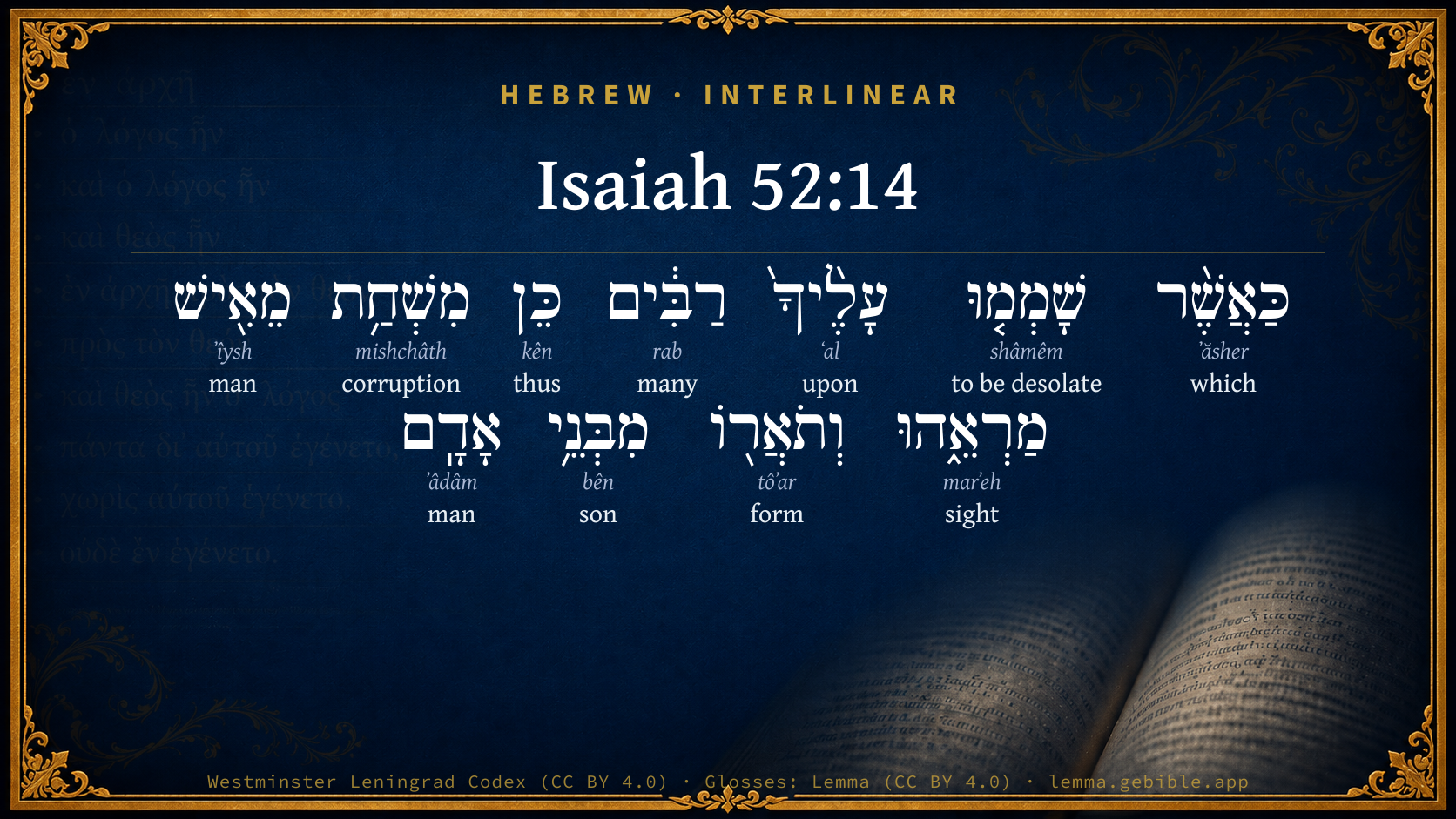
  1. כַּאֲשֶׁ֨ר ʼăsher H834 “like/as · which” Preposition + Particle, Relative
  2. שָׁמְמ֤וּ shâmêm H8074 “to be desolate” Verb, Qal, Perfect, 3rd Person, Common, Plural
  3. עָלֶ֨יךָ֙ ʻal H5921 “upon · you” Preposition + Suffix, Personal, 2nd Person, Masculine, Singular
  4. רַבִּ֔ים rab H7227 “many” Adjective, Adjective, Masculine, Plural, Absolute
  5. כֵּן kên H3651 “thus” Particle, Demonstrative
  6. מֵאִ֖ישׁ ʼîysh H376 “from · man” Preposition + Noun, Common, Masculine, Singular, Absolute
  7. מַרְאֵ֑הוּ marʼeh H4758 “sight · his” Noun, Common, Masculine, Singular, Construct + Suffix, Personal, 3rd Person, Masculine, Singular
  8. וְתֹאֲר֖וֹ tôʼar H8389 “and · form · his” Conjunction + Noun, Common, Masculine, Singular, Construct + Suffix, Personal, 3rd Person, Masculine, Singular
  9. מִבְּנֵ֥י bên H1121 “from · sons of” Preposition + Noun, Common, Masculine, Plural, Construct
  10. אָדָֽם ʼâdâm H120 “man” Noun, Common, Masculine, Singular, Absolute

About this verse

These counts appear in no published source. They are computed here, from the morphology-tagged text and Lemma’s own curated glosses. What Lemma adds →

11
words
11
distinct lemmas
Prophets
section

Notable vocabulary

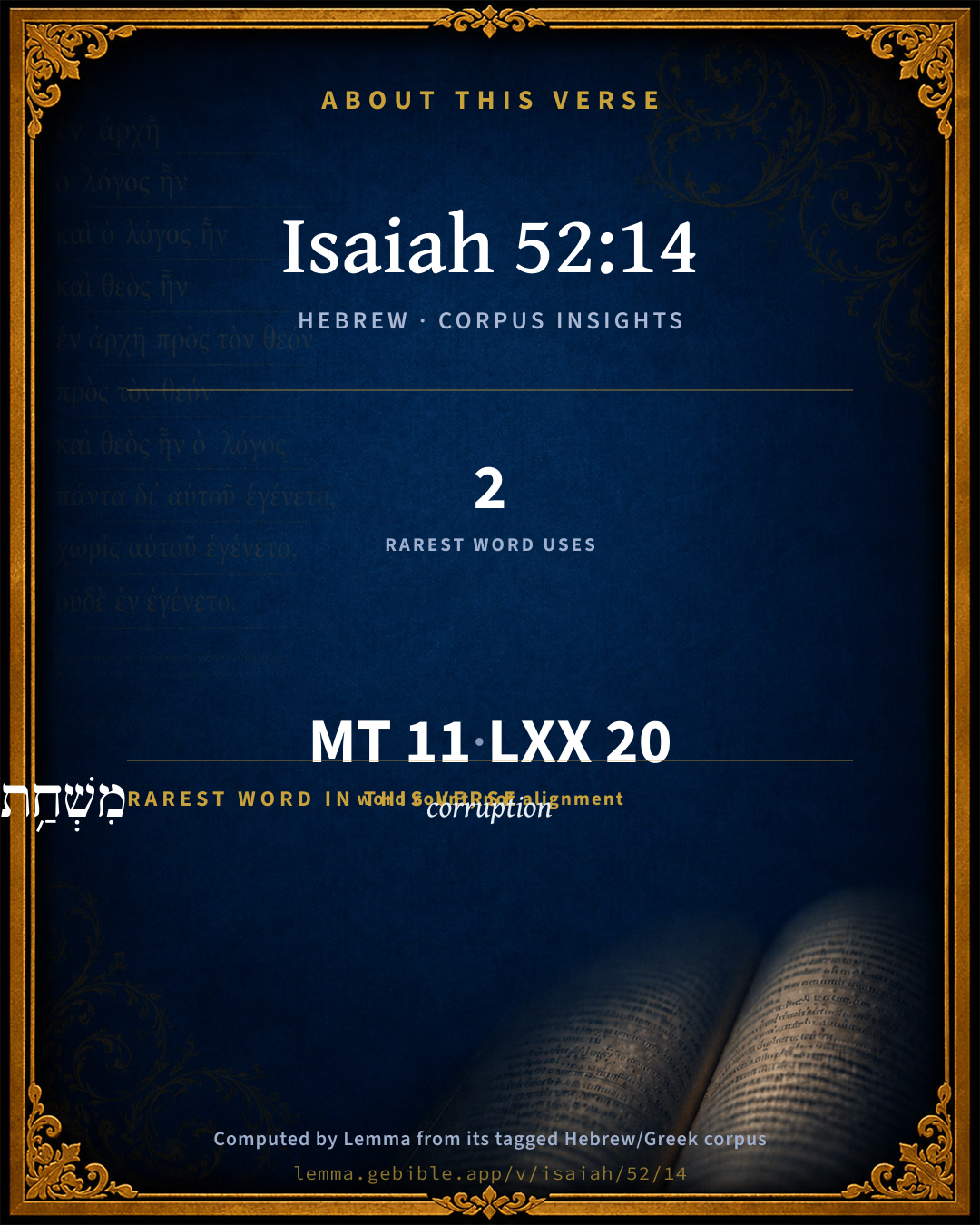
The rarest word here is מִשְׁחַ֥ת corruption H4893 — appearing just 2 times in the whole Hebrew Bible.

Shared distinctive vocabulary

מִשְׁחַ֥ת corruption H4893 occurs in 2 verses of the Hebrew Bible. Also found in:

Grammatical profile

  • 1 verb
  • 6 nouns
  • 1 adjective
  • 1 preposition
  • 2 particles

Verb forms

  • שָׁמְמ֤וּ Qal · Perfect

Hebrew & Septuagint length

In English translation the verse runs 25 words from the Hebrew and 28 from the Septuagint (LXX English) — closely comparable.

A rough comparison of the two English renderings, which tokenize alike — not a word-level alignment.

Word counts can differ between the Hebrew and the Greek without any difference in meaning — e.g. the Hebrew direct-object marker אֵת has no separate Greek word, and Greek often adds the article ὁ.

In the original languages it is 11 Hebrew tokens and 20 Greek tokens — but the two are counted differently (Hebrew bundles its prefixes and suffixes into one token; the Greek is in lemma form), so that isn’t a like-for-like length.

Cross-references

21

Topical passages linked to Isaiah 52:14 in the Treasury of Scripture Knowledge — connected by theme and wording, ordered by reader-vote popularity; previews shown in the World English Bible.

  • Isaiah 50:6 I gave my back to the strikers, and my cheeks to those who plucked off the hair; I didn't hide my face from shame and spitting.
  • Matthew 26:67 Then they spit in his face and beat him with their fists, and some slapped him,
  • Isaiah 53:2–5 For he grew up before him as a tender plant, and as a root out of a dry ground: he has no form nor comeliness; and when we see him, there is no beauty that we should desire him.
  • Psalms 22:6–7 But I am a worm, and no man; A reproach of men, and despised by the people.
  • Psalms 22:17 I can count all of my bones. They look and stare at me.
  • Matthew 27:14 He gave him no answer, not even one word, so that the governor marveled greatly.
  • Psalms 22:15 My strength is dried up like a potsherd. My tongue sticks to the roof of my mouth. You have brought me into the dust of death.
  • Matthew 27:29–30 They braided a crown of thorns and put it on his head, and a reed in his right hand; and they kneeled down before him, and mocked him, saying, "Hail, King of the Jews!"
  • Luke 22:64 Having blindfolded him, they struck him on the face and asked him, "Prophesy! Who is the one who struck you?"
  • Psalms 71:7 I am a marvel to many, But you are my strong refuge.
  • Psalms 102:3–5 For my days consume away like smoke. My bones are burned as a firebrand.
  • Matthew 7:28 It happened, when Jesus had finished saying these things, that the multitudes were astonished at his teaching,
  • Matthew 22:22–23 When they heard it, they marveled, and left him, and went away.
  • Mark 5:42 Immediately the girl rose up, and walked, for she was twelve years old. They were amazed with great amazement.
  • Luke 5:26 Amazement took hold on all, and they glorified God. They were filled with fear, saying, "We have seen strange things today."
  • Mark 6:51 He got into the boat with them; and the wind ceased, and they were very amazed among themselves, and marveled;
  • Mark 7:37 They were astonished beyond measure, saying, "He has done all things well. He makes even the deaf hear, and the mute speak!"
  • Luke 2:47 All who heard him were amazed at his understanding and his answers.
  • Luke 4:36 Amazement came on all, and they spoke together, one with another, saying, "What is this word? For with authority and power he commands the unclean spirits, and they come out!"
  • Mark 10:26 They were exceedingly astonished, saying to him, "Then who can be saved?"
  • Mark 10:32 They were on the way, going up to Jerusalem; and Jesus was going in front of them, and they were amazed; and those who followed were afraid. He again took the twelve, and began to tell them the things that were going to happen to him.

Cross-references courtesy of OpenBible.info (CC BY 4.0).

Hebrew and Greek witnesses Masoretic Hebrew ↔ Greek Septuagint

The same verse in the two great witnesses to the Old Testament, shown verse-for-verse.

These are two independent witnesses, not word-aligned to each other, and the Septuagint is shown in lemma (dictionary) form.

Hebrew Isaiah 52:14 Masoretic · Westminster Leningrad Codex

כַּאֲשֶׁ֨ר שָׁמְמ֤וּ עָלֶ֨יךָ֙ רַבִּ֔ים כֵּן מִשְׁחַ֥ת מֵאִ֖ישׁ מַרְאֵ֑הוּ וְתֹאֲר֖וֹ מִבְּנֵ֥י אָדָֽם

Like as many were astonished at you (his visage was so marred more than any man, and his form more than the sons of men),

World English Bible · Public Domain

Greek LXX Isaiah 52:14 Septuagint · lemma form

ὅς τρόπος ἐκἵστημι ἐπί σύ πολύς οὕτως ἀδοξέω ἀπό ἄνθρωπος ὁ εἶδος σύ καί ὁ δόξα σύ ἀπό ὁ ἄνθρωπος

As many shall be amazed at you, so shall your face be without glory from men, and your glory shall not be honored by the sons of men.

LXX2012 (modern English Septuagint) · Public Domain

On this verse, Whedon's Commentary on the Bible discusses the Septuagint’s reading. Read the note in Commentary ↓

Hebrew: Westminster Leningrad Codex (CC BY 4.0). Greek: Septuagint (public domain); English from LXX2012 (modern English Septuagint) (Public Domain). How the Septuagint differs from the Hebrew →

Targum (Aramaic paraphrase)

1

The Targum is the ancient Jewish Aramaic paraphrase of the Hebrew Scriptures — an interpretive translation, not the Hebrew text itself. Onkelos (literal) and Pseudo-Jonathan (expansive) render the Torah, and Jonathan the Prophets. Coverage is partial: where no permissively-licensed English translation exists for a verse, only the Aramaic is shown. This is verse-level text, not a word-by-word alignment to the Hebrew.

  1. Targum Jonathan Prophets (Joshua–Malachi)
    כְּמָא דִסְבַרוּ לֵיהּ בֵּית יִשְׂרָאֵל יוֹמִין סַגִיאִין דַהֲוָה חֲשִׁיךְ בֵּינֵי עַמְמַיָא חֶזְוֵהוֹן וְזִיוְהוֹן מִבְּנֵי אֱנָשָׁא:

    As the house of Israel anxiously hoped for him many days, (which was poor among the nations; their appearance and their brightness being worse than that of the sons of men)

    Targum Jonathan — Aramaic: “Mikraot Gedolot” (public domain). English: “Sefaria Community Translation” (CC0 1.0 (public-domain dedication)); “London "Chaldee Paraphrase," 1871” (public domain). Text via Sefaria.

Commentary

Notes on Isaiah 52:14 from classic Christian and Jewish commentators (each source and its license shown beneath its notes). The classic Christian expositions comment on the surrounding passage and are grouped to its opening verse, so a note may address several verses; the Jewish commentaries on the Tanakh (Rashi and others) are per-verse, so they appear only where the commentator wrote on this verse.

Lemma curates 59 commentaries, every one of them public domain or Creative Commons licensed, each selected and text-cleaned for this edition rather than reprinted as found. About our sources →

Trapp's Complete Commentary

John Trapp

Isa 52:14 As many were astonied at thee; his visage was so marred more than any man, and his form more than the sons of men:

Ver. 14. As many were astonied at thee,] viz., At thine abasement first, and then at thine advancement thereupon. All things in Christ are admirable; well, therefore, might he be called "Wonderful." {Isa 9:6}

His visage was so marred more than any man.] Partly through the anguish of his mind at his Passion and on the cross, and partly also by the misusage of his body, while they made totum pro vulnero corpus, by their scourging, scratching, racking on the tree, piercing, buffeting, &c.

And his form more than the sons of men.] Plusquam filii Adae, more than those of the common sort; whereas naturally his body, being of the finest temperament, and no way diseased, could not but be very beautiful. See Psa 45:2. {See Trapp on "Psa 45:2"}

John Trapp, A Commentary or Exposition upon All the Books of the Old and New Testament (1647–1656) — public domain. Text from a community e-Sword module.

The Biblical Illustrator

Joseph S. Exell

Isa_52:14-15

As many were astonied at Thee

The abasement of Christ and its consequences

I.

THE UNEQUALLED ABASEMENT AND SORROW OF THE MESSIAH. Unequalled--

1. Because of the previous dignity from which He descended.

2. If we trace the various stages of His humiliation. Was He born? It was of no opulent parents. As He grew up he became the object of envy. When He sprang into youth, it was not to sway a sceptre or to govern millions, but to work with His reputed father. As He went on in His course He was exposed to the scoffs and malice of Jews and Gentiles, etc. Eye the Saviours sufferings in what light you please, and you will find His sufferings were various as well as intense. He suffered as a man; from want--from fatigue--from poverty--from the crown of thorns placed onHis head, etc. He suffered civilly, as a member of society. An insurrectionist and a murderer was preferred before Him. He suffered spiritually--from the thick volleys of fiery darts which were showered at Him, and from the hidings of His Fathers countenance. And observe the associations which were likely to aggravate His sufferings. They all forsook Him and fled.

3. Our Saviours sufferings and woes derived additional poignancy and exquisiteness from the very character which He bare. Many were astonied at Thee. The spectators were so, who smote upon their breasts, and returned, after having seen these things. Devils were astonished, when they saw how all the shafts of their malice recoiled. Angels were astonished as they ministered unto Him. So He is still a wonder unto many; and if He be not so to us, it is because of our criminal insensibility and indifference.

II. THE MOMENTOUS CONSEQUENCES BY WHICH HIS SUFFERINGS AND SORROWS WERE TO BE FOLLOWED. So shall He sprinkle many nations. There is a direct reference to the various aspersions and ablutions under the law of Moses. These were of three kinds--

1. An aspersion of the blood of atonement once a year.

2. An aspersion of water on the unclean person, called the water of separation, by which a person was separated to a holy purpose.

3. An aspersion both of water and of blood on the leper, by which he was pronounced clean, and needed no longer to remain without the camp.

Combine these ideas, and they will give the two grand designs of our Saviours death--a propitiation, and a purification. And recollect that these two great and important ends of our Saviours death must always be associated. Here we see their superiority over the legal aspersions. (J. Clayton, ,M.A.)

A twofold wonder

I. THE ASTONISHMENT PRODUCED BY OUR SAVIOURS HUMILIATION.

1. Many were astonied at Thee--astonished, doubtless, at the disappointment of their expectations. They had looked for a second Joshua, who should march at their head, and lead them forth from victory to victory till all their enemies should have fallen beneath their feet. They had expected another son of Jesse, who should make the name of Israel terrible to surrounding nations. And when they saw the worlds Redeemer, and found Him possessed of none of those external attributes which they deemed essential to His character, they were offended at Him, and their astonishment was that of indignation and bitter disappointment. Is not this the carpenters son?

2. But our text goes on to describe some special causes of this astonishment. His visage was so marred, more than any man, and His form more than the sons of men. Whilst further on the prophet adds, He hath no form nor comeliness; and when we shall see Him, there is no beauty that we should desire Him. I do not believe that such expressions as these are intended to represent the person of the Saviour as naturally defective in comeliness or dignity, though they have been oftentimes so understood, for we may reasonably conclude that the form which God gave His own Son was one of the best and the most perfect, and that the features of His countenance were as expressive as human features could be of intelligence, of dignity, and of love. Yet there was a marvellous mixture of meekness with this intelligence, of abasement with this dignity, and of sorrow with this love. Never was there a countenance which so beamed with holiness; yet never was there one so deeply furrowed with the lines the curse had made. Unrepenting sinners, like the Jews of old, are to this day astonished without being benefited at the sight, of the Redeemers sufferings.

II. The text says, alluding to the ceremonial law, He shall sprinkle many nations, etc. We here perceive THE DIFFERENCE OF EFFECT produced by that astonishment which flows from contempt, and that which is produced by reverential regard for an object of infinite worth and dignity. The first opens the lips, and the latter seals them. The first accumulates epithets of scorn. But very different shall be the result of that wonder which shall fill the breast when the Saviour begins to give convincing proof of the greatness, and universality of His triumph.. Kings shall then shut their mouths at Him. Seeing the progress of His kingdom, says Vitrings, they shall revoke their edicts against it, and thus shut their mouths at Him. The wonder shall then become too great for expression. Again, That which had not been told them shall they see. The general ignorance which prevails amongst men, even the most noble and the most educated, on religious subjects, is oftentimes most astounding. To cleanse the heart, to sanctify the soul, there is no power but of God; and so, whenever a sinner is converted from the error of his ways, he is brought to acknowledge, this is the Lords doing. But the true accomplishment of the prediction before us requires greater things than these. There shall be a time when high and low, rich and poor, kings and subjects, shall all stand in amazement at the triumphs of the Cross of Christ. What they had not heard shall they consider. They shall lay to heart those things which shall arrest their attention. It will not be enough for them to be mere spectators of the Saviours triumph; they shall become deeply interested in it; all their thoughts, affections, efforts, shall tend towards it. (S. Bridge, M.A.)

Christs endurance and success

I. THE SAVIOURS ENDURANCE.

II. THE SAVIOURS SUCCESS. (S. Bridge, M. A.)

His visage was so marred more than any man

The marred face

I. CHRISTS FACE BEING SO BEAUTIFUL WAS EASILY MARRED. The perfect beauty of God was the reflected loveliness of Christ. Perfection is easily blemished; the more beautiful anything is, the more easily it is injured.

II. CHRISTS FACE WAS AN INDEX OF HIS LIFE AND WORK. His face told the story of His inner life. This was the chief reason for the loveliness of Jesus face. His heart was full of pure, white thoughts, and consequently rays of beauty shot out through His gentle eyes. There burned within Him the light of tranquillity, which found expression in His calm, peaceful countenance. All the grandest virtues of this life could be seen in Jesus face. And yet this beauty was marred, the light from His inner light suffered a black eclipse.

His face was also an index of His work. When you see a man in the street you can often tell whether he is student, artist or working-man. The employment makes a certain impression upon the face. Christ s employment must have told upon His countenance. In His compassion for souls He sighed deeply in spirit, He groaned and was troubled. Words such as these convey some idea of the wear and tear Jesus had to endure.

III. THERE ARE SPECIAL INSTANCES GIVEN OF THE MARRING OF HIS FACE. At the grave of Lazarus, when the sisters were lamenting for their dead brother, Christ joined in the sorrow and wept, His face being stained with tears. On the brow of Olivet as He stood looking at the beloved city He began to weep, and in the garden of Gethsemane as the sweat dropped from Him in drops like blood, He fell on His face and prayed; in the judgment-hall when standing in the presence of His accusers, we read, And some began to spit on Him and to cover His face, and to buffet Him, and to say unto Him, Prophesy, and the servants did strike Him with the palms of their hands. They degraded Jesus as much as possible, directing their blows and insults to His face; such treatment would tell heavily upon His appearance.

IV. THERE MUST HAVE BEEN SOMETHING ATTRACTIVE IN THE FACE OF JESUS. The average man could see no beauty in Jesus; still, the children were attracted by Him, and children as a rule are either repelled or won by a look. It was by a look that Jesus won Peter from a state of backsliding. In conclusion, we like to think of God as having a face the same as that of Jesus. Scientists talk of an essence, a great first cause, something in the abstract, but with such definitions we wander and cannot understand God. By faith, as Dr. Saphir says, we see the face of our dear God and seek Him as a friend or, like one of old, we say, Thy face, Lord, will I seek. We look forward to one day seeing the face of Jesus. (W. K. Bryce.)

The Biblical Illustrator, edited by Joseph S. Exell (c. 1880s–1900s) — public domain. Text from a community e-Sword module.

Joseph Benson's Commentary

Isa 52:14-15. As many were astonished at thee — At thee, O my servant: were struck with wonder at his glorious endowments, at the excellence and power of his doctrine, and his miraculous works, or rather, at his humiliation. His visage was so marred, &c. — Christ, in respect of his birth, breeding, manner of life, and outward condition in the world, was obscure and contemptible, and therefore said to be a worm, and no man, a reproach of men, and despised of the people, Psa 22:6, being exposed to all manner of affronts, indignities, and contumelies, from day to day. His countenance also was so marred with frequent watchings, fastings, and troubles, that he was thought to be nearly fifty years old when he was but thirty, Joh 8:57, and was further disfigured when he was buffeted, smitten on the cheek, spit upon, and crowned with thorns, and met with other cruel and despiteful usages. So, &c. — His exaltation shall be answerable to his humiliation; shall he sprinkle many nations — 1st, With his blood, which is called the blood of sprinkling, Heb 12:24, that is, he shall justify them by his blood, as it follows, Isa 53:11, which act is frequently expressed by washing, as Psa 51:2; Psa 51:7; Eze 16:9; Rev 1:5. Or, 2d, With his word or doctrine; which, being often compared to rain, or water, as chap. 55:10, 11; Psa 72:6, may be said to be sprinkled: as it is said to be dropped, Deu 32:2; Eze 20:46; Eze 21:2. This sense seems to be favoured by the following words: or, 3d, With his Spirit, represented under the emblem of the sprinkling of water, Eze 36:25-27; and frequently compared to water in the Scriptures, and, in the days of the Messiah, to be poured out on all flesh, Joe 2:28; and particularly promised to such as should thirst for it, and believe in Christ, Joh 7:37-38; Rev 21:6; Rev 22:17. Kings shall shut their mouths at him — Shall be silent before him, out of profound humility, reverence, and admiration of his wisdom, and an eager desire to hear and receive counsels and oracles from his mouth; for that which had not been told them shall they see — They shall hear from his mouth many excellent doctrines, which will be new and strange to them. And particularly that comfortable doctrine of the salvation of the Gentiles, which was not only new to them, but strange and incredible to the Jews themselves.

Joseph Benson's Commentary on the Old and New Testaments (1811–1818) — public domain. Text from a community e-Sword module.

Whedon's Commentary on the Bible

Daniel D. Whedon

14, 15. The more specific details of his condition follow in these verses. The prophecy concerning him begins in the protasis, (Isa_52:14,) as an address, first to him, but passes in the apodosis (Isa_52:15) at once to remarks concerning him, a change quite common with Isaiah when under intense emotion.

Many were astonished at thee — The appearance of such humility in the Messiah when he should come is, as the prophet foresees, to be a marvel and an astonishment to the Jews. He is wholly to disappoint carnal minds, who look for outward signs of royalty.

His visage was so marred — This is an explanatory parenthetic sentence, giving reasons for the astonishment expressed in the first words, or protasis. “Marred,” not from injury as yet inflicted by man, but from sadness on account of man, more serious (and almost terror-struck) than any man is accustomed to exhibit. Part of this, namely, low birth, poverty, etc., was chosen, and partly, it was from ill treatment of man in refusing him as the true Messiah; also from unrelieved sensitiveness at the guilt of the world’s sins. These were sufficient to render his aspect that of a burdened, wearied man. Men of carnal ambitions reasoned thus: Was the Messiah to be of this appearance? Could the Messiah of Isaiah, pictured as a man of greatness, beauty, glory, be so disfigured? What more astonishing! Isa_52:15 silently admits it to be even so, yet declares (apodosis) so shall he sprinkle many nations. And this shall be the greater wonder (Septuagint) to many. That is, he shall rain his grace of purification upon them. Reacting mercy shall close the mouths of kings from uttering scorn of him, lowly though he be, deformed by suffering though he appear. For in even this, men shall discover more beauty and glory than ever prophetic words had revealed. By very reason of immaculate purity thus discovered, and of truth, goodness, and saving power, they shall see in him greatness in all dimensions far beyond the conceptions which prophetic words had shaped for them.

Daniel D. Whedon (gen. ed.), Commentary on the Old and New Testaments (1874–1909) — public domain. Text from a community e-Sword module.

The Preacher's Complete Homiletical Commentary

Joseph S. Exell (gen. ed.)

THE FACE OF JESUS

Isa_52:14. As many were astonished at Thee; His visage was so marred, &c.

The personal coming of the Son of God was a great theme of prophecy. Changes of dynasties, national and local calamities, the raising up of heroes, the overthrow of sovereigns and of empires were predicted by the ministers of Jehovah; but the overthrow of the dominion of sin, by that man Jesus Christ, is the sublimest intelligence uttered by prophetic lips. The personal character of Christ is sketched in prophecy. He is to be different from ordinary men—their superior. He is to be open of heart, gentle of hand, sober of mind, consistent in conduct. The personal circumstances of Christ are mentioned. He is to come of royal stock, yet impoverished. Obscurity and lowliness are to be His portion in His domestic life, rejection and contempt in His public career. Yet are men to hear eagerly His words, and He is to be crowned with ultimate glory. The countenance of the Saviour, His personal appearance, is also referred to. These slight sketches were literally fulfilled. How different is the face of the infant from that of the dying man! During the tortuous course of life, the chisel of the energetic sculptor, Time, has been busy cutting deep furrows; the pencils of the twin painters, Sorrow and Care, have left the expression wan and worn.

I. The text is a photograph of the face of Jesus in the hour of His death. Let us meditate upon it. “Love and grief the heart dividing.”

1. The face and form are those of a man. There is here flesh and blood; parts and features capable of expressing feeling.

2. Though in these respects a face like ours, yet how different! It is a visage marred; but not by evil life, evil disposition, infirmity, sickness, or age. In the Saviour’s face there are,

(1.) Lines which tell of severe hardship. He was made acquainted with hunger, thirst, and fatigue. He lived for others’ welfare, comfort, and happiness, forgetting His own.

(2.) Indications of heavy sorrow (Isa_53:3-4). A world’s ingratitude pressed upon His spirit. A world’s sin grieved Him.

(3.) Traces of anxious care. He had come as the representative of His Father to men. He had undertaken to represent the case of man before His Father. What responsibility!

(4.) Marks of much suffering. Allusion is made in the text not only to mental, but to physical suffering. Gethsemane’s agony; the cruel usage in Herod’s hall, where “He gave His back to the smiters, and His cheeks to them that plucked off the hair;” His sufferings under Pilate; the tortures of the crucifixion, remove all room for wonder at the statement of the text. There are actual scars upon His sacred Person; “the print of the nails;” of the thorn crown; the spear-wound.

II. We may reverently muse upon what is here revealed. The face is but the outer mask; the soul is hidden within. The face is an index which reveals and expresses the feelings and experiences of the soul.

1. We learn from the face of Jesus the reality of His life. It is seen to have been intensely real. The visit to earth was no illusive appearance of the Son of God. To Him sin, human guilt, and Divine wrath were real and fearful matters. The features of the grim soldier on the battle-field tell forth unmistakably his earnestness and anxiety; for with him it is a matter of glory or shame, of victory or death.

2. We see the reality of His sympathy. Life is to us a reality. It is a burden, an effort, a struggle. He understands our case. He has undergone all. Behold His face! Think upon His racked nerves, weary limbs, aching head, wounded spirit, broken heart! (Heb_4:15.)

3. We understand the reality of His work. God might have left us to our fate; but where would then have been the glory of His grace? He might have forgiven us and saved us with a word; but where then would have been the purity of His holiness, justice, and truth? “It behoved Christ to suffer.”

4. We have now evidence of the reality of His love (Joh_3:16; Joh_15:13; Eph_3:19; 1Jn_3:16).

(5.) We cannot now doubt the reality of His Divinity. The weakness of His humanity having endured the long trial of anxiety, pain, and sorrow, and having ultimately and perfectly triumphed, proves to us the fact and the glory of His Divinity.

III. Let us make application of this subject to ourselves. We look at Christ to learn of Him.

1. Is there not here matter for wonder? “As many were astonished at Thee.” They said: “It is impossible, incredible, that this humble, patient sufferer can be the Christ” (Isa_53:1). We wonder, not to doubt, but to adore.

2. Here is reason for admiration and love. What has the Lord endured for our eternal salvation?

3. We must remember to expect an experience very similar to that of our Lord.

4. We have here an example worthy of imitation. How patiently He endures all! (Heb_12:1-2.)

5. Does not this revelation of the nature, character, and work of Christ afford us ground for trust? Saints may be assured of His sympathy. Sinners may see in His substitutionary suffering their salvation.—Robert S. Latimer: Study and Homiletic Monthly, New Series, vol. iii. pp. 164–166.

OUR MARVELLOUS REDEEMER

Isa_52:14-15. As many were astonished at Thee; His visage, &c.

This prophecy runs through chapter 53. It sets forth the exaltation of the Messiah, which was to be preceded by His humiliation. There would be surprise and disappointment in some cases, while there would be surprise and admiration in others.

I. View the Saviour as attracting universal attention. “That which had not been told them shall they see; and that which they had not heard shall they consider.”

Some men cannot fail to attract attention whether they court it or not. There is something in their appearance, or manner, or intelligence, or power of expression, or sympathy, on account of which, wherever they are, they become the object of general interest. Jesus was one of these when here. Sometimes He tried to escape from the crowd. But He could not be hid. He was largely discussed by the people of His country and time; in some cases favourably, in other cases very unfavourably. In the end they rejected His claims.

He soon after attracted very wide attention outside Judaism. For it was part of His plan and purpose that after His earthly life and work were completed, He should be proclaimed more extensively than among His own countrymen. His apostles preached Him freely among the heathen. Not without effect. Communities sprang up in every direction in Asia and in Europe, called by His name, and held together by their common belief of the things concerning Him. One apostle quotes this part of our text in illustration of his own action in spreading the knowledge of Christ among the heathen (Rom_15:20-21).

He attracts attention still. He is extensively preached and believed in at the present time; more than at any previous time. He exerts the most valuable and gracious influence on those that receive His truth. He gradually through them leavens and modifies society, making His influence felt even where it is not recognised as His. His claims are regularly brought before the attention of countless multitudes, and are more or less considered by them. And they are, according to prophetic Scripture, destined to be made known over the wide world.

II. View Him as exciting extreme astonishment.

1. His humiliation did. “As many were astonished at Thee; His visage was so marred more than any man, and His form more than the sons of men.” Were the sufferings of Jesus depicted on His face? Was the personal beauty which tradition attributes to Him spoiled by His experience of suffering? That Messiah should appear in so lowly a form as did Jesus of Nazareth, excited disappointed astonishment. There was a revulsion of feeling even on the part of many who had been at first favourably inclined. They could not believe that the great Messianic King would come in so lowly a form.

2. His exaltation did. Even the disciples who believed in Him, and had heard Him speak of resurrection, were astonished when it occurred. The ascension surprised them still more. But they were joyfully surprised. The Jews could not believe that the Crucified One was crowned.—Thus it is still. Christ does not command universal faith even where His claims are known. Men do not trust those whom they deem unfortunate. They cannot receive a humbled Christ. The offence of the cross has not ceased. That He who was crucified should be exalted is of difficult belief to many. Yet some believe. They admire, while they wonder at, the wisdom and the love that shine through the redemptive plan.

III. View Him as bestowing saving blessings. “So shall He sprinkle many nations.” This word is capable of two interpretations.

1. That which points directly to the impartation of the blessing. Under the law there were washings and sprinklings that made reconciliation for sinners, or cleansed them from sin. When Jesus comes with His salvation He reconciles to God, and cleanses the soul from sin.

2. That which points to the effect of the blessing. They shall spring up with joy, as those leap who have found great treasure. Is not the influence of Christ joy-creating everywhere?

He does this on an extensive scale. “Many nations.” There is a universal sufficiency in His atoning blood. There is also a widely extensive efficacy. The Gospel is for man. Jesus bade His followers preach it among all nations. The redeemed are a multitude that no man can number (Rev_5:9).

IV. View Him as winning reverent homage. “The kings shall shut their mouths at Him.” It indicates the reverence in which they hold Him who conquers all opposition. It includes,

1. Honour. They see His power and glory, with which none can vie. Like conquered kings they confess His superiority.

2. Love. For He attaches them to Himself with personal admiration and love.

3. Obedience. They willingly obey His commands, although formerly they resisted His authority; for His laws are written on their hearts.

Thus the text exhibits not only the glory of Christ, but the great importance of the sentiments with which He is regarded.

1. Some hate Him. The Gospel does not commend itself to their approbation. It is utterly distasteful to them. Its doctrines are too humbling, or its precepts are too holy. Their pride flies from the Crucified, their sinfulness from the crowned Saviour. A mighty change must take place in your spirit before you can be safe.

2. Some are indifferent to Him. You think it matters little what you think of Christ, so long as you are not actively hostile to Him. But it does matter. Union with Christ; a spiritual union, formed with consent of mind, and heart, and will, makes all the difference between life in Christ, and death without Him.

3. Some love Him. There is a deep personal love between Christ and His people. Although on the throne of the universe, He finds room in His heart for each believer, however lowly, and they for Him; “Whom, having not seen, ye love.”—J. Rawlinson.

The Preacher's Complete Homiletical Commentary (gen. ed. Joseph S. Exell; Funk & Wagnalls, c. 1892) — public domain (pre-1929). A full-Bible homiletical/sermon-outline anthology covering 65 of 66 books (2 John is absent from the source module). Text from a community e-Sword module.

Keil & Delitzsch

C. F. Keil & F. Delitzsch

The prophecy concerning him passes now into an address to him, as in Isa 49:8 (cf., Isa 49:7), which sinks again immediately into an objective tone. "Just as many were astonished at thee: so disfigured, his appearance was not human, and his form not like that of the children of men: so will he make many nations to tremble; kings will shut their mouth at him: for they see what has not been told them, and discover what they have not heard." Both Oehler and Hahn suppose that the first clause is addressed to Israel, and that it is here pointed away from its own degradation, which excited such astonishment, to the depth of suffering endured by the One man. Hahn's principal reason, which Oehler adopts, is the sudden leap that we should otherwise have to assume from the second person to the third - an example of "negligence" which we can hardly impute to the prophet. But a single glance at Isa 42:20 and Isa 1:29 is sufficient to show how little force there is in this principal argument. We should no doubt expect עליכם or עליך after what has gone before, if the nation were addressed; but it is difficult to see what end a comparison between the sufferings of the nation and those of the One man, which merely places the sufferings of the two in an external relation to one another, could be intended to answer; whilst the second kēn (so), which evidently introduces an antithesis, is altogether unexplained. The words are certainly addressed to the servant of Jehovah; and the meaning of the sicut (just as) in Isa 52:14, and of the sic (so) which introduces the principal sentence in Isa 52:15, is, that just as His degradation was the deepest degradation possible, so His glorification would be of the loftiest kind. The height of the exaltation is held up as presenting a perfect contrast to the depth of the degradation. The words, "so distorted was his face, more than that of a man," form, as has been almost unanimously admitted since the time of Vitringa, a parenthesis, containing the reason for the astonishment excited by the servant of Jehovah. Stier is wrong in supposing that this first "so" (kēn) refers to ka'ăsher (just as), in the sense of "If men were astonished at thee, there was ground for the astonishment." Isa 52:15 would not stand out as an antithesis, if we adopted this explanation; moreover, the thought that the fact corresponded to the impression which men received, is a very tame and unnecessary one; and the change of persons in sentences related to one another in this manner is intolerably harsh; whereas, with our view of the relation in which the sentences stand to one another, the parenthesis prepares the way for the sudden change from a direct address to a declaration. Hitherto many had been astonished at the servant of Jehovah: shâmēm, to be desolate or waste, to be thrown by anything into a desolate or benumbed condition, to be startled, confused, as it were petrified, by paralyzing astonishment (Lev 26:32; Eze 26:16). To such a degree (kēn, adeo) was his appearance mishchath mē'ı̄sh, and his form mibbenē 'âdâm (sc., mishchath). We might take mishchath as the construct of mishchâth, as Hitzig does, since this connecting form is sometimes used (e.g., Isa 33:6) even without any genitive relation; but it may also be the absolute, syncopated from משׁחתתּ = משׁחתת (Hvernick and Stier), like moshchath in Mal 1:14, or, what we prefer, after the form mirmas (Isa 10:6), with the original ă, without the usual lengthening (Ewald, 160, c, Anm. 4). His appearance and his form were altogether distortion (stronger than moshchâth, distorted), away from men, out beyond men, i.e., a distortion that destroys all likeness to a man;

(Note: The church before the time of Constantine pictured to itself the Lord, as He walked on earth, as repulsive in His appearance; whereas the church after Constantine pictured Him as having quite an ideal beauty (see my tract, Jesus and Hillel, 1865, p. 4). They were both right: unattractive in appearance, though not deformed, He no doubt was in the days of His flesh; but He is ideally beautiful in His glorification. The body in which He was born of Mary was no royal form, though faith could see the doxa shining through. It was no royal form, for the suffering of death was the portion of the Lamb of God, even from His mother's womb; but the glorified One is infinitely exalted above all the idea of art.)

'ı̄sh does not signify man as distinguished from woman here, but a human being generally.

The antithesis follows in Isa 52:15 : viz., the state of glory in which this form of wretchedness has passed away. As a parallel to the "many" in Isa 52:14, we have here "many nations," indicating the excess of the glory by the greater fulness of the expression; and as a parallel to "were astonished at thee," "he shall make to tremble" (yazzeh), in other words, the effect which He produces by what He does to the effect produced by what He suffers. The hiphil hizzâh generally means to spirt or sprinkle (adspergere), and is applied to the sprinkling of the blood with the finger, more especially upon the capporeth and altar of incense on the day of atonement (differing in this respect from zâraq, the swinging of the blood out of a bowl), also to the sprinkling of the water of purification upon a leper with the bunch of hyssop (Lev 14:7), and of the ashes of the red heifer upon those defiled through touching a corpse (Num 19:18); in fact, generally, to sprinkling for the purpose of expiation and sanctification. And Vitringa, Hengstenberg, and others, accordingly follow the Syriac and Vulgate in adopting the rendering adsperget (he will sprinkle). They have the usage of the language in their favour; and this explanation also commends itself from a reference to נגוּע in Isa 53:4, and נגע in Isa 53:8 (words which are generally used of leprosy, and on account of which the suffering Messiah is called in b. Sanhedrin 98b by an emblematical name adopted from the old synagogue, "the leper of Rabbi's school"), since it yields the significant antithesis, that he who was himself regarded as unclean, even as a second Job, would sprinkle and sanctify whole nations, and thus abolish the wall of partition between Israel and the heathen, and gather together into one holy church with Israel those who had hitherto been pronounced "unclean" (Isa 52:1). But, on the other hand, this explanation has so far the usage of the language against it, that hizzâh is never construed with the accusative of the person or thing sprinkled (like adspergere aliqua re aliquem; since 'eth in Lev 4:6, Lev 4:17 is a preposition like ‛al, ‛el elsewhere); moreover, there would be something very abrupt in this sudden representation of the servant as a priest. Such explanations as "he will scatter asunder" (disperget, Targum, etc.), or "he will spill" (sc., their blood), are altogether out of the question; such thoughts as these would be quite out of place in a spiritual picture of salvation and glory, painted upon the dark ground we have here. The verb nâzâh signified primarily to leap or spring; hence hizzâh, with the causative meaning to sprinkle. The kal combines the intransitive and transitive meanings of the word "spirt," and is used in the former sense in Isa 63:3, to signify the springing up or sprouting up of any liquid scattered about in drops. The Arabic nazâ (see Ges. Thes.) shows that this verb may also be applied to the springing or leaping of living beings, caused by excess of emotion. And accordingly we follow the majority of the commentators in adopting the rendering exsilire faciet. The fact that whole nations are the object, and not merely individuals, proves nothing to the contrary, as Hab 3:6 clearly shows. The reference is to their leaping up in amazement (lxx θαυμάσονται); and the verb denotes less an external than an internal movement. They will tremble with astonishment within themselves (cf., pâchădū verâgezū in Jer 33:9), being electrified, as it were, by the surprising change that has taken place in the servant of Jehovah. The reason why kings "shut their mouths at him" is expressly stated, viz., what was never related they see, and what was never heard of they perceive; i.e., it was something going far beyond all that had ever been reported to them outside the world of nations, or come to their knowledge within it. Hitzig's explanation, that they do not trust themselves to begin to speak before him or along with him, gives too feeble a sense, and would lead us rather to expect לפניו than עליו. The shutting of the mouth is the involuntary effect of the overpowering impression, or the manifestation of their extreme amazement at one so suddenly brought out of the depths, and lifted up to so great a height. The strongest emotion is that which remains shut up within ourselves, because, from its very intensity, it throws the whole nature into a suffering state, and drowns all reflection in emotion (cf., yachărı̄sh in Zep 3:17). The parallel in Isa 49:7 is not opposed to this; the speechless astonishment, at what is unheard and inconceivable, changes into adoring homage, as soon as they have become to some extent familiar with it. The first turn in the prophecy closes here: The servant of Jehovah, whose inhuman sufferings excite such astonishment, is exalted on high; so that from utter amazement the nations tremble, and their kings are struck dumb.

Keil & Delitzsch — Biblical Commentary on the Old Testament (1861–1891) — public domain (CC PDM 1.0). Text via the HelloAO Bible API. (Old Testament only.)

Tyndale Open Study Notes

Tyndale Open Resources

52:14-15 Despite the servant’s greatness, the actual way he would appear on earth would shock people.

52:14 were amazed: No one expected that the rescuer would suffer and die.

Tyndale Open Study Notes — © Tyndale Open Resources, licensed CC BY-SA 4.0. Text via the HelloAO Bible API.

Geneva Bible (1599)

Geneva Bible translators

In the corrupt judgment of man, Christ in his person was not esteemed.

By the preaching of the Gospel.

In sign of reverence, and as being astonished at his excellency.

He shall spread his word through many nations.

Geneva Bible (1599) marginal notes — public domain. Text via Bolls.life.

Jamieson, Fausset & Brown

Robert Jamieson, A. R. Fausset & David Brown

Summary of Messiah's history, which is set forth more in detail in the fifty-third chapter. "Just as many were astonished (accompanied with aversion, Jer 18:16; Jer 19:8), &c.; his visage, &c.; so shall He sprinkle," &c.; Israel in this answers to its antitype Messiah, now "an astonishment and byword" (Deu 28:37), hereafter about to be a blessing and means of salvation to many nations (Isa 2:2-3; Mic 5:7).

thee; his--Such changes of persons are common in Hebrew poetry.

marred--Hebrew, "disfigurement"; abstract for concrete; not only disfigured, but disfigurement itself.

more than man--CASTALIO translates, "so that it was no longer that of a man" (compare Psa 22:6). The more perfect we may suppose the "body prepared" (Heb 10:5) for Him by God, the sadder by contrast was the "marring" of His visage and form.

Jamieson, Fausset & Brown — Commentary Critical and Explanatory on the Whole Bible (1871) — public domain (CC PDM 1.0). Text via the HelloAO Bible API.

Adam Clarke's Commentary

Verse 14. As many were astonished at thee - "As many were astonished at him"] For עליך aleicha read עליו alaiv. So the Syriac, Chaldee, and Vulgate in a MS.; and so likewise two ancient MSS.

His visage was so marred more than any man] Most interpreters understand this of the indignities offered to our blessed Lord: but Kimchi gives it another turn, and says, "It means the Jewish people, whom are considered by most nations as having an appearance different from all the people of the earth." Poor Jews! they have in general a very disagreeable look, partly affected, and partly through neglect of neatness and cleanliness. Most Christians think they carry the impress of their reprobation on every feature of their face. However this may be, it should never be forgotten that the greatest men that ever flourished as kings, judges, magistrates, lawgivers, heroes, and poets, were of Jewish extraction. Isaiah was a Jew; so was Paul, and so was JESUS of Nazareth.

Adam Clarke's Commentary on the Bible (1810–1826) — public domain. Text from a community e-Sword/MySword module.

Ellicott's Commentary for English Readers

(14) As many were astonied . . .—The words point to the correspondence of the supreme exaltation following on the supreme humiliation.

His visage was so marred . . .—The words conflict strangely with the type of pure and holy beauty with which Christian art has made us familiar as its ideal of the Son of Man. It has to be noted, however, that the earlier forms of that art, prior to the time of Constantine, and, in some cases, later, represented the Christ as worn, emaciated, with hardly any touch of earthly comeliness, and that it is at least possible that the beauty may have been of expression rather than of feature or complexion, and that men have said of Him, as of St. Paul, that his “bodily presence was weak” (2Co_10:10).

A Bible Commentary for English Readers, edited by Charles John Ellicott (1878–1897) — public domain. Text from a community e-Sword module.

John Gill's Exposition

As many were astonished at thee,.... Not so much at the miracles he wrought, the doctrines he taught, and the work he did; or at his greatness and glory, at his exaltation and dignity, though very wonderful; as at his humiliation, the mean appearance he made, the low estate he was brought into; the sufferings and death which he underwent. These words are placed between the account of his exaltation and humiliation, and may be thought to have respect to both; and indeed it is astonishing that one so great as he was, and is, should become so low as he did; and also that one that was brought so low should be raised so high:

his visage was so marred more than any man, and his form more than the sons of men; though fairer than the children of men, as he was the immediate workmanship of the divine Spirit, and without sin; yet, what with his griefs and sorrows he bore, and troubles he met with; what with watchings and fastings, with laborious preaching, and constant travelling about to do good; what with sweat and blood, with buffetings and scourgings, never was any man's face more marred, or his form more altered, than his was.

John Gill's Exposition of the Whole Bible (1746–1763) — public domain (CC PDM 1.0). Text via the HelloAO Bible API.

Haydock's Catholic Bible Commentary

Of men, who have disfigured the countenance of our Saviour with buffets, &c. The Jews would not receive him under this abject form, though it had been foretold equally with his elevation. (Calmet)

George Leo Haydock (1774–1849), Haydock's Catholic Family Bible and Commentary, 1859 edition — public domain. Excludes Psalms (Douay-Rheims chapter numbering differs from Protestant) and Deuterocanonical books (Catholic canon only).

Matthew Poole's English Annotations

Were astonished; were struck with wonder, either,

1. At his glorious endowments, and the excellency and power of his doctrine, and his miraculous works. Or rather,

2. At his great deformity, and stupendous humiliation and calamity, as may be gathered both from the following words, and from the use of this word in Scripture, which is generally used in a bad sense, or of wondering at some extraordinary evil, as Jer 18:16; 19:8, and oft elsewhere; and never in a good sense, or of wondering at any thing which is extraordinarily good.

At thee; at thee, O my servant, to whom he now turneth his speech, and then turneth his speech from him, and speaks of him in the next words; such sudden changes of persons, and speaking of one and the same man sometimes in one person, and then presently in another, being very frequent in the writings of the prophets, as we have already seen in divers instances.

His visage was so marred more than any man, and his form more than the sons of men; he was more deformed or uncomely than any other man; which was undoubtedly verified in Christ, who, in respect of his birth, and breeding, and manner of life, was most obscure and contemptible, and therefore said to be a worm, and no man; a reproach of men, and despised of the people, Psa 22:6; who was more hated and vilified by the generality of the Jews than any man upon earth, and was accounted and called by them a deceiver, a Samaritan, a blasphemer, and a devil, &c.; whose countenance also was so marred with frequent watchings, and fastings, and troubles, that he was thought to be near fifty years old when he was but about thirty, Joh 8:57; and was further spoiled with buffetings, and crowning with thorns, and other cruel and despiteful usages from men, and with the deep and continual sense of the burden of men’s sins, and of God’s displeasure due unto them; all which did not only oppress his spirit, but had a great influence upon the very constitution of his body.

Matthew Poole's English Annotations on the Holy Bible (1683–1685) — public domain. Text from a community e-Sword/MySword module.

The Pulpit Commentary

As many were astonied at thee. The world was "astonied" to see, in One come to deliver it, no outward show of grandeur or magnificence, no special beauty or "comeliness", (Isa_53:2) but a Presence unattractive to the mass of men at all times, and in the end so cruelly marred and disfigured as to retain scarcely any resemblance to the ordinary form and face of man. The prophet, as Delitzsch says, sits at the foot of the cross on Calvary, and sees the Redeemer as he hung upon the accursed tree, after he had been buffeted, and crowned with thorns, and smitten, and scourged, and crucified, when his face was covered with bruises and with gore, and his frame and features distorted with agony.

Surprise at the appearance of God"s Servant.

Whatever may be the immediate and historical reference of this term "servant," of this we may feel quite sure the full reference must be to Messiah, and to the Lord Jesus Christ as Messiah. Now, it is certainly singular that no trustworthy traces of the appearance of our Lord have come down to us. Everybody may imagine for himself what were the features and expression of his Divine Master; and it is better that our free imaginations should have no limitations to the representation of any artistic genius. We remember in an exhibition observing a number of paintings of the thorn-crowned head. The faces of our Lord precisely differed according as the artist was Spanish, Italian, or English, or had made the uncertain attempt of creating a face of Jewish type. All that Scripture asserts is that, so far as face and form were concerned, there was nothing arresting about Christ; you might have passed him by as a common man. It is even suggested that, as with his servant Paul, men might have rudely said that his "bodily presence was contemptible." Dean Plumptre remarks, "These words (of ver. 14) conflict strangely with the type of pure and holy beauty with which Christian art has made us familiar as its ideal of the Son of man. It has to be noted, however, that the earlier forms of that art, prior to the time of Constantine, and, in some cases, later, represented the Christ as worn, emaciated, with hardly any touch of earthly comeliness; and that it is at least possible that the beauty may have been of expression rather than of feature or complexion

I WHAT MESSIAH WAS IN FACT. In no way striking. Not aristocratic-looking, or handsome, or big. Just a man, simple, undistinguished-looking. Dekker, one of our early English poets, says"The best of men that e"er wore earth about him was a sufferer, A soft, meek, patient, humble, tranquil spirit, The first true gentleman that ever breathed.

II WHAT MESSIAH WAS CONTRARY TO EXPECTATION. Jewish hopes fashion a hero-king, a patriot like Judas Maccabaeus, a restorer of David"s line of kings. Instead, he was a simple Man, who lived a life; a Sufferer who bore a burden of peculiar sorrows; a Man who seemed to end his life in failure and shame.

III WHY WAS MESSIAH THUS DIFFERENT TO ALL EXPECTATION OF HIM? Because men are so enslaved to the literal, the temporal, the earthly. There was nothing in the Man to attract, because God would have us feel the attractions of the Divine Saviour. R.T.

The Pulpit Commentary (1880–1919), ed. H.D.M. Spence-Jones & Joseph S. Exell — public domain. Text from a community e-Sword module.

John Wesley's Explanatory Notes

Astonished - At his humiliation. Thee - At thee, O my servant. His form - Christ, in respect of his birth, breeding, and manner of life, was most obscure and contemptible. His countenance also was so marred with frequent watchings, and fastings, and troubles, that he was thought to be near fifty years old when he was but about thirty, John viii, 57, and was farther spoiled with buffetings, and crowning with thorns, and other cruel and despiteful usages.

John Wesley, Explanatory Notes Upon the Whole Bible (1754–1765) — public domain. Text via the GEBible commentary corpus.

J. A. Alexander on Isaiah

Joseph Addison Alexander

“As many were shocked at Thee—so marred from man His look, and His form from the sons of man—so shall He sprinkle many nations; concerning Him shall kings stop their mouth, because what was not recounted to them they have seen, and what they had not heard they have perceived.” His exaltation shall bear due proportion to His humiliation; the contempt of men shall be exchanged for wonder and respect.

According to the common agreement of interpreters, v. 14 is the protasis and v. 15 the apodosis of the same sentence, the correlative clauses being introduced, as usual in cases of comparison, by as and so. The construction is somewhat embarrassed by the intervening ‘so’ at the beginning of the last clause of v. 14, which most interpreters however treat as a parenthesis explanatory of the first clause: ‘as many were shocked at thee - because His countenance was so marred, etc. so shall He sprinkle many nations,’ etc. A simpler construction, though it does not yield so clear a sense, would be to assume a double apodosis: ‘as many were shocked at Thee, so was His countenance marred, etc., so also shall He sprinkle,’ etc. As thus explained the sense would be, their abhorrence of Him was not without reason and it shall not be without requital. The first verb expresses a mixture of surprise, contempt, and aversion; it is frequently applied to extraordinary instances of suffering when viewed as divine judgments (Lev 26:32; Eze 27:35; Jer 18:16; Jer 19:8). ‘Many’ does not mean ‘all’, nor is ‘nations’ to be anticipated from the other clause; there seems to be rather an antithesis between many individuals and many nations. As a single people had despised Him, so the whole world should admire Him. By ‘look’ and ‘form’ we are neither to understand a mean condition nor the personal appearance, but as an intermediate idea, the visible effects of suffering. The idiomatic phrase ‘from man’, may be taken simply as expressive of comparison (more than other men), or more emphatically of negation (so as not to be human), which are only different gradations of the same essential meaning. Yazzeh is a technical term of the Mosaic law for sprinkling water, oil, or blood, as a purifying rite. This is a description, at the very outset, of the Servant of Jehovah as an expiatory purifier, one who must be innocent Himself in order to cleanse others, an office and a character alike inapplicable either to the prophets as a class, or to Israel as a nation, or even to the better class of Jews, much more to any single individual except the One who claimed to be the Purifier of the guilty, and to whom many nations do at this day ascribe whatever purity of heart or life they either have or hope for. The next clause is understood by some to mean that they shall be reverently silent before Him, by others that they shall be dumb with wonder on account of Him, by others that they shall be silent respecting Him, (i.e., no longer utter expressions of aversion or contempt). The reason of this voluntary humiliation is expressed in the last clause, viz. because they see things of which they had never had experience or even knowledge by report. This expression shows that many nations must be taken in its natural and proper sense, as denoting the Gentiles. It is accordingly applied by Paul (Rom 15:21) to the preaching of the gospel among those who had never before heard it. Interpreters have needlessly refined in interpreting the verb see as signifying mental no less than bodily perception. The truth is that the language is not scientific but poetical; the writer does not put sight for experience, but on the contrary describes experience as simple vision. For the stopping of the mouth, as an expression of astonishment or reverence, see Job 29:9; Job 40:4; Psa 107:42; Eze 16:63; Mic 7:16.

Joseph Addison Alexander, The Prophecies of Isaiah (1846–1847; New York: Scribner, 1870–1878) — public domain. Text from a community e-Sword module.

Scofield Reference Notes

C. I. Scofield

so marred

The literal rendering is terrible: "So marred from the form of man was His aspect that His appearance was not that of a son of man"--i.e. not human--the effect of the brutalities described in Mat 26:67; Mat 26:68; Mat 27:27-30.

The Scofield Reference Bible (1917 edition), notes by C. I. Scofield — public domain. Text from a community e-Sword module.

Rashi

Rabbi Shlomo Yitzchaki (Rashi)

As many wondered As many peoples wondered about them when they saw them in their humble state, and said to one another, How marred is his [Israel’s] appearance from that of a man! See how their features are darker than those of other people, so, as we see with our eyes.

Rashi on the Tanakh — English translations: “The Judaica Press complete Tanach with Rashi, translated by A. J. Rosenberg” (CC BY 4.0); “Pentateuch with Rashi's commentary by M. Rosenbaum and A.M. Silbermann, 1929-1934” (public domain); “The Metsudah Tanach series, Lakewood, N.J” (CC BY 4.0); and “The Book of Joshua, Metsudah Publications, 1997” (CC BY 4.0). Text via Sefaria.

Ibn Ezra

Rabbi Abraham ibn Ezra

שממו Were astonished. Comp. ושממו and shall be astonished (Lev. 26:32). Every one will be surprised at the sight of the servant of the Lord.

Many. The heathen nations.

כן משחת מאיש מראהו His visage is so marred more than any man. Supply לאמר saying before this sentence. משחת Marred. It is an adjective.

ותארו And his form. It is in form similar to רחבו his breadth (Exod. 25:10). —It is a well-known fact that many people in the world imagine the Jew a being altogether different from his fellow creatures; they ask, Has the Jew a mouth, an eye, etc.? This is the case among Mahometans as well as among Christians.

Ibn Ezra on the Tanakh — English translations: “Sefaria Community Translation” (CC0 1.0 (public-domain dedication)); “Yalkut, Sifsei Chachomim Chumash, Metsudah Publications, 2009” (CC BY 4.0); and “Commentary of Ibn Ezra on Isaiah - trans. by M. Friedlander, 1873” (public domain). Text via Sefaria.

Lesson kit

Teaching starters — assembled from the data on this page, not authored interpretation. Every prompt links to the verse data it draws on. Edit before teaching.

Isaiah, in the Prophets, opens this verse with 11 words (11 distinct Hebrew lemmas). Its most distinctive word is mishchâth (“corruption”). A historical commentator’s framing appears above. Read the whole chapter for the surrounding context.

Discussion questions

  1. The word mishchâth carries the sense “corruption.” How does it shape the verse?
  2. How does Leviticus 22:25, which shares the word «corruption», read alongside this verse?
  3. The translations on this page render this verse differently — a whole-verse word diff, not a word-by-word alignment. What might account for the different wordings?
  4. «שָׁמְמ֤וּ» is a Qal Perfect verb. How does that grammatical form shape the action described?
  5. Compare how Trapp's Complete Commentary and The Biblical Illustrator read this verse. Where do they agree or differ?

Things to notice

Reading settings

Reading text

Shown beneath each verse's original-language words.

Old Testament
Old Testament edition

Read the OT as the Masoretic Hebrew (MT) or the Greek Septuagint (LXX).

English shown for the Greek Septuagint (in the Hebrew ↔ Greek comparison).

Comparing translations? Open the Compare panel on any verse page to stack up to four side by side.