Isaiah 3:6

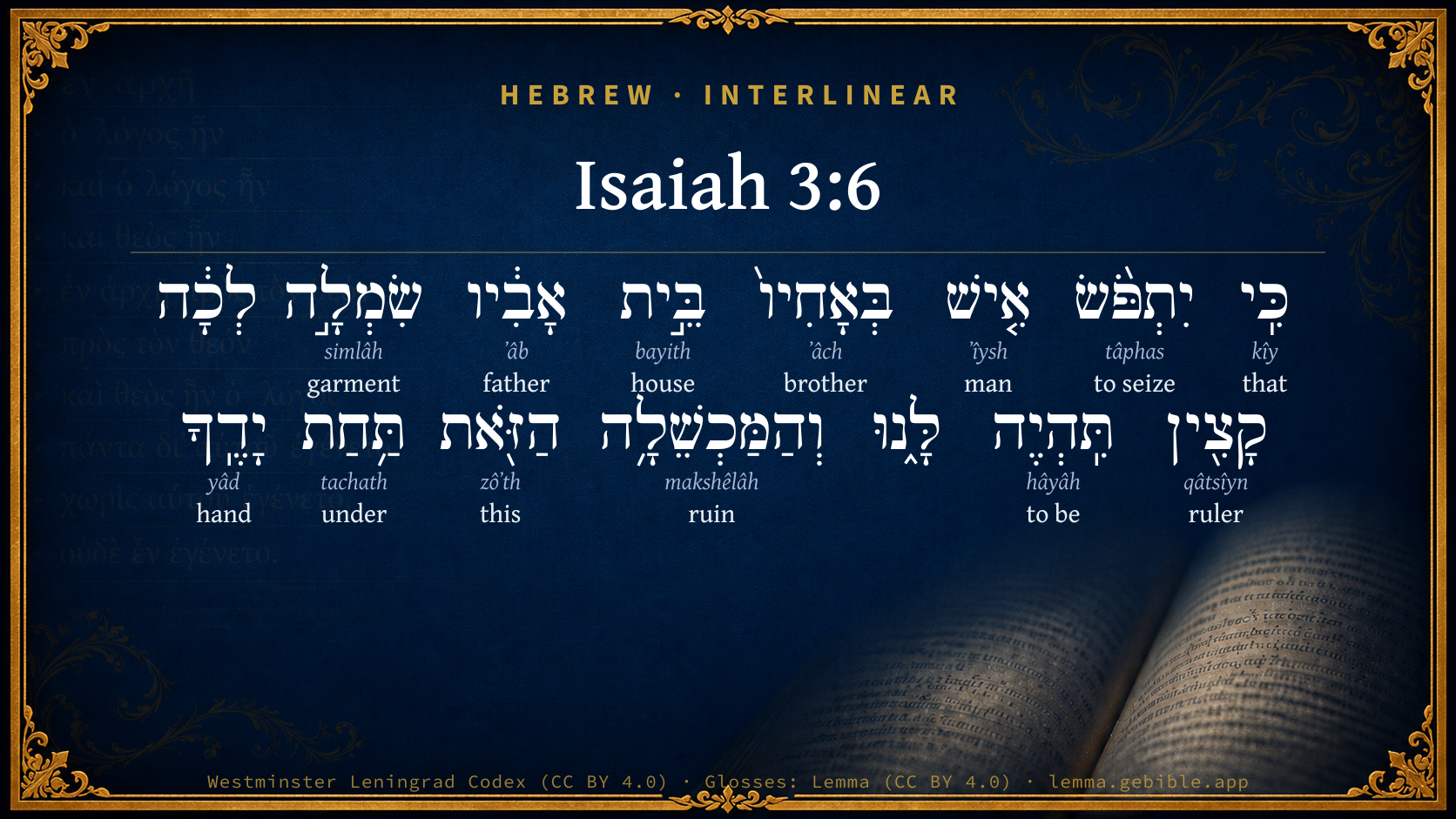
Hebrew (Westminster Leningrad Codex) Isaiah 3:6 appears in the Hebrew Old Testament. The text above is from the Westminster Leningrad Codex. Each word links to its Strong’s number, a concise gloss, and parsing drawn from the Open Scriptures Hebrew Bible morphology. Click any word for its full Brown-Driver-Briggs (BDB) entry.
Download image
Cite this verse

Isaiah 3:6 (World English Bible). Public Domain. Lemma interlinear Bible study tool, https://lemma.gebible.app/v/isaiah/3/6.

Show BibTeX & RIS
BibTeX
RIS
English Translation
Indeed a man shall take hold of his brother in the house of his father, saying, "You have clothing, you be our ruler, And let this ruin be under your hand."
World English Bible · Public Domain
Highlights
  • 1 first appearance in the Hebrew Bible
Full analysis ↓
Download a study sheet

One document with this verse’s original text, its word-by-word gloss line, the meaning frame, cross-references with their text, attributed commentary, and full source and license credits — printable, and it pastes into notes with its structure intact.

This verse Autodidact and up

Study sheet (.html) Plain text (.txt)

A passage Seminary Student

Up to 50 verses in one chapter. A passage sheet keeps up to 6 commentary sources and 12 cross-references per verse, in the order this page ranks them, and says so on the sheet whenever that leaves anything out. Ask for a single verse and you get the Autodidact verse sheet above.

Everything on this page stays free to read, with no account — the sheet is a download of what is already on screen, not access to it.

Want to remove ads? Support Godless Engineer
Compare translations 3

The same verse in 3 English versions, stacked beneath the original-language interlinear above. Click any original word for its lexicon entry.

Each is an independent rendering of the whole verse — the interlinear is not word-aligned to these translations.

Highlighted words mark where these versions differ — a whole-verse word diff, not a word-by-word alignment.

  • World English Bible Public Domain
    Indeed a man shall take hold of his brother in the house of his father, saying, "You have clothing, you be our ruler, And let this ruin be under your hand."
  • King James Version Public Domain
    When a man shall take hold of his brother of the house of his father, saying, Thou hast clothing, be thou our ruler, and let this ruin be under thy hand:
  • unfoldingWord Literal Text CC BY-SA 4.0
    For a man will seize his brother the house of his father, “You have a cloak; you shall be ruler over us, and this ruin, under your hand.”

unfoldingWord Literal Text — © unfoldingWord, licensed CC BY-SA 4.0. Word-aligned USFM3 via Door43 (git.door43.org/unfoldingWord/en_ult).

Versions to compare (up to 4)

3 of 4 selected

Show all 18 translations

Every available English version of this verse, each an independent rendering of the whole verse.

  • World English Bible Public Domain
    Indeed a man shall take hold of his brother in the house of his father, saying, "You have clothing, you be our ruler, And let this ruin be under your hand."
  • Berean Standard Bible Public Domain
    A man will seize his brother within his father’s house: “You have a cloak—you be our leader! Take charge of this heap of rubble.”
  • Majority Standard Bible Public Domain
    A man will seize his brother within his father’s house: “You have a cloak—you be our leader! Take charge of this heap of rubble.”
  • King James Version Public Domain
    When a man shall take hold of his brother of the house of his father, saying, Thou hast clothing, be thou our ruler, and let this ruin be under thy hand:
  • American Standard Version (1901) Public Domain
    When a man shall take hold of his brother in the house of his father, `saying', Thou hast clothing, be thou our ruler, and let this ruin be under thy hand;
  • Revised Version (1885) Public Domain
    When a man shall take hold of his brother in the house of his father, saying, Thou hast clothing, be thou our ruler, and let this ruin be under thy hand:
  • Geneva Bible (1599) Public Domain
    When euery one shall take holde of his brother of the house of his father, and say, Thou hast clothing: thou shalt bee our prince, and let this fall be vnder thine hand.
  • Douay-Rheims (1899) Public Domain
    For a man shall take hold or his brother, one of the house of his father, saying: Thou hast a garment, be thou our ruler, and let this ruin be under thy hand.
  • Young's Literal Translation Public Domain
    When one layeth hold on his brother, `Of' the house of his father, `by' the garment, `Come, a ruler thou art to us, And this ruin `is' under thy hand.'
  • Literal Standard Version CC BY-SA 4.0
    When one lays hold on his brother, || Of the house of his father, [by] the garment, “Come, you are a ruler to us, || And this ruin [is] under your hand.”
  • Unlocked Literal Bible CC BY-SA 4.0
    A man will even take hold of his brother in his father's house and say, 'You have a coat; be our ruler, and let this ruin be in your hands.'
  • unfoldingWord Literal Text CC BY-SA 4.0
    For a man will seize his brother the house of his father, “You have a cloak; you shall be ruler over us, and this ruin, under your hand.”
  • Darby Bible Public Domain
    When a man shall take hold of his brother, in his father's house, [and shall say:] Thou hast clothing; be our chief, and let this ruin be under thy hand;
  • World Messianic Bible Public Domain
    Indeed a man shall take hold of his brother in the house of his father, saying, “You have clothing, you be our ruler, and let this ruin be under your hand.”
  • Webster's Bible Public Domain
    When a man shall take hold of his brother of the house of his father, saying, Thou hast clothing, be thou our ruler, and let this ruin be under thy hand:
  • Free Bible Version CC BY-SA 4.0
    A man will grab hold of one of his brothers in their father's house, and tell him, “You've got a coat, you can be our leader! Take over the running of this pile of ruins!”
  • Bible in Basic English Public Domain
    When one man puts his hand on another in his father's house, and says, You have clothing, be our ruler and be responsible for us in our sad condition:
  • JPS Tanakh (1917) Public Domain
    For a man shall take hold of his brother of the house of his father: 'Thou hast a mantle, be thou our ruler, and let this ruin be under thy hand.'

Literal Standard Version (2020), Covenant Press — licensed CC BY-SA 4.0. Text via the HelloAO Bible API (eBible.org). Unlocked Literal Bible (unfoldingWord) — licensed CC BY-SA 4.0. Text via the HelloAO Bible API (eBible.org). unfoldingWord Literal Text — © unfoldingWord, licensed CC BY-SA 4.0. Word-aligned USFM3 via Door43 (git.door43.org/unfoldingWord/en_ult). Free Bible Version, Dr. Jonathan Gallagher — licensed CC BY-SA 4.0. Text via the HelloAO Bible API (eBible.org).

Word by word

More ways to search: Search by grammar → Find every occurrence → Compare this word →

Practice this passage: Drill this verse → Learn its vocabulary →

וְהַמַּכְשֵׁלָ֥ה
makshêlâh
H4384
“and · the · ruin”
Conjunction + Particle, Definite Article + Noun, Common, Feminine, Singular, Absolute
Part of Speech
Conjunction + Particle + Noun
Type
Common
Gender
Feminine
Number
Singular
State
Absolute
Full BDB Definition

Origin: from H3782

TWOT: 1050d

overthrown mass, stumbling-block, something overthrown, decay, ruin - thing overthrown (figurative of kingdom) - stumbling-block (of idols)
  1. כִּֽי kîy H3588 “that” Conjunction
  2. יִתְפֹּ֨שׂ tâphas H8610 “to seize” Verb, Qal, Imperfect, 3rd Person, Masculine, Singular
  3. אִ֤ישׁ ʼîysh H376 “man” Noun, Common, Masculine, Singular, Absolute
  4. בְּאָחִיו֙ ʼâch H251 “in/at · brother · his” Preposition + Noun, Common, Masculine, Singular, Construct + Suffix, Personal, 3rd Person, Masculine, Singular
  5. בֵּ֣ית bayith H1004 “house of” Noun, Common, Masculine, Singular, Construct
  6. אָבִ֔יו ʼâb H1 “father · his” Noun, Common, Masculine, Singular, Construct + Suffix, Personal, 3rd Person, Masculine, Singular
  7. שִׂמְלָ֣ה simlâh H8071 “garment” Noun, Common, Feminine, Singular, Absolute
  8. קָצִ֖ין qâtsîyn H7101 “ruler” Noun, Common, Masculine, Singular, Absolute
  9. תִּֽהְיֶה hâyâh H1961 “to be” Verb, Qal, Imperfect, 2nd Person, Masculine, Singular
  10. הַזֹּ֖את zôʼth H2063 “the · this” Particle, Definite Article + Pronoun, Demonstrative, Feminine, Singular
  11. תַּ֥חַת tachath H8478 “under” Preposition
  12. יָדֶֽךָ yâd H3027 “hand · your” Noun, Common, Both, Singular, Construct + Suffix, Personal, 2nd Person, Masculine, Singular

About this verse

These counts appear in no published source. They are computed here, from the morphology-tagged text and Lemma’s own curated glosses. What Lemma adds →

15
words
13
distinct lemmas
Prophets
section

Notable vocabulary

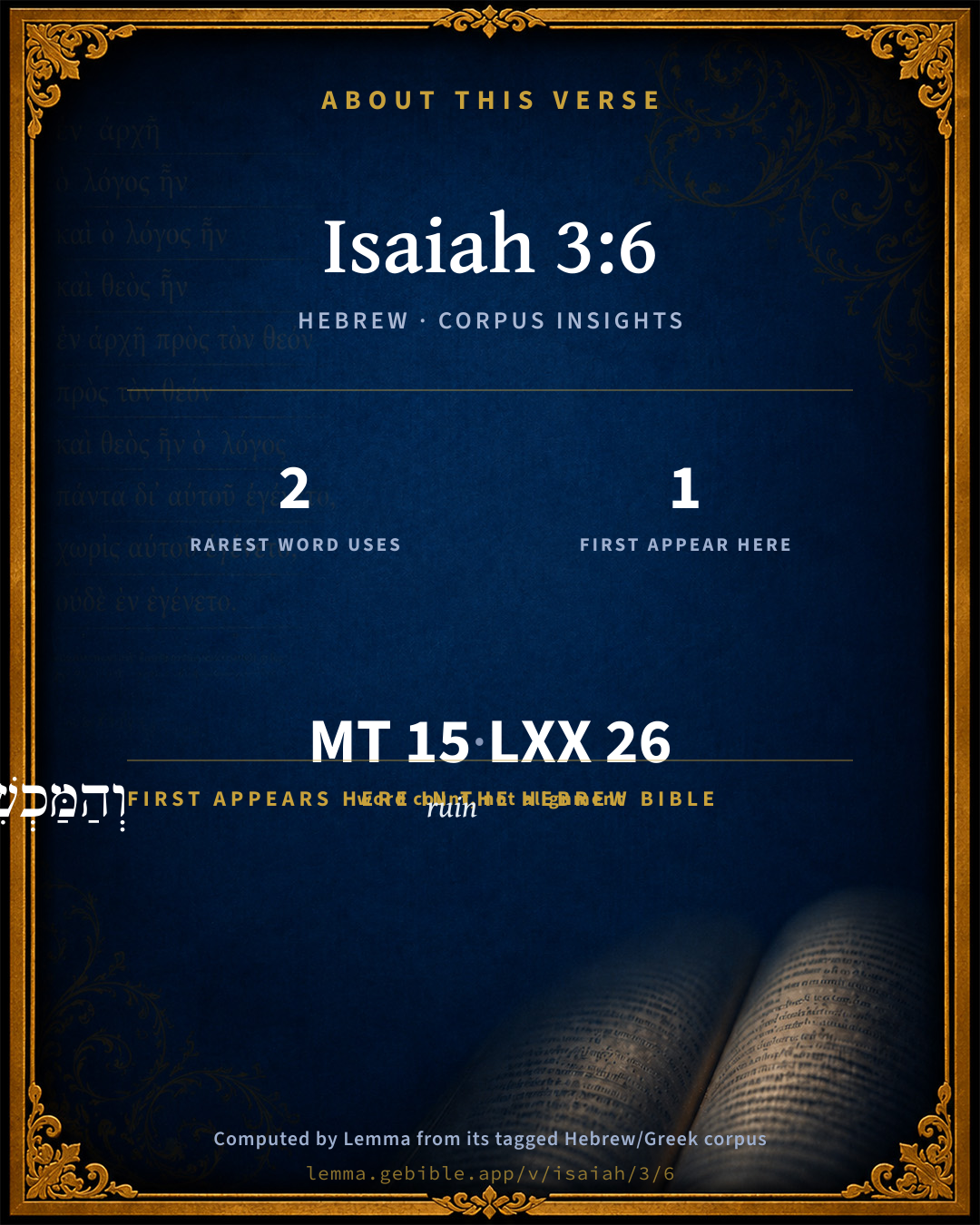
The rarest word here is וְהַמַּכְשֵׁלָ֥ה ruin H4384 — appearing just 2 times in the whole Hebrew Bible.

First appearance in Scripture

This word makes its first canonical appearance in the Hebrew Bible here:

  • וְהַמַּכְשֵׁלָ֥ה ruin H4384

Shared distinctive vocabulary

וְהַמַּכְשֵׁלָ֥ה ruin H4384 occurs in 2 verses of the Hebrew Bible. Also found in:

Grammatical profile

  • 2 verbs
  • 8 nouns
  • 1 pronoun
  • 3 prepositions
  • 1 conjunction

Verb forms

  • יִתְפֹּ֨שׂ Qal · Imperfect
  • תִּֽהְיֶה Qal · Imperfect

Hebrew & Septuagint length

In English translation the verse runs 31 words from the Hebrew and 30 from the Septuagint (LXX English) — closely comparable.

A rough comparison of the two English renderings, which tokenize alike — not a word-level alignment.

Word counts can differ between the Hebrew and the Greek without any difference in meaning — e.g. the Hebrew direct-object marker אֵת has no separate Greek word, and Greek often adds the article ὁ.

In the original languages it is 15 Hebrew tokens and 26 Greek tokens — but the two are counted differently (Hebrew bundles its prefixes and suffixes into one token; the Greek is in lemma form), so that isn’t a like-for-like length.

Cross-references

3

Topical passages linked to Isaiah 3:6 in the Treasury of Scripture Knowledge — connected by theme and wording, ordered by reader-vote popularity; previews shown in the World English Bible.

  • Isaiah 4:1 Seven women shall take hold of one man in that day, saying, "We will eat our own bread, and wear our own clothing: only let us be called by your name. Take away our reproach."
  • Judges 11:6–8 and they said to Jephthah, Come and be our chief, that we may fight with the children of Ammon.
  • John 6:15 Jesus therefore, perceiving that they were about to come and take him by force, to make him king, withdrew again to the mountain by himself.

Cross-references courtesy of OpenBible.info (CC BY 4.0).

Hebrew and Greek witnesses Masoretic Hebrew ↔ Greek Septuagint

The same verse in the two great witnesses to the Old Testament, shown verse-for-verse.

These are two independent witnesses, not word-aligned to each other, and the Septuagint is shown in lemma (dictionary) form.

Hebrew Isaiah 3:6 Masoretic · Westminster Leningrad Codex

כִּֽי יִתְפֹּ֨שׂ אִ֤ישׁ בְּאָחִיו֙ בֵּ֣ית אָבִ֔יו שִׂמְלָ֣ה לְכָ֔ה קָצִ֖ין תִּֽהְיֶה לָּ֑נוּ וְהַמַּכְשֵׁלָ֥ה הַזֹּ֖את תַּ֥חַת יָדֶֽךָ

Indeed a man shall take hold of his brother in the house of his father, saying, "You have clothing, you be our ruler, And let this ruin be under your hand."

World English Bible · Public Domain

Greek LXX Isaiah 3:6 Septuagint · lemma form

ὅτι ἐπιλαμβάνω ἄνθρωπος ὁ ἀδελφός αὐτός ἤ ὁ οἰκεῖος ὁ πατήρ αὐτός λέγω ἱμάτιον ἔχω ἀρχηγός ἐγώ γίγνομαι καί ὁ βρῶμα ὁ ἐμός ὑπό σύ εἰμί

For a man shall lay hold of his brother, as one of his father's household, saying, You have raiment, be you our ruler, and let my meat be under you.

LXX2012 (modern English Septuagint) · Public Domain

On this verse, Adam Clarke's Commentary discusses the Septuagint’s reading. Read the note in Commentary ↓

Hebrew: Westminster Leningrad Codex (CC BY 4.0). Greek: Septuagint (public domain); English from LXX2012 (modern English Septuagint) (Public Domain). How the Septuagint differs from the Hebrew →

Targum (Aramaic paraphrase)

1

The Targum is the ancient Jewish Aramaic paraphrase of the Hebrew Scriptures — an interpretive translation, not the Hebrew text itself. Onkelos (literal) and Pseudo-Jonathan (expansive) render the Torah, and Jonathan the Prophets. Coverage is partial: where no permissively-licensed English translation exists for a verse, only the Aramaic is shown. This is verse-level text, not a word-by-word alignment to the Hebrew.

  1. Targum Jonathan Prophets (Joshua–Malachi)
    אֲרֵי יֵחוֹד גְבַר בַּאֲחוֹהִי מִזַרְעֲיַת בֵּית אֲבוּהִי לְמֵימַר כְּסוּ אִית לָךְ רַב תְּהֵא עֲלָנָא וּמַגְבִּיתָא הָדָא תְּהֵא תְּחוֹת יְדָךְ:

    For a man shall take hold of his brother, of the family of his father's house, saying, Thou hast clothing, be thou a ruler over us, and this ruin shall be under thy government.

    Targum Jonathan — Aramaic: “Mikraot Gedolot” (public domain). English: “Sefaria Community Translation” (CC0 1.0 (public-domain dedication)); “London "Chaldee Paraphrase," 1871” (public domain). Text via Sefaria.

Commentary

Notes on Isaiah 3:6 from classic Christian and Jewish commentators (each source and its license shown beneath its notes). The classic Christian expositions comment on the surrounding passage and are grouped to its opening verse, so a note may address several verses; the Jewish commentaries on the Tanakh (Rashi and others) are per-verse, so they appear only where the commentator wrote on this verse.

Lemma curates 59 commentaries, every one of them public domain or Creative Commons licensed, each selected and text-cleaned for this edition rather than reprinted as found. About our sources →

The Cambridge Bible for Schools and Colleges

gen. ed. J. J. S. Perowne

6, 7. Frantic but unsuccessful efforts will be made to induce some one to undertake the task of maintaining order, Isa_3:6 is the protasis, Isa_3:7 the apodosis. Render: When one man lays hold of another in his father’s house: “Thou hast a cloak, thou shalt he a ruler for us,” &c. It is the election of a local justice (kadi ch. Isa_1:10), not of a king or dictator, which is described; “not an isolated, but a frequently observed circumstance” (Cheyne). The choice of the people falls on a landed proprietor who has been fortunate enough to retain his ancestral estate (his “father’s house”), and whose outer garment is a sufficient badge of respectability. On ruler see Isa_1:10.

The Cambridge Bible for Schools and Colleges (gen. ed. J. J. S. Perowne; Cambridge University Press, 1878–1918) — public domain. Text from a community e-Sword module.

Trapp's Complete Commentary

John Trapp

Isa 3:6 When a man shall take hold of his brother of the house of his father, [saying], Thou hast clothing, be thou our ruler, and [let] this ruin [be] under thy hand:

Ver. 6. When a man shall take hold of his brother.] This is a further mischief that government shall go a-begging, and scarce one be found that shall hold it worth having. The Venetians have magistrates called Proegadi, because at first men were prayed to take the office, and not many would accept of it; this was the case here. Men are naturally ambitious of ruledom - the bramble thinks it a goodly thing to reign over the trees - but they may soon have enough of it, and be forced to cry out, as he once did of his diadem, O rills pannus! O base rag, not worth taking up at a man’s feet!

Thou hast clothing.] Fit for a prince; some badge of honour, and such apparel as may procure thee respect; for

“ Hunc homines decorant, quem vestimenta decorant. ”

Let this ruin be under thy hand.] That is, by a hypallage, {a} let thy hand be under this ruin, that is, under this desolate and ruined State, to raise it up and repair it.

{a} A figure of speech in which there is an interchange of two elements of a proposition, the natural relations of these being reversed.

John Trapp, A Commentary or Exposition upon All the Books of the Old and New Testament (1647–1656) — public domain. Text from a community e-Sword module.

The Biblical Illustrator

Joseph S. Exell

Isa_3:6-7

A man shall take hold of his brother

Seeking to transfer rulership

Here we have the law of primogeniture.

By the law of the State it was right that the eldest son should take a certain definite and ruling position. But he was naked; he had not one rag with which to cover his nudity; and seeing one of his younger brethren with a coat on, with a garment on, he sprang upon him and said, By that coat I ask thee to take my place: thou hast at least so much, and I have nothing; come, be head of the family and be prince of the tribe. But the younger son scorned the proffered dignity. The moral base had gone, and therefore the mechanical dignity was of no account; the pedestal of righteousness had been struck away, and the statue of nominal dignity fell into the dust. (J. Parker, D. D.)

Let this ruin be under thy hand

Or, according to a various reading, making a very good sense, Take into thy hand our ruinous state. Endeavour, if possible, to retrieve our affairs, now in sad disorder, prognosticating our destruction as a people: deliver, if possible, from injustice and oppression, from foreign enemies and domestic troubles; and, in the prosecution of these great and important purposes, we will act as thy dutiful subjects. (R. Macculloch.)

Government going a-begging

Here--

1. It is taken for granted that there is no way of redressing all these grievances and bringing things into order again, but by good magistrates, that shall be invested with power by common consent, and shall exert that power for the good of the community. And it is probable this was in many places the true origin of government. Men found it necessary to unite in a subjection to one who was thought fit for such a trust, in order to the welfare and safety of them all, being aware that they must be either ruled or ruined.

2. The case is represented as very deplorable, and things come to a sad pass; for--

(1) Children being their princes, every man will think himself fit to prescribe who shall be a magistrate, and will be for preferring his own relations.

(2) Men will find themselves under a necessity even of forcing power into the hands of those that are thought to be fit for it. Nay, a man shall urge it upon his brother; whereas, commonly, men are not willing that their equals should be their superiors; witness the envy of Josephs brethren.

3. It will be looked upon as ground sufficient for the preferring a man to be a ruler, that he hath clothing better than his neighbours; a very poor qualification to recommend a man to a place of trust in the government. It was a sign the country was much impoverished, when it was a rare thing to find a man that had good clothes, or that could afford to buy himself an aldermans gown, or a judges robes; and that the people were very unthinking, when they had so much respect to a man in gay clothing with a gold ring (Jam_2:2-3), that for the sake thereof they would make him their ruler. It had been some sense to have said, Thou hast wisdom, integrity, experience, be thou our ruler; but it was a jest to say, Thou hast clothing, be thou our ruler. A poor, wise man, though in vile raiment, delivered a city (Ecc_9:15). (Matthew Henry.)

I will not be an healer

I do not want to be a surgeon--he does not like to be a binder, namely, of the broken arms and legs and ribs of the ruined State (Isa_30:26; Isa_1:6; Isa_61:1). (F. Delitzsch.)

A reason for refusing rulership

In my house is neither bread nor clothing. If he saith true, it was a sign mens estates were sadly ruined; if he do not speak truth, it was a sign mens consciences were sadly debauched, when, to avoid the expense of an office, they would load themselves with the guilt of perjury. (M. Henry.)

Clothing in the East

It was customary in Eastern countries, where fashions did not vary as among us, to collect immense quantities of clothes and provisions, not only for the persons own use, and that of his family, but for presents upon proper occasions. This appears plainly, from the sacred writings, to have been the practice among the Jews. This, as a celebrated writer observes, explains the meaning of the excuse made by him that is desired to undertake the government. He alleges he hath not wherewithal to support the dignity of that station by such acts of liberality and hospitality as the law and custom required of persons in high rank. (R. Macculloch.)

The Biblical Illustrator, edited by Joseph S. Exell (c. 1880s–1900s) — public domain. Text from a community e-Sword module.

Joseph Benson's Commentary

Isa 3:6-8. A man shall take hold of his brother — Of his relation, friend, or neighbour. To take hold of another implies entreating his assistance; see Isa 4:1; Zec 8:23; saying, Thou hast clothing — We are utterly undone, and have neither food nor raiment; but thou hast something left to support the dignity, which we offer to thee; be thou our ruler —

And we will be subject to thee. It is taken for granted that there would be no way of redressing all these grievances, and bringing things into order again, but by good magistrates, who should be invested with power by common consent, and exert that power for the good of the community; and let this ruin be under thy hand — Namely, to heal it. In that day he shall swear — To show that he was resolved. Hebrew, he shall lift up, namely, his hand, which was the usual gesture in swearing; I will not be a healer — A repairer of the ruins of the state; for in my house is neither bread nor clothing — I have not sufficient provisions, either of food or raiment, for my own family; much less, as you falsely suppose, for the discharge of so high a trust. For Jerusalem is ruined — The case is desperate, and past relief: it will be to no purpose to attempt affording any; because their tongue and their doings are against the Lord — They have broken the law of God in word and deed, and that in contempt of his authority and defiance of his justice. Their tongue was against the Lord, for they contradicted his prophets, and their doings were against him, for they acted as they spoke; to provoke the eyes of his glory — Of his glorious majesty, whom they ought to reverence and adore; the all-seeing eyes of Him who is of purer eyes than to behold iniquity, unless with abhorrence.

Joseph Benson's Commentary on the Old and New Testaments (1811–1818) — public domain. Text from a community e-Sword module.

Tyndale Open Study Notes

Tyndale Open Resources

3:6-7 Things would be so bad (a heap of ruins) that no one would want to take leadership. The people would become so desperate that anyone providing food or clothes (3:7) could be the leader of the people. In fact, however, no one would have food or clothing (see 4:1).

Tyndale Open Study Notes — © Tyndale Open Resources, licensed CC BY-SA 4.0. Text via the HelloAO Bible API.

Geneva Bible (1599)

Geneva Bible translators

He showeth that this plague shall be so horrible, that contrary to the common manner of men, which by nature are ambitious, none shall be found able or willing to be their governor.

Geneva Bible (1599) marginal notes — public domain. Text via Bolls.life.

Jamieson, Fausset & Brown

Robert Jamieson, A. R. Fausset & David Brown

Such will be the want of men of wealth and ability, that they will "take hold of" (Isa 4:1) the first man whom they meet, having any property, to make him "ruler."

brother--one having no better hereditary claim to be ruler than the "man" supplicating him.

Thou hast clothing--which none of us has. Changes of raiment are wealth in the East (Kg2 5:5).

ruin--Let our ruined affairs be committed to thee to retrieve.

Jamieson, Fausset & Brown — Commentary Critical and Explanatory on the Whole Bible (1871) — public domain (CC PDM 1.0). Text via the HelloAO Bible API.

Adam Clarke's Commentary

Verse 6. Of the house of his father - "Of his father's house"] For בית beith, the house, the ancient interpreters seem to have read מבית mibbeith, from the house; του οικειου του πατρος αυτου, Septuagint; domesticum patris sui, Vulgate; which gives no good sense. But the Septuagint MS. I. D. II. for οικειου has οικου. And, his brother, of his father's house, is little better than a tautology. The case seems to require that the man should apply to a person of some sort of rank and eminence; one that was the head of his father's house, (see Jos 12:14,) whether of the house of him who applies to him, or of any other; ראש בית אביו rosh beith abaiu, the chief, or head of his father's house. I cannot help suspecting, therefore, that the word ראש rosh, head, chief, has been lost out of the text.

Saying] Before שמלה simlah, garment, two MSS., one ancient, and the Babylonish Talmud have the word לאמר lemor, saying; and so the Septuagint, Vulgate, Syriac, and Chaldee. I place it with Houbigant, after שמלה simlah.

Thou hast clothing - "Take by the garment"] That is, shall entreat him in an humble and supplicating manner. "Ten men shall take hold of the skirt of him that is a Jew, saying, Let us go with you; for we have heard that God is with you," Zec 8:23. And so in Isa 4:1, the same gesture is used to express earnest and humble entreaty. The behaviour of Saul towards Samuel was of the same kind, when he laid hold on the skirt of his raiment, 1Sa 15:27. The preceding and following verses show, that his whole deportment, in regard to the prophet, was full of submission and humility.

And let this ruin be under thy hand - "And let thy hand support"] Before תחת ידך tachath yadecha, a MS. adds תהיה tihyeh, "let it be; " another MS. adds in the same place, תקח בידך takach beyadecha, which latter seems to be a various reading of the two preceding words, making a very good sense: "Take into thy hand our ruinous state." Twenty-one MSS. of Kennicott's, thirteen of De Rossi's, one of my own, ancient, and three editions of the Babylonish Talmud have ידיך yadeycha, plural, "thy hands."

Adam Clarke's Commentary on the Bible (1810–1826) — public domain. Text from a community e-Sword/MySword module.

Ellicott's Commentary for English Readers

(6, 7) When a man shall take hold of his brother . . .—Disorder was followed by destitution. The elder brother, the impoverished owner of the ruined dwelling, the head of a family or village, turns in his rags to the younger, whose decent garments seem to indicate comparative wealth, and would fain transfer to him the responsibilities of the first-born, though he has but a ruined tenement to give him. And instead of accepting what most men would have coveted (Gen_25:31-33), the younger brother rejects it. He has enough bread and clothing (same word as in Exo_22:27) for himself, and no more. It is not for him to bind up the wounds of others, or to try to introduce law where all is lawlessness. The supreme selfishness of a sauve qui peut asserts itself in his answer. In Isa_4:1 we have another feature of the same social state.

A Bible Commentary for English Readers, edited by Charles John Ellicott (1878–1897) — public domain. Text from a community e-Sword module.

John Gill's Exposition

When a man shall take hold of his brother of the house of his father,.... One of the same country, kindred, and family; for only one of their brethren, and not a stranger, might rule over them, Deu 17:15 this taking hold of him may design not so much a literal taking hold of his person, his hand or garment, much less using any forcible measures with him; though indeed the Jews would have took Christ by force, who was one of their brethren, and would have made him a temporal king, which he refused, as this man did here spoken of, Joh 6:15 but rather an importunate desire and entreaty, urging him, as follows,

saying, thou hast clothing, be thou our ruler; that is, he had good and rich clothing, fit for a ruler or civil magistrate to appear in, which everyone had not, and some scarce any in those troublesome times:

and let this ruin be under thy hand; that is, let thy care, concern, and business, be to raise up the almost ruined state of the city and nation; and let thy hand be under it, to support and maintain it. The Targum is,

"and this power shall be under thy hand;''

thou shalt have power and government over the nation, and the honour and greatness which belong unto it, and all shall be subject unto thee. The Septuagint renders it, "let my meat be under thee", or "from thee", as the Arabic version.

John Gill's Exposition of the Whole Bible (1746–1763) — public domain (CC PDM 1.0). Text via the HelloAO Bible API.

Albert Barnes' Notes on the Bible

When a man shall take hold ... - In this verse, and the following verses, the prophet continues to describe the calamitous and ruined state that would come upon the Jews; when there would be such a want of wealth and people, that they would seize upon anyone that they thought able to defend them. The act of “taking hold” here denotes “supplication” and “entreaty,” as when one in danger or distress clings to that which is near, or which may be likely to aid him; compare Isa 4:1; 1Sa 15:27,

His brother - His kinsman, or one of the same tribe and family - claiming protection because they belonged to the same family.

Of the house of his father - Descended from the same paternal ancestors as himself. Probably this refers to one of an ancient and opulent family - a man who had kept himself from the civil broils and tumults of the nation, and who had retained his property safe in the midst of the surrounding desolation. In the previous verse, the prophet had said that one characteristic of the times would be a want of respect for “the aged” and “the honorable.” He here says that such would be the distress, that a man would be “compelled” to show respect to rank; he would look to the ancient and wealthy families for protection.

Thou hast clothing - In ancient times wealth consisted very much in changes of garments; and the expression, ‘thou hast clothing,’ is the same as ‘you are rich, you are able to assist us;’ see Exo 12:34; Exo 20:26; Gen 45:22; 2Ki 5:5.

And let this ruin ... - This is an expression of entreaty. ‘Give us assistance, or defense. We commit our ruined and dilapidated affairs to thee, and implore thy help.’ The Septuagint reads this, ‘and let my food,’ that is, my support, ‘be under thee’ - do thou furnish me food. There are some other unimportant variations in the ancient versions, but the sense is substantially given in our translation. It is expressive of great distress and anarchy - when there would be no ruler, and every man would seek one for himself. The whole deportment evinced here by the suppliant is one of submission, distress, and humility.

Albert Barnes' Notes on the Bible (1834–1885) — public domain. Text from a community e-Sword/MySword module.

Haydock's Catholic Bible Commentary

Garment. They were ready to follow any, who was not quite destitute, like themselves, Jeremias xxxix. 10. --- Ruin. Fallen people.

George Leo Haydock (1774–1849), Haydock's Catholic Family Bible and Commentary, 1859 edition — public domain. Excludes Psalms (Douay-Rheims chapter numbering differs from Protestant) and Deuterocanonical books (Catholic canon only).

Matthew Poole's English Annotations

A man shall take hold of his brother of the house of his father; whereas envy ordinarily reigns in near relations, when one brother is advanced far above all the rest.

Thou hast clothing: we are utterly undone, and have neither food nor raiment; but thou hast something yet left to support the dignity which we offer to thee, and to enable thee to execute thine office.

Be thou our ruler: he showeth that misgovernment should cause the dissolution of the government, and that the former governors should be removed either by foreign force, or by domestic insurrection.

Let this ruin be under thine hand, to wit, to heal it, as it is explained in the next verse. Undertake the charge of this tottering state.

Matthew Poole's English Annotations on the Holy Bible (1683–1685) — public domain. Text from a community e-Sword/MySword module.

Whedon's Commentary on the Bible

Daniel D. Whedon

6, 7. Nobody desires state-position in anarchy like this.

Take hold of his brother — In a supplicating way, and then only on a kinsman, or one of his tribe. Outside of ties of blood no one ventures.

Hast clothing — A large wardrobe, which was a mark of oriental wealth.

Be thou our ruler — A like example is that of Jephthah, but in times when anarchy was less desperate, and probably less general (Jdg_11:6) than that here represented.

In that day — In that time of anarchy.

Shall he swear — Literally, lift up the hand; this being the usual form of oath-taking.

Not be a healer — Or, binder up; the chief proceeding in oriental surgery. The body politic has been too long and irrecoverably diseased.

In my house — Powerful and wealthy though it has been, it is now impoverished; it has neither bread nor clothing. “It is customary for Eastern rulers to gather an immense quantity of clothes, for there fashions never alter.” — Chardin.

“The kings of Persia have great wardrobes,… many habits to spare and to give away, on occasion, as presents.” — Lowth. The picture here is that of extreme poverty as the result of a long continued ruinous civil and moral condition.

Daniel D. Whedon (gen. ed.), Commentary on the Old and New Testaments (1874–1909) — public domain. Text from a community e-Sword module.

The Pulpit Commentary

When a man shall take hold of his brother. A new departure. In the general anarchy described (vers. 4, 5) it will be felt that something must be done. A man will take hold of his brother (i.e. his fellow) in his ( i.e. the latter"s) father"s house, where he lives in seclusion, and say to him, "Thou hast clothing" (or, "thou art decently clad"), "thou must be our ruler; let this ruin" (i.e. "this ruined state") "be under thy band." This ruin; literally, this stumbling-block. (see Zep_1:3; and compare the uniform translation of the kindred noun mikshol Lev_19:14 Psa_119:165 Isa_57:14 Jer_6:21 Eze_7:10, etc.) The Jewish community is meant, which was full of stumbling itself, and might well cause all those to stumble who came into contact with it.

The Pulpit Commentary (1880–1919), ed. H.D.M. Spence-Jones & Joseph S. Exell — public domain. Text from a community e-Sword module.

John Wesley's Explanatory Notes

Thou hast - We are utterly undone, and have neither food nor raiment; but thou hast something left to support the dignity which we offer to thee. Under thine hand - To heal it.

John Wesley, Explanatory Notes Upon the Whole Bible (1754–1765) — public domain. Text via the GEBible commentary corpus.

Keil & Delitzsch

C. F. Keil & F. Delitzsch

At length there would be no authorities left; even the desire to rule would die out: for despotism is sure to be followed by mob-rule, and mob-rule by anarchy in the most literal sense. The distress would become so great, that whoever had a coat (cloak), so as to be able to clothe himself at all decently, would be asked to undertake the government. "When a man shall take hold of his brother in his father's house, Thou hast a coat, thou shalt be our ruler, and take this ruin under thy hand; he will cry out in that day, I do not want to be a surgeon; there is neither bread nor coat in my house: ye cannot make me the ruler of the people." "his father's house" - this is not an unmeaning trait in the picture of misery. The population would have become so thin and dispirited through hunger, that with a little energy it would be possible to decide within the narrow circle of a family who should be ruler, and to give effect to the decision. "In his father's house:" Beth âbiv is an acc. loci. The father's house is the place where brother meets with brother; and one breaks out with the urgent petition contained in the words, which follow without the introductory "saying" (cf., Isa 14:8, Isa 14:16, and Isa 22:16; Isa 33:14). לכה for לך with He otians, a form rarely met with (vid., Gen 27:37). תּהיה, which would be written תּהי before the predicate, is jussive in meaning, though not in form. "This ruin:" macshelah is used in Zep 1:3 for that which occasions a person's fall; here it signifies what has been overthrown; and as Câshal itself, which means not only to stumble, strip, or slide, but also to fall in consequence of some force applied from without, is not used in connection with falling buildings, it must be introduced here with an allusion to the prosopopeia which follows in Isa 3:8. The man who was distinguished above all others, or at any rate above many others, by the fact that he could still dress himself decently (even if it were only in a blouse), should be made supreme ruler or dictator (cf., kâtzin, Jdg 11:6); and the state which lay so miserably in ruins should be under his hand, i.e., his direction, protection, and care (Kg2 8:20; Gen 41:35, cf., Isa 16:9, where the plural is used instead of the ordinary singular yâd.) The apodosis to the protasis introduced with Chi as a particle of time (when) commences in Isa 3:7. The answer given by the brother to the earnest petition is introduced with "he will raise (viz., his voice, Isa 24:14) in that day, saying." It is given in this circumstantial manner because it is a solemn protest. He does not want to be a Chobēsh, i.e., a binder, namely of the broken arms, and bones, and ribs of the ruined state (Isa 30:26; Isa 1:6; Isa 61:1). The expression ehyeh implies that he does not like it, because he is conscious of his inability. He has not confidence enough in himself, and the assumption that he has a coat is a false cone: he not only has no coat at home (we must remember that the conversation is supposed to take place in his father's house), but he has not any bread; so that it is utterly impossible for a naked, starving man like him to do what is suggested ("in my house," ubebethi with a Vav of causal connection: Ges. 155, 1, c).

Keil & Delitzsch — Biblical Commentary on the Old Testament (1861–1891) — public domain (CC PDM 1.0). Text via the HelloAO Bible API. (Old Testament only.)

J. A. Alexander on Isaiah

Joseph Addison Alexander

Having predicted the removal of those qualified to govern, the rise of incompetent successors, and a consequent insubordination and confusion, the Prophet now describes this last as having reached such a height that no one is willing to hold office, or, as Matthew Henry says, "the government goes a begging.” This verse, notwithstanding its length, seems to contain only the protasis or conditional clause of the sentence, in which the commonwealth is represented as a ruin, and the task of managing it pressed upon one living in retirement, on the ground that he still possesses decent raiment, a lively picture both of general anarchy and general wretchedness. “When a man shall take hold of his brother (i.e., one man of another) in his father’s house (at home in a private station, saying) thou hast raiment, a ruler shalt thou be to us, and this ruin (shall be) under thy hand (i.e., under thy power, control, and management).”

It is equally consistent with the syntax and the usage of the words to understand the man as addressing his brother, in the proper sense, or in that of a near kinsman, of or belonging to the house of his (the speaker’s) father, (i.e., one of the same family). But the offer would then seem to be simply that of headship or chief-captainship over a family or house, whereas a wider meaning is required by the connection. Some explain the phrase as meaning thou art rich, because clothing forms a large part of oriental wealth. But others understand the words more probably as meaning ‘thou hast still a garment,’ whereas we have none, implying general distress as well as anarchy.

Joseph Addison Alexander, The Prophecies of Isaiah (1846–1847; New York: Scribner, 1870–1878) — public domain. Text from a community e-Sword module.

unfoldingWord translationNotes

Door43 World Missions Community

let this ruin be in your hands

Here "hands" represents authority. AT: "take charge of this ruin" or "rule over this ruin" (See: Metaphor)

this ruin

Possible meanings are 1) many or most of the buildings in the city of Jerusalem were destroyed or 2) the people in Jerusalem have no more prosperity or leadership. AT: "this city, which is now ruined" (See: Metaphor)

I will not be a healer

Solving the people's troubles is spoken of as if it were healing them. AT: "No, I cannot fix this problem" or "No, I cannot help you" (See: Metaphor)

translationWords

rule

cure

bread

people group

unfoldingWord translationNotes — © Distant Shores Media and the Door43 World Missions Community, licensed CC BY-SA 4.0. Source: git.door43.org/Door43/en_tn.

Rashi

Rabbi Shlomo Yitzchaki (Rashi)

When a man shall seize his brother When a man shall seize his brother in his father’s house, saying, “You are wealthy in Torah, and it is as white to you as a garment.”

be an officer to us and teach us.

and this obstacle upon which we are stumbling, in prohibition or permissibility, in defilement or in purity, shall be under your hand, for you know how to instruct us. Another explanation is: You have a garment to clothe the naked.

and this obstacle fajjlejjnca in O.F. [faibless in modern French]. My want, that I lack bread, is under your hand to supply me. Therefore, you shall be to us as an officer. He replies, In my house there is neither bread nor clothing. What then are my qualifications as an officer?

Rashi on the Tanakh — English translations: “The Judaica Press complete Tanach with Rashi, translated by A. J. Rosenberg” (CC BY 4.0); “Pentateuch with Rashi's commentary by M. Rosenbaum and A.M. Silbermann, 1929-1934” (public domain); “The Metsudah Tanach series, Lakewood, N.J” (CC BY 4.0); and “The Book of Joshua, Metsudah Publications, 1997” (CC BY 4.0). Text via Sefaria.

Ibn Ezra

Rabbi Abraham ibn Ezra

The house of his father. His family.

לכה To thee. It is the same as לך though having an additional שמלה לכה.ה thy clothing be to thee. We do not ask thee to give us clothing.

This ruin. Jerusalem (comp. 5:8.).—This is just the style in which people speak while labouring under strong excitement.

Ibn Ezra on the Tanakh — English translations: “Sefaria Community Translation” (CC0 1.0 (public-domain dedication)); “Yalkut, Sifsei Chachomim Chumash, Metsudah Publications, 2009” (CC BY 4.0); and “Commentary of Ibn Ezra on Isaiah - trans. by M. Friedlander, 1873” (public domain). Text via Sefaria.

Lesson kit

Teaching starters — assembled from the data on this page, not authored interpretation. Every prompt links to the verse data it draws on. Edit before teaching.

Isaiah, in the Prophets, opens this verse with 15 words (13 distinct Hebrew lemmas). Its most distinctive word is makshêlâh (“ruin”). A historical commentator’s framing appears above. Read the whole chapter for the surrounding context.

Discussion questions

  1. How does “ruin” (makshêlâh) shape what this verse is saying?
  2. The word “ruin” first appears here in Scripture. What is being introduced at this debut?
  3. Zephaniah 1:3 shares the word «ruin» with this verse. How do the two illuminate each other?
  4. These translations render this verse differently. What is at stake in choosing one wording over another?
  5. The verb «יִתְפֹּ֨שׂ» is Qal Imperfect. How does its form color the action?
  6. Reading how The Cambridge Bible for Schools and Colleges and Trapp's Complete Commentary read this verse, where do the two commentators agree and where do they part?

Things to notice

Reading settings

Reading text

Shown beneath each verse's original-language words.

Old Testament
Old Testament edition

Read the OT as the Masoretic Hebrew (MT) or the Greek Septuagint (LXX).

English shown for the Greek Septuagint (in the Hebrew ↔ Greek comparison).

Comparing translations? Open the Compare panel on any verse page to stack up to four side by side.