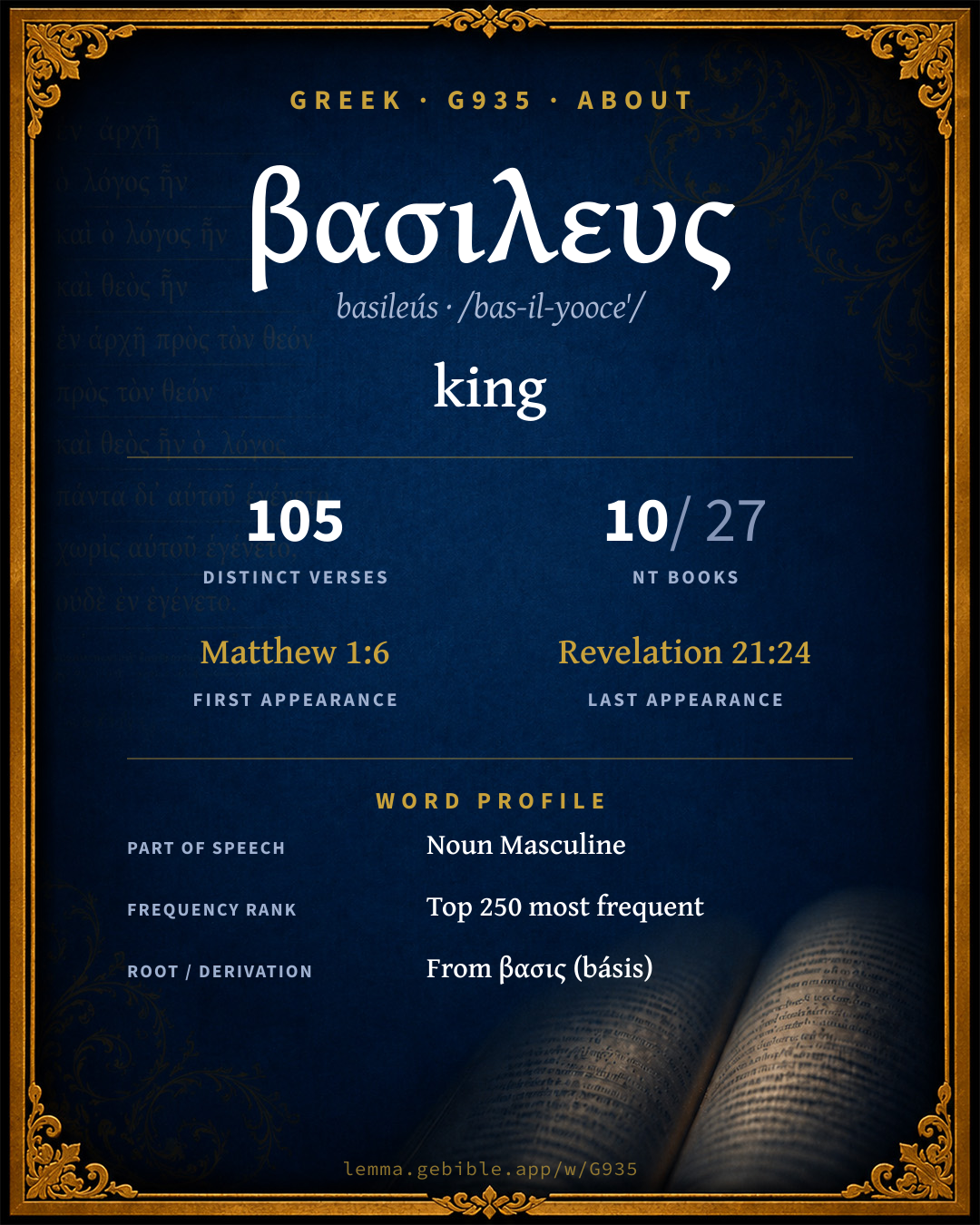
βασιλεύς
king
Full lexicon entry — Thayer's Greek Lexicon
From Thayer's Greek Lexicon
Where this word appears
See every Nominative-case word in the Greek New Testament →
Grammar key — what these labels mean
Part of speech
- Noun
- A naming word — a person, place, thing, or idea.
Case
- Nominative
- The case of the subject (and the predicate nominative).
- Accusative
- The case of the direct object and of extent.
- Genitive
- The case of source, possession, or “of” — answers “whose / from what.”
- Vocative
- The case of direct address (“O Lord”).
- Dative
- The case of the indirect object, means, or location — “to / for / with / in.”
Gender
- Masculine
- Grammatically masculine.
Number
- Singular
- One.
- Plural
- More than one.
56 distinct verses where G935 appears in the Nominative case, across 8 books. Filtered view — show all forms. Click any verse to open its interlinear word-by-word view. Verse text shown in the World English Bible for context — . Each verse’s Greek form is shown with its reference; the English is not keyword-highlighted, since the data carries no word-level English alignment. Use “Compare translations” on any verse to read it across multiple English versions. This concordance covers the Greek New Testament; Septuagint (Greek Old Testament) occurrences of this word are not indexed here.
Matthew 14 verses
- Matthew 2:2 βασιλεὺς n nom sg masc "Where is he who is born King of the Jews? For we saw his star in the east, and have come to worship him."
- Matthew 2:3 βασιλεὺς n nom sg masc When Herod the king heard it, he was troubled, and all Jerusalem with him.
- Matthew 14:9 βασιλεὺς n nom sg masc The king was grieved, but for the sake of his oaths, and of those who sat at the table with him, he commanded it to be given,
- Matthew 17:25 Βασιλεῖς n nom pl masc He said, "Yes." When he came into the house, Jesus anticipated him, saying, "What do you think, Simon? From whom do the kings of the earth receive toll or tribute? From their children, or from strangers?"
- Matthew 21:5 βασιλεύς n nom sg masc "Tell the daughter of Zion, Behold, your King comes to you, Humble, and riding on a donkey, On a colt, the foal of a donkey."
- Matthew 22:7 βασιλεὺς n nom sg masc When the king heard that, he was angry, and he sent his armies, destroyed those murderers, and burned their city.
- Matthew 22:11 βασιλεὺς n nom sg masc But when the king came in to see the guests, he saw there a man who didn't have on wedding clothing,
- Matthew 22:13 βασιλεὺς n nom sg masc Then the king said to the servants, 'Bind him hand and foot, take him away, and throw him into the outer darkness; there is where the weeping and grinding of teeth will be.'
- Matthew 25:34 βασιλεὺς n nom sg masc Then the King will tell those on his right hand, 'Come, blessed of my Father, inherit the Kingdom prepared for you from the foundation of the world;
- Matthew 25:40 βασιλεὺς n nom sg masc "The King will answer them, 'Most assuredly I tell you, inasmuch as you did it to one of the least of these my brothers, you did it to me.'
- Matthew 27:11 βασιλεὺς n nom sg masc Now Jesus stood before the governor: and the governor asked him, saying, "Are you the King of the Jews?" Jesus said to him, "So you say."
- Matthew 27:29 βασιλεὺς n nom sg masc They braided a crown of thorns and put it on his head, and a reed in his right hand; and they kneeled down before him, and mocked him, saying, "Hail, King of the Jews!"
- Matthew 27:37 βασιλεὺς n nom sg masc They set up over his head the accusation against him written, "THIS IS JESUS, THE KING OF THE JEWS."
- Matthew 27:42 βασιλεὺς n nom sg masc "He saved others, but he can't save himself. If he is the King of Israel, let him come down from the cross now, and we will believe in him.
Mark 7 verses
- Mark 6:14 βασιλεὺς n nom sg masc King Herod heard this, for his name had become known, and he said, "John the Baptizer has risen from the dead, and therefore these powers are at work in him."
- Mark 6:22 βασιλεὺς n nom sg masc When the daughter of Herodias herself came in and danced, she pleased Herod and those sitting with him. The king said to the young lady, "Ask me whatever you want, and I will give it to you."
- Mark 6:26 βασιλεὺς n nom sg masc The king was exceedingly sorry, but for the sake of his oaths, and of his dinner guests, he didn't wish to refuse her.
- Mark 6:27 βασιλεὺς n nom sg masc Immediately the king sent out a soldier of his guard, and commanded to bring John's head, and he went and beheaded him in the prison,
- Mark 15:2 βασιλεὺς n nom sg masc Pilate asked him, "Are you the King of the Jews?" He answered, "So you say."
- Mark 15:26 βασιλεὺς n nom sg masc The superscription of his accusation was written over him, "THE KING OF THE JEWS."
- Mark 15:32 βασιλεὺς n nom sg masc Let the Christ, the King of Israel, now come down from the cross, that we may see and believe him." Those who were crucified with him insulted him.
Luke 7 verses
- Luke 10:24 βασιλεῖς n nom pl masc for I tell you that many prophets and kings desired to see the things which you see, and didn't see them, and to hear the things which you hear, and didn't hear them."
- Luke 14:31 βασιλεὺς βασιλεῖ n nom sg masc n dat sg masc Or what king, as he goes to encounter another king in war, will not sit down first and consider whether he is able with ten thousand to meet him who comes against him with twenty thousand?
- Luke 19:38 βασιλεὺς n nom sg masc saying, "Blessed is the King who comes in the name of the Lord! Peace in heaven, and glory in the highest!"
- Luke 22:25 βασιλεῖς n nom pl masc He said to them, "The kings of the Gentiles lord it over them, and those who have authority over them are called 'benefactors.'
- Luke 23:3 βασιλεὺς n nom sg masc Pilate asked him, "Are you the King of the Jews?" He answered him, "So you say."
- Luke 23:37 βασιλεὺς n nom sg masc and saying, "If you are the King of the Jews, save yourself!"
- Luke 23:38 βασιλεὺς n nom sg masc An inscription was also written over him in letters of Greek, Latin, and Hebrew: "THIS IS THE KING OF THE JEWS."
John 9 verses
- John 1:50 βασιλεὺς n nom sg masc Jesus answered him, "Because I told you, 'I saw you underneath the fig tree,' do you believe? You will see greater things than these!"
- John 12:13 βασιλεὺς n nom sg masc they took the branches of the palm trees, and went out to meet him, and cried out, "Hosanna! Blessed is he who comes in the name of the Lord, the King of Israel!"
- John 12:15 βασιλεύς n nom sg masc "Don't be afraid, daughter of Zion. Behold, your King comes, sitting on a donkey's colt."
- John 18:33 βασιλεὺς n nom sg masc Pilate therefore entered again into the Praetorium, called Jesus, and said to him, "Are you the King of the Jews?"
- John 18:37 βασιλεὺς βασιλεύς n nom sg masc n nom sg masc Pilate therefore said to him, "Are you a king then?" Jesus answered, "You say that I am a king. For this reason I have been born, and for this reason I have come into the world, that I should testify to the truth. Everyone who is of the truth listens to my voice."
- John 19:3 βασιλεὺς n nom sg masc They kept saying, "Hail, King of the Jews!" and they kept slapping him.
- John 19:14 βασιλεὺς n nom sg masc Now it was the Preparation Day of the Passover, at about the sixth hour. He said to the Jews, "Behold, your King!"
- John 19:19 βασιλεὺς n nom sg masc Pilate wrote a title also, and put it on the cross. There was written, "JESUS OF NAZARETH, THE KING OF THE JEWS."
- John 19:21 βασιλεὺς βασιλεύς n nom sg masc n nom sg masc The chief priests of the Jews therefore said to Pilate, "Don't write, 'The King of the Jews,' but, 'he said, I am King of the Jews.'"
Acts 6 verses
- Acts 4:26 βασιλεῖς n nom pl masc The kings of the earth take a stand, And the rulers take council together, Against the Lord, and against his Christ.'
- Acts 7:18 βασιλεὺς n nom sg masc until there arose a different king, who didn't know Joseph.
- Acts 12:1 βασιλεὺς n nom sg masc Now about that time, Herod the king stretched out his hands to oppress some of the assembly.
- Acts 25:13 βασιλεὺς n nom sg masc Now when some days had passed, Agrippa the King and Bernice arrived at Caesarea, and greeted Festus.
- Acts 26:26 βασιλεύς n nom sg masc For the king knows of these things, to whom also I speak freely. For I am persuaded that none of these things is hidden from him, for this has not been done in a corner.
- Acts 26:30 βασιλεὺς n nom sg masc The king rose up with the governor, and Bernice, and those who sat with them.
1 Timothy 1 verse
Hebrews 2 verses
- Hebrews 7:1 βασιλεὺς βασιλέων n nom sg masc n gen pl masc For this Melchizedek, king of Salem, priest of God Most High, who met Abraham returning from the slaughter of the kings and blessed him,
- Hebrews 7:2 βασιλεὺς βασιλεὺς βασιλεὺς n nom sg masc n nom sg masc n nom sg masc to whom also Abraham divided a tenth part of all (being first, by interpretation, king of righteousness, and then also king of Salem, which is king of peace;
Revelation 10 verses
- Revelation 6:15 βασιλεῖς n nom pl masc The kings of the earth, the princes, the commanding officers, the rich, the strong, and every slave and free person, hid themselves in the caves and in the rocks of the mountains.
- Revelation 15:3 βασιλεὺς n nom sg masc They sang the song of Moses, the servant of God, and the song of the Lamb, saying, "Great and marvelous are your works, Lord God, the Almighty; Righteous and true are your ways, you King of the nations.
- Revelation 17:2 βασιλεῖς n nom pl masc with whom the kings of the earth committed sexual immorality, and those who dwell in the earth were made drunken with the wine of her sexual immorality."
- Revelation 17:10 βασιλεῖς n nom pl masc They are seven kings. Five have fallen, the one is, the other has not yet come. When he comes, he must continue a little while.
- Revelation 17:12 βασιλεῖς βασιλεῖς n nom pl masc n nom pl masc The ten horns that you saw are ten kings who have received no kingdom as yet, but they receive authority as kings, with the beast, for one hour.
- Revelation 17:14 βασιλεὺς βασιλέων n nom sg masc n gen pl masc These will war against the Lamb, and the Lamb will overcome them, for he is Lord of lords, and King of kings. They also will overcome who are with him, called and chosen and faithful."
- Revelation 18:3 βασιλεῖς n nom pl masc For all the nations have drunk of the wine of the wrath of her sexual immorality, the kings of the earth committed sexual immorality with her, and the merchants of the earth grew rich from the abundance of her luxury."
- Revelation 18:9 βασιλεῖς n nom pl masc The kings of the earth, who committed sexual immorality and lived wantonly with her, will weep and wail over her, when they look at the smoke of her burning,
- Revelation 19:16 βασιλεὺς βασιλέων n nom sg masc n gen pl masc He has on his garment and on his thigh a name written, "KING OF KINGS, AND LORD OF LORDS."
- Revelation 21:24 βασιλεῖς n nom pl masc The nations will walk in its light. The kings of the earth bring the glory and honor of the nations into it.
About this entry
At a glance — auto-summarized from this page’s data, not written by a person. Every figure links to its source below. This summary describes the numbers; it doesn’t interpret them.
At its core, βασιλευς (basileús) means “king.” It first appears in Matthew 1:6. Spanning 105 verses in 10 books, it ranks among the common words of the Greek New Testament. Sharing its root, it stands alongside βασις, βαθυς and βαΐον. Dig into 105-verse concordance and the renderings breakdown below.
Gloss history
Strong's 1890 vs modern scholarship
About this word
Strong's G935 catalogs a Greek word from the Greek New Testament.
These counts are not copied from any lexicon or concordance. They are computed here, from the morphology-tagged Greek New Testament. What Lemma adds →
- 105
- distinct verses
- The word appears in 105 distinct verses.
- 10 / 27
- NT books
- The word appears in 10 of 27 New Testament books.
- #144
- by frequency
- Top 250 most frequent Greek words (rank 144 of 5,347 Greek words by occurrence).
View all 105 occurrences in the concordance →
Most concentrated in
- Matthew 22 verses 21%
- Acts 20 verses 19%
- Revelation 18 verses 17%
By section of the New Testament
By traditional corpus
Conventional, traditional groupings — biblical authorship is debated, so this is a traditional corpus grouping, not an authorship claim. Some books belong to more than one corpus (Luke is in both the Gospels and the Lukan corpus, and so on), so these shares overlap and need not total 100%. Each figure is a share of the word’s 105 distinct verses.
- Gospels 57 verses · 54%
- Johannine 31 verses · 30%
- Lukan (Luke–Acts) 30 verses · 29%
- Revelation 18 verses · 17%
- Pauline corpus 4 verses · 4%
- Hebrews 4 verses · 4%
- General (Catholic) Epistles 2 verses · 2%
How translations render this word
Counts come from each version’s own published word-to-Strong’s tagging or interlinear alignment — an approximate guide to how each version renders this word, not a word-level alignment the data otherwise carries. Because each total is that version’s own tagged count, the per-version totals vary from one another and need not match the appearance or distinct-verse counts above. These counts may also differ from a printed concordance because Lemma counts each distinctly tagged rendering and does not collapse phrase taggings into a single head-word total. This is a fixed set of word-tagged versions (KJV, ASV, BSB, ULT) and does not change with the reading translation you choose elsewhere. Each version’s license is shown beside its name below (and on Sources).
- King James Version: King 82×, Kings 29×, King's 2×
- American Standard Version: King 81×, Kings 28×
- Berean Standard Bible: King 84×, Kings 27×, King’s 3×
- unfoldingWord Literal Text: King 87×, Kings 28×
King James Version Public Domain
Renders G935 across 118 tagged occurrences — most commonly:
Plus 5 renderings that appear only once — usually multi-word phrases or single function words the recovered tagging swept in, not distinct renderings.
American Standard Version Public Domain
Renders G935 across 116 tagged occurrences — most commonly:
Plus 7 renderings that appear only once — usually multi-word phrases or single function words the recovered tagging swept in, not distinct renderings.
Berean Standard Bible Public Domain
Renders G935 across 115 tagged occurrences — most commonly:
Plus 1 rendering that appears only once — usually multi-word phrases or single function words the recovered tagging swept in, not distinct renderings.
unfoldingWord Literal Text CC BY-SA 4.0
Renders G935 across 117 tagged occurrences — most commonly:
Plus 2 renderings that appear only once — usually multi-word phrases or single function words the recovered tagging swept in, not distinct renderings.
Senses in Thayer's
The 1 sense Thayer's distinguishes for this word, in lexicon order (not ranked by frequency or importance). The full entry — with sub-senses — is in the Lexicon Entry tab.
- leader of the people, prince, commander, lord of the land, king
Word origin
Derived from βασις (básis) (G939) — foot.
Probably from G939 (through the notion of a foundation of power); a sovereign (abstractly relatively or figuratively): - king.
— Strong’s Exhaustive Concordance (1890), public domain.
Forms in the corpus
The 10 distinct written forms G935 takes in the Greek New Testament, most frequent first — each parse links to that case’s occurrences in the concordance.
| Form | Parsing | Example | Uses |
|---|---|---|---|
| βασιλεὺς basileùs | Noun, Nominative, Singular, Masculine | Matthew 2:2 | 44 |
| βασιλεῖς basileîs | Noun, Nominative, Plural, Masculine | Luke 10:24 | 15 |
| βασιλέα basiléa | Noun, Accusative, Singular, Masculine | Matthew 1:6 | 15 |
| βασιλέων basiléōn | Noun, Genitive, Plural, Masculine | Matthew 11:8 | 11 |
| βασιλέως basiléōs | Noun, Genitive, Singular, Masculine | Matthew 2:1 | 9 |
| βασιλεῦ basileû | Noun, Vocative, Singular, Masculine | Mark 15:18 | 8 |
| βασιλεῖ basileî | Noun, Dative, Singular, Masculine | Matthew 18:23 | 6 |
| βασιλεύς basileús | Noun, Nominative, Singular, Masculine | Matthew 21:5 | 5 |
| Βασιλεῖς Basileîs | Noun, Nominative, Plural, Masculine | Matthew 17:25 | 1 |
| βασιλεῦσιν basileûsin | Noun, Dative, Plural, Masculine | Revelation 10:11 | 1 |
Same root — word family
Other Thayer's entries built from the same root as G935, grouped by Strong’s listed origin. These share a root / origin per the lexicon — not necessarily a shared meaning. Each links to that word’s own entry.
Derives from
Shares the same root
- βαθυς bathýs G901 deep
- βαΐον baḯon G902 palm branch
- βαρος báros G922 heaviness
- βασανος básanos G931 touchstone
- βασταζω bastázō G941 to take up
- βεβαιος bébaios G949 firm
- βεβηλος bébēlos G952 profane
- βημα bēma G968 judgment seat
- βωμος bōmós G1041 elevated place
Derived from this word
- βασιλεια basileía G932 kingdom
- βασιλειος basíleios G934 royal
- βασιλευω basileúō G936 to reign
- βασιλικος basilikós G937 kingly
Compare all same-root words → Showing 4 of 15 — not the complete family. They share a root, not necessarily a meaning.
Septuagint usage
The same Greek word βασιλευς appears 2,607 times in the Greek Old Testament (Septuagint), across 1,974 verses in 34 books.
- 2,607
- LXX occurrences
- Tagged occurrences of this Greek word in the Septuagint.
- 1,974
- verses
- Distinct Septuagint verses containing this word.
- 34 / 39
- OT books
- The word appears in 34 of the 39 Old Testament books.
Sample Septuagint occurrences
- Genesis 14:1 βασιλεύς
- Exodus 1:8 βασιλεύς
- Numbers 20:14 βασιλεύς
- Deuteronomy 1:4 βασιλεύς
- Joshua 2:2 βασιλεύς
- Judges 1:7 βασιλεύς
- 1 Samuel 2:10 βασιλεύς
- 2 Samuel 2:7 βασιλεύς
- 1 Kings 1:1 βασιλεύς
- 2 Kings 1:3 βασιλεύς
- 1 Chronicles 1:31 βασιλεύς
- 2 Chronicles 1:12 βασιλεύς
Septuagint occurrences (same lexeme)
Every verse where the same Strong’s number (G935) appears in the Greek Septuagint — showing the first 50 of 1,974. Verse text shown in the World English Bible for context; the Greek form is the matched word — the English is not keyword-highlighted.
- Genesis 14:1 βασιλεύς It happened in the days of Amraphel, king of Shinar, Arioch, king of Ellasar, Chedorlaomer, king of Elam, and Tidal, king of Goiim,
- Genesis 14:2 βασιλεύς that they made war with Bera, king of Sodom, and with Birsha, king of Gomorrah, Shinab, king of Admah, and Shemeber, king of Zeboiim, and the king of Bela (the same is Zoar).
- Genesis 14:5 βασιλεύς In the fourteenth year Chedorlaomer came, and the kings who were with him, and struck the Rephaim in Ashteroth Karnaim, and the Zuzim in Ham, and the Emim in Shaveh-kiriathaim,
- Genesis 14:8 βασιλεύς There went out the king of Sodom, and the king of Gomorrah, and the king of Admah, and the king of Zeboiim, and the king of Bela (the same is Zoar); and they set the battle in array against them in the valley of Siddim;
- Genesis 14:9 βασιλεύς against Chedorlaomer king of Elam, and Tidal king of Goiim, and Amraphel king of Shinar, and Arioch king of Ellasar; four kings against the five.
- Genesis 14:10 βασιλεύς Now the valley of Siddim was full of tar pits; and the kings of Sodom and Gomorrah fled, and they fell there, and those who remained fled to the mountain.
- Genesis 14:17 βασιλεύς The king of Sodom went out to meet him, after his return from the slaughter of Chedorlaomer and the kings who were with him, at the valley of Shaveh (the same is the King's Valley).
- Genesis 14:18 βασιλεύς Melchizedek king of Salem brought forth bread and wine: and he was priest of God Most High.
- Genesis 14:21 βασιλεύς The king of Sodom said to Abram, "Give me the people, and take the goods to yourself."
- Genesis 14:22 βασιλεύς Abram said to the king of Sodom, "I have lifted up my hand to Yahweh, God Most High, possessor of heaven and earth,
- Genesis 17:6 βασιλεύς I will make you exceeding fruitful, and I will make nations of you. Kings will come out of you.
- Genesis 17:16 βασιλεύς I will bless her, and moreover I will give you a son by her. Yes, I will bless her, and she will be a mother of nations. Kings of peoples will come from her."
- Genesis 20:2 βασιλεύς Abraham said about Sarah his wife, "She is my sister." Abimelech king of Gerar sent, and took Sarah.
- Genesis 23:6 βασιλεύς "Hear us, my lord. You are a prince of God among us. In the choice of our tombs bury your dead. None of us will withhold from you his tomb, but that you may bury your dead."
- Genesis 26:1 βασιλεύς There was a famine in the land, besides the first famine that was in the days of Abraham. Isaac went to Abimelech king of the Philistines, to Gerar.
- Genesis 26:8 βασιλεύς It happened, when he had been there a long time, that Abimelech king of the Philistines looked out at a window, and saw, and, behold, Isaac was caressing Rebekah, his wife.
- Genesis 35:11 βασιλεύς God said to him, "I am God Almighty. Be fruitful and multiply. A nation and a company of nations will be from you, and kings will come out of your loins.
- Genesis 36:31 βασιλεύς These are the kings who reigned in the land of Edom, before any king reigned over the children of Israel.
- Genesis 39:20 βασιλεύς Joseph's master took him, and put him into the prison, the place where the king's prisoners were bound, and he was there in custody.
- Genesis 40:1 βασιλεύς It happened after these things, that the butler of the king of Egypt and his baker offended their lord, the king of Egypt.
- Genesis 40:5 βασιλεύς They both dreamed a dream, each man his dream, in one night, each man according to the interpretation of his dream, the cupbearer and the baker of the king of Egypt, who were bound in the prison.
- Genesis 40:17 βασιλεύς In the uppermost basket there was all kinds of baked food for Pharaoh, and the birds ate them out of the basket on my head."
- Genesis 41:46 βασιλεύς Joseph was thirty years old when he stood before Pharaoh king of Egypt. Joseph went out from the presence of Pharaoh, and went throughout all the land of Egypt.
- Genesis 45:21 βασιλεύς The sons of Israel did so. Joseph gave them wagons, according to the commandment of Pharaoh, and gave them provision for the way.
- Genesis 47:5 βασιλεύς Pharaoh spoke to Joseph, saying, "Your father and your brothers have come to you.
- Exodus 1:8 βασιλεύς Now there arose a new king over Egypt, who didn't know Joseph.
- Exodus 1:15 βασιλεύς The king of Egypt spoke to the Hebrew midwives, of whom the name of the one was Shiphrah, and the name of the other Puah,
- Exodus 1:17 βασιλεύς But the midwives feared God, and didn't do what the king of Egypt commanded them, but saved the baby boys alive.
- Exodus 1:18 βασιλεύς The king of Egypt called for the midwives, and said to them, "Why have you done this thing, and have saved the men-children alive?"
- Exodus 2:23 βασιλεύς It happened in the course of those many days, that the king of Egypt died, and the children of Israel sighed because of the bondage, and they cried, and their cry came up to God because of the bondage.
- Exodus 3:10 βασιλεύς Come now therefore, and I will send you to Pharaoh, that you may bring forth my people, the children of Israel, out of Egypt."
- Exodus 3:11 βασιλεύς Moses said to God, "Who am I, that I should go to Pharaoh, and that I should bring forth the children of Israel out of Egypt?"
- Exodus 3:18 βασιλεύς They will listen to your voice, and you shall come, you and the elders of Israel, to the king of Egypt, and you shall tell him, 'Yahweh, the God of the Hebrews, has met with us. Now please let us go three days' journey into the wilderness, that we may sacrifice to Yahweh, our God.'
- Exodus 3:19 βασιλεύς I know that the king of Egypt won't give you permission to go, no, not by a mighty hand.
- Exodus 4:19 βασιλεύς Yahweh said to Moses in Midian, "Go, return into Egypt; for all the men who sought your life are dead."
- Exodus 5:4 βασιλεύς The king of Egypt said to them, "Why do you, Moses and Aaron, take the people from their work? Get back to your burdens!"
- Exodus 6:11 βασιλεύς "Go in, speak to Pharaoh king of Egypt, that he let the children of Israel go out of his land."
- Exodus 6:13 βασιλεύς Yahweh spoke to Moses and to Aaron, and gave them a charge to the children of Israel, and to Pharaoh king of Egypt, to bring the children of Israel out of the land of Egypt.
- Exodus 6:27 βασιλεύς These are those who spoke to Pharaoh king of Egypt, to bring out the children of Israel from Egypt. These are that Moses and Aaron.
- Exodus 6:29 βασιλεύς that Yahweh spoke to Moses, saying, "I am Yahweh. Speak to Pharaoh king of Egypt all that I speak to you."
- Exodus 14:5 βασιλεύς It was told the king of Egypt that the people had fled; and the heart of Pharaoh and of his servants was changed towards the people, and they said, "What is this we have done, that we have let Israel go from serving us?"
- Exodus 14:8 βασιλεύς Yahweh hardened the heart of Pharaoh king of Egypt, and he pursued after the children of Israel; for the children of Israel went out with a high hand.
- Numbers 20:14 βασιλεύς Moses sent messengers from Kadesh to the king of Edom, Thus says your brother Israel, You know all the travail that has happened to us:
- Numbers 21:1 βασιλεύς The Canaanite, the king of Arad, who lived in the South, heard tell that Israel came by the way of Atharim; and he fought against Israel, and took some of them captive.
- Numbers 21:18 βασιλεύς The well, which the princes dug, Which the nobles of the people dug, With the scepter, [and] with their poles. From the wilderness [they traveled] to Mattanah;
- Numbers 21:21 βασιλεύς Israel sent messengers to Sihon king of the Amorites, saying,
- Numbers 21:26 βασιλεύς For Heshbon was the city of Sihon the king of the Amorites, who had fought against the former king of Moab, and taken all his land out of his hand, even to the Arnon.
- Numbers 21:29 βασιλεύς Woe to you, Moab! You are undone, people of Chemosh: He has given his sons as fugitives, His daughters into captivity, To Sihon king of the Amorites.
- Numbers 21:33 βασιλεύς They turned and went up by the way of Bashan: and Og the king of Bashan went out against them, he and all his people, to battle at Edrei.
- Numbers 21:34 βασιλεύς Yahweh said to Moses, Don't fear him: for I have delivered him into your hand, and all his people, and his land; and you shall do to him as you did to Sihon king of the Amorites, who lived at Heshbon.
These are occurrences of the same Greek lexeme (G935) in the Septuagint — not a translation of any one Hebrew word. The store carries no word-level Hebrew↔Greek alignment, so no Hebrew original is asserted here. Counts come from the recovered LXX Strong's tagging — high-frequency vocabulary is well covered, while rare or late forms may be untagged — so they reflect tagged occurrences and may slightly undercount.