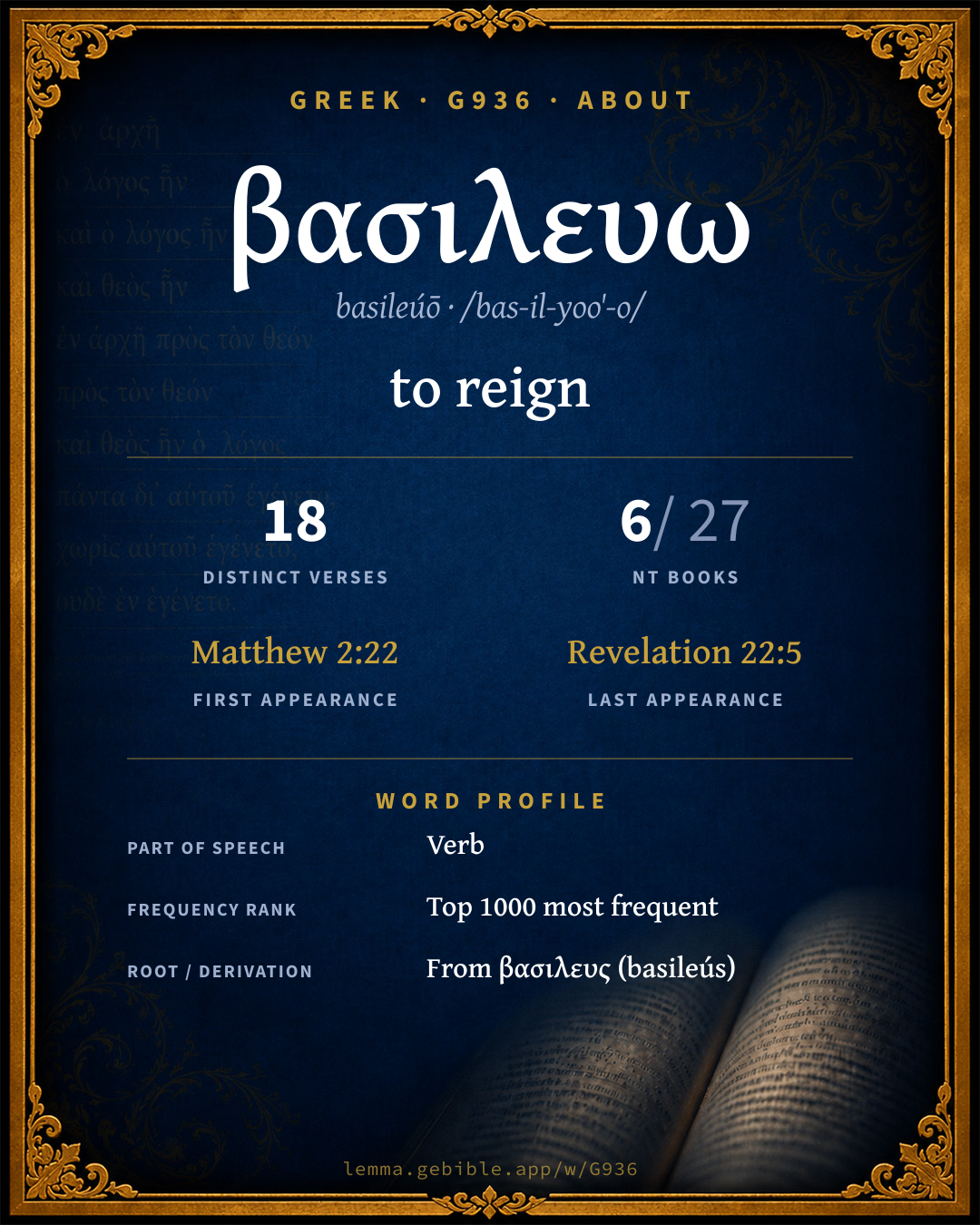
βασιλεύω
to reign
‘to reign’ is one of 2 main senses fuller range ↓
Full lexicon entry — Thayer's Greek Lexicon
From Thayer's Greek Lexicon
Where this word appears
See every Aorist-tense verb in the Greek New Testament →
Grammar key — what these labels mean
Part of speech
- Verb
- An action or state-of-being word.
Tense
- Aorist
- Action viewed as a simple whole, without regard to duration — often past (perfective aspect).
- Future
- Action expected in future time.
- Present
- Ongoing or general action in present time (imperfective aspect).
Voice
- Active
- The subject performs the action.
Mood
- Indicative
- States a fact or asks a factual question (the mood of reality).
- Infinitive
- A verbal noun (“to write”), unmarked for person or number.
- Subjunctive
- Expresses probability, purpose, or possibility (the mood of contingency).
- Imperative
- Expresses a command or request.
- Participle
- A verbal adjective (“writing,” “having written”).
Case
- Genitive
- The case of source, possession, or “of” — answers “whose / from what.”
Person
- 3rd person
- The one spoken about (“he / she / it / they”).
- 2nd person
- The one addressed (“you”).
Gender
- Masculine
- Grammatically masculine.
Number
- Singular
- One.
- Plural
- More than one.
Grammatical forms 12 distinct
- Verb, Aorist, Active, Indicative, 3rd person, Singular 4 times (19%)
- Verb, Future, Active, Indicative, 3rd person, Plural 4 times (19%)
- Verb, Aorist, Active, Indicative, 2nd person, Plural 2 times (10%)
- Verb, Aorist, Active, Infinitive 2 times (10%)
- Verb, Future, Active, Indicative, 3rd person, Singular 2 times (10%)
- Verb, Aorist, Active, Indicative, 2nd person, Singular 1 time (5%)
- Verb, Aorist, Active, Indicative, 3rd person, Plural 1 time (5%)
- Verb, Aorist, Active, Subjunctive, 3rd person, Singular 1 time (5%)
+4 more forms (4 occurrences)
Parsed forms decoded from the imported morphology (Robinson–Tischendorf, public domain), counted across 21 parsed occurrences — not distinct verses.
Every verse where G936 appears — 18 distinct verses across 6 books. Click any verse to open its interlinear word-by-word view. Verse text shown in the World English Bible for context — . Each verse’s Greek form is shown with its reference; the English is not keyword-highlighted, since the data carries no word-level English alignment. Use “Compare translations” on any verse to read it across multiple English versions. This concordance covers the Greek New Testament; Septuagint (Greek Old Testament) occurrences of this word are not indexed here.
Matthew 1 verse
Luke 3 verses
- Luke 1:33 βασιλεύσει fut act ind 3sg and he will reign over the house of Jacob forever. There will be no end to his Kingdom."
- Luke 19:14 βασιλεῦσαι aor act inf But his citizens hated him, and sent an envoy after him, saying, 'We don't want this man to reign over us.'
- Luke 19:27 βασιλεῦσαι aor act inf But bring those enemies of mine who didn't want me to reign over them here, and kill them before me.'"
Romans 4 verses
- Romans 5:14 ἐβασίλευσεν aor act ind 3sg Nevertheless death reigned from Adam until Moses, even over those whose sins weren't like Adam's disobedience, who is a foreshadowing of him who was to come.
- Romans 5:17 ἐβασίλευσεν βασιλεύσουσιν aor act ind 3sg fut act ind 3pl For if by the trespass of the one, death reigned through the one; so much more will those who receive the abundance of grace and of the gift of righteousness reign in life through the one, Jesus Christ.
- Romans 5:21 ἐβασίλευσεν βασιλεύσῃ aor act ind 3sg aor act subj 3sg that as sin reigned in death, even so might grace reign through righteousness to eternal life through Jesus Christ our Lord.
- Romans 6:12 βασιλευέτω pres act impv 3sg Therefore don't let sin reign in your mortal body, that you should obey it in its lusts.
1 Corinthians 2 verses
- 1 Corinthians 4:8 ἐβασιλεύσατε ἐβασιλεύσατε aor act ind 2pl aor act ind 2pl You are already filled. You have already become rich. You have come to reign without us. Yes, and I wish that you did reign, that we also might reign with you.
- 1 Corinthians 15:25 βασιλεύειν pres act inf For he must reign until he has put all his enemies under his feet.
1 Timothy 1 verse
Revelation 7 verses
- Revelation 5:10 βασιλεύσουσιν fut act ind 3pl And made them kings and priests to our God, And they reign on earth."
- Revelation 11:15 βασιλεύσει fut act ind 3sg The seventh angel sounded, and great voices in heaven followed, saying, "The kingdom of the world has become the Kingdom of our Lord, and of his Christ. He will reign forever and ever!"
- Revelation 11:17 ἐβασίλευσας aor act ind 2sg saying: "We give you thanks, Lord God, the Almighty, the one who is and who was; because you have taken your great power, and reigned.
- Revelation 19:6 ἐβασίλευσεν aor act ind 3sg I heard something like the voice of a great multitude, and like the voice of many waters, and like the voice of mighty thunders, saying, "Hallelujah! For the Lord our God, the Almighty, reigns!
- Revelation 20:4 ἐβασίλευσαν aor act ind 3pl I saw thrones, and they sat on them, and judgment was given to them. I saw the souls of those who had been beheaded for the testimony of Jesus, and for the word of God, and such as didn't worship the beast nor his image, and didn't receive the mark on their forehead and on their hand. They lived, and reigned with Christ for the thousand years.
- Revelation 20:6 βασιλεύσουσιν fut act ind 3pl Blessed and holy is he who has part in the first resurrection. Over these, the second death has no power, but they will be priests of God and of Christ, and will reign with him one thousand years.
- Revelation 22:5 βασιλεύσουσιν fut act ind 3pl There will be no night, and they need no lamp light; for the Lord God will illuminate them. They will reign forever and ever.
About this entry
At a glance — auto-summarized from this page’s data, not written by a person. Every figure links to its source below. This summary describes the numbers; it doesn’t interpret them.
βασιλευω (basileúō) is a Greek verb most often rendered “to reign.” Scripture first uses it in Matthew 2:22. It turns up in 18 verses across 6 books, an uncommon footprint. It concentrates in Revelation, which alone accounts for 39% of its uses. Ranging over 2 senses, it is not a single-sense word. For the data behind this summary, explore the sense tree and the renderings breakdown below.
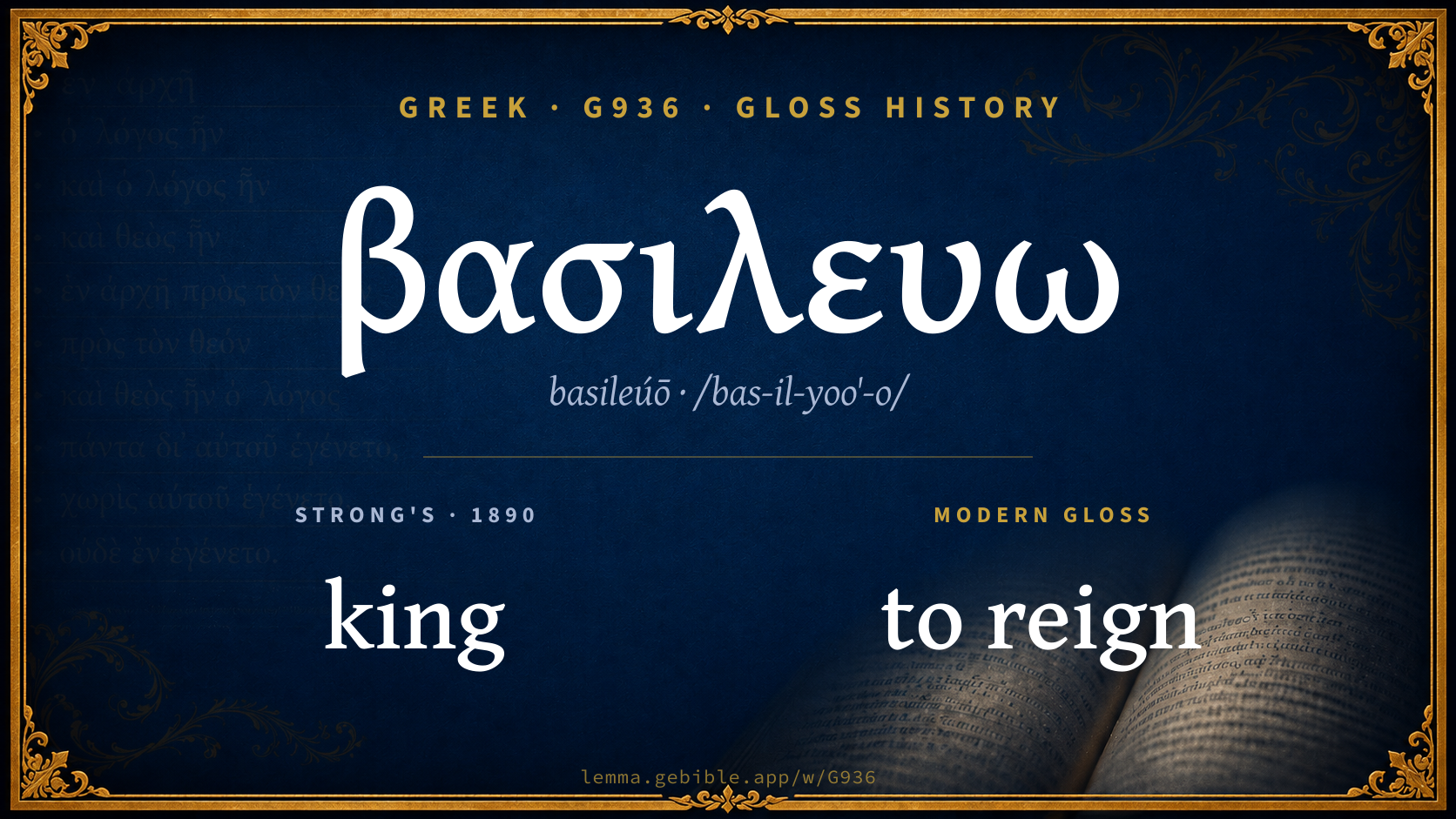
Gloss history
Strong's 1890 vs modern scholarship
About this word
Strong's G936 catalogs a Greek word from the Greek New Testament.
These counts are not copied from any lexicon or concordance. They are computed here, from the morphology-tagged Greek New Testament. What Lemma adds →
- 18
- distinct verses
- The word appears in 18 distinct verses.
- 6 / 27
- NT books
- The word appears in 6 of 27 New Testament books.
- #607
- by frequency
- Top 1000 most frequent Greek words (rank 607 of 5,347 Greek words by occurrence).
View all 18 occurrences in the concordance →
Most concentrated in
- Revelation 7 verses 39%
- Romans 4 verses 22%
- Luke 3 verses 17%
By section of the New Testament
By traditional corpus
Conventional, traditional groupings — biblical authorship is debated, so this is a traditional corpus grouping, not an authorship claim. Some books belong to more than one corpus (Luke is in both the Gospels and the Lukan corpus, and so on), so these shares overlap and need not total 100%. Each figure is a share of the word’s 18 distinct verses.
- Johannine 7 verses · 39%
- Pauline corpus 7 verses · 39%
- Revelation 7 verses · 39%
- Gospels 4 verses · 22%
- Lukan (Luke–Acts) 3 verses · 17%
How translations render this word
Counts come from each version’s own published word-to-Strong’s tagging or interlinear alignment — an approximate guide to how each version renders this word, not a word-level alignment the data otherwise carries. Because each total is that version’s own tagged count, the per-version totals vary from one another and need not match the appearance or distinct-verse counts above. These counts may also differ from a printed concordance because Lemma counts each distinctly tagged rendering and does not collapse phrase taggings into a single head-word total. This is a fixed set of word-tagged versions (KJV, ASV, BSB, ULT) and does not change with the reading translation you choose elsewhere. Each version’s license is shown beside its name below (and on Sources).
- King James Version: Reign 3×, Reigned 3×, He shall reign 2×
- American Standard Version: Reign 4×, Reigned 4×, He shall reign 2×
- Berean Standard Bible: Reigned 4×, He will reign 2×, Reign 2×
- unfoldingWord Literal Text: Rule 3×, Ruled 3×, They will reign 3×
King James Version Public Domain
Renders G936 across 23 tagged occurrences — most commonly:
Plus 13 renderings that appear only once — usually multi-word phrases or single function words the recovered tagging swept in, not distinct renderings.
American Standard Version Public Domain
Renders G936 across 23 tagged occurrences — most commonly:
Plus 13 renderings that appear only once — usually multi-word phrases or single function words the recovered tagging swept in, not distinct renderings.
Berean Standard Bible Public Domain
Renders G936 across 21 tagged occurrences — most commonly:
Plus 9 renderings that appear only once — usually multi-word phrases or single function words the recovered tagging swept in, not distinct renderings.
unfoldingWord Literal Text CC BY-SA 4.0
Renders G936 across 25 tagged occurrences — most commonly:
Plus 12 renderings that appear only once — usually multi-word phrases or single function words the recovered tagging swept in, not distinct renderings.
Senses in Thayer's
The 2 senses Thayer's distinguishes for this word, in lexicon order (not ranked by frequency or importance). The full entry — with sub-senses — is in the Lexicon Entry tab.
- to be king, to exercise kingly power, to reign
- metaph. to exercise the highest influence, to control
Word origin
Derived from βασιλευς (basileús) (G935) — king.
From G935 ; to rule (literally or figuratively): - king reign.
— Strong’s Exhaustive Concordance (1890), public domain.
Forms in the corpus
The 12 distinct written forms G936 takes in the Greek New Testament, most frequent first — each parse links to that tense’s occurrences in the concordance.
Same root — word family
Other Thayer's entries built from the same root as G936, grouped by Strong’s listed origin. These share a root / origin per the lexicon — not necessarily a shared meaning. Each links to that word’s own entry.
Derives from
Shares the same root
Derived from this word
Compare all same-root words → Showing 4 of 6 — not the complete family. They share a root, not necessarily a meaning.
Septuagint usage
The same Greek word βασιλευω appears 343 times in the Greek Old Testament (Septuagint), across 277 verses in 21 books.
- 343
- LXX occurrences
- Tagged occurrences of this Greek word in the Septuagint.
- 277
- verses
- Distinct Septuagint verses containing this word.
- 21 / 39
- OT books
- The word appears in 21 of the 39 Old Testament books.
Sample Septuagint occurrences
- Genesis 36:31 βασιλεύω
- Exodus 15:18 βασιλεύω
- Joshua 13:10 βασιλεύω
- Judges 4:2 βασιλεύω
- 1 Samuel 8:7 βασιλεύω
- 2 Samuel 2:4 βασιλεύω
- 1 Kings 1:5 βασιλεύω
- 2 Kings 1:18 βασιλεύω
- 1 Chronicles 1:32 βασιλεύω
- 2 Chronicles 1:8 βασιλεύω
- Esther 1:3 βασιλεύω
- Job 34:30 βασιλεύω
Septuagint occurrences (same lexeme)
Every verse where the same Strong’s number (G936) appears in the Greek Septuagint — showing the first 50 of 277. Verse text shown in the World English Bible for context; the Greek form is the matched word — the English is not keyword-highlighted.
- Genesis 36:31 βασιλεύω These are the kings who reigned in the land of Edom, before any king reigned over the children of Israel.
- Genesis 36:32 βασιλεύω Bela, the son of Beor, reigned in Edom. The name of his city was Dinhabah.
- Genesis 36:33 βασιλεύω Bela died, and Jobab, the son of Zerah of Bozrah, reigned in his place.
- Genesis 36:34 βασιλεύω Jobab died, and Husham of the land of the Temanites reigned in his place.
- Genesis 36:35 βασιλεύω Husham died, and Hadad, the son of Bedad, who struck Midian in the field of Moab, reigned in his place. The name of his city was Avith.
- Genesis 36:36 βασιλεύω Hadad died, and Samlah of Masrekah reigned in his place.
- Genesis 36:37 βασιλεύω Samlah died, and Shaul of Rehoboth by the river, reigned in his place.
- Genesis 36:38 βασιλεύω Shaul died, and Baal Hanan, the son of Achbor reigned in his place.
- Genesis 36:39 βασιλεύω Baal Hanan the son of Achbor died, and Hadar reigned in his place. The name of his city was Pau. His wife's name was Mehetabel, the daughter of Matred, the daughter of Me-zahab.
- Genesis 37:8 βασιλεύω His brothers said to him, "Will you indeed reign over us? Or will you indeed have dominion over us?" They hated him all the more for his dreams and for his words.
- Exodus 15:18 βασιλεύω Yahweh shall reign forever and ever."
- Joshua 13:10 βασιλεύω and all the cities of Sihon king of the Amorites, who reigned in Heshbon, to the border of the children of Ammon;
- Joshua 13:12 βασιλεύω all the kingdom of Og in Bashan, who reigned in Ashtaroth and in Edrei (the same was left of the remnant of the Rephaim); for these did Moses strike, and drove them out.
- Judges 4:2 βασιλεύω Yahweh sold them into the hand of Jabin king of Canaan, who reigned in Hazor; the captain of whose host was Sisera, who lived in Harosheth of the Gentiles.
- Judges 9:6 βασιλεύω All the men of Shechem assembled themselves together, and all the house of Millo, and went and made Abimelech king, by the oak of the pillar that was in Shechem.
- Judges 9:8 βασιλεύω The trees went forth on a time to anoint a king over them; and they said to the olive tree, Reign you over us.
- Judges 9:10 βασιλεύω The trees said to the fig tree, Come you, and reign over us.
- Judges 9:12 βασιλεύω The trees said to the vine, Come you, and reign over us.
- Judges 9:14 βασιλεύω Then said all the trees to the bramble, Come you, and reign over us.
- Judges 9:15 βασιλεύω The bramble said to the trees, If in truth you anoint me king over you, then come and take refuge in my shade; and if not, let fire come out of the bramble, and devour the cedars of Lebanon.
- Judges 9:16 βασιλεύω Now therefore, if you have dealt truly and righteously, in that you have made Abimelech king, and if you have dealt well with Jerubbaal and his house, and have done to him according to the deserving of his hands
- Judges 9:18 βασιλεύω and you are risen up against my father's house this day, and have slain his sons, seventy persons, on one stone, and have made Abimelech, the son of his maid-servant, king over the men of Shechem, because he is your brother);
- 1 Samuel 8:7 βασιλεύω Yahweh said to Samuel, Listen to the voice of the people in all that they tell you; for they have not rejected you, but they have rejected me, that I should not be king over them.
- 1 Samuel 8:9 βασιλεύω Now therefore listen to their voice: however you shall protest solemnly to them, and shall show them the manner of the king who shall reign over them.
- 1 Samuel 8:11 βασιλεύω He said, This will be the manner of the king who shall reign over you: he will take your sons, and appoint them to him, for his chariots, and to be his horsemen; and they shall run before his chariots;
- 1 Samuel 8:22 βασιλεύω Yahweh said to Samuel, Listen to their voice, and make them a king. Samuel said to the men of Israel, Go you every man to his city.
- 1 Samuel 11:12 βασιλεύω The people said to Samuel, Who is he who said, Shall Saul reign over us? bring the men, that we may put them to death.
- 1 Samuel 12:1 βασιλεύω Samuel said to all Israel, Behold, I have listened to your voice in all that you said to me, and have made a king over you.
- 1 Samuel 12:12 βασιλεύω When you saw that Nahash the king of the children of Ammon came against you, you said to me, No, but a king shall reign over us; when Yahweh your God was your king.
- 1 Samuel 12:14 βασιλεύω If you will fear Yahweh, and serve him, and listen to his voice, and not rebel against the commandment of Yahweh, and both you and also the king who reigns over you are followers of Yahweh your God, [well]:
- 1 Samuel 15:11 βασιλεύω It repents me that I have set up Saul to be king; for he is turned back from following me, and has not performed my commandments. Samuel was angry; and he cried to Yahweh all night.
- 1 Samuel 15:35 βασιλεύω Samuel came no more to see Saul until the day of his death; for Samuel mourned for Saul: and Yahweh repented that he had made Saul king over Israel.
- 1 Samuel 16:1 βασιλεύω Yahweh said to Samuel, How long will you mourn for Saul, seeing I have rejected him from being king over Israel? fill your horn with oil, and go: I will send you to Jesse the Bethlehemite; for I have provided me a king among his sons.
- 1 Samuel 23:17 βασιλεύω He said to him, Don't be afraid; for the hand of Saul my father shall not find you; and you shall be king over Israel, and I shall be next to you; and that also Saul my father knows.
- 1 Samuel 24:21 βασιλεύω Swear now therefore to me by Yahweh, that you will not cut off my seed after me, and that you will not destroy my name out of my father's house.
- 1 Samuel 27:5 βασιλεύω David said to Achish, If now I have found favor in your eyes, let them give me a place in one of the cities in the country, that I may dwell there: for why should your servant dwell in the royal city with you?
- 2 Samuel 2:4 βασιλεύω The men of Judah came, and there they anointed David king over the house of Judah. They told David, saying, The men of Jabesh Gilead were those who buried Saul.
- 2 Samuel 2:9 βασιλεύω and he made him king over Gilead, and over the Ashurites, and over Jezreel, and over Ephraim, and over Benjamin, and over all Israel.
- 2 Samuel 2:10 βασιλεύω Ish-bosheth, Saul's son, was forty years old when he began to reign over Israel, and he reigned two years. But the house of Judah followed David.
- 2 Samuel 2:11 βασιλεύω The time that David was king in Hebron over the house of Judah was seven years and six months.
- 2 Samuel 3:17 βασιλεύω Abner had communication with the elders of Israel, saying, In times past you sought for David to be king over you:
- 2 Samuel 3:21 βασιλεύω Abner said to David, I will arise and go, and will gather all Israel to my lord the king, that they may make a covenant with you, and that you may reign over all that your soul desires. David sent Abner away; and he went in peace.
- 2 Samuel 5:4 βασιλεύω David was thirty years old when he began to reign, and he reigned forty years.
- 2 Samuel 5:5 βασιλεύω In Hebron he reigned over Judah seven years and six months; and in Jerusalem he reigned thirty-three years over all Israel and Judah.
- 2 Samuel 8:15 βασιλεύω David reigned over all Israel; and David executed justice and righteousness to all his people.
- 2 Samuel 10:1 βασιλεύω It happened after this, that the king of the children of Ammon died, and Hanun his son reigned in his place.
- 2 Samuel 15:10 βασιλεύω But Absalom sent spies throughout all the tribes of Israel, saying, As soon as you hear the sound of the trumpet, then you shall say, Absalom is king in Hebron.
- 2 Samuel 16:8 βασιλεύω Yahweh has returned on you all the blood of the house of Saul, in whose place you have reigned; and Yahweh has delivered the kingdom into the hand of Absalom your son; and, behold, you are [taken] in your own mischief, because you are a man of blood.
- 2 Samuel 19:23 βασιλεύω The king said to Shimei, You shall not die. The king swore to him.
- 1 Kings 1:5 βασιλεύω Then Adonijah the son of Haggith exalted himself, saying, I will be king: and he prepared him chariots and horsemen, and fifty men to run before him.
These are occurrences of the same Greek lexeme (G936) in the Septuagint — not a translation of any one Hebrew word. The store carries no word-level Hebrew↔Greek alignment, so no Hebrew original is asserted here. Counts come from the recovered LXX Strong's tagging — high-frequency vocabulary is well covered, while rare or late forms may be untagged — so they reflect tagged occurrences and may slightly undercount.