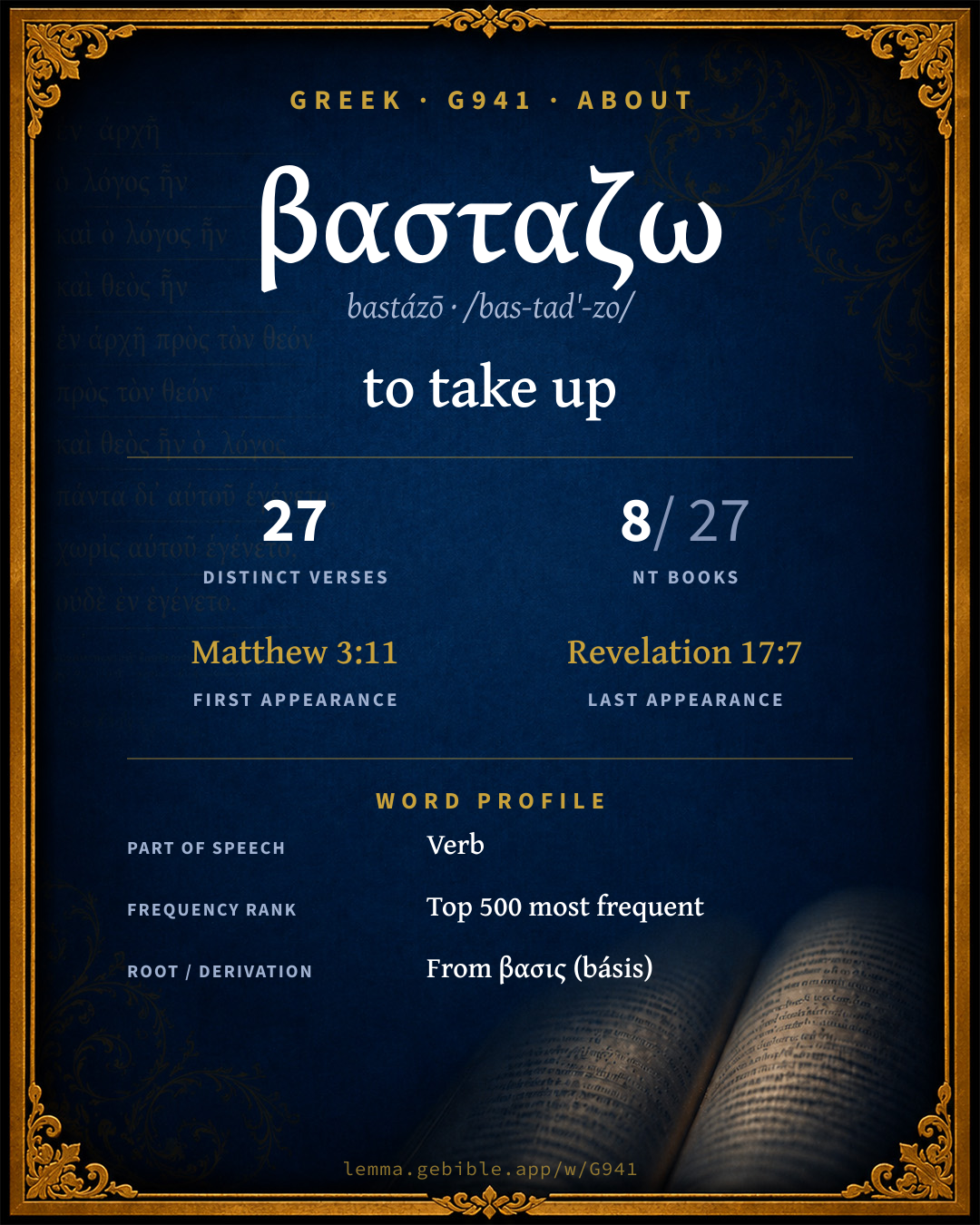
βαστάζω
to take up
‘to take up’ is one of 5 main senses fuller range ↓
Full lexicon entry — Thayer's Greek Lexicon
From Thayer's Greek Lexicon
Where this word appears
See every Present-tense verb in the Greek New Testament →
Grammar key — what these labels mean
Part of speech
- Verb
- An action or state-of-being word.
Tense
- Aorist
- Action viewed as a simple whole, without regard to duration — often past (perfective aspect).
- Present
- Ongoing or general action in present time (imperfective aspect).
- Future
- Action expected in future time.
- Imperfect
- Continuous or repeated action in past time (“was writing”).
Voice
- Active
- The subject performs the action.
- Passive
- The subject receives the action.
Mood
- Infinitive
- A verbal noun (“to write”), unmarked for person or number.
- Participle
- A verbal adjective (“writing,” “having written”).
- Indicative
- States a fact or asks a factual question (the mood of reality).
- Imperative
- Expresses a command or request.
Case
- Nominative
- The case of the subject (and the predicate nominative).
- Dative
- The case of the indirect object, means, or location — “to / for / with / in.”
- Genitive
- The case of source, possession, or “of” — answers “whose / from what.”
Person
- 2nd person
- The one addressed (“you”).
- 3rd person
- The one spoken about (“he / she / it / they”).
- 1st person
- The speaker (“I / we”).
Gender
- Masculine
- Grammatically masculine.
- Feminine
- Grammatically feminine.
- Neuter
- Grammatically neuter.
Number
- Singular
- One.
- Plural
- More than one.
Grammatical forms 18 distinct
- Verb, Aorist, Active, Infinitive 4 times (15%)
- Verb, Present, Active, Participle, Nominative, Singular, Masculine 3 times (11%)
- Verb, Aorist, Active, Indicative, 2nd person, Singular 2 times (7%)
- Verb, Future, Active, Indicative, 3rd person, Singular 2 times (7%)
- Verb, Present, Active, Imperative, 2nd person, Plural 2 times (7%)
- Verb, Present, Active, Infinitive 2 times (7%)
- Verb, Aorist, Active, Indicative, 3rd person, Plural 1 time (4%)
- Verb, Aorist, Active, Indicative, 3rd person, Singular 1 time (4%)
+10 more forms (10 occurrences)
Parsed forms decoded from the imported morphology (Robinson–Tischendorf, public domain), counted across 27 parsed occurrences — not distinct verses.
Every verse where G941 appears — 27 distinct verses across 8 books. Click any verse to open its interlinear word-by-word view. Verse text shown in the World English Bible for context — . Each verse’s Greek form is shown with its reference; the English is not keyword-highlighted, since the data carries no word-level English alignment. Use “Compare translations” on any verse to read it across multiple English versions. This concordance covers the Greek New Testament; Septuagint (Greek Old Testament) occurrences of this word are not indexed here.
Matthew 3 verses
- Matthew 3:11 βαστάσαι aor act inf I indeed baptize you in water for repentance, but he who comes after me is mightier than I, whose shoes I am not worthy to carry. He will baptize you in the Holy Spirit.
- Matthew 8:17 ἐβάστασεν aor act ind 3sg that it might be fulfilled which was spoken through Isaiah the prophet, saying: "He took our infirmities, and bore our diseases."
- Matthew 20:12 βαστάσασι aor act ptcp dat pl masc saying, 'These last have spent one hour, and you have made them equal to us, who have borne the burden of the day and the scorching heat!'
Mark 1 verse
Luke 5 verses
- Luke 7:14 βαστάζοντες pres act ptcp nom pl masc He came near and touched the coffin, and the bearers stood still. He said, "Young man, I tell you, arise!"
- Luke 10:4 βαστάζετε pres act impv 2pl Carry no purse, nor wallet, nor sandals. Greet no one on the way.
- Luke 11:27 βαστάσασά aor act ptcp nom sg fem It came to pass, as he said these things, a certain woman out of the multitude lifted up her voice, and said to him, "Blessed is the womb that bore you, and the breasts which nursed you!"
- Luke 14:27 βαστάζει pres act ind 3sg Whoever doesn't bear his own cross, and come after me, can't be my disciple.
- Luke 22:10 βαστάζων pres act ptcp nom sg masc He said to them, "Behold, when you have entered into the city, a man carrying a pitcher of water will meet you. Follow him into the house which he enters.
John 5 verses
- John 10:31 Ἐβάστασαν aor act ind 3pl Therefore Jews took up stones again to stone him.
- John 12:6 ἐβάσταζεν impf act ind 3sg Now he said this, not because he cared for the poor, but because he was a thief, and having the money box, used to steal what was put into it.
- John 16:12 βαστάζειν pres act inf "I have yet many things to tell you, but you can't bear them now.
- John 19:17 βαστάζων pres act ptcp nom sg masc He went out, bearing his cross, to the place called "The Place of a Skull," which is called in Hebrew, "Golgotha,"
- John 20:15 ἐβάστασας aor act ind 2sg Jesus said to her, "Woman, why are you weeping? Who are you looking for?" She, supposing him to be the gardener, said to him, "Sir, if you have carried him away, tell me where you have laid him, and I will take him away."
Acts 4 verses
- Acts 3:2 ἐβαστάζετο impf pass ind 3sg A certain man who was lame from his mother's womb was being carried, whom they laid daily at the door of the temple which is called Beautiful, to ask gifts for the needy of those who entered into the temple.
- Acts 9:15 βαστάσαι aor act inf But the Lord said to him, "Go your way, for he is my chosen vessel to bear my name before the nations and kings, and the children of Israel.
- Acts 15:10 βαστάσαι aor act inf Now therefore why do you tempt God, that you should put a yoke on the neck of the disciples which neither our fathers nor we were able to bear?
- Acts 21:35 βαστάζεσθαι pres pass inf When he came to the stairs, it happened that he was carried by the soldiers because of the violence of the crowd;
Romans 2 verses
Galatians 4 verses
- Galatians 5:10 βαστάσει fut act ind 3sg I have confidence toward you in the Lord that you will think no other way. But he who troubles you will bear his judgment, whoever he is.
- Galatians 6:2 βαστάζετε pres act impv 2pl Bear one another's burdens, and so fulfill the law of Christ.
- Galatians 6:5 βαστάσει fut act ind 3sg For each man will bear his own burden.
- Galatians 6:17 βαστάζω pres act ind 1sg From now on, let no one cause me any trouble, for I bear the marks of the Lord Jesus branded on my body.
Revelation 3 verses
- Revelation 2:2 βαστάσαι aor act inf "I know your works, and your toil and perseverance, and that you can't tolerate evil men, and have tested those who call themselves apostles, and they are not, and found them false.
- Revelation 2:3 ἐβάστασας aor act ind 2sg You have perseverance and have endured for my name's sake, and have not grown weary.
- Revelation 17:7 βαστάζοντος pres act ptcp gen sg neut The angel said to me, "Why do you wonder? I will tell you the mystery of the woman, and of the beast that carries her, which has the seven heads and the ten horns.
About this entry
At a glance — auto-summarized from this page’s data, not written by a person. Every figure links to its source below. This summary describes the numbers; it doesn’t interpret them.
At its core, βασταζω (bastázō) means “to take up.” The King James Version usually renders it “bear,” while modern versions prefer “carry” (Berean Standard Bible) — see the renderings breakdown. With 27 verses in 8 books, it is a moderately common word in the Greek New Testament. Scripture first uses it in Matthew 3:11. Ranging over 5 senses, it is not a single-sense word. Each statement above links to its evidence; the full detail follows below.
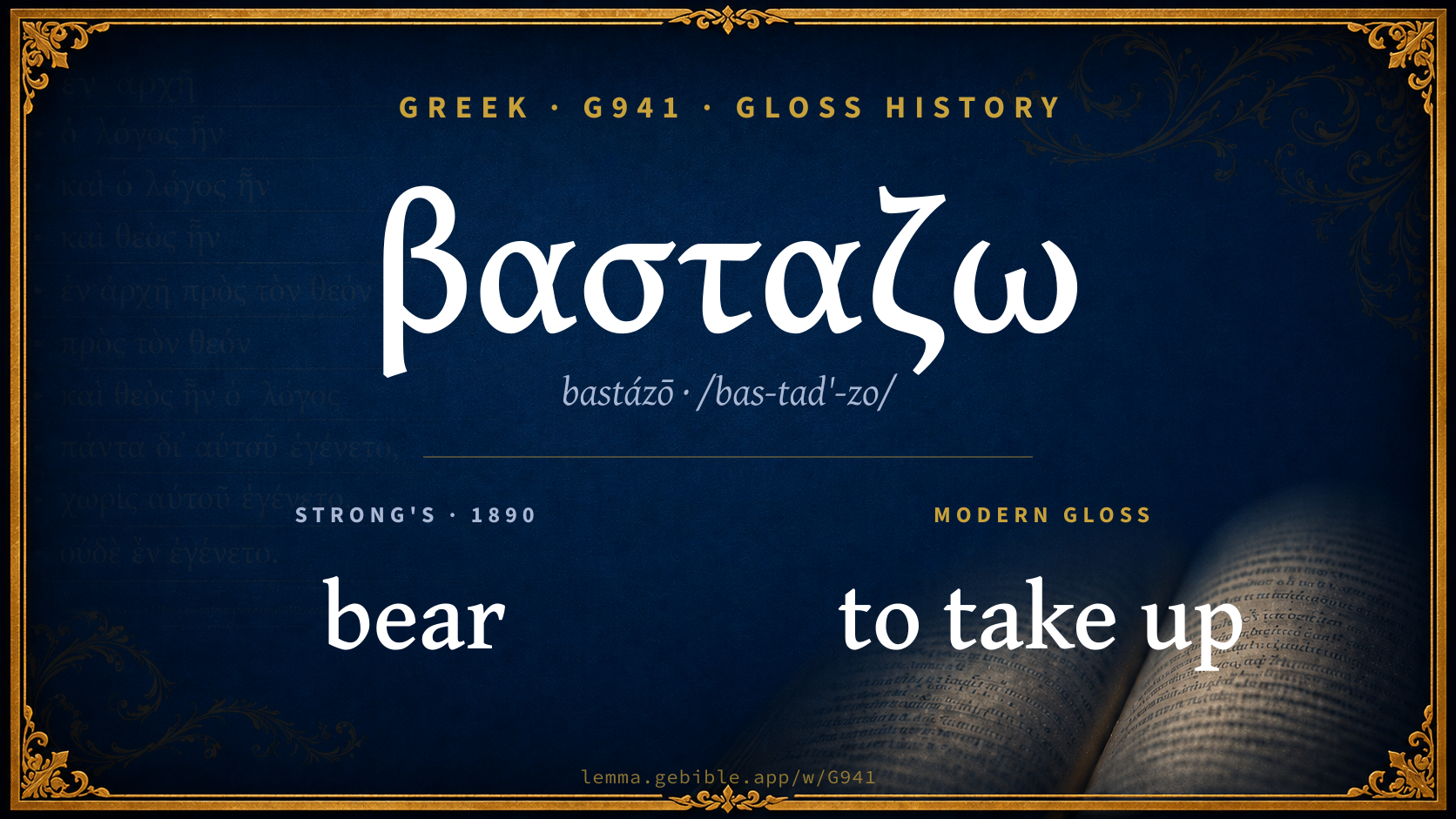
Gloss history
Strong's 1890 vs modern scholarship
About this word
Strong's G941 catalogs a Greek word from the Greek New Testament.
These counts are not copied from any lexicon or concordance. They are computed here, from the morphology-tagged Greek New Testament. What Lemma adds →
- 27
- distinct verses
- The word appears in 27 distinct verses.
- 8 / 27
- NT books
- The word appears in 8 of 27 New Testament books.
- #500
- by frequency
- Top 500 most frequent Greek words (rank 500 of 5,347 Greek words by occurrence).
View all 27 occurrences in the concordance →
By section of the New Testament
By traditional corpus
Conventional, traditional groupings — biblical authorship is debated, so this is a traditional corpus grouping, not an authorship claim. Some books belong to more than one corpus (Luke is in both the Gospels and the Lukan corpus, and so on), so these shares overlap and need not total 100%. Each figure is a share of the word’s 27 distinct verses.
- Gospels 14 verses · 52%
- Lukan (Luke–Acts) 9 verses · 33%
- Johannine 8 verses · 30%
- Pauline corpus 6 verses · 22%
- Revelation 3 verses · 11%
How translations render this word
Counts come from each version’s own published word-to-Strong’s tagging or interlinear alignment — an approximate guide to how each version renders this word, not a word-level alignment the data otherwise carries. Because each total is that version’s own tagged count, the per-version totals vary from one another and need not match the appearance or distinct-verse counts above. These counts may also differ from a printed concordance because Lemma counts each distinctly tagged rendering and does not collapse phrase taggings into a single head-word total. This is a fixed set of word-tagged versions (KJV, ASV, BSB, ULT) and does not change with the reading translation you choose elsewhere. Each version’s license is shown beside its name below (and on Sources).
- King James Version: Bear 7×, Bare 3×, Bearing 2×
- American Standard Version: Bear 8×, Bearing 3×, Bare 2×
- Berean Standard Bible: Carry 5×, Bear 3×, Carrying 3×
- unfoldingWord Literal Text: Carry 5×, Carrying 4×, Bear 3×
King James Version Public Domain
Renders G941 across 29 tagged occurrences — most commonly:
Plus 13 renderings that appear only once — usually multi-word phrases or single function words the recovered tagging swept in, not distinct renderings.
American Standard Version Public Domain
Renders G941 across 28 tagged occurrences — most commonly:
Plus 13 renderings that appear only once — usually multi-word phrases or single function words the recovered tagging swept in, not distinct renderings.
Berean Standard Bible Public Domain
Renders G941 across 27 tagged occurrences — most commonly:
Plus 16 renderings that appear only once — usually multi-word phrases or single function words the recovered tagging swept in, not distinct renderings.
unfoldingWord Literal Text CC BY-SA 4.0
Renders G941 across 33 tagged occurrences — most commonly:
Plus 17 renderings that appear only once — usually multi-word phrases or single function words the recovered tagging swept in, not distinct renderings.
Senses in Thayer's
The 5 senses Thayer's distinguishes for this word, in lexicon order (not ranked by frequency or importance). The full entry — with sub-senses — is in the Lexicon Entry tab.
- to take up with the hands
- to take up in order to carry or bear, to put upon one's self (something) to be carried
- to carry on one's person
- to sustain, i.e. uphold, support
- to bear away, carry off
Word origin
Derived from βασις (básis) (G939) — foot.
Perhaps remotely derived from the base of G939 (through the idea of removal ); to lift literally or figuratively ( endure declare sustain receive etc.): - bear carry take up.
— Strong’s Exhaustive Concordance (1890), public domain.
Forms in the corpus
The 18 distinct written forms G941 takes in the Greek New Testament, most frequent first — each parse links to that tense’s occurrences in the concordance.
Same root — word family
Other Thayer's entries built from the same root as G941, grouped by Strong’s listed origin. These share a root / origin per the lexicon — not necessarily a shared meaning. Each links to that word’s own entry.
Derives from
Shares the same root
- βαθυς bathýs G901 deep
- βαΐον baḯon G902 palm branch
- βαρος báros G922 heaviness
- βασανος básanos G931 touchstone
- βασιλευς basileús G935 king
- βεβαιος bébaios G949 firm
- βεβηλος bébēlos G952 profane
- βημα bēma G968 judgment seat
- βωμος bōmós G1041 elevated place
Compare all same-root words → Showing 4 of 11 — not the complete family. They share a root, not necessarily a meaning.
Septuagint usage
The same Greek word βασταζω appears 4 times in the Greek Old Testament (Septuagint), across 3 verses in 3 books.
- 4
- LXX occurrences
- Tagged occurrences of this Greek word in the Septuagint.
- 3
- verses
- Distinct Septuagint verses containing this word.
- 3 / 39
- OT books
- The word appears in 3 of the 39 Old Testament books.
Sample Septuagint occurrences
- Judges 16:30 βαστάζω
- Ruth 2:16 βαστάζω
- 2 Kings 18:14 βαστάζω
Septuagint occurrences (same lexeme)
Every verse where the same Strong’s number (G941) appears in the Greek Septuagint. Verse text shown in the World English Bible for context; the Greek form is the matched word — the English is not keyword-highlighted.
- Judges 16:30 βαστάζω Samson said, Let me die with the Philistines. He bowed himself with all his might; and the house fell on the lords, and on all the people who were therein. So the dead that he killed at his death were more than those who he killed in his life.
- Ruth 2:16 βαστάζω Also pull out some for her from the bundles, and leave it, and let her glean, and don't rebuke her.
- 2 Kings 18:14 βαστάζω Hezekiah king of Judah sent to the king of Assyria to Lachish, saying, I have offended; return from me: that which you put on me will I bear. The king of Assyria appointed to Hezekiah king of Judah three hundred talents of silver and thirty talents of gold.
These are occurrences of the same Greek lexeme (G941) in the Septuagint — not a translation of any one Hebrew word. The store carries no word-level Hebrew↔Greek alignment, so no Hebrew original is asserted here. Counts come from the recovered LXX Strong's tagging — high-frequency vocabulary is well covered, while rare or late forms may be untagged — so they reflect tagged occurrences and may slightly undercount.