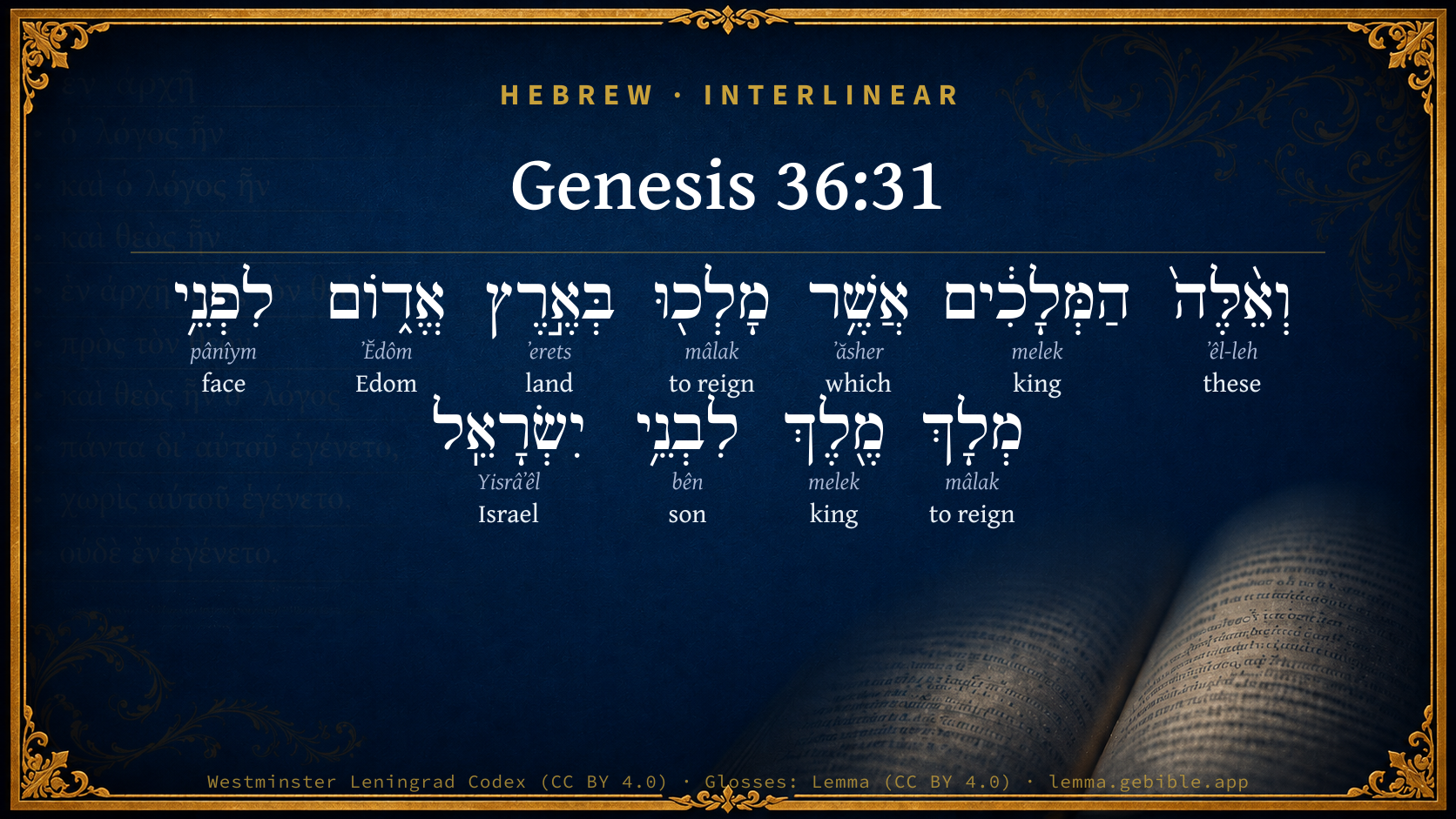
Genesis 36:31

Hebrew (Westminster Leningrad Codex) Genesis 36:31 appears in the Hebrew Old Testament. The text above is from the Westminster Leningrad Codex. Each word links to its Strong’s number, a concise gloss, and parsing drawn from the Open Scriptures Hebrew Bible morphology. Click any word for its full Brown-Driver-Briggs (BDB) entry.
Download image
Cite this verse

Genesis 36:31 (World English Bible). Public Domain. Lemma interlinear Bible study tool, https://lemma.gebible.app/v/genesis/36/31.

Show BibTeX & RIS
BibTeX
RIS
English Translation
These are the kings who reigned in the land of Edom, before any king reigned over the children of Israel.
World English Bible · Public Domain
Highlights Full analysis ↓
Download a study sheet

One document with this verse’s original text, its word-by-word gloss line, the meaning frame, cross-references with their text, attributed commentary, and full source and license credits — printable, and it pastes into notes with its structure intact.

This verse Autodidact and up

Study sheet (.html) Plain text (.txt)

A passage Seminary Student

Up to 50 verses in one chapter. A passage sheet keeps up to 6 commentary sources and 12 cross-references per verse, in the order this page ranks them, and says so on the sheet whenever that leaves anything out. Ask for a single verse and you get the Autodidact verse sheet above.

Everything on this page stays free to read, with no account — the sheet is a download of what is already on screen, not access to it.

Want to remove ads? Support Godless Engineer
Compare translations 3

The same verse in 3 English versions, stacked beneath the original-language interlinear above. Click any original word for its lexicon entry.

Each is an independent rendering of the whole verse — the interlinear is not word-aligned to these translations.

Highlighted words mark where these versions differ — a whole-verse word diff, not a word-by-word alignment.

  • World English Bible Public Domain
    These are the kings who reigned in the land of Edom, before any king reigned over the children of Israel.
  • King James Version Public Domain
    And these are the kings that reigned in the land of Edom, before there reigned any king over the children of Israel.
  • unfoldingWord Literal Text CC BY-SA 4.0
    And these the kings who reigned in the land of Edom before a king reigned for the sons of Israel.

unfoldingWord Literal Text — © unfoldingWord, licensed CC BY-SA 4.0. Word-aligned USFM3 via Door43 (git.door43.org/unfoldingWord/en_ult).

Versions to compare (up to 4)

3 of 4 selected

Show all 18 translations

Every available English version of this verse, each an independent rendering of the whole verse.

  • World English Bible Public Domain
    These are the kings who reigned in the land of Edom, before any king reigned over the children of Israel.
  • Berean Standard Bible Public Domain
    These are the kings who reigned in the land of Edom before any king reigned over the Israelites:
  • Majority Standard Bible Public Domain
    These are the kings who reigned in the land of Edom before any king reigned over the Israelites:
  • King James Version Public Domain
    And these are the kings that reigned in the land of Edom, before there reigned any king over the children of Israel.
  • American Standard Version (1901) Public Domain
    And these are the kings that reigned in the land of Edom, before there reigned any king over the children of Israel.
  • Revised Version (1885) Public Domain
    And these are the kings that reigned in the land of Edom, before there reigned any king over the children of Israel.
  • Geneva Bible (1599) Public Domain
    And these are the Kings that reigned in the lande of Edom, before there reigned any King ouer the children of Israel.
  • Douay-Rheims (1899) Public Domain
    And the kings that ruled in the land of Edom, before the children of Israel had a king were these:
  • Young's Literal Translation Public Domain
    And these `are' the kings who have reigned in the land of Edom before the reigning of a king over the sons of Israel.
  • Literal Standard Version CC BY-SA 4.0
    And these [are] the kings who have reigned in the land of Edom before the reigning of a king over the sons of Israel.
  • Unlocked Literal Bible CC BY-SA 4.0
    These were the kings who reigned in the land of Edom before any king reigned over the Israelites:
  • unfoldingWord Literal Text CC BY-SA 4.0
    And these the kings who reigned in the land of Edom before a king reigned for the sons of Israel.
  • Darby Bible Public Domain
    And these are the kings that reigned in the land of Edom before there reigned a king over the children of Israel.
  • World Messianic Bible Public Domain
    These are the kings who reigned in the land of Edom, before any king reigned over the children of Israel.
  • Webster's Bible Public Domain
    And these are the kings that reigned in the land of Edom, before there reigned any king over the children of Israel.
  • Free Bible Version CC BY-SA 4.0
    These were the kings who ruled in the land of Edom before there was any king who ruled over the Israelites:
  • Bible in Basic English Public Domain
    And these are the kings who were ruling in the land of Edom before there was any king over the children of Israel.
  • JPS Tanakh (1917) Public Domain
    And these are the kings that reigned in the land of Edom, before there reigned any king over the children of Israel.

Literal Standard Version (2020), Covenant Press — licensed CC BY-SA 4.0. Text via the HelloAO Bible API (eBible.org). Unlocked Literal Bible (unfoldingWord) — licensed CC BY-SA 4.0. Text via the HelloAO Bible API (eBible.org). unfoldingWord Literal Text — © unfoldingWord, licensed CC BY-SA 4.0. Word-aligned USFM3 via Door43 (git.door43.org/unfoldingWord/en_ult). Free Bible Version, Dr. Jonathan Gallagher — licensed CC BY-SA 4.0. Text via the HelloAO Bible API (eBible.org).

Word by word

More ways to search: Search by grammar → Find every occurrence → Compare this word →

Practice this passage: Drill this verse → Learn its vocabulary →

About this verse

These counts appear in no published source. They are computed here, from the morphology-tagged text and Lemma’s own curated glosses. What Lemma adds →

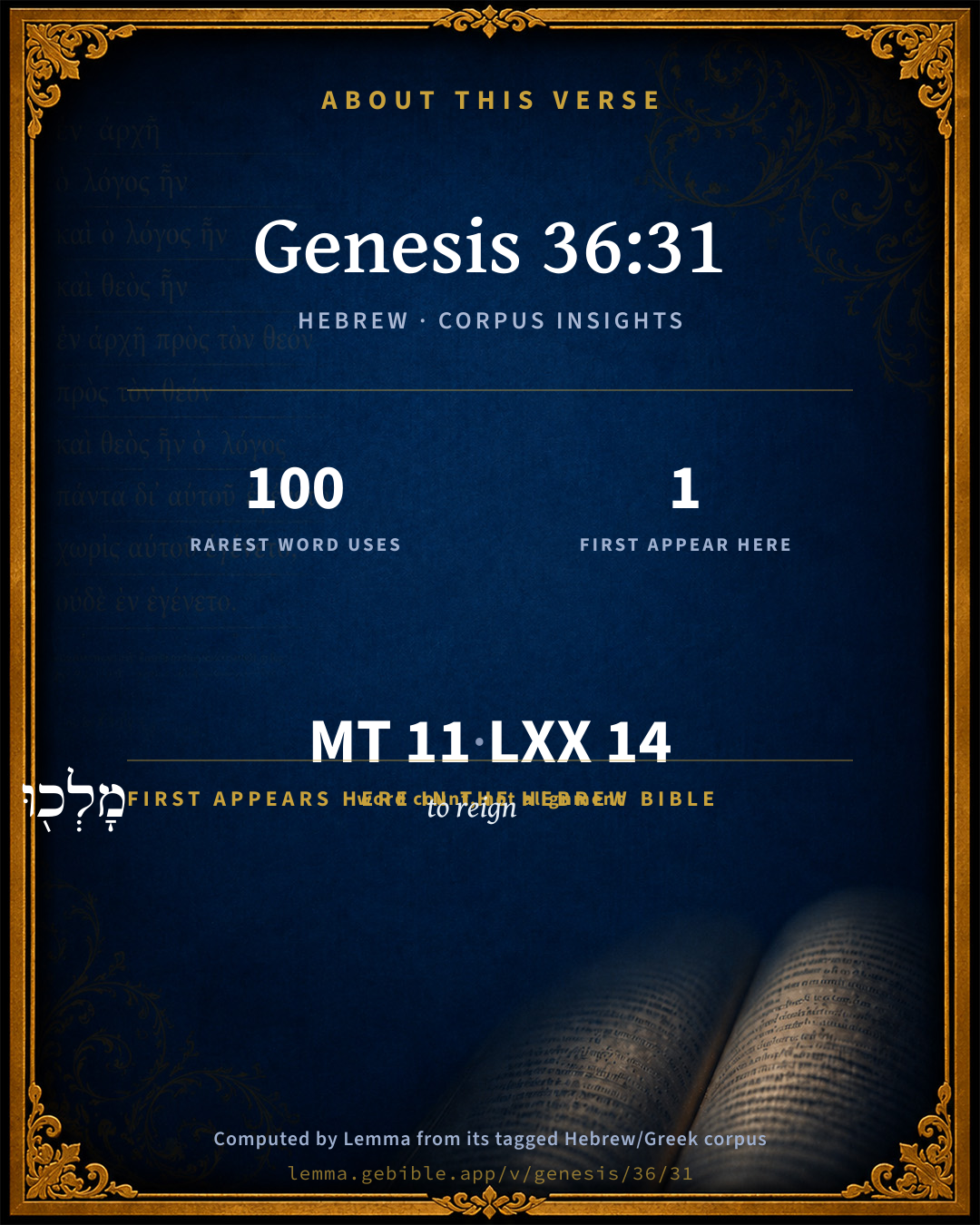
11
words
9
distinct lemmas
Pentateuch
section

First appearance in Scripture

This word makes its first canonical appearance in the Hebrew Bible here:

  • מָלְכ֖וּ to reign H4427

Grammatical profile

  • 2 verbs
  • 7 nouns
  • 1 pronoun
  • 1 particle

Verb forms

  • מָלְכ֖וּ Qal · Perfect
  • מְלָךְ Qal · Infinitive Construct

Repetition

Words recur within this verse — often emphatic in Hebrew:

  • הַמְּלָכִ֔ים king H4428 ×2
  • מָלְכ֖וּ to reign H4427 ×2

Hebrew & Septuagint length

In English translation the verse runs 20 words from the Hebrew and 14 from the Septuagint (LXX English) — the Septuagint runs noticeably shorter here. See the side-by-side →

A rough comparison of the two English renderings, which tokenize alike — not a word-level alignment.

Word counts can differ between the Hebrew and the Greek without any difference in meaning — e.g. the Hebrew direct-object marker אֵת has no separate Greek word, and Greek often adds the article ὁ.

In the original languages it is 11 Hebrew tokens and 14 Greek tokens — but the two are counted differently (Hebrew bundles its prefixes and suffixes into one token; the Greek is in lemma form), so that isn’t a like-for-like length.

Cross-references

9

Topical passages linked to Genesis 36:31 in the Treasury of Scripture Knowledge — connected by theme and wording, ordered by reader-vote popularity; previews shown in the World English Bible.

  • Genesis 17:6 I will make you exceeding fruitful, and I will make nations of you. Kings will come out of you.
  • Genesis 17:16 I will bless her, and moreover I will give you a son by her. Yes, I will bless her, and she will be a mother of nations. Kings of peoples will come from her."
  • 1 Chronicles 1:43–50 Now these are the kings who reigned in the land of Edom, before there resigned any king over the children of Israel: Bela the son of Beor; and the name of his city was Dinhabah.
  • Genesis 25:23 Yahweh said to her, Two nations are in your womb, Two peoples will be separated from your body. The one people will be stronger than the other people. The elder will serve the younger.
  • Numbers 20:14 Moses sent messengers from Kadesh to the king of Edom, Thus says your brother Israel, You know all the travail that has happened to us:
  • Numbers 24:17–18 I see him, but not now; I see him, but not near: There shall come forth a star out of Jacob, A scepter shall rise out of Israel, Shall strike through the corners of Moab, Break down all the sons of tumult.
  • Deuteronomy 17:14–20 When you are come to the land which Yahweh your God gives you, and shall possess it, and shall dwell therein, and shall say, I will set a king over me, like all the nations that are round about me;
  • Deuteronomy 33:5 He was king in Jeshurun, When the heads of the people were gathered, All the tribes of Israel together.
  • Deuteronomy 33:29 Happy are you, Israel: Who is like you, a people saved by Yahweh, The shield of your help, The sword of your excellency! Your enemies shall submit themselves to you; You shall tread on their high places.

Cross-references courtesy of OpenBible.info (CC BY 4.0).

Hebrew and Greek witnesses Masoretic Hebrew ↔ Greek Septuagint

The same verse in the two great witnesses to the Old Testament, shown verse-for-verse.

Here the Septuagint runs noticeably shorter than the Hebrew — LXX2012 (modern English Septuagint) 14 words vs World English Bible 20. A rough length comparison of the two English translations, not a word-level alignment — read both below.

These are two independent witnesses, not word-aligned to each other, and the Septuagint is shown in lemma (dictionary) form.

Hebrew Genesis 36:31 Masoretic · Westminster Leningrad Codex

וְאֵ֨לֶּה֙ הַמְּלָכִ֔ים אֲשֶׁ֥ר מָלְכ֖וּ בְּאֶ֣רֶץ אֱד֑וֹם לִפְנֵ֥י מְלָךְ מֶ֖לֶךְ לִבְנֵ֥י יִשְׂרָאֵֽל

These are the kings who reigned in the land of Edom, before any king reigned over the children of Israel.

World English Bible · Public Domain

Greek LXX Genesis 36:31 Septuagint · lemma form

καί οὗτος ὁ βασιλεύς ὁ βασιλεύω ἐν εδωμ πρό ὁ βασιλεύω βασιλεύς ἐν ἰσραήλ

these are the kings which reigned in Edom, before a king reigned in Israel.

LXX2012 (modern English Septuagint) · Public Domain

On this verse, Adam Clarke's Commentary discusses the Septuagint’s reading. Read the note in Commentary ↓

Hebrew: Westminster Leningrad Codex (CC BY 4.0). Greek: Septuagint (public domain); English from LXX2012 (modern English Septuagint) (Public Domain). How the Septuagint differs from the Hebrew →

Targum (Aramaic paraphrase)

2

The Targum is the ancient Jewish Aramaic paraphrase of the Hebrew Scriptures — an interpretive translation, not the Hebrew text itself. Onkelos (literal) and Pseudo-Jonathan (expansive) render the Torah, and Jonathan the Prophets. Coverage is partial: where no permissively-licensed English translation exists for a verse, only the Aramaic is shown. This is verse-level text, not a word-by-word alignment to the Hebrew.

  1. Targum Onkelos Torah (Genesis–Deuteronomy)
    וְאִלֵּין מַלְכַיָּא דִי מְלִיכוּ בְּאַרְעָא דֶאֱדוֹם קֳדָם דִּי מְלַךְ מַלְכָּא לִבְנֵי יִשְׂרָאֵל

    (no public-domain English translation for this verse)

    Targum Onkelos — Aramaic: “Onkelos Genesis” (public domain); “Onkelos Exodus” (public domain); “Onkelos Leviticus” (public domain); “Onkelos Numbers” (public domain); “Onkelos Deuteronomy” (public domain). English: “Sefaria Community Translation” (CC0 1.0 (public-domain dedication)); “J.W. Etheridge. The Targums of Onkelos and Jonathan Ben Uzziel on the Pentateuch. London: Longmans, Green, 1862” (public domain). Text via Sefaria.

  2. Targum Pseudo-Jonathan Torah (Genesis–Deuteronomy)
    וְאִלֵין מַלְכַיָיא דִי מְלָכוּ בְּאַרְעָא דְאֱדוֹם קֳדָם עַד לָא מְלָךְ מַלְכָּא לִבְנֵי יִשְרָאֵל

    These are the kings who reigned in the land of Edom before any king reigned over the sons of Israel.

    Targum Pseudo-Jonathan — Aramaic: “Targum Jonathan on Genesis” (public domain); “Targum Jonathan on Exodus” (public domain); “Targum Jonathan on Leviticus” (public domain); “Targum Jonathan on Numbers” (public domain); “Targum Jonathan on Deuteronomy” (public domain). English: “The Targum of Jonathan ben Uzziel, trans. J. W. Etheridge, London, 1862” (public domain). Text via Sefaria.

Commentary

Notes on Genesis 36:31 from classic Christian and Jewish commentators (each source and its license shown beneath its notes). The classic Christian expositions comment on the surrounding passage and are grouped to its opening verse, so a note may address several verses; the Jewish commentaries on the Tanakh (Rashi and others) are per-verse, so they appear only where the commentator wrote on this verse.

Lemma curates 59 commentaries, every one of them public domain or Creative Commons licensed, each selected and text-cleaned for this edition rather than reprinted as found. About our sources →

Adam Clarke's Commentary

Verse 31. Before there reigned any king over - Israel.] I suppose all the verses, from Ge 36:31-39 inclusive, have been transferred to this place from 1Ch 1:43-50, as it is not likely they could have been written by Moses; and it is quite possible they might have been, at a very early period, written in the margin of an authentic copy, to make out the regal succession in Edom, prior to the consecration of Saul; which words being afterwards found in the margin of a valuable copy, from which others were transcribed, were supposed by the copyist to be a part of the text, which having been omitted by the mistake of the original writer, had been since added to make up the deficiency; on this conviction he would not hesitate to transcribe them consecutively in his copy. In most MSS. sentences and paragraphs have been left out by the copyists, which, when perceived, have been added in the margin, either by the original writer, or by some later hand. Now, as the margin was the ordinary place where glosses or explanatory notes were written, it is easy to conceive how the notes, as well as the parts of the original text found in the margin, might be all incorporated with the text by a future transcriber; and his MSS., being often copied, would of course multiply the copies with such additions, as we have much reason to believe has been the case. This appears very frequently in the Vulgate and Septuagint; and an English Bible now before me written some time in the fourteenth century, exhibits several proofs of this principle. See the preface to this work.

I know there is another way of accounting for those words on the ground of their being written originally by Moses; but to me it is not satisfactory. It is simply this: the word king should be considered as implying any kind of regular government, whether by chiefs, dukes, judges, &c., and therefore when Moses says these are the kings which reigned in Edom, before there was any king in Israel, he may be only understood as saying that these kings reigned among the Edomites before the family of Jacob had acquired any considerable power, or before the time in which his twelve sons had become the fathers of those numerous tribes, at the head of which, as king himself in Jeshurun, he now stood.

Esau, after his dukes, had eight kings, who reigned successively over their people, while Israel were in affliction in Egypt.

Adam Clarke's Commentary on the Bible (1810–1826) — public domain. Text from a community e-Sword/MySword module.

Trapp's Complete Commentary

John Trapp

Gen 36:31 And these [are] the kings that reigned in the land of Edom, before there reigned any king over the children of Israel.

Ver. 31. Before there reigned any king, &c.] Sicut herba tectorum praecocem habet vigorem, sed citius arescit. Exoriuntur impii, sed exuruntur. They are set up on high, but "on slippery places"; {Psa 73:18} advanced, as Haman, but to be brought down again with a vengeance. This observation the Hebrews make upon this text: While Edom reigns and flourishes, Israel groanes under the servitude of Egypt. Pomp and prosperity, then, is no sure note of the true Church.

John Trapp, A Commentary or Exposition upon All the Books of the Old and New Testament (1647–1656) — public domain. Text from a community e-Sword module.

Joseph Benson's Commentary

Gen 36:31. By degrees the Edomites worked out the Horites, and got full possession of the country. They were ruled by kings who governed the whole country, and seem to have come to the throne by election, and not by lineal descent: these kings reigned in Edom before there reigned any king over the children of Israel — That is, before Moses’s time, for he was king in Jeshurun. God had lately promised Jacob that kings should come out of his loins: yet Esau’s blood becomes royal long before any of Jacob’s did. Probably it was a trial to the faith of Israel, to hear of the power of the kings of Edom, while they were bond-slaves in Egypt: but those that look for great things from God must be content to wait for them. God’s time is the best time.

Joseph Benson's Commentary on the Old and New Testaments (1811–1818) — public domain. Text from a community e-Sword module.

Whedon's Commentary on the Bible

Daniel D. Whedon

THE KINGS OF EDOM, Gen_36:31-39.

How a monarchy arose among the Edomites we are not told, but it is noticeable that of the eight kings here mentioned, not one is said to have succeeded to his father. It is, therefore, very plausibly supposed that they were chosen by the dukes, or phylarchs. The statement that these kings reigned in the land of Edom before there reigned any king over the children of Israel has been suspected as an interpolation, introduced after kings reigned over the Israelites. This is not an unreasonable or improbable supposition. See Introd. to the Pentateuch, p. 22. Others have argued from it the late authorship of the Pentateuch. But neither of these suppositions are necessary. God had said to Abraham, “Kings shall come out of thee,” (Gen_17:6,) and he repeated the promise to Jacob, (Gen_35:11,) who, in his last words, prophesied of a sceptre to arise in Judah.

Gen_49:10. Moses also assumed that kings would arise in Israel, (Deu_17:14; Deu_28:36;) and with such expectations it would have been very natural for him, in recording this list of Edomite kings, to introduce the remark that all these reigned before Israel had any king. The Edomite monarchy was a sudden upstart affair, as compared with the Israelitish.

Of none of these kings have we any certain trace elsewhere. Bozrah, in Gen_36:33, is the same as that mentioned in Isa_34:6; Isa_53:1, and the land of Temani (Gen_36:34) was probably so called after the son of Eliphaz. Gen_36:11. Bozrah was probably at the site of the modern el-Busaireh, southeast of the Dead Sea.

In Gen_36:35 the mention of Hadad the son of Bedad, who smote Midian in the field of Moab, gives us a momentary glimpse of ancient wars among the peoples scattered south and east of the Dead Sea. As the death of all these kings except Hadar (Gen_36:39) is formally recorded, it is naturally supposed that he was living at the time of this writer, and was, perhaps, the same king to whom Moses applied for permission to pass through the Edomite territory. Num_20:14.

Daniel D. Whedon (gen. ed.), Commentary on the Old and New Testaments (1874–1909) — public domain. Text from a community e-Sword module.

Tyndale Open Study Notes

Tyndale Open Resources

36:31-39 It is not clear how these kings of Edom were related to Esau. The clans in Edom followed the same pattern of organization as the later tribes of Israel. They eventually chose a king from one of their tribes and carried on a line of succession from him.

36:31 before any king ruled over the Israelites: This editorial note was probably inserted into the text during Israel’s monarchy (see study note on 35:20).

Tyndale Open Study Notes — © Tyndale Open Resources, licensed CC BY-SA 4.0. Text via the HelloAO Bible API.

Geneva Bible (1599)

Geneva Bible translators

The wicked rise up suddenly to honor, and perish as quickly: but the inheritance of the children of God continueth ever, Ps. 102:28.

Geneva Bible (1599) marginal notes — public domain. Text via Bolls.life.

Matthew Henry's Commentary

By degrees, it seems, the Edomites wormed out the Horites, obtained full possession of the country, and had a government of their own. 1. They were ruled by kings, who governed the whole country, and seem to have come to the throne by election, and not by lineal descent; so bishop Patrick observes. These kings reigned in Edom before there reigned any king over the children of Israel, that is, before Moses's time, for he was king in Jeshurun, Gen 36:3. God had lately promised Jacob that kings should come out of his loins (Gen 35:11), yet Esau's blood becomes royal long before any of Jacob's did. Note, In external prosperity and honour, the children of the covenant are often cast behind, and those that are out of covenant get the start. The triumphing of the wicked may be quick, but it is short; soon ripe, and as soon rotten: but the products of the promise, though they are slow, are sure and lasting; at the end it shall speak, and not lie. We may suppose it was a great trial to the faith of God's Israel to hear of the pomp and power of the kings of Edom, while they were bond-slaves in Egypt; but those that look for great things from God must be content to wait for them; God's time is the best time. 2. They were afterwards governed by dukes, again here named, who, I suppose, ruled all at the same time in several places in the country. Either they set up this form of government in conformity to the Horites, who had used it (Gen 36:29), or God's providence reduced them to it, as some conjecture, to correct them for their unkindness to Israel, in refusing them a passage though their country, Num 20:18. Note, When power is abused, it is just with God to weaken it, by turning it into divers channels. For the transgression of a land, many are the princes thereof. Sin brought Edom from kings to dukes, from crowns to coronets. We read of the dukes of Edom (Exo 15:15), yet, long afterwards, of their kings again. 3. Mount Seir is called the land of their possession, Gen 36:43. While the Israelites dwelt in the house of bondage, and their Canaan was only the land of promise, the Edomites dwelt in their own habitations, and Seir was in their possession. Note, The children of this world have their all in hand, and nothing in hope (Luk 16:25); while the children of God have their all in hope, and next to nothing in hand. But, all things considered, it is better to have Canaan in promise than mount Seir in possession.

Matthew Henry's Commentary on the Whole Bible (1708–1710) — public domain (CC PDM 1.0). Text via the HelloAO Bible API.

Jamieson, Fausset & Brown

Robert Jamieson, A. R. Fausset & David Brown

kings of Edom--The royal power was not built on the ruins of the dukedoms, but existed at the same time.

Jamieson, Fausset & Brown — Commentary Critical and Explanatory on the Whole Bible (1871) — public domain (CC PDM 1.0). Text via the HelloAO Bible API.

John Calvin's Commentaries

31. These are the kings that reigned, etc We must keep in memory what we have said a little before, that reprobates are suddenly exalted, that they may immediately fall, like the herb upon the roofs, which is destitute of root, and has a hasty growth, but withers the more quickly. To the two sons of Isaac had been promised the honor that kings should spring from them. The Idumeans first began to reign, and thus the condition of Israel seemed to be inferior. But at length, lapse of time taught how much better it is, by creeping on the ground, to strike the roots deep, than to acquire an extravagant pre-eminence for a moment, which speedily vanishes away. There is, therefore, no reason why the faithful, who slowly pursue their way, should envy the quick children of this world, their rapid succession of delights; since the felicity which the Lord promises them is far more stable, as it is expressed in the psalm,

“The children’s children shall dwell there, and their inheritance shall be perpetual.” (Psalm 102:28.)

John Calvin's Commentaries (1540-1563) — public domain. Text from the Calvin Translation Society English edition (1840s-50s) via the Christian Classics Ethereal Library (ccel.org). Calvin's coverage is partial (roughly two-thirds of the Bible); uncommented books and verses are honest gaps, never fabricated. The 19th-century editor's footnotes and remarks are omitted so the notes are faithfully Calvin's own voice.

Ellicott's Commentary for English Readers

(31) The kings.—In the triumphal song of Moses on the Red Sea we still read of “dukes of Edom” (Exo_15:15; but when Israel had reached the borders of their land, we find that Edom had then a king (Num_20:14). But in the list given here, no king succeeds his father, and probably these were petty monarchs, who sprang up in various parts of the country during a long period of civil war, in which the Horites were finally as completely conquered as were the Canaanites in Palestine under the heavy hands of Saul and Solomon. In the time of the dukes, there were also Horite dukes of the race of Seir, ruling districts mixed up apparently with those governed by the descendants of Esau. But all these now disappear.

A Bible Commentary for English Readers, edited by Charles John Ellicott (1878–1897) — public domain. Text from a community e-Sword module.

The Cambridge Bible for Schools and Colleges

gen. ed. J. J. S. Perowne

31–39. Kings of Edom

31. any king] From this verse we infer that the writer lived at a time subsequent to the foundation of the Israelite monarchy. The definition, however, of the date is not quite clear in the opinion of some scholars. It is simplest to render, “before there reigned a king for Israel,” i.e. before the time of Saul. But it is noteworthy that LXX Cod. A renders, “before there reigned any king in Jerusalem.” Dillmann translates “before an Israelite king reigned,” i.e. over Edom, referring to the subjugation of the Edomites by David. The tradition shews that Edom had a settled constitution before Israel. In Scriptural terms Esau was “the elder.” It is to be observed that the Edomite kings, (1) had different places of residence, (2) were not hereditary kings. Perhaps they may be compared with the local judges of Israel. “The land of Edom” is the whole territory, more extensive than “mount Seir” (Gen_36:8). There was a “king of Edom” in Moses’ time (Num_20:14).

The Cambridge Bible for Schools and Colleges (gen. ed. J. J. S. Perowne; Cambridge University Press, 1878–1918) — public domain. Text from a community e-Sword module.

John Gill's Exposition

And Hadad died,.... As is supposed, about A. M. 2241.

and Samlah of Masrekah reigned in his stead; but who he was, or the place he was of, cannot be said.

John Gill's Exposition of the Whole Bible (1746–1763) — public domain (CC PDM 1.0). Text via the HelloAO Bible API.

Haydock's Catholic Bible Commentary

A king. See ver. 1. Moses might also add this with reference to the times, when he knew the Hebrews would petition for a king, for whom he gave particular laws. (Menochius) --- These kings were probably foreigners, who subdued the natives. They did not obtain the kingdom by succession. (Calmet)

George Leo Haydock (1774–1849), Haydock's Catholic Family Bible and Commentary, 1859 edition — public domain. Excludes Psalms (Douay-Rheims chapter numbering differs from Protestant) and Deuterocanonical books (Catholic canon only).

Matthew Poole's English Annotations

He speaks of the posterity of Esau, who after they had subdued the Horites, erected a kingdom there.

Here profane wits triumph. How, say they, could Moses write this, when as yet there was no king in Israel?

Answ.

1. The word may be taken for any chief governor, in which sense the title of king is given to Moses, Deu 33:5; and to the judges, Jdg 17:6; and to others who were not kings, properly so called, Psa 119:46; Luk 22:25; Act 9:15, &c.

Answ. 2. Moses might well say thus, because he did by the Spirit of prophecy foresee, and therefore could foretell, that the Israelites would have a king, as appears from Deu 17:14,15.

Answ. 3. This, with other clauses of the same nature, might be inserted afterwards by some holy and inspired man of God, as it is confessed that part of the last chapter of Deuteronomy was.

Matthew Poole's English Annotations on the Holy Bible (1683–1685) — public domain. Text from a community e-Sword/MySword module.

The Pulpit Commentary

And these (which follow) are the kings that reigned in the land of Edom, before there reigned any (literally, before the reigning of a) king over (or, to) the children of Israel.

1. The reference to Israelitish kings in this place has been explained as an evidence of post-Mosaic authorship (Le Clerc, Bleek, Ewald, Bohlen, et alii), or at least as a later interpolation from 1Ch_1:43 (Kennicott, A. Clarke, Lange), but is sufficiently accounted for by remembering that in Gen_35:11 kings had been promised to Jacob, while the blessing pronounced on Esau (Gen_27:40) implied that in his line also should arise governors, the historian being understood to say that though the promised kings had not yet arisen in the line of Jacob, the house of Esau had attained at a somewhat early period to political importance (Calvin, Michaelis, Rosenm Keil, Kalisch, Gerlach, Havernick, and others).

2. The difficulty of finding room for the dukes (seven, four and three, all grandsons of Esau, vers. 15-19), the kings (eight in number, vers. 32-39), and again the dukes (in all eleven, vers. 40-43), that intervened between Esau and Moses disappears if the kings and dukes existed contemporaneously, of which Exo_15:15, as compared with Num_20:14, affords probable evidence.

3. As to the character of the Edomitish kings, it is apparent that it was not a hereditary monarchy, since in no case does the son succeed the father, but an elective sovereignty, the kings being chosen by the dukes, alluphim, or phylarchs (Keil, Hengstenberg, Kalisch, Gerlach), though the idea of successive usurpations (Lange) is not without a measure of probability.

Delay in fulfillment of God"s promises.

Between two stages of the history of the covenant family stands the genealogy of Esau s descendants. The text suggests a contrast between their course and that of the family of Jacob. On the death of Isaac Esau departed from Canaan with family and possessions (cf. Gen_27:40) The desert and the valleys of Seir were more attractive than quietness of Canaan. Prosperity, such as he cared for, attended him. Among his family we read of dukes, or heads of tribes, and of kings. And what of the line of promise? kings foretold to them. (Gen_17:6 Gen_35:11) Yet while kings were reigning in Edom, Israelites were slaves in Egypt or wanderers in the desert. Is God slack to fulfill his word?. (1Pe_3:4) This is often a trial to believers. (Psa_73:3) But God"s promises are sure, though the time may seem long. The fulfillment of promises of great blessings has almost always been slow, as we count it. Abraham waited. (Gen_12:2) It was long ere the kingdom of Israel arose; far longer ere the promise of a Savior fulfilled (Gen_3:15; Gal_4:4) and still we wait for the Lord"s return. The same truth appears in nature. Great and precious things are of slow growth (cf. Mar_4:5)

Doctrinal lessons:

1. Delay serves for the trial and strengthening of faith. Faith grows by enduring trial. Mark how often the faith of eminent saints has been tried. Without faith we cannot please God; for faith believes God"s truth and love, and embraces his will. Unbelief charges God with untruth (Gen_3:4; 1Jn_5:10) Even in believers a leaven of unbelief may be at work. Trials are sent to cause faith to develop into other graces. (Jam_1:3)

1. What springs up quietly is apt to fade quickly. (cf. Exo_3:11 with Hag_1:2) Danger lest what seems to be faith be merely feeling.

2. The time that seems so long is not mere delay, but preparation. While the seed lies in the earth a process is going on, though unseen, without which the perfect plant could not be formed. Compare the expression, "the fullness of time", (Gal_4:4) and the way in which all previous history prepared the way for the coming of Christ. These lessons apply equally to God"s dealings with the world and with individuals.

Practical lessons:

1. Encouragement if disheartened by slow progress of Christ"s kingdom: much labor among the heathen with little apparent result; or many efforts at home, yet ungodliness not checked. We have promises (Isa_55:11; 1Co_15:58) In his own time God will make them good.

2. In like manner if our own striving for personal holiness, or for good of others, seems to have little success. We require the training of disappointment to check pride, (2Co_12:7) and God will see to the result. (Gal_6:9)

3. To bear in mind that we are but instruments in the Lord"s hand. (1Co_3:6) Every work to be performed "looking unto Jesus". M. (2Co_12:10)

The Pulpit Commentary (1880–1919), ed. H.D.M. Spence-Jones & Joseph S. Exell — public domain. Text from a community e-Sword module.

John Wesley's Explanatory Notes

By degrees the Edomites worked out the Horites, and got full possession of the country. 1. They were ruled by kings who governed the whole country, and seem to have come to the throne by election, and not by lineal descent: these kings reigned in Edom before there reigned any king over the children of Israel - That is, before Moses's time, for he was king in Jeshurun. God had lately promised Jacob that kings shall come out of his loins: yet Esau's blood becomes royal long before any of Jacob's did. Probably it was a trial to the faith of Israel, to hear of the power of the kings of Edom, while they were bond-slaves in Egypt: but those that look for great things from God must be content to wait for them. God's time is the best time. 2. They were afterward's governed by dukes again, here named, who, I suppose, ruled all at the same time in several places in the country. They set up this form of government, either in conformity to the Horites, who had used it, ver. 29, or God's providence reduced them to it, as some conjecture, to correct them for their unkindness to Israel, in refusing them passage through their country, Num. xx, 18.

John Wesley, Explanatory Notes Upon the Whole Bible (1754–1765) — public domain. Text via the GEBible commentary corpus.

Keil & Delitzsch

C. F. Keil & F. Delitzsch

(Parallel, Ch1 1:43-50). The Kings in the Land of Edom: before the children of Israel had a king. It is to be observed in connection with the eight kings mentioned here, that whilst they follow one another, that is to say, one never comes to the throne till his predecessor is dead, yet the son never succeeds the father, but they all belong to different families and places, and in the case of the last the statement that "he died" is wanting. From this it is unquestionably obvious, that the sovereignty was elective; that the kings were chosen by the phylarchs; and, as Isa 34:12 also shows, that they lived or reigned contemporaneously with these. The contemporaneous existence of the Alluphim and the kings may also be inferred from Exo 15:15 as compared with Num 20:14. Whilst it was with the king of Edom that Moses treated respecting the passage through the land, in the song of Moses it is the princes who tremble with fear on account of the miraculous passage through the Red Sea (cf. Eze 32:29). Lastly, this is also supported by the fact, that the account of the seats of the phylarchs (Gen 36:40-43) follows the list of the kings. This arrangement would have been thoroughly unsuitable if the monarchy had been founded upon the ruins of the phylarchs (vid., Hengstenberg, ut sup. pp. 238ff.). Of all the kings of Edom, not one is named elsewhere. It is true, the attempt has been made to identify the fourth, Hadad (Gen 36:35), with the Edomite Hadad who rose up against Solomon (Kg1 11:14); but without foundation. The contemporary of Solomon was of royal blood, but neither a king nor a pretender; our Hadad, on the contrary, was a king, but he was the son of an unknown Hadad of the town of Avith, and no relation to his predecessor Husham of the country of the Temanites. It is related of him that he smote Midian in the fields of Moab (Gen 36:35); from which Hengstenberg (pp. 235-6) justly infers that this event cannot have been very remote from the Mosaic age, since we find the Midianites allied to the Moabites in Num 22; whereas afterwards, viz., in the time of Gideon, the Midianites vanished from history, and in Solomon's days the fields of Moab, being Israelitish territory, cannot have served as a field of battle for the Midianites and Moabites. - Of the tribe-cities of these kings only a few can be identified now. Bozrah, a noted city of the Edomites (Isa 34:6; Isa 43:1, etc.), is still to be traced in el Buseireh, a village with ruins in Jebal (Rob. Pal. ii. 571). - The land of the Temanite (Gen 36:34) is a province in northern Idumaea, with a city, Teman, which has not yet been discovered; according to Jerome, quinque millibus from Petra. - Rehoboth of the river (Gen 36:37) can neither be the Idumaean Robotha, nor er Ruheibeh in the wady running towards el Arish, but must be sought for on the Euphrates, say in Errachabi or Rachabeh, near the mouth of the Chaboras. Consequently Saul, who sprang from Rehoboth, was a foreigner. - Of the last king, Hadar (Gen 36:39; not Hadad, as it is written in Ch1 1:50), the wife, the mother-in-law, and the mother are mentioned: his death is not mentioned here, but is added by the later chronicler (Ch1 1:51). This can be explained easily enough from the simple fact, that at the time when the table was first drawn up, Hadad was still alive and seated upon the throne. In all probability, therefore, Hadad was the king of Edom, to whom Moses applied for permission to pass through the land (Num 20:14.).

(Note: If this be admitted; then, on the supposition that this list of kings contains all the previous kings of Edom, the introduction of monarchy among the Edomites can hardly have taken place more than 200 years before the exodus; and, in that case, none of the phylarchs named in Gen 36:15-18 can have lived to see its establishment. For the list only reaches to the grandsons of Esau, none of whom are likely to have lived more than 100 or 150 years after Esau's death. It is true we do not know when Esau died; but 413 years elapsed between the death of Jacob and the exodus, and Joseph, who was born in the 91st years of Jacob's life, died 54 years afterwards, i.e., 359 years before the exodus. But Esau was married in his 40th year, 37 years before Jacob (Gen 26:34), and had sons and daughters before his removal to Seir (Gen 36:6). Unless, therefore, his sons and grandsons attained a most unusual age, or were married remarkably late in life, his grandsons can hardly have outlived Joseph more than 100 years. Now, if we fix their death at about 250 years before the exodus of Israel from Egypt, there remains from that point to the arrival of the Israelites at the land of Edom (Num 20:14) a period of 290 years; amply sufficient for the reigns of eight kings, even if the monarchy was not introduced till after the death of the last of the phylarchs mentioned in Gen 36:15-18.)

At any rate the list is evidently a record relating to the Edomitish kings of a pre-Mosaic age. But if this is the case, the heading, "These are the kings that reigned in the land of Edom, before there reigned any king over the children of Israel," does not refer to the time when the monarchy was introduced into Israel under Saul, but was written with the promise in mind, that kings should come out of the loins of Jacob (Gen 35:11, cf. Gen 17:4.), and merely expresses the thought, that Edom became a kingdom at an earlier period than Israel. Such a thought was by no means inappropriate to the Mosaic age. For the idea, "that Israel was destined to grow into a kingdom with monarchs of his own family, was a hope handed down to the age of Moses, which the long residence in Egypt was well adapted to foster" (Del.).

Keil & Delitzsch — Biblical Commentary on the Old Testament (1861–1891) — public domain (CC PDM 1.0). Text via the HelloAO Bible API. (Old Testament only.)

Scofield Reference Notes

C. I. Scofield

kings that reigned in the land of Edom

It is characteristic of Scripture that the kings of Edom should be enumerated before the kings of Israel. The principle is stated in 1Co 15:46. First things are "natural," man’s best, and always fail; second things are "spiritual," God’s things, and succeed. Adam--Christ; Cain--Abel; Cain’s posterity--Seth’s posterity; Saul--David; Israel--the true Church, etc.

The Scofield Reference Bible (1917 edition), notes by C. I. Scofield — public domain. Text from a community e-Sword module.

Kretzmann's Popular Commentary

Paul E. Kretzmann

The Kings of Edom

v. 31. And these are the kings that reigned in the land of Edom, before there reigned any king over the children of Israel, up to the time that the children of Israel began the conquest of Canaan, for it was at that time that Moses wrote this account.

v. 32. And Bela, the son of Beor, reigned in Edom; and the name of his city was Dinhabah.

v. 33. And Bela died, and Jobab, the son of Zerah of Bozrah, reigned in his stead. This city was very important, being considered one of the capitals of the Edomites, Isa 34:6; Isa 63:1.

v. 34. And Jobab died, and Husham of the land of Temani reigned in his stead. This land, according to Jerome, was a region in Southern Idumea, not far from the city of Petra.

v. 35. And Husham died, and Hadad, the son of Bedad, who smote Midian in the field of Moab, reigned in his stead; and the name— of his city was Avith. At his time the kingdom must have been very powerful.

v. 36. And Hadad died, and Samlah of Masrekah reigned in his stead.

v. 37. And Samlah died, and Saul of Rehoboth by the river reigned in his stead. This may indicate that Saul was a stranger from the Euphrates, but it is more probable that Rehoboth was a city on the Zered, which flows into the Dead Sea.

v. 38. And Saul died, and Baalhanan, the son of Achbor, reigned in his stead.

v. 39. And Baalhanan, the son of Achbor, died, and Hadar reigned in his stead; and the name of his city was Pau; and his wife’s name was Mehetabel, the daughter of Matred, the daughter of Mezahab. Since the relatives of Hadar are noted so carefully and his death is not mentioned, he seems to have been king at the time of Israel’s sojourn in the wilderness. It was Hadar, then, who refused the children of Israel passage through his land, Num 20:14-21. It appears from the list of kings that the monarchy in Edom was limited and that it was not hereditary, but elective, the tribal princes very likely choosing a king out of their midst whenever a vacancy occurred.

v. 40. And these are the names of the dukes that came of Esau, according to their families, after their places, by their names: Duke Timnah, Duke Alvah, Duke Jetheth,

v. 41. Duke Aholibamah, Duke Elah, Duke Pinon,

v. 42. Duke Kenaz, Duke Teman, Duke Mibzar,

v. 43. Duke Magdiel, Duke Iram; these be the dukes of Edom, according to their habitations in the land of their possession; he is Esau, the father of the Edomites. This list gives the geographical position of the original personal tribe-princes, for it was a hereditary aristocracy that obtained in the land of Edom, and the princes formed the electoral college whenever a new king was to be chosen. The history of Esau is herewith brought to an end.

Paul E. Kretzmann, Popular Commentary of the Bible (1921–1924) — public domain. Text from a community e-Sword module.

unfoldingWord translationNotes

Door43 World Missions Community

Bela ... Beor ... Jobab ... Zerah

These are names of men. (See: How to Translate Names)

the name of his city

This means that this was the city where he lived. AT: "the name of the city where he lived" (See: Idiom)

Dinhabah ... Bozrah

These are names of places. (See: How to Translate Names)

translationWords

king

reign

Edom

Israel

unfoldingWord translationNotes — © Distant Shores Media and the Door43 World Missions Community, licensed CC BY-SA 4.0. Source: git.door43.org/Door43/en_tn.

Rashi

Rabbi Shlomo Yitzchaki (Rashi)

’ואלה המלכים וגו AND THESE ARE THE KINGS etc. — There were eight and Jacob raised an equal number in whose days the kingdom of Esau temporarily ceased to exist, viz., Saul, Ishbosheth, David, Solomon, Rehoboam, Asa, Abiah and Jehoshaphat. For of the days of Yoram his (Jehoshaphat’s) son it is written, (2 Kings 8:20) “In his days Edom revolted from under the hand of Judah and made a king over themselves”, whereas in the days of Jehoshaphat it is written, (1 Kings 22:48) “And there was no king in Edom: a deputy was king”.

Rashi on the Tanakh — English translations: “The Judaica Press complete Tanach with Rashi, translated by A. J. Rosenberg” (CC BY 4.0); “Pentateuch with Rashi's commentary by M. Rosenbaum and A.M. Silbermann, 1929-1934” (public domain); “The Metsudah Tanach series, Lakewood, N.J” (CC BY 4.0); and “The Book of Joshua, Metsudah Publications, 1997” (CC BY 4.0). Text via Sefaria.

Ramban (Nachmanides)

Rabbi Moshe ben Nachman (Ramban / Nachmanides)

AND THESE ARE THE KINGS THAT REIGNED IN THE LAND OF EDOM. This was written in order to relate that the blessing of Isaac was fulfilled in Esau. He had said to him, And by thy sword shalt thou live, and they prevailed over the sons of Se’ir the Horite and reigned over them in their land. These cities mentioned here were provinces in the land of Edom, for Bozrah belonged to Edom, as it is written, For the Eternal hath a sacrifice in Bozrah, and a great slaughter in the land of Edom. Similarly, the land of the Temanites, is also of Edom, as it is said concerning it, And thy mighty men, O Teman, shall be dismayed, to the end that every one may be cut off from the mount of Esau, as are all the cities mentioned here. Scripture, however, relates that these kings did not succeed their fathers, as was the case in Israel.The expression, Before there reigned any king, means “many years before.” But before there reigned any king does not mean that these kingdoms of Edom continued to exist until the kingdom of Israel. Instead, it means to say that at that time the Edomites will not have sovereignty, in order to fulfill Isaac’s words, and thou shalt serve thy brother. It is possible that all these kings had already passed away in the days of Moses, refers to Moses. This coincides with the opinion of Ibn Ezra expressed in his commentary on Verse 31. as they were old when they crowned them, and their lives were not prolonged.

Ramban (Nachmanides) on the Tanakh — English translation: “Commentary on the Torah by Ramban (Nachmanides). Translated and annotated by Charles B. Chavel. New York, Shilo Pub. House, 1971-1976” (CC BY 4.0). Text via Sefaria.

Sforno

Rabbi Ovadia Sforno

Before any king reigned. Before Moshe reigned over them.

Sforno on the Tanakh — English translation: “Yalkut, Sifsei Chachomim Chumash, Metsudah Publications, 2009” (CC BY 4.0). Text via Sefaria.

Radak

Rabbi David Kimhi (Radak)

ואלה המלכים, the kings of the nation Edom are mentioned at length in the Torah before any kings of the Jewish nation. According to what we read here eight kings and eleven Alufim ruled in Edom before the first Jewish king was crowned. The kings that ruled over Edom were not hereditary dynasties, i.e. father bequeathing his throne to his son, but the Edomites appointed outsiders as their kings. This was the basic difference between the power structure in Edom and that in the Jewish state afterwards. Even though the Edomites were politically organised, had experience in being ruled centrally by a king, this did not help them once the Jewish people began to be organised under the rule of kings. Already the very first of the Jewish kings, Sha-ul, fought a war against the Edomites, and the Edomites could not defeat him. King David, a few years later, totally subdued the Edomites, resulting in that nation being enslaved to Israel. This situation continued until the reign of Yehoram son of Yehoshaphat, (about 150 years later ) According to Bereshit Rabbah 83,1 this is the meaning of Proverbs 20,21 נחלה מבוהלת בראשונה ואחריתה לא תבורך, “an inheritance gained hastily at the outset, will not be blessed in the end.” The Midrash there also states that both the Edomites and the Israelites appointed eight Kings. The eight Edomite Kings were: Bela, Yovav, Chusham, Haddad, Simla, Sha-ul, Baal Chanan, and Hadar. The Jewish Kings were Sha-ul, Ish Boshet, David, Solomon, Rechavam, Aviah, Assa, Yehoshaphat, and during the reign of his son Yehoram the Edomites rebelled.

Radak on the Tanakh — English translations: “Sefaria Community Translation” (CC0 1.0 (public-domain dedication)); “Eliyahu Munk, HaChut Hameshulash” (CC BY 4.0); “Rabbi Mike Feuer, Jerusalem Anthology” (CC BY 4.0); and “R. David Kimhi on the first book of Psalms, Translated by R.G. Finch, London, 1919” (public domain). Text via Sefaria.

Lesson kit

Teaching starters — assembled from the data on this page, not authored interpretation. Every prompt links to the verse data it draws on. Edit before teaching.

Genesis, in the Pentateuch, opens this verse with 11 words (9 distinct Hebrew lemmas). Its most distinctive word is ʼĔdôm (“Edom”). The Greek Septuagint runs shorter here. A historical commentator’s framing appears above. Read the whole chapter for the surrounding context.

Discussion questions

  1. How does “Edom” (ʼĔdôm) shape what this verse is saying?
  2. This is the first place “to reign” appears in Scripture (first appears here). What does its debut here establish?
  3. How does Genesis 17:6, which shares this passage’s theme, read alongside this verse?
  4. What does the repetition of “king” (2× in this one verse) do in this verse?
  5. The Septuagint runs shorter here than the Hebrew. What might account for the difference?
  6. These translations render this verse differently; the difference is in the English rendering, not the original. What questions does that raise?
  7. «מָלְכ֖וּ» is a Qal Perfect verb. How does that grammatical form shape the action described?
  8. Compare how Adam Clarke's Commentary and Trapp's Complete Commentary read this verse. Where do they agree or differ?

Things to notice

Reading settings

Reading text

Shown beneath each verse's original-language words.

Old Testament
Old Testament edition

Read the OT as the Masoretic Hebrew (MT) or the Greek Septuagint (LXX).

English shown for the Greek Septuagint (in the Hebrew ↔ Greek comparison).

Comparing translations? Open the Compare panel on any verse page to stack up to four side by side.