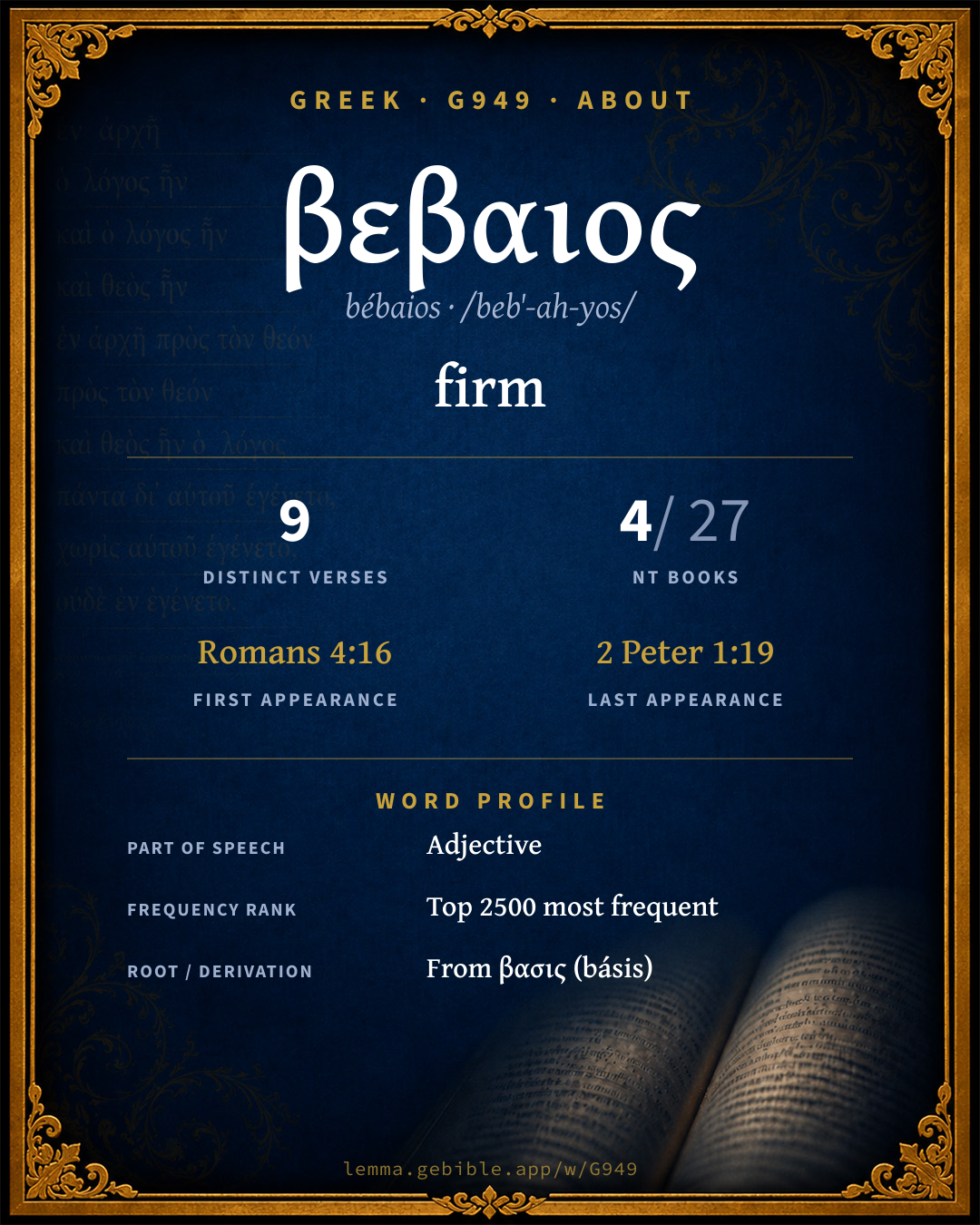
βέβαιος
firm
also: stable, fast fuller range ↓
Full lexicon entry — Thayer's Greek Lexicon
From Thayer's Greek Lexicon
Where this word appears
See every Accusative-case word in the Greek New Testament →
Grammar key — what these labels mean
Part of speech
- Adjective
- A word that describes or qualifies a noun.
Case
- Accusative
- The case of the direct object and of extent.
- Nominative
- The case of the subject (and the predicate nominative).
Gender
- Feminine
- Grammatically feminine.
- Masculine
- Grammatically masculine.
Number
- Singular
- One.
Degree
- Comparative
- Expresses a greater degree (“greater,” “more”).
Grammatical forms
- Adjective, Accusative, Singular, Feminine 5 times (56%)
- Adjective, Nominative, Singular, Feminine 2 times (22%)
- Adjective, Accusative, Singular, Masculine, Comparative 1 time (11%)
- Adjective, Nominative, Singular, Masculine 1 time (11%)
Parsed forms decoded from the imported morphology (Robinson–Tischendorf, public domain), counted across 9 parsed occurrences — not distinct verses.
Every verse where G949 appears — 9 distinct verses across 4 books. Click any verse to open its interlinear word-by-word view. Verse text shown in the World English Bible for context — . Each verse’s Greek form is shown with its reference; the English is not keyword-highlighted, since the data carries no word-level English alignment. Use “Compare translations” on any verse to read it across multiple English versions. This concordance covers the Greek New Testament; Septuagint (Greek Old Testament) occurrences of this word are not indexed here.
Romans 1 verse
2 Corinthians 1 verse
Hebrews 5 verses
- Hebrews 2:2 βέβαιος adj nom sg masc For if the word spoken through angels proved steadfast, and every transgression and disobedience received a just recompense;
- Hebrews 3:6 βεβαίαν adj acc sg fem but Christ is faithful as a Son over his house; whose house we are, if we hold fast our confidence and the glorying of our hope firm to the end.
- Hebrews 3:14 βεβαίαν adj acc sg fem For we have become partakers of Christ, if we hold fast the beginning of our confidence firm to the end:
- Hebrews 6:19 βεβαίαν adj acc sg fem This hope we have as an anchor of the soul, a hope both sure and steadfast and entering into that which is within the veil;
- Hebrews 9:17 βεβαία adj nom sg fem For a will is in force where there has been death, for it is never in force while he who made it lives.
2 Peter 2 verses
- 2 Peter 1:10 βεβαίαν adj acc sg fem Therefore, brothers, be more diligent to make your calling and election sure. For if you do these things, you will never stumble.
- 2 Peter 1:19 βεβαιότερον adj acc sg masc comp We have the more sure word of prophecy; whereunto you do well that you take heed, as to a lamp shining in a dark place, until the day dawns, and the day star arises in your hearts:
About this entry
At a glance — auto-summarized from this page’s data, not written by a person. Every figure links to its source below. This summary describes the numbers; it doesn’t interpret them.
βεβαιος — transliterated bébaios — is a Greek adjective carrying the sense “firm.” More than half of its appearances fall in Hebrews. The Greek New Testament uses it across 9 verses — uncommon. Debuting at Romans 4:16, it then recurs through the corpus. Thayer's distinguishes 2 senses; alongside “firm” it spans “stable” and “fast”. Each statement above links to its evidence; the full detail follows below.
Gloss history
Strong's 1890 vs modern scholarship
About this word
Strong's G949 catalogs a Greek word from the Greek New Testament.
These counts are not copied from any lexicon or concordance. They are computed here, from the morphology-tagged Greek New Testament. What Lemma adds →
- 9
- distinct verses
- The word appears in 9 distinct verses.
- 4 / 27
- NT books
- The word appears in 4 of 27 New Testament books.
- #1,140
- by frequency
- Top 2500 most frequent Greek words (rank 1,140 of 5,347 Greek words by occurrence).
View all 9 occurrences in the concordance →
By section of the New Testament
By traditional corpus
Conventional, traditional groupings — biblical authorship is debated, so this is a traditional corpus grouping, not an authorship claim. Some books belong to more than one corpus (Luke is in both the Gospels and the Lukan corpus, and so on), so these shares overlap and need not total 100%. Each figure is a share of the word’s 9 distinct verses.
- Hebrews 5 verses · 56%
- Pauline corpus 2 verses · 22%
- General (Catholic) Epistles 2 verses · 22%
How translations render this word
Counts come from each version’s own published word-to-Strong’s tagging or interlinear alignment — an approximate guide to how each version renders this word, not a word-level alignment the data otherwise carries. Because each total is that version’s own tagged count, the per-version totals vary from one another and need not match the appearance or distinct-verse counts above. These counts may also differ from a printed concordance because Lemma counts each distinctly tagged rendering and does not collapse phrase taggings into a single head-word total. This is a fixed set of word-tagged versions (KJV, ASV, BSB, ULT) and does not change with the reading translation you choose elsewhere. Each version’s license is shown beside its name below (and on Sources).
- King James Version: Stedfast 3×, Sure 2×
- American Standard Version: Firm 2×, Stedfast 2×, Sure 2×
- Berean Standard Bible: Sure 2×
- unfoldingWord Literal Text: Certain 1×, Confirmed 1×, Firm 1×
King James Version Public Domain
Renders G949 across 9 tagged occurrences — most commonly:
Plus 4 renderings that appear only once — usually multi-word phrases or single function words the recovered tagging swept in, not distinct renderings.
American Standard Version Public Domain
Renders G949 across 8 tagged occurrences — most commonly:
Plus 2 renderings that appear only once — usually multi-word phrases or single function words the recovered tagging swept in, not distinct renderings.
Berean Standard Bible Public Domain
Renders G949 across 8 tagged occurrences — most commonly:
Plus 6 renderings that appear only once — usually multi-word phrases or single function words the recovered tagging swept in, not distinct renderings.
unfoldingWord Literal Text CC BY-SA 4.0
Renders G949 across 8 tagged occurrences — most commonly:
Senses in Thayer's
The 2 senses Thayer's distinguishes for this word, in lexicon order (not ranked by frequency or importance). The full entry — with sub-senses — is in the Lexicon Entry tab.
- stable, fast, firm
- metaph. sure, trusty
Word origin
Derived from βασις (básis) (G939) — foot.
From the base of G939 (through the idea of basality ); stable (literally or figuratively): - firm of force stedfast sure.
— Strong’s Exhaustive Concordance (1890), public domain.
Forms in the corpus
The 4 distinct written forms G949 takes in the Greek New Testament, most frequent first — each parse links to that case’s occurrences in the concordance.
| Form | Parsing | Example | Uses |
|---|---|---|---|
| βεβαίαν bebaían | Adjective, Accusative, Singular, Feminine | Romans 4:16 | 5 |
| βεβαία bebaía | Adjective, Nominative, Singular, Feminine | 2 Corinthians 1:6 | 2 |
| βέβαιος bébaios | Adjective, Nominative, Singular, Masculine | Hebrews 2:2 | 1 |
| βεβαιότερον bebaióteron | Adjective, Accusative, Singular, Masculine, Comparative | 2 Peter 1:19 | 1 |
Same root — word family
Other Thayer's entries built from the same root as G949, grouped by Strong’s listed origin. These share a root / origin per the lexicon — not necessarily a shared meaning. Each links to that word’s own entry.
Derives from
Shares the same root
- βαθυς bathýs G901 deep
- βαΐον baḯon G902 palm branch
- βαρος báros G922 heaviness
- βασανος básanos G931 touchstone
- βασιλευς basileús G935 king
- βασταζω bastázō G941 to take up
- βεβηλος bébēlos G952 profane
- βημα bēma G968 judgment seat
- βωμος bōmós G1041 elevated place
Derived from this word
Compare all same-root words → Showing 4 of 12 — not the complete family. They share a root, not necessarily a meaning.