Galatians 5:3

Greek (Tischendorf 8th ed.) Galatians 5:3 appears in the Greek New Testament. The text above is from the Tischendorf 8th edition. Each word links to its Strong’s number and a concise gloss. Click any word for its full Thayer’s Greek Lexicon entry.
Download image
Cite this verse

Galatians 5:3 (World English Bible). Public Domain. Lemma interlinear Bible study tool, https://lemma.gebible.app/v/galatians/5/3.

Show BibTeX & RIS
BibTeX
RIS
English Translation
Yes, I testify again to every man who receives circumcision, that he is a debtor to do the whole law.
World English Bible · Public Domain
Download a study sheet

One document with this verse’s original text, its word-by-word gloss line, the meaning frame, cross-references with their text, attributed commentary, and full source and license credits — printable, and it pastes into notes with its structure intact.

This verse Autodidact and up

Study sheet (.html) Plain text (.txt)

A passage Seminary Student

Up to 50 verses in one chapter. A passage sheet keeps up to 6 commentary sources and 12 cross-references per verse, in the order this page ranks them, and says so on the sheet whenever that leaves anything out. Ask for a single verse and you get the Autodidact verse sheet above.

Everything on this page stays free to read, with no account — the sheet is a download of what is already on screen, not access to it.

Want to remove ads? Support Godless Engineer
Compare translations 3

The same verse in 3 English versions, stacked beneath the original-language interlinear above. Click any original word for its lexicon entry.

Each is an independent rendering of the whole verse — the interlinear is not word-aligned to these translations.

Highlighted words mark where these versions differ — a whole-verse word diff, not a word-by-word alignment.

  • World English Bible Public Domain
    Yes, I testify again to every man who receives circumcision, that he is a debtor to do the whole law.
  • King James Version Public Domain
    For I testify again to every man that is circumcised, that he is a debtor to do the whole law.
  • unfoldingWord Literal Text CC BY-SA 4.0
    Now I testify again to every man being circumcised that he is obligated to do the whole law.

unfoldingWord Literal Text — © unfoldingWord, licensed CC BY-SA 4.0. Word-aligned USFM3 via Door43 (git.door43.org/unfoldingWord/en_ult).

Versions to compare (up to 4)

3 of 4 selected

Show all 19 translations

Every available English version of this verse, each an independent rendering of the whole verse.

  • World English Bible Public Domain
    Yes, I testify again to every man who receives circumcision, that he is a debtor to do the whole law.
  • Berean Standard Bible Public Domain
    Again I testify to every man who gets himself circumcised that he is obligated to obey the whole law.
  • Majority Standard Bible Public Domain
    Again I testify to every man who gets himself circumcised that he is obligated to obey the whole law.
  • King James Version Public Domain
    For I testify again to every man that is circumcised, that he is a debtor to do the whole law.
  • American Standard Version (1901) Public Domain
    Yea, I testify again to every man that receiveth circumcision, that he is a debtor to do the whole law.
  • Revised Version (1885) Public Domain
    Yea, I testify again to every man that receiveth circumcision, that he is a debtor to do the whole law.
  • Geneva Bible (1599) Public Domain
    For I testifie againe to euery man, which is circumcised, that he is bound to keepe the whole Lawe.
  • Douay-Rheims (1899) Public Domain
    And I testify again to every man circumcising himself, that he is a debtor to the whole law.
  • Young's Literal Translation Public Domain
    and I testify again to every man circumcised, that he is a debtor to do the whole law;
  • Literal Standard Version CC BY-SA 4.0
    and I testify again to every man circumcised, that he is a debtor to do the whole law;
  • Unlocked Literal Bible CC BY-SA 4.0
    I testify again to every man who lets himself be circumcised that he is obligated to obey the whole law.
  • unfoldingWord Literal Text CC BY-SA 4.0
    Now I testify again to every man being circumcised that he is obligated to do the whole law.
  • Darby Bible Public Domain
    And I witness again to every man [who is] circumcised, that he is debtor to do the whole law.
  • World Messianic Bible Public Domain
    Yes, I testify again to every man who receives circumcision that he is a debtor to do the whole law.
  • Webster's Bible Public Domain
    For I testify again to every man that is circumcised, that he is a debtor to do the whole law.
  • Free Bible Version CC BY-SA 4.0
    Let me repeat: every man who is circumcised has to keep the whole of the law.
  • Bible in Basic English Public Domain
    Yes, I give witness again to every man who undergoes circumcision, that he will have to keep all the law.
  • Text-Critical English NT CC BY 4.0
    I testify again to every man who lets himself be circumcised that he is obligated to keep the entire law.
  • Tyndale New Testament (1534) Public Domain
    I testifie agayne to every man which is circumcised that he is bounde to kepe the whole lawe.

Literal Standard Version (2020), Covenant Press — licensed CC BY-SA 4.0. Text via the HelloAO Bible API (eBible.org). Unlocked Literal Bible (unfoldingWord) — licensed CC BY-SA 4.0. Text via the HelloAO Bible API (eBible.org). unfoldingWord Literal Text — © unfoldingWord, licensed CC BY-SA 4.0. Word-aligned USFM3 via Door43 (git.door43.org/unfoldingWord/en_ult). Free Bible Version, Dr. Jonathan Gallagher — licensed CC BY-SA 4.0. Text via the HelloAO Bible API (eBible.org).

Word by word

More ways to search: Search by grammar → Find every occurrence → Compare this word →

Practice this passage: Drill this verse → Learn its vocabulary →

μαρτύρομαι
martýromai
G3143
“to call to witness”
Verb, Present, Middle or Passive deponent, Indicative, 1st person, Singular
Part of Speech
Verb
Tense
Present
Voice
Middle or Passive deponent
Mood
Indicative
Person
1st person
Number
Singular
Full Thayer's Definition

Origin: middle voice from G3144

TDNT: 12:30,6

1. to cite a witness, bring forward a witness, call to witness a. to affirm be appeal to God, to declare solemnly, protest 2. to conjure, beseech as in God's name, exhort solemnly
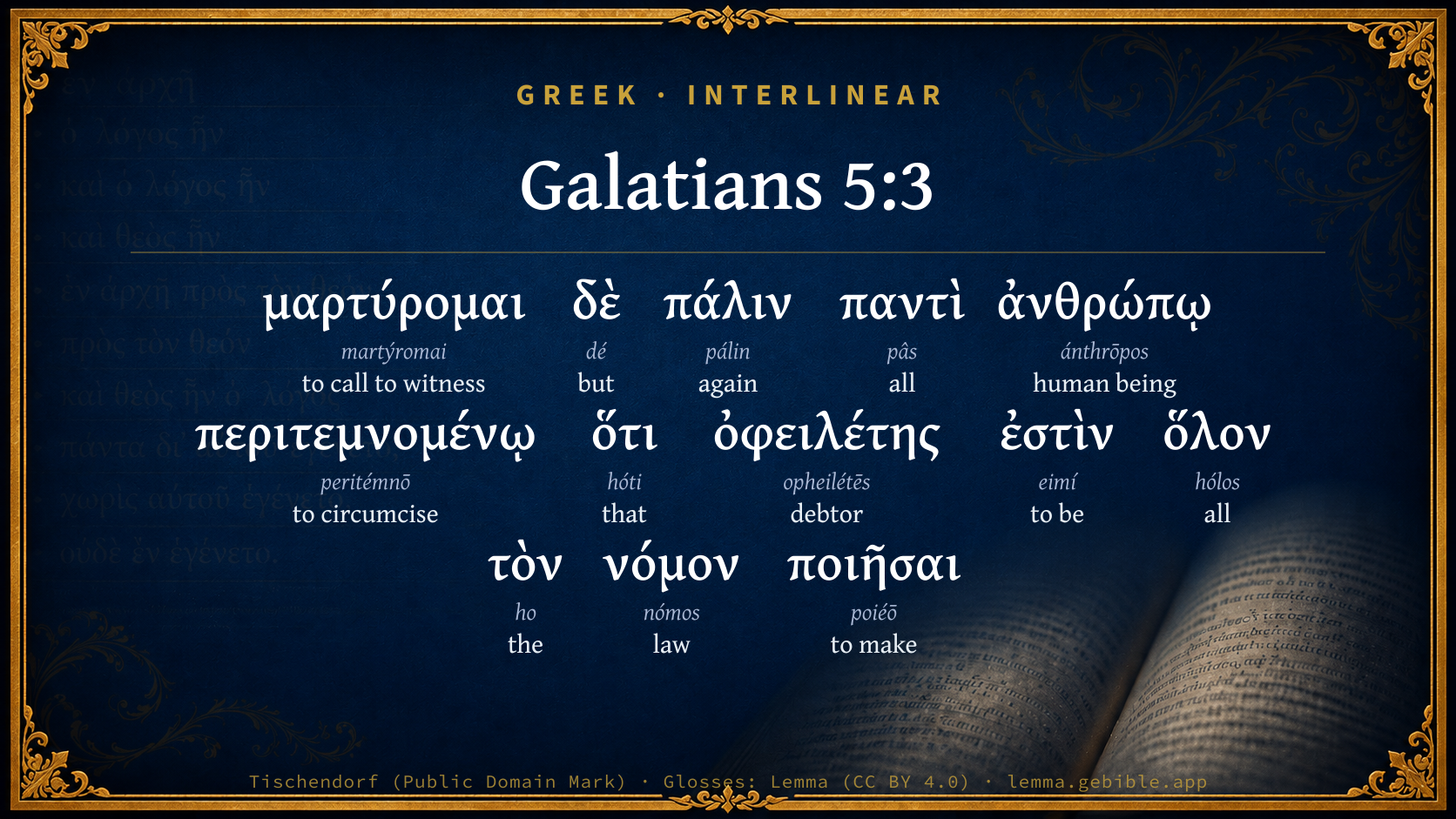
  1. δὲ dé G1161 “but” Conjunction
  2. πάλιν pálin G3825 “again” Adverb
  3. παντὶ pâs G3956 “all” Adjective, Dative, Singular, Masculine
  4. ἀνθρώπῳ ánthrōpos G444 “human being” Noun, Dative, Singular, Masculine
  5. περιτεμνομένῳ peritémnō G4059 “to circumcise” Verb, Present, Passive, Participle, Dative, Singular, Masculine
  6. ὅτι hóti G3754 “that” Conjunction
  7. ὀφειλέτης opheilétēs G3781 “debtor” Noun, Nominative, Singular, Masculine
  8. ἐστὶν eimí G1510 “to be” Verb, Present, Active, Indicative, 3rd person, Singular
  9. ὅλον hólos G3650 “all” Adjective, Accusative, Singular, Masculine
  10. τὸν ho G3588 “the” Article, Accusative, Singular, Masculine
  11. νόμον nómos G3551 “law” Noun, Accusative, Singular, Masculine
  12. ποιῆσαι poiéō G4160 “to make” Verb, Aorist, Active, Infinitive

About this verse

These counts appear in no published source. They are computed here, from the morphology-tagged text and Lemma’s own curated glosses. What Lemma adds →

13
words
13
distinct lemmas
Pauline Epistles
section

Notable vocabulary

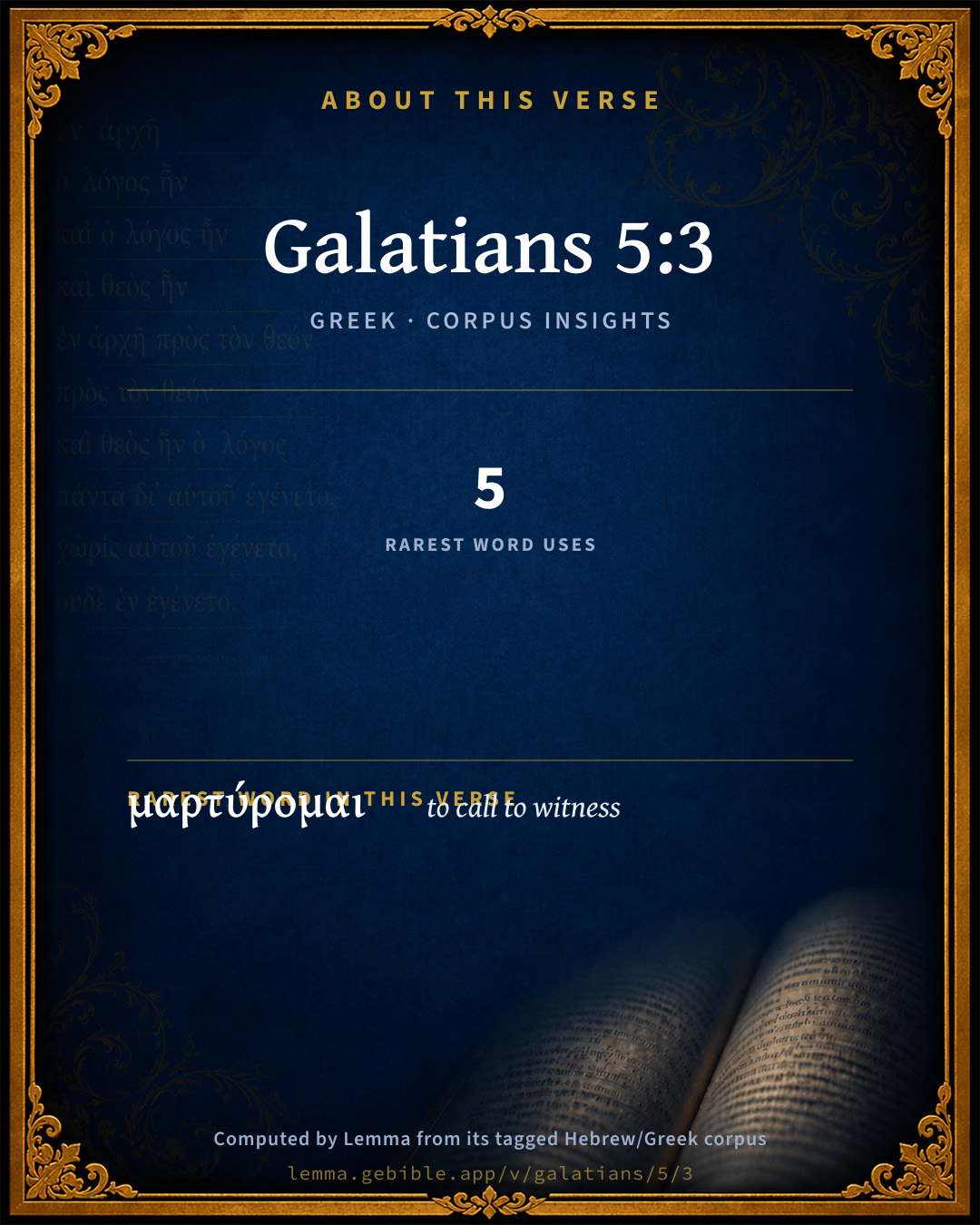
The rarest word here is μαρτύρομαι to call to witness G3143 — appearing just 5 times in the whole Greek New Testament.

Shared distinctive vocabulary

μαρτύρομαι to call to witness G3143 occurs in 5 verses of the Greek New Testament. Also found in:

Cross-references

16

Topical passages linked to Galatians 5:3 in the Treasury of Scripture Knowledge — connected by theme and wording, ordered by reader-vote popularity; previews shown in the World English Bible.

  • Romans 2:25 For circumcision indeed profits, if you are a doer of the law, but if you are a transgressor of the law, your circumcision has become uncircumcision.
  • Galatians 3:10 For as many as are of the works of the law are under a curse. For it is written, "Cursed is everyone who doesn't continue in all things that are written in the book of the law, to do them."
  • James 2:10–11 For whoever shall keep the whole law, and yet stumble in one point, he has become guilty of all.
  • Deuteronomy 27:26 Cursed be he who doesn't confirm the words of this law to do them. All the people shall say, Amen.
  • Deuteronomy 8:19 It shall be, if you shall forget Yahweh your God, and walk after other gods, and serve them, and worship them, I testify against you this day that you shall surely perish.
  • Deuteronomy 31:21 It shall happen, when many evils and troubles are come on them, that this song shall testify before them as a witness; for it shall not be forgotten out of the mouths of their seed: for I know their imagination which they frame this day, before I have brought them into the land which I swore.
  • Ephesians 4:17 This I say therefore, and testify in the Lord, that you no longer walk as the rest of the Gentiles also walk, in the futility of their mind,
  • Nehemiah 9:29–30 and testified against them, that you might bring them again to your law. Yet they dealt proudly, and didn't listen to your commandments, but sinned against your ordinances, (which if a man do, he shall live in them), and withdrew the shoulder, and hardened their neck, and would not hear.
  • Matthew 23:18 'Whoever swears by the altar, it is nothing; but whoever swears by the gift that is on it, he is obligated.'
  • Matthew 23:16 "Woe to you, you blind guides, who say, 'Whoever swears by the temple, it is nothing; but whoever swears by the gold of the temple, he is obligated.'
  • Luke 16:28 for I have five brothers, that he may testify to them, so they won't also come into this place of torment.'
  • Acts 2:40 With many other words he testified, and exhorted them, saying, "Save yourselves from this crooked generation!"
  • Acts 20:21 testifying both to Jews and to Greeks repentance toward God, and faith toward our Lord Jesus.
  • 1 Thessalonians 4:6 that no one should take advantage of and wrong a brother or sister in this matter; because the Lord is an avenger in all these things, as also we forewarned you and testified.
  • 1 John 4:14 We have seen and testify that the Father has sent the Son as the Savior of the world.
  • Nehemiah 9:34 neither have our kings, our princes, our priests, nor our fathers, kept your law, nor listened to your commandments and your testimonies with which you did testify against them.

Cross-references courtesy of OpenBible.info (CC BY 4.0).

Commentary

Notes on Galatians 5:3 from classic Christian and Jewish commentators (each source and its license shown beneath its notes). The classic Christian expositions comment on the surrounding passage and are grouped to its opening verse, so a note may address several verses; the Jewish commentaries on the Tanakh (Rashi and others) are per-verse, so they appear only where the commentator wrote on this verse.

Lemma curates 59 commentaries, every one of them public domain or Creative Commons licensed, each selected and text-cleaned for this edition rather than reprinted as found. About our sources →

The Biblical Illustrator

Joseph S. Exell

Gal_5:3

For I testify again to every man that is circumcised, that he is a debtor to do the whole law.

The great dilemma

I. Justification by the law.

1. What this means.

(1) Circumcision which commits a man to the law.

(2) Obedience to all the requirements of the law to which the circumcised are committed.

2. Its utter impossibility.

(1) The legal covenant is abolished. To seek justification is to follow a course which God condemns.

(2) Supposing it still in force, no man can fulfil all its requirements.

II. Salvation by grace.

1. This is now the only appointed way.

2. This is a perfectly possible way: what man cannot do God does for him.

3. This is a very simple way: accept by faith what God has provided.

III. To reject the latter in favour of the former, therefore, is to fall from grace. Christ is thus--

(1) repudiated;

(2) rendered unnecessary; consequently

(3) becomes of no effect, and so

(4) the legalist puts himself beyond the pale of salvation.

The comprehensiveness of the claims of the law

Tell me, then, ye who desire to be under the law, do ye not hear the law? Does it say anything to you, but do this and thou shalt live: Does it set before you any alternative but cursed is he that continueth not (Gal_3:10)? Do this, this wrath-working law proclaims, do it all--all without exception--continue in it from first to last, and you shall live; but a curse, an everlasting curse, awaits you if you offend in one particular. Plead what you will, these denunciations are irreversible--its terms cannot be changed. You may say, I wish to obey; and it answers you; tell me not of your wishes, but do it. I have endeavoured to obey. Tell me of no endeavours, but do it or you are cursed. I have done it in almost every particular. Tell me, not what you have done almost, have you obeyed it altogether? Have you obeyed it in all things; if not, you are cursed. I have for many years obeyed it, and but once only have I transgressed. Then you are cursed; if you have offended in one point you are guilty of all. But I am very sorry for my transgressions. I cannot regard your sorrow; you are under a curse. But I will reform, and never transgress again. I care nothing for your reformation; the curse remains upon you. But I will obey perfectly in the future, if I can find mercy for the past. I can have no concern with your determinations for the future; I know no such word as mercy; my terms cannot be altered for any one. If you rise to these terms you will have a right to life, and need no mercy. If you fall short in any one particular, nothing remains for you but punishment! (C. Simeon)

.

The Biblical Illustrator, edited by Joseph S. Exell (c. 1880s–1900s) — public domain. Text from a community e-Sword module.

Tyndale Open Study Notes

Tyndale Open Resources

5:3 Those who seek righteousness through the law must obey every regulation of it (see 2:15-16; cp. Jas 2:10).

Tyndale Open Study Notes — © Tyndale Open Resources, licensed CC BY-SA 4.0. Text via the HelloAO Bible API.

Bengel's Gnomon

Johann Albrecht Bengel

Gal 5:3. Ὀφειλέτης, a debtor) Endangering salvation.—ὅλον, the whole) A task which he will never be able to perform.

Bengel's Gnomon of the New Testament — English translation (T&T Clark, Edinburgh, 1860) — public domain. Text from a community e-Sword module.

Meyer's Critical & Exegetical Commentary

Heinrich August Wilhelm Meyer

Gal_5:3. With regard to the judgment just expressed, Χριστὸς οὐδὲν ὑμᾶς ὠφελήσει, Paul now, with increasing emotion (μαρτύρομαι, παντὶ ἀνθρ. περιτ.), gives an explanation (Gal_5:3-4) which clearly discloses the entire certainty of this negation.

The δέ is not potius (Schott), because it is not preceded by any antagonistic assertion, but is the autem which leads on to more detailed information (Herm. ad Viger. p. 845).

μαρτύρομαι] in the sense of μαρτυρῶ, as in Act_20:26; Eph_4:17; Joseph. Bell. iii. 8. 3; and also Plat. Phil. p. 47 D, while in classical authors it usually means to summon as a witness and obtestor. Paul testifies that which with divine certainty he knows. The context does not warrant us to supply θεόν, with Bretschneider and Hilgenfeld.

πάλιν] not contra (Erasmus, Er. Schmid, Koppe, Wahl; comp. Usteri), which is never its meaning (see Fritzsche, ad Matth. p. 166 f.), but again, not however in the sense that Gal_5:3 is described as a repetition of what was said in Gal_5:2 (Calvin, Castalio, Calovius, Wolf, Zachariae, Paulus, and others), which it is not; nor in the sense that Paul is thinking merely of the testifying in itself, and not of its purport (Hofmann; comp. Fritzsche, Winer, de Wette),an interpretation which cannot but be the less natural, the more necessarily that which is attested πάλιν stands in essential inner connection with the axiom which had been previously expressed (probatio est proximae sententiae sumta ex loco repugnantium, Calvin); but in the sense that Paul calls to the remembrance of his readers his last presence among them (the second), when he had already orally assured them of what he here expresses (Moldenhauer, Flatt, Rückert, Olshausen, Wieseler). Comp. on Gal_1:9, Gal_4:16.

παντὶ ἀνθρ. περιτ.] stands in a climactic relation to the foregoing ὑμῖν, remorselessly embracing all: to every one I testify, so that no one may fancy himself excluded from the bearing of the statement. According to Chrysostom and Theophylact, with whom Schott and others agree, Paul has wished to avoid the appearance κατʼ ἔχθραν ταῦτα λέγεσθαι; but in this view the whole climactic force of the address is misunderstood.

ὅλον] has the emphasis; comp. Jam_2:10. Circumcision binds the man who accepts it to obey the whole law, because it makes him a full member of the covenant of the law, a proselyte of righteousness, and the law requires from those who are bound to it its entire fulfilment (Gal_3:10). Probably the pseudo-apostles had sought at least to conceal or to weaken this true andsince no one is able wholly to keep the law (Act_13:38; Act_15:10; Rom_8:3)yet so fearful consequence of accepting circumcision, as if faith in Christ and acceptance of circumcision might be compatible with one another. On the contrary, Paul proclaims the decisive aut … aut. The state of the man who allows himself to be circumcised stands in a relation contradictory to the state of grace (comp. Rom_6:14 f., Rom_11:6).

Meyer — Critical and Exegetical Commentary on the New Testament — English translation by Peter Christie, edited by Frederick Crombie (T&T Clark, 1880) — public domain. Text from a community e-Sword module.

Expositor's Greek Testament

ed. W. Robertson Nicoll

Gal 5:3 . μαρτύρομαι . This verb, which in Attic Greek denotes the calling of witnesses, is applied in Pauline language to the Apostle’s own testimony. περιτέμνησθε , περιτεμνομένῳ . The use of the present tense intimates that the warning is not aimed at isolated acts, but at the introduction of a systematic practice involving a virtual transfer of allegiance from Christ to the Law.

The Expositor's Greek Testament, edited by W. Robertson Nicoll (1897–1910) — public domain. Text from a community e-Sword module.

Cambridge Greek Testament for Schools and Colleges

3. Gal 5:3-4 are at once a solemn reiteration of the truth stated in Gal 5:2, and an explanation of it.

μαρτύρομαι δὲ. The δέ suggests a contrast to ὠφελήσει. So far from receiving advantage from Christ you will fall under obligation to the Law. μαρτύρομαι, “I protest,” strengthening the preceding λέγω, very nearly as in Eph 4:17. On μαρτ. see Milligan, 1Th 2:12.

πάλιν. Referring to Gal 5:2, the ὑμῖν of which is expanded to παντὶ ἀνθρ. It can hardly refer to the last occasion when he was with them.

παντὶ ἀνθρώπῳ. Col 1:28. Perhaps suggesting the superior station etc. of some who were being led astray; cf. Gal 5:10.

περιτεμνομένῳ, cf. Gal 6:13. The present suggests a process in mind and act, still uncompleted. The Apostle will wean the man from it.

ὀφειλέτης. Elsewhere in St Paul’s Epp. only Rom 1:14; Rom 8:12; Rom 15:27. The circumcised man pledges himself to keep the whole Law; which, as we all know, he cannot do. He loses Christ and does not even gain the blessings of the Law. Further, if the Galatians had received teaching similar to that recorded for us in the First Gospel, ὀφειλέτης would have a very serious connotation for them, Mat 6:12; Mat 18:24.

ὅλον τὸν νόμον. Jas 2:10. No doubt the Gentile Galatian Christians did not realize all that circumcision would mean to them now.

Cambridge Greek Testament for Schools and Colleges (Cambridge University Press, 1896; 21 vols, various authors incl. Carr, Maclear, Plummer, Farrar, Lumby, Moule, M. R. James, Simcox) — public domain. Text from a community e-Sword module.

Jamieson, Fausset & Brown

Robert Jamieson, A. R. Fausset & David Brown

For--Greek, "Yea, more"; "Moreover."

I testify . . . to every man--as well as "unto you" (Gal 5:2).

that is circumcised--that submits to be circumcised. Such a one became a "proselyte of righteousness."

the whole law--impossible for man to keep even in part, much less wholly (Jam 2:10); yet none can be justified by the law, unless he keep it wholly (Gal 3:10).

Jamieson, Fausset & Brown — Commentary Critical and Explanatory on the Whole Bible (1871) — public domain (CC PDM 1.0). Text via the HelloAO Bible API.

Adam Clarke's Commentary

Verse 3. He is a debtor to do the whole law.] Lays himself, by receiving circumcision, under the obligation to fulfil all its precepts, ordinances, &c.

Adam Clarke's Commentary on the Bible (1810–1826) — public domain. Text from a community e-Sword/MySword module.

John Calvin's Commentaries

3. For I testify again. What he now advances is proved by the contradiction involved in the opposite statement. He who is a debtor to do the whole law will never escape death, but will always continue to be held as guilty; for no man will ever be found who satisfies the law. Such being the obligation, the man must unavoidably be condemned, and Christ can render him no service. We see then the contradictory nature of the two propositions, that we are partakers of the grace of Christ, and yet that we are bound to fulfill the whole law. But will it not then follow, that none of the fathers were saved? Will it not also follow that Timothy was ruined, since Paul caused him to be circumcised? (Acts 16:3.) Wo to us then, till we have been emancipated from the law, for subjection is inseparable from circumcision!

It ought to be observed that Paul is accustomed to view circumcision in two different aspects, as every person who has best, owed a moderate degree of attention on his writings will easily perceive. In the Epistle to the Romans, (Romans 4:11,) he calls it “a seal of the righteousness of faith;” and there, under circumcision, he includes Christ and the free promise of salvation. But here he contrasts it with Christ, and faith, and the gospel, and grace, — viewing it simply as a legal covenant, founded on the merit of works.

The consequence is, as we have already said, that he does not always speak about circumcision in the same way; but the reason of the difference must be taken into account. When he views circumcision in its own nature, he properly makes it to be a symbol of grace, because such was the appointment of God. But when he is dealing with the false apostles, who abused circumcision by making it an instrument for destroying the Gospel, he does not there consider the purpose for which it was appointed by the Lord, but attacks the corruption which has proceeded from men.

A very striking example occurs in this passage. When Abraham had received a promise concerning Christ, and justification by free grace, and eternal salvation, circumcision was added, in order to confirm the promise; and thus it became, by the appointment of God, a sacrament, which was subservient to faith. Next come the false apostles, who pretend that it is a meritorious work, and recommend the observance of the law, making a profession of obedience to it to be signified by circumcision as an initiatory rite. Paul makes no reference here to the appointment of God, but attacks the unscriptural views of the false apostles.

It will be objected, that the abuses, whatever they may be, which wicked men commit, do not at all impair the sacred ordinances of God. I reply, the Divine appointment of circumcision was only for a time. After the coming of Christ, it ceased to be a Divine institution, because baptism had suceeeded in its room. Why, then, was Timothy circumcised? Not certainly on his own account, but for the sake of weak brethren, to whom that point was yielded. To show more fully the agreement between the doctrine of the Papists and that which Paul opposes, it must be observed, that the sacraments, when we partake of them in a sincere manner, are not the works of men, but of God. In baptism or the Lord’s supper, we do nothing but present ourselves to God, in order to receive his grace. Baptism, viewed in regard to us, is a passive work: we bring nothing to it but faith; and all that belongs to it is laid up in Christ. But what are the views of the Papists? They contrive the opus operatum, by which men merit the grace of God; and what is this, but to extinguish utterly the truth of the sacrament? Baptism and the Lord’s supper are retained by us, because it was the will of Christ that the use of them should be perpetual; but those wicked and foolish notions are rejected by us with the strong abhorrence which they deserve.

John Calvin's Commentaries (1540-1563) — public domain. Text from the Calvin Translation Society English edition (1840s-50s) via the Christian Classics Ethereal Library (ccel.org). Calvin's coverage is partial (roughly two-thirds of the Bible); uncommented books and verses are honest gaps, never fabricated. The 19th-century editor's footnotes and remarks are omitted so the notes are faithfully Calvin's own voice.

Ellicott's Commentary for English Readers

(3) For I testify again.—Translate rather, Nay, I protest again, introducing a further argument. He who allows himself to be circumcised thereby commits himself wholly to the Law, just as, it might be said, he who is baptised commits himself wholly to Christ. The act of circumcision placed a man under the legal system, just as the act of baptism placed him under the Christian system. From that time forward he could not choose one part and refuse another, but was bound alike by all.

He is a debtor.—He is under an obligation.

A Bible Commentary for English Readers, edited by Charles John Ellicott (1878–1897) — public domain. Text from a community e-Sword module.

The Cambridge Bible for Schools and Colleges

gen. ed. J. J. S. Perowne

3. By receiving circumcision a man voluntarily put himself under the conditions of the law, which were, ‘fulfil perfectly and live: fail and die’. The tremendous responsibility thus incurred may have been disguised by the false Apostles: or the Galatians may have been slow to realise it. St Paul’s appeal is to the individual conscience. ‘Warning every man and teaching every man’ (Col_1:28) was his maxim as a minister of the Gospel, and it ought to be the maxim of all who claim to be successors of the Apostles.

The Cambridge Bible for Schools and Colleges (gen. ed. J. J. S. Perowne; Cambridge University Press, 1878–1918) — public domain. Text from a community e-Sword module.

John Gill's Exposition

For I testify again to every man,.... This is the form of an oath, a calling God to witness, swearing by the living God, and declaring as in his presence to every man, whether Jew or Gentile, whoever he be:

that is circumcised; in order to obtain salvation, and as necessary to it:

that he is a debtor to do the whole law; and this it is that made circumcision an insupportable yoke, for that itself might be bore, and was bore by children of eight days old; but the fulfilling of the whole law cannot be done by any man; and yet everyone that is circumcised, in order to procure righteousness and life, is bound to keep the whole law; because the law is only his righteousness, when he observes all that is required in it, and as the Lord has commanded; if he does not, he is pronounced accursed: and this proves what was before said, that Christ is of no profit to such persons; because they reject him and his righteousness, and, as much as in them lie, make void his obedience, sufferings, and death: hence the same thing is repeated, though not in the same words, in the next verse.

John Gill's Exposition of the Whole Bible (1746–1763) — public domain (CC PDM 1.0). Text via the HelloAO Bible API.

Trapp's Complete Commentary

John Trapp

3 For I testify again to every man that is circumcised, that he is a debtor to do the whole law.

Ver. 3. That he is a debtor] viz. If he be circumcised with an opinion of meriting thereby. Christ will be our sole Saviour, or none; he will not mingle his precious blood with our puddle stuff. Those that will look unto him must look off all things else, as the apostle’s word αφορωντες importeth, Heb 12:2.

John Trapp, A Commentary or Exposition upon All the Books of the Old and New Testament (1647–1656) — public domain. Text from a community e-Sword module.

Albert Barnes' Notes on the Bible

For I testify again - Probably he had stated this when he had preached the gospel to them first, and he now solemnly bears witness to the same thing again. Bloomfield, however, supposes that the word “again” here (πάλιν palin) means, on the other hand, or, “furthermore,” or, as we would say, “and again.”

That he is a debtor to do the whole law - He binds himself to obey all the Law of Moses. Circumcision was the distinguishing badge of the Jews, as baptism is of Christians. A man, therefore, who became circumcised became a professor of the Jewish religion, and bound himself to obey all its special laws. This must be understood, of course, with reference to the point under discussion; and means, if he did it with a view to justification, or as a thing that was necessary and binding. It would not apply to such a case as that of Timothy, where it was a matter of mere expediency or prudence; see the note at Gal 5:2.

Albert Barnes' Notes on the Bible (1834–1885) — public domain. Text from a community e-Sword/MySword module.

Haydock's Catholic Bible Commentary

The false teachers had insisted on the observance of circumcision and a few other rites only, as necessary for salvation; but St. Paul assures them, that the receiving of circumcision is an open profession of Judaism, and that he that makes this profession, binds himself to the observance of every part of the law, since a curse is pronounced against those that do not keep it in all its parts. If then circumcision be necessary for salvation, the whole law is necessary also. (Calmet)

George Leo Haydock (1774–1849), Haydock's Catholic Family Bible and Commentary, 1859 edition — public domain. Excludes Psalms (Douay-Rheims chapter numbering differs from Protestant) and Deuterocanonical books (Catholic canon only).

Matthew Poole's English Annotations

This must be understood either of the Gentiles only, who were never under any obligation to circumcision, or of such as were circumcised, with an opinion that it was necessary at this time to justification and salvation. Of these the apostle saith, that by this they made themselves debtors to do the whole law; they were obliged to one part of the law, they must also be obliged to all the other parts of it. Besides that circumcision was an owning and professing subjection to the whole law; as the receiving the sacrament of baptism is a professed subjecting ourselves to the whole gospel.

Objection. But (may some say) ought not then all Christians to observe the law?

Answer.

1. Not the ceremonial and political law, which were peculiar to the Jewish church and state.

2. It is one thing to be under an obligation to our utmost to fulfil the law, another thing to acknowledge ourselves debtors to the law.

Objection. But did not the fathers, then, by being circumcised, acknowledge themselves debtors to the law?

Answer. Yes, they did acknowledge themselves bound to the observation of the law, and to endure (upon the breaking it) the curse of it: but they were discharged from this obligation by believing in the Lord Jesus Christ, who was made a curse for them, that he might redeem them from the curse of the law. But if any disclaimed Christ, (which, whosoever added any thing to his righteousness and to faith in him, as to the justification of the soul, did, as the apostle had said in the former verse), they laid themselves under an obligation to fulfil the whole law of God, if they would be saved.

Matthew Poole's English Annotations on the Holy Bible (1683–1685) — public domain. Text from a community e-Sword/MySword module.

Whedon's Commentary on the Bible

Daniel D. Whedon

3. Debtor to do the whole law—Debtor, or obligated thus, because the act of circumcision made the man not a “proselyte of the gate,” but a “proselyte of righteousness,” thereby taking upon him all the obligations of the Jew, rejecting Christ, (Act_6:1,) and so making him debtor, not only to the ritual law, but the moral. So Gal_3:10, “As many as are of the works of the law are under the curse: for it is written, Cursed is every one that continueth not in all things which are written in the book of the law to do them.”

Daniel D. Whedon (gen. ed.), Commentary on the Old and New Testaments (1874–1909) — public domain. Text from a community e-Sword module.

The Pulpit Commentary

For I testify again (marturomai delin); I protest again. In using the word marturomai, pro teste loquor, "I speak in the presence of a witness," the apostle intimates that he is making his affirmation with a definite sense of the Lord being his Witness (cf. Eph_4:17, "This I say and testify in the Lord The original construction and force of the verb are shown in RAPC Jdt 7:28, Marturomai uJmin ton oujranon kai thn ghn. The apostle is wont to use it with a distinct sense of its emphatic import. (see Act_20:26; 1Th_2:11) The word "again" points, not to the substance of the subsequent affirmation, as if it were a repetition of that mode in the preceding verse, which in fact it does not appear to be, but to the solemnity with which he makes this fresh affirmation. For the phrase, "I Paul say unto you," was one form of solemn affirmation which in effect gaged his personality as Christ"s apostle and as acting in his name; and this "I protest" is another of equally solemn import. To every man that is circumcised (pantipw peritemnomenw); to every man that is having himself circumcised. St. Paul"s statements elsewhere, and his own proceeding in circumcising Timothy, as well as the present context, make it certain that, however absolute and universal his affirmation at first sight seems to be, it is nevertheless meant to be taken as made with reference to certain understood conditions. Thus: "I protest to any one of you Gentiles, who, being already baptized into Christ, has himself circumcised with the view of winning righteousness and favour with God, by obeying this one prescription of the Law that," etc. The conjunction de is most probably the de of transition (metabatic), introducing a fresh particular merely; and in this instance, as often, it needs not to be represented in translation at all. Certainly,s for" is not its meaning. Possibly, as De Wette supposes, it points back, as an adversative, to the words," Christ shall profit you nothing," as if it were "but on the contrary." That he is a debtor to do the whole Law (oti ojfeilethv ejstin olon tomon poihsai); that he is under obligation (Greek, is a debtor) to do the whole Law. By having himself circumcised, he adopts the token of the Lord"s covenant (Gen_17:11, Gen_17:13) made with those who were his people after the flesh; he enrolls himself with them to share with them their obligations. And to them the Lord had given the Law of Mount Sinai to be their appointed pedagogue till the Christ should come. "By being circumcised" (he means) "you of your own accord put yourself back afresh under this pedagogue, and just his bidding you must do. And for what? All the ordinances and ceremonies he puts you upon observing will leave you as far off as ever from remission of sins and justification with God! And this self-surrender to the pedagogue God has not asked for at your hands; while what he does require, that you withhold, even faith in him whom he hath sent: nay, not merely withhold your belief, but by open act and deed testify your disbelief in him." Under all that the apostle is here writing there appears to lie the principle, which, however, he has not distinctly stored, but which we see to be true, that circumcision was the peculiar badge of "Israel after the flesh," appertaining to them alone and not to be meddled with by any who did not mean to become naturalized as fellow-citizens with them. (For the use of ojfeilethv ijstin, comp. Rom_8:14) The noun more commonly points to a debt incurred, or guiltiness; but here it simply denotes obligation.

The obligations involved in circumcision.

The Judaizing teachers did not, perhaps, allow their converts to realize the full extent of the obligation involved in circumcision.

I THE APOSTLE REITERATES THE EXTENT OF THIS OBLIGATION IN THE CASE OF THE CIRCUMCISED. They are "debtors to do the whole Law." Circumcision was not a mere badge of Judaism, as baptism is of Christianity, but it involved a profession of obedience to the whole Jewish Law. It was not competent to select a few precepts for obedience; for the circumcised was a debtor to do "the whole Law." The false teachers did not observe it themselves, (Gal_6:13) yet it was their duty, on their own principles, to observe it unremittingly, completely, and without external help, in every department of it.

II THE DANGER OF THIS OBLIGATION. Circumcision could only profit on one supposition. "It verily profiteth if thou keep the Law". (Rom_2:25) But, in case of failure, it had no power to save from the curse. Circumcision in that case becomes uncircumcision that is, it will not save you from being treated as a transgressor or treated as if you had never been circumcised.

The Pulpit Commentary (1880–1919), ed. H.D.M. Spence-Jones & Joseph S. Exell — public domain. Text from a community e-Sword module.

John Wesley's Explanatory Notes

I testify to every man - Every gentile. That is circumcised - He thereby makes himself a debtor - Obliges.

John Wesley, Explanatory Notes Upon the Whole Bible (1754–1765) — public domain. Text via the GEBible commentary corpus.

Luther on Galatians

Martin Luther

VERSE 3. For I testify again to every man that is circumcised, that he is a debtor to do the whole law.

The first fault with circumcision is that it makes Christ unprofitable. The second fault is that it obligates those who are circumcised to observe the whole Law. Paul is so very much in earnest about this matter that he confirms it with an oath. "I testify," he says, "I swear by the living God." Paul’s statement may be explained negatively to mean: "I testify to every man who is being circumcised that he cannot perform the Law in any point. In the very act of circumcision he is not being circumcised, and in the very act of fulfilling the Law he fulfills it not." This seems to be the simple meaning of Paul’s statement. Later on in the sixth chapter he explicitly states, "They themselves which are circumcised keep not the law. The fact that you are circumcised does not mean you are righteous and free from the Law. The truth is that by circumcision you have become debtors and servants of the Law. The more you endeavor to perform the Law, the more you will become tangled up in the yoke of the Law."

The truth of this I have experienced in myself and in others. I have seen many work themselves down to the bones in their hungry effort to obtain peace of conscience. But the harder they tried the more they worried. Especially in the presence of death they were so uneasy that I have seen murderers die with better grace and courage.

This holds true also in regard to the church regulations. When I was a monk I tried ever so hard to live up to the strict rules of my order. I used to make a list of my sins, and I was always on the way to confession, and whatever penances were enjoined upon me I performed religiously. In spite of it all, my conscience was always in a fever of doubt. The more I sought to help my poor stricken conscience the worse it got. The more I paid attention to the regulations the more I transgressed them.

Hence those that seek to be justified by the Law are much further away from the righteousness of life than the publicans, sinners, and harlots. They know better than to trust in their own works. They know that they cannot ever hope to obtain forgiveness by their sins.

Paul’s statement in this verse may be taken to mean that those who submit to circumcision are thereby submitting to the whole Law. To obey Moses in one point requires obedience to him in all points. It does no good to say that only circumcision is necessary, and not the rest of Moses’ laws. The same reasons that obligate a person to accept circumcision also obligate a person to accept the whole Law. Thus to acknowledge the Law is tantamount to declaring that Christ is not yet come. And if Christ is not yet come, then all the Jewish ceremonies and laws concerning meats, places, and times are still in force, and Christ must be awaited as one who is still to come. The whole Scripture, however, testifies that Christ has come, that by His death He has abolished the Law, and that He has fulfilled all things which the prophets have foretold about Him.

Some would like to subjugate us to certain parts of the Mosaic Law. But this is not to be permitted under any circumstances. If we permit Moses to rule over us in one thing, we must obey him in all things.

Martin Luther — Commentary on the Epistle to the Galatians (1535), English translation by Theodore Graebner (Zondervan, 1939) — public domain (U.S. copyright not renewed). Text from a community e-Sword module.

Burkitt's Expository Notes on the New Testament

William Burkitt

He that urges the necessity of circumcision, is a debtor to the law, in a double respect, namely, in regard of duty, and in regard of penalty.

First, he is a debtor in regard of duty; because he that thinks himself bound to keep the whole ceremonial law, yea, and the whole moral law too, without deficiency, and that under the penalty of condemnation.

Again, Secondly, As he is a debtor in point of duty, so he must needs be a debtor in regard of penalty; because he is not able to keep any part of it perfectly.

Hence we may infer, 1. How endearing our obligations are to Christ, who as our Surety paid both these debts for us, namely, our debt of duty, and our debt of penalty to the law of God: by fulfilling all righteousness, he paid our debt of duty, and by suffering the punishment due to transgressors, he paid our debt of penalty.

We may also, infer, 2. That as he that is circumcised, is bound to keep the whole law; so he that is baptized, is obliged to obey all the commands of the gospel, to make conscience of the duties of both tables, as an argument of his sincerity, and as an ornament to his profession.

William Burkitt's Expository Notes on the New Testament (1700–1703) — public domain. Text from a community e-Sword module.

McGarvey & Pendleton's Commentaries

J. W. McGarvey

Yea, I testify again to every man that receiveth of circumcision, that he is a debtor to do the whole law. [The apostle here gives the reason for what he has said in the previous verse. Circumcision was, in its symbolic significance, an entrance into covenant relations with God under the terms of the old covenant, and as that covenant embraced not a part, but the whole law, the covenantee, or circumcised person, was obliged to observe the whole law, or forfeit his claims to life. Paul had probably fully explained this fact on one of his previous visits, and so he now reiterates it.]

J. W. McGarvey (with Philip Y. Pendleton), Commentaries on the New Testament (The Fourfold Gospel, 1914; Acts; and the epistles) — public domain. Text from a community e-Sword/MySword module.

The People's New Testament

B. W. Johnson

3. I testify again. He shows them that if one becomes circumcised to keep the law of Moses, that he is placed under obligation to keep the whole law, since other commandments are equally binding.

B. W. Johnson's The People's New Testament with Notes (1889–1891) — public domain. Electronic text from the Christian Classics Ethereal Library (CCEL) ThML edition.

unfoldingWord translationNotes

Door43 World Missions Community

I testify

"I declare" or "I serve as a witness"

to every man who lets himself be circumcised

Paul is using circumcision as a metonym for being Jewish. AT: "to every person who has become a Jew" (See: Metonymy)

he is obligated to obey

"he must obey"

You are cut off from Christ

Here "cut off" is a metaphor for separation from Christ. AT: "You have ended your relationship with Christ" or "You are no longer united with Christ" (See: Metaphor)

you who would be justified by the law

Paul is speaking ironically here. He actually teaches that no one can be justified by trying to do the deeds required by the law. AT: "all you who think you can be justified by doing the deeds required by the law" or "you who want to be justified by the law" (See: Irony)

you no longer experience grace

Who that grace comes from can be stated clearly. AT: "God will not be gracious to you" (See: Assumed Knowledge and Implicit Information)

translationWords

circumcise

law

Christ

just

grace

unfoldingWord translationNotes — © Distant Shores Media and the Door43 World Missions Community, licensed CC BY-SA 4.0. Source: git.door43.org/Door43/en_tn.

Alford’s Greek Testament

Henry Alford

3.] δέ, moreover, introduces an addition, and a slight contrast—‘not only will Christ not profit … but …’

On μαρτύρομαι (usually, in this sense, -ροῦμαι;— -ρομαι having an accusative, whence Bretschn., al., supply τὸν θεόν here, but wrongly), see reff. πάλιν, once more: applies to the verb, not to the μαρτυρία which follows, for that is not a repetition. Thus it will refer to παντὶ ἀνθρ. as ‘a more extended application of ὑμῖν’ (Ellic.), not, as Meyer, to a former inculcation of this by word of mouth at his second visit. περιτεμνομένῳ, not -τμηθέντι, see above—to every man who receives circumcision,—‘submits to be circumcised,’ as Ellic. The emphasis is on παντί, substantiating, and carrying further, the last verse. ὅλον has the stress. The circumcised man became a ‘proselyte of righteousness,’ and bound to keep the whole law. “This true and serious consequence of circumcision the false Apostles had probably at least dissembled.” Mey.

Henry Alford, The Greek Testament (1849–1861) — public domain. Text from a community e-Sword module.

International Critical Commentary

3. ᾗ ἐλευθερίᾳ: FG d f g Vg. Goth. Tert. Or. Victorin. Hier. Ambrst. Aug.

II. Respecting the position of ἡμᾶς:

3. Χρ. ἠλευθέρωσεν ἡμᾶς: Thphyl. (so Ltft.).

III. Respecting οὖν:

3. Omit in both places: D d 263, 1908, Vg. Syr. (harcl.) Thdrt. Chr. Dam.

The weight of external evidence thus strongly favours τῇ ἐλευθερίᾳ ἡμᾶς Χριστὸς ἠλευθέρωσεν· στήκετε οὖν, and the originality of this reading is confirmed by the fact that it accounts for all the rest. It is adopted by Ln. Tdf. Alf. WH. Sief. Those who have preferred another reading (Ell. Ltft.: τῇ ἐλευθερίᾳ ᾗ; Zahn: ᾗ ἐλευθερίᾳ) have done so on the ground of the syntactical difficulty of τῇ ἐλευθερίᾳ as a limitation of ἠλευθέρωσεν. But this construction, though unusual, does not seem to be impossible (see exegetical notes). On the other hand, Hort’s suggestion that τῇ is a primitive error for ἐπʼ (cf. v. 13, ἐπʼ ἐλευθερίᾳ ἐκλήθητε) has much to commend it. The only choice is between τῆ ἐλ. ὴμ., etc., which is undoubtedly the parent of all the other existing readings, and ἐπʼ ἐλ. ἡμ. as the unattested original of the former.

The dative τῆ ἐλευθερίᾳ is to be explained as a dative of instrument (not intensive as in Luk 22:15, ἐπιθυμίᾳ ἐπεθύμησα, and Jas 5:17, προσευχῆ προσεύξατο, in which case the noun, being qualitative, would be without the article), but descriptive, “by (bestowing) the freedom (spoken of above) Christ made us free”; cf. Joh 12:33, ποίῳ θανάτῳ ἤμελλεν ἀποθνήσκειν. To this view the article is no objection: cf. 1Th 3:9, πάσῃ τῇ χαρᾷ ᾗ χαίρομεν, where the relative ᾗ limiting χαίρομεν has all the definiteness of τᾔ χαρᾷ. Or it may be a dative of destination (cf. Act 22:25: προέτειναν αὐτὸν τοῖς ἱμᾶσιν: “They stretched him out for the thongs” with which he was to be scourged). The meaning would then be: “For the freedom (above spoken of) Christ set us free.” The latter interpretation is favoured somewhat by v. 13, and perhaps by the absence of any exact parallel to such a use of verb and cognate noun with the article as the former view supposes; while against it is the unusualness of such a dative as it supposes (even Act 22:25 is not quite certain) and the probability that Paul would have expressed this idea by εἰς ἐλευθερίαν (cf. Rom 5:2). On the whole the former construction is the more probable, if τῇ be the correct reading. It is, perhaps, still more likely that Paul wrote ἐπʼ (see textual note above), in which case the meaning would be substantially that of the dative denoting destination.

Στήκω, a post-classical word, derived from ἒστηκα, has with Paul the meaning not simply “to stand” (as in the gospels), but with intensive force, “to stand firm.” Cf. 1Co 16:13, Php 1:27, Php 4:1, etc. πάλιν recalls the fact that as Gentiles they had been in slavery, and classes the burden of Jewish legalism with that of heathenism. Cf. 4:9 and notes there. The omission of the article with ζυγῷ δουλείας gives to the phrase a qualitative force, and though the reference is clearly to the yoke of legalism, is appropriate after πάλιν because the new yoke which he would have them avoid is not identical with that previously borne.

Ἐνέχεσθε—a frequent classical word, “to be held in,” “to be ensnared,” is in the present tense, denoting action in progress, not probably because Paul thinks of them as already entangled (so that the expression would mean “cease to be entangled”), but because he is thinking about and warning them against not only the putting of their necks into the yoke, but the continuous state of subjection which would result therefrom.

3. μαρτύρομαι δὲ πάλιν παντὶ ἀνθρώπῳ περιτεμνομένῳ ὅτι ὀφειλέτης ἐστὶν ὅλον τὸν νόμον ποιῆσαι. “And I protest again to every man that receiveth circumcision that he is bound to do the whole law.” Joined to v. 2 by δέ, this sentence supplements that one by a further reason why the Galatians should not receive circumcision. Not only do they thereby lose any advantage which the relation to Christ would confer, but they assume a heavy burden. The acceptance of circumcision is in principle the acceptance of the whole legalistic scheme. The reasons that can be urged in favour of circumcision apply equally to every statute of the law. That Paul points out this logical consequence of circumcision implies that the judaisers had not done so. They were now urging the Galatians to accept circumcision as the rite by which they could become sons of Abraham and participators in the blessings of the Abrahamic covenant (cf. chap. 3 passim); they had already persuaded them to adopt the cycle of Jewish festivals (4:10), perhaps as serving to mark them off from their heathen compatriots, perhaps because of the appeal which these observances would make to the Galatians. On the question whether the judaisers had imposed or endeavoured to impose upon their consciences any other requirements of the law, see on 4:10. It is certain only that the Galatians had adopted the festival cycle, that they were undecided concerning circumcision, and that the judaisers had not proposed to them to undertake to keep the whole law.

Μαρτύρομαι without obj. acc. signifies, not “to call to witness” (so with obj. acc. in Soph. Eur. et al.), but “to affirm,” “to protest” (Plato, Php_47C.; Jos. Bell. 3. 354 (8:3); Act 20:26, Act 26:22, Eph 4:17), differing from μαρτυρέω in that it denotes a strong asseveration, not simple testimony.

Πάλιν, “again,” can not be understood as referring either to the content of v. 2, of which this is regarded as a repetition (Ltft.), for the two verses, though related, are not identical in thought; or to any previous passage in this epistle, since there is none in which this statement is made; nor can it be taken as marking this verse as a second μαρτυρία, of different content from the former one, for in that case it would have preceded the verb, as in Mat 4:7, Mat 5:33, Rom 15:10, Rom 15:12. It must, therefore, refer to a statement previously made to the Galatians, and in that case probably to a statement made on the occasion referred to in 4:16 (ἀληθεύων) and 1:9. Cf. notes on these passages and 5:21. The present passage thus furnishes some confirmatory evidence that Paul had either visited the Galatians or written to them since the visit spoken of in 4:13; since definitely anti-legalistic instruction at that time before the legalistic influence had been exerted among them is improbable, though not, indeed, impossible.

The words παντὶ ἀνθρώπῳ περιτεμνομένῳ mean not, “to every one who has been circumcised” (which would call for the perfect περιτετμνημένῳ or aorist περιτμηθέντι), but “to every man that receives circumcision.” Cf. BMT 124. The warning is addressed not to the man who has already been circumcised but (like ἐὰν περιτέμνησθε, v. 2) to the one who is contemplating circumcision.

Ὀφειλέτης is one who is under obligation, one who is bound, ὀφείλει, to do a certain thing; here in effect one who binds himself; for the obligation is, as the context shows, one which he ought not to assume. Cf. contra Rom 1:14.

Ὅλον τὸν νόμον refers to the whole body of O. T. statutes, legalistically interpreted. See detached note on Νόμος, V 2. (c), p. 457. For a Gentile to receive circumcision is to commit himself logically to the whole legalistic system. The clear implication of the sentence is that the believer in Christ is under no such obligation. The freedom of the believer in Christ is not simply from the law’s condemnation of him who does not obey its statutes, or from the law as a means of justification, but from the obligation to render obedience to these statutes. The Galatians are not simply not to seek justification by circumcision; they are not to be circumcised; they are not to do the whole law.

3. On the other hand, to interpret the first clause, ἡ γὰρ … σαρκός in an experiential sense makes ταῦτα … ἀντίκειται a meaningless and obstructive repetition of the preceding statement.

It seems best, therefore, to understand the sentence from ἡ γὰρ to σαρκός as referring to the essential contrariety of the two forces as such. This contrariety the apostle adduces as proof (γάρ) of the statement of v. 16 (they will not come under the power of the flesh by coming under the Spirit, for the two forces are of precisely opposite tendency), and in turn substantiates it by appeal to their own experience, the reference to their experience being intimated by the use of the second person in the telic clause. The change in point of view from essential contrariety to that of experience is, then, at ταῦτα γάρ, γάρ being not explanatory but confirmatory.

What condition that is in which the internal conflict described in v. 17b ensues is suggested (a) by ὑπὸ νόμον of v. 18 (see notes below), itself apparently suggested by the thought of v. 17 b; (b) by reference to Rom 6:14, where, after urging his readers not to continue in sin, the apostle abruptly introduces the expression ὑπὸ νόμον in such a way as to show that, though he has not previously in this chapter spoken of the law, he has all the time had in mind that it is under law that one is unable to get the victory over sin; (c) by comparison of Rom 7:13-2, in which the apostle sets forth the conflict which ensues when one strives after righteousness under law, and from which escape is possible only through the law of the Spirit of life in Christ Jesus, freeing one from that other law which, though it can command the good, can not achieve it.

Ἵνα … ποιῆτε as a pure final clause is to be understood not as expressing the purpose of God, this conflict being represented as a thing desired by him (for neither is the subject of the sentence a word referring to God, nor is the thought thus yielded a Pauline thought), nor of the flesh alone, nor of the Spirit alone, but as the purpose of both flesh and Spirit, in the sense that the flesh opposes the Spirit that men may not do what they will in accordance with the mind of the Spirit, and the Spirit opposes the flesh that they may not do what they will after the flesh. Does the man choose evil, the Spirit opposes him; does he choose good, the flesh hinders him.

International Critical Commentary — older volumes (1896–1929), various authors — public domain. Text from a community e-Sword module.

Vincent's Word Studies in the New Testament

Marvin R. Vincent

Again [παλιν] . Probably with reference to what he had said at his last visit.

Every man. Emphasizing and particularising the general to you, you, in verse 2.

A debtor [οφειλετης] . In N. T. mostly of one under moral obligation. So in the sense of sinner, Mt 6:12; Luk 13:4. Comp. Rom 1:14; Rom 8:12. Similarly the verb ojfeilein to owe, as Luk 11:4; Luk 17:10; Rom 14:1, etc., though it is frequent in the literal sense.

To do the law [ποιησαι] . Rare in N. T. See Joh 7:19; Rom 2:13, 25 [πρασσης] . Threin to observe the law, the tradition, the commandment, Mt 19:17; Mr 7:9; Joh 14:15; Act 14:5 Jas 2:10 : plhroun to fulfill the law, Rom 13:8; Gal 5:14; comp. ajnaplhroun Gal 6:2 : fulassein to keep or guard the law, Act 7:53; Act 21:24; Gal 6:13 : also with commandments, word of God or of Christ, ordinances of the law, Mt 19:20; Mr 10:20; Luk 11:28; Joh 12:47; Rom 2:26. Telein to carry out the law, Rom 2:27; Jas 2:8. Poihsai is to perform what the law commands : threin to observe, keep an eye on with the result of performing : fulassein to guard against violation : telein to bring to fulfillment in action.

The whole law [ολον] . Comp. Jas 2:10. Submission to circumcision commits one to the whole law. It makes him a party to the covenant of the law, and the law requires of every one thus committed a perfect fulfillment, Gal 3:10.

Marvin R. Vincent, Word Studies in the New Testament (1887–1900) — public domain. Text from a community e-Sword/MySword module.

Lesson kit

Teaching starters — assembled from the data on this page, not authored interpretation. Every prompt links to the verse data it draws on. Edit before teaching.

Galatians, in the Pauline Epistles, opens this verse with 13 words (13 distinct Greek lemmas). Its most distinctive word is martýromai (“to call to witness”). A historical commentator’s framing appears above. Read the whole chapter for the surrounding context.

Discussion questions

  1. The word martýromai carries the sense “to call to witness.” How does it shape the verse?
  2. Acts 20:26 shares the word «to call to witness» with this verse. How do the two illuminate each other?
  3. These translations render this verse differently. What is at stake in choosing one wording over another?
  4. Reading how The Biblical Illustrator and Tyndale Open Study Notes read this verse, where do the two commentators agree and where do they part?

Things to notice

Reading settings

Reading text

Shown beneath each verse's original-language words.

Old Testament
Old Testament edition

Read the OT as the Masoretic Hebrew (MT) or the Greek Septuagint (LXX).

English shown for the Greek Septuagint (in the Hebrew ↔ Greek comparison).

Comparing translations? Open the Compare panel on any verse page to stack up to four side by side.