Galatians 3:29

Greek (Tischendorf 8th ed.) Galatians 3:29 appears in the Greek New Testament. The text above is from the Tischendorf 8th edition. Each word links to its Strong’s number and a concise gloss. Click any word for its full Thayer’s Greek Lexicon entry.
Download image
Cite this verse

Galatians 3:29 (World English Bible). Public Domain. Lemma interlinear Bible study tool, https://lemma.gebible.app/v/galatians/3/29.

Show BibTeX & RIS
BibTeX
RIS
English Translation
If you are Christ's, then you are Abraham's seed and heirs according to promise.
World English Bible · Public Domain
Download a study sheet

One document with this verse’s original text, its word-by-word gloss line, the meaning frame, cross-references with their text, attributed commentary, and full source and license credits — printable, and it pastes into notes with its structure intact.

This verse Autodidact and up

Study sheet (.html) Plain text (.txt)

A passage Seminary Student

Up to 50 verses in one chapter. A passage sheet keeps up to 6 commentary sources and 12 cross-references per verse, in the order this page ranks them, and says so on the sheet whenever that leaves anything out. Ask for a single verse and you get the Autodidact verse sheet above.

Everything on this page stays free to read, with no account — the sheet is a download of what is already on screen, not access to it.

Want to remove ads? Support Godless Engineer
Compare translations 3

The same verse in 3 English versions, stacked beneath the original-language interlinear above. Click any original word for its lexicon entry.

Each is an independent rendering of the whole verse — the interlinear is not word-aligned to these translations.

Highlighted words mark where these versions differ — a whole-verse word diff, not a word-by-word alignment.

  • World English Bible Public Domain
    If you are Christ's, then you are Abraham's seed and heirs according to promise.
  • King James Version Public Domain
    And if ye be Christ's, then are ye Abraham's seed, and heirs according to the promise.
  • unfoldingWord Literal Text CC BY-SA 4.0
    Now if you of Christ, then you are seed of Abraham, heirs according to promise.

unfoldingWord Literal Text — © unfoldingWord, licensed CC BY-SA 4.0. Word-aligned USFM3 via Door43 (git.door43.org/unfoldingWord/en_ult).

Versions to compare (up to 4)

3 of 4 selected

Show all 19 translations

Every available English version of this verse, each an independent rendering of the whole verse.

  • World English Bible Public Domain
    If you are Christ's, then you are Abraham's seed and heirs according to promise.
  • Berean Standard Bible Public Domain
    And if you belong to Christ, then you are Abraham’s seed and heirs according to the promise.
  • Majority Standard Bible Public Domain
    And if you belong to Christ, then you are Abraham’s seed and heirs according to the promise.
  • King James Version Public Domain
    And if ye be Christ's, then are ye Abraham's seed, and heirs according to the promise.
  • American Standard Version (1901) Public Domain
    And if ye are Christ's, then are ye Abraham's seed, heirs according to promise.
  • Revised Version (1885) Public Domain
    And if ye are Christ’s, then are ye Abraham’s seed, heirs according to promise.
  • Geneva Bible (1599) Public Domain
    And if ye be Christes, then are ye Abrahams seede, and heires by promise.
  • Douay-Rheims (1899) Public Domain
    And if you be Christ's, then are you the seed of Abraham, heirs according to the promise.
  • Young's Literal Translation Public Domain
    and if ye `are' of Christ then of Abraham ye are seed, and according to promise -- heirs.
  • Literal Standard Version CC BY-SA 4.0
    and if you [are] of Christ then you are seed of Abraham, and heirs according to promise.
  • Unlocked Literal Bible CC BY-SA 4.0
    Then if you are Christ's, you are Abraham's descendants, and heirs according to promise.
  • unfoldingWord Literal Text CC BY-SA 4.0
    Now if you of Christ, then you are seed of Abraham, heirs according to promise.
  • Darby Bible Public Domain
    but if *ye* [are] of Christ, then ye are Abraham's seed, heirs according to promise.
  • World Messianic Bible Public Domain
    If you are Messiah’s, then you are Abraham’s offspring and heirs according to promise.
  • Webster's Bible Public Domain
    And if ye are Christ's, then are ye Abraham's seed, and heirs according to the promise.
  • Free Bible Version CC BY-SA 4.0
    If you are Christ's, then you are Abraham's children, and you are heirs of the promise!
  • Bible in Basic English Public Domain
    And if you are Christ's, then you are Abraham's seed, and yours is the heritage by the right of God's undertaking given to Abraham.
  • Text-Critical English NT CC BY 4.0
    And if you belong to Christ, then you are Abraham's descendants and heirs according to the promise.
  • Tyndale New Testament (1534) Public Domain
    Yf ye be Christes then are ye Abrahams seed and heyres by promes.

Literal Standard Version (2020), Covenant Press — licensed CC BY-SA 4.0. Text via the HelloAO Bible API (eBible.org). Unlocked Literal Bible (unfoldingWord) — licensed CC BY-SA 4.0. Text via the HelloAO Bible API (eBible.org). unfoldingWord Literal Text — © unfoldingWord, licensed CC BY-SA 4.0. Word-aligned USFM3 via Door43 (git.door43.org/unfoldingWord/en_ult). Free Bible Version, Dr. Jonathan Gallagher — licensed CC BY-SA 4.0. Text via the HelloAO Bible API (eBible.org).

Word by word

More ways to search: Search by grammar → Find every occurrence → Compare this word →

Practice this passage: Drill this verse → Learn its vocabulary →

κληρονόμοι
klēronómos
G2818
“heir”
Noun, Nominative, Plural, Masculine
Part of Speech
Noun
Case
Nominative
Number
Plural
Gender
Masculine
Full Thayer's Definition

Origin: from G2819 and the base of G3551 (in its original sense of partitioning, i.e. [reflexively] getting by apportionment)

TDNT: 15:47,4

1. one who receives by lot, an heir a. an heir b. in Messianic usage, one who receives his allotted possession by right of sonship 2. one who has acquired or obtained the portion allotted to him
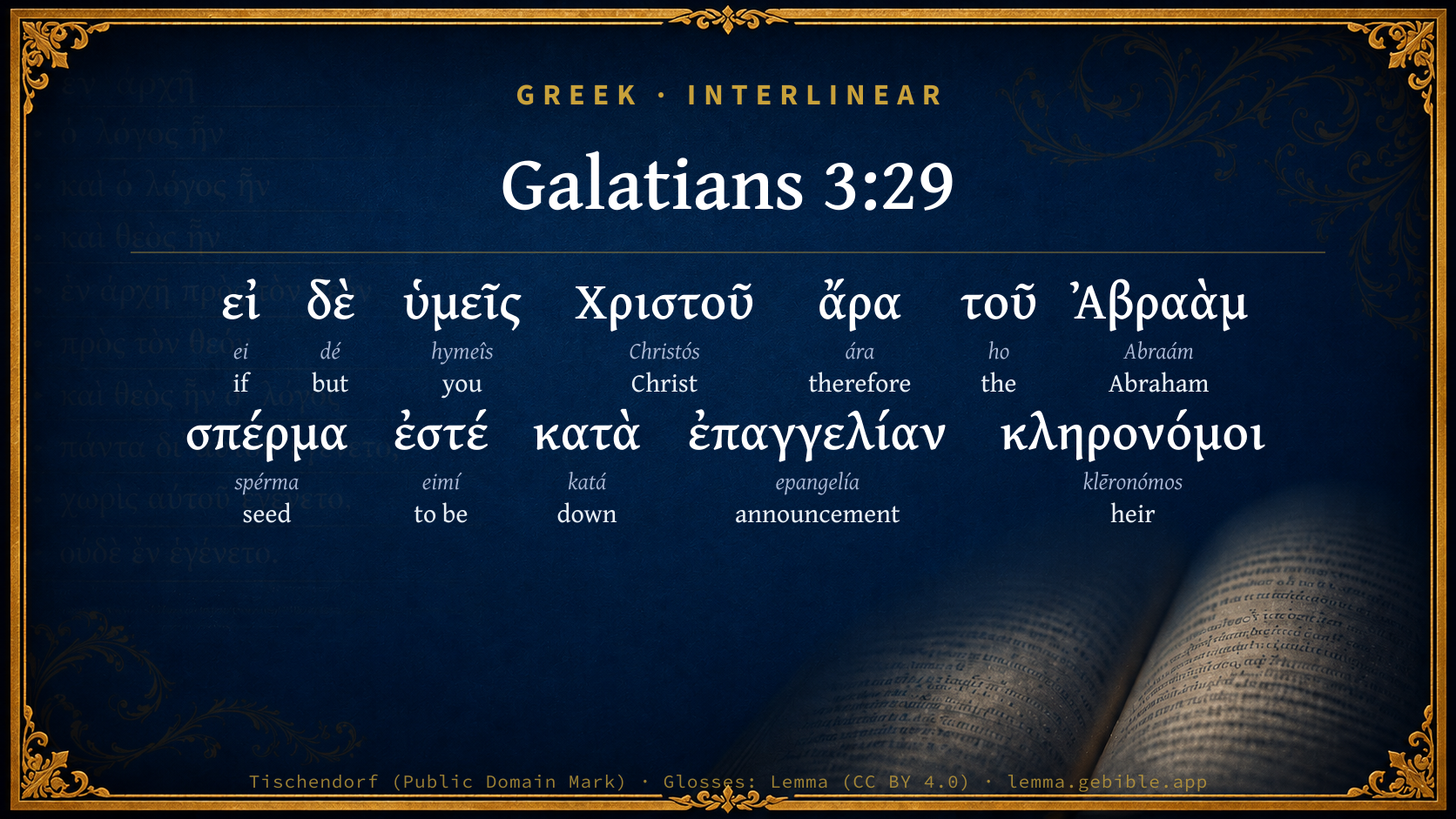
  1. εἰ ei G1487 “if” Conditional
  2. δὲ dé G1161 “but” Conjunction
  3. ὑμεῖς hymeîs G5210 “you” Personal pronoun, 2nd person, Nominative, Plural
  4. Χριστοῦ Christós G5547 “Christ” Noun, Genitive, Singular, Masculine
  5. ἄρα ára G686 “therefore” Particle
  6. τοῦ ho G3588 “the” Article, Genitive, Singular, Masculine
  7. Ἀβραὰμ Abraám G11 “Abraham” Noun, Proper, indeclinable
  8. σπέρμα spérma G4690 “seed” Noun, Nominative, Singular, Neuter
  9. ἐστέ eimí G1510 “to be” Verb, Present, Active, Indicative, 2nd person, Plural
  10. κατὰ katá G2596 “down” Preposition
  11. ἐπαγγελίαν epangelía G1860 “announcement” Noun, Accusative, Singular, Feminine

About this verse

These counts appear in no published source. They are computed here, from the morphology-tagged text and Lemma’s own curated glosses. What Lemma adds →

12
words
12
distinct lemmas
Pauline Epistles
section

Notable vocabulary

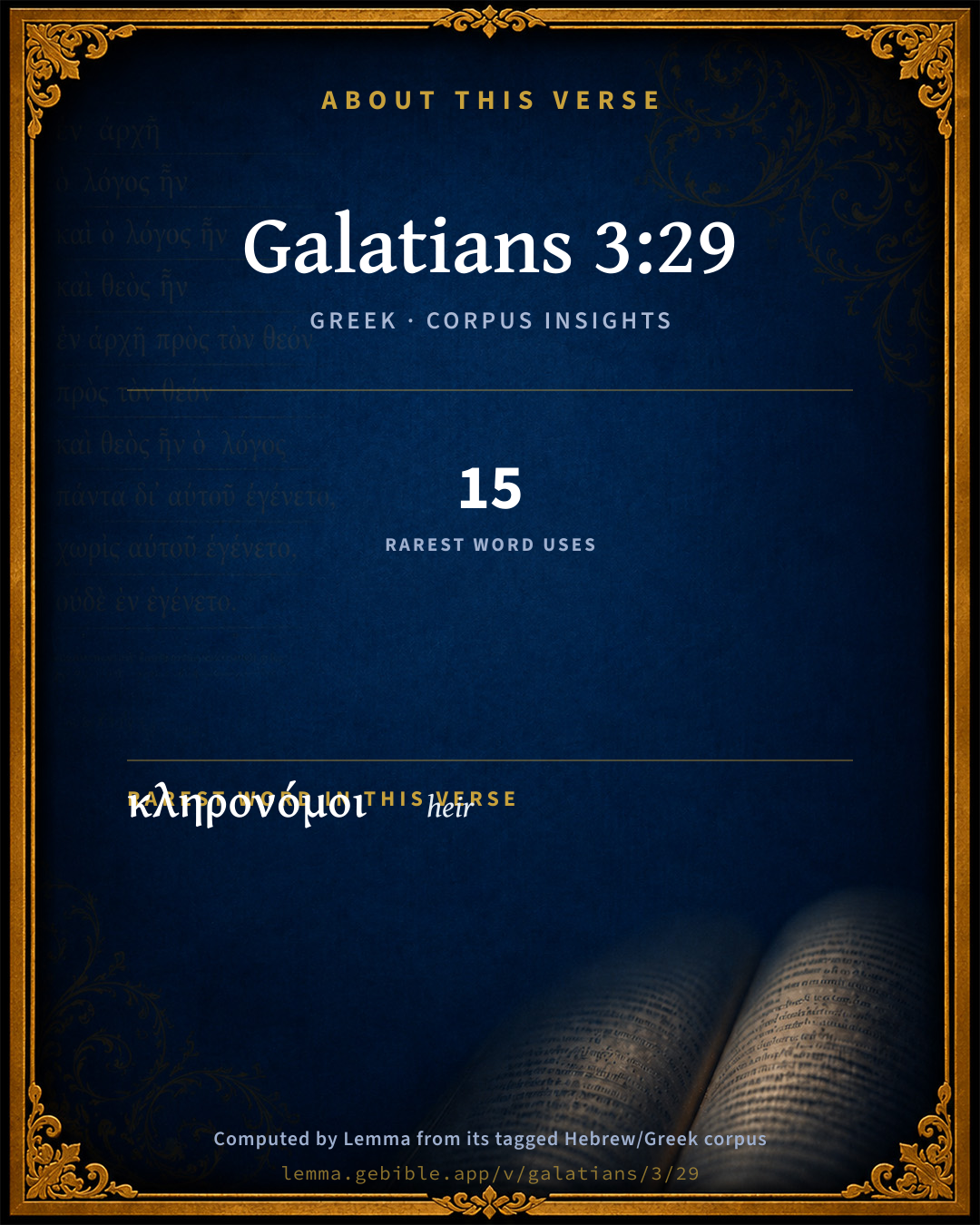
The rarest word here is κληρονόμοι heir G2818 — appearing just 15 times in the whole Greek New Testament.

Shared distinctive vocabulary

κληρονόμοι heir G2818 occurs in 14 verses of the Greek New Testament. Also found in:

Cross-references

22

Topical passages linked to Galatians 3:29 in the Treasury of Scripture Knowledge — connected by theme and wording, ordered by reader-vote popularity; previews shown in the World English Bible.

  • Ephesians 3:6 that the Gentiles are fellow heirs, and fellow members of the body, and fellow partakers of his promise in Christ Jesus through the Gospel,
  • Romans 9:7–8 Neither, because they are Abraham's seed, are they all children. But, "In Isaac will your seed be called."
  • Galatians 3:7 Know therefore that those who are of faith, the same are children of Abraham.
  • Romans 8:17 and if children, then heirs; heirs of God, and joint-heirs with Christ; if indeed we suffer with him, that we may also be glorified with him.
  • Romans 4:16–21 For this cause it is of faith, that it may be according to grace, to the end that the promise may be sure to all the seed, not to that only which is of the law, but to that also which is of the faith of Abraham, who is the father of us all.
  • Galatians 4:22–31 For it is written that Abraham had two sons, one by the handmaid, and one by the free woman.
  • Galatians 4:7 So you are no longer a bondservant, but a son; and if a son, then an heir of God through Christ.
  • Titus 3:7 that, being justified by his grace, we might be made heirs according to the hope of eternal life.
  • Romans 4:12–14 The father of circumcision to those who not only are of the circumcision, but who also walk in the steps of that faith of our father Abraham, which he had in uncircumcision.
  • James 2:5 Listen, my beloved brothers. Didn't God choose those who are poor in this world to be rich in faith, and heirs of the Kingdom which he promised to those who love him?
  • Revelation 21:7 He who overcomes, I will give him these things. I will be his God, and he will be my son.
  • 1 Corinthians 3:22–23 whether Paul, or Apollos, or Cephas, or the world, or life, or death, or things present, or things to come. All are yours,
  • 1 Corinthians 15:23 But each in his own order: Christ the first fruits, then those who are Christ's, at his coming.
  • 2 Corinthians 10:7 Do you look at things only as they appear in front of your face? If anyone trusts in himself that he is Christ's, let him consider this again with himself, that, even as he is Christ's, so also we are Christ's.
  • Galatians 3:16 Now the promises were spoken to Abraham and to his seed. He doesn't say, "To seeds," as of many, but as of one, "To your seed," which is Christ.
  • Galatians 5:24 Those who belong to Christ have crucified the flesh with its passions and lusts.
  • Hebrews 6:17 In this way God, being determined to show more abundantly to the heirs of the promise the immutability of his counsel, interposed with an oath;
  • Genesis 21:10–12 Therefore she said to Abraham, "Cast out this handmaid and her son! For the son of this handmaid will not be heir with my son, even with Isaac."
  • Galatians 3:28 There is neither Jew nor Greek, there is neither slave nor free man, there is neither male nor female; for you are all one in Christ Jesus.
  • Hebrews 1:14 Aren't they all ministering spirits, sent out to do service for the sake of those who will inherit salvation?
  • Hebrews 11:7 By faith, Noah, being warned about things not yet seen, moved with godly fear, prepared an ark for the saving of his house, through which he condemned the world, and became heir of the righteousness which is according to faith.
  • Hebrews 11:18 even he to whom it was said, "In Isaac will your seed be called;"

Cross-references courtesy of OpenBible.info (CC BY 4.0).

Commentary

Notes on Galatians 3:29 from classic Christian and Jewish commentators (each source and its license shown beneath its notes). The classic Christian expositions comment on the surrounding passage and are grouped to its opening verse, so a note may address several verses; the Jewish commentaries on the Tanakh (Rashi and others) are per-verse, so they appear only where the commentator wrote on this verse.

Lemma curates 59 commentaries, every one of them public domain or Creative Commons licensed, each selected and text-cleaned for this edition rather than reprinted as found. About our sources →

The Biblical Illustrator

Joseph S. Exell

Gal_3:25; Gal_3:29

For we are all the children of God by faith in Christ Jesus.

Liberty, equality, and fraternity

Liberty, equality, and fraternity, is the three-fold watchword of the masses in modern society. These words are written up in large characters on public buildings, and even on some of the churches, in France; and the ideas represented by them are held and aimed after by vast numbers in nearly every European country. What is meant by them?

(a) By Liberty is meant perfect freedom for the people to govern themselves, This is attainable, and, so far as political government is concerned, it has been attained by France, Great Britain, and other countries.

(b) By Equality is meant the abolition o! rank and title, whether hereditary or otherwise; to many it means socialism or communism--the abolition of personal property--the State becoming the sole proprietor and apportioner of the means of subsistence.

(c) By Fraternity is meant the realization of the feeling of true brotherhood as between man and man. Such are the ideas represented by the liberty, equality, and fraternity sought after by the world--a mixture of truth and error. True liberty, equality, and fraternity are only to be attained through the gospel being accepted and acted on throughout the world. This alone will stop the seethings of dissatisfaction, the upheavals of discontent, and the outbreaks of revolutionary passion.

I. True liberty is that which is enjoyed by the children of God.

1. Freedom from the condemnation of the law.

2. Freedom from the power of evil.

II. Equality in Jesus Christ. Not an equality subverting natural relations; these remain, but with a new spirit of light and love, constituting essential equality under circumstantial inequalities, so far as these are not inlaid in the very constitution of man as a social being.

1. In Christ there is no national inequality.

2. In Christ there is complete equality between master and servant.

3. Equality as between man and woman.

III. True fraternity. This is unattainable by political methods. It never yet has been, and never will be, reached by these means. Neither ancient nor modern republics have been able to secure true brotherhood among the members of the State, e.g., Athenian democracy, French and American Republics. Only the gospel of Jesus Christ can make us true brothers, as descended from the same parent, heirs of the same inheritance, and hence possessed of a spirit of true fraternal affection towards each other. Not necessarily do Christians always agree in their opinion on indifferent points; nor do they see fundamental questions always from the same standpoint--one seeing the matter according to his own God-given mental peculiarities, another according to his, and so on; but, amid all differences of opinion, they are one in true brotherly affection, sympathy, and aim. This is the real tendency and intention and aim of Christianity, however far we may at present fall short of it. What we can now see only in part, will one day be perfected, for our citizenship, our commonwealth, is in heaven. (W. Spensley.)

True believers the children of God

I. Consider the sonship of believers under the gospel.

1. In common with the other intelligent creatures of God (Act_17:29).

2. By external profession (Hos_11:1; Mat_2:15).

3. Their sonship consists chiefly in their regeneration and adoption.

4. This sonship is not a mere title or mark of distinction, but has privileges the most excellent annexed to it. There is no condemnation to them. They are His temples. Led by His spirit. Abiding in their Fathers house, heart, love. They have a title to incorruption and immortality (Rom_8:23). They are born to a great inheritance (Rom_8:17; Psa_16:5).

5. This sonship is equally the privilege of every believer in Christ. They may be distinguished from each other, as to external circumstances in life, spiritual gifts and graces, etc., but their filial relation is the same.

6. It is a privilege of which they are conscious, and hence they enjoy the comfort of it (Gal_4:6).

II. How it is that they attain to this privilege and dignity. The text says, by faith in Christ Jesus. To illustrate this, it may be proper to recollect--

1. That in the state of primitive innocence, Adam was truly the son of God: he resembled God (Gen_1:27). This resemblance was effaced by sin; his former relation of sonship to God then ceased, and he was turned out of Gods family and garden as a rebel, while he and his numerous progeny became children of disobedience and wrath.

2. It is by faith, or a supernatural revelation only, that we are informed how this high prerogative may be regained. This surpasses the capacity of the wisest philosopher, and even of angels. It is brought to light by the gospel (Gal_4:4-5).

3. We become the children of God, when we cordially believe in Christ: we are thereby brought into union with Christ and into a relation of sonship with the Father (Joh_1:12). Concluding exhortation:

1. Be astonished, ye heavenly principalities and powers, to see such base-born slaves and rebellious creatures taken into the family of God. Unmeasurable love! Infinite honour!

2. Forget not the love, duty, submission, and service, resulting from this relation.

3. How insipid, alas I are such themes as this to the generality even of gospel hearers. Show them how to acquire a fortune, etc., and they will be all attention; but publish the riches of Gods gracious adoption, they relish it not. Blinded sinner, what a fatal choice! Naught can avail thee in the long run, but this. Claim thy adoption, and live as a child of God. (Theological Sketch Book.)

All children of God by faith in Christ Jesus

I. A wonderful and an inexplicable privilege. What an honour (Pro_17:6)! What an advantage (Rom_8:17)! In this name we have--

1. A spiritual right to all the creatures of God (1Co_3:21-23).

2. An interest in God Himself (Isa_49:15-16; 1Jn_4:16).

3. The service and guardianship of angels (Psa_91:11; Mat_18:10; Heb_1:14).

4. A certain and infallible claim to eternal glory (Col_1:12; Mat_25:34).

II. The means of the enjoyment of this privilege.

1. This privilege is not natural to man. By nature we are

(1) children of this world (Luk_16:8); or worse,

(2) a seed of falsehood (Isa_57:4); or yet worse,

(3) children of unrighteousness and darkness (1Th_5:5); or yet worse,

(4) sons of wilful disobedience (Eph_2:3); or worst of all,

(5) children of wrath (Eph_2:2).

2. This enjoyment may be obtained by

(1) Adoption (Eph_1:5);

(2) Regeneration; not of water only, so we are all sacramentally regenerated; but of the Holy Ghost (Joh_1:12-13; Joh_3:5).

3. Union with Christ (2Co_5:17; 1Co_4:15; Jam_1:18).

4. By means of faith as saith the text.

III. How shall we know that we enjoy this privilege. Every child of God is--

1. Like his Father (1Pe_1:15-16);

(1) He is merciful; are we cruel?

(2) He is righteous; are we unjust?

(3) He is slow to anger; are we furious?

(4) He is abhorrent of evil; do we take pleasure in wickedness?

2. Bears a filial answering to a paternal love.

3. Reverences his Father (Mal_1:6).

4. Is obedient to his Father.

5. But beyond this there is the witness and guidance of the Holy Spirit of our Father. (Bishop Hall.)

The means of Christian sonship

A man has faith in God as the Creator of the universe, as the Father of man, as the moral Ruler of the world; but that is not what is meant by the faith that admits into the saved family. A man may assure himself that he has scientific ground for his faith in theism, but that is a long way from the faith that saves the soul. To put faith in manhood, or kinghood, or pope, or progress, or church, or creed, as the object of faith is simply to divert the mind from that which saves. Faith in the beautiful, the good, the nobler aspects of the race, in the poetry and yearnings of the higher humanitarianism, are interesting things to talk about; but to put them forth as the dark passages through which men are to find their way into the family, is to shut the door of hope in the face of the great sinning, sorrowing, race. Not without meaning is Fichtes despair of raising men into the blessed life since they are so far beneath the reach of his philosophy. But Paul here opens the door of hope, and shows how any man may become a new child of God. (Mitchell.)

The vastness of the Christian family

No man ever wrought to make the world better that was not my brother. No man ever laboured to exemplify the coming manhood, that was not kindred to me. Whatever nation he belonged to he belonged to my nation. Whatever language he spoke, he spoke my language. Whatever sphere he wrought in was my sphere. Whether he was crowned or uncrowned, he was of my lineage. I own him; and if he is saved he owns me. And all over the world, there are no spirits bearing and enduring with fortitude and cheerfulness in obscurity that are not my unknown relations. My Father has an enormous family, for my Father is God. My eldest brother is named Jesus Christ, and the relationships which spring out of this Fatherhood and this Brotherhood--how many they are! Wherever men are denying themselves for rectitude, and enduring for that which is just and true, and living courageously for the right, and exemplifying purity and sweetness, and diffusing happiness-these are the children of God by faith in Christ Jesus, and our brethren. (H. W. Beecher.)

Safety by trusting Christ

A man was fleeing from some men who desired to rob and kill him. He came to a wide gulf, over which there was only a slender plank for a bridge. It looked too weak to bear him, so that there seemed only a choice of the kind of death open to him. What was he to do? Death behind! Death in front by a fearful fall! While his mind was wavering as to his right course, he saw a strong, heavy man on the opposite side, who shouted. Come over, man! I crossed the plank safely; I am heavier than you are. When it has borne me it will bear you: Similarly, Christ is our plank of safety across the gulf of damnation. He has borne my sins, therefore He can and will bear yours.

Jesus the only Saviour

A person asked me the other day whether I had seen a book entitled, Sixteen Saviours. I answered, No, I have not, and I do not want to know of sixteen saviours, I am satisfied with one. If all who dwell in heaven and earth could be made into saviours, and the whole were put together, you might blow them away as a child blows away thistle-down, but there is this one Saviour, the Son of Man, and yet the mighty God, and He cannot be moved. Joy then, my brethren, and rejoice in your blessed Lord. (C. H. Spurgeon.)

Gal_3:29

And if ye be Christs then are ye Abrahams seed, and heirs according to the premise.

Abrahams spiritual seed

If the life we have in the flesh were all we had to provide for, they might be accounted the happiest of mankind who possess in the greatest abundance the means of sustaining it in health and comfort who can--as one of whom Jesus speaks in parable, proposed to do--take their ease, eat, drink, and be merry, because they have much goods laid up for many years. Who then is to be regarded as truly favoured and blest among the children of men? There is a class, few of whom may have been born to opulence in this world, or have any prospect of ever becoming rich in the goods of time; a class whose peculiar possessions may be little coveted or admired by those around them; for the world knoweth them not. Yet with them, if we were true for ourselves, we would desire to have our lot assigned; for they alone have an inheritance that can supply the wants of the immortal spirit, and endure while its being lasts. They are the persons spoken of in our text. Those who are Christs, and therefore Abrahams seed, and heirs according to the promise. To be Christs is to belong to Him, as those who have given themselves to Him, come under His government and guidance, placed themselves at His disposal, and whom He hath taken for His own, redeeming them from all iniquity, purifying them to Himself. But there is more than this. They are in Him, and He is in them, by a spiritual and vital union formed between them; so they may be regarded as members of His body, of His flesh, and of His bones. He that is thus joined to the Lord is one spirit with Him. Now, if ye be Christs in this sense, then are ye Abrahams seed. They have an inheritance. All the promises of God, the promises of the covenant made with Abraham, are in Christ yea, and in Him amen; and they who are Christs must therefore have an interest in them all.

1. Their inheritance is one which is freely given them of God, or gratuitously bestowed. This may be said of all the gifts of God to His creatures. For who hath first given to Him, and it shall be recompensed to him again? Angels do not possess their thrones of light as the merited reward of service rendered to the Great Supreme. Man in innocence, though he held that fair paradise in which he dwelt, and all its happy fruits, by the tenure of his obedience, could not have been said to have won for himself, as due for that obedience, even had he continued in it, that which was justly forfeited by transgression. It is still more manifest in regard to those of his fallen race, who are constituted heirs according to the promise of an eternal inheritance, that the change effected in their state and prospects must be wholly of grace.

2. It is an inheritance which is spiritual in its character. It includes in it, indeed, the means of temporal subsistence; the things needful for the body. But these, only in as far as they may be subservient to spiritual and eternal interests. The good promised, however, does not lie altogether without themselves, in the abundance of the things they shall possess in the land of their habitation. It is rather an exaltation and enlargement of their own being. The Spirit of promise is the earnest of the inheritance now; and there is nothing of an earthly or carnal nature in what He imparts as a pledge and foretaste of its delights. Wisdom, and purity, and love, are His fruits.

3. That it is yet future and unseen. They who are heirs according to the promise have the inheritance in prospect, not in full possession. They hope for what they see not. They are under tutors and governors, until the time appointed of the Father for their entering on the enjoyment of that for which His discipline is preparing them.

4. It will be satisfying and eternal. How striking in these respects is the difference between it and every earthly inheritance! The inheritance of those who are heirs according to the promise is incorruptible, and undefiled, and fadeth not away. The gold and the silver which are so much coveted here are reckoned by the apostle among corruptible things, but this inheritance cannot be marred or vitiated; neither moth nor rust will ever tarnish its beauty or embitter its sweetness; nothing shall enter into that world, that better and heavenly country where it lies, that defileth, or that worketh abomination, or maketh a lie. Holiness and happiness shall there be felt to be but different names for the same thing, or shall be found in indissoluble and blissful union.

5. It is infallibly secured to those who are heirs according to the promise. He is faithful who hath promised it. He who cannot lie, the apostle tells us, promised it before the world began. We trust you have been already examining yourselves.

Yet we may offer a few suggestions further on a subject which at no season can be without its interest to those who would know whether they be in the faith.

1. We may say that they who are heirs according to the promise may be distinguished by the foundation on which they rest their hope of the inheritance. This is not any worth or goodness of their own, not any compensation they have to make for past offences, by contrition for sin and amendment of life, not any gifts or offerings they have to present to God in order to conciliate His favour. It is the promise itself which secures the inheritance to all who are persuaded of it and embrace it. But the promise is in Christ Jesus.

2. They may be distinguished by their regards to the inheritance itself. The character of that inheritance is spiritual, but we are by nature carnal, sold under sin. We have no delight in holy exercises; no desire to know, and see, and dwell with God. A great change must take place in our dispositions before we can derive any satisfaction from the society of saints in light, from fellowship with Jesus, the Holy One of God, from the felt presence of the Father of our spirits. He can no otherwise bless us but by turning us away from our iniquities.

3. They who are heirs according to the promise may be distinguished by the influence which the hope of the inheritance has on their tempers and conduct. (J. Henderson, D. D.)

Christian privileges

I. To be Christs, i.e., to belong to Him as members of His body.

1. The means. Faith makes us one with Christ.

2. The immediate benefits--

(1) love;

(2) care;

(3) protection (Eph_5:29-30).

II. In Christ to be Abrahams seed.

1. The Jews and all legalists have despised their birthright and broken away from Abraham.

2. Christ is the true seed of Abraham (Gal_3:16), and those who are one with Christ by faith become the same through Him. Note

(1) the antiquity;

(2) the nobility of the Christians ancestry.

III. As Abrahams seed, to be heirs of Abrahams promise.

1. Of the Spirit (Gal_3:14), which is the earnest of the inheritance.

2. The full enjoyment of the inheritance in heaven. The Use: Believers should

(1) Be content with any earthly estate. In this regard Abraham was content to forsake his country (Heb_11:8-9).

(2) Be moderate in their earthly cares, and not live as drudges in the world.

(3) Have a care for heaven in comparison with which the things of this world are trifles. This did Abraham (Heb_11:15-16). (W. Perkins.)

Believers heirs of God

When the Danish missionaries stationed at Malabar set some of their converts to translate a Catechism, in which it was asserted that believers became the sons of God, one of the translators was so startled that he suddenly laid down his pen, and exclaimed, It is too much: let me rather render it, They shall be permitted to kiss His feet!

The Biblical Illustrator, edited by Joseph S. Exell (c. 1880s–1900s) — public domain. Text from a community e-Sword module.

Tyndale Open Study Notes

Tyndale Open Resources

3:29 Because Christ is the ideal descendant of Abraham (3:16), it follows that those who are one with Christ (3:27-28) are children of Abraham and heirs of all that was promised to him.

Tyndale Open Study Notes — © Tyndale Open Resources, licensed CC BY-SA 4.0. Text via the HelloAO Bible API.

Bengel's Gnomon

Johann Albrecht Bengel

Gal 3:29. Ἆρα, therefore) Christ sanctifies the whole posterity of Abraham.—ἐπαγγελίαν, the promise) given to Abraham.

—————

Bengel's Gnomon of the New Testament — English translation (T&T Clark, Edinburgh, 1860) — public domain. Text from a community e-Sword module.

Meyer's Critical & Exegetical Commentary

Heinrich August Wilhelm Meyer

Gal_3:29. But by your thus belonging to Christ ye are also Abrahams posterity: for Christ is indeed the σπέρμα Ἀβ. (Gal_3:16), and, since ye have entered into the relation of Christ, ye must consequently have a share in the same state, and must likewise be Abrahams σπέρμα; with which in conformity to the promise is combined the result, that ye are heirs, that is, that ye, just like heirs who have come into the possession of the property belonging to them, have as your own the salvation of the Messianic kingdom promised to Abraham and his seed (the realization of which is impending).

δέ] drawing a further inference, so that, after the explanation contained in Gal_3:28, εἰ δὲ ὑμεῖς Χριστοῦ in point of fact resumes the Χριστὸν ἐνεδύσασθε of Gal_3:27. The emphatic ὑμεῖς has as its background of contrast the natural descendants of Abraham, who as such do not belong to Christ and therefore are not Abrahams σπέρμα.

τοῦ Ἀβρ.] correlative to Χριστοῦ, and emphatically prefixed. Ye are Abrahams seed, because Christ is so (Gal_3:16), whose position has become yours (Gal_3:27). Comp. Theodoret and Theophylact.

κατʼ ἐπαγγ.] for τῷ Ἀβρ. ἐῤῥήθησαν αἱ ἐπαγγελίαι καὶ τῷ σπέρματι αὐτοῦ, Gal_3:16. It is true that this σπέρμα in Gal_3:16 is Christ: but Christians have put on Christ (Gal_3:27), and are altogether one in Christ (Gal_3:28); thus the κατʼ ἐπαγγ. (in conformity with promise) finds its justification. But the emphasis is laid, not on κατʼ ἐπαγγ. as contrasted with κατὰ νόμον (Baumgarten-Crusius, Ewald, Wieseler), or with another order of heirs (Hofmann), or with natural inheritance (Reithmayr), but on κληρονόμοι, which forms the link of connection with the matter that follows in ch. 4, and both here and at Gal_4:7 constitutes the important key-stone of the argument. This κληρονόμοι is the triumph of the whole, accompanied with the seal of divine certainty by means of κατʼ ἐπαγγ.; the two together forming the final death-blow to the Judaistic opponents, which comes in all the more forcibly without καί (see critical notes). The alleged contrast was obvious of itself long before in the words σπέρμα τοῦ Ἀβρ. (comp. Gal_3:18). The article was no more requisite than in Gal_3:18.

κληρονόμοι] The connection with the sequel shows, that the sense of heir is intended here. Τοῦ Ἀβρ. is not, however, to be again supplied to κληρονόμοι, as might be inferred from σπέρμα; but, without supplying a genitive of the person inherited from, we have to think of the κληρονομία of the Messianic salvation. Comp. Rom_8:17. Against the supplying of τοῦ Ἀβρ. we may decisively urge not only the sequel, in which nothing whatever is said of any inheriting from Abraham, but also κατʼ ἐπαγγ. For if Paul had wished to express the idea that Christians as the children of Abraham were also the heirs of Abraham, the κατʼ ἐπαγγ. would have been inappropriate; because the promise (Gal_3:16) had announced the heirship of the Messianic kingdom to Abraham and his seed, but had not announced this heirship in the first instance to Abraham, and then announced to his seed in their turn that they should be Abrahams heirs.

Meyer — Critical and Exegetical Commentary on the New Testament — English translation by Peter Christie, edited by Frederick Crombie (T&T Clark, 1880) — public domain. Text from a community e-Sword module.

Expositor's Greek Testament

ed. W. Robertson Nicoll

Gal 3:29 . ὑμεῖς . The emphatic insertion of ὑμεῖς before Χριστοῦ in preference to Χριστοῦ ἐστέ lays stress apparently on the wonderful transformation of men who had been aliens from the people of God into members of Christ.

The Expositor's Greek Testament, edited by W. Robertson Nicoll (1897–1910) — public domain. Text from a community e-Sword module.

Jamieson, Fausset & Brown

Robert Jamieson, A. R. Fausset & David Brown

and heirs--The oldest manuscripts omit "and." Christ is "Abraham's seed" (Gal 3:16): ye are "one in Christ" (Gal 3:28), and one with Christ, as having "put on Christ" (Gal 3:27); therefore YE are "Abraham's seed," which is tantamount to saying (whence the "and" is omitted), ye are "heirs according to the promise" (not "by the law," Gal 3:18); for it was to Abraham's seed that the inheritance was promised (Gal 3:16). Thus he arrives at the same truth which he set out with (Gal 3:7). But one new "seed" of a righteous succession could be found. One single faultless grain of human nature was found by God Himself, the source of a new and imperishable seed: "the seed" (Psa 22:30) who receive from Him a new nature and name (Gen 3:15; Isa 53:10-11; Joh 12:24). In Him the lineal descent from David becomes extinct. He died without posterity. But He lives and shall reign on David's throne. No one has a legal claim to sit upon it but Himself, He being the only living direct representative (Eze 21:27). His spiritual seed derive their birth from the travail of His soul, being born again of His word, which is the incorruptible seed (Joh 1:12; Rom 9:8; Pe1 1:23).

Next: Galatians Chapter 4

Jamieson, Fausset & Brown — Commentary Critical and Explanatory on the Whole Bible (1871) — public domain (CC PDM 1.0). Text via the HelloAO Bible API.

Adam Clarke's Commentary

Verse 29. And if ye be Christ's] Or, as several good MSS. read, If ye be one in Christ. If ye have all received justification through his blood, and the mind that was in him, then are ye Abraham's seed; ye are that real, spiritual posterity of Abraham, that other seed, to whom the promises were made; and then heirs, according to that promise, being fitted for the rest that remains for the people of God, that heavenly inheritance which was typified by the earthly Canaan, even to the Jews.

1. THE Galatians, it appears, had begun well, and for a time run well, but they permitted Satan to hinder, and they stopped short of the prize. Let us beware of those teachers who would draw us away from trusting in Christ crucified. By listening to such the Galatians lost their religion.

2. The temptation that leads us astray may be as sudden as it is successful. We may lose in one moment the fruit of a whole life! How frequently is this the case, and how few lay it to heart! A man may fall by the means of his understanding, as well as by means of his passions.

3. How strange is it that there should be found any backslider! that one who once felt the power of Christ should ever turn aside! But it is still stranger that any one who has felt it, and given in his life and conversation full proof that he has felt it, should not only let it slip, but at last deny that he ever had it, and even ridicule a work of grace in the heart! Such instances have appeared among men.

4. The Jewish covenant, the sign of which was circumcision, is annulled, though the people with whom it was made are still preserved, and they preserve the rite or sign. Why then should the covenant be annulled? This question admits a twofold answer.

1. This covenant was designed to last only for a time, and when that time came, having waxed old, it vanished away.

2. It was long before that void, through want of the performance of the conditions.

The covenant did not state merely, ye shall be circumcised, and observe all the rites and ceremonies of the law; but, ye shall love the Lord your God with all your heart, soul, mind, and strength, and your neighbour as yourself. This condition, which was the very soul of the covenant, was universally broken by that people. Need they wonder, therefore, that God has cast then off? Jesus alone can restore them, and him they continue to reject. To us the new covenant says the same things: Ye shall love the Lord, c. if we do not so, we also shall be cut off. Take heed, lest he who did not spare the natural branches, spare not thee; therefore, make a profitable use of the goodness and severity of God.

Adam Clarke's Commentary on the Bible (1810–1826) — public domain. Text from a community e-Sword/MySword module.

John Calvin's Commentaries

29. Then are ye Abraham’s seed. This is not intended to convey the idea, that to be a child of Abraham is better than to be a member of Christ, — but to repress the pride of the Jews, who gloried in their privilege, as if they alone were the people of God. They reckoned no distinction higher than to belong to the race of Abraham; and this very distinction he makes to be common to all who believe in Christ. The conclusion rests on this argument, that Christ is the blessed seed, in whom, as we have said, all the children of Abraham are united. He proves this by the universal offer of the inheritance to them all, from which it follows, that the promise includes them among the children. It deserves notice, that, wherever faith is mentioned, it is always his relation to the promise.

John Calvin's Commentaries (1540-1563) — public domain. Text from the Calvin Translation Society English edition (1840s-50s) via the Christian Classics Ethereal Library (ccel.org). Calvin's coverage is partial (roughly two-thirds of the Bible); uncommented books and verses are honest gaps, never fabricated. The 19th-century editor's footnotes and remarks are omitted so the notes are faithfully Calvin's own voice.

Ellicott's Commentary for English Readers

(29) Conclusion of the whole argument. The followers of the Messiah are the true seed of Abraham. The kingdom of the Messiah, which they possess, is the promised inheritance.

A Bible Commentary for English Readers, edited by Charles John Ellicott (1878–1897) — public domain. Text from a community e-Sword module.

The Cambridge Bible for Schools and Colleges

gen. ed. J. J. S. Perowne

29. If ye be Christ’s] If ye are by faith incorporated into Christ, the promised Seed, then by virtue of that living union ye are yourselves Abraham’s seed. The paraphrase of Theod. Mops. is remarkable: ‘If ye are Christ’s by reason of regeneration in Baptism, typifying your future likeness to Him, and if Christ is Abraham’s seed, it follows of necessity that you also, being His body, are the seed of the same ancestor as He is, and consequently heirs too of the promise’.

Christ’s] Our Lord Himself used this expression (Mar_9:41) to describe His disciples. The blessed privilege may be abused, and vaunted in a spirit of sectarian rivalry (1Co_1:12); but to ‘belong to Christ’ is the high dignity and the eternal security of every believer (1Co_3:23). The Apostle has established the assertion of Gal_3:7 that believers are the true children of Abraham and heirs of the promise. ‘Union with Christ constitutes the true spiritual descent from Abraham, and secures the inheritance of all the Messianic blessings by promise, as against inheritance by law’. Dr Schaff.

The Cambridge Bible for Schools and Colleges (gen. ed. J. J. S. Perowne; Cambridge University Press, 1878–1918) — public domain. Text from a community e-Sword module.

John Gill's Exposition

For if ye be Christ's,.... Or seeing ye are his, not by creation only, but by the Father's gift to him, by the purchase of his own blood, by the power of his grace, making them willing to give up themselves to him; not only his by profession, saying they are the Lord's, calling themselves by his name; but by possession, Christ dwelling in their hearts by faith, and they having his Spirit as a spirit of regeneration and adoption:

then are ye Abraham's seed; not his natural but his spiritual seed, the seed that should come, and to whom the promises were made, Gal 3:16 and so were upon an equal foot even with the Jews that believed:

and heirs according to the promise; being the children of God, they are heirs of God; and being the spiritual children of Abraham, the children of the promise, which are counted for the seed, they are, according to the promise made to Abraham and his spiritual seed, heirs of the blessings of the grace of life, and of the eternal inheritance; of the blessing of justification of life, and of everlasting salvation; of this world and of the world to come; of all the spiritual blessings of the covenant of grace, and of the incorruptible and undefiled inheritance of the saints in light; to which they are begotten through the abundant mercy of God, for which they are made meet by the grace of Christ; and to which they have a right by his justifying righteousness.

Next: Galatians Chapter 4

John Gill's Exposition of the Whole Bible (1746–1763) — public domain (CC PDM 1.0). Text via the HelloAO Bible API.

Trapp's Complete Commentary

John Trapp

29 And if ye be Christ’s, then are ye Abraham’s seed, and heirs according to the promise.

Ver. 29. Heirs according] Heirs are kept short in their under age, and sometimes forced to borrow of servants; but when once at years, they have all. So shall the saints in heaven, though here hard put to it.

John Trapp, A Commentary or Exposition upon All the Books of the Old and New Testament (1647–1656) — public domain. Text from a community e-Sword module.

Albert Barnes' Notes on the Bible

And if ye be Christ’s - If you belong to the Messiah, and are interested in his work.

Then are ye Abraham’s seed - The promise made to Abraham related to the Messiah. It was a promise that in him all should be blessed. Abraham believed in that Messiah, and was distinguished for his faith in him who was to come. If they believed in Christ, therefore, they showed that they were the spiritual descendants of Abraham. No matter whether they were Jews or Gentiles; whether they had been circumcised or not, they had the same spirit which he evinced, and were interested in the promises made to him.

And heirs according to the promise - See Rom 8:17. Are heirs of God. You inherit the blessings promised to Abraham, and partake of the felicity to which he looked forward. You have become truly heirs of God, and this is in accordance with the promise made to Abraham. It is not by the obedience of the Law; it is by faith - in the same way that Abraham possessed the blessing; an arrangement before the giving of the Law, and therefore one that may include all, whether Jews or Gentiles. All are on a level; and all are alike the children of God, and in the same manner, and on the same terms that Abraham was.

Albert Barnes' Notes on the Bible (1834–1885) — public domain. Text from a community e-Sword/MySword module.

Matthew Poole's English Annotations

Lest these Galatians should be discouraged, because the promise was made to Abraham and his seed, and they were not the seed of Abraham; he tells them, if they were Christ’s, that is, if they truly believed in him, and were implanted into him, that then they were the seed of Abraham, that seed to which the promise was made; and though not heirs of Abraham according to the flesh, yet heirs according to the promise: see Rom 9:7,8.

Matthew Poole's English Annotations on the Holy Bible (1683–1685) — public domain. Text from a community e-Sword/MySword module.

Whedon's Commentary on the Bible

Daniel D. Whedon

29. Abraham’s seed… the promise—The promise in the Abrahamic covenant. See notes on Gal_3:16-18.

Daniel D. Whedon (gen. ed.), Commentary on the Old and New Testaments (1874–1909) — public domain. Text from a community e-Sword module.

The Pulpit Commentary

And if ye be Christ"s (eij de uJmeiv Cristou); and if ye are Christ"s. The de simply marks a fresh stage in the argument, as e.g. Rom_8:17, eij dekna kaimoi. For the preceding verse is no digression, requiring us to render this de "but," but simply an amplification of the notion of putting on Christ in ver. 27; and the present clause recites that previous conclusion, to serve for a premiss to a further conclusion. "Are Christ"s;" comp. 1Co_3:23, "And ye are Christ"s, and Christ is God"s." This genitive here, as also there, denotes the closest and most intimate approximation conceivable, "Christ"s own;" covering, in fact, the notion of being clothed with Christ; and expresses what that "one and the same man" is, which according to ver. 28 in Christ Jesus all had become. Comp. ra Tit_2:14, laosion, "a people of his very own." Then are ye Abraham"s seed (a tou jAbraarma ejste); then seed of Abraham are ye. "Ye," Gentiles though ye be. In ver. 7 the apostle has affirmed that they who are of faith are sons of Abraham; in ver. 16, that the promises were made to Abraham and "his seed, which is Christ." We have seen that in that ver. 16 "Christ" appears to mean that branch of Abraham"s offspring which was, so to speak, to proceed from Christ and was to be called by his name. If, however, "Christ" be there taken to mean the individual Son of Abraham, Jesus, then those who believe in him and have been baptized into him are to be understood as here affirmed to be "Abraham"s seed," because, being clothed with Christ. they share his position. The same result is arrived at either way. And heirs according to the promise kai which word is rejected by recent editors kat ejpaggelian klhronomoi; heirs in pursuance of a promise. "Heirs," not of Abraham, but of God; for the notion connects itself with that of the sonship to God, which has been predicated in ver. 26 of believers in Christ; and these two united conceptions form the topic of the first seven verses of the next chapter. This is in accordance with Rom_8:16, Rom_8:17, "We are children of God; and if children, also heirs; heirs of God, joint-heirs with Christ." It goes upon the same lines of thought as the statement made above in ver. 16, that the promises were spoken, not to Abraham only, but also to his seed as well; the seed being conceived of by the apostle, not as inheriting from Abraham, but as holding an independent position of their own at his side. The benefits accruing to them have been styled "the inheritance" in ver. 18, which verse also serves to illustrate the spirit of the clause now before us, by affirming that the inheritance was a free gift of God conveyed by a promise, and not one to be either gained or made sure by obedience to a ceremonial law as the Galatians were in danger of supposing. The article is wanting before "promise" here, as it was also in ver. 18; because the apostle is not thinking immediately of the terms of the promise, but rather of its distinctive character as a promise, betokening a free gift of God. The inheritance is no doubt the adoption of sons, both in its firstfruits in this life and in its complete manifestation hereafter in the bliss and glory of heaven (Rom_8:23, Rom_8:30; 1Pe_1:4)

The heirs.

if ye be Christ"s, then are ye Abraham"s seed, and heirs according to the promise." Mark how the apostle moves from point to point.

I BELIEVERS ARE CHRIST"S POSSESSION. They are so:

1. By gift. "Thine they were, and thou gavest them me". (Joh_17:6)

2. By purchase. "Ye are bought with a price". (1Co_6:20)

3. By conquest. "The people shall be willing in the day of thy power". (Psa_110:3)

4. By their own self-surrender. They are "a living sacrifice." They have"committed themselves to him". (2Ti_1:12)

II CHRIST"S PEOPLE ARE ABRAHAM"S SEED. Christ himself is Abraham"s Seed (ver. 16), and therefore they, as one with him in the mystical union, are Abraham"s seed.

III THE HEIRSHIP OF PROMISE. They became heirs, not by any legal observances, but according to the promise made to Abraham.

1. The inheritance is the only one worth having.

2. It is the only one that can be kept for ever.

3. It is, unlike earthly riches or honours, within everybody"s reach.

4. It is the duty of heirs to live according to their prospects, to walk worthyof a Father"s house, and to behave like a brother to brethren.

The Pulpit Commentary (1880–1919), ed. H.D.M. Spence-Jones & Joseph S. Exell — public domain. Text from a community e-Sword module.

John Wesley's Explanatory Notes

If ye are Christ's - That is, believers in him.

John Wesley, Explanatory Notes Upon the Whole Bible (1754–1765) — public domain. Text via the GEBible commentary corpus.

Luther on Galatians

Martin Luther

VERSE 29. And if ye be Christ’s, then are ye Abraham’s seed, and heirs according to the promise.

"If ye be Christ’s" means, if you believe in Christ. If you believe in Christ, then are you the children of Abraham indeed. Through our faith in Christ Abraham gains paternity over us and over the nations of the earth according to the promise: "In thy seed shall all the nations of the earth be blessed." Through faith we belong to Christ and Christ to us.

Martin Luther — Commentary on the Epistle to the Galatians (1535), English translation by Theodore Graebner (Zondervan, 1939) — public domain (U.S. copyright not renewed). Text from a community e-Sword module.

Burkitt's Expository Notes on the New Testament

William Burkitt

That is, "If ye be Christ’s servants and subjects, then are ye the true seed of faithful Abraham, and heirs of the blessing, according to the promise made to him and to his seed." This our apostle asserts, in opposition to the false apostles, who maintained, that there could be none tryly reputed Abraham’s seed, except they were circumcised, and subjected themselves to the law of Moses: "Yes, says the apostle, if ye be Christ’s, and by baptism ingrafted into him, you are the true children of Abraham, though ye be not circumcised; yea, you are heirs apparent of the heavenly inheritance given unto Abraham by promise."

Learn hence, that all sincere and serious Christians are Abraham’s spiritual seed, children of his faith, though not of his flesh; and being the children of his faith, are heirs together with him of the same promises. If ye be Christ’s, that is, sincere and serious Christians, then are ye Abraham’s seed, and heirs according to the promise.

William Burkitt's Expository Notes on the New Testament (1700–1703) — public domain. Text from a community e-Sword module.

McGarvey & Pendleton's Commentaries

J. W. McGarvey

And if ye are Christ's, then are ye Abraham's seed, heirs according to promise . [The promise was given to Christ, the seed of Abraham, and if ye are Christ's, then are ye in him heirs of that promise. Thus Paul demonstrates that the gospel privileges are not obtained by the law, but by the gospel system of justification through faith, which gospel system was promised equally to all nations, and may be enjoyed by them all without any racial or less distinctions.]

J. W. McGarvey (with Philip Y. Pendleton), Commentaries on the New Testament (The Fourfold Gospel, 1914; Acts; and the epistles) — public domain. Text from a community e-Sword/MySword module.

The People's New Testament

B. W. Johnson

29. If ye be Christ's. As Christ is the seed of Abraham, all in Christ become the spiritual seed of Abraham, and hence heirs of the promise to Abraham's seed.

Note. —In the study of this Letter, it is well to keep in mind that the term faith is used by Paul often in a sense that means more than the act of belief. When it is put in contrast with the law, it is used in the sense of The Faith, that is, The Gospel. It comprehends what is believed, believing, and the results of believing. The fact that the apostles so often places the definite article before the word faith, so that in the Greek he speaks of The Faith, leaves no doubt of his meaning. It is unfortunate that the translators have obscured the meaning by omitting the article. Thus in this chapter the Greek gives the definite article before the word (the faith) five times where it is omitted in the Common Version. The examples are verse 14, verse 23 (twice), verses 25 and 26.

B. W. Johnson's The People's New Testament with Notes (1889–1891) — public domain. Electronic text from the Christian Classics Ethereal Library (CCEL) ThML edition.

Cambridge Greek Testament for Schools and Colleges

29. εἰ δὲ ὑμεῖς Χριστοῦ. A few “western” authorities assimilate these words to the form of Gal 3:28.

29. εἰ δὲ ὑμεῖς Χριστοῦ. Observe the emphasis on ὑμεῖς. If ye, ye Galatians, Gentiles though you are, are Christ’s, then etc. If you belong to Christ, as surely you do after the close relation implied in your faith in Him (Gal 3:26), your baptism into Him, your putting of Him on (Gal 3:27), your union in Him (Gal 3:28), then we must conclude that you are Abraham’s seed, with all that this implies of promise and heirship. St Paul insists once more that the blessing of Abraham is only to be obtained in Christ, and is obtained in Him.

ἄρα (Gal 2:21) τοῦ Αβραὰμ σπέρμα ἐστέ. οὐχ οἶόν τε τὴν μὲν κεφαλὴν ἐκείνον (Abraham) νομίζεσθαι, τὸ δὲ σῶμα ἂλλου τινός (Theodoret).

κατʼ ἐπαγγελίαν. The phrase occurs absolutely elsewhere in Act 13:23, and with the addition of ζωῆς, 2Ti 1:1[112]. According to promise (not “the promise,” A.V.) in contrast to the Law and its deeds.

[112] Is affixed to a word it means that all the passages are mentioned where that word occurs in the New Testament.

κληρονόμοι. The closing and emphatic word, implying possession actually received, not merely in expectancy. St Paul has mentioned heirship definitely only in Gal 3:18, where see note, though he has implied it in Gal 3:24-26. You want to be heirs of all that true relationship to Abraham brings—you have obtained it in Christ.

Then, characteristically enough, St Paul takes up this word κληρονόμος, and makes it a starting-point for further thoughts about God’s dealings with us in the past and present.

Note on Gal 3:16

Dr Driver has been kind enough to call my attention to an article in the Expositor for January, 1889, in which he adopts an explanation of this passage proposed by Abraham Geiger, and accepted by Delitzsch. It is to the effect that we find in the Mishna and the Targum of Onqelos derivatives of the root zera’ which must be translated “seeds,” and mean successive generations of men. So in the Mishna, Sanh. IV. 5 (11), “his own blood, and the blood of his seeds (zar‘iyyothayw) to the end of the world.” Thus of Cain: “ ‘the bloods of thy brother cry unto me from the ground.’ The text does not say ‘blood,’ but ‘bloods’; i.e. Abel’s own blood, and the blood of his seeds (zar‘iyyothayw).” Similarly in the Targum of Onqelos on Gen 4:10: “the blood of the seeds (zera‘ayan) which were destined to spring from thy brother.” [See also Jastrow, Talmudic Dictionary, 1903, p. 414b.] Hence it is probable (Dr Driver thinks) that to St Paul the use of the plural of substantives formed from the root zera‘, in the sense of successive generations of men, seemed to be nothing extraordinary, and, regardless of the usage of the Hebrew Bible, the Apostle therefore called attention to the fact that the actual wording of the passage in Gen 22:18 excluded, strictly speaking, the performance of the promise in successive generations of Israelites, and required its fulfilment in one generation, which was summed up in Christ.

Cambridge Greek Testament for Schools and Colleges (Cambridge University Press, 1896; 21 vols, various authors incl. Carr, Maclear, Plummer, Farrar, Lumby, Moule, M. R. James, Simcox) — public domain. Text from a community e-Sword module.

Alford’s Greek Testament

Henry Alford

29.] Christ is ‘Abraham’s seed’ (ver. 16): ye are one in and with Christ, have put on Christ; therefore ye are Abraham’s seed; consequently heirs by promise; for to Abraham and his seed were the promises made. The stress is on ὑμεῖς, τοῦ Ἀβραάμ, and κατʼ ἐπαγγελίαν, especially on the latter,—carrying the conclusion of the argument, as against inheritance by the law. See on this verse, the note on ver. 16 above. “The declaration of ver. 7 is now substantiated by 22 verses of the deepest, the most varied, and most comprehensive reasoning that exists in the whole compass of the great Apostle’s writings.” Ellicott.

Henry Alford, The Greek Testament (1849–1861) — public domain. Text from a community e-Sword module.

International Critical Commentary

29. εἰ δὲ ὑμεῖς Χριστοῦ, ἄρα τοῦ Ἀβραὰμ σπέρμα ἐστέ, κατʼ επαγγελίαν κληρονόμοι. “And if ye are Christ’s, then are ye seed of Abraham, heirs according to promise.” δέ is continuative, the new sentence adding fresh inferences from what has already been said. The conditional clause, expressing in itself a simple supposition, refers, as is frequently the case, to something assumed to be true. BMT 244. ὑμεῖς Χριστοῦ is assumed to have been previously affirmed or implied, and doubtless in εἷς ἐν Χριστῷ Ἰησοῦ or in ἐν Χριστῷ Ἰησοῦ alone. Of these latter alternatives the second is more probable, since there is nothing to indicate that in this v. the apostle is intending to carry forward the idea of the unity of believers in one body, or their equal standing before God. Had this been his purpose, he must have employed some such phraseology as that of 1Co 12:12, 1Co 12:27, or Rom 12:5, e. g., εἷς [or ἓν σῶμα] ἐν Χριστῷ, or τὸ σῶμα Χριστοῦ. More probably, therefore, the genitive is to be taken, as in 1Co 3:23; cf. vv. 21, 22; also Rom 8:8, Rom 8:9, with its implication that those who have the spirit of Christ are pleasing to God, and Rom 8:17, Rom 8:32, with the suggestion that believers are sharers in the possessions of Christ, objects of God’s love. In the words τοῦ Ἀβραὰμ σπέρμα the apostle reverts abruptly to the thought first expressed in v. 7 but repeated in variant phraseology in vv. 9, 13. The prize which the opponents of Paul had held before the eyes of the Galatians, and by which they hoped to persuade them to accept circumcision and become subjects of the law, was the privilege of becoming seed of Abraham, and so heirs of the promise to him and to his seed. This prize, the apostle now assures the Galatians, belongs to them by virtue of the fact that they are Christ’s, as in v. 7 he had said it belongs to those who are of faith. In the phrase κατʼ ἐπαγγελίαν κληρονόμοι both nouns are qualitative, but the substance of the thought recalls the previous mention of the promise and the inheritance in vv. 14, 16, 17, 18, 19, 21, 22, and emphasises the aspect of Abrahamic sonship that is important to the apostle’s present purpose. On the use of κληρονόμος, see detached note on Διαθήκη, p. 503. The κληρονομία is, doubtless, as in v. 18 (q. v; and cf. v. 14), the blessing of justification. The absence of the article before σπέρμα is significant. Paul does not say to his readers, “Ye are the seed of Abraham,” as he might perhaps have done if, having written v. 16b, he wished now to identify the followers of Christ with Christ as the seed of Abraham. Observe, also, that in the preceding clause he has not said, “ye are Christ,” but “ye are Christ’s.” Though the article before Ἀβραάμ is restrictive, as in Rom 4:13, directing the thought to a preceding mention of him and probably to vv. 7, 9, 16a, yet σπέρμα, being without the article, is indefinite or qualitative. It may designate its subject as included in the seed (as distinguished from constituting it, which would have required the article) or, like υἱοὶ Ἀβραάμ in v. 7, ascribe to them the standing and privilege of Abrahamic seed. Cf. Ἰουδαῖος Rom 2:28, Rom 2:29. If we suppose that Paul wrote v. 16b, the reasoning is probably to this effect:“If you belong to Christ, who is the seed of Abraham, you share his standing as such.” If v. 16b is not from him the thought may be more akin to that of the passages cited above (1Co 3:21-23, Rom 8:17, Rom 8:32): “If ye are Christ’s then by virtue of that fact you are objects of God’s approval,” which for the purposes of argument against his opponents he translates into “seed of Abraham,” since in their vocabulary that phrase really means “acceptable to God.” In either case the phrase “seed of Abraham” is a synonym for objects of God’s approval; the occasion of its employment was its use by those whose views and arguments Paul is opposing; and the ground of its application to the Gentiles is in their relation to Christ. The matter of doubt is whether a previous designation of Christ as the seed of Abraham (v. 16b) furnished the ground for applying the term qualitatively to those who being in Christ are Christ’s, or the reasoning is independent of a previous application of the phrase to Christ.

C C. Codex Ephrœmi Rescriptus. Fifth century. In National Library, Paris. As its name implies, it is a palimpsest, the text of the Syrian Father Ephrem being written over the original biblical text. New Testament portion edited by Tischendorf, 1843. Contains Gal 1:21, ἔπειτα to the end, except that certain leaves are damaged on the edge, causing the loss of a few words. So e. g. ξῆλος or ξῆλοι, Gal 5:20.

D D. Codex Claromontanus. Sixth century. In National Library, Paris. Greek-Latin. Edited by Tischendorf, 1852.

K K. Codex Mosquensis. Ninth century. In Moscow.

L G. Codex Bærnerianus. Ninth century. In Royal Library, Dresden. Greek-Latin. Edited by Matthæi, 1791; photographic reproduction issued by the Hiersemann publishing house, Leipzig, 1909.

P P. Codex Porphyrianus. Ninth century. In Imperial Library, Petrograd. Published by Tischendorf in Mon. Sac. Ined. Bd. V, 1865.

Lxx The Old Testament in Greek according to the Septuagint. Quotations are from the edition of H. B. Swete. 3 vols. Cambridge, 1887-94.

H Dictionary of the Bible. Edited by James Hastings. 5 vols Edinburgh and New York, 1898-1905.

M. and M. Moulton, J. H., and Milligan, G., Vocabulary of the Greek New Testament. 1914-.

Ltft. Lightfoot, Joseph Barber, Saint Paul’s Epistle to the Galatians. London, 1865. 2d ed., revised, 1866. Various later editions.

Th. Thayer, Joseph Henry, A Greek English Lexicon of the New Testament. New York, 1886. Rev. edition, 1889.

Sief. Sieffert, F. Galatien und seine ersten Christengemeinden, in Zeitschrift für nistorische Theologie., vol. XLI, 1871.

Calv.

Calvin, J., Commentarii in quatuor Pauli Epistolas (Gal. Eph. Phil. Col.). Geneva, 1548.

——, In omnes Pauli Apostoli Epistolas Commentarii. Geneva, 1565. Various later editions and translations.

Cremer Cremer, H., Biblisch-theologisches Wörterbuch der neutestamentlichen Gräcität. Zehnte völlig durchgearbeitete Auflage herausgegeben von Julius Kögel. Gotha, 1911-15.

PRE. Real-Encyclopädie für protestantische Theologie und Kirche. Dritte Auflage, herausgegeben von A. Hauck, 1896-1913.

Cf. Confer, compare.

L.&S. Liddell, H. G., and Scott, R., Greek English Lexicon. Seventh edition revised. New York, 1882.

Wies. Wieseler, Karl, Commentar über den Brief Pauli an die Galater. Göttingen, 1859.

Preusch. Preuschen, Erwin, Vollständiges -Griechisch- Deutsches Handwörterbuch zu den Schriften des Neuen Testaments und der übrigen urchristlichen Literatur. Giessen, 1910.

Kühner-Gerth Kühner, Raphael, Ausführliche Grammatik der griechischen Sprache. Dritte Auflage in neuer Bearbeitung, besorgt von Bernhard Gerth. 2 vols. Leipzig, 1898, 1904.

Ell. Ellicott, Charles John, A Critical and Grammatical Commentary on St. Paul’s Epistle to the Galatians. London, 1854. Various subsequent editions.

B Burton, Ernest De Witt, Syntax of the Moods and Tenses in New Testament Greek. Third edition. Chicago, 1898.

Cyr. Cyril of Alexandria. † 444. See Dictionary of Christian Biography, Literature, Sects, and Doctrines. Edited by Wm. Smith and Henry Wace. 4 vols. London 1877-87.

q. quod vide, which see.

אԠא. Codex Sinaiticus. Fourth century. In Imperial Library, Petrograd. Edited by Tischendorf, 1862; photographic reproduction by H. and K. Lake, Oxford, 1911.

B B. Codex Vaticanus. Fourth century. In Vatican Library, Rome. Photographic facsimile by Cozza-Luzi, 1889; and a second issued by the Hoepli publishing house, 1904.

Rück. Rückert, Leopold Immanuel, Commentar über den Brief Pauli an die Galater. Leipzig, 1833.

RV. The Holy Bible, Revised Oxford, N.T., 1881, O.T.1884.

Bous. Bousset, Wilhelm, in Die Schriften des Neuen Testaments. Göttingen, 1907. 2te Aufl., 1908.

Mey. Meyer, Heinrich August Wilhelm, Kritisch-exegetisches Handbuch über den Brief an die Galater. Göttingen, 1841, in Kritisch-exegetischer Kommentar über das Neue Testament, 1832-59. E. T., with bibliography, by Venables and Dickson. Edinburgh, 1873-85. Various later editions. See also under Sieffert, F. Galatien und seine ersten Christengemeinden, in Zeitschrift für nistorische Theologie., vol. XLI, 1871.

Boeckh, Corpus Inscriptionum Grœcarum edidit Augustus Boeckius, Berlin, 1828-77.

Schm. Schmiedel, P. W.

Encyc. Bib. Encyclopedia Biblica. Edited by T. K. Cheyne and J. S. Black. 4 vols. London, 1899-1903.

Tdf. Tischendorf, Constantin, Novum Testamentum Grœce. Editio octava crit. maj. Leipzig, 1869-72.

A A. Codex Alexandrinus. Fifth century. In British Museum, London. Edited by Woide, 1786; N. T. portion by Cowper, 1860; Hansell, 1864; in photographic facsimile, by E. Maunde Thompson, 1879; and again in photographic simile by F. G. Kenyon in 1909.

Pap. Amh. The Amherst Papyri. 2 vols. Edited by B. P. Grenfell and A. S. Hunt. London 1900-1.

BGU. Ägyptische Urkunden aus den königlichen Museen zu Berlin: Griechische Urkunden I-IV. Berlin, 1895.

Pap. Tebt. The Tebtunis Papyri. Vol. I edited by B. P. Grenfell, A. S. Hunt, and J. G. Smyly; vol. II by B. P. Grenfell, A. S. Hunt, and E. J. Goodspeed. London, 1902-7.

Grimm Grimm, C. L. W., Lexicon Grœco-Latinum in Libros Novi Testamenti. (Based on the Clavis Novi Testamenti Philologica of C. G. Wilke.) Editio secunda, emendata et aucta. Leipzig, 1879.

F F. Codex Augiensis. Ninth century. In Trinity College, Cambridge. Greek-Latin. Edited by Scrivener, 1859. Closely related to Codex Bærnerianus. See Gregory, Textkritik des Neuen Testaments, vol. II, Leipzig, 1902, pp. 113 f.

33 33 (Tischendorf, Constantin, Novum Testamentum Grœce. 17). Ninth or tenth century. In National Library, Paris. Called by Eichhorn “the queen of the cursives.” Cited by Tischendorf in Galatians more frequently than any other cursive. Contains the Prophets as well as Gospels, Acts, Cath. Epp. and Paul.

Pap. Gd. Cairo Greek Papyri from the Cairo Museum. Edited by E. J. Goodspeed. Chicago, 1902.

Chrys. Joannes Chrysostomus. † 407. See Lightfoot, Joseph Barber, Saint Paul’s Epistle to the Galatians. London, 1865. 2d ed., revised, 1866. Various later editions., p. 228.

*

It comes to nearly the same result to take ὁ δὲ θεὸς εἷς ἐστίν as referring directly to the promise, meaning, in effect: “But God, who gave the promise, is one, acted without a mediator”; in which fact the inferiority of the law to the promise is evident. So Ltft. But if this were the thought intended to be directly conveyed by this clause, it could hardly have failed to be expressed. It seems more reasonable to take the words ὁ δὲ θεὸς εἷς ἐστίν as in themselves expressing only what they directly say, and to assume that the thought to be supplied is the conclusion which the expressed premises support.

It may be objected to the view advocated above and equally to that of Ltft. that on the supposition that διαθήκην is a covenant. Paul’s argument in v. 17 turns on the fact of the two parties to it, and thus that the law and the covenant are in that fact placed on the same basis. But this ignores the fact that the argument concerning the mediator is in reality to the effect that the mediator stands between the two parties, making a third, separating as well as joining them, while in the covenant, God, the one, comes into direct relation with man. Moreover if, as is probably the case, and as is indicated by his use of ἐπαγγελία for what he also calls the διαθήκη, he shared the O. T. thought of the covenant as predominantly one-sided, God taking the initiative, this fact would still further tend in his mind to depreciate the law as compared with the covenant.

B B. Codex Vaticanus. Fourth century. In Vatican Library, Rome. Photographic facsimile by Cozza-Luzi, 1889; and a second issued by the Hoepli publishing house, 1904.

Victorin. C. Marius Victorinus. Ca. 360 a.d. See Lightfoot, Joseph Barber, Saint Paul’s Epistle to the Galatians. London, 1865. 2d ed., revised, 1866. Various later editions., p. 231; Dictionary of Christian Biography, Literature, Sects, and Doctrines. Edited by Wm. Smith and Henry Wace. 4 vols. London 1877-87.;

Ambrst. Ambrosiaster. Ca. 305 a.d. See Lightfoot, Joseph Barber, Saint Paul’s Epistle to the Galatians. London, 1865. 2d ed., revised, 1866. Various later editions., p. 232; Dictionary of Christian Biography, Literature, Sects, and Doctrines. Edited by Wm. Smith and Henry Wace. 4 vols. London 1877-87.

B Burton, Ernest De Witt, Syntax of the Moods and Tenses in New Testament Greek. Third edition. Chicago, 1898.

Cf. Confer, compare.

Cyr. Cyril of Alexandria. † 444. See Dictionary of Christian Biography, Literature, Sects, and Doctrines. Edited by Wm. Smith and Henry Wace. 4 vols. London 1877-87.

F F. Codex Augiensis. Ninth century. In Trinity College, Cambridge. Greek-Latin. Edited by Scrivener, 1859. Closely related to Codex Bærnerianus. See Gregory, Textkritik des Neuen Testaments, vol. II, Leipzig, 1902, pp. 113 f.

G G. Codex Bærnerianus. Ninth century. In Royal Library, Dresden. Greek-Latin. Edited by Matthæi, 1791; photographic reproduction issued by the Hiersemann publishing house, Leipzig, 1909.

A A. Codex Alexandrinus. Fifth century. In British Museum, London. Edited by Woide, 1786; N. T. portion by Cowper, 1860; Hansell, 1864; in photographic facsimile, by E. Maunde Thompson, 1879; and again in photographic simile by F. G. Kenyon in 1909.

C C. Codex Ephrœmi Rescriptus. Fifth century. In National Library, Paris. As its name implies, it is a palimpsest, the text of the Syrian Father Ephrem being written over the original biblical text. New Testament portion edited by Tischendorf, 1843. Contains Gal 1:21, ἔπειτα to the end, except that certain leaves are damaged on the edge, causing the loss of a few words. So e. g. ξῆλος or ξῆλοι, Gal 5:20.

אԠא. Codex Sinaiticus. Fourth century. In Imperial Library, Petrograd. Edited by Tischendorf, 1862; photographic reproduction by H. and K. Lake, Oxford, 1911.

33 33 (Tischendorf, Constantin, Novum Testamentum Grœce. 17). Ninth or tenth century. In National Library, Paris. Called by Eichhorn “the queen of the cursives.” Cited by Tischendorf in Galatians more frequently than any other cursive. Contains the Prophets as well as Gospels, Acts, Cath. Epp. and Paul.

436 436 (Tischendorf, Constantin, Novum Testamentum Grœce. 80). Eleventh century. In the Vatican Library, Rome.

D D. Codex Claromontanus. Sixth century. In National Library, Paris. Greek-Latin. Edited by Tischendorf, 1852.

K K. Codex Mosquensis. Ninth century. In Moscow.

P P. Codex Porphyrianus. Ninth century. In Imperial Library, Petrograd. Published by Tischendorf in Mon. Sac. Ined. Bd. V, 1865.

Thdrt. Theodoretus. † ca. 458. See Lightfoot, Joseph Barber, Saint Paul’s Epistle to the Galatians. London, 1865. 2d ed., revised, 1866. Various later editions., p. 230; Dictionary of Christian Biography, Literature, Sects, and Doctrines. Edited by Wm. Smith and Henry Wace. 4 vols. London 1877-87.

442 442 (Tischendorf, Constantin, Novum Testamentum Grœce. 73). Thirteenth century. In Upsala.

Dam. Joannes Damascenus. † ca. 756. See Sanday, Wm., and Headlam, A. C.. A Critical and Exegetical Commentary on the Epistle to the Romans. Edinburgh and New York, 1895. , p. c.; Dictionary of Christian Biography, Literature, Sects, and Doctrines. Edited by Wm. Smith and Henry Wace. 4 vols. London 1877-87.

WH. Westcott, B. F., and Hort, F. J. A., The New Testament in the original Greek. London, 1881. Vol. I, Text; vol. II, Introduction and Appendix.

W. Winer, G. B., Grammatik des neutestamentlichen Sprachidioms. Various editions and translations.

Rad. Radermacher, L., Neutestameniliche Grammatik. Tübingen, 1911.

Gild. Gildersleeve, Basil L., Syntax of Classical Greek from Homer to Demosthenes. 2 vols. New York, 1900, 1911.

Rob. Robertson, Archibald T., Grammar of the Greek New Testament. New York, 1914.

Lxx The Old Testament in Greek according to the Septuagint. Quotations are from the edition of H. B. Swete. 3 vols. Cambridge, 1887-94.

Ell. Ellicott, Charles John, A Critical and Grammatical Commentary on St. Paul’s Epistle to the Galatians. London, 1854. Various subsequent editions.

Sief. Sieffert, F. Galatien und seine ersten Christengemeinden, in Zeitschrift für nistorische Theologie., vol. XLI, 1871.

Iren. Irenæus. † 190. See Dictionary of Christian Biography, Literature, Sects, and Doctrines. Edited by Wm. Smith and Henry Wace. 4 vols. London 1877-87.

Th. Thayer, Joseph Henry, A Greek English Lexicon of the New Testament. New York, 1886. Rev. edition, 1889.

Ltft. Lightfoot, Joseph Barber, Saint Paul’s Epistle to the Galatians. London, 1865. 2d ed., revised, 1866. Various later editions.

E. T. English translation.

H Dictionary of the Bible. Edited by James Hastings. 5 vols Edinburgh and New York, 1898-1905.

Preusch. Preuschen, Erwin, Vollständiges -Griechisch- Deutsches Handwörterbuch zu den Schriften des Neuen Testaments und der übrigen urchristlichen Literatur. Giessen, 1910.

S. and H. Sanday, Wm., and Headlam, A. C.. A Critical and Exegetical Commentary on the Epistle to the Romans. Edinburgh and New York, 1895.

L.&S. Liddell, H. G., and Scott, R., Greek English Lexicon. Seventh edition revised. New York, 1882.

RV. The Holy Bible, Revised Oxford, N.T., 1881, O.T.1884.

Bous. Bousset, Wilhelm, in Die Schriften des Neuen Testaments. Göttingen, 1907. 2te Aufl., 1908.

Chrys. Joannes Chrysostomus. † 407. See Lightfoot, Joseph Barber, Saint Paul’s Epistle to the Galatians. London, 1865. 2d ed., revised, 1866. Various later editions., p. 228.

Euthal. Euthalius. 459. See Lightfoot, Joseph Barber, Saint Paul’s Epistle to the Galatians. London, 1865. 2d ed., revised, 1866. Various later editions., p. 230, and Dictionary of Christian Biography, Literature, Sects, and Doctrines. Edited by Wm. Smith and Henry Wace. 4 vols. London 1877-87.

Vg. Vulgate, text of the Latin Bible.

International Critical Commentary — older volumes (1896–1929), various authors — public domain. Text from a community e-Sword module.

Lesson kit

Teaching starters — assembled from the data on this page, not authored interpretation. Every prompt links to the verse data it draws on. Edit before teaching.

Galatians, in the Pauline Epistles, opens this verse with 12 words (12 distinct Greek lemmas). Its most distinctive word is klēronómos (“heir”). A historical commentator’s framing appears above. Read the whole chapter for the surrounding context.

Discussion questions

  1. How does “heir” (klēronómos) shape what this verse is saying?
  2. Matthew 21:38 shares the word «heir» with this verse. How do the two illuminate each other?
  3. These translations render this verse differently. What is at stake in choosing one wording over another?
  4. Reading how The Biblical Illustrator and Tyndale Open Study Notes read this verse, where do the two commentators agree and where do they part?

Things to notice

Reading settings

Reading text

Shown beneath each verse's original-language words.

Old Testament
Old Testament edition

Read the OT as the Masoretic Hebrew (MT) or the Greek Septuagint (LXX).

English shown for the Greek Septuagint (in the Hebrew ↔ Greek comparison).

Comparing translations? Open the Compare panel on any verse page to stack up to four side by side.