Galatians 5:18

Greek (Tischendorf 8th ed.) Galatians 5:18 appears in the Greek New Testament. The text above is from the Tischendorf 8th edition. Each word links to its Strong’s number and a concise gloss. Click any word for its full Thayer’s Greek Lexicon entry.
Download image
Cite this verse

Galatians 5:18 (World English Bible). Public Domain. Lemma interlinear Bible study tool, https://lemma.gebible.app/v/galatians/5/18.

Show BibTeX & RIS
BibTeX
RIS
English Translation
But if you are led by the Spirit, you are not under the law.
World English Bible · Public Domain
Download a study sheet

One document with this verse’s original text, its word-by-word gloss line, the meaning frame, cross-references with their text, attributed commentary, and full source and license credits — printable, and it pastes into notes with its structure intact.

This verse Autodidact and up

Study sheet (.html) Plain text (.txt)

A passage Seminary Student

Up to 50 verses in one chapter. A passage sheet keeps up to 6 commentary sources and 12 cross-references per verse, in the order this page ranks them, and says so on the sheet whenever that leaves anything out. Ask for a single verse and you get the Autodidact verse sheet above.

Everything on this page stays free to read, with no account — the sheet is a download of what is already on screen, not access to it.

Want to remove ads? Support Godless Engineer
Compare translations 3

The same verse in 3 English versions, stacked beneath the original-language interlinear above. Click any original word for its lexicon entry.

Each is an independent rendering of the whole verse — the interlinear is not word-aligned to these translations.

Highlighted words mark where these versions differ — a whole-verse word diff, not a word-by-word alignment.

  • World English Bible Public Domain
    But if you are led by the Spirit, you are not under the law.
  • King James Version Public Domain
    But if ye be led of the Spirit, ye are not under the law.
  • unfoldingWord Literal Text CC BY-SA 4.0
    But if you are led by the Spirit, you are not under the law.

unfoldingWord Literal Text — © unfoldingWord, licensed CC BY-SA 4.0. Word-aligned USFM3 via Door43 (git.door43.org/unfoldingWord/en_ult).

Versions to compare (up to 4)

3 of 4 selected

Show all 19 translations

Every available English version of this verse, each an independent rendering of the whole verse.

  • World English Bible Public Domain
    But if you are led by the Spirit, you are not under the law.
  • Berean Standard Bible Public Domain
    But if you are led by the Spirit, you are not under the law.
  • Majority Standard Bible Public Domain
    But if you are led by the Spirit, you are not under the law.
  • King James Version Public Domain
    But if ye be led of the Spirit, ye are not under the law.
  • American Standard Version (1901) Public Domain
    But if ye are led by the Spirit, ye are not under the law.
  • Revised Version (1885) Public Domain
    But if ye are led by the Spirit, ye are not under the law.
  • Geneva Bible (1599) Public Domain
    And if ye be led by the Spirit, ye are not vnder the Lawe.
  • Douay-Rheims (1899) Public Domain
    But if you are led by the spirit, you are not under the law.
  • Young's Literal Translation Public Domain
    and if by the Spirit ye are led, ye are not under law.
  • Literal Standard Version CC BY-SA 4.0
    and if you are led by the Spirit, you are not under law.
  • Unlocked Literal Bible CC BY-SA 4.0
    But if you are led by the Spirit, you are not under the law.
  • unfoldingWord Literal Text CC BY-SA 4.0
    But if you are led by the Spirit, you are not under the law.
  • Darby Bible Public Domain
    but if ye are led by the Spirit, ye are not under law.
  • World Messianic Bible Public Domain
    But if you are led by the Spirit, you are not under the law.
  • Webster's Bible Public Domain
    But if ye are led by the Spirit, ye are not under the law.
  • Free Bible Version CC BY-SA 4.0
    But if the Spirit leads you, you're not under the law.
  • Bible in Basic English Public Domain
    But if you are guided by the Spirit, you are not under the law.
  • Text-Critical English NT CC BY 4.0
    But if you are led by the Spirit, you are not under the law.
  • Tyndale New Testament (1534) Public Domain
    But and yf ye be ledde of the sprete then are ye not vnder the lawe.

Literal Standard Version (2020), Covenant Press — licensed CC BY-SA 4.0. Text via the HelloAO Bible API (eBible.org). Unlocked Literal Bible (unfoldingWord) — licensed CC BY-SA 4.0. Text via the HelloAO Bible API (eBible.org). unfoldingWord Literal Text — © unfoldingWord, licensed CC BY-SA 4.0. Word-aligned USFM3 via Door43 (git.door43.org/unfoldingWord/en_ult). Free Bible Version, Dr. Jonathan Gallagher — licensed CC BY-SA 4.0. Text via the HelloAO Bible API (eBible.org).

Word by word

More ways to search: Search by grammar → Find every occurrence → Compare this word →

Practice this passage: Drill this verse → Learn its vocabulary →

ἄγεσθε
ágō
G71
“to lead”
Verb, Present, Passive, Indicative, 2nd person, Plural
Part of Speech
Verb
Tense
Present
Voice
Passive
Mood
Indicative
Person
2nd person
Number
Plural
Full Thayer's Definition

Origin: a primary word

TDNT: None

1. to lead, take with one a. to lead by laying hold of, and this way to bring to the point of destination: of an animal b. to lead by accompanying to (into) a place c. to lead with one's self, attach to one's self as an attendant d. to conduct, bring e. to lead away, to a court of justice, magistrate, etc. 2. to lead, a. to lead, guide, direct b. to lead through, conduct to: to something c. to move, impel: of forces and influences on the mind 3. to pass a day, keep or celebrate a feast, etc. 4. to go, depart
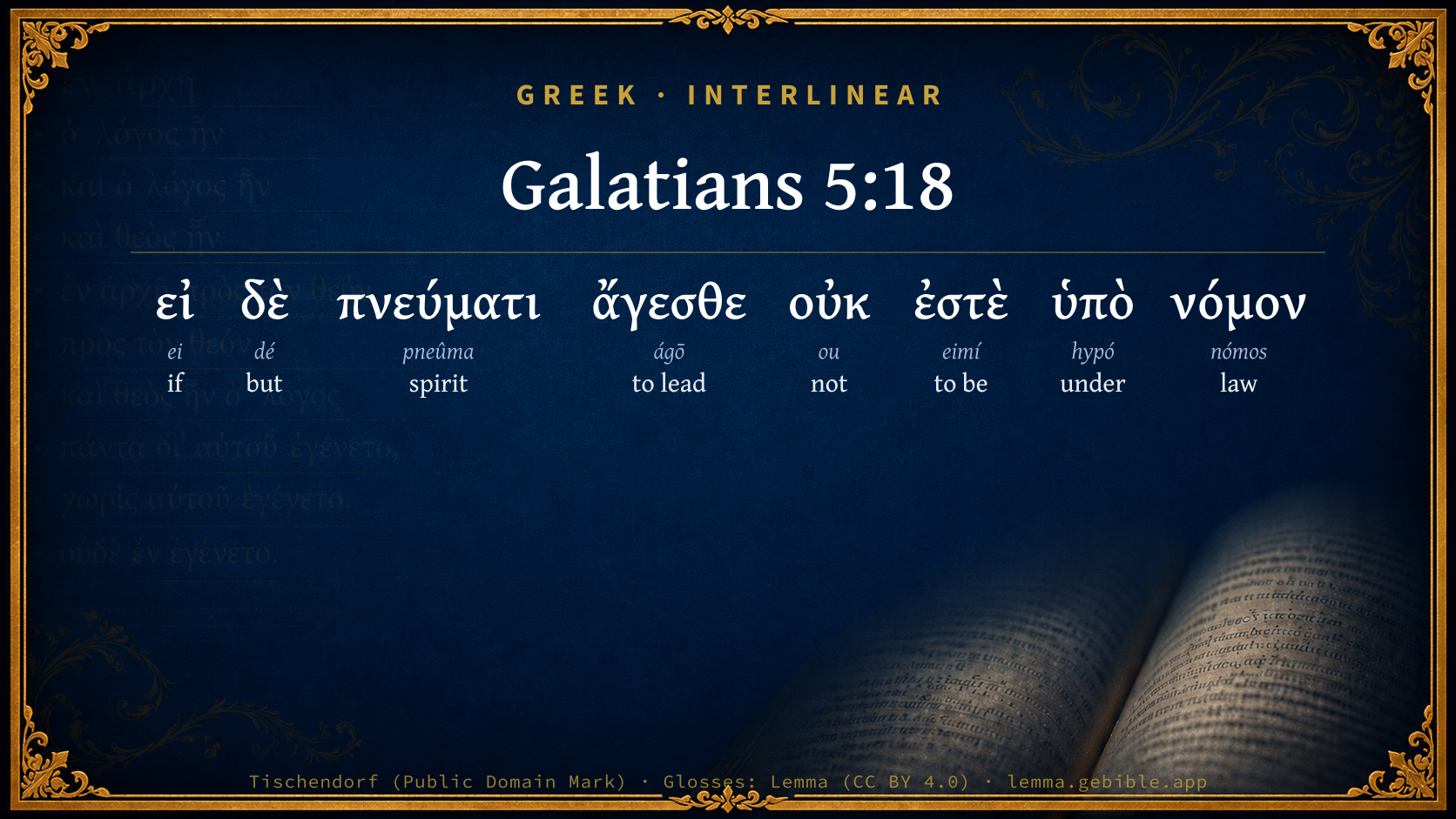
  1. εἰ ei G1487 “if” Conditional
  2. δὲ dé G1161 “but” Conjunction
  3. πνεύματι pneûma G4151 “spirit” Noun, Dative, Singular, Neuter
  4. οὐκ ou G3756 “not” Particle, Negative
  5. ἐστὲ eimí G1510 “to be” Verb, Present, Active, Indicative, 2nd person, Plural
  6. ὑπὸ hypó G5259 “under” Preposition
  7. νόμον nómos G3551 “law” Noun, Accusative, Singular, Masculine

About this verse

These counts appear in no published source. They are computed here, from the morphology-tagged text and Lemma’s own curated glosses. What Lemma adds →

8
words
8
distinct lemmas
Pauline Epistles
section

Cross-references

17

Topical passages linked to Galatians 5:18 in the Treasury of Scripture Knowledge — connected by theme and wording, ordered by reader-vote popularity; previews shown in the World English Bible.

  • Romans 6:14–15 For sin will not have dominion over you. For you are not under law, but under grace.
  • Romans 8:14 For as many as are led by the Spirit of God, these are children of God.
  • Proverbs 8:20 I walk in the way of righteousness, In the midst of the paths of justice;
  • Galatians 5:25 If we live by the Spirit, let's also walk by the Spirit.
  • Ezekiel 36:27 I will put my Spirit within you, and cause you to walk in my statutes, and you shall keep my ordinances, and do them.
  • Galatians 4:5–6 that he might redeem those who were under the law, that we might receive the adoption of children.
  • Galatians 5:16 But I say, walk by the Spirit, and you won't fulfill the lust of the flesh.
  • John 16:13 However when he, the Spirit of truth, has come, he will guide you into all truth, for he will not speak from himself; but whatever he hears, he will speak. He will declare to you things that are coming.
  • Romans 7:4 Therefore, my brothers, you also were made dead to the law through the body of Christ, that you would be joined to another, to him who was raised from the dead, that we might bring forth fruit to God.
  • Isaiah 48:16–18 Come you near to me, hear you this; from the beginning I have not spoken in secret; from the time that it was, there am I: and now the Lord Yahweh has sent me, and his Spirit.
  • Psalms 25:4–5 Show me your ways, Yahweh. Teach me your paths.
  • Psalms 25:8–9 Good and upright is Yahweh, Therefore he will instruct sinners in the way.
  • Psalms 143:8–10 Cause me to hear your loving kindness in the morning, For I trust in you. Cause me to know the way in which I should walk, For I lift up my soul to you.
  • 1 Timothy 1:9 as knowing this, that law is not made for a righteous man, but for the lawless and insubordinate, for the ungodly and sinners, for the unholy and profane, for murderers of fathers and murderers of mothers, for manslayers,
  • 2 Timothy 1:7 For God didn't give us a spirit of fear, but of power, love, and self-control.
  • 1 John 2:20–27 You have an anointing from the Holy One, and you know the truth.
  • Romans 8:12 So then, brothers, we are debtors, not to the flesh, to live after the flesh.

Cross-references courtesy of OpenBible.info (CC BY 4.0).

Commentary

Notes on Galatians 5:18 from classic Christian and Jewish commentators (each source and its license shown beneath its notes). The classic Christian expositions comment on the surrounding passage and are grouped to its opening verse, so a note may address several verses; the Jewish commentaries on the Tanakh (Rashi and others) are per-verse, so they appear only where the commentator wrote on this verse.

Lemma curates 59 commentaries, every one of them public domain or Creative Commons licensed, each selected and text-cleaned for this edition rather than reprinted as found. About our sources →

The Biblical Illustrator

Joseph S. Exell

Gal_5:18

But if ye be led of the Spirit ye are not under the law.

The guidance of the Spirit

1. The Spirit is a person. The personality of the Spirit is a doctrine freely confessed by us in our creed, but often denied by us in thought, converse, prayers. He comes to have with us only the indefiniteness of an impulse and the impersonalness of an influence, with none of that substantive being, intelligence, and will that constitutes the Holy Spirit a true and complete personality.

2. The Spirit is in some way the continuance to us, under altered conditions, of that same Jesus, who once walked among men in visible form, and in the utterance of tones that were audible. In a way He is the Sons messenger; and so, in letting ourselves be actuated by the Spirit, we are living still under the same personal regime as did the disciples who walked in the companionship of Jesus. (Chas. H. Parkhurst, D. D.)

Christian freedom

The text has its affirmative and also its negative element. In neglecting the latter, and addressing ourselves (as is more satisfactory) only to its affirmative and constructive aspect, it needs to be accepted as our basal principle, that through whatever stages Gods government passes, Gods government never ceases, and that changes of dispensation are not breaks in Divine authority, but alterations simply in Gods method of administering His authority. This principle is distinctly implied in the text. The Jew as such is under the law, amenable to Gods authority as exercised through Moses: the Christian as a Christian is also under a kind of law, amenable to Gods authority as exercised through the Son, the Holy Spirit--sovereignty, Divine sovereignty, carrying its exercise through both dispensations in one uninterrupted continuity without hint of break or interregnum. Now the conception we are likely to have of Christianity is of a system under which there is larger liberty enjoyed than under the system of Moses; and this conception, provided only we associate with the word liberty its true notion, is justified, and justified by the Scripture (Joh_8:32-33; Joh_8:36; 1Co_7:22; 2Co_3:17). But I question if we are all of us, or even most of us, quite careful or accurate in the notion we have of the thing called freedom. Freedom is not exemption from government; rather is freedom a form of government. Anarchy, lawlessness, is the opposite of government; freedom is a special variety of government. Political freedom is civil authority vested in a particular way. Christian freedom is Divine authority vested in a particular way; so that in coming out from the bondage of a Jew into the freedom of a Christian, there is no inquiry to be had respecting the abatement of authority, but only respecting the new point at which authority is vested and the new manner in which it is exercised. (Chas. H. Parkhurst, D. D.)

Freedom only for the spiritual

If… A man may live in an age of gospel, but it does not follow from that that he lives under the administration of the gospel. Christ has come into the world, but it does not follow that He has come into my heart and set up His throne there. The Holy Spirit is abroad in society, and there are thousands and hundreds of thousands that are being led by that Spirit. It does not follow from that, that I am being led by it. If I am led by it, I am not under the law; if I am not led by it, of course I am under the law. I have not escaped the pressure of Divine authority at one point until I have first put myself under the pressure of Divine authority at another point. We read in the Book of Numbers that a man gathered sticks on the Sabbath, and he was stoned at the Lords command; and our thought perhaps is that God used to be very particular. We read in the book of Joshua that Achan, the son of Zerah, was guilty of embezzlement, and that at the Lords command he and his sons and his daughters were stoned with stones and burned with fire; and our thought perhaps is that the Lord used to be very particular. He used to be particular to be obeyed. There is so much in the New Testament respecting love, liberty, and the abolition of old ordinances, that we allow ourselves sometimes to be betrayed into supposing that the old dispensation was the dispensation of mans submission to God, and that the new dispensation is the dispensation of Gods submission to man; that the gospel is a kind of giving up on Gods part, a sort of confession that He is not disposed to be particular about little things any more, and that it hardly avails Him to attempt to be particular about little things. Now, this conception of the gospel as an economy of Divine relaxation, Divine letting down, Divine giving up, is one that yields bitter fruit; it makes the gospel contemptible by making it irresolute … Calvary proves that the truth is exactly the opposite of such a notion as this--that God thinks so much of His own sovereignty that He would rather have Divine blood shed than not have you and me respect that sovereignty and come into terms of gentle allegiance to it …. The man who discards the punctilious observance of Gods outward statutes because he lives in an age of gospel, without having first submitted himself to the governance of an inward Christ, and to the laws written by the Spirit upon the fleshly tables of the heart, has detached himself from God at one point, without having first attached himself to God at another point. (Chas. H. Parkhurst, D. D.)

Superiority of spiritual to legal guidance

The old administration was an administration of exterior lines that men could see: the new administration is an administration of interior personal impulses that men can feel. God drew the lines: God gives the impulses. Moses was the agency then: Christ is the agency now; one government underlying both, one sovereign administrative in both. In one case it was government by communicated statute; in the other it is government by immanent leadings. In one the law was a thing distinct from us, and laid down for us to run upon, like railroad-irons spiked and bedded before a locomotive; in the other the impulse is a thing inwardly contained and inseparable from us, in a certain way like the instinct of a bird guiding it southward at the approach of winter. In various ways might this distinction between government by applied constraint and government by contained motive be illustrated to us. Any bar of wood or metal you can balance upon a pivot and constrain into a north and south direction; a magnetic needle delicately suspended in the same way will constantly constrain itself into a north and south direction. An applied constraint in one instance, an immanent tendency in the other. Although it will occur to you, I hope, that even this immanent tendency of the magnetized needle becomes operative only as celestial polarity makes itself in a delicate way inwardly felt. The needle would not move only as the heavens move in it. Or again--one pupil solves a problem according to the rule stated in his arithmetic; another pupil solves the same problem purely at the direction of his own mathematical insight. The result may be the same--the steps by which the result is reached may be the same; but in the latter instance the process will be purely intellectual, and in the former to a considerable degree mechanical; for between such constrained operations of mind and the operations of a Babbages calculating machine the points of resemblance are obvious and striking. This contrast, however, must not betray us into supposing that our gifted problem-worker is not as amenable, quite as amenable, to authority, as the boy who ciphers with his finger on the rule. When a man becomes a genius, a mathematical genius if you please, he passes out from under the constraints of his book, but not from under the supremacy of his science. There is no caprice about genius. Genius does not care much for a set of explicit regulations, but that does not mean that genius is lawless; in fact no mind comes so close to, and into such loyal intimacy with, the very substance of mathematical law as the free and the gifted mathematician. So far from genius discarding law, rather is it the supreme joy of genius to re-enact the eternal and unwritten law in the chamber of its own intellect. And however the Christian, the moral genius, may discard systems of detailed ordainment suited to a slow-paced Hebrew, so far from a Christians denying the great supremacy beneath which he stands, rather is it his sovereign joy to re-enact in the senate-chamber of his own conscience the unwritten law that abides eternal in the bosom of his Lord. (Chas. H. Parkhurst, D. D.)

The Spirits leading

We cannot put one foot before another in religion, except as we are led; and if there be difficulty of a more than common order, it is that which encounters the man who takes upon himself to be his own guide in seeking salvation. We are not, indeed, machines; we are not to be the subjects of an uncontrollable impulse, or a rigid compulsion, destroying free will, and forcing us into righteousness; but if we be not, drawn, we must be led; if there be no bending of the will which would destroy our moral responsibility, there must be a bending of the will which would incline us to godliness. Helpless and hopeless is mans natural estate: born in sin, cradled in sorrow. The Spirit of the living God enters into this alienated creature, lifts him from the dust, urges him with vigour, and introduces him into the circle of the celestial family, leading him to the knowledge of all that is most blessed and to the love of all that is most beautiful, leading him from ruin to triumph, from the wreck of all that Adam was to the fulness of all that Christ Jesus is. Whom else, then, shall I take as my guide? Shall I be led by reason? Meteor of a day, I cannot trust thee. Shall I be led by philosophy? Device of man, thou canst not bring me to God. Oh, Spirit of light, Spirit of truth, enter Thou into our souls, and go Thou before us, as went the fiery cloudy pillar before Israel of old; and we will follow Thee, and we will obey Thee; making it our confidence, that, if we are led of Thee, we are sons of God and heirs of immortality. (H. Melvill, B. D.)

A disposition to follow the guide needed

The case is not merely that the man has lost his way. The traveller who is conscious that he has wandered from the road is uneasy at advancing, so that he will climb every little eminence as that from which he may hope to catch some landmark; and if none be around him, he will look up to the stars, and seek to learn from the constellations the direction he should take; and all his actions will betray his anxiety. If he hear but the barking of a shepherds dog, or discern a glimmering light amongst distant trees, there will be an eagerness in endeavouring to procure intelligence, and to seek guidance. But there is nothing of all this in the moral traveller. He will follow with obstinate determination the path upon which he has entered. And though there be much to assure him of his error--the rugged rocks, and deep mountains, and tangled forests--he will nevertheless push desperately on, pausing now and then for a moment, as though half conscious that all is not right, and then with a more dogged resolution hurrying forward in the same hopeless course. Thus he requires something more than a guide; he must be furnished with a disposition to follow. And when we say that the Spirit of God leads the true Christian, we do not mean that it merely goes before him as a guide and a director to the city of refuge. Nay, but that it takes hold on him, as did the angel when he brought Lot out of Sodom. We rather mean that the Spirit literally leads him by dwelling in him, residing in him as a quickening and actuating principle. (Chas. H. Parkhurst, D. D.)

The leading of the Spirit

These words have before now been must mischievously mistaken by ignorant persons who were glad enough to suppose that by Christian privilege they were put out of the reach of the law. The meaning is as follows:--The Holy Spirit of God puts into the heart of man the Spirit of Christ, and this is the Spirit to think and do whatsoever things are true, whatsoever things are honest, whatsoever things are just, whatsoever things are pure, whatsoever things are lovely, whatsoever things are of good report. Now if a man have in himself the spirit for a thing, what needs he any outward ordinance to compel him to it? To the man who is led by the Spirit the works of the law of God are the natural outward, working of his spirit, as natural to him as the very motion of his limbs; he does not want them to be written down, any more than he requires to be told that he must move his arms and legs, and they can neither condemn him nor justify him; he is what he is without them, before he comes to them; and, as St. Paul says, he, through the Spirit, waits for the hope of righteousness by faith; so independent is he of them. Is it not manifest, then, that he who is led by the Spirit is not, under the law? Let us go on, then, to know more concerning this Spirit, in which we are called into such glorious liberty. It is, as I have said, the Spirit of Christ within a man, formed there by the renewing power of the Holy Spirit; it is the new, the inner, the spiritual man, and the walk of this man is, of course, a following of Christ, a continual working out of that which he believes; for instance, he believes that Christ was crucified, therefore he crucifies the flesh with the affections and lusts; he believes that Christ died, therefore he reckons himself dead unto sin; he believes that Christ rose again, therefore he reckons himself alive unto God through Him; he believes that Christ ascended into heaven, therefore he sets his affections on things above; he believes that Christ is sitting at the right hand of God, administering His kingdom and interceding for His people, therefore he does all that His kingdom may come and His will be done, and is instant in prayer; he believes that Christ will come again to judge the quick and the dead, therefore he does the part of a faithful servant in watching and waiting for his Lord. Our notion of perfect liberty in the flesh is to do everything that we like; but experience soon tells us that the notion is impossible. But the true Christian does everything that he likes, for he does everything from the heart, because of the spirit which is within him. This it is to be led by the Spirit; this is the liberty wherewith Christ hath made His people free. Shall we not desire to stand fast in it? Shall we surrender ourselves to the bondage of the law? Let us only consider a little farther the difference of these two states.

1. To be under the bondage of the law, is either to take merit to ourselves for obeying it, or to bring its vengeance upon us by disobeying it; in either ease it is a hard master indeed.

2. Surely, then, there is no real liberty but that wherewith the gospel of Christ makes us free. Let me state a few particulars of this also. The man of God, continuing in the word of Christ, and led by the Spirit, uses the law as he does a road; he is not guided by it, any more than a man perfectly acquainted with a country is guided by it, but he uses it to travel along through this world, and he delights in it, as in a road to a better place, and as in the exercise of his spirit. As for the commandments of God, he loves them, and in His statutes he meditates. The word of God is a lamp unto his feet and a light unto his path. He feels no unwillingness; he has no mind for pleading excuses and making delays; but he deplores the weakness of the flesh, which in this body of sin cannot follow up the willingness of the spirit, and he strives to put to full account all the means which God hath so graciously given in Jesus Christ our Lord for enabling him to keep the precepts and testimonies of the Lord. He takes to himself no merit for keeping them, any more than for eating or drinking, or satisfying any craving of his nature; the leading of the Spirit makes the will of God his will, and therefore doing the will of God is doing his own will, so that while he keeps the law he is not subject to it. (R. W. Evans, B. D.)

Beside the spirit of our mind (Eph_4:23) every man is led by some spirit or other.

1. One is led by the spirit of error (1Ti_4:1).

2. Another by the spirit of giddiness (Isa_19:14).

3. Another by the spirit of bondage (verse 1; Rom_8:15).

4. Another by the spirit of the world (1Co_2:12).

5. The regenerate by the Spirit of God.

I. How may a man know that he is truly led by the Spirit? The Spirit leads--

1. In a right way: the way of Gods commandment.

2. By a just rule: the word of truth.

3. Sweetly and justly.

4. In a constant way of progression, from grace to grace.

5. In a way opposed to the flesh.

II. Who are those who are not led by the Spirit?

1. Those who go in a known evil way.

2. Those who are led by their own imaginations without any warrant from the Word of God.

3. Those who are carried by passions and distempers even in a good way.

4. Those who make no progress.

5. Those who fulfil the lust of the flesh. (Bishop Hall.)

I. The need of guidance and help.

1. We are ignorant of the road.

2. Have defective vision and cannot see our way.

3. Are lame and impotent.

II. We should seek for this guidance and help. This is what a lost, benighted, or disabled traveller does. Man, however, does the opposite, and pursues his journey perversely, blindly, helplessly.

III. We must be provided spiritually with what an ordinary traveller has mentally,

1. A disposition to seek the right way.

2. A willingness to receive every help in the pursuit of it.

IV. This is supplied by the Spirit of God.

1. He leads by dwelling in the believer as a quickening and actuating principle ever aspiring after knowledge and holiness.

2. Under His guidance the believer advances--

(1) in knowledge

(a) of the person and work of Christ;

(b) of the issues of obedience and suffering;

(c) of Christs spiritual kingdom.

(2) In holiness.

(a) In inward graces;

(b) in outward deportment.

V. This leading is not driving.

1. The free will is not destroyed by uncontrollable impulses or rigid compulsion.

2. The will is so influenced as to be inclined to holiness. (H. Melvill, B. D.)

The spiritually guided not under the law

I. Negatively. I am not under the law--of picking pockets. If the law were abolished to-morrow, I would not pick anybodys pocket. I am not under the law of murder; for if there were no gallows, nor officer, nor judge, nor court, I would not murder. I am not under the law to drunkenness. I can go by a whole regiment of shops and never think of turning in. I am above it. I have the law within me. I do not abstain from gambling because gambling is disreputable, and I fear losses. I do not gamble because I do not want to. I do not avoid bad company because I should lose respectability; but for the same reason that musicians do not sit down and work out discords, and who keep to harmony because harmony is so sweet, and discord so painful. And so in regard to spiritual things, we are led by the Divine Spirit into such a state of approbation and satisfaction in the higher things, that we do not want the inferior, the antagonistic, the antithetic.

II. Positively. There is not in all the statute books in the world one single word saying to the mother, Thou shalt love thy babe. There is not a Church or creed which says, Thou shalt feed thy babe. But see the mother as the twilight darkens, sitting with her child as it draws sustenance from her own bosom, and singing sweet carols, and counting it the proudest of all the hours of the day. She has the love of the mother in her, and does the things that ought to be done, because she loves to do them--it is automatic. So if ye be led of the Spirit ye do the things by the law that is in you, and by your spiritual preferences and loves and likes, which otherwise are commandments. (H. W. Beecher.)

From bondage to liberty by obedience

Consider how many laws there are which affect a mans body--the laws of light, of heat, of gravitation, of sleep, of digestion, of exercise, dec., etc. When men are young and inexperienced, and have no one to teach them they get into trouble by violating these laws. They have no mind to keep them, and they suffer in consequence. They are in bondage respecting these laws. But as they learn more perfectly, so that they use their eyes according to the law of light, and their ears according to the law of sound, and their mouth according to the law of health; selecting this thing because the law requires, rejecting that because the law forbids it--then they are set free from these trials, and pass out of a state of bondage into a state of liberty. The little child when it begins to walk has to think where it shall put this foot and where it shall put that, and has to poise itself carefully, and use its mind as well as its body. But a man walks without thinking. What is the difference? One is under the law--has not learned it--is yet subject to it; the other has learned it so perfectly that he is emancipated from it. The man does automatically, what it requires an effort on the part of the child to do. The child is in bondage and the man is free, because the child does not keep the law, and the man does. (H. W. Beecher.)

The Holy Spirit our light

A man has lost his way in a dark and dreary mine. By the light of one candle, which he carries in his hand, he is groping for the road to sunshine and to home. That light is essential to his safety. The mine has many winding passages, in which he may be hopelessly bewildered. Here and there marks have been made on the rocks to point out the true path, but he cannot see them without that light. There are many deep pits into which, if unwary, he may suddenly fall; but he cannot avoid the danger without that. Should it go out, that mine will be his tomb. How carefully he carries it! How anxiously he shields it from sudden gusts of air, from water dropping on it, from everything that might quench it! The case described is our own. (Newman Hall.)

The Biblical Illustrator, edited by Joseph S. Exell (c. 1880s–1900s) — public domain. Text from a community e-Sword module.

The Pulpit Commentary

But if ye be led of the Spirit, ye are not under the Law (eij demati agesqe, oujk ejste uJpomon); but if ye are led by the Spirit, ye are not under the Law. The sense of Pneumati as denoting the Spirit of God is put beyond question by the parallel passage in Romans, (Rom_8:14) "As many as are led by the Spirit of God (Pneumati Qeou agontai), these are sons of God." The dative case with agomai in both passages is illustrated bymena 2Ti_3:6, "silly women laden with sins, led away by divers lusts (ajgo ejpiqomiaiv poikilaiv)." In all three cases the dative must be the dative of the agent, there being in 2Ti_3:6 a slight personification. This use of the dative is not in prose writers a common construction with passive verbs, though not altogether unknown (Winer, "Gram. N.T.," 10). In the present case its harshness is perhaps relieved by the circumstance that the noun does not represent an agent whose personality is markedly conspicuous ab extra; but rather an internally swaying influence, whoso personality is a matter of faith. Hence 2Ti_3:6 we render, "led away with divers lusts." This shade of sense might be represented by rendering, "led with the Spirit." Ingeto Luk_4:1, "led by the Spirit," we have h ejn tw Pneumati. In all these passages the passive, "being led," must, from the nature of the case, include the voluntary self-subjection of those led. In Romans," being led by the Spirit" stands instead of "walking after the Spirit" in ver. 4; "being after the Spirit" in ver. 5; "by the Spirit mortifying the deeds of the body" in ver. 13. Similarly, here it is tantamount to the "walking by the Spirit"mentioned above in ver. 16. The phrase cannot be fairly understood of merely having that presence of the Holy Spirit. which is predicated of the whole "body of Christ," even of those members thereof whose conduct is plainly not regulated by the sacred influence; (comp. 1Co_12:13 1Co_6:19) it must be understood as describing the case of such as recognize its presence and yield themselves to its guidance. The sense of the phrase, "being under the Law," is illustrated by Gal_3:23, "we were kept in ward under the Law; Gal_4:4, "made to be under the Law;" ibid., 5, "to redeem those which were under the Law;" ibid., 21, "ye who would fain be under the Law;" Rom_6:14, Rom_6:15, "not under the Law, but under grace;" 1Co_9:20, "to those which are under the Law as under the Law, that I might gain those who are under the Law." These are all the passages in which the expression occurs. The inference is clear that the apostle designates by it the condition of such as are subject to the Law of the old covenant, viewed as a whole, in its ceremonial aspect as well as its moral; his meaning would not be exhausted by the paraphrase, "subject to the condemnation of the Law." What he affirms here is this: If in the course of your lives you are habitually swayed by the inward motions of the Spirit of God, then you are not subject to the Law of the old covenant. The connection between the premiss and the conclusion has been clearly shown by the apostle above, (Gal_4:5-7) it is this, that the possession of the Spirit of adoption proves a man to be a "son one who has attained his majority and is no longer subject to a pedagogue. This aphorism of the apostle, that if they were led by the Spirit they were not under the Law, suggests the inquiry But how was it with those Christians who were not led by the Spirit? Would the apostle teach, or would he allow us to say, that Gentile Christians (for it is to such that he is writing), and Jewish as well, if not guided by the Spirit, were bound to obey the Law of the old covenant? With reference to this point we are to consider that the apostle has elsewhere clearly stated, for example in Ro 11, that the Church of God forms, in solidarity with Israel of old, one "Israel of God," as he speaks in the sixth chapter of this Epistle (ver. 16); Gentiles, being "grafted in" upon the original stock, have thus become branches (sumfutoi) having one common life and nature therewith; or, in the language of another figure, "fellow-heirs, and fellow-members of the body, and fellow-partakers of the promise in Christ Jesus," with those who originally were heirs and forming the body and partners in the promised blessing. (Eph_3:6) This leads us to the view that God"s Law, the revelation of his will relative to his people"s conduct, given in successive developments patriarchal, Mosaical, prophetical is, with such modifications as have been made by the crucifixion and the priesthood of Christ, and by the mission and work of the Holy Spirit, God"s Law relative to his people"s conduct still. The cross and priestly work of Christ, as we are taught by this Epistle and the Epistle to the Hebrews, do for all Christians eliminate from this Law its ceremonial prescriptions altogether; but its moral prescriptions, more fully perfected by the moral teaching of Jesus and his apostles, are still incumbent upon them. Those Christians who really give themselves up to the Spirit to be taught and animated by him, who are as St. Paul says (Gal_6:1) "spiritual," these use this Law (as Calvin phrases it) as a doctrina liberalis; the Law of the Spirit of life within them leads and enables them to recognize, and so to speak assimilate, the kindred import of the Law embodied in the letter; which thus ministers to their instruction and consolation (Rom_15:4; 2Ti_3:16; 1Co_9:10) The letter of the Law is now their helper, no longer their absolute rigid rule; as a rule it is superseded by the law written in the heart (2Co_3:6-11; Heb_8:8-11) As Chrysostom writes in his note on the present passage, "They are raised to a height far above the Law"s injunction." But in the degree in which they axe not spiritual, but natural, (yucikoi 1Co_2:14-16; Jud_1:19) in that degree must they use the letter of the Law, in the New Testament as well as the Old, as the rule of their conduct. We, those who have been sacramentally brought into covenant with God, cannot be left to ourselves; either we must be sweetly, persuasively, instinctively, swayed by the Spirit of God within, or else own the coercing dominion of the written Law. In fact, the same individual Christian may at different times be subject to alternation between these two diverse phases of experience, passing over from one to the other of them according to his fluctuating needs. Christians may, therefore, be broadly divided into three classes:

(1) the spiritual (Gal_6:1; Rom_8:1-4)

(2) those who are as yet in bondage to the letter;

(3) those who are living after the flesh (1Co_3:3)

The above statement of the case commends itself as in accordance with what the apostle writes in: (1Ti_1:8-11, "We know that the Law is good kalo) cf. (Rom_7:12) if a man use it lawfully nomimwv, according to the manner in which God has directed us to use it in his gospel (ver. 11), knowing this having his eye upon this, that the Law is not made (ouj keitai) for a righteous man, but for the lawless and disobedient, for,.., according to the gospel of the glory of the blessed God." In contrast with this Law, coercing impiety and immorality wherever it is found, whether in the world or in the Church, the apostle has before in ver. 5 declared that its function is superseded in the case of the spiritual believer: "The end of the commandment see Alford is charity, out of a pure heart and a good conscience, and faith unfeigned." The perpetual obligation of the Law given under the old covenant, subject to the qualifications noted above, appears to be emphatically affirmed by our Lord: "I came not to destroy the Law, but to fulfil: for verily I say unto you, till heaven and earth pass away, one jot or one tittle shall in no wise pass away from the Law, till all things be accomplished". (Mat_5:17, Mat_5:18) And the recognition of this principle underlies all his moral teaching; as, for example, in the sermon on the mount; in his controversies with the Jewish rabbins; in such passages as Mar_10:19; Mat_22:37-40. The moral Law given in the Old Testament amalgamates itself with that given in the New, forming one whole.

The Pulpit Commentary (1880–1919), ed. H.D.M. Spence-Jones & Joseph S. Exell — public domain. Text from a community e-Sword module.

Tyndale Open Study Notes

Tyndale Open Resources

5:18 Those who are directed by the Spirit are under the Spirit’s authority and not under obligation to the law. They do not answer to the law but to the Spirit of God. It was not Paul’s intent to justify civil disobedience (see Rom 13:1-7; Titus 3:1; cp. 1 Pet 2:13-17). He was addressing the means of obtaining spiritual righteousness before God.

Tyndale Open Study Notes — © Tyndale Open Resources, licensed CC BY-SA 4.0. Text via the HelloAO Bible API.

Bengel's Gnomon

Johann Albrecht Bengel

Gal 5:18. Πνεύματι, by the Spirit) of God, Rom 8:14, and of liberty.—ἄγεσθε, ye be led) The middle voice;[52] see Rom., as above, with the annot.—ὙΠῸ ΝΌΜΟΝ, under the law) Rom 6:14-15.

[52] Ye give yourselves up to the leading of.—ED.

Bengel's Gnomon of the New Testament — English translation (T&T Clark, Edinburgh, 1860) — public domain. Text from a community e-Sword module.

Meyer's Critical & Exegetical Commentary

Heinrich August Wilhelm Meyer

Gal_5:18. If, however, of these two conflicting powers, the Spirit is that which rules you, in what blessed freedom ye are then! Comp. 2Co_3:17; Rom_8:2 ff.

πνεύματι ἄγεσθε] See on Rom_8:14. Comp. also 2Ti_3:6.

οὐκ ἐστὲ ὑπὸ νόμον] namely, because then the law can have no power over you; through the ruling power of the Spirit ye find yourselves in such a condition of moral life (in such a καινότης ζωῆς, Rom_6:4, and πνεύματος, Rom_7:6), that the law has no power to censure, to condemn, or to punish anything in you. Comp. on Rom_8:4. In accordance with Gal_5:23, this explanation is the only correct one; and this freedom is the true moral freedom from the law, to which the apostle here, in accordance with Gal_5:13, attaches importance. Comp. 1Ti_1:9. There is less accuracy in the usual interpretation (adopted by Winer, Rückert, Matthies, Schott, Baumgarten-Crusius; comp. de Wette): ye no longer need the law; as Chrysostom: τίς χρεία νόμου; τῷ γὰρ οἴκοθεν κατορθοῦντι τὰ μείζω ποῦ χρεία παιδαγωγοῦ; or: you are free from the outward constraint of the law (Usteri, Ewald); comp. also Hofmann, who, in connection with his mistaken interpretation of Gal_5:14, understands a subjection to the law as a requirement coming from without, which does not exist in the case of the Christian, because in him the law collectively as an unity is fulfilled.

Meyer — Critical and Exegetical Commentary on the New Testament — English translation by Peter Christie, edited by Frederick Crombie (T&T Clark, 1880) — public domain. Text from a community e-Sword module.

Expositor's Greek Testament

ed. W. Robertson Nicoll

Gal 5:18 . Law finds no just occasion against men who are led by the spirit, for they themselves check every wrong desire within them, and so fulfil the whole Law. The identity of Law with justice and right is, of course, assumed.

The Expositor's Greek Testament, edited by W. Robertson Nicoll (1897–1910) — public domain. Text from a community e-Sword module.

Jamieson, Fausset & Brown

Robert Jamieson, A. R. Fausset & David Brown

"If ye are led (give yourselves up to be led) by (Greek) the Spirit, ye are not under the law." For ye are not working the works of the flesh (Gal 5:16, Gal 5:19-21) which bring one "under the law" (Rom 8:2, Rom 8:14). The "Spirit makes free from the law of sin and death" (Gal 5:23). The law is made for a fleshly man, and for the works of the flesh (Ti1 1:9), "not for a righteous man" (Rom 6:14-15).

Jamieson, Fausset & Brown — Commentary Critical and Explanatory on the Whole Bible (1871) — public domain (CC PDM 1.0). Text via the HelloAO Bible API.

Adam Clarke's Commentary

Verse 18. But, if ye be led of the Spirit] If ye receive again the Gospel and the grace of Christ, and permit yourselves to be influenced by the Holy Spirit whom you are now grieving, ye are not under the law-ye will not feel those evil propensities which now disgrace and torment you; but they must prevail while you are not under the influence of the grace and Spirit of Christ.

Adam Clarke's Commentary on the Bible (1810–1826) — public domain. Text from a community e-Sword/MySword module.

John Calvin's Commentaries

18. But if ye be led by the Spirit. In the way of the Lord believers are apt to stumble. But let them not be discouraged, because they are unable to satisfy the demands of the law. Let them listen to the consolatory declaration of the apostle, which is also found in other parts of his writings, (Romans 6:14,) ye are not under the law. Hence it follows, that the performance of their duties is not rejected on account of their present defects, but is accepted in the sight of God, as if it had been in every respect perfect and complete. Paul is still pursuing the controversy about freedom. The Spirit is elsewhere (Romans 8:15) denominated by him, “the Spirit of adoption;” and when the Spirit makes men free, he emancipates them from the yoke of the law. As if he had said, “Is it your desire instantly to terminate the controversies in which you are now engaged? Walk according to the Spirit. You will then be free from the dominion of the law, which will act only in the capacity of a kind adviser, and will no longer lay a restraint upon your consciences.” Besides, when the condemnation of the law is removed, freedom from ceremonies follows as a necessary consequence; for ceremonies mark the condition of a slave.

John Calvin's Commentaries (1540-1563) — public domain. Text from the Calvin Translation Society English edition (1840s-50s) via the Christian Classics Ethereal Library (ccel.org). Calvin's coverage is partial (roughly two-thirds of the Bible); uncommented books and verses are honest gaps, never fabricated. The 19th-century editor's footnotes and remarks are omitted so the notes are faithfully Calvin's own voice.

Ellicott's Commentary for English Readers

(18) Ye are not under the law.—Strictly, Ye are not under law—law in the abstract. The flesh and law are correlative terms: to be free from the one is to be free from the other. The flesh represents unaided human nature, and law is the standard which this unaided human nature strives, but strives in vain, to fulfil. By the intervention of the Spirit, the law is fulfilled at the same time that its domination is abolished and human nature ceases to be unaided. In its highest part it is brought into direct contact with the divine nature, and the whole tenor of its actions changes accordingly.

A Bible Commentary for English Readers, edited by Charles John Ellicott (1878–1897) — public domain. Text from a community e-Sword module.

John Gill's Exposition

Now the works of the flesh are manifest,.... By "flesh" is meant corrupt nature, as before, and by the works of it, not only external acts of sin, but inward lusts; for such are here mentioned among its works, as "hatred", "wrath", "envyings", &c. and both external and internal acts are so called, because they spring from the flesh, or corrupt nature, and are what that urges and solicits to, and are wrought thereby, and are what denominate and show men to be carnal: these are said to be "manifest"; not that they are all, and always publicly done, and are open to the sight of men; for they are works of darkness, and often done in secret, though they are always manifest to God the searcher of hearts, and will be brought to light in the day of judgment; but they are known to be sins in some measure by the light of nature, and especially by the law of God; and a clear case it is, that they are contrary to the Spirit, both to the Spirit of God, and to the principle of grace he forms in the heart; and that such who live in the commission of them are not led by him, nor are under the influence of his grace:

which are these; though all are not mentioned, only some of the chief, by which judgment may be made of the rest:

adultery; this is left out in the Vulgate Latin, Syriac, and Ethiopic versions, and in the Alexandrian copy; it is a defilement of the marriage bed, and is the sin of uncleanness committed by two persons, one of which at least is in a married state, is condemned by the law of God and light of nature:

fornication; which though by many of the Gentiles was reckoned no sin, or a very small one, stands here among the works of the flesh, that are manifest and to be avoided; it is the sin of uncleanness committed by persons in a single state;

uncleanness, it is a general name for all unchastity, in thought, word, or action; and may here design more especially all unnatural lusts, as

sodomy, self-pollution, &c.

lasciviousness; or wantonness, all lustful dalliance, everything that leads on to acts of uncleanness, or attends them, as impure words, filthy gestures, and the like.

John Gill's Exposition of the Whole Bible (1746–1763) — public domain (CC PDM 1.0). Text via the HelloAO Bible API.

Trapp's Complete Commentary

John Trapp

18 But if ye be led of the Spirit, ye are not under the law.

Ver. 18. Ye are not under the law] For where the Spirit is, there is liberty from the rigour, irritation, and malediction of the law.

John Trapp, A Commentary or Exposition upon All the Books of the Old and New Testament (1647–1656) — public domain. Text from a community e-Sword module.

Albert Barnes' Notes on the Bible

But if ye be led of the Spirit - If you submit to the teachings and guidance of the Holy Spirit.

Ye are not under the law - You are under a different dispensation - the dispensation of the Spirit. You are free from the restraints and control of the Mosaic law, and are under the control of the Spirit of God.

Albert Barnes' Notes on the Bible (1834–1885) — public domain. Text from a community e-Sword/MySword module.

Matthew Poole's English Annotations

To be led of the Spirit, and to walk in the Spirit, are the same thing; and differ only as the cause and the effect. To be

under the law, is to be under the curse of it, or coaction of it, and an obligation to the performance of the ceremonial law. The reason is, because the Spirit is a Spirit of adoption and liberty; and where it is, it teacheth to serve the Lord without fear from a principle of freedom and ingenuity.

Matthew Poole's English Annotations on the Holy Bible (1683–1685) — public domain. Text from a community e-Sword/MySword module.

Whedon's Commentary on the Bible

Daniel D. Whedon

18. Led—By your submission and following of his drawings.

Not under the law—Not that the obligations of the moral law cease to rest upon you, but that by the full accordance of your heart with the law you feel not the presence of the law.

Gal_5:19-21 present the summation of the works of the flesh, in contrast with Gal_5:21-26, which present the fruits of the Spirit.

Daniel D. Whedon (gen. ed.), Commentary on the Old and New Testaments (1874–1909) — public domain. Text from a community e-Sword module.

John Wesley's Explanatory Notes

But if ye are led by the Spirit - Of liberty and love, into all holiness. Ye are not under the law - Not under the curse or bondage of it; not under the guilt or the power of sin.

John Wesley, Explanatory Notes Upon the Whole Bible (1754–1765) — public domain. Text via the GEBible commentary corpus.

Luther on Galatians

Martin Luther

VERSE 18. But if ye be led of the Spirit, ye are not under the law.

Here someone may object: "How come we are not under the law? You yourself say, Paul, that we have the flesh which wars against the Spirit, and brings us into subjection."

But Paul says not to let it trouble us. As long as we are led by the Spirit, and are willing to obey the Spirit who resists the flesh, we are not under the Law. True believers are not under the Law. The Law cannot condemn them although they feel sin and confess it.

Great then is the power of the Spirit. Led by the Spirit, the Law cannot condemn the believer though he commits real sin. For Christ in whom we believe is our righteousness. He is without sin, and the Law cannot accuse Him. As long as we cling to Him we are led by the Spirit and are free from the Law. Even as he teaches good works, the Apostle does not lose sight of the doctrine of justification, but shows at every turn that it is impossible for us to be justified by works.

The words, "If ye be led of the Spirit, ye are not under the law," are replete with comfort. It happens at times that anger, hatred, impatience, carnal desire, fear, sorrow, or some other lust of the flesh so overwhelms a man that he cannot shake them off, though he try ever so hard. What should he do? Should he despair? God forbid. Let him say to himself: "My flesh seems to be on a warpath against the Spirit again. Go to it, flesh, and rage all you want to. But you are not going to have your way. I follow the leading of the Spirit."

When the flesh begins to cut up the only remedy is to take the sword of the Spirit, the word of salvation, and fight against the flesh. If you set the Word out of sight, you are helpless against the flesh. I know this to be a fact. I have been assailed by many violent passions, but as soon as I took hold of some Scripture passage, my temptations left me. Without the Word I could not have helped myself against the flesh.

Martin Luther — Commentary on the Epistle to the Galatians (1535), English translation by Theodore Graebner (Zondervan, 1939) — public domain (U.S. copyright not renewed). Text from a community e-Sword module.

Scofield Reference Notes

C. I. Scofield

under the law

i.e. not under bondage of effort to please God by law-works. 2Co 3:17.

The Scofield Reference Bible (1917 edition), notes by C. I. Scofield — public domain. Text from a community e-Sword module.

Burkitt's Expository Notes on the New Testament

William Burkitt

That is, if ye be under the guidance and government of the Holy Spirit of God, and that renewing principle of grace which he had produced in you, you are no longer under the law; that is, not under the moral law as a covenant of life for our justification, though under it as an eternal role of living; not under the vindictive, though under the directive power of the law. So that the force of the apostle’s argument seems to lie thus: "You are by the Spirit, by the spiritual dispensation of the gospel, free from the curse and terror of the moral law; how unreasonable then is it to suppose, that you should be still subject to the ceremonial law? No; if you be led by the Spirit, neither the moral law shall condemn you, nor the cermonial law oblige and bind you."

William Burkitt's Expository Notes on the New Testament (1700–1703) — public domain. Text from a community e-Sword module.

McGarvey & Pendleton's Commentaries

J. W. McGarvey

But if ye are led by the Spirit, ye are not under the law. [By as much as the Spirit triumphs within us, by that much are we freed from feeling the presence of the law. So long as we have two wills we are sensible of conflict, and so of the restraint of law, but when our nature is merged in the will of the Spirit, so that there is but one will within us, then we lose all consciousness of restraint. We attain to that true rule of liberty which Augustine condenses in the saying: "Love God, and do what you please." God himself leads the life of perfect righteousness, yet God can never be said to be under law. He knows no law but his own choice, but his choice is ever righteousness because of the perfect holiness of his character. So the Christian should strive to bring his own will into such perfect accord with the will of the Spirit that he does not feel the constraint of law resting upon him.]

J. W. McGarvey (with Philip Y. Pendleton), Commentaries on the New Testament (The Fourfold Gospel, 1914; Acts; and the epistles) — public domain. Text from a community e-Sword/MySword module.

The People's New Testament

B. W. Johnson

18. But if ye be led by the Spirit. If the desire of the Spirit prevails. Those “led of the Spirit are the sons of God” (Rom. 8:14), and are free from the law. The law with its carnal ordinances in Paul's view was adapted to a fleshly condition.

B. W. Johnson's The People's New Testament with Notes (1889–1891) — public domain. Electronic text from the Christian Classics Ethereal Library (CCEL) ThML edition.

Cambridge Greek Testament for Schools and Colleges

18. εἰ δὲ πνεύματι ἄγεσθε, οὐκ ἐστὲ ὑπὸ νόμον. The contrast is to the possibility implied in Gal 5:16-17 of listening to and carrying out the lust of the flesh. If you are led by the spirit you are not under (shall I say the flesh? nay, I will say that which calls out the power of the flesh) the Law. St Paul thus arrives by a practical argument at the same result to which he had come by his earlier proof from the nature of God’s promises, Gal 4:1-7. Compare Rom 8:1-5; Rom 8:14.

Cambridge Greek Testament for Schools and Colleges (Cambridge University Press, 1896; 21 vols, various authors incl. Carr, Maclear, Plummer, Farrar, Lumby, Moule, M. R. James, Simcox) — public domain. Text from a community e-Sword module.

Alford’s Greek Testament

Henry Alford

18.] By this verse, the locus respecting the flesh and the Spirit is interwoven into the general argument, thus (cf. ver. 23): the law is made for the flesh, and the works of the flesh: the Spirit and flesh ἀντίκεινται: if (δέ bringing out the contrast between the treatment of both in ver. 17, and the selection of one side in this verse) then ye are led by (see Rom. ref., ὅσοι … πνεύματι θεοῦ ἄγονται, οὗτοι υἱοί εἰσιν θεοῦ) the Spirit, ye are not under the law. This he proceeds to substantiate, by specifying the works of the flesh and of the Spirit. This interpretation is better than the merely practical one of Chrys., al., ὁ γὰρ πνεῦμα ἔχων ὡς χρή, σβέννυσι διὰ τούτου πονηρὰν ἐπιθυμίαν ἅπασαν· ὁ δὲ τούτων ἀπαλλαγεὶς οὐ δεῖται τῆς ἀπὸ τοῦ νόμου βοηθείας, ὑψηλότερος πολλῷ τῆς ἐκείνου παραγγελίας γενόμενος,—for it is a very different thing οὐ δεῖσθαι νόμου, from οὐκ εἶναι ὑπὸ νόμον.

Henry Alford, The Greek Testament (1849–1861) — public domain. Text from a community e-Sword module.

International Critical Commentary

18. εἰ δὲ πνεύματι ἄγεσθε, οὐκ ἐστὲ ὑπὸ νόμον. “But if ye are led by the Spirit, ye are not under law.” In this sentence the apostle harks back for a moment to the point of view of the first part of the chapter, vv. 1-6, complementing the statement of v. 16, that to walk by the Spirit does not involve subjection to the flesh, by the assertion that to be led by the Spirit is not to be under law. Clearly, therefore, life by the Spirit constitutes for the apostle a third way of life distinct both on the one hand from legalism and on the other from that which is characterised by a yielding to the impulses of the flesh. It is by no means a middle course between them, but a highway above them both, a life of freedom from statutes, of faith and love. The introduction of the statement at this point may be due to a desire, even in the midst of the warning against the danger of converting freedom into an occasion to the flesh, to guard his readers against supposing that he is now really retracting what he has said before, and turning them back to legalism disguised as a life under the leading of the Spirit. This was an entirely possible danger for those to whose thought there were only the two possibilities, restraint by law or no restraint. Or perceiving that what he had said in v. 17 about the contrariety of the Spirit and the flesh and the struggle in which those find themselves in whom both Spirit and flesh are still working, might seem to justify a doubt whether to walk by the Spirit after all assures one the victory over the flesh, and having in mind that it is in the case of those who are under law that the conflict is thus indecisive, he answers the doubt by saying, “But this does not apply to you who walk by the Spirit; for if ye are led by the Spirit ye are not under law.” There seems no decisive ground of choice between these two explanations of the occasion of the sentence; its meaning remains the same in either case. πνεύματι is here, as in v. 16, the Holy Spirit, qualitatively spoken of. That the term is nevertheless distinctly individual is shown by the connection with the verb ἄγεσθε, which, though practically synonymous with the περιπατεῖτε of v. 16, emphasises the voluntary subjection of the will to the Spirit, as περιπατεῖτε on the other hand makes prominent the conformity of conduct to the guidance of the Spirit, and ζῶμεν in v. 25 the intimate and vital nature of the relation of the Christian to the Spirit. Cf. Rom 8:14: ὅσοι γὰρ πνεύματι θεοῦ ἄγονται, οὗτοι υἱοῖ θεοῦ εἰσίν. The conditional clause expressing a present particular supposition conveys a suggestion, as in περιπατεῖτε, of continuance of action in progress, “If ye are continuing to be led by the Spirit.” ὑπὸ νόμον is undoubtedly to be taken, as elsewhere in the epistle (cf. 3:23, 4:4, 5, 21), as referring to that legalistic system from which it is the apostle’s aim to keep his readers free. To understand the word in the ethical sense in which it is used in v. 14 would immediately bring the statement into conflict with the plain implication of vv. 13, 14. Any other sense than one of these two is wholly foreign to the context.

International Critical Commentary — older volumes (1896–1929), various authors — public domain. Text from a community e-Sword module.

Vincent's Word Studies in the New Testament

Marvin R. Vincent

The question is, which of these two powers shall prevail. If the Spirit, then you are free men, no longer under the law. Comp. Rom 6:11, 14. Under the law [υπο νομον] . The Mosaic law. We might have expected, from what precedes, under the flesh. But the law and the flesh are in the same category. Circumcision was a requirement of the law, and was a work of the flesh. The ordinances of the law were ordinances of the flesh (Heb 9:10, 13); the law was weak through the flesh (Rom 8:3). See especially, Gal 3:2 - 6. In Phi 3:3 ff. Paul explains his grounds for confidence in the flesh as his legal righteousness. The whole legal economy was an economy of the flesh as distinguished from the Spirit.

Marvin R. Vincent, Word Studies in the New Testament (1887–1900) — public domain. Text from a community e-Sword/MySword module.

Lesson kit

Teaching starters — assembled from the data on this page, not authored interpretation. Every prompt links to the verse data it draws on. Edit before teaching.

Galatians, in the Pauline Epistles, opens this verse with 8 words (8 distinct Greek lemmas). Its most distinctive word is ágō (“to lead”). A historical commentator’s framing appears above. Read the whole chapter for the surrounding context.

Discussion questions

  1. What does “to lead” (ágō) contribute to the verse as a whole?
  2. Romans 6:14–15 shares this passage’s theme. How do the two illuminate each other?
  3. These translations render this verse differently; the difference is in the English rendering, not the original. What questions does that raise?
  4. Reading how The Biblical Illustrator and The Pulpit Commentary read this verse, where do the two commentators agree and where do they part?

Things to notice

Reading settings

Reading text

Shown beneath each verse's original-language words.

Old Testament
Old Testament edition

Read the OT as the Masoretic Hebrew (MT) or the Greek Septuagint (LXX).

English shown for the Greek Septuagint (in the Hebrew ↔ Greek comparison).

Comparing translations? Open the Compare panel on any verse page to stack up to four side by side.