Galatians 5:11

Greek (Tischendorf 8th ed.) Galatians 5:11 appears in the Greek New Testament. The text above is from the Tischendorf 8th edition. Each word links to its Strong’s number and a concise gloss. Click any word for its full Thayer’s Greek Lexicon entry.
Download image
Cite this verse

Galatians 5:11 (World English Bible). Public Domain. Lemma interlinear Bible study tool, https://lemma.gebible.app/v/galatians/5/11.

Show BibTeX & RIS
BibTeX
RIS
English Translation
But I, brothers, if I still preach circumcision, why am I still persecuted? Then the stumbling-block of the cross has been removed.
World English Bible · Public Domain
Download a study sheet

One document with this verse’s original text, its word-by-word gloss line, the meaning frame, cross-references with their text, attributed commentary, and full source and license credits — printable, and it pastes into notes with its structure intact.

This verse Autodidact and up

Study sheet (.html) Plain text (.txt)

A passage Seminary Student

Up to 50 verses in one chapter. A passage sheet keeps up to 6 commentary sources and 12 cross-references per verse, in the order this page ranks them, and says so on the sheet whenever that leaves anything out. Ask for a single verse and you get the Autodidact verse sheet above.

Everything on this page stays free to read, with no account — the sheet is a download of what is already on screen, not access to it.

Want to remove ads? Support Godless Engineer
Compare translations 3

The same verse in 3 English versions, stacked beneath the original-language interlinear above. Click any original word for its lexicon entry.

Each is an independent rendering of the whole verse — the interlinear is not word-aligned to these translations.

Highlighted words mark where these versions differ — a whole-verse word diff, not a word-by-word alignment.

  • World English Bible Public Domain
    But I, brothers, if I still preach circumcision, why am I still persecuted? Then the stumbling-block of the cross has been removed.
  • King James Version Public Domain
    And I, brethren, if I yet preach circumcision, why do I yet suffer persecution? then is the offence of the cross ceased.
  • unfoldingWord Literal Text CC BY-SA 4.0
    But brothers, if I still proclaim circumcision, why am I still being persecuted? In that case the stumbling block of the cross has been removed.

unfoldingWord Literal Text — © unfoldingWord, licensed CC BY-SA 4.0. Word-aligned USFM3 via Door43 (git.door43.org/unfoldingWord/en_ult).

Versions to compare (up to 4)

3 of 4 selected

Show all 19 translations

Every available English version of this verse, each an independent rendering of the whole verse.

  • World English Bible Public Domain
    But I, brothers, if I still preach circumcision, why am I still persecuted? Then the stumbling-block of the cross has been removed.
  • Berean Standard Bible Public Domain
    Now, brothers, if I am still preaching circumcision, why am I still being persecuted? In that case the offense of the cross has been abolished.
  • Majority Standard Bible Public Domain
    Now, brothers, if I am still preaching circumcision, why am I still being persecuted? In that case the offense of the cross has been abolished.
  • King James Version Public Domain
    And I, brethren, if I yet preach circumcision, why do I yet suffer persecution? then is the offence of the cross ceased.
  • American Standard Version (1901) Public Domain
    But I, brethren, if I still preach circumcision, why am I still persecuted? then hath the stumbling-block of the cross been done away.
  • Revised Version (1885) Public Domain
    But I, brethren, if I still preach circumcision, why am I still persecuted? then hath the stumblingblock of the cross been done away.
  • Geneva Bible (1599) Public Domain
    And brethren, if I yet preach circumcision, why doe I yet suffer persecution? Then is the slaunder of the crosse abolished.
  • Douay-Rheims (1899) Public Domain
    And I, brethren, if I yet preach circumcision, why do I yet suffer persecution? Then is the scandal of the cross made void.
  • Young's Literal Translation Public Domain
    And I, brethren, if uncircumcision I yet preach, why yet am I persecuted? then hath the stumbling-block of the cross been done away;
  • Literal Standard Version CC BY-SA 4.0
    And I, brothers, if I still preach circumcision, why am I still persecuted? Then the stumbling-block of the Cross has been done away [with];
  • Unlocked Literal Bible CC BY-SA 4.0
    Brothers, if I still proclaim circumcision, why am I still being persecuted? In that case the stumbling block of the cross has been removed.
  • unfoldingWord Literal Text CC BY-SA 4.0
    But brothers, if I still proclaim circumcision, why am I still being persecuted? In that case the stumbling block of the cross has been removed.
  • Darby Bible Public Domain
    But *I*, brethren, if I yet preach circumcision, why am I yet persecuted? Then the scandal of the cross has been done away.
  • World Messianic Bible Public Domain
    But I, brothers, if I still proclaim circumcision, why am I still persecuted? Then the stumbling block of the cross has been removed.
  • Webster's Bible Public Domain
    And I, brethren, if I yet preach circumcision, why do I yet suffer persecution? then hath the offense of the cross ceased.
  • Free Bible Version CC BY-SA 4.0
    As for me, brothers and sisters, if I were still advocating circumcision—why am I still persecuted? If that was true, it would remove the issue of the cross that offends people so much.
  • Bible in Basic English Public Domain
    But I, brothers, if I am still preaching circumcision, why am I still attacked? then has the shame of the cross been taken away.
  • Text-Critical English NT CC BY 4.0
    Now, brothers, if I am still preaching circumcision, why am I still being persecuted? In that case the offense of the cross has been done away with.
  • Tyndale New Testament (1534) Public Domain
    Brethren yf I yet preache circucision: why do I then yet suffre persecucion? For then had the offence which the crosse geveth ceased.

Literal Standard Version (2020), Covenant Press — licensed CC BY-SA 4.0. Text via the HelloAO Bible API (eBible.org). Unlocked Literal Bible (unfoldingWord) — licensed CC BY-SA 4.0. Text via the HelloAO Bible API (eBible.org). unfoldingWord Literal Text — © unfoldingWord, licensed CC BY-SA 4.0. Word-aligned USFM3 via Door43 (git.door43.org/unfoldingWord/en_ult). Free Bible Version, Dr. Jonathan Gallagher — licensed CC BY-SA 4.0. Text via the HelloAO Bible API (eBible.org).

Word by word

More ways to search: Search by grammar → Find every occurrence → Compare this word →

Practice this passage: Drill this verse → Learn its vocabulary →

σκάνδαλον
skándalon
G4625
“stumbling block”
Noun, Nominative, Singular, Neuter
Part of Speech
Noun
Case
Nominative
Number
Singular
Gender
Neuter
Full Thayer's Definition

Origin: probably from a derivative of G2578

TDNT: 12:39,1

1. the movable stick or trigger of a trap, a trap stick a. a trap, snare b. any impediment placed in the way and causing one to stumble or fall, (a stumbling block, occasion of stumbling) i.e. a rock which is a cause of stumbling c. fig. applied to Jesus Christ, whose person and career were so contrary to the expectations of the Jews concerning the Messiah, that they rejected him and by their obstinacy made shipwreck of their salvation 2. any person or thing by which one is (entrapped) drawn into error or sin
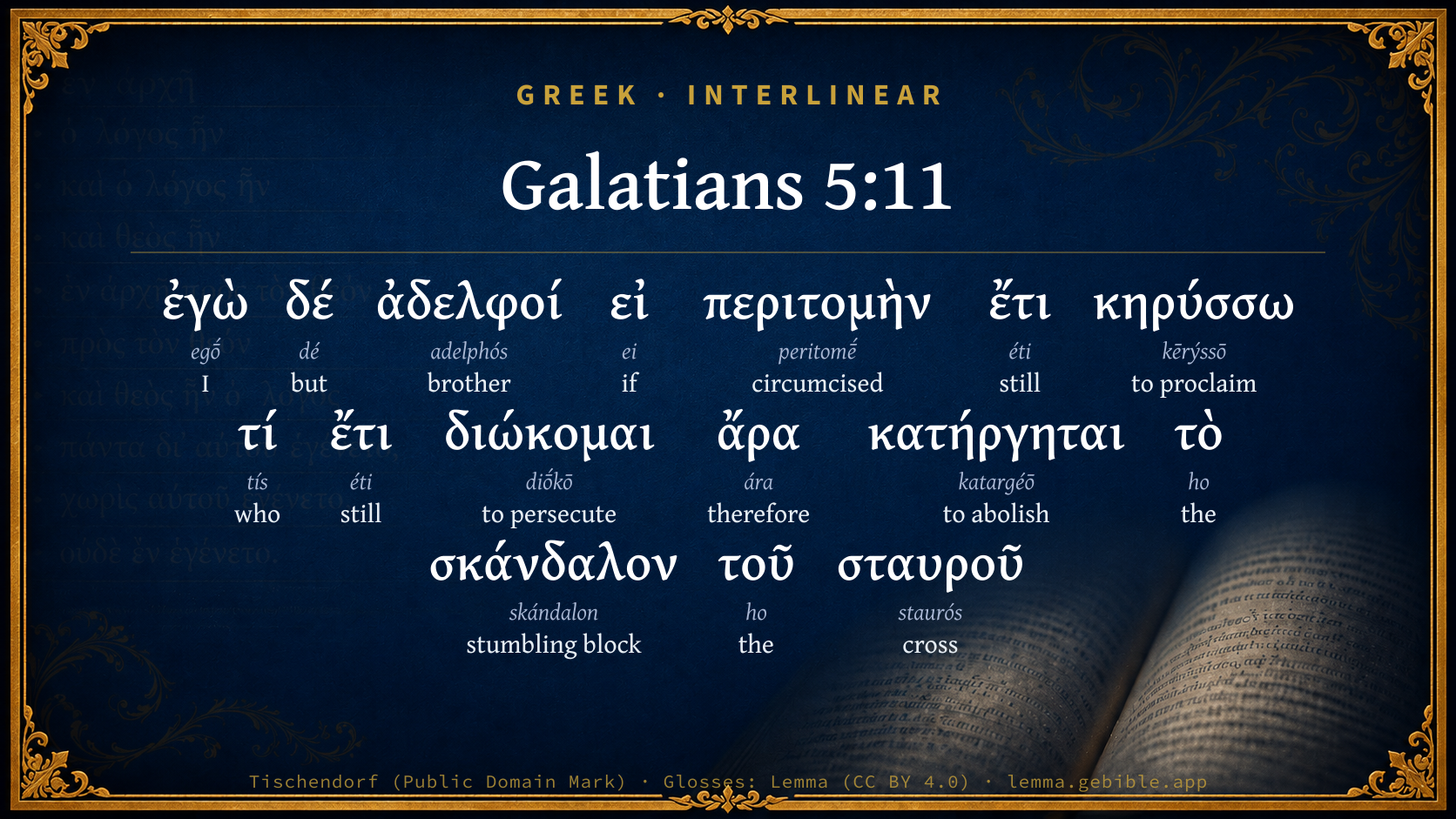
  1. ἐγὼ egṓ G1473 “I” Personal pronoun, 1st person, Nominative, Singular
  2. δέ dé G1161 “but” Conjunction
  3. ἀδελφοί adelphós G80 “brother” Noun, Vocative, Plural, Masculine
  4. εἰ ei G1487 “if” Conditional
  5. περιτομὴν peritomḗ G4061 “circumcised” Noun, Accusative, Singular, Feminine
  6. ἔτι éti G2089 “still” Adverb
  7. κηρύσσω kērýssō G2784 “to proclaim” Verb, Present, Active, Indicative, 1st person, Singular
  8. τί tís G5101 “who” Interrogative pronoun, Accusative, Singular, Neuter
  9. ἔτι éti G2089 “still” Adverb
  10. διώκομαι diṓkō G1377 “to persecute” Verb, Present, Passive, Indicative, 1st person, Singular
  11. ἄρα ára G686 “therefore” Particle
  12. κατήργηται katargéō G2673 “to abolish” Verb, Perfect, Passive, Indicative, 3rd person, Singular
  13. τὸ ho G3588 “the” Article, Nominative, Singular, Neuter
  14. τοῦ ho G3588 “the” Article, Genitive, Singular, Masculine
  15. σταυροῦ staurós G4716 “cross” Noun, Genitive, Singular, Masculine

About this verse

These counts appear in no published source. They are computed here, from the morphology-tagged text and Lemma’s own curated glosses. What Lemma adds →

16
words
14
distinct lemmas
Pauline Epistles
section

Notable vocabulary

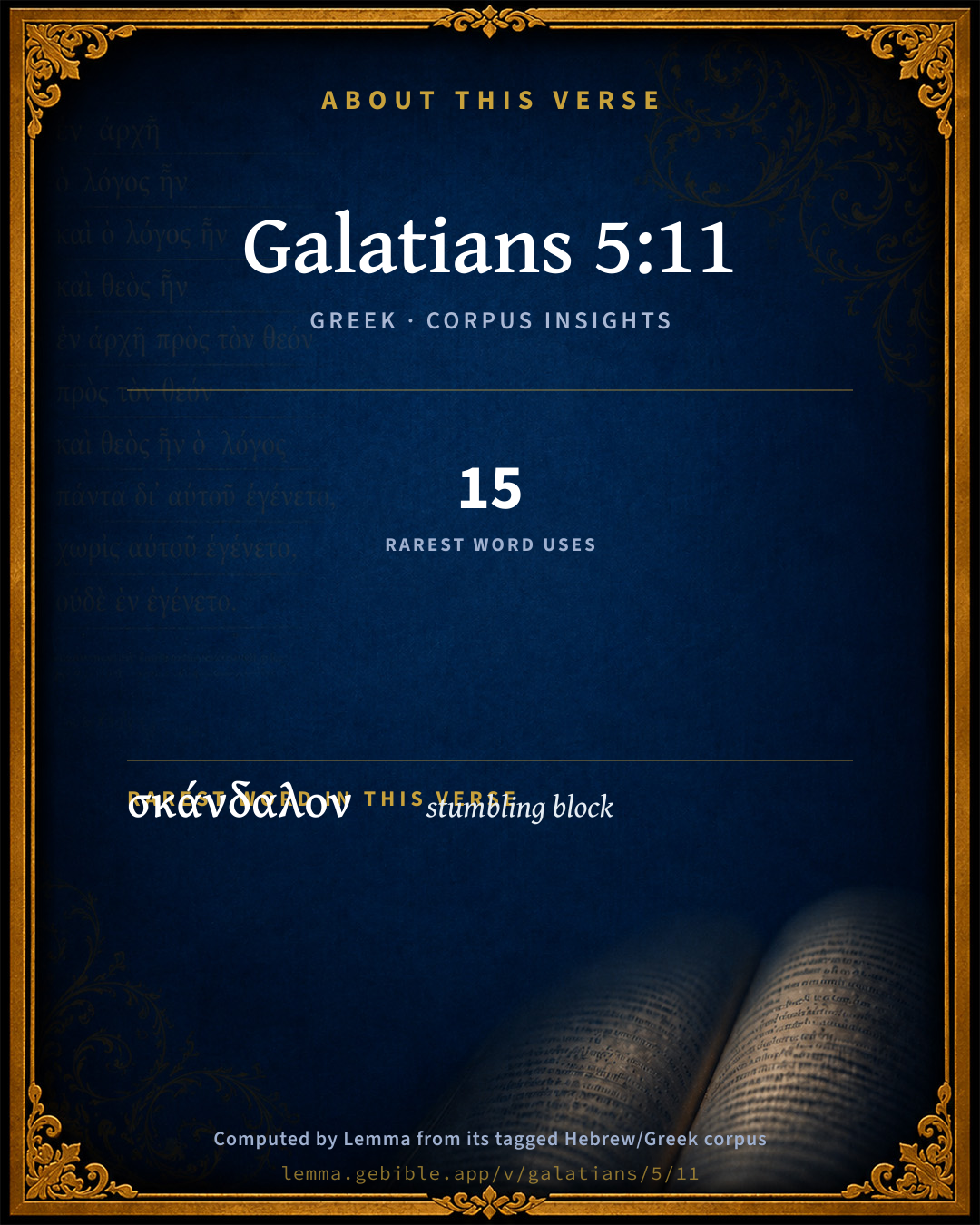
The rarest word here is σκάνδαλον stumbling block G4625 — appearing just 15 times in the whole Greek New Testament.

Shared distinctive vocabulary

σκάνδαλον stumbling block G4625 occurs in 13 verses of the Greek New Testament. Also found in:

Repetition

Words recur within this verse:

Cross-references

16

Topical passages linked to Galatians 5:11 in the Treasury of Scripture Knowledge — connected by theme and wording, ordered by reader-vote popularity; previews shown in the World English Bible.

  • 1 Corinthians 1:23 but we preach Christ crucified; a stumbling block to Jews, and foolishness to Greeks,
  • Galatians 6:12 As many as desire to look good in the flesh, they compel you to be circumcised; only that they may not be persecuted for the cross of Christ.
  • Galatians 4:29 But as then, he who was born according to the flesh persecuted him who was born according to the Spirit, so also it is now.
  • Acts 21:21 They have been informed about you, that you teach all the Jews who are among the Gentiles to forsake Moses, telling them not to circumcise their children neither to walk after the customs.
  • 1 Corinthians 1:18 For the word of the cross is foolishness to those who are dying, but to us who are saved it is the power of God.
  • 1 Corinthians 15:30 Why do we also stand in jeopardy every hour?
  • Galatians 2:3 But not even Titus, who was with me, being a Greek, was compelled to be circumcised.
  • 1 Peter 2:8–9 and, "A stone of stumbling, and a rock of offense." For they stumble at the word, being disobedient, whereunto also they were appointed.
  • Isaiah 8:14 He shall be for a sanctuary; but for a stone of stumbling and for a rock of offense to both the houses of Israel, for a gin and for a snare to the inhabitants of Jerusalem.
  • Acts 16:3 Paul wanted to have him go out with him, and he took and circumcised him because of the Jews who were in those parts; for they all knew that his father was a Greek.
  • Acts 21:28 crying out, "Men of Israel, help! This is the man who teaches all men everywhere against the people, and the law, and this place. Moreover, he also brought Greeks into the temple, and has defiled this holy place!"
  • Acts 22:21–22 "He said to me, 'Depart, for I will send you out far from here to the Gentiles.'"
  • Acts 23:13–14 There were more than forty people who had made this conspiracy.
  • Romans 9:32–33 Why? Because they didn't seek it by faith, but as it were by works of the law. They stumbled over the stumbling stone;
  • 2 Corinthians 11:23–26 Are they servants of Christ? (I speak as one beside himself) I am more so; in labors more abundantly, in prisons more abundantly, in stripes above measure, in deaths often.
  • Galatians 6:17 From now on, let no one cause me any trouble, for I bear the marks of the Lord Jesus branded on my body.

Cross-references courtesy of OpenBible.info (CC BY 4.0).

Commentary

Notes on Galatians 5:11 from classic Christian and Jewish commentators (each source and its license shown beneath its notes). The classic Christian expositions comment on the surrounding passage and are grouped to its opening verse, so a note may address several verses; the Jewish commentaries on the Tanakh (Rashi and others) are per-verse, so they appear only where the commentator wrote on this verse.

Lemma curates 59 commentaries, every one of them public domain or Creative Commons licensed, each selected and text-cleaned for this edition rather than reprinted as found. About our sources →

The Biblical Illustrator

Joseph S. Exell

Gal_5:11

And I, brethren, if I yet preach circumcision, why do I yet suffer persecution?

then is the offence of the Cross ceased.

The perversion of apostolic preaching

There are two attempts or resolves in constant operation as to the Cross. One is mans, to accommodate it to human liking and taste: the second is Gods, to raise human liking and taste to it.

I. The aim of man. Then is the offence of the Cross ceased. And in such case, there must be its depreciation. It is brought down from its proper excellency. What is to be understood by the Cross? Not the wood. How should we be the better did we possess the very tree on which the Saviour hung and died? The true Cross consists in a fact, the crucifixion of the Son of God: in a doctrine, salvation by atonement: in an influence and moral power, a hatred to sin, a weanedness from the world, a penitential devotedness to the Saviour. The Cross is preached when the sinner is taught how he may be justified, and how he must be born again. In what lies its scandalising property, its offence? It was early declared that Christ should be a sign spoken against, and that in connection with his death, when the sword should pierce through her soul who held the Holy Child. This obnoxious sign was therefore the spectacle of a crucified Messiah. Now the following may be named as the principal exceptions taken to it by those who rejected it.

1. It was an improbable medium of revelation. For man can talk loudly how God should manifest Himself and His purposes toward us. He is fond of anticipating the Father of lights, would teach Him the path of judgment and show to Him the way of understanding. Is it morally probable that all His dispensations should revolve upon the Cross for their pivot?

2. It was a stigma on this religion which set it in disadvantageous contrast with every other. It was unheard of that the vilest of all deaths should give its absolute character to a religion, and that this religion of the Cross should triumph over all. Yet this was avowed.

3. It was a violent disappointment of a general hope.

4. It was a humiliating test. Ambition, selfishness, insincerity, licentiousness, ferocity, pride, felt that it was encircled with an atmosphere in which they were instantly interrupted and condemned. In what manner did the first preachers of the Cross exhibit it? So ingenuous, so unvarnished, was that manner, that it always prejudiced them: to the Jews a stumbling-block and to the Greeks foolishness. They preached it not only in its integrity of truths, but without gloss and concealment. They refined not on it. But man is desirous of doing this away as a wrongful and unnecessary impression. He would make the offence of the Cross to cease.

(1) By fixing it upon some extrinsic authority.

(2) By torturing it into coalition with foreign principles.

(3) By transforming the character of its religious instructions.

(4) By applying it to inappropriate uses.

(5) By excluding its proper connections.

It is not to be viewed as naked and detached, it is a centre to which all that is great and serious spreads out as circumference. While it is alone and single in its incomparableness, it is full of relations and consequences. It declares the righteousness of God. It is the basis of mercy to sinners. It is intended to sanctify as well as to expiate.

II. The procedure of God. We have seen that the Cross, the true type and pledge of Christianity, may be placed in suck factitious lights and may be contemplated through such false mediums, may be so distorted from its real excellence, and so polished of its real reproach, may be so illustrated and decked, that, instead of offending, it shall be taken into favour. Yet, this is no just reading of Christianity, it is only a fiction, a tale that is told. It evades the actual import of it. It offers nothing of its actual efficacy. It is a god which cannot save. Gods way is therefore to frustrate all these miserable perversions--to set them all aside--to honour the Cross as He knows and unfolds it--to bring the sinner into direct contact with it--to suffer him to interpose nothing--to add nothing of his own--to subtract nothing however offensive to him--that he may be brought under its original power and receive its complete impression. The method is conducted after this sort.

1. It is necessary, if we would receive the proper influence of the Cross, that we be prepared to hail it as a distinct revelation. It is not the wisdom of this world, nor of the princes of this world. It is not some conclusion that the wise, the prudent, the disputer of this world, have reached. It is no gathering up of certain prepossessions and analogies. It is no happy venture in the large field of discovery and experiment. It is the immediate ray from heaven. It is a great declarative act.

2. When we rightly appreciate the Cross, when it has its full effect upon us, we recognize it as the instrument of redemption. This is not an expedient among many expedients, a safe remedy among remedies equally safe. It stands apart. This is the one vent and vehicle for mercy.

3. When our mind approves this method of salvation, it finds in it the principle of sanctification. We reverse all our aims and desires. We are called unto holiness. What shall work it in us? Gratitude for the Saviours love, common cause with His mission, sympathy with His design.

(1) Mark the process. We had hitherto abided in death. We had continued indifferent to the most mighty interests. Christ was preached, but He was dead in vain. He profited us nothing. We thrilled not with wonder, nor grief, nor joy. But now we are quickened with Him. He liveth in us. Our eyes are opened. It is like another sense. Our ideas are new. Each emotion is strange. We are disabused.

(2) Mark the necessity. Until we be brought nigh to it, until we take hold of it, the doctrine of the Crucified Saviour is an unintelligible and uninteresting thing. He is of none effect to us. It is alienated from holy use. We see it only at a distance, and it scarcely moves the most transient feeling. Until it comes into contact with our mind, it can command no proper influence. It is not a blind agent, operating perforce. It works in no occult manner. It addresses the understanding. It convinces and persuades. It excites the moral dispositions.

(3) Mark the effect. There is a suddenly, though a most intelligently, developed charm. It is the infinite of attraction. All concentrates on it. It absorbs the tenderness and the majesty of the universe. It is full of glory. It combines whatever can make great or constitute greatness. It is the simplest of all simple things--the deepest of all deep things. (R. W. Hamilton, D. D.)

The offence of the Cross

I. Wherein lies the offence of the cross?

1. Its doctrine of atonement offends mans pride.

2. Its simple teaching offends mans wisdom, and artificial taste.

3. Its being a remedy for mans ruin offends his fancied power to save himself.

4. Its addressing all as sinners offends the dignity of Pharisees.

5. Its coming as a revelation offends modern thought.

6. Its lofty holiness offends mans love of sin.

II. How is this offence shown?

1. Frequently by the actual persecution of believers.

2. More often by slandering believers, and sneering at them as old-fashioned, foolish, weak-minded, morose, self-conceited, etc.

3. Often by omitting to preach the Cross. Many nowadays preach a Christless, bloodless gospel.

4. Or by importing new meanings into orthodox terms.

5. Or by mixing the truth of Christ with errors.

6. Or by openly denying the Deity of Him who died on the cross, and the substitutionary character of His sufferings.

Indeed, there are a thousand ways of showing that the Cross offends us in one respect or another.

III. What then?

1. Herein is folly, that men are offended with that which God ordains; with that which must win the day; with the only thing which can save them; with that which is full of wisdom and beauty.

2. Herein is grace, that we who once were offended by the Cross, now find it to be

(1) the one hope of our hearts,

(2) the great delight of our souls,

(3) the joyful boast of our tongues.

3. Herein is heart-searching.

(1) Perhaps we are secretly offended at the Cross.

(2) Perhaps we give no offence to haters of the Cross.

Many professed Christians never cause offence to the most godless.

(a) Is this because they bear no testimony to the Cross?

(b) Is this because they are not crucified to the world?

(c) Is this because there is no real trust in the Cross, and no true knowledge of Christ? (C. H. Spurgeon.)

The slandered apostle

I. The report spread about Paul.

1. What it was--that he preached circumcision: from whence we see that ministers are subject to defamation, not only in respect of their lives but of their doctrine.

(1) This verifies the saying (Ecc_8:14).

(2) Ministers must use circumspection both in the manner and matter of preaching.

(3) Being defamed wrongfully they must be more careful to please God (Psa_119:69).

2. How it came about. Probably by the circumcision of Timothy. Hence we see the fashion of the world to raise reports on light occasions.

II. Pauls defence.

1. AS it was more than a mere personal matter, and one that affected the purity and success of the gospel, he was obliged to notice it.

(1) Ministers should not be overnice in defending themselves. Character is its best defence.

(2) When their doctrine is impugned let them defend it with all their might, for thereunto are they set.

2. Paul disproves the charge from the fact that he is persecuted for not doing what he is charged with doing. Hence we see

(1) that ministers must preach the gospel, whatsoever trouble may follow.

(2) The fidelity of St. Paul, who, by conceding circumcision, might have gained honour, profit, and pleasure.

3. Paul proves his innocence by the fact that the offence of the Cross was not abolished. It still offended the lapsed Galatians and their teachers. Hence this charge. (W. Perkins.)

Preach the Cross

Let others hold forth the terrors of hell and the joys of heaven. Let others drench their congregations with teachings about the sacraments and the Church. Give me the Cross of Christ. This is the only lever which has ever turned the world upside down hitherto, and made men forsake their sins. And, if this will not, nothing will. A man may begin preaching with a perfect knowledge of Latin, Greek, and Hebrew; but he will do little or no good among his hearers unless he knows something of the Cross. Never was there a minister, who did much for the conversion of souls, who did not dwell much on Christ crucified. Luther, Rutherford, Whitefield, MCheyne, were all most eminent preachers of the Cross. This is the preaching that the Holy Ghost delights to bless. He loves to honour those who honour the Cross. (Bishop Ryle.)

The offence of the Cross

Luther was offered to be made a cardinal if be would be quiet. He answered, No, not if I might be pope, and defends himself thus against those that thought him haply a proud fool for his pains: Let me be counted fool, or anything, so I be not found guilty of cowardly silence. The Papists, when they could not rule him, railed at him, and called him an apostate. He confesseth the action, and saith, I am indeed an apostate, but a blessed and holy apostate--one that hath fallen off from the devil. Then they called him devil; but what saith he? Luther is a devil; be it so: but Christ liveth and reigneth; thats enough for Luther: so be it. Nay, such was the activity of Luthers spirit, that, when Erasmus was asked by the Elector of Saxony why the pope and his clergy could so little abide Luther, he answered, For two great offences--meddling with the popes triple crown and the monks fat paunches. And hence was all the hatred. (Spencer.)

The Biblical Illustrator, edited by Joseph S. Exell (c. 1880s–1900s) — public domain. Text from a community e-Sword module.

Joseph Benson's Commentary

Gal 5:11-12. And I, brethren — If, as my enemies insinuate; I yet preach circumcision — As necessary to salvation, and urge it upon the believing Gentiles; why do I yet suffer persecution — From the Jews, as one apostatized from their religion? Probably the person that troubled them took occasion, from Paul’s having circumcised Timothy, to affirm that he preached the necessity of submitting to that rite. Then is the offence of the cross ceased — The grand reason why the Jews were so offended at his preaching Christ crucified, and so bitterly persecuted him for it, was, that it implied the abolition of the ceremonial law. Yet St. Paul did not condemn the conforming, out of condescension to the weakness of any one, to that law; but he did even absolutely condemn those who taught that this was necessary to justification. I would they were even cut off — From your communion; cast out of your church; that thus trouble you — “It by no means agrees with the gentle genius of Christianity, to suppose that the apostle should mean by this, that he wished them dead, or wished that any bodily evil were inflicted upon them by human violence. All arguments, therefore, which are drawn from this text, in favour of persecuting principles, must be very inconclusive.” — Doddridge.

Joseph Benson's Commentary on the Old and New Testaments (1811–1818) — public domain. Text from a community e-Sword module.

Tyndale Open Study Notes

Tyndale Open Resources

5:11 if I were still preaching: This statement probably refers to Paul’s preaching as an ardent zealot of Judaism before his conversion to Christ (1:13-14; Acts 7:58–8:3). As a Christian, Paul had never preached that Gentiles must be circumcised. • why am I still being persecuted? If Paul had been preaching a law-based religion, the zealous Jews would not have been persecuting him wherever he went. They found the rejection of the necessity of their laws to be scandalous (cp. Rom 9:33; 1 Cor 1:23).

Tyndale Open Study Notes — © Tyndale Open Resources, licensed CC BY-SA 4.0. Text via the HelloAO Bible API.

Bengel's Gnomon

Johann Albrecht Bengel

Gal 5:11. [48]ἜΤΙ) still [as yet], ch. Gal 1:10.—κηρύσσω, I preach) Hence we gather what had been said by this turbulent person, “that Paul himself preached circumcision;” and perhaps he took as a pretext the circumcision of Timothy; and yet the reason for his having done so in the case of the latter, a long while back, was quite different [from the grounds on which it was advocated by the disturber].—διώκομαι, I suffer persecution) They persecuted Paul, because he did away with circumcision. It was now a useless rite, which, if Paul would have conceded to his opponents, there would have been immediate peace; but he did not yield. See how keenly the truth should be defended.—ἄρα, then) If I were to preach circumcision, he says, there would at present be no offence of the Cross; but the offence still burns hotly. Therefore it is a false assertion, that I am a preacher of circumcision.—σκάνδαλον, an offence) among carnal men.—τοῦ σταυροῦ, of the Cross) the power of which is inconsistent with circumcision; ch. Gal 6:12; Gal 6:14. The Cross of Christ itself is intended. There was a great blending together of Jews and Judaizers. Many more easily endured the preaching of the Cross of Christ, by mixing it up with circumcision and the preaching of circumcision. They thus still retained something.

[48] This particle in the larger Ed. is reckoned rather as an uncertain reading, but by the margin of the 2d Ed. it is considered among the more certain, and therefore also in the Germ. Vers. It is twice expressed in this verse.—E. B.

D corrected later, Gfg, omit ἔτι. But AB Vulg. and Rec. Text retain it. C has εἴ τι.—ED.

Bengel's Gnomon of the New Testament — English translation (T&T Clark, Edinburgh, 1860) — public domain. Text from a community e-Sword module.

Meyer's Critical & Exegetical Commentary

Heinrich August Wilhelm Meyer

Gal_5:11. But I, on my part. The Judaistic teachers, whom the apostle thus confronts, had (see Chrysostom), as is evident from our passagewith the view of weakening the hindrance, which among Pauline churches they could not but encounter in the authority of the apostle opposing themalleged (perhaps making use of Timothys circumcision, Act_16:3, for this purpose) that Paul himself still (in other churches) preached circumcision; that is, that, when Gentiles went over to Christianity, they should allow themselves to be circumcised. This calumny (comp. also Hilgenfeld in his Zeitschr. 1860, p. 216 ff.) was sufficiently absurd to admit of his dismissing it, as he does here, with all brevity, and with what a striking experimental proof! But if I am still preaching circumcision, wherefore am I still persecuted? For the persecution on the part of the Jews was based on the very fact of the antagonism to the law, which characterized his preaching of the Crucified One. See the sequel.

εἰ περιτομὴν ἔτι κηρύσσω] Paul might also have said, εἰ π. ἐ. ἐκήρυσσον, τ. ἐ. ἐ̓διωκόμην ἄν, for he means what objectively is not a real matter of fact. But he transfers himself directly into the thought of his opponents, and just as directly shows its absurdity; he assumes the reality of what his opponents asserted, and then by the apodosis annuls it as preposterous: hence the sense cannot be, as it is defined by Holsten, that his persecution on account of no longer preaching circumcision had not, possibly, the alleged pretext of making the Gentiles complete members of the theocracy, but only the one motive of national vanity and selfishness, to annul the offence of the cross.[230]

The emphasis is laid on περιτομήν; but ἜΤΙ, still (see Schneider, ad Plat. Rep. p. 449 C), does not convey the idea that Paul, as apostle, had formerly preached circumcision. For although the enlightenment of the Holy Spirit produced in none of the apostles at once and absolutely the laying aside of all religious error previously cherished, but led them forward by gradual and individual development into the whole truth (see Lückes apt remarks on John ii. 10, p. 501); yet in the case of Paul especially, just because he was converted in the midst of his zealotry for the law, the assumption that he had still preached the necessity of circumcision for salvation, and had thus done direct homage to the fundamental error opposed to the revelation of God in him (Gal_1:15), and to His gospel which had been revealed to him (Gal_1:11 f.), would be quite unpsychological. And in a historical point of view it would be at variance with the decidedly antinomistic character of his whole apostolic labours as known to us (comp. Act_21:21), as well as with the circumstance that the requirement of circumcision in the case of the Gentile Christians, Acts 15, came upon the apostolical church as something quite new and unheard of, and therefore produced so much excitement, and in fact occasioned the apostolic conference. In a purely exegetical point of view, moreover, such an assumption is not compatible with τι ἔτι διώκομαι, because we should thereby be led to the inference that, so long as Paul preached circumcision, he had not been persecuted; and yet at the very beginning of his Christian labours he was persecuted by the Jews (Act_9:24 f.; 2Co_11:32 f.). Rückert (comp. Baumgarten-Crusius and de Wette) is of opinion that in using ἔτι they only mean to say that Paul, although he preached Christ, required that, notwithstanding this, they should still allow themselves to he circumcised. Comp. Olshausen, who refers ἔτι to the inferiority of the tendency. But in Olshausens view, the reference to an earlier κηρύττειν περιτομήν still remains unremoved; and in that of Rückert, the ἜΤΙ is unwarrantably withdrawn from the apostle and passed over to the side of those to whom he preached. Even if (with Hofmann[231]) we understand the ἔτι as in contradistinction to the earlier time, when the preaching of circumcision had been of general occurrence and had been in its due place, the reference of this ἔτι is transferred to a general practice of the earlier time, although, according to the words of the apostle, it clearly and distinctly assumes his own previous κήρυσσειν περιτ. The correct view is the usual one, adopted also by Winer, Usteri, Matthies, Schott, Hilgenfeld, Ewald, Wieseler, that ἔτι points back to the period before the conversion of the apostle. Certainly the objection is made (see Reithmayr and Hofmann), that Paul at that time, as a Jew among Jews, and coming in contact with Jewish Christians only, had no occasion at all to preach circumcision. But looking at our slight acquaintance with the circumstances of the apostles pre-Christian life, this conclusion is formed much too rashly. For, as ζηλωτής for God and the law (Act_22:3; comp. Gal_1:14; Php_3:5), Saul, who was an energetic and (comp. Act_22:4-5) esteemed Pharisaic Rabbi, might often have had occasion enough to preach and to defend circumcision, partly in the interest of proselytizing, and partly also in polemic conflict with Christians in and beyond Judaea, who maintained that their faith, and not their circumcision, was the cause of salvation.

τί ἔτι διώκομαι;] This ἔτι also, which by most (including de Wette and Wieseler) is taken as logical, as in Rom_3:7; Rom_9:19, cannot without arbitrary procedure be understood otherwise than as temporal: Why am I yet always persecuted? Why have they not yet ceased to persecute me? They could not but in fact have seen how groundless this διώκειν was!

ἄρα κατήργηται κ.τ.λ.] ἄρα is, as always, igitur, rebus sic se habentibus (if, namely, I still preach circumcision). Paul gives information concerning the foregoing question,how far, namely, there no longer existed any cause, etc.: thus therefore is the offence of the cross done away, that is, the occasion for the rejection of the gospel, which is afforded by the circumstance that the death of Christ on the cross is preached as the only ground of salvation (1Co_1:23; Php_3:18). If Paul had at the same time preached circumcision also as necessary to salvation, then would the Jew have seen his law upheld, and the cross would have been inoffensive to him; but when, according to his decisive principle, Gal_2:21, he preached the death of the cross as the end of the law (Gal_3:13; Rom_10:3, et al.), and rejected all legal righteousnessthen the Jew took offence at the cross, and rejected the faith. Comp. Chrysostom and Theophylact. To take it as an interrogation (Syr., Bengel on Gal_5:12, Usteri, Ewald, and others)with which the accentuation might have been ἆρα (comp. on Gal_2:17)appears logically not inappropriate after τί ἔτι διώκομαι, but yields a less striking continuation of the discourse.

[230] Holsten has, in a special excursus (z. Evang. d. Paul. u. Petr. p. 337 ff.), acutely explained his interpretation, and endeavoured to vindicate it. At the close he puts it in this shape: Paul wishes to denounce to the Galatians the secret, unexpressed ground of his persecution on the part of his opponents: I, dear brethren, am only persecuted because I no longer preach circumcision; for, if I still preach it as the divine will, why am I still persecuted?Thus indeed is the offence of the cross annulled! But still Paul must have had some special inducement for positing, in εἰ κ.τ.λ., a notoriously non-real case as a logical reality; and this inducement could only be found in the corresponding accusation of his opponents. Otherwise it would be difficult to see why he should not have thrown his language into such a form, that the protasis should have begun either with εἰ and the imperfect or with ὅτι (because), and the expression of the apodoses should have undergone corresponding modification. According to Holstens view, the words have a dialectic enigmatical obscurity, which, looking at the simplicity of the underlying idea, would be without motive.

[231] According to Hofmann, the apostles meaning is, that they would have no longer any cause for persecuting him, so soon as his preaching of Jesus Christ should be that, which it is nota continuance of the preaching of circumcision at the present time. This is also unsuitable, because εἰ would introduce a sumtio ficti, and that indeed in the view of Paul himself. Certainly εἰ with the present indicative might be so put; but in the apodosis the optative with ἄν must have been used, as is the case in the passages compared by Hofmann himself (Xen. Anab. vii. 6. 15, v. 6. 12. See also Memor ii. 2. 3; Bornemann, ad Sympos. 4. 10, 5. 7; Klotz, ad Devar. p. 487).

Meyer — Critical and Exegetical Commentary on the New Testament — English translation by Peter Christie, edited by Frederick Crombie (T&T Clark, 1880) — public domain. Text from a community e-Sword module.

Expositor's Greek Testament

ed. W. Robertson Nicoll

Gal 5:11 . It seems strange in view of Paul’s later career that he should have needed to repudiate, however briefly and scornfully, the charge of still preaching circumcision as he had before his conversion. After his open breach with the synagogue, indeed, at Corinth and at Ephesus it would have been hardly possible to advance such a plea. But he had recently, before writing this Epistle, taken two steps open to this misconstruction on which agitators could fasten. He had deposited with the Galatians for their guidance the resolution adopted by the Church at Jerusalem which recommended scrupulous regard for the Law in certain matters, and he had himself circumcised a Galatian convert whose father had been a Greek. Paul contents himself with pointing for answer to the persecutions which he was still enduring at the hands of Jews, probably those which befel him in Macedonia. ἆρα . The interrogative ἆρα is far more appropriate to the context than the inferential ἄρα . The Apostle, being accused of currying favour with the Jews, points indignantly to the persecutions he was suffering from them and exclaims, “Hath the stumbling-block of the Cross been done away?”

The Expositor's Greek Testament, edited by W. Robertson Nicoll (1897–1910) — public domain. Text from a community e-Sword module.

Geneva Bible (1599)

Geneva Bible translators

He willeth them to consider how that he seeketh not his own profit in this matter, seeing that he could eschew the hatred of men, if he would join Judaism with Christianity.

Geneva Bible (1599) marginal notes — public domain. Text via Bolls.life.

Jamieson, Fausset & Brown

Robert Jamieson, A. R. Fausset & David Brown

Translate, "If I am still preaching (as I did before conversion) circumcision, why am I still persecuted?" The Judaizing troubler of the Galatians had said, "Paul himself preaches circumcision," as is shown by his having circumcised Timothy (Act 16:3; compare also Act 20:6; Act 21:24). Paul replies by anticipation of their objection, As regards myself, the fact that I am still persecuted by the Jews shows plainly that I do not preach circumcision; for it is just because I preach Christ crucified, and not the Mosaic law, as the sole ground of justification, that they persecute me. If for conciliation he lived as a Jew among the Jews, it was in accordance with his principle enunciated (Co1 7:18, Co1 7:20; Co1 9:20). Circumcision, or uncircumcision, are things indifferent in themselves: their lawfulness or unlawfulness depends on the animus of him who uses them. The Gentile Galatians' animus in circumcision could only be their supposition that it influenced favorably their standing before God. Paul's living as a Gentile among Gentiles, plainly showed that, if he lived as a Jew among Jews, it was not that he thought it meritorious before God, but as a matter indifferent, wherein he might lawfully conform as a Jew by birth to those with whom he was, in order to put no needless stumbling-block to the Gospel in the way of his countrymen.

then--Presuming that I did so, "then," in that case, "the offense of (stumbling-block, Co1 1:23 occasioned to the Jews by) the cross has become done away." Thus the Jews' accusation against Stephen was not that he preached Christ crucified, but that "he spake blasphemous words against this holy place and the law." They would, in some measure, have borne the former, if he had mixed with it justification in part by circumcision and the law, and if he had, through the medium of Christianity, brought converts to Judaism. But if justification in any degree depended on legal ordinances, Christ's crucifixion in that degree was unnecessary, and could profit nothing (Gal 5:2, Gal 5:4). Worldly Wiseman, of the town of Carnal Policy, turns Christian out of the narrow way of the Cross, to the house of Legality. But the way to it was up a mountain, which, as Christian advanced, threatened to fall on him and crush him, amidst flashes of lightning from the mountain [BUNYAN, Pilgrim's Progress] (Heb 12:18-21).

Jamieson, Fausset & Brown — Commentary Critical and Explanatory on the Whole Bible (1871) — public domain (CC PDM 1.0). Text via the HelloAO Bible API.

Adam Clarke's Commentary

Verse 11. If I yet preach circumcision] it is very likely that some of the false apostles, hearing of Paul's having circumcised Timothy, Ac 16:3, which must have been done about this time, reported him as being an advocate for circumcision, and by this means endeavoured to sanction their own doctrine. To this the apostle replies: Were it so, that I am a friend to this measure, is it likely that I should suffer persecution from the Jews? But I am every where persecuted by them, and I am persecuted because I am known to be an enemy to circumcision; were I a friend to this doctrine, the offence of the cross-preaching salvation only through the sacrifice of Christ, would soon cease; because, to be consistent with myself, if I preached the necessity of circumcision I must soon cease to preach Christ crucified, and then the Jews would be no longer my enemies.

Adam Clarke's Commentary on the Bible (1810–1826) — public domain. Text from a community e-Sword/MySword module.

John Calvin's Commentaries

11. And I, brethren. This argument, is drawn from the final cause. “It would be completely in my power,” he says, “to avoid the displeasure of men, and every kind of danger and persecution, were I only to mix ceremonies with Christ. The earnestness with which I oppose them is not on my own account, nor for my own advantage.” But does it therefore follow that his doctrine is true? I answer, proper feelings and pure conscience, when manifested by a teacher, have no small share in obtaining confidence. Besides, it cannot be believed that any man would be so mad as to take measures, of his own accord, for bringing distress upon himself. Lastly, he throws upon his adversaries the suspicion, that, in preaching circumcision, they were more disposed to consult their own ease than to be faithful in the service of Christ. In short, Paul was at the farthest remove from ambition, covetousness, or regard to personal interest, since he despised favor and applause, and exposed himself to the persecutions and fury of the multitude rather than swerve a hair’s-breadth from the purity of the gospel.

Then is the offense of the cross ceased. Willingly does Paul, in speaking of the gospel, call it the cross, or the preaching of the cross, when he wishes to bring its poor, simple style, into contrast with the “great swelling words” (Jude 1:16) of human wisdom or righteousness. For the Jews, puffed up with an ill-founded confidence in their righteousness, and the Greeks, with a foolish belief of their wisdom, despised the meanness of the gospel. When therefore he says that now, If the preaching of circumcision be admitted, the offense of the cross will no longer exist, he means that the gospel will meet with no annoyance from the Jews, but will be taught with their entire concurrence. And why? Because they will no longer take offense at a pretended and spurious gospel, gathered out of Moses and out of Christ, but will look with greater indulgence on that mixture which will leave them in possession of their former superiority.

John Calvin's Commentaries (1540-1563) — public domain. Text from the Calvin Translation Society English edition (1840s-50s) via the Christian Classics Ethereal Library (ccel.org). Calvin's coverage is partial (roughly two-thirds of the Bible); uncommented books and verses are honest gaps, never fabricated. The 19th-century editor's footnotes and remarks are omitted so the notes are faithfully Calvin's own voice.

Ellicott's Commentary for English Readers

(11)And I, brethren.—Rather, But I, brethren. Another abrupt transition. We should naturally infer from this passage that St. Paul had at one time seemed to preach, or at least to permit, circumcision. Thus, in the Acts, we should gather, from the account of the conference at Jerusalem in Acts 15, that he did not insist strongly upon this point, and on taking Timothy with him upon his second missionary journey—the very journey in which he first visited Galatia—his first step was to have him circumcised. It was only natural that the progress of time and of events should deepen the Apostle’s conviction of the radical antagonism between the ceremonial Judaism and Christianity. This he is now stating in the most emphatic manner, and he feels that he is open to a charge of something like inconsistency. The Galatians might say that he preached circumcision himself. His answer is, that if he really preached circumcision he would not be so persecuted by the Judaising party. And he has also a further answer, which is conveyed in an ironical form: “If I do preach circumcision, and if I have ceased to lay stress on that one great stumbling-block, the cross of Christ, I may assume that there are no more hindrances in the way of my teaching.” Circumcision is taken as occupying, in the Judaising system, the same place that the cross of Christ occupied in that of St. Paul. The two things are alternatives. If one is taught there is no need for the other.

Ceased.—Done away; the same word as that which is translated “become of no effect” in Gal_5:4.

A Bible Commentary for English Readers, edited by Charles John Ellicott (1878–1897) — public domain. Text from a community e-Sword module.

The Cambridge Bible for Schools and Colleges

gen. ed. J. J. S. Perowne

11. Another abrupt transition of thought, rendering the connexion obscure and uncertain. It is however evident either that a charge of inconsistency had been brought against St Paul, or that the possibility of such a charge flashed across his mind. He could find no language too strong to condemn those who submitted to circumcision, and yet it was an admitted fact that he had himself circumcised Timothy. Did he not ‘yet’ (still) virtually preach circumcision, as he had insisted on it before his conversion? This was a specious, and if unrefuted, a fatal objection. Based on a fact, it must be met by an appeal to fact—the fact of persecution. ‘If I still Judaize, why do the Judaizers still persecute me?’

then is the offence of the cross ceased] This is ironical, ‘I suppose then the doctrine of the cross has utterly ceased to be a stumbling-block; so that there really is no reason why I should suffer persecution’.

the offence of the cross] The fact that Jesus died on the cross does not in itself constitute ‘the offence of the cross’. It is accepted by many who deny its atoning efficacy. ‘The offence of the cross’ in every age consists in this, that it cuts at the root of human merit in the matter of justification, whether in the form of legal observance, or holy dispositions, or good works. The Jews (as Chrysostom points out) accused Stephen not of worshipping or preaching Christ crucified, but of speaking against the law and the holy place. And if St Paul had preached Christ’s death upon the cross as a pattern of humility and submission, he would have escaped persecution. But he preached righteousness by the cross alone through faith, and they were offended. No more striking commentary on these words can be adduced than St Paul’s language, Rom_9:31-33, ‘Israel following after a law of righteousness, did not attain to a law of righteousness. Why? because they sought it not by faith, but as it were by works of the law. They stumbled at the stone of stumbling (were offended at the rock of offence); even as it is written (Isa_28:16), Behold I lay in Zion a stone of stumbling and a rock of offence, and he that believeth on him shall not be put to shame’. It is interesting to note that St Peter quotes the same passage of Isaiah in a letter addressed to the strangers of Galatia (1Pe_2:6-8).

ceased] entirely done away with. The same word which is rendered ‘is become of no effect’ Gal_5:4. Comp. Rom_4:14; Rom_7:2.

The Cambridge Bible for Schools and Colleges (gen. ed. J. J. S. Perowne; Cambridge University Press, 1878–1918) — public domain. Text from a community e-Sword module.

John Gill's Exposition

I would they were even cut off which trouble you. These words are a solemn wish of the apostle's with respect to the false teachers, or an imprecation of the judgment of God upon them; that they might be cut off out of the land of the living by the immediate hand of God, that they might do no more mischief to the churches of Christ: this he said not out of hatred to their persons, but from a concern for the glory of God, and the good of his people. The word here used answers to the Hebrew word and which is often made use of by the Jews in solemn imprecations; we read (o) of a righteous man, , "that cut off his children": the gloss upon it is,

"he used to say, when he made any imprecation, , "may I cut off my children";''

that is, may they die, may they be cut off by the hand of God, and I bury them;

"says R. Tarphon (p), may my children be "cut off", if these books of heretics come into my hands, that I will burn them;''

and says the same Rabbi (q) may I "cut off" my children, or may my children be cut off, if this sentence or constitution is cut off, or should perish. There is another use of this word, which may have a place here, for it sometimes signifies to confute a person, or refute his notion (r).

"It is a tradition of the Rabbius, that after the departure of R. Meir, R. Judah said to his disciples, let not the disciples of R. Meir come in hither, for they are contentious; and not to learn the law do they come, but , "to cut me off"; (i.e. as the gloss says, to show how sharp they are that none can stand against them;) to confute and overcome me, by their sentences, or constitutions.''

So the apostle here might wish that the mouths of these false teachers were stopped, their notions refuted, that they might give them no more trouble; to which agrees the Arabic version; "they that trouble you I wish they were dumb"; or that their mouths were stopped, as such vain talkers should be; see Tit 1:10 or the sense of the apostle is, that it was his will and desire that these men should be cut off from the communion of the church; with which views he mentions the proverbial expression in Gal 5:9 with which compare Co1 5:6 or that they would cut themselves off, by withdrawing from them, going out from among them, and leaving them as these men sometimes did.

(o) T. Bab. Bava Metzia, fol. 85. 1. (p) T. Bab. Sabbat, fol, 116. 1. (q) T. Bab. Sabbat, fol. 17. 1. Misn. Oholot, c. 16. sect. 1. & Maimon, in Bartenora in ib. (r) T. Bab. Kiddushin, fol. 52. 2. Nazir, fol. 49. 2.

John Gill's Exposition of the Whole Bible (1746–1763) — public domain (CC PDM 1.0). Text via the HelloAO Bible API.

Trapp's Complete Commentary

John Trapp

11 And I, brethren, if I yet preach circumcision, why do I yet suffer persecution? then is the offence of the cross ceased.

Ver. 11. Why do I yet suffer persecution] From the Jews zealous of the law. It is well observed that the nearer any are unto a conjunction in matters of religion, and yet some difference retained, the deeper is the hatred. {a} A Jew hates a Christian worse than he doth a Turk or Pagan. A Papist hates a Protestant worse than he doth a Jew, &c.

{a} Dr Day upon 1Co 16:9.

John Trapp, A Commentary or Exposition upon All the Books of the Old and New Testament (1647–1656) — public domain. Text from a community e-Sword module.

Albert Barnes' Notes on the Bible

And I, brethren - Paul here proceeds to vindicate himself from giving countenance to the doctrines which they had advanced there. It is evident that the false teachers in Galatia appealed to Paul himself, and alleged that he insisted on the necessity of circumcision, and that they were teaching no more than he taught. On what they founded this is unknown. It may have been mere slander; or it may have arisen from the fact that he had circumcised Timothy Act 16:3, and, possibly, that he may have encouraged circumcision in some other similar cases. Or it may have been inferred from the fact (which was undoubtedly true) that Paul in general complied with the customs of the Jews when he was with them. But his conduct and example had been greatly perverted. He had never enjoined circumcision as necessary to salvation; and had never complied with Jewish customs where there was danger that it would be understood that he regarded them as at all indispensable, or as furnishing a ground of acceptance with God.

If I yet preach circumcision - If I preach it as necessary to salvation; or if I enjoin it on those who are converted to Christianity.

Why do I yet suffer persecution? - That is, from the Jews. “Why do they oppose me? Circumcision is the special badge of the Jewish religion; it implies all the rest (see Gal 5:2); and if I preach the necessity of that, it would satisfy the Jews, and save me from persecution. They would never persecute one who did that as they do me; and the fact that I am thus persecuted by them is full demonstration that I am not regarded as preaching the necessity of circumcision.” It is remarkable that Paul does not expressly deny the charge. The reason may be, that his own word would be called in question, or that it might require much explanation to show why he had recommended circumcision in any case, as in the case of Timothy; Act 16:3. But the fact that he was persecuted by the Jews settled the question, and showed that he did not preach the necessity of circumcision in any such sense as to satisfy them, or in any such sense as was claimed by the false teachers in Galatia. In regard to the fact that Paul was persecuted by the Jews; see Act 14:1-2, Act 14:19; Act 17:4-5, Act 17:13; compare Paley, Hora Paulina, Galat. no. v.

Then is the offence of the cross ceased - “For if I should preach the necessity of circumcision, as is alleged, the offence of the cross of Christ would be removed. The necessity of depending on the merits of the sacrifice made on the cross would be taken away, since then people could be saved by conformity to the laws of Moses. The very thing that I have so much insisted on, and that has been such a stumbling-block to the Jews (see the note at 1Co 1:23), that conformity to their rites was of no avail, and that they must be saved only by the merits of a crucified Saviour, would be done away with.” Paul means that if this had been done, he would have saved himself from giving offence, and from the evils of persecution. He would have preached that people could be saved by conformity to Jewish rites, and that would have saved him from all the persecutions which he had endured in consequence of preaching the necessity of salvation by the cross.

Albert Barnes' Notes on the Bible (1834–1885) — public domain. Text from a community e-Sword/MySword module.

Matthew Poole's English Annotations

It should seem by what the apostle saith in this verse, that some of these false teachers had quoted the apostle for them, as if he himself had preached circumcision; possibly taking advantage from his circumcising Timothy, not distinguishing between what was done by Paul as of liberty, and to avoid the offence of the Jews, and what they pressed as necessary to be done (besides believing in Christ) for justification. Now, (saith the apostle),

if I yet preach up circumision as necessary to be observed,

why do I yet suffer persecution? Why am I then persecuted by the Jews, as one apostatized from their religion?

Then is the offence of the cross ceased: by the cross, he eihter means the cross of Christ; then the sense is: It is my opposing the observance of their law, that more offendeth them than my preaching of Christ crucified. Or else he meaneth the afflictions which he suffered for the sake of Christ and the gospel; (in which sense the term is used, Mat 16:24; Luk 9:23; 14:22); then the sense is, that all sufferings for the owning and preaching of Christ are at an end; let us but yield the Jews that point, (that Christians are obliged to the observance of the law of Moses), the great quarrel between them and us is at an end; but their daily persecuting of me is a sufficient demonstration that I do not preach up circumcision.

Matthew Poole's English Annotations on the Holy Bible (1683–1685) — public domain. Text from a community e-Sword/MySword module.

Whedon's Commentary on the Bible

Daniel D. Whedon

11. And I, brethren—In antithesis to the above whoever.

If I yet I preach circumcision—As charged by this whosoever. The original charge was probably at first based on the case of Timothy. See notes on Act_16:3 and Gal_2:3. Paul’s policy of becoming, in nonessentials, all things to all men—even a Jew to Jews—treating the mere act of circumcision, where it involved no vital concession, as admissible—enabled the Judaist to pretend that in the other Pauline Churches Paul preached circumcision.

Yet—Since my conversion, as I did before my conversion.

Why… suffer persecution—His endurances and scars were ample proof that he was a most consistent and uncompromising opponent of the foundation rite of Judaism.

Yet—Continually, while I am continually preaching circumcision.

Then—In case I preach justification by circumcision I make the cross a mere appendage.

Offence… ceased— There is no ground for all these hostilities of Judaism toward me. The attacks of these Judaizers are my defence. They persecute me, and, therefore, they are untrue when they say that I preach circumcision elsewhere than in Galatia.

Daniel D. Whedon (gen. ed.), Commentary on the Old and New Testaments (1874–1909) — public domain. Text from a community e-Sword module.

The Pulpit Commentary

And I, brethren (ejgw ajdelfoi); but in respect to myself, brethren. The personal pronoun is again accentuated. It seems that it had been affirmed by some one, most probably that individual "troubler" of the preceding verse (on which account the point is just here mentioned), that the apostle did himself "preach circumcision." The compellation "brethren" has a tone of pathos in it: it appeals, not merely to their knowledge of his experience of persecution, but to their sympathy with him under it, He is grappling to himself, as it were, the better-minded of those he is writing to.

If I yet preach circumcision (eij peritomhssw); if I am still preaching circumcision. The phrase, "preach circumcision," is like that of "preaching the baptism of repentance" in Mar_1:4; it denotes openly declaring that men should be circumcised The force of e is best explained by supposing that the apostle is quoting the assertion of this gainsayer Paul himself up to this hour still preaches circumcision, just as he did when he followed Judaism." And taking it thus, we may discern a shade of irony in the apostle"s repeating the eti in his reply: "Why, then, am I still persecuted up to this hour?" He had begun to be the object of persecution as soon as he began to preach Christ, as he pathetically reminds the Corinthians (2Co_11:32; cf. Act_9:24) In trying to imagine how this gainsayer could have given the least colour of probability to so audacious an assertion, we may suppose that he would point to St. Paul"s behaviour at Jerusalem, and no doubt elsewhere, when he "to the Jews became as a Jew; to those under the Law as under the Law"; (1Co_9:20) and in all probability, as Chrysostom and others have observed, cited the well-known fact of his circumcising Timothy; and there doubtless were other facts of a similar complexion, all which, with a little distortion, might enable an unscrupulous or a merely very eager opponent to dress up a statement like that before us with a certain amount of plausibleness. Why do I yet suffer persecution? (ti eti diwkomai;); why am I still persecuted? The apostle distinctly implies

(1) that his persecutions were mainly occasioned by the hostility of the Jews; and

(2) that the hostility of the Jews mainly originated in his teaching the doctrine that the cross of Christ put circumcision, together with the observance of the Law of Moses, aside as terms of acceptance with God. The first point is fully borne out by the history of the Acts and various allusions in the Epistles, showing that the fact was so, both before and after the time when this letter was written. The second is perfectly consistent with the history, and alone fully explains it. Then is the offence of the cross ceased (ara kathrghtai tondalon tou staurou); then the stumbling-block of the cross hath been done away. The stumbling-block of the cross is that which makes the cross a stumbling-block. in 1Co_1:23 "Christ crucified" is designated as "to the Jews a stumbling-block;" while to Gentiles it simply seemed "folly." "Then" follows up an argument ex absurdo, as in 1Co_15:14, 1Co_15:18. The apostle means that the cross would not be to Jews the stumbling-block that it was if it had been preached in conjunction with the obligatoriness of circumcision together with the observance of the ceremonial law, upon those who believed in Christ. If, then, he had preached Christ crucified thus, he could not have been so offensive to the Jews. But it was all otherwise. It has been supposed that the notion of a crucified Messiah was offensive to Jewish feeling, merely because it ran counter to their conception of the Christ as a secular king and conqueror. St. Paul"s words show that this was not the case. That preconception of the Jews no doubt made it difficult to them to believe in the Jesus whose worldly career had been closed by an early violent death; even as before our Lord"s passion it had made it difficult to the apostles to believe that he was thus to die. But after the question whether the Christ was predestined to be a suffering Christ (Act_26:23) had been discussed, and it had been shown from the Old Testament that the Messiah was to suffer before he should reign, it had yet to be determined in what relation the particular form of Jesus" death stood with respect to the Mosaic Law. Gentiles would naturally think of the cress chiefly, indeed solely, as a sign of extremest ignominy; they thought scorn of the Christians who looked for life from "this Master of theirs, who was crucified" (Lucian). But to Jews, with the habits of feeling to which they had been trained in the school of Moses" Law, the cross was more than a sign of extremest ignominy to them it was a sign also of extremest pollutedness. Now, to the Apostle Paul it had been given to see, with more distinctness than the general body of believers at Jerusalem appear to have seen it, the inference to which the finger of Divine providence pointed in the particular form of death which, in the counsels of God, had been selected for the Christ to suffer (cf. Joh_18:32) He had seen that faith in the crucified Saviour, by just consequence and in the Divine purpose, disconnected those, who embraced it as the supreme element of spiritual life, from all obligation to the ceremonial law as viewed in relation to their acceptance with God. (Gal_2:19, and note) And because he held forth this truth, and insisted upon its vital importance in determining the mutual relations of Jew and Gentile in the Christian Church, therefore it was that he drew upon himself the peculiar unrelenting enmity with which the Jews pursued him. They could manage to live on terms of peace with their fellow-Jews at Jerusalem who held that the Christ predicted in the Old Testament was to be, in the first instance, a suffering Christ, and trusted in Jesus as fulfilling those predictions; for they saw that they, while believing in Jesus, continued, as St. James told St. Paul all of them did, to Observe and to be zealous for the Law; (Act_21:20) they were able, therefore, in some degree to tolerate their "heresy." But St. Paul was led by the Saviour of all the world to adopt a different line. The truth, which lay wrapped up in the manner of Christ"s death, and which at Jerusalem was left, so to speak, in its latency, it became necessary for the welfare of mankind that Paul should bring forth into view, and apply for the doing of the work which it was designed to accomplish. The cross annihilated the obligatoriness upon God"s people of the Law of Moses. And, by teaching this, this apostle revived against himself the animosity which had flamed forth so fiercely upon St. Stephen, who was charged with saying that "Jesus the Nazarene was to change the customs which Moses had delivered unto them." It illustrates the economy which marks the Holy Spirit"s development of revealed truth in the consciousness of the Church, that this consequence of the crucifixion of our Lord was for a while left so much in abeyance in the mother Church in Judaea. The fact stands on the same footing as the development of the doctrine of the essential Godhead of the Lord Jesus; for this too would seem to have been not at once and by an abrupt illumination brought distinctly home to the consciousness of the Hebrew Church, but to have been deposited like a seed in its bosom to unfold itself gradually. It seemed meet to the Divine Wisdom to cradle the infant faith tenderly, that it should not be exposed to too great risks through want of sympathy on the part of its first nursing mother towards these two of its most important elements. By-and-bye, when circumstances allowed, the same great apostle, who in his Epistle develops the doctrine of the cross in relation to Mosaism, could with advantage address the Hebrew Church, either himself or through another whom he inspired with his thoughts, that Epistle, in which the Godhead of Jesus is proclaimed with as much clearness and emphasis as the dissolution of the Mosaic institute in face of the new spiritual economy. The Epistle to the Hebrews, however, in proving that the new covenant was superseding the old, does not lay the chief stress of the argument upon the Crucifixion, but upon the utter unavailingness of the Mosaic priestly functions for the clearing of the conscience as compared with the efficacy of Christ"s one offering. Nevertheless,the other point is not altogether neglected; at least, a kindred argument is suggested in Heb_13:10-13, in which passage contact with Christ as suffering without the camp is spoken of as inferring a pollution which was incompatible with "serving the tabernacle." The "Cross" is definitely named only once, and that with relation to extreme" shame" attaching to it. (Heb_12:2) In other Epistles which are certainly of St. Paul"s own composition, the "cross" s mentioned in connection with the abrogation of the ceremonial law, in Col_1:20 Col_2:14; but the manner in which it brought about this result is nowhere so plainly indicated as in this Epistle to the Galatians, in which "the cross" is the very key-note of the whole discussion. The flashing out of resentful feeling which we read in the next verse was probably in part evoked by the clear glimpse which the apostle this moment caught of the conscious insincerity of those seducers, shown in their making or adopting such an assertion respecting himself as he here rebuts, which facts proved to be so glaringly false.

A false imputation repelled.

Perhaps one of the false teachers might say that the apostle was himself one of the subverters of the gospel, for he had circumcised Timothy. "And I, brethren, if I yet preach circumcision, why do I yet suffer persecution? then is the offence of the cross ceased.

I IT IS RIGHT FOR GOOD MEN TO REPEL FALSE ACCUSATIONS AGAINST THEIR CHARACTER. There are ultra-spiritual people in our day who decline to notice attacks upon themselves, because, as they say, the Lord will preserve their character; and yet they are often found to do unlovely and uncharitable things condemned both by the Church and the world. The apostle could well say, at one time, that for him it was but a small matter that he should be judged by man"s judgment; but he as pointedly says, "Let not your good be evil spoken of;" "Let your moderation be known to all men;" and he counsels Timothy that deacons "must have a good report from them that are without." He himself always resolutely defended his moral consistency.

II CONSIDER THE SOUNDNESS AND RELEVANCY OF HIS ANSWER.

1. He makes no allusion to the case of Timothy, because that could not justify the Judaistic doctrine of circumcision. It was not because he deemed the rite necessary for Timothy"s salvation, but to meet the scruples of weak Christian Jews, that he became for the time "as a Jew to the Jews.

2. He asks, If I preach circumcision still, why do you persecute me?" If I preached circumcision, I should not be persecuted. I should be exactly where you are.

3. But that position would imply that "the offence of the cross had ceased. " The cross was a stumbling-block to the Jews, because their Saviour was presented to them in circumstances of humiliation, as a crucified Man. But it was doubly so when it appeared as the very means of atonement, so that a Jew, by simply believing in Christ, might, without legal observances, be saved. The cross is still an offence to more than Jews or Greeks, for it humbles the pride of man, it dethrones all priesthoods, and makes the sinner directly dependent for salvation upon the Lord himself. It humbles man"s pride; yet, "whosoever believeth in him shall not be ashamed." The gospel is throughout the religion of a crucified Saviour and of a ruined sinner; not a mere system of morals, nor a mere revelation of truth, but a scheme of remedial mercy. We cannot alter it or shape it in accordance with the false philosophizings of the world. "Blessed is the man whosoever shall not be offended in me."

The Pulpit Commentary (1880–1919), ed. H.D.M. Spence-Jones & Joseph S. Exell — public domain. Text from a community e-Sword module.

John Wesley's Explanatory Notes

But if I still preach circumcision - As that troubler seems to have affirmed, probably taking occasion from his having circumcised Timothy. Why do I still suffer persecution? then is the offense of the cross ceased - The grand reason why the Jews were so offended at his preaching Christ crucified, and so bitterly persecuted him for it, was, that it implied the abolition of the law. Yet St. Paul did not condemn the conforming, out of condescension to the weakness of any one, even to the ceremonial law; but he did absolutely condemn those who taught it as necessary to justification.

John Wesley, Explanatory Notes Upon the Whole Bible (1754–1765) — public domain. Text via the GEBible commentary corpus.

Luther on Galatians

Martin Luther

VERSE 11. And I, brethren, if I yet preach circumcision, why do I yet suffer persecution? then is the offense of the cross ceased.

In his great desire to recall the Galatians, Paul draws himself into the argument. He says: "Because I refuse to recognize circumcision as a factor in our salvation, I have brought upon myself the hatred and persecution of my whole nation. If I were to acknowledge circumcision the Jews would cease to persecute me; in fact they would love and praise me. But because I preach the Gospel of Christ and the righteousness of faith I must suffer persecution. The false apostles know how to avoid the Cross and the deadly hatred of the Jewish nation. They preach circumcision and thus retain the favor of the Jews. If they had their way they would ignore all differences in doctrine and preserve unity at all cost. But their unionistic dreams cannot be realized without loss to the pure doctrine of the Cross. It would be too bad if the offense of the Cross were to cease." To the Corinthians he expressed the same conviction: "Christ sent me. . .to preach the gospel: not with wisdom of words, lest the cross of Christ should be made of none effect." (1Co 1:17.)

Here someone may be tempted to call the Christians crazy. Deliberately to court danger by preaching and confessing the truth, and thus to bring upon ourselves the hatred and enmity of the whole world, is this not madness? But Paul does not mind the enmity of the world. It made him all the bolder to confess Christ. The enmity of the world in his estimation augurs well for the success and growth of the Church, which fares best in times of persecution. When the offense of the Cross ceases, when the rage of the enemies of the Cross abates, when everything is quiet, it is a sign that the devil is the door-keeper of the Church and that the pure doctrine of God’s Word has been lost.

Saint Bernard observed that the Church is in best shape when Satan assaults it on every side by trickery and violence; and in worst shape when it is at peace. In support of his statement he quotes the passage from the song of Hezekiah: "Behold, for peace I had great bitterness." Paul looks with suspicion upon any doctrine that does not provoke antagonism.

Persecution always follows on the heels of the Word of God as the Psalmist experienced. "I believe, therefore have I spoken: I was greatly afflicted." (Psa 116:10.) The Christians are accused and slandered without mercy. Murderers and thieves receive better treatment than Christians. The world regards true Christians as the worst offenders, for whom no punishment can be too severe. The world hates the Christians with amazing brutality, and without compunction commits them to the most shameful death, congratulating itself that it has rendered God and the cause of peace a distinct service by ridding the world of the undesired presence of these Christians. We are not to let such treatment cause us to falter in our adherence to Christ. As long as we experience such persecutions we know all is well with the Gospel.

Jesus held out the same comfort to His disciples in the fifth chapter of St. Matthew. "Blessed are ye, when men shall revile you and persecute you, and shall say all manner of evil against you falsely, for my sake. Rejoice, and be exceeding glad; for great is your reward in heaven." The Church must not come short of this joy. I would not want to be at peace with the pope, the bishops, the princes, and the sectarians, unless they consent to our doctrine. Unity with them would be an unmistakable sign that we have lost the true doctrine. Briefly, as long as the Church proclaims the doctrine she must suffer persecution, because the Gospel declares the mercy and glory of God. This in turn stirs up the devil, because the Gospel shows him up for what he is, the devil, and not God. Therefore as long as the Gospel holds sway persecution plays the accompaniment, or else there is something the matter with the devil. When he is hit you will know it by the havoc he raises everywhere.

So do not be surprised or offended when hell breaks loose. Look upon it as a happy indication that all is well with the Gospel of the Cross. God forbid that the offense of the Cross should ever be removed. This would be the case if we were to preach what the prince of this world and his followers would be only too glad to hear, the righteousness of works. You would never know the devil could be so gentle, the world so sweet, the Pope so gracious, and the princes so charming. But because we seek the advantage and honor of Christ, they persecute us all around.

Martin Luther — Commentary on the Epistle to the Galatians (1535), English translation by Theodore Graebner (Zondervan, 1939) — public domain (U.S. copyright not renewed). Text from a community e-Sword module.

Kretzmann's Popular Commentary

Paul E. Kretzmann

The service of love as opposed to the service of the flesh:

v. 11. and I, brethren, if I yet preach circumcision, why do I yet suffer persecution? Then is the offense of the Cross ceased.

v. 12. I would they were even cut off which trouble you.

v. 13. For, brethren, ye have been called unto liberty; only use not liberty for an occasion to the flesh, but by love serve one another.

v. 14. For all the Law is fulfilled in one word, even in this: Thou shalt love thy neighbor as thyself.

v. 15. But if ye bite and devour one another, take heed that ye be not consumed one of another.

Paul here finds it necessary to deny a charge of the false teachers that he himself was still preaching circumcision. It may be that the resolution of the meeting at Jerusalem was deliberately misconstrued, Act 15:1-41, or the opponents were making the best of the fact that Paul had circumcised Timothy, Act 16:3. But the apostle finds little difficulty in refuting the charge: If I am still preaching circumcision, if that be true that I am insisting upon this rite as a prerequisite for salvation, why is it that I am yet persecuted? Why should the Jews and the Jewish teachers continue their attacks upon him? What reason would they have for such behavior? Then the offense of the Cross has been entirely removed; or: Has the stumbling block of the Cross, then, been put away? No Jew would then have to be offended any more at the Savior’s death on the cross, at the message that Christ’s death was the only ground of salvation, for Paul’s own preaching would have been retracted, then he would have admitted that the Jewish ceremonies were still necessary for justification.

But so offensive is this very thought to the apostle that he cries out: Would that they had even made themselves eunuchs that cause you to rebel! Since they overemphasized the rite of circumcision, Paul wishes that they might go a step farther and proceed to the mutilation of the flesh like that practiced by many heathen in that region of Galatia, who made this a practice in honor of the goddess Cybele. For then they would be excluded from the Jewish community, Deu 23:1, and there would be some hope of their accepting the gracious liberty of the Gospel, or at least of no longer hindering such as put their trust in the Gospel.

But as for the Galatian Christians, Paul reminds them: For you were called to liberty, brethren; only (use) not your liberty for an occasion to the flesh, but through love serve one another. The condition of the false teachers was that of servitude to the Law, and their endeavor aimed at foisting this bondage upon the Christians; for them, therefore, the apostle has only a malediction. But the condition of the believers is that of liberty, of the freedom of the Gospel, to which they have been called, into which they have been brought. It is the glorious liberty of the children of God. But liberty is not identical with license. And so the believers will not place their liberty into service in such a way as to offer an opening for sin. The freedom of the Gospel does not permit a person to do as he pleases, does not sanction indulgence in sinful lusts. The liberty which the believers enjoy should rather be treated as an opening for loving service toward one another. A true Christian will subordinate all selfish desires to the eager desire to be of service to his neighbor; a true Christian is the freest person in the world, and yet, by his own free will, he is never without service. And thus, as a believer, as a partaker of the freedom of the Gospel, the Christian is enabled to do what he could never have done while in bondage to the Law: he can practice love, which is the fulfillment of the Law: The entire Law is fulfilled in that one sentence, namely, in this, Thou shalt love thy neighbor as thyself, Love is the substance of the Law, and therefore by showing perfect love we fulfill the Law. The precept of Lev 19:18 gives a summary of the Law, showing that the keeping of the Law must proceed from the right condition of the heart; for then the external works will follow as a matter of course. "For that reason we are called to liberty, we fulfill the entire Law, when we, in case our neighbor needs it, serve him alone through love. " But if, on the other hand, people calling themselves Christians bite and devour each other, as Paul expresses it, then they may well take heed lest the result be that they consume each other. If the spirit of Christian love does not prevent believers from preying upon one another, they are in danger of utter destruction. This may well have been the case in the Galatian congregations, when the contrast between Jewish and Gentile Christians was brought out by the agitation attending the message of the false teachers. Note: This is always the result of factions and divisions within the Christian congregations; if no party is willing to act according to the great principle of love and all are disposed to supplant the rest, the end often shows a wasting away of the entire organization.

Paul E. Kretzmann, Popular Commentary of the Bible (1921–1924) — public domain. Text from a community e-Sword module.

Burkitt's Expository Notes on the New Testament

William Burkitt

Our apostle, in these words, signifies to us, that some of the judaizing teachers had suggested to the Galatians, as if he himself had preached elsewhere the doctrine of circumcision, and also practised the duty of circumcision, (by circumcising Timothy,) which here he opposes. "True, he did circumcise Timothy, but it was only to avoid offending the weak Jews, not out of any opinion which he had touching the necessity of circumcision: therefore, to discover to them the falsehood of that suggestion, he declares, that if he would have preached circumcision, he might have escaped persecution; the Jews were his persecutors, looking upon him as an apostate from their holy religion, for preaching up the abolishment of the Mosaic law."

Where observe, That the Jews, who looked upon themselves to be the people, yea, the peculiar and only people of God, and accounted all others contemptible and profane, were yet far greater persecutors of Christ and his apostles than the blind and barbarous Heathen, and all this out of zeal for God and his law: Why do I yet suffer persecution? implying, that the Jews did persecute him, that his not preaching circumcision was the cause why they did so.

He adds, Then is the offence of the cross ceased.

By the cross, may be understood either, 1. The doctrine of the cross, the doctrine of the gospel; and then the sense is, the Jews would not have taken such offence at my preaching the doctrine of the gospel as they do, were it not because by it circumcision, and the whole frame of the old legal administration, are laid aside.

Or else, 2. By the cross, may be understood the afflictions and sufferings which he underwent for the sake of Christ and his holy religion; and the sense then is, Verily, all my suffering had long since been at an end, would I but have yielded the Jews this point, that Christians are obliged to circumcision, and to yield obedience to the law of Moses; would I grant them this, my sufferings would soon be at an end; but my daily persecutions are evident demonstrations that I do not preach up circumcision; for had I so done, the offences of the cross had long since ceased.

Learn hence, That the faithful ministers of Jesus Chrsit, will not, dare not, conceal any part of the necessary truth, when the imminent hazard of people’s salvation calls for the preaching of it, though the embittered enemies of religion should raise against them the fiercest persecution for the same: If I yet preach circumcision, why do I yet suffer persecution?

William Burkitt's Expository Notes on the New Testament (1700–1703) — public domain. Text from a community e-Sword module.

McGarvey & Pendleton's Commentaries

J. W. McGarvey

But I, brethren, if I still preach circumcision, why am I still persecuted? then hath the stumbling-block of the cross been done away. [It is evident that in this verse Paul defends himself against the charge of having taught the necessity of circumcision by having circumcised Timothy. His answer is that false brethren might misconstrue his act for the purpose of founding false teaching upon it, but that the Jews, the real parties in interest, placed a truer construction upon the act, for they still continued to persecute him as an enemy to circumcision. If Paul had preached circumcision, the stumbling-block of the cross would have been done away. Paul taught that the whole Jewish system of ordinances perished at the cross, and that on the cross Jesus made the one and only atonement for sin. Such teaching was a stumbling-block to the Jews. Had Paul rejected the doctrine of the cross and preached circumcision, as these Judaizers contended that he did when they wished to countenance their errors with his authority, he would have been a hero among the Jews.]

J. W. McGarvey (with Philip Y. Pendleton), Commentaries on the New Testament (The Fourfold Gospel, 1914; Acts; and the epistles) — public domain. Text from a community e-Sword/MySword module.

The People's New Testament

B. W. Johnson

11, 12. And I, brethren, if I yet preach circumcision. Perhaps the Judaizers, in order to promote their doctrine, urged that Paul also taught circumcision in some places. They might even quote the case of Timothy (see notes on Acts 16:3). If this charge was true, why did the Jews everywhere persecute him? Then is the offense of the cross ceased. The great offense of the cross to the Jews was that Christ is the atonement for sin, and that the whole Jewish system of ordinances perished at the cross. Of course, if Paul taught obedience to the law, he rejected the doctrine of the cross.

B. W. Johnson's The People's New Testament with Notes (1889–1891) — public domain. Electronic text from the Christian Classics Ethereal Library (CCEL) ThML edition.

unfoldingWord translationNotes

Door43 World Missions Community

Brothers, if I still proclaim circumcision, why am I still being persecuted?

Paul is describing a situation that does not exist to emphasize that people are persecuting him because he is not preaching that people need to become Jews. This can be stated in active form. AT: "Brothers, you can see that I am not still proclaiming circumcision because the Jews are persecuting me." (See: Rhetorical Question and Hypothetical Situations)

Brothers

See how you translated this in Galatians 1:2.

In that case the stumbling block of the cross has been removed

Paul is describing a situation that does not exist to emphasize that people persecute him because he is preaching that God forgives people because of Jesus' work on the cross. (See: Hypothetical Situations)

In that case

"If I were still saying that people need to become Jews"

the stumbling block of the cross has been removed

This can be stated in active form. AT: "the teaching about the cross has no stumbling block" or "there is nothing in the teaching of the cross that would cause people to stumble" (See: Active or Passive)

the stumbling block of the cross has been removed

Stumbling represents sinning, and a stumbling block represents something that causes people to sin. In this case the sin is to reject the truth of the teaching that in order to be made right with God, people only need to believe that Jesus died on the cross for us. AT: "the teaching about the cross that causes people to reject the truth has been removed" or "there is nothing in the teaching about Jesus dying on the cross that would lead people to reject the teaching" (See: Metaphor and Assumed Knowledge and Implicit Information)

castrate themselves

Possible meanings are 1) literal, to cut off their male organs so as to become eunuchs or 2) metaphorical, completely withdraw from the Christian community. (See: Metaphor)

translationWords

brother

preach

circumcise

persecute

stumbling block

cross

unfoldingWord translationNotes — © Distant Shores Media and the Door43 World Missions Community, licensed CC BY-SA 4.0. Source: git.door43.org/Door43/en_tn.

Cambridge Greek Testament for Schools and Colleges

11. ἐλὼ δὲ. Primarily in contrast to the change, probably made and certainly taught, by the false leader. I, in contrast to him, and also to what is said of me by him and others like him, am different from what I was as a Jew before my conversion, and remain different. I at any rate have made no change since my conversion. The causes of such an accusation may have been (a) his circumcision of Timothy, Act 16:3; (b) his permission, or instruction, to Jewish parents to circumcise their children, for the accusation in Act 21:21 is evidently false; (c) his indifference to circumcision as such in the case of Jews, 1Co 7:18; (d) perhaps also his recent dissemination of the decree of the Council of Jerusalem.

ἀδελφοί (Gal 4:28 note), εἰ περιτομὴν ἔτι (Gal 1:10) κηρύσσω (Gal 2:2).

τί ἔτι διὠκομαι; The first ἔτι is continuous from before his conversion; the second from after his conversion, i.e. temporal not logical.

ἄρα. The conclusion is logical (Gal 2:21) if the premisses are granted. But the supposition that he still preaches circumcision is so plainly false, and it is so evident that he is still persecuted, that the sentence becomes satirical. The accentuation ἇρα (Gal 2:17) gives a weaker sense.

κατήργηται (Gal 5:4 note) τὸ σκάνδαλον. The figure is suggested by Isa 8:14 (cf. Isa 28:16) where the full revelation of God (which is Christ), is termed a stone of stumbling, for the revelation culminates in the Cross; see Rom 9:33; 1Pe 2:8 (where see Hort); 1Co 1:23.

τοῦ σταυροῦ: Gal 6:12; Gal 6:14; Col 1:20; cf. Col 3:1; Php 3:18.

Cambridge Greek Testament for Schools and Colleges (Cambridge University Press, 1896; 21 vols, various authors incl. Carr, Maclear, Plummer, Farrar, Lumby, Moule, M. R. James, Simcox) — public domain. Text from a community e-Sword module.

Alford’s Greek Testament

Henry Alford

11.] The connexion appears to be this: the Apostle had apparently been charged with being a favourer of circumcision in other churches; as shewn e.g. by his having circumcised Timothy. After the preceding sharp denunciation of ὁ ταράσσων ὑμᾶς, and ὅστις ἐὰν ᾖ, it is open to the adversaries to say, that Paul himself was one of their ταράσσοντες, by his inconsistency. In the abruptness then of his fervid thoughts he breaks out in this self-defence. ἐγώ, emphatic as before.

περιτομήν has the chief emphasis, as the new element in the sentence, and not κηρύσσω, as Chrys. (οὐ γὰρ εἶπεν ὅτι περιτομὴν οὐκ ἐργάζομαι, ἀλλά, οὐ κηρύσσω, τουτέστιν, οὐχ οὕτω κελεύω πιστεύειν), al.,—its position not allowing this. The first ἔτι is best understood, as referring, not to any change in his preaching as an Apostle (for he appears always to have been of the same mind, and certainly was from the first persecuted by the Jews), but to the change since his conversion, before which he was a strenuous fautor of Judaism. Olsh. objects to this, that κηρύσσω could not be used of that period. But this (even if it be necessary to press κηρύσ. so far into matter of fact) cannot be said with any certainty:—the course of Saul as a zealot may have often led him even to preach, if not circumcision in its present debated position, yet that strict Judaism of which it formed a part.

τί ἔτι διώκ.] ἔτι is logical, as in reff. (De W.): i.e., what further excuse is there for my being (as I am) persecuted (by the Jews)? For, if this is so, if I still preach circumcision, ἄρα, then is brought to nought, is done away, the offence (reff. stumbling-block, σκάνδ. has the emphasis) of the cross—because, if circumcision, and not faith in Christ crucified, is the condition of salvation, then the Cross has lost its offensive character to the Jew: οὐδὲ γὰρ οὕτως ὁ σταυρὸς ἦν ὁ σκανδαλίζων τοὺς Ἰουδαίους, ὡς τὸ μὴ δεῖν πείθεσθαι τοῖς πατρῴοις νόμοις. καὶ γὰρ τὸν Στέφανον προσενέγκοντες, οὐκ εἶπον ὅτι οὗτος τὸν ἐσταυρωμένον προσκυνεῖ, ἀλλʼ ὅτι κατὰ τοῦ νόμου κ. τοῦ τόπου λέγει τοῦ ἁγίου. Chrys.

Henry Alford, The Greek Testament (1849–1861) — public domain. Text from a community e-Sword module.

International Critical Commentary

11. Ἐγὼ δέ, ἀδελφοί, εἰ περιτομὴν ἔτι κηρύσσω, τί ἔτι διώκομαι; “And I, brethren, if I am still preaching circumcision, why am I still being persecuted?” Still another abrupt sentence, probably occasioned by the fact that they who were troubling the Galatians were using as one of their weapons a charge that the apostle was still, when it suited his purpose, preaching circumcision. As evidence of the falsity of the charge, Paul appeals to the fact that he is being persecuted, implying that it was for anti-legalism. The use of ἔτι with κηρύσσω implies that there was a time when he preached circumcision. The reference is doubtless to his pre-Christian life, since we have no information that he ever advocated circumcision after he became a Christian. On the reasons for holding that 1:10 furnishes no evidence of a period of conformity to the views of the judaisers in the matter, see notes on that passage. What basis there was for the charge that he was still advising circumcision, and whether the charges referred to the circumcision of Gentiles or of Jews—doubtless there was something to give colour to it—may perhaps be inferred from 1Co 7:18, if we may assume that even before writing Galatians he had said or written things similar to that passage. On Act 16:3, see below.

The conditional clause εἰ … κηρύσσω, though having the form of a simple present supposition, evidently expresses an unfulfilled condition (BMT 245; cf. 2:21, 3:18, Rom 4:2 Joh 18:23), while the apodosis takes the form of a rhetorical question, meaning, “I should not be persecuted.” On the possible uses of ἔτι, cf. on 1:10. Despite the seeming parallelism, the two words ἔτι can hardly both be temporal. To make both mean “still as in my pre-Christian days,” is forbidden by the fact that he was not in those days persecuted for preaching circumcision. To make both mean “still as in my early Christian days,” is forbidden by the improbability that he was then preaching circumcision and the certainty (implied in the sentence itself) that if he had been he would not have been persecuted. If both are temporal, the meaning can only be, If I am still as in my pre-Christian days, preaching circumcision, why do they, having learned this, continue that persecution which they began supposing that I was opposed to circumcision? Simpler and more probable than this is the interpretation of the first ἔτι as temporal, and the second as denoting logical opposition; cf., e. g., Rom 3:7. The sentence then means: “If I am still preaching circumcision, why am I despite this fact persecuted?”

The bearing of this passage on the historicity of the statement of Act 16:3 with reference to the circumcision of Timothy belongs, rather, to the interpretation of Acts than here. If the event occurred as there narrated and became the occasion for the charge to which Paul here refers, why he made no further reply than to deny the charge, and that only by implication, can only be conjectured. Perhaps knowing that the Galatians and his critics both knew that he had never objected to the circumcision of Jews, and that the only question really at issue was the circumcision of Gentiles who accepted the gospel, he judged it unnecessary to make any reply other than an appeal to the fact that they were persecuting him.

ἄρα κατήργηται τὸ σκάνδαλον τοῦ σταυροῦ. “Then is the stumbling-block of the cross done away with.” i. e., if circumcision may be maintained, the cross of Christ has ceased to be a stumbling-block. τὸ σκάνδαλον τοῦ σταυροῦ is that element or accompaniment of the death of Christ on the cross that makes it offensive (1Co 1:23), viz., to the Jews, deterring them from accepting Jesus as the Christ. This offensiveness, the apostle implies, lay in the doctrine of the freedom of believers in Christ from the law. Whatever else there may have been in the fact of Jesus’ death on the cross to make the doctrine of his messiahship offensive to the Jews, that which above all else made it such was the doctrine that men may obtain divine acceptance and a share in the messianic blessings through faith in Jesus, without circumcision or obedience to the statutes of Moses.*

It is natural and reasonable to suppose that this sentence reflects Paul’s own pre-Christian attitude, when his own zeal for the law made him a persecutor of Christians (1:13, 14, Php 3:6). Had it been something else than its anti-legalism that chiefly made the Christian movement offensive to him, he could not have made this statement, since in that case the removal of this element would have left the doctrine of the cross offensive to those who still occupied the position which he maintained in his pre-Christian days. And this fact in turn confirms the evidence of the Acts that even in its early days the Christian movement had an anti-legalistic element. The implication of the sentence is that, in his judgment, had Christianity been content to remain Jewish-legalistic, it might have won the Jews, or at least have maintained a respected standing among Jewish sects. The conflict between the Christianity of Paul and that of the ultra-legalists, was radical. The former sought to reach the nations at the risk of becoming offensive to the Jews; the latter would win the Jews at the sacrifice of all other nations. With this view of Paul the testimony of the book of Acts is in harmony, both in its indication of the large number of Jews who attached themselves to the legalistic Christianity of James and the Jerusalem church, and in the bitter offensiveness to them of the anti-legalism of Paul. See esp. Acts, chaps. 15 and 21:15-22.

Ltft. understands the sentence as ironical (cf. 4:16), meaning: “Then I have adopted their mode of preaching, and I am silent about the cross.” But this ascribes to κατήργηται an improbable meaning, and to the whole sentence a more personal reference than the language warrants.

On the use of ἄρα with the indicative without ἄν in an apodosis shown by the context to be contrary to fact, cf. 2:21, 1Co 15:14, where the protasis is expressed and the condition is in form that of a simple supposition, and 1Co 15:18, where as here the protasis is implied in the preceding sentence.

International Critical Commentary — older volumes (1896–1929), various authors — public domain. Text from a community e-Sword module.

Vincent's Word Studies in the New Testament

Marvin R. Vincent

And i. In sharp contrast with the disturber.

If I yet preach circumcision [ει περιτομην ετι κηρυσσω] . Commonly explained as an allusion to a charge circulated by the Judaisers that Paul preached or sanctioned the circumcision of Gentile converts in churches outside of Galatia, as, for example, in the case of Timothy, Act 16:3. 8 3 But it is quite unlikely that any such charge was circulated. The Judaisers would not have founded such a charge on an individual case or two, like Timothy's, especially in the face of the notorious fact that Paul, in Jerusalem and Antioch, had contested the demand for the circumcision of Gentile Christians; and Paul 's question, "Why do I suffer persecution?" would have been pertinent only on the assumption that he was charged with habitually. not occasionally, preaching circumcision. Had the Judaisers actually circulated such a charge, Paul would have been compelled to meet it in a far more direct and thorough manner than he does here. He would have been likely to formulate the charge, and to deal incisively with the inconsistency in his preaching which it involved. The course of his thought is as follows : "He that troubleth you by preaching circumcision shall bear his judgment; but I am not a disturber - not your enemy (chapter Gal 4:16), for I do not preach circumcision; and the proof of this is that I am persecuted. If I preached circumcision, there would be no offense, and therefore no disturbance; for the cross would cease to be an offense, if, in addition to the cross, I preached just what the Judaisers assert, the necessity of circumcision."

Yet [επι] . As in the time before my conversion. The second epi is not temporal but logical, as Rom 3:7; Rom 9:19. What further ground is there for persecuting me?

Then [αρα] . As a consequence of my preaching circumcision.

The offense of the cross [το σκανδαλον του σταυρου] . Comp. 1Co 1:23. For offense, see on offend, Mt 5:29.

Ceased [κατηργηται] . Lit. been done away or brought to nought. See on verse 4. If Paul had preached circumcision as necessary to salvation, the preaching of the cross would have ceased to be an offense, because, along with the cross, Paul would have preached what the Judaisers demanded, that the Mosaic law should still be binding on Christians. The Judaisers would have accepted the cross with circumcision, but not the cross instead of circumcision. The Judaisers thus exposed themselves to no persecution in accepting Christ. They covered the offense of the cross, and conciliated unbelieving Jews by maintaining that the law was binding upon Christians. See chapter Gal 6:12.

Marvin R. Vincent, Word Studies in the New Testament (1887–1900) — public domain. Text from a community e-Sword/MySword module.

Lesson kit

Teaching starters — assembled from the data on this page, not authored interpretation. Every prompt links to the verse data it draws on. Edit before teaching.

Galatians, in the Pauline Epistles, opens this verse with 16 words (14 distinct Greek lemmas). Its most distinctive word is skándalon (“stumbling block”). A historical commentator’s framing appears above. Read the whole chapter for the surrounding context.

Discussion questions

  1. How does “stumbling block” (skándalon) shape what this verse is saying?
  2. How does Matthew 13:41, which shares the word «stumbling block», read alongside this verse?
  3. What does the repetition of “still” (2× in this one verse) do in this verse?
  4. The translations on this page render this verse differently — a whole-verse word diff, not a word-by-word alignment. What might account for the different wordings?
  5. Compare how The Biblical Illustrator and Joseph Benson's Commentary read this verse. Where do they agree or differ?

Things to notice

Reading settings

Reading text

Shown beneath each verse's original-language words.

Old Testament
Old Testament edition

Read the OT as the Masoretic Hebrew (MT) or the Greek Septuagint (LXX).

English shown for the Greek Septuagint (in the Hebrew ↔ Greek comparison).

Comparing translations? Open the Compare panel on any verse page to stack up to four side by side.