Galatians 4:28

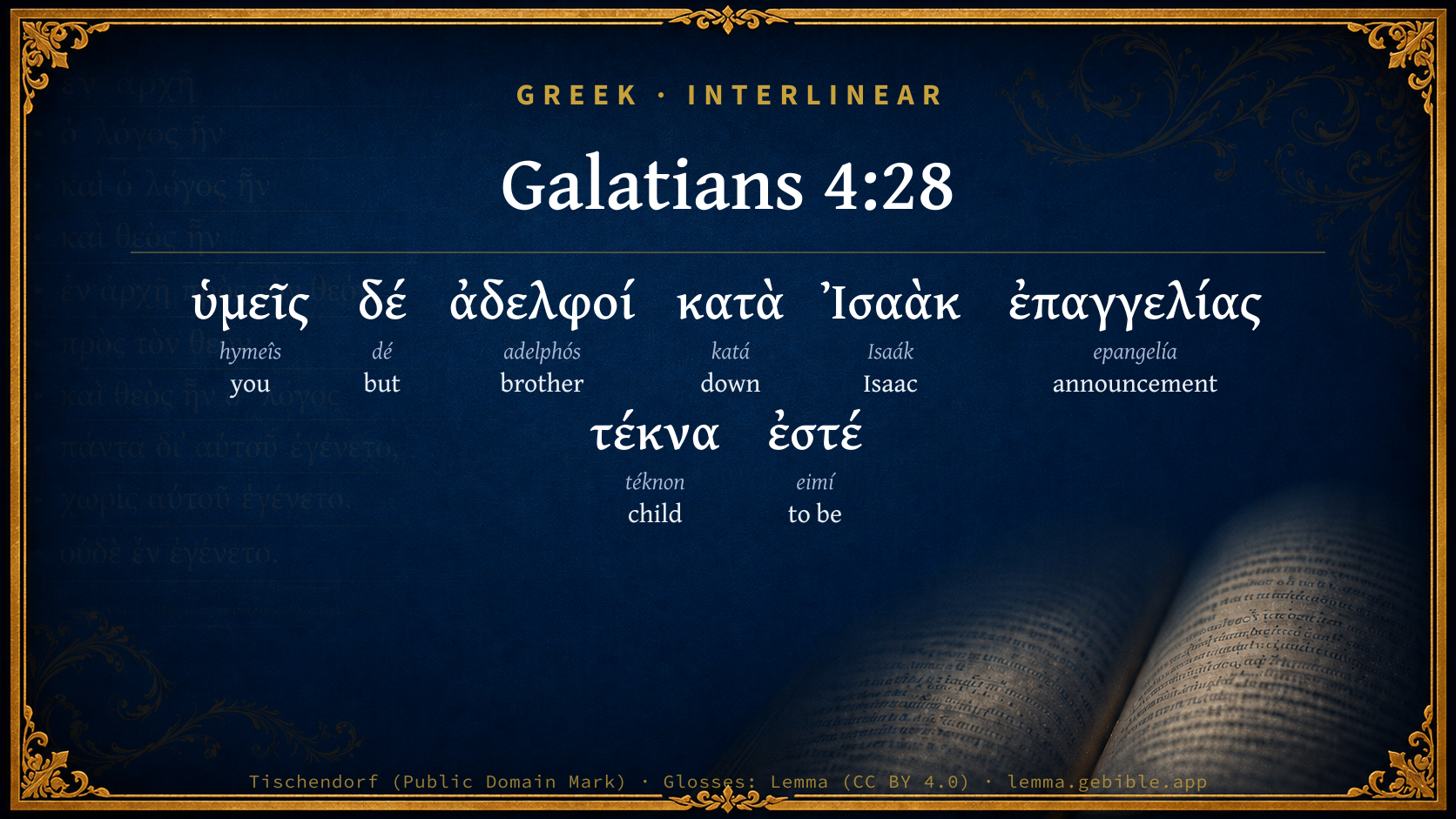
Greek (Tischendorf 8th ed.) Galatians 4:28 appears in the Greek New Testament. The text above is from the Tischendorf 8th edition. Each word links to its Strong’s number and a concise gloss. Click any word for its full Thayer’s Greek Lexicon entry.
Download image
Cite this verse

Galatians 4:28 (World English Bible). Public Domain. Lemma interlinear Bible study tool, https://lemma.gebible.app/v/galatians/4/28.

Show BibTeX & RIS
BibTeX
RIS
English Translation
Now we, brothers, as Isaac was, are children of promise.
World English Bible · Public Domain
Download a study sheet

One document with this verse’s original text, its word-by-word gloss line, the meaning frame, cross-references with their text, attributed commentary, and full source and license credits — printable, and it pastes into notes with its structure intact.

This verse Autodidact and up

Study sheet (.html) Plain text (.txt)

A passage Seminary Student

Up to 50 verses in one chapter. A passage sheet keeps up to 6 commentary sources and 12 cross-references per verse, in the order this page ranks them, and says so on the sheet whenever that leaves anything out. Ask for a single verse and you get the Autodidact verse sheet above.

Everything on this page stays free to read, with no account — the sheet is a download of what is already on screen, not access to it.

Want to remove ads? Support Godless Engineer
Compare translations 3

The same verse in 3 English versions, stacked beneath the original-language interlinear above. Click any original word for its lexicon entry.

Each is an independent rendering of the whole verse — the interlinear is not word-aligned to these translations.

Highlighted words mark where these versions differ — a whole-verse word diff, not a word-by-word alignment.

  • World English Bible Public Domain
    Now we, brothers, as Isaac was, are children of promise.
  • King James Version Public Domain
    Now we, brethren, as Isaac was, are the children of promise.
  • unfoldingWord Literal Text CC BY-SA 4.0
    Now you, brothers, like Isaac, are children of promise.

unfoldingWord Literal Text — © unfoldingWord, licensed CC BY-SA 4.0. Word-aligned USFM3 via Door43 (git.door43.org/unfoldingWord/en_ult).

Versions to compare (up to 4)

3 of 4 selected

Show all 19 translations

Every available English version of this verse, each an independent rendering of the whole verse.

  • World English Bible Public Domain
    Now we, brothers, as Isaac was, are children of promise.
  • Berean Standard Bible Public Domain
    Now you, brothers, like Isaac, are children of promise.
  • Majority Standard Bible Public Domain
    Now we, brothers, like Isaac, are children of promise.
  • King James Version Public Domain
    Now we, brethren, as Isaac was, are the children of promise.
  • American Standard Version (1901) Public Domain
    Now we, brethren, as Isaac was, are children of promise.
  • Revised Version (1885) Public Domain
    Now we, brethren, as Isaac was, are children of promise.
  • Geneva Bible (1599) Public Domain
    Therefore, brethren, wee are after the maner of Isaac, children of the promise.
  • Douay-Rheims (1899) Public Domain
    Now we, brethren, as Isaac was, are the children of promise.
  • Young's Literal Translation Public Domain
    And we, brethren, as Isaac, are children of promise,
  • Literal Standard Version CC BY-SA 4.0
    And we, brothers, as Isaac, are children of promise,
  • Unlocked Literal Bible CC BY-SA 4.0
    But you, brothers, like Isaac, are children of promise.
  • unfoldingWord Literal Text CC BY-SA 4.0
    Now you, brothers, like Isaac, are children of promise.
  • Darby Bible Public Domain
    But *ye*, brethren, after the pattern of Isaac, are children of promise.
  • World Messianic Bible Public Domain
    Now we, brothers, as Isaac was, are children of promise.
  • Webster's Bible Public Domain
    Now we, brethren, as Isaac was, are the children of promise.
  • Free Bible Version CC BY-SA 4.0
    Now my friends, we are children of promise just like Isaac.
  • Bible in Basic English Public Domain
    Now we, brothers, as Isaac was, are the children of the undertaking of God.
  • Text-Critical English NT CC BY 4.0
    Now we, brothers, like Isaac, are children of the promise.
  • Tyndale New Testament (1534) Public Domain
    Brethren we are after the maner of Isaac chyldren of promes.

Literal Standard Version (2020), Covenant Press — licensed CC BY-SA 4.0. Text via the HelloAO Bible API (eBible.org). Unlocked Literal Bible (unfoldingWord) — licensed CC BY-SA 4.0. Text via the HelloAO Bible API (eBible.org). unfoldingWord Literal Text — © unfoldingWord, licensed CC BY-SA 4.0. Word-aligned USFM3 via Door43 (git.door43.org/unfoldingWord/en_ult). Free Bible Version, Dr. Jonathan Gallagher — licensed CC BY-SA 4.0. Text via the HelloAO Bible API (eBible.org).

Word by word

More ways to search: Search by grammar → Find every occurrence → Compare this word →

Practice this passage: Drill this verse → Learn its vocabulary →

About this verse

These counts appear in no published source. They are computed here, from the morphology-tagged text and Lemma’s own curated glosses. What Lemma adds →

8
words
8
distinct lemmas
Pauline Epistles
section

Notable vocabulary

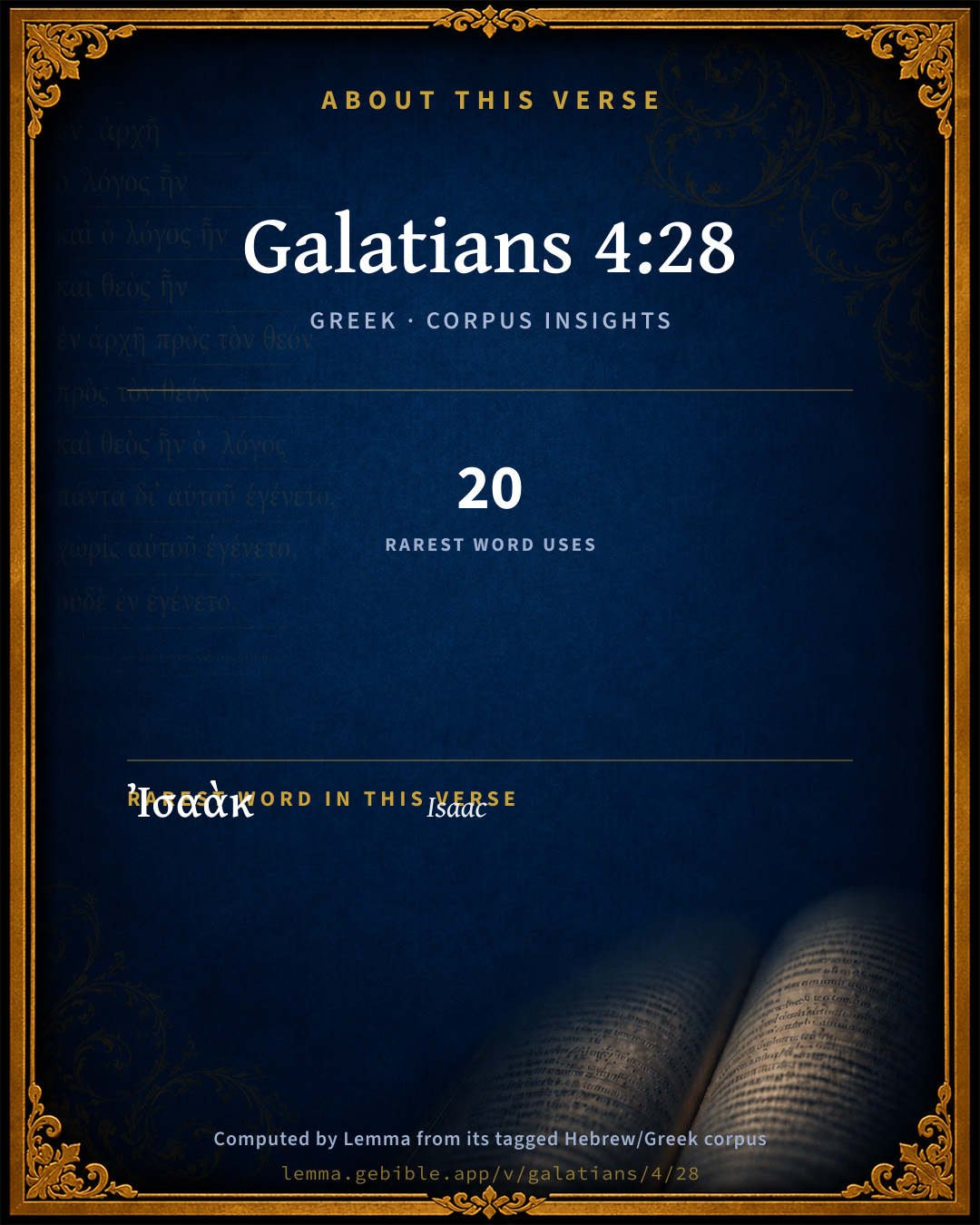
The rarest word here is Ἰσαὰκ Isaac G2464 — appearing just 20 times in the whole Greek New Testament.

Shared distinctive vocabulary

Ἰσαὰκ Isaac G2464 occurs in 18 verses of the Greek New Testament. Also found in:

Cross-references

5

Topical passages linked to Galatians 4:28 in the Treasury of Scripture Knowledge — connected by theme and wording, ordered by reader-vote popularity; previews shown in the World English Bible.

  • Galatians 4:23 However, the son by the handmaid was born according to the flesh, but the son by the free woman was born through promise.
  • Romans 9:8–9 That is, it is not the children of the flesh who are children of God, but the children of the promise are counted as a seed.
  • Romans 4:13–18 For the promise to Abraham and to his seed that he should be heir of the world wasn't through the law, but through the righteousness of faith.
  • Galatians 3:29 If you are Christ's, then you are Abraham's seed and heirs according to promise.
  • Acts 3:25 You are the children of the prophets, and of the covenant which God made with our fathers, saying to Abraham, 'In your seed will all the families of the earth be blessed.'

Cross-references courtesy of OpenBible.info (CC BY 4.0).

Where the printed editions differ

2 variants

Places in this verse where the major printed Greek editions disagree on the wording in a way that affects the translation — a comparison of editions, not a manuscript-by-manuscript collation. The editions are the modern critical texts (Nestlé-Aland 28/27, SBL, Westcott-Hort, Tregelles, Tyndale House) and the traditional texts behind the KJV (the Textus Receptus and the Byzantine/Majority text). It is not a claim about which reading is original.

  1. Different wording
    ὑμεῖς

    “you yourselves”

    In NA28NA27TynSBLTreg Not in WHTRByz

    ἡμεῖς (hēmeis) 'we ourselves' occurs in traditional manuscripts (WH+TR+Byz) instead of ὑμεῖς (humeis) 'you yourselves' in older manuscripts (NA28+NA27+Tyn+SBL+Treg)

  2. Different wording
    ἐστέ.

    “you are.”

    In NA28NA27TynSBLTreg Not in WHTRByz

    ἐσμέν (esmen) 'we are' occurs in traditional manuscripts (WH+TR+Byz) instead of ἐστέ. (este) 'you are.' in older manuscripts (NA28+NA27+Tyn+SBL+Treg)

Textual data: Translators Amalgamated Greek New Testament (STEPBible TAGNT) · CC BY 4.0.

Commentary

Notes on Galatians 4:28 from classic Christian and Jewish commentators (each source and its license shown beneath its notes). The classic Christian expositions comment on the surrounding passage and are grouped to its opening verse, so a note may address several verses; the Jewish commentaries on the Tanakh (Rashi and others) are per-verse, so they appear only where the commentator wrote on this verse.

Lemma curates 59 commentaries, every one of them public domain or Creative Commons licensed, each selected and text-cleaned for this edition rather than reprinted as found. About our sources →

Joseph Benson's Commentary

Gal 4:28-30. Now — That I may apply what has just been advanced to ourselves; we, brethren — Who believe, whether Jews or Gentiles; as Isaac was — Κατα Ισαακ, after the manner of Isaac; are children of promise — Are children of God, being children of Abraham and Sarah, by the promise which made him the father, and her the mother, of nations. In other words, we are children, not born in a natural way, but by the supernatural power of God; and as such, we are heirs of the promise made to believing Abraham. And, “if believers, after the manner of Isaac, are children begotten to Abraham by the divine power accompanying the promise, can it be doubted that they were typified by Isaac, and that his procreation was deferred till the bodies of his parents were dead as to these things, that being supernaturally begotten, he might be a fit type of those who by divine power become the seed of Abraham, through faith.” But — Indeed the parallel holds further still; for as then, he that was born after the flesh — That is, Ishmael, in whose production there was nothing beyond the common course of nature, and who was related to Abraham by natural descent only; persecuted him who was born after the Spirit — That is, Isaac, who was produced by the special energy of God’s miraculous power; even so it is now — The carnal Jews, who are the seed of Abraham after the flesh, abuse and persecute us who believe in Christ, and are therefore Abraham’s seed after the Spirit. Ishmael’s persecution of Isaac consisted in his mocking at the feast of his weaning, Gen 21:9. “No doubt he pretended that by right of primogeniture he was his father’s heir, and therefore he ridiculed the feast made in honour of Isaac as the heir, together with Sarah’s laying claim to the whole of the inheritance for her son. This action was typical of the contempt with which the Jews, Abraham’s natural posterity, would treat his spiritual seed, and their hopes of salvation through faith; typical also of the claim which the natural seed would set up, of being the only heirs of God, because they were first his people.” But what saith the Scripture — Showing the consequence of this? Cast out the bond-woman and her son — Who mocked Isaac. Which sentence, however grievous it might be to Abraham, when pronounced by Sarah, God confirmed, and they were cast out of Abraham’s family. And so, as the apostle’s discourse implies, shall all who reject Christ, and seek justification and salvation by the law of Moses, notwithstanding their boasted descent from Abraham, be cast out of the church and family of God, and rejected from being his people; especially if they persecute them who are his children by faith; and they shall not be permitted to be heirs of his promise with them. So that, as in his birth and condition, his character and actions; so likewise in his being cast out of his father’s house, Ishmael was a fit type of the unbelieving and disobedient Jews. So then — To sum up all; we — Who believe; are not the children of the bond-woman — Are not under subjection to the servile dispensation of the law, nor have any thing to do with it; but we are children of the free-woman — And have the privilege of being called into a state of liberty under the spiritual covenant of the gospel, being free from the curse and bond of the law, and from the power of sin and Satan.

Joseph Benson's Commentary on the Old and New Testaments (1811–1818) — public domain. Text from a community e-Sword module.

Tyndale Open Study Notes

Tyndale Open Resources

4:28-31 Paul applies the allegory of Hagar and Sarah (4:21-27) to the situation in Galatia. Isaac represents those who are born through God’s promise (3:8) by the power of the Spirit (3:2-5; cp. Eph 1:13-14) and who trust in God for salvation through Christ by faith alone. Ishmael represents those who believe that human effort by keeping the law will make them acceptable to God (Gal 3:10-11). This identification would have been shocking to the Judaizers, who thought of themselves as the legitimate children of Abraham because of their insistence on law-keeping.

Tyndale Open Study Notes — © Tyndale Open Resources, licensed CC BY-SA 4.0. Text via the HelloAO Bible API.

Bengel's Gnomon

Johann Albrecht Bengel

Gal 4:28. Κατὰ Ἰσαὰκ, [as] after the similitude of Isaac).—ἐπαγγελίας, of the promise) Gal 4:23.—ἐσμὲν) we are, and ought to wish to be so, Gal 4:31.

Bengel's Gnomon of the New Testament — English translation (T&T Clark, Edinburgh, 1860) — public domain. Text from a community e-Sword module.

Meyer's Critical & Exegetical Commentary

Heinrich August Wilhelm Meyer

Gal_4:28. It is not till Gal_4:29 that a new thought is entered on; hence Gal_4:28 is to be regarded as a remark explaining the fulfilment of the prophetic utterance, which has its actual realization in the case of Christians, and is to be annexed to Gal_4:27 (by a semicolon). So correctly, in opposition to the usual separation from Gal_4:27, Hofmann, Ewald, Wieseler.

But the Christians (ὑμεῖς individualizing; see the critical notes) are the many children of that spiritual Sarah, the heavenly Jerusalem!

κατὰ Ἰσαάκ] After the manner of Isaac; comp. 1Pe_1:15; and see Wetstein and Kypke, also Heindorf, ad Plat. Gorg. p. 225 f.

ἐπαγγελίας τέκνα] ἐπαγγ. is emphatically prefixed: children of Abraham, who are not so by carnal descent like Ishmael, but by promise. So, namely, as Isaac was born to Abraham in virtue of the promise (Gal_4:23), are Christians by means of divine promise also children of Abraham, in virtue of the fact that they were promised by God to Abraham as τέκνα; without which promise, having reference to them, they would not stand in the relation of sonship to Abraham. Comp. Rom_9:8. We must not on account of Gal_4:23 explain the expression here, any more than in Rom_9:8 (see in loc.), as liberi promissi (Winer and others).

Meyer — Critical and Exegetical Commentary on the New Testament — English translation by Peter Christie, edited by Frederick Crombie (T&T Clark, 1880) — public domain. Text from a community e-Sword module.

Geneva Bible (1599)

Geneva Bible translators

That seed, unto which the promise belongeth.

After the manner of Isaac who is the first begotten of the heavenly Jerusalem, as Israel is of the slavish Synagogue.

Geneva Bible (1599) marginal notes — public domain. Text via Bolls.life.

Jamieson, Fausset & Brown

Robert Jamieson, A. R. Fausset & David Brown

we--The oldest manuscripts and versions are divided between "we" and "ye." "We" better accords with Gal 4:26, "mother of us."

children of promise--not children after the flesh, but through the promise (Gal 4:23, Gal 4:29, Gal 4:31). "We are" so, and ought to wish to continue so.

Jamieson, Fausset & Brown — Commentary Critical and Explanatory on the Whole Bible (1871) — public domain (CC PDM 1.0). Text via the HelloAO Bible API.

Adam Clarke's Commentary

Verse 28. Now we] Who believe in the Lord Jesus, are the children of promise-are the spiritual offspring of the Messiah, the seed of Abraham, in whom the promise stated that all the nations of the earth should be blessed.

Adam Clarke's Commentary on the Bible (1810–1826) — public domain. Text from a community e-Sword/MySword module.

Ellicott's Commentary for English Readers

(28) We.—The better reading appears to be Ye. Children of promise.—Children born in accomplishment of the promise. (See Rom_9:8, and Note.)

A Bible Commentary for English Readers, edited by Charles John Ellicott (1878–1897) — public domain. Text from a community e-Sword module.

The Cambridge Bible for Schools and Colleges

gen. ed. J. J. S. Perowne

28. The previous verse is introduced parenthetically. The connexion is, ‘Jerusalem from above is our mother … and we, brethren, as Isaac was, are children, not according to the flesh, but of promise’. The same conclusion as that arrived at ch. Gal_3:29.

The Cambridge Bible for Schools and Colleges (gen. ed. J. J. S. Perowne; Cambridge University Press, 1878–1918) — public domain. Text from a community e-Sword module.

John Gill's Exposition

But as then,.... In the times of Abraham, when Hagar and Sarah, the types of the two dispensations of the covenant, and Ishmael and Isaac, the figures of the two different seeds, the natural and spiritual seed of Abraham, legalists and true believers, were living:

he that was born after the flesh; which was Ishmael, who was a type, or an allegorical representation of such who were under the Sinai covenant, and were seeking for righteousness by the works of the law; as he was born after the flesh, according to the ordinary course of nature, and was, as he was born, a carnal man; so are self-justiciaries, notwithstanding all their pretensions to religion and righteousness, just as they were born; there is nothing but flesh in them; they are without God, and Christ, and the Spirit, and have neither true faith, nor hope, nor love, not any other grace; they have no internal principle of goodness in them; flesh, or corrupt, nature, has the government of them, is the reigning principle in them; their minds are fleshly, and so are their tenets; and such is their conversation, they trust in the flesh, in outward performances, in their own righteousness, and so come under the curse; for as many as trust in an arm of flesh, or are of the works of the law, are under the curse of it:

persecuted him that was born after the Spirit: by whom is meant Isaac, who, though he was not conceived under the overshadowings of the Holy Spirit, without the help of man, as Christ was; yet because of the divine power which was so eminently displayed in his conception and generation, under all the difficulties, and disadvantages, and seeming impossibilities of nature, he is said to be born after the Spirit: and besides, he was also regenerated by the Spirit of God, was a good man, and one that feared the Lord, as the whole account of him shows; and in this also fitly pointed out the spiritual seed, true believers, under the Gospel dispensation, who are born again of water, and of the Spirit, and are renewed in the spirit of their minds; in whom the work of the Spirit is begun, and grace is the governing principle; in whom the Spirit of God dwells and operates; and whose conversation is spiritual, and who walk not after the flesh, but after the Spirit. The persecution of Isaac by Ishmael was by "mocking" him, Gen 21:9 the Hebrew word there made use of is in allusion to Isaac's name, which signifies "laughter": and Ishmael laughed at him, jeered and derided him. The Jewish doctors are divided about the sense of this: some say that the word rendered "mocking" is expressive of idolatry, according to

Exo 32:6 and that Ishmael would have taught Isaac, and drawn him into it; others that it signifies uncleanness, according to

Gen 39:17 and that he talked to him in a lascivious and indecent manner, in order to corrupt his mind: others that it designs murder according to Sa2 2:14 and that he intended to kill him, and attempted it (a); it is pretty much received by them, that either he finding him alone, or they going out to the field together, he took his bow and drew it, and shot an arrow at him, with an intention to kill him (b), though he pretended it was but in play: and one of their writers on the text says (c), that the word used, by gematry, that is, by the arithmetic of the letters, signifies "to slay"; so that this persecution was not by words only, but by deeds: but others (d) of them more rightly think, that it meant a contention about the inheritance, which Sarah's words to Abraham seem to confirm; and that Ishmael claimed the birthright, and despised Isaac as the younger son; insisted upon the right to the inheritance, and mocked at the promise of God, with respect to Isaac; and might threaten what he would do to him, should he claim it thereupon: mocking has been always reckoned a species of persecution; so the Old Testament saints, among other instances of persecution, had trial of "cruel mockings"; thus our Lord was persecuted, and also his apostles

and even so it is now. The carnal Jews, who trusted in themselves that they were righteous, and despised others, persecuted the spiritual seed that believed in Christ, both by words and deeds; they confiscated their goods, imprisoned their persons, and even put them to death; and the false teachers, though they did not, and could not go such lengths, yet as persons fitly represented by Ishmael, they derided the apostles, and mocked at the doctrines of grace preached by them, and despised those that embraced them; and pleaded that the inheritance belonged to them, upon the foot of the works of the law: and so it is at this day; though there is no persecution of men's persons and estates, yet there never was a greater persecution of the doctrines of grace, and of the righteousness of Christ, and the saints more mocked at and derided for maintaining them; and that by persons just of the same complexion as those in the apostle's time, signified by Ishmael, carnal professors, and self-righteous persons.

(a) Jarchi in Gen. xxi. 9. Bereshit Rabba, sect. 53. fol. 47. 4. (b) Jarchi & Bereshit Rabba, sect. 53, fol. 47. 4. Pirke Eliezer. c. 30. (c) Baal Hattrim, in loc. (d) Jarchi & Bereshit Rabba, ut supra. (sect. 53, fol. 47. 4.)

John Gill's Exposition of the Whole Bible (1746–1763) — public domain (CC PDM 1.0). Text via the HelloAO Bible API.

Trapp's Complete Commentary

John Trapp

28 Now we, brethren, as Isaac was, are the children of promise.

Ver. 28. Now we, brethren, as Isaac] This the Jews to this day will not hear of, but call us Mamzer Goi, bastardly Gentiles.

John Trapp, A Commentary or Exposition upon All the Books of the Old and New Testament (1647–1656) — public domain. Text from a community e-Sword module.

Albert Barnes' Notes on the Bible

Now we, brethren - We who are Christians.

Are the children of the promise - We so far resemble Isaac, that there are great and precious promises made to us. We are not in the condition of Ishmael, to whom no promise was made.

Albert Barnes' Notes on the Bible (1834–1885) — public domain. Text from a community e-Sword/MySword module.

Matthew Poole's English Annotations

Isaac was the promised seed, Gen 21:12; Rom 9:7; the apostle tells the Galatians that the believing Gentiles were (as Isaac) the children of the promise. Isaac being born, not by virtue of any procreative virtue in his parents, which was now dead in them, Rom 4:19, but by virtue of the promise, and by a power above nature, was a type of the believing Gentiles, who are a spiritual seed, and that seed to whom the promise was made, being the members of Christ by faith: so as the Jews had no reason so much to glory as they did, that Abraham was their father, for those amongst them that believed not were but his carnal seed, believers only were the spiritual seed,

the children of the promise; to which the believing Gentiles had the same claim with the believing Jews, and a much better than those of them that believed not in Christ.

Matthew Poole's English Annotations on the Holy Bible (1683–1685) — public domain. Text from a community e-Sword/MySword module.

Whedon's Commentary on the Bible

Daniel D. Whedon

28. We, brethren—The direct application of the allegory to the present company. We—Not as seeking circumcision, but as reposing faith in Christ.

As Isaac… children of promise—Isaac’s miraculous generation is type of our miraculous regeneration. The promise of his birth, first made by Jehovah to Abraham, is part of the covenant by which man is regenerate through Christ.

Daniel D. Whedon (gen. ed.), Commentary on the Old and New Testaments (1874–1909) — public domain. Text from a community e-Sword module.

The Pulpit Commentary

Now we, brethren, as Isaac was, are the children of promise (hJmeiv de, ajdelfoi kataav tekna ejsmen or, uJmeiv de... ejste); now we (or, now ye), brethren, after the mariner of Isaac, are children of promise. In the Greek text it is uncertain whether we should read hJmeiv... ejsmen or uJmeiv.., ejste, "we are" or "ye are." The only difference is that "ye are" would more directly thrust upon the attention of the Galatians the conclusion, which "we are" would express in a more general form. "After the manner of Isaac;" kata as in Eph_4:24, ton kata Qeonta: 1Pe_1:15, Kata tosanta: Lam_1:12, Septuagint, Algov kata to algov mou. The apostle is viewing Isaac as in the manner of his being brought into being, the type, to which the children of the mystic freewoman were in after ages to be assimilated. In both cases the children are born or begotten through a promise which God of his own free grace hath given, and which, by an accepting faith, is appropriated and made effectual. Thus Isaac was born. (see ver. 23 and. Rom_9:8, Rom_9:9) The children of the supernal Jerusalem are begotten through the gospel, which in effect is a promise of adoption through Christ to be children of God held out to all who will accept it. Obviously the cases differ in this that in one it was the faith of the parents which made the promise effectual; in the other, the faith of those who in consequence of believing become children. But none the less is it true that the result is due to an announcement proceeding out of God"s own free grace of works but of him that calleth" (Rom_9:7-13; comp. Joh_1:12, Joh_1:13; 1Co_4:15; Jam_1:18 1Pe_1:23) The "promise" is not the parent of the children; this, in the imagery now present to the apostle"s mind, is in the antitypal case the mystic Freewoman. The genitive "of promise" is a genitive of qualification, pointing here to the means through which the children are begotten. Compare a somewhat similarly loose use of the genitive in Rom_9:8, "Not the children of the flesh.., but the children of the promise." The case of baptized infants is not in the apostle"s view.

The Pulpit Commentary (1880–1919), ed. H.D.M. Spence-Jones & Joseph S. Exell — public domain. Text from a community e-Sword module.

John Wesley's Explanatory Notes

Now we - Who believe, whether Jews or Gentiles. Are children of the promise - Not born in a natural way, but by the supernatural power of God. And as such we are heirs of the promise made to believing Abraham.

John Wesley, Explanatory Notes Upon the Whole Bible (1754–1765) — public domain. Text via the GEBible commentary corpus.

Luther on Galatians

Martin Luther

VERSE 28. Now we, brethren, as Isaac was, are the children of promise.

The Jews claimed to be the children of God because they were the children of Abraham. Jesus answered them, Joh 8:39-40, "If ye were Abraham’s children, ye would do the works of Abraham. But now ye seek to kill me, a man that hath told you the truth." And in verse 42: "If God were your Father, ye would love me." In other words: "You are not the children of God. If you were, you would know and love me. Brothers born and living together in the same house recognize each other. You do not recognize me. You are of your father, the devil."

We are not like these Jews, the children of the bondwoman, the Law, who were cast out of the house by Jesus. We are children of the promise like Isaac, born of grace and faith unto an everlasting inheritance.

Martin Luther — Commentary on the Epistle to the Galatians (1535), English translation by Theodore Graebner (Zondervan, 1939) — public domain (U.S. copyright not renewed). Text from a community e-Sword module.

Kretzmann's Popular Commentary

Paul E. Kretzmann

The application of the lesson:

v. 28. Now we, brethren, as Isaac was, are the children of promise.

v. 29. But as then he that was born after the flesh persecuted him that was born after the Spirit, even so it is now.

v. 30. Nevertheless, what saith the Scripture? Cast out the bond-woman and her son; for the son of the bond-woman shall not be heir with the son of the freewoman.

v. 31. So then, brethren, we are not children of the bond-woman, but of the free.

What the prophet had foretold found its realization in the Church of the New Testament. We Christians, we believers, who by virtue of the Gospel-promise are spiritual descendants of Abraham, are, after the manner of Isaac, children of the promise. See 1Pe 1:15. As Isaac was born to Abraham by virtue of the promise of God, so we, through faith in the promise of the Gospel, have been born anew, by the Spirit of God, as His true children, Rom 9:8.

History, however, repeats itself: Just as then he that was born after the flesh made it a practice to persecute the one after the Spirit, thus it is also now. In addition to the fact that Ishmael, Gen 21:9, is called a scoffer, we here have the information that his attitude toward Isaac was that of continual nagging, boasting, and despising, a persecution all the more diabolical since it left little tangible cause for which one could call the lad to account. Isaac had been born according to the Spirit; the Spirit of God through His creative power had restored the atrophied organs of Sarah, Isaac’s birth thus being a miracle. Undoubtedly this fact had much to do with the attitude of Ishmael. But the very same disposition, the apostle says, we find in the world today; those that are in bondage under the Law and are firmly convinced that they can earn the inheritance of heaven by their works are full of hatred and enmity against those that rely upon the gracious promise of God; the self-righteous and hypocrites despise and persecute the true Christians.

But the confidence and supercilious attitude of the self-righteous will not be of long duration. For what does the Scripture say? Cast out the slave and her son; for the son of the slave shall not be heir together with the son of the free-woman. Gen 21:10. That was Sarah’s decision with reference to Hagar and Ishmael, the bond-woman and her offspring. And such is God’s sentence upon all those that are the spiritual descendants of Ishmael, that attempt to get to heaven by the works of the Law. In spite of the persecution to which the believers in the Gospel-promises are subjected, they have on their side the divine assurance that the plans of their enemies will be unsuccessful in the end, that they have no part in the blessings of the Kingdom of Grace and the Kingdom of Glory, for they cannot be heirs together with the children of the Spirit.

So Paul concludes triumphantly: Wherefore, brethren, we are not children of the bond-woman, but of the free. We Christians that believe in Christ and hope by such faith to be justified before God and obtain eternal life, are not among those who, like Hagar and Ishmael, were expelled from the home of Sarah and Abraham, but by the grace of God belong to those that are typified by Isaac, the son of promise; we are true children of God and heirs of eternal life. Thus the fact which Paul intended to set forth in this allegory stands out beyond contradiction over against the Judaizing teachers: The religion of the Law brings into bondage and thus to final condemnation; only the Gospel liberates and brings salvation, and therefore the religion of the Gospel is the only true religion.

Summary

Paul reminds the Galatians that they are children of God, and that they should therefore not return to the bondage of the Law; he rebukes them for falling may from their former loving relation toward him, which, he says, is due to the sordid methods of the false teachers; he shows in an allegory that only the children of the promise will obtain salvation.

Paul E. Kretzmann, Popular Commentary of the Bible (1921–1924) — public domain. Text from a community e-Sword module.

Burkitt's Expository Notes on the New Testament

William Burkitt

In the former of these two verses the apostle applies the foregoing allegory, or typical history of Sarah and Hagar, thus: "As, says he, Isaac by virtue of the promise, being born of the free-woman, was heir to all his father’s estate; in like manner, they who seek salvation not by the law, but by faith in Christ, are the free children of God, and heirs of the promise of life eternal: We, brethren, as Isaac was, are the children of the promise."

In the latter of these two verses, which gives us an account of the persecuting enmity that was in the heart and tongue of Ishmael against Isaac, we have several things observable.

As, 1. The root and rise of Ishmael’s persecuting malice discovered, and whence it proceeded; and that was an inward antipathy to the work of grace in Isaac. Those great differences in divine heraldry, of being born after the flesh, and after the Spirit, evidently discover where the quarrel lay, and whence it arose; it was the spiritualness of Isaac that exasperated Ishmael’s rage. Isaac was born after the Spirit, and doubtless he showed some fruits of the Spirit which Ishmael could not relish, and therefore did deride and mock him.

Observe, 2. What was the kind of persecution which Isaac underwent; it was the persecution of the tongue, in derisions and cruel mockings; Moses tells us, in the book of Genesis, the manner how, and the weapon with which. Ishmael did not lift up his hand against Isaac, as Cain did against Abel, but his tongue only; yet St. Paul calls it here persecution. Mocking and scoffing either at the word, ways, or people of God, is a sin of unspeakable profaneness, a blaspheming of Christ, and a persecution of his members. He that was born after the flesh persecuted him that was born after the Spirit.

Observe, 3. That the persecution of the tongue, at least, is that which the children and church of God have met with in all former, and must expect to meet with in future ages: As it was then, says the apostle, even so it is now; afflictions are the donatives of the gospel, and persecution is the church’s patrimony: To us it is given on the behalf of Christ, not only to believe on him, but to suffer, Php 1:29.

Observe lastly, From Ishmael’s being brother to Isaac, and yet his bitter persecutor, that the sorest trials and sharpest persecutions which the saints endure, are very often from the nearest relations, who are tied to them by the strongest obligations either of kindred or acquaintance. Bitterest things are sometimes endured from the hands of those from whom better things might justly have been expected. Christ foretold all this, The brother shall betray the brother to death, and the father the son. Cain is dead, but the spirit of Cain yet lives; they that scoff, would bite, and make their teeth meet, had they power to use their cheekbone; he that is born after the flesh, will persecute those of his own flesh and family that are born after the Spirit; as it was then, we may go on to say, even so it is now.

William Burkitt's Expository Notes on the New Testament (1700–1703) — public domain. Text from a community e-Sword module.

McGarvey & Pendleton's Commentaries

J. W. McGarvey

Now we, brethren, as Isaac was, are children of promise.

J. W. McGarvey (with Philip Y. Pendleton), Commentaries on the New Testament (The Fourfold Gospel, 1914; Acts; and the epistles) — public domain. Text from a community e-Sword/MySword module.

The People's New Testament

B. W. Johnson

28. Now we, brethren. As Isaac was the child of promise, so are we, Gentile and Jewish Christians, of the promise to Abraham of a Seed in which all nations should be blessed.

B. W. Johnson's The People's New Testament with Notes (1889–1891) — public domain. Electronic text from the Christian Classics Ethereal Library (CCEL) ThML edition.

unfoldingWord translationNotes

Door43 World Missions Community

brothers

See how you translated this in Galatians 1:2.

children of promise

Possible meanings are that the Galatians have become God's children 1) by believing God's promise or 2) because God worked miracles to fulfill his promises to Abraham, first by giving Abraham a son and then by making the Galatians children of Abraham and thus sons of God.

according to the flesh

This refers to Abraham's becoming Ishmael's father by taking Hagar as a wife. AT: "by means of human action" or "because of what people did" (See: Metaphor)

according to the Spirit

"because of something the Spirit did"

translationWords

brother

Isaac

children

flesh

persecute

Holy Spirit

unfoldingWord translationNotes — © Distant Shores Media and the Door43 World Missions Community, licensed CC BY-SA 4.0. Source: git.door43.org/Door43/en_tn.

Cambridge Greek Testament for Schools and Colleges

28. ἡμεῖς … ἐσμέν (cf. Gal 4:31) Text. Rec. with אACDcKLP etc. ὑμεῖς … ἐστέ W.H. margin with BD*G.

28. Having shown in Gal 4:23-27 that we as believers are like Isaac, children of the free woman, indeed the Jerusalem above, St Paul in this one verse recalls the fact that we, also like Isaac, have our origin in promise, a subject already discussed at length in Gal 3:16-29.

ἡμεῖς δὲ … ἐσμέν. See notes on Textual Criticism, ἡμ. emphatic as in Gal 4:26.

ἀδελφοί (Gal 1:11). St Paul gladly returns to this term of faith in their real and present standing. There can hardly be any thought in the word of all believers, you Gentiles and we Jews, being brothers as sons of one mother, as Zahn suggests (p. 241).

κατὰ Ἰσαὰκ. Apparently after the category of Isaac, cf. Heb 5:6; Heb 7:11.

ἐπαγγελίας τέκνα ἐσμέν, Rom 9:8. We are not dependent on the Law, but on God’s promise, Gal 3:22.

Cambridge Greek Testament for Schools and Colleges (Cambridge University Press, 1896; 21 vols, various authors incl. Carr, Maclear, Plummer, Farrar, Lumby, Moule, M. R. James, Simcox) — public domain. Text from a community e-Sword module.

Alford’s Greek Testament

Henry Alford

28.] But (transitional: or rather perhaps adversative to the children of her who had an husband, which were last mentioned. With ἡμεῖς, it would be resumptive of ver. 26) ye (see var. readd.), brethren, like (the expression in full, κατὰ τ. ὁμοιότητα Μελχισεδέκ, occurs Heb 7:15. Wetst. quotes from Galen, ὁ ἄνθρωπος οὐ κατὰ λέοντά ἐστι τὴν ῥώμην, and from Arrian, Hist. Gr. ii., τιμώμενος ὑπὸ τοῦ δήμου κατὰ τὸν πατέρα Ἄγνωνα: see also reff.) Isaac, are children of promise (ἐπαγγ. emphatic:—are children, not κατὰ σάρκα, but διὰ τῆς ἐπαγγελίας, see ver. 23, and below, ver. 29).

Henry Alford, The Greek Testament (1849–1861) — public domain. Text from a community e-Sword module.

International Critical Commentary

28. ὑμεῖς δέ, ἀδελφοί, κατὰ Ἰσαὰκ ἐπαγγελίας τέκνα ἐστέ· “And ye, brethren, like Isaac, are children of promise.” With this sentence the apostle takes up his allegorical development of the O. T. narrative at a new point. Having in vv. 22, 23 developed it with reference to the two women, which he has made to represent the two communities, and incidentally enforced his thought by a quotation from the prophets, he now makes use of the sons, Isaac and Ishmael, and more pointedly applies his allegory to his readers. Note the address ὑμεῖς δέ, ἀδελφοί. As Isaac was born in fulfilment of a promise, not in the usual course of nature, so Paul assures the Galatians, they also are children of promise, whose standing with God rests not on physical descent, but on the promise made to Abraham, which has already been interpreted as applying to all who have faith (3:7, 8, 10). δέ is continuative, introducing this element of the allegorical interpretation of the O. T. passage as an addition to that of vv. 24-27.

As in 4:23, evidence is very evenly divided between ὑμεῖς … ἐστέ and ἡμεῖς … ἐσμέν. The former is attested by the group BDG, supported by 33, 424** Sah., the latter by אAC with the concurrence of LP f Boh. and Cyr. and the great body of the Syrian authorities. Transcriptional probability favours ὑμεῖς … ἐστέ, the change of this form to the first person being more easily explicable as due to assimilation to vv. 27, 31 than the reverse. ὑμεῖς is unobjectionable on grounds of intrinsic probability, such changes of person being characteristic of Paul; cf. 4:23-29.

Κατά in the sense “like,” “after the manner of,” occurs not infrequently in classic writers (L.&S. s. v. B. III 3) and in N. T. Cf. Eph 4:24, 1Pe 1:15, 1Pe 4:6, Heb 8:9. The position of ἐπαγγελίας (gen. of characteristic) is emphatic. The term is qualitative, but the reference is undoubtedly to the promise already repeatedly referred to in the epistle (3:16, 18, 21, 22). Whose children they are, whether sons of God or sons of Abraham is not emphasised; but the context as a whole implies the latter. To take τέκνα as meaning children of the Jerusalem above (Sief.) is to insist upon a closeness of connection with v. 27 which is not only not justified by anything in this v. but is practically excluded by the phrase κατὰ Ἰσαάκ and vv. 29ff.

International Critical Commentary — older volumes (1896–1929), various authors — public domain. Text from a community e-Sword module.

Lesson kit

Teaching starters — assembled from the data on this page, not authored interpretation. Every prompt links to the verse data it draws on. Edit before teaching.

Galatians, in the Pauline Epistles, opens this verse with 8 words (8 distinct Greek lemmas). Its most distinctive word is Isaák (“Isaac”). A historical commentator’s framing appears above. Read the whole chapter for the surrounding context.

Discussion questions

  1. The word Isaák carries the sense “Isaac.” How does it shape the verse?
  2. Matthew 1:2 shares the word «Isaac» with this verse. How do the two illuminate each other?
  3. These translations render this verse differently. What is at stake in choosing one wording over another?
  4. Reading how Joseph Benson's Commentary and Tyndale Open Study Notes read this verse, where do the two commentators agree and where do they part?

Things to notice

Reading settings

Reading text

Shown beneath each verse's original-language words.

Old Testament
Old Testament edition

Read the OT as the Masoretic Hebrew (MT) or the Greek Septuagint (LXX).

English shown for the Greek Septuagint (in the Hebrew ↔ Greek comparison).

Comparing translations? Open the Compare panel on any verse page to stack up to four side by side.