Galatians 3:23

Greek (Tischendorf 8th ed.) Galatians 3:23 appears in the Greek New Testament. The text above is from the Tischendorf 8th edition. Each word links to its Strong’s number and a concise gloss. Click any word for its full Thayer’s Greek Lexicon entry.
Download image
Cite this verse

Galatians 3:23 (World English Bible). Public Domain. Lemma interlinear Bible study tool, https://lemma.gebible.app/v/galatians/3/23.

Show BibTeX & RIS
BibTeX
RIS
English Translation
But before faith came, we were kept in custody under the law, shut up to the faith which should afterwards be revealed.
World English Bible · Public Domain
Download a study sheet

One document with this verse’s original text, its word-by-word gloss line, the meaning frame, cross-references with their text, attributed commentary, and full source and license credits — printable, and it pastes into notes with its structure intact.

This verse Autodidact and up

Study sheet (.html) Plain text (.txt)

A passage Seminary Student

Up to 50 verses in one chapter. A passage sheet keeps up to 6 commentary sources and 12 cross-references per verse, in the order this page ranks them, and says so on the sheet whenever that leaves anything out. Ask for a single verse and you get the Autodidact verse sheet above.

Everything on this page stays free to read, with no account — the sheet is a download of what is already on screen, not access to it.

Want to remove ads? Support Godless Engineer
Compare translations 3

The same verse in 3 English versions, stacked beneath the original-language interlinear above. Click any original word for its lexicon entry.

Each is an independent rendering of the whole verse — the interlinear is not word-aligned to these translations.

Highlighted words mark where these versions differ — a whole-verse word diff, not a word-by-word alignment.

  • World English Bible Public Domain
    But before faith came, we were kept in custody under the law, shut up to the faith which should afterwards be revealed.
  • King James Version Public Domain
    But before faith came, we were kept under the law, shut up unto the faith which should afterwards be revealed.
  • unfoldingWord Literal Text CC BY-SA 4.0
    Now before the faith came, we were held captive under the law, imprisoned until the faith about to be revealed.

unfoldingWord Literal Text — © unfoldingWord, licensed CC BY-SA 4.0. Word-aligned USFM3 via Door43 (git.door43.org/unfoldingWord/en_ult).

Versions to compare (up to 4)

3 of 4 selected

Show all 19 translations

Every available English version of this verse, each an independent rendering of the whole verse.

  • World English Bible Public Domain
    But before faith came, we were kept in custody under the law, shut up to the faith which should afterwards be revealed.
  • Berean Standard Bible Public Domain
    Before this faith came, we were held in custody under the law, locked up until faith should be revealed.
  • Majority Standard Bible Public Domain
    Before this faith came, we were held in custody under the law, locked up until faith should be revealed.
  • King James Version Public Domain
    But before faith came, we were kept under the law, shut up unto the faith which should afterwards be revealed.
  • American Standard Version (1901) Public Domain
    But before faith came, we were kept in ward under the law, shut up unto the faith which should afterwards be revealed.
  • Revised Version (1885) Public Domain
    But before faith came, we were kept in ward under the law, shut up unto the faith which should afterwards be revealed.
  • Geneva Bible (1599) Public Domain
    But before faith came, we were kept vnder the Law, as vnder a garison, and shut vp vnto that faith, which should afterward be reueiled.
  • Douay-Rheims (1899) Public Domain
    But before the faith came, we were kept under the law shut up, unto that faith which was to be revealed.
  • Young's Literal Translation Public Domain
    And before the coming of the faith, under law we were being kept, shut up to the faith about to be revealed,
  • Literal Standard Version CC BY-SA 4.0
    And before the coming of faith, we were being kept under law, shut up to the faith about to be revealed,
  • Unlocked Literal Bible CC BY-SA 4.0
    Now before faith came, we were held captive under the law, imprisoned until faith should be revealed.
  • unfoldingWord Literal Text CC BY-SA 4.0
    Now before the faith came, we were held captive under the law, imprisoned until the faith about to be revealed.
  • Darby Bible Public Domain
    But before faith came, we were guarded under law, shut up to faith [which was] about to be revealed.
  • World Messianic Bible Public Domain
    But before faith came, we were kept in custody under the law, confined for the faith which should afterwards be revealed.
  • Webster's Bible Public Domain
    But before faith came, we were kept under the law, shut up to the faith which should afterwards be revealed.
  • Free Bible Version CC BY-SA 4.0
    Before we trusted in Jesus we remained in the custody of the law until this way of trusting was revealed.
  • Bible in Basic English Public Domain
    But before faith came, we were kept in prison under the law, waiting for the revelation of the faith which was to come.
  • Text-Critical English NT CC BY 4.0
    Now before faith came, we were kept in custody under the law, confined until the faith that was to come would be revealed.
  • Tyndale New Testament (1534) Public Domain
    Before that fayth cam, we were kept and shut vp vnder the lawe, vnto the fayth which shuld afterwarde be declared.

Literal Standard Version (2020), Covenant Press — licensed CC BY-SA 4.0. Text via the HelloAO Bible API (eBible.org). Unlocked Literal Bible (unfoldingWord) — licensed CC BY-SA 4.0. Text via the HelloAO Bible API (eBible.org). unfoldingWord Literal Text — © unfoldingWord, licensed CC BY-SA 4.0. Word-aligned USFM3 via Door43 (git.door43.org/unfoldingWord/en_ult). Free Bible Version, Dr. Jonathan Gallagher — licensed CC BY-SA 4.0. Text via the HelloAO Bible API (eBible.org).

Word by word

More ways to search: Search by grammar → Find every occurrence → Compare this word →

Practice this passage: Drill this verse → Learn its vocabulary →

ἐφρουρούμεθα
phrouréō
G5432
“to guard”
Verb, Imperfect, Passive, Indicative, 1st person, Plural
Part of Speech
Verb
Tense
Imperfect
Voice
Passive
Mood
Indicative
Person
1st person
Number
Plural
Full Thayer's Definition

Origin: from a compound of G4253 and G3708

TDNT: None

1. to guard, protect by a military guard, either to prevent hostile invasion, or to keep the inhabitants of a besieged city from flight 2. metaph. a. under the control of the Mosaic law, that he might not escape from its power b. to protect by guarding, to keep c. by watching and guarding to preserve one for the attainment of something
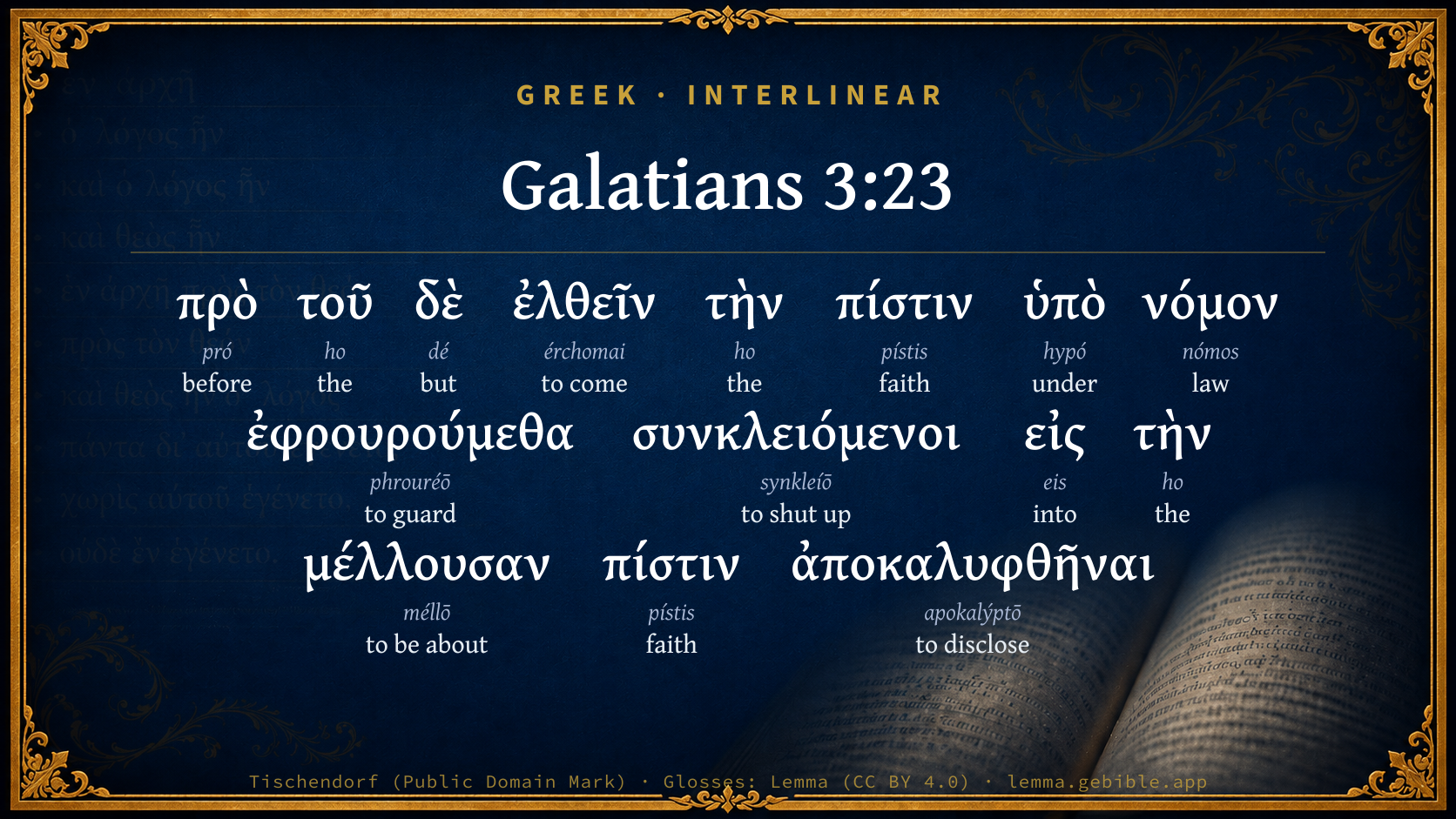
  1. πρὸ pró G4253 “before” Preposition
  2. τοῦ ho G3588 “the” Article, Genitive, Singular, Neuter
  3. δὲ dé G1161 “but” Conjunction
  4. ἐλθεῖν érchomai G2064 “to come” Verb, Aorist, Active, Infinitive
  5. τὴν ho G3588 “the” Article, Accusative, Singular, Feminine
  6. πίστιν pístis G4102 “faith” Noun, Accusative, Singular, Feminine
  7. ὑπὸ hypó G5259 “under” Preposition
  8. νόμον nómos G3551 “law” Noun, Accusative, Singular, Masculine
  9. συνκλειόμενοι synkleíō G4788 “to shut up” Verb, Present, Passive, Participle, Nominative, Plural, Masculine
  10. εἰς eis G1519 “into” Preposition
  11. τὴν ho G3588 “the” Article, Accusative, Singular, Feminine
  12. μέλλουσαν méllō G3195 “to be about” Verb, Present, Active, Participle, Accusative, Singular, Feminine
  13. πίστιν pístis G4102 “faith” Noun, Accusative, Singular, Feminine
  14. ἀποκαλυφθῆναι apokalýptō G601 “to disclose” Verb, Aorist, Passive, Infinitive

About this verse

These counts appear in no published source. They are computed here, from the morphology-tagged text and Lemma’s own curated glosses. What Lemma adds →

15
words
12
distinct lemmas
Pauline Epistles
section

Notable vocabulary

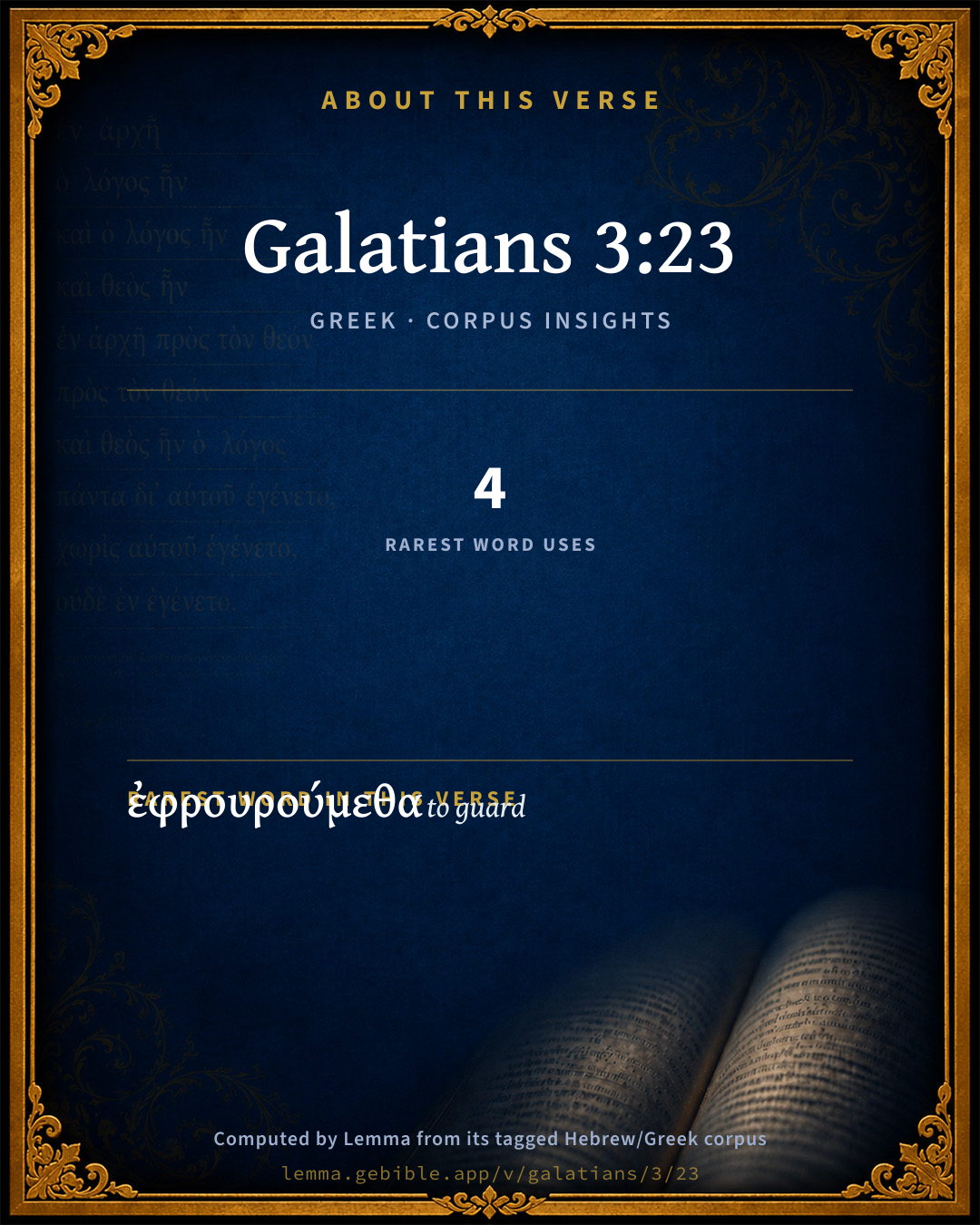
The rarest word here is ἐφρουρούμεθα to guard G5432 — appearing just 4 times in the whole Greek New Testament.

Shared distinctive vocabulary

ἐφρουρούμεθα to guard G5432 occurs in 4 verses of the Greek New Testament. Also found in:

Repetition

Words recur within this verse:

  • πίστιν faith G4102 ×2
  • τοῦ the G3588 ×3

Cross-references

14

Topical passages linked to Galatians 3:23 in the Treasury of Scripture Knowledge — connected by theme and wording, ordered by reader-vote popularity; previews shown in the World English Bible.

  • Galatians 5:18 But if you are led by the Spirit, you are not under the law.
  • Galatians 3:24–25 So that the law has become our tutor to bring us to Christ, that we might be justified by faith.
  • Romans 6:14–15 For sin will not have dominion over you. For you are not under law, but under grace.
  • Romans 11:32 For God has shut up all to disobedience, that he might have mercy on all.
  • Galatians 3:19 What then is the law? It was added because of transgressions, until the seed should come to whom the promise has been made. It was ordained through angels by the hand of a mediator.
  • Romans 3:19 Now we know that whatever things the law says, it speaks to those who are under the law, that every mouth may be closed, and all the world may be brought under the judgment of God.
  • Galatians 4:1–5 But I say that so long as the heir is a child, he is no different from a bondservant, though he is lord of all;
  • 1 Peter 1:11–12 searching for who or what kind of time the Spirit of Christ, which was in them, pointed to, when he predicted the sufferings of Christ, and the glories that would follow them.
  • Luke 10:23–24 Turning to the disciples, he said privately, "Blessed are the eyes which see the things that you see,
  • 1 Corinthians 9:20–21 To the Jews I became as a Jew, that I might gain Jews; to those who are under the law, as under the law, that I might gain those who are under the law;
  • Hebrews 12:2 looking to Jesus, the author and perfecter of faith, who for the joy that was set before him endured the cross, despising shame, and has sat down at the right hand of the throne of God.
  • Galatians 4:21 Tell me, you that desire to be under the law, don't you listen to the law?
  • Hebrews 11:13 These all died in faith, not having received the promises, but having seen them and embraced them from afar, and having confessed that they were strangers and pilgrims on the earth.
  • Hebrews 11:39–40 These all, having had testimony given to them through their faith, didn't receive the promise,

Cross-references courtesy of OpenBible.info (CC BY 4.0).

Commentary

Notes on Galatians 3:23 from classic Christian and Jewish commentators (each source and its license shown beneath its notes). The classic Christian expositions comment on the surrounding passage and are grouped to its opening verse, so a note may address several verses; the Jewish commentaries on the Tanakh (Rashi and others) are per-verse, so they appear only where the commentator wrote on this verse.

Lemma curates 59 commentaries, every one of them public domain or Creative Commons licensed, each selected and text-cleaned for this edition rather than reprinted as found. About our sources →

Joseph Benson's Commentary

Gal 3:23. But before faith — That is, the gospel dispensation, came, we — The nation of the Jews; were kept under the law — Under that dispensation, as condemned malefactors are guarded in close custody; shut up — As prisoners under sentence; unto the faith which should afterward be revealed — Reserved and prepared for the gospel. Observe here, reader, 1st, “The gospel is called faith, (Gal 3:2; Gal 3:23; Gal 3:25,) and the law of faith, (Rom 3:27,) because it requires faith, instead of perfect obedience, as the means of men’s justification. This law of faith, or method of justification, came at the fall: it was then established; and till it came, Adam was kept in ward without hope, under the law he had broken. In like manner the Gentiles, under the law of nature, and the Jews, under the law of Moses, were kept in ward, as criminals, and had no hope of pardon, but what the law of faith gave them, as made known obscurely in the first promise, (Gen 3:15,) and afterward in the covenant with Abraham. 2d, The law of Moses, instead of being contrary to the promises of God, or covenant with Abraham, effectually co-operates therewith. By the perfection and spirituality of its moral precepts, it makes us sensible of our inability to obey it perfectly; and by its curse, denounced against every one who does not obey perfectly, it makes us flee, trembling and affrighted, to the method of salvation revealed to us in the covenant with Abraham, and published to all mankind in the gospel.” — Macknight.

Joseph Benson's Commentary on the Old and New Testaments (1811–1818) — public domain. Text from a community e-Sword module.

Tyndale Open Study Notes

Tyndale Open Resources

3:23-29 Paul contrasts the condition of God’s people under the law before Christ with their condition now under Christ.

3:23 Because sin had imprisoned us (3:22), the law was a guard, keeping God’s people in protective custody . . . until the way of faith in Christ was revealed. It made God’s requirements explicit, and thus highlights the need for a Savior. The law also restrains sin by making the consequences of sin explicit.

Tyndale Open Study Notes — © Tyndale Open Resources, licensed CC BY-SA 4.0. Text via the HelloAO Bible API.

Bengel's Gnomon

Johann Albrecht Bengel

Gal 3:23. Τὴν πίστιν, the faith of Jesus Christ) So the following verses.—ἐφρουρούμεθα συγκεκλεισμένοι, we were kept shut up) These two words elegantly disjoin the law and faith. The being ‘kept’ in custody is the consequence of the shutting up. Wis 17:16: ἐφρουρεῖτο εἰς τὴν ἀσίδηρον εἱρκτὴν κατακλεισθείς, he was kept shut up in a prison without iron bars.—συγκεκλεισμένοι εἰς) So the LXX., συγκλείειν εἰς θάνατον, Psa 78:50, Psa 31:9; Amo 1:6; Amo 1:9. But it is an abbreviated phrase: shut up, and therefore reserved and forced to the faith, etc. [so that there remained to us no refuge but faith.—V. g.] Polybius says, εἰς αὐτὰς συνεκλείσθη τὰς ἐν ἰδίοις οἰκέταις καὶ φίλοις ἐλπίδας, “he was shut up to those very hopes which were among [which depended on] his own domestics and friends;” and so it often occurs in the same writer.—See Raphelius. Irenaeus has, the sons of God are shut up to the belief of His coming: l. iii. c. 25.

Bengel's Gnomon of the New Testament — English translation (T&T Clark, Edinburgh, 1860) — public domain. Text from a community e-Sword module.

Meyer's Critical & Exegetical Commentary

Heinrich August Wilhelm Meyer

Gal_3:23. Δέ] no longer connected with ἀλλά (Hofmann), but leading over to a new portion of the statement (the counterpart to which is to follow in Gal_3:25),namely, to the position which the law held under the circumstances expressed in Gal_3:25. Before the introduction of faith, it was to guard and maintain those who belonged to it in this relation of bondage, so that they should not get rid of it and become free,a liberation which was reserved for the faith which was to come.

πρὸ τοῦ δὲ ἐλθεῖν] δέ in the third place with the prepositional phrase. See Ellendt, Lex. Soph. I. p. 397; Klotz, ad Devar. II. p. 378 f.

Here also πίστις is neither doctrina fidem postulans, the gospel, as most ancient expositors and Schott think, nor the dispensation of faith (Buhl, comp. Rückert), but subjective faith, which is treated objectively. Comp. on Gal_1:23, Gal_3:2. As long as there was not yet any belief in Christ, faith was not yet present; but when on the preaching of the gospel men believed in Christ, the faith, which was previously wanting, had come, that is, had now set in, had presented itself,namely, in the hearts of those who had become believers. On ἐλθεῖν as applied to mental things and states, which set in, comp. Pind. Nem. i. 48 (hopes); Plat. Pol. iii. p. 402 A (understanding); Soph. O. R. 681 (δόκησις). Comp. also Rom_7:9.

ὑπὸ νόμον ἐφρουρούμεθα συγκλειόμενοι] (see the critical notes): under the law we were held in custody, so that we were placed in ward with a view to the faith about to be revealed. The. subject is: we Jewish Christians (Gal_3:25); the emphasis is on ὑπὸ νόμον, and afterwards on πίστιν. The law is represented as a ruler, under whose dominion (ὑπὸ νόμον) those who belonged to it were held in moral captivity, as in a prison; so that they, as persons shut up in the φρουρά under lock and key, were placed beyond the possibility of liberationwhich was only to ensue by means of the faith that was to be revealed in the future.[166] The words and the context do not yield more than this: the paedagogic efficacy of the law is not inferred till Gal_3:24, and is not to be anticipated here. This view is opposed to that of many expositors (Chrysostom, Theophylact, Oecumenius, Erasmus, Grotius, Estius, Winer, Rückert, Schott, Ewald, and others), who find already expressed here that paedagogic function, which, however, is understood in the sense of the usus politicus of the law (but see on Gal_3:24): in severam legis disciplinam, quae ne in omnem libidinem effunderemur cavit, traditi, Winer. But the whole explanation of the law guarding from sin (to which also Wieseler refers ἐφρουρ.) is opposed to the correct interpretation of ΤῶΝ ΠΑΡΑΒΆΣΕΩΝ ΧΆΡΙΝ (Gal_3:19), and also to Gal_3:22. The captivity so forcibly described by Paul is just the sinful bondage under the law, Rom_7:1; 1Co_15:56. Observe, moreover, in order to a just understanding of the passage, that ὑπὸ νόμον, according to the very position of the words, cannot without proceeding arbitrarily be connected with ΣΥΓΚΛ. (so de Wette, Wieseler, and many others, also my own former interpretation),a connection which is not warranted by the other thought, Gal_3:22,but must be joined to ἘΦΡΟΥΡ. (Augustine and many others, also Hofmann, Reithmayr, Buhl); and further, that the present participle ΣΥΓΚΛΕΙΌΜΕΝΟΙ (with the ΕἸς ΤῊΝ ΜΈΛΛ. Κ.Τ.Λ. belonging to it) forms the modal definition of ἐφρουρούμεθα, representing the continued operation of the latter, which, constantly appearing in fresh acts, renders liberation impossible. Hofmann (comp. his Schriftbew. II. 2, p. 59) understands συγκλείειν εἰς in the sense of constraining to something; it expresses in his view the constraining power, with which subjection to the law served to keep the people directed towards the faith which was to be revealed in the future.[167] Such an use of the phrase is indubitably found among later Greek authors, and is especially frequent in Polybius (see Raphel, and Schweighäuser, Lex. Polyb. p. 571 f.); but how improbable, and in fact incredible it is, that Paul should have here used this word in a different sense from that in which he used it immediately before in Gal_3:22, and in the kindred passage, Rom_11:32 (he has it not elsewhere)! This sense could not have occurred to any reader. Besides, the idea of constraint against ones will, which must be conveyed in συγκλειόμ. εἰς (see Fritzsche, ad Rom. II. p. 545), and which Hofmann obliterates (the law conferred on the people its distinctive position, and its abiding in this distinctive position was at the same time an abiding directed towards the faith that was to come), would neither agree with the text (Gal_3:22; Gal_3:24) nor harmonize with history (Romans 11; Act_28:25 ff.).

εἰς τὴν μέλλουσαν πίστιν ἀποκαλυφθῆναι] As εἰς in Gal_3:24 is evidently to be understood as telic, and as the temporal interpretation usque ad (Erasmus, Grotius, Michaelis, Koppe, Morus, Rosenmüller, Rückert, Usteri, and others) after πρὸ τοῦ ἐλθεῖν τὴν πίστιν, which includes in itself the terminus ad quem, would be very unmeaning, εἰς is to be explained: towards the faith, that is, with the design, that we should pass over into the state of faith. Luther (1519) aptly remarks: in hoc, ut fide futura liberaremur. In accordance with the view of Oecumenius, Theophylact, Augustine, Calovius, Raphel, Bengel, Hofmann, εἰς κ.τ.λ. is to be connected with συγκλειόμενοι, because the latter, without this annexation of the telic statement εἰς κ.τ.λ., would not form a characteristic modal definition of ἐφρουρ. This εἰς κ.τ.λ. is, in the history of salvation, the divine aim of that σύγκλεισις, which was to cease on its attainment; Christ is the end of the law. Comp. Gal_3:22, where ἵνα κ.τ.λ. corresponds with the εἰς κ.τ.λ. here.

μέλλουσαν] is placed first (Paul did not write, εἰς τ. πίστ. τ. μέλλ. ἀποκ.), because with that earlier situation is contrasted the subsequent future state of things which was throughout the object of its aim. Comp. on Rom_8:18. Similarly in 1Pe_5:1, 2Ma_8:11.

ἀποκαλυφθῆναι] for so long as there was not yet belief in Christ, faith had not yet made its appearance: it was still a (in the counsel of God) hidden element of life, which became revealed as a historical phenomenon, when Christ had come and the gospelthe preaching of faith (Gal_3:2; Gal_3:5)was made known. Ἀποκαλ. cannot be understood as the infinitive of design and, according to the reading συγκεκλεισμένοι, as belonging to the latter word (Matthias: in order to become manifest, as those who were under the ban with a view to the future faith), because in the religious-historical connection of the text it must signify the final appearance of the blessing of salvation, which hitherto as a μυστήριον had been unknown (Rom_16:25). Besides, Paul would thus have written very far from clearly; he must at least have placed the infinitive before συγκεκλεισ.

[166] If, with Winer, Usteri, and Schott, ἐφρουρ. is explained merely as asservabamur (1Pe_1:5),comp. Hofmann, we were held in keeping,it yields, according to the connection with συγκεκλεισμένοι, and with the inference thereupon of the paedagogic function of the law, too weak a thought. Comp. Wis_17:16. Luther, Calvin, and many others, including Rückert and de Wette, have rightly found in ἐφρουρ. and συγκεκλ. the figurative idea of a prison (φρούριον, Plat. Ax. p. 365 E; φρουρά, Plat. Phaed. p. 62 ff.). The prison, however, is not the law itself; but the latter is the ruler, under whose power the captives are in prison,because, namely, under the law, as the δύναμις τῆς ἁμαρτίας (1Co_15:56), they are not in a position to attain to the freedom of moral life.

[167] Raphel, Polyb. p. 518, has understood συγκλείειν εἰς in a similar way to Hofmann, and finely paraphrased it: eo necessitatis quem adigere, ut ad fidem tanquam sacram ancoram confugere cogatur. Comp. Bengel.

Meyer — Critical and Exegetical Commentary on the New Testament — English translation by Peter Christie, edited by Frederick Crombie (T&T Clark, 1880) — public domain. Text from a community e-Sword module.

Expositor's Greek Testament

ed. W. Robertson Nicoll

Gal 3:23-24 . THE POSITION OF THE TRUE CHILDREN OF GOD BEFORE THE COMING OF CHRIST IS ILLUSTRATED BY THE CONTROL EXERCISED OVER CHILDREN IN THEIR FATHER’S HOUSE BY MEMBERS OF HIS HOUSEHOLD. These verses explain the position of the faithful under the Law. They are here associated with Christians by the use of the first person plural; for they too were in their generation believers in God, they belonged to the same blessed family and inherited the original promise. Yet since all Israel from the time of Moses to the Advent were subjected to the control of the Law, they too were subject to bondage. But this was really due to the watchful love of their Heavenly Father, who thus provided needful shelter and guidance, just as an earthly father places his young children during years of weakness and inexperience under the charge of household servants. τὴν πίστιν . The article, though ignored in our versions, is essential to the sense. By the coming of the faith is meant the historic fact of the Christian religion, the spread of the Gospel on earth. The term has the same objective sense as in Gal 1:23 , Gal 3:25 , Act 6:7 , and Rom 3:30 , where also a clear distinction is drawn between πίστεως , faith in the abstract, and τῆς πίστεως , the faith of Christ. Obviously faith did not come with Christ, it was the most conspicuous virtue of the Jewish Church, and Abraham was but the first of many splendid examples of it. συγκλειόμενοι . MS. authority is strongly in favour of the present participle, which is also more appropriate than the perfect συγκεκλεισμένοι for describing the continuous process of legal condemnation which prevailed from generation to generation. παιδαγωγὸς . No English equivalent for this term can convey its real force, for it has no exact counterpart in an English home. The position of a nurse towards young children approaches more nearly than that of schoolmaster or tutor to the office of the παιδαγωγός , for he was a confidential dependent, usually a slave, neither qualified to instruct, nor invested with authority to control his young master, but appointed to attend on him, to safeguard him, and to report to his father any disorderly or immoral habits on which it might be necessary for the father to place a check. The Law in like manner regulated outward habits, enforced order and decency, and maintained a certain standard of morality among Israelites until in due time they became ripe for spiritual freedom. It was not the function of the Law to address itself directly to the conscience like the Prophets, or to claim spiritual authority over the whole man, but to impose a check on the open tyranny of evil, to enforce on the community a higher standard of morals, and so to foster indirectly the growth of spiritual life.

The Expositor's Greek Testament, edited by W. Robertson Nicoll (1897–1910) — public domain. Text from a community e-Sword module.

Cambridge Greek Testament for Schools and Colleges

23–4:7. The contrast between our former state of pupillage under the Law, and our present state in Christ, full sonship

This is brought out under two aspects:

I. Gal 3:23-29. The preparative character of the Law; faith in Christ makes us Abraham’s seed, (a) Gal 3:23-24. We were protected by the Law with the hope of the future faith. The Law has been our paedagogue, leading us to Christ. (b) Gal 3:25-29. Now we are all sons of God by our faith in Christ, and therefore Abraham’s seed, heirs according to promise.

II. Gal 4:1-7. Temporary submission to laws, for those who are in an inferior position, is common. But Christ has delivered us and brought us into full sonship, as our experience tells us.

23, 24. A more positive answer to the question of v.19. The Law was distinctly preparative

(Gal 3:23) We Jews were protected—the Law leaving us no room to escape from its power—that we should at last be brought into the faith that was about to be revealed. (Gal 3:24) So that the Law has become our moral guide unto Christ (Messiah), in order that we should be justified of faith.

23. συνκλειόμενοι אABD*G. συγκεκλεισμένοι Text. Rec. CDcKL.

23. πρὸ τοῦ δὲ ἐλθεῖν τὴν πίστιν. Gal 3:22 suggests to St Paul that he should (Gal 3:23-24) dwell on the temporary and preparative character of the Law, a point which he touched upon in Gal 3:19 ἄχρις ἂν ἔλθῃ κ.τ.λ. τὴν π. The article resumes the πίστις of Gal 3:22. It is almost “this faith of which I speak,” hardly “the dispensation of faith.”

ὑπὸ νόμον ἐφρουρούμεθα. φρουρ.: 2Co 11:32; Php 4:7; 1Pe 1:5[110]. “We” = we Jews, who alone were under the Law. In the last two of these three passages φρουρεῖν has the connotation of protecting rather than keeping in prison. So probably here. The various laws were, as Chrysostom and Theodoret say, a wall to the Israelites, or, as Jewish writers say, a “hedge” against sins of the heathen (see Schechter, Some Aspects, pp. 206 sq.).

[110] Is affixed to a word it means that all the passages are mentioned where that word occurs in the New Testament.

συνκλειόμενοι, Gal 3:22 note. See notes on Textual Criticism. It is the “present participle of identical action”: cf. Joh 6:6 (Burton, § 120). It describes the nature of the imprisonment; we were shut up.

εἰς κ.τ.λ. Preferably with the principal verb ἐφρουρούμεθα. The guard of the Law was with the aim that we should pass over into faith.

τὴν μέλλουσαν πίστιν ἀποκαλυφθῆναι. For the construction see Rom 8:18. Contrast 1Pe 5:1. The position of μέλλουσαν suggests the length of the period during which we were in ward. Only here, as it seems, are πίστις and ἀποκαλύπτεσθαι coupled. Here also πίστις can hardly be “the dispensation of faith.”

Cambridge Greek Testament for Schools and Colleges (Cambridge University Press, 1896; 21 vols, various authors incl. Carr, Maclear, Plummer, Farrar, Lumby, Moule, M. R. James, Simcox) — public domain. Text from a community e-Sword module.

Geneva Bible (1599)

Geneva Bible translators

Now there followeth another handling of the second part of this Epistle: the state whereof is this: Although the Law (that is, the whole government of God’s house according to the Law) [does] not justify, is it therefore to be abolished, seeing that Abraham himself was circumcised, and his posterity held still the use of Moses’ Law? Paul affirmeth that it ought to be abolished, because it was instituted for that end and purpose, that is should be as it were a schoolmaster and keeper to the people of God, until the promise appeared in deed, that is to say, Christ, and the Gospel manifestly published with great efficacy of the Spirit.

The cause why we were kept under the Law, is set down here.

Geneva Bible (1599) marginal notes — public domain. Text via Bolls.life.

Jamieson, Fausset & Brown

Robert Jamieson, A. R. Fausset & David Brown

faith--namely, that just mentioned (Gal 3:22), of which Christ is the object.

kept--Greek, "kept in ward": the effect of the "shutting up" (Gal 3:22; Gal 4:2; Rom 7:6).

unto--"with a view to the faith," &c. We were, in a manner, morally forced to it, so that there remained to us no refuge but faith. Compare the phrase, Psa 78:50, Margin; Psa 31:8.

which should afterwards, &c.--"which was afterwards to be revealed."

Jamieson, Fausset & Brown — Commentary Critical and Explanatory on the Whole Bible (1871) — public domain (CC PDM 1.0). Text via the HelloAO Bible API.

Adam Clarke's Commentary

Verse 23. But before faith came] Before the Gospel was published.

We were kept under the law, shut up] εφρουρουμεθα. We were kept as in a strong hold, συγκεκλεισμενοι, locked up, unto the faith-the religion of the Lord Jesus, which should afterwards be revealed. Here the same metaphor is used as above, and for its explanation I must refer the reader to the same place, Ro 11:32.

Adam Clarke's Commentary on the Bible (1810–1826) — public domain. Text from a community e-Sword/MySword module.

John Calvin's Commentaries

23. Before faith came. The question proposed is now more fully defined. He explains at great length the use of the law, and the reason why it was temporal; for otherwise it would have appeared to be always unreasonable that a law should be delivered to the Jews, from which the Gentiles were excluded. If there be but one church consisting of Jews and Gentiles, why is there a diversity in its government? Whence is this new liberty derived, and on what authority does it rest, since the fathers were under subjection to the law? He therefore informs us, that the distinction is such as not to interrupt the union and harmony of the church.

We must again remind the reader that Paul does not treat exclusively of ceremonies, or of the moral law, but embraces the whole economy by which the Lord governed his people under the Old Testament. It became a subject of dispute whether the form of government instituted by Moses had any influence in obtaining righteousness. Paul compares this law first to a prison, and next to a schoolmaster. Such was the nature of the law, as both comparisons plainly show, that it could not have been in force beyond a certain time.

Faith denotes the full revelation of those things which, during the darkness of the shadows of the law, were dimly seen; for he does not intend to say that the fathers, who lived under the law, did not possess faith. The faith of Abraham has already come under our notice, and other instances are quoted by the author of the Epistle to the Hebrews. (Hebrews 11.) The doctrine of faith, in short, is attested by Moses and all the prophets: but, as faith was not then clearly manifested, so the time of faith is an appellation here given, not in an absolute, but in a comparative sense, to the time of the New Testament. That this was his meaning is evident from what he immediately adds, that they were shut up under the faith which should afterwards be revealed; for this implies that those who were under the custody of the law were partakers of the same faith. The law did not restrain them from faith; but, that they might not wander from the fold of faith, it kept possession of themselves. There is an elegant allusion, too, to what he had formerly said, that “the scripture hath concluded all under sin.” They were besieged on every hand by the curse, but this siege was counteracted by an imprisonment which protected them from the curse; so that the imprisonment by the law is here proved to have been highly generous in its character.

Faith was not yet revealed, not because the fathers wanted light, but because they had less light than we have. The ceremonies might be said to shadow out an absent Christ, but to us he is represented as actually present, and thus while they had the mirror, we have the substance. Whatever might be the amount of darkness under the law, the fathers were not ignorant of the road in which they ought to walk. Though the dawn is not equal to the splendor of noon, yet, as it is sufficient to direct a journey, travelers do not wait till the sun is fully risen. Their portion of light resembled the dawn, which was enough to preserve them from all error, and guide them to everlasting blessedness.

John Calvin's Commentaries (1540-1563) — public domain. Text from the Calvin Translation Society English edition (1840s-50s) via the Christian Classics Ethereal Library (ccel.org). Calvin's coverage is partial (roughly two-thirds of the Bible); uncommented books and verses are honest gaps, never fabricated. The 19th-century editor's footnotes and remarks are omitted so the notes are faithfully Calvin's own voice.

Ellicott's Commentary for English Readers

(23) Before faith came.—Before faith awoke into exercise, began to exist, or the preaching of Christ as its object.

We were kept.—Better, we were kept in ward, so as to bring out more clearly the force of the metaphor which runs through the verse. The Law was a kind of prison-house, in which we were kept shut up. It was a custody from which we were not permitted to escape—a stern guardian that we were made to obey.

Unto the faith . . .—With a view to the dispensation of faith which was in store for us. The object of this state of guardianship was to fit us for the dispensation of faith looming in the future.

A Bible Commentary for English Readers, edited by Charles John Ellicott (1878–1897) — public domain. Text from a community e-Sword module.

The Cambridge Bible for Schools and Colleges

gen. ed. J. J. S. Perowne

23. But before faith came] Better, ‘before this faith’, i.e. in Jesus Christ, ‘came’; and so nearly = before Christ came.

we were kept] kept in ward. The same word occurs 1Pe_1:5.

shut up] The passive of the same verb which is rendered ‘hath concluded’ in Gal_3:22.

the faith which should afterwards be revealed] Here the word faith seems to pass from the subjective to the objective sense. It means the full Gospel revelation of salvation by faith in the Lord Jesus Christ.

The Cambridge Bible for Schools and Colleges (gen. ed. J. J. S. Perowne; Cambridge University Press, 1878–1918) — public domain. Text from a community e-Sword module.

John Gill's Exposition

But before faith came,.... This is to be understood, not of the grace of faith, which was under the former dispensation, as now; the Old Testament saints had the same Spirit of faith, and the same grace of faith, as for its nature, object, and use, as New Testament saints have; Adam, Abel, Enoch, Noah, Abraham, &c. believed in Christ, and were justified by faith in his righteousness, as we are. It is much better to understand it of the doctrine of faith, which though preached to Adam, and by Noah, and to Abraham, and by Isaiah, and others, yet not so clearly, largely, and fully, as by Jesus Christ and his apostles; so that the times of the Gospel may be called the times of faith, in comparison of the times of the law, and which some think is here meant; but it is best to interpret it of Christ, the object of faith, who was to come, and is come in the flesh, to fulfil the law; and, by so doing, has put an end to it; and to redeem his people from under it, and to save them with an everlasting salvation; for before this his coming in the flesh, the people of the Jews, of whom the apostle was one, were under the law:

we were kept under the law; as persons in a garrison, as the word signifies; they were kept distinct and separate from the rest of the nations of the world, and had neither civil nor religious conversation with them; and so were preserved in some measure both from their impieties and idolatries, which otherwise they were naturally prone to; and as a distinct people, unto the coming of the Messiah, who was to arise from among them; so that their being kept under the law in this sense, was both for their honour and their safety: though the meaning may also be, that they were kept under it as persons under a military guard, as the word likewise imports; and signifies, that the law kept a strict guard and a watchful eye over them, as the Roman soldier had over Paul, that kept him, and held fast the chain in his hand, with which he was bound, that he might not get loose and escape from him; see Act 28:16 to which the apostle seems here to allude; the law kept them close to the discharge of their duty, and held them fast as prisoners; and which is more fully expressed in the next clause,

shut up. The Syriac version reads this in connection with the former, thus, "the law kept us shut up", as in a prison; and the same way reads the Arabic version; which shows the state and condition the Jews were in under the law, and how they were treated by it; not as good and righteous persons, but as persons in debt, as criminals and malefactors; a prison is made, and so the law, for such sort of persons; the law considered and used them as sinners, as criminals convicted and condemned; it did itself accuse, convict, and pronounce them guilty, and condemned them to punishment; and detained them as prisoners in its dark dungeon, where they had little light and comfort; and were as in a pit, wherein is no water; though they lay here as prisoners of hope, in expectation of the Messiah's coming; who was to proclaim liberty to the captives, and the opening of the prison to them that are bound, and to say to the prisoners, Come forth, and to them that sit in darkness, Show yourselves. Also the allusion may be to the custom of the eastern nations, in the usage of their slaves and captives; who in the daytime used to grind at a mill in a prison house, and in the night time were put down into a pit and shut up, and a mill stone put to the mouth of the pit (p); and so describes the state of bondage and slavery the Jews were in under the law, who differed nothing from servants, to whom the saints under the Gospel dispensation are opposed, Gal 3:26 as being the children of God by faith in Christ. And in this uncomfortable condition they continued,

unto the faith which should afterwards be revealed; that is, until Christ the object of faith came, who was to be revealed, or made manifest in the flesh; who, before his incarnation, not only lay in the bosom of the Father, but was in a great measure hid under the types and prophecies of the Old Testament; which though they gave some hints of him, yet but obscure ones, in comparison of the revelation made of him by his appearance in human nature; by the testimonies of his Father by a voice from heaven of angels, of John the Baptist, and others; and by his own doctrines and miracles, and by the spirit of wisdom and revelation in the knowledge of him.

(p) Schindler Lex. Pentaglott. in voce col. 1712.

John Gill's Exposition of the Whole Bible (1746–1763) — public domain (CC PDM 1.0). Text via the HelloAO Bible API.

Trapp's Complete Commentary

John Trapp

23 But before faith came, we were kept under the law, shut up unto the faith which should afterwards be revealed.

Ver. 23. But before faith came, &c.] i.e. Before Christ came; faith is put for the object of faith.

We were kept under the law] φρουρουμεθα, as in a prison or garrison, being circled with a compassing strength. The sinner, having transgressed, is kept by the law, as with a guard or garrison, that he cannot escape unless he be delivered by Christ. Some learned men make this expression of the apostle here, "Kept under the law," to denote the duty of a schoolmaster; as one who is to give an account of such as are committed to his charge.

John Trapp, A Commentary or Exposition upon All the Books of the Old and New Testament (1647–1656) — public domain. Text from a community e-Sword module.

Albert Barnes' Notes on the Bible

But before faith came - That is, the system of salvation by faith in the Lord Jesus. Faith here denotes the Christian religion, because faith is its distinguishing characteristic.

We were kept under the law - We, who were sinners; we, who have violated the Law. It is a general truth, that before the gospel was introduced, people were under the condemning sentence of the Law.

Shut up unto the faith - Enclosed by the Law with reference to the full and glorious revelation of a system of salvation by faith. The design and tendency of the Law was to shut us up to that as the only method of salvation. All other means failed. The Law condemned every other mode, and the Law condemned all who attempted to be justified in any other way. Man, therefore, was shut up to that as his last hope; and could look only to that for any possible prospect of salvation. The word which in this verse is rendered “were kept” ἐφρουρούμεθα ephrouroumetha, usually means to guard or watch, as in a castle, or as prisoners are guarded; and though the word should not be pressed too far in the interpretation, yet it implies that there wasa rigid scrutiny observed; that the Law guarded them; that there was no way of escape; and that they were shut up. as prisoners under sentence of death, to the only hope, which was that of pardons.

Unto the faith ... - That was the only hope. The Law condemned them, and offered no hope of escape. Their only hope was in that system which was to be revealed through the Messiah, the system which extended forgiveness on the ground of faith in his atoning blood.

Albert Barnes' Notes on the Bible (1834–1885) — public domain. Text from a community e-Sword/MySword module.

Matthew Poole's English Annotations

Before faith came; before the covenant of grace, or the doctrine of the gospel, or Christ himself, was revealed.

We were kept under the law; the apostle either speaks of all mankind, of whom it is true, that until God’s revelation of the covenant of grace, they had no other way of salvation made known to them than by the law of works; or else of the Jews, to whom, though before Christ there was a revelation of the gospel, yet it was more dark and imperfect, so as they

were kept under the law, but few apprehending any other way of justification than by the works of the law.

Shut up unto the faith which should afterwards be revealed; but the apostle saith they were but shut up under it; God never intended it as that by the observance of which they should be saved; but as even then, to those whom he intended to save, he made a more secret revelation of his gospel, so he had now more fully and plainly revealed the way of salvatiou which he had from eternity established.

Matthew Poole's English Annotations on the Holy Bible (1683–1685) — public domain. Text from a community e-Sword/MySword module.

Whedon's Commentary on the Bible

Daniel D. Whedon

23. Before faith came—As offered in the gospel of the crucified Jesus.

Kept—The Greek word signifies watched, as by a military guard; under sentinels.

Law—As a military fortress.

Shut up—The doors of our stronghold locked, and we imprisoned; in confinement, yet in safety.

Unto the faith—Our future and only outlet.

Which should afterwards be revealed—Rather, faith, which was about to be revealed. The faith was in its essence and power operated during the time of the law. It lay in the underlying promise of the Abrahamic covenant throughout the whole period. It lies in the designs of God’s mercy even under the heathen dispensation. But in their dim and dark dispensation, that faith is afterwards to be revealed.

Daniel D. Whedon (gen. ed.), Commentary on the Old and New Testaments (1874–1909) — public domain. Text from a community e-Sword module.

The Pulpit Commentary

The feature which distinguishes this new paragraph (vers. 23, 24) from the preceding (vers. 21, 22) is the more distinct statement of the paedagogic function of the Law as preparatory to that economy of grace which was the ulterior purpose of the Lawgiver. In the meanwhile (the apostle here says) we were committed to the custody of the Law. But before faith came (pro tou de ejlqein thstin). The "but" is antithetic to the closing clause of ver. 22, from which is taken up afresh the notion of faith, there spoken of as of old destined to become at the proper time the qualifier for the receiving of the promise. "Faith" denotes, not objectively, "the faith," that is, the gospel, as Gal_1:23, a sense in which it is seldom used, and which is repelled here by the whole context; but subjectively, the principle of belief in One who gives of mere grace. This, by a bold and surely jubilant figure of speech, is personified as "coming" for men"s deliverance, while the "Law" is also personified as the stern custodian under whose charge till then men were detained. Compare the frequent references in the Psalms to "light," "truth," "righteousness," "word," etc., being" sent," "commanded," by the Lord, as in angels, despatched for the help of his saints. (Psa_43:3 Psa_40:11 Psa_57:3 Psa_107:20, etc.) We were kept under the Law, shut up (uJpomon ejfrouroumeqa sugkekleismenoi sugkleiomenoi, Revised Text; so, according to Scrivener, L. T. Tr.); we were kept in ward under the Law. shut up. The "we" recites, not exactly Jewish Christians or Jews, except per accidens, but God"s people. The verb frourein, keep carefully guarded, is used with a prominent notion of protection in 1Pe_1:5; whilst in 2Co_11:32, as here, the more prominent idea is that of preventing egress. Comp. meqa." Rom_7:6, "The Law wherein we were holden (kateico) So RAPC Wis 17:16, of Egyptians, in the plague of miraculous darkness, as it were imprisoned, unable to move, jEfroureito eijv thdhron eiJrkthv, "Was kept ill ward, having been shut up into the prison which had no iron bars." The reading sugkleiomenoi or sunkleiomenoi, although highly witnessed to by uncial manuscripts, appears to be accounted for by the reading in B, sugkleismenoi (very probably a clerical blunder for sugkekleismenoi), which may have given it vogue. The perfect participle seems alone suitable to the passage, q.d. shut up for good and all. The present participle would require to be understood of the repression of a constantly repeated endeavour to escape (or, what?). As the verb sunekleisen occurs in the preceding verse, sugkekleismenoi takes the shade of meaning, "shut up as I said." Unto the faith which should afterwards be revealed (eijv thllousan pistin ajpokalufqhnai). "Unto;" with reference to, with an eye to, the coming economy of free grace, to which they were then to be transferred. The same preposition (eijv) is used in the same manner in the next verse," unto Christ." In the words, thllousan pistin ajpokalufqhnai, we have the same form of sentence as in Rom_8:18, Prov thllousan do ajpokalufqhnai, "For the glory which shall hereafter be revealed." In both cases, the emphatic position of mellousan appears to indicate, not merely that the manifestation was future, but that the future would be sure to bring it; the predetermining purpose of God made it certain. "Revealed:" the principle of faith as accepting a gift bestowed of free grace, though not unknown to the pious of former ages (Rom_3:21) for how in any age could one con-scions of sin look for any gift at the hands of the Almighty except thus? was destined, under the "gospel of the grace of God," to come forth into conspicuous prominence as the one supremely commanding element of religious sentiment.

Vers. 23-29.

The Law-school and the home-coming.

Paul, in the present section, pursues the thought of the purpose of Law. It is the tutor to convey certain lessons to the soul and to secure thereby the soul"s return to the Father and the home. Let us look at the interesting line of thought thus given.

I THE LAW-SCHOOL. (Vers. 23, 24.) The idea was once entertained that the Law, as paidagwgov, meant the slave who was entrusted with the guidance of the child to the school of Christ. But this notion is now abandoned, and, as the superior slaves were often entrusted with the education of the child to a certain age, the idea which is now accepted from this passage is that the soul goes to the school of the Law, and learns from the Law the lessons which fit it for coming home to Christ. Christ is not the Schoolmaster to whom Law leads the soul, but is the elder Brother of the Divine family to whom the lessons of the schoolmaster, the Law, leads the enlightened soul. The Law-school is an institution of great strictness and severity. Hence we are represented here as "kept in ward under the Law" (Revised Version). Like one of the great barracks which are called euphoniously "public schools," and where, as in public prisons, the youths are for some hours daily confined, and out of which they are thankful to escape; so the Mosaic Law is meant to be the severe training-school which will make us relish ever so much the freedom and comfort of home.

II THE BURDEN OF ITS TEACHING. (Ver. 24.) The lesson of the Law is personal unworthiness, the impossibility of our ever saving ourselves. The more we study the ten commandments, the more we enter into the spirit and meaning of the moral Law, the deeper must be our conviction that we cannot keep it perfectly, and so must be liable to its penalties. But the Jews, instead of holding hard to the teaching of the moral Law, turned their back upon it and betook themselves to the ceremonial Law as their hope of life. Their notion was that, though they might neglect the weightier matters of the Law, such as judgment, mercy, and faith, they were perfectly safe so long as they tithed the mint, the anise, and the cummin. (Mat_23:23) Instead of learning Law"s lesson and being "shut up to faith," they mistook the lesson altogether and shut themselves up to ceremony. The Law was meant to defeat self-righteousness; the pupils allowed it to minister to self-righteousness. Instead of being shut up to faith, they remained in the school of Law for ever and never got home. Now, every well-conducted school impresses upon its pupils the desirability of their getting beyond its lessons and its confinement. The broad liberty of manhood and of home lies in supposed sunlight beyond it, and the school training encourages the vision. So with God"s Law; it is designed to create a longing for the liberty in Christ and the larger opportunities that liberty implies.

III THE HOME-COMING. (Vers. 25, 26.) If we learn the true lesson from the Law, we are carried by it to the feet of Christ, and we seek justification by trusting him. Faith is thus the home-coming of the soul; and undoubtedly no schoolboy ever came whistling so joyfully home, even when his home-coming was the final one, as the soul does which has learned to trust and love Christ. Then the sense of imprisonment and confinement gives place to a sense of freedom. As children of God in Christ Jesus, we rejoice in the abundant liberty of home. Our education is so far finished when we have learned to hope in our elder Brother only. Then do we know what it is to be "at home" with God. The prodigal son enjoyed himself greatly at the father"s banquet, and so do all of us; for we are all prodigals by nature, when by faith and repentance we come home to God.

IV UNITY IN CHRIST. (Vers. 27, 28.) The home-coming is attended by the entertainment of the Christian spirit. By that spirit all caste-distinctions die. Having put on Christ, we do not look contemptuously on any, but hopefully on all. The Jew and the Greek forget their national differences and separations; the bond and the free do not dwell despairingly or proudly on the accident of birth; the man does not tyrannize over the woman, and neither will the Christian woman, when she secures her rights, tyrannize over the man; but each and all will rejoice in their unity in Christ. Christ thus proves himself to be the unifying element in the human race. Coming near to each, he brings each near to all, and establishes around his person the brotherhood of man.

V FAITH ALSO INTRODUCES SOULS TO THE PRIVILEGES OF THE ABRAHAMIC FAMILY. (Ver. 29.) Unquestionably the Jews were the heirs of magnificent promises. But is it carnal Jews that are to get them? is it men who are only descended from Abraham according to the flesh? Nay; Abraham has a spiritual seed, and all who are Christ"s through faith become children of Abraham. Paul thus proclaims a chosen generation, whose fellowship may be entered by faith and not by circumcision, by the Christian spirit and not by Jewish ceremony. This is better than converting the world to Judaism, to convert it to Christ, and through relationship to Christ to count kindred with Abraham. "We are the circumcision," as he says to the Philippian converts, "who worship God in the spirit, who rejoice in Christ Jesus, and have no confidence in the flesh". (Php_3:3) The Law teaches us a precious lesson if it sends us for salvation to Christ, and enables us to find in fellowship with our Lord the privileges of the chosen people becoming ours. R.M.E.

Vers. 23-29.

Before and after faith.

I BEFORE FAITH CAME. "But before faith came." The faith which is here brought into prominence is that which was historically manifested when Christ came. Faith existed before Christianity, as is evident from the eleventh of Hebrews. There was trust in the Divine word. But the attitude toward Christ was that of expectancy. "We who had before hoped in Christ." It had been faith along with the observance of the Mosaic Law. But when the gospel of salvation was preached, it was faith, pure and simple, on Christ.

1. The state of God"s people under the Law. "We were kept in ward under the Law, shut up." They were wards of the Law. A strict watch was kept over them, as those who could not manage themselves. This went the length of their being in custody.

(1) There were manifold restrictions. The limits were greatly narrowed within which they were free to act. Even their common life was encompassed with ceremonial regulations. However good these were, there was this to be said, that they were outwardly imposed. And they had the effect of multiplying the occasions of offence. They made many things sins which were not sins in themselves. There was thus a heavy pressure laid on the life. The moral Law, too, came in with its oppressive "Thou shalt not.

(2) There was the feeling of helplessness produced. The Law represented the Divine requirement. As a revelation of what God required, it raised a very high ideal. God was to be loved with the whole soul, and a man"s neighbour as himself. But at the same time, it did not bring with it strength for the attainment of this ideal. It, therefore, sometimes even stimulated the sinful life. It excited desires which it had not power to quell. And thus it worked towards despondency.

(3) There was the feeling of guilt produced. The Law revealed what ought to have been attained; but, revealing at the same time the wide distance between the ideal raised and the actual attainment, instead of being a witness of its high ends as accomplished, it became an accuser.

(4) There were appeals to fears. Its "Thou shalt not" was accompanied with a threat. There was a curse pronounced on the breaking of every one of its requirements.

(5) There was the.feeling of condemnation produced. The Law, in showing them their guilt, showed them also to be condemned sinners, actually lying under the curse. Thus the outcome of its working was the eliciting of the cry, "O wretched man that I am, who shall deliver me out of the body of this death?

2. The goal intended for them. "Unto the faith which should afterwards be revealed." It is to be remembered that the Law existed alongside of the promise, to which it was simply an addition. It is to be remembered, also, that the ceremonial part of the Law had promise largely mixed up with it, many of the types being really promises. And, so far as the promise was concerned, there could be, in the religious life of those times, a feeling of liberty in the enjoyment of forgiveness and in the hope of the attainment of their ideal. There was grace, too, in the heart of the Law. It was a disciplinary institution, preparatory to Christianity. It was with a view to the people of God being brought into a higher state, into the freer relation of faith, which was to be revealed when Christ came. Illustration. "So that the Law hath been our tutor to bring us unto Christ, that we might be justified by faith." The pedagogue (formerly translated "schoolmaster," now "tutor") was one who got his name born leading the child to school. He had the responsible office of superintending the education of the child, and also his morals and manners. He had strictly to regulate and watch over the employments and deportment of the child, and he was armed with the power of punishment. The pedagogic function is what belongs to every parent. He has himself or by deputy to educate his child, physically, intellectually, morally, and spiritually. The restrictions he has to lay on the employment of his time, thoughts, energies, are not agreeable to him, but they are with a view to his being of age. The Law is thus laid upon him that it may be ultimately within him, and that he may do that which is right and proper with no sense of bondage. The people of God were under the Law as under a pedagogue. They were treated as children, and had their duty minutely prescribed to them and their fears appealed to. This produced a sense of bondage, but it was that by-and-by they might the better welcome Christ and those higher influences he was to bring with him. The feeling of guilt and condemnation which the Law produced was that Christ might be longed for in his justifying merit to be received through faith.

II NOW THAT FAITH IS COME. "But now that faith is come.

1. Christian emancipation. "We are no longer under a tutor." We are no longer under the discipline of the Mosaic institution. We do not need rules outwardly imposed on us, nosy that the higher Christian influences are operative in us. We are absolutely freed from the ceremonial Law, which received its fulfilment in Christ. The moral Law could never be called Mosaic, rather it was that round which the whole Mosaic institution was gathered. We are freed from it as the ground of our justification or condemnation. But it is still needed to hold up before us higher ideas of righteousness. It is still needed to work in us deeper conviction of sin. It is still needed to keep us to the true source of our security. But what thus disciplines us, is the Law as it has received its highest exhibition in the cross of Christ. From it, as connected with the Mosaic institution, we are freed.

2. Christian sonship.

(1) The relation described. "For ye are all sons of God." Gentiles as well as Jews are sons of God. We are not in the relation of slaves, without any feeling of freedom. Neither are we in the relation of servants, with such freedom as belongs to them. But we are in the freest relation of sons of God. Neither are we mere children, but we are sons that have come of age. That does not mean that we are to leave our Father"s house. "The servant goeth away; the son abideth ever." We are independent, not in being liberated from our Father"s control, but in having our Father"s will so much within our heart that we act according to it without the need of rules being imposed on us.

(2) How the relation is formed. "Through faith." We are not sons of God by virtue of our living in a Christian land. Multitudinism is alien to Christianity. We cannot be Christians merely in the mass. The state, whatever it has to do with religion, cannot relieve us of the responsibility of acting for ourselves. We are not sons of God by virtue of our connection with godly parents. There is a certain law of heredity in religion. "The unfeigned faith that is in thee; which dwelt first in thy grandmother Lois, and thy mother Eunice; and, I am persuaded, in thee also." The promise is to us and to our children; therefore there is encouragement to use the means. Still, all that parents can do is to act upon their children by good advice and example and prayer. They cannot relieve their children, any more than the state its subjects, of the responsibility of thinking and acting for themselves. We are not sons of God by virtue of our having been baptized. Baptism, as we shall presently see, is an important Christian rite. It should be attended with regenerating grace. Only, when there is no evidence of regeneration in the life, it is vain to be satisfied with baptism. It should be used simply as an argument for taking action in accordance with it. We are not sons of God by virtue of our being members of a Christian Church. There has been, in this case, examination by a representative of the Church, and admission has been granted; but this is not to be rested upon. Man is not the lord of our conscience. Every one must judge for himself as to the evidences of his being a child of God. And if he was not a child of God before admission, the fact of his admission will not make him one. He is just presumably what he was before. The Church has no magical virtue. It can assist men in becoming children of God, but it cannot do more than assist. And when Church connection does not benefit, it will certainly add to condemnation. .But we are sons of God through faith. This is the instrument by which we become sons of God. We take action for ourselves. Our souls lay hold upon Christ. We place our dependence on his finished work, and we are not only justified, but are adopted into the family of God.

(3) Causal element in which our sonship subsists. "In Christ Jesus." Christ alone can make us sons of God. Our rulers cannot make us sons of God. Our parents cannot make us sons of God. A rite like baptism cannot make us sons of God. Even the Church cannot make us sons of God. Christ alone can. He is not the means, but the efficient cause. It is in him that our sonship is originated and is maintained.

(4) Sign of our sonship. "For as many of you as were baptized into Christ did put on Christ." By insisting on faith the apostle has supplied a counteractive to superstitious ideas of baptism. But this shows how much importance he attached to it. Baptized into Christ, they did put on Christ. And from the connection it is to be understood that they so put on Christ in baptism as to stand in the same relation to God in which Christ stands to God.

3. Christian equality.

(1) What it is. It sometimes matters very essentially in whose hands is the advocacy of a doctrine. In the hands of the communists, who have the modern intellectual activity without any hold upon the everlasting principles of religion, there is no more dangerous doctrine than that of equality. As used by them, it would lead to complete anarchy, disturbing altogether the present order and putting no stable order in its stead. It is already, in one or other of its phases, producing a feeling of insecurity among the supporters of old institutions, extending to that of monarchy. Paul, also, is an advocate of equality; but he was held by everlasting truth and love. And, in his hands, equality is a safe doctrine, which would indeed be the salvation of society, curing present canker and alienation, and introducing a blessed order such as would realize the golden age. As men we are essentially equal. God hath made of one blood all nations of men that dwell upon the earth." We lay aside this and that and all the other unlikenesses, till we come to that which refuses to be taken away. And this, we say, is man, the same as to kind under all conditions. The apostle pointed to the everlasting common humanity, when he quoted to the Athenians the words, "For we are also his offspring." Adam, the source of humanity, is declared to be the son of God, i.e. by constitution. "Which was the son of Adam, which was the son of God." What Christianity does is, not to add a new element of sonship to our constitution, but to bring us back into the reality and forward into the full flood of this relationship. It is after establishing our sonship in Christ that Paul proceeds here to lay down his doctrine of Christian equality. And by it he means that, in regard to this most essential element, there are no classes, no distinctions. There are not some in the position of superiors and others in the position of inferiors, but all are placed on the same platform, and that the highest platform of sonship. All are sons of God, therefore all are equal.

(2) Specimens of earthly distinctions which are obliterated in Christ.

can be neither Jew nor Greek." The Greek is the weaker member in this coupling, but he was by no means to be despised. As there was greater natural inventiveness among the descendants of Cain than among the descendants of Seth, so there was greater intellectual force and culture among the Greeks than among the Jews. Not to speak of their art, their poetry, their philosophy, their language itself, slowly formed, was a magnificent product of mind. Significant of a widespread Greek influence, that language had mastered even the Jews. The mob at Jerusalem were prepared to hear a Greek oration from Paul, only they gave the more silence when he spoke in the Jewish vernacular. And, what was more, the Greek language was chosen by God as the medium of conveying the Christian revelation. And yet the Jew, thus inferior, was of more consequence than the Greek. In the wise purposes of God, which looked beyond one nation, the Jew was raised to very high religious privilege, and any Greek could only share in the same privilege by being naturalized as a Jew. But what was Jewish was at best only external and subject to removal, and was actually removed when the Divine purposes were matured. And now, in and through Christ, the universal Mediator, the Gentile is as near and dear to God as is the Jew. We are so much accustomed to the Gentile being in Christian privilege that it is more to the point now to say that the Jew is as near and dear to God as is the Gentile. Under Christianity there is no privileged nation. In Colossians it is said that there is neither barbarian nor Scythian in Christ. The Scythians were those who appeared barbarians to the barbarians. In Christ there is no barbarian far down in the scale of civilization. There is not even the Scythian, down at the very bottom and only too readily despised by the despised. Christ does not belong to the white skin; but even under the black skin and crisp hair and imperfect configuration there may be the same consciousness of sonship that the finest of Europeans has, in Christ. There is a common ground, upon which all peoples and nations and tribes can meet, deep down below all distinctions of colour and figure and civilization, which thus appear as unessential. "There can be neither bond nor free." There can be no greater diversity in social position than between the bondman and the freeman. It may be said to be infinite; for the freeman has rights rights to bestow his labour where he thinks he can get most for it, rights to demand redress if he thinks himself injured, to be judged if he is complained of. But the bondman has no rights, being classed as a chattel. Cato, censor-general of morals, a Roman more virtuous than the Romans, gives written advice to the farmers" to sell worn-out iron implements, old slaves, sick slaves, and other odds and ends that have no further use on the farm!" But, though thus put out of the ranks and trampled upon by men, he could be conscious in his own mind of his rights as a man, and, what availed more, through the gospel of the grace of God preached to and received by him, he, a man, the equal at bottom of his master and of that master"s master, the august Caesar, he could be ranked as a son of God, without any super-added badge of inferiority, as much a son of God as Paul himself. There is a most touching, most beautiful exemplification of this in Paul"s brief Epistle to Philemon. Paul takes as much interest in Onesimus, a runaway slave, converted by him at Rome, as though he had been a noble born. He calls him his very heart, and, more than a servant, even a brother beloved to Philemon, both in the flesh and in the Lord. The gap between men in respect of social standing, between the sovereign and the common subject of the realm, between the nobleman and the peasant, between the rich and the poor, between master and servant, sometimes so impresses us that we do not think of their being equal at all, they seem beings of a different order; but in Christ there is no difference; there is a great absolute equality before God, who is no respecter of persons, and the man with a Christian heart under a rough exterior is full brother to the Christian gentleman, and the servant-girl who loves her Bible is of as much account as her Christian mistress. Paul says to slaves, wanting to be set free, "For he that is called in the Lord, being a servant, is the Lord"s freeman; likewise also he that is called, being free, is Christ"s servant." It has been made out of this, not that there are no conditions in Christ, but, what also puts us on an equality, that all conditions are possessed in Christ. "If a man is a slave, he may be free in Christ. If free, he may have the joy of utter submission to an absolute master in Christ. If you and I are lonely, we may feel all the delights of society by union with him. If surrounded and distracted by companionship, and seeking for seclusion, we may get all the peace of perfect privacy in fellowship with him. If we are rich, and sometimes think that we were in a position of less temptation if we were poorer, we may find all the blessings for which we sometimes crave poverty in communion with him. If we are poor, and fancy that if we had a little more, just to lift us above the grinding, carking care of to-day, and the anxiety of to-morrow, we should be happier, we may find all tranquillity in him." "There can be no male and female." This distinction in sex has more foundation in nature than the distinction of men by nationality or by their social standing. "Male and female created he them." In the resurrection, the distinction, in its physical aspect, will have no place; but now it reigns, and forms an agreeable contrast in humanity. But it also disappears in the lower ground of a common sonship. There is daughterhood spoken of in that passage," Ye shall be my sons and daughters, saith the Lord Almighty;" but generally it is a filial standing, without any distinction of sex, that is indicated. "And, after all, women are men. Their relation with God is an immediate one. They stand in exactly the same position with regard to him as man; and, in this supreme point of view, the equality of the sexes is perfect, as is that between the rich and the poor, the powerful and the weak. The two sexes are only the two forms, or two functions, of our common humanity, the members of which are all called to serve and glorify God, some as men, others as women. The service of God is the substance, the rest is only the mode or the accident. Now, we fully believe that God has made the woman for the man, in that he has dualized man, for whom it was not good to be alone, and who would have been alone in a moral sense, and in that sense more especially, with a being exactly similar and perfectly equal to himself; but we cannot, we must not, imagine that the whole feminine sex has been called out of nothingness into being, merely to complete the existence of individuals of the other sex. The proposition, "the woman was made for the man," has, therefore, for counterpoise and complement, another proposition the woman has been created for herself, or, better still, "man and woman both have been created for God." Inferences. We are to rejoice most in that wherein we are equal. It is not external advantages or points of superiority over others that can afford any man the deepest, purest joy. If he is vain of these, and allows them prevalence in his thoughts, he will certainly forfeit his joy. When the seventy returned from their missionary tour, they were flushed with the joy of a new-found power over devils: "Lord, even the devils are subject unto us, through thy Name." Christ directed them to the true source of joy: "Notwithstanding in this rejoice not, that the spirits are subject unto you, but rather rejoice that your names are written in heaven." That God numbers us among his children that is the humble, equalizing element in our joy. It is not implied that inequalities are to be repudiated. There are inequalities in the providence of God, mainly for purposes of trial; and we are not to find fault with them. "Brethren, let every man, wherein he is called, therein abide with God." The instance in point was the converted slave, who, when he came to the knowledge of Christ, was not to go away and demand a change of condition; but if it was the will of God that he should still remain in slavery, he was to abide therein with God, content to enjoy that freedom with which Christ had made him free. The same consideration might lead a man not to shirk, like Jonah, but to take a very high position, for which, perhaps, he had no natural liking, bat to which he felt that he was called by a higher will. But, whatever the position intended for us, we are to accept of it as an expression of the will of God; and, if we see the same will in the stations which others occupy, that will keep us right in the midst of inequalities. It has been remarked "that a great part of the duties of life are based, and must be, on the fact that men are unequal; some inferior, some superior; some elected to power and leadership, and some to homage and trust. Everything here will depend on how much of personal quality and soul-force different men may have for their endowments; how much reason, conscience, love, will, vision, music, science, and worship they have room for; and then it will be seen what precedences they are to yield, what deferences to pay, or what patronages to assume, what forward conditions to support. Thus far the true beauty of life will consist in a due observance of inequalities; every man consenting to be himself, and let everybody else be himself too, in his own true measure." There are duties founded upon our equality as Christians. "Whosoever shall give to drink unto one of these little ones a cup of cold water only, in the name of a disciple, verily, I say unto you, he shall in no wise lose his reward." One might perform the same little act from considerations of humanity, but it is the performing it from considerations of discipleship that receives the commendation of Christ. There is a whole tier of virtues rising up here, for which there is required the greatest delicacy, and which are really of the finest mould. They are such as will be suggested by the names, Christian courtesy, Christian consideration, and the like. Here is culture, accomplishment, for any Christian lady or Christian gentleman. There have none of us learned enough to show consideration all round the Christian circle because of sonship and equality in Christ. Some have a long, hard lesson to learn here, who, perhaps, little imagine it. The inequalities of Providence form their peculiar temptation. They naturally like to associate with persons of their own tastes and manners, and, perhaps, they are so accustomed to regard men because they are rich, because they are influential, that they cannot bring their minds to respect a man simply because he is a Christian. Now, how becoming it is that those who are unequally placed in providence should meet freely together on the ground of an equality in the Divine covenant! It would let the rich feel more potently that wealth and station and culture are on the outside; and it would let the poor see that honesty and piety are not confined to them. Whatever opportunities for meeting may be enjoyed in the common walks of life, there is a special meeting-ground afforded for all classes in the Church. Here the rich and the poor meet together; the Lord is the Maker of them all. The Church is the place where most of all we should be helped to understand and to feel the levelling influence of Christian love, and to value and to honour the Christian under all distinctions. There is an equalizing process going on under Christian influences. If we take the Jew and the Greek as bringing before us national distinctions, there is better feeling between nations than there once was. A Christian in a nation sees and feels that in Christ all nations are one, that there is a common salvation for them, and that the loss of one is really the loss of all. If there is a considerable body of Christians in each nation, especially known, in some degree, to one another, that will be the strongest counteractive to hostile feeling; and it will only be in seasons of great national excitement that these will be borne down, and, perhaps, themselves carried away, by the national impulse. Certainly, in calm moments there is a growing conviction that the true and best condition to be sought after is that which Christianity puts before us, and gives us reason to hope for a brotherhood of nations, free from selfishness and intrigue, in which nation shall not lift up sword against nation, neither shall they learn war any more. The second distinction between bond and free in that particular form is very nearly obliterated. Although Christianity did not preach revolution, did not incite to a rising of the slaves against their masters, yet it has led indirectly to the abolition of slavery. When it represented even slaves as some of them invested with the privileges of sonship in Christ, in the logic of events the conclusion was sure to follow, that their rights as men could not justly be withheld from them. The poor African race has been the last to know the elevating, equalizing power of Christianity; and some think that they may be gradually matured to be the equals of Europeans in civilization, having great capacities of vision, of song, and of worship. There will be an equalizing even in that which communists have an eye to material condition. Only this is to be got at, not by any flashy communistic scheme, but by Christianity having more the moulding of the conditions of trade and commerce, and also more the moulding of the individual character. The last distinction between male and female has been materially changed by Christianity. Her equality before God was a lever power which could not but raise woman out of that degradation into which man"s sin had brought her. We see the process going on in India which has taken place in many nations, zenana agencies especially spreading influences which must eventually liberate. The most real inequality is that which is produced by sin. If we are equal in sonship, let us also be equal in fidelity.

(3) Ground of our Christian equality. "For ye all are one man in Christ Jesus. And if ye are Christ"s, then are ye Abraham"s seed, heirs according to promise." It has already been implied that we are equal because of our sonship in Christ. That it may be placed beyond doubt, it is explicitly stated that we are equal because of what we are in Christ. And we are in Christ in such a way that, because he is Abraham"s seed, we are Abraham"s seed too. And, as Abraham"s seed, we are heirs according to the tenor of the promise. This heirship he proceeds to connect with sonship. So that the teaching is that our equality is based on our sonship in Christ. R.F.

The Pulpit Commentary (1880–1919), ed. H.D.M. Spence-Jones & Joseph S. Exell — public domain. Text from a community e-Sword module.

John Wesley's Explanatory Notes

But before faith - That is, the gospel dispensation. Came, we were kept - As in close custody. Under the law - The Mosaic dispensation. Shut up unto the faith which was to be revealed - Reserved and prepared for the gospel dispensation.

John Wesley, Explanatory Notes Upon the Whole Bible (1754–1765) — public domain. Text via the GEBible commentary corpus.

Luther on Galatians

Martin Luther

VERSE 23. But before faith came.

The Apostle proceeds to explain the service which the Law is to render. Previously Paul had said that the Law was given to reveal the wrath and death of God upon all sinners. Although the Law kills, God brings good out of evil. He uses the Law to bring life. God saw that the universal illusion of self-righteousness could not be put down in any other way but by the Law. The Law dispels all self-illusions. It puts the fear of God in a man. Without this fear there can be no thirst for God’s mercy. God accordingly uses the Law for a hammer to break up the illusion of self- righteousness, that we should despair of our own strength and efforts at self-justification.

VERSE 23. But before faith came, we were kept under the law, shut up unto the faith which should afterwards be revealed.

The Law is a prison to those who have not as yet obtained grace. No prisoner enjoys the confinement. He hates it. If he could he would smash the prison and find his freedom at all cost. As long as he stays in prison he refrains from evil deeds. Not because he wants to, but because he has to. The bars and the chains restrain him. He does not regret the crime that put him in jail. On the contrary, he is mighty sore that he cannot rob and kill as before. If he could escape he would go right back to robbing and killing.

The Law enforces good behavior, at least outwardly. We obey the Law because if we don’t we will be punished. Our obedience is inspired by fear. We obey under duress and we do it resentfully. Now what kind of righteousness is this when we refrain from evil out of fear of punishment? Hence, the righteousness of the Law is at bottom nothing but love of sin and hatred of righteousness.

All the same, the Law accomplishes this much, that it will outwardly at least and to a certain extent repress vice and crime.

But the Law is also a spiritual prison, a veritable hell. When the Law begins to threaten a person with death and the eternal wrath of God, a man just cannot find any comfort at all. He cannot shake off at will the nightmare of terror which the Law stirs up in his conscience. Of this terror of the Law the Psalms furnish many glimpses.

The Law is a civil and a spiritual prison. And such it should be. For that the Law is intended. Only the confinement in the prison of the Law must not be unduly prolonged. It must come to an end. The freedom of faith must succeed the imprisonment of the Law.

Happy the person who knows how to utilize the Law so that it serves the purposes of grace and of faith. Unbelievers are ignorant of this happy knowledge. When Cain was first shut up in the prison of the Law he felt no pang at the fratricide he had committed. He thought he could pass it off as an incident with a shrug of the shoulder. "Am I my brother’s keeper?" he answered God flippantly. But when he heard the ominous words, "What hast thou done? the voice of thy brother’s blood crieth unto me from the ground," Cain began to feel his imprisonment. Did he know how to get out of prison? No. He failed to call the Gospel to his aid. He said: "My punishment is greater than I can bear." He could only think of the prison. He forgot that he was brought face to face with his crime so that he should hurry to God for mercy and for pardon. Cain remained in the prison of the Law and despaired.

As a stone prison proves a physical handicap, so the spiritual prison of the Law proves a chamber of torture. But this it should only be until faith be revealed. The silly conscience must be educated to this. Talk to your conscience. Say: "Sister, you are now in jail all right. But you don’t have to stay there forever. It is written that we are ’shut up unto faith which should afterwards be revealed.’ Christ will lead you to freedom. Do not despair like Cain, Saul, or Judas. They might have gone free if they had called Christ to their aid. Just take it easy, Sister Conscience. It’s good for you to be locked up for a while. It will teach you to appreciate Christ."

How anybody can say that he by nature loves the Law is beyond me. The Law is a prison to be feared and hated. Any unconverted person who says he loves the Law is a liar. He does not know what he is talking about. We love the Law about as well as a murderer loves his gloomy cell, his straight-jacket, and the iron bars in front of him. How then can the Law justify us?

VERSE 23. Shut up unto the faith which should afterwards be revealed.

We know that Paul has reference to the time of Christ’s coming. It was then that faith and the object of faith were fully revealed. But we may apply the historical fact to our inner life. When Christ came He abolished the Law and brought liberty and life to light. This He continues to do in the hearts of the believers. The Christian has a body in whose members, as Paul says, sin dwells and wars. I take sin to mean not only the deed but root, tree, fruit, and all. A Christian may perhaps not fall into the gross sins of murder, adultery, theft, but he is not free from impatience, complaints, hatreds, and blasphemy of God. As carnal lust is strong in a young man, in a man of full age the desire for glory, and in an old man covetousness, so impatience, doubt, and hatred of God often prevail in the hearts of sincere Christians. Examples of these sins may be garnered from the Psalms, Job, Jeremiah, and all the Sacred Scriptures.

Accordingly each Christian continues to experience in his heart times of the Law and times of the Gospel. The times of the Law are discernible by heaviness of heart, by a lively sense of sin, and a feeling of despair brought on by the Law. These periods of the Law will come again and again as long as we live. To mention my own case. There are many times when I find fault with God and am impatient with Him. The wrath and the judgment of God displease me, my wrath and impatience displease Him. Then is the season of the Law, when "the flesh lusteth against the Spirit, and the Spirit against the flesh."

The time of grace returns when the heart is enlivened by the promise of God’s mercy. It soliloquizes: "Why art thou cast down, O my soul? and why art thou disquieted within me? Can you see nothing but law, sin, death, and hell? Is there no grace, no forgiveness, no joy, peace, life, heaven, no Christ and God? Trouble me no more, my soul. Hope in God who has not spared His own dear Son but has given Him into death for thy sins." When the Law carries things too far, say: "Mister Law, you are not the whole show. There are other and better things than you. They tell me to trust in the Lord."

There is a time for the Law and a time for grace. Let us study to be good timekeepers. It is not easy. Law and grace may be miles apart in essence, but in the heart, they are pretty close together. In the heart fear and trust, sin and grace, Law and Gospel cross paths continually.

Whether reason hears that justification before God is obtained by grace alone, it draws the inference that the Law is without value. The doctrine of the Law must therefore be studied carefully lest we either reject the Law altogether, or are tempted to attribute to the Law a capacity to save.

There are three ways in which the Law may be abused. First, by the self- righteous hypocrites who fancy that they can be justified by the Law. Secondly, by those who claim that Christian liberty exempts a Christian from the observance of the Law. "These," says Peter, "use their liberty for a cloak of maliciousness," and bring the name and the Gospel of Christ into ill repute. Thirdly, the Law is abused by those who do not understand that the Law is meant to drive us to Christ. When the Law is properly used its value cannot be too highly appraised. It will take me to Christ every time.

Martin Luther — Commentary on the Epistle to the Galatians (1535), English translation by Theodore Graebner (Zondervan, 1939) — public domain (U.S. copyright not renewed). Text from a community e-Sword module.

Kretzmann's Popular Commentary

Paul E. Kretzmann

The Law’s pedagogical task has now been completed:

v. 23. But before faith came, we were kept under the Law, shut up unto the faith which should afterwards be revealed.

v. 24. Wherefore the Law was our schoolmaster to bring us unto Christ, that we might be justified by faith.

v. 25. But after that faith is come, we are no longer under a schoolmaster.

v. 26. For ye are all the children of God by faith in Christ Jesus.

v. 27. For as many of you as have been baptized into Christ have put on Christ.

v. 28. There is neither Jew nor Greek, there is neither bond nor free, there is neither male nor female; for ye are all one in Christ Jesus.

v. 29. And if ye be Christ’s, then are ye Abraham’s seed and heirs according to the promise.

The apostle here completes his discussion as to the purpose of the Law by holding before the Galatians an example with which they were familiar: But before faith came, we were in custody under the Law, shut up unto the faith which was to be revealed in the future. Before the era of the Gospel, before the preaching of faith in the redemption of Christ in the proper sense of the term had begun, the Jews were under restraint, confined, kept in custody under the Law. The believers of the Old Testament were under the guardianship of the Law, which regulated their lives even to the last detail. It was a galling bondage which was thus exercised, depriving them of all liberty and choice of action. But God’s purpose in imposing this temporary restraint was kind and merciful, for it was to serve in the interests of the future time of the New Testament, when Christ would come to deliver them from the bondage of the Law.

This relationship and aim the apostle illustrates: So that the Law has been our pedagogue unto Christ, that by faith we might be justified. Among the Greeks the pedagogue was a faithful slave entrusted with the care of the boy from his infancy to the time of his beginning manhood, whose specific duties consisted in keeping the boy under his charge from physical and moral evils and in accompanying him to school and to places of amusement. The pedagogue thus had the right, to a certain extent, to issue commands and prohibitions, to threaten punishment, and to limit the boy’s freedom, but always to the end that the pupil might be trained for mature age and for the assuming of the higher duties which devolved upon him as a citizen of the state. The believers of the Old Testament, according to this comparison, were spiritually not yet of age; God had given them the Law with all its demands and injunctions as a pedagogue, its purpose being to lead them to salvation in Christ, with whom the era of the Law would come to an end. Not as though the Law was able to make the believing Israelites better morally and thus render them worthy of Christ’s love. Its aim was simply to make the people conscious of their inability to fulfill the Law, and thus to make them eager for the free mercy which was revealed in Christ. in this manner the eager desire of the Old Testament believers was kept awake: I have waited for Thy salvation, O Lord! Gen 49:18. Note: The fact that the Law is a pedagogue holds true even now, inasmuch as it works knowledge of sin in the heart of man, showing him his utter insufficiency and inability even with his best efforts. For when so much has been achieved in the heart of man by the preaching of the Law, then the gracious Gospel brings faith in the righteousness of Jesus Christ and assures the believer of his salvation.

But the work of the Law is only preparatory: But now that faith has come, we are no longer under the pedagogue. For you all are children of God through faith in Christ Jesus; for as many of you as are baptized into Christ have put on Christ. Now that the Gospel-era is upon us, now that the time of the New Testament is come, now that faith in Jesus Christ is being proclaimed, we are no longer under the jurisdiction of any pedagogue. We are now spiritually of age, we have grown to manhood, we are adult children of God; the services of a special overseer are no longer required. By faith in Christ Jesus, which was kindled in us by the preaching of the Gospel, we have entered into that wonderful relationship to God the Father. The apostle here expands the thought to include the Gentile Christians as well: You all are children of God by faith in Jesus, not by any work of the Law. And with this thought he connects another, namely, that we have become children of God by faith, through the Sacrament of Baptism. Our baptism was done in Christ, unto Christ; we have thereby entered into the most intimate relation to Christ, we have put on Christ with His garment of perfect righteousness. In and with Christ we are clothed with His innocence, righteousness, wisdom, power, salvation, spirit, and life. "It is a spiritual putting on... and is done in this way, that the soul accepts Christ and all His righteousness as its own possession, is defiant, relying upon it as if done and earned by itself... Such accepting is a spiritual putting on: that is the manner and nature of faith."

In this respect, moreover, all believers are alike before God: Not is there Jew or Greek, not is there slave or freeman, not is there male or female; for you all are one in Christ Jesus. Because in Baptism the believers have put on Christ, have been clothed with the garment of his righteousness, therefore all distinctions of nationality are abrogated. It makes no difference to the Lord whether a person was originally a Jew, and burdened with the yoke of the Law, or a Greek, a Gentile living in the license of heathenism: by putting on Christ in Baptism they all become His dear children. All distinctions of rank and social position, too, are done away with, just as all differences of sex. In the Christian Church a man does not hold a higher rank because he is a freeman, or a lower rank because he is a slave; nor does one stand higher, if a man, and lower, if a woman. All are in the same way children of God through Christ. Social distinctions are indeed not abrogated in the world, just as all the other differences will continue to exist, 1Co 7:17-22. But within the Church, before God, we are all alike, poor sinners in need of salvation, children of God by faith in Christ Jesus, and therefore all one in Him. Christ the Head, and all believers the body; in Him is power and life, from Him all His members derive life and strength.

And so the apostle concludes: But if you are Christ’s, then you are the seed of Abraham, heirs according to the promise. By faith the believers are one with Christ, one in Christ. And since Christ is the true Seed of Abraham, therefore the believers, having put on Christ, having entered into the most intimate fellowship with His person, become related to Abraham as Christ is related to the patriarch by the promise of God: they are Abraham’s true seed, his spiritual descendants. And here also there is no difference between Israel according to the flesh and according to the spirit: in fact, whether Jews or Gentiles, the true children of Abraham are those that have accepted the promise of God given to him by faith. And so they are also heirs, not by nature, not by merit, but according to the promise. The believers receive the inheritance, righteousness before God, life, and salvation by reason of the Gospel message proclaimed to Abraham and are children and heirs of the promise. Not by the works of the Law, but by faith these wonderful gifts become theirs. Thus Paul has refuted the errors of the Judaizing teachers of all times with powerful and irrefutable arguments.

Summary

Paul shows that salvation is not of works, but by faith, from the experience of the Galatians, from the example of Abraham, and from the nature of the Law; he shows that the purpose of the Law is subordinate as serving in the capacity of a pedagogue unto Christ, in order that the liberty of the believers as children of God may finally be realized.

Paul E. Kretzmann, Popular Commentary of the Bible (1921–1924) — public domain. Text from a community e-Sword module.

Burkitt's Expository Notes on the New Testament

William Burkitt

Before faith came, that is, before Christ came, and the doctrine of faith was preached, we were in bondage under the law; the ceremonial law was a very great bondage; their frequent going up to Jerusalem at their festivals, was burthensome; their ceremonies were many, inconvenient and chargeable; their laws for uncleanness and purifications, rendered them unconversable, at all times, with other people, and sometimes unconversable one with another; yet was the law very useful to the Jews, that so they might be prepared by it to receive the doctrine of Christ, and salvation by faith in him.

Hence it is that he calleth the law their schoolmaster to bring them unto Christ: the schoolmaster excercises authority over minors only, not over grown persons; he teaches only rudiments and first principles for beginners, not such things as require mature judgment and perfect age.

Such was the law in comparison of the gospel, and Moses with respect to Christ. Moses and the law is a rigid and severe schoolmaster, who, by whips and threats, require a hard lesson of their scholars, whether able to learn it or not: But Christ and the gospel is a mild and gentle teacher, who, by sweet promises and good rewards, invite their scholars to their duty, and guide and help them to do what of themselves they cannot do; by which means, they love both their master and their lesson, and rejoice when he is nearest to them, to direct them in their studies. As the law is our schoolmaster to bring us to Christ, so Christ is our great prophet that leads us to God.

Note, farther, that though the law was a good schoolmaster to the Jews in their infancy and minority; yet it has no authority over Christians now grown up to maturity. The gospel-church, that is, both believing Jews and Gentiles, being like a son come to age, believing in Christ already come, are no longer to be treated as children under the discipline of the law as a schoolmaster; for they are now under the evangelical, not Mosaical dispensation of the covenant of grace. After that faith is come: that is, Christ, the object of faith manifested, and the gospel, the doctrine of faith revealed, we are no longer under a schoolmaster.

William Burkitt's Expository Notes on the New Testament (1700–1703) — public domain. Text from a community e-Sword module.

McGarvey & Pendleton's Commentaries

J. W. McGarvey

But before faith came, we were kept in ward under the law shut up unto the faith which should afterwards be revealed.

J. W. McGarvey (with Philip Y. Pendleton), Commentaries on the New Testament (The Fourfold Gospel, 1914; Acts; and the epistles) — public domain. Text from a community e-Sword/MySword module.

The People's New Testament

B. W. Johnson

23. Kept under the law. Before the faith was revealed we were confined under the law, as it were in prison, in a state of preparation for the faith that was to be revealed. The law was “added” (see verse 19) in order to do a work of preparation until the gospel was revealed.

B. W. Johnson's The People's New Testament with Notes (1889–1891) — public domain. Electronic text from the Christian Classics Ethereal Library (CCEL) ThML edition.

unfoldingWord translationNotes

Door43 World Missions Community

Connecting Statement:

Paul reminds those in Galatia that believers are free in God's family, not slaves under the law.

we were held captive under the law, imprisoned

This can be stated in active form. AT: "the law held us captive and we were in prison" or "the law held us captive in prison" (See: Active or Passive)

we were held captive under the law, imprisoned

The way the law controlled us is spoken of as if the law were a prison guard holding us as captives. AT: "the law controlled us like a prison guard" (See: Metaphor)

until faith should be revealed

This can be stated in active form, and who this faith is in can be stated clearly. AT: "until God would reveal that he justifies those who have faith in Christ" or "until God would reveal that he justifies those who trust in Christ" (See: Active or Passive and Assumed Knowledge and Implicit Information)

guardian

More than simply "one who gives oversight to a child," this was usually a slave who was responsible for enforcing rules and behaviors given by the parent and would report to the parent on the child's actions.

until Christ came

"until the time when Christ came"

so that we might be justified

Before Christ came, God had planned to justify us. When Christ came, he carried out his plan to justify us. This can be stated in active form. AT: "so that God would declare us to be righteous" (See: Active or Passive)

translationWords

faith

Christ

law

just

son

Jesus

unfoldingWord translationNotes — © Distant Shores Media and the Door43 World Missions Community, licensed CC BY-SA 4.0. Source: git.door43.org/Door43/en_tn.

Alford’s Greek Testament

Henry Alford

23.] But (δέ carries us on to a further account of the rationale and office of the law. “When the noun, to which the particle is attached, is preceded by a preposition, and perhaps the article as well, δέ may stand the third or fourth word in the sentence. So ἐν τοῖς πρῶτοι δὲ Ἀθηναῖοι, Thuc. i. 6: οὐχ ὑπὸ ἐραστοῦ δέ, Plato, Phædr. 227 d, &c.” Hartung, Partikell. i. 190) before (this) faith (not, the faith, in the sense of the objects of faith, but the faith just mentioned, viz. πίστις Ἰησοῦ χρ., which did not exist until Christ) came (was found, or was possible, in men: cf. ref., where however it is more entirely subjective), we (properly, we Jewish believers—but not here to be pressed, because he is speaking of the divine dealings with men generally—the Law was for τὰ πάντα, the only revelation) were kept in ward (not simply ‘kept’ as E. V., but as Chrys., ὥσπερ ἐν τειχίῳ τινί,—though not as he proceeds, τῷ φόβῳ κατεχόμενοι—for, as above, our objective state is here treated of: see Rom 7:6. But we must not yet, with Chrys., al., introduce the παιδαγωγός, or understand ἐφρουρ. as conveying the idea of ‘safely kept’ (οὐδὲν ἕτερον δηλοῦντός ἐστιν, ἢ τὴν ἐκ τῶν ἐντολῶν τοῦ νόμου γενομένην ἀσφάλειαν): συγκλειόμενοι is quite against this, and the pædagogic figure does not enter till the next verse, springing out of the preparation implied in εἰς, joined to the fact of our sonship, see below. Our present verse answers to ch. 4:2, where we find ἐπίτροποι and οἰκονόμοι, not the παιδαγωγός. See Jowett’s beautiful illustration), shut up under the law, in order to (εἰς of the preparatory design, not merely of the result, or the arrival of the time: and it may belong either to συγκλειόμ. (not to συγκεκλεισμένοι, if that be read, as that would betoken the act completed when the Law was given), or to the imperfect ἐφρουρούμεθα) the faith (as in ver. 22) about to be revealed (on the order of the words see on ref. Rom. “As long as there was no such thing as faith in Christ, this faith was not yet revealed, was as yet an element of life hidden in the counsel of God.” Meyer).

Henry Alford, The Greek Testament (1849–1861) — public domain. Text from a community e-Sword module.

International Critical Commentary

23. πρὸ τοῦ δὲ ἐλθεῖν τὴν πίστιν ὑπὸ νόμον ἐφρουρούμεθα “But before the faith came, we were kept guarded under law.” By τὴν πίστιν is meant not faith qualitatively; the article excludes this; not generically; Paul could not speak of this as having recently come, since, as he has maintained, it was at least as old as Abraham; nor the faith in the sense “that which is believed” (cf. on 1:23); but the faith in Christ just spoken of in v. 22. That this was, in the apostle’s view, fundamentally alike in kind with the faith of Abraham is clear not chiefly from the use of the same word, but from the apostle’s definite defence of the Christian faith on the ground that the principle was established in the case of Abraham. That it was specifically different is indicated by the use of the definite article, the frequent addition of Ἰησοῦ Χριστοῦ, and by the assertion of this verse that the faith came at the end of the reign of the law. The phrase ὑπὸ νόμον is a qualitative phrase, “under law,” but the law referred to is, of course, that spoken of in v. 19, and this in turn the same as in v. 13 (q. v.). That the subjection referred to in this phrase was not absolute, excluding the possibility or privilege of faith, or justification by it, is shown by v. 11, and the argument of vv. 15 ff. The law has a real function, but that function is not the displacement of faith. Cf. on v. 22b. That the apostle has so far modified his thought of that function since v.19 as to be speaking here in ἐφρουρούμεθα of protection against transgressions is wholly improbable, for though φρουρέω in itself may be used of a protective guarding (2Co 11:32, Php 4:7, 1Pe 1:5, and examples in classical writers) yet the proximity of v. 19 and the participle συνκλειόμενοι compel us to understand it here of a restrictive guarding.

συνκλειόμενοι εἰς τὴν μέλλουσαν πίστιν ἀποκαλυφθῆναι. “shut up for the obtaining of the faith that was to be revealed.” On the meaning of συνκλειόμενοι, see συνέκλεισεν, v. 22. It is here a present participle of identical action, hence used in its continuative sense, “to hold in confinement,” as in Aristot. Part. Animal. II 9. 8 (654 b35): αἱ συνκλείουσαι πλευραὶ τὸ στῆθος. The sense “having been put into confinement” would demand an aor. or perfect participle, the latter of which some mss., most of them late, have. The participle μέλλουσαν, limiting πίστιν, marks the latter as future from the point of view of the verb ἐφρουρούμεθα (BMT 142); the revelation is at the time of the writing already past. εἰς may be either temporal, as in Php 1:10, Php 2:16, or telic, “in order to produce, give, or obtain” (in this case the latter), as in 1Co 5:5, Rom 3:25, Col 1:29, Act 2:38, 1Pe 1:3, 1Pe 1:4. So Th. for this passage, interpreting it “that we might the more readily embrace the faith when its time should come.” Of similar ambiguity and interestingly parallel to this passage 1Pe 1:5, φρουρουμένους διὰ πίστεως εἰς σωτηρίαν ἑτοίμην ἀποκαλυφθῆναι ἐν καιρῷ ἐσχάτῳ (cf. vv. 3, 4), which may mean “guarded until (we obtain) a salvation,” etc., or “that we may obtain.” The temporal meaning is the simpler, finding in the phrase less that is not certainly expressed by it, but in view of the fact that εἰς with temporal force is usually followed by a term of time, and that the thought which the telic sense implies is expressed both in v. 20 above and v. 24 below, it is probably best to suppose it to be intended here also. On ἀποκαλυφθῆναι, see detached note, p. 433, and cf. esp. Rom 1:17, Rom 1:8:18, 1Co 2:10, Eph 3:5, 1Pe 1:5.

International Critical Commentary — older volumes (1896–1929), various authors — public domain. Text from a community e-Sword module.

Vincent's Word Studies in the New Testament

Marvin R. Vincent

But the office of the law as a jailer was designed to be only temporary, until the time when faith should come. It was to hold in custody those who were subjected to sin, so that they should not escape the consciousness of their sins and of their liability to punishment. Faith [την πιστιν] . The subjective faith in Christ which appropriates the promise. See on chapter Gal 1:23.

We were kept [εφρουρουμεθα] . Better, kept in ward, continuing the figure in shut up, verse 22. The imperfect tense indicates the continued activity of the law as a warder.

Under the law [υπο νομον] . Const. with were kept in ward, not with shut up. We were shut up with the law as a warder, not for protection, but to guard against escape. Comp. Wisd. 17 15. The figure of the law as pedagogue (verse 24) is not anticipated. The law is conceived, not as the prison, but as the warder, the Lord or despot, the power of sin (see 1Co 14:56; Romans 7), by whom those who belong to sin are kept under lock and key - under moral captivity, without possibility of liberation except through faith.

Shut up unto the faith [συνκλειομενοι εις την πιστιν] . Eijv unto or for expresses the object of keeping in ward. It is not temporal, until, which is a rare usage in N. T., but with a view to our passing into the state of faith. Which should afterwards be revealed [μελλουσαν - αποκαλυφθηναι] . The position of mellousan emphasizes the future state of things to which the earlier conditions pointed. The faith was first revealed at the coming of Christ and the gospel.

Marvin R. Vincent, Word Studies in the New Testament (1887–1900) — public domain. Text from a community e-Sword/MySword module.

Lesson kit

Teaching starters — assembled from the data on this page, not authored interpretation. Every prompt links to the verse data it draws on. Edit before teaching.

Galatians, in the Pauline Epistles, opens this verse with 15 words (12 distinct Greek lemmas). Its most distinctive word is phrouréō (“to guard”). A historical commentator’s framing appears above. Read the whole chapter for the surrounding context.

Discussion questions

  1. What does “to guard” (phrouréō) contribute to the verse as a whole?
  2. 2 Corinthians 11:32 shares the word «to guard» with this verse. How do the two illuminate each other?
  3. “faith” occurs 2× in this one verse. What is the effect of the repetition?
  4. These translations render this verse differently. What is at stake in choosing one wording over another?
  5. Reading how Joseph Benson's Commentary and Tyndale Open Study Notes read this verse, where do the two commentators agree and where do they part?

Things to notice

Reading settings

Reading text

Shown beneath each verse's original-language words.

Old Testament
Old Testament edition

Read the OT as the Masoretic Hebrew (MT) or the Greek Septuagint (LXX).

English shown for the Greek Septuagint (in the Hebrew ↔ Greek comparison).

Comparing translations? Open the Compare panel on any verse page to stack up to four side by side.