Galatians 3:12

Greek (Tischendorf 8th ed.) Galatians 3:12 appears in the Greek New Testament. The text above is from the Tischendorf 8th edition. Each word links to its Strong’s number and a concise gloss. Click any word for its full Thayer’s Greek Lexicon entry.
Download image
Cite this verse

Galatians 3:12 (World English Bible). Public Domain. Lemma interlinear Bible study tool, https://lemma.gebible.app/v/galatians/3/12.

Show BibTeX & RIS
BibTeX
RIS
English Translation
The law is not of faith, but, "The man who does them will live by them."
World English Bible · Public Domain
Download a study sheet

One document with this verse’s original text, its word-by-word gloss line, the meaning frame, cross-references with their text, attributed commentary, and full source and license credits — printable, and it pastes into notes with its structure intact.

This verse Autodidact and up

Study sheet (.html) Plain text (.txt)

A passage Seminary Student

Up to 50 verses in one chapter. A passage sheet keeps up to 6 commentary sources and 12 cross-references per verse, in the order this page ranks them, and says so on the sheet whenever that leaves anything out. Ask for a single verse and you get the Autodidact verse sheet above.

Everything on this page stays free to read, with no account — the sheet is a download of what is already on screen, not access to it.

Want to remove ads? Support Godless Engineer
Compare translations 3

The same verse in 3 English versions, stacked beneath the original-language interlinear above. Click any original word for its lexicon entry.

Each is an independent rendering of the whole verse — the interlinear is not word-aligned to these translations.

Highlighted words mark where these versions differ — a whole-verse word diff, not a word-by-word alignment.

  • World English Bible Public Domain
    The law is not of faith, but, "The man who does them will live by them."
  • King James Version Public Domain
    And the law is not of faith: but, The man that doeth them shall live in them.
  • unfoldingWord Literal Text CC BY-SA 4.0
    Now the law is not by faith, but, “The one doing these things will live in them.”

unfoldingWord Literal Text — © unfoldingWord, licensed CC BY-SA 4.0. Word-aligned USFM3 via Door43 (git.door43.org/unfoldingWord/en_ult).

Versions to compare (up to 4)

3 of 4 selected

Show all 19 translations

Every available English version of this verse, each an independent rendering of the whole verse.

  • World English Bible Public Domain
    The law is not of faith, but, "The man who does them will live by them."
  • Berean Standard Bible Public Domain
    The law, however, is not based on faith; on the contrary, “The man who does these things will live by them.”
  • Majority Standard Bible Public Domain
    The law, however, is not based on faith; on the contrary, “The man who does these things will live by them.”
  • King James Version Public Domain
    And the law is not of faith: but, The man that doeth them shall live in them.
  • American Standard Version (1901) Public Domain
    and the law is not of faith; but, He that doeth them shall live in them.
  • Revised Version (1885) Public Domain
    and the law is not of faith; but, He that doeth them shall live in them.
  • Geneva Bible (1599) Public Domain
    And the Lawe is not of faith: but the man that shall doe those things, shall liue in them.
  • Douay-Rheims (1899) Public Domain
    But the law is not of faith: but, He that doth those things, shall live in them.
  • Young's Literal Translation Public Domain
    and the law is not by faith, but -- `The man who did them shall live in them.'
  • Literal Standard Version CC BY-SA 4.0
    and the Law is not by faith, rather, “The man who did them will live in them.”
  • Unlocked Literal Bible CC BY-SA 4.0
    But the law is not of faith, rather, “The person who does the works of the law must live by them.”
  • unfoldingWord Literal Text CC BY-SA 4.0
    Now the law is not by faith, but, “The one doing these things will live in them.”
  • Darby Bible Public Domain
    but the law is not on the principle of faith; but, He that shall have done these things shall live by them.
  • World Messianic Bible Public Domain
    The law is not of faith, but, “The man who does them will live by them.”
  • Webster's Bible Public Domain
    And the law is not of faith: but, The man that doeth them shall live by them.
  • Free Bible Version CC BY-SA 4.0
    Obedience to the law has nothing to do with trusting God. Scripture only says, “You will live if you observe everything the law requires.”
  • Bible in Basic English Public Domain
    And the law is not of faith; but, He who does them will have life by them.
  • Text-Critical English NT CC BY 4.0
    But the law is not based on faith; on the contrary, “ The person who does these things will live by them.”
  • Tyndale New Testament (1534) Public Domain
    The lawe is not of fayth: but the man that fulfilleth the thinges contayned in the lawe (shall live in the.)

Literal Standard Version (2020), Covenant Press — licensed CC BY-SA 4.0. Text via the HelloAO Bible API (eBible.org). Unlocked Literal Bible (unfoldingWord) — licensed CC BY-SA 4.0. Text via the HelloAO Bible API (eBible.org). unfoldingWord Literal Text — © unfoldingWord, licensed CC BY-SA 4.0. Word-aligned USFM3 via Door43 (git.door43.org/unfoldingWord/en_ult). Free Bible Version, Dr. Jonathan Gallagher — licensed CC BY-SA 4.0. Text via the HelloAO Bible API (eBible.org).

Word by word

More ways to search: Search by grammar → Find every occurrence → Compare this word →

Practice this passage: Drill this verse → Learn its vocabulary →

ζήσεται
záō
G2198
“to live”
Verb, Future, Middle deponent, Indicative, 3rd person, Singular
Part of Speech
Verb
Tense
Future
Voice
Middle deponent
Mood
Indicative
Person
3rd person
Number
Singular
Full Thayer's Definition

Origin: a primary verb

TDNT: 15:52,3

1. to live, breathe, be among the living (not lifeless, not dead) 2. to enjoy real life a. to have true life and worthy of the name b. active, blessed, endless in the kingdom of God 3. to live i.e. pass life, in the manner of the living and acting a. of mortals or character 4. living water, having vital power in itself and exerting the same upon the soul 5. metaph. to be in full vigour a. to be fresh, strong, efficient, b. as adj. active, powerful, efficacious
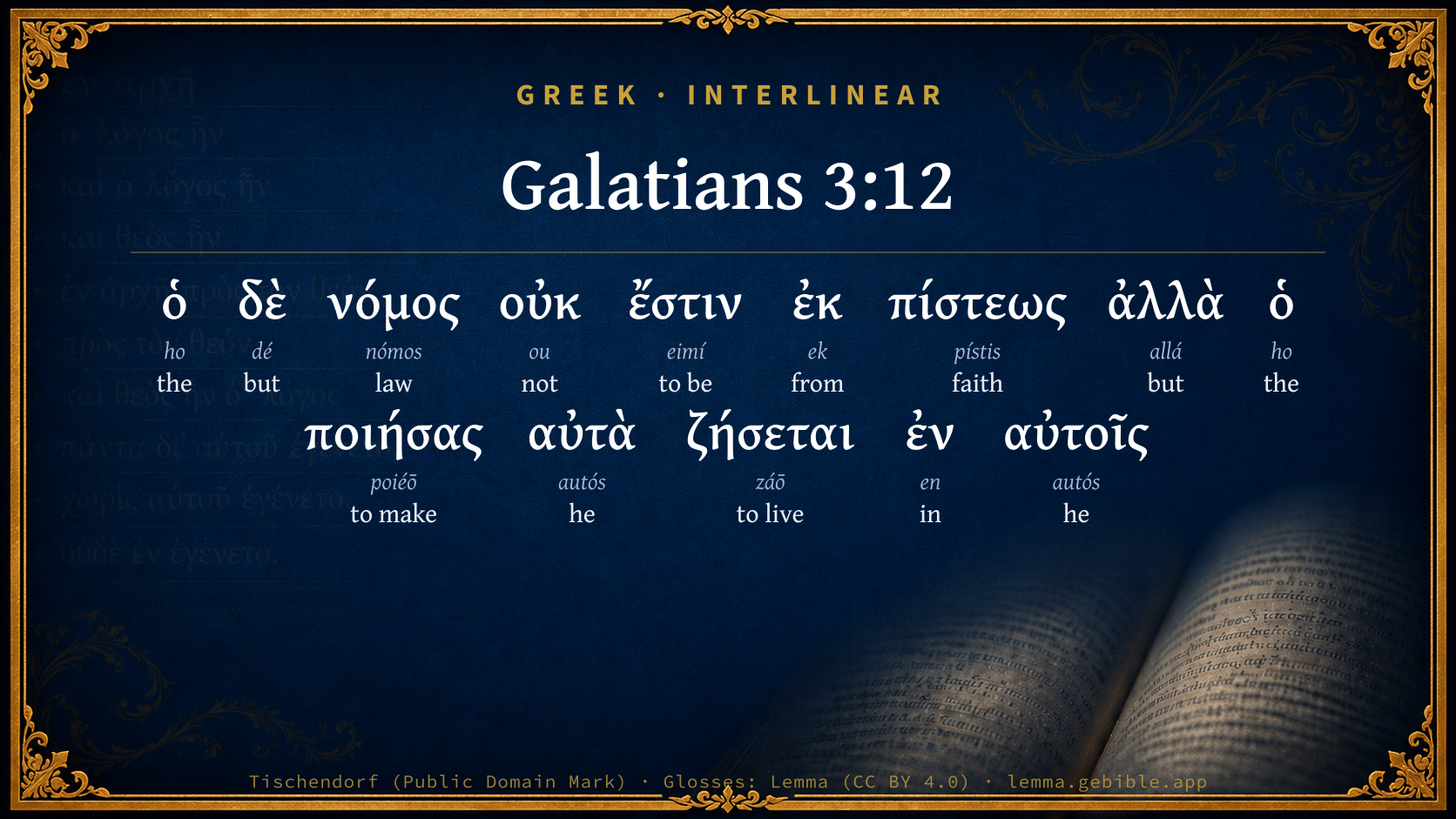
  1. ὁ ho G3588 “the” Article, Nominative, Singular, Masculine
  2. δὲ dé G1161 “but” Conjunction
  3. νόμος nómos G3551 “law” Noun, Nominative, Singular, Masculine
  4. οὐκ ou G3756 “not” Particle, Negative
  5. ἔστιν eimí G1510 “to be” Verb, Present, Active, Indicative, 3rd person, Singular
  6. ἐκ ek G1537 “from” Preposition
  7. πίστεως pístis G4102 “faith” Noun, Genitive, Singular, Feminine
  8. ἀλλὰ allá G235 “but” Conjunction
  9. ὁ ho G3588 “the” Article, Nominative, Singular, Masculine
  10. ποιήσας poiéō G4160 “to make” Verb, Aorist, Active, Participle, Nominative, Singular, Masculine
  11. αὐτὰ autós G846 “he” Personal pronoun, Accusative, Plural, Neuter
  12. ἐν en G1722 “in” Preposition
  13. αὐτοῖς autós G846 “he” Personal pronoun, Dative, Plural, Neuter

About this verse

These counts appear in no published source. They are computed here, from the morphology-tagged text and Lemma’s own curated glosses. What Lemma adds →

14
words
12
distinct lemmas
Pauline Epistles
section

Repetition

Words recur within this verse:

Cross-references

12

Topical passages linked to Galatians 3:12 in the Treasury of Scripture Knowledge — connected by theme and wording, ordered by reader-vote popularity; previews shown in the World English Bible.

  • Leviticus 18:5 You shall therefore keep my statutes and my ordinances; which if a man does, he shall live in them: I am Yahweh.
  • Romans 10:5–6 For Moses writes about the righteousness of the law, "The one who does them will live by them."
  • Nehemiah 9:29 and testified against them, that you might bring them again to your law. Yet they dealt proudly, and didn't listen to your commandments, but sinned against your ordinances, (which if a man do, he shall live in them), and withdrew the shoulder, and hardened their neck, and would not hear.
  • Romans 4:14 For if those who are of the law are heirs, faith is made void, and the promise is made of no effect.
  • Ezekiel 20:11 I gave them my statutes, and shown them my ordinances, which if a man do, he shall live in them.
  • Luke 10:25–28 Behold, a certain lawyer stood up and tested him, saying, "Teacher, what shall I do to inherit eternal life?"
  • Romans 4:4–5 Now to him who works, the reward is not counted as grace, but as debt.
  • Romans 4:16 For this cause it is of faith, that it may be according to grace, to the end that the promise may be sure to all the seed, not to that only which is of the law, but to that also which is of the faith of Abraham, who is the father of us all.
  • Ezekiel 20:13 But the house of Israel rebelled against me in the wilderness: they didn't walk in my statutes, and they rejected my ordinances, which if a man keep, he shall live in them; and my Sabbaths they greatly profaned. Then I said I would pour out my wrath on them in the wilderness, to consume them.
  • Matthew 19:17 He said to him, "Why do you call me good? No one is good but one, that is, God. But if you want to enter into life, keep the commandments."
  • Romans 9:30–32 What shall we say then? That the Gentiles, who didn't follow after righteousness, attained to righteousness, even the righteousness which is of faith;
  • Romans 11:6 And if by grace, then it is no longer of works; otherwise grace is no longer grace. But if it is of works, it is no longer grace; otherwise work is no longer work.

Cross-references courtesy of OpenBible.info (CC BY 4.0).

Where the printed editions differ

1 variant

Places in this verse where the major printed Greek editions disagree on the wording in a way that affects the translation — a comparison of editions, not a manuscript-by-manuscript collation. The editions are the modern critical texts (Nestlé-Aland 28/27, SBL, Westcott-Hort, Tregelles, Tyndale House) and the traditional texts behind the KJV (the Textus Receptus and the Byzantine/Majority text). It is not a claim about which reading is original.

  1. Extra text
    ἄνθρωπος

    “man”

    In TRByz Not in NA28NA27TynSBLWHTreg

    ἄνθρωπος (anthrōpos) 'man' is only in traditional manuscripts (TR+Byz)

Textual data: Translators Amalgamated Greek New Testament (STEPBible TAGNT) · CC BY 4.0.

Commentary

Notes on Galatians 3:12 from classic Christian and Jewish commentators (each source and its license shown beneath its notes). The classic Christian expositions comment on the surrounding passage and are grouped to its opening verse, so a note may address several verses; the Jewish commentaries on the Tanakh (Rashi and others) are per-verse, so they appear only where the commentator wrote on this verse.

Lemma curates 59 commentaries, every one of them public domain or Creative Commons licensed, each selected and text-cleaned for this edition rather than reprinted as found. About our sources →

The Biblical Illustrator

Joseph S. Exell

Gal_3:12

And the law is not of faith.

The law and the gospel

I. They differ in the work of our justification.

1. The law promiseth life to him that performs perfect obedience, and that for his works.

2. The gospel promiseth life to him that believes for the sake of Christ.

3. The law then requires doing, the gospel believing.

II. They agree in our good conversation.

1. Faith comes first.

2. Then the life of faith.

3. Then the evidence of the love of faith in obedience.

Observe--

1. Salvation was the unfulfilled end of the law, and so it is now.

2. Salvation is the accomplished beginning of the gospel.

3. The law under which we live is not by obedience-salvation, but by salvation-obedience. (W. Perkins.)

The necessity of Divine law

Under whatever relation we consider God to stand to us we must feel that He has a law by which He governs us all. Is He a King? There must be royal decrees. Is He a Master? There must be appointed service. Is He a Judge? The very name implies a tribunal. Is He a Redeemer? The redemption must be in accordance with the principles of righteousness. Is He a Father? The home over which He presides must be a scene of harmonious action. (S. Pearson, M. A.)

The Biblical Illustrator, edited by Joseph S. Exell (c. 1880s–1900s) — public domain. Text from a community e-Sword module.

Tyndale Open Study Notes

Tyndale Open Resources

3:12 The law itself is not opposed to faith (see 3:19-25; Rom 7:7-13), but trying to be righteous by keeping the law opposes righteousness by faith in Christ. Paul quotes Lev 18:5 to show that life under the law comes by obeying rather than believing. Right standing with God is impossible on that basis (Gal 3:10-11).

Tyndale Open Study Notes — © Tyndale Open Resources, licensed CC BY-SA 4.0. Text via the HelloAO Bible API.

Bengel's Gnomon

Johann Albrecht Bengel

Gal 3:12. Οὐκ ἔστιν ἐκ πίστεως, is not of faith) It does not act the part of faith; it does not say, believe, but do.—ὁ ποιήσας αὐτὰ, the man that doeth them) Rom 10:5.

Bengel's Gnomon of the New Testament — English translation (T&T Clark, Edinburgh, 1860) — public domain. Text from a community e-Sword module.

Meyer's Critical & Exegetical Commentary

Heinrich August Wilhelm Meyer

Gal_3:12. Minor proposition; δέ the syllogistic atqui. See on Gal_3:11.

οὐκ ἔστιν ἐκ πίστεως, is not of faith, is not an institution which has faith as the principle of its nature and action. Comp. Gal_3:10.

ἀλλʼ ὁ ποιήσας κ.τ.λ.] but he who shall have done them (namely, the προστάγματα and κρίματα of God, Lev_18:5) shall live (shall have life in the Messiahs kingdom) through them, so that they form, in this way of doing, the channel of obtaining life. Thus in the express words of the law (Lev_18:5), likewise presumed to be familiar to his readers, Paul introduces the nature of the law as contrasted with ἐκ πίστεως. Comp. Rom_10:5. After ἀλλʼ, γέγραπται is not (with Schott) to be supplied (comp. also Matthias, who understands even οὐκ ἔστιν as runs not); but, as the form with the apostrophe indicates, Paul has connected ἀλλʼ immediately with ὁ ποιήσας αὐτά, leaving it to the reader not only to explain for himself αὐτά and ἐν αὐτοῖς from his acquaintance with the O.T. context of the saying referred to, but also to complete for himself the connection from the first half of the verse: The law, however, has not faith as its principle; but the doer of the commandmentsthis is the axiom of the lawshall live by them. Comp. on Rom_15:3; 1Co_1:31.

Meyer — Critical and Exegetical Commentary on the New Testament — English translation by Peter Christie, edited by Frederick Crombie (T&T Clark, 1880) — public domain. Text from a community e-Sword module.

Geneva Bible (1599)

Geneva Bible translators

Here is a reason shown of the former consequence: Because the law promiseth life to all that keep it, and therefore if it be kept, it justifieth and giveth life. But the Scripture attributing righteousness and life to faith, taketh it from the Law, seeing that faith justifieth by imputation, and the Law by the performing of the work.

Geneva Bible (1599) marginal notes — public domain. Text via Bolls.life.

Jamieson, Fausset & Brown

Robert Jamieson, A. R. Fausset & David Brown

doeth--Many depended on the law although they did not keep it; but without doing, saith Paul, it is of no use to them (Rom 2:13, Rom 2:17, Rom 2:23; Rom 10:5).

Jamieson, Fausset & Brown — Commentary Critical and Explanatory on the Whole Bible (1871) — public domain (CC PDM 1.0). Text via the HelloAO Bible API.

Adam Clarke's Commentary

Verse 12. And the law is not of faith] It promises no forgiveness to believing, but requires obedience. It is not, What do you believe? but, What have you done? The man that doeth them perfectly, at all times, and in all places, he shall live in them; but if in any case he fails, he forfeits his life. See Clarke on Ro 1:17, &c.

Adam Clarke's Commentary on the Bible (1810–1826) — public domain. Text from a community e-Sword/MySword module.

John Calvin's Commentaries

12. And the law is not of faith. The law evidently is not contrary to faith; otherwise God would be unlike himself; but we must return to a principle already noticed, that Paul’s language is modified by the present aspect of the case. The contradiction between the law and faith lies in the matter of justification. You will more easily unite fire and water, than reconcile these two statements, that men are justified by faith, and that they are justified by the law. “The law is not of faith;” that is, it has a method of justifying a man which is wholly at variance with faith.

But the man who shall do these things. The difference lies in this, that man, when he fulfils the law, is reckoned righteous by a legal righteousness, which he proves by a quotation from Moses. (Leviticus 18:5.) Now, what is the righteousness of faith? He defines it in the Epistle to the Romans,

“If thou shalt confess with thy mouth the Lord Jesus, and shalt believe in thine heart that God hath raised him from the dead, thou shalt be saved.” (Romans 10:9.)

And yet it does not follow from this, that faith is inactive, or that it sets believers free from good works. For the present question is not, whether believers ought to keep the law as far as they can, (which is beyond all doubt,) but whether they can obtain righteousness by works, which is impossible. But since God promises life to the doers of the law, why does Paul affirm that they are not righteous? The reply to this objection is easy. There are none righteous by the works of the law, because there are none who do those works. We admit that the doers of the law, if there were any such, are righteous; but since that is a conditional agreement, all are excluded from life, because no man performs that righteousness which he ought. We must bear in memory what I have already stated, that to do the law is not to obey it in part, but to fulfill everything which belongs to righteousness; and all are at the greatest distance from such perfection.

John Calvin's Commentaries (1540-1563) — public domain. Text from the Calvin Translation Society English edition (1840s-50s) via the Christian Classics Ethereal Library (ccel.org). Calvin's coverage is partial (roughly two-thirds of the Bible); uncommented books and verses are honest gaps, never fabricated. The 19th-century editor's footnotes and remarks are omitted so the notes are faithfully Calvin's own voice.

Ellicott's Commentary for English Readers

(12) The law is not of faith.—The ruling principle of the Law is not faith, but something else—works.

The man that doeth them.—By “them” is meant the “statutes” and “judgments” mentioned immediately before in the verse (Lev_18:5) from which the quotation is taken. Just as the stress was upon “faith” in the last verse, so here it falls on the word “doeth:” it is a matter of works.

Shall live.—The idea of life receives an enlargement, corresponding to the fuller revelation of immortality in the New Testament as compared with the Old. In the Old Testament, “life is an existence upon earth, shortened by no judgment, reposing upon God, and delighting itself in God.” On the other hand, “death is the sudden and dreadful end, the destruction of this existence through a judgment of some special kind” (Schultz, Theology of the Old Testament, 2:163). Such a judgment would be the Chaldean invasion; and when the prophet Habakkuk says that the “just shall live,” he means that he should be saved from this calamity, and still continue to enjoy the divine favour and protection. The promise in Leviticus declares that he who keeps the Law shall be preserved from all judgments of this kind. With St. Paul, as in the Old Testament, the root idea is that of drawing support and sustenance from God; but with him this is not confined to the present life, or extended beyond the grave only in some dim and shadowy way: it begins in time and stretches on into eternity.

In them.—His life shall spring out of them and be nourished by them, just as a tree strikes its roots into the earth.

A Bible Commentary for English Readers, edited by Charles John Ellicott (1878–1897) — public domain. Text from a community e-Sword module.

The Cambridge Bible for Schools and Colleges

gen. ed. J. J. S. Perowne

12. is not of faith] ‘does not spring out of, or start from faith’, but its principle is performance. This is clearly laid down in Rev_18:5, ‘He that doeth them &c.’. We observe that ‘justification’ and ‘life’ are almost convertible terms. He who by faith is made one with the Son of God, hath life—eternal life. Thus in Rom_5:18 St Paul argues that as by Adam’s transgression all his descendants were involved in condemnation, so by the one righteous act, the obedience unto death, of the second Adam, the blessing came to all men unto justification of life—a justification resulting in and constituting life.

The Cambridge Bible for Schools and Colleges (gen. ed. J. J. S. Perowne; Cambridge University Press, 1878–1918) — public domain. Text from a community e-Sword module.

John Gill's Exposition

And the law is not of faith,.... The Arabic version adds, "but of man"; which as it is an addition to the text, so it contains false doctrine; for though the law is not of faith, yet not of man, but of God; the law does not consist of faith in Christ, nor does it require it, and that a man should live by it upon his righteousness; it is the Gospel that reveals the righteousness of Christ, and directs and encourages men to believe in him and be saved; nor does the law take any notice of a man's faith; nor has it anything to do with a man as a believer, but as a doer, in the point of justification:

but the man that doth them shall live in them; the passage referred to, is in Lev 18:5, the word "them", relates to the statutes and judgments, not of the ceremonial, but of the moral law, which are equally obligatory on Gentiles as on Jews. The Jewish doctors (x) observe on those words, that

"it is not said, priests, Levites, and Israelites, but "the man"; lo, you learn from hence, that even a Gentile that studies in the law, is as an high priest:''

so that whatever man does the things contained in the law, that is, internally as well as externally, for the law is spiritual, reaches the inward part of man, and requires truth there, a conformity of heart and thought unto it, and that does them perfectly and constantly, without the least failure in matter or manner of obedience, such shall live in them and by them; the language of the law is, do this and live; so life, and the continuation of that happy natural life which Adam had in innocence, was promised to him, in case of his persisting in his obedience to the law; and so a long and prosperous life was promised to the Israelites in the land of Canaan, provided they observed the laws and statutes which were commanded them: but since eternal life is a promise made before the world began, is provided for in an everlasting covenant, is revealed in the Gospel, and is the pure gift of God's grace through Christ, it seems that it never was the will of God that it should be obtained by the works of the law; and which is a further proof that there can be no justification in the sight of God by them, see Gal 3:21.

(x) T. Bab. Avoda Zara, fol. 3. 1.

John Gill's Exposition of the Whole Bible (1746–1763) — public domain (CC PDM 1.0). Text via the HelloAO Bible API.

Trapp's Complete Commentary

John Trapp

12 And the law is not of faith: but, The man that doeth them shall live in them.

Ver. 12. And the law is not of faith] Because it promiseth not life to those that will be justified by faith, but requireth works.

John Trapp, A Commentary or Exposition upon All the Books of the Old and New Testament (1647–1656) — public domain. Text from a community e-Sword module.

Albert Barnes' Notes on the Bible

And the law is not of faith - The Law is not a matter of faith; it does not relate to faith; it does not require faith; it deals in other matters, and it pertains to another system than to faith.

But, The man ... - This is the language of the Law, and this is what the Law teaches. It does not make provision for faith, but it requires unwavering and perpetual obedience, if man would obtain life by it; see this passage explained in the notes at Rom 10:5.

Albert Barnes' Notes on the Bible (1834–1885) — public domain. Text from a community e-Sword/MySword module.

Matthew Poole's English Annotations

The law saith nothing of faith in the Mediator; though faith in God be commanded in the first precept, yet faith in Christ is not commanded by the law as that by which the soul shall live. For that which the law saith is:

Do this and live: The man that doeth the things contained in the law,

shall live in them; life, in the law, is promised to those who do the things which it requireth; not to them who, have failed in their performances, yet accept of the Lord Jesus Christ as the Redeemer which God hath sent, and believe in him who justifieth the ungodly. For that by the life promised to the observation of the law, not a temporal life only is to be understood, but eternal life also, is plain from our Saviour’s application of it to the young man, inquiring about the way to eternal life, Mat 19:16,17; Lu 10:28.

Matthew Poole's English Annotations on the Holy Bible (1683–1685) — public domain. Text from a community e-Sword/MySword module.

Whedon's Commentary on the Bible

Daniel D. Whedon

12. Law is not of (out from) faith—Law has no justifying power flowing out from faith, but from the perfect doing.

Doeth them—Lev_18:5.

Daniel D. Whedon (gen. ed.), Commentary on the Old and New Testaments (1874–1909) — public domain. Text from a community e-Sword module.

The Pulpit Commentary

And the Law is not of faith (oJ demov oujk estin ejk pistewv); but the Law is not "by faith." This is closely connected with the latter part of the preceding verse, as forming another portion of the proof which is there introduced by "for." Ver. 11 should end with a semicolon, not with a full stop. The de at the beginning of this verse is slightly adversative, setting "the Law" in contrast with the notion of "living by or from faith." These words, "by or from faith" (ejk pistewv), are borrowed from the preceding citation. We may paraphrase thus: The Law does not put forward as its characteristic principle, "by faith;" the characteristic principle of the Law is rather that which we read in the third book of Moses (18:5)," The man who hath actually done them shall live by them." But, The man that doeth them shall live in them ajll JO poihsas aujta anqrwpov zhsetai ejn aujtoiv: (the word anqrwpov is omitted by the recent editors, as having crept into the text from the Septuagint); but, He that doeth them shall live in them. The whole verse (Lev_18:5) in the Authorized Version, following the Hebrew, stands thus: "And ye shall keep my statutes and my judgments: which if a man do, he shall live in them: I am the Lord." The Septuagint runs thus: "And ye shall keep or, "and keep ye" all my statutes and all my judgments, and ye shall do them or, "and do ye them": the man that doeth them shall live in them (oJ poihsav aujtasetai ejn aujtoiv) I am the Lord your God." It thus appears that the pronoun "them" recites "my statutes and my judgments." But this the apostle is not at present particularly con-corned to specify; his main point here is that the Law requires such and such things to be actually done, before it holds out the prospect of life to be gained thereby. Those under the Law were bound to render strict obedience to all its requirements, whether moral or ceremonial; and whosoever set aside any of whichever class was constituted by the Law a "transgressor" and a man "accursed." As it stands in the passage of Leviticus referred to, the clause which is cited bears not so much the aspect of a promise as of a restrictive statement implying a threatening or warning, and is therefore its harmony with the commination quoted in ver. 10. The "doing" here spoken of differs essentially from evangelical obedience. Comprising as it did its very large proportion the observance of the ceremonial prescriptions (prostagmata) of the Law, it points to a course of conduct in which a man, striving to earn pardon and acceptance by a meritorious life, had continually to be turning his eye, slavishly and under tear of the "curse" in case of failure, towards an external Law, whose detail of positive enactments, in addition to the regulation of his moral conduct and inward spirit, he was bound with scrupulous exactness to copy in his life. The spiritual obedience of "faith," on the other hand, evolves itself (in the apostle"s view) freely and spontaneously from the inward teaching and prompting of God"s Spirit, of which it is the natural product or "fruit". (Gal_5:22) Such are these two forms of religious life when viewed each in its idea. When, however, we compare the spiritual state of many even sincere believers in Christ, so far as we can estimate it, with the spiritual state of (say) the marvellous author of Ps 119 or of David and other pious Israelites, as disclosed in the exercises of pious feeling garnered in that same devotional book, we cannot fail to perceive that an Israelite under the Law might yet be not "of the works of the Law," but in no small degree qualified to teach the Christian believer himself, even in the life which is "of faith." "Shall live in them;" that is, shall find in them a fountain, as it were, of life. The Targums, Bishop Lightfoot observes, define the meaning of "living" by "life eternal."

The Pulpit Commentary (1880–1919), ed. H.D.M. Spence-Jones & Joseph S. Exell — public domain. Text from a community e-Sword module.

John Wesley's Explanatory Notes

And the law is not of faith - But quite opposite to it: it does not say, Believe; but, Do. Lev. xviii, 5

John Wesley, Explanatory Notes Upon the Whole Bible (1754–1765) — public domain. Text via the GEBible commentary corpus.

Luther on Galatians

Martin Luther

VERSE 12. And the law is not of faith.

In direct opposition to the scholastics Paul declares: "The law is not of faith." What is this charity the scholastics talk so much about? Does not the Law command charity? The fact is the Law commands nothing but charity, as we may gather from the following Scripture passages: "Thou shalt love the Lord thy God with all thine heart, and with all thy soul, and with all thy might" (Deu 6:5.) "Strewing mercy unto thousands of them that love me, and keep my commandments." (Exo 20:6.) "On these two commandments hang all the law and the prophets." (Mat 22:40.) If the law requires charity, charity is part of the Law and not of faith. Since Christ has displaced the Law which commands charity, it follows that charity has been abrogated with the Law as a factor in our justification, and only faith is left.

VERSE 12. But, The man that doeth them shall live in them.

Paul undertakes to explain the difference between the righteousness of the Law and the righteousness of faith. The righteousness of the Law is the fulfillment of the Law according to the passage: "The man that doeth them shall live in them." The righteousness of faith is to believe the Gospel according to the passage: "The just shall live by faith." The Law is a statement of debit, the Gospel a statement of credit. By this distinction Paul explains why charity which is the commandment of the Law cannot justify, because the Law contributes nothing to our justification.

Indeed, works do follow after faith, but faith is not therefore a meritorious work. Faith is a gift. The character and limitations of the Law must be rigidly maintained.

When we believe in Christ we live by faith. When we believe in the Law we may be active enough but we have no life. The function of the Law is not to give life; the function of the Law is to kill. True, the Law says: "The man that doeth them shall live in them." But where is the person who can do "them," i.e., love God with all his heart, soul, and mind, and his neighbor as himself?

Paul has nothing against those who are justified by faith and therefore are true doers of the Law. He opposes those who think they can fulfill the Law when in reality they can only sin against the Law by trying to obtain righteousness by the Law. The Law demands that we fear, love, and worship God with a true faith. The law-workers fail to do this. Instead, they invent new modes of worship and new kinds of works which God never commanded. They provoke His anger according to the passage: "But in vain they do worship me, teaching for doctrines the commandments of men." (Mat 15:9.) Hence, the law-righteous workers are downright rebels against God, and idolaters who constantly sin against the first commandment. In short, they are no good at-all though outwardly they seem to be extremely solicitous of the honor of God.

We who are justified by faith as the saints of old, may be under the Law, but we are not under the curse of the Law because sin is not imputed to us for Christ’s sake. If the Law cannot be fulfilled by the believers, if sin continues to cling to them despite their love for God, what can you expect of people who are not yet justified by faith, who are still enemies of God and His Word, like the unbelieving law-workers? It goes to show how impossible it is for those who have not been justified by faith to fulfill the Law.

Martin Luther — Commentary on the Epistle to the Galatians (1535), English translation by Theodore Graebner (Zondervan, 1939) — public domain (U.S. copyright not renewed). Text from a community e-Sword module.

McGarvey & Pendleton's Commentaries

J. W. McGarvey

and the law is not of faith; but, He that doeth them shall live in them. [ Lev_18:5 . Moreover, later prophecy bears out the earlier declaration made to Abraham, for it says that the righteous obtain life, or salvation, by faith, and this has no reference whatever to the law, for the law is not a system of faith, but an antithetical system of works, for the Scripture so defines it by a counter statement to the one I have quoted, which says that whoever keeps the precepts of the law shall live by them. Compare Rom_11:6 ]

J. W. McGarvey (with Philip Y. Pendleton), Commentaries on the New Testament (The Fourfold Gospel, 1914; Acts; and the epistles) — public domain. Text from a community e-Sword/MySword module.

The People's New Testament

B. W. Johnson

12. The law is not of faith. Is not a system of faith, but proclaims life by doing the law, rather than by faith. The quotation is from Lev. 18:5. But since none can keep it perfectly, all are under the curse (verse 10).

B. W. Johnson's The People's New Testament with Notes (1889–1891) — public domain. Electronic text from the Christian Classics Ethereal Library (CCEL) ThML edition.

Cambridge Greek Testament for Schools and Colleges

12. ὁ δὲ νόμος. In contrast to the effect of faith just mentioned.

οὐκ ἔστιν ἐκ πίστεως. The Law has not faith, as the fundamental principle, or basis, of its existence. The phrase is even stronger than Theodoret’s words imply: ὁ νόμος οὐ πίστιν ζητεῖ, ἀλλὰ πρᾶξιν ἀπαιτεῖ, καὶ τοῖς φυλάττονσιν τὴν ζωὴν ἐπαγγέλλεται.

ἀλλʼ Ὁποιήσας αὐτὰ ζήσεται ἐν αὐτοῖς. From Lev 18:5, a free rendering of the Hebrew; see also Eze 20:11. St Paul has the same quotation in Rom 10:5, in a slightly different form. The promise in Leviticus and Ezekiel is that in performance lies life. But what if, as is the case, performance is more than we can accomplish? “We must find our refuge in God Himself, i.e. leave the Law for Faith.

Cambridge Greek Testament for Schools and Colleges (Cambridge University Press, 1896; 21 vols, various authors incl. Carr, Maclear, Plummer, Farrar, Lumby, Moule, M. R. James, Simcox) — public domain. Text from a community e-Sword module.

Alford’s Greek Testament

Henry Alford

12.] ‘contain a perfect syllogism, so that ὁ δίκ. ἐκ πίστ. ζήσεται is the major proposition, ver. 12 the minor, and ἐν νόμῳ οὐδ. δικ. παρὰ τ. θεῷ the consequence.’ Meyer. It is inserted to strengthen the inference of the former verse, by shewing that not even could a man keep the law, would he be justified—the condition of justification, as revealed in Scripture, being that it is by faith. But (= moreover) that in (not merely the elemental in, but the conditional as well: ‘in and by:’ not ‘through’) the law no man is justified (the normal present: is, in God’s order of things) with God (not emphatic as Bengel, ‘quic-quid sit apud homines:’ this would require οὐδεὶς παρὰ τῷ θεῷ δικαιοῦται: but δικαιοῦται-παρὰ-τῷ-θεῷ is simply predicated of οὐδείς) is evident, for (it is written, that) the just by faith shall live (not ‘the just shall live by his faith,’ as Winer, De W., al. The order of the words would indeed suggest this rendering, seeing that ὁ ἐκ π. δ. ζ. would properly represent the other: but we must regard St. Paul’s logical use of the citation: and I think, with Meyer, that he has abstained from altering the order of the words as being well known. He is not seeking to shew by what the righteous shall live, but the ground itself of that righteousness which shall issue in life; and the contrast is between ὁ δίκαιος ἐκ πίστεως and ὁ ποιήσας αὐτά. It is right to say that Ellic. (both edd.) prefers the other rendering, and supports it by the fact that the original Hebrew will not bear this one, and that St. Paul adopts the words of the LXX as they stand; and by the contrast between ζήσεται ἐκ πίστεως, and ζήσεται ἐν αὐτοῖς. Jowett doubts whether ζήσεται could be used absolutely: but see Heb 12:9. I still however prefer rendering as above. The construction desiderated by Bp. Middleton to suit our rendering,—ὁ δίκαιος ὁ ἐκ π.,—would stultify the sentence, by bringing into view other δίκαιοι, who were not ἐκ πίστεως): but (logical, introducing the minor of the syllogism: see above) the law (not ‘law, as such,’ Peile: no such consideration appears here, nor any where, except in so far as the law of Moses is treated of as possessing the qualities of law in general) is not of (does not spring from nor belong to: ‘non agit fidei partes,’ Beng.) faith: but (sondern) (its nature is such that) he who has done them (viz. πάντα τὰ προστάγματά μου κ. π. τὰ κρίματά μου of Lev 18:5) shall live in (conditional element) them (see Rom 10:5).

Henry Alford, The Greek Testament (1849–1861) — public domain. Text from a community e-Sword module.

International Critical Commentary

12. ὁ δὲ νόμος οὐκ ἔστιν ἐκ πίστεως, “and the law is not of faith.” That is, the principles of legalism and of faith are mutually exclusive as bases of justification. It would have been formally more exact to have used ὁ νόμος and ἡ πίστις or ἐξ ἔργων νόμου and ἐκ πίστεως. But with essential clearness the apostle employs in the predicate the prepositional phrase that was the watchword of the one doctrine, though for the other he had used in the subject a nominative in preference to the grammatically harsh prepositional expression. By this assertion the apostle excludes the thought of compromise between the two principles. Faith is one thing, legalism another, and as bases of justification they can not be combined. No doubt there were those who sought to combine them, admitting that justification was by faith, but claiming that obedience to law was nevertheless requisite to salvation; as a modern Christian will affirm that religion is wholly a spiritual matter, yet feel that he is surer of salvation if he has been baptised.

ἀλλʼ “Ὁ ποιήσας αὐτὰ ξήσεται ἐν αὐτοῖς.” “but, He that doeth them shall live in them.” The ἀλλά marks the antithesis between this statement of O. T. (Lev 18:5), which the apostle takes as a statement of the principle of legalism, and the possibility just denied that this principle and that of faith might somehow be reconciled or reduced to one. One must mentally supply after ἀλλʼ “the law says.” Thus to the principle of legalism stated in its negative from in v. 10 and set over against the quotation from Habakkuk with its affirmation of the principle of faith, the apostle adds an assertion of the principle of legalism in its positive form, also taken like that in v. 10 from O. T. On the point of view from which the apostle thus quotes O. T. for both doctrines, see on v. 10, and more fully in fine print below.

International Critical Commentary — older volumes (1896–1929), various authors — public domain. Text from a community e-Sword module.

Lesson kit

Teaching starters — assembled from the data on this page, not authored interpretation. Every prompt links to the verse data it draws on. Edit before teaching.

Galatians, in the Pauline Epistles, opens this verse with 14 words (12 distinct Greek lemmas). Its most distinctive word is záō (“to live”). A historical commentator’s framing appears above. Read the whole chapter for the surrounding context.

Discussion questions

  1. How does “to live” (záō) shape what this verse is saying?
  2. Leviticus 18:5 shares this passage’s theme. How do the two illuminate each other?
  3. “the” occurs 2× in this one verse. What is the effect of the repetition?
  4. These translations render this verse differently; the difference is in the English rendering, not the original. What questions does that raise?
  5. Reading how The Biblical Illustrator and Tyndale Open Study Notes read this verse, where do the two commentators agree and where do they part?

Things to notice

Reading settings

Reading text

Shown beneath each verse's original-language words.

Old Testament
Old Testament edition

Read the OT as the Masoretic Hebrew (MT) or the Greek Septuagint (LXX).

English shown for the Greek Septuagint (in the Hebrew ↔ Greek comparison).

Comparing translations? Open the Compare panel on any verse page to stack up to four side by side.