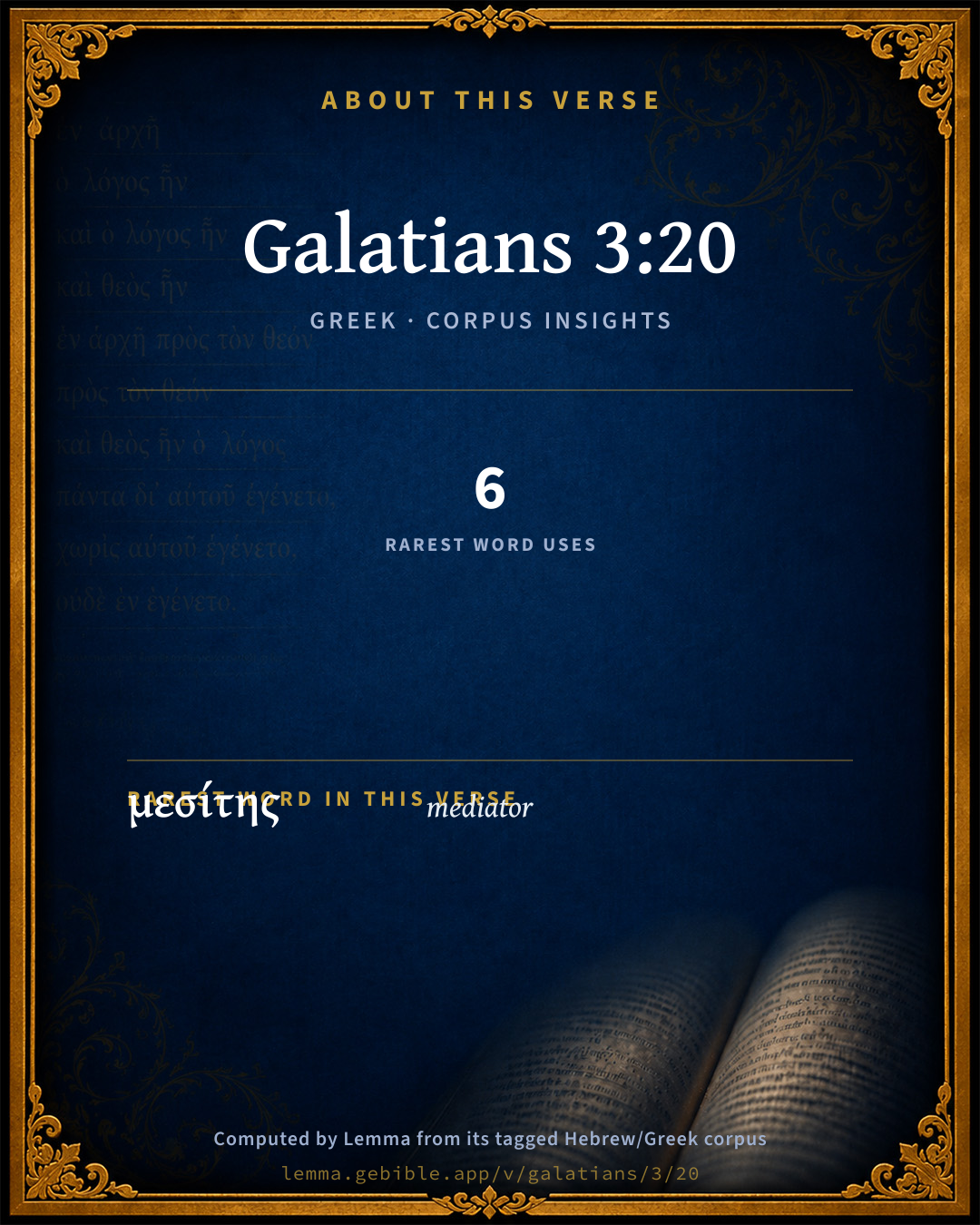
Galatians 3:20

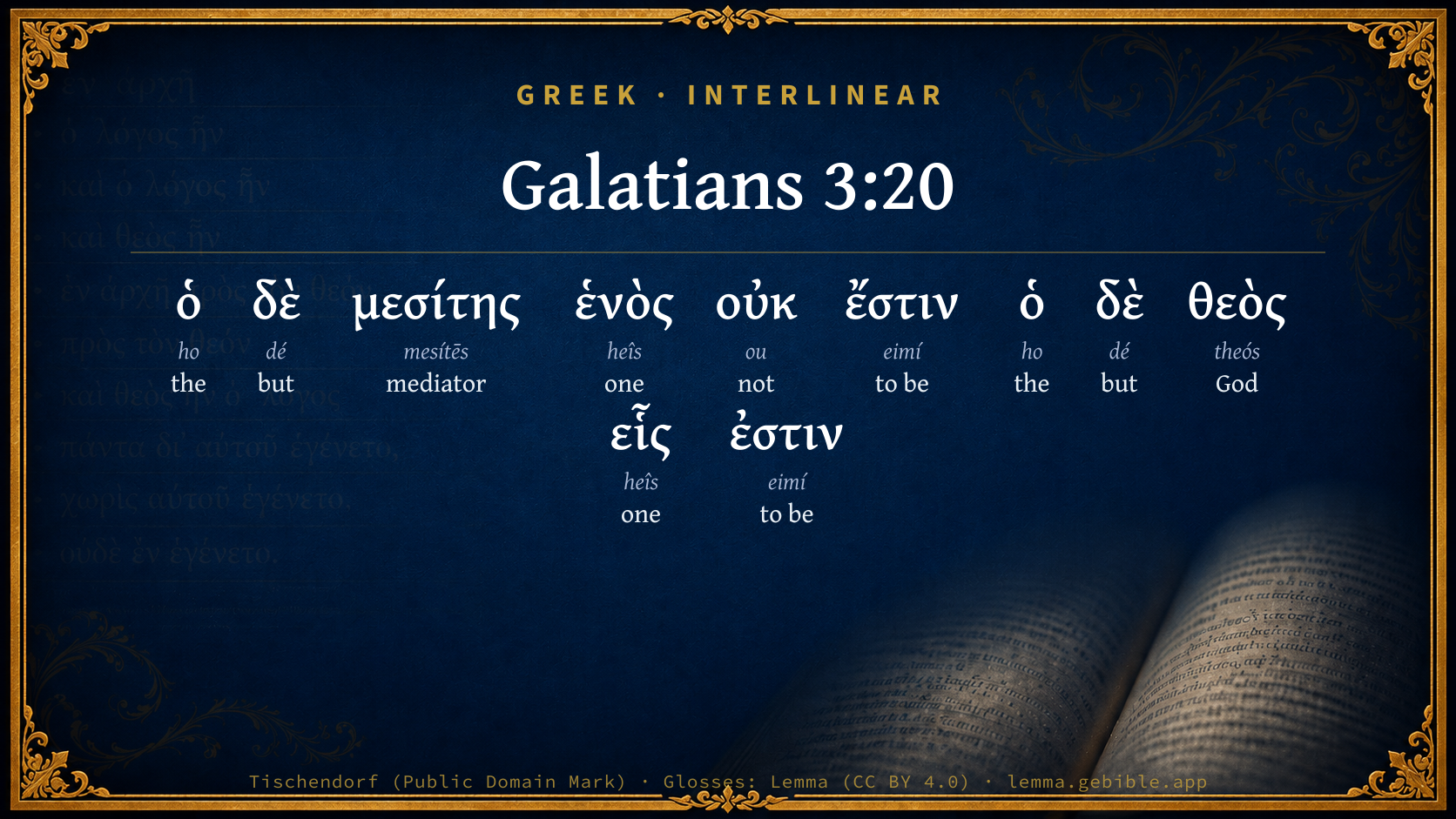
Greek (Tischendorf 8th ed.) Galatians 3:20 appears in the Greek New Testament. The text above is from the Tischendorf 8th edition. Each word links to its Strong’s number and a concise gloss. Click any word for its full Thayer’s Greek Lexicon entry.
Download image
Cite this verse

Galatians 3:20 (World English Bible). Public Domain. Lemma interlinear Bible study tool, https://lemma.gebible.app/v/galatians/3/20.

Show BibTeX & RIS
BibTeX
RIS
English Translation
Now a mediator is not between one, but God is one.
World English Bible · Public Domain
Download a study sheet

One document with this verse’s original text, its word-by-word gloss line, the meaning frame, cross-references with their text, attributed commentary, and full source and license credits — printable, and it pastes into notes with its structure intact.

This verse Autodidact and up

Study sheet (.html) Plain text (.txt)

A passage Seminary Student

Up to 50 verses in one chapter. A passage sheet keeps up to 6 commentary sources and 12 cross-references per verse, in the order this page ranks them, and says so on the sheet whenever that leaves anything out. Ask for a single verse and you get the Autodidact verse sheet above.

Everything on this page stays free to read, with no account — the sheet is a download of what is already on screen, not access to it.

Want to remove ads? Support Godless Engineer
Compare translations 3

The same verse in 3 English versions, stacked beneath the original-language interlinear above. Click any original word for its lexicon entry.

Each is an independent rendering of the whole verse — the interlinear is not word-aligned to these translations.

Highlighted words mark where these versions differ — a whole-verse word diff, not a word-by-word alignment.

  • World English Bible Public Domain
    Now a mediator is not between one, but God is one.
  • King James Version Public Domain
    Now a mediator is not a mediator of one, but God is one.
  • unfoldingWord Literal Text CC BY-SA 4.0
    Now a mediator is not for one, but God is one.

unfoldingWord Literal Text — © unfoldingWord, licensed CC BY-SA 4.0. Word-aligned USFM3 via Door43 (git.door43.org/unfoldingWord/en_ult).

Versions to compare (up to 4)

3 of 4 selected

Show all 19 translations

Every available English version of this verse, each an independent rendering of the whole verse.

  • World English Bible Public Domain
    Now a mediator is not between one, but God is one.
  • Berean Standard Bible Public Domain
    A mediator is unnecessary, however, for only one party; but God is one.
  • Majority Standard Bible Public Domain
    A mediator is unnecessary, however, for only one party; but God is one.
  • King James Version Public Domain
    Now a mediator is not a mediator of one, but God is one.
  • American Standard Version (1901) Public Domain
    Now a mediator is not `a mediator' of one; but God is one.
  • Revised Version (1885) Public Domain
    Now a mediator is not a mediator of one; but God is one.
  • Geneva Bible (1599) Public Domain
    Nowe a Mediatour is not a Mediatour of one: but God is one.
  • Douay-Rheims (1899) Public Domain
    Now a mediator is not of one: but God is one.
  • Young's Literal Translation Public Domain
    and the mediator is not of one, and God is one --
  • Literal Standard Version CC BY-SA 4.0
    and the mediator is not of one, but God is one.
  • Unlocked Literal Bible CC BY-SA 4.0
    Now a mediator implies more than one person, but God is one.
  • unfoldingWord Literal Text CC BY-SA 4.0
    Now a mediator is not for one, but God is one.
  • Darby Bible Public Domain
    But a mediator is not of one, but God is one.
  • World Messianic Bible Public Domain
    Now a mediator is not between one, but God is one.
  • Webster's Bible Public Domain
    Now a mediator is not a mediator of one; but God is one.
  • Free Bible Version CC BY-SA 4.0
    But a mediator isn't needed when there's only one person involved. And God is one!
  • Bible in Basic English Public Domain
    Now a go-between is not a go-between of one; but God is one.
  • Text-Critical English NT CC BY 4.0
    Now a mediator does not represent just one party, but God is one.
  • Tyndale New Testament (1534) Public Domain
    A mediator is not a mediator of one. But God is one.

Literal Standard Version (2020), Covenant Press — licensed CC BY-SA 4.0. Text via the HelloAO Bible API (eBible.org). Unlocked Literal Bible (unfoldingWord) — licensed CC BY-SA 4.0. Text via the HelloAO Bible API (eBible.org). unfoldingWord Literal Text — © unfoldingWord, licensed CC BY-SA 4.0. Word-aligned USFM3 via Door43 (git.door43.org/unfoldingWord/en_ult). Free Bible Version, Dr. Jonathan Gallagher — licensed CC BY-SA 4.0. Text via the HelloAO Bible API (eBible.org).

Word by word

More ways to search: Search by grammar → Find every occurrence → Compare this word →

Practice this passage: Drill this verse → Learn its vocabulary →

About this verse

These counts appear in no published source. They are computed here, from the morphology-tagged text and Lemma’s own curated glosses. What Lemma adds →

11
words
7
distinct lemmas
Pauline Epistles
section

Notable vocabulary

The rarest word here is μεσίτης mediator G3316 — appearing just 6 times in the whole Greek New Testament.

Shared distinctive vocabulary

μεσίτης mediator G3316 occurs in 6 verses of the Greek New Testament. Also found in:

Repetition

Words recur within this verse:

Cross-references

11

Topical passages linked to Galatians 3:20 in the Treasury of Scripture Knowledge — connected by theme and wording, ordered by reader-vote popularity; previews shown in the World English Bible.

  • 1 Timothy 2:5 For there is one God, and one mediator between God and men, the man Christ Jesus,
  • Deuteronomy 6:4 Hear, Israel: Yahweh is our God; Yahweh is one:
  • Job 9:33 There is no umpire between us, That might lay his hand on us both.
  • Hebrews 8:6 But now he has obtained a more excellent ministry, by so much as he is also the mediator of a better covenant, which has been enacted on better promises.
  • Hebrews 9:15 For this reason he is the mediator of a new covenant, since a death has occurred for the redemption of the transgressions that were under the first covenant, that those who have been called may receive the promise of the eternal inheritance.
  • Romans 3:29–30 Or is God the God of Jews only? Isn't he the God of Gentiles also? Yes, of Gentiles also,
  • Hebrews 12:24 to Jesus, the mediator of a new covenant, and to the blood of sprinkling that speaks better than that of Abel.
  • Genesis 15:18 In that day Yahweh made a covenant with Abram, saying, "To your seed have I given this land, from the river of Egypt to the great river, the river Euphrates:
  • Galatians 3:17 Now I say this. A covenant confirmed beforehand by God in Christ, the law, which came four hundred thirty years after, does not annul, so as to make the promise of no effect.
  • Genesis 17:1–2 When Abram was ninety-nine years old, Yahweh appeared to Abram, and said to him, "I am God Almighty. Walk before me, and be blameless.
  • Acts 12:20 Now Herod was very angry with the people of Tyre and Sidon. They came with one accord to him, and, having made Blastus, the king's chamberlain, their friend, they asked for peace, because their country depended on the king's country for food.

Cross-references courtesy of OpenBible.info (CC BY 4.0).

Commentary

Notes on Galatians 3:20 from classic Christian and Jewish commentators (each source and its license shown beneath its notes). The classic Christian expositions comment on the surrounding passage and are grouped to its opening verse, so a note may address several verses; the Jewish commentaries on the Tanakh (Rashi and others) are per-verse, so they appear only where the commentator wrote on this verse.

Lemma curates 59 commentaries, every one of them public domain or Creative Commons licensed, each selected and text-cleaned for this edition rather than reprinted as found. About our sources →

The Cambridge Bible for Schools and Colleges

gen. ed. J. J. S. Perowne

20. Probably no verse of Scripture has more exercised the ingenuity of commentators. Certainly of none other can it be said that it ‘has received 430 interpretations’ (Jowett), if by that expression contrariant or different interpretations are meant. Some notice of these is reserved for an Appendix (Appendix v. p. 89). The verse may be paraphrased as follows: Now the very fact that at the giving of the Law a Mediator was needed, marks the nature of the transaction as a compact entered into between two parties. The very term Mediator implies two parties between whom he intervenes. But the God of the promise is One and One only. He reveals Himself as the bestower of a free gift to the world. ‘The Giver is everything, the recipient nothing’ (Lightfoot). Hence there was no place in the Gospel revelation for a mediator in the sense in which Moses was mediator between God and the people of Israel. It may be observed that this view of the scope of the passage (which is all that is necessary to its connexion with the preceding and following context) does not militate against, nor is it inconsistent with, the declaration that there is ‘One Mediator between God and man’, (1Ti_2:5). The young student of theology needs to be cautioned against the too common mistake of treating a verse of Scripture as if it were an isolated proposition, instead of regarding it in its relation to the train of thought to the expression of which it contributes.

On Chapter Gal_3:20

Of the many explanations which have been given of this passage a few of the most important may be noticed. They may be classified in three divisions, according to the supposed reference in the term Mediator:—

1. The earlier expositors understood the term Mediator in the passage before us to refer to Christ. In favour of this view it may of course be urged that in all other passages of the N. T. (see note on Gal_3:19) where the word occurs it refers to our Lord Jesus Christ. But it no more follows that the word thus applied to our Lord so loses its primary meaning as to be appropriated exclusively to Him, than that the words ‘shepherd’ and ‘bishop’ must necessarily refer to Him in every passage where they occur, because He is ‘the Shepherd and Bishop’ of our souls. Even if the reference to Christ could be established as a simple and natural explanation of the passage, taken by itself, the connexion with the context is obscured or lost, and the force of the Apostle’s argument impaired thereby.

2. More probable is the opinion that in Gal_3:20, as in Gal_3:19, the Mediator is Moses. (The definite article in the Greek may lend equal support to this and to the next explanation.) This opinion, entertained by eminent commentators, both ancient and modern, is in full accord with the scope of the passage. But the reference, though suggested by, is not therefore limited to the giving of the Law. ‘The mediator,’ just spoken of (Gal_3:19), is undoubtedly Moses, but what was true of him in that capacity is also true of every other human mediator.

3. Lastly, we may regard the first portion of the verse as laying down a general proposition. Those who hold this view adopt the rendering of the English Bible, both A.V. and R.V. alike, as correct, and understand it to express ‘the idea, the specific type,’ and to state a characteristic of the Mediator, as such. The very idea of mediation implies a transaction involving the existence of at least two parties, and mutual conditions. But the Gospel is a promise, the gift of grace. God alone is its author, and its fulfilment depends on His faithfulness—on Himself alone.

Under each of these general divisions (especially the last) a great many explanations, differing in some particulars, are found. Many of these, so far from being destructive of one another, are not inconsistent or irreconcilable with one another. The slighter differences help to illustrate and confirm the great truth which St Paul is enforcing, rather than to obscure his meaning or render it uncertain. A more detailed account of these, with the names of their principal authors, may be found in Dr Schaffe’s Commentary, Excursus, p. 38, who gives the following extract from Reuss’s French Commentary, which clearly expresses one, and perhaps the best-supported, view of the passage under consideration: “A mediator implies two contracting parties, consequently two wills, which may be united, but may also disagree; a law therefore given by mediation is conditional and imperfect: but the promise, emanating from God alone, and having His will for its sole source and guarantee, is infinitely more sure and more elevated. The law, then, cannot set aside the promise, its aim can only be secondary.”

The Cambridge Bible for Schools and Colleges (gen. ed. J. J. S. Perowne; Cambridge University Press, 1878–1918) — public domain. Text from a community e-Sword module.

The Biblical Illustrator

Joseph S. Exell

Gal_3:20

Now a mediator is not a mediator of one, but God is one.

I. The key to the apostles argument--One.

1. (Gal_3:16) One is the seed of Abraham, to whom the promise was made. In thee shall all the nations be blessed (Gal_3:8), was the proposition with which St. Paul started to prove (Gal_3:14) that the blessing of Abraham was to come on the Gentiles through Jesus Christ.

2. (Gal_3:28-29) The conclusion evidently reverts to the beginning, Ye are all one in Christ Jesus … then are ye Abrahams seed, and heirs according to promise.

3. In Gal_3:20, therefore, the oneness in the centre must refer to the same unity. When, in the intermediate argument, designed to refute the plea of the Jews that their covenant was the fulfilment of the promise to Abraham, St. Paul insists on the non-unity or want of oneness connected with a mediator, the presumption is strong that it is to the Mosaic covenant and its mediator that he is denying the oneness which he claims to be fulfilled in the Christian covenant and its Mediator.

II. The steps of the argument.

1. (Gal_3:16) One is the seed of Abraham, to whom the blessing which extends to all nations is promised.

2. (Gal_3:20. The mediator must be a mediator of one (seed), including all Jews and Gentiles! and making all one; and the God (of both) is One.

3. (verses 28-29) But ye are all one in Christ Jesus; and therefore Abrahams seed and heirs according to the promise.

III. The conclusion of the argument.

1. Moses, the mediator of the Jewish covenant, is not such a mediator of one (Gal_3:20), uniting all into one, making all one seed, one body, one with God, one with each other.

2. But Christ is exactly such a mediator.

(1) He is the one seed in whom all find their unity.

(2) In Him God and man are made one, for He is both in one Person.

(3) In Him all men and all nations, the most diverse have become one. (1Co_12:13; Eph_1:10).

3. Christ, as Mediator, is a Mediator of one in the fullest sense as making all one. God, the author of the promise, is one God of all, Jews and Gentiles (Gal_3:20).

4. Ye are all one in Christ Jesus (Gal_3:28), being all baptized into Christ, having put on Christ (Gal_3:27), and if ye be Christs, then ye be Abrahams seed and heirs, etc. (Gal_3:29). (Principal Forbes.)

The law was ordained by angels in the hand of a mediator; but a mediator is not a mediator of one person, but of two--here, in the case under consideration, the mediator was Moses, and the two parties between whom he stood were God and the Israelites. But God is not a Mediator between two parties: He is one; in His promise God acts alone and independently--here, in the case under consideration, in the giving of a promise to Abraham by God, there was no mediator, it was absolute and unconditional, without the intervention of a third party. The covenant which God made with the Israelites at Sinai was given through a mediator, viz., Moses; but the covenant which God made with Abraham that in him and his seed all nations should be blessed, was given without a mediator. The one was conditional, and by law or contract; the other was unconditional, and by promise. (P. J. Gloag, D. D.)

Mediation and Gods oneness

Perhaps no passage in Scripture has received so many interpretations as this--more than two hundred and fifty at least. Who does not see in this an illustration of the honour done to the Word of God? On what other book would the same amount of time, and mental labour, and literary attainment, have been expended for the illustration of an occasional remark? The causes of the diversity of sentiment are various Some suppose the apostle to speak in his own person; others consider either the whole verse, or at any rate the first part of it, as the words of an objector. Some by the mediator understand any mediator; others, Moses; others, Christ. Some understand one as a substantive; others as an adjective which requires a substantive to be supplied to bring out the sense, and that substantive they have supplied very variously: some, of one party; others, of one seed; others, of one law; others, of one race; others, of one thing, etc. Some understand the assertion is not of one of the person; ethers, of the condition, others, of the design and business of the mediator. Some consider the last member of the sentence, God is one, as philosophical or dogmatic; others as historical, looking to the times of Abraham, or of the giving of the law at Sinai. Luthers notion is quite singular--God offendeth no man, and therefore needeth no mediator; but we offend God, and therefore we need a mediator. The mode of connecting the passage has also given origin to diversity of view respecting its meaning. Now, in any discussion of this passage, two things must be kept in mind:

1. The repetition of the word mediator is not in the original. The text reads literally thus: Now a--or the--mediator is not of one.

2. The words must contain in them some statement which lays a foundation for the conclusion deduced in the next verse, that the law is not against the promises of God. However plausible in other respects an interpretation may be, it cannot be the right one if it does not bring out a sense which justifies the apostles inference. The almost innumerable opinions of interpreters may be reduced to two classes--those in which the words, Now a mediator is not of one, are understood as a general proposition, true of all mediators, and applied by the apostle in the course of his reasoning to the subject before him; and those in which they are considered as a particular statement, referring exclusively and directly to the mediator spoken of in preceding verse. Those who are agreed in thinking the words are a general proposition, differ widely in the way in which they understand it, and in which they make it bear on the apostles argument. One class consider the words as equivalent to--Now a mediator does not belong to a state of unity or agreement. The use of a mediator seems to intimate that the parties between whom he mediates are not at one. This mode of interpretation labours under great difficulties. For, first, it is not true that the use of a mediator necessarily supposes disagreement. There are causes of the use of a mediator besides this. God continues to deal with those with whom He is reconciled through a mediator. And secondly, it breaks the connection between the two clauses of the verse, which obviously is very intimate. Another class consider the words as equivalent to--a mediator does not belong exclusively to one party; a mediator belongs to both parties; and they consider the apostle as arguing thus: No man can be a mediator who is not appointed by both parties. There were two parties in the original agreement--God and the spiritual seed of Abraham. Moses was indeed appointed by God; but God was one of the parties, so that whatever such a mediator could do could not affect the interests of the other party. This explanation is not satisfactory, because in the appointment of the Great Mediator of the better covenant, God alone was concerned. A third class consider the words as equivalent to--a mediator is not peculiar to this one dispensation. There have been various mediators, but there is but one God. The mediator may be changed, but God continues the same. But the words do not naturally convey this meaning. The mediator of this verse is evidently the same as the mediator referred to in the preceding verse. The question still remains, then, Who is the mediator thus referred to? Some consider the mediator by whose hands the law was given, as Jesus Christ. But Christ is nowhere in Scripture called the mediator of the law; and surely if the reference had been to Him, the language in verse :19 would not have been a mediator, but the mediator, if not the expression elsewhere used, the one Mediator between God and men. This still further narrows the field of discussion. We have now only--taking for granted that the mediator is Moses--to seek for a meaning which the words of the apostle will bear, and which will support his conclusion, that the law is not, cannot be, against the promises of God. If the first part of the verse be read interrogatively, and if the word one be understood, not numerically, but morally, as signifying uniform and unchangeable, always self-consistent, a plain meaning may be deduced from the words, in harmony with the context. The law was given by the hands of Moses as a mediator. But was he not the mediator of Him who is one and the same for ever? Now God, who appointed Moses mediator, is one and the same--unchanged, unchangeable. Can, then, the law be against the promises of God? (John Brown, D. D.)

The Mediator

God is one. He alone is to be considered in this transaction. It is all His doing. He not only mediates with us, but also for us; He is on our side; He takes part with us. It is His single hand which achieves the issue; the whole depends upon Him, and is consummated by Him.

I. The parties supposed. God; man. These two at variance.

II. The mediator. One who can take up both sides of the case. Necessary that he should receive power and deputation from both, and that each party abide by his determination. In Gods stead, and yet mans substitute and surety. Where shall such an one be found?

III. God provides the mediator. He acts for man, as well as for Himself.

1. God originates the plan.

2. God removes every obstruction.

3. God secures mans co-operation.

4. God alone is to be adored. (R. W. Hamilton, D. D.)

Explanation of the verse

Some two or three hundred interpretations go upon the misconception that the meaning is: A mediator is a mediator, not of one party, but of two parties, and God is one of those two parties. This is, I strongly think, quite erroneous. The structure of the Greek excludes it. The word one clearly points not to number, but to quality; and so the sense will be: A mediator has nothing to do with what is one, whatsoever be the number of individuals constituting that unit, but God is pre-eminently one--one with Himself, as in essence, so in will … one in His one method of dealing with all. (Canon T. S. Evans, D. D.)

St. Pauls view of the unity of God

There is more than one sense in which unity may be understood. It may mean one and no more, i.e., numerical unity; or, one and the same to all and always; or, union of many in a collective unit. We may say, there is one king, meaning that there are not two or more; or, there is one king, meaning that all have the same king, that he is the same to all his subjects; and we may say, the kingdom is one, meaning that it is not divided, that it is a collective unit in the monarchy. It is therefore important to observe in what sense St. Paul uses the word εἶς when in any passage he speaks of unity, and especially when he refers to the unity of God. Now it is plainly his habit to use the word in senses other than numerical. The following are instances: 1Co_3:8; 1Co_6:16; 1Co_10:17; 1Co_12:13; 2Co_11:2; Gal_3:28; Eph_1:10; Eph_2:14-15; Php_1:27. And so, when St. Paul speaks of God being one, it is certainly not usually, if it is ever, in the numerical sense. The very word θεός, as he understands it, excludes the idea of polytheism; and against polytheism, as implying many actual gods, he is nowhere concerned to argue … Brought up in Judaism, he had imbibed, as it were with his mothers milk, the idea of one God only. Hear, O Israel, the Lord thy God is one God, had been the central principle of his religion from the first, and expressed a self-evident truth which to his mind was unassailable. But he had been taught also to regard the One God as, in a peculiar sense, the God of Israel only; the whole Gentile world being to the mind of the Jew outside the circle of special Divine favour. Yet, as his mind became enlarged through familiarity with Gentile thought and literature, and through his own musings and his observation of the world, we may believe that he had long been perplexed by the limitation which his creed seemed to imply of the love of the universal Father. His mind craved a conception of God, as not only supreme, but as one in His own nature, one and the same to all, comprehending all alike in the embrace of His own essential unity. Further, it appears from his language in more than one passage, that he had been perplexed not only by the seeming partition between Jew and Gentile, but also by the discords and anomalies Apparent at present in creation generally. The general puzzle of this painful earth had set him musing. Such comprehensive language (as that in Rom_8:19-22) cannot surely be interpreted as referring to humanity alone. It seems to mean that everywhere throughout known sentient creation there is now pain and evil, discordant with the idea of unity in God. But among all the apparent discords of creation those within himself came home to him especially, because personally felt. He was conscious of a law of God within him, demanding his entire allegiance; but he was conscious also of another law in his members--a law of sin and death--warring against the law of his mind--such as to have wrung from him once the almost despairing cry, O wretched man that I am, etc. Such inward experience clashed with his conceived ideal of One God, the Father, of whom are all things, and we unto Him. And further, it is evident (as is especially seen in his Epistle to the Ephesians) that even beyond this mundane sphere of things his thoughts extended. His religious faith--confirmed doubtless by his observation of the mystery of spiritual evil among men--told him also of spiritual things of wickednesses in the heavenly places, of a prince of the power of the air, the spirit that now worketh in the children of disobedience; and such dissonance in the heavenly places themselves was inconsistent with his grand ideal. For God was to his mind the one absolute existence, the one eternal Being, of whom are all things: the Father (πατήρ) of whom every family (πατριά) in heaven and on earth is named; and not only the Father, but also present in all creation still And the God of his conscience being to him Love and Righteousness as well as Power and Life, he craved in all creation a reflection of the whole Divine perfection--such as, in the present state of things, he did not find. Such grand conceptions we conceive to have had possession of St. Pauls mind--after his conversion certainly, as is evident from his writings, and probably long before. To a mind thus prepared, the revelation of God in Christ was as a sudden burst of light. It did not, indeed, show him the original source or purpose of existing evil … But the new light from heaven showed him Reconciliation, and discords resolved, in the fulness of time, into eternal harmony In this passage the apostle has been arguing against the notion that the Mosaic law had either fulfilled or abrogated the promise made to Abraham; and the thought that suggests the verse before us is, that in the giving of the law Moses had intervened as a mediator. In reference to this fact he says: Now a mediator is not of one; but God is one. Viewed in the light of St. Pauls dominant conception, with all that it involves, of the unity of God, the following interpretation at once suggests itself to the mind: A mediator is not of one (i.e., of that which is one--whether singly or collectively--mediation has no place where there is unity)

; but God is one (in the sense, with all that follows from it, ever present to St. Pauls mind when he says εἶς ὁ Θεός): therefore (the conclusion follows, though not expressed) the law, with its intervening mediator, did not manifest Gods unity, and the consequent unity of all in Him. (J. Barmby, B. D.)

That nothing should disturb our deep and settled repose in immutable love and faithfulness of God. That the most rigid enactments of law can never affect the promises of Divine grace, while the grace revealed in the promises mellows and modifies the rigour of law. That both the law and the promise shut us up to one only ground of dependence and hope of eternal life. That Christianity, with its personal Saviour and remedial scheme of mercy, is the only revelation suited to the moral and undeniable necessities of mans fallen nature. That the belief and reception of the Christian revelation is the one simple condition of endless life and blessedness. Such we deem to be the true exegesis of this confessedly difficult text, and such the profound truths involved in its interpretation. There are no various readings to perplex us; there is no necessity for taking a single word out of its ordinary and accepted meaning; there is no pretext for twisting or wresting the apostles language, nor for interfering with the chain of his argument. His aim is to bring out the superiority of the gospel to the law: and this he does by showing that whatever methods God may adopt in the government of our world, nothing can interfere with His promise of grace, since that promise is founded on the immutability of His own nature, no less than on the depth and the exuberance of His own love. God is one, immutably and for ever the same; so that the promise which was given four hundred years before the law remains the same after the law--as rich in grace, and as pregnant with life. In this promise, or rather in Him to whom the promise refers, we can confide with calm and joyous repose, persuaded that neither life nor death, neither angels, nor principalities, etc. (R. Ferguson, LL. D.)

The one Mediator

The argument is based on the fact that when God blessed Abraham, He used a singular and not a plural word, and said, not seeds, but Seed: to Abraham and his seed were the promises made. The Seed, therefore, must be One Individual. And who could that single Individual be, but Christ only? Therefore all the promises in the Old Testament are to Christ. Not primarily, nor chiefly, to Isaac, or to Jacob, or to Judah, or to any other earthly descendants; but to one, to Christ. Stop a moment, and consider what that assertion involves. All the promises in the Old Testament are to Jesus only. Nay more, all the promises in the Bible centre in Jesus. They pass to us only through Him. How often have we taken the comfort of some beautiful promise in Deuteronomy; or in the Psalms; or the Proverbs; or in Isaiah; or any of the Prophets, without thinking of this. But not one of those promises was originally made to us. They were made to Christ. How then, could we dare to appropriate them, or even to touch them? Where do we find a right or a title to any one of them? Only by a union to Him to whom they were made. You must have a part in Christ. You must be in Him; a member in His mystical body. Thus and thus only, does any promise really belong to and to all that are in Him, what is the use of the law. Wherefore then serveth the law? The law is not covenant, it was four hundred and thirty years after covenant. The law does not give us the promises. Wherefore then serveth the law? Our fallen nature, and our sins, made it necessary. It was added (after the covenant) because of transgressions, to prevent transgressions; to punish transgressions; but not to give pardon, or peace, or salvation, or heaven. It was a beautiful and holy law; and if any law could have saved a man, that would have saved him. If there had been a law given which could have given life, verily righteousness should have been by the law. But no law can give life. But now let us consider the mode of the giving of that law which St. Paul introduces as a further link in his chain of argument. It was ordained by angels in the hand of a mediator (see Deu_33:2). It is clear, therefore, that in some way, at the giving of the law on mount Sinai, angels were employed for the ordering, disposing, and arranging the solemnities of that awful occasion. St. Paul introduces the fact to enhance the glory of the second and better covenant; he goes on to a climax; the first covenant was very glorious, it was ordained by angels; but how much more glorious when Christ did all Himself, in His own Person, by His own act, alone! Then St. Paul passes--from the angels, and the order of the solemnities on mount Sinai--to the mediator, Moses, who was employed by God to communicate Gods will to man, the Creators law to His creatures. It was ordained by angels in the hand of a mediator. And at that word mediator St Paul (as is his custom), breaks off to the thoughts which that word mediator suggested to his mind. A mediator!--what is it? What does that word involve? And so we come to the text, Now a mediator is not a mediator of one; but God is one. This short sentence is so difficult in its conciseness, so abstruse, and capable of so many meanings, that it is not too much to say that it has more interpretations than any other passage in the Bible. Amongst all the meanings, however, which have been attached to it, there are two which stand out so distinct, and are far superior (as far as I can judge) to all the rest, that the true understanding of the words must be, I think, in one or the other, or in both unitedly. The one is this. Now a mediator is not a mediator of one. A mediator implies that there are two parties concerned. There cannot be mediators unless there are two between whom the mediator is to act. And the two must be, more or less, at variance, otherwise there would be no need, or occasion, for the mediation. Here, then, there must be two. Two? God is one of the two, one of those two between whom the mediation takes place. Then, who was the other? Man. In what condition, then, must man be? At enmity with God! Else, he would not need a mediation. The other interpretation is this. The words are intended to draw a contrast between the law and the gospel. The mediation of the law--which was conducted by Moses--was of the nature of a contract between two parties--God, on the one side, man on the other. And each must fulfil his part in the contract, or else it would not be valid. Therefore the contract of the law, observe this! leaves the issue uncertain--for it depended, on one side, on mans obedience, which was an exceedingly doubtful thing; it certainly cannot be depended upon! But just the contrary to that is the contract of the gospel. In that contract God is all in all. It depends on the will and power of God. It is all, from beginning to end, His work. He elects the soul: He makes the faith: He makes the obedience: He makes the holiness; and He has provided, and He Himself gives, and is, the reward. There is nothing but God in it. So the unity of God is complete. There is nothing but God. God is one. The mediation is entirely different from the mediation of the law. There, the parties mediated, were two. Here, all are one. God the Author, God the Finisher; only God on either side, in His electing love, in the sinners penitence, in the sinners peace, in the sinners eternal life. It is all God. One; alone. Of these two explanations I myself very much prefer the first. But why may we not embrace the two, reading the verse thus? Man is separate from God. The fact that there is a Mediator, the necessity of a Mediator, proves it. We are all at variance with God. A controversy between a man and God is, on reasonable and rational principles, hopeless. I am one and alone in my deep, sinful degradation. God is one and alone in the solitude of His infinite and unapproachable holiness. There is not the vestige of a hope for me unless there be a Mediator. But God is one. One, up in heaven, in His foreordaining love; one, in my poor heart, working there in His grace and mercy; one, in His eternal sovereignty; one, in His power and will to make me all He would have me to be; one to plan, one to execute, His grand design. One to begin, and one to perfect, my salvation. One to save me and glorify Himself by my everlasting happiness. A mediator is not a mediator of one--then God and I are at enmity. But God is one. And, in His unity, I and God are one for ever. (James Vaughan, M. A.)

A mediator

I. His office--to act between two parties--needed betwixt God and man.

II. His qualifications--friendly relations with both parties--strict justice and impartiality.

III. His functions--to effect reconciliation-by bringing both together--on a common ground.

IV. His authority--Divine, for God is one--consequently there is but one mediator, the man Christ Jesus--Moses was but a shadow of the true. (J. Lyth.)

The mediation of Christ

I. Effects reconciliation between God and man.

II. Is the realization of the idea faintly depicted in the person of Moses--He gives the law of the Spirit--provides the true sacrifice--makes everlasting intercession.

III. Is based upon the original promise (v. 21)--God is one, therefore supreme--unchangeable--almighty to effect His purpose of grace. (J. Lyth.)

The Biblical Illustrator, edited by Joseph S. Exell (c. 1880s–1900s) — public domain. Text from a community e-Sword module.

Joseph Benson's Commentary

Gal 3:20. Now a mediator is not a mediator of one — There must be two parties, or there can be no place or use for a mediator: but God, who made the free promise to Abraham, is only one of the parties; the other, Abraham, was not present at the time of Moses. Therefore, in the affair of the promise, Moses had nothing to do: the law, wherein he was concerned, was a transaction of quite another nature. Or, as Dr. Doddridge paraphrases this difficult passage more at large, following, as he says, Mr. Locke’s interpretation, not without attentively comparing a variety of others, “A mediator is not merely the mediator of one party, but at least of two, between which he must pass, and, by the nature of his office, transact for both; but God is only one party in that covenant made with Abraham, and Abraham and his seed, including all that believe, both Jews and Gentiles, are the other. As Moses, therefore, when the law was given, stood at that time, between the Lord and Israel, (Deu 5:5,)

and did not pass between the whole collective body of Abraham’s seed and the blessed God; so nothing was transacted by him with relation to those for whom he did not appear, and consequently nothing in that covenant wherein he did mediate could disannul the promise, or affect the right accruing to any from a prior engagement, in which the Gentiles were concerned as well as the Israelites; for no covenant can be altered but by the mutual consent of both parties; and in what was done at mount Sinai by the mediation of Moses, there was none to appear for the Gentiles; so that this transaction between God and the Israelites could have no force to abrogate the promise, which extended likewise to the Gentiles, or to vacate a covenant that was made between parties of which one only was there.”

Joseph Benson's Commentary on the Old and New Testaments (1811–1818) — public domain. Text from a community e-Sword module.

Tyndale Open Study Notes

Tyndale Open Resources

3:20 The law, given through angels and a mediator, required agreement between God and the people. The law was conditional, with blessings and curses attached to keeping or not keeping its statutes. In contrast, God gave his promise to Abraham directly; he did not use a mediator. It was God’s unilateral and unconditional commitment. • God, who is one: Paul used the basic Jewish creed (Deut 6:4) to convince Gentile Christians not to become Jewish converts.

Tyndale Open Study Notes — © Tyndale Open Resources, licensed CC BY-SA 4.0. Text via the HelloAO Bible API.

Bengel's Gnomon

Johann Albrecht Bengel

Gal 3:20. Ὁ δὲ μεσίτης, now a Mediator) The article has the meaning of the relative. That Mediator, Moses, who was far later than the promise, and at the same time severe.—ἑνὸς, of one) The middle term of the syllogism, of which the major and minor proposition is expressed, the conclusion is understood, One does not make use of that Mediator (that is, whosoever is one [one and the same unchanging being] does not transact first without a mediator, then the same one through a mediator; nor does he afterwards withdraw himself [after having first dealt with His people immediately and directly], so as to transact through a mediator; for familiar acquaintance does not generally decrease, but increase): but God is one. Therefore God did not transact first without a mediator, then through a mediator. Therefore that party, to which the mediator belonged, is not one and the same with God, but different from God, namely the law.[28]—ὁ δὲ Θεὸς εἷς ἐστιν, but God is one) There is not one God before and another after the giving of the law, but one and the same God. Before the law He transacted without a mediator; therefore the mediator at Mount Sinai does not belong to God, but to the law; whereas the promise belongs to God; comp. on the unity of God, in reference to the same subject, Rom 3:30; also 1Ti 2:5: and the oneness of God before and after the law agrees most beautifully with the oneness of the seed before and after the law. Thus Paul infers from the very manner of giving the law, that the law was given on account of sin; and thus the new objection in the following verse is in consonance.

[28] The syllogism is one of the first figure in Ferio. The major prop. is: One does not make use of that mediator. The minor is: But God is one; and the conclusion is, therefore God does not use that mediator. But the conclusion drawn by Bengel is not directly from the major prop., but from the explanation of it within the parenthesis, and is perfectly sound according to his statement. The conclusion in the last sentence is not quite so clear. Let it be remembered, however, that there was a double mediation. God delegated the law to angels, who gave it to Moses: therefore Moses came between the law and the people.—TRANSL.

Bengel's Gnomon of the New Testament — English translation (T&T Clark, Edinburgh, 1860) — public domain. Text from a community e-Sword module.

Meyer's Critical & Exegetical Commentary

Heinrich August Wilhelm Meyer

Gal_3:20 down to μὴ γένοιτο, Gal_3:21. But from the fact that the law was ordained through a mediator, it must not at all be concluded that it is opposed to the promises of God. The expression just used, ἐν χειρὶ μεσίτου, might possibly be turned to the advantage of the law and to the prejudice of the promises, in this way, that it might be said: Since the idea of a mediator supposes not one subject, to whom his business relates, but more than one, who have to be mutually dealt with, and yet God (who gave the law through a mediator) is one, so that there could not be one God who gave the law and another who gave the promises (for there are not more Gods than one); it might possibly be concluded that, because the law was ordained by God in a different way from the promises,namely, by the calling in of a mediator acting between the two parties,the earlier divine mode of justification (that of faith) opened up in the promises was abolished by the law, and instead of it, another and opposite mode of justification (that of the works of the law) was opened up by God. Paul conceives the possibility of this inference, and therefore brings it forward, not, however, as an objection on the part of opponents, but as his own reflection; hence he expresses the concluding inference, ὁ οὖν νόμος κ.τ.λ., in an interrogative form, to which he thereupon replies by the disclaimer, μὴ γένοιτο. The explanation of the words, which in themselves are simple enough, is accordingly as follows: But the mediatornot to leave unnoticed an inference which might possibly be drawn to the prejudice of the promises from the ἐν χειρὶ μεσίτου just saidbut the mediator, that is, any mediator, does not belong to a single person, but intervenes between two or more; God, on the other hand, is a single person, and not a plurality. Is it nowwhen these two propositions are applied in concreto to the law and the promisesis it now to be thence inferred that the law, which was given through a mediator, and in which therefore there took part more subjects than one, in point of fact two (namely, God and Israel), between whom the mediator had to deal, is opposed to the divine promises, in which the same one God, who in the case of the law acted through a mediator and so implied two parties, acted directly? God forbid! From this point of difference in the divine bestowal of the law and the promises, by no means is any such conclusion to be arrived at to the prejudice of the latter, as if now, through the law mediatorially given by the one God, another divine mode of justification were to be made valid. In this view, Gal_3:20 contains two loci communes, from the mutual relation of which in reference to the two concreta under discussion (the law and the promises) in Gal_3:21 a possible inference is supposed to be drawn, and proposed by way of question for a reply. The δέ is in both cases adversative: the first introducing a supposed objection, and the second an incidental point belonging to this objection, the relation of which incidental point to the first proposition strengthens the doubt excited; ὁ μεσίτης denotes the mediator absolutely as genus (quae multa sunt cunctis in unum colligendis, Hermann, ad Iph. Aul. p. 15, pref.): ἑνὸς οὐκ ἔστιν is predicate, negativing the ἑνὸς εἶναι as regards the mediator, with emphatic stress laid on the prefixed ἑνός (not on the οὐκ, as Hofmann thinks), and ἑνός is masculine,[148] without requiring anything to be supplied: εἷς ἐστιν is predicate, and ΕἿς, in conformity with the axiom of monotheism here expressed, is used quite in the same purely numerical sense as ἑνός previously. Lastly, in the interrogative inference, Gal_3:21, Ὁ ΝΌΜΟς is used, as the close annexation by ΟὖΝ sufficiently indicates, in precise correlation to Ὁ ΜΕΣΊΤΗς in Gal_3:20 (for the law was given through a mediator, Gal_3:19), and τῶν ἐπαγγελιῶν τοῦ Θεοῦ to ᾯ ἘΠΉΓΓΕΛΤΑΙ, Gal_3:19; but the emphasis in this question of Gal_3:21 is laid upon ΚΑΤΆ, for Paul will not allow it to be inferred from the two propositions expressed in Gal_3:20 (ΜῊ ΓΈΝΟΙΤΟ), that the law stood in a relation to the promises which was antagonistic to them and opposed to their further validity as regards justification.

The numerous different interpretations of this passageand it has had to undergo above 250 of themhave specially multiplied in modern times: for the Fathers of the Church pass but lightly over the words which in themselves are clear, without taking into consideration their difficulties in relation to the general scope of the passage,mostly applying the ὁ δὲ μεσίτης ἑνὸς οὐκ ἔστιν, taken correctly and generally, to Christ,[149] who is the Mediator between God and man, and partly casting side-glances at the opponents of Christs divinity (see Chrysostom); although a diversity of interpretation (some referring μεσίτης to Moses, and others to Christ) is expressly mentioned by Oecumenius. Although no special dogmatic interest attached to the passage, nevertheless in the sixteenth and seventeenth centuries (see Pooles Synopsis) the variety of interpretations was already such that almost every interpreter of importance (yet, as a rule, without polemical controversy, because the dogmatic element did not come into play) took a way of his own. It became, however, still greater after the middle of the eighteenth century (especially after grammatico-historical exegesis gained ground, but with an abundant intermixture of its philological aberrations), and is even now continually increasing. How often have the most mistaken fancies and the crudest conjectures sought to gain acceptance in connection with our passage, the explanation of which was regarded as a feat of exegetical skill! For a general view of the mass of interpretations, the following works are of service:

Koppe, Exc. VII. p. 128 ff. ed. Galatians 3 : Bonitz, Plurimor. de I. Gal_3:20 sententiae examinatae novaque ejus interpr. tentata, Lips. 1800; also his Spicileg. observatt. ad Gal_3:20, Lips. 1802: Anton, Diss. I. Gal_3:20 critice, historice, et exeg. tract. in Potts Sylloge, V. p. 141 ff.: Keil (seven programmes), in his Opusc. I. p. 211 ff.: Winer, Exc. III.: Schott, p. 455 ff.: Wieseler, and de Wette ed. Möller, in loc. It is enough that out of the multitude of various interpretationsomitting the criticism in detail of the earlier views down to Keil[150]we specify the more recent literature, and adduce the following: 1. Keil, who comes nearest to our view, explains thus (see Opusc. I. p. 365 ff.): Mediatorem quidem non unius sed duarum certe partium esse, Deum autem, qui Abrahamo beneficii aliquid promiserit, unum modo fuisse; hincque apostolum id a lectoribus suis colligi voluisse, in lege ista Mos. pactum mutuum Deum inter atque populum Israelit. mediatoris opera intercedente initum fuisse, contra vero in promissione rem ab unius tantum (Dei sc., qui solus eam dederit) voluntate pendentem transactam, hincque legi isti nihil plane cum hac rei fuisse, adeoque nec potuisse ea novam illius promissionis implendae conditionem constitui, eoque ipso promissionem hanc omnino tolli. But (a) to take the second half of the verse not generally, like the first, but historically, as if ἦν was written, is an arbitrary deviation from the parallelism; and (b) the conclusion professedly to be drawn by the reader, hincque legi isti nihil, etc., is quite without warrant, for Paul himself puts as a question in Gal_3:21 the inference which he conceives may be possibly drawn from Gal_3:20. 2. Schleiermachers explanation is essentially similar (in Usteri, Lehrbegr. p. 186 ff.): The mediator of an agreement does not exist where there is only one person, but always presupposes two persons; these were God and the Jewish nation. But God is One in reference to His promises; that is, God therein acts quite freely, unconditionally, independently, and for Himself alone, as One numerically, because it is no agreement between two, but His free gift (χάρις). Does the law therefore conflict, etc.?[151] But in this view (a) the application of Gal_3:20 to the concreta of the law and the promises, which is in fact not made until Gal_3:21, is imported into and anticipated in Gal_3:20. Moreover, (b) εἷς imperceptibly changes from its numerical sense into the idea of aloneness and independence; and (c) the idea of free grace is arbitrarily introduced, and is not expressed by Paul. Nearest to this interpretation of Schleiermacher and Usteri comes Hilgenfeld, whose interpretation,[152] accompanied essentially by the same difficulties, ultimately amounts to the non-Pauline idea, that the position of God as a party in regard to the law is not in harmony with the divine unity (that is, with the divine monarchy). Comp. also Lipsius, Rechtfertigungsl. p. 77, according to whom Paul negatively strikes the law to the ground as incompatible with the sole agency of God. But how could Paul desire to strike to the ground the law, which to him was ἅγιος, ἀγαθός, and πνευματικός (Rom_7:12; Rom_7:14)? No, all he desires to show is, that, notwithstanding the diversity of its divine bestowal from the mode of giving the promise, it is not opposed to the promise. 3. Winer: Non potest μεσίτης cogitari aut fingi, qui sit ἑνός, unius h. e. unius partis: ὁ δὲ Θεὸς εἷς ἐστι, Deus est unus, una (altera) tantummodo pars; ita quaenam est altera? gens Israel. Jam si hoc, sponte efficitur, legem Mos. pertinere etiam ad Judaeos, hosque legi isti observandae adstrictos fuisse.[153] Thus Gal_3:20 contains only a parenthetical idea, Paul having in view to re-establish the dignity of the law, which appeared weakened by τῶν παραβ. χάριν προσετέθη: Lex Mos. data fuit peccatorum gratia; propterea vero non est, quod quis eam tanquam ista ἐπαγγελίᾳ longe inferiorem contemnat; data enim et ipsa est auctoritate divina

διαταγ. διʼ ἀγγέλωνgentique Hebr. tanquam agendi norma proposita ἐν χειρὶ μεσίτ. ὃς οὐκ ἔστιν ἑνός. It cannot be urged against Winer, that Paul must necessarily have written ὁ εἷς (see Winer, Gramm. p. 110 [E. T. 144]). But (a) in the logically exact chain of argument there is no indication at all that Gal_3:20 is to be taken as a parenthesis. (b) Since ὁ μεσίτης is subject, ὁ Θεός, which likewise is placed at the beginning of the sentence, may not be arbitrarily understood as predicate. (c) It must have been more precisely indicated by Paul, if it were intended that the first ἐστίν should be understood as the copula of a general judgment, and the second as historical (appears in the giving of the law); for every reader, if he had understood the first half of the verse as a general judgment, would naturally understand the second in like manner. (d) It would not occur to any reader to refer εἷς to a suppressed ὁ ἕτερος: for ἑνός had just been used absolutely in a numerical sense, in which therefore εἷς at once presents itself; and this the more, because the first sentence, by its negative form, has prepared the way for an antithesis to follow. (e) The idea which ὁ δὲ Θεὸς εἷς ἐστιν is supposed to indicate: therefore the law is obligatory on the Israelites, conveys something which is so entirely a matter of course, that it could not be made use of at all as an element of the dignity of the law; for the law was, in fact, given to the Israelites, and even to think of that obligation as non-existent would have been incongruous. And (f) even assuming such a superfluous idea, in what a strangely mysterious way would Paul have intimated it! That which he meant to say, he would wholly without reason have concealed, and have given out as it were a riddle. Apart from the unsuitableness of the idea generally, and from the inappropriate εἷς, he must have said: ὁ δὲ Ἰσραὴλ εἷς ἐστιν. 4. Schulthess has sought to vindicate his interpretation (proposed in Keil and Tzschirners Anal. II. 3, p. 133 ff.) in his Engelwelt, Engelgesetz und Engeldienst, Zürich 1833, and in de G. Hermanno, enodatore ep. P. ad Gal., Zürich 1835, viz.: Hic mediator (Moses) non est mediator unius, i.e. communis illius Dei, qui olim Abrahamo spopondit, per eum aliquando gentes beatum iri, et qui est unus, s. communis omnium parens, sed est potius mediator angelorum.[154] But (a) how erroneous it is to assume that the anarthrous ἑνός should denote the universal God of men, and how alien this reference is to the context! (b) How opposed is the διʼ ἀγγέλων to the notion, that Moses was mediator angelorum! (c) How at variance is the idea of the law as the work of angels with the conception throughout the Bible (comp. on Gal_3:19) of the law as the work of God! In how wholly different a way must Paul have spoken of and proved such a paradox, and how frequently would he have reverted to it (especially in the Epistle to the Romans) in his antinomistic discussions! 5. Akin to this, as far as the idea is concerned, is the interpretation of Schmieder (Nova interpr. I. Paul. Gal_3:19 f., Numb. 1826, and in Tholucks literar. Anz. 1830, No. 54): Quivis minister vel multorum est vel unius: atqui mediator non est unius: ergo est multorum minister. Qui multorum est minister, ad quod genus mediator pertinet, non est unius: atqui Deus (absolute) unus est: ergo cum multorum sit mediator, non est Dei minister. The connection is supposed to be: Concedo legem per angelos datam esse a Deo, non humana arte inventam, sed eo ipso, quod per angelos ministros, non per Deum aut Dei filium promulgata est, inferior est evangelio.[155] This interpretation is objectionable, (a) in a general point of view, because it rests wholly on the erroneous view that μεσίτου in Gal_3:19 applies not to Moses, but to the angelus mediator; (b) because Paul could not have expressed so peculiar an antinomistic argument more obscurely or more enigmatically than by thus omitting the essential points; (c) because the idea of μεσίτης by no means implies that the ΜΕΣΊΤΗς is the minister multorum: he may be commissioned as well by one as by many, as, in fact, Christ was commissioned as a μεσίτης by One, viz. by God. See also, in opposition to Schmieder, Lücke in the Stud. u. Krit. 1828, p. 95 ff.; Winer, Exc. III. p. 171 ff. 6. Steudel, in Bengels Archiv I. p. 124 ff., supposes that Gal_3:19 is an opponents question: To what purpose then serves the law? Was it bestowed merely somehow as an additional gift on account of transgressions (in order to be transgressed), until the seed should come to whom the promise applied? And yet was it made known through angels, and by the ministry of a mediator? To which Paul answers, Certainly through the ministry of a mediator; only he was not the mediator of an united seed (of the σπέρματος τῶν πιστεύοντων, Gal_3:16), but God is one (not another for the Gentiles). But (a) there is nothing that indicates any such division of the passage into dialogue; and (b) how strange it would be that Paul should have grasped, and furnished a reply to, nothing but the last part of the opponents question, ἐν χειρὶ μεσίτου, which, moreover, would be only a subordinate part of it! (c) The article must be added to ἑνός, if it is to apply to the ΣΠΈΡΜΑ already spoken of (as assumed also by Jatho); but no supplement whatever to ἑνός is suggested by the context;[156] and if τοῦ ἑνὸς σπέρματος were read, then, according to Gal_3:16, it would mean not the body of Christians, but Christ Himself.[157] (d) ἑνός and εἷς would be taken in different senses: united and one.[158] 7. Sack (in the Tüb. Zeitschr. 1831, I. p. 106 f.) supposes that Paul avails himself of the idea of a mediator to limit the recognition of the law, which perhaps some Jewish Christians were disposed to assert to an exaggerated extent, and says: The mediator, however, is not of one kind, but God is One and the same. For us Christians there is certainly another mediator than Moses; but God, the God in both Testaments, is nevertheless One and the same. But it is obvious that ἑνός ἐστιν cannot mean unius generis est, and it is equally evident that the clause, for us Christians there is certainly, etc., is arbitrarily brought in. See also Schneckenburger, Beitr. p. 187 f., and (in opposition to Steudel, Kern, and Sack) Winer, Zeitschr. f. wissensch. Theol. II. 1, p. 31 ff. 8. Hermann: Interventor non est unius (i. e. interventor ubi est, duos minimum esse oportet, inter quos ille interveniat); Deus autem unus est: ergo apud Deum non cogitari potest interventor; esset enim is, qui intercederet inter Deum et Deum, quod absurdum est. And the connection is: Id agebat P. ut ostenderet, legem Mosis, quae nihil neque cum promissione Abrahamo data neque cum praesente effectione promissionis commune haberet, dumtaxat interim valuisse, jam autem non amplius valere. Rationem reddit hanc, quod superaddita sit (ideo προσετέθη dixit), eoque non pertineat ad testamentum, cui non liceat quidquam addi; deinde quod non, sicut testamentum illud, ab ipso Deo condita et data, sed disposita per angelos allataque sit manu interventoris: atqui interventori, quod interventor non sit unius, non esse locum apud Deum, qui unus sit, utpote testator, cujus unius ex voluntate nemine intercedente haereditatem capiat haeres. But (a) it could not be expected that the reader should derive from Gal_3:20 the idea that no mediator is conceivable in the case of God on account of His oneness; nor could it be so conceived by Paul himself, for, in fact, with the one God a mediator may certainly have a place,not, however, inter Deum et Deum, into which absurdity no one could fall, unless Paul so expressed it, but inter Deum et homines, in which office the history of the theocracy showed so many mediators and at last Christ Himself. (b) The question in Gal_3:21 (οὖν), with the answer expressive of horror, ΜῊ ΓΈΝΟΙΤΟ, presupposes that the subject-matter of this questionconsequently an antagonistic relation of the law to the promisesmight possibly (although quite unduly) be derived from Gal_3:20. But according to Hermann, Paul in Gal_3:19-20 has already proved that an antagonism of the law to the promises does not exist, that the law was no longer valid, and had nothing at all in common with the promises. So, in a logical point of view, the question in Gal_3:21, ὁ οὖν νόμος κ.τ.λ., could not be asked, nor could the answer ΜῊ ΓΈΝΟΙΤΟ be made. (c) It may, besides, be urged against Hermann, that not only is διʼ ἀγγ. ἐν χειρὶ μεσ. regarded as lowering the authority of the law, but a quite undue stress is also laid upon ΠΡΟΣΕΤΈΘΗ; for in Gal_3:19 the emphasis lies on ΤῶΝ ΠΑΡΑΒ. ΧΆΡΙΝ. 9. Matthies (as in substance also Rinck, Lucubr. crit. p. 172 ff., and in the Stud. u. Krit. 1834, p. 309 ff.) interprets: But the mediator … does not relate to one, for his nature is in fact divided or disunited, since he is placed between two sides or parties opposed to one another; and therefore in connection with him we cannot think of unity, but only of duality, or of the variance subsisting between two parties; but God is One, comprehends in Himself nothing but unity, so that His nature contains no variance or disunion. Thus also, in the main, de Wette,[159] and among the older expositors Jac. Cappellus. But the simple numerical conception of unity is thus arbitrarily transformed into the philosophical idea, and the contrast of plurality is turned into the contrast of disunion. How could a reader discover in ὁ Θεὸς εἷς ἐστιν anything else than the popular doctrine of Monotheism? 10. Schott: Mediator quidem non uni tantum (eidemque immutabili) addictus est homini s. parti, i. e. in quavis causa humana, quae mediatore indiget, duae certe adsunt partes, quibus μεσίτης inserviat, sive res inter duos tantum homines singulos transigatur, sive multitudo sit ingens eorum, qui alterutram vel utramque partem constituant (v. c. populus) … ubi plures imo multi ejusdem foederis participes sunt et fiunt (praesertim ubi maxima est singulorum vicissitudo, dum mortuis succedunt posteri), facile etiam mutatis animorum consiliis atque propositis, foedus mutatur aut tollitur, μεσίτη cujus ope constitutum fuerat haud impediente … proinde ex eo quidem, quod lex Sinaitica ἐν χειρὶ μεσίτου promulgata est (Gal_3:19), non sequitur auctoritatem ei competere perpetuam [his verbis P. corrigere voluit perversam eorum opinionem, qui in defendenda legis auctoritate perpetua valitura ad personam Mosis mediatoris provocarent] … attamen Deus

est unus, qui semper idem manet Deus immutabilis, foedus legislationis Sinaiticae non fuit humanae, sed divinae auctoritatis, neque ab arbitrio hominum, sed a voluntate Dei pendebat immutabilis. His perpendendis quaestio excitabatur (Gal_3:21), an forte haec legislatio Sinait. auctoritate divina insignis ipso Deo jubente promissionem Abrahamo datam ejusmodi limitibus circumscribere (mutare) voluerit, ut non amplius esset promissio, cujus eventus liberae tantum Dei gratiae adnecteretur. How much is supplied by the expositor in this interpretation so copiously provided with modifying clauses! But it is decidedly erroneous, on account of the sense of εἷς and ἙΝΌς being changed into the idea of immutabilis (for which Schott should not have appealed to Rom_3:30, Php_1:27); and also because the proposition ὁ δὲ μεσίτης ἑνὸς οὐκ ἔστιν is limited to causae humanae, and yet the inference is supposed to be therein conveyed that the Sinaitic legislation is not always valid. Paul assuredly could never have thus illogically corrected the zealots for the law, and then in the very same breath have set aside the inference by attamen Deus est unus. 11. Gurlitt (in the Stud. u. Krit. 1837, p. 805 ff.; 1843, p. 715 ff.) refers ἑνός to the Gentile Christians, as one of the two divisions of the σπέρμα Ἀβρ.: The law was given through angels and through a mediator, and God indeed is throughout only One; what proceeds from Him, therefore, demands in every case equal recognition. It must nevertheless be taken into consideration, that the mediator is no mediator of those who were previously Gentiles, and that therefore the law was not destined for the latter by God Himself. But, apart from the fact that in this view of ἑνός there must have been previous mention of a twofold posterity of Abraham and ΤΟῦ ἙΝΌς must have been here used, and not to mention that the ἙΝΌς and ΕἿς are not taken as alike in sense, the interpretation must be at once pronounced decidedly wrong, because it depends upon the erroneous view that the ΣΠΈΡΜΑ, Gal_3:16; Gal_3:19, means not merely Christ Himself, but also the corpus mysticum of Christ. 12. Olshausen, taking ὁ δὲ Θεὸς εἷς ἐστιν as: God is one or a single one, and consequently only one party, explains it thus: Mediation presupposes a state of separation, and there can be no mediation in the case of one; since God is the one party, there must also have been a second, viz. men, who were separated from God. In the gospel it is otherwise: in Christ, the representative of the Church, all are one; all separations and distinctions are done away in Him (Gal_3:28). Thus Paul, in order to call attention to the inferiority of the law to the gospel, gives a cursory, parenthetic explanation as to the idea of a mediator. This is (1) unsuitable to the context; for in Gal_3:19, διαταγ. διʼ ἀγγέλων ἐν χειρὶ μεσ. has set forth the glory of the giving of the law. (2) The idea: and consequently also only one party, is quite arbitrarily added to ὁ δὲ Θεὸς εἷς ἐστιν. (3) In like manner, all the rest which is supposed properly to constitute the sense of the words (men, who were separated from God; in the gospel it is otherwise, etc.) is the pure invention of the expositor. 13. Matthias,[160] correctly explaining the first half of the verse, sees in Ὁ ΔῈ ΘΕῸς ΕἿς ἘΣΤΙΝ the minor premiss of an enthymeme, which has to be completed by supplying the major premiss and conclusion: If God is one of those two parties, the law, although ordained by angels, is nevertheless an ordinance of God; but God is this; and consequently the law, etc., is an ordinance, not of angels, but of God. Against this interpretation we may urge that the special connection with the point διαταγεὶς διʼ ἀγγέλων is not conveyed by the text; that the explanation of εἷς by alter is contrary to the context; that Gal_3:21 would be unsuitably subjoined from a logical point of view (see on κατά, Gal_3:21); and lastly, that the idea of the law being an ordinance of God was one altogether undisputed and not needing any proof. 14. Ewald (comp. also his Jahrb. IV. p. 109) assumes that Paul with this quick flash of thought intended to say: The idea of the mediator necessarily presupposes two different living beings between whom, as being at variance or separated, mediation has to take place; because the mediator of one is not, does not exist at all, is an impossibility. But since God is in strictness only One, and does not consist of two inwardly different Gods or of an earlier and later God, it is evident that Moses as mediator did not mediate between the God of the promise and the God of the law, and thereby mix up the law with the promise and cancel the promise by the later law; but he only mediated (as is well known) between God and the people of that time. But even this interpretation, the thought of which would probably have been expressed most simply by Paul writing ὁ δὲ μεσίτης Θεοῦ ἐστιν, ὁ δὲ Θεὸς εἷς ἐστιν, is liable to the objections urged above (under 8) against Hermanns explanation. 15. According to Hofmann (compare also his Schrifitbew. II. 2, p. 55 ff.), the first half of the verse is intended to affirm that, where there is only one to whom something is to be given, there is no room for mediatorship; such an individual recipient may receive it directly. Now, as the promise ran to Abrahams posterity as an unity, it is evident that the giving of the law, just because it was destined for a plurality of individuals, could be no fulfilment of the promise. The second half of the verse, which with δέ passes on to the divine side of the event, places the unity of God in contradistinction to the plurality of angels; that which comes to men through the latter must be of a different kind from the promised gift, which the One was to give to the Onethe one God to the one Christ. Thus on this side also it is clear that the giving of the law was not the fulfilment of the promise, but was only ordained for the time, until Christ should come. But (a) all this artificial interpretation must at once fall to the ground, because it conceives ἑνός to be opposed to a plurality of recipient subjects; for it is not true that the bestowal through a mediator presupposes such a plurality, seeing that it may take place just as well with one as with, many recipients. (b) It is incorrect that the unity of God is placed in contrast with the plurality of angels (which is not even marked, by πολλῶν ἀγγ. or the like): it stands in contrast to the ἙΝῸς ΟὐΚ ἜΣΤΙΝ, and it is untrue that the mediateness of the giving involved its taking place through manyjust as if the mediate giving could not with equal fitness take place through one, as in fact it has very often been given by God through one! (c) Pauls intention is, not to show that the giving of the law was not the fulfilment of the promise, but, as is clearly evident from Gal_3:21, to show that the law was not opposed to the promise.16. Wieseler: Moses as mediator, however (δέ being restrictive), has reference not merely to God (but also to men): for a mediator from his nature has not reference to one (but to two parties); but God is one. Consequently the failure of that mediatorial office of Moses was based on the fact, that he as mediator had to do not only with God, but also with men. The fault does not lie with the faithfulness of God, who appointed him as mediator,an idea which cannot be entertained,but rather with the action of men, etc. Against this interpretation it may be urged, not only that the words εἷς ἐστιν imperceptibly acquire the sense: is only one of the two parties, which Paul would certainly have been able to express otherwise than by the confession of monotheism (Deu_6:4; Jam_2:19; Rom_3:30; 1Co_8:4; 1Co_8:6, et al.), but also that the idea of a failure on the part of the law-giving, and of the blame due for it, was remote from the apostles mind, and would here be unsuitable to the divine purpose expressed in Gal_3:19. The law became to men the δύναμις τῆς ἁμαρτίας (1Co_15:56); but this falls to be regarded not as a failure on the part of the law-giving, but as a necessary stage in the development of the divine plan of salvation (Gal_3:22 ff.; Romans 7). 17. According to Stölting (Beiträge z. Exeg. d. Paul. Br. 1869, p. 86 ff.), ἑνός and ΕἿς are to be taken in the sense of absolute unity. Gal_3:20 is supposed to contain a syllogism with a suppressed conclusion: viz., A mediator does not belong to one; but God is one; consequently a mediator does not belong to God. Accordingly God is absolutely excluded from any mediation through the law: the objects of this mediation are on the one hand the Jews, and on the other hand their contrast, the Gentiles; and the law was to unite these two dissociated parts, which it effected by showing that the Jews were in need of redemption, and by making the Gentiles capable of redemption (Rom_3:22 f., 29 f.). The mediator, with the law in his hand, is supposed to have placed himself between Jews and Gentiles, and to have made both equal through the law,an equalization which does not take place with God, as there is not one God of the Jews and another God of the Gentiles, between whom mediation might occur, but only a single God, who treats Jews and Gentiles with equal justice, being, as He is, a single Person without opponent, an absolute unity. Even this acutely carried out interpretation is not tenable: for (a) the reader finds no indication in the text that ἑνός and ΕἿς are to be taken in the pregnant sense of absoluteness; and Paul, in order to be understood, must at least have written, in the second half of the verse, something like ὁ δὲ Θεὸς ὁ ὄντως εἷς (or Ὁ ἉΠΛῶς ΕἿς) ἘΣΤΙΝ. Nor (b) is it correct that absolute unity excludes the being an object of mediation; because the absolutely one God has allowed mediation to take place between Himself and man, not only through Christ, but also in the ancient history of salvation, through His ministers (the angels, Moses, and the prophets), (c) There is nothing in the words of the passage to make us think of the Jews and Gentiles as objects of the mediation; since the law is rather to be recognised as the μεσότοιχον (Eph_2:14) between the two, which had to be removed by Christ in order to their union. To the national consciousness, not only of the apostle, but also of his readers, God and Israel could alone occur as the parties reconciled with one another through the μεσίτης. (d) It is not correct that the conclusion drawn from Gal_3:20 is not expressed. It is expressed in Gal_3:21, and rejected as erroneous.

Lastly, Rückert confines himself to the correct translation of the words, The mediator does not refer to one (but always to more than one); but God is one; from which is to be concluded, Therefore the mediator does not refer to God alone, but also to others. He, however, at the same time confesses that he does not see any way, in which these propositions and this conclusion are to be connected with the foregoing passage, so as to yield any relevant and lucid thought. While Rückert has thus despaired of an explanation on his own part, he has not questioned the title of the passage to receive an explanation. But this course, to which Michaelis was already inclined,[161] has been actually adopted by Lücke (in the Stud. u. Krit. 1828, p. 83 ff.), who holds Gal_3:20 to be a gloss, which had originally served, on the one hand, to explain the conclusion of Gal_3:19 (the mediator was interpreted as applying to Christ, and it was desirable to point out that this mediator belonged not merely to the Jews, but also to the Gentiles), and, on the other, to give a reason for the beginning of Gal_3:21. But the witnesses in favour of its genuineness[162] are so decisively unanimous, that no other passage can appear better attested. Lücke only makes use of an argumentum a silentio,namely, that Irenaeus, Tertullian, and Origen do not cite our verse (Clement of Alexandria has it at least once, in the Theodot. ed. Col. p. 797 A); but little stress can be laid on this, when we consider how lightly in general the Fathers were wont to pass over the words in question, without even discerning in them any special importance or difficulty.

[148] Not neuter, as Holsten takes it, although ὁ δὲ Θεὸς εἷς ἐστιν which follows can only indicate the masculine. Holsten, notwithstanding all his subtle acuteness, errs also in making the law itself, in opposition to the tenor of the words, to be the μεσίτης (see on ver. 19), and in explaining the predicate εἷς attached to ὁ Θεός in the sense of the immutability of the divine will; holding that the law stands, not in unity with the promise, but between the two component parts of the latter (the giving of the promise and its fulfilment), and that Gods one saving will reveals itself in the promise and its two parts. See, in opposition to Holsten, Hilgenfeld in his Zeitschr. 1860, p. 230 ff.

[149] Jerome, however, explains the passage as referring to the two natures of Christ: manu mediatoris potentiam et virtutem ejus debemus accipere, qui cum secundum Deum unum sit ipse cum Patre (ὁ δὲ Θεός, as God), secundum mediatoris officium (ὁ δὲ μεσίτης) alius ab eo intelligitur (ἑνὸς οὐκ ἔστιν)! Theodoret understands ὁ δὲ μεσίτης definitely of Moses, who intervened between God and the people (ἑνὸς οὐκ ἔστιν), but holds that ὁ δὲ Θεὸς εἷς ἐστιν affirms that it is one and the same God who first gave the promises to Abraham, then gave the law, and now has shown the goal (τὸ πέρας) of the promises. Μεσίτης is explained as referring to Moses by Gennadius in Oecumenius (p. 742 C); on the other hand, Chrysostom and Theophylact take as a basis the conclusion, ὥστε καὶ ὁ Χριστὸς δύο τινῶν ἐστι μεσίτης, Θεοῦ δηλαδὴ καὶ ἀνθρώπων (Theophylact).Among modern Catholic expositors, Windischmann and Bisping have closely followed Jerome in the reference of the second half of the verse to the two natures of Christ. The meaning is supposed to amount to this, that the promise was directly addressed from God to God (i.e. to Christ), and the passage is thus a locus classicus in favour of the divinity of Christ. Not so Reithmayr, who in substance follows the interpretation of Theodoret.

[150] Luther, 1519: Ex nomine mediatoris concludit, nos adeo esse peccatores, ut legis opera satis esse nequeant. Si, inquit, lege justi estis, jam mediatore non egetis, sed neque Deus, cum sit ipse unus, secum optime conveniens. Inter duos ergo quaeritur mediator, inter Deum et hominem, ac si dicat; impiissima sit ingratitudo si mediatorem rejicitis, et Deo, qui unus est, remittitis, etc. Erasmus in his Paraphr., understanding Christ as referred to (in the Annotat. he says nothing at all about the passage): Atqui conciliator, qui intercedit, inter plures intercedat oportet; nemo enim secum ipse dissidet. Deus autem unus est, quocum dissidium erat humano generi. Proinde tertio quopiam erat opus, qui naturae utriusque particeps utramque inter sese reconciliaret, Deum placans sua morte, et homines sua doctrina ad verum Dei cultum pelliciens. Calvin also, explaining the passage of Christ, considers: diversitatem hic notari inter Judaeos et gentiles. Non unius ergo mediator est Christus, quia diversa est conditio eorum, quibuscum Deus, ipsius auspiciis, paciscitur, quod ad externam personam. Verum P. inde aestimandum Dei foedus negat, quasi secum pugnet aut varium sit pro hominum diversitate. Castalio gives the sense of the words correctly: Sequester autem internuntius est duorum, qui inter sese aliquid paciscuntur: atqui Deus unus est, non duo, but then draws therefrom the strange inference: itaque necesse est Mosen Dei et Israelitarum internuntium fuisse, nec enim potest Dei et Dei internuntius fuisse, cum duo Dei non sint; and from this again he infers that both parties had thus promised something, God promising life and the Israelites obedience; and lastly, with equal arbitrariness: nunc quoniam legi parere nequeunt, supplicio sunt obnoxii. Grotius (comp. Beza): Non solet sequester se interponere inter eos, qui unum sunt (ἑνός, neuter), i.e. bene conveniunt; Deus sibi constat, from which he arbitrarily infers: quare nisi homines se mutassent, nunquam opus fuisset mediatore neque tum neque nunc. Comp. Schoettgen, who, however, assumes the first part of the verse to be an objection on the part of the Jews, and ὁ δὲ Θεὸς εἷς ἐστιν to be Pauls reply. Wolf, although referring μεσίτου in ver. 19 to Moses, yet in ver. 20 understands μεσίτης of Christ: Ille vero mediator (qui imprimis hic respiciendus est) unius non est (sed duorum), quorum unus est Deus. Clarke, who understands μεσίτ. in ver. 19 as referring to Christ: Quilibet vero μεσίτης est duarum partium. Deus est una pars. Ergo quorum erit Christus mediator nisi Dei et hominum? Bengel discovers the syllogism: Unus non utitur mediatore illo (i. e. quisquis est unus, is non prius sine mediatore, deinde idem per mediatorem agit); atqui Deus est unus (non est alius Deus ante legem, alius deinceps, sed unus idemque Deus); ergo mediator Sinaiticus non est Dei, sed legis, Dei autem promissio. Wetstein: Sicut quando arbitrum vel medium vel sequestrum dicimus, intelligimus ad officium ejus pertinere, ut non uni tantum partium faveat, sed utrique sese aequum praebeat; ita etiam quando Deum dicimus, intelligimus non Judaorum solum, sed omnium hominum patrem. Unde statim colligitur, Mosen, qui inter Judaeos solum et Deum medius fuit, non veri nominis medium fuisse, sed a bonitate Dei expectari debere alium, totius humani generis negotium gerentem, i. e. Christum. Michaelis (following Locke): But this law cannot, in respect to the Gentiles, alter anything in the former covenant of God. For one of the parties who had a share in this covenant, namely the Gentiles, had not empowered Moses as a mediator and knew nothing of him; but God Himself is only one party, and cannot alter His covenant through a mediator appointed on one side only. Nösselt (Exercitatt. ad s. s. interpr. p. 143 ff.) and Rosenmüller: Ille autem (Moses nempe) mediator illius unius (prolis Abrahamicae, the Christians!) non est, Deus autem est unus (communis omnium) Deus. Morus, interpreting it as a syllogism with an interrogative major: Hic vero (Moses) nonne est mediator ejus, qui immutabilis est? Subsumtio: atqui vero Deus est immutabilis. Conclusio; num ergo lex adversari potest, etc? Gabler (Prolus. ad 3:20, 1787) has the same alteration in the sense of εἷς: He (Moses) was not, however, a mediator of something immutable, etc. Koppe: Jam quidem non νόμῳ Mosis tantum suus est μεσίτης; (plures fuerunt, imprimisque ὁ μεσίτης τῆς καιν. διαθήκης Jesus,) sed unus tamen idemque Deus est, qui misit omnes, is adeo debet sibi constare nec potest secum ipse pugnare. So also in substance, Baumgarten-Crusius: ἑνός means for one matter; and the sense is, that the law has been one of the many divine institutions, but as such it must stand in connection with the general plan of the divine government.Some of these interpretations condemn themselves, and others find their refutation in our examination of the more modern interpretations after Keil.

[151] In essential points, Usteri (Kommentar, p. 121; comp. with Beilage, p. 239) agrees with Schleiermacher in his explanation. Moreover, the substance of Schleiermachers interpretation is already to be found in Zachariae, who paraphrases as follows: A mediator presupposes two parties who make some promise to each other, inasmuch as a promise made on one side without a counter promise does not need any mediation between two. But in the case of Abraham God alone promises, who grants him a promise out of free grace.

[152] In his Commentary. He takes another view in his Zeitschr. 1860, p. 236 ff.: Paid wished to express that the covenant of the law, being ordained through angels and a mediator, and consequently through a plurality, shows itself thereby to be entirely different from the covenant of promise which was given by the divine unity, and consequently cannot cancel the latter. But this cancelling might certainly have been inferred from the very difference; besides, the plurality, which is supposed to be implied in ἑνὸς οὐκ ἐστίν, would have nothing at all to do with the angels, but would necessarily refer only to the mediator, who has to mediate between twoin this case, between God and the Israelites.

[153] In the explanation of the words Kern (in the Tüb. Zeitschr. 1830, 3) agrees with Winer, only he does not insert tantummodo in the second clause. He looks upon the words as an opponents objection, and in ὁ δὲ Θεὸς εἷς ἐστιν he finds the idea intimated, that God in consequence took it upon Himself to bless those who obey the law; whence the question follows: Does therefore the law, by which God has bound Himself to make blessed on account of works, conflict with the promises of God? But against this view it may be urged that there is absolutely nothing to indicate ver. 20 as the language of an opponent; further, that the points brought forward against Winer, under (b), (c), and (d), equally apply here; and lastly, that the idea found in ὁ δὲ Θεὸς εἷς ἐστιν is not suggested by the context, but arbitrarily introduced. Baur also, Paulus, II. p. 215 f. ed. 2 (comp. his neutest. Theol. p. 157), agrees with Winer in his conception of the words: the mediator belongs not to one, but to two parties, but God is only the one of the two parties. By this Paul is supposed to intimate, that the law has a merely subordinate significance, just as that of the mediator, insomuch as he is not himself one of the two parties, is merely subordinate: the ἐπαγγελία, as a διαθήκη in which God εἷς ἐστι without α μεσίτης having anything to do with it, stands higher than the νόμος, which cannot be conceived without the μεσίτης and is essentially conditioned by him. But in this interpretation Paul would not have said what he meant to say, and would have said what he did not mean. The view of Holsten (Deutung u. Bedeut. d. Worte Gal_3:20, Rostock 1853, and Inhalt u. Gedankengang des Gal. Br. 1859, pp. 39 ff., 63 ff.) is allied to the explanation of Baur. Holsten understands μεσίτης as referring to the law, and makes ἑνός neuter: Between the law and the promise the relation is not that of an ἕν, but of an essential distinction: but God is at one with Himself, not presenting any difference with Himself, namely, in the sense of the immutability of the divine will. This explanation cannot be accepted, because it starts from the supposition that the law is placed under the category of the μεσίτης. Paul cannot have so conceived it, because he has said that the law was ordained through a μεσίτης; therefore law and mediator must have been present to his mind as different ideas.Steinfass (in Guerickes Zeitschr. 1856, p. 237) understands the literal sense definitely and correctly, but from the words ὁ δὲ Θεὸς εἷς ἑστιν derives the tacit idea: God therefore is not the other party, and consequently is not under the lawby which the freedom of Christ as the Son of God from the law is supposed to be proved. But this is an idea foreign to the context and imported into the passage, not even quite Pauline; for submission to the law certainly formed a part of the state of humiliation of the Son of God (Gal_4:4), while as to the state of exaltation His elevation above the law is a matter of course.

[154] Similar also is the interpretation of Caspari (in the Strassb. Beitr. 1854, p. 206 ff.), that Moses, the middle-man of the angels who gave the law, is not the mediator of the One who gave the promise; he is the mediator of many angels, but God is one. Vogels explanation (in the Stud. u. Krit. 1865, p. 524) comes in substance to the same effect: Where there is a mediator, there is a plurality of those commissioning him; such a plurality existed in the giving of the law; but God is one; consequently the law proceeded from a plurality distinct from God, and the angels form this plurality. In opposition to Vogel, see Hilgenfeld, in his Zeitschrift, 1865, p. 452 ff.; Matthias, in the monograph quoted at ver. 19, p. 30 ff.; Hauck, in the Stud. u. Krit. 1866, p. 699 ff. Nevertheless Hauck (in the Stud. u. Krit. 1862, p. 541 ff.) has likewise assumed a plurality in μεσίτηςthe plurality of men, whom Moses represents as one out of the midst of them (but μεσίτης does not mean this); hence he cannot be representative of the one God. Nothing in our passage can be regarded as more certain than that ὁ μεσίτης, applied to the act of giving the law, embraces in itself the idea: ὃν ἔδωκε κύριος (not directly, but) ἀνὰ μέσον αὐτοῦ καὶ ἀνὰ μέσον τῶν υἱῶν Ἰσραὴλ ἐν τῷ ὄρει Σινᾷ ἐν χειρὶ Μωυσῆ (Lev_26:46). Buhl, l.c. p. 13, has interpreted the passage similarly to Hauck, but with an incorrect inference from the negation of necessity to the negation of possibility: the mediator always represents a great number of persons; but God is single, and as such does not need any mediator: therefore the mediator (ver. 19) cannot be the representative of God, but, on the contrary, can only accept the law for a plurality of recipients. Thus the law stands in contrast to the covenant of promise, which was given to the One σπέρμα.

[155] Schneckenburgers explanation (in his Beitr. p. 189 ff., and in the Stud. u. Krit. 1835, p. 121) agrees with Schmieders. Huths attempt at an explanation (Comment. de loco Gal. iii. 19f., Altenb., 1854) agrees partly with Schmieder and partly with Schulthess; he understands ἐν χειρὶ μεσίτου of an angelus mediator, and then in ver. 20 finds the idea that the law proceeds from angels, and not from God, as follows: Mediatore enim, nihil opus fuisset, si unus tantummodo legem tulisset; at si multitudo quaedam, qualis est angelorum, legem ferre vult, tum rei summa exsequenda traditur uni, qui mediatoris vicem inter legis latores et eos gerat, quibus lex destinata est. Haec autem ratio cadere non potest in Deum, quippe qui unus numero sit, ideoque mediatore non indigeat. Ex hoc ipso igitur, quod in ferenda lege Mosaica opus fuit mediatore, colligendum est, originem ejus repeti non debere ab uno Deo, sed a pluribus, h. e. ab angelis, quorum mediator vice fungebatur.

[156] This applies also against Kaisers strange attempt (de apologetic. Ev. Joh. consiliis, Erl. 1824, p. 7 ff.) to obtrude the entirely foreign supplement of υἱός: Hic mediator Moses non est unius filius, Deus autem (nempe) est unus: Moses is not to be compared with Christ, the only-begotten Son of God.

[157] This remark also applies to the very forced and arbitrary explanation of Mich. Weber (Paraphr. cap. III. ep. ad Gal. 1863): Hic autem interventor (Moses) non est interventor unius illius posteritatis Abrahami, quam paulo ante Christianos esse dixi, Israelitarum κατὰ πνεῦμα, sed Israelitarum κατὰ σάρκα interventor quippe in quo spem suam fiduciamque ponunt (Joh_2:4-5). Ex hac igitur parte, in interventore, Israelitae κατὰ σάρκα differunt ab Israelitis κατὰ πνεῦμα, quippe qui spem fiduciamque suam non in Mose, sed in solo Christo ponunt, μεσίτῃ Θεοῦ κ. ἀνθρώπων (1Ti_2:5). In Deo autem (ὁ δὲ Θεός) nulla est diversitas; nihil discriminis Israelitis κατὰ σάρκα cum Israelitis κατὰ πνεῦμα intercedit, eundem Deum verum colunt illi quem hi, Deus est unus idemque. Utrique habent quidem ἄλλον καὶ ἄλλον interventorem, non autem ἄλλον καὶ ἄλλον Deum.

[158] And in εἷς the relation of God to the Jews and Gentiles would be arbitrarily assumed. This is also done by the anonymous writer in the Stud. u. Krit. 1867, p. 331 ff., according to whom our passage is intended to assert that the mediator of the law was not only the mediator of God, but also had reference to the Jewish people, whereas God with His promise had reference to all the nations of the earth, both Jews and Gentiles.

[159] According to him, the idea in the second clause is merely: that which God in Himself, irrespective of the disunion which has arisen between Him and men, has promised, is elevated above this disunion.

[160] After several earlier attempts, according to his last view of 1866, in the monograph quoted at ver. 15.

[161] I wished, in fact, that it were allowable for me in the explanation to pass over the whole verse, and to give it out as a marginal note of some reader not understanding Paul, which had found its way into the text.Michaelis, Paraphr. p. 33, ed. 2.

[162] There is not even the slightest variation in the individual words, or in their arrangement,a fact which, judging by critical analogy, would be scarcely conceivable in a text compiled from a double gloss. Only the Æth. adds duorum at the end, evidently an exegetical addition, the author of which appears to have had in his mind some explanation which bore a similarity to that of Clarke, Locke, Winer, or Gurlitt.

Meyer — Critical and Exegetical Commentary on the New Testament — English translation by Peter Christie, edited by Frederick Crombie (T&T Clark, 1880) — public domain. Text from a community e-Sword module.

Expositor's Greek Testament

ed. W. Robertson Nicoll

Gal 3:20 . The rendering of the first clause in our versions, Now a mediator is not a mediator of one , reduces it to an unmeaning truism. The author is not treating of mediators in the abstract, but writes of Moses the mediator of the Law that he was not mediator of one chosen family; and so contrasts God’s revelation through him with the previous covenant. That covenant had been made with Abraham in person, and embraced a single chosen family ( cf. Gal 3:16 ) restricted from generation to generation by continuous selection of God’s elect until it centred in Christ Himself. Not so the covenant of Sinai: it was addressed, not to one family ( ἑνὸς , sc. σπέρματος ), but to many families of Abraham’s children after the flesh. This change of recipients involved a vital change in the revelation also whereas the promise had quickened faith by an appeal to gratitude and love, the Law used threats of wrath and punishment to deter corrupt and carnal natures from indulging the vices of the flesh.

The stress laid on the unity of the chosen seed in Gal 3:16 and the ellipsis of σπέρματα with τὰ πάνατα in Gal 3:22 justify us in understanding σπέρματος here with ἑνός . ὁ δὲ Θεὸς εἷς ἐστιν . The recurrence of the same phrase εἷς ὁ Θεός with a corresponding force in Rom 3:30 suggests its true force and connection with the context in this place. The Apostle is there urging the real harmony of God’s dealings with Jews and Gentiles, however different the method employed for justifying the two severally; and argues that it is nevertheless one and the same God who will justify both. So here after differentiating the revelation made through Moses from that to Abraham, he is careful to add that the God of Sinai is one with the God of Abraham, however distinct might be the two revelations. The true force of the clause may be expressed as follows, but the God ( sc. the God of Sinai) is one with the God of promise . The twofold revelation of the name of God to Moses as the God of Abraham, Isaac and Jacob, and as the eternal God I am that I am , suggests the same thought of the divine unity in spite of the various aspects in which God reveals Himself to successive generations of men.

The Expositor's Greek Testament, edited by W. Robertson Nicoll (1897–1910) — public domain. Text from a community e-Sword module.

Cambridge Greek Testament for Schools and Colleges

20. ὁ δὲ μεσίτης, “but a mediator.” The article is generic, or, perhaps better, recalls the mediator just mentioned: cf. Gal 3:23; Gal 3:25.

δέ, adversative, probably to the thought that a mediator is in itself good, or possibly to the Jewish glorification of Moses as mediator.

ἑνὸς οὐκ ἔστιν, i.e. does not belong to the category of “one.” In a promise God acts alone; when a mediator is employed in any act of His there is an implication of plurality and separation from Himself so long as the thing mediated is in force.

ὁ δὲ θεὸς εἷς ἐστίν. But God is essentially one in His nature and character. The idea of unity in word and act is most consonant with Him. St Paul would doubtless have written ἕν if this would not have suggested to his readers too material and impersonal a thought to be connected with God.

The verse thus serves to bring out the superiority of the Promise over the Law. It is in fuller agreement with God’s own character than was the Law. For the Promise was given directly by God to Abraham and his seed: the Law was given mediately, through Angels and by Moses. This mediation is a mark of inferiority set upon it.

The verse is so difficult that it is said to have received above 250 (Meyer) or 430 (Jowett) interpretations. The most important source of differences lies in the second half, many expositors explaining it as “God is one party and the Israelites are a second,” i.e. the Law depends for its fulfilment upon the ability of the second party to keep it, and is in this respect inferior to the unconditioned character of the Promise. But though at first sight the masculine εἷς suggests this interpretation, yet this is not so closely connected with the immediate context as that given above.

Observe (1) St Paul’s purpose in this verse is not to state, much less to prove, monotheism. He assumes this, and does not even mention it save in so far as it is included under the unity of God’s nature. (2) Gal 3:19-20 are not opposed to the Christian doctrine of the mediatorship of Christ. St Paul would thoroughly agree with the ordinary Jewish view that a mediatorship in the sense of an intermediate being between God and man is unnecessary. Nay, he says here as much, for, though a believer in Christ, he speaks disparagingly of such a mediator. The fact is that to him, as to us, Christ is not distinct from God, but is God. When on the other hand he speaks of ἄνθρωπος Χριστὸς Ἰησοῦς as μεσίτης θεοῦ καὶ ἀνθρώπων (1Ti 2:5) he is regarding Him in His humanity, putting, for the moment, His Godhead out of sight. See the quotation from a letter by Archbishop Temple, Appendix, Note D.

NOTE D

Archbishop Temple on Gal 3:20

“I prefer to take the argument in this sense. The law was ordained for a temporary purpose and showed its temporary character by being given through a Mediator. For God, being the eternal unity, can make no abiding covenant with any except those whom He so unites with Himself as to exclude the notion of a Mediator altogether. Or to put it in another way—a mediator implies separation, and a covenant made through a mediator implies perpetual separation while the covenant lasts. Such a covenant therefore cannot be eternal, for God the Eternal One cannot allow perpetual separation from Himself.” A letter in 1852 to the Rev. Robert Scott, afterwards Dean of Rochester (Life of Archbishop Temple, II. p. 494).

Cambridge Greek Testament for Schools and Colleges (Cambridge University Press, 1896; 21 vols, various authors incl. Carr, Maclear, Plummer, Farrar, Lumby, Moule, M. R. James, Simcox) — public domain. Text from a community e-Sword module.

International Critical Commentary

20. ὁ δε μεσίτης ἑνὸς οὐκ ἔστιν, ὁ δὲ θεὸς εἱς ἐστίν. “But the mediator is not of one; but God is one.” This is a part of the argument in depreciation of the law as compared with the covenant of promise, reiterating in part what has already been said in v. 19. The first clause is a general statement deduced from the very definition of a mediator. From the duality of the persons between whom the mediator acts and the fact that God is but one person, the inference intended to be drawn is that the law, being given through a mediator, came from God indirectly. That the promise came directly is not affirmed, but assumed to be in mind. To find here the thought that the law is conditional while the promise is unconditional, or a reference to the unchangeableness of God, is to go beyond the implication of the words or the context.

For the interpretation of this perplexing verse, of which. according to Fricke, Das exegetische Problem Gal 3:20, Leipzig, 1879, about three hundred interpretations have been proposed, the following data seem determinative. 1. ὁ μεσίτης is in this clause generic, lit., “The mediator of one does not exist,” or “the mediator is not [a mediator] of one.” To make it refer directly and exclusively to a specific mediator is to make the whole sentence simply assertion, lacking even the appearance of argument, and to render the second half of the sentence superfluous. It would, indeed, come to the same thing to make ὁ μεσίτης refer to the mediator of v. 19, if the assertion of v. 20 be understood to be true of the mediator of v. 19 because true of the mediator as such. But this is unnecessarily to complicate the thought. 2. This generic statement of v. 20: ὁ δὲ μεσίτης ἑνὸς οὐκ ἔστιν, is intended to be applied to Moses, the mediator, referred to in v. 19. To introduce the conception of some other mediator, as, e. g., Christ (Jerome Chrys. et al.), or the law itself (Holsten), is to exceed the indications of the context without warrant. 3. ἑνός must be taken as masculine, and, accordingly, as personal, the plurality affirmed in ἑνὸς οὐκ ἔστιν referring to the contracting parties to a transaction effected through a mediator; no other interpretation is consistent with the use of εἶς in the clause ὁ δὲ θεὸς εἶς ἐστίν. 4. The plurality affirmed in ἑνὸς οὐκ is not a plurality of persons constituting one party to the transaction effected through a mediator, but a duality of parties: in other words, ὁ μεσίτης ἑνὸς οὐκ ἔστιν affirms not that the party for whom the mediator acts must consist of a plurality of persons, but that there must be two parties to the transaction between whom the mediator acts as go-between. However attractive the interpretation which is built upon this definition of μεσίτης as the single person acting as the representative of a group, Paul being thus made to say that since a mediator can not be the representative of one, and God is one, Moses as mediator was not the representative of God, but of the angels (Vogel in Stud. u. Krit. 1865, pp. 524-38) or of the people (B. Weiss, Die paul. Briefe im berichtigten Text, ad loc.), it must be rejected on the clear evidence of usage (see the passages above): a μεσίτης by no means uniformly acted for a plurality of persons (constituting one party), but always, however, he may be thought of as specially representing the interests of one party, stood, as both the term itself and usage show, as the middleman between two parties, the latter consisting each of one person or of more, as the case might be. 5. ὁ δὲ θεὸς εἷς ἐστίν is most naturally taken as the minor premise to ὁ δὲ μεσίτης ἑνὸς οὐκ ἔστιν. The unexpressed but self-evident conclusion from these premises applied to the concrete case referred to in v. 19 is that to the giving of the law, in which Moses was mediator, there was, besides God, a second party. This in itself serves to emphasise the statement of v. 19, that the law was given through a mediator and to intimate that the covenant, in which God acted alone, without a mediator, is in this particular different from the law and superior to it. * So in the main, Fricke, op. cit. The reasoning is not indeed characteristically Pauline; like that of v. 16b it reads more like the gloss of a later commentator than a part of the original argument; and such it quite possibly is. Yet we have no decisive proof that Paul himself could not have added such a rabbinic re-enforcement of his own argument.

Ell.’s view, which while supplying “in the promise” makes the clause ὁ δὲ θεὸς εἷς ἐστίν, thus supplemented, a minor premise, the argument then running, A mediator is not of one party, but in the promise God is one; therefore, in the promise there is no mediator, only arrives by a laboured process at the point from which it started. Rendall’s view, Expositor’s Grk. Test.: The mediator, Moses, is not of one seed, but many (= the law was not like the promise for a single chosen family, but to many families of Abraham’s children after the flesh), but God is nevertheless one (= the God of Sinai is one with the God of promise), is singularly regardless of the requirements alike of the language itself and of the context.

International Critical Commentary — older volumes (1896–1929), various authors — public domain. Text from a community e-Sword module.

Geneva Bible (1599)

Geneva Bible translators

A taking away of an objection, lest any man might say, that sometimes by consent of the parties which have made a covenant, something is added to the covenant, or the former covenants are broken. This, saith the Apostle, cometh to pass in God, who is always one, and the selfsame, and like himself.

Geneva Bible (1599) marginal notes — public domain. Text via Bolls.life.

Jamieson, Fausset & Brown

Robert Jamieson, A. R. Fausset & David Brown

"Now a mediator cannot be of one (but must be of two parties whom he mediates between); but God is one" (not two: owing to His essential unity not admitting of an intervening party between Him and those to be blessed; but as the ONE Sovereign, His own representative, giving the blessing directly by promise to Abraham, and, in its fulfilment, to Christ, "the Seed," without new condition, and without a mediator such as the law had). The conclusion understood is, Therefore a mediator cannot appertain to God; and consequently, the law, with its inseparable appendage of a mediator, cannot be the normal way of dealing of God, the one, and unchangeable God, who dealt with Abraham by direct promise, as a sovereign, not as one forming a compact with another party, with conditions and a mediator attached thereto. God would bring man into immediate communion with Him, and not have man separated from Him by a mediator that keeps back from access, as Moses and the legal priesthood did (Exo 19:12-13, Exo 19:17, Exo 19:21-24; Heb 12:19-24). The law that thus interposed a mediator and conditions between man and God, was an exceptional state limited to the Jews, and parenthetically preparatory to the Gospel, God's normal mode of dealing, as He dealt with Abraham, namely, face to face directly; by promise and grace, and not conditions; to all nations united by faith in the one seed (Eph 2:14, Eph 2:16, Eph 2:18), and not to one people to the exclusion and severance from the ONE common Father, of all other nations. It is no objection to this view, that the Gospel, too, has a mediator (Ti1 2:5). For Jesus is not a mediator separating the two parties in the covenant of promise or grace, as Moses did, but ONE in both nature and office with both God and man (compare "God in Christ," Gal 3:17): representing the whole universal manhood (Co1 15:22, Co1 15:45, Co1 15:47), and also bearing in Him "all the fulness of the Godhead." Even His mediatorial office is to cease when its purpose of reconciling all things to God shall have been accomplished (Co1 15:24); and God's ONENESS (Zac 14:9), as "all in all," shall be fully manifested. Compare Joh 1:17, where the two mediators--Moses, the severing mediator of legal conditions, and Jesus, the uniting mediator of grace--are contrasted. The Jews began their worship by reciting the Schemah, opening thus, "Jehovah our God is ONE Jehovah"; which words their Rabbis (as JARCHIUS) interpret as teaching not only the unity of God, but the future universality of His Kingdom on earth (Zep 3:9). Paul (Rom 3:30) infers the same truth from the ONENESS of God (compare Eph 4:4-6). He, as being One, unites all believers, without distinction, to Himself (Gal 3:8, Gal 3:16, Gal 3:28; Eph 1:10; Eph 2:14; compare Heb 2:11) in direct communion. The unity of God involves the unity of the people of God, and also His dealing directly without intervention of a mediator.

Jamieson, Fausset & Brown — Commentary Critical and Explanatory on the Whole Bible (1871) — public domain (CC PDM 1.0). Text via the HelloAO Bible API.

Adam Clarke's Commentary

Verse 20. A mediator is not a mediator of one] As a mediator, μεσιτης, signifies a middle person, there must necessarily be two parties, between whom he stands, and acts in reference to both, as he is supposed to have the interests of both equally at heart.

This verse is allowed to be both obscure and difficult; and it is certain that there is little consent among learned men and critics in their opinions concerning it. Rosenmuller thinks that the opinion of Nosselt is to be preferred to all others.

He first translates the words ὁ δε μεσιτης ἑνος ουκ εστιν thus: But he (viz. Moses) is not the mediator of that one race of Abraham, viz. the Christians; for ἑνος relates to the σπερμα ᾡ επηγγελται, the seed that should come, Ga 3:19, of which he said, ὡς εφ' ἑνος, as of one, Ga 3:16. If Paul had written ὁ δε μεσιτης του ἑνος εκεινου ουκ εστι, he is not the mediator of one, no person would have had any doubt that σπερματος, seed, ought to be supplied after ἑνος, of one, Ga 3:19-20. The same mode of speaking Paul uses, Ro 5:17; ὁ δε, but he, ὁ for αυτος, Mat 12:3; Mat 12:11; Mat 12:39, ὁ δε ειπεν, but he said. Though Moses was the Mediator between God and the Israelites, yet he was not the mediator between God and that one seed which was to come; viz. the Gentiles who should believe in Christ.

But God is one.] He is the one God, who is the Father of the spirits of all flesh; the God of the Gentiles as well as the God of the Jews. That this is St. Paul's meaning is evident from his use of the same words in other places, 1Ti 2:5: ἑις γαρ Θεος, c., for there is one God, and one mediator between God and man, that is, there is only one God and one mediator for the whole human race Eph 4:5-6: One Lord, one faith, one baptism, εἱς Θεος και πατηρ παντων, ONE GOD and Father of ALL. The sense of the whole is: Moses was the mediator of one part of Abraham's seed, viz. the Israelites; but of the other seed, the Gentiles, he was certainly not the mediator; for the mediator of that seed, according to the promise of God, and covenant made with Abraham, is Christ.

Though Nosselt has got great credit for this interpretation, it was given in substance long before him by Dr. Whitby, as may be seen in the following words: "But this mediator (Moses) was only the mediator of the Jews, and so was only the mediator of one party, to whom belonged the blessings of Abraham, Gal 3:8; Gal 3:14. But GOD, who made the promise that in one should all the families of the earth be blessed, IS ONE; the God of the other party, the Gentiles, as well as of the Jews, επειπερ εἱς ὁ Θεος, seeing he is ONE GOD, who will justify the circumcision by faith, and the uncircumcision through faith, Ro 3:30." This exposition is so plain, and so well supported by the different scriptures already quoted, that there can be but small, if any, doubt of its propriety. The clause has been translated thus: "Now a mediator supposes two parties, of which God is but one."

Adam Clarke's Commentary on the Bible (1810–1826) — public domain. Text from a community e-Sword/MySword module.

John Calvin's Commentaries

20. Now, a mediator is not a mediator of one. Some are disposed to philosophize on this expression, and would make Paul’s meaning to be, that the twofold nature of Christ is not one in essence. But that Paul is here speaking of the contracting parties, no man of sound judgment entertains a doubt. And so they commonly expound it, that there is no room for a Mediator, unless when one of the parties has a matter to transact with the other. But why that statement should have been introduced they leave undetermined, though the passage manifestly deserves the most careful attention. There may, perhaps, be an Anticipation (πρόληψις) of some wicked thought that might arise about a change of the divine purpose. Some one might say, “As men, when they change their mind about their covenants, are wont to retract them, so has it happened with the covenants of God.” If you take this to be the meaning, then, in the former clause, Paul would acknowledge that men, who occupy one side of this contract, are unsteady and changeable, while God nevertheless remains the same, is consistent with himself, and partakes not of the unsteadiness of men.

But when I take a closer view of the whole subject, I rather think that it marks a difference between Jews and Gentiles. Christ is not the Mediator of one, because, in respect of outward character, there is a diversity of condition among those with whom, through his mediation, God enters into covenant. But Paul asserts that we have no right to judge in this manner of the covenant of God, as if it contradicted itself, or varied according to the diversities of men. The words are now clear. As Christ formerly reconciled God to the Jews in making a covenant, so now he is the Mediator of the Gentiles. The Jews differ widely from the Gentiles; for circumcision and ceremonies have erected “the middle wall of partition between them.” (Ephesians 2:14.) They were “nigh” to God, (Ephesians 2:13,) while the Gentiles were “afar off;” but still God is consistent with himself. This becomes evident, when Christ brings those who formerly differed among themselves to one God, and makes them unite in one body. God is one, because he always continues to be like himself, and, with unvarying regularity, holds fixed and unalterable the purpose which he has once made.

John Calvin's Commentaries (1540-1563) — public domain. Text from the Calvin Translation Society English edition (1840s-50s) via the Christian Classics Ethereal Library (ccel.org). Calvin's coverage is partial (roughly two-thirds of the Bible); uncommented books and verses are honest gaps, never fabricated. The 19th-century editor's footnotes and remarks are omitted so the notes are faithfully Calvin's own voice.

Ellicott's Commentary for English Readers

(20) The mention of the word “mediator” implies a contract to which there are at least two parties. But where there is a contract there must be also conditions, and if these conditions are not observed the whole falls to the ground. Such was the Law. The Law was not kept, and therefore the blessings annexed to it were forfeited. On the other hand, the promise depends upon God alone. He gave it, and He will assuredly keep it, no matter what man may do. God alone is concerned in it.

This passage is a conspicuous instance of the advance which has been made in New Testament exegesis. It is said to have received as many as 250 or 300 (according to another estimate, even 430) interpretations, but at the present moment there is a tendency to acquiesce in that given above, which, it is hoped, will be thought satisfactory.

Now a mediator is not a mediator of one.—The very idea of a mediator involves two parties at least. The Law had a mediator, therefore the Law involves two parties. In other words, it is a contract.

But God is one.—On the other hand, God, the giver of the promise, stands alone: therefore the promise is not a contract; and, resting on God, it is indefeasible.

A Bible Commentary for English Readers, edited by Charles John Ellicott (1878–1897) — public domain. Text from a community e-Sword module.

John Gill's Exposition

Now a mediator is not a mediator of one,.... A mediator supposes two parties he stands between, and these at a distance from, or disagreeing with each other; where there is but one party, there can be no need of, nor any reason for, a mediator; so Christ is the Mediator between God and men, the daysman, Job 9:33, that lays his hands upon them both; and Moses, he was the mediator between God and the Israelites:

but God is one; not in person, for there are three persons in the Godhead, the Father, the Word, and the Holy Ghost, and these three are one, in nature and essence; so that though there are three persons, there is but one God, and who is the God both of Jews and Gentiles; who is of one mind concerning them, and has taken them into one and the same covenant, and makes use of one and the same method in the justification of them: but the true sense of the phrase here is, that whereas a mediator supposes two parties at variance, "God is one of the two"; as the Ethiopic version reads the words; he is a party offended, that stands off, and at a distance, which the law given by angels in the hand of a mediator shows; so that that is rather a sign of disagreement and alienation, and consequently that justification is not to be expected by it.

John Gill's Exposition of the Whole Bible (1746–1763) — public domain (CC PDM 1.0). Text via the HelloAO Bible API.

Trapp's Complete Commentary

John Trapp

20 Now a mediator is not a mediator of one, but God is one.

Ver. 20. Is not a mediator of one] q.d. God and men were at odds, else what use of a mediator? Sin is the makebate (mischief maker), as being a transgression of the law.

But God is one] One and the same now as of old in taking vengeance on the law’s transgressors. Or, God is one party disagreeing or displeased.

John Trapp, A Commentary or Exposition upon All the Books of the Old and New Testament (1647–1656) — public domain. Text from a community e-Sword module.

Albert Barnes' Notes on the Bible

Now a mediator is not a mediator of one ... - This verse has given great perplexity to commentators. “There is, unquestionably,” says Bloomfield, “no passage in the New Testament that has so much, and to so little purpose, exercised the learning and ingenuity of commentators as the present, which seems to defy all attempts to elicit any satisfactory sense, except by methods so violent as to be almost the same thing as writing the passage afresh.” In regard, however, to the truth of the declarations here - that “a mediator is not a mediator of one,” and that “God is one” - there can be no doubt, and no difficulty. The very idea of a mediator supposes that there are two parties or persons between whom the mediator comes either to reconcile them or to bear some message from the one to the other; and it is abundantly affirmed also in the Old Testament that there is but one God; see Deu 6:4.

But the difficulty is, to see the pertinency or the bearing of the remark on the argument of the apostle. What does he intend to illustrate by the declaration? and how do the truths which he states, illustrate the point before him? It is not consistent with the design of these notes to detail the numerous opinions which have been entertained of the passage. They may be found in the larger commentaries, and particularly may be seen in Koppe, Excursus vii. on the Galatians. After referring to a number of works on the passage, Rosenmuller adopts the following interpretation, proposed by Noessett, as expressing the true sense. But he (that is, Moses) is not a mediator of one race (to wit, the Abrahamic), but God is the same God of them and of the Gentiles. The sense according to this is, that Moses had not reference in his office as mediator or as internuncius to the descendants of Abraham, or to that one seed or race, referred to in the promise.

He added the hard conditions of the Law; required its stern and severe observances; his institutions pertained to the Jews mainly. They indeed might obtain the favor of God, but by compliance with the severe laws which he had ordained. But to the one seed, the whole posterity of Abraham, they concerning whom the promise was made, the Gentiles as well as the Jews, he had no reference in his institutions: all their favors, therefore, must depend on the fulfillment of the promise made to Abraham. But God is one and the same in reference to all. His promise pertains to all. He is the common God to the Jews and the Gentiles. There is great difficulty in embracing this view of the passage, but it is not necessary for me to state the difficulty or to attempt to show that the view here proposed cannot be defended. Whitby has expressed substantially the same interpretation of this passage. “But this mediator (namely, Moses) was only the mediator of the Jews, and so was only the mediator of one party, to whom belonged the blessing of Abraham, Gal 3:8, Gal 3:14. But God, who made the promise, ‘That in one should all the families of the earth be blessed,’ is one; the God of the other party, the Gentiles as well as the Jews, and so as ready to justify the one as the other.”

According to this interpretation, the sense is, that Moses was mediator of one part of Abraham’s seed, the Israelites; but was not the mediator of the other part of that seed, the Gentiles; yet there was the same God to both parties, who was equally ready to justify both. Locke has expressed a view of the passage which differs somewhat from this, but which has quite as much plausibility. According to his exposition it means, that God was but one of the parties to the promise. The Jews and the Gentiles made up the other. But at the giving of the Law Moses was a mediator only between God and the Israelites, and, therefore, could not transact anything which would tend to the disannulling of the promise which was between God and the Jews and Gentiles together, the other party to the promise. Or in other words, at the covenant made on Mount Sinai, there was really present but one of the parties, and consequently nothing could be done that would affect the other.

Moses did not appear in behalf of the Gentiles. They had no representative there. He was engaged only for the Jews, for a part only of the one party, and that part could not transact anything for the whole. The giving of the Law, therefore, could not affect the promise which was made to Abraham, and which related to the Jews and the Gentiles as together constituting one party. This view is plausible. It has been adopted by Doddridge, and perhaps may be the true interpretation. No one can deny, however, that it is forced, and that it is far from being obvious. It seems to be making a meaning for the apostle, or furnishing him with an argument, rather than explaining the one which he has chosen to use; and it may be doubted whether Paul would have used an argument that required so much explanation as this before it could be understood. All these expositions proceed on the supposition that the word “mediator” here refers to Moses, and that the transaction here referred to was that on Mount Sinai. I would suggest a sense of the passage which I have found in none of the commentaries which I have consulted, and which I would, therefore, propose with diffidence.

All that I can claim for it is, that it may possibly be the meaning. According to the view which I shall submit, the words here are to be regarded as used in their usual signification; and the simplest interpretation possible is to be given to the propositions in the verse. One proposition is, that a mediator is not appointed with reference to one party, but to two. This proposition is universal. Wherever there is a mediator there are always two parties. The other proposition is, that God is one; that is, that he is the same one God, in whatever form his will may be made known to people, whether by a promise as to Abraham, or by the Law as to Moses. The interpretation which I would propose embraces the following particulars:

(1) The design of the apostle is, to show that the giving of the Law could not abrogate or affect the promise made to Abraham; and to show at the same time what is its true object. It could not annul the promises, says Paul. It was given long after, and could not affect them, Gal 3:17. It was an addition, an appendage, a subsequent enactment for a specific purpose, yet a part of the same general plan, and subordinate to the Mediator, Gal 3:19. It was to be shown also that the Law was not against the promises of God. It was a good law Gal 3:21; and was not designed to be an opposing system, or intended to counteract the promise, or the scheme of salvation by promise, but was a part of the same great plan.

(2) A mediator always supposes two parties. In all the transactions, therefore, where a mediator is employed, there is supposed to be two parties. When, therefore, the promise was made to Abraham with reference to the Messiah, the great Mediator; and when the Law was given in the hand of the Mediator, and under his control, there is always supposed to be two parties.

(3) The whole arrangement here referred to is under the Mediator, and with reference to him. The promise made to Abraham had reference to him and to those who should believe on him; and the Law given by Moses was also under him, and with reference to him. He was the grand object and agent of all. He was the Mediator with reference to both. Each transaction had reference to him, though in different ways the transaction with Abraham relating to him in connection with a promise; the transaction at the giving of the Law being under his control as Mediator, and being a part of the one great plan. There was an identity of plan; and the plan had reference to the Messiah, the great Mediator.

(4) God is one and the same. He is throughout one of the parties; and he does not change. However the arrangements may vary, whether in giving the Law or imparting a promise, He is the same. There is only one God in all the transaction; and He, throughout, constitutes one of the parties. The other party is man, at first receiving the promise from this one God with reference to the Mediator through Abraham, and then receiving the Law through the same Mediator on Mount Sinai. He is still the one party unchanged; and there is the same Mediator; implying all along that there are two parties.

(5) It follows, therefore, agreeably to the argument of the apostle, that the Law given so long after the promise, could not abrogate it, because they pertained to the same plan, were under the same one God, who was one unchanging party in all this transaction, and had reference to the same Mediator and were alike under his control. It followed, also, that the Law was temporary Gal 3:19; interposed for important purposes until the “seed should come,” because it was a part of the same general arrangement, and was under the control of the same Mediator, and directed by the same one God, the unchanging one party in all these transactions. It followed, further, that the one could not be against the other Gal 3:21, because they were a part of the same plan, under the control of the same Mediator, and where the same God remained unchanged as the one party. All that is assumed in this interpretation is:

That there was but one plan or arrangement; or that the transaction with Abraham and with Moses were parts of one great scheme; and, That the Mediator here referred to was not Moses, but the Messiah, the Son of God.

The following paraphrase will express the sense which I have endeavored to convey. “The giving of the Law could not annul or abrogate the promise made to Abraham. It was long after that, and it was itself subservient to that. It was given by the instrumentality of angels, and it was entirely under the control of the Mediator, the Messiah. The plan was one; and all the parts of it, in the promise made to Abraham and in the giving of the Law, were subordinate to him. A mediator always supposes two parties, and the reference to the Mediator, alike in the promise to Abraham and in the giving of the Law, supposes that there were two parties. God is one party, the same unchanging God in all the forms of the promise and of the Law. In this state of things, it is impossible that the Law should clash with the promise, or that it should supersede or modify it. It was a part of the one great plan; appointed with reference to the work which the Mediator came to do; and in accordance with the promise made to Abraham; and therefore they could not be contradictory and inconsistent.” It is assumed in all this that the Messiah was contemplated in the whole arrangement, and that it was entered into with reference to him. That this may be assumed no one can deny who believes the scriptures. The whole arrangement in the Old Testament, it is supposed, was designed to be ancillary to redemption; and the interpretation which has been submitted above is based on that supposition.

Albert Barnes' Notes on the Bible (1834–1885) — public domain. Text from a community e-Sword/MySword module.

Matthew Poole's English Annotations

This is a text acknowledged by all interpreters to be very obscure; not so much as considered in itself, (for all know, that a mediator speaks one that goes in the middle between two persons that are at odds, so cannot be of one), as in regard of the connection of it with what went before; where he had told us, that the law was given in the hand of a mediator. There are various senses given of this verse, and the variety much ariseth from men’s different understanding of the mediator in whose hand the law was given. To me the apostle seems to magnify the promise above the law, in that the promise was given to Abraham immediately by God, (who is one in essence), but the law was given not immediately by God, but by Moses as mediator, who in that action was a type of Christ. And God thereby showed, that the law would bring no man to life and salvation without the one and only Mediator Christ Jesus. Christ, indeed, is the Mediator of the new testament, he mediated for it, he mediateth in it; but it was men’s transgression of the law that brought them in need of a Mediator, sin being the only thing that separateth between God and man.

God is one; and there had been no need of mediating between him and man, but for the law which man had transgressed. Those that by the mediator, Gal 3:19, understand Christ, make this the sense: That as a mediator supposeth two parties at odds, so Christ’s being Mediator speaks him to have respect to Jews and Gentiles. But this interpretation seems to make Christ the Mediator between Jews and Gentiles, whom (the apostle saith) he made both one, breaking down the partition-wall, Eph 2:14; but we do not find the name of Mediator upon this account any where given unto Christ. Many other senses are given, but the first mentioned seemeth the most probable, viz. that God made use of no mediator in giving the promise, but only in giving the law, which evidenced that justification was not to be by it; nor had there been need of a true Mediator under the gospel, but for the law, men’s transgression of which brought in a need of a Mediator; which proved that justification could not be by the law.

Matthew Poole's English Annotations on the Holy Bible (1683–1685) — public domain. Text from a community e-Sword/MySword module.

Whedon's Commentary on the Bible

Daniel D. Whedon

20. A mediator, or middle-man, is one who stands between two parties to transact a business in which they are mutually engaged. The two parties to the law were God and the Jews; and Moses was mediator in seeing to the parts to be performed by the two parties.

Not… of one—Mediation of a law supposes two: a law giver and a law keeper.

But God is one—He is LAW GIVER; and he requires, in order that the law may give life, the other, namely, a law keeper. If there fail to be a law keeper, then the saving power of the law fails, and the Galatians must resort to grace and promise, or die.

Daniel D. Whedon (gen. ed.), Commentary on the Old and New Testaments (1874–1909) — public domain. Text from a community e-Sword module.

The Pulpit Commentary

This verse, closing the short paragraph commencing the verse which precedes it, appears designed to mark the difference of the relations which subsisted between the Lord and Israel at the time of the giving of the Law, compared with those which subsist between God and Abraham"s seed in the covenant of grace. Now a mediator is not a mediator of one (oJ dethv eJnov oujk estin). The article with mesithv, literally, "the mediator," marks the noun as a class noun, giving it the sense, "a mediator as such." Compare the use of the article in tou ajpostolou, in "the signs of an apostle"; (2Co_12:12) in oJ ajgaqov anqrwpov, "a good; (Mat_12:25) in oJ ejrgathv, "the labourer is worthy of his. (Luk_10:7) The clause means this: a mediator implies the existence of more than one party, of two parties at least, for him to mediate between; of two parties not at one, but standing on such terms towards each other as make his intervention necessary. So far as it characterized the giving of the Law viewed in contrast with the establishment of the covenant of grace, the mediation of Moses, as has been already observed, did not put an end to the estrangement between the Lord and Israel: the estrangement went on throughout Moses" life; throughout, the Israelites stand marked with the brand of "transgression." The genitive eJnov, "of one," is the same as the genitive in mesithv Qeou kaipwn, literally, "Mediator of God and men," instin). 1Ti_2:5: it marks the party or parties towards whom the function of mediation is exercised; so that what the apostle here affirms is that there cannot be only one such party. But God is one (oJ de Qeov eiv e). When we consider the number of interpretations given of this clause in connection with the preceding, which have literally been computed by hundreds (the reader will find a spieilegium of some sixty or eighty of them in Meyer), we may infer with certainty that the sense which the apostle intended to convey is not an obvious one not one which lies near the surface. So much appears, however, in the highest degree probable, that he refers either to some disadvantageous circumstance attaching to the Law or to some advantageous circumstance attaching to the covenant of promise, and is viewing the two in contrast the one with the other. On these grounds the present writer has long since acquiesced in the view propounded by Windischmann in his Commentary on this Epistle, and which is accepted by Bishop Ellicott, that the unity here predicated of God is the oneness subsisting between the Father and the Son. God is one in the Father and in his Son Christ our Lord. The fact is now present to the apostle"s mind, and is presently after stated by him, (Gal_4:4) that the Son has been "sent forth" by God to redeem us and make us sons, and has thus become the "Christ," that "Seed of Abraham" to which the promises had been made (ver. 29 of this chapter). Hereby the most perfect oneness is established between God and the heirs of the promise; for these are "clothed with Christ" (ver. 27) the Son of God; and he being one with the Father, they in and through him are really and permanently "reconciled into God," as the apostle writes in Col_1:20. Compare our Lord"s words in his intercessory prayer, (Joh_17:21, Joh_17:23) "That they all may be one; even as thou, Father, art in me, and I in thee, that they also may be in us. I in them, and thou in me; that they may be perfected into one." That this sense lies deep down in the apostle"s words and would not have readily been presented by them to the minds of his readers, forms no valid objection to this interpretation; for the history of the exegesis of the passage proves that this must have been the case with the sense which the apostle really designed to indicate, whatever that was. On the other hand, it is a sense which perfectly suits the requirement of the context; for it illustrates the superiority of the covenant of the promise to the covenant of the Law in the strongest manner possible. The nut has a very hard shell, but it yields a delicious kernel.

Direct communication with God.

The mediator here referred to is not Christ, but Moses, for St. Paul is describing the process through which the Law was given. This he contrasts with the direct flow of grace in the gospel. A mediator implies more than one party, and the gifts that come through mediation do not come immediately from the hand of the giver. But God is one person, and in Christ he immediately confers his grace upon us.

I A RELIGION OF LAW SEPARATES US FROM DIRECT COMMUNION WITH GOD. The Levitical Law depended on an elaborate system of mediation. The Jew regarded it as given through angels. Moses received it for the people. When the Israelites saw the terrors of Sinai they shrank back and begged Moses to go alone for them into the presence of God, and thus they received the Divine message through their human leader. (Exo_20:18, Exo_20:19) Subsequently it was administered through the priesthood. The consequence was that the people were not admitted to the sanctuary. The penalty of relying on a human intercessor out of fear of God was separation from direct communion with Heaven. This penalty is still paid by those who pursue the same course. The magnifying of human priesthood and the elaboration of ceremonial religion by one school in the Church, and the over-dependence on human teaching and preaching of another school, put new mediators between us and God, and so separate us from the privileges of immediate Divine fellowship. The same result follows the slavish observance of rules and regulations laid down by the wisest and holiest of teachers. Those men come between us and God.

II THE HIGHEST RELIGION CONSISTS IN DIRECT COMMUNION WITH GOD, "God is one." When he speaks to us we have all that we need. Many advantages belong to this pure and lofty relation with God.

1. Clear visions of truth. Truth is no longer adulterated with human imaginations.

2. The full efficacy of grace. This is not weakened by the harsh and ugly additions of man"s blundering attempts to improve his fellow-man. It flows clear and full in its own heavenly beauty.

3. The blessedness of fellowship with God. A religion of Law is irksome. There is no joy in obedience forced by constraint. But direct communion with God is itself the source of the deepest joy, and it makes all service glad, so that we delight to do the will of God.

III THE GOSPEL BRINGS TO US THIS RELIGION OF DIRECT COMMUNION. It is true that Christ is a Mediator, but in quite another way from the mediation of Moses. Moses and all human mediators stand between us and God, so as to separate us from him and darken the vision of his glory by their human shadows. But Christ only comes between to bridge over the gulf that separates, to unite us to God, to be the mirror in which the presence of God is revealed; nay, to bring God to us, made manifest in the flesh. Thus in Christ we have immediate communication with God. Through him we not only know that God is spirit and must be worshipped in spirit and in truth, we also have grace thus to worship. In Christ God"s grace directly flows to us with all its fresh, untainted purity and power. In Christ we have grace to enter through the rout veil to the holiest place, and to rest in the eternal light of God"s near presence. W.F.A.

The Pulpit Commentary (1880–1919), ed. H.D.M. Spence-Jones & Joseph S. Exell — public domain. Text from a community e-Sword module.

John Wesley's Explanatory Notes

Now the mediator is not a mediator of one - There must be two parties, or there can be no mediator between them; but God who made the free promise to Abraham is only one of the parties. The other, Abraham, was not present at the time of Moses. Therefore in the promise Moses had nothing to do. The law, wherein he was concerned, was a transaction of quite another nature.

John Wesley, Explanatory Notes Upon the Whole Bible (1754–1765) — public domain. Text via the GEBible commentary corpus.

Luther on Galatians

Martin Luther

VERSE 20. Now a mediator is not a mediator of one.

Here the Apostle briefly compares the two mediators: Moses and Christ. "A mediator," says Paul, "is not a mediator of one." He is necessarily a mediator of two: The offender and the offended. Moses was such a mediator between the Law and the people who were offended at the Law. They were offended at the Law because they did not understand its purpose. That was the veil which Moses put over his face. The people were also offended at the Law because they could not look at the bare face of Moses. It shone with the glory of God. When Moses addressed the people he had to cover his face with that veil of his. They could not listen to their mediator Moses without another mediator, the veil. The Law had to change its face and voice. In other words, the Law had to be made tolerable to the people.

Thus covered, the Law no longer spoke to the people in its undisguised majesty. It became more tolerable to the conscience. This explains why men fail to understand the Law properly, with the result that they become secure and presumptuous hypocrites. One of two things has to be done: Either the Law must be covered with a veil and then it loses its full effectiveness, or it must be unveiled and then the full blast of its force kills. Man cannot stand the Law without a veil over it. Hence, we are forced either to look beyond the Law to Christ, or we go through life as shameless hypocrites and secure sinners.

Paul says: "A mediator is not a mediator of one." Moses could not be a mediator of God only, for God needs no mediator. Again, Moses could not be a mediator of the people only. He was a mediator between God and the people. It is the office of a mediator to conciliate the party that is offended and to placate the party that is the offender. However, Moses’ mediation consisted only in changing the tone of the Law to make it more tolerable to the people. Moses was merely a mediator of the veil. He could not supply the ability to perform the Law.

What do you suppose would have happened if the Law had been given without a mediator and the people had been denied the services of a go- between? The people would have perished, or in case they had escaped they would have required the services of another mediator to preserve them alive and to keep the Law in force. Moses came along and he was made the mediator. He covered his face with a veil. But that is as much as he could do. He could not deliver men’s consciences from the terror of the Law. The sinner needs a better mediator.

That better mediator is Jesus Christ. He does not change the voice of the Law, nor does He hide the Law with a veil. He takes the full blast of the wrath of the Law and fulfills its demands most meticulously.

Of this better Mediator Paul says: "A mediator is not a mediator of one." We are the offending party; God is the party offended. The offense is of such a nature that God cannot pardon it. Neither can we render adequate satisfaction for our offenses. There is discord between God and us. Could not God revoke His Law? No. How about running away from God? It cannot be done. It took Christ to come between us and God and to reconcile God to us. How did Christ do it? "Blotting out the handwriting of ordinances that was against us, which was contrary to us, and took it out of the way, nailing it to his cross." (Col 2:14.)

This one word, "mediator," is proof enough that the Law cannot justify. Otherwise we should not need a mediator.

In Christian theology the Law does not justify. In fact it has the contrary effect. The Law alarms us, it magnifies our sins until we begin to hate the Law and its divine Author. Would you call this being justified by the Law?

Can you imagine a more arrant outrage than to hate God and to abhor His Law? What an excellent Law it is. Listen: "I am the Lord thy God, which have brought thee out of the land of Egypt, out of the house of bondage. Thou shalt have no other gods. . .showing mercy unto thousands . . . honor thy father and thy mother; that thy days may be long upon the land. . ." (Exo 20:2-3, 6, 12.) Are these not excellent laws, perfect wisdom? "Let not God speak with us, lest we die," cried the children of Israel. Is it not amazing that a person should refuse to hear things that are good for him? Any person would be glad to hear, I should think, that he has a gracious God who shows mercy unto thousands. Is it not amazing that people hate the Law that promotes their safety and welfare, e.g., "Thou shalt not kill; thou shalt not commit adultery; thou shalt not steal"?

The Law can do nothing for us except to arouse the conscience. Before the Law comes to me I feel no sin. But when the Law comes, sin, death, and hell are revealed to me. You would not call this being made righteous. You would call it being condemned to death and hell-fire.

VERSE 20. But God is one.

God does not offend anybody, therefore He needs no mediator. But we offend God, therefore we need a mediator. And we need a better mediator than Moses. We need Christ.

Martin Luther — Commentary on the Epistle to the Galatians (1535), English translation by Theodore Graebner (Zondervan, 1939) — public domain (U.S. copyright not renewed). Text from a community e-Sword module.

McGarvey & Pendleton's Commentaries

J. W. McGarvey

Now a mediator is not a mediator of one; but God is one. [This verse has been interpreted in more than three hundred different ways.]

J. W. McGarvey (with Philip Y. Pendleton), Commentaries on the New Testament (The Fourfold Gospel, 1914; Acts; and the epistles) — public domain. Text from a community e-Sword/MySword module.

The People's New Testament

B. W. Johnson

20. Now a mediator is not a mediator of one. A mediator implies two parties between whom he acts. But God is one. The idea is that when God makes a promise by his sovereign power no mediator is required. God acts alone. Thus it was when the promises were made to Abraham. God, too, is One, the same, always, and hence the law is not due to a change of the divine mind.

B. W. Johnson's The People's New Testament with Notes (1889–1891) — public domain. Electronic text from the Christian Classics Ethereal Library (CCEL) ThML edition.

Alford’s Greek Testament

Henry Alford

20.] “The explanations of this verse, so obscure from its brevity, are so numerous (Winer counted 250: Jowett mentions 430) that they require a bibliography of their own.” De Wette. I believe we shall best disentangle the sense as follows. (1) Clearly, ὁ μεσίτης and ὁ θεός are opposed. (2) As clearly, ἑνὸς οὐκ ἔστιν and εἷς ἐστιν are opposed. (3) From this contrast arises an apparent opposition between the law and the promises of God, which (not alone, but as the conclusion of the whole τί οὖν to εἷς ἐστιν) gives occasion to the question of ver. 21. Taking up therefore again (1),—ὁ μεσίτης, by whose hand the law was enacted, stands opposed to ὁ θεός, the giver of the promises. And that, in this respect (2);—(a) ὁ μεσίτης is not ἑνός, but (b) ὁ θεός is εἷς. And herein lies the knot of the verse; that is, in (b),—for the meaning of (a) is pretty clear on all hands; viz. that ὁ μεσίτης (generic, so ref. Job; ‘quæ multa sunt cunctis in unum colligendis,’ Hermann ad Iph. in Aul. p. 15, præf. cited by Meyer) does not belong to one party (masculine) (but to two, as going between one party and another). Then to guide us to the meaning of (b), we must remember, that the numerical contrast is the primary idea: ὁ μεσίτης belongs not to one, but ὁ θεός is one. Shall we then say, that all reference of εἷς (as applied to ὁ θεός) beyond this numerical one is to be repudiated? I cannot think so. The proposition ὁ θεὸς εἷς ἐστιν would carry to the mind of every reader much more than the mere numerical unity of God—viz. His Unity as an essential attribute, extending through the whole divine Character. And thus, though the proposition ὁ μεσίτης ἑνὸς οὐκ ἔστιν would not, by itself, convey any meaning but that a mediator belongs to more than one, it would, when combined with ὁ θεὸς εἷς ἐστιν, receive a shade of meaning which it did not bear before,—of a state of things involved in the fact of a μεσίτης being employed, which was not according to the ἑνότης of God, or, so to speak, in the main track of His unchanging purpose. And thus (3), the law, administered by the μεσίτης, belonging to a state of οὐχ εἷς, two at variance, is apparently opposed to the ἐπαγγελίαι, belonging entirely to ὁ εἷς, the one (faithful) God. And observe, that the above explanation is deduced entirely from the form of the sentence itself, and from the idea which the expression ὁ θεὸς εἷς ἐστιν must necessarily raise in the mind of its reader, accustomed to the proposition as the foundation of the faith;—not from any preconceived view, to suit which the words, or emphatic arrangement, must be forced. Notice by the way, that the objection, that the Gospel too is ἐν χειρὶ μεσίτου, does not apply here: for (α) there is no question here of the Gospel, but only of the promises, as direct from God: (β) the μεσίτης of the Gospel is altogether different, and His work different: He has absolutely reconciled the parties at variance, and made them one in Himself. Remember St. Paul’s habit of insulating the matter in hand, and dealing with it irrespective of all such possible objections. To give even an analysis of the various opinions on this verse would far exceed the limits of this commentary: I will only take advantage of Meyer’s long note, and of other sources, to indicate the main branches of the exegesis. (I) The Fathers, for the most part, pass lightly over it, as easy in itself,—and do not notice its pragmatic difficulty. Most of them understand by the μεσίτης, Christ, the mediator between God and man. In interpreting ἑνὸς οὐκ ἔστιν and εἷς ἐστιν, they go in omnia alia. It may suffice to quote one or two samples. Chrys. says, τί ἂν ἐνταῖθα εἴποιεν αἱρετικοί; εἰ γὰρ τὸ “μόνος ἀληθινός,” οὐκ ἀφίησι τὸν υἱὸν εἶναι θεὸν ἀληθινόν, οὐκ ἄρα οὐδὲ θεόν, διὰ τὸ λέγεσθαι “ὁ δὲ θεὸς εἷς ἐστιν.” … ὁ δὲ μεσίτης, φησί, δύο τινῶν γίνεται μεσίτης. τίνος οὖν μεσίτης ἦν ὁ χριστός; ἢ δῆλον ὅτι θεοῦ κ. ἀνθρώπων; ὁρᾷς πῶς δείκνυσιν ὅτι καὶ τὸν νόμον αὐτὸς ἔδωκεν; εἰ τοίνυν αὐτὸς ἔδωκε, κύριος ἂν εἴη καὶ λῦσαι πάλιν. And Jerome, ‘manu mediatoris potentiam et virtutem ejus debemus accipere, qui cum secundum Deum unum sit ipse cum patre, secundum mediatoris officium alins ab eo intelligitur.’ Theodoret, having explained the μεσίτης of Moses, proceeds, on ὁ δὲ θεὸς εἷς ἐστιν,—ὁ καὶ τὴν ἐπαγγελίαν τῷ Ἀβραὰμ δεδωκώς, καὶ τὸν νόμον τεθεικώς, καὶ οὖν τῆς ἐπαγγελίας ἡμῖν ἐπιδείξας τὸ πέρας. οὐ γὰρ ἄλλος μὲν ἐκεῖνα θεὸς ᾠκονόμησεν, ἄλλος δὲ ταῦτα. (II) The older of the modern Commentators are generally quite at fault: I give a few of them: Grotius says, ‘Etsi Christus mediator Legem Judæis tulerit, ut ad agnitionem transgressionum adduceret, eoque ad fœdus gratiæ præpararet, non tamen unius est gentis Judaicæ mediator, sed omnium hominum: quemadmodum Deus unus est omnium.’ Luther (1519), ‘Ex nomine mediatoris concludit, nos adeo esse peccatores, ut legis opera satis esse nequeant. Si, inquit, lege justi estis, jam mediatore non egetis, sed neque Deus, cum sit ipse unus, secum optime conveniens. Inter duos ergo quæritur mediator, inter Deum et hominem; ac si dicat, impiissima est ingratitudo, si mediatorem rejicitis, et Deo, qui unus est, remittitis, &c.’ Erasmus, in his paraphrase: ‘Atqui conciliator, qui intercedit, inter plures intercedat oportet, nemo enim secum ipse dissidet. Deus autem unus est, quocum dissidium erat humano generi. Proinde tertio quopiam erat opus, qui naturæ utriusque particeps utramque inter sese reconciliaret, &c.’ Calvin, as the preferable view, ‘diversitatem hic notari arbitror inter Judæos et Gentiles. Non unius ergo mediator est Christus, quia diversa est conditio eorum quibuscum Deus, ipsius auspiciis, paciscitur, quod ad externam personam. Verum Paulus inde æstimandum Dei fœdus negat, quasi secum pugnet, aut varium sit pro hominum diversitate.’ (III) The later moderns begin to approach nearer to the philological and contextual requirements of the passage, but still with considerable errors and divergences. Bengel, on the first clause, ‘Medius terminus est in syllogismo, cujus major propositio et minor exprimitur, conclusio subauditur. Unus non utitur mediatore illo: atqui Deus est unus. Ergo Deus non prius sine mediatore, deinde per mediatorem egit. Ergo is cujus erat mediator non est unus idemque cum Deo sed diversus a Deo, nempe ὁ νόμος Lex … ergo mediator Sinaiticus non est Dei sed legis: Dei autem, promissio.’ Locke (so also Michaelis): “God is but one of the parties concerned in the promise: the Gentiles and Israelites together made up the other, ver. 14. But Moses, at the giving of the law, was a mediator only between the Israelites and God: and therefore could not transact any thing to the disannulling the promise, which was between God and the Israelites and Gentiles together, because God was but one of the parties to that covenant: the other, which was the Gentiles as well as Israelites, Moses appeared or transacted not for.” (IV) Of the recent Commentators, Keil (Opusc. 1809-12) says: ‘Mediatorem quidem non unius sed duarum certe partium esse, Deum autem qui Abrahamo beneficii aliquid promiserit, unum modo fuisse: hincque apostolum id a lectoribus suis colligi voluisse, in lege ista Mosaica pactum mutuum Deum inter atque populum Israeliticum mediatoris opera intercedente initum fuisse, contra vero in promissione rem ab unius tantum (Dei sc. qui solus eam dederit) voluntate pendentem transactam,—hincque legi isti nihil plane cum hac rei fuisse, adeoque nec potuisse ea novam illius promissionis implendæ conditionem constitui, eoque ipso promissionem omnino tolli.’ And similarly Schleiermacher (in Usteri’s Lehrbegriff, p. 186 ff.), but giving to εἷς the sense of freedom and independence;—and Meyer, only repudiating the second part of Keil’s explanation from ‘hincque,’ as not belonging to an abstract sentence like this, but being historical, as if it had been ἦν, and besides contrary to the Apostle’s meaning, who deduces from our verse a consequence the contrary to this (‘hincque … fuisse’), and obviates it by the question in ver. 21. For the numerous other recent interpretations and their refutations I must refer the reader to Meyer’s note (as also to Ellicott’s (in his Exo_1: see his present view in his Exo_2), who preferred Windischmann’s interpretation of εἷς, ‘One, because He was both giver and receiver united: giver, as the Father; receiver, as the Son, the σπέρμα ᾧ ἐπήγγελται.’ But this seems going too deep—almost, we may say, arriving at the conclusion by a coup de main, which would not have borne any meaning to the readers): see also Jowett’s note, which seems to me further to complicate the matter by introducing into it God’s unity of dealing with man, and man’s unity with God in Christ. (V) We may profitably lay down one or two canons of interpretation of the verse. (α) Every interpretation is wrong, which understands Christ by ὁ μεσίτης. The context determines it to be abstract, and its reference to be to Moses, the mediator of the Law. (β) Every interpretation is wrong, which makes εἷς mean ‘one party’ in the covenant. ὁ θεὸς εἷς ἐστιν itself confutes any such view, being a well-known general proposition, not admitting of a concrete interpretation. (γ) Every interpretation is wrong, which confines εἷς (as Meyer) to its mere numerical meaning, and does not take into account the ideas which the general proposition would raise. (δ) Every interpretation is wrong, which deduces from the verse the agreement of the law with the promises: because the Apostle himself, in the next verse, draws the very opposite inference from it, and refutes it on other grounds. (ε) Every attempt to set aside the verse as a gloss is utterly futile.

Henry Alford, The Greek Testament (1849–1861) — public domain. Text from a community e-Sword module.

Vincent's Word Studies in the New Testament

Marvin R. Vincent

Now a mediator is not a mediator of one [ο δε μεσιτης ενος ουκ εστιν] . Observe,

1. De is explanatory, not antithetic. The verse illustrates the conception of mediator.

2. The article, the mediator, has a generic force : the mediator according to the general and proper conception of his function. Comp. the apostle (2Co 12:12); the shepherd, the good (Joh 10:11).

3. Enov of one, is to be explained by the following ei=v, so that it is masculine and personal.

We are not to supply party or law. The meaning is : the conception of mediator does not belong to an individual considered singly. One is not a mediator of his single self, but he is a mediator between two contracting parties; in this case between God and the people of Israel, as Lev 26:46; thus differing from Christ, who is called the mediator of a new covenant (Heb 8:6; Heb 9:15; Heb 12:24). The new covenant, the gospel, was not a contract. Accordingly verse 20 serves to define the true conception of a mediator, and through this definition to make clearer the difference between the law, which required a mediator, and the promise, which is the simple expression of God 's will. The very idea of mediation supposes two parties. The law is of the nature of a contract between God and the Jewish people. The validity of the contract depends on its fulfillment by both parties. Hence it is contingent, not absolute.

But God is one [ο δε θεος εις αστιν] . God does not need a mediator to make his promise valid. His promise is not of the nature of a contract between two parties. His promise depends on his own individual decree. He dealt with Abraham singly and directly, without a mediator. The dignity of the law is thus inferior to that of the promise.

Marvin R. Vincent, Word Studies in the New Testament (1887–1900) — public domain. Text from a community e-Sword/MySword module.

Lesson kit

Teaching starters — assembled from the data on this page, not authored interpretation. Every prompt links to the verse data it draws on. Edit before teaching.

Galatians, in the Pauline Epistles, opens this verse with 11 words (7 distinct Greek lemmas). Its most distinctive word is mesítēs (“mediator”). A historical commentator’s framing appears above. Read the whole chapter for the surrounding context.

Discussion questions

  1. The word mesítēs carries the sense “mediator.” How does it shape the verse?
  2. How does Galatians 3:19, which shares the word «mediator», read alongside this verse?
  3. What does the repetition of “one” (2× in this one verse) do in this verse?
  4. The translations on this page render this verse differently — a whole-verse word diff, not a word-by-word alignment. What might account for the different wordings?
  5. Compare how The Cambridge Bible for Schools and Colleges and The Biblical Illustrator read this verse. Where do they agree or differ?

Things to notice

  • These translations choose different wording for 1 word in this verse.
  • “one” occurs 2× in this single verse.
  • 7 distinct Greek lemmas span 11 words in this verse.

Reading settings

Reading text

Shown beneath each verse's original-language words.

Old Testament
Old Testament edition

Read the OT as the Masoretic Hebrew (MT) or the Greek Septuagint (LXX).

English shown for the Greek Septuagint (in the Hebrew ↔ Greek comparison).

Comparing translations? Open the Compare panel on any verse page to stack up to four side by side.