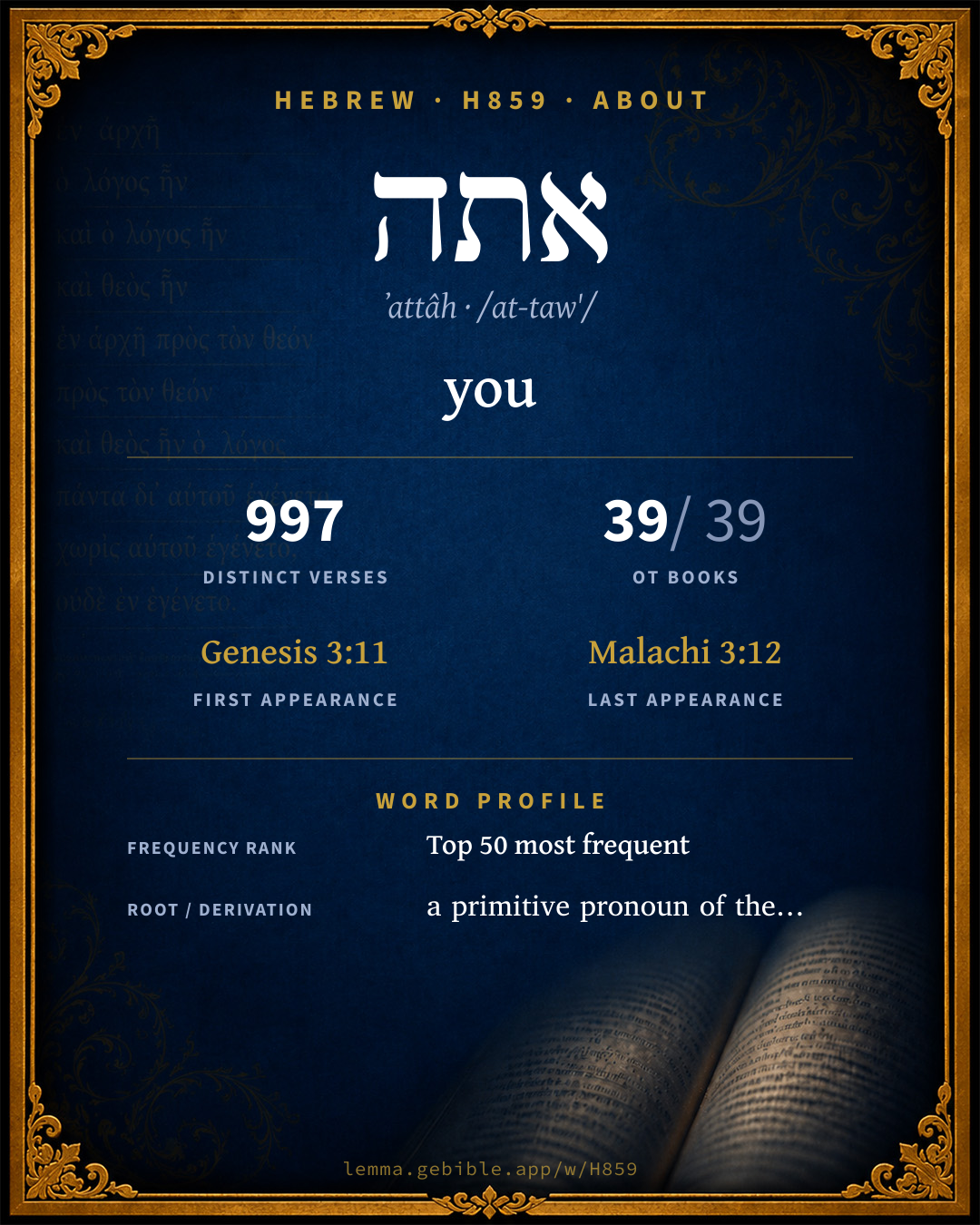
אַתָּ֫ה
you
Full lexicon entry — Brown-Driver-Briggs (BDB)
From Brown-Driver-Briggs (BDB)
Where this word appears
Grammar key — what these labels mean
Part of speech
- Pronoun
- A word standing in for a noun (“he,” “this,” “who”).
Person
- 2nd Person
- The one addressed (“you”).
Gender
- Masculine
- Grammatically masculine.
- Feminine
- Grammatically feminine.
Number
- Singular
- One.
- Plural
- More than one (in Hebrew, generally three or more).
Every verse where H859 appears in the Book of 2 Samuel — 43 distinct verses. Click any verse to open its interlinear word-by-word view. Verse text shown in the World English Bible for context — . Each verse’s Hebrew form is shown with its reference; the English is not keyword-highlighted, since the data carries no word-level English alignment. Use “Compare translations” on any verse to read it across multiple English versions. This concordance covers the Hebrew Bible; Septuagint (Greek Old Testament) occurrences are not indexed here.
2 Samuel
- 2 Samuel 1:8 אָ֑תָּה pron pers 2ms He said to me, Who are you? I answered him, I am an Amalekite.
- 2 Samuel 1:13 אָ֑תָּה pron pers 2ms David said to the young man who told him, Whence are you? He answered, I am the son of a foreigner, an Amalekite.
- 2 Samuel 2:5 אַתֶּם֙ pron pers 2mp David sent messengers to the men of Jabesh Gilead, and said to them, Blessed be you of Yahweh, that you have shown this kindness to your lord, even to Saul, and have buried him.
- 2 Samuel 2:20 הַ/אַתָּ֥ה ptcl inter + pron pers 2ms Then Abner looked behind him, and said, Is it you, Asahel? He answered, It is I.
- 2 Samuel 3:25 אַתָּ֖ה pron pers 2ms You know Abner the son of Ner, that he came to deceive you, and to know your going out and your coming in, and to know all that you do.
- 2 Samuel 5:2 אַתָּ֗ה אַתָּ֨ה וְ/אַתָּ֛ה pron pers 2ms pron pers 2ms conj + pron pers 2ms In times past, when Saul was king over us, it was you who led out and brought in Israel: and Yahweh said to you, You shall be shepherd of my people Israel, and you shall be prince over Israel.
- 2 Samuel 7:5 הַ/אַתָּ֛ה ptcl inter + pron pers 2ms Go and tell my servant David, Thus says Yahweh, Shall you build me a house for me to dwell in?
- 2 Samuel 7:20 וְ/אַתָּ֛ה conj + pron pers 2ms What can David say more to you? for you know your servant, Lord Yahweh.
- 2 Samuel 7:24 וְ/אַתָּ֣ה conj + pron pers 2ms You did establish to yourself your people Israel to be a people to you forever; and you, Yahweh, became their God.
- 2 Samuel 7:27 אַתָּה֩ pron pers 2ms For you, Yahweh of Hosts, the God of Israel, have revealed to your servant, saying, I will build you a house: therefore has your servant found in his heart to pray this prayer to you.
- 2 Samuel 7:28 אַתָּה pron pers 2ms Now, O Lord Yahweh, you are God, and your words are truth, and you have promised this good thing to your servant:
- 2 Samuel 7:29 אַתָּ֞ה pron pers 2ms now therefore let it please you to bless the house of your servant, that it may continue forever before you; for you, Lord Yahweh, have spoken it: and with your blessing let the house of your servant be blessed forever.
- 2 Samuel 9:2 הַ/אַתָּ֥ה ptcl inter + pron pers 2ms There was of the house of Saul a servant whose name was Ziba, and they called him to David; and the king said to him, Are you Ziba? He said, Your servant is he.
- 2 Samuel 9:7 וְ/אַתָּ֗ה conj + pron pers 2ms David said to him, "Don't be afraid of him; for I will surely show you kindness for Jonathan your father's sake, and will restore you all the land of Saul your father; and you shall eat bread at my table continually."
- 2 Samuel 9:10 אַתָּה֩ pron pers 2ms You shall till the land for him, you, and your sons, and your servants; and you shall bring in [the fruits], that your master's son may have bread to eat: but Mephibosheth your master's son shall eat bread always at my table." Now Ziba had fifteen sons and twenty servants.
- 2 Samuel 11:10 אַתָּ֣ה pron pers 2ms When they had told David, saying, Uriah didn't go down to his house, David said to Uriah, Haven't you come from a journey? why did you not go down to your house?
- 2 Samuel 12:7 אַתָּ֣ה pron pers 2ms Nathan said to David, "You are the man. This is what Yahweh, the God of Israel, says: 'I anointed you king over Israel, and I delivered you out of the hand of Saul.
- 2 Samuel 12:12 אַתָּ֖ה pron pers 2ms For you did it secretly, but I will do this thing before all Israel, and before the sun.'"
- 2 Samuel 13:4 אַ֠תָּה pron pers 2ms He said to him, Why, son of the king, are you thus lean from day to day? Won't you tell me? Amnon said to him, I love Tamar, my brother Absalom's sister.
- 2 Samuel 13:13 וְ/אַתָּ֗ה conj + pron pers 2ms I, where shall I carry my shame? and as for you, you will be as one of the fools in Israel. Now therefore, please speak to the king; for he will not withhold me from you.
- 2 Samuel 15:2 אַ֔תָּה pron pers 2ms Absalom rose up early, and stood beside the way of the gate: and it was so, that when any man had a suit which should come to the king for judgment, then Absalom called to him, and said, Of what city are you? He said, Your servant is of one of the tribes of Israel.
- 2 Samuel 15:19 אַתָּ֖ה אַ֔תָּה אַתָּ֖ה pron pers 2ms pron pers 2ms pron pers 2ms Then said the king to Ittai the Gittite, Why go you also with us? return, and abide with the king: for you are a foreigner, and also an exile; [return] to your own place.
- 2 Samuel 15:27 אַתָּ֔ה pron pers 2ms The king said also to Zadok the priest, "Aren't you a seer? Return into the city in peace, and your two sons with you, Ahimaaz your son, and Jonathan the son of Abiathar.
- 2 Samuel 16:8 אָֽתָּה pron pers 2ms Yahweh has returned on you all the blood of the house of Saul, in whose place you have reigned; and Yahweh has delivered the kingdom into the hand of Absalom your son; and, behold, you are [taken] in your own mischief, because you are a man of blood.
- 2 Samuel 17:3 אַתָּ֣ה pron pers 2ms and I will bring back all the people to you: the man whom you seek is as if all returned: [so] all the people shall be in peace.
- 2 Samuel 17:6 אַתָּ֥ה pron pers 2ms When Hushai was come to Absalom, Absalom spoke to him, saying, Ahithophel has spoken after this manner: shall we do [after] his saying? if not, speak up.
- 2 Samuel 17:8 אַתָּ֣ה pron pers 2ms Hushai said moreover, You know your father and his men, that they are mighty men, and they are fierce in their minds, as a bear robbed of her cubs in the field; and your father is a man of war, and will not lodge with the people.
- 2 Samuel 18:13 וְ/אַתָּ֖ה conj + pron pers 2ms Otherwise if I had dealt falsely against his life (and there is no matter hid from the king), then you yourself would have set yourself against [me].
- 2 Samuel 18:20 אַתָּה֙ pron pers 2ms Joab said to him, You shall not be the bearer of news this day, but you shall bear news another day; but this day you shall bear no news, because the king's son is dead.
- 2 Samuel 18:22 אַתָּ֥ה pron pers 2ms Then said Ahimaaz the son of Zadok yet again to Joab, But come what may, Please let me also run after the Cushite. Joab said, Why will you run, my son, seeing that you will have no reward for the news?
- 2 Samuel 19:10 אַתֶּ֛ם pron pers 2mp Absalom, whom we anointed over us, is dead in battle. Now therefore why don't you speak a word of bringing the king back?
- 2 Samuel 19:12 אַתֶּ֔ם אַתֶּ֑ם pron pers 2mp pron pers 2mp You are my brothers, you are my bone and my flesh: why then are you the last to bring back the king?
- 2 Samuel 19:13 אָ֑תָּה pron pers 2ms Say you to Amasa, Aren't you my bone and my flesh? God do so to me, and more also, if you aren't captain of the host before me continually in the room of Joab.
- 2 Samuel 19:14 אַתָּ֖ה pron pers 2ms He bowed the heart of all the men of Judah, even as [the heart of] one man; so that they sent to the king, [saying], Return you, and all your servants.
- 2 Samuel 19:29 אַתָּ֣ה pron pers 2ms The king said to him, Why speak you any more of your matters? I say, You and Ziba divide the land.
- 2 Samuel 19:33 אַתָּה֙ pron pers 2ms The king said to Barzillai, Come you over with me, and I will sustain you with me in Jerusalem.
- 2 Samuel 20:4 וְ/אַתָּ֖ה conj + pron pers 2ms Then said the king to Amasa, Call me the men of Judah together within three days, and be here present.
- 2 Samuel 20:6 אַ֠תָּה pron pers 2ms David said to Abishai, Now will Sheba the son of Bichri do us more harm than did Absalom: take your lord's servants, and pursue after him, lest he get him fortified cities, and escape out of our sight.
- 2 Samuel 20:9 אַתָּ֖ה pron pers 2ms Joab said to Amasa, Is it well with you, my brother? Joab took Amasa by the beard with his right hand to kiss him.
- 2 Samuel 20:17 הַ/אַתָּ֥ה ptcl inter + pron pers 2ms He came near to her; and the woman said, Are you Joab? He answered, I am. Then she said to him, Hear the words of your handmaid. He answered, I do hear.
- 2 Samuel 20:19 אַתָּ֣ה pron pers 2ms I am of those who are peaceable and faithful in Israel: you seek to destroy a city and a mother in Israel: why will you swallow up the inheritance of Yahweh?
- 2 Samuel 21:4 אַתֶּ֥ם pron pers 2mp The Gibeonites said to him, It is no matter of silver or gold between us and Saul, or his house; neither is it for us to put any man to death in Israel. He said, What you shall say, that will I do for you.
- 2 Samuel 22:29 אַתָּ֥ה pron pers 2ms For you are my lamp, Yahweh; Yahweh will lighten my darkness.
About this entry
At a glance — auto-summarized from this page’s data, not written by a person. Every figure links to its source below. This summary describes the numbers; it doesn’t interpret them.
אתה — transliterated ʼattâh — is a Hebrew word carrying the sense “you.” The King James Version usually renders it “thou,” while modern versions prefer “you” (Berean Standard Bible) — see the renderings breakdown. Spanning 997 verses in 39 books, it ranks among the most common words of the Hebrew Bible. Debuting at Genesis 3:11, it then recurs through the corpus. From the same root come אנתה. See the sense tree, 997-verse concordance, and the renderings breakdown below.
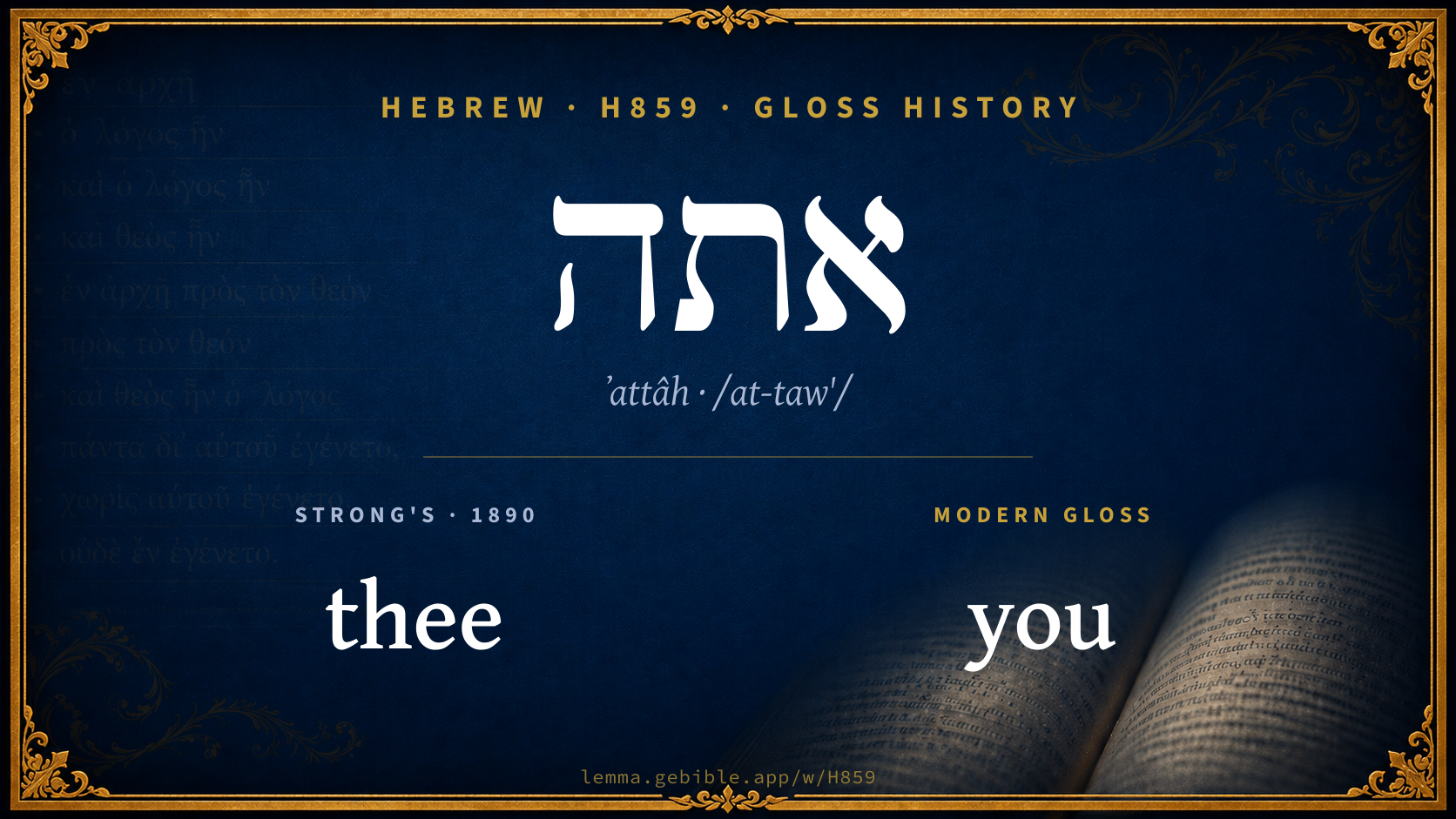
Gloss history
Strong's 1890 vs modern scholarship
About this word
Strong's H859 catalogs a Hebrew word from the Hebrew Old Testament.
These counts are not copied from any lexicon or concordance. They are computed here, from the morphology-tagged Hebrew Old Testament. What Lemma adds →
- 997
- distinct verses
- The word appears in 997 distinct verses.
- 39 / 39
- OT books
- The word appears in 39 of 39 Old Testament books.
- #34
- by frequency
- Top 50 most frequent Hebrew words (rank 34 of 8,640 Hebrew words by occurrence).
View all 997 occurrences in the concordance →
By section of the Old Testament
By traditional corpus
Conventional, traditional groupings — biblical authorship is debated, so this is a traditional corpus grouping, not an authorship claim. Each share is this word’s portion of its verses in that division of the Hebrew canon. Each figure is a share of the word’s 997 distinct verses.
- Prophets (Nevi'im) 517 verses · 52%
- Torah (Pentateuch) 241 verses · 24%
- Writings (Ketuvim) 239 verses · 24%
How translations render this word
Counts come from each version’s own published word-to-Strong’s tagging or interlinear alignment — an approximate guide to how each version renders this word, not a word-level alignment the data otherwise carries. Because each total is that version’s own tagged count, the per-version totals vary from one another and need not match the appearance or distinct-verse counts above. These counts may also differ from a printed concordance because Lemma counts each distinctly tagged rendering and does not collapse phrase taggings into a single head-word total. This is a fixed set of word-tagged versions (KJV, ASV, BSB, ULT) and does not change with the reading translation you choose elsewhere. Each version’s license is shown beside its name below (and on Sources).
BDB lists this Strong’s number as 7 distinct words (homographs). Each count above pools all of them and is not split by sense — see the Senses section below. A low-frequency rendering may belong to a different one of those words, not the primary meaning.
- King James Version†: Thou 5×, Ye 3×
- American Standard Version†: Thou 4×, Ye 3×
- Berean Standard Bible†: You 800×, Are you 49×, Do you 21×
- unfoldingWord Literal Text†: You 833×, Yourself 46×, Are you 42×
King James Version Public Domain
Renders H859 across 11† tagged occurrences — most commonly:
Plus 3 renderings that appear only once — usually multi-word phrases or single function words the recovered tagging swept in, not distinct renderings.
American Standard Version Public Domain
Renders H859 across 11† tagged occurrences — most commonly:
Plus 4 renderings that appear only once — usually multi-word phrases or single function words the recovered tagging swept in, not distinct renderings.
Berean Standard Bible Public Domain
Renders H859 across 1,022† tagged occurrences — most commonly:
Plus other, less common renderings. Plus 34 renderings that appear only once — usually multi-word phrases or single function words the recovered tagging swept in, not distinct renderings. Not rendered by a distinct English word in 67 further occurrences.
unfoldingWord Literal Text CC BY-SA 4.0
Renders H859 across 1,122† tagged occurrences — most commonly:
Plus other, less common renderings. Plus 35 renderings that appear only once — usually multi-word phrases or single function words the recovered tagging swept in, not distinct renderings.
Senses in the full BDB
What do BDB’s symbols mean?
BDB uses these scholarly abbreviations:
| Symbol | Meaning |
|---|---|
| 𝔊 | the Septuagint (the ancient Greek translation, LXX) |
| 𝔙 | the Vulgate (the Latin translation) |
| 𝔖 | the Syriac version (the Peshitta) |
| 𝔗 | the Targum (the Aramaic translation) |
| ψ | the Psalms |
| √ | root (the underlying root or stem) |
| ‖ | parallel passage (a synonymous or contrasted parallel) |
| † | the dagger: every passage where the word occurs is cited |
The 0 senses and sub-senses the full Brown-Driver-Briggs lexicon distinguishes for this word, in lexicon order (not ranked by frequency), with BDB’s own verbatim wording and sub-sense lettering. Shown in Hebrew script with BDB’s own scholarly abbreviations. The condensed entry is in the Lexicon Entry tab. See also the Forms in the corpus table below.
אתה I (so regularly
אתה II on. 2 s. f. thou (fem.) (shortened from אַתִּי (q.v.)
אתה III on. 2 m.pl. you (masc.) (for antem, v. supr.) Gn 9
Senses from the full Brown-Driver-Briggs lexicon (Brown, Driver, Briggs; Oxford 1906 — public domain), digitized via Sefaria, supplemented by the OpenScriptures HebrewLexicon (CC BY 4.0). Full attribution on Sources.
Word origin
I. (so regularly; but 26–7 times, with different disj. accents, אַ֑תָּה: v. FrMM 228; Sta§ 178 a (read 8 for 18) pron. 2 s. m. thou (for anta, v. supr.; cf. נָתַתָּ for נָתַנְתָּ) Gn 3:11, 19 + often. Written אַתָּ †1 S 24:18 ψ 6:4; Jb 1:10; Ec 7:22; Ne 9:6. Appended to a vb. for emph., Ex 18:19(×2) 1 S 17:56 שְׁאַל אַתָּה inquire thou, 20:8; 22:18; Is 43:26 סַפֵּר אַתָּה. Added for the purpose of strengthening a gen. or accus. sf. 1 K 21:19; Pr 22:19 (Ges§ 135, 2).
I. pron. 2 s. f. thou (fem.) (shortened from אַתִּי (q.v.); in Syriac the two genders are written differently, ܐܰܢ̱ܬ݀, ܐܰܢ̱ܬ݀ܝ, but, the ܝ not being sounded, are pronounced alike: in 𝔗 both are written אַתְּ or אַנְתְּ) Gn 12:11, 13; 24:23 + often. Thrice Nu 11:15; Dt 5:24; Ez 28:14 used as a masc. (as in Aramaic of 𝔗); but prob. אַתָּ (v. sub אַתָּה) should be here read.
I. pron. 2 m.pl. you (masc.) (for antem, v. supr.) Gn 9:7; 26:27; 29:4 + often. With הֲ, הָאַתֶּם †Ju 6:31; following the vb. for emph. Ju 15:12; Je 34:15; construed inaccurately with a fem. Ez 13:20.
I. Ez 34:31 (many edd. אַתֶּן), אַתֵּ֫נָה Gn 31:6 Ez 13:11, 20 (edd. אַתֵּ֫נָּה) 34:17 pron. 2 f.pl. you (fem.)
— Brown-Driver-Briggs (Oxford 1906, public domain), digitized via Sefaria, supplemented by the OpenScriptures HebrewLexicon (CC BY 4.0). See Sources.
Origin: a primitive pronoun of the second person
Jastrow Dictionary
A second Hebrew/Aramaic lexicon for comparison, covering Aramaic and post-biblical (Talmudic, Targumic, Midrashic) usage that the biblical-Hebrew BDB does not. Matched by lemma rather than by Strong’s number, so a lemma may carry more than one Jastrow headword (shown separately below), and the entries cover usage well beyond the Bible.
אַתָּה
- ,, v. אָנֹכִי) thou. Ber. 11ᵃ; a. fr.—אתה אומר, v. אַתְּ.—Pl. אַתֶּם, אַתֶּן ye. Ber. I, 1; a. fr.—R. Hash. 25ᵃ א׳ א׳ א׳ ג׳ פעמים וכ׳ three times attem is written (אֹתָם, without ו); v. אֲפִילּוּ. Sifra Emor IX, 9; a. fr.
A Dictionary of the Targumim, the Talmud Babli and Yerushalmi, and the Midrashic Literature (Marcus Jastrow; London, Luzac, 1903) — Public Domain. Digitized via Sefaria. Digitized via Sefaria. Full attribution on Sources.
Forms in the corpus
The 126 distinct written forms H859 takes in the Hebrew Bible, most frequent first — each parse links to that state’s occurrences in the concordance. Hebrew forms include their vowel points and cantillation, so a single lemma takes many written forms.
| Form | Parsing | Example | Uses |
|---|---|---|---|
| אַתָּ֣ה | Pronoun, Personal, 2nd Person, Masculine, Singular | Amos 7:16 | 100 |
| אַתָּ֖ה | Pronoun, Personal, 2nd Person, Masculine, Singular | Deuteronomy 1:37 | 71 |
| אַתָּ֥ה | Pronoun, Personal, 2nd Person, Masculine, Singular | Deuteronomy 7:1 | 67 |
| אַתָּה֙ | Pronoun, Personal, 2nd Person, Masculine, Singular | Deuteronomy 4:35 | 55 |
| וְ/אַתָּ֣ה | Pronoun, Personal, 2nd Person, Masculine, Singular | Daniel 12:4 | 52 |
| אַתֶּ֣ם | Pronoun, Personal, 2nd Person, Masculine, Plural | Deuteronomy 2:4 | 48 |
| אַתָּ֤ה | Pronoun, Personal, 2nd Person, Masculine, Singular | Amos 7:8 | 38 |
| וְ/אַתָּ֖ה | Pronoun, Personal, 2nd Person, Masculine, Singular | Daniel 12:13 | 32 |
| אַתֶּם֙ | Pronoun, Personal, 2nd Person, Masculine, Plural | Deuteronomy 11:31 | 30 |
| אַתֶּ֥ם | Pronoun, Personal, 2nd Person, Masculine, Plural | Amos 9:7 | 28 |
| אָ֑תָּה | Pronoun, Personal, 2nd Person, Masculine, Singular | Daniel 9:23 | 27 |
| וְ/אַתָּה֙ | Pronoun, Personal, 2nd Person, Masculine, Singular | Daniel 8:26 | 27 |
| אָֽתָּה | Pronoun, Personal, 2nd Person, Masculine, Singular | Deuteronomy 9:6 | 22 |
| אַתֶּ֖ם | Pronoun, Personal, 2nd Person, Masculine, Plural | Deuteronomy 12:7 | 21 |
| אַתָּ֛ה | Pronoun, Personal, 2nd Person, Masculine, Singular | Deuteronomy 28:52 | 19 |
| וְ/אַתֶּ֖ם | Pronoun, Personal, 2nd Person, Masculine, Plural | Deuteronomy 1:40 | 17 |
| וְ/אַתָּ֞ה | Pronoun, Personal, 2nd Person, Masculine, Singular | Exodus 14:16 | 16 |
| אַ֔תָּה | Pronoun, Personal, 2nd Person, Masculine, Singular | Exodus 33:3 | 15 |
| אַתָּ֨ה | Pronoun, Personal, 2nd Person, Masculine, Singular | Deuteronomy 2:18 | 15 |
| אַ֭תָּה | Pronoun, Personal, 2nd Person, Masculine, Singular | Job 8:5 | 14 |
| אַתֶּ֛ם | Pronoun, Personal, 2nd Person, Masculine, Plural | Deuteronomy 4:5 | 13 |
| אַתָּ֔ה | Pronoun, Personal, 2nd Person, Masculine, Singular | Deuteronomy 7:6 | 13 |
| וְ/אַתֶּם֙ | Pronoun, Personal, 2nd Person, Masculine, Plural | Deuteronomy 4:4 | 13 |
| וְ/אַתָּ֗ה | Pronoun, Personal, 2nd Person, Masculine, Singular | Amos 7:17 | 13 |
| וְ/אַתָּ֤ה | Pronoun, Personal, 2nd Person, Masculine, Singular | Exodus 33:12 | 13 |
| אַתֶּ֑ם | Pronoun, Personal, 2nd Person, Masculine, Plural | Ezekiel 34:31 | 12 |
| אַ֣תְּ | Pronoun, Personal, 2nd Person, Feminine, Singular | Ezekiel 16:52 | 11 |
| אַתֶּ֔ם | Pronoun, Personal, 2nd Person, Masculine, Plural | Deuteronomy 14:1 | 11 |
| אַתָּ֗ה | Pronoun, Personal, 2nd Person, Masculine, Singular | Deuteronomy 31:7 | 11 |
| וְ/אַתָּ֥ה | Pronoun, Personal, 2nd Person, Masculine, Singular | Deuteronomy 28:43 | 10 |
| אַתֶּ֜ם | Pronoun, Personal, 2nd Person, Masculine, Plural | Deuteronomy 4:26 | 9 |
| אַתֶּ֤ם | Pronoun, Personal, 2nd Person, Masculine, Plural | Deuteronomy 31:13 | 9 |
| אַתָּ֕ה | Pronoun, Personal, 2nd Person, Masculine, Singular | Exodus 18:18 | 9 |
| אַתָּ֞ה | Pronoun, Personal, 2nd Person, Masculine, Singular | Exodus 19:23 | 9 |
| וְ/אַתֶּ֗ם | Pronoun, Personal, 2nd Person, Masculine, Plural | Exodus 12:22 | 9 |
| אַתָּה | Pronoun, Personal, 2nd Person, Masculine, Singular | 1 Chronicles 17:26 | 8 |
| וְ/אַתָּ֛ה | Pronoun, Personal, 2nd Person, Masculine, Singular | Genesis 15:15 | 8 |
| אַ֖תְּ | Pronoun, Personal, 2nd Person, Feminine, Singular | Ezekiel 16:48 | 7 |
| וְ/אַתֶּ֣ם | Pronoun, Personal, 2nd Person, Masculine, Plural | 2 Chronicles 15:7 | 7 |
| אַ֠תָּה | Pronoun, Personal, 2nd Person, Masculine, Singular | Genesis 31:52 | 6 |
| אַתֶּ֞ם | Pronoun, Personal, 2nd Person, Masculine, Plural | Genesis 45:8 | 6 |
| אַתֶּֽם | Pronoun, Personal, 2nd Person, Masculine, Plural | Genesis 42:14 | 6 |
| הַ/אַתָּ֥ה | Pronoun, Personal, 2nd Person, Masculine, Singular | 1 Kings 18:7 | 6 |
| וְ֠/אַתָּה | Pronoun, Personal, 2nd Person, Masculine, Singular | Ezekiel 33:9 | 6 |
| אַתְּ | Pronoun, Personal, 2nd Person, Feminine, Singular | Genesis 39:9 | 5 |
| אַ֖תָּה | Pronoun, Personal, 2nd Person, Masculine, Singular | Habakkuk 2:16 | 5 |
| אַתֶּ֗ם | Pronoun, Personal, 2nd Person, Masculine, Plural | Deuteronomy 12:12 | 5 |
| אַתֶּ֨ם | Pronoun, Personal, 2nd Person, Masculine, Plural | Deuteronomy 20:3 | 5 |
| אתי | Pronoun, Personal, 2nd Person, Feminine, Singular | Ezekiel 36:13 | 5 |
| וְ/אַתֶּ֥ם | Pronoun, Personal, 2nd Person, Masculine, Plural | Haggai 1:9 | 5 |
| אַ֑תָּה | Pronoun, Personal, 2nd Person, Masculine, Singular | Psalms 2:7 | 4 |
| אַ֤תְּ | Pronoun, Personal, 2nd Person, Feminine, Singular | 1 Kings 2:15 | 4 |
| אַתָּֽה | Pronoun, Personal, 2nd Person, Masculine, Singular | 2 Chronicles 20:6 | 4 |
| אַתָּה֩ | Pronoun, Personal, 2nd Person, Masculine, Singular | Exodus 3:18 | 4 |
| אָ֑תְּ | Pronoun, Personal, 2nd Person, Feminine, Singular | Ezekiel 36:13 | 4 |
| וְ/אַתֶּ֞ם | Pronoun, Personal, 2nd Person, Masculine, Plural | Ezekiel 36:8 | 4 |
| וְ/אַתָּ֡ה | Pronoun, Personal, 2nd Person, Masculine, Singular | Exodus 28:1 | 4 |
| וְ/אַתָּ֨ה | Pronoun, Personal, 2nd Person, Masculine, Singular | Ezekiel 5:1 | 4 |
| אַ֝תָּ֗ה | Pronoun, Personal, 2nd Person, Masculine, Singular | Psalms 16:5 | 3 |
| אַתָּ֧ה | Pronoun, Personal, 2nd Person, Masculine, Singular | 1 Kings 18:36 | 3 |
The 60 most common forms are shown; 66 rarer forms follow in the full concordance.
Same root — word family
Other BDB entries built from the same root as H859, grouped by Strong’s listed origin. These share a root / origin per the lexicon — not necessarily a shared meaning. Each links to that word’s own entry.
Derived from this word
Compare all same-root words → They share a root, not necessarily a meaning.
Septuagint verse parallels
This word appears in 904 verses that also exist in the Greek Old Testament (Septuagint), out of the 997 Hebrew verses it occurs in. You can read those verses in Greek by switching the Old Testament edition to the Septuagint.
Read these verses in the Septuagint
- Genesis 3:11
- Exodus 2:14
- Leviticus 10:9
- Numbers 1:3
- Deuteronomy 1:37
- Joshua 1:2
- Judges 2:2
- Ruth 3:9
- 1 Samuel 7:3
- 2 Samuel 1:8
- 1 Kings 1:13
- 2 Kings 1:3
This is a verse-level parallel only — the same verses exist in both the Hebrew and Greek Old Testaments. No word-level Hebrew↔Greek correspondence is claimed: the data carries no such alignment, so no Greek word is shown as this Hebrew word’s translation. Coverage is not total — the Septuagint omits the deuterocanon and renumbers the Psalms, so some Hebrew verses have no direct Greek parallel.