

Job 8:5

Hebrew (Westminster Leningrad Codex) Job 8:5 appears in the Hebrew Old Testament. The text above is from the Westminster Leningrad Codex. Each word links to its Strong’s number, a concise gloss, and parsing drawn from the Open Scriptures Hebrew Bible morphology. Click any word for its full Brown-Driver-Briggs (BDB) entry.
Download image
Cite this verse

Job 8:5 (World English Bible). Public Domain. Lemma interlinear Bible study tool, https://lemma.gebible.app/v/job/8/5.

Show BibTeX & RIS
BibTeX
RIS
English Translation
If you want to seek God diligently, Make your supplication to the Almighty.
World English Bible · Public Domain
Download a study sheet

One document with this verse’s original text, its word-by-word gloss line, the meaning frame, cross-references with their text, attributed commentary, and full source and license credits — printable, and it pastes into notes with its structure intact.

This verse Autodidact and up

Study sheet (.html) Plain text (.txt)

A passage Seminary Student

Up to 50 verses in one chapter. A passage sheet keeps up to 6 commentary sources and 12 cross-references per verse, in the order this page ranks them, and says so on the sheet whenever that leaves anything out. Ask for a single verse and you get the Autodidact verse sheet above.

Everything on this page stays free to read, with no account — the sheet is a download of what is already on screen, not access to it.

Want to remove ads? Support Godless Engineer
Compare translations 3

The same verse in 3 English versions, stacked beneath the original-language interlinear above. Click any original word for its lexicon entry.

Each is an independent rendering of the whole verse — the interlinear is not word-aligned to these translations.

Highlighted words mark where these versions differ — a whole-verse word diff, not a word-by-word alignment.

  • World English Bible Public Domain
    If you want to seek God diligently, Make your supplication to the Almighty.
  • King James Version Public Domain
    If thou wouldest seek unto God betimes, and make thy supplication to the Almighty;
  • unfoldingWord Literal Text CC BY-SA 4.0
    If you seek diligently for God, and to the Almighty you appeal,

unfoldingWord Literal Text — © unfoldingWord, licensed CC BY-SA 4.0. Word-aligned USFM3 via Door43 (git.door43.org/unfoldingWord/en_ult).

Versions to compare (up to 4)

3 of 4 selected

Show all 18 translations

Every available English version of this verse, each an independent rendering of the whole verse.

  • World English Bible Public Domain
    If you want to seek God diligently, Make your supplication to the Almighty.
  • Berean Standard Bible Public Domain
    But if you would earnestly seek God and ask the Almighty for mercy,
  • Majority Standard Bible Public Domain
    But if you would earnestly seek God and ask the Almighty for mercy,
  • King James Version Public Domain
    If thou wouldest seek unto God betimes, and make thy supplication to the Almighty;
  • American Standard Version (1901) Public Domain
    If thou wouldest seek diligently unto God, And make thy supplication to the Almighty;
  • Revised Version (1885) Public Domain
    If thou wouldest seek diligently unto God, and make thy supplication to the Almighty;
  • Geneva Bible (1599) Public Domain
    Yet if thou wilt early seeke vnto God, and pray to the Almightie,
  • Douay-Rheims (1899) Public Domain
    Yet if thou wilt arise early to God, and wilt beseech the Almighty:
  • Young's Literal Translation Public Domain
    If thou dost seek early unto God, And unto the Mighty makest supplication,
  • Literal Standard Version CC BY-SA 4.0
    If you seek for God early, || And make supplication to the Mighty,
  • Unlocked Literal Bible CC BY-SA 4.0
    But suppose you diligently sought God and presented your request to the Almighty.
  • unfoldingWord Literal Text CC BY-SA 4.0
    If you seek diligently for God, and to the Almighty you appeal,
  • Darby Bible Public Domain
    If thou seek earnestly unto ùGod, and make thy supplication to the Almighty,
  • World Messianic Bible Public Domain
    If you want to seek God diligently, make your supplication to the Almighty.
  • Webster's Bible Public Domain
    If thou wouldst seek to God betimes, and make thy supplication to the Almighty;
  • Free Bible Version CC BY-SA 4.0
    But if you pray to God and ask for his help,
  • Bible in Basic English Public Domain
    If you will make search for God with care, and put your request before the Ruler of all;
  • JPS Tanakh (1917) Public Domain
    If thou wouldest seek earnestly unto God, and make thy supplication to the Almighty;

Literal Standard Version (2020), Covenant Press — licensed CC BY-SA 4.0. Text via the HelloAO Bible API (eBible.org). Unlocked Literal Bible (unfoldingWord) — licensed CC BY-SA 4.0. Text via the HelloAO Bible API (eBible.org). unfoldingWord Literal Text — © unfoldingWord, licensed CC BY-SA 4.0. Word-aligned USFM3 via Door43 (git.door43.org/unfoldingWord/en_ult). Free Bible Version, Dr. Jonathan Gallagher — licensed CC BY-SA 4.0. Text via the HelloAO Bible API (eBible.org).

Word by word

More ways to search: Search by grammar → Find every occurrence → Compare this word →

Practice this passage: Drill this verse → Learn its vocabulary →

About this verse

These counts appear in no published source. They are computed here, from the morphology-tagged text and Lemma’s own curated glosses. What Lemma adds →

8
words
7
distinct lemmas
Wisdom
section

Notable vocabulary

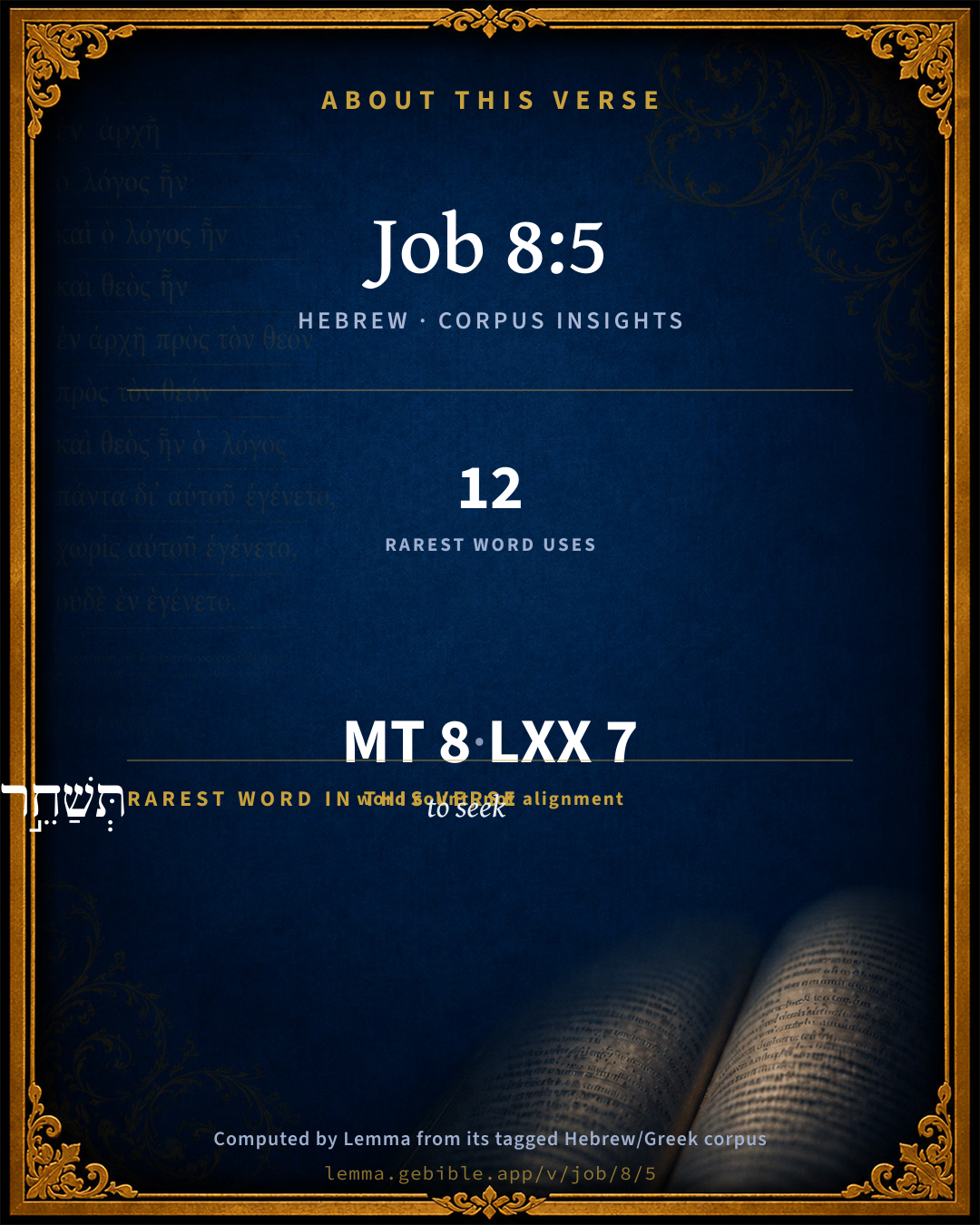
The rarest word here is תְּשַׁחֵ֣ר to seek H7836 — appearing just 12 times in the whole Hebrew Bible.

Shared distinctive vocabulary

תְּשַׁחֵ֣ר to seek H7836 occurs in 12 verses of the Hebrew Bible. Also found in:

Grammatical profile

  • 2 verbs
  • 2 nouns
  • 1 pronoun
  • 2 prepositions
  • 1 conjunction

Verb forms

  • תְּשַׁחֵ֣ר Piel · Imperfect
  • תִּתְחַנָּֽן Hithpael · Imperfect

Repetition

A word recurs within this verse — often emphatic in Hebrew:

  • אֶל to H413 ×2

Hebrew & Septuagint length

In English translation the verse runs 13 words from the Hebrew and 10 from the Septuagint (LXX English) — closely comparable.

A rough comparison of the two English renderings, which tokenize alike — not a word-level alignment.

Word counts can differ between the Hebrew and the Greek without any difference in meaning — e.g. the Hebrew direct-object marker אֵת has no separate Greek word, and Greek often adds the article ὁ.

In the original languages it is 8 Hebrew tokens and 7 Greek tokens — but the two are counted differently (Hebrew bundles its prefixes and suffixes into one token; the Greek is in lemma form), so that isn’t a like-for-like length.

Cross-references

8

Topical passages linked to Job 8:5 in the Treasury of Scripture Knowledge — connected by theme and wording, ordered by reader-vote popularity; previews shown in the World English Bible.

  • James 4:7–10 Be subject therefore to God. But resist the devil, and he will flee from you.
  • Job 11:13 "If you set your heart aright, Stretch out your hands toward him.
  • Isaiah 55:6–7 Seek you Yahweh while he may be found; call you on him while he is near:
  • Matthew 7:7–8 "Ask, and it will be given you. Seek, and you will find. Knock, and it will be opened for you.
  • Hebrews 3:7–8 Therefore, even as the Holy Spirit says, "Today if you will hear his voice,
  • 2 Chronicles 33:12–13 When he was in distress, he begged Yahweh his God, and humbled himself greatly before the God of his fathers.
  • Job 5:8 "But as for me, I would seek God, To God would I commit my cause;
  • Job 22:21–30 "Acquaint yourself with him, now, and be at peace. Thereby good shall come to you.

Cross-references courtesy of OpenBible.info (CC BY 4.0).

Hebrew and Greek witnesses Masoretic Hebrew ↔ Greek Septuagint

The same verse in the two great witnesses to the Old Testament, shown verse-for-verse.

These are two independent witnesses, not word-aligned to each other, and the Septuagint is shown in lemma (dictionary) form.

Hebrew Job 8:5 Masoretic · Westminster Leningrad Codex

אִם אַ֭תָּה תְּשַׁחֵ֣ר אֶל אֵ֑ל וְאֶל שַׁ֝דַּ֗י תִּתְחַנָּֽן

If you want to seek God diligently, Make your supplication to the Almighty.

World English Bible · Public Domain

Greek LXX Job 8:5 Septuagint · lemma form

σύ δέ ὀρθρίζω πρός κύριος παντοκράτωρ δέω

But be you early in prayer to the Lord Almighty.

LXX2012 (modern English Septuagint) · Public Domain

Hebrew: Westminster Leningrad Codex (CC BY 4.0). Greek: Septuagint (public domain); English from LXX2012 (modern English Septuagint) (Public Domain). How the Septuagint differs from the Hebrew →

Commentary

Notes on Job 8:5 from classic Christian and Jewish commentators (each source and its license shown beneath its notes). The classic Christian expositions comment on the surrounding passage and are grouped to its opening verse, so a note may address several verses; the Jewish commentaries on the Tanakh (Rashi and others) are per-verse, so they appear only where the commentator wrote on this verse.

Lemma curates 59 commentaries, every one of them public domain or Creative Commons licensed, each selected and text-cleaned for this edition rather than reprinted as found. About our sources →

Trapp's Complete Commentary

John Trapp

Job 8:5 If thou wouldest seek unto God betimes, and make thy supplication to the Almighty;

Ver. 5. If thou wouldst seek unto God betimes] If warned by the evil end that befell thine unhappy children, thou wouldst early and earnestly seek unto God for mercy, for which purpose it may seem that thy life hast been graciously spared, when thy children have been destroyed, that thou might be made wise at their expense. Such counsel as that is Eliphaz hath given Job before, Job 5:8.

And make thy supplication to the Almighty] Pray for mercy out of free grace alone, so the Hebrew word signifieth; plead for pity, speak supplications, as the poor man doth, Pro 18:23. Be poor in spirit, a stark beggar and bankrupt, less than the least of all God’s mercies, Gen 32:10, and in this mind address thyself to the all sufficient, the cornucopia, the God rich in mercy to all that call upon him, for pardon of thy great sin in standing out in contention with his majesty, and resisting his fatherly visitation.

John Trapp, A Commentary or Exposition upon All the Books of the Old and New Testament (1647–1656) — public domain. Text from a community e-Sword module.

The Biblical Illustrator

Joseph S. Exell

Job_8:5-7

If thou wouldst seek unto God betimes.

The sinful mans search

I. What is it that God requireth? A diligent and speedy search. It is a work both in desire and labour to be joined with God. How must we search? Faithfully, humbly, continually. Whom we must seek. God, for four causes.

1. Because we have nothing of ourselves, nor of any other creature.

2. Because none is so present as He.

3. Because none is so able to help as He.

4. Because there is none so willing to help as He. When we must seek. Early. Even in a time when He may be found.

II. How is the search to be made? In prayer. Prayer is a shield against the force of our adversary. Prayer hath ever been the cognisance, and the victory, and the triumph of the faithful; for as the soul giveth life to the body, so prayer giveth life to the soul.

III. What effect this seeking and praying should have on us. If thou wert pure and upright. Gods promises for the performance hereof yield unto us most plentiful matter of doctrine and consolation. In Gods promises note His mercy, which exceedeth all His works. Note His bountiful kindness, His patience and long-suffering, and His love. God increase the love of these things in our hearts, and make us worthy of Christs blessings, which He hath plentifully in store for us; that after He hath heaped temporal blessings upon us, He will give us the blessing of all blessings, even the life of the world to come. (H. Smith.)

The Biblical Illustrator, edited by Joseph S. Exell (c. 1880s–1900s) — public domain. Text from a community e-Sword module.

Joseph Benson's Commentary

Job 8:5. If thou wouldest seek unto God, &c. — God hath spared thee, whom he might justly have destroyed with thy children, and thou art yet capable of obtaining his favour if thou wilt seek it. And, therefore, cease from thy causeless and unthankful complaints. Seek unto God betimes — Hebrew, אם תשׁחר, im teshacher, if thou wouldst rise early to seek him; if thou wouldst seek him speedily, early, and diligently, Job 5:8; and Job 7:18-21. And make thy supplication to the Almighty — Instead of complaining, implore his grace and favour with humble supplication.

Joseph Benson's Commentary on the Old and New Testaments (1811–1818) — public domain. Text from a community e-Sword module.

Whedon's Commentary on the Bible

Daniel D. Whedon

b. Divine Providence, that punishes the wicked, will as certainly reward the man who conciliates his God, Job_8:5-7.

5. Thou — Emphatic. While the dead children cannot, thou mayest repent.

Daniel D. Whedon (gen. ed.), Commentary on the Old and New Testaments (1874–1909) — public domain. Text from a community e-Sword module.

Geneva Bible (1599)

Geneva Bible translators

That is, if thou turn betime while God calleth thee to repentance.

Geneva Bible (1599) marginal notes — public domain. Text via Bolls.life.

Jamieson, Fausset & Brown

Robert Jamieson, A. R. Fausset & David Brown

seek unto God betimes--early. Make it the first and chief anxiety (Psa 78:34; Hos 5:15; Isa 26:9; Pro 8:17; Pro 13:24).

Jamieson, Fausset & Brown — Commentary Critical and Explanatory on the Whole Bible (1871) — public domain (CC PDM 1.0). Text via the HelloAO Bible API.

Adam Clarke's Commentary

Verse 5. If thou wouldest seek unto God] Though God has so severely afflicted thee, and removed thy children by a terrible judgment; yet if thou wilt now humble thyself before him, and implore his mercy, thou shalt be saved. He cut them off in their sins, but he spares thee; and this is a proof that he waits to be gracious to thee.

Adam Clarke's Commentary on the Bible (1810–1826) — public domain. Text from a community e-Sword/MySword module.

The Cambridge Bible for Schools and Colleges

gen. ed. J. J. S. Perowne

5. Bildad saw in the fate of Job’s children not only proof that they had sinned but that their sin was deadly. He saw in Job’s afflictions proof equally decisive that he had sinned, but the fact that he was still spared, however severe his afflictions, gave a different complexion to his sin, and also suggested a different meaning for his afflictions. They were chastisements meant for his good, and Bildad is enabled to hope the best for Job, if he will rightly lay his trials to heart.

wouldest seek unto God betimes] Rather, if thou wilt seek earnestly unto God. Thou is emphatic in antithesis to “thy children,” Job_8:4.

The Cambridge Bible for Schools and Colleges (gen. ed. J. J. S. Perowne; Cambridge University Press, 1878–1918) — public domain. Text from a community e-Sword module.

John Gill's Exposition

If thou wert pure and upright,.... By which he tacitly intimates that he was neither; though the character given of him is, that he was perfect and upright, feared God and eschewed evil, and which is confirmed by God himself, and even after he had been tried by sore afflictions. Bildad's meaning is, if he was pure in heart, and upright in his life and conversation, then things would be well with him. Men's hearts are naturally impure; no man is pure of himself, or can make his heart pure; nor is there any good man that is so pure as to be entirely free from sin; but such are pure in heart, who have clean hearts created, and right spirits renewed in them; or have new hearts and new spirits given them; have their hearts sprinkled from an evil conscience, and so keep the faith in a pure conscience; having their hearts purified by faith in the blood of Christ, whose blood cleanses from all sin; and in this sense Job was pure, having an interest in a living Redeemer, and in his blood, and a partaker of his grace; and that he was upright is before testified of him, though now called in question, an if being put upon it, as well as on the former, having in the course of his life walked uprightly, according to the will of God revealed unto him:

surely now; directly at once, without delay, as Sephorno interprets it; it need not be doubted of, verily so it would be:

he would awake for thee; who though he neither slumbers nor sleeps, yet seems to be asleep when he suffers his people to be afflicted, distressed, and oppressed, and therefore they cry unto him to awake to their judgment, and their cause; see Psa 7:8; the sense is, that he would stir up and exert himself, and show himself strong on his behalf, and appear to be on his side, and work deliverance and salvation for him; or awake his mercy, grace, and goodness, as some Jewish commentators (p) interpret it; that is, bestow his favours upon him:

and make the habitation of thy righteousness prosperous; which some understand of his body, the earthly house of his tabernacle, which if his soul was pure and upright that dwelt in it, might be called the habitation of righteousness; which, were this the case, would become healthful that was now covered with worms, and clods of dust: others interpret it of the soul, as Aben Ezra and Ben Gersom, the seat of righteousness, and of all the graces of the Spirit; which is in a prosperous condition when these graces are in lively exercise, and the presence of God, and the light of his countenance, and communion with him, are enjoyed; but rather his dwelling house in a literal sense, and all his domestic affairs, are here meant; and it is signified that all would be again in peace and prosperity, and he should enjoy great plenty of good things should he behave well; and here is a tacit intimation as if his habitation had not been an habitation of righteousness, but had been filled with the mammon of unrighteousness, with goods ill gotten, such as were obtained by rapine and oppression, and neither he nor his family righteous; a very unjust and iniquitous insinuation: the Targum paraphrases it, "and, shall make the beauty of thy righteousness perfect" (q); but Job had a more beautiful righteousness than his own; his was but as rags, and neither pure nor perfect; even the righteousness of Christ, which is perfect and beautiful, and makes such so, that are arrayed with it; see Psa 50:2.

(p) Gersom, Simeon Bar Tzemach, Sephorno. (q) "pulchritudinent justitiae tuae", Bolducius.

John Gill's Exposition of the Whole Bible (1746–1763) — public domain (CC PDM 1.0). Text via the HelloAO Bible API.

Albert Barnes' Notes on the Bible

If thou wouldest seek unto God betimes - If thou wouldest do it now. If even on the supposition that your sons have thus perished, and that God has come out in judgment against your family, you would look to God, you might be restored to favor. The word rendered “seek betimes” (שׁחר shâchar) means literally to seek in the morning, to seek early; and then, to make it the first business. It is derived from the word meaning aurora (שׁחר shachar) and has reference to the early light of the morning, and hence, to an early seeking. It may be applied to seeking him in early life, or as the first thing - looking to him immediately when help is needed, or before we apply to anyone else; compare Pro 7:15; Pro 8:17; Pro 13:24; Job 24:5; Psa 63:1; Psa 78:34; Isa 26:9; Hos 5:15; compare the advice of Eliphaz, Job 5:8.

Albert Barnes' Notes on the Bible (1834–1885) — public domain. Text from a community e-Sword/MySword module.

Matthew Poole's English Annotations

But, God hath spared thee, whom he might justly have destroyed with thy children, and thou art yet capable of his favour, if thou seek for it; and therefore cease from these causeless and unthankful complaints.

Seek unto God betimes, Heb. rise early to seek him, i.e. if thou wouldst seek him speedily, early, and diligently. See Job 5:8; 7:18,21. But this may be understood of the time past; and this verse being connected with the next, may be thus rendered and understood, If thou hadst sought (for the future tense in the Hebrew is oft put for the past) unto God betimes, (as thou didst seem to do, Job 1:5) and made supplication to the Almighty; if withal thou hadst been pure and upright, i.e. if thy prayers had been accompanied with purity and uprightness of heart and life, they should have been heard and answered. But because thou didst regard iniquity in thy heart, therefore God would not hear and did not answer thy prayers, but answered thee with a curse instead of a blessing, as he useth to deal with hypocrites.

Matthew Poole's English Annotations on the Holy Bible (1683–1685) — public domain. Text from a community e-Sword/MySword module.

The Pulpit Commentary

If thou wouldest seek unto God betimes. Here we have again an echo of the words of Eliphaz. (Job_5:8) There is a tacit assumption that Job has not had recourse to God, has not pleaded his cause with him or taken him into counsel; whereas all the evidence was the other way. Both when the first batch of calamities was reported to him, (Job_1:14-19) and when the stroke of disease came, (Job_2:10) Job cast his care on God, fell back on him, submitted himself to him unreservedly. "The Lord gave, and the Lord hath taken away; blessed be the Name of the Lord," he said in the one case; in the other, "What? shall we receive good at the hand of God, and shall we not receive evil?" And make thy supplication to the Almighty; literally, make the Almighty gracious to thee.

Vers. 5, 6. The picture of a good man"s home.

I A PRAYING HOME. Where by both parents and children private and family devotion is observed.

II A PIOUS HOME. Where such devotion is the outcome and expression of inward spiritual life.

III A PEACEFUL HOME. Where the inmates enjoy the blessed calm of forgiveness, and dwell in love towards one another.

IV A PROTECTED HOME. Where the eye of God continually rests upon the habitation and all who dwell therein.

V A PROSPEROUS HOME. Where true spiritual riches are possessed, and as much temporal fortune is enjoyed as God"s wisdom appoints.

The Pulpit Commentary (1880–1919), ed. H.D.M. Spence-Jones & Joseph S. Exell — public domain. Text from a community e-Sword module.

John Wesley's Explanatory Notes

Betimes - Hebrew. rise early to seek him, if thou wouldest seek him speedily, early and diligently.

John Wesley, Explanatory Notes Upon the Whole Bible (1754–1765) — public domain. Text via the GEBible commentary corpus.

Keil & Delitzsch

C. F. Keil & F. Delitzsch

5 If thou seekest unto God,

And makest supplication to the Almighty,

6 If thou art pure and upright; Surely!

He will care for thee,

And restore the habitation of thy righteousness;

7 And if thy beginning was small,

Thy end shall be exceeding great.

There is still hope for Job (אתּה, in opposition to his children), if, turning humbly to God, he shows that, although not suffering undeservedly, he is nevertheless pure and upright in his inmost mind. Job 8:6 is so intended; not as Mercier and others explain: si in posterum puritati et justitiae studueris. אל־אל שׁחר, to turn one's self to God earnestly seeking, constr. praegnans, like אל־אל דּרשׁ, Job 5:8. Then begins the conclusion with כּי־עתּה, like Job 13:18. "The habitation of thy righteousness" is Job's household cleansed and justified from sin. God will restore that; שׁלּם might also signify, give peace to, but restore is far more appropriate. Completely falling back on שׁלם, the Piel signifies to recompense, off like being returned for like, and to restore, of a complete covering of the loss sustained. God will not only restore, but increase beyond measure, what Job was and had. The verb. masc. after אחרית here is remarkable. But we need not, with Olsh., read ישׂגּה: we may suppose, with Ewald, according to 174, e, that אהרית is purposely treated as masc. It would be a mistake to refer to Pro 23:32; Pro 29:21, in support of it.

Keil & Delitzsch — Biblical Commentary on the Old Testament (1861–1891) — public domain (CC PDM 1.0). Text via the HelloAO Bible API. (Old Testament only.)

Rashi

Rabbi Shlomo Yitzchaki (Rashi)

If you seek God etc., He will arouse your merit over you.

Rashi on the Tanakh — English translations: “The Judaica Press complete Tanach with Rashi, translated by A. J. Rosenberg” (CC BY 4.0); “Pentateuch with Rashi's commentary by M. Rosenbaum and A.M. Silbermann, 1929-1934” (public domain); “The Metsudah Tanach series, Lakewood, N.J” (CC BY 4.0); and “The Book of Joshua, Metsudah Publications, 1997” (CC BY 4.0). Text via Sefaria.

Lesson kit

Teaching starters — assembled from the data on this page, not authored interpretation. Every prompt links to the verse data it draws on. Edit before teaching.

Job, in the Wisdom, opens this verse with 8 words (7 distinct Hebrew lemmas). Its most distinctive word is shâchar (“to seek”). A historical commentator’s framing appears above. Read the whole chapter for the surrounding context.

Discussion questions

  1. What does “to seek” (shâchar) contribute to the verse as a whole?
  2. Job 7:21 shares the word «to seek» with this verse. How do the two illuminate each other?
  3. “to” occurs 2× in this one verse. What is the effect of the repetition?
  4. The translations on this page render this verse differently — a whole-verse word diff, not a word-by-word alignment. What might account for the different wordings?
  5. The verb «תְּשַׁחֵ֣ר» is Piel Imperfect. How does its form color the action?
  6. Reading how Trapp's Complete Commentary and The Biblical Illustrator read this verse, where do the two commentators agree and where do they part?

Things to notice

Reading settings

Reading text

Shown beneath each verse's original-language words.

Old Testament
Old Testament edition

Read the OT as the Masoretic Hebrew (MT) or the Greek Septuagint (LXX).

English shown for the Greek Septuagint (in the Hebrew ↔ Greek comparison).

Comparing translations? Open the Compare panel on any verse page to stack up to four side by side.