
2 Samuel 18:20

Hebrew (Westminster Leningrad Codex) 2 Samuel 18:20 appears in the Hebrew Old Testament. The text above is from the Westminster Leningrad Codex. Each word links to its Strong’s number, a concise gloss, and parsing drawn from the Open Scriptures Hebrew Bible morphology. Click any word for its full Brown-Driver-Briggs (BDB) entry.
Download image
Cite this verse

2 Samuel 18:20 (World English Bible). Public Domain. Lemma interlinear Bible study tool, https://lemma.gebible.app/v/2-samuel/18/20.

Show BibTeX & RIS
BibTeX
RIS
English Translation
Joab said to him, You shall not be the bearer of news this day, but you shall bear news another day; but this day you shall bear no news, because the king's son is dead.
World English Bible · Public Domain
Download a study sheet

One document with this verse’s original text, its word-by-word gloss line, the meaning frame, cross-references with their text, attributed commentary, and full source and license credits — printable, and it pastes into notes with its structure intact.

This verse Autodidact and up

Study sheet (.html) Plain text (.txt)

A passage Seminary Student

Up to 50 verses in one chapter. A passage sheet keeps up to 6 commentary sources and 12 cross-references per verse, in the order this page ranks them, and says so on the sheet whenever that leaves anything out. Ask for a single verse and you get the Autodidact verse sheet above.

Everything on this page stays free to read, with no account — the sheet is a download of what is already on screen, not access to it.

Want to remove ads? Support Godless Engineer
Compare translations 3

The same verse in 3 English versions, stacked beneath the original-language interlinear above. Click any original word for its lexicon entry.

Each is an independent rendering of the whole verse — the interlinear is not word-aligned to these translations.

Highlighted words mark where these versions differ — a whole-verse word diff, not a word-by-word alignment.

  • World English Bible Public Domain
    Joab said to him, You shall not be the bearer of news this day, but you shall bear news another day; but this day you shall bear no news, because the king's son is dead.
  • King James Version Public Domain
    And Joab said unto him, Thou shalt not bear tidings this day, but thou shalt bear tidings another day: but this day thou shalt bear no tidings, because the king's son is dead.
  • unfoldingWord Literal Text CC BY-SA 4.0
    But Joab said to him, “You not a man of news this day, but you will bring news another day. But this day you will not bring news, because the son of the king is dead.”

unfoldingWord Literal Text — © unfoldingWord, licensed CC BY-SA 4.0. Word-aligned USFM3 via Door43 (git.door43.org/unfoldingWord/en_ult).

Versions to compare (up to 4)

3 of 4 selected

Show all 18 translations

Every available English version of this verse, each an independent rendering of the whole verse.

  • World English Bible Public Domain
    Joab said to him, You shall not be the bearer of news this day, but you shall bear news another day; but this day you shall bear no news, because the king's son is dead.
  • Berean Standard Bible Public Domain
    But Joab replied, “You are not the man to take good news today. You may do it another day, but you must not do so today, because the king’s son is dead.”
  • Majority Standard Bible Public Domain
    But Joab replied, “You are not the man to take good news today. You may do it another day, but you must not do so today, because the king’s son is dead.”
  • King James Version Public Domain
    And Joab said unto him, Thou shalt not bear tidings this day, but thou shalt bear tidings another day: but this day thou shalt bear no tidings, because the king's son is dead.
  • American Standard Version (1901) Public Domain
    And Joab said unto him, Thou shalt not be the bearer of tidings this day, but thou shalt bear tidings another day; but this day thou shalt bear no tidings, because the king's son is dead.
  • Revised Version (1885) Public Domain
    And Joab said unto him, Thou shalt not be the bearer of tidings this day, but thou shalt bear tidings another day: but this day thou shalt bear no tidings, because the king’s son is dead.
  • Geneva Bible (1599) Public Domain
    And Ioab said vnto him, Thou shalt not be the messenger to day, but thou shalt beare tidings another time, but to day thou shalt beare none: for the Kings sonne is dead.
  • Douay-Rheims (1899) Public Domain
    And Joab said to him: Thou shalt not be the messenger this day, but shalt bear tidings another day: this day I will not have thee bear tidings, because the king's son is dead.
  • Young's Literal Translation Public Domain
    and Joab saith to him, `Thou art not a man of tidings this day, but thou hast borne tidings on another day, and this day thou dost not bear tidings, because the king's son `is' dead.'
  • Literal Standard Version CC BY-SA 4.0
    and Joab says to him, “You are not a man of tidings this day, but you have borne tidings on another day, and this day you do not bear tidings, because the king’s son [is] dead.”
  • Unlocked Literal Bible CC BY-SA 4.0
    Joab answered him, “You will not be the bearer of news today; you must do it another day. Today you will bear no news because the king's son is dead.”
  • unfoldingWord Literal Text CC BY-SA 4.0
    But Joab said to him, “You not a man of news this day, but you will bring news another day. But this day you will not bring news, because the son of the king is dead.”
  • Darby Bible Public Domain
    And Joab said to him, Thou shalt not be a bearer of news to-day, but thou shalt carry the news another day; but to-day thou shalt carry no news, because the king's son is dead.
  • World Messianic Bible Public Domain
    Joab said to him, “You must not be the bearer of news today, but you must carry news another day. But today you must carry no news, because the king’s son is dead.”
  • Webster's Bible Public Domain
    And Joab said to him, Thou shalt not bear tidings this day, but thou shalt bear tidings another day: but this day thou shalt bear no tidings, because the king's son is dead.
  • Free Bible Version CC BY-SA 4.0
    “You're not the man to take the good news today,” Joab replied. “You can do it some other time, but don't do it today, because the king's son is dead.”
  • Bible in Basic English Public Domain
    And Joab said, You will take no news today; another day you may give him the news, but you will take no news today, because the king's son is dead.
  • JPS Tanakh (1917) Public Domain
    And Joab said unto him: 'Thou shalt not be the bearer of tidings this day, but thou shalt bear tidings another day; but this day thou shalt bear no tidings, forasmuch as the king's son is dead.'

Literal Standard Version (2020), Covenant Press — licensed CC BY-SA 4.0. Text via the HelloAO Bible API (eBible.org). Unlocked Literal Bible (unfoldingWord) — licensed CC BY-SA 4.0. Text via the HelloAO Bible API (eBible.org). unfoldingWord Literal Text — © unfoldingWord, licensed CC BY-SA 4.0. Word-aligned USFM3 via Door43 (git.door43.org/unfoldingWord/en_ult). Free Bible Version, Dr. Jonathan Gallagher — licensed CC BY-SA 4.0. Text via the HelloAO Bible API (eBible.org).

Word by word

More ways to search: Search by grammar → Find every occurrence → Compare this word →

Practice this passage: Drill this verse → Learn its vocabulary →

בְּשֹׂרָ֤ה
bᵉsôwrâh
H1309
“good news”
Noun, Common, Feminine, Singular, Absolute
Part of Speech
Noun
Type
Common
Gender
Feminine
Number
Singular
State
Absolute
Full BDB Definition

Origin: from H1319

TWOT: 291b

news, good news, tidings, reward for good news - good tidings - tidings, news - reward for good tidings
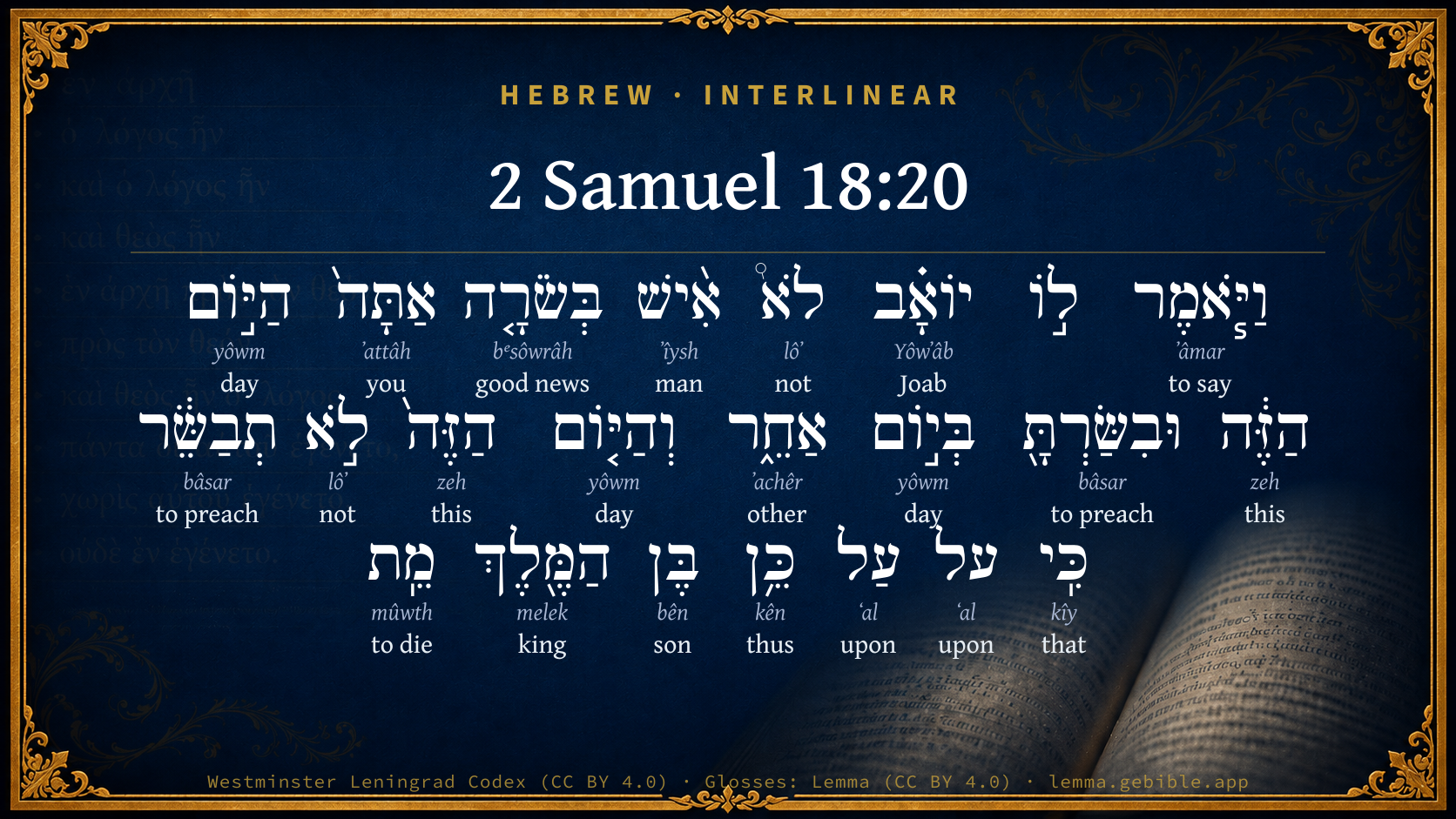
  1. וַיֹּ֧אמֶר ʼâmar H559 “and · to say” Conjunction + Verb, Qal, Sequential Imperfect, 3rd Person, Masculine, Singular
  2. יוֹאָ֗ב Yôwʼâb H3097 “Joab” Noun, Proper
  3. לֹא֩ lôʼ H3808 “not” Particle, Negative
  4. אִ֨ישׁ ʼîysh H376 “man of” Noun, Common, Masculine, Singular, Construct
  5. אַתָּה֙ ʼattâh H859 “you” Pronoun, Personal, 2nd Person, Masculine, Singular
  6. הַיּ֣וֹם yôwm H3117 “the · day” Particle, Definite Article + Noun, Common, Masculine, Singular, Absolute
  7. הַזֶּ֔ה zeh H2088 “the · this” Particle, Definite Article + Pronoun, Demonstrative, Masculine, Singular
  8. וּבִשַּׂרְתָּ֖ bâsar H1319 “and · to preach” Conjunction + Verb, Piel, Sequential Perfect, 2nd Person, Masculine, Singular
  9. בְּי֣וֹם yôwm H3117 “in/at · day” Preposition + Noun, Common, Masculine, Singular, Absolute
  10. אַחֵ֑ר ʼachêr H312 “other” Adjective, Adjective, Masculine, Singular, Absolute
  11. וְהַיּ֤וֹם yôwm H3117 “and · the · day” Conjunction + Particle, Definite Article + Noun, Common, Masculine, Singular, Absolute
  12. הַזֶּה֙ zeh H2088 “the · this” Particle, Definite Article + Pronoun, Demonstrative, Masculine, Singular
  13. לֹ֣א lôʼ H3808 “not” Particle, Negative
  14. תְבַשֵּׂ֔ר bâsar H1319 “to preach” Verb, Piel, Imperfect, 2nd Person, Masculine, Singular
  15. כִּֽי kîy H3588 “that” Conjunction
  16. על ʻal H5921 “upon” Preposition
  17. עַל ʻal H5921 “upon” Preposition
  18. כֵּ֥ן kên H3651 “thus” Particle, Demonstrative
  19. בֶּן bên H1121 “son of” Noun, Common, Masculine, Singular, Construct
  20. הַמֶּ֖לֶךְ melek H4428 “the · king” Particle, Definite Article + Noun, Common, Masculine, Singular, Absolute
  21. מֵֽת mûwth H4191 “to die” Verb, Qal, Perfect, 3rd Person, Masculine, Singular

About this verse

These counts appear in no published source. They are computed here, from the morphology-tagged text and Lemma’s own curated glosses. What Lemma adds →

23
words
16
distinct lemmas
Historical
section

Notable vocabulary

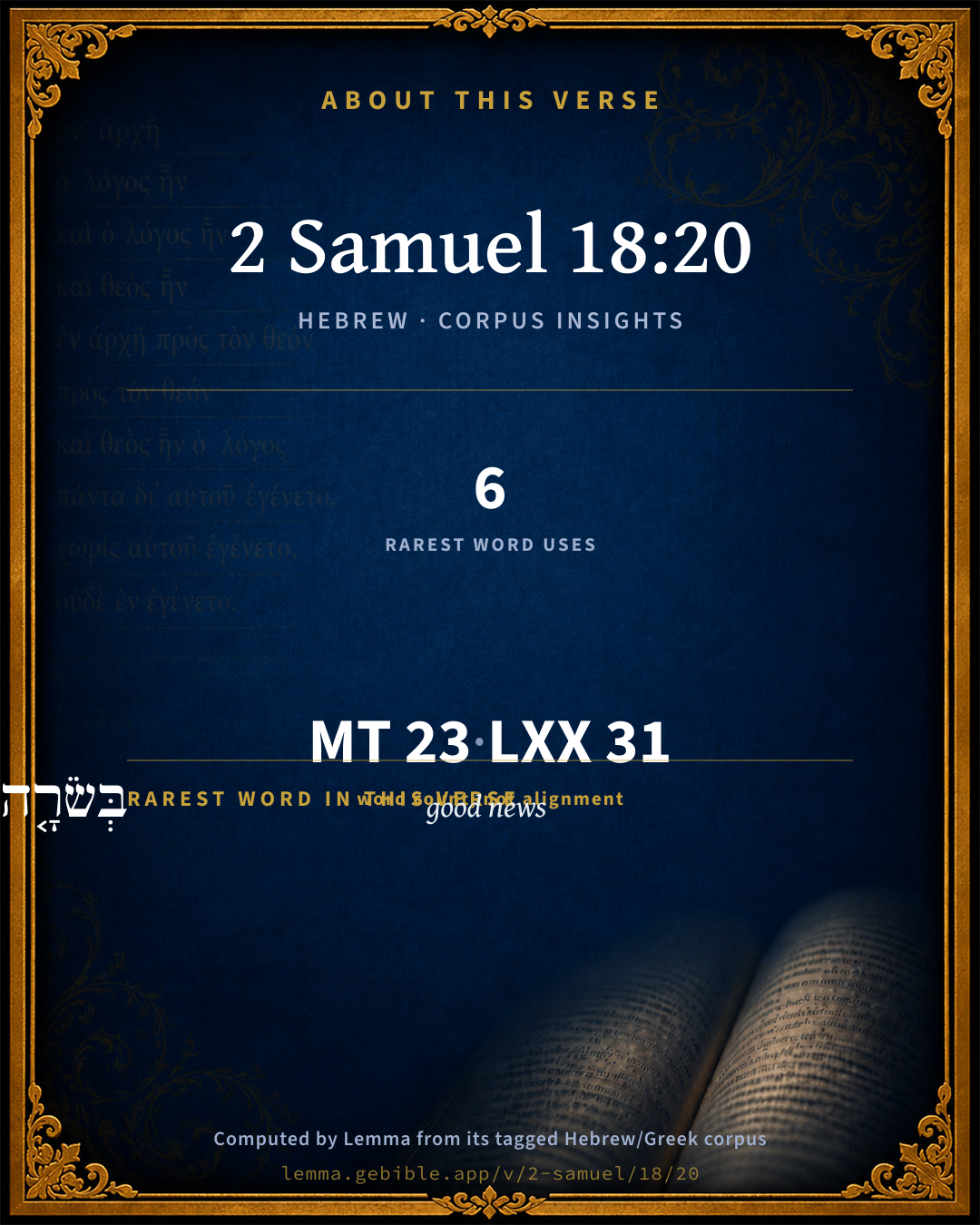
The rarest word here is בְּשֹׂרָ֤ה good news H1309 — appearing just 6 times in the whole Hebrew Bible.

Shared distinctive vocabulary

בְּשֹׂרָ֤ה good news H1309 occurs in 6 verses of the Hebrew Bible. Also found in:

Grammatical profile

  • 4 verbs
  • 8 nouns
  • 1 adjective
  • 3 pronouns
  • 3 prepositions
  • 1 conjunction
  • 3 particles

Verb forms

  • וַיֹּ֧אמֶר Qal · Sequential Imperfect
  • וּבִשַּׂרְתָּ֖ Piel · Sequential Perfect
  • תְבַשֵּׂ֔ר Piel · Imperfect
  • מֵֽת Qal · Perfect

Repetition

Words recur within this verse — often emphatic in Hebrew:

  • הַיּ֣וֹם day H3117 ×3
  • וּבִשַּׂרְתָּ֖ to preach H1319 ×2
  • על upon H5921 ×2
  • לֹא֩ not H3808 ×2
  • הַזֶּ֔ה this H2088 ×2

Hebrew & Septuagint length

In English translation the verse runs 35 words from the Hebrew and 37 from the Septuagint (LXX English) — closely comparable.

A rough comparison of the two English renderings, which tokenize alike — not a word-level alignment.

Word counts can differ between the Hebrew and the Greek without any difference in meaning — e.g. the Hebrew direct-object marker אֵת has no separate Greek word, and Greek often adds the article ὁ.

In the original languages it is 23 Hebrew tokens and 31 Greek tokens — but the two are counted differently (Hebrew bundles its prefixes and suffixes into one token; the Greek is in lemma form), so that isn’t a like-for-like length.

Cross-references

5

Topical passages linked to 2 Samuel 18:20 in the Treasury of Scripture Knowledge — connected by theme and wording, ordered by reader-vote popularity; previews shown in the World English Bible.

  • 2 Samuel 17:16–21 Now therefore send quickly, and tell David, saying, Don't lodge this night at the fords of the wilderness, but by all means pass over; lest the king be swallowed up, and all the people who are with him.
  • 2 Samuel 18:5 The king commanded Joab and Abishai and Ittai, saying, Deal gently for my sake with the young man, even with Absalom. All the people heard when the king gave all the captains charge concerning Absalom.
  • 2 Samuel 18:27 The watchman said, I think the running of the foremost is like the running of Ahimaaz the son of Zadok. The king said, He is a good man, and comes with good news.
  • 2 Samuel 18:29 The king said, Is it well with the young man Absalom? Ahimaaz answered, When Joab sent the king's servant, even me your servant, I saw a great tumult, but I don't know what it was.
  • 2 Samuel 18:33 The king was much moved, and went up to the chamber over the gate, and wept: and as he went, thus he said, my son Absalom, my son, my son Absalom! would I had died for you, Absalom, my son, my son!

Cross-references courtesy of OpenBible.info (CC BY 4.0).

Hebrew and Greek witnesses Masoretic Hebrew ↔ Greek Septuagint

The same verse in the two great witnesses to the Old Testament, shown verse-for-verse.

These are two independent witnesses, not word-aligned to each other, and the Septuagint is shown in lemma (dictionary) form.

Hebrew 2 Samuel 18:20 Masoretic · Westminster Leningrad Codex

וַיֹּ֧אמֶר ל֣וֹ יוֹאָ֗ב לֹא֩ אִ֨ישׁ בְּשֹׂרָ֤ה אַתָּה֙ הַיּ֣וֹם הַזֶּ֔ה וּבִשַּׂרְתָּ֖ בְּי֣וֹם אַחֵ֑ר וְהַיּ֤וֹם הַזֶּה֙ לֹ֣א תְבַשֵּׂ֔ר כִּֽי על עַל כֵּ֥ן בֶּן הַמֶּ֖לֶךְ מֵֽת

Joab said to him, You shall not be the bearer of news this day, but you shall bear news another day; but this day you shall bear no news, because the king's son is dead.

World English Bible · Public Domain

Greek LXX 2 Samuel 18:20 Septuagint · lemma form

καί εἶπον αὐτός ιωαβ οὐ ἀνήρ εὐαγγελία σύ ἐν ὁ ἡμέρα οὗτος καί εὐαγγελίζω ἐν ἡμέρα ἄλλος ἐν δέ ὁ ἡμέρα οὗτος οὐ εὐαγγελίζω ὅς εἵνεκεν ὁ υἱός ὁ βασιλεύς ἀποθνήσκω

And Joab said to him, You shall not be a messenger of glad tidings this day; you shall bear them another day; but on this day you shall bear no tidings, because the king's son is dead.

LXX2012 (modern English Septuagint) · Public Domain

Hebrew: Westminster Leningrad Codex (CC BY 4.0). Greek: Septuagint (public domain); English from LXX2012 (modern English Septuagint) (Public Domain). How the Septuagint differs from the Hebrew →

Targum (Aramaic paraphrase)

1

The Targum is the ancient Jewish Aramaic paraphrase of the Hebrew Scriptures — an interpretive translation, not the Hebrew text itself. Onkelos (literal) and Pseudo-Jonathan (expansive) render the Torah, and Jonathan the Prophets. Coverage is partial: where no permissively-licensed English translation exists for a verse, only the Aramaic is shown. This is verse-level text, not a word-by-word alignment to the Hebrew.

  1. Targum Jonathan Prophets (Joshua–Malachi)
    וַאֲמַר לֵיהּ יוֹאָב לָא גְבַר כְּשַׁר לְבַסָרָא אַתְּ יוֹמָא דֵין וּתְבַסֵר בְּיוֹם אוֹחֲרָן וְיוֹמָא הָדֵין לָא תְבַסֵר אֱלָהֵין דְבַּר מַלְכָּא מִית:

    (no public-domain English translation for this verse)

    Targum Jonathan — Aramaic: “Mikraot Gedolot” (public domain). English: “Sefaria Community Translation” (CC0 1.0 (public-domain dedication)); “London "Chaldee Paraphrase," 1871” (public domain). Text via Sefaria.

Commentary

Notes on 2 Samuel 18:20 from classic Christian and Jewish commentators (each source and its license shown beneath its notes). The classic Christian expositions comment on the surrounding passage and are grouped to its opening verse, so a note may address several verses; the Jewish commentaries on the Tanakh (Rashi and others) are per-verse, so they appear only where the commentator wrote on this verse.

Lemma curates 59 commentaries, every one of them public domain or Creative Commons licensed, each selected and text-cleaned for this edition rather than reprinted as found. About our sources →

Trapp's Complete Commentary

John Trapp

2Sa 18:20 And Joab said unto him, Thou shalt not bear tidings this day, but thou shalt bear tidings another day: but this day thou shalt bear no tidings, because the king’s son is dead.

Ver. 20. Because the king’s son is dead.] Not by a fever and a flux, with excoriation of his bowels (as died Henry, son of our Henry II - crowned by his father, but rebelling against him - after floods of tears, and a most sorrowful confession of his sin; which being by some good Ahimaaz afterwards related to his father, who hearing before of his penitency, had sent him his ring in token of forgiveness, the king fell upon the earth weeping bitterly, and mourned very sore); {a} but by a most sad stroke of divine justice in the flagrancy of his rebellion, which he had neither space nor grace to regret, that we read of. This would be heavy news to good David, as Joab well knew; and therefore, out of his love to Ahimaaz, was loath to send him with it.

{a} Speed, 522.

John Trapp, A Commentary or Exposition upon All the Books of the Old and New Testament (1647–1656) — public domain. Text from a community e-Sword module.

Geneva Bible (1599)

Geneva Bible translators

For Joab bare a good affection to Ahimaaz, and doubted how David would take the report of Absalom’s death.

Geneva Bible (1599) marginal notes — public domain. Text via Bolls.life.

Ellicott's Commentary for English Readers

(20) Thou shalt bear no tidings.—Ahimaaz appears to have been in favour both with David (comp. 2Sa_18:27) and with Joab. Joab, therefore, well knowing how painful to David would be the news of the death of Absalom, refused to let Ahimaaz bear it. The word is used, with rare exceptions, of good tidings.

A Bible Commentary for English Readers, edited by Charles John Ellicott (1878–1897) — public domain. Text from a community e-Sword module.

The Cambridge Bible for Schools and Colleges

gen. ed. J. J. S. Perowne

20. bear tidings] The word with rare exceptions means to bear good tidings, and this meaning should be retained here and in 2Sa_18:19. Joab would not let Ahimaaz have the thankless task of carrying news which to the king would be no good news.

The Cambridge Bible for Schools and Colleges (gen. ed. J. J. S. Perowne; Cambridge University Press, 1878–1918) — public domain. Text from a community e-Sword module.

John Gill's Exposition

And Joab said unto him, thou shall not bear tidings this day,.... Because Joab knew the tidings of Absalom's death would not be acceptable to the king; and Ahimaaz being a good man, and the son of a priest, for whom Joab had a respect, he would not send the tidings by him, which he was sensible would not recommend him to the king:

but thou shalt bear tidings another day; when any salvation is wrought, or victory obtained, the tidings of which will be welcome:

but this day thou shall bear no tidings, because the king's son is dead; and thou must carry the news concerning his death, which it is not proper thou shouldest, being a priest, nor will it be to thine advantage.

John Gill's Exposition of the Whole Bible (1746–1763) — public domain (CC PDM 1.0). Text via the HelloAO Bible API.

Matthew Poole's English Annotations

And thou shalt not be a messenger of evil tidings, which will be unwelcome to him, and prejudicial to thee.

Matthew Poole's English Annotations on the Holy Bible (1683–1685) — public domain. Text from a community e-Sword/MySword module.

Whedon's Commentary on the Bible

Daniel D. Whedon

20. The woman said — Like Rahab, she deceived them. Compare Jos_2:4-5.

The brook of water — The wady or stream that ran just below Bahurim.

Daniel D. Whedon (gen. ed.), Commentary on the Old and New Testaments (1874–1909) — public domain. Text from a community e-Sword module.

Rashi

Rabbi Shlomo Yitzchaki (Rashi)

Inform him another day. A tiding of some other victory.

Because. As a result of the king's son's death therefor this announcement will not be good for you.

Rashi on the Tanakh — English translations: “The Judaica Press complete Tanach with Rashi, translated by A. J. Rosenberg” (CC BY 4.0); “Pentateuch with Rashi's commentary by M. Rosenbaum and A.M. Silbermann, 1929-1934” (public domain); “The Metsudah Tanach series, Lakewood, N.J” (CC BY 4.0); and “The Book of Joshua, Metsudah Publications, 1997” (CC BY 4.0). Text via Sefaria.

Lesson kit

Teaching starters — assembled from the data on this page, not authored interpretation. Every prompt links to the verse data it draws on. Edit before teaching.

2 Samuel, in the Historical, opens this verse with 23 words (16 distinct Hebrew lemmas). Its most distinctive word is bᵉsôwrâh (“good news”). A historical commentator’s framing appears above. Read the whole chapter for the surrounding context.

Discussion questions

  1. How does “good news” (bᵉsôwrâh) shape what this verse is saying?
  2. 2 Samuel 4:10 shares the word «good news» with this verse. How do the two illuminate each other?
  3. “day” occurs 3× in this one verse. What is the effect of the repetition?
  4. These translations render this verse differently; the difference is in the English rendering, not the original. What questions does that raise?
  5. The verb «וַיֹּ֧אמֶר» is Qal Sequential Imperfect. How does its form color the action?
  6. Reading how Trapp's Complete Commentary and Geneva Bible (1599) read this verse, where do the two commentators agree and where do they part?

Things to notice

Reading settings

Reading text

Shown beneath each verse's original-language words.

Old Testament
Old Testament edition

Read the OT as the Masoretic Hebrew (MT) or the Greek Septuagint (LXX).

English shown for the Greek Septuagint (in the Hebrew ↔ Greek comparison).

Comparing translations? Open the Compare panel on any verse page to stack up to four side by side.