Ezekiel 36:13

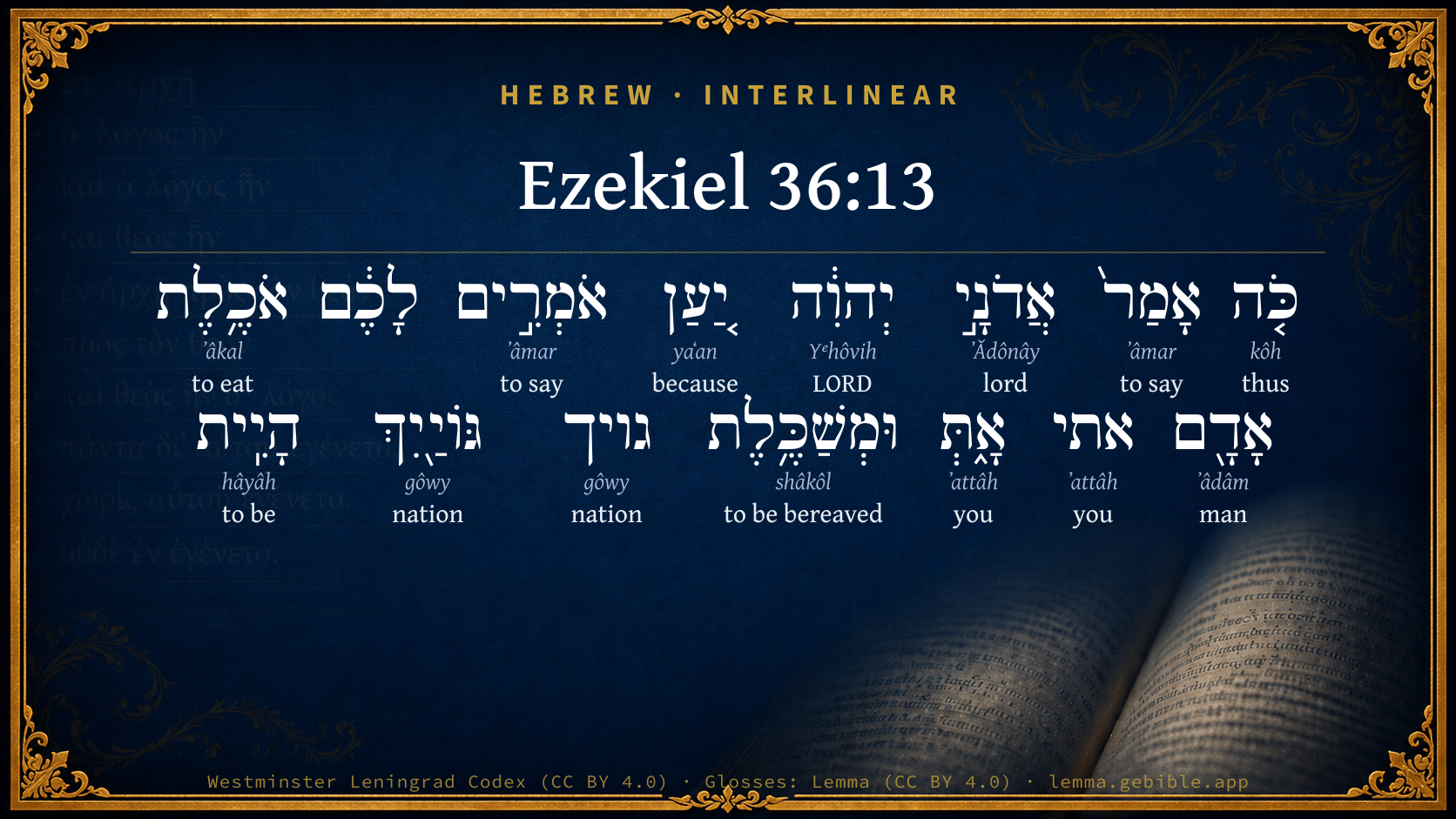
Hebrew (Westminster Leningrad Codex) Ezekiel 36:13 appears in the Hebrew Old Testament. The text above is from the Westminster Leningrad Codex. Each word links to its Strong’s number, a concise gloss, and parsing drawn from the Open Scriptures Hebrew Bible morphology. Click any word for its full Brown-Driver-Briggs (BDB) entry.
Download image
Cite this verse

Ezekiel 36:13 (World English Bible). Public Domain. Lemma interlinear Bible study tool, https://lemma.gebible.app/v/ezekiel/36/13.

Show BibTeX & RIS
BibTeX
RIS
English Translation
Thus says the Lord Yahweh: Because they say to you, You [land] are a devourer of men, and have been a bereaver of your nation;
World English Bible · Public Domain
Download a study sheet

One document with this verse’s original text, its word-by-word gloss line, the meaning frame, cross-references with their text, attributed commentary, and full source and license credits — printable, and it pastes into notes with its structure intact.

This verse Autodidact and up

Study sheet (.html) Plain text (.txt)

A passage Seminary Student

Up to 50 verses in one chapter. A passage sheet keeps up to 6 commentary sources and 12 cross-references per verse, in the order this page ranks them, and says so on the sheet whenever that leaves anything out. Ask for a single verse and you get the Autodidact verse sheet above.

Everything on this page stays free to read, with no account — the sheet is a download of what is already on screen, not access to it.

Want to remove ads? Support Godless Engineer
Compare translations 3

The same verse in 3 English versions, stacked beneath the original-language interlinear above. Click any original word for its lexicon entry.

Each is an independent rendering of the whole verse — the interlinear is not word-aligned to these translations.

Highlighted words mark where these versions differ — a whole-verse word diff, not a word-by-word alignment.

  • World English Bible Public Domain
    Thus says the Lord Yahweh: Because they say to you, You [land] are a devourer of men, and have been a bereaver of your nation;
  • King James Version Public Domain
    Thus saith the Lord GOD; Because they say unto you, Thou land devourest up men, and hast bereaved thy nations:
  • unfoldingWord Literal Text CC BY-SA 4.0
    The Lord Yahweh says this: Because they are saying to you, “You devour men, bereaving your nation of children,”

unfoldingWord Literal Text — © unfoldingWord, licensed CC BY-SA 4.0. Word-aligned USFM3 via Door43 (git.door43.org/unfoldingWord/en_ult).

Versions to compare (up to 4)

3 of 4 selected

Show all 18 translations

Every available English version of this verse, each an independent rendering of the whole verse.

  • World English Bible Public Domain
    Thus says the Lord Yahweh: Because they say to you, You [land] are a devourer of men, and have been a bereaver of your nation;
  • Berean Standard Bible Public Domain
    For this is what the Lord GOD says: Because people say to you, ‘You devour men and deprive your nation of its children,’
  • Majority Standard Bible Public Domain
    For this is what the Lord GOD says: Because people say to you, ‘You devour men and deprive your nation of its children,’
  • King James Version Public Domain
    Thus saith the Lord GOD; Because they say unto you, Thou land devourest up men, and hast bereaved thy nations:
  • American Standard Version (1901) Public Domain
    Thus saith the Lord Jehovah: Because they say unto you, Thou `land' art a devourer of men, and hast been a bereaver of thy nation;
  • Revised Version (1885) Public Domain
    Thus saith the Lord GOD: Because they say unto you, Thou land art a devourer of men, and hast been a bereaver of thy nation;
  • Geneva Bible (1599) Public Domain
    Thus sayth the Lord God, because they say vnto you, Thou land deuourest vp men, and hast bene a waster of thy people,
  • Douay-Rheims (1899) Public Domain
    Thus saith the Lord God: Because they say of you: Thou art a devourer of men, and one that suffocatest thy nation:
  • Young's Literal Translation Public Domain
    Thus said the Lord Jehovah: Because they are saying to you: A devourer of men `art' thou, And a bereaver of thy nations thou hast been,
  • Literal Standard Version CC BY-SA 4.0
    Thus said Lord YHWH: Because they are saying to you, You [are] a devourer of men, || And you have been a bereaver of your nations,
  • Unlocked Literal Bible CC BY-SA 4.0
    The Lord Yahweh says this: Because they are saying to you, “You devour men, bereaving your nation of children,”
  • unfoldingWord Literal Text CC BY-SA 4.0
    The Lord Yahweh says this: Because they are saying to you, “You devour men, bereaving your nation of children,”
  • Darby Bible Public Domain
    Thus saith the Lord Jehovah: Because they say unto you, Thou devourest men, and hast bereaved thy nation,
  • World Messianic Bible Public Domain
    “‘The Lord GOD says: “Because they say to you, ‘You are a devourer of men, and have been a bereaver of your nation;’
  • Webster's Bible Public Domain
    Thus saith the Lord GOD; Because they say to you, Thou land devourest men, and hast bereaved thy nations;
  • Free Bible Version CC BY-SA 4.0
    This is what the Lord God says: Because people say to you, ‘You eat people, and rob your nation of their children,’
  • Bible in Basic English Public Domain
    This is what the Lord has said: Because they say to you, You, O land, are the destruction of men, causing loss of children to your nation;
  • JPS Tanakh (1917) Public Domain
    Thus saith the Lord GOD: Because they say unto you: Thou land art a devourer of men, and hast been a bereaver of thy nations;

Literal Standard Version (2020), Covenant Press — licensed CC BY-SA 4.0. Text via the HelloAO Bible API (eBible.org). Unlocked Literal Bible (unfoldingWord) — licensed CC BY-SA 4.0. Text via the HelloAO Bible API (eBible.org). unfoldingWord Literal Text — © unfoldingWord, licensed CC BY-SA 4.0. Word-aligned USFM3 via Door43 (git.door43.org/unfoldingWord/en_ult). Free Bible Version, Dr. Jonathan Gallagher — licensed CC BY-SA 4.0. Text via the HelloAO Bible API (eBible.org).

Word by word

More ways to search: Search by grammar → Find every occurrence → Compare this word →

Practice this passage: Drill this verse → Learn its vocabulary →

וּמְשַׁכֶּ֥לֶת
shâkôl
H7921
“and · being bereaved”
Conjunction + Verb, Piel, Participle Active, Feminine, Singular, Construct
Part of Speech
Conjunction + Verb
Stem
Piel
Form
Participle Active
Gender
Feminine
Number
Singular
State
Construct
Full BDB Definition

Origin: a primitive root

TWOT: 2385

to be bereaved, make childless, miscarry - (Qal) to be bereaved - (Piel) - to make childless - to cause barrenness, show barrenness or abortion - to miscarry - (Hiphil) miscarrying (participle)
  1. כֹּ֤ה kôh H3541 “thus” Adverb
  2. אָמַר֙ ʼâmar H559 “to say” Verb, Qal, Perfect, 3rd Person, Masculine, Singular
  3. אֲדֹנָ֣י ʼĂdônây H136 “Lord · my” Noun, Common, Masculine, Plural, Construct + Suffix, Personal, 1st Person, Common, Singular
  4. יְהוִ֔ה Yᵉhôvih H3069 “LORD” Noun, Proper
  5. יַ֚עַן yaʻan H3282 “because” Conjunction
  6. אֹמְרִ֣ים ʼâmar H559 “saying” Verb, Qal, Participle Active, Masculine, Plural, Absolute
  7. אֹכֶ֥לֶת ʼâkal H398 “eating” Verb, Qal, Participle Active, Feminine, Singular, Construct
  8. אָדָ֖ם ʼâdâm H120 “man” Noun, Common, Masculine, Singular, Absolute
  9. אתי ʼattâh H859 “you” Pronoun, Personal, 2nd Person, Feminine, Singular
  10. אָ֑תְּ ʼattâh H859 “you” Pronoun, Personal, 2nd Person, Feminine, Singular
  11. גויך gôwy H1471 “nation · your” Noun, Common, Masculine, Singular, Construct + Suffix, Personal, 2nd Person, Feminine, Singular
  12. גּוֹיַ֖יִךְ gôwy H1471 “nations · your” Noun, Common, Masculine, Plural, Construct + Suffix, Personal, 2nd Person, Feminine, Singular
  13. הָיִֽית hâyâh H1961 “to be” Verb, Qal, Perfect, 2nd Person, Feminine, Singular

About this verse

These counts appear in no published source. They are computed here, from the morphology-tagged text and Lemma’s own curated glosses. What Lemma adds →

15
words
11
distinct lemmas
Prophets
section

Notable vocabulary

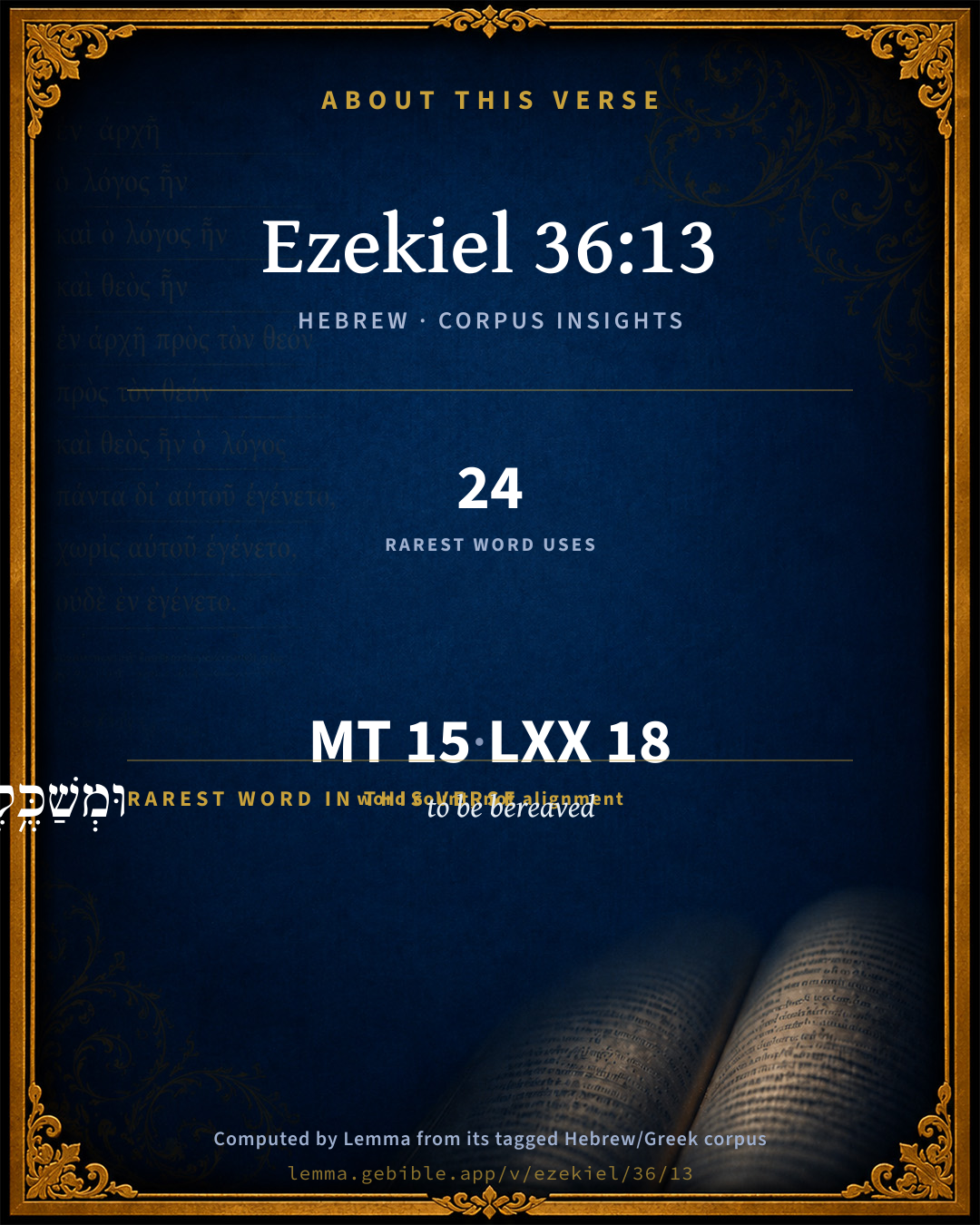
The rarest word here is וּמְשַׁכֶּ֥לֶת to be bereaved H7921 — appearing just 24 times in the whole Hebrew Bible.

Shared distinctive vocabulary

וּמְשַׁכֶּ֥לֶת to be bereaved H7921 occurs in 22 verses of the Hebrew Bible. Also found in:

Grammatical profile

  • 5 verbs
  • 5 nouns
  • 2 pronouns
  • 1 preposition
  • 1 conjunction
  • 1 adverb

Verb forms

  • אָמַר֙ Qal · Perfect
  • אֹמְרִ֣ים Qal · Participle Active
  • אֹכֶ֥לֶת Qal · Participle Active
  • וּמְשַׁכֶּ֥לֶת Piel · Participle Active
  • הָיִֽית Qal · Perfect

Repetition

Words recur within this verse — often emphatic in Hebrew:

  • אָמַר֙ to say H559 ×2
  • גויך nation H1471 ×2
  • אתי you H859 ×2

Hebrew & Septuagint length

In English translation the verse runs 25 words from the Hebrew and 21 from the Septuagint (LXX English) — closely comparable.

A rough comparison of the two English renderings, which tokenize alike — not a word-level alignment.

Word counts can differ between the Hebrew and the Greek without any difference in meaning — e.g. the Hebrew direct-object marker אֵת has no separate Greek word, and Greek often adds the article ὁ.

In the original languages it is 15 Hebrew tokens and 18 Greek tokens — but the two are counted differently (Hebrew bundles its prefixes and suffixes into one token; the Greek is in lemma form), so that isn’t a like-for-like length.

Cross-references

1

Topical passages linked to Ezekiel 36:13 in the Treasury of Scripture Knowledge — connected by theme and wording, ordered by reader-vote popularity; previews shown in the World English Bible.

  • Numbers 13:32 They brought up an evil report of the land which they had spied out to the children of Israel, saying, The land, through which we have gone to spy it out, is a land that eats up the inhabitants of it; and all the people who we saw in it are men of great stature.

Cross-references courtesy of OpenBible.info (CC BY 4.0).

Hebrew and Greek witnesses Masoretic Hebrew ↔ Greek Septuagint

The same verse in the two great witnesses to the Old Testament, shown verse-for-verse.

These are two independent witnesses, not word-aligned to each other, and the Septuagint is shown in lemma (dictionary) form.

Hebrew Ezekiel 36:13 Masoretic · Westminster Leningrad Codex

כֹּ֤ה אָמַר֙ אֲדֹנָ֣י יְהוִ֔ה יַ֚עַן אֹמְרִ֣ים לָכֶ֔ם אֹכֶ֥לֶת אָדָ֖ם אתי אָ֑תְּ וּמְשַׁכֶּ֥לֶת גויך גּוֹיַ֖יִךְ הָיִֽית

Thus says the Lord Yahweh: Because they say to you, You [land] are a devourer of men, and have been a bereaver of your nation;

World English Bible · Public Domain

Greek LXX Ezekiel 36:13 Septuagint · lemma form

ὅδε λέγω κύριος κύριος ἀντί ὅς εἶπον σύ καταἐσθίω ἄνθρωπος εἰμί καί ἀτεκνόω ὑπό ὁ ἔθνος σύ γίγνομαι

Thus says the Lord God: Because they said to you, You land devour men, and have been bereaved of your nation;

LXX2012 (modern English Septuagint) · Public Domain

Hebrew: Westminster Leningrad Codex (CC BY 4.0). Greek: Septuagint (public domain); English from LXX2012 (modern English Septuagint) (Public Domain). How the Septuagint differs from the Hebrew →

Targum (Aramaic paraphrase)

1

The Targum is the ancient Jewish Aramaic paraphrase of the Hebrew Scriptures — an interpretive translation, not the Hebrew text itself. Onkelos (literal) and Pseudo-Jonathan (expansive) render the Torah, and Jonathan the Prophets. Coverage is partial: where no permissively-licensed English translation exists for a verse, only the Aramaic is shown. This is verse-level text, not a word-by-word alignment to the Hebrew.

  1. Targum Jonathan Prophets (Joshua–Malachi)
    כִּדְנַן אֲמַר יְיָ אֱלֹהִים חֲלַף דְאָמְרִין לְכוֹן מְקַטֶלֶת אֱנָשָׁא אַתְּ וּמְתַכֶּלֶת עַמִיךְ הֲוֵית:

    (no public-domain English translation for this verse)

    Targum Jonathan — Aramaic: “Mikraot Gedolot” (public domain). English: “Sefaria Community Translation” (CC0 1.0 (public-domain dedication)); “London "Chaldee Paraphrase," 1871” (public domain). Text via Sefaria.

Commentary

Notes on Ezekiel 36:13 from classic Christian and Jewish commentators (each source and its license shown beneath its notes). The classic Christian expositions comment on the surrounding passage and are grouped to its opening verse, so a note may address several verses; the Jewish commentaries on the Tanakh (Rashi and others) are per-verse, so they appear only where the commentator wrote on this verse.

Lemma curates 59 commentaries, every one of them public domain or Creative Commons licensed, each selected and text-cleaned for this edition rather than reprinted as found. About our sources →

Trapp's Complete Commentary

John Trapp

Eze 36:13 Thus saith the Lord GOD; Because they say unto you, Thou [land] devourest up men, and hast bereaved thy nations;

Ver. 13. Thou land devourest up men,] {a} scil., By pestilence, famine, sword, evil beasts: thou art an unlucky land, an unblest country, feral and fatal to thine inhabitants. Hesiod saith the like of his country Ascre; and another {b} of St David’s in Wales, that it is a place neither pleasant, fertile, nor safe. Strabo saith the like of Judea, but with a despiteful mind. {as Eze 36:5} Those malevolent spies said no less. {Num 13:32}

{a} Terra abortiens populos.

{b} Girald., Cambrens.

John Trapp, A Commentary or Exposition upon All the Books of the Old and New Testament (1647–1656) — public domain. Text from a community e-Sword module.

Joseph Benson's Commentary

Eze 36:13-15. Because they say, Thou land devourest men — Or, thy people. The country of Judea (as appears from what is here said) was spoken of by the neighbouring nations with disgrace, as a country particularly fatal to its inhabitants, where more died by famine, pestilence, and the sword, than in any other place: and therefore God here says, that there should be no more any occasion to give this character of Judea, for that these judgments and frequent calamities should cease in it. Therefore thou shall devour men no more — Thou shalt be free from such destructive judgments as have, in past ages, consumed thy people. Neither will I cause men to hear in thee the shame of the heathen — Neither shall thy inhabitants hear any more the scoffs of the heathen nations round, reproaching them on account of their grievous calamities, as if they were an accursed people, forsaken by their God, and abandoned to destruction. Neither shalt thou cause thy nations to fall, &c. — Or, as the Chaldee and some other ancient versions translate the words, Neither shalt thou bereave thy people any more, an interpretation adopted by Bishop Newcome. The Vulgate renders the clause, Et gentem tuam non amittes amplius — And thou shall not lose thy nation (or people) any more, that is, by these remarkable calamities. Those who think these promises were fulfilled in the restoration of the Jews from the captivity of Babylon, and their re-establishment in their own land, take the expressions no more, and not any more, in a limited sense, and understand thereby only a long period of time: but it seems more reasonable to suppose that these and such like prophecies, of which there are many in the Scriptures, remain yet to be accomplished, and that they respect the future restoration of the Jews to their own land, after their conversion to Christianity.

Joseph Benson's Commentary on the Old and New Testaments (1811–1818) — public domain. Text from a community e-Sword module.

Geneva Bible (1599)

Geneva Bible translators

This the enemies imputed as the reproach of the land, which God did for the sins of the people according to his just judgments.

Geneva Bible (1599) marginal notes — public domain. Text via Bolls.life.

Jamieson, Fausset & Brown

Robert Jamieson, A. R. Fausset & David Brown

Thou land devourest up men--alluding to the words of the spies (Num 13:32). The land personified is represented as doing that which was done in it. Like an unnatural mother it devoured, that is, it was the grave of its people; of the Canaanites, its former possessors, through mutual wars, and finally by the sword of Israel; and now, of the Jews, through internal and external ills; for example, wars, famine (to which Eze 36:30, "reproach of famine among the heathen," implies the allusion here is).

Jamieson, Fausset & Brown — Commentary Critical and Explanatory on the Whole Bible (1871) — public domain (CC PDM 1.0). Text via the HelloAO Bible API.

Ellicott's Commentary for English Readers

(13) Thou land devourest up men.—Comp. Num_13:32, a passage probably in the prophet’s mind, though he uses it for a different reason. Israel had so often sinned, and so often, in consequence, suffered the Divine punishments, that the heathen, not recognising the true cause, superstitiously attributed the result to something in the land itself.

With the promises of this chapter comp. Isa_54:1-8. It is impossible to interpret that passage otherwise than of spiritual blessings; and Ezekiel, as a devout Jew, as well as a prophet, was thoroughly penetrated with the same hopes as are there expressed by the evangelic prophet.

A Bible Commentary for English Readers, edited by Charles John Ellicott (1878–1897) — public domain. Text from a community e-Sword module.

The Cambridge Bible for Schools and Colleges

gen. ed. J. J. S. Perowne

13. Comp. the report of the spies, Num_13:32, “the land is a land that eateth up the inhabitants thereof.” The land whose population perishes of scarcity is regarded as itself devouring them. It is doubtful if there is any reference to such things as the unhealthy situation of the land (2Ki_2:19), or even to the wars by which the country had been decimated. The true meaning is given Eze_36:30.

bereaved thy nations] thy nation, i.e. population, and so Eze_36:14-15. The plur. could hardly refer to the two nations, Israel and Judah (Eze_35:10), although it might possibly be used like “peoples” of the nation considered as made up of a number of portions (Hos_10:14). The land of Israel was subject to droughts (Jer_14:1; 1 Kings 17 seq., Amo_4:7), to blasting and mildew (Amo_4:9), as well as to the scourge of locusts (Joel 1). Comp. the struggles with famine which the returned exiles had, Hag_1:10-11; Hag_2:17.

The Cambridge Bible for Schools and Colleges (gen. ed. J. J. S. Perowne; Cambridge University Press, 1878–1918) — public domain. Text from a community e-Sword module.

John Gill's Exposition

Thus saith the Lord God, because they say unto you,.... The Heathens that dwelt round about the land of Judea said to the mountains, or to the whole land,

thou land devourest up men; eats up the inhabitants of it; which is part of the ill report the spies, in the times of Moses, brought on it, Num 13:32, to which the allusion is here; suggesting, that either the air was unwholesome; or that the land did not produce a sufficiency of food to support the inhabitants of it; or that the curse of God was upon it; and that one judgment or another was ever on it; either famine, or pestilence, or the sword of the enemy, or internal broils among themselves, or wild beasts, whereby the inhabitants of the land were wasted and consumed:

and hast bereaved thy nations; the several tribes, of men and children; so that they were diminished and depopulated: the allusion seems to be to miscarrying women, or such who kill their children in the womb, and become abortive.

John Gill's Exposition of the Whole Bible (1746–1763) — public domain (CC PDM 1.0). Text via the HelloAO Bible API.

Albert Barnes' Notes on the Bible

The judgments which God sent upon the land, had so destroyed the inhabitants that men deemed it a fatal land, which brought destruction to all that should occupy it (compare 2Ki 17:25).

Albert Barnes' Notes on the Bible (1834–1885) — public domain. Text from a community e-Sword/MySword module.

Haydock's Catholic Bible Commentary

Men. This remark was very ancient, Numbers xiii. 33. Wars had almost always raged in the country. (Calmet)

George Leo Haydock (1774–1849), Haydock's Catholic Family Bible and Commentary, 1859 edition — public domain. Excludes Psalms (Douay-Rheims chapter numbering differs from Protestant) and Deuterocanonical books (Catholic canon only).

Matthew Poole's English Annotations

They say; the heathen round about, the enemies of Israel, accuse the land of destroying its natives, and bring an evil report on it.

Devourest up men; either by intestine wars, or foreign invasions, or by unhealthful air, or by multitude of wild beasts, or by barrenness and famine, thou killest them, art like a womb that conceives often, but almost as often miscarrieth, as the word implieth.

Hast bereaved; consumed thy nations, so the French; deprived them of their hope of increasing in numbers of men, as a miscarrying womb deprives a family of hoped children.

Matthew Poole's English Annotations on the Holy Bible (1683–1685) — public domain. Text from a community e-Sword/MySword module.

John Wesley's Explanatory Notes

They - The heathen round about.

John Wesley, Explanatory Notes Upon the Whole Bible (1754–1765) — public domain. Text via the GEBible commentary corpus.

unfoldingWord translationNotes

Door43 World Missions Community

General Information:

This continues Yahweh's message to the mountains of Israel. The message is meant for the people of Israel.

they are saying to you

"other nations are saying to you mountains"

You devour men

Not enough food growing in Israel so that people die is spoken of as if the mountains of Israel were devouring the people. AT: "You cause many people to die" (See: Metaphor)

bereaving your nation of children

"you cause your people's children to die"

you will not consume people any longer

Not enough food growing in Israel so that people die is spoken of as if the mountains of Israel were consuming the people. AT: "you will no longer cause the people to die" (See: Metaphor)

This is the Lord Yahweh's declaration

Yahweh speaks of himself by name to express the certainty of what he is declaring. See how you translated this in Ezekiel 5:11. AT: "This is what the Lord Yahweh has declared" or "This is what I, the Lord Yahweh, have declared" (See: First, Second, or Third Person)

Nor will I allow you to hear the insults of the nations any longer

This speaks of the mountains as if they were able to hear when people insult them. AT: "I will no longer allow the other nations to insult you" (See: Personification)

you will no longer have to bear the shame of the peoples

Experiencing shame is spoken of as if the mountains could bear shame. AT: "the peoples will no longer cause you to feel ashamed" (See: Personification and Metaphor)

or cause your nation to fall

Here "to fall" is an idiom that means to be defeated in battle. AT: "or cause your people to suffer defeat" (See: Idiom)

translationWords

Lord Yahweh

devour

nation

declare

shame

unfoldingWord translationNotes — © Distant Shores Media and the Door43 World Missions Community, licensed CC BY-SA 4.0. Source: git.door43.org/Door43/en_tn.

Rashi

Rabbi Shlomo Yitzchaki (Rashi)

You are a devourer of men This land is accustomed to destroying its inhabitants. The Amorites perished therein, and the Jews perished therein.

Rashi on the Tanakh — English translations: “The Judaica Press complete Tanach with Rashi, translated by A. J. Rosenberg” (CC BY 4.0); “Pentateuch with Rashi's commentary by M. Rosenbaum and A.M. Silbermann, 1929-1934” (public domain); “The Metsudah Tanach series, Lakewood, N.J” (CC BY 4.0); and “The Book of Joshua, Metsudah Publications, 1997” (CC BY 4.0). Text via Sefaria.

Lesson kit

Teaching starters — assembled from the data on this page, not authored interpretation. Every prompt links to the verse data it draws on. Edit before teaching.

Ezekiel, in the Prophets, opens this verse with 15 words (11 distinct Hebrew lemmas). Its most distinctive word is shâkôl (“to be bereaved”). A historical commentator’s framing appears above. Read the whole chapter for the surrounding context.

Discussion questions

  1. The word shâkôl carries the sense “to be bereaved.” How does it shape the verse?
  2. Genesis 27:45 shares the word «to be bereaved» with this verse. How do the two illuminate each other?
  3. “to say” occurs 2× in this one verse. What is the effect of the repetition?
  4. The translations on this page render this verse differently — a whole-verse word diff, not a word-by-word alignment. What might account for the different wordings?
  5. The verb «אָמַר֙» is Qal Perfect. How does its form color the action?
  6. Reading how Trapp's Complete Commentary and Joseph Benson's Commentary read this verse, where do the two commentators agree and where do they part?

Things to notice

Reading settings

Reading text

Shown beneath each verse's original-language words.

Old Testament
Old Testament edition

Read the OT as the Masoretic Hebrew (MT) or the Greek Septuagint (LXX).

English shown for the Greek Septuagint (in the Hebrew ↔ Greek comparison).

Comparing translations? Open the Compare panel on any verse page to stack up to four side by side.