
Ezekiel 34:31

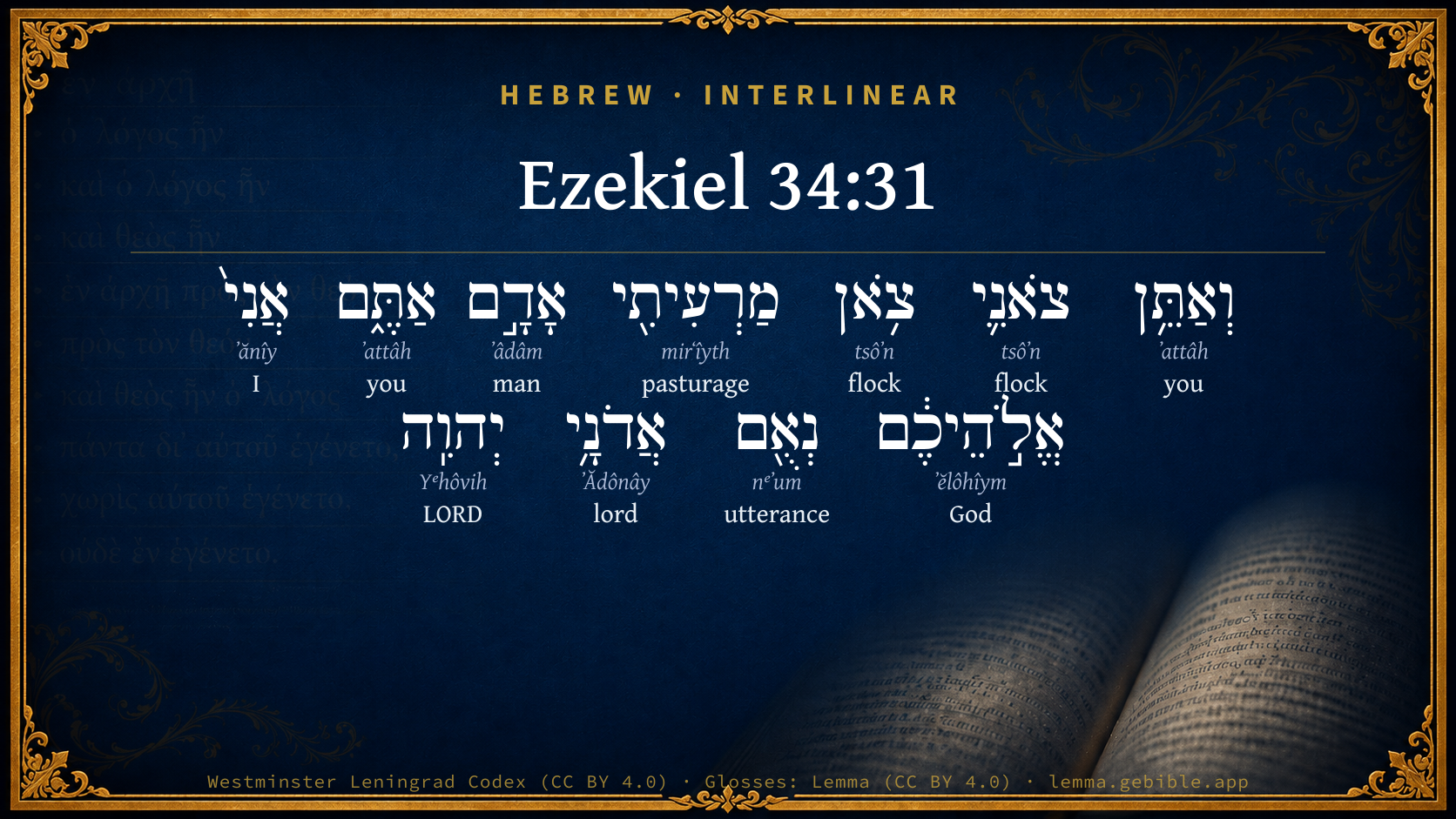
Hebrew (Westminster Leningrad Codex) Ezekiel 34:31 appears in the Hebrew Old Testament. The text above is from the Westminster Leningrad Codex. Each word links to its Strong’s number, a concise gloss, and parsing drawn from the Open Scriptures Hebrew Bible morphology. Click any word for its full Brown-Driver-Briggs (BDB) entry.
Download image
Cite this verse

Ezekiel 34:31 (World English Bible). Public Domain. Lemma interlinear Bible study tool, https://lemma.gebible.app/v/ezekiel/34/31.

Show BibTeX & RIS
BibTeX
RIS
English Translation
You my sheep, the sheep of my pasture, are men, and I am your God, says the Lord Yahweh.
World English Bible · Public Domain
Download a study sheet

One document with this verse’s original text, its word-by-word gloss line, the meaning frame, cross-references with their text, attributed commentary, and full source and license credits — printable, and it pastes into notes with its structure intact.

This verse Autodidact and up

Study sheet (.html) Plain text (.txt)

A passage Seminary Student

Up to 50 verses in one chapter. A passage sheet keeps up to 6 commentary sources and 12 cross-references per verse, in the order this page ranks them, and says so on the sheet whenever that leaves anything out. Ask for a single verse and you get the Autodidact verse sheet above.

Everything on this page stays free to read, with no account — the sheet is a download of what is already on screen, not access to it.

Want to remove ads? Support Godless Engineer
Compare translations 3

The same verse in 3 English versions, stacked beneath the original-language interlinear above. Click any original word for its lexicon entry.

Each is an independent rendering of the whole verse — the interlinear is not word-aligned to these translations.

Highlighted words mark where these versions differ — a whole-verse word diff, not a word-by-word alignment.

  • World English Bible Public Domain
    You my sheep, the sheep of my pasture, are men, and I am your God, says the Lord Yahweh.
  • King James Version Public Domain
    And ye my flock, the flock of my pasture, are men, and I am your God, saith the Lord GOD.
  • unfoldingWord Literal Text CC BY-SA 4.0
    For you are my sheep, the flock of my pasture, and my people, and I am your God—this is the Lord Yahweh’s declaration.’”

unfoldingWord Literal Text — © unfoldingWord, licensed CC BY-SA 4.0. Word-aligned USFM3 via Door43 (git.door43.org/unfoldingWord/en_ult).

Versions to compare (up to 4)

3 of 4 selected

Show all 18 translations

Every available English version of this verse, each an independent rendering of the whole verse.

  • World English Bible Public Domain
    You my sheep, the sheep of my pasture, are men, and I am your God, says the Lord Yahweh.
  • Berean Standard Bible Public Domain
    ‘You are My flock, the sheep of My pasture, My people, and I am your God,’ declares the Lord GOD.”
  • Majority Standard Bible Public Domain
    ‘You are My flock, the sheep of My pasture, My people, and I am your God,’ declares the Lord GOD.”
  • King James Version Public Domain
    And ye my flock, the flock of my pasture, are men, and I am your God, saith the Lord GOD.
  • American Standard Version (1901) Public Domain
    And ye my sheep, the sheep of my pasture, are men, and I am your God, saith the Lord Jehovah.
  • Revised Version (1885) Public Domain
    And ye my sheep, the sheep of my pasture, are men, and I am your God, saith the Lord GOD.
  • Geneva Bible (1599) Public Domain
    And yee my sheepe, the sheepe of my pasture are men, and I am your God, saith the Lord God.
  • Douay-Rheims (1899) Public Domain
    And you my flocks, the flocks of my pasture are men: and I am the Lord your God, saith the Lord God.
  • Young's Literal Translation Public Domain
    And ye, My flock, the flock of My pasture, Men ye `are' -- I `am' your God, An affirmation of the Lord Jehovah!'
  • Literal Standard Version CC BY-SA 4.0
    And you, My flock, the flock of My pasture, || You [are] men [and] I [am] your God, || A declaration of Lord YHWH!”
  • Unlocked Literal Bible CC BY-SA 4.0
    For you are my sheep, the flock of my pasture, and my people, and I am your God—this is the Lord Yahweh's declaration.'”
  • unfoldingWord Literal Text CC BY-SA 4.0
    For you are my sheep, the flock of my pasture, and my people, and I am your God—this is the Lord Yahweh’s declaration.’”
  • Darby Bible Public Domain
    And ye, my flock, the flock of my pasture, are men: I [am] your God, saith the Lord Jehovah.
  • World Messianic Bible Public Domain
    You my sheep, the sheep of my pasture, are men, and I am your God,’ says the Lord GOD.”
  • Webster's Bible Public Domain
    And ye my flock, the flock of my pasture, are men, and I am your God, saith the Lord GOD.
  • Free Bible Version CC BY-SA 4.0
    You are my sheep, the sheep that I feed. You are my people, and I am your God, declares the Lord God.”
  • Bible in Basic English Public Domain
    And you are my sheep, the sheep of my grass-lands, and I am your God, says the Lord.
  • JPS Tanakh (1917) Public Domain
    And ye My sheep, the sheep of My pasture, are men, and I am your God, saith the Lord GOD.'

Literal Standard Version (2020), Covenant Press — licensed CC BY-SA 4.0. Text via the HelloAO Bible API (eBible.org). Unlocked Literal Bible (unfoldingWord) — licensed CC BY-SA 4.0. Text via the HelloAO Bible API (eBible.org). unfoldingWord Literal Text — © unfoldingWord, licensed CC BY-SA 4.0. Word-aligned USFM3 via Door43 (git.door43.org/unfoldingWord/en_ult). Free Bible Version, Dr. Jonathan Gallagher — licensed CC BY-SA 4.0. Text via the HelloAO Bible API (eBible.org).

Word by word

More ways to search: Search by grammar → Find every occurrence → Compare this word →

Practice this passage: Drill this verse → Learn its vocabulary →

מַרְעִיתִ֖י
mirʻîyth
H4830
“pasturage · my”
Noun, Common, Feminine, Singular, Construct + Suffix, Personal, 1st Person, Common, Singular
Part of Speech
Noun
Type
Common
Gender
Feminine
Number
Singular
State
Construct
Full BDB Definition

Origin: from H7462 in the sense of feeding

TWOT: 2185c

pasturing, pasturage, shepherding - pasturing, shepherding - pasturage - flock (metonymy)
  1. וְאַתֵּ֥ן ʼattâh H859 “and · you” Conjunction + Pronoun, Personal, 2nd Person, Feminine, Plural
  2. צֹאנִ֛י tsôʼn H6629 “flock · my” Noun, Common, Both, Singular, Construct + Suffix, Personal, 1st Person, Common, Singular
  3. צֹ֥אן tsôʼn H6629 “flock of” Noun, Common, Both, Singular, Construct
  4. אָדָ֣ם ʼâdâm H120 “man” Noun, Common, Masculine, Singular, Absolute
  5. אַתֶּ֑ם ʼattâh H859 “you” Pronoun, Personal, 2nd Person, Masculine, Plural
  6. אֲנִי֙ ʼănîy H589 “I” Pronoun, Personal, 1st Person, Common, Singular
  7. אֱלֹ֣הֵיכֶ֔ם ʼĕlôhîym H430 “God(s) · your” Noun, Common, Masculine, Plural, Construct + Suffix, Personal, 2nd Person, Masculine, Plural
  8. נְאֻ֖ם nᵉʼum H5002 “utterance of” Noun, Common, Masculine, Singular, Construct
  9. אֲדֹנָ֥י ʼĂdônây H136 “Lord · my” Noun, Common, Masculine, Plural, Construct + Suffix, Personal, 1st Person, Common, Singular
  10. יְהוִֽה Yᵉhôvih H3069 “LORD” Noun, Proper

About this verse

These counts appear in no published source. They are computed here, from the morphology-tagged text and Lemma’s own curated glosses. What Lemma adds →

11
words
9
distinct lemmas
Prophets
section

Notable vocabulary

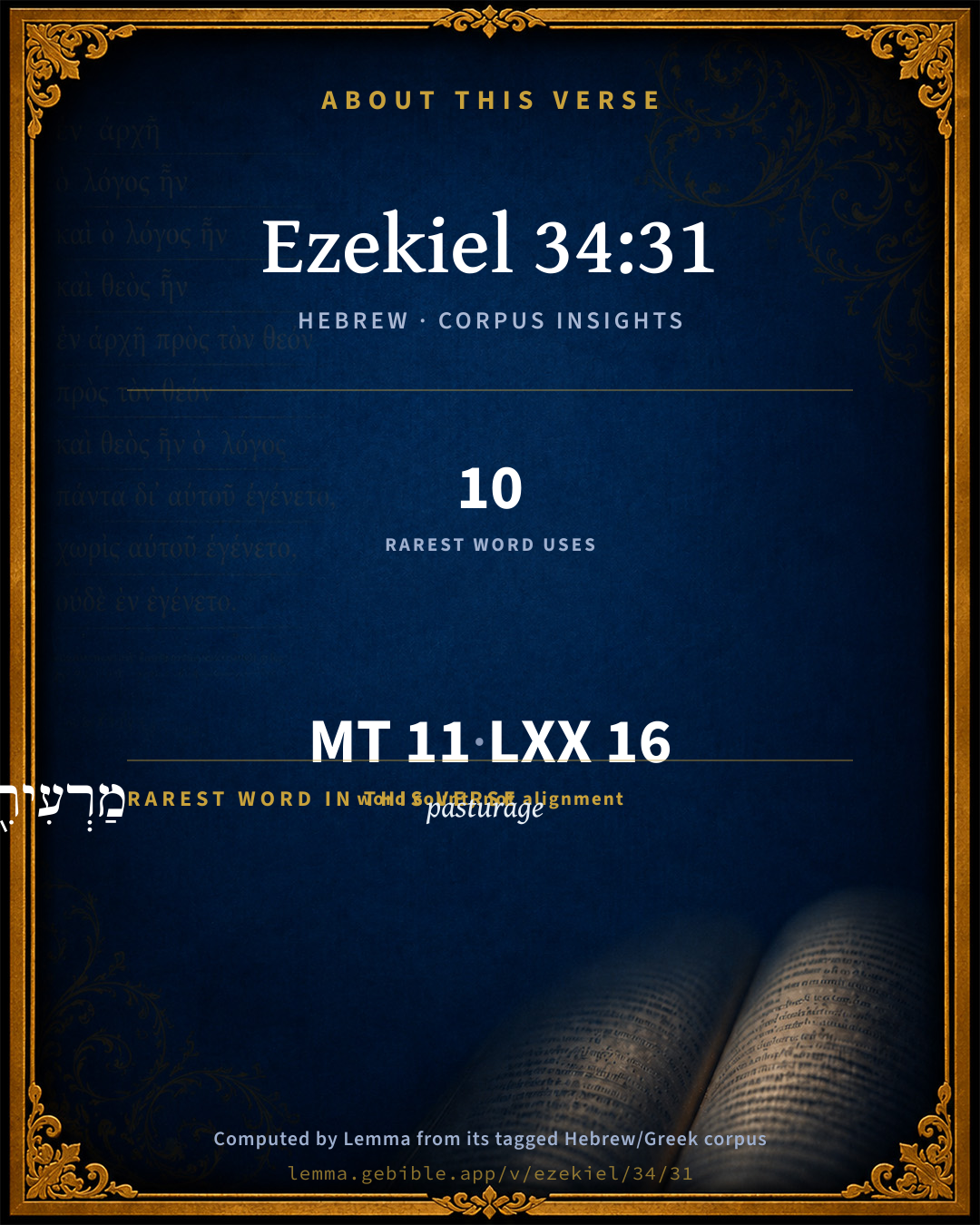
The rarest word here is מַרְעִיתִ֖י pasturage H4830 — appearing just 10 times in the whole Hebrew Bible.

Shared distinctive vocabulary

מַרְעִיתִ֖י pasturage H4830 occurs in 10 verses of the Hebrew Bible. Also found in:

Grammatical profile

  • 8 nouns
  • 3 pronouns

Repetition

Words recur within this verse — often emphatic in Hebrew:

  • צֹאנִ֛י flock H6629 ×2
  • וְאַתֵּ֥ן you H859 ×2

Hebrew & Septuagint length

In English translation the verse runs 19 words from the Hebrew and 21 from the Septuagint (LXX English) — closely comparable.

A rough comparison of the two English renderings, which tokenize alike — not a word-level alignment.

Word counts can differ between the Hebrew and the Greek without any difference in meaning — e.g. the Hebrew direct-object marker אֵת has no separate Greek word, and Greek often adds the article ὁ.

In the original languages it is 11 Hebrew tokens and 16 Greek tokens — but the two are counted differently (Hebrew bundles its prefixes and suffixes into one token; the Greek is in lemma form), so that isn’t a like-for-like length.

Cross-references

15

Topical passages linked to Ezekiel 34:31 in the Treasury of Scripture Knowledge — connected by theme and wording, ordered by reader-vote popularity; previews shown in the World English Bible.

  • Psalms 100:3 Know that Yahweh, he is God. It is he who has made us, and we are his. We are his people, and the sheep of his pasture.
  • John 10:16 I have other sheep, which are not of this fold. I must bring them also, and they will hear my voice. They will become one flock with one shepherd.
  • Psalms 78:52 But he led forth his own people like sheep, And guided them in the wilderness like a flock.
  • Ezekiel 36:38 As the flock for sacrifice, as the flock of Jerusalem in her appointed feasts, so shall the waste cities be filled with flocks of men; and they shall know that I am Yahweh.
  • Psalms 80:1 Hear us, Shepherd of Israel, You who lead Joseph like a flock, You who sit above the cherubim, shine forth.
  • John 10:11 I am the good shepherd. The good shepherd lays down his life for the sheep.
  • John 20:15–17 Jesus said to her, "Woman, why are you weeping? Who are you looking for?" She, supposing him to be the gardener, said to him, "Sir, if you have carried him away, tell me where you have laid him, and I will take him away."
  • Acts 20:28 Take heed, therefore, to yourselves, and to all the flock, in which the Holy Spirit has made you overseers, to shepherd the assembly of the Lord and God which he purchased with his own blood.
  • Psalms 95:7 For he is our God. We are the people of his pasture, And the sheep in his care. Today, oh that you would hear his voice!
  • Isaiah 40:11 He will feed his flock like a shepherd, he will gather the lambs in his arm, and carry them in his bosom, [and] will gently lead those who have their young.
  • John 10:26–30 But you don't believe, because you are not of my sheep, as I told you.
  • Jeremiah 23:1 Woe to the shepherds who destroy and scatter the sheep of my pasture! says Yahweh.
  • Micah 7:14 Shepherd your people with your staff, The flock of your heritage, Who dwell by themselves in a forest, In the midst of fertile pasture land, let them feed; In Bashan and Gilead, as in the days of old.
  • Luke 12:32 Don't be afraid, little flock, for it is your Father's good pleasure to give you the Kingdom.
  • 1 Peter 5:2–3 Shepherd the flock of God which is among you, exercising the oversight, not under compulsion, but voluntarily, not for dishonest gain, but willingly;

Cross-references courtesy of OpenBible.info (CC BY 4.0).

Hebrew and Greek witnesses Masoretic Hebrew ↔ Greek Septuagint

The same verse in the two great witnesses to the Old Testament, shown verse-for-verse.

These are two independent witnesses, not word-aligned to each other, and the Septuagint is shown in lemma (dictionary) form.

Hebrew Ezekiel 34:31 Masoretic · Westminster Leningrad Codex

וְאַתֵּ֥ן צֹאנִ֛י צֹ֥אן מַרְעִיתִ֖י אָדָ֣ם אַתֶּ֑ם אֲנִי֙ אֱלֹ֣הֵיכֶ֔ם נְאֻ֖ם אֲדֹנָ֥י יְהוִֽה

You my sheep, the sheep of my pasture, are men, and I am your God, says the Lord Yahweh.

World English Bible · Public Domain

Greek LXX Ezekiel 34:31 Septuagint · lemma form

πρόβατον ἐγώ καί πρόβατον ποίμνιον ἐγώ εἰμί καί ἐγώ κύριος ὁ θεός σύ λέγω κύριος κύριος

you⌃ are my sheep, even the sheep of my flock, and I am the Lord your God, says the Lord God.

LXX2012 (modern English Septuagint) · Public Domain

On this verse, The Cambridge Bible for Schools and Colleges discusses the Septuagint’s reading. Read the note in Commentary ↓

Hebrew: Westminster Leningrad Codex (CC BY 4.0). Greek: Septuagint (public domain); English from LXX2012 (modern English Septuagint) (Public Domain). How the Septuagint differs from the Hebrew →

Targum (Aramaic paraphrase)

1

The Targum is the ancient Jewish Aramaic paraphrase of the Hebrew Scriptures — an interpretive translation, not the Hebrew text itself. Onkelos (literal) and Pseudo-Jonathan (expansive) render the Torah, and Jonathan the Prophets. Coverage is partial: where no permissively-licensed English translation exists for a verse, only the Aramaic is shown. This is verse-level text, not a word-by-word alignment to the Hebrew.

  1. Targum Jonathan Prophets (Joshua–Malachi)
    וְאַתּוּן עַמִי עַם דְאִתְקְרֵי שְׁמִי עֲלֵיהוֹן בֵּית יִשְׂרָאֵל אַתּוּן אֲנָא אֱלָהָכוֹן אֲמַר יְיָ אֱלֹהִים:

    (no public-domain English translation for this verse)

    Targum Jonathan — Aramaic: “Mikraot Gedolot” (public domain). English: “Sefaria Community Translation” (CC0 1.0 (public-domain dedication)); “London "Chaldee Paraphrase," 1871” (public domain). Text via Sefaria.

Commentary

Notes on Ezekiel 34:31 from classic Christian and Jewish commentators (each source and its license shown beneath its notes). The classic Christian expositions comment on the surrounding passage and are grouped to its opening verse, so a note may address several verses; the Jewish commentaries on the Tanakh (Rashi and others) are per-verse, so they appear only where the commentator wrote on this verse.

Lemma curates 59 commentaries, every one of them public domain or Creative Commons licensed, each selected and text-cleaned for this edition rather than reprinted as found. About our sources →

Trapp's Complete Commentary

John Trapp

Eze 34:31 And ye my flock, the flock of my pasture, [are] men, [and] I [am] your God, saith the Lord GOD.

Ver. 31. And ye my flock … are men.] Sheep ye are, but rational sheep, having your spiritual "senses habitually exercised to discern good and evil," {Heb 5:14} so that ye "taste and see" my goodness. {Psa 34:8}

John Trapp, A Commentary or Exposition upon All the Books of the Old and New Testament (1647–1656) — public domain. Text from a community e-Sword module.

The Biblical Illustrator

Joseph S. Exell

Eze_34:31

And ye My flock, the flock of My pasture, are men, and I am your God.

Mans destiny

Every breath of the autumnal wind brings down hundreds of faded leaves: they lie thick under the fast baring trees in thousands. Perfect in form, wonderful in construction, beautiful in hue, they are crushed down in myriads under every passing foot of man or beast. And what is the fall of one leaf among so many? Yet we are told by those who have studied the vast distances and proportions of this marvellous universe,--the fall of our world from the sphere of creation would be but as the fall of a leaf in the midst of a great forest. And our text does not even concern itself with the earth in its entirety, but speaks only of the members of the race that inhabits it, creatures of a moment, dying fast as the leaves of the autumn wood, and swept like them to decay.

1. The Lord God. This holy name meant much to the devout Israelite in Ezekiels time. The Jew had been taught to ascribe all around him--from the tiny herb on the wall to the cedars of Lebanon, from the raindrop against his easement to the blue waters of the Mediterranean that washed the shores of his beloved land, from the minute insect on the leaf to the lion roaring for his prey, from the lowest among the people to the majestic figure of a Moses or an Elijah--to the power and will of the Lord God. For Thy pleasure they are and were created was a fundamental article of his faith. And he associated with the holy name the conception of the Lawgiver. Yet what was his knowledge of the power and majesty of the Lord God compared with that we now possess? The power, the wisdom, and the greatness of the Lord God as creator have been magnified a thousandfold by the scientific research of later days. And certainly the discoveries of science have tended to magnify the idea of Law. We meet it everywhere, inflexible, unbending, supreme. If, then, it is dominant in the physical universe, and certain to justify itself upon the disobedient, must not we, who acknowledge the God of the Israelites, feel what an argument we thus have for the fact that the moral law is equally stern and unyielding in its demands on our obedience? Thus are we prepared to understand our need of the Gospel, and to comprehend in some degree the absolute necessity, of the perfect obedience and of the great Atonement which is set forth in the life and death of Jesus Christ. The first duty required of man--the initial duty, if he is to receive blessing and acceptance, is that he should bow down in humility and adoration before the Lord his God.

2. He, then, the High and Holy One that inhabiteth eternity, is the speaker. And looking down upon this little globe, a mere speck in His vast universe, He says of its inhabitants, Ye My flock, the flock of My pasture, are men, and I am your God. And what has science to tell us of man? It has been busy with his origin, with his capabilities and his destiny, and every step in its progress has tended to do away with any special dignity as connected with our humanity. We are asked to believe that by a gradual process man has been developed from the lowest scale of organism to his present state of physical and intellectual power; we are told that all the researches of science go to prove that the difference between his mental capabilities and those of the higher animals is one of degree, not of kind; we are confidently assured that as they die so he dies. Science can find no trace of the spirit of man that goeth upward, and it can only pronounce upon what it sees, and the lofty conceptions of mans immortality it dismisses to the region of dreams.

3. And has our experience a more flattering tale to tell of human capabilities and destinies? A few years of bright hope and vigour, a narrow span of time which is utterly insufficient to fulfil one half of mans aspirations and purposes, a training which is suddenly arrested, an education broken short, a sharp discipline of sorrow and pain--and then the darkness and decay of death. Mans very work outlives him. The labours of his brain and hands have a vitality beyond his own. If we look at man morally, have we greater reason for speaking of his dignity? There is much that we may call noble, but how much that is unutterably mean and degrading! There is a gradual advance in civilisation and outward refinement, but the thin veneered surface covers a depth of moral defilement and evil.

4. Yet it is of man, of whom science and experience have but a mournful tale to tell, that the Lord God says, Ye, the flock of My pasture, are men, and I am your God. And this is surely the point to which we are brought. Talk as we may of the dignity and destiny of humanity, we search in vain for any real proof of it till we come to the Revelation of Gods Word. The Bible, which throws the clearest light on mans weakness and sin, exalts him to a height above all we could hope or desire. It marks out man from the rest of creation by the fact that he is capable by grace of hearing Gods voice, of following after and of loving Him. The Lord takes one of the tenderest relations of pastoral life when He says, Ye are My flock; and in the fulness of time we have the clear explanation of these words in those of Christ Jesus our Lord, I am the Good Shepherd: My sheep hear My voice and follow Me. He who believes that this world has been trodden by the human steps of the Son of God, that His prayers have ascended from it, that He shed His blood to redeem it, that He shared our humanity even unto death, and lives again at Gods right hand, can receive with joy unspeakable the marvellous promises of the destiny of those who are Christs. The love of God becomes a reality, life earnest, restoration to holiness possible. (D. Reith, M. A.)

Gods care for men

I. The Divine method in creation shows this. In so far as we know creation generally, and the earth in particular, this is the case. Scientific research has landed us near impassable gulfs between period and period, genus and genus, species and species; and a still wider gulf between matter and mind, which the Creators hand alone can span. By the impetus of His will God has sent forth matter and life, travelling through immeasurable distances, and they exhausted their strength. Then another breath of inspiration from Him sent them still further; and from stage to stage they have come to our own day, which appears to be the consummation of all the former processes; we will not say that it is the last, because a new heaven and a new earth are in prospect. And why do we mention these things? Because that the highest steps yet taken by both matter and life known to us are seen in the constitution of man. Call it evolution, but it means development; call it discovery, but it is as old as Genesis. It is a grand truth that an unseen hand has guided the steps of matter and life through countless ages to find a resting place today in the being of man.

II. The care of God for men is exhibited in the circumstances of life. We sometimes speak of the subordination of all things to the wants and wishes of mankind. When we do this we look through the spectacles of authority. When, however, we regard all these provisions and arrangements as the outcome of that supreme desire in the Divine heart to care for the flock, we have a higher and a clearer vision of the being of man. Man never appears so great and noble as when seen in the light of eternal love. Provision and preservation are the two handmaids which attend to his wants. A glance at mans creation satisfies us that he received a fitness to ascend, by degrees of discipline, into union with God. This fitness needed resources in order to expansion,--Yea, we say pasture for the flock. All things yield their fruit, and even themselves, for the service of mankind. The earth hath He given to the children of men. No less clear is the hand of God seen in the preservation of His people. He is a wall of fire around them; their sun and shield. The guardianship is so complete that not a moment of time, or an inch of space, is devoid of its presence.

III. The care of God for men appears more distinctly in the appointment of the Good Shepherd. The tender care of Jesus Christ was exclusively shown to mankind.

1. That care arose from His heartfelt love to men. It was not mere pity excited by their wants, or commiseration engendered by their helplessness and misery, but affection for their very being. When the Saviour saw the sheep of the lost house of Israel without a Shepherd scattered over the mountains, torn of wild beasts, and no one caring for their life, His compassionate nature was necessarily moved. But there was below that a love which sprang from the old relationship--they were the children of the heavenly Father.

2. The extent of the care of Jesus for men appears in a life of effort, and a death of sacrifice on their behalf. He sought men. He went after them as the shepherd goes after his lost sheep. There were others who searched, some for riches, others for knowledge, others for power, and others for fame, but He sought out men--not the tatters of sin which covered their life, but themselves. He Unsealed the fountains of their being, and made streams of devotion flow God-ward.

IV. Let us be imitators of him. Let those to whom God has given light flash it on their fellow creatures who live in gross darkness. Be ye leaders of men, to go before the sheep and show them the better pasture. Defend the helpless against oppression. Show charity to them for whom Christ died. To receive Christ into our heart is a glorious state, but to give that Christ to the world is a grade higher. (T. Davies, M. A.)

A call to the Lords own flock

I. I shall notice first, what the text rather suggests than declares, namely, our profession towards God.

1. That we avow Jehovah to be our God. The God of Abraham, of Isaac, and of Jacob is the God of believers to this day. We do not wish to have any other God, although in these days the carnally wise have set up another. This effeminate deity now occupies the place once given to Apollo or Venus, and he is as much a false god as they were.

2. That we are His people. Our song is, My Beloved is mine, and I am His. To glorify God in our spirits and in our bodies, which are alike redeemed, is our reasonable service. In Jehovah is our trust, our joy, our glory.

3. Our joyful confidence in our Immanuel--God with us. Leave out the word am, which is in italics, and you get it, God with them. What is this but God with us? Has there not been a Divine nearness between our souls and Christ since that first day when we touched His garments hem and were made whole?

II. Our proof from God. If God work among us, then shall even our adversaries say, Jehovah-Shammah, the Lord is there. A tree is known by its fruit, and the rule applies even to God Himself.

1. The first mark is the gathering in of the scattered (verse 11). Conversion is the sure sign of the immediate presence of the Lord. Glory be to His name, His hand is stretched out still for miracles of grace.

2. A second token of the Lords presence is the feeding of the flock. The Holy Spirit seems to lay great stress upon that (verse 15). Have not your Sabbaths been times of holy festival? Has not the King Himself banqueted with us? At the communion table have we not been transported with such joys as can never be excelled until we behold the Chief Shepherd face to face?

3. Another token of the presence of the Good Shepherd is the healing of the sick; I mean the spiritually sick, for there is this promise given, I will seek that which was lost, etc. It is a rare joy to restore such as have been overtaken in a fault. The God of our salvation hath devised means to bring home His banished, and therefore He is still in the midst of us. Glory be to His condescending love!

4. A further Drool of the presence of God in a church is when the Lord Jesus Christ is greatly honoured; for here it is written, I will set up one shepherd over them, etc. If your faith rested anywhere but in the glorious person and finished work of the Son of God it were a worthless faith. If He be indeed the Lord of whom we are the loyal subjects, then the Lord our God is with us, and we are His people.

5. A further evidence of the Lords presence with a people is found in their prevailing peace of mind. I will make with them a covenant of peace, etc. Do not many of you realise that deep peace, the peace of God which passeth all understanding, so that you are free from all fear, and happy amid grievous poverty and trial?

III. Our description by God.

1. God calls His Church His flock. A flock is the shepherds treasure, it is his living wealth; but it is also the shepherds care, it is his constant anxiety. A true Church is therefore a very precious thing, it is not a mere human society banded together for certain objects, but it is a community which God Himself hath formed, and over which He doth watch with an unsleeping eye.

2. Observe that it is added, The flock of My pasture. There is a different idea here. It shows that Gods people are not only peculiar in other things, but they are peculiar in their feeding. You may know a child of God by that which his soul lives upon. Gods people know their Lord, and they know the kind of food which He gives them. They know the truth from a lie. They will have nothing but clean provender, and the more evidently it comes from the great Shepherds own hand the better it is to them.

3. It is a very singular thing, but it is added, Ye My flock, the flock of My pasture, are men. Ye are men: then God knows what kind of persons we are, whom He has loved with an everlasting love. We are Adams, not angels. Gods people are but men; yet they are men and not brutes. There are in human form many who are hardly so good as brutes; but the saints are gentle, compassionate, and gracious. Gods people are true men: when the Spirit of God is in them they quit themselves like men; they come to the front and bear the brunt of the battle.

4. But then He adds this blessed assurance, And I am your God. God is not a man, that He should lie; nor the son of a man, that He should repent. I hear that poor soul seeking after God, say, Oh, but I am so unworthy. Just so. The Lord knows it. He says you are men. But then He is not unworthy; he is worthy to receive honour and power Divine, for He is our God. (C. H. Spurgeon.)

.

The Biblical Illustrator, edited by Joseph S. Exell (c. 1880s–1900s) — public domain. Text from a community e-Sword module.

Joseph Benson's Commentary

Eze 34:31. And ye my flock, &c., are men — These words at the conclusion of the chapter, explain the metaphor which runs through the whole of it; namely, that what was said of a flock and its shepherds, is to be understood of men and their governors, and especially of God’s people, whom their civil and ecclesiastical governors neglected, or misled and oppressed, but whom God regards, watches over, provides for, and takes care of, as a shepherd does his flock. It is justly observed here by Mr. Ostervald, that “this is a chapter which both magistrates and rulers of the church ought to meditate upon very seriously. The complaints that God here makes of false shepherds, and the curses he denounces against them, show that it is the duty of pastors, with their utmost diligence, to watch over the sheep with which they are intrusted, and to provide with care and readiness for all their wants; and that if they fail herein, they must give a severe account to God for it. This too lays an obligation upon princes and magistrates, to govern faithfully and justly the people committed to their trust. What befell the Jews, who, for the unfaithfulness of their prophets and magistrates, were utterly destroyed, shows that it is the greatest misfortune to a nation to have wicked rulers; and that all who are concerned for the glory of God, and the happiness and edification of the church, have great reason to pray to God, that he would always raise up to his people faithful and good pastors.”

Joseph Benson's Commentary on the Old and New Testaments (1811–1818) — public domain. Text from a community e-Sword module.

Jamieson, Fausset & Brown

Robert Jamieson, A. R. Fausset & David Brown

ye my flock . . . are men--not merely an explanation of the image, as JEROME represents. But as God had promised many things which mere "men" could not expect to realize, He shows that it is not from man's might their realization is to be looked for, but from GOD, who would perform them for His covenant-people, "His flock" [ROSENMULLER]. When we realize most our weakness and God's power and faithfulness to His covenant, we are in the fittest state for receiving His blessings.

Another feature of Israel's prosperity; those who exulted over Israel's humiliation, shall themselves be a "prey." Already stated in Eze 25:12-14; properly repeated here in full detail, as a commentary on Eze 34:28. The Israelites "shall be no more a prey"; but Edom, the type of their most bitter foes, shall be destroyed irrecoverably.

Next: Ezekiel Chapter 35

Jamieson, Fausset & Brown — Commentary Critical and Explanatory on the Whole Bible (1871) — public domain (CC PDM 1.0). Text via the HelloAO Bible API.

Adam Clarke's Commentary

Verse 31. And ye my flock] That is, under the allegory of a flock of sheep, I point out men; under that of a pasture, my Church, and under that of a shepherd, the Messiah, through whom I am become your God. And he who is your God is אדני יהוה Adonai Jehovah, the self-existent Being; the Governor and Director, as well as the Saviour and Judge of men.

Adam Clarke's Commentary on the Bible (1810–1826) — public domain. Text from a community e-Sword/MySword module.

Ellicott's Commentary for English Readers

(31) The flock of my pasture.—The chapter closes with the strongest and tenderest assurance that the object of its figurative language is to point out the renewed and close communion which is to come about between God and His people. They are to be His flock, and He is to be their God. Yet still, the vast and infinite distance between them is not left out of view, but rather brought prominently forward—they are men; He is God. They were not yet prepared to understand how this infinite chasm could be bridged over; only it should be by their shepherd David. We know that He was the Mediator, both God and man, thus uniting both in one.

A Bible Commentary for English Readers, edited by Charles John Ellicott (1878–1897) — public domain. Text from a community e-Sword module.

The Cambridge Bible for Schools and Colleges

gen. ed. J. J. S. Perowne

31. ye my flock … are men] Omit “are men” with LXX. and read: and ye are my flock … pasture, and I am your God.

The Cambridge Bible for Schools and Colleges (gen. ed. J. J. S. Perowne; Cambridge University Press, 1878–1918) — public domain. Text from a community e-Sword module.

Haydock's Catholic Bible Commentary

Men. What has been said of sheep (Menochius) relates to you. --- Am the Lord. This is not in Hebrew or Protestants. (Haydock) --- But it is found in one Hebrew manuscript and Septuagint, as this version is thus frequently confirmed. (Kennicott, Dis. ii.)

George Leo Haydock (1774–1849), Haydock's Catholic Family Bible and Commentary, 1859 edition — public domain. Excludes Psalms (Douay-Rheims chapter numbering differs from Protestant) and Deuterocanonical books (Catholic canon only).

Matthew Poole's English Annotations

Now, that neither you nor any else mistake the allegory, note, saith God, this flock of my pasture are not sheep literally, but they are men expressed by this emblem, and these men are those I am a God to, and will be so for ever.

Matthew Poole's English Annotations on the Holy Bible (1683–1685) — public domain. Text from a community e-Sword/MySword module.

The Pulpit Commentary

And ye my flock. The great utterance, we might call it the "ode of the shepherds," comes round to the point from which its second portion started (ver. 11). All blessings were summed up in the thought that, behind every representative of the Father"s care, the ideal David and his house, there was the eternal relationship between Jehovah and his people, even that of the Shepherd and his sheep. The LXX omits the words "are men," and here also is followed by Cornill.

God"s flock.

Israel was formerly God"s flock. Christians are now God"s flock.

I CHRISTIANS ARE CONSTITUTED INTO A FLOCK. The wandering sheep are restored. They no longer roam at large over the mountains. They are gathered together. Man is naturally gregarious. Religion should deepen this characteristic by destroying selfishness and quickening the great social instinct, love. Thus Christ founded the Church idea. He recognized that he had many sheep that were not of the fold of Israel, or of his first community of disciples, and he prayed that they might all become one flock, even if they might not all be gathered into one fold. It may be impossible to restore the external unity of Christendom. At all events, this grand consummation seems at present to be far off, and some of those who profess to desire it most fervently do their worst to postpone it by their narrowness, bigotry, and serf-assertion. Certainly, if the dream is ever realized, it will not be by all sections of Christendom succumbing to the views and practices of any one party, but by a general agreement within large lines of liberty. Meanwhile, though we may not have one fold, we should be one flock. There should be a spirit of brotherhood among all Christians. The boundaries of folds do not convert sheep into wolves. The spiritual unity of Christendom may be accomplished in the spirit of charity and sympathy taking possession of the hearts of all Christians.

II CHRISTIANS ARE TENDED AS A FLOCK. The flock is under the care of a shepherd. God has "set up one Shepherd over" his flock (ver. 23) Christ, who cares for his sheep to the extent of giving his life for them.The flock of Christ is variously tended.

1. It is fed. God has not left his people in the wilderness, or, if they must traverse that barren region, he sends heavenly manna and gives water from the rock.

2. It is sheltered. The shepherd watches over the flock by night and drives off beasts of prey. Christ guards his people from harm and danger.

3. It is led. The shepherd leads his sheep by the still waters, and ultimately home to their fold. God led his people Israel "like a flock", (Psa_77:20) till they had passed all the perils of the forty years" wandering, crossed the Jordan, and taken possession of the Promised Land. Christ leads his people through life safely on towards the heavenly Canaan.

III Christians SHOULD BEHAVE AS A FLOCK.

1. They should follow the Shepherd. Christianity is walking in the footsteps of Christ. (Joh_12:26) We cannot expect the grace of Christ if we wander from him.

2. The flock is the property of its Owner; it exists for his advantage. It is not to be supposed that we are to receive countless blessings and render no return in obedience. The supreme end of the Church is the glory of God, though this is attained in conjunction with its own highest welfare.

3. The sheep are foolish, weak, helpless creatures. The Shepherd is far greater than they. He deserves to be locked up to with trust, and followed obediently. In our ignorance, folly, and weakness we should trust and obey our good Shepherd, who is wiser and stronger than we, and whose will is supreme over our lives.

The Pulpit Commentary (1880–1919), ed. H.D.M. Spence-Jones & Joseph S. Exell — public domain. Text from a community e-Sword module.

Rashi

Rabbi Shlomo Yitzchaki (Rashi)

you are man You are not like animals in My eyes.

Rashi on the Tanakh — English translations: “The Judaica Press complete Tanach with Rashi, translated by A. J. Rosenberg” (CC BY 4.0); “Pentateuch with Rashi's commentary by M. Rosenbaum and A.M. Silbermann, 1929-1934” (public domain); “The Metsudah Tanach series, Lakewood, N.J” (CC BY 4.0); and “The Book of Joshua, Metsudah Publications, 1997” (CC BY 4.0). Text via Sefaria.

Lesson kit

Teaching starters — assembled from the data on this page, not authored interpretation. Every prompt links to the verse data it draws on. Edit before teaching.

Ezekiel, in the Prophets, opens this verse with 11 words (9 distinct Hebrew lemmas). Its most distinctive word is mirʻîyth (“pasturage”). A historical commentator’s framing appears above. Read the whole chapter for the surrounding context.

Discussion questions

  1. How does “pasturage” (mirʻîyth) shape what this verse is saying?
  2. Psalms 74:1 shares the word «pasturage» with this verse. How do the two illuminate each other?
  3. “flock” occurs 2× in this one verse. What is the effect of the repetition?
  4. These translations render this verse differently; the difference is in the English rendering, not the original. What questions does that raise?
  5. Reading how Trapp's Complete Commentary and The Biblical Illustrator read this verse, where do the two commentators agree and where do they part?

Things to notice

Reading settings

Reading text

Shown beneath each verse's original-language words.

Old Testament
Old Testament edition

Read the OT as the Masoretic Hebrew (MT) or the Greek Septuagint (LXX).

English shown for the Greek Septuagint (in the Hebrew ↔ Greek comparison).

Comparing translations? Open the Compare panel on any verse page to stack up to four side by side.