
Ezekiel 16:52

Hebrew (Westminster Leningrad Codex) Ezekiel 16:52 appears in the Hebrew Old Testament. The text above is from the Westminster Leningrad Codex. Each word links to its Strong’s number, a concise gloss, and parsing drawn from the Open Scriptures Hebrew Bible morphology. Click any word for its full Brown-Driver-Briggs (BDB) entry.
Download image
Cite this verse

Ezekiel 16:52 (World English Bible). Public Domain. Lemma interlinear Bible study tool, https://lemma.gebible.app/v/ezekiel/16/52.

Show BibTeX & RIS
BibTeX
RIS
English Translation
You also, bear you your own shame, in that you have given judgment for your sisters; through your sins that you have committed more abominable than they, they are more righteous that you: yes, be also confounded, and bear your shame, in that you have justified your sisters.
World English Bible · Public Domain
Download a study sheet

One document with this verse’s original text, its word-by-word gloss line, the meaning frame, cross-references with their text, attributed commentary, and full source and license credits — printable, and it pastes into notes with its structure intact.

This verse Autodidact and up

Study sheet (.html) Plain text (.txt)

A passage Seminary Student

Up to 50 verses in one chapter. A passage sheet keeps up to 6 commentary sources and 12 cross-references per verse, in the order this page ranks them, and says so on the sheet whenever that leaves anything out. Ask for a single verse and you get the Autodidact verse sheet above.

Everything on this page stays free to read, with no account — the sheet is a download of what is already on screen, not access to it.

Want to remove ads? Support Godless Engineer
Compare translations 3

The same verse in 3 English versions, stacked beneath the original-language interlinear above. Click any original word for its lexicon entry.

Each is an independent rendering of the whole verse — the interlinear is not word-aligned to these translations.

Highlighted words mark where these versions differ — a whole-verse word diff, not a word-by-word alignment.

  • World English Bible Public Domain
    You also, bear you your own shame, in that you have given judgment for your sisters; through your sins that you have committed more abominable than they, they are more righteous that you: yes, be also confounded, and bear your shame, in that you have justified your sisters.
  • King James Version Public Domain
    Thou also, which hast judged thy sisters, bear thine own shame for thy sins that thou hast committed more abominable than they: they are more righteous than thou: yea, be thou confounded also, and bear thy shame, in that thou hast justified thy sisters.
  • unfoldingWord Literal Text CC BY-SA 4.0
    Especially you, show your own shame; in this way you have shown that your sisters were better than you, because of the sins you committed in all those disgusting ways. Your sisters now seem better than you. Especially you, show your own shame, for in this way you have shown that your sisters were better than you.

unfoldingWord Literal Text — © unfoldingWord, licensed CC BY-SA 4.0. Word-aligned USFM3 via Door43 (git.door43.org/unfoldingWord/en_ult).

Versions to compare (up to 4)

3 of 4 selected

Show all 18 translations

Every available English version of this verse, each an independent rendering of the whole verse.

  • World English Bible Public Domain
    You also, bear you your own shame, in that you have given judgment for your sisters; through your sins that you have committed more abominable than they, they are more righteous that you: yes, be also confounded, and bear your shame, in that you have justified your sisters.
  • Berean Standard Bible Public Domain
    So now you must bear your disgrace, since you have brought justification for your sisters. For they appear more righteous than you, because your sins were more vile than theirs. So you too must bear your shame and disgrace, since you have made your sisters appear righteous.
  • Majority Standard Bible Public Domain
    So now you must bear your disgrace, since you have brought justification for your sisters. For they appear more righteous than you, because your sins were more vile than theirs. So you too must bear your shame and disgrace, since you have made your sisters appear righteous.
  • King James Version Public Domain
    Thou also, which hast judged thy sisters, bear thine own shame for thy sins that thou hast committed more abominable than they: they are more righteous than thou: yea, be thou confounded also, and bear thy shame, in that thou hast justified thy sisters.
  • American Standard Version (1901) Public Domain
    Thou also, bear thou thine own shame, in that thou hast given judgment for thy sisters; through thy sins that thou hast committed more abominable than they, they are more righteous that thou: yea, be thou also confounded, and bear thy shame, in that thou hast justified thy sisters.
  • Revised Version (1885) Public Domain
    Thou also, bear thine own shame, in that thou hast given judgment for thy sisters; through thy sins that thou hast committed more abominable than they, they are more righteous than thou: yea, be thou also confounded, and bear thy shame, in that thou hast justified thy sisters.
  • Geneva Bible (1599) Public Domain
    Therefore thou which hast iustified thy sisters, beare thine owne shame for thy sinnes, that thou hast committed more abominable then they which are more righteous then thou art: be thou therefore confounded also, and beare thy shame, seeing that thou hast iustified thy sisters.
  • Douay-Rheims (1899) Public Domain
    Therefore do thou also bear thy confusion, thou that hast surpassed thy sisters with thy sine, doing more wickedly than they: for they are justified above thee, therefore be thou also confounded, and bear thy shame, thou that hast justified thy sisters.
  • Young's Literal Translation Public Domain
    Thou also -- bear thy shame, That thou hast adjudged to thy sisters, Because of thy sins that thou hast done more abominably than they, They are more righteous than thou, And thou, also, be ashamed and bear thy shame, In thy justifying thy sisters.
  • Literal Standard Version CC BY-SA 4.0
    You also—bear your shame, || That you have adjudged for your sisters, || Because of your sins that you have done more abominably than they, || They are more righteous than you, || And you, also, be ashamed and bear your shame, || In your justifying your sisters.
  • Unlocked Literal Bible CC BY-SA 4.0
    Especially you, show your own shame; in this way you have shown that your sisters were better than you, because of the sins you committed in all those disgusting ways. Your sisters now seem better than you. Especially you, show your own shame, for in this way you have shown that your sisters were better than you.
  • unfoldingWord Literal Text CC BY-SA 4.0
    Especially you, show your own shame; in this way you have shown that your sisters were better than you, because of the sins you committed in all those disgusting ways. Your sisters now seem better than you. Especially you, show your own shame, for in this way you have shown that your sisters were better than you.
  • Darby Bible Public Domain
    Thou also, who hast judged thy sisters, bear thine own confusion, because of thy sins in which thou hast acted more abominably than they: they are more righteous than thou. So be thou ashamed also, and bear thy confusion, in that thou hast justified thy sisters.
  • World Messianic Bible Public Domain
    You also bear your own shame yourself, in that you have given judgment for your sisters; through your sins that you have committed more abominable than they, they are more righteous than you. Yes, be also confounded, and bear your shame, in that you have justified your sisters.
  • Webster's Bible Public Domain
    Thou also, who hast judged thy sisters, bear thy own shame for thy sins that thou hast committed more abominable than they: they are more righteous than thou: yes, be thou confounded also, and bear thy shame, in that thou hast justified thy sisters.
  • Free Bible Version CC BY-SA 4.0
    Now you're going to have to put up with your shame, since by your disgraceful sins you made them seem far better. Compared to you they look good! Now you too have to put up with your shame and disgrace because you've made your sisters look as if they were good.
  • Bible in Basic English Public Domain
    And you yourself will be put to shame, in that you have given the decision for your sisters; through your sins, which are more disgusting than theirs, they are more upright than you: truly, you will be shamed and made low, for you have made your sisters seem upright.
  • JPS Tanakh (1917) Public Domain
    Thou also, bear thine own shame, in that thou hast given judgment for thy sisters; through thy sins that thou hast committed more abominable than they, they are more righteous than thou; yea, be thou also confounded, and bear thy shame, in that thou hast justified thy sisters.

Literal Standard Version (2020), Covenant Press — licensed CC BY-SA 4.0. Text via the HelloAO Bible API (eBible.org). Unlocked Literal Bible (unfoldingWord) — licensed CC BY-SA 4.0. Text via the HelloAO Bible API (eBible.org). unfoldingWord Literal Text — © unfoldingWord, licensed CC BY-SA 4.0. Word-aligned USFM3 via Door43 (git.door43.org/unfoldingWord/en_ult). Free Bible Version, Dr. Jonathan Gallagher — licensed CC BY-SA 4.0. Text via the HelloAO Bible API (eBible.org).

Word by word

More ways to search: Search by grammar → Find every occurrence → Compare this word →

Practice this passage: Drill this verse → Learn its vocabulary →

מֵהֵ֖ן
hên
H2004
“from · them”
Preposition + Suffix, Personal, 3rd Person, Feminine, Plural
Part of Speech
Preposition
Full BDB Definition

Origin: from H1931

TWOT: 504

they, these, the same, who
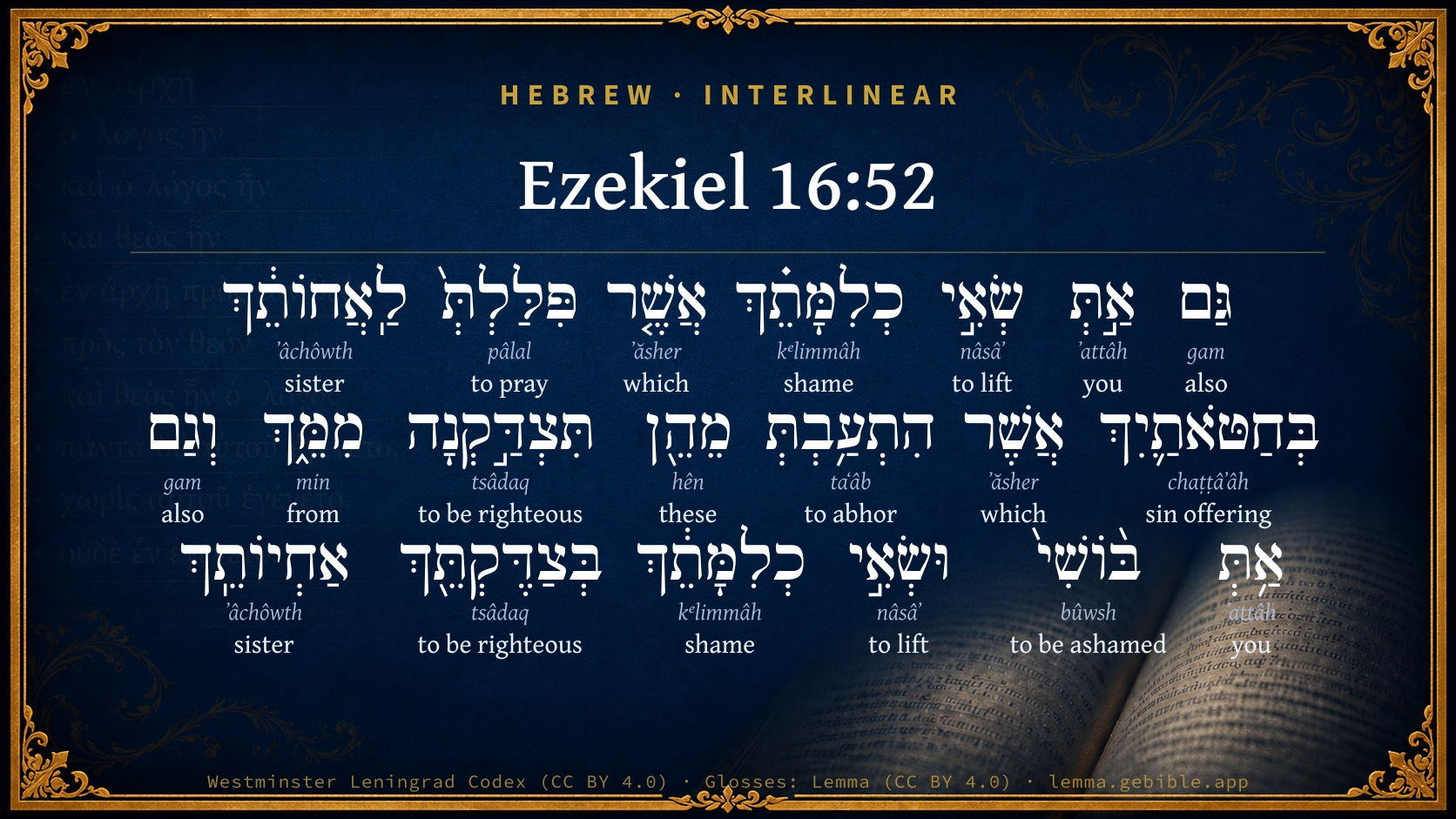
  1. גַּם gam H1571 “also” Particle, Accusative
  2. אַ֣תְּ ʼattâh H859 “you” Pronoun, Personal, 2nd Person, Feminine, Singular
  3. שְׂאִ֣י nâsâʼ H5375 “lift” Verb, Qal, Imperative, 2nd Person, Feminine, Singular
  4. כְלִמָּתֵ֗ךְ kᵉlimmâh H3639 “shame · your” Noun, Common, Feminine, Singular, Construct + Suffix, Personal, 2nd Person, Feminine, Singular
  5. אֲשֶׁ֤ר ʼăsher H834 “which” Particle, Relative
  6. פִּלַּלְתְּ֙ pâlal H6419 “to pray” Verb, Piel, Perfect, 2nd Person, Feminine, Singular
  7. לַֽאֲחוֹתֵ֔ךְ ʼâchôwth H269 “to/for · sister · your” Preposition + Noun, Common, Feminine, Singular, Construct + Suffix, Personal, 2nd Person, Feminine, Singular
  8. בְּחַטֹּאתַ֛יִךְ chaṭṭâʼâh H2403 “in/at · sin offerings · your” Preposition + Noun, Common, Feminine, Plural, Construct + Suffix, Personal, 2nd Person, Feminine, Singular
  9. אֲשֶׁר ʼăsher H834 “which” Particle, Relative
  10. הִתְעַ֥בְתְּ taʻâb H8581 “to abhor” Verb, Hiphil, Perfect, 2nd Person, Feminine, Singular
  11. תִּצְדַּ֣קְנָה tsâdaq H6663 “to be righteous” Verb, Qal, Imperfect, 3rd Person, Feminine, Plural
  12. מִמֵּ֑ךְ min H4480 “from · you” Preposition + Suffix, Personal, 2nd Person, Feminine, Singular
  13. וְגַם gam H1571 “and · also” Conjunction + Particle, Accusative
  14. אַ֥תְּ ʼattâh H859 “you” Pronoun, Personal, 2nd Person, Feminine, Singular
  15. בּ֨וֹשִׁי֙ bûwsh H954 “be ashamed” Verb, Qal, Imperative, 2nd Person, Feminine, Singular
  16. וּשְׂאִ֣י nâsâʼ H5375 “and · lift” Conjunction + Verb, Qal, Imperative, 2nd Person, Feminine, Singular
  17. כְלִמָּתֵ֔ךְ kᵉlimmâh H3639 “shame · your” Noun, Common, Feminine, Singular, Construct + Suffix, Personal, 2nd Person, Feminine, Singular
  18. בְּצַדֶּקְתֵּ֖ךְ tsâdaq H6663 “in/at · to be righteous · you” Preposition + Verb, Piel, Infinitive Construct + Suffix, Personal, 2nd Person, Feminine, Singular
  19. אַחְיוֹתֵֽךְ ʼâchôwth H269 “sisters · your” Noun, Common, Feminine, Plural, Construct + Suffix, Personal, 2nd Person, Feminine, Singular

About this verse

These counts appear in no published source. They are computed here, from the morphology-tagged text and Lemma’s own curated glosses. What Lemma adds →

20
words
13
distinct lemmas
Prophets
section

Notable vocabulary

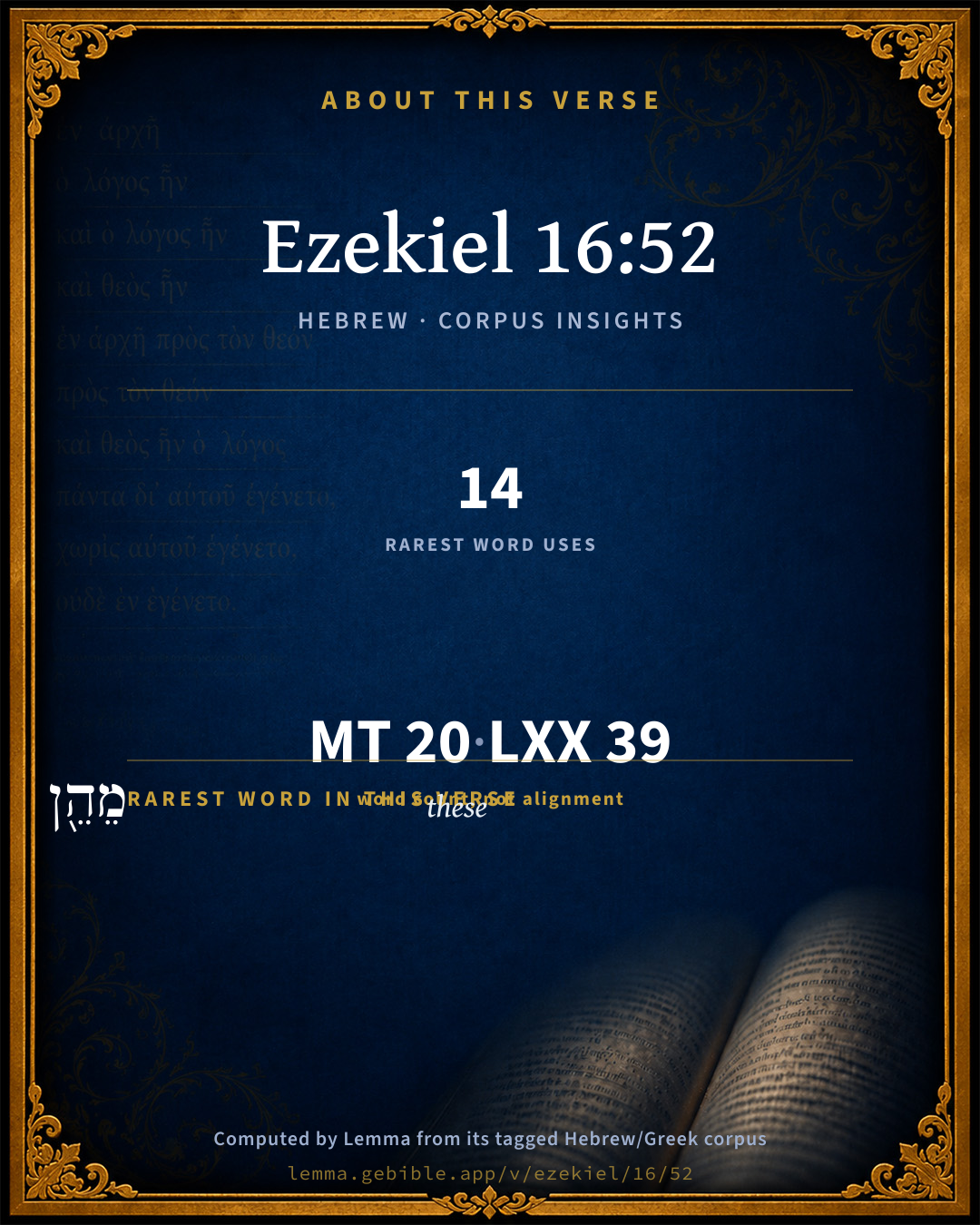
The rarest word here is מֵהֵ֖ן these H2004 — appearing just 14 times in the whole Hebrew Bible.

Shared distinctive vocabulary

מֵהֵ֖ן these H2004 occurs in 14 verses of the Hebrew Bible. Also found in:

Grammatical profile

  • 7 verbs
  • 5 nouns
  • 2 pronouns
  • 2 prepositions
  • 4 particles

Verb forms

  • שְׂאִ֣י Qal · Imperative
  • פִּלַּלְתְּ֙ Piel · Perfect
  • הִתְעַ֥בְתְּ Hiphil · Perfect
  • תִּצְדַּ֣קְנָה Qal · Imperfect
  • בּ֨וֹשִׁי֙ Qal · Imperative
  • וּשְׂאִ֣י Qal · Imperative
  • בְּצַדֶּקְתֵּ֖ךְ Piel · Infinitive Construct

Repetition

Words recur within this verse — often emphatic in Hebrew:

  • גַּם also H1571 ×2
  • שְׂאִ֣י to lift H5375 ×2
  • כְלִמָּתֵ֗ךְ shame H3639 ×2
  • לַֽאֲחוֹתֵ֔ךְ sister H269 ×2
  • תִּצְדַּ֣קְנָה to be righteous H6663 ×2
  • אַ֣תְּ you H859 ×2
  • אֲשֶׁ֤ר which H834 ×2

Hebrew & Septuagint length

In English translation the verse runs 48 words from the Hebrew and 46 from the Septuagint (LXX English) — closely comparable.

A rough comparison of the two English renderings, which tokenize alike — not a word-level alignment.

Word counts can differ between the Hebrew and the Greek without any difference in meaning — e.g. the Hebrew direct-object marker אֵת has no separate Greek word, and Greek often adds the article ὁ.

In the original languages it is 20 Hebrew tokens and 39 Greek tokens — but the two are counted differently (Hebrew bundles its prefixes and suffixes into one token; the Greek is in lemma form), so that isn’t a like-for-like length.

Cross-references

21

Topical passages linked to Ezekiel 16:52 in the Treasury of Scripture Knowledge — connected by theme and wording, ordered by reader-vote popularity; previews shown in the World English Bible.

  • Matthew 7:1–5 "Don't judge, so that you won't be judged.
  • Genesis 38:26 Judah acknowledged them, and said, "She is more righteous than I, because I didn't give her to Shelah, my son." He knew her again no more.
  • 1 Samuel 24:17 He said to David, You are more righteous than I; for you have rendered to me good, whereas I have rendered to you evil.
  • 1 Kings 2:32 Yahweh will return his blood on his own head, because he fell on two men more righteous and better than he, and killed them with the sword, and my father David didn't know it, [to wit], Abner the son of Ner, captain of the host of Israel, and Amasa the son of Jether, captain of the host of Judah.
  • Jeremiah 23:40 and I will bring an everlasting reproach on you, and a perpetual shame, which shall not be forgotten.
  • Jeremiah 31:19 Surely after that I was turned, I repented; and after that I was instructed, I struck on my thigh: I was ashamed, yes, even confounded, because I did bear the reproach of my youth.
  • Jeremiah 51:51 We are confounded, because we have heard reproach; confusion has covered our faces: for strangers are come into the sanctuaries of Yahweh's house.
  • Ezekiel 16:54 that you may bear your own shame, and may be ashamed because of all that you have done, in that you are a comfort to them.
  • Ezekiel 16:56 For your sister Sodom was not mentioned by your mouth in the day of your pride,
  • Ezekiel 16:63 that you may remember, and be confounded, and never open your mouth any more, because of your shame, when I have forgiven you all that you have done, says the Lord Yahweh.
  • Ezekiel 36:6–7 Therefore prophesy concerning the land of Israel, and tell the mountains and to the hills, to the watercourses and to the valleys, Thus says the Lord Yahweh: Behold, I have spoken in my jealousy and in my wrath, because you have borne the shame of the nations:
  • Ezekiel 36:15 neither will I let you hear any more the shame of the nations, neither shall you bear the reproach of the peoples any more, neither shall you cause your nation to stumble any more, says the Lord Yahweh.
  • Ezekiel 36:31–32 Then shall you remember your evil ways, and your doings that were not good; and you shall loathe yourselves in your own sight for your iniquities and for your abominations.
  • Ezekiel 39:26 They shall bear their shame, and all their trespasses by which they have trespassed against me, when they shall dwell securely in their land, and none shall make them afraid;
  • Ezekiel 44:13 They shall not come near to me, to execute the office of priest to me, nor to come near to any of my holy things, to the things that are most holy; but they shall bear their shame, and their abominations which they have committed.
  • Hosea 10:6 It also will be carried to Assyria for a present to a great king. Ephraim will receive shame, And Israel will be ashamed of his own counsel.
  • Luke 6:37 Don't judge, And you won't be judged. Don't condemn, And you won't be condemned. Set free, And you will be set free.
  • Romans 1:32–2:1 who, knowing the ordinance of God, that those who practice such things are worthy of death, not only do the same, but also approve of those who practice them.
  • Romans 2:10 But glory and honor and peace to every man who works good, to the Jew first, and also to the Greek.
  • Romans 2:26–27 If therefore the uncircumcised keep the ordinances of the law, won't his uncircumcision be accounted as circumcision?
  • Romans 6:21 What fruit then did you have at that time in the things of which you are now ashamed? For the end of those things is death.

Cross-references courtesy of OpenBible.info (CC BY 4.0).

Hebrew and Greek witnesses Masoretic Hebrew ↔ Greek Septuagint

The same verse in the two great witnesses to the Old Testament, shown verse-for-verse.

These are two independent witnesses, not word-aligned to each other, and the Septuagint is shown in lemma (dictionary) form.

Hebrew Ezekiel 16:52 Masoretic · Westminster Leningrad Codex

גַּם אַ֣תְּ שְׂאִ֣י כְלִמָּתֵ֗ךְ אֲשֶׁ֤ר פִּלַּלְתְּ֙ לַֽאֲחוֹתֵ֔ךְ בְּחַטֹּאתַ֛יִךְ אֲשֶׁר הִתְעַ֥בְתְּ מֵהֵ֖ן תִּצְדַּ֣קְנָה מִמֵּ֑ךְ וְגַם אַ֥תְּ בּ֨וֹשִׁי֙ וּשְׂאִ֣י כְלִמָּתֵ֔ךְ בְּצַדֶּקְתֵּ֖ךְ אַחְיוֹתֵֽךְ

You also, bear you your own shame, in that you have given judgment for your sisters; through your sins that you have committed more abominable than they, they are more righteous that you: yes, be also confounded, and bear your shame, in that you have justified your sisters.

World English Bible · Public Domain

Greek LXX Ezekiel 16:52 Septuagint · lemma form

καί σύ κομίζω βάσανος σύ ἐν ὅς φθείρω ὁ ἀδελφή σύ ἐν ὁ ἁμαρτία σύ ὅς ἀνομέω ὑπέρ αὐτός καί δικαιόω αὐτός ὑπέρ σεαυτοῦ καί σύ αἰσχύνω καί λαμβάνω ὁ ἀτιμία σύ ἐν ὁ δικαιόω σύ ὁ ἀδελφή σύ

You therefore bear your punishment, for that you have corrupted your sisters by your sins which you have committed beyond them; and you have made them appear more righteous than yourself: you therefore be ashamed, and bear your dishonor, in that you have justified your sisters.

LXX2012 (modern English Septuagint) · Public Domain

Hebrew: Westminster Leningrad Codex (CC BY 4.0). Greek: Septuagint (public domain); English from LXX2012 (modern English Septuagint) (Public Domain). How the Septuagint differs from the Hebrew →

Targum (Aramaic paraphrase)

1

The Targum is the ancient Jewish Aramaic paraphrase of the Hebrew Scriptures — an interpretive translation, not the Hebrew text itself. Onkelos (literal) and Pseudo-Jonathan (expansive) render the Torah, and Jonathan the Prophets. Coverage is partial: where no permissively-licensed English translation exists for a verse, only the Aramaic is shown. This is verse-level text, not a word-by-word alignment to the Hebrew.

  1. Targum Jonathan Prophets (Joshua–Malachi)
    אַף אַתְּ קַבִּילִי אִתְכְּנָעוּתִיךְ דִי בְעֵית לַאֲחַתִיךְ בְּחוֹבַיִךְ דְאַתְעֵיבְתְּ מִנְהֵין וְזַכְיָן מִנִיךְ וְאַף אַתְּ בַּהֲתִי וְקַבִּילִי אִתְכְּנָעוּתִיךְ בִּדְזַכֵּית אַחֲוָתַיִךְ:

    (no public-domain English translation for this verse)

    Targum Jonathan — Aramaic: “Mikraot Gedolot” (public domain). English: “Sefaria Community Translation” (CC0 1.0 (public-domain dedication)); “London "Chaldee Paraphrase," 1871” (public domain). Text via Sefaria.

Commentary

Notes on Ezekiel 16:52 from classic Christian and Jewish commentators (each source and its license shown beneath its notes). The classic Christian expositions comment on the surrounding passage and are grouped to its opening verse, so a note may address several verses; the Jewish commentaries on the Tanakh (Rashi and others) are per-verse, so they appear only where the commentator wrote on this verse.

Lemma curates 59 commentaries, every one of them public domain or Creative Commons licensed, each selected and text-cleaned for this edition rather than reprinted as found. About our sources →

Trapp's Complete Commentary

John Trapp

Eze 16:52 Thou also, which hast judged thy sisters, bear thine own shame for thy sins that thou hast committed more abominable than they: they are more righteous than thou: yea, be thou confounded also, and bear thy shame, in that thou hast justified thy sisters.

Ver. 52. Thou also which hast judged thy sisters.] Passed many harsh and rash censures upon them, not looking at all to the hinder part of the wallet.

Bear thine own shame.] Thou shalt do it sure enough; for where sin is in the saddle, there shame is on the crupper. Accept therefore the punishment of thine iniquity; {Lev 26:43} give glory to God, take shame to thyself.

John Trapp, A Commentary or Exposition upon All the Books of the Old and New Testament (1647–1656) — public domain. Text from a community e-Sword module.

Jamieson, Fausset & Brown

Robert Jamieson, A. R. Fausset & David Brown

Thou . . . which hast judged . . . bear thine own-- (Mat 7:1-2; Rom 2:1, Rom 2:17-23). Judah had judged Sodom (representing "the heathen nations") and Samaria (Israel), saying they were justly punished, as if she herself was innocent (Luk 13:2).

thy shame--ignominious punishment.

Jamieson, Fausset & Brown — Commentary Critical and Explanatory on the Whole Bible (1871) — public domain (CC PDM 1.0). Text via the HelloAO Bible API.

Adam Clarke's Commentary

Verse 52. They are more righteous than thou] תצדקנה ממך tetsuddaknah mimmech, "They shall be justified more than thou." They are less guilty in the sight of God, for their crimes were not accompanied with so many aggravations. This phrase casts light on Lu 18:14: "This man went down to his house justified rather than the other." Less blame in the sight of God was attached to him. He always had fewer advantages, and now he was a true penitent; while the other was boasting of what he had done, and what he had not done.

Adam Clarke's Commentary on the Bible (1810–1826) — public domain. Text from a community e-Sword/MySword module.

John Calvin's Commentaries

Here at length God announces that he would punish the Jews according to their deserts. Hitherto he has recounted their crimes, as judges are accustomed, when they condemn criminals, to state the reasons which induce them to pass sentence: thus God shortly shows how wicked the Jews were. He now adds, that he would avenge them according to the magnitude of their crimes. For they would easily have swallowed all reproaches if the fear of punishment had not been infused into them. This second head, then, was necessary, lest they should Judea off with impunity, since they had surpassed both Sodom and Samaria. Do thou also bear thy disgrace who has judged thy sisters. Here Ezekiel seems to be at variance with himself, for he said just now and will repeat again shortly, that Jerusalem had justified her sisters; and this is contrary to judging. But he says that Samaria was condemned by the Jews; and the solution of this discrepancy is easy: for the Jews justified both the Israelites and the Sodomites, not by absolving them in any sentence passed on them, but because they were worthy of double condemnation; as Christ says, In the last day it shall be more tolerable for Sodom and Gomorrah than for the Jews. (Matthew 11:24.) But what is here said of condemnation has another meaning — that the Jews insulted over their brethren when they saw their kingdom destroyed, and the Israelites driven away from their land. Since they spoke so proudly of the slaughter of the ten tribes, as if innocent themselves, the Prophet here reproves them as if they judged them. And this is too common with all hypocrites, to inveigh hardly against all others, and to grow hot against them, as if in this way they covered their own crimes. And Paul reproves this vice in them, since they were supercilious censors of others, and at the same time committed every sin. Thinkest you, O man, says he, when you judge others, that God will not condemn thee; for who art you, O mortal man? Do you claim the office of a judge? (Romans 2:1-3.) Meanwhile will God be deprived of his rights, so as not to call thee to account for thy sins? Now, therefore, we understand the Prophet’s intention: for he exaggerates the crimes of the Jews when he pronounces sentence from on high against the ten tribes. Truly God blotted out this kingdom deservedly: for they were apostates; they had revolted from the family of David, and had violated that sacred unity by which God had bound to himself the whole family of Abraham. They had indeed just cause for speaking thus in condemning the Israelites; but when they were worse than them, what arrogance it was to harass their brethren, and to be blind to their own vices, nay, to grow utterly callous to them!

Thou, therefore, have judged thy sister, that is, you have taken God’s office upon thee, and yet you were worse than thy sister. Some explain it otherwise, that the Jews judged the ten tribes as long as they remained in a moderate degree worshipers of God: but they do not attend to the context. There is no doubt that the Prophet here rebukes the pride with which the Jews were puffed up, while they judged others severely and themselves leniently. They were justified in comparison with thee, says he: you, therefore, he repeats, blush and bear thy disgrace. This repetition is not superfluous, although in the former words there was nothing obscure, for it was difficult to persuade the Jews that they should suffer punishment, since God had borne with them so long. God’s goodness, then, which invited them to repentance, had rather hardened them, and had occasioned so much torpor that they thought themselves free from all danger. Hence this is the reason why the Prophet confirms his former teaching concerning the nearness of God’s vengeance against them. He says, when you have justified them. He here repeats the cause, and does so to restrain all pretenses by which the Jews could in any way protect themselves. For by one word he shows that they must perish, since they had justified those who had been treated so strictly. For it is by no means likely, that God should cease from his office of judge in one direction, since he had been so severe against the Sodomites, who were in some way excusable for their errors. This then is the reason why the Prophet affirms again that Sodom and Samaria were justified by the Jews. It follows —

John Calvin's Commentaries (1540-1563) — public domain. Text from the Calvin Translation Society English edition (1840s-50s) via the Christian Classics Ethereal Library (ccel.org). Calvin's coverage is partial (roughly two-thirds of the Bible); uncommented books and verses are honest gaps, never fabricated. The 19th-century editor's footnotes and remarks are omitted so the notes are faithfully Calvin's own voice.

Ellicott's Commentary for English Readers

(52) Hast judged thy sisters.—Judah had approved the judgments upon Sodom and Samaria, as it is always easy for man to approve judgments upon the sins of others; but now this must be brought home to herself for her own greater sins. (Comp. Romans 2)

Having described the sin and the punishment, the prophet now goes on in the remainder of the chapter to speak of the restoration of Israel. This is first declared in the strongest terms to be impossible (Eze_16:53-59), and the efforts of many commentators to transform the language into a covert promise of restoration are entirely unsuccessful. After this, indeed, in Eze_16:60-63, the establishment of the Divine covenant with Israel is fully and distinctly promised. Yet there is no contradiction between the two, for the prophet had a right to suppose that the people would remember what had been so plainly declared before: that while the nation as a whole must perish, yet after the purifying chastisements of the Lord He would have mercy upon and bless a remnant who should be saved. The general doom is first announced as irrevocable; then the exception is made for the few.

A Bible Commentary for English Readers, edited by Charles John Ellicott (1878–1897) — public domain. Text from a community e-Sword module.

The Cambridge Bible for Schools and Colleges

gen. ed. J. J. S. Perowne

52. Point thus: “and thou also, which hast (in that thou hast) given judgment for (in behalf of) thy sisters, bear thy shame; through thy sins which thou hast committed more abominable than they, they are more righteous than thou.” Jerusalem has “given judgment” or interposed (1Sa_2:25) in behalf of her sisters in being more wicked than they—she has made them comparatively righteous. The phrase “bear thy shame” might mean “suffer in destruction the consequences of thy wickedness;” Eze_16:54; Eze_16:61; Eze_16:63, however, shew that the ref. is to the feeling of shame due to the fact that by the grossness of her abominations she has shewn her sisters to be more righteous than she (cf. Eze_39:26). The prophet assumes the exile and looks forward to the time of restoration. Sodom also and Samaria shall be restored as well as Jerusalem, and it is this that shall bring shame to her, for she shall feel that they whom she did not deign to mention because of their evil fame (Eze_16:56) were not worse but better than herself.

The Cambridge Bible for Schools and Colleges (gen. ed. J. J. S. Perowne; Cambridge University Press, 1878–1918) — public domain. Text from a community e-Sword module.

John Gill's Exposition

When I shall bring again their captivity,.... The captivity of Sodom and Samaria, as after mentioned:

the captivity of Sodom and her daughters, and the captivity of Samaria and her daughters; which some understand as what never will be, as it never yet has been: Sodom remains to this day a dead sea, and the ten tribes are not returned:

then will I bring again the captivity of thy captives in the midst of them; that is, it shall never be brought again, according to the above sense; but rather this is to be understood of the calling of the Gentiles, comparable to Sodom for their wickedness, as the great city of Rome is, Rev 11:8; and of the calling of God's elect among the ten tribes, scattered up and down among the Gentiles, by the preaching of the apostles; and when the fulness of the Gentiles is brought in then will follow the conversion of the Jews, and all Israel will be sawed, Rom 11:25; for it is certain those sisters, Sodom and Samaria, were to be restored, and received into the church, and given to her for daughters, Eze 16:61; thus the conversion, of the Gentiles is signified by bringing again the captivity of Moab and Ammon, in Jer 48:47.

John Gill's Exposition of the Whole Bible (1746–1763) — public domain (CC PDM 1.0). Text via the HelloAO Bible API.

Matthew Poole's English Annotations

Thou also; Jerusalem, and all the Jews with her.

Hast judged; hast pretended it was wonder a people should sin as Samaria; or hast once condemned their apesracy, whilst thou stoodest; or hast judged their punishment just, that they deserved all they suffered.

Bear; shalt surely be loaded with punishment.

Thine own shame; that shall be thy shame as well as smart.

More abominable: see Eze 16:47,48,51.

Matthew Poole's English Annotations on the Holy Bible (1683–1685) — public domain. Text from a community e-Sword/MySword module.

Whedon's Commentary on the Bible

Daniel D. Whedon

52. Thou also, which hast judged — Read preferably, “And thou also, which hast [in that thou hast] given judgment for [in behalf of] thy sisters, bear thy shame; through thy sins which thou hast committed more abominable than they, they are more righteous than thou.” — Davidson. The ignorant and untaught nations which she most despises (Eze_16:56) are seen to be less wicked than herself (Eze_16:54; Eze_16:63). This is Jerusalem’s greatest shame.

Daniel D. Whedon (gen. ed.), Commentary on the Old and New Testaments (1874–1909) — public domain. Text from a community e-Sword module.

John Wesley's Explanatory Notes

Hast judged - Condemned their apostacy, and hast judged their punishment just.

John Wesley, Explanatory Notes Upon the Whole Bible (1754–1765) — public domain. Text via the GEBible commentary corpus.

Rashi

Rabbi Shlomo Yitzchaki (Rashi)

that you judged That you judged them; before you behaved more wickedly than they, you used to say about them that they are fit for punishment.

Rashi on the Tanakh — English translations: “The Judaica Press complete Tanach with Rashi, translated by A. J. Rosenberg” (CC BY 4.0); “Pentateuch with Rashi's commentary by M. Rosenbaum and A.M. Silbermann, 1929-1934” (public domain); “The Metsudah Tanach series, Lakewood, N.J” (CC BY 4.0); and “The Book of Joshua, Metsudah Publications, 1997” (CC BY 4.0). Text via Sefaria.

Lesson kit

Teaching starters — assembled from the data on this page, not authored interpretation. Every prompt links to the verse data it draws on. Edit before teaching.

Ezekiel, in the Prophets, opens this verse with 20 words (13 distinct Hebrew lemmas). Its most distinctive word is hên (“these”). A historical commentator’s framing appears above. Read the whole chapter for the surrounding context.

Discussion questions

  1. How does “these” (hên) shape what this verse is saying?
  2. How does Genesis 19:29, which shares the word «these», read alongside this verse?
  3. What does the repetition of “also” (2× in this one verse) do in this verse?
  4. These translations render this verse differently; the difference is in the English rendering, not the original. What questions does that raise?
  5. «שְׂאִ֣י» is a Qal Imperative verb. How does that grammatical form shape the action described?
  6. Compare how Trapp's Complete Commentary and Jamieson, Fausset & Brown read this verse. Where do they agree or differ?

Things to notice

Reading settings

Reading text

Shown beneath each verse's original-language words.

Old Testament
Old Testament edition

Read the OT as the Masoretic Hebrew (MT) or the Greek Septuagint (LXX).

English shown for the Greek Septuagint (in the Hebrew ↔ Greek comparison).

Comparing translations? Open the Compare panel on any verse page to stack up to four side by side.