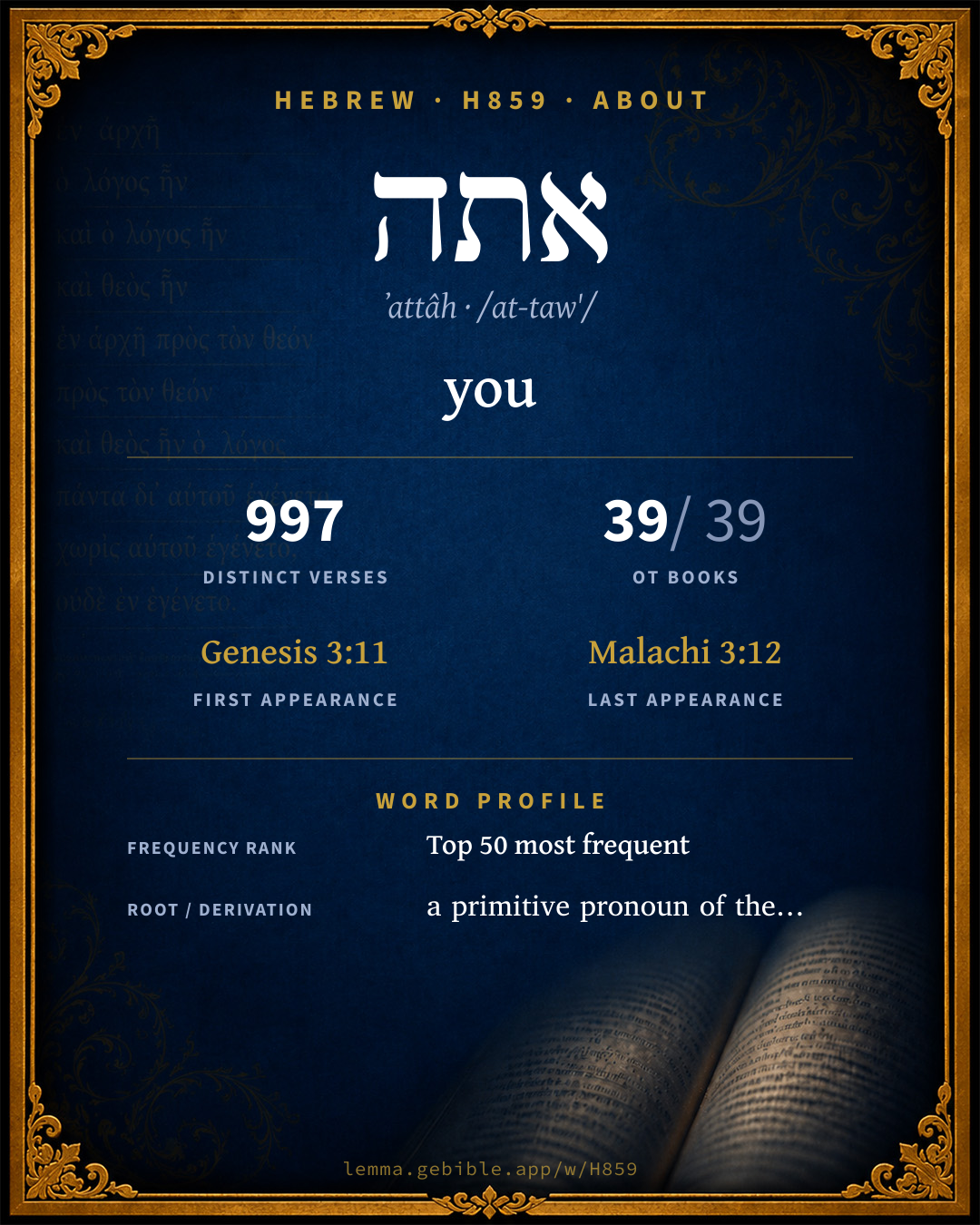
אַתָּ֫ה
you
Full lexicon entry — Brown-Driver-Briggs (BDB)
From Brown-Driver-Briggs (BDB)
Where this word appears
Grammar key — what these labels mean
Part of speech
- Pronoun
- A word standing in for a noun (“he,” “this,” “who”).
Person
- 2nd Person
- The one addressed (“you”).
Gender
- Masculine
- Grammatically masculine.
- Feminine
- Grammatically feminine.
Number
- Singular
- One.
- Plural
- More than one (in Hebrew, generally three or more).
Every verse where H859 appears in the Book of Exodus — 50 distinct verses. Click any verse to open its interlinear word-by-word view. Verse text shown in the World English Bible for context — . Each verse’s Hebrew form is shown with its reference; the English is not keyword-highlighted, since the data carries no word-level English alignment. Use “Compare translations” on any verse to read it across multiple English versions. This concordance covers the Hebrew Bible; Septuagint (Greek Old Testament) occurrences are not indexed here.
Exodus
- Exodus 2:14 אַתָּ֣ה pron pers 2ms He said, "Who made you a prince and a judge over us? Do you plan to kill me, as you killed the Egyptian?" Moses was afraid, and said, "Surely this thing is known."
- Exodus 3:5 אַתָּה֙ pron pers 2ms He said, "Don't come close. Take off your sandals from off your feet, for the place you are standing on is holy ground."
- Exodus 3:18 אַתָּה֩ pron pers 2ms They will listen to your voice, and you shall come, you and the elders of Israel, to the king of Egypt, and you shall tell him, 'Yahweh, the God of the Hebrews, has met with us. Now please let us go three days' journey into the wilderness, that we may sacrifice to Yahweh, our God.'
- Exodus 4:16 וְ/אַתָּ֖ה conj + pron pers 2ms He will be your spokesman to the people; and it will happen, that he will be to you a mouth, and you will be to him as God.
- Exodus 4:25 אַתָּ֖ה pron pers 2ms Then Zipporah took a flint, and cut off the foreskin of her son, and cast it at his feet; and she said, "Surely you are a bridegroom of blood to me."
- Exodus 5:11 אַתֶּ֗ם pron pers 2mp Go yourselves, get straw where you can find it, for nothing of your work shall be diminished."
- Exodus 5:17 אַתֶּ֖ם אַתֶּ֣ם pron pers 2mp pron pers 2mp But he said, "You are idle! You are idle! Therefore you say, 'Let us go and sacrifice to Yahweh.'
- Exodus 7:2 אַתָּ֣ה pron pers 2ms You shall speak all that I command you; and Aaron your brother shall speak to Pharaoh, that he let the children of Israel go out of his land.
- Exodus 8:2 אַתָּ֖ה pron pers 2ms If you refuse to let them go, behold, I will plague all your borders with frogs:
- Exodus 9:2 אַתָּ֖ה pron pers 2ms For if you refuse to let them go, and hold them still,
- Exodus 9:30 וְ/אַתָּ֖ה conj + pron pers 2ms But as for you and your servants, I know that you don't yet fear Yahweh God."
- Exodus 10:4 אַתָּ֖ה pron pers 2ms Or else, if you refuse to let my people go, behold, tomorrow I will bring locusts into your country,
- Exodus 10:11 אַתֶּ֣ם pron pers 2mp Not so! Go now you who are men, and serve Yahweh; for that is what you desire!" They were driven out from Pharaoh's presence.
- Exodus 10:25 אַתָּ֛ה pron pers 2ms Moses said, "You must also give into our hand sacrifices and burnt-offerings, that we may sacrifice to Yahweh our God.
- Exodus 11:8 אַתָּה֙ pron pers 2ms All these your servants shall come down to me, and bow down themselves to me, saying, 'Get out, and all the people who follow you; and after that I will go out.'" He went out from Pharaoh in hot anger.
- Exodus 12:13 אַתֶּ֣ם pron pers 2mp The blood shall be to you for a token on the houses where you are: and when I see the blood, I will pass over you, and there shall no plague be on you to destroy you, when I strike the land of Egypt.
- Exodus 12:22 וְ/אַתֶּ֗ם conj + pron pers 2mp You shall take a bunch of hyssop, and dip it in the blood that is in the basin, and strike the lintel and the two side-posts with the blood that is in the basin; and none of you shall go out of the door of his house until the morning.
- Exodus 12:31 אַתֶּ֖ם pron pers 2mp He called for Moses and Aaron by night, and said, "Rise up, get out from among my people, both you and the children of Israel; and go, serve Yahweh, as you have said!
- Exodus 13:4 אַתֶּ֣ם pron pers 2mp This day you go forth in the month Abib.
- Exodus 14:14 וְ/אַתֶּ֖ם conj + pron pers 2mp Yahweh will fight for you, and you shall be still."
- Exodus 14:16 וְ/אַתָּ֞ה conj + pron pers 2ms Lift up your rod, and stretch out your hand over the sea, and divide it: and the children of Israel shall go into the midst of the sea on dry ground.
- Exodus 16:8 אַתֶּ֥ם pron pers 2mp Moses said, "Now Yahweh shall give you meat to eat in the evening, and in the morning bread to satisfy you; because Yahweh hears your murmurings which you murmur against him. And who are we? Your murmurings are not against us, but against Yahweh."
- Exodus 18:14 אַתָּ֤ה אַתָּ֤ה pron pers 2ms pron pers 2ms When Moses' father-in-law saw all that he did to the people, he said, "What is this thing that you do for the people? Why do you sit alone, and all the people stand around you from morning to evening?"
- Exodus 18:17 אַתָּ֖ה pron pers 2ms Moses' father-in-law said to him, "The thing that you do is not good.
- Exodus 18:18 אַתָּ֕ה pron pers 2ms You will surely wear away, both you, and this people that is with you; for the thing is too heavy for you. You are not able to perform it yourself alone.
- Exodus 18:19 אַתָּ֣ה אַתָּ֛ה pron pers 2ms pron pers 2ms Listen now to my voice. I will give you counsel, and God be with you. You represent the people before God, and bring the causes to God.
- Exodus 18:21 וְ/אַתָּ֣ה conj + pron pers 2ms Moreover you shall provide out of all the people able men, such as fear God: men of truth, hating unjust gain; and place such over them, to be rulers of thousands, rulers of hundreds, rulers of fifties, and rulers of tens.
- Exodus 19:4 אַתֶּ֣ם pron pers 2mp 'You have seen what I did to the Egyptians, and how I bore you on eagles' wings, and brought you to myself.
- Exodus 19:6 וְ/אַתֶּ֧ם conj + pron pers 2mp and you shall be to me a kingdom of priests, and a holy nation.' These are the words which you shall speak to the children of Israel."
- Exodus 19:23 אַתָּ֞ה pron pers 2ms Moses said to Yahweh, "The people can't come up to Mount Sinai, for you charged us, saying, 'Set bounds around the mountain, and sanctify it.'"
- Exodus 19:24 אַתָּ֖ה pron pers 2ms Yahweh said to him, "Go down and you shall bring Aaron up with you, but don't let the priests and the people break through to come up to Yahweh, lest he break forth on them."
- Exodus 20:10 אַתָּ֣ה pron pers 2ms but the seventh day is a Sabbath to Yahweh your God. You shall not do any work in it, you, nor your son, nor your daughter, your man-servant, nor your maid-servant, nor your cattle, nor your stranger who is within your gates;
- Exodus 20:19 אַתָּ֥ה pron pers 2ms They said to Moses, "Speak with us yourself, and we will listen; but don't let God speak with us, lest we die."
- Exodus 20:22 אַתֶּ֣ם pron pers 2mp Yahweh said to Moses, "This is what you shall tell the children of Israel: 'You yourselves have seen that I have talked with you from heaven.
- Exodus 23:9 וְ/אַתֶּ֗ם conj + pron pers 2mp "You shall not oppress an alien, for you know the heart of an alien, seeing you were aliens in the land of Egypt.
- Exodus 24:1 אַתָּה֙ pron pers 2ms He said to Moses, "Come up to Yahweh, you, and Aaron, Nadab, and Abihu, and seventy of the elders of Israel; and worship from a distance.
- Exodus 25:40 אַתָּ֥ה pron pers 2ms See that you make them after their pattern, which has been shown to you on the mountain.
- Exodus 27:20 וְ/אַתָּ֞ה conj + pron pers 2ms "You shall command the children of Israel, that they bring to you pure olive oil beaten for the light, to cause a lamp to burn continually.
- Exodus 28:1 וְ/אַתָּ֡ה conj + pron pers 2ms "Bring Aaron your brother, and his sons with him, near to you from among the children of Israel, that he may minister to me in the priest's office, even Aaron, Nadab and Abihu, Eleazar and Ithamar, Aaron's sons.
- Exodus 28:3 וְ/אַתָּ֗ה conj + pron pers 2ms You shall speak to all who are wise-hearted, whom I have filled with the spirit of wisdom, that they make Aaron's garments to sanctify him, that he may minister to me in the priest's office.
- Exodus 30:23 וְ/אַתָּ֣ה conj + pron pers 2ms "Also take fine spices: of liquid myrrh, five hundred shekels; and of fragrant cinnamon half as much, even two hundred and fifty; and of fragrant cane, two hundred and fifty;
- Exodus 31:13 וְ/אַתָּ֞ה conj + pron pers 2ms "Speak also to the children of Israel, saying, 'Most assuredly you shall keep my Sabbaths: for it is a sign between me and you throughout your generations; that you may know that I am Yahweh who sanctifies you.
- Exodus 32:22 אַתָּה֙ pron pers 2ms Aaron said, "Don't let the anger of my lord grow hot. You know the people, that they are set on evil.
- Exodus 32:30 אַתֶּ֥ם pron pers 2mp It happened on the next day, that Moses said to the people, "You have sinned a great sin. Now I will go up to Yahweh. Perhaps I shall make atonement for your sin."
- Exodus 33:1 אַתָּ֣ה pron pers 2ms Yahweh spoke to Moses, "Depart, go up from here, you and the people that you have brought up out of the land of Egypt, to the land of which I swore to Abraham, to Isaac, and to Jacob, saying, 'I will give it to your seed.'
- Exodus 33:3 אַ֔תָּה pron pers 2ms to a land flowing with milk and honey: for I will not go up in the midst of you, for you are a stiff-necked people, lest I consume you in the way."
- Exodus 33:5 אַתֶּ֣ם pron pers 2mp Yahweh said to Moses, "Tell the children of Israel, 'You are a stiff-necked people. If I were to go up into your midst for one moment, I would consume you. Therefore now take off your jewelry from you, that I may know what to do to you."
- Exodus 33:12 אַתָּ֞ה וְ/אַתָּה֙ וְ/אַתָּ֤ה pron pers 2ms conj + pron pers 2ms conj + pron pers 2ms Moses said to Yahweh, "Behold, you tell me, 'Bring up this people:' and you haven't let me know whom you will send with me. Yet you have said, 'I know you by name, and you have also found favor in my sight.'
- Exodus 34:10 אַתָּ֨ה pron pers 2ms He said, "Behold, I make a covenant: before all your people I will do marvels, such as have not been worked in all the earth, nor in any nation; and all the people among which you are shall see the work of Yahweh; for it is an awesome thing that I do with you.
- Exodus 34:12 אַתָּ֖ה pron pers 2ms Be careful, lest you make a covenant with the inhabitants of the land where you are going, lest it be for a snare in the midst of you:
About this entry
At a glance — auto-summarized from this page’s data, not written by a person. Every figure links to its source below. This summary describes the numbers; it doesn’t interpret them.
אתה — transliterated ʼattâh — is a Hebrew word carrying the sense “you.” The King James Version usually renders it “thou,” while modern versions prefer “you” (Berean Standard Bible) — see the renderings breakdown. Spanning 997 verses in 39 books, it ranks among the most common words of the Hebrew Bible. Debuting at Genesis 3:11, it then recurs through the corpus. From the same root come אנתה. See the sense tree, 997-verse concordance, and the renderings breakdown below.
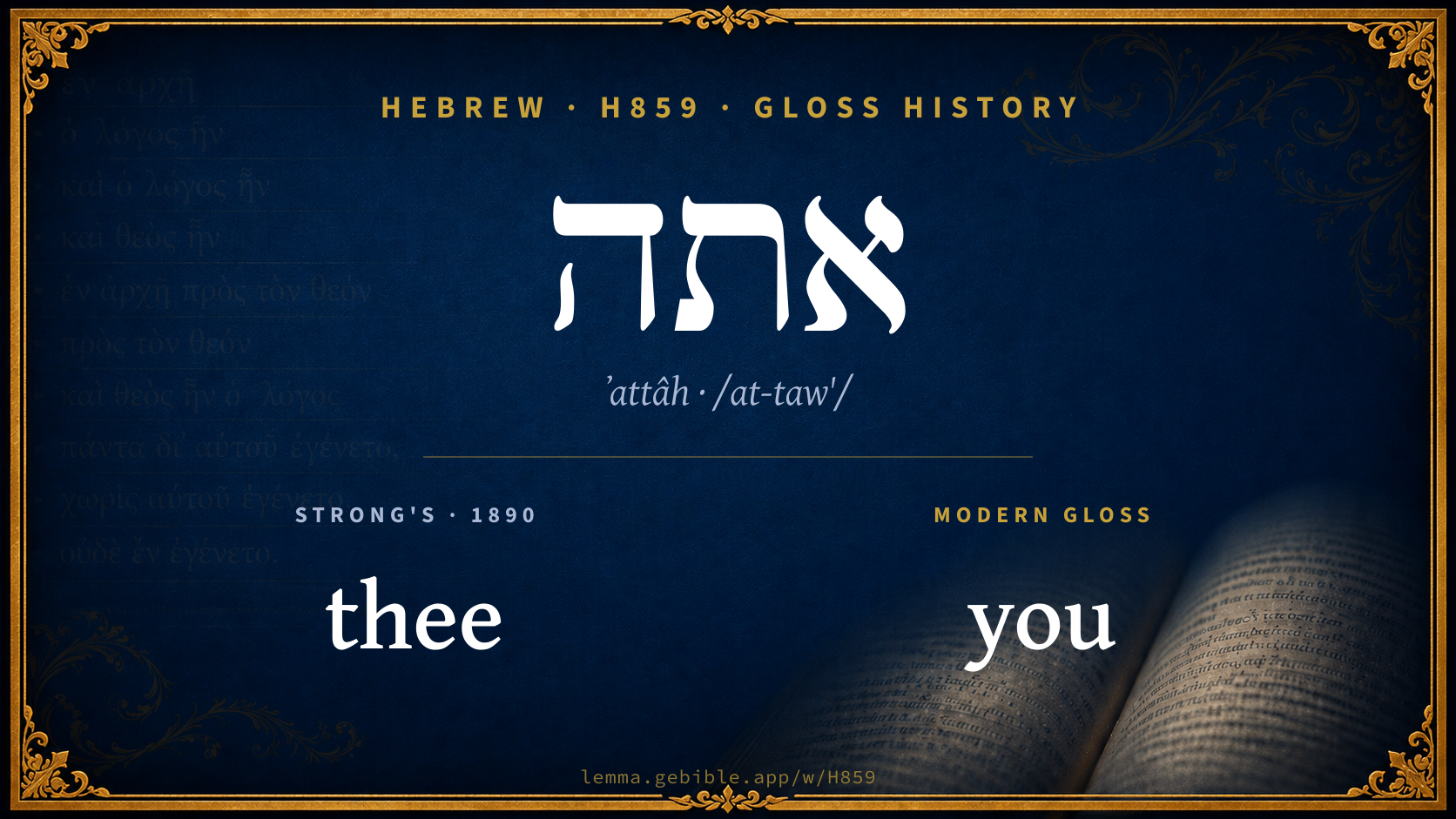
Gloss history
Strong's 1890 vs modern scholarship
About this word
Strong's H859 catalogs a Hebrew word from the Hebrew Old Testament.
These counts are not copied from any lexicon or concordance. They are computed here, from the morphology-tagged Hebrew Old Testament. What Lemma adds →
- 997
- distinct verses
- The word appears in 997 distinct verses.
- 39 / 39
- OT books
- The word appears in 39 of 39 Old Testament books.
- #34
- by frequency
- Top 50 most frequent Hebrew words (rank 34 of 8,640 Hebrew words by occurrence).
View all 997 occurrences in the concordance →
By section of the Old Testament
By traditional corpus
Conventional, traditional groupings — biblical authorship is debated, so this is a traditional corpus grouping, not an authorship claim. Each share is this word’s portion of its verses in that division of the Hebrew canon. Each figure is a share of the word’s 997 distinct verses.
- Prophets (Nevi'im) 517 verses · 52%
- Torah (Pentateuch) 241 verses · 24%
- Writings (Ketuvim) 239 verses · 24%
How translations render this word
Counts come from each version’s own published word-to-Strong’s tagging or interlinear alignment — an approximate guide to how each version renders this word, not a word-level alignment the data otherwise carries. Because each total is that version’s own tagged count, the per-version totals vary from one another and need not match the appearance or distinct-verse counts above. These counts may also differ from a printed concordance because Lemma counts each distinctly tagged rendering and does not collapse phrase taggings into a single head-word total. This is a fixed set of word-tagged versions (KJV, ASV, BSB, ULT) and does not change with the reading translation you choose elsewhere. Each version’s license is shown beside its name below (and on Sources).
BDB lists this Strong’s number as 7 distinct words (homographs). Each count above pools all of them and is not split by sense — see the Senses section below. A low-frequency rendering may belong to a different one of those words, not the primary meaning.
- King James Version†: Thou 5×, Ye 3×
- American Standard Version†: Thou 4×, Ye 3×
- Berean Standard Bible†: You 800×, Are you 49×, Do you 21×
- unfoldingWord Literal Text†: You 833×, Yourself 46×, Are you 42×
King James Version Public Domain
Renders H859 across 11† tagged occurrences — most commonly:
Plus 3 renderings that appear only once — usually multi-word phrases or single function words the recovered tagging swept in, not distinct renderings.
American Standard Version Public Domain
Renders H859 across 11† tagged occurrences — most commonly:
Plus 4 renderings that appear only once — usually multi-word phrases or single function words the recovered tagging swept in, not distinct renderings.
Berean Standard Bible Public Domain
Renders H859 across 1,022† tagged occurrences — most commonly:
Plus other, less common renderings. Plus 34 renderings that appear only once — usually multi-word phrases or single function words the recovered tagging swept in, not distinct renderings. Not rendered by a distinct English word in 67 further occurrences.
unfoldingWord Literal Text CC BY-SA 4.0
Renders H859 across 1,122† tagged occurrences — most commonly:
Plus other, less common renderings. Plus 35 renderings that appear only once — usually multi-word phrases or single function words the recovered tagging swept in, not distinct renderings.
Senses in the full BDB
What do BDB’s symbols mean?
BDB uses these scholarly abbreviations:
| Symbol | Meaning |
|---|---|
| 𝔊 | the Septuagint (the ancient Greek translation, LXX) |
| 𝔙 | the Vulgate (the Latin translation) |
| 𝔖 | the Syriac version (the Peshitta) |
| 𝔗 | the Targum (the Aramaic translation) |
| ψ | the Psalms |
| √ | root (the underlying root or stem) |
| ‖ | parallel passage (a synonymous or contrasted parallel) |
| † | the dagger: every passage where the word occurs is cited |
The 0 senses and sub-senses the full Brown-Driver-Briggs lexicon distinguishes for this word, in lexicon order (not ranked by frequency), with BDB’s own verbatim wording and sub-sense lettering. Shown in Hebrew script with BDB’s own scholarly abbreviations. The condensed entry is in the Lexicon Entry tab. See also the Forms in the corpus table below.
אתה I (so regularly
אתה II on. 2 s. f. thou (fem.) (shortened from אַתִּי (q.v.)
אתה III on. 2 m.pl. you (masc.) (for antem, v. supr.) Gn 9
Senses from the full Brown-Driver-Briggs lexicon (Brown, Driver, Briggs; Oxford 1906 — public domain), digitized via Sefaria, supplemented by the OpenScriptures HebrewLexicon (CC BY 4.0). Full attribution on Sources.
Word origin
I. (so regularly; but 26–7 times, with different disj. accents, אַ֑תָּה: v. FrMM 228; Sta§ 178 a (read 8 for 18) pron. 2 s. m. thou (for anta, v. supr.; cf. נָתַתָּ for נָתַנְתָּ) Gn 3:11, 19 + often. Written אַתָּ †1 S 24:18 ψ 6:4; Jb 1:10; Ec 7:22; Ne 9:6. Appended to a vb. for emph., Ex 18:19(×2) 1 S 17:56 שְׁאַל אַתָּה inquire thou, 20:8; 22:18; Is 43:26 סַפֵּר אַתָּה. Added for the purpose of strengthening a gen. or accus. sf. 1 K 21:19; Pr 22:19 (Ges§ 135, 2).
I. pron. 2 s. f. thou (fem.) (shortened from אַתִּי (q.v.); in Syriac the two genders are written differently, ܐܰܢ̱ܬ݀, ܐܰܢ̱ܬ݀ܝ, but, the ܝ not being sounded, are pronounced alike: in 𝔗 both are written אַתְּ or אַנְתְּ) Gn 12:11, 13; 24:23 + often. Thrice Nu 11:15; Dt 5:24; Ez 28:14 used as a masc. (as in Aramaic of 𝔗); but prob. אַתָּ (v. sub אַתָּה) should be here read.
I. pron. 2 m.pl. you (masc.) (for antem, v. supr.) Gn 9:7; 26:27; 29:4 + often. With הֲ, הָאַתֶּם †Ju 6:31; following the vb. for emph. Ju 15:12; Je 34:15; construed inaccurately with a fem. Ez 13:20.
I. Ez 34:31 (many edd. אַתֶּן), אַתֵּ֫נָה Gn 31:6 Ez 13:11, 20 (edd. אַתֵּ֫נָּה) 34:17 pron. 2 f.pl. you (fem.)
— Brown-Driver-Briggs (Oxford 1906, public domain), digitized via Sefaria, supplemented by the OpenScriptures HebrewLexicon (CC BY 4.0). See Sources.
Origin: a primitive pronoun of the second person
Jastrow Dictionary
A second Hebrew/Aramaic lexicon for comparison, covering Aramaic and post-biblical (Talmudic, Targumic, Midrashic) usage that the biblical-Hebrew BDB does not. Matched by lemma rather than by Strong’s number, so a lemma may carry more than one Jastrow headword (shown separately below), and the entries cover usage well beyond the Bible.
אַתָּה
- ,, v. אָנֹכִי) thou. Ber. 11ᵃ; a. fr.—אתה אומר, v. אַתְּ.—Pl. אַתֶּם, אַתֶּן ye. Ber. I, 1; a. fr.—R. Hash. 25ᵃ א׳ א׳ א׳ ג׳ פעמים וכ׳ three times attem is written (אֹתָם, without ו); v. אֲפִילּוּ. Sifra Emor IX, 9; a. fr.
A Dictionary of the Targumim, the Talmud Babli and Yerushalmi, and the Midrashic Literature (Marcus Jastrow; London, Luzac, 1903) — Public Domain. Digitized via Sefaria. Digitized via Sefaria. Full attribution on Sources.
Forms in the corpus
The 126 distinct written forms H859 takes in the Hebrew Bible, most frequent first — each parse links to that state’s occurrences in the concordance. Hebrew forms include their vowel points and cantillation, so a single lemma takes many written forms.
| Form | Parsing | Example | Uses |
|---|---|---|---|
| אַתָּ֣ה | Pronoun, Personal, 2nd Person, Masculine, Singular | Amos 7:16 | 100 |
| אַתָּ֖ה | Pronoun, Personal, 2nd Person, Masculine, Singular | Deuteronomy 1:37 | 71 |
| אַתָּ֥ה | Pronoun, Personal, 2nd Person, Masculine, Singular | Deuteronomy 7:1 | 67 |
| אַתָּה֙ | Pronoun, Personal, 2nd Person, Masculine, Singular | Deuteronomy 4:35 | 55 |
| וְ/אַתָּ֣ה | Pronoun, Personal, 2nd Person, Masculine, Singular | Daniel 12:4 | 52 |
| אַתֶּ֣ם | Pronoun, Personal, 2nd Person, Masculine, Plural | Deuteronomy 2:4 | 48 |
| אַתָּ֤ה | Pronoun, Personal, 2nd Person, Masculine, Singular | Amos 7:8 | 38 |
| וְ/אַתָּ֖ה | Pronoun, Personal, 2nd Person, Masculine, Singular | Daniel 12:13 | 32 |
| אַתֶּם֙ | Pronoun, Personal, 2nd Person, Masculine, Plural | Deuteronomy 11:31 | 30 |
| אַתֶּ֥ם | Pronoun, Personal, 2nd Person, Masculine, Plural | Amos 9:7 | 28 |
| אָ֑תָּה | Pronoun, Personal, 2nd Person, Masculine, Singular | Daniel 9:23 | 27 |
| וְ/אַתָּה֙ | Pronoun, Personal, 2nd Person, Masculine, Singular | Daniel 8:26 | 27 |
| אָֽתָּה | Pronoun, Personal, 2nd Person, Masculine, Singular | Deuteronomy 9:6 | 22 |
| אַתֶּ֖ם | Pronoun, Personal, 2nd Person, Masculine, Plural | Deuteronomy 12:7 | 21 |
| אַתָּ֛ה | Pronoun, Personal, 2nd Person, Masculine, Singular | Deuteronomy 28:52 | 19 |
| וְ/אַתֶּ֖ם | Pronoun, Personal, 2nd Person, Masculine, Plural | Deuteronomy 1:40 | 17 |
| וְ/אַתָּ֞ה | Pronoun, Personal, 2nd Person, Masculine, Singular | Exodus 14:16 | 16 |
| אַ֔תָּה | Pronoun, Personal, 2nd Person, Masculine, Singular | Exodus 33:3 | 15 |
| אַתָּ֨ה | Pronoun, Personal, 2nd Person, Masculine, Singular | Deuteronomy 2:18 | 15 |
| אַ֭תָּה | Pronoun, Personal, 2nd Person, Masculine, Singular | Job 8:5 | 14 |
| אַתֶּ֛ם | Pronoun, Personal, 2nd Person, Masculine, Plural | Deuteronomy 4:5 | 13 |
| אַתָּ֔ה | Pronoun, Personal, 2nd Person, Masculine, Singular | Deuteronomy 7:6 | 13 |
| וְ/אַתֶּם֙ | Pronoun, Personal, 2nd Person, Masculine, Plural | Deuteronomy 4:4 | 13 |
| וְ/אַתָּ֗ה | Pronoun, Personal, 2nd Person, Masculine, Singular | Amos 7:17 | 13 |
| וְ/אַתָּ֤ה | Pronoun, Personal, 2nd Person, Masculine, Singular | Exodus 33:12 | 13 |
| אַתֶּ֑ם | Pronoun, Personal, 2nd Person, Masculine, Plural | Ezekiel 34:31 | 12 |
| אַ֣תְּ | Pronoun, Personal, 2nd Person, Feminine, Singular | Ezekiel 16:52 | 11 |
| אַתֶּ֔ם | Pronoun, Personal, 2nd Person, Masculine, Plural | Deuteronomy 14:1 | 11 |
| אַתָּ֗ה | Pronoun, Personal, 2nd Person, Masculine, Singular | Deuteronomy 31:7 | 11 |
| וְ/אַתָּ֥ה | Pronoun, Personal, 2nd Person, Masculine, Singular | Deuteronomy 28:43 | 10 |
| אַתֶּ֜ם | Pronoun, Personal, 2nd Person, Masculine, Plural | Deuteronomy 4:26 | 9 |
| אַתֶּ֤ם | Pronoun, Personal, 2nd Person, Masculine, Plural | Deuteronomy 31:13 | 9 |
| אַתָּ֕ה | Pronoun, Personal, 2nd Person, Masculine, Singular | Exodus 18:18 | 9 |
| אַתָּ֞ה | Pronoun, Personal, 2nd Person, Masculine, Singular | Exodus 19:23 | 9 |
| וְ/אַתֶּ֗ם | Pronoun, Personal, 2nd Person, Masculine, Plural | Exodus 12:22 | 9 |
| אַתָּה | Pronoun, Personal, 2nd Person, Masculine, Singular | 1 Chronicles 17:26 | 8 |
| וְ/אַתָּ֛ה | Pronoun, Personal, 2nd Person, Masculine, Singular | Genesis 15:15 | 8 |
| אַ֖תְּ | Pronoun, Personal, 2nd Person, Feminine, Singular | Ezekiel 16:48 | 7 |
| וְ/אַתֶּ֣ם | Pronoun, Personal, 2nd Person, Masculine, Plural | 2 Chronicles 15:7 | 7 |
| אַ֠תָּה | Pronoun, Personal, 2nd Person, Masculine, Singular | Genesis 31:52 | 6 |
| אַתֶּ֞ם | Pronoun, Personal, 2nd Person, Masculine, Plural | Genesis 45:8 | 6 |
| אַתֶּֽם | Pronoun, Personal, 2nd Person, Masculine, Plural | Genesis 42:14 | 6 |
| הַ/אַתָּ֥ה | Pronoun, Personal, 2nd Person, Masculine, Singular | 1 Kings 18:7 | 6 |
| וְ֠/אַתָּה | Pronoun, Personal, 2nd Person, Masculine, Singular | Ezekiel 33:9 | 6 |
| אַתְּ | Pronoun, Personal, 2nd Person, Feminine, Singular | Genesis 39:9 | 5 |
| אַ֖תָּה | Pronoun, Personal, 2nd Person, Masculine, Singular | Habakkuk 2:16 | 5 |
| אַתֶּ֗ם | Pronoun, Personal, 2nd Person, Masculine, Plural | Deuteronomy 12:12 | 5 |
| אַתֶּ֨ם | Pronoun, Personal, 2nd Person, Masculine, Plural | Deuteronomy 20:3 | 5 |
| אתי | Pronoun, Personal, 2nd Person, Feminine, Singular | Ezekiel 36:13 | 5 |
| וְ/אַתֶּ֥ם | Pronoun, Personal, 2nd Person, Masculine, Plural | Haggai 1:9 | 5 |
| אַ֑תָּה | Pronoun, Personal, 2nd Person, Masculine, Singular | Psalms 2:7 | 4 |
| אַ֤תְּ | Pronoun, Personal, 2nd Person, Feminine, Singular | 1 Kings 2:15 | 4 |
| אַתָּֽה | Pronoun, Personal, 2nd Person, Masculine, Singular | 2 Chronicles 20:6 | 4 |
| אַתָּה֩ | Pronoun, Personal, 2nd Person, Masculine, Singular | Exodus 3:18 | 4 |
| אָ֑תְּ | Pronoun, Personal, 2nd Person, Feminine, Singular | Ezekiel 36:13 | 4 |
| וְ/אַתֶּ֞ם | Pronoun, Personal, 2nd Person, Masculine, Plural | Ezekiel 36:8 | 4 |
| וְ/אַתָּ֡ה | Pronoun, Personal, 2nd Person, Masculine, Singular | Exodus 28:1 | 4 |
| וְ/אַתָּ֨ה | Pronoun, Personal, 2nd Person, Masculine, Singular | Ezekiel 5:1 | 4 |
| אַ֝תָּ֗ה | Pronoun, Personal, 2nd Person, Masculine, Singular | Psalms 16:5 | 3 |
| אַתָּ֧ה | Pronoun, Personal, 2nd Person, Masculine, Singular | 1 Kings 18:36 | 3 |
The 60 most common forms are shown; 66 rarer forms follow in the full concordance.
Same root — word family
Other BDB entries built from the same root as H859, grouped by Strong’s listed origin. These share a root / origin per the lexicon — not necessarily a shared meaning. Each links to that word’s own entry.
Derived from this word
Compare all same-root words → They share a root, not necessarily a meaning.
Septuagint verse parallels
This word appears in 904 verses that also exist in the Greek Old Testament (Septuagint), out of the 997 Hebrew verses it occurs in. You can read those verses in Greek by switching the Old Testament edition to the Septuagint.
Read these verses in the Septuagint
- Genesis 3:11
- Exodus 2:14
- Leviticus 10:9
- Numbers 1:3
- Deuteronomy 1:37
- Joshua 1:2
- Judges 2:2
- Ruth 3:9
- 1 Samuel 7:3
- 2 Samuel 1:8
- 1 Kings 1:13
- 2 Kings 1:3
This is a verse-level parallel only — the same verses exist in both the Hebrew and Greek Old Testaments. No word-level Hebrew↔Greek correspondence is claimed: the data carries no such alignment, so no Greek word is shown as this Hebrew word’s translation. Coverage is not total — the Septuagint omits the deuterocanon and renumbers the Psalms, so some Hebrew verses have no direct Greek parallel.