Ruth 3:9

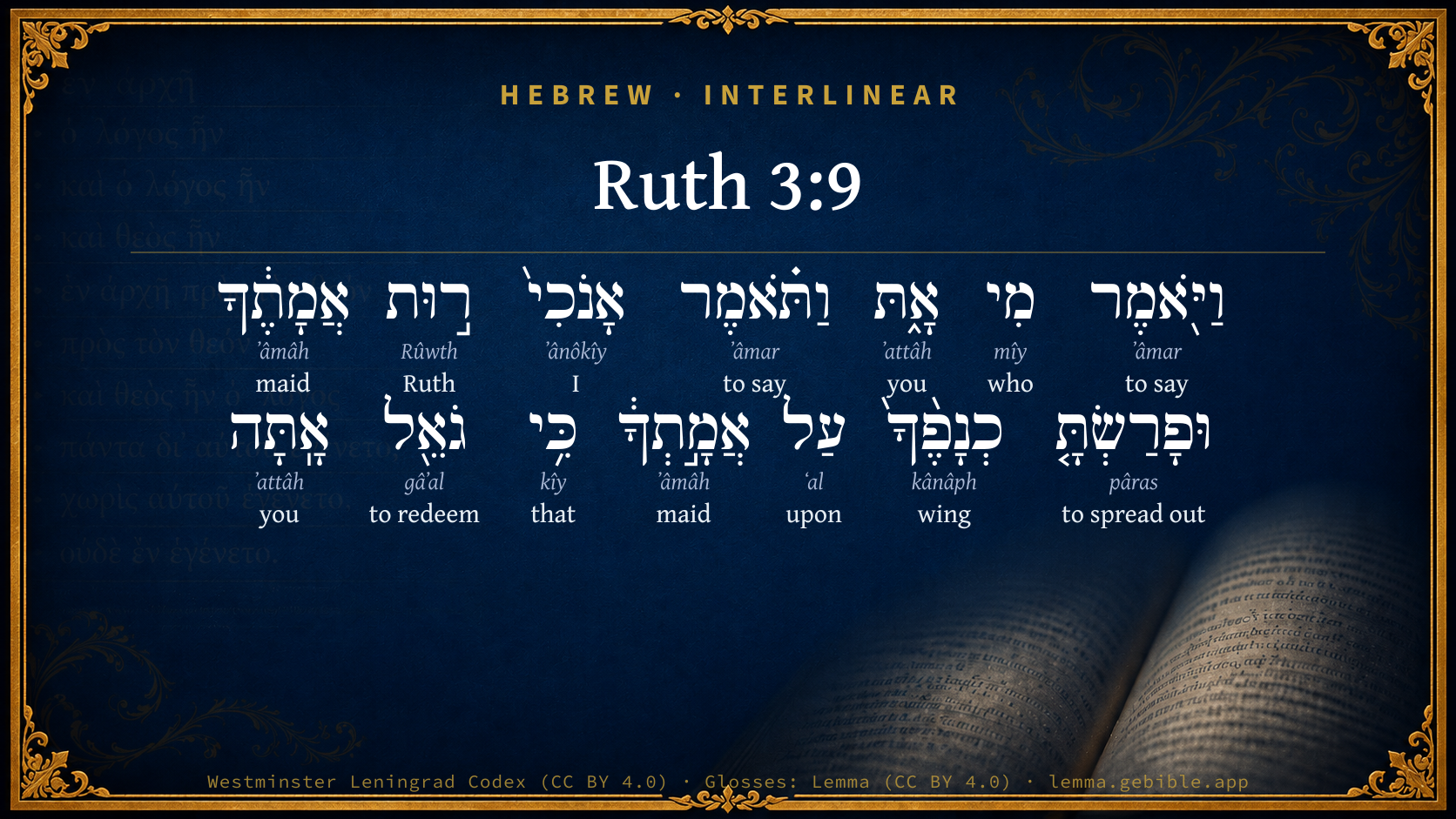
Hebrew (Westminster Leningrad Codex) Ruth 3:9 appears in the Hebrew Old Testament. The text above is from the Westminster Leningrad Codex. Each word links to its Strong’s number, a concise gloss, and parsing drawn from the Open Scriptures Hebrew Bible morphology. Click any word for its full Brown-Driver-Briggs (BDB) entry.
Download image
Cite this verse

Ruth 3:9 (World English Bible). Public Domain. Lemma interlinear Bible study tool, https://lemma.gebible.app/v/ruth/3/9.

Show BibTeX & RIS
BibTeX
RIS
English Translation
He said, Who are you? She answered, I am Ruth your handmaid: spread therefore your skirt over your handmaid; for you are a near kinsman.
World English Bible · Public Domain
Download a study sheet

One document with this verse’s original text, its word-by-word gloss line, the meaning frame, cross-references with their text, attributed commentary, and full source and license credits — printable, and it pastes into notes with its structure intact.

This verse Autodidact and up

Study sheet (.html) Plain text (.txt)

A passage Seminary Student

Up to 50 verses in one chapter. A passage sheet keeps up to 6 commentary sources and 12 cross-references per verse, in the order this page ranks them, and says so on the sheet whenever that leaves anything out. Ask for a single verse and you get the Autodidact verse sheet above.

Everything on this page stays free to read, with no account — the sheet is a download of what is already on screen, not access to it.

Want to remove ads? Support Godless Engineer
Compare translations 3

The same verse in 3 English versions, stacked beneath the original-language interlinear above. Click any original word for its lexicon entry.

Each is an independent rendering of the whole verse — the interlinear is not word-aligned to these translations.

Highlighted words mark where these versions differ — a whole-verse word diff, not a word-by-word alignment.

  • World English Bible Public Domain
    He said, Who are you? She answered, I am Ruth your handmaid: spread therefore your skirt over your handmaid; for you are a near kinsman.
  • King James Version Public Domain
    And he said, Who art thou? And she answered, I am Ruth thine handmaid: spread therefore thy skirt over thine handmaid; for thou art a near kinsman.
  • unfoldingWord Literal Text CC BY-SA 4.0
    And he said, “Who are you?” Then she said, “I am Ruth, your female servant. So spread the edge of your cloak over your female servant, for you are a kinsman-redeemer.”

unfoldingWord Literal Text — © unfoldingWord, licensed CC BY-SA 4.0. Word-aligned USFM3 via Door43 (git.door43.org/unfoldingWord/en_ult).

Versions to compare (up to 4)

3 of 4 selected

Show all 18 translations

Every available English version of this verse, each an independent rendering of the whole verse.

  • World English Bible Public Domain
    He said, Who are you? She answered, I am Ruth your handmaid: spread therefore your skirt over your handmaid; for you are a near kinsman.
  • Berean Standard Bible Public Domain
    “Who are you?” he asked. “I am your servant Ruth,” she replied. “Spread the corner of your garment over me, for you are a kinsman-redeemer.”
  • Majority Standard Bible Public Domain
    “Who are you?” he asked. “I am your servant Ruth,” she replied. “Spread the corner of your garment over me, for you are a kinsman-redeemer.”
  • King James Version Public Domain
    And he said, Who art thou? And she answered, I am Ruth thine handmaid: spread therefore thy skirt over thine handmaid; for thou art a near kinsman.
  • American Standard Version (1901) Public Domain
    And he said, Who art thou? And she answered, I am Ruth thy handmaid: spread therefore thy skirt over thy handmaid; for thou art a near kinsman.
  • Revised Version (1885) Public Domain
    And he said, Who art thou? And she answered, I am Ruth thine handmaid: spread therefore thy skirt over thine handmaid; for thou art a near kinsman.
  • Geneva Bible (1599) Public Domain
    Then he sayd, Who art thou? And she answered, I am Ruth thine handmayd: spread therefore the wing of thy garment ouer thine handmayd: for thou art the kinsman.
  • Douay-Rheims (1899) Public Domain
    And he said to her: Who art thou? And she answered: I am Ruth thy handmaid: spread thy coverlet over thy servant, for thou art a near kinsman.
  • Young's Literal Translation Public Domain
    And he saith, `Who `art' thou?' and she saith, `I `am' Ruth thy handmaid, and thou hast spread thy skirt over thy handmaid, for thou `art' a redeemer.'
  • Literal Standard Version CC BY-SA 4.0
    And he says, “Who [are] you?” And she says, “I [am] Ruth your handmaid, and you have spread your skirt over your handmaid, for you [are] a redeemer.”
  • Unlocked Literal Bible CC BY-SA 4.0
    He said, “Who are you?” She answered, “I am Ruth, your female servant. Spread your cloak over your female servant, for you are a near kinsman.”
  • unfoldingWord Literal Text CC BY-SA 4.0
    And he said, “Who are you?” Then she said, “I am Ruth, your female servant. So spread the edge of your cloak over your female servant, for you are a kinsman-redeemer.”
  • Darby Bible Public Domain
    And he said, Who art thou? And she answered, I am Ruth, thy handmaid: spread thy skirt over thy handmaid; for thou hast the right of redemption.
  • World Messianic Bible Public Domain
    He said, “Who are you?” She answered, “I am Ruth your servant. Therefore spread the corner of your garment over your servant; for you are a near kinsman.”
  • Webster's Bible Public Domain
    And he said, Who art thou? And she answered, I am Ruth thy handmaid: spread therefore thy skirt over thy handmaid; for thou art a near kinsman.
  • Free Bible Version CC BY-SA 4.0
    “Who are you?” he asked. “I'm Ruth, your servant,” she replied. “Please spread the corner of your cloak over me, for you are my family redeemer.”
  • Bible in Basic English Public Domain
    And he said, Who are you? And she answering said, I am your servant Ruth: take your servant as wife, for you are a near relation.
  • JPS Tanakh (1917) Public Domain
    And he said: 'Who art thou?' And she answered: 'I am Ruth thine handmaid; spread therefore thy skirt over thy handmaid; for thou art a near kinsman.'

Literal Standard Version (2020), Covenant Press — licensed CC BY-SA 4.0. Text via the HelloAO Bible API (eBible.org). Unlocked Literal Bible (unfoldingWord) — licensed CC BY-SA 4.0. Text via the HelloAO Bible API (eBible.org). unfoldingWord Literal Text — © unfoldingWord, licensed CC BY-SA 4.0. Word-aligned USFM3 via Door43 (git.door43.org/unfoldingWord/en_ult). Free Bible Version, Dr. Jonathan Gallagher — licensed CC BY-SA 4.0. Text via the HelloAO Bible API (eBible.org).

Word by word

More ways to search: Search by grammar → Find every occurrence → Compare this word →

Practice this passage: Drill this verse → Learn its vocabulary →

ר֣וּת
Rûwth
H7327
“Ruth”
Noun, Proper
Part of Speech
Noun
Type
Proper
Full BDB Definition

Origin: probably for H7468

TWOT: None

Ruth = "friendship" - daughter-in-law of Naomi, wife of Boaz, and grandmother of David
  1. וַיֹּ֖אמֶר ʼâmar H559 “and · to say” Conjunction + Verb, Qal, Sequential Imperfect, 3rd Person, Masculine, Singular
  2. מִי mîy H4310 “who” Particle, Interrogative
  3. אָ֑תּ ʼattâh H859 “you” Pronoun, Personal, 2nd Person, Feminine, Singular
  4. וַתֹּ֗אמֶר ʼâmar H559 “and · to say” Conjunction + Verb, Qal, Sequential Imperfect, 3rd Person, Feminine, Singular
  5. אָנֹכִי֙ ʼânôkîy H595 “I” Pronoun, Personal, 1st Person, Common, Singular
  6. אֲמָתֶ֔ךָ ʼâmâh H519 “maid · your” Noun, Common, Feminine, Singular, Construct + Suffix, Personal, 2nd Person, Masculine, Singular
  7. וּפָרַשְׂתָּ֤ pâras H6566 “and · to spread out” Conjunction + Verb, Qal, Sequential Perfect, 2nd Person, Masculine, Singular
  8. כְנָפֶ֨ךָ֙ kânâph H3671 “wing · your” Noun, Common, Feminine, Singular, Construct + Suffix, Personal, 2nd Person, Masculine, Singular
  9. עַל ʻal H5921 “upon” Preposition
  10. אֲמָ֣תְךָ֔ ʼâmâh H519 “maid · your” Noun, Common, Feminine, Singular, Construct + Suffix, Personal, 2nd Person, Masculine, Singular
  11. כִּ֥י kîy H3588 “that” Conjunction
  12. גֹאֵ֖ל gâʼal H1350 “redeeming” Verb, Qal, Participle Active, Masculine, Singular, Absolute
  13. אָֽתָּה ʼattâh H859 “you” Pronoun, Personal, 2nd Person, Masculine, Singular

About this verse

These counts appear in no published source. They are computed here, from the morphology-tagged text and Lemma’s own curated glosses. What Lemma adds →

14
words
11
distinct lemmas
Historical
section

Notable vocabulary

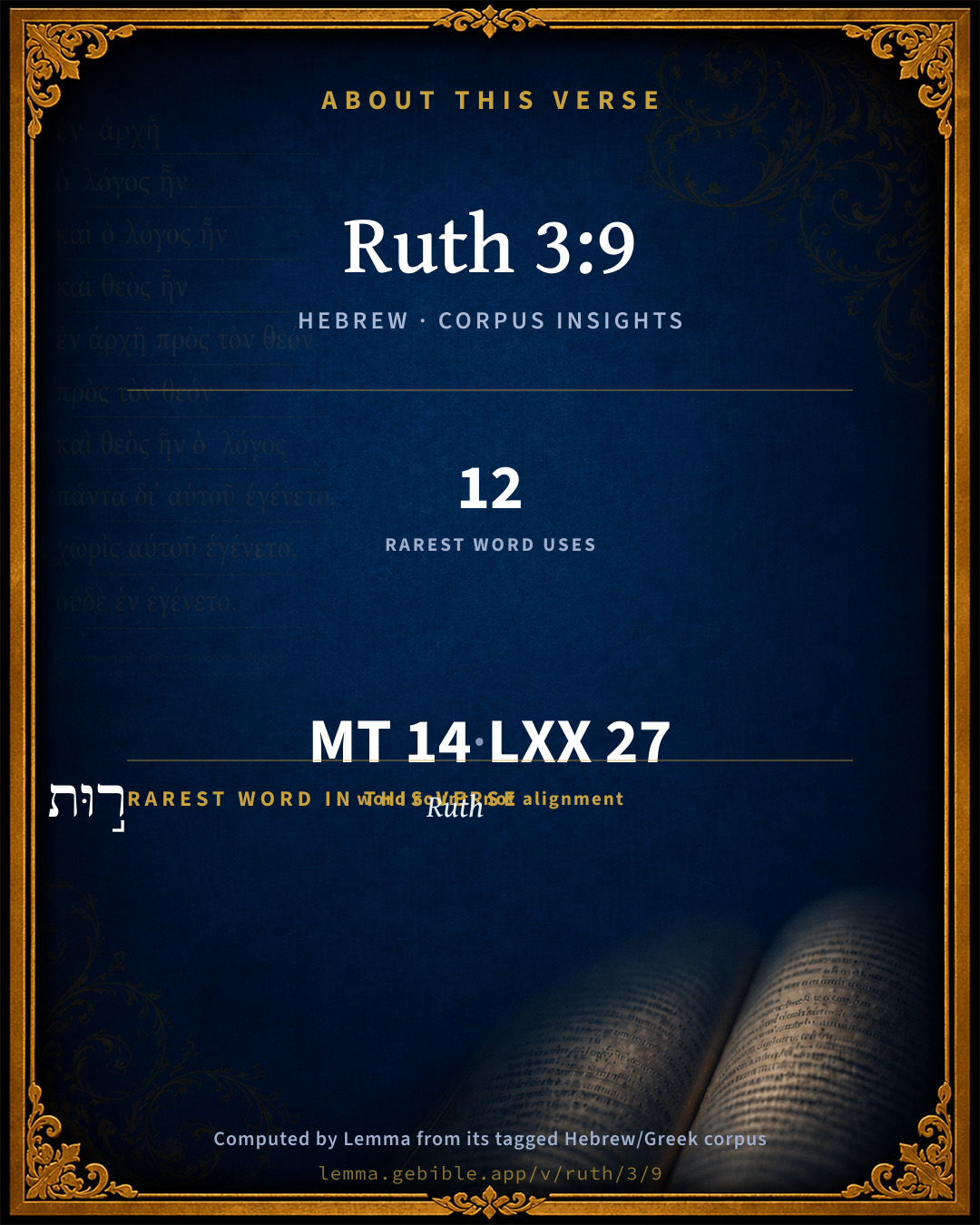
The rarest word here is ר֣וּת Ruth H7327 — appearing just 12 times in the whole Hebrew Bible.

Shared distinctive vocabulary

ר֣וּת Ruth H7327 occurs in 12 verses of the Hebrew Bible. Also found in:

Grammatical profile

  • 4 verbs
  • 4 nouns
  • 3 pronouns
  • 1 preposition
  • 1 conjunction
  • 1 particle

Verb forms

  • וַיֹּ֖אמֶר Qal · Sequential Imperfect
  • וַתֹּ֗אמֶר Qal · Sequential Imperfect
  • וּפָרַשְׂתָּ֤ Qal · Sequential Perfect
  • גֹאֵ֖ל Qal · Participle Active

Repetition

Words recur within this verse — often emphatic in Hebrew:

  • וַיֹּ֖אמֶר to say H559 ×2
  • אֲמָתֶ֔ךָ maid H519 ×2
  • אָ֑תּ you H859 ×2

Hebrew & Septuagint length

In English translation the verse runs 25 words from the Hebrew and 27 from the Septuagint (LXX English) — closely comparable.

A rough comparison of the two English renderings, which tokenize alike — not a word-level alignment.

Word counts can differ between the Hebrew and the Greek without any difference in meaning — e.g. the Hebrew direct-object marker אֵת has no separate Greek word, and Greek often adds the article ὁ.

In the original languages it is 14 Hebrew tokens and 27 Greek tokens — but the two are counted differently (Hebrew bundles its prefixes and suffixes into one token; the Greek is in lemma form), so that isn’t a like-for-like length.

Cross-references

6

Topical passages linked to Ruth 3:9 in the Treasury of Scripture Knowledge — connected by theme and wording, ordered by reader-vote popularity; previews shown in the World English Bible.

  • Ezekiel 16:8 Now when I passed by you, and looked at you, behold, your time was the time of love; and I spread my skirt over you, and covered your nakedness: yes, I swore to you, and entered into a covenant with you, says the Lord Yahweh, and you became mine.
  • Ruth 2:20 Naomi said to her daughter-in-law, Blessed be he of Yahweh, who has not left off his kindness to the living and to the dead. Naomi said to her, The man is a close relative to us, one of our near kinsmen.
  • Ruth 3:12 Now it is true that I am a near kinsman; however there is a kinsman nearer than I.
  • Ruth 2:10–13 Then she fell on her face, and bowed herself to the ground, and said to him, Why have I found favor in your sight, that you should take knowledge of me, seeing I am a foreigner?
  • Luke 14:11 For everyone who exalts himself will be humbled, and whoever humbles himself will be exalted."
  • 1 Samuel 25:41 She arose, and bowed herself with her face to the earth, and said, Behold, your handmaid is a servant to wash the feet of the servants of my lord.

Cross-references courtesy of OpenBible.info (CC BY 4.0).

Hebrew and Greek witnesses Masoretic Hebrew ↔ Greek Septuagint

The same verse in the two great witnesses to the Old Testament, shown verse-for-verse.

These are two independent witnesses, not word-aligned to each other, and the Septuagint is shown in lemma (dictionary) form.

Hebrew Ruth 3:9 Masoretic · Westminster Leningrad Codex

וַיֹּ֖אמֶר מִי אָ֑תּ וַתֹּ֗אמֶר אָנֹכִי֙ ר֣וּת אֲמָתֶ֔ךָ וּפָרַשְׂתָּ֤ כְנָפֶ֨ךָ֙ עַל אֲמָ֣תְךָ֔ כִּ֥י גֹאֵ֖ל אָֽתָּה

He said, Who are you? She answered, I am Ruth your handmaid: spread therefore your skirt over your handmaid; for you are a near kinsman.

World English Bible · Public Domain

Greek LXX Ruth 3:9 Septuagint · lemma form

εἶπον δέ τίς εἰμί σύ ὁ δέ εἶπον ἐγώ εἰμί ρουθ ὁ δούλη σύ καί περιβάλλω ὁ πτερυγίον σύ ἐπί ὁ δούλη σύ ὅτι ἀγχιστεύς εἰμί σύ

And he said, Who are you? and she said, I am your handmaid Ruth; spread therefore your skirt over your handmaid, for you are a near relation.

LXX2012 (modern English Septuagint) · Public Domain

On this verse, Haydock's Catholic Bible Commentary discusses the Septuagint’s reading. Read the note in Commentary ↓

Hebrew: Westminster Leningrad Codex (CC BY 4.0). Greek: Septuagint (public domain); English from LXX2012 (modern English Septuagint) (Public Domain). How the Septuagint differs from the Hebrew →

Commentary

Notes on Ruth 3:9 from classic Christian and Jewish commentators (each source and its license shown beneath its notes). The classic Christian expositions comment on the surrounding passage and are grouped to its opening verse, so a note may address several verses; the Jewish commentaries on the Tanakh (Rashi and others) are per-verse, so they appear only where the commentator wrote on this verse.

Lemma curates 59 commentaries, every one of them public domain or Creative Commons licensed, each selected and text-cleaned for this edition rather than reprinted as found. About our sources →

Trapp's Complete Commentary

John Trapp

Rth 3:9 And he said, Who [art] thou? And she answered, I [am] Ruth thine handmaid: spread therefore thy skirt over thine handmaid; for thou [art] a near kinsman.

Ver. 9. Spread therefore thy skirt.] Tostatus thinketh that by this speech she desired him to lie with her; which is gross. Rather, hereby she desired him to marry her - see Eze 16:8, - and as a husband to nourish and cherish her; {Eph 5:29} and he understandeth her no otherwise, as appeareth by his answer.

For thou art a near kinsman.] And so hast the right of redemption, and reason to raise up seed to my deceased husband. Let us go boldly to Jesus Christ our elder Brother, and say to him in like sort, Thou, Lord, art my near and dear kinsman, Oh spread thy skirt over me, &c.

John Trapp, A Commentary or Exposition upon All the Books of the Old and New Testament (1647–1656) — public domain. Text from a community e-Sword module.

Tyndale Open Study Notes

Tyndale Open Resources

3:9 your servant: Ruth deliberately identified herself with the female workers. • Spread . . . your covering over me: This was a way of asking Boaz to marry her (cp. Ezek 16:8). • Ruth appealed to Boaz’s status as a family redeemer (Hebrew go’el) to persuade him to marry her (see Ruth 4:5; “The Family Redeemer” Theme Note).

Tyndale Open Study Notes — © Tyndale Open Resources, licensed CC BY-SA 4.0. Text via the HelloAO Bible API.

Jamieson, Fausset & Brown

Robert Jamieson, A. R. Fausset & David Brown

I am Ruth thine handmaid: spread therefore thy skirt over thine handmaid; for thou art a near kinsman--She had already drawn part of the mantle over her; and she asked him now to do it, that the act might become his own. To spread a skirt over one is, in the East, a symbolical action denoting protection. To this day in many parts of the East, to say of anyone that he put his skirt over a woman, is synonymous with saying that he married her; and at all the marriages of the modern Jews and Hindus, one part of the ceremony is for the bridegroom to put a silken or cotton cloak around his bride.

Jamieson, Fausset & Brown — Commentary Critical and Explanatory on the Whole Bible (1871) — public domain (CC PDM 1.0). Text via the HelloAO Bible API.

Adam Clarke's Commentary

Verse 9. Spread therefore thy skirt over thine hand maid] Hebrew, Spread thy wing. The wing is the emblem of protection, and is a metaphor taken from the young of fowls, which run under the wings of their mothers, that they may be saved from birds of prey. The meaning here is, Take me to thee for wife; and so the Targum has translated it, Let thy name be called on thy handmaid to take me for wife, because thou art the redeemer; i.e., thou art the גאל goel, the kinsman, to whom the right of redemption belongs. See on Ru 2:20. Even to the present day, when a Jew marries a woman, he throws the skirt or end of his talith over her, to signify that he has taken her under his protection.

Adam Clarke's Commentary on the Bible (1810–1826) — public domain. Text from a community e-Sword/MySword module.

Ellicott's Commentary for English Readers

(9) Skirt.—Literally wing; Heb. canaph, as in Rth_2:12. The Targum treats this as in itself the claim to espousal on her part. The metaphor may be illustrated from Eze_16:8, and more generally from Mat_23:37.

A Bible Commentary for English Readers, edited by Charles John Ellicott (1878–1897) — public domain. Text from a community e-Sword module.

The Cambridge Bible for Schools and Colleges

gen. ed. J. J. S. Perowne

9. spread therefore thy skirt over thy handmaid] This symbolic act denoted that the kinsman claimed the widow as his wife. Cf. Eze_16:8. The custom prevailed among the early Arabs; a good illustration is given in Ṭabarî’s commentary on the Koran (Sura 4:23, forbidding men to ‘inherit women against their will’): ‘In the Jâhilîya, when a man’s father or brother or son died and left a widow, the dead man’s heir, if he came at once and threw his garment over her, had the right to marry her under the dowry of [i.e. already paid by] her [deceased] lord, or to give her in marriage and take her dowry. But if she anticipated him and went off to her own people, then the disposal of her hand belonged to herself’; Robertson Smith, Kinship etc., p. 87. See also Sale’s translation of the Koran (Warne & Co.), p. 56 and note.

a near kinsman] The primary meaning of the Hebr. go’el is ‘one who enforces a claim’ which has lapsed; so ‘one who re-claims’ or ‘re-vindicates.’ Hence the verb is used of redeeming a house or field after it has been sold, or an Israelite who has been obliged to sell himself as a slave (Lev_25:25 ff., Lev_25:47 ff.), or something which has been vowed to Jehovah; in the expression go’el had-dâm, ‘the avenger of blood,’ Deu_19:6; Deu_19:12 etc., it denotes ‘one who vindicates the rights of the murdered man;’ see Driver in loc. But since a man was not as a rule able himself to redeem a right which had lapsed, the duty fell upon his family and more particularly upon his nearest relative; in this way go’el came to mean ‘the next of kin.’ Boaz, however, was not the nearest relative (Rth_3:12), so he could not act unless the next of kin declined; nor did the Pentatenchal law require the go’el to marry the widow of the deceased in addition to redeeming his property, though custom sanctioned the marriage. Hence Ruth’s appeal to the generosity of Boaz.

The Cambridge Bible for Schools and Colleges (gen. ed. J. J. S. Perowne; Cambridge University Press, 1878–1918) — public domain. Text from a community e-Sword module.

John Gill's Exposition

And he said, who art thou?.... He spoke quick and short, as one displeased, or however surprised and frightened, just coming out of sleep, and in the night:

and she answered, I am Ruth thine handmaid; that had gleaned in his fields with his maidens, and with whom he had conversed there, and knew her by name:

spread therefore thy skirt over thy handmaid; which seems to account for the reason of her uncovering his feet, or turning up the skirt of his garment that was upon them; not through wantonness and immodesty, but to direct him, when opportunity offered, to spread it over her as a token of his taking her in marriage, and of her being under his care and protection, and of her subjection to him; so the Targum,"let thy name be called upon me to take me for a wife,''Whether the custom now used with the Jews at marriage, for a man to cast the skirt of his "talith", or outward garment, over the head of his spouse, and cover it, was in use so early, is questionable; and yet something like it seems to have been done, as this phrase intimates, and to which there is an allusion in Eze 16:8. So Jarchi,"spread the skirt of thy garments to cover me with thy talith, and this is expressive of marriage;''and Aben Ezra says, it intimates taking her to him for wife; though as the word signifies a wing, the allusion may be to the wings of birds spread over their young, to cherish and protect them, which are acts to be done by a man to his wife:

for thou art a near kinsman; as she had been informed by Naomi, to whom the right of redemption of her husband's estate belonged, and in whom it lay to marry her, and raise up seed to his kinsman, her former husband.

John Gill's Exposition of the Whole Bible (1746–1763) — public domain (CC PDM 1.0). Text via the HelloAO Bible API.

Albert Barnes' Notes on the Bible

Spread thy skirt ... - The phrase indicates receiving and acknowledging her as a wife.

Albert Barnes' Notes on the Bible (1834–1885) — public domain. Text from a community e-Sword/MySword module.

Haydock's Catholic Bible Commentary

Kinsman. Hebrew, "a redeemer;" (Calmet) one bound to defend and to espouse a brother’s widow, if others more nearly akin refuse. (Haydock) --- Ruth modestly admonishes him of this duty, and begs that he would take her to wife, (Calmet) as he might then have done without any other formality. (Serarius, q. vii.) --- We find a similar expression [in] Ezechiel xvi. 8., and Deuteronomy xxii. 80. Some think that she only asked for protection. The custom of the husband, stretching a part of his garment over his bride, was perhaps already established among the Hebrews. (Calmet) --- Hebrew and Septuagint, "stretch thy wing over," &c. Chaldean, "Let thy name be invoked upon thy handmaid, to take me to wife." (Menochius; Isaias iv. 1.)

George Leo Haydock (1774–1849), Haydock's Catholic Family Bible and Commentary, 1859 edition — public domain. Excludes Psalms (Douay-Rheims chapter numbering differs from Protestant) and Deuterocanonical books (Catholic canon only).

Matthew Poole's English Annotations

Spread thy skirt over thine hand-maid, i.e. take me to be thy wife, and perform the duty of an husband to me. This phrase is used in this sense Deu 22:30; 27:20; Eze 16:8. Either, first, Because the wife is admitted into the same bed with her husband, and both are covered with one and the same covering. Or, secondly, From an ancient ceremony of the husband’s throwing the skirt of his garment over her head, in token both of her subjection, 1Co 11:5,6,10, and appropriation to him, being hereby as it were hid from the eyes of others; see Gen 20:16; and also of that protection which he oweth to her: see Rth 2:12.

Matthew Poole's English Annotations on the Holy Bible (1683–1685) — public domain. Text from a community e-Sword/MySword module.

Whedon's Commentary on the Bible

Daniel D. Whedon

9. Spread… thy skirt over thine handmaid — Literally, spread thy wing. The meaning is, Take me into the protection and intimacy of the marriage relation. The figure, taken originally from birds that cover their young with their wings for protection, is appropriately used of the marriage state. Thus in Eze_16:8, Jehovah represents himself as spreading his wing over Jerusalem in the time of love, and thus taking her to wife. Also in Deu_22:30; Deu_27:20, a man guilty of incest is represented as one that uncovereth his father’s wing, or skirt, because he meddles with that which is closed and legally sealed to all but the married pair.

Thou art a near kinsman — A goel, from whom I have a legal right to claim this relation.

Daniel D. Whedon (gen. ed.), Commentary on the Old and New Testaments (1874–1909) — public domain. Text from a community e-Sword module.

The Pulpit Commentary

And he said, Who art thou? And she said, I am Ruth, thy handmaid; and thou hast spread thy wings over thy handmaid, for thou art kinsman. The Syriac translator spoils the question of Boaz by metamorphosing it from Who art thou?" into What is thy message?" Tremulous would be the voice of Ruth as she replied, "I am Ruth, thy handmaid." What she said in continuance has been very generally, and by Driver, among others ("Hebrew Tenses," p. 135), misapprehended. Not by Raabe, however. It has been regarded as a petition presented to Boaz thy wings (or, thy wing) over thy handmaid, for thou art kinsman." The literal translation, however, and far the more delicate idea, as also far the more effective representation, is, "And thou hast spread thy wings over thy handmaid, for thou art kinsman." Ruth explains her position under Boaz"s coverlet as if it were his own deliberate act. Such is her felicitous way of putting the ease. It is as if she had said, "The position in which thy handmaid actually is exhibits the true relation in which thou standest to thy handmaid. She is under thy wings. Thou hast benignantly spread them over her, for thou art kinsman." The Masorites have correctly regarded pnk as a scriptio defectiva for the dual of the noun, and hence have punctuated it "thy wings." The majority of interpreters, however, have assumed that the word is singular, and have hence translated it as if it had been punctuated The dual reading is to be preferred. Boaz himself had represented Ruth as having come trustfully under the wings of Yahveh. (see Rth_2:12) She accepted the representation. It was beautifully true. But, as she was well aware that God often works through human agency, she now recognized the Divine hand in the kindness of Boaz. Thou hast spread thy wings over thine handmaid." She was under his wings because she had come under the wings of Yahveh. She felt like a little timid chicken; but she had found a refuge. It is the wings of tender, gentle, sheltering care that are referred to. There is only indirect allusion to the typical coverlet under which she lay. For thou art kinsman. (see Rth_2:20) The native modesty of Ruth led her to account for her position by a reference to the law of kinship. She had rights, and she stood upon them. She conceived that Boaz had correlative duties to discharge; but we may be sure that she would never have made the least reference to her rights, or to the correlative duties which she regarded as devolving on Boaz, had she not known that his heart was already hers.

His touch had satisfied him that it was a woman who was at his feet. Who was she? Ruth at once declared herself, no doubt in accents of sweet modesty. The statement with which she follows up the declaration of herself is variously interpreted. In King James"s version there are two departures from literality.

1. The word skirt is not a literal rendering of the Hebrew term. Wings is the proper translation.

2. The entreaty Spread therefore is also a departure from literality. The verb is not in the imperative, but in the affirmative And thou hast spread. It is Ruth"s own interpretation of the position of affairs. She had come to Judaea to take shelter under the wings of Jehovah; and Boaz had, on his part, in harmony with the heavenly kindness of Jehovah, spread over her his wings of terrestrial kindness. She thus does not speak at all of Boaz"s skirt, or skirts. There was beautiful delicacy in her representation. She did not need to enter into particular details. Her position, viewed in the light of custom, explained the whole case.

The Pulpit Commentary (1880–1919), ed. H.D.M. Spence-Jones & Joseph S. Exell — public domain. Text from a community e-Sword module.

John Wesley's Explanatory Notes

Spread thy Skirt - That is, take me to be thy wife, and perform the duty of an husband to me.

John Wesley, Explanatory Notes Upon the Whole Bible (1754–1765) — public domain. Text via the GEBible commentary corpus.

Keil & Delitzsch

C. F. Keil & F. Delitzsch

In answer to his inquiry, "Who art thou?" she said, "I am Ruth, thine handmaid; spread thy wing over thine handmaid, for thou art a redeemer." כּנפך is a dual according to the Masoretic pointing, as we cannot look upon it as a pausal form on account of the position of the word, but it is most probably to be regarded as a singular; and the figurative expression is not taken from birds, which spread their wings over their young, i.e., to protect them, but refers, according to Deu 23:1; Deu 27:20, and Eze 16:8, to the wing, i.e., the corner of the counterpane, referring to the fact that a man spreads this over his wife as well as himself. Thus Ruth entreated Boaz to marry her because he was a redeemer. On this reason for the request, see the remarks in the introduction to the chapter.

Keil & Delitzsch — Biblical Commentary on the Old Testament (1861–1891) — public domain (CC PDM 1.0). Text via the HelloAO Bible API. (Old Testament only.)

Rashi

Rabbi Shlomo Yitzchaki (Rashi)

and you shall spread your skirt the skirt of your garments to cover me with your cloak, and this is a term connoting marriage.

for you are a near kinsman to redeem my husband’s estate, as it is written (Lev. 25:25): “then his near kinsman who is closest to him shall come and redeem, etc.” My mother-in-law and I must sell our estate, and now it is incumbent upon you to buy [it]. Acquire me also, along with it, so that the name of the deceased be remembered on his estate. When I come to the field, they will say: This is Mahlon’s wife.

Rashi on the Tanakh — English translations: “The Judaica Press complete Tanach with Rashi, translated by A. J. Rosenberg” (CC BY 4.0); “Pentateuch with Rashi's commentary by M. Rosenbaum and A.M. Silbermann, 1929-1934” (public domain); “The Metsudah Tanach series, Lakewood, N.J” (CC BY 4.0); and “The Book of Joshua, Metsudah Publications, 1997” (CC BY 4.0). Text via Sefaria.

Ibn Ezra

Rabbi Abraham ibn Ezra

"ופרשת (and you shall spread):" A hint to take her as a wife.

"כי גואל אתה (for you are a kinsman-redeemer):" For this is the custom of all Israel, as No῾omi had informed her.

Ibn Ezra on the Tanakh — English translations: “Sefaria Community Translation” (CC0 1.0 (public-domain dedication)); “Yalkut, Sifsei Chachomim Chumash, Metsudah Publications, 2009” (CC BY 4.0); and “Commentary of Ibn Ezra on Isaiah - trans. by M. Friedlander, 1873” (public domain). Text via Sefaria.

Lesson kit

Teaching starters — assembled from the data on this page, not authored interpretation. Every prompt links to the verse data it draws on. Edit before teaching.

Ruth, in the Historical, opens this verse with 14 words (11 distinct Hebrew lemmas). Its most distinctive word is Rûwth (“Ruth”). A historical commentator’s framing appears above. Read the whole chapter for the surrounding context.

Discussion questions

  1. What does “Ruth” (Rûwth) contribute to the verse as a whole?
  2. How does Ruth 1:4, which shares the word «Ruth», read alongside this verse?
  3. What does the repetition of “to say” (2× in this one verse) do in this verse?
  4. The translations on this page render this verse differently — a whole-verse word diff, not a word-by-word alignment. What might account for the different wordings?
  5. «וַיֹּ֖אמֶר» is a Qal Sequential Imperfect verb. How does that grammatical form shape the action described?
  6. Compare how Trapp's Complete Commentary and Tyndale Open Study Notes read this verse. Where do they agree or differ?

Things to notice

Reading settings

Reading text

Shown beneath each verse's original-language words.

Old Testament
Old Testament edition

Read the OT as the Masoretic Hebrew (MT) or the Greek Septuagint (LXX).

English shown for the Greek Septuagint (in the Hebrew ↔ Greek comparison).

Comparing translations? Open the Compare panel on any verse page to stack up to four side by side.