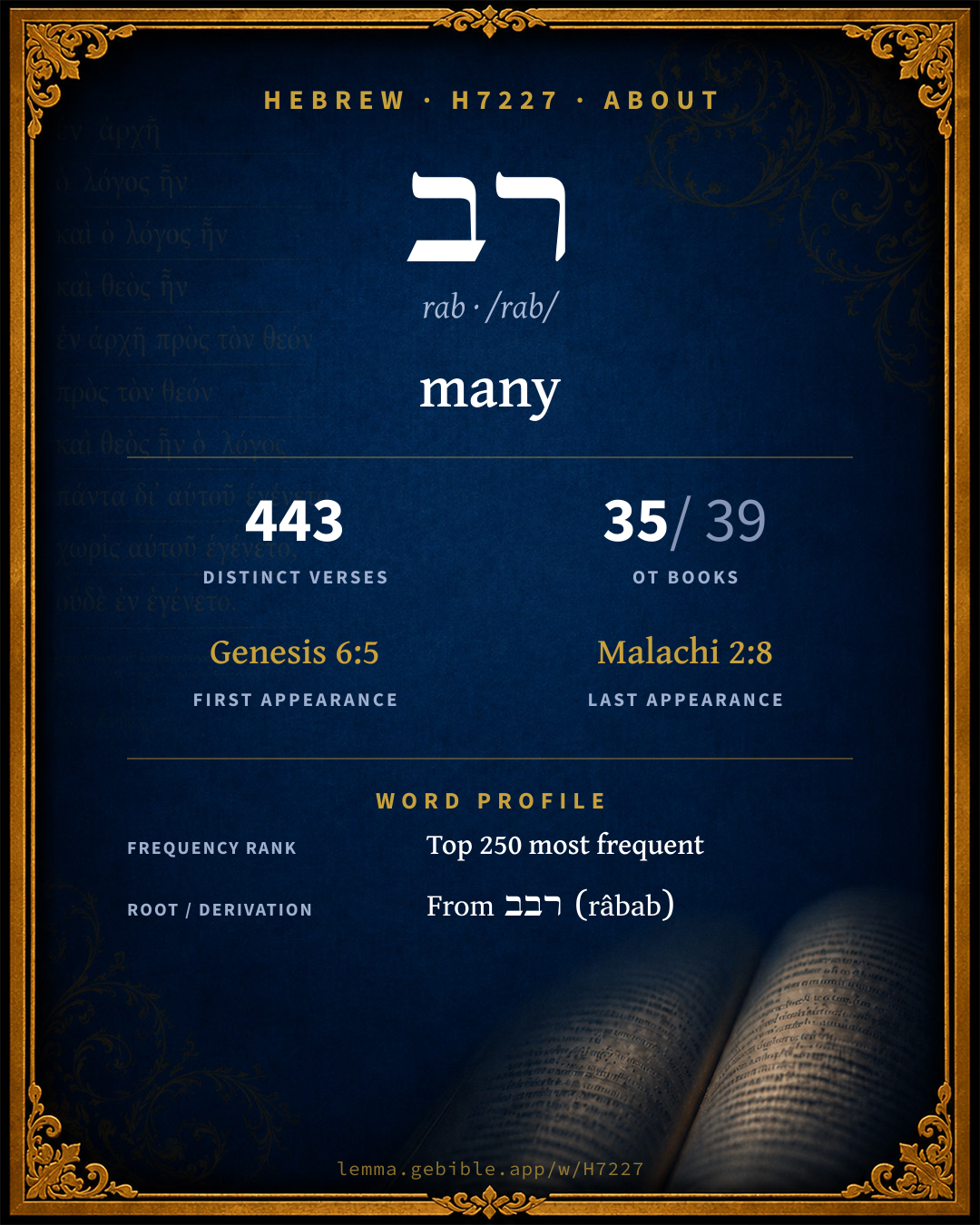
רַב
many
also: much, great fuller range ↓
Full lexicon entry — Brown-Driver-Briggs (BDB)
From Brown-Driver-Briggs (BDB)
Where this word appears
See every Absolute-state word in the Hebrew Bible →
Grammar key — what these labels mean
Part of speech
- Adjective
- A word that describes or qualifies a noun.
- Noun
- A naming word — a person, place, thing, or idea.
- Verb
- An action or state-of-being word.
Noun type
- Common
- A common noun — a general class of person, place, or thing (“king,” “city,” “water”), not a specific name.
Stem
- Qal
- The basic, simple active stem — the plain form of the verb (“he wrote”).
Form
- Sequential Perfect
- A perfect with prefixed waw continuing a preceding imperfect or command (waw-consecutive perfect).
- Participle Active
- A verbal adjective expressing ongoing or characteristic action (“writing / one who writes”).
- Perfect
- A completed action or state — Hebrew marks aspect (completeness) more than strict tense (“he wrote”).
State
- Absolute
- The independent form of a noun, not bound to a following word.
- Construct
- A noun bound to a following noun in a possessive / “of” relationship (the construct chain).
Person
- 3rd Person
- The one spoken about (“he / she / it / they”).
Gender
- Masculine
- Grammatically masculine.
- Feminine
- Grammatically feminine.
Number
- Plural
- More than one (in Hebrew, generally three or more).
- Singular
- One.
Grammatical forms 12 distinct
- Adjective, Adjective, Masculine, Plural, Absolute 200 times (43%)
- Adjective, Adjective, Masculine, Singular, Absolute 119 times (26%)
- Adjective, Adjective, Feminine, Singular, Absolute 36 times (8%)
- Adjective, Adjective, Feminine, Plural, Absolute 31 times (7%)
- Noun, Common, Masculine, Singular, Construct 31 times (7%)
- Adjective, Adjective, Masculine, Singular, Construct 24 times (5%)
- Adjective, Adjective, Feminine, Singular, Construct 13 times (3%)
- Verb, Qal, Sequential Perfect, 3rd Person, Feminine, Singular 2 times (0%)
+4 more forms (5 occurrences)
Parsed forms decoded from the imported morphology (morphhb / Westminster Leningrad Codex — WLC text public domain, morphhb tagging CC BY 4.0), counted across 461 parsed occurrences — not distinct verses.
Page 3 of 3 — showing verses 401–443 of 443 distinct verses where H7227 appears, across 35 books. Click any verse to open its interlinear word-by-word view. Verse text shown in the World English Bible for context — . Each verse’s Hebrew form is shown with its reference; the English is not keyword-highlighted, since the data carries no word-level English alignment. Use “Compare translations” on any verse to read it across multiple English versions. This concordance covers the Hebrew Bible; Septuagint (Greek Old Testament) occurrences are not indexed here.
Daniel 23 verses
- Daniel 11:26 רַבִּֽים adj Adjective mp Yes, they who eat of his dainties shall destroy him, and his army shall overflow; and many shall fall down slain.
- Daniel 11:33 לָֽ/רַבִּ֑ים prep det + Adjective Adjective mp Those who are wise among the people shall instruct many; yet they shall fall by the sword and by flame, by captivity and by spoil, [many] days.
- Daniel 11:34 רַבִּ֖ים adj Adjective mp Now when they shall fall, they shall be helped with a little help; but many shall join themselves to them with flatteries.
- Daniel 11:39 בָּֽ/רַבִּ֔ים prep det + Adjective Adjective mp He shall deal with the strongest fortresses by the help of a foreign god: whoever acknowledges [him] he will increase with glory; and he shall cause them to rule over many, and shall divide the land for a price.
- Daniel 11:40 רַבּ֑וֹת adj Adjective fp At the time of the end shall the king of the south contend with him; and the king of the north shall come against him like a whirlwind, with chariots, and with horsemen, and with many ships; and he shall enter into the countries, and shall overflow and pass through.
- Daniel 11:41 וְ/רַבּ֖וֹת conj + Adjective Adjective fp He shall enter also into the glorious land, and many [countries] shall be overthrown; but these shall be delivered out of his hand: Edom, and Moab, and the chief of the children of Ammon.
- Daniel 11:44 רַבִּֽים adj Adjective mp But news out of the east and out of the north shall trouble him; and he shall go forth with great fury to destroy and utterly to sweep away many.
- Daniel 12:2 וְ/רַבִּ֕ים conj + Adjective Adjective mp Many of those who sleep in the dust of the earth shall awake, some to everlasting life, and some to shame and everlasting contempt.
- Daniel 12:3 הָֽ/רַבִּ֔ים ptcl def.art + Adjective Adjective mp Those who are wise shall shine as the brightness of the expanse; and those who turn many to righteousness as the stars forever and ever.
- Daniel 12:4 רַבִּ֖ים adj Adjective mp But you, Daniel, shut up the words, and seal the book, even to the time of the end: many shall run back and forth, and knowledge shall be increased."
- Daniel 12:10 רַבִּ֔ים adj Adjective mp Many shall purify themselves, and make themselves white, and be refined; but the wicked shall do wickedly; and none of the wicked shall understand; but those who are wise shall understand.
Hosea 3 verses
- Hosea 3:3 רַבִּים֙ adj Adjective mp I said to her, "You shall stay with me many days. You shall not play the prostitute, and you shall not be with any other man. I will also be so toward you."
- Hosea 3:4 רַבִּ֗ים adj Adjective mp For the children of Israel shall abide many days without king, and without prince, and without sacrifice, and without sacred stone, and without ephod or idols.
- Hosea 9:7 וְ/רַבָּ֖ה conj + Adjective Adjective fs The days of visitation have come. The days of reckoning have come. Israel will consider the prophet to be a fool, And the man who is inspired to be insane, Because of the abundance of your sins, And because your hostility is great.
Joel 4 verses
- Joel 2:2 רַ֣ב adj Adjective ms A day of darkness and gloominess, A day of clouds and thick darkness. As the dawn spreading on the mountains, A great and strong people; There has never been the like, Neither will there be any more after them, Even to the years of many generations.
- Joel 2:11 רַ֤ב adj Adjective ms Yahweh thunders his voice before his army; For his forces are very great; For he is strong who obeys his command; For the day of Yahweh is great and very awesome, And who can endure it?
- Joel 2:13 וְ/רַב conj + Adjective Adjective ms cs Tear your heart, and not your garments, And turn to Yahweh, your God; For he is gracious and merciful, Slow to anger, and abundant in loving kindness, And relents from sending calamity.
- Joel 3:13 רַבָּ֖ה adj Adjective fs Put in the sickle; For the harvest is ripe. Come, tread, for the winepress is full, The vats overflow, for their wickedness is great."
Amos 6 verses
- Amos 3:9 רַבּוֹת֙ adj Adjective fp Proclaim in the palaces at Ashdod, And in the palaces in the land of Egypt, And say, "Assemble yourselves on the mountains of Samaria, And see what unrest is in her, And what oppression is among them."
- Amos 3:15 רַבִּ֖ים adj Adjective mp I will strike the winter house with the summer house; And the houses of ivory will perish, And the great houses will have an end," says Yahweh.
- Amos 5:12 רַבִּ֣ים adj Adjective mp For I know how many your offenses, And how great are your sins-- You who afflict the just, Who take a bribe, And who turn aside the needy in the courts.
- Amos 6:2 רַ֥ב adj Adjective ms Go to Calneh, and see; And from there go to Hamath the great; Then go down to Gath of the Philistines. Are they better than these kingdoms? Or is their border greater than your border?
- Amos 7:4 רַבָּ֔ה adj Adjective fs Thus the Lord Yahweh showed me and, behold, the Lord Yahweh called for judgment by fire; and it dried up the great deep, and would have devoured the land.
- Amos 8:3 רַ֣ב adj Adjective ms The songs of the temple will be wailings in that day," says the Lord Yahweh. "The dead bodies will be many. In every place they will throw them out with silence.
Jonah 3 verses
- Jonah 1:6 רַ֣ב n c ms cs So the shipmaster came to him, and said to him, "What do you mean, sleeper? Arise, call on your gods! Maybe the gods will notice us, so that we won't perish."
- Jonah 4:2 וְ/רַב conj + Adjective Adjective ms cs He prayed to Yahweh, and said, "Please, Yahweh, wasn't this what I said when I was still in my own country? Therefore I hurried to flee to Tarshish, for I knew that you are a gracious God, and merciful, slow to anger, and abundant in loving kindness, and you repent of the evil.
- Jonah 4:11 רַבָּֽה adj Adjective fs Shouldn't I be concerned for Nineveh, that great city, in which are more than one hundred twenty thousand persons who can't discern between their right hand and their left hand; and also much cattle?"
Micah 6 verses
- Micah 4:2 רַבִּ֗ים adj Adjective mp Many nations will go and say, "Come, and let us go up to the mountain of Yahweh, And to the house of the God of Jacob; And he will teach us of his ways, And we will walk in his paths." For out of Zion will go forth the law, And the word of Yahweh from Jerusalem;
- Micah 4:3 רַבִּ֔ים adj Adjective mp And he will judge between many peoples, And will decide concerning strong nations afar off. They will beat their swords into plowshares, And their spears into pruning hooks. Nation will not lift up sword against nation, Neither will they learn war any more.
- Micah 4:11 רַבִּ֑ים adj Adjective mp Now many nations have assembled against you, that say, 'Let her be defiled, And let our eye gloat over Zion.'
- Micah 4:13 רַבִּ֑ים adj Adjective mp Arise and thresh, daughter of Zion; For I will make your horn iron, And I will make your hoofs brass; And you will beat in pieces many peoples: And I will devote their gain to Yahweh, And their substance to the Lord of the whole earth.
- Micah 5:7 רַבִּ֔ים adj Adjective mp The remnant of Jacob will be in the midst of many peoples, Like dew from Yahweh, Like showers on the grass, That don't wait for man, Nor wait for the sons of men.
- Micah 5:8 רַבִּ֔ים adj Adjective mp The remnant of Jacob will be among the nations, In the midst of many peoples, Like a lion among the animals of the forest, Like a young lion among the flocks of sheep; Who, if he goes through, treads down and tears in pieces, And there is no one to deliver.
Nahum 1 verse
Habakkuk 3 verses
- Habakkuk 2:8 רַבִּ֔ים adj Adjective mp Because you have plundered many nations, all the remnant of the peoples will plunder you, because of men's blood, and for the violence done to the land, to the city and to all who dwell in it.
- Habakkuk 2:10 רַבִּ֖ים adj Adjective mp You have devised shame to your house, by cutting off many peoples, and have sinned against your soul.
- Habakkuk 3:15 רַבִּֽים adj Adjective mp You trampled the sea with your horses, Churning mighty waters.
Zechariah 4 verses
- Zechariah 2:11 רַבִּ֤ים adj Adjective mp Many nations shall join themselves to Yahweh in that day, and shall be my people; and I will dwell in the midst of you, and you shall know that Yahweh of Hosts has sent me to you.
- Zechariah 8:20 רַבּֽוֹת adj Adjective fp Thus says Yahweh of Hosts: "Many peoples, and the inhabitants of many cities will yet come;
- Zechariah 8:22 רַבִּים֙ adj Adjective mp Yes, many peoples and strong nations will come to seek Yahweh of Hosts in Jerusalem, and to entreat the favor of Yahweh."
- Zechariah 14:13 רַבָּ֖ה adj Adjective fs It will happen in that day, that a great panic from Yahweh will be among them; and they will lay hold everyone on the hand of his neighbor, and his hand will rise up against the hand of his neighbor.
Malachi 2 verses
- Malachi 2:6 וְ/רַבִּ֖ים conj + Adjective Adjective mp The law of truth was in his mouth, and unrighteousness was not found in his lips. He walked with me in peace and uprightness, and turned many away from iniquity.
- Malachi 2:8 רַבִּ֖ים adj Adjective mp But you have turned aside out of the way. You have caused many to stumble in the law. You have corrupted the covenant of Levi," says Yahweh of Hosts.
About this entry
At a glance — auto-summarized from this page’s data, not written by a person. Every figure links to its source below. This summary describes the numbers; it doesn’t interpret them.
At its core, רב (rab) means “many.” Scripture first uses it in Genesis 6:5. Spanning 443 verses in 35 books, it ranks among the common words of the Hebrew Bible. Not a single-sense word: its full sense range also takes in “much” and “great”. From the same root come רבב, רב and רבב. Dig into 443-verse concordance and the renderings breakdown below.
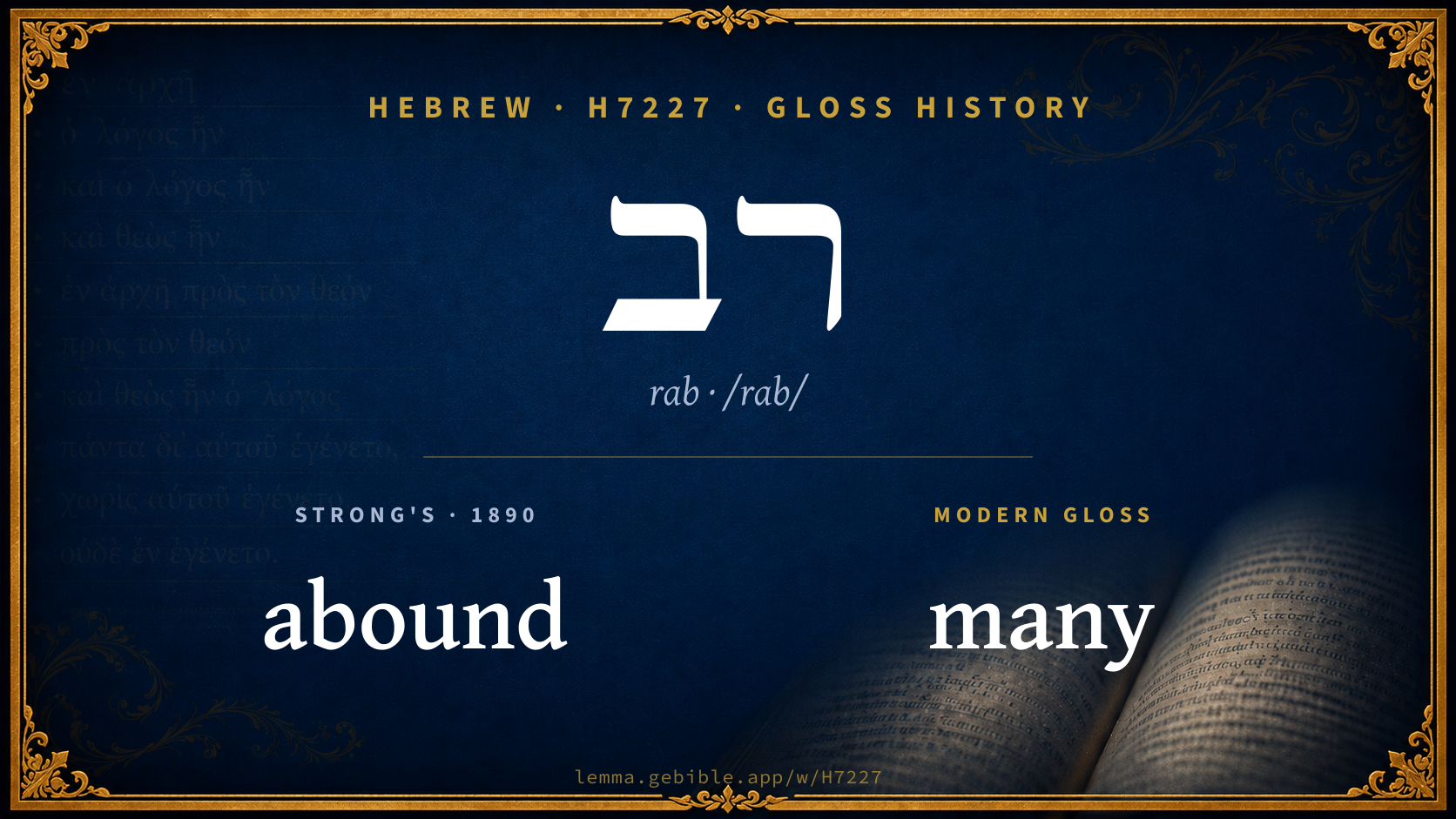
Gloss history
Strong's 1890 vs modern scholarship
About this word
Strong's H7227 catalogs a Hebrew word from the Hebrew Old Testament.
These counts are not copied from any lexicon or concordance. They are computed here, from the morphology-tagged Hebrew Old Testament. What Lemma adds →
- 443
- distinct verses
- The word appears in 443 distinct verses.
- 35 / 39
- OT books
- The word appears in 35 of 39 Old Testament books.
- #108
- by frequency
- Top 250 most frequent Hebrew words (rank 108 of 8,640 Hebrew words by occurrence).
View all 443 occurrences in the concordance →
By section of the Old Testament
By traditional corpus
Conventional, traditional groupings — biblical authorship is debated, so this is a traditional corpus grouping, not an authorship claim. Each share is this word’s portion of its verses in that division of the Hebrew canon. Each figure is a share of the word’s 443 distinct verses.
- Prophets (Nevi'im) 192 verses · 43%
- Writings (Ketuvim) 188 verses · 42%
- Torah (Pentateuch) 63 verses · 14%
How translations render this word
Counts come from each version’s own published word-to-Strong’s tagging or interlinear alignment — an approximate guide to how each version renders this word, not a word-level alignment the data otherwise carries. Because each total is that version’s own tagged count, the per-version totals vary from one another and need not match the appearance or distinct-verse counts above. These counts may also differ from a printed concordance because Lemma counts each distinctly tagged rendering and does not collapse phrase taggings into a single head-word total. This is a fixed set of word-tagged versions (KJV, ASV, BSB, ULT) and does not change with the reading translation you choose elsewhere. Each version’s license is shown beside its name below (and on Sources).
BDB lists this Strong’s number as 4 distinct words (homographs). Each count above pools all of them and is not split by sense — see the Senses section below. A low-frequency rendering may belong to a different one of those words, not the primary meaning.
- King James Version†: Many 130×, Great 73×, Captain 22×
- American Standard Version†: Many 118×, Great 57×, Captain 22×
- Berean Standard Bible†: Many 146×, Great 53×, Captain 24×
- unfoldingWord Literal Text†: Many 193×, Great 62×, Much 21×
King James Version Public Domain
Renders H7227 across 456† tagged occurrences — most commonly:
Plus other, less common renderings. Plus 114 renderings that appear only once — usually multi-word phrases or single function words the recovered tagging swept in, not distinct renderings. Not rendered by a distinct English word in 2 further occurrences.
American Standard Version Public Domain
Renders H7227 across 457† tagged occurrences — most commonly:
Plus other, less common renderings. Plus 136 renderings that appear only once — usually multi-word phrases or single function words the recovered tagging swept in, not distinct renderings.
Berean Standard Bible Public Domain
Renders H7227 across 444† tagged occurrences — most commonly:
Plus other, less common renderings. Plus 94 renderings that appear only once — usually multi-word phrases or single function words the recovered tagging swept in, not distinct renderings. Not rendered by a distinct English word in 10 further occurrences.
unfoldingWord Literal Text CC BY-SA 4.0
Renders H7227 across 452† tagged occurrences — most commonly:
Plus other, less common renderings. Plus 67 renderings that appear only once — usually multi-word phrases or single function words the recovered tagging swept in, not distinct renderings.
12 senses and sub-senses in the full BDB
What do BDB’s symbols mean?
BDB uses these scholarly abbreviations:
| Symbol | Meaning |
|---|---|
| 𝔊 | the Septuagint (the ancient Greek translation, LXX) |
| 𝔙 | the Vulgate (the Latin translation) |
| 𝔖 | the Syriac version (the Peshitta) |
| 𝔗 | the Targum (the Aramaic translation) |
| ψ | the Psalms |
| √ | root (the underlying root or stem) |
| ‖ | parallel passage (a synonymous or contrasted parallel) |
| † | the dagger: every passage where the word occurs is cited |
The 12 senses and sub-senses the full Brown-Driver-Briggs lexicon distinguishes for this word, in lexicon order (not ranked by frequency), with BDB’s own verbatim wording and sub-sense lettering. Shown in Hebrew script with BDB’s own scholarly abbreviations. The condensed entry is in the Lexicon Entry tab. See also the Forms in the corpus table below.
רב I much, many, great
- a. (1) much: of substances, gold 1 K 10:2 ψ 19:11, silver (money) 2 K 12:11 = 2 Ch 24:11, bronze 1 Ch 18:8, wine Est 1:7; of other quantities, e.g. spoil 2 S 3:22, property 2 Ch 32:29, seed Dt 28:38, etc.; רַב שֶׁיִּהְיוּ Ec 6:3b be it much that his days amount to; (2) especially of collectives, numerous, עַם־רַב Jos 11:4 2 S 13:34, עֲבֻדָּה רַבָּה Gn 26:14 Jb 1:3, מִקְנֶה רַב Dt 3:19 +, etc. e.g. 1 Kings 10:2
- b. pl. many: pers. Ex 5:5; Ju 8:30; 9:40; 1 K 4:20; 11:1 +, things Gn 30:43 Am 5:12 Dt 31:17 +; n. om. רַבּוֹת Dn 11:41 (sc. lands; read רִבּוֹת myriads Kmp Bev Behrm Marti Prince); יָמִים רַבִּים many days (a long time) Gn 21:34; 37:24 + 28 times, שָׁנִים רַבּוֹת Ne 9:30; Ec 6:3a, אִם עוֹד רַבּוֹת בַּשָּׁנִים Lv 25:51; רַבּוֹת עִתִּים Ne 9:28 many times (v. supr.) = פְּעָמִים רַבּוֹת ψ 106:43 Ec 7:22; מַכָּה רַבָּה Dt 25:3 many blows; מַיִם רַבִּים many waters Nu 20:11; 24:7 + 27 times, cf. Is 8:7; etc. e.g. Exodus 5:5
- c. רַב as subst. coll. pers. Ex 19:21, also (opp. מְעַט) 1 S 14:6; Nu 13:18; 26:54, 56; 33:54; 35:8; so רַבַּת (Ges§ 130a) 2 Ch 30:17, 18, and (rei; = much) Ez 24:12; רַב cstr. before abstr. (= רֹב) Is 21:7; 63:7 ψ 145:7; especially pl. רֵבִּים of pers. Ex 23:2(×2) + 37 times + בַּת־רַבִּים Ct 7:5 (v. p. 123). e.g. Exodus 19:21
- d. cstr. = abounding in, רַב־בְּרָכוֹת Pr 28:20, רַב־חֶסֶד (v. 1. חֶסֶד 3), רַב־כֹּחַ ψ 147:5, רַב־מְאֵרוֹת Pr 28:27, רַב הַמְּהוּמָה Ez 22:5, רַב־נוֹצָה 17:7, רַב־הָעֲלִילִיָּה Je 32:19, רַב־פְּעָלִים 2 S 23:20 = 1 Ch 11:22, רַב־פָּ֑שַׁע Pr 29:22, רַב־תְּבוּנָה 14:29; רַבַּת אוֹצָרֹת Je 51:13, רַבַּת בָּנִים 1 S 2:5, רַבָּ֫תִי עָם La 1:1 (Ges§ 90 1). e.g. Proverbs 28:20
- e. + מִן comp. = more numerous than Ex 1:9; Nu 22:15; Jos 10:11; Ju 16:30; 2 K 6:16; Is 54:1; 1 Ch 24:4; 2 Ch 32:7; Dn 11:13; sq. inf., too many to Gn 36:7; Ju 7:2 (cf. v 4); vid. also foll. e.g. Exodus 1:9
- f. רַב = abundant, enough Gn 24:25; 33:9; as exclam. enough! Gn 45:28; 2 S 24:16 = 1 Ch 21:15; 1 K 19:4, so (+ מִן inf.) Ex 9:28 (מִן 6 d); רַב־לָךְ (with implication of excess) Dt 3:26 (let it) suffice thee! so רַב־לָכֶם Ez 45:9, also Nu 16:3, 7 = ye assume too much! + inf. it is enough for you to Dt 1:6; 2:3 (i.e. you have done it enough), so + מִן inf. 1 K 12:28, מִן subst. Ez 44:6. e.g. Genesis 24:25
- g. as adv. much, exceedingly (only ψψ), רַב ψ 123:3, רָ֜ב ψ 18:15 (Hup De Che al.; HPS 2 S 22:15 conj. רָמָה; om. ‖ 2 S 22:15); רַבָּה ψ 62:3; 78:15; 89:8 (𝔊 Bae רַב הוּא); רַבַּת (Aramaism, cf. Syriac ܪܶܒܰܬ, ܪܰܒܰܬ, Nö§ 155 A WSG 135) ψ 65:10; 120:6 (= long enough), 123:4; 129:1, 2. e.g. Psalms 123:3
- 2. great:
- a. of person ψ 48:3, space 1 S 26:13, the deep Am 7:4 Gn 7:11 Is 51:10 ψ 36:7 (fig.), city La 1:1 (רַבָּ֫תִי בַגּוֹיִם Ges§ 90 1),—v. also צִידוֹן, חֲמָת;—plague Nu 11:33, empire Est 1:20, goodness ψ 31:20, wickedness Gn 6:5, etc. e.g. Psalms 48:3
- b. specif. strong (opp. אֵין כֹּחַ) 2 Ch 14:10; רַב לְהוֹשִׁיעַ Is 63:1; so רַבִּים as subst. Is 53:12 (‖ עֲצוּמִים). e.g. 2 Chronicles 14:10
- c. major natu Gn 25:23 (opp. צָעִיר); רַבִּים as subst. grandævi, Jb 32:9. e.g. Genesis 25:23
- d. + מִן comp. greater than Dt 7:1, 17; 9:14; 20:1; too great for Jos 19:9; 1 K 19:7.—Pr 26:10 is hopelessly corrupt, v. Toy. e.g. Deuteronomy 7:1
רב II chief (Assyrian-Bab. influence, cf. rab DlHWB 609b
רב III archer
Senses from the full Brown-Driver-Briggs lexicon (Brown, Driver, Briggs; Oxford 1906 — public domain), digitized via Sefaria, supplemented by the OpenScriptures HebrewLexicon (CC BY 4.0). Full attribution on Sources.
Word origin
III. adj. much, many, great;—ms. abs. ר׳ Gn 24:25 +, רָ֑ב Gn 33:9 +, also רָב֥ 2 Ch 20:2, רָב֖ 28:8, רָב֨ Ezr 10:13, etc.; cstr. רַב Ex 34:6 +; fs. רַבָּה Nu 11:33 +; cstr. רַבַּת Ez 22:5 +, רַבָּ֫תִי (Ges§ 90 k l) La 1:1(×2); mpl. abs. רַבִּים Ex 23:2(×2) +, cstr. v. ii. רב; fpl. abs. רַבּוֹת Gn 30:43 +;—[often both as pred. and as attrib.; as attrib. preceding n. (infl. of usage for numerals? KöSynt. § 334 k Ges§ 132b): רַב Is 63:7 ψ 145:7 (but read prob. רֹב, רָב־; in Is 21:7 ר׳ is pred.), רַבִּים Je 16:16 ψ 32:10; 89:51 (on context BöNÄ Bae, also Hup), Pr 7:26 1 Ch 28:5, רַבּוֹת Ne 9:28 Pr 31:29];—
IV. n.m. chief (Assyrian-Bab. influence, cf. rab DlHWB 609b; Biblical Aramaic רַב);—cstr. ר׳ Je 39:9 +; pl. cstr. רַבֵּי 39:13; 41:1 (but v. infr.);—especially רַב־ טַבָּחִים chief of guardsmen (v. טַבָּח), only as title of Bab. officer Je 39:9, 10 + 15 times Je, 7 times ‖ 2 K 25 (cf. שַׂר הַטּ׳ in Gn [JE]); also †רַב הַחֹבֵל Jon 1:6 chief of the sailors, i.e. captain; †in gen. כָּל־רַב בֵּיתוֹ Est 1:8, †רַב־סָרִיסָיו Dn 1:3 (v. סָרִיס), and so רַבֵּי מֶלֶךְ בָּבֶל Je 39:13, רַבֵּי הַמֶּלֶךְ 41:1 (late gloss; om. 𝔊 and ‖ 2 K 25:25, so Hi Gf Gie). †The foll. titles of Assyrian-Bab. officers are prob. loan-words in Heb.: רַב־מָ֑ג Je 39:3, 13 usually chief soothsayer (v. מָ֑ג), but = rab-mugi [? chief of princes] Pinches Hast. DB. Rab-mag; רַב־סָרִיס (cf. Old Aramaic [Nineveh] רב סרס Lzb366), 2 K 18:17 (Assyrian; not in ‖ Is 36:2), Je 39:3, 13 (Bab.), usually chief eunuch, but = rabû-ša-rêši, chief of the heads (the principal men) Wkl Unters. z. altor. Gesch., 1889, Excurs. v, p. 138 (actually found as rubû-ša-ri-ešu PinchesAcad. June 25, 1892, 618), PinchesHast. DB. Rab-saris; רַב־שָׁקֵה (van d. H. רַבְשָׁקֵה) chief of the officers (?) (so prob. Assyrian rab- ŠAḲ; šaḳû = high one; COT 2 K 18:17 KBii. 23 DlHWB 685a TieleBab.-Assyrian Gesch. 497. 513 PinchesHast. DB. iv. 191), 2 K 18:17, 19, 26, 27, 28, 37; 19:4, 8 = Is 36:2, 4, 11, 12, 13, 22; 37:4, 8.
V. n.m. archer;—s. רַב Pr 26:10, pl. רַבִּים Je 50:29 (‖ דֹּרְכֵי קֶשֶׁת), sf. רַבָּיו Jb 16:13 (in fig.; Bö al. רֹבָיו; Vrss. Ew al. his missiles).
— Brown-Driver-Briggs (Oxford 1906, public domain), digitized via Sefaria, supplemented by the OpenScriptures HebrewLexicon (CC BY 4.0). See Sources.
Derived from רבב (râbab) (H7231) — to become many.
Jastrow Dictionary
A second Hebrew/Aramaic lexicon for comparison, covering Aramaic and post-biblical (Talmudic, Targumic, Midrashic) usage that the biblical-Hebrew BDB does not. Matched by lemma rather than by Strong’s number, so a lemma may carry more than one Jastrow headword (shown separately below), and the entries cover usage well beyond the Bible.
רַב I
- large, great; much. Y. Yeb. XII, 12ᶜ bot. (in Chald. dict.) לא הוה לבן רב וכ׳ they would not have dared to do so. Ber. 62ᵇ (ref. to II Sam. XXIV, 16) the Lord said to the angel, טול לי רב שבהם וכ׳ take me the greatest of them in whom there is (merit enough) with which to pay their debts (sins); a. e.—Pl. רַבִּים, רַבִּין. Keth. 8ᵇ ר׳ שתו ר׳ ישתו many have drunk (the cup of mourning), many shall drink. Yeb. 63ᵇ (from Ben Sira) מנע ר׳ מתיך וכ׳ keep the many off thy house, nor bring every body to thy house. Ib. ר׳ יהיו דורשי וכ׳ let thy well-wishers be many, but reveal a secret to one out of a thousand. Ab. Zar. 43ᵇ (in Chald. dict.) ר׳ שאני where several people meet to pray, it is different. Ib. שכיחי ר׳ גביה many people are usually with him. Ber. 9ᵃ, a. fr. יחיד ור׳, v. יָחִיד; a. fr.—Esp. רַבִּים community, public. Y. Meg. III, 73ᵈ בה"כ של ר׳ a synagogue belonging to a community, opp. של יחיד. Bab. Meg. 28ᵇ הספד של ר׳ funeral ceremonies in a case of public mourning (for a public man), opp. של יחיד. Sabb. 67ᵃ צריך … לר׳ ור׳ וכ׳ should make his trouble known to the people, and the people will pray for him. Ab. V, 18. Ber. 8ᵃ תפלתן של ר׳ congregational prayer; a. v. fr.—בָּרַ׳ in public. Ib. 61ᵇ, a. e., v. קָהַל. B. Mets. 58ᵇ, v. לָבָן II; a. fr.—Fem. רַבָּה. Gen. R. s. 33 (ref. to Ps. XXXVI, 7) את מדקדק … עד תהום ר׳ thou dealest strictly with them (the wicked) (searching their doings) ‘to the great deep’; a. fr.—[Ib. s. 27, v. רָבַב.]—Pl. רַבּוֹת. Ḥag. 5ᵃ (ref. to Deut. XXXI, 21) צרות ר׳ ורעות Ms. M. many troubles and evils, v. מָצָא; a. e.—[מדרש רַבּיֹת, v. מִדְרָשׁ.] e.g. 2 Samuel 24:16
רַב II
- (preced.)
- 1. superior, master. Gitt. 23ᵇ העבד … רַבּוֹ של חבירו אבל לא מיד רַבּוֹ שלו a slave may receive a deed of manumission in behalf of a fellow slave at the hand of his fellow’s master, but not at the hands of his own master (if both slaves belong to the same master). Ab. I, 3, v. עֶבֶד. Ḥag. 5ᵃ, v. מָצָא; a. fr.
- 2. teacher. Ber. 63ᵇ יאמרו הרב בכעס וכ׳ they will say, the teacher (the Lord) is angry, and the disciple (Moses) is angry, what is to become of Israel? Ib. כל תלמיד … רבו וכ׳ a student with whom his teacher is angry for the first time, and who keeps silence. Eduy. I, 3, v. לָשׁוֹן. Ab. I, 16 עשה לך רב וכ׳ get thyself a teacher, and be relieved of doubt. R. Hash. II, 9 רַבִּי ותלמידי רבי וכ׳ my teacher and my pupil; my teacher in wisdom &c.; v. רַבִּי.—M. Kat. 9ᵃ, a. fr. למדתנו רַבֵּינוּ thou, our teacher, hast taught us; v. רַבֵּנוּ; a. v. fr.—Esp. רַב Rab, a) title of the Babylonian Amoraim. Pes. 52ᵇ; a. v. fr.—בי רב the school of, v. בֵּי.—b) surname of Abba Arekha, the founder of the academy of Sura in Babylonia (v. Graetz, Gesch. d. Jud.1 IV, p. 312, sq.; Fr. M’bo, p. 122ᵇ). Ḥull. 95ᵇ כולהו שני דרב וכ׳ as long as Rab lived, R. Joḥ. addressed his letters to Babylonia, ‘to our teacher in Babylonia.’ Ab. Zar. 10ᵇ אדרכן שמשיה לרב A. (a Parthian ruler) attended (associated with) Rab. Y. Peah VI, 19ᶜ רב כד נחת לתמן when Rab came down to Babylonia. Erub. 50ᵇ, a. fr. רב תנא הוא ופליג Rab is a Tannai and has a right to differ (with other Tannaim). Nidd. 24ᵇ, a. fr. הלכתא כרב וכ׳, v. אִיסּוּרָא; a. v. fr.—ספרא דבי רב, ספרי דבי רב, v. סִפְרָא.—Pl. רַבּוֹת (only with suffix). Taan. 7ᵃ, a. e. מרַבּוֹתַי, v. לָמַד. Shebu. 47ᵃ רַבּוֹתֵינוּ שבבבל וכ׳ ‘our teachers in Babylonia’ means Rab and Samuel. Y. Gitt. VII, 48ᵈ top ורבותינו אמרו and our teachers said; מנו רבותינו וכ׳ who are meant by ‘our teachers’? Ib., a. e. בשלשה … רבותיני on three occasions R. Judah (with his court) is quoted as ‘our teachers.’ Y. Sabb. V, end, 7ᶜ רבותינו שבגולה our teachers in the diaspora (Babylonia, v. supra); Y. Bets. II, 61ᶜ bot. Y. Meg. I, 70ᵈ כתבו אגרת ושלחו לרבותינו שהן וכ׳ they (Mordecai and Esther) wrote a letter addressed ‘to our teachers (in Palestine) that be’, saying to them &c.; a. fr.—Fem. רַבָּה mistress. Ruth R. to II, 5 רַבָּתָהּ וכ׳ her mistress (Naomi) &c., v. רָפָה.
רַב
- 1. large, great, numerous; senior. Targ. Josh. XXII, 10. Targ. Y. Deut. I, 28. Targ. Gen. I, 16. Ib. X, 21 (Y. ed. Vien. רַבָּה); a. fr.—[In Talmudic literature mostly רַבָּה, q. v.]
- 2. chief, master, teacher. Targ. I Sam. XXII, 14 (h. text סָר). Targ. Gen. XXXVII, 36 (Y. II שליטא; h. text סריס). Ib. (h. text שַׂר). Ib. IV, 20, sq. Targ. Job III, 18 ינקי בית ר׳ school children; a. fr.—Targ. I Chr. XI, 22, v. סִפְרָא.—R. Hash. 31ᵇ לאו אירח … לרַבֵּיה רַבָּךְ it is not customary to say to one’s own teacher, ‘thy teacher’ (has said &c.). Ab. Zar. 17ᵇ רַבָּן של וכ׳, v. רַבִּי; a. fr.—בֵּי רַב school, academy. Snh. 33ᵇ, a. e. זיל קרי בי רב הוא this is a case when you may say, ‘go and learn it (in the Bible) at school’, i.e. an erroneous judgment of such a nature must be reversed. Erub. 22ᵃ הוה קאזיל לבי רב left home in order to study; a. fr.—V. בֵּי.—Fem. רַבָּא, רַבְּתָא, רַבְּתָה. Targ. Jer. XLVIII, 34. Targ. Gen. XXVII, 34. Ib. XIX, 31; a. fr.—Pl. רַבָּתָא, רַבָּתָה. Y. Snh. X, 29ᵃ top אתה עבדת ר׳ וכ׳ (not עברת) thou (Doeg) hast done great things, turn thou around &c.—V. רַבְּתָא.
A Dictionary of the Targumim, the Talmud Babli and Yerushalmi, and the Midrashic Literature (Marcus Jastrow; London, Luzac, 1903) — Public Domain. Digitized via Sefaria. Digitized via Sefaria. Full attribution on Sources.
Forms in the corpus
The 130 distinct written forms H7227 takes in the Hebrew Bible, most frequent first — each parse links to that state’s occurrences in the concordance. Hebrew forms include their vowel points and cantillation, so a single lemma takes many written forms.
The 60 most common forms are shown; 70 rarer forms follow in the full concordance.
Same root — word family
Other BDB entries built from the same root as H7227, grouped by Strong’s listed origin. These share a root / origin per the lexicon — not necessarily a shared meaning. Each links to that word’s own entry.
Derives from
Shares the same root
- רב rôb H7230 multitude
- רבב râbab H7232 to shoot
- רבבה rᵉbâbâh H7233 myriad
- רבו ribbôw H7239 ten thousand
- רביב râbîyb H7241 heavy showers
Derived from this word
- ραββι rhabbí G4461 rabbi
- רב rab H7229 great
- רבמג Rab-Mâg H7248 chief magician
- רבשקה Rabshâqêh H7262 chief cupbearer
Proper names from this root
People and places named from this root — a name, not an additional meaning of the word.
- מרב Mêrâb H4764 Merab
- רבית Rabbîyth H7245 Rabbith
- רבה Rabbâh H7237 Rabbath
- רבסריס Rab-Çârîyç H7249 chief eunuch
Compare all same-root words → Showing 4 of 15 — not the complete family. 4 of the same-root words are proper names (people or places). They share a root, not necessarily a meaning.
Septuagint verse parallels
This word appears in 403 verses that also exist in the Greek Old Testament (Septuagint), out of the 443 Hebrew verses it occurs in. You can read those verses in Greek by switching the Old Testament edition to the Septuagint.
Read these verses in the Septuagint
- Genesis 6:5
- Exodus 1:9
- Leviticus 15:25
- Numbers 9:19
- Deuteronomy 1:6
- Joshua 10:11
- Judges 7:2
- 1 Samuel 2:5
- 2 Samuel 3:22
- 1 Kings 2:38
- 2 Kings 6:16
- 1 Chronicles 4:27
This is a verse-level parallel only — the same verses exist in both the Hebrew and Greek Old Testaments. No word-level Hebrew↔Greek correspondence is claimed: the data carries no such alignment, so no Greek word is shown as this Hebrew word’s translation. Coverage is not total — the Septuagint omits the deuterocanon and renumbers the Psalms, so some Hebrew verses have no direct Greek parallel.