Daniel 11:44

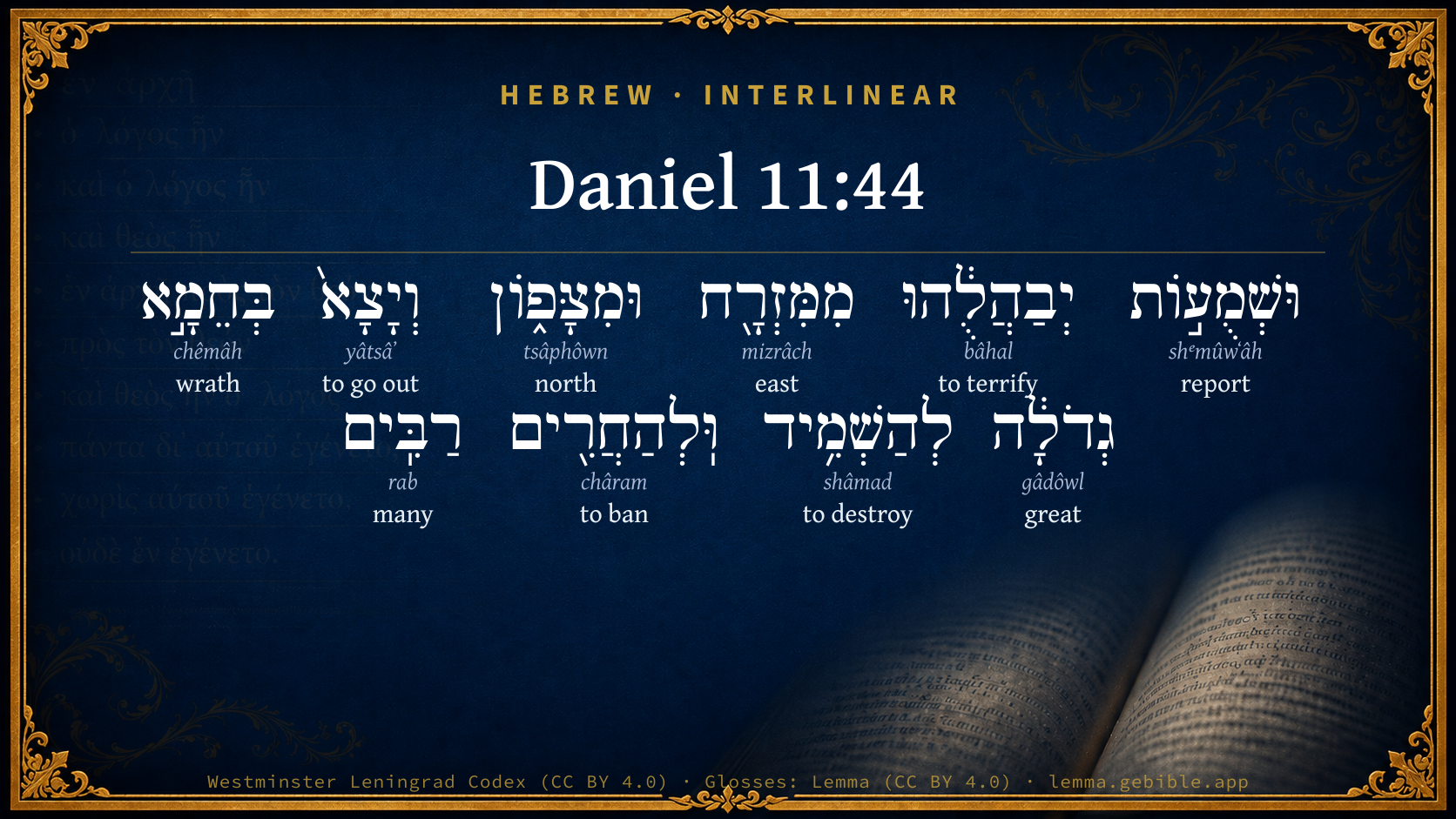
Hebrew (Westminster Leningrad Codex) Daniel 11:44 appears in the Hebrew Old Testament. The text above is from the Westminster Leningrad Codex. Each word links to its Strong’s number, a concise gloss, and parsing drawn from the Open Scriptures Hebrew Bible morphology. Click any word for its full Brown-Driver-Briggs (BDB) entry.
Download image
Cite this verse

Daniel 11:44 (World English Bible). Public Domain. Lemma interlinear Bible study tool, https://lemma.gebible.app/v/daniel/11/44.

Show BibTeX & RIS
BibTeX
RIS
English Translation
But news out of the east and out of the north shall trouble him; and he shall go forth with great fury to destroy and utterly to sweep away many.
World English Bible · Public Domain
Download a study sheet

One document with this verse’s original text, its word-by-word gloss line, the meaning frame, cross-references with their text, attributed commentary, and full source and license credits — printable, and it pastes into notes with its structure intact.

This verse Autodidact and up

Study sheet (.html) Plain text (.txt)

A passage Seminary Student

Up to 50 verses in one chapter. A passage sheet keeps up to 6 commentary sources and 12 cross-references per verse, in the order this page ranks them, and says so on the sheet whenever that leaves anything out. Ask for a single verse and you get the Autodidact verse sheet above.

Everything on this page stays free to read, with no account — the sheet is a download of what is already on screen, not access to it.

Want to remove ads? Support Godless Engineer
Compare translations 3

The same verse in 3 English versions, stacked beneath the original-language interlinear above. Click any original word for its lexicon entry.

Each is an independent rendering of the whole verse — the interlinear is not word-aligned to these translations.

Highlighted words mark where these versions differ — a whole-verse word diff, not a word-by-word alignment.

  • World English Bible Public Domain
    But news out of the east and out of the north shall trouble him; and he shall go forth with great fury to destroy and utterly to sweep away many.
  • King James Version Public Domain
    But tidings out of the east and out of the north shall trouble him: therefore he shall go forth with great fury to destroy, and utterly to make away many.
  • unfoldingWord Literal Text CC BY-SA 4.0
    But rumors from the east and the north will terrify him, and he will go out with great rage to exterminate and to devote many to destruction.

unfoldingWord Literal Text — © unfoldingWord, licensed CC BY-SA 4.0. Word-aligned USFM3 via Door43 (git.door43.org/unfoldingWord/en_ult).

Versions to compare (up to 4)

3 of 4 selected

Show all 18 translations

Every available English version of this verse, each an independent rendering of the whole verse.

  • World English Bible Public Domain
    But news out of the east and out of the north shall trouble him; and he shall go forth with great fury to destroy and utterly to sweep away many.
  • Berean Standard Bible Public Domain
    But news from the east and the north will alarm him, and he will go out with great fury to destroy many and devote them to destruction.
  • Majority Standard Bible Public Domain
    But news from the east and the north will alarm him, and he will go out with great fury to destroy many and devote them to destruction.
  • King James Version Public Domain
    But tidings out of the east and out of the north shall trouble him: therefore he shall go forth with great fury to destroy, and utterly to make away many.
  • American Standard Version (1901) Public Domain
    But tidings out of the east and out of the north shall trouble him; and he shall go forth with great fury to destroy and utterly to sweep away many.
  • Revised Version (1885) Public Domain
    But tidings out of the east and out of the north shall trouble him: and he shall go forth with great fury to destroy and utterly to make away many.
  • Geneva Bible (1599) Public Domain
    But the tidings out of the East and the North shall trouble him: therefore he shall goe foorth with great wrath to destroy and roote out many.
  • Douay-Rheims (1899) Public Domain
    And tidings out of the east, and out of the north shall trouble him: and he shall come with a great multitude to destroy and slay many.
  • Young's Literal Translation Public Domain
    `And reports trouble him out of the east and out of the north, and he hath gone forth in great fury to destroy, and to devote many to destruction;
  • Literal Standard Version CC BY-SA 4.0
    And reports trouble him out of the east and out of the north, and he has gone forth in great fury to destroy, and to devote many to destruction;
  • Unlocked Literal Bible CC BY-SA 4.0
    But news from the east and the north will frighten him, and he will go out with great rage to completely destroy and to set many apart for destruction.
  • unfoldingWord Literal Text CC BY-SA 4.0
    But rumors from the east and the north will terrify him, and he will go out with great rage to exterminate and to devote many to destruction.
  • Darby Bible Public Domain
    But tidings out of the east and out of the north shall trouble him; and he shall go forth with great fury to exterminate, and utterly to destroy many.
  • World Messianic Bible Public Domain
    But news out of the east and out of the north will trouble him; and he will go out with great fury to destroy and utterly to sweep away many.
  • Webster's Bible Public Domain
    But tidings out of the east and out of the north shall trouble him: therefore he shall go forth with great fury to destroy, and utterly to make away many.
  • Free Bible Version CC BY-SA 4.0
    But news from the east and the north will alarm him, and in a furious rage he will set out to destroy and exterminate many people.
  • Bible in Basic English Public Domain
    But he will be troubled by news from the east and from the north; and he will go out in great wrath, to send destruction on, and put an end to, great numbers.
  • JPS Tanakh (1917) Public Domain
    But tidings out of the east and out of the north shall affright him; and he shall go forth with great fury to destroy and utterly to take away many.

Literal Standard Version (2020), Covenant Press — licensed CC BY-SA 4.0. Text via the HelloAO Bible API (eBible.org). Unlocked Literal Bible (unfoldingWord) — licensed CC BY-SA 4.0. Text via the HelloAO Bible API (eBible.org). unfoldingWord Literal Text — © unfoldingWord, licensed CC BY-SA 4.0. Word-aligned USFM3 via Door43 (git.door43.org/unfoldingWord/en_ult). Free Bible Version, Dr. Jonathan Gallagher — licensed CC BY-SA 4.0. Text via the HelloAO Bible API (eBible.org).

Word by word

More ways to search: Search by grammar → Find every occurrence → Compare this word →

Practice this passage: Drill this verse → Learn its vocabulary →

וּשְׁמֻע֣וֹת
shᵉmûwʻâh
H8052
“and · reports”
Conjunction + Noun, Common, Feminine, Plural, Absolute
Part of Speech
Conjunction + Noun
Type
Common
Gender
Feminine
Number
Plural
State
Absolute
Full BDB Definition

Origin: pass part of H8074

TWOT: 2412d

report, news, rumour - report, news, tidings - mention
  1. יְבַהֲלֻ֔הוּ bâhal H926 “to terrify · him” Verb, Piel, Imperfect, 3rd Person, Masculine, Plural + Suffix, Personal, 3rd Person, Masculine, Singular
  2. מִמִּזְרָ֖ח mizrâch H4217 “from · east” Preposition + Noun, Common, Masculine, Singular, Absolute
  3. וּמִצָּפ֑וֹן tsâphôwn H6828 “and · from · north” Conjunction + Preposition + Noun, Common, Feminine, Singular, Absolute
  4. וְיָצָא֙ yâtsâʼ H3318 “and · to go out” Conjunction + Verb, Qal, Sequential Perfect, 3rd Person, Masculine, Singular
  5. בְּחֵמָ֣א chêmâh H2534 “in/at · wrath” Preposition + Noun, Common, Feminine, Singular, Absolute
  6. גְדֹלָ֔ה gâdôwl H1419 “great” Adjective, Adjective, Feminine, Singular, Absolute
  7. לְהַשְׁמִ֥יד shâmad H8045 “to destroy” Preposition + Verb, Hiphil, Infinitive Construct
  8. וּֽלְהַחֲרִ֖ים châram H2763 “and · to ban” Conjunction + Preposition + Verb, Hiphil, Infinitive Construct
  9. רַבִּֽים rab H7227 “many” Adjective, Adjective, Masculine, Plural, Absolute

About this verse

These counts appear in no published source. They are computed here, from the morphology-tagged text and Lemma’s own curated glosses. What Lemma adds →

10
words
10
distinct lemmas
Prophets
section

Shared distinctive vocabulary

וּשְׁמֻע֣וֹת report H8052 occurs in 24 verses of the Hebrew Bible. Also found in:

Grammatical profile

  • 4 verbs
  • 4 nouns
  • 2 adjectives

Verb forms

  • יְבַהֲלֻ֔הוּ Piel · Imperfect
  • וְיָצָא֙ Qal · Sequential Perfect
  • לְהַשְׁמִ֥יד Hiphil · Infinitive Construct
  • וּֽלְהַחֲרִ֖ים Hiphil · Infinitive Construct

Hebrew & Septuagint length

In English translation the verse runs 30 words from the Hebrew and 25 from the Septuagint (LXX English) — closely comparable.

A rough comparison of the two English renderings, which tokenize alike — not a word-level alignment.

Word counts can differ between the Hebrew and the Greek without any difference in meaning — e.g. the Hebrew direct-object marker אֵת has no separate Greek word, and Greek often adds the article ὁ.

Cross-references

6

Topical passages linked to Daniel 11:44 in the Treasury of Scripture Knowledge — connected by theme and wording, ordered by reader-vote popularity; previews shown in the World English Bible.

  • Revelation 19:19–21 I saw the beast, and the kings of the earth, and their armies, gathered together to make war against him who sat on the horse, and against his army.
  • Ezekiel 38:9–12 You shall ascend, you shall come like a storm, you shall be like a cloud to cover the land, you, and all your hordes, and many peoples with you.
  • Daniel 11:11 The king of the south shall be moved with anger, and shall come forth and fight with him, even with the king of the north; and he shall set forth a great multitude, and the multitude shall be given into his hand.
  • Daniel 11:30 For ships of Kittim shall come against him; therefore he shall be grieved, and shall return, and have indignation against the holy covenant, and shall do [his pleasure]: he shall even return, and have regard to those who forsake the holy covenant.
  • Revelation 16:12 The sixth poured out his bowl on the great river, the Euphrates. Its water was dried up, that the way might be made ready for the kings that come from the sunrise.
  • Revelation 17:13 These have one mind, and they give their power and authority to the beast.

Cross-references courtesy of OpenBible.info (CC BY 4.0).

Hebrew and Greek witnesses Masoretic Hebrew ↔ Greek Septuagint

The same verse in the two great witnesses to the Old Testament, shown verse-for-verse.

These are two independent witnesses, not word-aligned to each other, and the Septuagint is shown in lemma (dictionary) form.

Hebrew Daniel 11:44 Masoretic · Westminster Leningrad Codex

וּשְׁמֻע֣וֹת יְבַהֲלֻ֔הוּ מִמִּזְרָ֖ח וּמִצָּפ֑וֹן וְיָצָא֙ בְּחֵמָ֣א גְדֹלָ֔ה לְהַשְׁמִ֥יד וּֽלְהַחֲרִ֖ים רַבִּֽים

But news out of the east and out of the north shall trouble him; and he shall go forth with great fury to destroy and utterly to sweep away many.

World English Bible · Public Domain

Greek LXX Daniel 11:44 Septuagint · lemma form

καί ἀκοή ταράσσω αὐτός ἀπό ἀνατολή καί βορέας καί ἐκἔρχομαι ἐν θυμός ἰσχυρός καί ῥομφαία ἀπο ἀναἵζω καί ἀποκτείνω πολύς

But rumors and anxieties out of the east and from the north shall trouble him; and he shall come with great wrath to destroy many.

LXX2012 (modern English Septuagint) · Public Domain

On this verse, The Pulpit Commentary discusses the Septuagint’s reading. Read the note in Commentary ↓

Hebrew: Westminster Leningrad Codex (CC BY 4.0). Greek: Septuagint (public domain); English from LXX2012 (modern English Septuagint) (Public Domain). How the Septuagint differs from the Hebrew →

Commentary

Notes on Daniel 11:44 from classic Christian and Jewish commentators (each source and its license shown beneath its notes). The classic Christian expositions comment on the surrounding passage and are grouped to its opening verse, so a note may address several verses; the Jewish commentaries on the Tanakh (Rashi and others) are per-verse, so they appear only where the commentator wrote on this verse.

Lemma curates 59 commentaries, every one of them public domain or Creative Commons licensed, each selected and text-cleaned for this edition rather than reprinted as found. About our sources →

Trapp's Complete Commentary

John Trapp

Dan 11:44 But tidings out of the east and out of the north shall trouble him: therefore he shall go forth with great fury to destroy, and utterly to make away many.

Ver. 44. But tidings out of the east, &c.] It is seldom seen that God alloweth to the greatest darlings of the world a perfect contentment; but something or other they must have to trouble them still.

John Trapp, A Commentary or Exposition upon All the Books of the Old and New Testament (1647–1656) — public domain. Text from a community e-Sword module.

Joseph Benson's Commentary

Dan 11:44-45. But tidings out of the east and out of the north shall trouble him — Historians relate, that the Parthians on the east, and the Armenians on the north, declared war against Antiochus about the same time; so that this may very reasonably be supposed to relate to this fact. And he shall plant the tabernacles of his palace — The word translated palace here, is a Syriac word, and therefore is very properly used when speaking of the Syrian king. The expression signifies, as we would speak now, his royal tent, or pavilion. By planting it between the seas, in the glorious holy mountain, is meant, his fixing it in Judea, called a mountain elsewhere, as well as here, because it is a mountainous country. The epithet glorious is the very same as Daniel generally uses in speaking of Judea as a peculiar mark of distinction. The epithet holy is also frequently applied to Judea, because the whole of it was dedicated to the true God, and was chosen by him for the residence of a nation which he intended to be a holy people. Judea is likewise situated between two seas, namely, the Mediterranean, and the sea of Sodom, or the Dead sea; which are its boundaries on each side. So the meaning of this sentence is, that Antiochus should place his royal pavilion in Judea, leaving there some of his principal generals, or officers, who should, by his command, keep up the pomp of majesty as if he himself were present. Yet he shall come to his end, and none shall help him — God shall cut him off in the midst of his days, and none shall be able to prevent his fall. This is the same with what is foretold Dan 8:25, He shall be broken without hand; where see the note. Observe, reader, when God’s time is come to bring proud oppressors to their end, none shall be able, nor perhaps, inclined to help them, for those who, when they are in their grandeur, covet to be feared by all, will find, when they come to be in distress, that they are loved by none: none will lend them so much as a hand, or a prayer to help them: for if the Lord do not help, who shall? Of the kings that came after Antiochus nothing is here prophesied, for he was the most malicious, mischievous enemy to the church, and a type of the son of perdition, whom the Lord will consume with the breath of his mouth, and destroy with the brightness of his coming, and none shall help him. As a confirmation of the explanation of this prophecy given above, it may be proper to observe here, that Calmet, in like manner, confines the latter part of it to the persecutions of Antiochus against the Jews. He observes, however, at the close of the chapter, it is necessary to acknowledge that Antiochus was one of the most manifest, and most expressive figures of antichrist, and that these things which the angel foretold of Antiochus will receive a further accomplishment before the end of the world.

Joseph Benson's Commentary on the Old and New Testaments (1811–1818) — public domain. Text from a community e-Sword module.

Keil & Delitzsch

C. F. Keil & F. Delitzsch

The End of the Hostile King

As has been already seen, the expressions in Dan 11:40-43 regarding this king do not agree with Antiochus Epiphanes, so also the statements regarding his end are in contradiction to the historical facts regarding the end of the Syrian king. When the hostile king took possession of Egypt and its treasures, and made the Lybians and Cushites subject to him, tidings from the east and the north overwhelm him with terror. The masc. יבהלהוּ stands ad sensum related to the persons who occasion the reports. The reports excited his anger, so that he goes forth to destroy many. We have to think thus on the reports of revolt and insurrections in the east and the north of his kingdom, which came to his ears in Egypt. On this ground Hitzig, with other interpreters, refuses to refer the statement in Dan 11:44 to the expedition of Antiochus against the Parthians and Armenians (Tacit. hist. Dan 11:8, and App. Syr. c. 45, 46; 1 Macc. 3:37), because Antiochus did not undertake this expedition from Egypt; and rather, in regard to the east, thinks on the tidings from Jerusalem of the rebellion of Judea (2 Macc. 5:11ff.; 1 Macc. 1:24), and in regard to the north, on the very problematical expedition against the Aradiaei, without observing, however, that no Scripture writer designates Jerusalem as lying in the east of Egypt, But besides, Antiochus, since he has occupied for some years beyond the Euphrates, and there met with his death, could not shortly before his end lead an expedition out of Egypt against Aradus. What Porphyry says

(Note: The words are: Pugnans contra Aegyptios et Lybias, Aethiopiasque pertransiens, audiet sibi ab aquilone et oriente praelia concitari, unde et regrediens capit Aradios resistentes et omnem in littore Phoenicis vastavit provinciam; confestimque pergit ad Artaxiam regem Armeniae, qui de orientis partibus movebatur.)

(in Jerome under Dan 11:44) regarding an expedition of Antiochus undertaken from Egypt and Lybia against the Aradiaei and the Armenian king Artaxias, he has gathered only from this verse and from notices regarding the wars of Antiochus against the Aradiaei and king Artaxias (after whose imprisonment, according to App. Syr. c. 46, he died), without having any historical evidence for it. But even though the statement of Porphyry were better established, yet it would not agree with Dan 11:45; for when the king goes forth, in consequence of the report brought to him, to destroy many, he plants, according to Dan 11:45, his palace-tent near to the holy mount, and here comes to his end; thus meeting with his destruction in the Holy Land not far from Jerusalem, while Antiochus, according to Polybius and Porphyry, died in the Persian city of Tabae on his return from Persia to Babylon.

Dan 11:45

נטע of planting a tent, only here instead of the usual word נטה, to spread out, to set up, probably with reference to the great palace-like tent of the oriental ruler, whose poles must be struck very deep into the earth. Cf. The description of the tent of Alexander the Great, which was erected after the oriental type, in Polyaen. Strateg. iv. 3. 24, and of the tent of Nadir-Schah in Rosenmller, A. u. N. Morgl. iv. p. 364f. These tents were surrounded by a multitude of smaller tents for the guards and servants, a circumstance which explains the use of the plur. אהלי is incorrectly taken by Theodotion, Porphyry, Jerome, and others for a nomen propr., meaning in Syria, palace or tower. להר בּין = וּבּין בּין, Gen 1:6; Joe 2:17, of a space between two other places or objects. צבי-קדשׁ-צב הר, the holy hill of the delight, i.e., of Palestine (cf. Dan 8:9), is without doubt the mountain on which stood the temple of Jerusalem, as v. Leng., Maur., Hitzig, and Ewald acknowledge. The interpretation of the mountain of the temple of Anatis in Elymas (Dereser, Hvernick) needs no refutation. According to this, ימּים cannot designate the Mediterranean and the Dead Sea, as Kliefoth supposes, but it is only the poetic plur. of fulness, as a sign of the great Mediterranean Sea. Since now this scene where the great enemy of the people of God comes to his end, i.e., perishes, in no respect agrees with the place where Antiochus died, then according to Hitzig the pseudo-Daniel does not here accurately distinguish the separate expeditions from one another, and must have omitted between the first and the second half of the verse the interval between the return of Antiochus from Egypt and his death, because Antiochus never again trod the soil of Palestine. Such expedients condemn themselves. With "he shall come to his end," cf. Dan 8:25, where the end of this enemy of God is described as a being "broken without the hand of man." Here the expression "and none shall help him" is added to designate the hopelessness of his overthrow.

The placing of the overthrow of this enemy with his host near the temple-mountain agrees with the other prophecies of the O.T., which place the decisive destruction of the hostile world-power by the appearance of the Lord for the consummation of His kingdom upon the mountains of Israel (Eze 39:4), or in the valley of Jehoshaphat at Jerusalem, or at Jerusalem (Joe 3:2, Joe 3:12.; Zac 14:2), and confirms the result of our exposition, that the hostile king, the last enemy of the world-power, is the Antichrist. With this also the conclusion, Dan 12:1-3, is in harmony.

Keil & Delitzsch — Biblical Commentary on the Old Testament (1861–1891) — public domain (CC PDM 1.0). Text via the HelloAO Bible API. (Old Testament only.)

Geneva Bible (1599)

Geneva Bible translators

Hearing that Crassus was slain, and Antonius discomfited.

For Augustus overcame the Parthians, and recovered that which Antonius had lost.

Geneva Bible (1599) marginal notes — public domain. Text via Bolls.life.

Jamieson, Fausset & Brown

Robert Jamieson, A. R. Fausset & David Brown

tidings out of the east and out of the north--Artaxias, king of Armenia, his vassal, had revolted in the north, and Arsaces, leader of the Parthians, in the east (1 Maccabees 3:10, &c., 1 Maccabees 3:37; TACITUS, Histories, 5.8). In 147 B.C. Antiochus went on the expedition against them, on the return from which he died.

great fury--at the Jews, on account of their successes under Judas Maccabeus, whence he desired to replenish his treasury with means to prosecute the war with them; also at Artaxias and Arsaces, and their respective followers. DE BURGH makes the "tidings" which rouse his fury, to be concerning the Jews' restoration; such may be the antitypical reference.

Jamieson, Fausset & Brown — Commentary Critical and Explanatory on the Whole Bible (1871) — public domain (CC PDM 1.0). Text via the HelloAO Bible API.

Adam Clarke's Commentary

Verse 44. But tidings out of the east and out of the north shall trouble him] This part of the prophecy is allowed to be yet unfulfilled; and what is portented, the course of prophetic events will show. Were we to understand it as applying to Antiochus, then the news might be of the preparations which he heard, that the provinces of the east, and Artaxerxes, king of Armenia, on the north were intending to rise up against him. But if the Turkish power be understood, as in the preceding verses, it may mean that the Persians on the east, and the Russians on the north, will at some time greatly embarrass the Ottoman government. And how completely has this been fulfilled; first, by the total destruction of the Egyptian fleet, by the combined fleets of England, France, and Russia, in the Bay of Navarino; and, secondly, by the total overthrow of the Turkish army by the Russians, in the years 1828 and 1829, when the sultan was obliged to accept any conditions that the emperor of Russia was pleased to give! [N.B. - The former part of this note was written for the first edition of this work, printed in 1825.]

Adam Clarke's Commentary on the Bible (1810–1826) — public domain. Text from a community e-Sword/MySword module.

John Calvin's Commentaries

The angel’s narrative seems here to differ somewhat from the preceding one, as the Romans should not succeed so completely as to avoid being arrested in the midst of their victorious course. He says, they shall be frightened by rumors, and the events suit this case, for although the Romans subdued the whole east with scarcely any trouble, and in a few years, yet they were afterwards checked by adversity. For Crassus perished miserably after spoiling the temple, and destroyed himself and the flower of the Roman army; he was conquered at Carrse, near Babylon, in an important engagement, through betrayal by a spy in when he had placed too much confidence. Antony, again, after dividing the world into three parts between himself, and Octavius, and Lepidus, suffered miserably in the same neighborhood against the Parthians. We are not surprised at the angel’s saying, The Romans should be frightened from the east and the north, as this really came to pass. Then he adds, they should come in great wrath; meaning, although they should lose many troops, yet this severe massacre should not depress their spirits. When their circumstances were desperate, they were excited to fury like savage beasts of prey, until they rushed upon their own destruction. This came to pass more especially under the reign of Augustus; for a short period he contended successfully with the Parthians, and compelled them to surrender. He then imposed upon them conditions of peace; and as the Roman eagles had been carried into Persia, much to their disgrace, he compelled this people to return them. By this compulsion he blotted out the disgrace which they had suffered under Antony. We see, then, how exceedingly well this suits the context, — the Romans shall come with great wrath to destroy many; as the Parthians expected to enjoy tranquillity for many ages, and to be perfectly free from any future attempt or attack from the Romans. It now follows, —

John Calvin's Commentaries (1540-1563) — public domain. Text from the Calvin Translation Society English edition (1840s-50s) via the Christian Classics Ethereal Library (ccel.org). Calvin's coverage is partial (roughly two-thirds of the Bible); uncommented books and verses are honest gaps, never fabricated. The 19th-century editor's footnotes and remarks are omitted so the notes are faithfully Calvin's own voice.

Ellicott's Commentary for English Readers

(44) He shall go forth.—The end of the northern king. While in Egypt he has bad news brought to him from the north and from the east, which stirs up feelings of revenge. Once again he halts in Palestine, where he comes to an end. That this cannot apply to Antiochus is evident from the following facts—(1) Antiochus was in Persia when the news of the defeat of Lysias reached him; (2) Judæa and Jerusalem cannot in any sense be regarded as either east or north of Persia; (3) Antiochus died in Persia, and not near Jerusalem.

A Bible Commentary for English Readers, edited by Charles John Ellicott (1878–1897) — public domain. Text from a community e-Sword module.

The Cambridge Bible for Schools and Colleges

gen. ed. J. J. S. Perowne

44. But tidings] or rumours, as the same word is rendered in 2Ki_19:7 (= Isa_37:7), of the tidings which caused Sennacherib to withdraw. So Jer_51:46; Eze_7:26. Lit. something heard. Here, probably, rumours of insurrections, or wars, in the E. and N. of his dominions.

trouble] alarm. See on Dan_4:5.

and he shall go forth] viz. out of Egypt.

to destroy and utterly to make away many] lit. ‘and to ban (or devote) many.’ The word, which means properly to set apart, seclude, is used primarily of the ban laid upon persons or objects hostile to Israel’s religion (Exo_22:20; Deu_2:34; Deu_7:2; Deu_7:25-26; Jos_6:17-19, &c.)[391]: as this involved generally their destruction, it is often rendered in A.V. utterly destroy (so also in R.V., when applied to persons), though, of course, this rendering expresses only a secondary idea. In the present late passage, however, as in 2Ch_20:23, it is simply a synonym for destroy.

[391] See further the writer’s Commentary on 1Sa_15:33, or Deu_7:2.

The Cambridge Bible for Schools and Colleges (gen. ed. J. J. S. Perowne; Cambridge University Press, 1878–1918) — public domain. Text from a community e-Sword module.

John Gill's Exposition

But tidings out of the east and out of the north shall trouble him,.... This and the following verse respect times and things yet to come, and the interpretation of them is not so certain: perhaps this clause may have a regard to the news brought to the Turk, of the Jews, upon their conversion, being about to return to their own land, from the eastern and northern parts of the world, where they chiefly are at this day; which will greatly alarm him, since their land is part of his dominions: or it may be, out of the east may come tidings of some commotions and disturbances in the eastern part of the world, as Tartary, &c. which he may fear would be of bad consequence to the Ottoman empire; and news out of the north, of the northern Christian princes preparing to assist the Jews in the repossession of their country; all which may give him great uneasiness.

Therefore he shall go forth with great fury to destroy, and utterly to make away many; hearing the Jews are preparing to return to their own country, or that they have got possession of it, he will be provoked to the last degree, and raise a prodigious army, and march out of his own land with them to Judea;

and will come like a storm, with the utmost rage and fury, and like a cloud for number, and threaten utter ruin and destruction to the nation of the Jews; this will be his end in view in coming out, but he will not be able to accomplish it; of all which see Eze 38:2, where the Turk, and this expedition of his, are prophesied of, and where he goes by the name of Gog.

John Gill's Exposition of the Whole Bible (1746–1763) — public domain (CC PDM 1.0). Text via the HelloAO Bible API.

Albert Barnes' Notes on the Bible

But tidings out of the east and out of the north shall trouble him - Shall disturb him, or alarm him. That is, he will hear something from those quarters that will disarrange all his other plans, or that will summon him forth in his last and final expedition - on that expedition in which “he will come to his end” Dan 11:45, or which will be the end of this series of historical events. The reference here is to the winding up of this series of transactions, and, according to the view taken on Dan 11:40 (see the note at that place), it is not necessary to suppose that this would happen immediately after what is stated in Dan 11:43, but it is rather to be regarded as a statement of what would occur in the end, or of the manner in which the person here referred to would finally come to an end, or in which these events would be closed. As a matter of fact, Antiochus, as will be seen in the notes at Dan 11:45, was called forth in a warlike expedition by tidings or reports from Parthia and Armenia - regions lying to the east and the north, and it was in this expedition that he lost his life, and that this series of historical events was closed. Lengerke says, Antiochus assembled an army to take vengeance on the Jews, who, after the close of the unfortunate campaign in Egypt, rose up, under the Maccabees, against Antiochus, 1 Macc. 3:10, following Then the intelligence that the Parthians in the east, and the Armenians in the north, had armed themselves for war against him, alarmed him. So Tacitus (Hist. v. 8) says (Antiochus Judaeis), Demere superstitionem et mores Groecorum dare adnixus, quominus teterrimain gentem in melius mutaret, Parthorum bello prohibitus est, nam ea tempestate Arsaces defecerat. In the year 147 b.c., Antiochus went on the expedition to Persia and Armenia, on the return from which he died. The occasions for this were these:

(a) Artaxias, the king of Armenia, who was his vassal, had revolted from him, and

(b) he sought to replenish his exhausted treasury, that he might wage the war with Judas Maccabeus.

See 1 Macc. 3:27-37; Jos. Ant. b. xii. ch. vii. Section 2; Appian, Syriac. xlvi. 80; Porphyry, in Jerome, in loc.

Therefore he shall go forth with great fury to destroy ... - Great fury at the revolt of Artaxias, and especially at this juncture when he was waging war with the Jews; and great fury at the Jews, with a determination to obtain the means utterly to destroy them. 1 Macc. 3:27: “Now when king Antiochus heard these things (the successes of Judas Maceabeus), he was full of indignation.” In every way his wrath was kindled. He was enraged against the Jews on account of their success; he was enraged against Artaxias for revolting from him; he was enraged because his treasury was exhausted, and he had not the means of prosecuting the war. In this mood of mind he crossed the Euphrates (1 Macc. 3:37) to prosecute the war in the East, and, as it is said here, “utterly to make away many.” Everything conspired to kindle his fury, and in this state of mind, he went forth on his last expedition to the East. Nothing, in fact, could better describe the state of mind of Antiochus than the language used here by the angel to Daniel.

Albert Barnes' Notes on the Bible (1834–1885) — public domain. Text from a community e-Sword/MySword module.

Haydock's Catholic Bible Commentary

North. Judas continued victorious. Armenia (Calmet) and Parthia rebelled. (Tacit. [Tacitus?] v. 8.) --- Many. Epiphanes left three generals and half his army to destroy the Jews. (Calmet)

George Leo Haydock (1774–1849), Haydock's Catholic Family Bible and Commentary, 1859 edition — public domain. Excludes Psalms (Douay-Rheims chapter numbering differs from Protestant) and Deuterocanonical books (Catholic canon only).

Matthew Poole's English Annotations

The Christian princes of the north, and the dispersed Israelites, and the Jews carried captive into the north, Jer 16:14,15, called also kings of the east, shall come and trouble him, and all his power shall not be able to withstand. See Rev 16:12.

Matthew Poole's English Annotations on the Holy Bible (1683–1685) — public domain. Text from a community e-Sword/MySword module.

Whedon's Commentary on the Bible

Daniel D. Whedon

44. After all his victories and brutal persecutions the “end” which God had from the first decreed is now upon him. The tidings reach him that the Parthians and Armenians are in revolt, and furiously does he rush to punish the offenders. (So 1 Maccabees 6; 2 Maccabees 9.) After all the breaks in time and place to which we have been accustomed in this chapter Bevan and Prince should not insist that because Antiochus in Dan_11:43 was in Egypt the points of the compass should therefore be reckoned from Egypt in this verse. If, however, east and north be reckoned from the south land, the reference would very naturally be to the tidings from the Roman senate sent to him by Caius Popilius Laenas or Tiberius Gracchus which did send him in great fury to destroy, and utterly to make away many. (Compare notes Dan_11:29-30.) If, however, the standpoint is considered as Palestine then the reference is to the revolt of the Parthians and Armenians, the tidings of which are said to have reached him in the last year of his life. (See above.) Several writers tell in what “fury” he went forth to punish those insurrectionists.

Daniel D. Whedon (gen. ed.), Commentary on the Old and New Testaments (1874–1909) — public domain. Text from a community e-Sword module.

The Pulpit Commentary

But tidings out of the east and out of the north shall trouble him; there. fore he shall go forth with great fury to destroy, and utterly to make away many. The version of the Septuagint is very like this, "A rumour out of the east and out of the north shall trouble him, and he shall come out in great rage to lay waste with the sword, and to slay many." The version of Theodotion is somewhat briefer, "Rumours and disturbances out of the east and from the north shall trouble him, and he shall come in much wrath to destroy many." The Syriac is closer than any other version to the Massoretic text. The Vulgate renders, "A rumour out of the east and north shall trouble him, and he shall come with a great multitude that he may beat down and slay many." The word amje (hayma) may mean either "wrath" or "multitude." It is difficult to identify the rumours that recalled Antiochus from his conquests. The account given by Porphyry (quoted by Jerome) of his receiving news that led him to ravage the coasts of Phoenicia and march against Armenia are unsupported by other historians. A phrase in Tacitus ("Hist.," 5:8) seems to throw light on this, "After the Macedonians held the supremacy, King Antiochus, when he was endeavouring to change the superstition of this people, i.e. the Jews, into the manners of the Greeks, was hindered by a Parthian war." There is, however, no record of such a Parthian war; but such a war may have arisen, and not be recorded, as the histories for the period before us are very incomplete. Should we regard these verses as giving another account of the war between Epiphanes and Ptolemy, the tidings out of the north might mean the arrival of the Roman envoys, headed by Popilius Lsenas. If there were also a threat of a Parthian invasion, we should then have, "tidings put of the east and north." Therefore he shall go forth with great fury to destroy, and utterly to make away many. Certainly Antiochus did return furious from the expedition in which he was stayed by the Romans; and certainly also he set himself thereafter to compel the Jews to become Greeks in religion, punishing with death refusal to yield to his demands (RAPC 1Ma 1:24-28; Josephus, "Ant.," 12:5. 3).

The Pulpit Commentary (1880–1919), ed. H.D.M. Spence-Jones & Joseph S. Exell — public domain. Text from a community e-Sword module.

unfoldingWord translationNotes

Door43 World Missions Community

General Information:

This is still about the king of the North.

he will go out with great rage

The abstract noun "rage" can be expressed with the word "angry." It can be stated clearly that he would go out with his army. AT: "he will be very angry and will go out" or "he will become very angry and will go out with his army" (See: Abstract Nouns and Assumed Knowledge and Implicit Information)

go out

To "go out" represents the action of attacking the enemy. (See: Metonymy)

to set many apart for destruction

"to destroy many people"

the tent of his royal residence

This refers to the king's luxurious tents that he lived in when he was with his army in time of war.

between the seas and the mountain of the beauty of holiness

This probably refers to the region between the Mediterranean Sea and Temple Mount in Jerusalem.

the mountain of the beauty of holiness

This refers to the hill in Jerusalem where God's temple was. See how you translated somewhat similar phrases in Daniel 9:16 and Daniel 9:20. (See: Metonymy)

translationWords

report

alarm

tent

holy

unfoldingWord translationNotes — © Distant Shores Media and the Door43 World Missions Community, licensed CC BY-SA 4.0. Source: git.door43.org/Door43/en_tn.

Lesson kit

Teaching starters — assembled from the data on this page, not authored interpretation. Every prompt links to the verse data it draws on. Edit before teaching.

Daniel, in the Prophets, opens this verse with 10 words (10 distinct Hebrew lemmas). Its most distinctive word is shᵉmûwʻâh (“report”). A historical commentator’s framing appears above. Read the whole chapter for the surrounding context.

Discussion questions

  1. The word shᵉmûwʻâh carries the sense “report.” How does it shape the verse?
  2. How does 1 Samuel 2:24, which shares the word «report», read alongside this verse?
  3. These translations render this verse differently; the difference is in the English rendering, not the original. What questions does that raise?
  4. «יְבַהֲלֻ֔הוּ» is a Piel Imperfect verb. How does that grammatical form shape the action described?
  5. Compare how Trapp's Complete Commentary and Joseph Benson's Commentary read this verse. Where do they agree or differ?

Things to notice

Reading settings

Reading text

Shown beneath each verse's original-language words.

Old Testament
Old Testament edition

Read the OT as the Masoretic Hebrew (MT) or the Greek Septuagint (LXX).

English shown for the Greek Septuagint (in the Hebrew ↔ Greek comparison).

Comparing translations? Open the Compare panel on any verse page to stack up to four side by side.