
Habakkuk 2:8

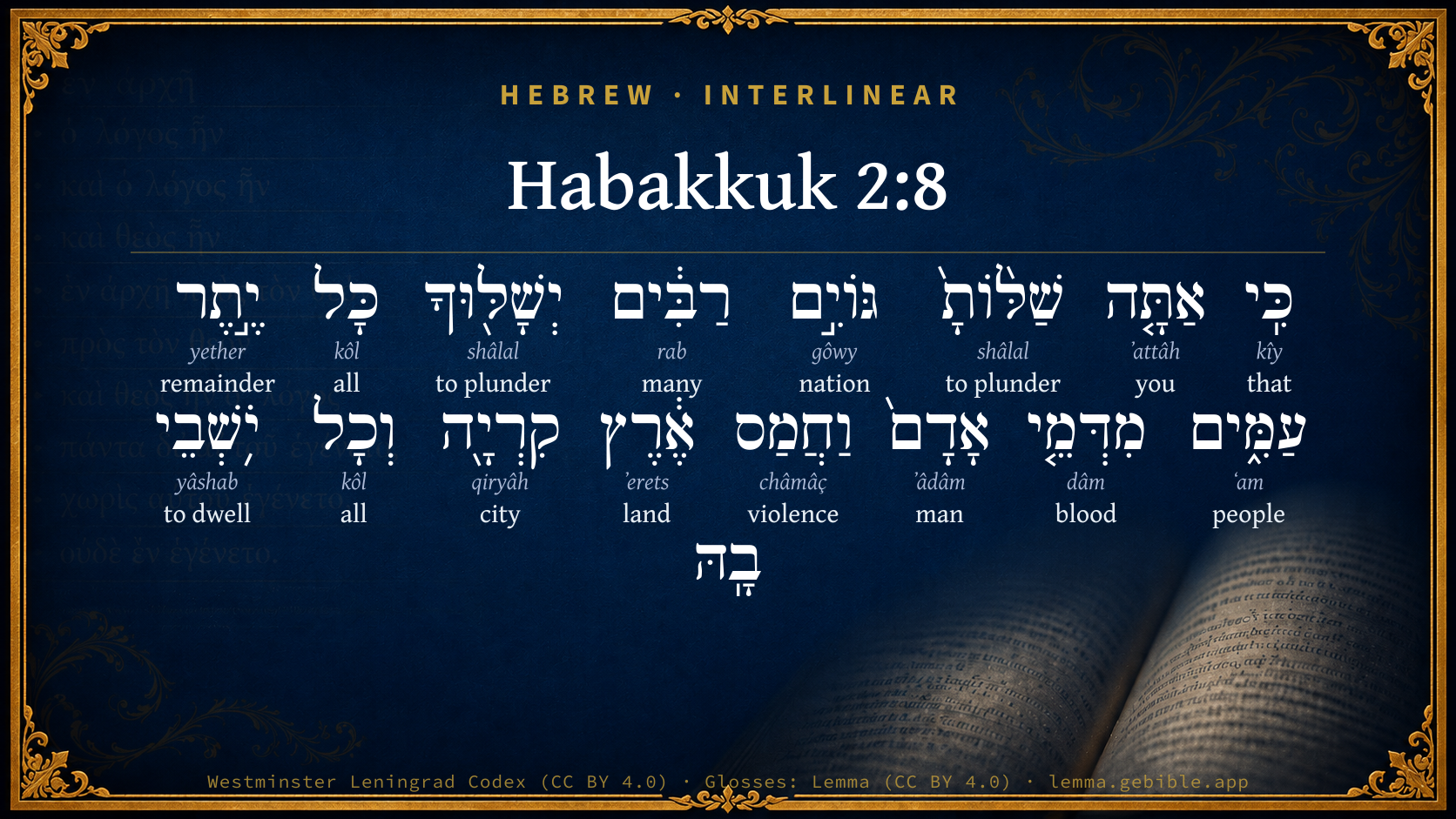
Hebrew (Westminster Leningrad Codex) Habakkuk 2:8 appears in the Hebrew Old Testament. The text above is from the Westminster Leningrad Codex. Each word links to its Strong’s number, a concise gloss, and parsing drawn from the Open Scriptures Hebrew Bible morphology. Click any word for its full Brown-Driver-Briggs (BDB) entry.
Download image
Cite this verse

Habakkuk 2:8 (World English Bible). Public Domain. Lemma interlinear Bible study tool, https://lemma.gebible.app/v/habakkuk/2/8.

Show BibTeX & RIS
BibTeX
RIS
English Translation
Because you have plundered many nations, all the remnant of the peoples will plunder you, because of men's blood, and for the violence done to the land, to the city and to all who dwell in it.
World English Bible · Public Domain
Download a study sheet

One document with this verse’s original text, its word-by-word gloss line, the meaning frame, cross-references with their text, attributed commentary, and full source and license credits — printable, and it pastes into notes with its structure intact.

This verse Autodidact and up

Study sheet (.html) Plain text (.txt)

A passage Seminary Student

Up to 50 verses in one chapter. A passage sheet keeps up to 6 commentary sources and 12 cross-references per verse, in the order this page ranks them, and says so on the sheet whenever that leaves anything out. Ask for a single verse and you get the Autodidact verse sheet above.

Everything on this page stays free to read, with no account — the sheet is a download of what is already on screen, not access to it.

Want to remove ads? Support Godless Engineer
Compare translations 3

The same verse in 3 English versions, stacked beneath the original-language interlinear above. Click any original word for its lexicon entry.

Each is an independent rendering of the whole verse — the interlinear is not word-aligned to these translations.

Highlighted words mark where these versions differ — a whole-verse word diff, not a word-by-word alignment.

  • World English Bible Public Domain
    Because you have plundered many nations, all the remnant of the peoples will plunder you, because of men's blood, and for the violence done to the land, to the city and to all who dwell in it.
  • King James Version Public Domain
    Because thou hast spoiled many nations, all the remnant of the people shall spoil thee; because of men's blood, and for the violence of the land, of the city, and of all that dwell therein.
  • unfoldingWord Literal Text CC BY-SA 4.0
    Because you have plundered many nations, all of the remainder of the peoples will plunder you, from the bloodshed of man and the violence of the land, the city, and all the dwellers in it.

unfoldingWord Literal Text — © unfoldingWord, licensed CC BY-SA 4.0. Word-aligned USFM3 via Door43 (git.door43.org/unfoldingWord/en_ult).

Versions to compare (up to 4)

3 of 4 selected

Show all 18 translations

Every available English version of this verse, each an independent rendering of the whole verse.

  • World English Bible Public Domain
    Because you have plundered many nations, all the remnant of the peoples will plunder you, because of men's blood, and for the violence done to the land, to the city and to all who dwell in it.
  • Berean Standard Bible Public Domain
    Because you have plundered many nations, the remnant of the people will plunder you—because of your bloodshed against man and your violence against the land, the city, and all their dwellers.
  • Majority Standard Bible Public Domain
    Because you have plundered many nations, the remnant of the people will plunder you—because of your bloodshed against man and your violence against the land, the city, and all their dwellers.
  • King James Version Public Domain
    Because thou hast spoiled many nations, all the remnant of the people shall spoil thee; because of men's blood, and for the violence of the land, of the city, and of all that dwell therein.
  • American Standard Version (1901) Public Domain
    Because thou hast plundered many nations, all the remnant of the peoples shall plunder thee, because of men's blood, and for the violence done to the land, to the city and to all that dwell therein.
  • Revised Version (1885) Public Domain
    Because thou hast spoiled many nations, all the remnant of the peoples shall spoil thee; because of men’s blood, and for the violence done to the land, to the city and to all that dwell therein.
  • Geneva Bible (1599) Public Domain
    Because thou hast spoyled many nations, all the remnant of the people shall spoyle thee, because of mens blood, and for the wrong done in the land, in the citie, and vnto all that dwell therein.
  • Douay-Rheims (1899) Public Domain
    Because thou hast spoiled many nations, all that shall be left of the people shall spoil thee: because of men's blood, and for the iniquity of the land, of the city, and of all that dwell therein.
  • Young's Literal Translation Public Domain
    Because thou hast spoiled many nations, Spoil thee do all the remnant of the peoples, Because of man's blood, and of violence `to' the land, `To' the city, and `to' all dwelling in it.
  • Literal Standard Version CC BY-SA 4.0
    Because you have spoiled many nations, || All the remnant of the peoples spoil you, || Because of man’s blood, and of violence [to] the land, || [To] the city, and [to] all dwelling in it.
  • Unlocked Literal Bible CC BY-SA 4.0
    Because you have plundered many peoples, all the remnant of the peoples will plunder you. For you have shed human blood and acted with violence against the land, the cities, and all who live in them.
  • unfoldingWord Literal Text CC BY-SA 4.0
    Because you have plundered many nations, all of the remainder of the peoples will plunder you, from the bloodshed of man and the violence of the land, the city, and all the dwellers in it.
  • Darby Bible Public Domain
    Because thou hast plundered many nations, all the rest of the peoples shall plunder thee; because of men's blood, and for the violence [done] to the land, to the city, and all that dwell therein.
  • World Messianic Bible Public Domain
    Because you have plundered many nations, all the remnant of the peoples will plunder you because of men’s blood, and for the violence done to the land, to the city and to all who dwell in it.
  • Webster's Bible Public Domain
    Because thou hast laid waste many nations, all the remnant of the people shall lay thee waste; because of men's blood, and for the violence of the land, of the city, and of all that dwell therein.
  • Free Bible Version CC BY-SA 4.0
    Because you have plundered many nations, those who are left will plunder you—for the human blood you have shed and the destruction you brought on lands and cities, and those who lived there.
  • Bible in Basic English Public Domain
    Because you have taken their goods from great nations, all the rest of the peoples will take your goods from you; because of men's blood and violent acts against the land and the town and all who are living in it.
  • JPS Tanakh (1917) Public Domain
    Because thou hast spoiled many nations, all the remnant of the peoples shall spoil thee; because of men's blood, and for the violence done to the land, to the city and to all that dwell therein.

Literal Standard Version (2020), Covenant Press — licensed CC BY-SA 4.0. Text via the HelloAO Bible API (eBible.org). Unlocked Literal Bible (unfoldingWord) — licensed CC BY-SA 4.0. Text via the HelloAO Bible API (eBible.org). unfoldingWord Literal Text — © unfoldingWord, licensed CC BY-SA 4.0. Word-aligned USFM3 via Door43 (git.door43.org/unfoldingWord/en_ult). Free Bible Version, Dr. Jonathan Gallagher — licensed CC BY-SA 4.0. Text via the HelloAO Bible API (eBible.org).

Word by word

More ways to search: Search by grammar → Find every occurrence → Compare this word →

Practice this passage: Drill this verse → Learn its vocabulary →

שַׁלּ֨וֹתָ֙
shâlal
H7997
“to plunder”
Verb, Qal, Perfect, 2nd Person, Masculine, Singular
Part of Speech
Verb
Stem
Qal
Form
Perfect
Person
2nd Person
Gender
Masculine
Number
Singular
Full BDB Definition

Origin: a primitive root

TWOT: 2399 , 2400

(Qal) to draw out - to spoil, plunder, take spoil - (Qal) to spoil, plunder - (Hithpolel) to be spoiled, be plundered
  1. כִּֽי kîy H3588 “that” Conjunction
  2. אַתָּ֤ה ʼattâh H859 “you” Pronoun, Personal, 2nd Person, Masculine, Singular
  3. גּוֹיִ֣ם gôwy H1471 “nations” Noun, Common, Masculine, Plural, Absolute
  4. רַבִּ֔ים rab H7227 “many” Adjective, Adjective, Masculine, Plural, Absolute
  5. יְשָׁלּ֖וּךָ shâlal H7997 “to plunder · you” Verb, Qal, Imperfect, 3rd Person, Masculine, Plural + Suffix, Personal, 2nd Person, Masculine, Singular
  6. כָּל kôl H3605 “all of” Noun, Common, Masculine, Singular, Construct
  7. יֶ֣תֶר yether H3499 “remainder of” Noun, Common, Masculine, Singular, Construct
  8. עַמִּ֑ים ʻam H5971 “peoples” Noun, Common, Masculine, Plural, Absolute
  9. מִדְּמֵ֤י dâm H1818 “from · blood of” Preposition + Noun, Common, Masculine, Plural, Construct
  10. אָדָם֙ ʼâdâm H120 “man” Noun, Common, Masculine, Singular, Absolute
  11. וַחֲמַס châmâç H2555 “and · violence of” Conjunction + Noun, Common, Masculine, Singular, Construct
  12. אֶ֔רֶץ ʼerets H776 “land” Noun, Common, Both, Singular, Absolute
  13. קִרְיָ֖ה qiryâh H7151 “city” Noun, Common, Feminine, Singular, Absolute
  14. וְכָל kôl H3605 “and · all of” Conjunction + Noun, Common, Masculine, Singular, Construct
  15. יֹ֥שְׁבֵי yâshab H3427 “dwelling” Verb, Qal, Participle Active, Masculine, Plural, Construct

About this verse

These counts appear in no published source. They are computed here, from the morphology-tagged text and Lemma’s own curated glosses. What Lemma adds →

17
words
14
distinct lemmas
Prophets
section

Notable vocabulary

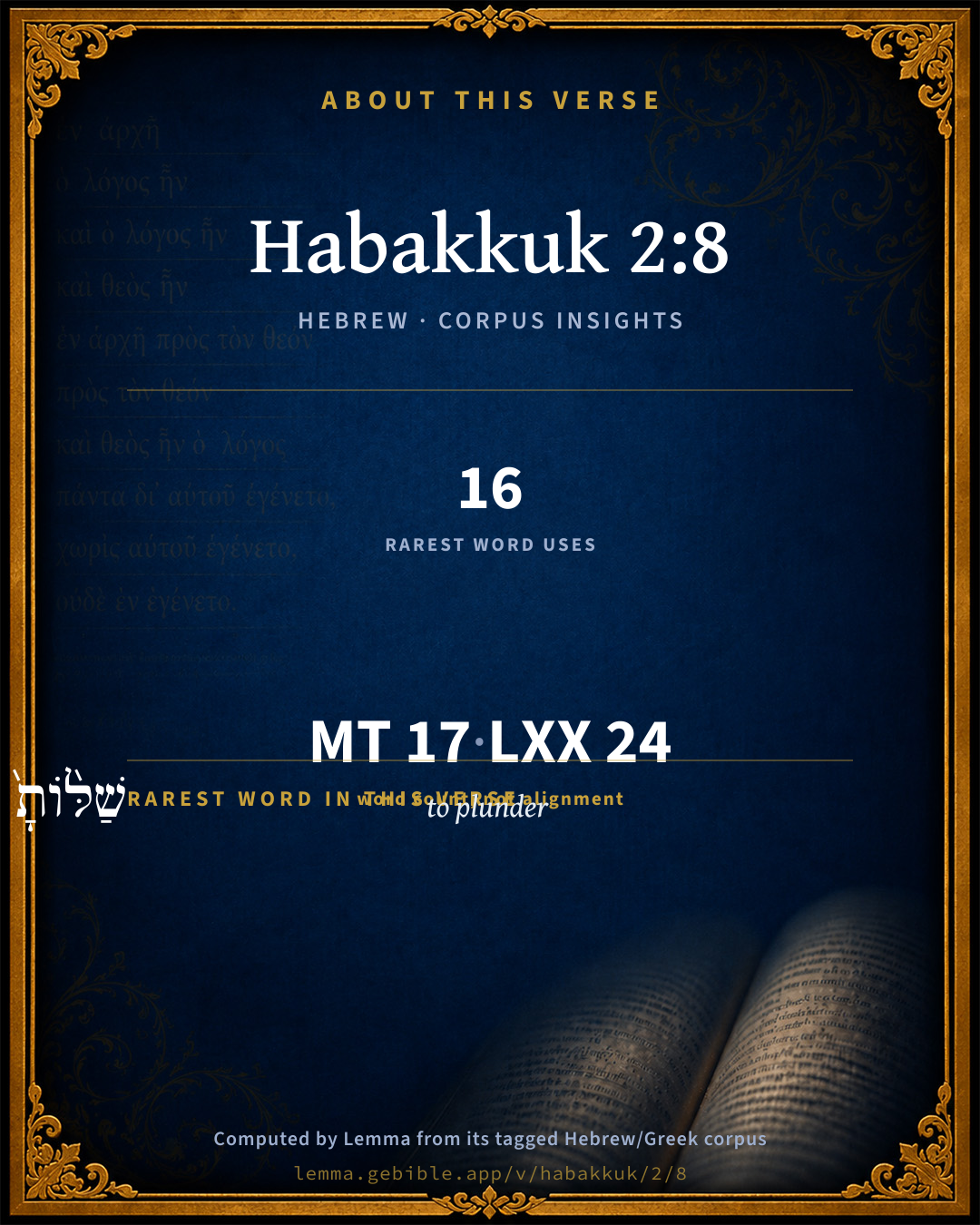
The rarest word here is שַׁלּ֨וֹתָ֙ to plunder H7997 — appearing just 16 times in the whole Hebrew Bible.

Shared distinctive vocabulary

שַׁלּ֨וֹתָ֙ to plunder H7997 occurs in 12 verses of the Hebrew Bible. Also found in:

Grammatical profile

  • 3 verbs
  • 10 nouns
  • 1 adjective
  • 1 pronoun
  • 1 preposition
  • 1 conjunction

Verb forms

  • שַׁלּ֨וֹתָ֙ Qal · Perfect
  • יְשָׁלּ֖וּךָ Qal · Imperfect
  • יֹ֥שְׁבֵי Qal · Participle Active

Repetition

Words recur within this verse — often emphatic in Hebrew:

  • שַׁלּ֨וֹתָ֙ to plunder H7997 ×2
  • כָּל all H3605 ×2

Hebrew & Septuagint length

In English translation the verse runs 37 words from the Hebrew and 36 from the Septuagint (LXX English) — closely comparable.

A rough comparison of the two English renderings, which tokenize alike — not a word-level alignment.

Word counts can differ between the Hebrew and the Greek without any difference in meaning — e.g. the Hebrew direct-object marker אֵת has no separate Greek word, and Greek often adds the article ὁ.

In the original languages it is 17 Hebrew tokens and 24 Greek tokens — but the two are counted differently (Hebrew bundles its prefixes and suffixes into one token; the Greek is in lemma form), so that isn’t a like-for-like length.

Cross-references

27

Topical passages linked to Habakkuk 2:8 in the Treasury of Scripture Knowledge — connected by theme and wording, ordered by reader-vote popularity; previews shown in the World English Bible.

  • Isaiah 33:1 Woe to you who destroy, and you weren't destroyed; and deal treacherously, and they didn't deal treacherously with you! When you have ceased to destroy, you shall be destroyed; and when you have made an end of dealing treacherously, they shall deal treacherously with you.
  • Habakkuk 2:17 For the violence done to Lebanon will overwhelm you, and the destruction of the animals, which made them afraid; because of men's blood, and for the violence done to the land, to every city and to those who dwell in them.
  • Jeremiah 27:7 All the nations shall serve him, and his son, and his son's son, until the time of his own land come: and then many nations and great kings shall make him their bondservant.
  • Psalms 137:8 Daughter of Babylon, doomed to destruction, He will be happy who rewards you, As you have served us.
  • Isaiah 33:4 Your spoil shall be gathered as the caterpillar gathers: as locusts leap shall men leap on it.
  • Isaiah 47:6 I was angry with my people, I profaned my inheritance, and gave them into your hand: you did show them no mercy; on the aged have you very heavily laid your yoke.
  • Jeremiah 30:16 Therefore all those who devour you shall be devoured; and all your adversaries, everyone of them, shall go into captivity; and those who despoil you shall be a spoil, and all who prey on you will I give for a prey.
  • Jeremiah 50:10–11 Chaldea shall be a prey: all who prey on her shall be satisfied, says Yahweh.
  • Jeremiah 50:17–18 Israel is a hunted sheep; the lions have driven him away: first, the king of Assyria devoured him; and now at last Nebuchadrezzar king of Babylon has broken his bones.
  • Jeremiah 50:28 The voice of those who flee and escape out of the land of Babylon, to declare in Zion the vengeance of Yahweh our God, the vengeance of his temple.
  • Jeremiah 50:33–34 Thus says Yahweh of hosts: The children of Israel and the children of Judah are oppressed together; and all who took them captive hold them fast; they refuse to let them go.
  • Jeremiah 50:37 A sword is on their horses, and on their chariots, and on all the mixed people who are in the midst of her; and they shall become as women: a sword is on her treasures, and they shall be robbed.
  • Jeremiah 51:8 Babylon is suddenly fallen and destroyed: wail for her; take balm for her pain, if so be she may be healed.
  • Jeremiah 51:13 You who dwell on many waters, abundant in treasures, your end is come, the measure of your covetousness.
  • Jeremiah 51:24 I will render to Babylon and to all the inhabitants of Chaldea all their evil that they have done in Zion in your sight, says Yahweh.
  • Jeremiah 51:34–35 Nebuchadrezzar the king of Babylon has devoured me, he has crushed me, he has made me an empty vessel, he has, like a monster, swallowed me up, he has filled his maw with my delicacies; he has cast me out.
  • Jeremiah 51:44 I will execute judgment on Bel in Babylon, and I will bring forth out of his mouth that which he has swallowed up; and the nations shall not flow any more to him: yes, the wall of Babylon shall fall.
  • Jeremiah 51:48 Then the heavens and the earth, and all that is therein, shall sing for joy over Babylon; for the destroyers shall come to her from the north, says Yahweh.
  • Jeremiah 51:55–56 For Yahweh lays Babylon waste, and destroys out of her the great voice; and their waves roar like many waters; the noise of their voice is uttered:
  • Micah 4:11–13 Now many nations have assembled against you, that say, 'Let her be defiled, And let our eye gloat over Zion.'
  • Habakkuk 2:10 You have devised shame to your house, by cutting off many peoples, and have sinned against your soul.
  • Zechariah 1:15 I am very angry with the nations that are at ease; for I was but a little displeased, but they added to the calamity."
  • Zechariah 2:8–9 For thus says Yahweh of hosts: 'For honor he has sent me to the nations which plundered you; for he who touches you touches the apple of his eye.
  • Zechariah 12:2–4 "Behold, I will make Jerusalem a cup of reeling to all the surrounding peoples, and on Judah also will it be in the siege against Jerusalem.
  • Zechariah 14:12 This will be the plague with which Yahweh will strike all the peoples who have warred against Jerusalem: their flesh will consume away while they stand on their feet, and their eyes will consume away in their sockets, and their tongue will consume away in their mouth.
  • Revelation 6:10 They cried with a loud voice, saying, "How long, Master, the holy and true, until you judge and avenge our blood on those who dwell on the earth?"
  • Revelation 18:20–24 Rejoice over her, O heaven, you saints, apostles, and prophets; for God has judged your judgment on her."

Cross-references courtesy of OpenBible.info (CC BY 4.0).

Hebrew and Greek witnesses Masoretic Hebrew ↔ Greek Septuagint

The same verse in the two great witnesses to the Old Testament, shown verse-for-verse.

These are two independent witnesses, not word-aligned to each other, and the Septuagint is shown in lemma (dictionary) form.

Hebrew Habakkuk 2:8 Masoretic · Westminster Leningrad Codex

כִּֽי אַתָּ֤ה שַׁלּ֨וֹתָ֙ גּוֹיִ֣ם רַבִּ֔ים יְשָׁלּ֖וּךָ כָּל יֶ֣תֶר עַמִּ֑ים מִדְּמֵ֤י אָדָם֙ וַחֲמַס אֶ֔רֶץ קִרְיָ֖ה וְכָל יֹ֥שְׁבֵי בָֽהּ

Because you have plundered many nations, all the remnant of the peoples will plunder you, because of men's blood, and for the violence done to the land, to the city and to all who dwell in it.

World English Bible · Public Domain

Greek LXX Habakkuk 2:8 Septuagint · lemma form

διότι σύ σκυλεύω ἔθνος πολύς σκυλεύω σύ πᾶς ὁ ὑπολείπω λαός διά αἷμα ἄνθρωπος καί ἀσέβεια γῆ καί πόλις καί πᾶς ὁ καταοἰκέω αὐτός

Because you have spoiled many nations, all the nations that are left shall spoil you, because of the blood of men, and the sins of the land and city, and of all that dwell in it.

LXX2012 (modern English Septuagint) · Public Domain

On this verse, The Pulpit Commentary discusses the Septuagint’s reading. Read the note in Commentary ↓

Hebrew: Westminster Leningrad Codex (CC BY 4.0). Greek: Septuagint (public domain); English from LXX2012 (modern English Septuagint) (Public Domain). How the Septuagint differs from the Hebrew →

Targum (Aramaic paraphrase)

1

The Targum is the ancient Jewish Aramaic paraphrase of the Hebrew Scriptures — an interpretive translation, not the Hebrew text itself. Onkelos (literal) and Pseudo-Jonathan (expansive) render the Torah, and Jonathan the Prophets. Coverage is partial: where no permissively-licensed English translation exists for a verse, only the Aramaic is shown. This is verse-level text, not a word-by-word alignment to the Hebrew.

  1. Targum Jonathan Prophets (Joshua–Malachi)
    אֲרֵי אַתְּ בַּזְתָא עַמְמִין סַגִיאִין יִבְזוּנָךְ כָּל שְׁאָר שִׁבְטַיָא מִדְמֵי אֱנָשָׁא וַחֲטוֹף אַרְעָא דְיִשְׂרָאֵל קַרְתָּא יְרוּשְׁלֶם וְכָל דְיָתְבִין בָהּ:

    (no public-domain English translation for this verse)

    Targum Jonathan — Aramaic: “Mikraot Gedolot” (public domain). English: “Sefaria Community Translation” (CC0 1.0 (public-domain dedication)); “London "Chaldee Paraphrase," 1871” (public domain). Text via Sefaria.

Commentary

Notes on Habakkuk 2:8 from classic Christian and Jewish commentators (each source and its license shown beneath its notes). The classic Christian expositions comment on the surrounding passage and are grouped to its opening verse, so a note may address several verses; the Jewish commentaries on the Tanakh (Rashi and others) are per-verse, so they appear only where the commentator wrote on this verse.

Lemma curates 59 commentaries, every one of them public domain or Creative Commons licensed, each selected and text-cleaned for this edition rather than reprinted as found. About our sources →

Trapp's Complete Commentary

John Trapp

Hab 2:8 Because thou hast spoiled many nations, all the remnant of the people shall spoil thee; because of men’s blood, and [for] the violence of the land, of the city, and of all that dwell therein.

Ver. 8. Because thou hast spoiled many nations] God loves to retaliate (as hath before been often observed), to spoil the spoilers by a remnant of the people, by such as were of no note, and much unlikely to do such exploits. Thus he spoiled these Babylonians by Cyrus and his Medes; the Persians, by Alexander and his Macedonians (whom they so slighted, that Darius, in his proud embassy to him, called him his servant, but himself the king of kings, and cousin of the gods). So the Roman empire was miserably rent and torn by the Goths, Vandals, Huns, Lombards, people not before heard of, and the Greek empire by Turks, Tartars, Saracens, Scythians, &c., that it might the better appear, haec non sine numine fieri, these events happen not without divine intervention, that it was the Lord’s own doing, who often suffers his enemies, like Adonijah’s guests, to feast and frolic in a jocular security and promise of continued prosperity. But at last, when they are at the height of their joys and hopes, he confounds all their devices, and lays them open to the scorn of the world, and the spoil of the remnant of the people whom they vilified.

Because of men’s blood] Heb. Bloods, every drop whereof had a tongue to cry to God for vengeance, saying, Give them blood to drink, for they are worthy, Oh let not bloody and deceitful men live out half their days, Rev 16:6 Psa 55:23. That soldier can never answer it to God that hath not a good cause, and striketh not rather as a justicer than as a soldier.

And for the violence of the land] Heb. Of the earth, though principally of that land of desires, the promised land, and the inhabitants thereof, whom he that touched, touched the apple of God s eye, that little man in the eye (Ishon) that may not be meddled with, Zec 2:8.

Of the city] Jerusalem, called the city by an excellence, and by a better right than ever Rome was. See Lam 1:1, and Jeremiah’s elegy there over it, when captivated by these Chaldees.

John Trapp, A Commentary or Exposition upon All the Books of the Old and New Testament (1647–1656) — public domain. Text from a community e-Sword module.

Whedon's Commentary on the Bible

Daniel D. Whedon

Hab_2:8 justifies the destruction of the Chaldeans, which is only just retribution for the cruelties perpetrated by them.

All the remnant of the people — A threefold interpretation is possible: (1) those of the subdued nations who have survived the oppression and slaughter; (2) the nations with the exception of the Chaldeans, with no reference to any previous contact with the latter (in this case the translation “rest” would be preferable to “remnant”); (3) the nations that were able to withstand the Chaldeans, in distinction from those that were conquered. The first is to be preferred. The oppressed nations will rise and throw off the yoke.

Men’s blood — The blood wantonly shed in the pursuit of a policy of conquest.

Violence — See Hab_1:9.

Land — The reference is not to the land of Israel alone, but to the lands of all the nations that have suffered; hence, “land” must be understood in a collective sense, or the translation might be changed to “earth”; the whole earth has experienced their violence (Jer_50:23; Jer_51:7; Jer_51:25).

City — This cannot be restricted to Jerusalem or to any other particular city; it also is to be understood collectively. As the Chaldeans have spoiled others, so they will be spoiled in turn.

Daniel D. Whedon (gen. ed.), Commentary on the Old and New Testaments (1874–1909) — public domain. Text from a community e-Sword module.

Jamieson, Fausset & Brown

Robert Jamieson, A. R. Fausset & David Brown

the remnant of the people--Those remaining of the peoples spoiled by thee, though but a remnant, will suffice to inflict vengeance on thee.

the violence of the land . . . city--that is, on account of thy violent oppression of the lands and cities of the earth [GROTIUS] (compare Hab 2:5-6, Hab 2:12). The same phrase occurs in Hab 2:17, where the "land" and "city" are Judea and Jerusalem.

Jamieson, Fausset & Brown — Commentary Critical and Explanatory on the Whole Bible (1871) — public domain (CC PDM 1.0). Text via the HelloAO Bible API.

Adam Clarke's Commentary

Verse 8. For the violence of the land] Or, for the violence done to the land of Judea, and to the city of Jerusalem.

Adam Clarke's Commentary on the Bible (1810–1826) — public domain. Text from a community e-Sword/MySword module.

John Calvin's Commentaries

The Prophet here expresses more clearly why the Babylonians were to be so severely dealt with by God. He shows that it would be a just reward that they should be plundered in their turn, who had previously given themselves up to plunder, violence, and cruelty. Since, then, they had exercised so much inhumanity towards all people, the Prophet intimates here that God could not be deemed as treating them cruelly, by inflicting on them so severe a punishment: he also confirms the former truth, and recalls the attention of the faithful to the judgement of God, as a main principle to be remembered; for when things in the world are in a state of confusion, we despond, and all hope vanishes, except this comes to our mind—that as God is the judge of the world it cannot be otherwise but that at length all the wicked must appear before his tribunal, and give there an account of all their deeds; and Scripture, also, is wont to set God before us as a judge, whenever the purpose is to allay our troubles. The Prophet now does the same thing: for he says, that robbers should soon come upon the Babylonians, who would plunder them; for God, the judge of the world, would not at last suffer so many plunders to be unpunished.

But it was everywhere known that the Babylonians had, beyond all bounds and moderation, given themselves up to plunder, so that they spared no nations. Hence he says, because thou hast plundered many nations; and on this he enlarges; because the Babylonians had not only done wrongs to a few men, or to one people, but had marched through many countries. As, then, they had taken to themselves so much liberty in doing evil, the Prophet draws this conclusion—that they could not escape the hand of God, but that they were at length to find by experience that there was a God in heaven, who would repay them for their wrongs.

He says also, Spoil thee shall the remnant of all people. This admits of two expositions; it may mean, that the people, who had been plundered by the Chaldeans, would take revenge on them: and he calls them a remnant, because they were not entire; but yet he intimates that they would be sufficient to take vengeance on the Babylonians. This view may be admitted, and yet we may suppose, that the Prophet takes in other nations, who had never been plundered; as though he had said—“Thou hast indeed spoiled many nations; but there are other nations in the world whom thy cruelty could not have reached. All the people then who remain in the world shall strive to outdo one another in attacking thee; and canst thou be strong enough to resist so great a power?” Either of these views may be admitted; that is, that in the wasted and plundered countries there would be still a remnant who would take vengeance,—or that the world contained other people who would willingly undertake this cause and execute vengeance on the Babylonians; for God would by his secret influence fulfill by their means his purpose of punishing them.

He then adds, on account of man’s blood; that is, because thou hast shed innocent blood, and because thou hast committed many plunders; for thou hast not only injured a few men, but thy daringness and cruelty have also extended to many nations. He indeed mentions the earth, and also the city. Some confine these words to the land of Judea and to Jerusalem, but not rightly; for the Prophet speaks here generally; and to the land, he joins cities and their inhabitants.

But this verse contains a truth which applies to all times. Let us then learn, during the licentious success of tyrants, to raise up our minds to heaven’s tribunal, and to nourish our patience with this confidence, that the Lord, who is the judge of the world, will recompense these cruel and bloody robbers, and that the more licentious they are, the heavier judgement is nigh them; for the Lord will awaken and raise up as many to execute vengeance as there are men in the world, who by shedding blood will inflict punishment, though they may not intend to fulfill his purpose. God can indeed (as it has been often observed) execute his judgements in a wonderful and sudden manner. Let us hence also learn to restrain our evil desires; for none shall go unpunished who will allow themselves to injure their brethren; though they may seem to be unpunished for a time, yet God, who is ever the same, will at length return on their heads whatever they have devised against others, as we shall presently see again. He now adds—

John Calvin's Commentaries (1540-1563) — public domain. Text from the Calvin Translation Society English edition (1840s-50s) via the Christian Classics Ethereal Library (ccel.org). Calvin's coverage is partial (roughly two-thirds of the Bible); uncommented books and verses are honest gaps, never fabricated. The 19th-century editor's footnotes and remarks are omitted so the notes are faithfully Calvin's own voice.

Ellicott's Commentary for English Readers

(8) Violence of.—Scil., violence wreaked on, both here and in Hab_2:17.

A Bible Commentary for English Readers, edited by Charles John Ellicott (1878–1897) — public domain. Text from a community e-Sword module.

The Cambridge Bible for Schools and Colleges

gen. ed. J. J. S. Perowne

8. remnant of the people] the peoples. The most natural meaning is, all the other peoples in contrast with the Chaldean: the nations shall make common cause against him and spoil their spoiler. Others consider that reference is made to the desolating wars of the Chaldeans which have reduced the inhabitants of the world to a “remnant.” This is less natural. Altogether unacceptable is the view that the remnant or rest of the nations are those nations whom the Chaldean did not spoil, for in Hab_2:5 he is said to have gathered to him all nations.

violence of the land] violence done to the earth, Jer_50:23; Jer_51:7; Jer_51:25. The term “city” is collective, cities. Bloodshed of men, desolation of the earth, which also is sentient and moral (Isa_16:7; Isa_45:18), and burning of cities—these are the things for which nemesis awaits the Chaldean. The like shall be done unto him—he shall be spoiled, his proud cities burned in the fire (Hab_2:13), and his glory covered with shame (Hab_2:16). This refrain recurs Hab_2:17.

The Cambridge Bible for Schools and Colleges (gen. ed. J. J. S. Perowne; Cambridge University Press, 1878–1918) — public domain. Text from a community e-Sword module.

John Gill's Exposition

Because thou hast spoiled many nations, all the remnant of the people shall spoil thee,.... Those that survived the persecutions of the Roman emperors; those that were left of the great numbers put to death by them; those under Constantine rose up, and by just retaliation spoiled them of all their power and wealth:

because of men's blood; the blood of the saints and martyrs of Jesus, of those under the altar, whose blood cried for vengeance, Rev 6:9, which was shed under the ten bloody persecutions: or, "because of the blood of a man": of Adam (f), as it may be rendered; the blood of Christ the second Adam, which, though shed at the instance of the Jews, yet by the order of Pontius Pilate, the Roman governor:

and for the violence of the land, and of the city, and of all that dwell therein: that is, for the violence and injuries done to the land of Israel and city of Jerusalem, and the inhabitants thereof, as the Targum, and so Jarchi; and which were done by the Romans to those places and people, under Titus Vespasian, when he invaded the country of Judea, and made it desolate; besieged and took Jerusalem, and burnt it with fire; destroyed great numbers of its inhabitants, and carried them captive, and sent great multitudes of them to the mines; as well as for what were done to the Christians in every country and city where they dwelt; and to the city of the living God, the church, the heavenly Jerusalem, and the citizens of it, who were used by them in a very cruel and inhuman manner, and for which vengeance would be, and was, taken upon them.

(f) "propter sanguinem hominis", i. e. "Christi, qui est secundus Adam", Cocceius, Van Till.

John Gill's Exposition of the Whole Bible (1746–1763) — public domain (CC PDM 1.0). Text via the HelloAO Bible API.

Albert Barnes' Notes on the Bible

Because (or For). The prophet assigns the reason of the woes he had just pronounced. “Thou (emphatic), thou hast spoiled many nations, all the resonant of the people shall spoil thee.” So Isaiah Isa 33:1, “When thou shalt cease to spoil, thou shalt be spoiled; when thou shalt make an end to deal treacherously, they shall deal treacherously with thee.” Boundless as his conquests were, each remaining people, tribe, or family shall be his foe. Theodotion: “Having subdued very many, thou shalt be destroyed by few, and they who long endured thy tyranny, arising as from sleep, shall compass thy destruction; and thou shalt pay the penalty of thy countless slaughters and thy great ungodliness and thy lawless violence to cities which thou modest desolate of inhabitants.” Nothing was too great or too little to escape this violence.

All the remnant - Theodotion: “As thou, invading, didst take away the things of others, in like way shall what appertaineth to thee be taken away by those who are left for vengeance.” Jeremiah foretold of Elam “in the beginning of the reign of Zedekiah” Jer 49:34-39 (in expansion of the prophecy in the reign of Jehoiakim) ; “Thus saith the Lord of hosts, Behold, I will break the bow of Elam, the chief of their might. And upon Elam I will bring the four winds from the four quarters of the heavens, and will scatter them toward all these winds, and there shall be no nation where the outcasts of Elam shall not come. For I will cause Elam to be dismayed before her enemies; but it shall come to pass in the latter days, that I will bring again the captivity of Elam, saith the Lord.” Elam is also counted by Ezekiel Ezek. 32:17-32 among those who, together with Pharaoh, should be brought down to the grave, with Asshur, Meshech, Tabal, Edom and all the Zidonians, by the king of Babylon. They were then all which remained, Jer 39:9) of the nations which he had conquered, who should be gathered against his house.

“Because of men’s blood and of the violence of” i. e., “to the land, as the violence of,” i. e., “to , Lebanon,” and “men’s blood” is their blood which was shed. “To land, city, and all dwellers therein.” Land or earth, city, are left purposely undefined, so that while that in which the offence culminated should be, by the singular, specially suggested, the violence to Judah and Jerusalem, the cruelty condemned should not be limited, to these. The violence was dealt out to the whole land or earth, and in it, to cities, and in each, one by one, to all its inhabitants. Babylon is called Jer 50:23, “the hammer of the whole earth Jer 51:7; a golden cup in the Lord’s hand, that made all the earth drunken; Jer. 25 a destroying mountain, which destroyeth the whole earth; the whole earth is at rest and is quiet” Isa 14:7, after Babylon, “which made it to tremble” Isa 14:16, is overthrown.

So Satan had by violence and deceit subdued the whole earth, yet Christ made him a spoil to those whom he had spoiled, and the strong man was bound and his goods Spoiled and himself trampled underfoot. Yet here as throughout the prophets, it is a “remnant” only which is saved Cyril: “Satan too was spoiled by the remnant of the people, i. e., by those justified by Christ and sanctified in the Spirit. For the remnant of Israel was saved.”

Albert Barnes' Notes on the Bible (1834–1885) — public domain. Text from a community e-Sword/MySword module.

Haydock's Catholic Bible Commentary

Blood. For cruelty, avarice, &c., the Chaldeans shall be ruined. (Worthington) --- City, different from that land of the Arabs, who dwell under tents. This city may denote Jerusalem, Babylon, &c.

George Leo Haydock (1774–1849), Haydock's Catholic Family Bible and Commentary, 1859 edition — public domain. Excludes Psalms (Douay-Rheims chapter numbering differs from Protestant) and Deuterocanonical books (Catholic canon only).

Matthew Poole's English Annotations

The prophet proceeds to give account of the reasons on which the Divine nemesis moves in this affair, and these may convince and confirm us in it.

Thou hast spoiled many nations; slain their people, sacked their cities, robbed their treasuries, led captive the subjects, and deposed kings, and done this to many nations, whose cry is come up to heaven. Jer 25:9, and Jer 27:3, recounts some six or seven nations. It is likely all the nations that lay round about this kingdom were spoiled by it. Now shalt thou be paid in thine own coin. The remnant of the nations unspoiled by thee, shall combine against thee, and execute the Lord’s just sentence, and spoil the spoiler.

Thee, O Babylon.

Because of men’s blood; either shed by private murders which cried to Heaven for vengeance, or shed by ill application of the sword of justice, or continual needless wars upon her neighbours.

And for the violence, injustice and oppressions, of the land; of the whole land of Chaldea, if you understand it actively, or else, if passively taken, it is the violence done by Babylon to the land of Judea especially.

Of the city; either Babylon, which oppressed Jerusalem, or Jerusalem, oppressed by Babylon.

And all that dwell therein: this also, as understood actively or passively, is applicable to either Babylon’s or Jerusalem’s citizens and inhabitants.

Matthew Poole's English Annotations on the Holy Bible (1683–1685) — public domain. Text from a community e-Sword/MySword module.

The Pulpit Commentary

The law of retaliation is asserted. All the remnant of the people (peoples) shall spoil thee. The remnant of the nations subjugated and plundered by the Chaldeans shall rise up against them. The downfall of Babylon was brought about chiefly by the combined forces of Media, Persia, and Elam (Isa_21:2; Jer_1:9, etc.) and it is certain that Nebuchadnezzar, at one period of his reign, conquered and annexed Elam; and there is every probability that he warred successfully against Media; (see Jer_25:9, 25 RAPC Jdt 1:5, 13, etc.) and doubtless many of the neighbouring tribes, which had suffered under these oppressors, joined in the attack. Because of men"s blood. Because of the cruelty and bloodshed of which the Babylonians were guilty. For the violence of (done to) the land, of the city (see ver. 17). The statement is general, but with special reference to the Chaldeans" treatment of Judaea and Jerusalem, as Isa_43:14 Isa_45:4; Jer_51:4, Jer_51:11. Jerome takes "the violenceof the land," etc., to mean the wickedness of the Jews themselves, which is to be punished. He is led astray by the Septuagint, which gives, dia ajsebei) ghv, "through the iniquity of the land."

The Pulpit Commentary (1880–1919), ed. H.D.M. Spence-Jones & Joseph S. Exell — public domain. Text from a community e-Sword module.

John Wesley's Explanatory Notes

Of the land - Of the whole land of Chaldea. The city - Babylon.

John Wesley, Explanatory Notes Upon the Whole Bible (1754–1765) — public domain. Text via the GEBible commentary corpus.

Rashi

Rabbi Shlomo Yitzchaki (Rashi)

Since you have cast away many nations You have cast them and thrown them from their place.

all remaining peoples shall cast you away The nations that escaped.

because of the blood of man As revenge for the blood of Israel, called ‘man,’ as it is said (Ezek. 34:31): “You are man.”

and the violence done to the land The land of Israel.

the city Jerusalem.

Rashi on the Tanakh — English translations: “The Judaica Press complete Tanach with Rashi, translated by A. J. Rosenberg” (CC BY 4.0); “Pentateuch with Rashi's commentary by M. Rosenbaum and A.M. Silbermann, 1929-1934” (public domain); “The Metsudah Tanach series, Lakewood, N.J” (CC BY 4.0); and “The Book of Joshua, Metsudah Publications, 1997” (CC BY 4.0). Text via Sefaria.

Lesson kit

Teaching starters — assembled from the data on this page, not authored interpretation. Every prompt links to the verse data it draws on. Edit before teaching.

Habakkuk, in the Prophets, opens this verse with 17 words (14 distinct Hebrew lemmas). Its most distinctive word is shâlal (“to plunder”). A historical commentator’s framing appears above. Read the whole chapter for the surrounding context.

Discussion questions

  1. The word shâlal carries the sense “to plunder.” How does it shape the verse?
  2. Ruth 2:16 shares the word «to plunder» with this verse. How do the two illuminate each other?
  3. “to plunder” occurs 2× in this one verse. What is the effect of the repetition?
  4. The translations on this page render this verse differently — a whole-verse word diff, not a word-by-word alignment. What might account for the different wordings?
  5. The verb «שַׁלּ֨וֹתָ֙» is Qal Perfect. How does its form color the action?
  6. Reading how Trapp's Complete Commentary and Whedon's Commentary on the Bible read this verse, where do the two commentators agree and where do they part?

Things to notice

Reading settings

Reading text

Shown beneath each verse's original-language words.

Old Testament
Old Testament edition

Read the OT as the Masoretic Hebrew (MT) or the Greek Septuagint (LXX).

English shown for the Greek Septuagint (in the Hebrew ↔ Greek comparison).

Comparing translations? Open the Compare panel on any verse page to stack up to four side by side.