

Zechariah 8:20

Hebrew (Westminster Leningrad Codex) Zechariah 8:20 appears in the Hebrew Old Testament. The text above is from the Westminster Leningrad Codex. Each word links to its Strong’s number, a concise gloss, and parsing drawn from the Open Scriptures Hebrew Bible morphology. Click any word for its full Brown-Driver-Briggs (BDB) entry.
Download image
Cite this verse

Zechariah 8:20 (World English Bible). Public Domain. Lemma interlinear Bible study tool, https://lemma.gebible.app/v/zechariah/8/20.

Show BibTeX & RIS
BibTeX
RIS
English Translation
Thus says Yahweh of Hosts: "Many peoples, and the inhabitants of many cities will yet come;
World English Bible · Public Domain
Download a study sheet

One document with this verse’s original text, its word-by-word gloss line, the meaning frame, cross-references with their text, attributed commentary, and full source and license credits — printable, and it pastes into notes with its structure intact.

This verse Autodidact and up

Study sheet (.html) Plain text (.txt)

A passage Seminary Student

Up to 50 verses in one chapter. A passage sheet keeps up to 6 commentary sources and 12 cross-references per verse, in the order this page ranks them, and says so on the sheet whenever that leaves anything out. Ask for a single verse and you get the Autodidact verse sheet above.

Everything on this page stays free to read, with no account — the sheet is a download of what is already on screen, not access to it.

Want to remove ads? Support Godless Engineer
Compare translations 3

The same verse in 3 English versions, stacked beneath the original-language interlinear above. Click any original word for its lexicon entry.

Each is an independent rendering of the whole verse — the interlinear is not word-aligned to these translations.

Highlighted words mark where these versions differ — a whole-verse word diff, not a word-by-word alignment.

  • World English Bible Public Domain
    Thus says Yahweh of Hosts: "Many peoples, and the inhabitants of many cities will yet come;
  • King James Version Public Domain
    Thus saith the LORD of hosts; It shall yet come to pass, that there shall come people, and the inhabitants of many cities:
  • unfoldingWord Literal Text CC BY-SA 4.0
    Yahweh of hosts says this: People will come again, even those who are living in many different cities.

unfoldingWord Literal Text — © unfoldingWord, licensed CC BY-SA 4.0. Word-aligned USFM3 via Door43 (git.door43.org/unfoldingWord/en_ult).

Versions to compare (up to 4)

3 of 4 selected

Show all 18 translations

Every available English version of this verse, each an independent rendering of the whole verse.

  • World English Bible Public Domain
    Thus says Yahweh of Hosts: "Many peoples, and the inhabitants of many cities will yet come;
  • Berean Standard Bible Public Domain
    This is what the LORD of Hosts says: “Peoples will yet come—the residents of many cities—
  • Majority Standard Bible Public Domain
    This is what the LORD of Hosts says: “Peoples will yet come—the residents of many cities—
  • King James Version Public Domain
    Thus saith the LORD of hosts; It shall yet come to pass, that there shall come people, and the inhabitants of many cities:
  • American Standard Version (1901) Public Domain
    Thus saith Jehovah of hosts: `It shall' yet `come to pass', that there shall come peoples, and the inhabitants of many cities;
  • Revised Version (1885) Public Domain
    Thus saith the LORD of hosts: It shall yet come to pass, that there shall come peoples, and the inhabitants of many cities:
  • Geneva Bible (1599) Public Domain
    Thus saith the Lord of hostes, That there shall yet come people, and the inhabitants of great cities.
  • Douay-Rheims (1899) Public Domain
    Thus saith the Lord of hosts, until people come, and dwell in many cities,
  • Young's Literal Translation Public Domain
    Thus said Jehovah of Hosts: Yet come do peoples, and inhabitants of many cities,
  • Literal Standard Version CC BY-SA 4.0
    Thus said YHWH of Hosts: Yet peoples come, and inhabitants of many cities,
  • Unlocked Literal Bible CC BY-SA 4.0
    Yahweh of hosts says this: People will come again, even those who are living in many different cities.
  • unfoldingWord Literal Text CC BY-SA 4.0
    Yahweh of hosts says this: People will come again, even those who are living in many different cities.
  • Darby Bible Public Domain
    Thus saith Jehovah of hosts: Yet again shall there come peoples, and the inhabitants of many cities;
  • World Messianic Bible Public Domain
    The LORD of Hosts says: “Many peoples and the inhabitants of many cities will yet come.
  • Webster's Bible Public Domain
    Thus saith the LORD of hosts: It shall yet come to pass, that there shall come people, and the inhabitants of many cities:
  • Free Bible Version CC BY-SA 4.0
    This is what the Lord Almighty says: People from many nations and cities will yet come to Jerusalem,
  • Bible in Basic English Public Domain
    This is what the Lord of armies has said: It will again come about that when peoples and those living in great towns come,
  • JPS Tanakh (1917) Public Domain
    Thus saith the LORD of hosts: It shall yet come to pass, that there shall come peoples, and the inhabitants of many cities;

Literal Standard Version (2020), Covenant Press — licensed CC BY-SA 4.0. Text via the HelloAO Bible API (eBible.org). Unlocked Literal Bible (unfoldingWord) — licensed CC BY-SA 4.0. Text via the HelloAO Bible API (eBible.org). unfoldingWord Literal Text — © unfoldingWord, licensed CC BY-SA 4.0. Word-aligned USFM3 via Door43 (git.door43.org/unfoldingWord/en_ult). Free Bible Version, Dr. Jonathan Gallagher — licensed CC BY-SA 4.0. Text via the HelloAO Bible API (eBible.org).

Word by word

More ways to search: Search by grammar → Find every occurrence → Compare this word →

Practice this passage: Drill this verse → Learn its vocabulary →

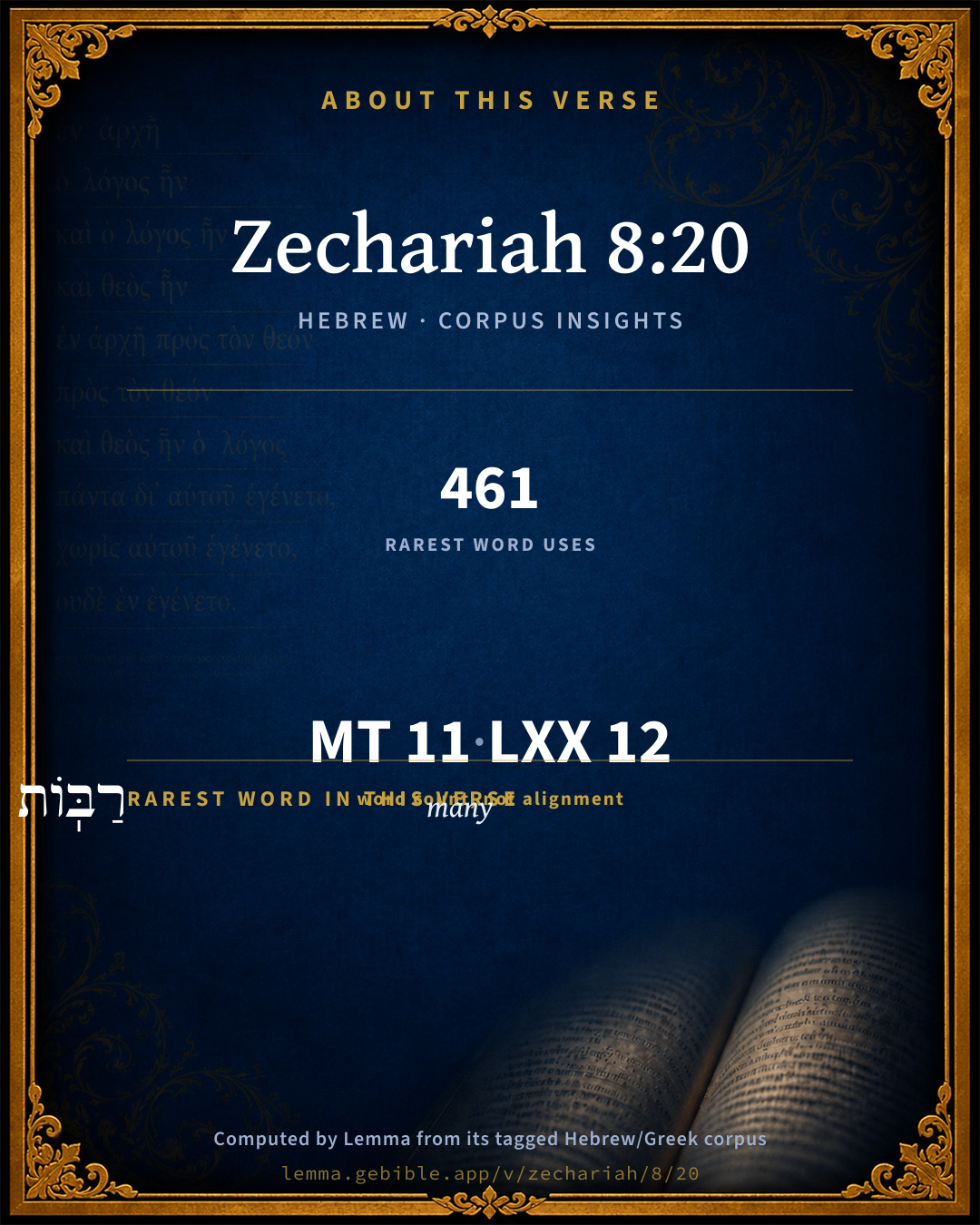
רַבּֽוֹת
rab
H7227
“many”
Adjective, Adjective, Feminine, Plural, Absolute
Part of Speech
Adjective
Type
Adjective
Gender
Feminine
Number
Plural
State
Absolute
Full BDB Definition

Origin: contracted from H7231

TWOT: 2099a , 2099b

much, many, great (adjective) - much - many - abounding in - more numerous than - abundant, enough - great - strong - greater than - much, exceedingly - captain, chief (noun masculine)
  1. כֹּ֥ה kôh H3541 “thus” Adverb
  2. אָמַ֖ר ʼâmar H559 “to say” Verb, Qal, Perfect, 3rd Person, Masculine, Singular
  3. יְהוָ֣ה Yᵉhôvâh H3068 “LORD” Noun, Proper
  4. צְבָא֑וֹת tsâbâʼ H6635 “armies” Noun, Common, Both, Plural, Absolute
  5. עֹ֚ד ʻôwd H5750 “still” Adverb
  6. אֲשֶׁ֣ר ʼăsher H834 “which” Particle, Relative
  7. יָבֹ֣אוּ bôwʼ H935 “to enter” Verb, Qal, Imperfect, 3rd Person, Masculine, Plural
  8. עַמִּ֔ים ʻam H5971 “peoples” Noun, Common, Masculine, Plural, Absolute
  9. וְיֹשְׁבֵ֖י yâshab H3427 “and · dwelling” Conjunction + Verb, Qal, Participle Active, Masculine, Plural, Construct
  10. עָרִ֥ים ʻîyr H5892 “cities” Noun, Common, Feminine, Plural, Absolute

About this verse

These counts appear in no published source. They are computed here, from the morphology-tagged text and Lemma’s own curated glosses. What Lemma adds →

11
words
11
distinct lemmas
Prophets
section

Grammatical profile

  • 3 verbs
  • 4 nouns
  • 1 adjective
  • 2 adverbs
  • 1 particle

Verb forms

  • אָמַ֖ר Qal · Perfect
  • יָבֹ֣אוּ Qal · Imperfect
  • וְיֹשְׁבֵ֖י Qal · Participle Active

Hebrew & Septuagint length

In English translation the verse runs 16 words from the Hebrew and 16 from the Septuagint (LXX English) — the same length.

A rough comparison of the two English renderings, which tokenize alike — not a word-level alignment.

Word counts can differ between the Hebrew and the Greek without any difference in meaning — e.g. the Hebrew direct-object marker אֵת has no separate Greek word, and Greek often adds the article ὁ.

In the original languages it is 11 Hebrew tokens and 12 Greek tokens — but the two are counted differently (Hebrew bundles its prefixes and suffixes into one token; the Greek is in lemma form), so that isn’t a like-for-like length.

Cross-references

28

Topical passages linked to Zechariah 8:20 in the Treasury of Scripture Knowledge — connected by theme and wording, ordered by reader-vote popularity; previews shown in the World English Bible.

  • Isaiah 2:2–3 It shall happen in the latter days, that the mountain of Yahweh's house shall be established on the top of the mountains, And shall be raised above the hills; And all nations shall flow to it.
  • Micah 4:1–2 But in the latter days, It will happen that the mountain of Yahweh's temple will be established on the top of the mountains, And it will be exalted above the hills; And peoples will stream to it.
  • Zechariah 2:11 Many nations shall join themselves to Yahweh in that day, and shall be my people; and I will dwell in the midst of you, and you shall know that Yahweh of Hosts has sent me to you.
  • Isaiah 60:3–12 Nations shall come to your light, and kings to the brightness of your rising.
  • Jeremiah 16:19 Yahweh, my strength, and my stronghold, and my refuge in the day of affliction, to you shall the nations come from the ends of the earth, and shall say, Our fathers have inherited nothing but lies, [even] vanity and things in which there is no profit.
  • Matthew 8:11 I tell you that many will come from the east and the west, and will sit down with Abraham, Isaac, and Jacob in the Kingdom of Heaven,
  • 1 Kings 8:41 Moreover concerning the foreigner, who is not of your people Israel, when he shall come out of a far country for your name's sake
  • 1 Kings 8:43 hear in heaven, your dwelling-place, and do according to all that the foreigner calls to you for; that all the peoples of the earth may know your name, to fear you, as does your people Israel, and that they may know that this house which I have built is called by my name.
  • 2 Chronicles 6:32–33 Moreover concerning the foreigner, who is not of your people Israel, when he shall come from a far country for your great name's sake, and your mighty hand, and your outstretched arm; when they shall come and pray toward this house:
  • Psalms 22:27 All the ends of the earth shall remember and turn to Yahweh. All the relatives of the nations shall worship before you.
  • Psalms 67:1–4 May God be merciful to us, bless us, And cause his face to shine on us. Selah.
  • Psalms 72:17 His name endures forever. His name continues as long as the sun. Men shall be blessed by him. All nations will call him blessed.
  • Psalms 89:9 You rule the pride of the sea. When its waves rise up, you calm them.
  • Psalms 117:1–2 Praise Yahweh, all you nations! Extol him, all you peoples!
  • Psalms 138:4–5 All the kings of the earth will give you thanks, Yahweh, For they have heard the words of your mouth.
  • Isaiah 11:10 It shall happen in that day, that the root of Jesse, who stands for an ensign of the peoples, to him shall the nations seek; and his resting-place shall be glorious.
  • Isaiah 49:6 yes, he says, It is too light a thing that you should be my servant to raise up the tribes of Jacob, and to restore the preserved of Israel: I will also give you for a light to the Gentiles, that you may be my salvation to the end of the earth.
  • Isaiah 49:22–23 Thus says the Lord Yahweh, Behold, I will lift up my hand to the nations, and set up my ensign to the peoples; and they shall bring your sons in their bosom, and your daughters shall be carried on their shoulders.
  • Isaiah 66:18–20 For I [know] their works and their thoughts: [the time] comes, that I will gather all nations and languages; and they shall come, and shall see my glory.
  • Hosea 1:10 Yet the number of the children of Israel will be as the sand of the sea, which can't be measured nor numbered; and it will come to pass that, in the place where it was said to them, 'You are not my people,' they will be called 'sons of the living God.'
  • Hosea 2:23 I will sow her to me in the earth; And I will have mercy on her who had not obtained mercy; And I will tell those who were not my people, 'You are my people;' And they will say, 'My God!'"
  • Amos 9:12 that they may possess the remnant of Edom, and all the nations who are called by my name," says Yahweh who does this.
  • Zechariah 14:16–17 It will happen that everyone who is left of all the nations that came against Jerusalem will go up from year to year to worship the King, Yahweh of Hosts, and to keep the feast of tents.
  • Malachi 1:11 For from the rising of the sun even to the going down of the same, my name is great among the nations, and in every place incense will be offered to my name, and a pure offering: for my name is great among the nations," says Yahweh of Hosts.
  • Romans 15:9–12 and that the Gentiles might glorify God for his mercy. As it is written, "Therefore will I give praise to you among the Gentiles, And sing to your name."
  • Revelation 11:15 The seventh angel sounded, and great voices in heaven followed, saying, "The kingdom of the world has become the Kingdom of our Lord, and of his Christ. He will reign forever and ever!"
  • Acts 15:14 Simeon has reported how God first visited the Gentiles, to take out of them a people for his name.
  • Acts 15:18 All his works are known to God from eternity.'

Cross-references courtesy of OpenBible.info (CC BY 4.0).

Hebrew and Greek witnesses Masoretic Hebrew ↔ Greek Septuagint

The same verse in the two great witnesses to the Old Testament, shown verse-for-verse.

These are two independent witnesses, not word-aligned to each other, and the Septuagint is shown in lemma (dictionary) form.

Hebrew Zechariah 8:20 Masoretic · Westminster Leningrad Codex

כֹּ֥ה אָמַ֖ר יְהוָ֣ה צְבָא֑וֹת עֹ֚ד אֲשֶׁ֣ר יָבֹ֣אוּ עַמִּ֔ים וְיֹשְׁבֵ֖י עָרִ֥ים רַבּֽוֹת

Thus says Yahweh of Hosts: "Many peoples, and the inhabitants of many cities will yet come;

World English Bible · Public Domain

Greek LXX Zechariah 8:20 Septuagint · lemma form

ὅδε λέγω κύριος παντοκράτωρ ἔτι ἥκω λαός πολύς καί καταοἰκέω πόλις πολύς

Thus says the Lord Almighty; Yet shall many peoples come, and the inhabitants of many cities;

LXX2012 (modern English Septuagint) · Public Domain

On this verse, The Pulpit Commentary discusses the Septuagint’s reading. Read the note in Commentary ↓

Hebrew: Westminster Leningrad Codex (CC BY 4.0). Greek: Septuagint (public domain); English from LXX2012 (modern English Septuagint) (Public Domain). How the Septuagint differs from the Hebrew →

Targum (Aramaic paraphrase)

1

The Targum is the ancient Jewish Aramaic paraphrase of the Hebrew Scriptures — an interpretive translation, not the Hebrew text itself. Onkelos (literal) and Pseudo-Jonathan (expansive) render the Torah, and Jonathan the Prophets. Coverage is partial: where no permissively-licensed English translation exists for a verse, only the Aramaic is shown. This is verse-level text, not a word-by-word alignment to the Hebrew.

  1. Targum Jonathan Prophets (Joshua–Malachi)
    כִּדְנַן אֲמַר יְיָ צְבָאוֹת עוֹד דְיֵיתוּן עַמְמִין וְיַתְבֵי קִרְוִין סַגִיאָן:

    (no public-domain English translation for this verse)

    Targum Jonathan — Aramaic: “Mikraot Gedolot” (public domain). English: “Sefaria Community Translation” (CC0 1.0 (public-domain dedication)); “London "Chaldee Paraphrase," 1871” (public domain). Text via Sefaria.

Commentary

Notes on Zechariah 8:20 from classic Christian and Jewish commentators (each source and its license shown beneath its notes). The classic Christian expositions comment on the surrounding passage and are grouped to its opening verse, so a note may address several verses; the Jewish commentaries on the Tanakh (Rashi and others) are per-verse, so they appear only where the commentator wrote on this verse.

Lemma curates 59 commentaries, every one of them public domain or Creative Commons licensed, each selected and text-cleaned for this edition rather than reprinted as found. About our sources →

Trapp's Complete Commentary

John Trapp

Zec 8:20 Thus saith the LORD of hosts; [It shall] yet [come to pass], that there shall come people, and the inhabitants of many cities:

Ver. 20. It shall yet come to pass that there shall come people] The prophet cannot shut up with the former corollary; but further comforts the Jews with a promise of the conversion and conflux of the Gentiles to the Church; yea, Christ’s people shall be willing in the day of his power, Psa 110:3; they are like the isles that wait for his law, Isa 42:4; they are set upon it to come for an offering to the Lord upon horses, in chariots, and in litters, Isa 66:20, to make any shift rather than not come, in litters rather than not at all. The kingdom of heaven shall suffer violence, and the violent take it by force, Mat 11:12.

John Trapp, A Commentary or Exposition upon All the Books of the Old and New Testament (1647–1656) — public domain. Text from a community e-Sword module.

The Biblical Illustrator

Joseph S. Exell

Zec_8:20-22

Let us go speedily to pray before the Lord

Nations meeting for prayer

A scene like this has never yet been witnessed upon the earth.

The prophecy was partially fulfilled when, from the time of the rebuilding of the temple to the coming of the Saviour, a more than usual number of Gentile proselytes from the nations around sought admission into the Jewish Church, and attended the annual festivals.

I. The object of this gathering of the nations. To pray. The time is coming when the nations will crowd to the feast of devotion. The result of the awakening of the nations will be a universal movement for concentrated prayer.

II. The universality of this gathering of the nations for prayer. They are described as many cities, strong nations, and all languages. Isaiah, wrapt in the vision of the future, beholds all the tribes of mankind, instigated by one common and irresistible impulse, flocking along the road to Zion, panting to be within its holy walls, and to pour out their prayers in her courts.

III. The promptitude of their decision. This heaven-originated movement for universal prayer will be felt to be a matter demanding immediate attention. Let us go speedily. When the Spirit is poured out from on high, all the speed and promptitude with which men pursue inferior ends will be consecrated to religion. Universal man will feel it his first duty to serve God.

IV. The personal character of this movement. No mighty movement takes place among masses of mankind until individuals have been moved. The world is but the aggregate of single individuals. Every individual must act his part. If men smother the enkindled fires of ardent devotion in their own breasts, till they see the zeal of others manifested, that day of prayer for all nations will never dawn. Every man is to invite to prayer, and at the same time resolve for himself. Then seek to be distinguished as a devotional Christian--a man of prayer. Then you will seek the society of men like-minded with yourself, and thus the holy flame will be borne onward, till every soul is enkindled, the Church revived, and the world saved. (Evangelical Preacher.)

God everywhere for those who seek Him

1. We are here reminded of our high and distinguishing privileges, as subjects of the Christian economy, in relation to the outward institutions of religion, and all that is commanded in the worship and service of God. When we would offer our devotions in His presence, we need no longer travel from one city to another, ascending to the house of the Lord. Wherever we seek Him, He is equally near, and equally accessible. Great and important purposes were once attained by the selection of a definite abode, wherein to place the sensible demonstrations of His majesty. It was in accordance with the infantile condition of the human mind on the great subject of religion. It repressed the tendency to mingle with the idol worship of the surrounding nations. It secured the permanency of the ordinances of the true God, till the coming of Messiah. By the final cessation of such services, soon after the death of Jesus, it marked that the Messiah had appeared, that the fulness of the times had been accomplished.

2. We are led to reflect upon that singular and elevated relation we now personally sustain to Him who was once known and worshipped only under the appellation of the God of Abraham. We have come to the family and household of the saints. This incorporation of the idolatrous heathen with the seed of the promise--this accession of the Gentiles to the Church--while it presents a subject of gratitude and wonder, is fitted also to expand our sentiments and to confirm our faith; and it leads us to anticipate a day when the Gospel shall universally prevail.

3. An interesting and attractive picture of a period of spiritual prosperity.

(1) The period thus described is marked by the diffusion of the spirit of prayer.

(2) Under the aspect of unity and mutual cooperation.

(3) Signalised by the prevalence of activity, energy, and zeal. Let us go speedily. Let us go to seek the Lord of hosts.

(4) The last characteristic of the period so depicted is the inseparable and intimate connection of all its other features with the decisiveness of individual piety. I will go also.

4. Apply these reflections to purposes of immediate and practical utility. (R. S. MAll, LL. D.)

Spiritual prosperity described

The text is part of the answer given to the question asked in Zec_7:2-3.

1. There are many false notions abroad respecting religious prosperity--crowded Churches--forms in the aisles--full exchequer; such things are taken by some as a sure sign of a Churchs vitality. Flying here and there--doing this, that, and the other in three minutes, and making a great noise, are looked upon by some as signs of saintship, and indications of true religious prosperity. And they may be, but not necessarily so; because outward manifestation is not always a sign of true strength. But we have true signs, unmistakable signs, described in the text.

I. Delight in prayer. Let us go speedily to pray before the Lord.

1. Thus there is a gathering together. It is a regular prayer meeting, and it is in answer to united prayer that blessings come. Illustrations: Day of Pentecost. Liberation of Peter. And it is only when Churches feel the importance of this that a true revival comes.

2. Not only must we pray, hut we must seek the Lord as well--give God no rest until He answers prayer.

II. Harmony and cooperation. And the inhabitants of one city shall go to another, saying, etc. When will the different Churches of the different denominations learn the importance of united prayer? When shall we have done with our little differences and distinctions, and kneel as one family round the throne? God speed the day.

III. A spirit of zeal. Let us go speedily.

1. There will be no lagging behind. It is not, Let us have a prayer meeting tomorrow; let us turn unto the Lord soon; but, Let us do it now.

IV. Personal dedication. I will go also.

1. It is no uncommon thing for people to ask others to do what they dont like to engage in themselves. How inspiring it is to hear the exhortation, Do this, and I will do it, too You go and pray before the Lord; I will accompany you. When this spirit is actuating the members of a Church, the result will be surely seen--in the earnestness and goodwill which exist--sinners saved--church roll increasing--joy in heaven--comment of the world. Behold how good and pleasant a thing it is for brethren to dwell together in unity. (Christian World Pulpit.)

Revival

Suggesting the benefits of a spiritual revival.

1. That the possession of religious life awakens interest in others. And the inhabitants, etc., shall go, etc.

2. That a revived religious life sets value on prayer. Let us go to pray before the Lord.

3. This revived life realises the importance and value of time. Let us go speedily.

4. Revived life constrains us to seek companionship. Let us go. Christians are gregarious.

5. Revived spiritual life ensures a powerful influence over our companions. They said, We will go with you. (J. H. Snell.)

The Biblical Illustrator, edited by Joseph S. Exell (c. 1880s–1900s) — public domain. Text from a community e-Sword module.

Joseph Benson's Commentary

Zec 8:20-22. It shall yet come to pass, &c. — The design of this and the three following verses is evidently to show the high degree of estimation in which Jerusalem and the Jews would hereafter be held, by foreign nations, when those among them, who were piously disposed to worship Jehovah the true God, would come to worship him at Jerusalem, as a place of peculiar sanctity; and those who wanted protection would humbly sue to the Jews for it, convinced that the men of that nation were especial objects of divine favour. It must be observed, however, that though the prediction contained in these verses might, in the primary sense, refer to those times of the Jewish republic which should precede the coming of the Messiah, and to the proselytes, which should then be made to the Jewish religion; yet the expressions are such, that it can scarce be doubted that the times of the gospel are also and more especially intended, when many more, of various nations, should be brought to the knowledge of the true God, and engaged to worship him in an acceptable manner. There shall come people, and the inhabitants of many cities — Great multitudes of different cities and nations. Saying, Let us go speedily to pray before the Lord — The expressions allude to the Jews going up in companies to Jerusalem at the solemn feasts. I will go also — So every single person shall express his willingness to go along with them. Many people, &c., shall come to seek the Lord in Jerusalem — Understanding the words literally, we find the first-fruits of these mentioned Act 2:10-12; but mystically Jerusalem means the church of Christ. To pray before the Lord — To perform all parts of gospel worship.

Joseph Benson's Commentary on the Old and New Testaments (1811–1818) — public domain. Text from a community e-Sword module.

The Preacher's Complete Homiletical Commentary

Joseph S. Exell (gen. ed.)

CRITICAL NOTES.]

Zec_8:20. Yet] Emphatic. People] shall be attracted to God’s house.

Zec_8:21. Saying] Mutually appealing to one another. Speedily] Lit. go, going, implying intense earnestness and determination. I also] Prompt response.

Zec_8:22. Many] in contrast to a few and weak Jews now engaged in God’s work.

Zec_8:23. Ten] A definite for an indefinite number; denoting a great and complete multitude (Gen_31:7; Lev_26:26; Num_14:22). For the figure cf. Isa_4:1. Converts from among the Gentiles shall be as ten to one Jew. All languages] i.e. of nations of all languages. Take hold] A gesture of entreaty for help and protection (Isa_3:6; 1Sa_15:32). With you] An effect often produced upon unbelievers when entering the assemblies of Christians (1Co_14:25). Primarily produced on the nations who witnessed the deliverance by Cyrus; finally, that to be produced by the future grand interposition of Messiah on behalf of his people [cf. Fausset].

HOMILETICS

THE FUTURE PROSPERITY OF THE CHRISTIAN CHURCH.—Zec_8:20-23

The ordinary reference of these words is to Gospel times, and, in part, to the Gospel dispensation of the future. They express the obligations to be felt and owned by the whole world—by “men of every kindred, and people, and nation, and tongue”—to the Jews, for the knowledge, the worship, and the practice of true religion [cf. Wardlaw]. The text contains a wonderful description of future prosperity to the Church of God.

I. Multitudes will be converted to God. “Many people and strong nations shall come.” The few and feeble Jews shall increase into a mighty nation. “Many shall come from the east and the west, from the north and the south.” Bigotry says few. Modern Scribes and Pharisees say few; but God says many. Every fresh conversion shall win others, until “all nations flow” into God’s kingdom.

II. Multitudes will be converted to God by the instrumentality of the Jews. “Ten men shall take hold out of all languages of the nations of the skirt of him that is a Jew.”

1. Nations shall feel indebted to the Jews. Their outward polity has decayed, and they have been scattered and despised for centuries; but the world will yet own its obligation to them. Other nations have given science and art, government and laws; but to the Jews are we indebted for a knowledge of God, and the preservation of his Word. “What advantage then hath the Jew? Much every way; chiefly, because that unto them were committed the oracles of God” (cf. Rom_3:2; Rom_9:4-5).

2. Nations shall discern that God is with the Jews. “For we have heard that God is with you.” God has not cast off his ancient people, but still watches over them. The report of his deeds among them shall spread. They shall be gathered and honoured, and other nations will be anxious to participate in their blessings. All people shall yet testify in their favour. “Their seed shall be known among the Gentiles, and their offspring among the people; all they that see them shall acknowledge them that they are the seed which the Lord hath blessed.”

A CALL TO GOD’S HOUSE.—Zec_8:21-22

Take Jerusalem here literally or spiritually, the words may be regarded as a call to Christian worship. God has put his name in his house. It shall be attractive to all sincere believers, and in whatever place they reside they shall come to the great festivals of the future.

I. The purpose for which they come. Not to play nor pass away the time; not for any secular, but a spiritual end.

1. They go to pray before the Lord. Prayer is the language of dependence and entreaty. Men feel that nothing can satisfy but God—are led to give up every kind of idolatry and come to him, believing that he will hear prayer. Prayer is most important, and most necessary, yet meetings for united prayer are neglected. If the spirit of prayer be not with a people, there can be no life and unity.

2. They go to seek the Lord. God preeminently displays grace and glory in his house. True worshippers covet his favour, and long for his fellowship. They regard God in everything. They earnestly seek to behold his power and glory in his sanctuary (Psa_63:2). Through the veil of ceremonies they look to the Invisible One. “This is the generation of those that seek him.”

II. The method in which they come. “Many people and strong nations,” &c.

1. In great numbers. At present the ways of Zion mourn. Few attend the house of God, and like sparrows are alone upon the house-top. As in ancient times, Jews went from village to village, gathering numbers and singing hymns as they journeyed on, until all appeared in Zion before God: so shall multitudes say, “Come ye, and let us go up to the mountain of the Lord, to the house of the God of Jacob” (Isa_2:3).

2. In great variety. “The inhabitants of many cities.” Country and townspeople, merchants and mechanics, masters and servants, shall come. “Men out of all languages of the nations”—the Mahomedan and the Turk, the Hindoo and the Hottentot, Greek and Jew, shall yet meet together in the house of God.

III. The spirit in which they come.

1. A spirit of mutual excitement. The inhabitants of one city go to another. They do not invite those whom they accidentally meet on the way, nor do they wait for the minister and the missionary to do their work. They go to the negligent—perhaps at some sacrifice and inconvenience—and stir one another up. This is needful now. Frivolous are the excuses, and unjustifiable the causes, which keep men from the house of God.

2. A spirit of personal resolve. “I will go also,” was the response of each when invited. Many excuse; they have no time, no clothes, and you must call again. But others are only waiting for an invitation. Let us all resolve with Nehemiah and his friends: “We will not forsake the house of our God.”

3. A spirit of earnestness. “Let us go speedily.” (a) Go with heartiness. Put heart and feeling into your work. Angels are like flaming fire in their service. We are dull and half-asleep. (b) Go withtout delay. Many delay and never go. They never begin to pray, till God has ceased to hear. Let all attend and take others to the house of God—pray that God would revive his work, and bless our souls. “I was glad when they said unto me, Let us go into the house of the Lord. Our feet shall stand within thy gates, O Jerusalem.”

HOMILETIC HINTS AND OUTLINES

Zec_8:20-21. Characteristics of a genuine revival.

1. A general interest in the house of God.

2. A mutual concern for each other’s welfare.

3. An earnest resolve for individual duty; and

4. A great accession to the Christian Church.

The inhabitants, &c. They shall not be satisfied with their own salvation, careless about the salvation of others; they shall employ all labour and industry, with wondrous love, to provide for the salvation of others as if it were their own It is a marvellous stirring of minds [Pusey]. Learn also—

1. That those who know God will seek to bring others to know him.

2. That mutual stirring up to duty is a means of increase to the Church. 3. That in this work we should not be discouraged.

(1) Sad times should not blot out remembrance of the Church’s charter and future privileges.

(2) Personal sacrifices should not tire nor dishearten us. Indifference and lukewarmness are out of place. We must be active and constant in the work. “Let us go speedily.”

I will go also. I. The object of the awakened sinner. To seek God. II. The means of accomplishing this object.

(1) Attendance in sanctuary.

(2) Prayer. III. The influence of example in pursuing this object. Inciting others. Individual example connected with general exhortation.

Zec_8:23. A revived people.

1. Blessed with God’s presence.

2. Instrumental in the conversion of others.

ILLUSTRATIONS TO CHAPTER 8

Zec_8:20-22. Pray. The gracious God is pleased to esteem it his glory to have many beggars thronging at the beautiful gate of his temple, for spiritual and corporal alms. What an honour it is to our Great Landlord that multitudes of tenants flock together to his house to pay their rent of thanks and worship for all which they hold of him! How loud and lovely is the noise of many golden trumpets! Good Lord, what an echo do they make in heaven’s ears! When many skilful musicians play in concert with well-tuned and prepared instruments, the music cannot but be ravishing to God himself [George Swinnock].

Zec_8:23. Skirt. This is a simple and striking expression. We have seen a dear little infant, when he wished to engage the attention of his mother, pulling her by the clothes. When a child has been walking along with his father, and afraid that he would leave him, he not only cries but lays hold of his coat. When the cripple had been healed at the beautiful gate of the temple, he held Peter and John, and was afraid to let them go (probably dreading a return of his former misery), as much as to say, “You shall not go, and if you do I will go with you, and you shall draw me after you.” Just so is it here. It shows conviction, attachment, eager attention, a wishing to be among them and of them [Jay].

The Preacher's Complete Homiletical Commentary (gen. ed. Joseph S. Exell; Funk & Wagnalls, c. 1892) — public domain (pre-1929). A full-Bible homiletical/sermon-outline anthology covering 65 of 66 books (2 John is absent from the source module). Text from a community e-Sword module.

Keil & Delitzsch

C. F. Keil & F. Delitzsch

Zac 8:20. "Thus saith Jehovah of hosts: Yet will nations come, and inhabitants of many cities. Zac 8:21. And the inhabitants of one (city) will go to another, and say, 'We will go, go away, to supplicate the face of Jehovah, and to seek Jehovah of hosts.' 'I will also go.' Zac 8:22. And many peoples and strong nations will come, to seek Jehovah of hosts in Jerusalem, and to supplicate the face of Jehovah." These verses do not announce a further or second glorification, which God has designed for His people, but simply indicate the nature and magnitude of the salvation appointed for Israel, through which its fast-days will be turned into days of joy. Hitherto Israel had kept days of mourning and fasting on account of the destruction of Jerusalem and the temple; but in the future the Lord will so glorify His city and His house, that not only will Israel keep joyful feasts there, but many and strong heathen nations will go to the house of God, to seek and worship the God of hosts. עד is used with emphasis, so that it resembles a sentence: "It will still come to pass, that," etc. This is how אשׁר in Zac 8:21 and Zac 8:23 is to be taken, and not as the introduction to the saying preceded energetically by עד, for which Hitzig is wrong in referring to Mic 6:10. For the fact itself, compare Mic 4:1., Isa 2:2., Jer 16:19. In Zac 8:21 the thought is individualized. The inhabitants of one city call upon those of another. נלכה הלוך, "we will go to supplicate," etc.; and the population of the other city responds to the summons by saying, "I also will go." חלּות את־פּני, as in Zac 7:2.

Keil & Delitzsch — Biblical Commentary on the Old Testament (1861–1891) — public domain (CC PDM 1.0). Text via the HelloAO Bible API. (Old Testament only.)

Geneva Bible (1599)

Geneva Bible translators

He declareth the great zeal that God should give the Gentiles to come to his Church, and to join with the Jews in his true religion, which should be in the kingdom of Christ.

Geneva Bible (1599) marginal notes — public domain. Text via Bolls.life.

Jamieson, Fausset & Brown

Robert Jamieson, A. R. Fausset & David Brown

(Isa 2:3; Mic 4:2).

Thus saith the Lord of hosts--a preface needed to assure the Jews, now disheartened by the perils surrounding them, and by the humble aspect of the temple. "Unlikely as what follows may seem to you, Jehovah of hosts, boundless in resources, saith it, therefore it shall be so." Just before Christ's coming, a feeling grew up among the heathen of the unsatisfactoriness of their systems of religion and philosophy; this disposed them favorably towards the religion of the Jew, so that proselytes embraced the worship of Jehovah from various parts of Asia; these again were predisposed to embrace Christianity when it was preached to them (Act 2:9-12, Act 2:41). But the full accomplishment of the conversion of the Gentiles foretold here is reserved till "Jerusalem" (Zac 8:22) becomes the center of Christianized Jewry (Rom 11:12, Rom 11:15).

Jamieson, Fausset & Brown — Commentary Critical and Explanatory on the Whole Bible (1871) — public domain (CC PDM 1.0). Text via the HelloAO Bible API.

Adam Clarke's Commentary

Verse 20. There shall come people] Similar promises to those in Isa 2:3 and in Mic 4:1-2. Many Gentiles, as well as Jews, will then be found devoting themselves to the Lord.

Adam Clarke's Commentary on the Bible (1810–1826) — public domain. Text from a community e-Sword/MySword module.

John Calvin's Commentaries

The Prophet here extends his discourse still farther; for he promises not only the complete restoration of his chosen people, but also the propagation of the Church; for God, he says, will gather a Church for himself from many and remote nations, and unite many nations in one body. And this ought to have availed especially to animate the Jews, as they were thus taught that the temple was built, not only that God might be worshipped by one nation, but by all nations. Moreover, as before this time some had come from distant lands to worship God, the Prophet may seem here to have this in view by using עוד, oud, the adverb of time. But he not only declares that some would come, as in the time of Solomon, but as I have already said, he promises here something more remarkable — that the temple would not belong peculiarly to the Jews, but would be common to all nations; for there is to be no language and no nation which is not to unite in the true worship of God. But let us consider the words of the Prophet.

He begins by saying, that God was the author of this prophecy; and this was said to secure credit. There was need, as we have said, of no common authority, since he was here speaking of what was incredible. There was only a handful of people returned to their country, and many dangers surrounded them almost every day; so that many, wearied with their present condition, preferred exile, and regret for their return had now crept into the minds of many, for they thought that they had been deceived. Since then the state of the people was such, there was need of something more than ordinary to confirm what is here said — that the glory of the second temple would be greater and more eminent than that of the first: It shall yet be, he says. Though a comparison is implied, there is yet no equality expressed, as though some few only would come. But as there had been no temple for seventy years, and as the temple, now begun to be built, was in no high esteem, but mean and insignificant, the Prophet says, that the time would yet come, when nations and inhabitants of great cities would ascend into Jerusalem. We may indeed render רבות, rebut, many or great, for it means both; but the Prophet, I think, speaks of great cities; and the reason will presently appear.

John Calvin's Commentaries (1540-1563) — public domain. Text from the Calvin Translation Society English edition (1840s-50s) via the Christian Classics Ethereal Library (ccel.org). Calvin's coverage is partial (roughly two-thirds of the Bible); uncommented books and verses are honest gaps, never fabricated. The 19th-century editor's footnotes and remarks are omitted so the notes are faithfully Calvin's own voice.

Ellicott's Commentary for English Readers

(20-23) The language of the promises contained in these verses is evidently borrowed from Mic_4:2; Isa_2:2-3. (Comp. Isa_45:14-17.) According to the figurative language of the Old Testament, the nations are represented as coming up to Jerusalem with the object, doubtless, of keeping there the festivals. (Comp. Zec_2:10-13; Zec_14:16-19.) But we must not look for a literal fulfilment of such prophecies. The one before us seems to be virtually fulfilled, in the fact that through Jesus Christ (who was a Jew according to the flesh) the knowledge of the true God has been spread among most nations of the world. Still, in view of Romans 11, we are not without warrant in looking forward to a more glorious and perfect fulfilment of such prophecies as this in the unknown future.

A Bible Commentary for English Readers, edited by Charles John Ellicott (1878–1897) — public domain. Text from a community e-Sword module.

The Cambridge Bible for Schools and Colleges

gen. ed. J. J. S. Perowne

20. people] Lit. peoples. Here probably the tribes of Israel (comp. Deu_33:3; Deu_33:19, where the word is used in that sense). In Zec_8:22, many peoples, refers to foreign nations, to whom the prophecy extends itself in that and the following verses.

20–23. The joyful change shall extend, in its influence, to the heathen nations of the world. Comp. Isa_2:2-3; Mic_4:1-2.

The Cambridge Bible for Schools and Colleges (gen. ed. J. J. S. Perowne; Cambridge University Press, 1878–1918) — public domain. Text from a community e-Sword module.

John Gill's Exposition

Yea, many people, and strong nations,.... Or, "mighty kingdoms", as the Targum renders it; even such have embraced the Gospel, and professed the Christian religion; of which there has been abundant proof since the downfall of Paganism under Constantine:

shall come to seek the Lord of hosts in Jerusalem; that is, shall attend the public worship of God in the church:

and to pray before the Lord; join in public prayer, and other ordinances of the Gospel. This phrase, which is used also in the preceding verse Zac 8:21, signifies that the Lord, and he only, is the object of prayer: it is not to be made to a creature, or to an idol made with hands, they had been used to pray to before, but to the one only living and true God, Father, Son, and Spirit; and that this is to be done as in the presence of God, who is omniscient, who knows all persons and their cases, and what are their ends and views in their petitions to him, and whether these come from a true heart and unfeigned lips; for all things are naked and open unto him, with whom we have to do; that, under the Gospel dispensation especially, men may come into the presence of God with great freedom and liberty, and pour out their souls before him, and with great boldness and confidence, through the blood of Christ being shed, and a new and living way opened by it, in which they may come and ask in faith whatever they want; though this should always be performed with reverence and godly fear, and with all humility and submission to the will of God: and though it may take in all sorts of prayer, and wherever and by whomsoever performed, either mental or vocal, in the closet or in the family, which is always to be done in like manner before God; yet it seems chiefly to design social and public prayer: which being put up to God in the church, may be said to be before the Lord, it being in the assembly of his saints, where he more especially grants his presence, and shows himself to be a God hearing and answering prayer; see Psa 65:1.

John Gill's Exposition of the Whole Bible (1746–1763) — public domain (CC PDM 1.0). Text via the HelloAO Bible API.

Albert Barnes' Notes on the Bible

It shall yet be that - The promises are those which God had already made by Isaiah (Isa 2:2 ff) and Micah (Mic 4:1 ff). Yet where was the show of their fulfillment? The Jews themselves, a handful: the temple unfinished; its completion depending, in human sight, upon the will of their pagan masters, the rival worship at Samaria standing and inviting to coalition. Appearances and experience were against it. God says virtually, that it was, in human sight, contrary to all expectations. But “weakness is aye Heaven’s might.” Despite of all, of the fewness of those who were returned, their downheartedness, broken condition, hopelessness, though all had hitherto failed, though, or rather because, all human energy and strength were gone, as God had said before, “The Lord shall yet (Zec 1:17; Zec 2:1-13 :16 (12 English)) choose Jerusalem,” so now, It shall “yet” be “that.”

Nations and many cities shall come - He describes vividly the eagerness and mutual impulse, with which not only many but mighty nations should throng to the Gospel, and every fresh conversion should win others also, until the great tide should sweep through the world.

Albert Barnes' Notes on the Bible (1834–1885) — public domain. Text from a community e-Sword/MySword module.

Matthew Poole's English Annotations

Thus saith the Lord of hosts: this solemn attestation, that it is the Lord of hosts who will do that great thing next promised, calls both for our heeding and believing of it.

It shall yet come to pass; how low soever the state of my church doth appear, and really is, yet a time shall come when it shall be more considerable.

There shall come people; that is, multitudes of people, for they shall be inhabitants of many and great cities, which is added to explain what was more obscure in that one word,

people. The Gentiles shall be added to the church, and increase her greatly.

Matthew Poole's English Annotations on the Holy Bible (1683–1685) — public domain. Text from a community e-Sword/MySword module.

The Pulpit Commentary

It shall yet come to pass, that there shall come people; peoples. The sight of the prosperity of the Jews shall induce surrounding nations to join in the worship of Jehovah. The same truth is expressed in Psa_126:1-3. Perowne thinks that vers. 20, 21 refer to the tribes of Israel; but it seems unnatural to suppose the prophet asserting that it will yet happen that Israelites will seek the Lord, when there is no reason to think that they had not done so in some fashion, or that they would need the previous deliberation mentioned in the next verse. Many cities. So the LXX and Vulgate. Others translate, "great, or, populous cities;" but this isless suitable.

The Pulpit Commentary (1880–1919), ed. H.D.M. Spence-Jones & Joseph S. Exell — public domain. Text from a community e-Sword module.

John Wesley's Explanatory Notes

People - Multitudes.

John Wesley, Explanatory Notes Upon the Whole Bible (1754–1765) — public domain. Text via the GEBible commentary corpus.

unfoldingWord translationNotes

Door43 World Missions Community

People will come again

The implied information is that Jerusalem is where the people will come. AT: "People will come again to Jerusalem" (See: Assumed Knowledge and Implicit Information)

will go to another city

This is a metonym for the people in the other city. AT: "will go to the people of another city" (See: Metonymy)

beg

Here the word "beg" means to plead or ask urgently.

before the face of Yahweh

Here "face" is a metonym for Yahweh's presence. See how you translated this in Zechariah 7:2. AT: "in the presence of Yahweh" (See: Metonymy)

seek Yahweh of hosts

Those who want to know Yahweh and please him are spoken of as if they are literally seeking to find Yahweh. (See: Metaphor)

mighty nations

This is a metonym for the people in the mighty nations. AT: "people of mighty nations" (See: Metonymy)

translationWords

beg

favor

might

nation

unfoldingWord translationNotes — © Distant Shores Media and the Door43 World Missions Community, licensed CC BY-SA 4.0. Source: git.door43.org/Door43/en_tn.

Lesson kit

Teaching starters — assembled from the data on this page, not authored interpretation. Every prompt links to the verse data it draws on. Edit before teaching.

Zechariah, in the Prophets, opens this verse with 11 words (11 distinct Hebrew lemmas). Its most distinctive word is rab (“many”). A historical commentator’s framing appears above. Read the whole chapter for the surrounding context.

Discussion questions

  1. What does “many” (rab) contribute to the verse as a whole?
  2. How does Isaiah 2:2–3, which shares this passage’s theme, read alongside this verse?
  3. These translations render this verse differently. What is at stake in choosing one wording over another?
  4. «אָמַ֖ר» is a Qal Perfect verb. How does that grammatical form shape the action described?
  5. Compare how Trapp's Complete Commentary and The Biblical Illustrator read this verse. Where do they agree or differ?

Things to notice

Reading settings

Reading text

Shown beneath each verse's original-language words.

Old Testament
Old Testament edition

Read the OT as the Masoretic Hebrew (MT) or the Greek Septuagint (LXX).

English shown for the Greek Septuagint (in the Hebrew ↔ Greek comparison).

Comparing translations? Open the Compare panel on any verse page to stack up to four side by side.