
Hosea 3:4

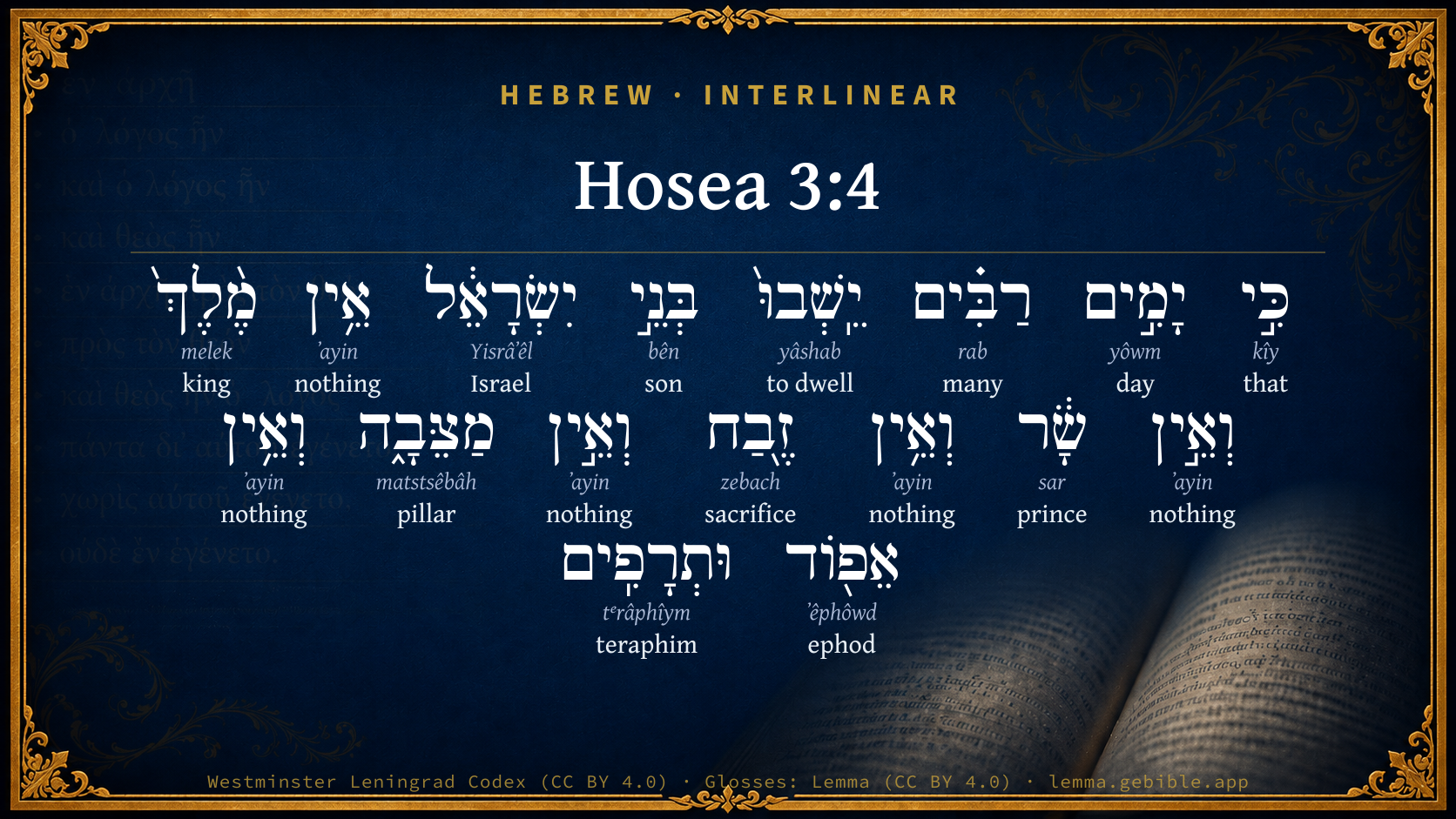
Hebrew (Westminster Leningrad Codex) Hosea 3:4 appears in the Hebrew Old Testament. The text above is from the Westminster Leningrad Codex. Each word links to its Strong’s number, a concise gloss, and parsing drawn from the Open Scriptures Hebrew Bible morphology. Click any word for its full Brown-Driver-Briggs (BDB) entry.
Download image
Cite this verse

Hosea 3:4 (World English Bible). Public Domain. Lemma interlinear Bible study tool, https://lemma.gebible.app/v/hosea/3/4.

Show BibTeX & RIS
BibTeX
RIS
English Translation
For the children of Israel shall abide many days without king, and without prince, and without sacrifice, and without sacred stone, and without ephod or idols.
World English Bible · Public Domain
Download a study sheet

One document with this verse’s original text, its word-by-word gloss line, the meaning frame, cross-references with their text, attributed commentary, and full source and license credits — printable, and it pastes into notes with its structure intact.

This verse Autodidact and up

Study sheet (.html) Plain text (.txt)

A passage Seminary Student

Up to 50 verses in one chapter. A passage sheet keeps up to 6 commentary sources and 12 cross-references per verse, in the order this page ranks them, and says so on the sheet whenever that leaves anything out. Ask for a single verse and you get the Autodidact verse sheet above.

Everything on this page stays free to read, with no account — the sheet is a download of what is already on screen, not access to it.

Want to remove ads? Support Godless Engineer
Compare translations 3

The same verse in 3 English versions, stacked beneath the original-language interlinear above. Click any original word for its lexicon entry.

Each is an independent rendering of the whole verse — the interlinear is not word-aligned to these translations.

Highlighted words mark where these versions differ — a whole-verse word diff, not a word-by-word alignment.

  • World English Bible Public Domain
    For the children of Israel shall abide many days without king, and without prince, and without sacrifice, and without sacred stone, and without ephod or idols.
  • King James Version Public Domain
    For the children of Israel shall abide many days without a king, and without a prince, and without a sacrifice, and without an image, and without an ephod, and without teraphim:
  • unfoldingWord Literal Text CC BY-SA 4.0
    For many days the sons of Israel will dwell without a king, and without a prince, and without a sacrifice, and without a pillar, and without an ephod, and teraphim.

unfoldingWord Literal Text — © unfoldingWord, licensed CC BY-SA 4.0. Word-aligned USFM3 via Door43 (git.door43.org/unfoldingWord/en_ult).

Versions to compare (up to 4)

3 of 4 selected

Show all 18 translations

Every available English version of this verse, each an independent rendering of the whole verse.

  • World English Bible Public Domain
    For the children of Israel shall abide many days without king, and without prince, and without sacrifice, and without sacred stone, and without ephod or idols.
  • Berean Standard Bible Public Domain
    For the Israelites must live many days without king or prince, without sacrifice or sacred pillar, and without ephod or idol.
  • Majority Standard Bible Public Domain
    For the Israelites must live many days without king or prince, without sacrifice or sacred pillar, and without ephod or idol.
  • King James Version Public Domain
    For the children of Israel shall abide many days without a king, and without a prince, and without a sacrifice, and without an image, and without an ephod, and without teraphim:
  • American Standard Version (1901) Public Domain
    For the children of Israel shall abide many days without king, and without prince, and without sacrifice, and without pillar, and without ephod or teraphim:
  • Revised Version (1885) Public Domain
    For the children of Israel shall abide many days without king, and without prince, and without sacrifice, and without pillar, and without ephod or teraphim.
  • Geneva Bible (1599) Public Domain
    For the children of Israel shall remaine many dayes without a King and without a prince, and without an offering, and without an image, and without an Ephod and without Teraphim.
  • Douay-Rheims (1899) Public Domain
    For the children of Israel shall sit many days without king, and without prince, and without sacrifice, and without altar, and without ephod, and without theraphim.
  • Young's Literal Translation Public Domain
    For many days remain do the sons of Israel without a king, and there is no prince, and there is no sacrifice, and there is no standing pillar, and there is no ephod and teraphim.
  • Literal Standard Version CC BY-SA 4.0
    For the sons of Israel remain without a king for many days, and there is no prince, and there is no sacrifice, and there is no standing pillar, and there is no ephod and teraphim.
  • Unlocked Literal Bible CC BY-SA 4.0
    For the people of Israel will live for many days without a king, prince, sacrifice, stone pillar, ephod or household idols.
  • unfoldingWord Literal Text CC BY-SA 4.0
    For many days the sons of Israel will dwell without a king, and without a prince, and without a sacrifice, and without a pillar, and without an ephod, and teraphim.
  • Darby Bible Public Domain
    For the children of Israel shall abide many days without king, and without prince, and without sacrifice, and without statue, and without ephod and teraphim.
  • World Messianic Bible Public Domain
    For the children of Israel shall live many days without king, without prince, without sacrifice, without sacred stone, and without ephod or idols.
  • Webster's Bible Public Domain
    For the children of Israel shall abide many days without a king and without a prince, and without a sacrifice, and without an image, and without an ephod, and without teraphim:
  • Free Bible Version CC BY-SA 4.0
    For the people of Israel shall be without a king or a prince, without a sacrifice or a stone pillar or a pagan image or an idolatrous shrine for a long time.
  • Bible in Basic English Public Domain
    For the children of Israel will for a long time be without king and without ruler, without offerings and without pillars, and without ephod or images.
  • JPS Tanakh (1917) Public Domain
    For the children of Israel shall sit solitary many days without king, and without prince, and without sacrifice, and without pillar, and without ephod or teraphim;

Literal Standard Version (2020), Covenant Press — licensed CC BY-SA 4.0. Text via the HelloAO Bible API (eBible.org). Unlocked Literal Bible (unfoldingWord) — licensed CC BY-SA 4.0. Text via the HelloAO Bible API (eBible.org). unfoldingWord Literal Text — © unfoldingWord, licensed CC BY-SA 4.0. Word-aligned USFM3 via Door43 (git.door43.org/unfoldingWord/en_ult). Free Bible Version, Dr. Jonathan Gallagher — licensed CC BY-SA 4.0. Text via the HelloAO Bible API (eBible.org).

Word by word

More ways to search: Search by grammar → Find every occurrence → Compare this word →

Practice this passage: Drill this verse → Learn its vocabulary →

וּתְרָפִֽים
tᵉrâphîym
H8655
“and · teraphim”
Conjunction + Noun, Common, Masculine, Plural, Absolute
Part of Speech
Conjunction + Noun
Type
Common
Gender
Masculine
Number
Plural
State
Absolute
Full BDB Definition

Origin: pl. from H7495

TWOT: 2545

idolatry, idols, image(s), teraphim, family idol - a kind of idol used in household shrine or worship
  1. כִּ֣י kîy H3588 “that” Conjunction
  2. יָמִ֣ים yôwm H3117 “days” Noun, Common, Masculine, Plural, Absolute
  3. רַבִּ֗ים rab H7227 “many” Adjective, Adjective, Masculine, Plural, Absolute
  4. יֵֽשְׁבוּ֙ yâshab H3427 “to dwell” Verb, Qal, Imperfect, 3rd Person, Masculine, Plural
  5. בְּנֵ֣י bên H1121 “sons of” Noun, Common, Masculine, Plural, Construct
  6. יִשְׂרָאֵ֔ל Yisrâʼêl H3478 “Israel” Noun, Proper
  7. אֵ֥ין ʼayin H369 “nothing” Particle, Negative
  8. מֶ֨לֶךְ֙ melek H4428 “king” Noun, Common, Masculine, Singular, Absolute
  9. וְאֵ֣ין ʼayin H369 “and · nothing” Conjunction + Particle, Negative
  10. שָׂ֔ר sar H8269 “prince” Noun, Common, Masculine, Singular, Absolute
  11. וְאֵ֥ין ʼayin H369 “and · nothing” Conjunction + Particle, Negative
  12. זֶ֖בַח zebach H2077 “sacrifice” Noun, Common, Masculine, Singular, Absolute
  13. וְאֵ֣ין ʼayin H369 “and · nothing” Conjunction + Particle, Negative
  14. מַצֵּבָ֑ה matstsêbâh H4676 “pillar” Noun, Common, Feminine, Singular, Absolute
  15. וְאֵ֥ין ʼayin H369 “and · nothing” Conjunction + Particle, Negative
  16. אֵפ֖וֹד ʼêphôwd H646 “ephod” Noun, Common, Masculine, Singular, Absolute

About this verse

These counts appear in no published source. They are computed here, from the morphology-tagged text and Lemma’s own curated glosses. What Lemma adds →

17
words
13
distinct lemmas
Prophets
section

Notable vocabulary

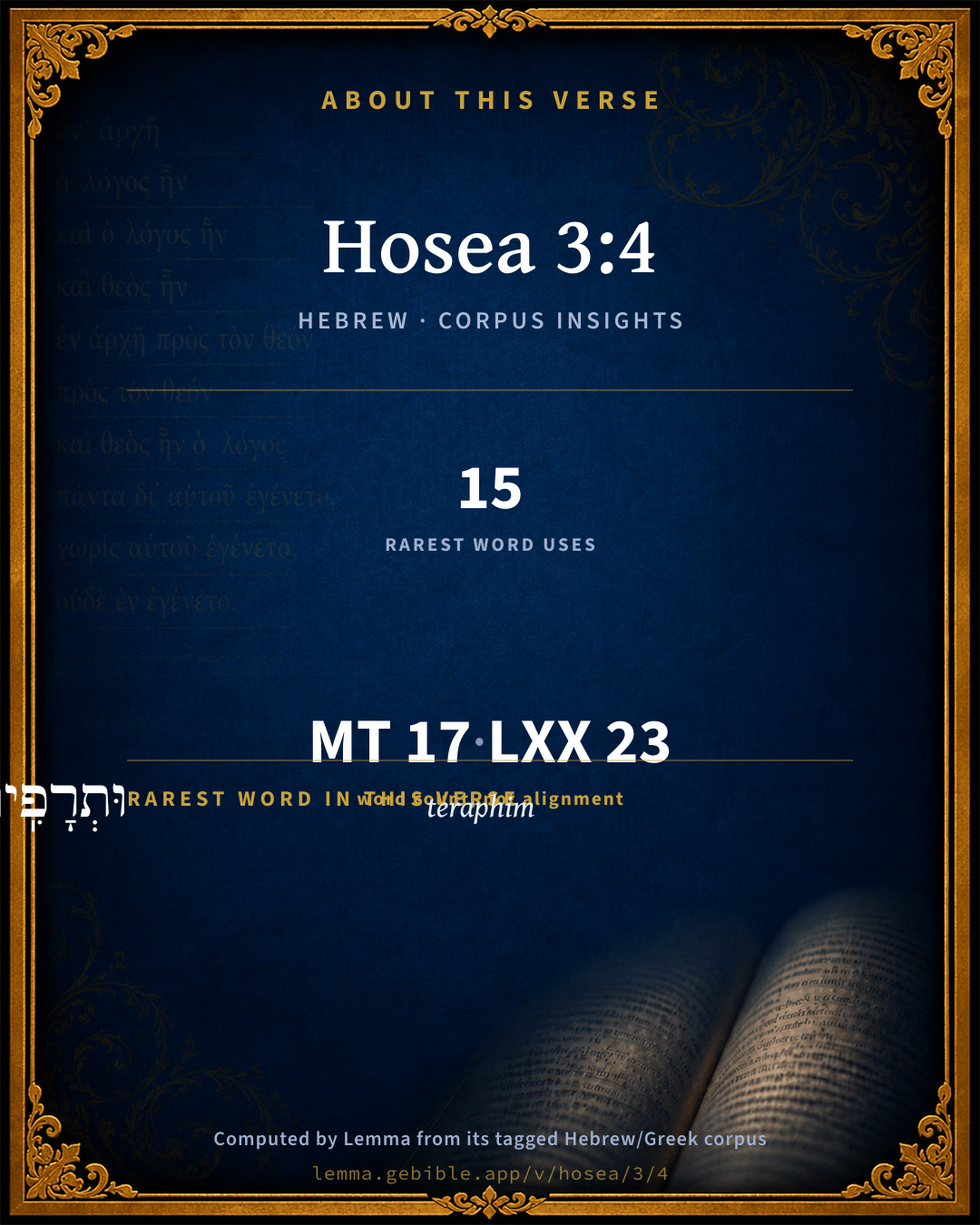
The rarest word here is וּתְרָפִֽים teraphim H8655 — appearing just 15 times in the whole Hebrew Bible.

Shared distinctive vocabulary

וּתְרָפִֽים teraphim H8655 occurs in 15 verses of the Hebrew Bible. Also found in:

Grammatical profile

  • 1 verb
  • 9 nouns
  • 1 adjective
  • 1 conjunction
  • 5 particles

Verb forms

  • יֵֽשְׁבוּ֙ Qal · Imperfect

Repetition

A word recurs within this verse — often emphatic in Hebrew:

  • אֵ֥ין nothing H369 ×5

Hebrew & Septuagint length

In English translation the verse runs 26 words from the Hebrew and 31 from the Septuagint (LXX English) — closely comparable.

A rough comparison of the two English renderings, which tokenize alike — not a word-level alignment.

Word counts can differ between the Hebrew and the Greek without any difference in meaning — e.g. the Hebrew direct-object marker אֵת has no separate Greek word, and Greek often adds the article ὁ.

In the original languages it is 17 Hebrew tokens and 23 Greek tokens — but the two are counted differently (Hebrew bundles its prefixes and suffixes into one token; the Greek is in lemma form), so that isn’t a like-for-like length.

Cross-references

35

Topical passages linked to Hosea 3:4 in the Treasury of Scripture Knowledge — connected by theme and wording, ordered by reader-vote popularity; previews shown in the World English Bible.

  • Judges 17:5 The man Micah had a house of gods, and he made an ephod, and teraphim, and consecrated one of his sons, who became his priest.
  • Genesis 31:19 Now Laban had gone to shear his sheep: and Rachel stole the teraphim that were her father's.
  • 2 Chronicles 15:2 and he went out to meet Asa, and said to him, Hear you me, Asa, and all Judah and Benjamin: Yahweh is with you, while you are with him; and if you seek him, he will be found of you; but if you forsake him, he will forsake you.
  • Exodus 28:4 These are the garments which they shall make: a breastplate, and an ephod, and a robe, and a coat of checker work, a turban, and a sash: and they shall make holy garments for Aaron your brother, and his sons, that he may minister to me in the priest's office.
  • Judges 8:27 Gideon made an ephod of it, and put it in his city, even in Ophrah: and all Israel played the prostitute after it there; and it became a snare to Gideon, and to his house.
  • 1 Samuel 23:9 David knew that Saul was devising mischief against him; and he said to Abiathar the priest, Bring here the ephod.
  • Daniel 9:27 He shall make a firm covenant with many for one week: and in the midst of the week he shall cause the sacrifice and the offering to cease; and on the wing of abominations [shall come] one who makes desolate; and even to the full end, and that determined, shall [wrath] be poured out on the desolate.
  • Daniel 12:11 From the time that the continual [burnt offering] shall be taken away, and the abomination that makes desolate set up, there shall be one thousand two hundred ninety days.
  • John 19:15 They cried out, "Away with him! Away with him! Crucify him!" Pilate said to them, "Shall I crucify your King?" The chief priests answered, "We have no king but Caesar!"
  • Hebrews 10:26 For if we sin willfully after we have received the knowledge of the truth, there remains no more a sacrifice for sins,
  • Genesis 49:10 The scepter will not depart from Judah, Nor the ruler's staff from between his feet, Until he comes to whom it belongs. To him will the obedience of the peoples be.
  • Leviticus 8:7 He put the coat on him, tied the sash on him, clothed him with the robe, put the ephod on him, and he tied the skillfully woven band of the ephod on him, and fastened it to him with it.
  • Judges 18:17–24 The five men who went to spy out the land went up, and came in there, and took the engraved image, and the ephod, and the teraphim, and the molten image: and the priest stood by the entrance of the gate with the six hundred men girt with weapons of war.
  • 1 Samuel 2:18 But Samuel ministered before Yahweh, being a child, girded with a linen ephod.
  • 1 Samuel 14:3 and Ahijah, the son of Ahitub, Ichabod's brother, the son of Phinehas, the son of Eli, the priest of Yahweh in Shiloh, wearing an ephod. The people didn't know that Jonathan was gone.
  • 1 Samuel 21:9 The priest said, The sword of Goliath the Philistine, whom you killed in the valley of Elah, behold, it is here wrapped in a cloth behind the ephod: if you will take that, take it; for there is no other except that here. David said, There is none like that; give it me.
  • 1 Samuel 22:18 The king said to Doeg, Turn you, and fall on the priests. Doeg the Edomite turned, and he fell on the priests, and he killed on that day eighty-five persons who wore a linen ephod.
  • 1 Samuel 23:6 It happened, when Abiathar the son of Ahimelech fled to David to Keilah, that he came down with an ephod in his hand.
  • 1 Samuel 30:7 David said to Abiathar the priest, the son of Ahimelech, Please bring me here the ephod. Abiathar brought there the ephod to David.
  • 2 Samuel 6:14 David danced before Yahweh with all his might; and David was girded with a linen ephod.
  • 2 Kings 23:24 Moreover those who had familiar spirits, and the wizards, and the teraphim, and the idols, and all the abominations that were seen in the land of Judah and in Jerusalem, did Josiah put away, that he might confirm the words of the law which were written in the book that Hilkiah the priest found in the house of Yahweh.
  • Isaiah 19:19–20 In that day shall there be an altar to Yahweh in the midst of the land of Egypt, and a pillar at the border of it to Yahweh.
  • Jeremiah 15:4–5 I will cause them to be tossed back and forth among all the kingdoms of the earth, because of Manasseh, the son of Hezekiah, king of Judah, for that which he did in Jerusalem.
  • Ezekiel 20:32 and that which comes into your mind shall not be at all, in that you say, We will be as the nations, as the families of the countries, to serve wood and stone.
  • Ezekiel 21:21 For the king of Babylon stood at the parting of the way, at the head of the two ways, to use divination: he shook the arrows back and forth, he consulted the teraphim, he looked in the liver.
  • Daniel 8:11–13 Yes, it magnified itself, even to the prince of the host; and it took away from him the continual [burnt offering], and the place of his sanctuary was cast down.
  • Daniel 11:31 Forces shall stand on his part, and they shall profane the sanctuary, even the fortress, and shall take away the continual [burnt offering], and they shall set up the abomination that makes desolate.
  • Hosea 2:11 I will also cause all her celebrations to cease: Her feasts, her new moons, her Sabbaths, and all her solemn assemblies.
  • Hosea 10:1–3 Israel is a luxuriant vine that puts forth his fruit. According to the abundance of his fruit he has multiplied his altars. As their land has prospered, they have adorned their sacred stones.
  • Hosea 13:11 I have given you a king in my anger, And have taken him away in my wrath.
  • Micah 5:11–14 I will cut off the cities of your land, And will tear down all your strongholds.
  • Zechariah 13:2 It will come to pass in that day, says Yahweh of Hosts, that I will cut off the names of the idols out of the land, and they will no more be remembered; and also I will cause the prophets and the spirit of impurity to pass out of the land.
  • Matthew 24:1–2 Jesus went out from the temple, and was going on his way. His disciples came to him to show him the buildings of the temple.
  • Luke 21:24 They will fall by the edge of the sword, and will be led captive into all the nations. Jerusalem will be trampled down by the Gentiles, until the times of the Gentiles are fulfilled.
  • Acts 6:13–14 and set up false witnesses who said, "This man never stops speaking blasphemous words against this holy place and the law.

Cross-references courtesy of OpenBible.info (CC BY 4.0).

Hebrew and Greek witnesses Masoretic Hebrew ↔ Greek Septuagint

The same verse in the two great witnesses to the Old Testament, shown verse-for-verse.

These are two independent witnesses, not word-aligned to each other, and the Septuagint is shown in lemma (dictionary) form.

Hebrew Hosea 3:4 Masoretic · Westminster Leningrad Codex

כִּ֣י יָמִ֣ים רַבִּ֗ים יֵֽשְׁבוּ֙ בְּנֵ֣י יִשְׂרָאֵ֔ל אֵ֥ין מֶ֨לֶךְ֙ וְאֵ֣ין שָׂ֔ר וְאֵ֥ין זֶ֖בַח וְאֵ֣ין מַצֵּבָ֑ה וְאֵ֥ין אֵפ֖וֹד וּתְרָפִֽים

For the children of Israel shall abide many days without king, and without prince, and without sacrifice, and without sacred stone, and without ephod or idols.

World English Bible · Public Domain

Greek LXX Hosea 3:4 Septuagint · lemma form

διότι ἡμέρα πολύς καταἵημι ὁ υἱός ἰσραήλ οὐ εἰμί βασιλεύς οὐδέ εἰμί ἄρχων οὐδέ εἰμί θυσία οὐδέ εἰμί θυσιαστήριον οὐδέ ἱερατεία οὐδέ δῆλος

For the children of Israel shall abide many days without a king, and without a prince, and without a sacrifice, and without an altar, and without a priesthood, and without manifestations.

LXX2012 (modern English Septuagint) · Public Domain

On this verse, Joseph Benson's Commentary discusses the Septuagint’s reading. Read the note in Commentary ↓

Hebrew: Westminster Leningrad Codex (CC BY 4.0). Greek: Septuagint (public domain); English from LXX2012 (modern English Septuagint) (Public Domain). How the Septuagint differs from the Hebrew →

Targum (Aramaic paraphrase)

1

The Targum is the ancient Jewish Aramaic paraphrase of the Hebrew Scriptures — an interpretive translation, not the Hebrew text itself. Onkelos (literal) and Pseudo-Jonathan (expansive) render the Torah, and Jonathan the Prophets. Coverage is partial: where no permissively-licensed English translation exists for a verse, only the Aramaic is shown. This is verse-level text, not a word-by-word alignment to the Hebrew.

  1. Targum Jonathan Prophets (Joshua–Malachi)
    אֲרֵי יוֹמִין סַגִיאִין יַתְבוּן בְּנֵי יִשְׂרָאֵל לֵית מַלְכָּא מִדְבֵית דָוִד וְלֵית דְעָבִיד שׁוּלְטַן עַל יִשְׂרָאֵל וְלֵית דְדָבַח לְרַעֲוָא בִּירוּשְׁלֵם וְלֵית קָמְתָא בְּשֹׁמְרוֹן וְלֵית אֵפוֹד וּמְחַוֵי:

    (no public-domain English translation for this verse)

    Targum Jonathan — Aramaic: “Mikraot Gedolot” (public domain). English: “Sefaria Community Translation” (CC0 1.0 (public-domain dedication)); “London "Chaldee Paraphrase," 1871” (public domain). Text via Sefaria.

Commentary

Notes on Hosea 3:4 from classic Christian and Jewish commentators (each source and its license shown beneath its notes). The classic Christian expositions comment on the surrounding passage and are grouped to its opening verse, so a note may address several verses; the Jewish commentaries on the Tanakh (Rashi and others) are per-verse, so they appear only where the commentator wrote on this verse.

Lemma curates 59 commentaries, every one of them public domain or Creative Commons licensed, each selected and text-cleaned for this edition rather than reprinted as found. About our sources →

Trapp's Complete Commentary

John Trapp

Hos 3:4 For the children of Israel shall abide many days without a king, and without a prince, and without a sacrifice, and without an image, and without an ephod, and [without] teraphim:

Ver. 4. For the children of Israel shall abide many days without a king, &c.] They shall be, as it is said of the Brazilians, Sine rege, sine lege, sine fide, without a king, without law, without hope, in a woeful confused estate, both for state and Church. This they had brought upon themselves by their idols set up at Dan and Bethel; that is, in the place of judgment, and in the house of God (so Dan and Bethel signify). Bethel was become Bethaven, and the place of judicature (called by Solomon the place of the Holy God, Ecc 8:10), so corrupted, that people were ready to say, as Themistocles once did, that if there were two ways showed him, the one leading to hell and the other to the tribunal, he would choose that which went to hell and forsake the other. That corruption caused this confusion. The children of Israel shall be without and withont, here are six withouts, that they might be sensible of their abuse of mercies, and see bona a tergo formosissima, good things fairest behind, their worth best appearing by their want. The Persian law commanded that at the death of their kings there should be πενθ ημερων ανομιαν, a suspension of laws, a lawless liberty, for the length of five days (Stob. Orat. 42), that subjects might know the necessity of government by being bereft of the benefit of it for a time; and the better prize it when they had it. The like custom they have now in Turkey at the death of the Grand Signor, which is no sooner known but every man doth what is good in his own eyes, till his successor be sent for, and set upon his throne. Israel hath neither king nor prince, ruler nor civil magistrates of their own, (the ten tribes, I mean: for Judah hath both prince and priests after the captivity, till the last desolation, since which they have) no form nor face of Church or commonwealth, no, not of a corrupt or depraved Church, meant here by image and teraphim, see 2Ki 17:10 Jdg 17:5, which much less of such a one as God had prescribed, meant by sacrifices and ephod. Prosper’s conceit was that this people were called Iudaei Jews because they received ius Dei, their law, from God’s mouth. And Josephus calleth their commonwealth a theocracy, or government by God. They received their order both for Church and commonwealth from heaven: which no other people ever did in the same manner; and might truly take up that of the prophet, Isa 33:22, "The Lord is our judge, the Lord is our lawgiver, the Lord is our King, he will save us." But man being in honour is without understanding. "Jeshurun waxed fat and kicked; then he forsook God which made him, and sacrificed unto devils, not to God, to gods whom they knew not, to new gods that came newly up," Deu 32:15; Deu 32:17. When Ephraim spake and spake right there was trembling, and none dared budge against him: but when he offended in Baal he died, Hos 13:1, then every paltry adversary trampled upon him as a dead man, then every scurrilous poet could insult over him and cry, Credat Iudaeus Apella, Non ego; then every common Turk could, by way of execration, say, Iudaeus sim si fallo; and in detestation of a thing, I would I might die a Jew then. A dispersed and despised people they are (none more) under the cope of heaven; partly for their former idolatry, but principally for their rejecting Christ crucified, whom they cannot but in their conscience know to be the Shiloh that should come, since the sceptre is so long since departed from Judah, and a lawgiver from between his feet, Gen 49:10. That for their sins, which are many (say the Talmudists), he yet hides himself in the caverns and secret places of the earth, is σοφον φαρμακον, a simple pretence, or rather a subtlety of Satan, to hold them still in blindness till God unseal their eyes; till when things that are never so dear will not be believed.

John Trapp, A Commentary or Exposition upon All the Books of the Old and New Testament (1647–1656) — public domain. Text from a community e-Sword module.

The Biblical Illustrator

Joseph S. Exell

Hos_3:4

For the children of Israel shall abide many days without a king.

Present condition of the Jews

Into the state here described the Ten Tribes were brought upon their captivity, and (those only excepted who joined the Two Tribes, or have been converted to the Gospel) they have ever since remained in it. Into that same condition the two tribes were brought, after that, by killing the Son, they had filled up the measure of their fathers sins, and the second temple, which His presence had hallowed, was destroyed by the Romans. In that condition they have ever since remained; free from idolatry, and in a state of waiting for God, yet looking in vain for a Messias, since they had not and would not receive Him who came unto them. Praying to God, yet without sacrifice for sin. Not owned by God, yet kept distinct and apart by His providence for a future yet to be revealed. No one of their own nation has been able to gather them together, or to become their king. Julian the apostate attempted in vain to rebuild their temple. God interposed by miracles to hinder the effort which challenged His omnipotence. Davids temporal kingdom has perished, and his line is lost, because Shiloh, the Peacemaker, is come. The typical priesthood ceased, in presence of the true Priest after the order of Melchizedek. The line Of Aaron is forgotten, unknown, and cannot be recovered. Sacrifice, the centre of their religion, has ceased and become unlawful. Still their characteristic has been to wait. Their prayer as to the Christ has been, May He soon be revealed. Eighteen centuries have flowed by. Their eyes have failed with looking for Gods promise, whence it is not to be found. Nothing has changed this character in the mass of the people. Oppressed, released, favoured, despised, or aggrandised; in East or West; hating Christians, loving to blaspheme Christ, forced (as they would remain Jews) to explain away the prophecies which speak of Him, deprived of the sacrifices which, to their forefathers, spoke of Him and His atonement;--still, as a mass, they blindly wait for Him, the true knowledge of whom, His offices, His priesthood, and His kingdom, they have laid aside. And God has been towards them. He has preserved them from mingling with idolaters or Mahommedans. Oppression has not extinguished them, favour has not bribed them. He has kept them from abandoning their mangled worship, or the Scripture which they understand not, and whose true meaning they believe not; they have fed on the raisin-husks of a barren ritual and unspiritual legalism, since the Holy Spirit they have grieved away. Yet they exist still, a monument to Us, of Gods abiding wrath on sin, as Lots wife was to them, encrusted, stiff, lifeless, only that we know the dead shall hear the voice of the Son of God, and they that hear shall live. (E. B. Pusey, D. D.)

The Biblical Illustrator, edited by Joseph S. Exell (c. 1880s–1900s) — public domain. Text from a community e-Sword module.

Joseph Benson's Commentary

Hos 3:4. For the children of Israel shall abide many days — Here begins a more plain and full explication of the symbolical action of the prophet, namely, that it signified what should befall the children of Israel; that they should continue many days in a state of captivity; without a king, as the woman continued without a husband; without the means of worshipping God according to the rites of their law; and yet refraining from idolatry, as the woman refrained from unfaithfulness to her betrothed husband. And this prediction was remarkably fulfilled upon the ten tribes, when made captives by Shalmaneser, (compare Hos 9:4,) and upon the two remaining tribes, after the destruction of their temple and commonwealth by Nebuchadnezzar, and during their captivity in Babylon. This prophecy has also been fulfilled upon the whole nation of the Jews, from the destruction of Jerusalem by Titus unto this day. From that time, they have had no republic, or civil government of their own; but have lived everywhere like so many exiles, only upon sufferance; they have had neither priest nor sacrifice, their temple being destroyed where only they were to offer sacrifices: and yet the want of a place where to perform the most solemn parts of their public worship, does not tempt them to idolatry, or make them fond of image-worship, or any such idolatrous practice, which was the epidemical sin of their forefathers. This seems the general import of this remarkable prophecy; but the several expressions must be more particularly explained. Without a king — Namely of their own; and without a prince — Without any civil magistrate of their own with supreme authority. And without a sacrifice — Deprived of the means of offering the typical sacrifices of the law, and having, as yet, no share in the true sacrifice of Christ. And without an image — Or, as the LXX. and Vulgate read, without an altar. The Hebrew word, מצבה, here rendered image, seems properly to signify those pillars, which, in the patriarchal ages, were erected to the honour of God, and used as altars. Thus we read, Gen 28:18, that Jacob, after the divine vision he had had, took the stone that he had put for his pillow, and set it up for a PILLAR, (Hebrew, מצבה, the same word which is used here,) and poured oil upon the top of it; that is, he made an altar of it to pour out a libation upon it, as a token of gratitude for the vision with which he had been favoured, and to ratify, in a solemn manner, his resolution of serving Jehovah. And again, Gen 35:14, we find the same word rendered pillar twice, and used in the same sense. And without an ephod — The ephod being one principal part of the high-priest’s garments of consecration and of service, the saying here, that the children of Israel should be without an ephod, seems to signify, that they should be without a high-priest to minister in the priest’s office. And without teraphim — Those interpreters who suppose that the different words here used denote the several ways of lawful worship practised among God’s ancient people, and the means they used of inquiring after the will of God, understand the word teraphim here as signifying the same with the Urim and Thummim, or the oracle placed in the breast-plate of the high-priest; which they think is fitly joined with the ephod, that being often put for the whole priestly habit, and used when there was occasion of consulting God by the high-priest: see 1Sa 23:9; 1Sa 30:7. This interpretation is followed by the LXX., and it makes an easy and natural sense of the text, namely, that God would deprive the Jews of the principal offices, for the enjoyment of which they chiefly valued themselves, namely, that of the priesthood, and that of prophecy. The Jews had no succession of prophets, for a considerable time before Christ’s coming; and both kingdom and priesthood were taken away, within forty years after Christ’s death.

The word teraphim, however, evidently signifies images, Gen 31:34, and, it seems, is used of idol-images, Jdg 17:5; and some commentators of great note understand it in the same sense here, and indeed interpret also the two preceding expressions as intended of the worship of idols. Thus Archbishop Newcome, “My opinion is, that the teraphim were objects of idolatrous worship; and such, in their state of captivity, the Israelites would not harbour.” Thus also Bishop Horsley, “After much consideration of this passage, and of much that has been written upon it by expositors, I rest in the opinion strenuously maintained by the learned Pocock, in which he agrees with many that went before him, and has the concurrence of many that came after, Luther, Calvin, Vetablus, Drusius, Houbigant, and Archbishop Newcome, with many others of inferior note; I rest, I say, in the opinion, that statue, ephod, and teraphim, are mentioned as principal implements of idolatrous rites. And the sum of this 4th verse is this; that for many ages the Jews would not be their own masters; would be deprived of the exercise of their own religion, in its most essential parts; not embracing the Christian, they would have no share in the true service; and yet would be restrained from idolatry, to which their forefathers had been so prone.” As a confirmation of this interpretation, the bishop observes, that this 4th verse is the exposition of the type of the prophet’s conduct toward his wife; and that, if the restriction of the Jews from idolatry is not mentioned, we have nothing in the exposition answering to that article, Thou shalt not play the harlot.” “This is surely a most astonishing prophecy of events directly contrary to all human probability; yet undeniably taking place, not on a particular occasion, or for a short time, but through very many revolving centuries. How could Hosea have foreseen this, had not God inspired him? And does not this demonstrate the divine inspiration of this prophecy?” — Scott.

Joseph Benson's Commentary on the Old and New Testaments (1811–1818) — public domain. Text from a community e-Sword module.

Geneva Bible (1599)

Geneva Bible translators

That is, they should neither have policy nor religion, and their idols also wherein they put their confidence, should be destroyed.

Meaning, not only all the time of their captivity, but also unto Christ.

Geneva Bible (1599) marginal notes — public domain. Text via Bolls.life.

Jamieson, Fausset & Brown

Robert Jamieson, A. R. Fausset & David Brown

The long period here foretold was to be one in which Israel should have no civil polity, king, or prince, no sacrifice to Jehovah, and yet no idol, or false god, no ephod, or teraphim. Exactly describing their state for the last nineteen centuries, separate from idols, yet without any legal sacrifice to Jehovah, whom they profess to worship, and without being acknowledged by Him as His Church. So KIMCHI, a Jew, explains it. The ephod was worn by the high priest above the tunic and robe. It consisted of two finely wrought pieces which hung down, the one in front over the breast, the other on the back, to the middle of the thigh; joined on the shoulders by golden clasps set in onyx stones with the names of the twelve tribes, and fastened round the waist by a girdle (Exo 28:6-12). The common ephod worn by the lower priests, Levites, and any person performing sacred rites, was of linen (Sa2 6:14; Ch1 15:27). In the breast were the Urim and Thummim by which God gave responses to the Hebrews. The latter was one of the five things which the second temple lacked, and which the first had. It, as representing the divinely constituted priesthood, is opposed to the idolatrous "teraphim," as "sacrifice" (to Jehovah) is to "an (idolatrous) image." "Abide" answers to "thou shalt abide for me" (Hos 3:3). Abide in solitary isolation, as a separated wife. The teraphim were tutelary household gods, in the shape of human busts, cut off at the waist (as the root of the Hebrew word implies) [MAURER], (Gen 31:19, Gen 31:30-35). They were supposed to give responses to consulters (Kg2 23:24; Eze 21:21, Margin; Zac 10:2). Saul's daughter, Michal, putting one in a bed, as if it were David, proves the shape to have been that of a man.

Jamieson, Fausset & Brown — Commentary Critical and Explanatory on the Whole Bible (1871) — public domain (CC PDM 1.0). Text via the HelloAO Bible API.

Adam Clarke's Commentary

Verse 4. Many days without a king] Hitherto this prophecy has been literally fulfilled. Since the destruction of the temple by the Romans they have neither had king nor prince, nor any civil government of their own, but have lived in different nations of the earth as mere exiles. They have neither priests nor sacrifices, nor urim nor thummim; no prophet, no oracle, no communication of any kind from God.

Without an image ephod - teraphim] The Septuagint read, Ουδε ουσης θυσιας, ουδε οντος θυσιαστηριου, ουδε ἱερατειας, ουδε δηλων: "Without a sacrifice, without an altar, without a priesthood, and without oracles;" that is, the urim and thummim. The Vulgate, Arabic, and Syriac read nearly the same. Instead of מצבה matstsebah, an image, they have evidently read מזבח mizbeach, an altar; the letters of these words being very similar, and easily mistaken for each other. But instead of either, one, if not two, of Kennicott's MSS. has מנחה minchah, an oblation.

What is called image may signify any kind of pillar, such as God forbade them to erect, Le 26:1, lest it should be an incitement to idolatry.

The ephod was the high priest's garment of ceremony; the teraphim were some kind of amulets, telesms, or idolatrous images; the urim and thummim belonged to the breastplate, which was attached to the ephod.

Instead of teraphim some would read seraphim, changing the ת tau into ש sin; these are an order of the celestial hierarchy. In short, all the time that the Israelites were in captivity in Babylon, they seem to have been as wholly without forms of idolatrous worship as they were without the worship of God; and this may be what the prophet designs: they were totally without any kind of public worship, whether true or false. As well without images and teraphim, as they were without sacrifice and ephod, though still idolaters in their hearts. They were in a state of the most miserable darkness, which was to continue many days; and it has continued now nearly eighteen hundred years, and must continue yet longer, till they acknowledge him as their Saviour whom they crucified as a blasphemer.

Adam Clarke's Commentary on the Bible (1810–1826) — public domain. Text from a community e-Sword/MySword module.

John Calvin's Commentaries

He afterwards adds, For many days shall the children of Israel abide He says, for many days, that they might prepare themselves for long endurance, and be not dispirited through weariness, though the Lord should not soon free them from their calamities. “Though then your exile should be long, still cherish,” he says, “strong hope in your hearts; for so long a trial must necessarily be made of your repentance; as you have very often pretended to return to the Lord, and soon after your hypocrisy was discovered; and then ye became hardened in your wilful obstinacy: it is therefore necessary that the Lord should subdue you by a long chastisement.” Hence he says, The children of Israel shall abide without a king and without a prince

But it may still be further asked, What is the number of the days of which the Prophet speaks, for the definite number is not stated here; and we know that the exile appointed for the Jews was seventy years? (Jeremiah 29:10.) But the Prophet seems here to extend his prediction farther, even to the time of Christ. To this I answer, that here he refers simply to the seventy years; though, at the same time, we must remember that those who returned not from exile were supported by this promise, and hoped in the promised Mediator: but the Prophet goes not beyond that number, afterwards prefixed by Jeremiah. It is not to be wondered at, that the Prophet had not computed the years and days; for the time of the captivity, that is, of the last captivity, was not yet come. Shortly after, indeed, four tribes were led away, and then the ten, and the whole kingdom of Israel was destroyed: but the last ruin of the whole people was not yet so near. It was therefore not necessary to compute then the years; but he speaks of a long time indefinitely, and speaks of the children of Israel and says, They shall abide without a king and without a prince: and inasmuch as they placed their trust in their king, and thought themselves happy in having this one distinction, a powerful king, he says, They shall abide without a king, without a prince. He now explains their widowhood without similitudes: hence he says, They shall be without a king and a prince, that is, there shall be among them no kind of civil government; they shall be like a mutilated body without a head; and so it happened to them in their miserable dispersion.

And without a sacrifice, he says, and without a statue. The Hebrews take מצבה, metsabe, often in a bad sense, though it means generally a statue, as a monument over a grave is called מצבה, metsabe,: but the Prophet seems to speak here of idols, for he afterwards adds, תרפים“teraphim”; and teraphim were no doubt images, (Genesis 31:19-30,) which the superstitious used while worshipping their fictitious gods, as we read in many places. The king of Babylon is said to have consulted the teraphim; and it is said that Rachel stole the teraphim, and shortly after Laban calls the teraphim his gods. But the Hebrews talk idly when they say that these images were made of a constellation, and that they afterwards uttered words: but all this has been invented, and we know what liberty they take in devising fables. The meaning is, that God would take away from the people of Israel all civil order, and then all sacred rites and ceremonies, that they might abide as a widow, and at the same time know, that they were not utterly rejected by God without hope of reconciliation.

It is asked, why “ephod” is mentioned; for the priesthood continued among the tribe of Judah, and the ephod, it is well known, was a part of the sacerdotal dress. To this I answer, that when Jeroboam introduced false worship, he employed this artifice — to make religion among the Israelites nearly like true religion in its outward form: for it seems to have been his purpose that it should vary as little as possible from the legitimate worship of God: hence he said,

‘It is grievous and troublesome to you to go up to Jerusalem; then let us worship God here,’ (1 Kings 12:28.)

But he pretended to change nothing; he would not appear to be an apostate, departing from the only true God. What then? “God may be worshipped without trouble by us here; for I will build temples in several places, and also erect altars: what hinders that sacrifices should not be offered to God in many places?” There is therefore no doubt but that he made his altars according to the form of the true altar, and also added the ephod and various ceremonies, that the Israelites might think that they still continued in the true worship of God.

John Calvin's Commentaries (1540-1563) — public domain. Text from the Calvin Translation Society English edition (1840s-50s) via the Christian Classics Ethereal Library (ccel.org). Calvin's coverage is partial (roughly two-thirds of the Bible); uncommented books and verses are honest gaps, never fabricated. The 19th-century editor's footnotes and remarks are omitted so the notes are faithfully Calvin's own voice.

Ellicott's Commentary for English Readers

(4) The prophet suddenly passes from his personal history to that of Israel, which it symbolised.

Without a king . . .—The isolation of Gomer’s position pre-figured that of Israel in the exile. Her bitter experience was a parable of Israel’s utter deprivation of all civil and religious privilege. There was to be no king, or prince, or sacred ritual of any kind. Observe that the terms of both cultus are here intermingled, suggesting the idolatrous conceptions of the pure ancient practice which Jeroboam’s calf-worship was only too likely to introduce. By “image” we are to understand upright stones, representing Baal or the sun-god. (Comp. Hos_10:1 and Exo_24:4.) On “ephod,” see Jdg_17:5; Jdg_18:14; Jdg_18:17-20; on “teraphim,” Gen_31:19-35; 1Sa_19:13-16; Eze_21:21; Zec_10:2. In the last two passages the word is translated “idols,” “images,” their use as instruments of divination being condemned.

A Bible Commentary for English Readers, edited by Charles John Ellicott (1878–1897) — public domain. Text from a community e-Sword module.

The Cambridge Bible for Schools and Colleges

gen. ed. J. J. S. Perowne

4. For …] The explanation of this latter part of the prophet’s acted allegory. As he has restrained his erring wife from even the legitimate gratification of her natural instincts, so Jehovah will chastise idolatrous Israel by depriving her of her civil and religious institutions. By ‘the children of Israel’ Hosea means the Ten Tribes, as elsewhere in these chapters,

shall abide] Rather, shall sit still (as Hos_3:3).

many days] The prophet has received no revelation as to the duration of the captivity of the Ten Tribes.

without a king and without a prince] The abolition of ‘king and princes’ corresponds to the denial of intercourse with her lovers to Gomer. The term ‘prince’ is used partly of the magnates of the state in general, partly of the ‘elders’ or heads of families, who played such an important part in the Israelitish community (comp. Exo_3:16; 2Sa_19:11; 1Ki_8:1; 1Ki_20:7; Jer_26:17). A king and princes are mentioned together again in Hos_7:3, Hos_13:10 (and probably in Hos_8:10).

without a sacrifice and without an image] The withholding of this and the next pair of objects corresponds to the cessation of conjugal intercourse between Hosea and Gomer. Consequently as Hosea represents Jehovah, the ‘image’ (or rather consecrated pillar, Heb. maçççbah) spoken of must stand in some relation to Jehovah, must in fact be of one of those pillars sacred to Jehovah, which, as many think, lasted on in Judah (much more therefore in Israel) at any rate till the time of Hezekiah: see note on Hos_10:1. The ‘pillars’ were the distinguishing marks of holy places, and are therefore very naturally combined by Hosea with sacrifices or altars (Sept., followed by Pesh. and Vulg. reads ‘altar’ here instead of ‘sacrifice’). Comp. Dean Plumptre:

No pomp of kings, no priests in gorgeous robes,

No victims bleeding on the altar-fires,

No golden ephod set with sparkling gems,

No pillar speaking of the gate of heaven,

No Teraphim with strange mysterious gleam

Shall give their signs oracular.

(Lazarus, p. 90.)

It follows from this passage of Hosea that the worship of Jehovah in northern Israel presented features altogether alien to the orthodox worship of Jehovah according to the Law, and that Hosea raises no protest against it. He refers to its suspension as a privation corresponding to and equally felt with that of king and princes. We must remember however that the kings of N. Israel were regarded by Hosea as usurpers.

without an ephod] The high priest’s ephod is described in Exo_28:6-14. It was a sleeveless coat of splendid and costly material, and with two ouches of onyx on the shoulders, bound by a rich girdle. Over it was worn the so-called choshen, a jewelled breastplate, with the Urim and Thummim. But what connexion had this coat with the sacred ‘pillar’ and the teraphim? It is as difficult to answer as the question with regard to Gideon’s ephod in Jdg_8:24-27. The root-meaning of ephod is simply to overlay, and the feminine form of the word ephod (aphuddâh) is used in Isa_30:22 of the gold plating of images. The easiest supposition is that both in Judg. l.c. and here ‘ephod’ means, not an article of sacerdotal dress but an image of Jehovah overlaid with gold or silver (so in Judges 17, 18; 1Sa_21:10; 1Sa_23:6; 1Sa_23:9; 1Sa_30:7-8, but not 1Sa_2:18; 1Sa_22:18). It is no doubt strange to find this idolatry of Jehovah still prevalent among the larger section of the Israelites. But the fact is in harmony with all that Hosea tells us of the religious state of his country elsewhere.

and without teraphim] Ephod and teraphim were evidently used for similar purposes (see Judges 17, 18). The latter word only occurs in the plural form; the teraphim seem to have been household gods (see Gen_31:19; Gen_31:34; 1Sa_19:13; 1Sa_19:16), and regarded as the protectors of domestic happiness (if we may derive from root taraf to fare well). Very possibly they were representations of the animals worshipped by the Semitic clans of Syria in primitive times—survivals of a fetishistic period in Semitic heathenism (see Prof. Robertson Smith’s article in the Journal of Philology, 1880, and compare, on the general question of fetishism in the Old Testament, Max Müller, Hibbert Lectures, p. 60). If so, we may connect them with the ‘creeping things and beasts and idols (gillûlîm) of the house of Israel’ which Ezekiel saw ‘pourtrayed upon the wall’ in the ‘chambers of imagery’ (Eze_8:10-12). Josiah indeed had attempted to put away ‘the teraphim and the gillûlîm’ (2Ki_23:24), but in vain; the Jews took them with them into exile. Ezekiel represents the king of Babylon as seeking an oracle from his teraphim (Eze_21:21); at any rate, this was the principal use of the teraphim to the Israelites—to divine by (Zec_10:2). The meaning of ‘ephod and teraphim’ was already forgotten in the time of the Septuagint translator of Hosea, who renders οὐδὲ ἱερατείας οὐδὲ δήλων (he identifies the teraphim with the Thummim, comp. Sept. Deu_33:8; elsewhere δῆλα or δήλωσις = the Urim).

The Cambridge Bible for Schools and Colleges (gen. ed. J. J. S. Perowne; Cambridge University Press, 1878–1918) — public domain. Text from a community e-Sword module.

John Gill's Exposition

For the children of Israel shall abide many days without a king, and without a prince,.... Without any form of civil government, either regal or without any civil magistrate, either superior or subordinate, of their own; being subject to the kings and princes of other nations, as the ten tribes were from their captivity by Shalmaneser, to the coming of Christ, which was about seven hundred years; and from that time the tribes of Judah and Benjamin have had no kings and princes among them, for the space of nineteen hundred years, which may very well be called "many days". This answers to the harlot's abiding for the prophet many days, in the parable:

and without a sacrifice; the daily sacrifice, which has ceased as long as before observed; and any other sacrifice of slain beasts, as the passover lamb, &c.; the Jews not thinking it lawful to offer sacrifice in a strange land, or any where but upon the altar in Jerusalem; and to this day have no such sacrifices among them, though they have no notion of the abrogation of them, as the Christians have; but so it is ordered in Providence, that they should be without them, being kept out of their own land, that this and other prophecies might be fulfilled:

and without an image, or "statue": such as were made for Baal, or as were the calves at Dan and Bethel; and though the people of Israel were very subject to idolatry, and set up images and statues for worship before their captivities, yet since have nothing of image worship among them, but strictly observe the command.

And without an ephod; a linen garment wore by the high priests under the law, to which the breastplate was fastened, which had in it the Urim and Thummim; and which were wanting in the second temple, and have been ever since; so that these people have been so long without this way and means of inquiry of God about future things, see Ezr 2:63, this may be put for the whole priesthood, now ceased in a proper sense; and so the Septuagint render it, "without a priesthood"; so that the Jews are without any form of government, civil or ecclesiastical; they have neither princely nor priestly power: "and without teraphim"; which some understand to be the same with the Urim and Thummim; and so the Septuagint render it, "without manifestations"; by which they are thought to mean the Urim, which according to them so signifies: but the word is generally thought to design some little images or idols, like the penates or household gods of the Romans, which were consulted about future things; and so the Jews commonly understand it, and some describe them thus (g),

"what are the "teraphim?" they slay the firstborn of a man, cut off his head, and pickle it with salt and oil, and inscribe on a plate of gold the name of an unclean spirit, and put that under his tongue; then they place it in a wall, and light candles before it, and pray unto it, and it talks with them.''

But now, according to this prophecy, the Jews in their captivity should have no way and means of knowing future things, either in a lawful or unlawful manner; see Psa 74:9. How the whole of this prophecy is now fulfilled in them, hear what they themselves say, particularly Kimchi;

"these are the days of the captivity in which we now are at this day; we have no king nor prince out of Israel; for we are in the power of the nations, and of their kings and princes; and have no sacrifice for God, nor image for idols; no "ephod" for God, that declares future things; and no "teraphim" for idolatry, which show things to come, according to the mind of those that believe in them;''

and so Jarchi

"without a sacrifice in the sanctuary in Judah; without an image of Baal in Samaria, for the kings of Israel; without an ephod of Urim and Thummim, that declares hidden things; and "teraphim" made for a time to speak of, and show things that are secret;''

and to the same purpose Aben Ezra. The Targum is,

"without a king of the house of David, and without a ruler over Israel; without sacrifice for acceptance in Jerusalem; and without a high place in Samaria; and without an ephod, and him that shows;''

i.e. what shall come to pass. The Syriac version renders the last clause, "without one that offers incense"; and the Arabic version, "without one that teaches".

(g) Pirke Eliezer, c. 36. fol. 40. 1.

John Gill's Exposition of the Whole Bible (1746–1763) — public domain (CC PDM 1.0). Text via the HelloAO Bible API.

Albert Barnes' Notes on the Bible

For the children of Israel shall abide many days - The condition described is one in which there should be no civil polity, none of the special temple-service, nor yet the idolatry, which they had hitherto combined with it or substituted for it. “King and prince” include both higher and lower governors. Judah had “kings” before the captivity, and a sort of “prince” in her governors after it. Judah remained still a polity, although without the glory of her kings, until she rejected Christ. Israel ceased to have any civil government at all. “Sacrifice” was the center of worship before Christ. It was that part of their service, which, above all, foreshadowed His love, His atonement and sacrifice, and the reconciliation of God by His blood, whose merits it pleaded. “Images,” were, “contrariwise,” the center of idolatry, the visible form of the beings, whom they worshipped instead of God. The “ephod” was the holy garment which the high priest wore, with the names of the twelve tribes and the Urim and Thummim, over his heart, and by which he inquired of God. The “Teraphim” were idolatrous means of divination.

So then, “for many days,” a long, long period, “the children of Israel” should “abide,” in a manner waiting for God, as the wife waited for her husband, kept apart under His care, yet not acknowledged by Him; not following after idolatries, yet cut off from the sacrificial worship which He had appointed for forgiveness of sins, through faith in the Sacrifice yet to be offered, cut off also from the appointed means of consulting Him and knowing His will. Into this state the ten tribes were brought upon their captivity, and (those only excepted who joined the two tribes or have been converted to the Gospel,) they have ever since remained in it.’ Into that same condition the two tribes were brought, after that, by “killing the Son, they had filled up the measure of their father’s” sins; and the second temple, which His presence had hallowed, was destroyed by the Romans, in that condition they have ever since remained; free from idolatry, and in a state of waiting for God, yet looking in vain for a Messiah, since they had not and would not receive Him who came unto them; praying to God; yet without sacrifice for sin; not owned by God, yet kept distinct and apart by His providence, for a future yet to be revealed. “No one of their own nation has been able to gather them together or to become their king.”

Julian the Apostate attempted in vain to rebuild their temple, God interposing by miracles to hinder the effort which challenged His Omnipotence. David’s temporal kingdom has perished and his line is lost, because Shiloh, the peace-maker, is come. The typical priesthood ceased, in presence of the true “priest after the order of Melchisedek.” The line of Aaron is forgotten, unknown, and cannot be recovered. So hopelessly are their genealogies confused, that they themselves conceive it to be one of the offices of their Messiah to disentangle them. Sacrifice, the center of their religion, has ceased and become unlawful. Still their characteristic has been to wait. Their prayer as to the Christ has been, “may He soon be revealed.” Eighteen centuries have flowed by. “Their eyes have failed with looking” for God’s promise, from where it is not to be found. Nothing has changed this character, in the mass of the people.

Oppressed, released, favored; despised, or aggrandised; in East or West; hating Christians, loving to blaspheme Christ, forced (as they would remain Jews,) to explain away the prophecies which speak of Him, deprived of the sacrifices which, to their forefathers, spoke of Him and His atonement; still, as a mass, they blindly wait for Him, the true knowledge of whom, His offices, His priesthood, and His kingdom, they have laid aside. Anti God has been “toward them.” He has preserved them from mingling with idolaters or Muslims. Oppression has not extinguished them, favor has not bribed them. He has kept them from abandoning their mangled worship, or the Scriptures which they understand not, and whose true meaning they believe not; they have fed on the raisinhusks of a barren ritual and unspiritual legalism since the Holy Spirit they have grieved away. Yet they exist still, a monument to “us,” of God’s abiding wrath on sin, as Lot’s wife was to them, encrusted, stiff, lifeless, only that we know that “the dead shall hear the voice of the Son of God, and they that hear shall live.”

True it is, that idolatry was not the immediate cause of the final punishment of the two, as it was of the ten tribes. But the words of the prophecy go beyond the first and immediate occasion of it. The sin, which God condemned by Hosea, was alienation from Himself. He loved them, and “They turned to other gods.” The outward idolatry was but a fruit and a symbol of the inward. The temptation to idolatry was not simply, nor chiefly, to have a visible symbol to worship, but the hope to obtain from the beings so symbolized, or from their worship, what God refused or forbade. It was a rejection of God, choosing His rival. “The adulteress soul is whoever, forsaking the Creator, loveth the creature.” The rejection of our Lord was moreover the crowning act of apostasy, which set the seal on all former rejection of God. And when the sinful soul or nation is punished at last, God punishes not only the last act, which draws down the stroke, but all the former accumulated sins, which culminated in it. So then they who “despised the Bridegroom, who came from heaven to seek the love of His own in faith, and, forsaking Him, gave themselves over to the Scribes and Pharisees who slew Him, that the inheritance, i. e., God’s people, “might be” theirs,” having the same principle of sin as the ten tribes, were included in their sentence.

Albert Barnes' Notes on the Bible (1834–1885) — public domain. Text from a community e-Sword/MySword module.

Haydock's Catholic Bible Commentary

Altar. Hebrew, "statue;" matseba instead of mozbe, as (Haydock) others agree with St. Jerome, and there seems to have been no variation in his time. --- Theraphim. Images or representations, (Challoner) either good or bad. As the other things mentioned were good, such lawful images as were used in the temple must be meant, 3 Kings vii. 36. (Worthington) --- St. Jerome explains it of cherubim. Septuagint, "altar, priesthood, and manifestations (Urim, &c.) being wanting." (Haydock) --- Yet some take it in a bad sense. The Jews adhere neither to God nor to idols. (Vatable, &c.) --- What misfortune, however, would the latter be? In exile the Jews were deprived of the exercise of their religion, and of their princes. (Calmet) --- But this was only a figure of what they endured since they rejected Christ. (Origen, Philoc. i.; St. Jerome) --- This wretched state will probably continue till they at last embrace the yoke of Christ, the true king of ages. (Calmet)

George Leo Haydock (1774–1849), Haydock's Catholic Family Bible and Commentary, 1859 edition — public domain. Excludes Psalms (Douay-Rheims chapter numbering differs from Protestant) and Deuterocanonical books (Catholic canon only).

Matthew Poole's English Annotations

Now the parable is unfolded and made plain; it shall be with Israel much like as with such a woman, they and she guilty of adultery, both punished with a divorce, both punished long with such afflicted state, both made slaves, kept hardly, and valued meanly, yet in mercy at last pardoned, reaccepted, and preferred, but this after long time of probation: how long we cannot tell, nor list to dispute whether seventy years of Babylon’s captivity, or whether these seventy and the one hundred and thirty years of the ten tribes’ captivity before the two tribes went captives, i.e. two hundred years; or whether till Messiah’s coming, or the general and last conversion of the Jews; long it was to be no doubt.

Without a king; none of their own royal line shall sit on the throne, and rule them, but foreigners, enemies, and they that had conquered them, should be kings over them. So the kingdom ceased, as Hos 1:4.

Without a prince; the conquering kings will not out of the Jews make their chief officers to rule the Jews, but strangers shall be princes and governors over them.

Without a sacrifice; either right, and according to law, (these sacrifices they had long since cast off,) or idolatrous ones, which they would choose.

Without an image; they could carry none of their images with them, and the Assyrians would not let them make new ones.

Without an ephod; no priest as well as no ephod.

Without teraphim; idolatrous images kept in their private houses to worship and consult with, like the Roman lares and penates, household gods. In one word, such should be the state of these captives, they should have nothing of their own, either in kingdom and civil affairs, or in church and religion, but be wholly under the power and arbitrary wills of their conquering enemies.

Matthew Poole's English Annotations on the Holy Bible (1683–1685) — public domain. Text from a community e-Sword/MySword module.

The Pulpit Commentary

For the children of Israel shall abide many days without a king, and without a prince, and without a sacrifice, and without an image, and without an ephod, and teraphim. For a long series of years they were thus doomed to be without civil polity, or ecclesiastical privilege, or prophetic intimations. More particularly they were to remain without royal rule, or princely power, or priestly function, or prophetic instruction. As the prophet"s wife was neither to be, strictly speaking, her husband"s nor yet belong to another man; so Israel, as represented by her, was destined to be deprived of independent self-government and princely sovereignty; of Divine service, whether allowed as by sacrifice the central part of Hebrew worship or disallowed as by statue; of oracular responses, whether lawful as by the ephod or unlawful as by teraphim. There was thus an entire breaking up of Church and state as they had long existed; of all civil and ecclesiastical relations and privileges as they had been long enjoyed. Without a king of their own nationality to sit upon the throne, or a prince of their own race as heir apparent to the kingdom, or princes as the great officers of state; without offering by sacrifice to Jehovah, or statue by way of memorial to Baal; without means of ascertaining the will of Heaven in relation to the future by the Urim and Thummim of the high-priestly ephod, only the more than questionable means of soothsaying by the teraphim; the children of Israel were to be left. And what attaches special importance to this remarkable passage is the undeniable tact that these predictions were uttered, not only before the dissolution of the monarchy and the cessation of sacrifices, but at a time when no human sagacity could foresee and no human power foretell the future abstention of the Hebrew race from idol-worship so long practiced, and from heathenish divination resorted to from such an early period of their history. Rashi, in his comment, has the following: "I said to her, Many days shalt thou abide for me; thou shalt not go a-whoring after other gods; for if thou shalt play the harlot, thy sons shall remain many days without a king, and without a prince, and without a sacrifice in the sanctuary in Judah, and without a statue of Baal in Samaria of the kings of Israel, and without an ephod with Urim and Thummim which declared to them secrets, and without teraphim; they are images that are made with the observation of one hour composed for the purpose, and which speak of themselves and declare secrets; and so Jonathan has translated, "Neither will there be an ephod nor one to give a response. Similarly Aben Ezra: "Without king, nor is there any objection from the Chasmoneans, for they were not of the children of Judah... without sacrifice to Jehovah nor statue to Baal, without ephod to Jehovah and without teraphim to the worshippers of idols, which Laban called his gods." It is a matter of much consequence that some of the ablest of the Jewish expositors realize these predictions as applicable to their own case and the existing circumstances of their nation. Thus Kimchi, in commenting on this verse, says, "These are the days of the exile in which we are this day, and we have neither king nor prince of Israel, for we are in the power of the Gentiles, and in the power of their kings and princes... no sacrifice to God and no statue for worshippers of idols... and no ephod which shall declare future things by Urim and Thummim, and no teraphim for idolaters which declare the future according to the notion of those who believe in them; and thus we are this day in this exile, all the children of Israel;" he then cites the Targum of Jonathan in confirmation of his sentiments. For the ephod, comp. Exo_28:6-14, from which we learn that it was "a short cloak, covering shoulders and breast, wrought with colors and gold, formed of two halves connected by two shoulder-pieces, on each of which was an onyx engraved with six names of tribes, and held together round the waist by a girdle of the same material;" it was part of the high priest"s attire. The teraphim from the Arabic tarifa, to live comfortably, and turfator, a comfortable life, were the household gods and domestic oracles, like the Roman penates, and deriving the name from being thought the givers and guardians of a comfortable life, prj. They were images in human form and stature, either graven of wood or stone (pesel), or molten out of precious metal (mas-sekhah). The first mention of them is in Gen_31:19, and the name occurs fifteen times in the Old Testament. They appear to have been of Syrian or Chaldean origin. Aben Ezra says of them, "What appears to me most probable is that they had a human form and were made for the purpose of receiving supernal power, nor can I explain it further." The two principal species of offerings were the jbz, or bloody sacrifice, and the hjnm, or unbloody oblation. The former comprehended those entirely burnt on the altar, jlO rad hl, to ascend, from going up entirely in the altar-smoke; and blj, or those of which only the fat was burnt. According to the object of the offerer, they were chattah, sin offering, pointing to expiation or pardon for something done demanding punishment; or asham, trespass offering, implying satisfaction and acceptance, or something undone demanding amends; and shelamim, peace offerings.

Vers. 4, 5. The applicability of these verses.

There is an important question in connection with these verses which presses for solution, and that is Are the children of Israel the descendants of the ten tribes exclusively? Or has the expression, as used by the prophet, that wider and larger signification in which we popularly employ it, namely, as including all the descendants of Jacob or Israel, in other words, all the Jewish or Hebrew race? These questions involve a prior consideration. The ten tribes were carried away into captivity and left in the lands of Assyria, B.C. 722 according to the common chronology; the two tribes of Judah and Benjamin were carried into captivity in Babylon about one hundred and thirty years subsequently. After a lapse of seventy years" captivity the latter were permitted to return to their own land, and large numbers availed themselves of that permission. But what became of the ten tribes of Israel? They are still spoken of by some as the lost tribes; some, again, identify them with the Afghans; others with the American Indians. Such theories are easily enough formed, but can scarcely be said to be founded on facts. It is admitted that the fifty thousand who returned belonged mainly to the two tribes of Judah and Benjamin, while many of those two tribes remained behind in Babylon, and comparatively few of the members of other tribes joined their brethren in the return to Palestine. Where, then, are we to look for the main body of the ten tribes? We will try to answer this interesting and important question as best we can, and with a view to its bearing on the subject before us. After the restoration of the temple and city of Jerusalem, we find that there was an immense increase of the inhabitants of Palestine in the time and under the rule of the Maccabees. May we not regard it as more than probable that lingerers out of all the tribes were attracted to their native land after the restoration of its capital, and the revival of the country"s prosperity? But large bodies still remained behind in the lands of their dispersion; there would be a natural tendency on the part of the remnants of the two tribes and the ten to gravitate towards each other. Thus they may be supposed to have amalgamated. Hence James addresses his Epistle to "the twelve tribes which are of the dispersion," that is, "scattered abroad," according to the Authorized Version; and Paul says, "Unto which promise our twelve tribes instantly serving God day and night, hope to come." We may cite, as confirmatory, the opinion of the late Dr. M"Caul. He says, "I feel strongly inclined to the opinion that the ten tribes are now found mingled with the other two. I do not mean that the ten tribes returned from Babylon, for in Ezra and Nehemiah we are told particularly who did return, but that the main body of the Jews, who remained in Babylon, who were dispersed in Egypt and other countries, and who never returned, naturally mingled with their brethren of the other tribes, and that this intermixture increased after the destruction of the second temple." Their return to the house of David, intimated in ver. 5, presupposes some such reunion with their brethren as that of which we speak. We are, therefore, inclined to believe that the Judahites as well as the Israelites are comprehended in this plural patronymic of the children of Israel.

I THE CORRESPONDENCE OF THE CONDITION OF THE JEWS WITH THAT HERE SPECIFIED. The state of the Jewish people at the present day, as well as during centuries past, corresponds most exactly with that here described by Hosea. And where, it may be asked, is it possible to find any other nation whose condition political and religious is the same or even similar? Their condition is precisely what is here described with respect to Church and state, or public worship and civil government. No doubt in their dispersion they are subject to the king or rulers of the countries where they dwell; they have kings over them, but not of their own nation; they have laws by which they are governed, but those laws are not their own, nor the laws which God had given them. They have no king nor rulers to defend them from aggression without, nor king and high officers of state as the legislative and executive powers within. Kings of countries where they have sojourned have been mean enough and wicked enough to rob and plunder and oppress them cruelly.

II THE CONFUSION OF THEIR CIRCUMSTANCES. "Here," says an old commentator, "is much privation six "withouts:

(1) "without a king;

(2) "without a prince;

(3) "without a sacrifice;

(4) "without an image;

(5) "without an ephod;

(6) "without teraphim;

but the last verse makes up for all: "They shall return, and seek the Lord their God, and David their king." These "withouts" show the wonderfully confused estate that Israel was to be in for many days, many years, both in regard of their civil and of their Church estate." They had corrupted their way, setting up idols in Dan the place of judgment, and in Bethel the house of God; and that corruption now ends in confusion of both their civil and Church estate. They had combined the ordinances of God with their own devices, that is, the sacrifice and ephod with the image and the teraphim; now they are deprived of both.

The kingless state and priestless Church.

The singular symbolism of this book is intended vividly to depict the misery of Israel, by which she was to be driven in penitence and contrition to seek again the Divine favor she had forfeited. The woman whom the prophet purchased and married was to be deprived at once of her husband and of her lovers, and in this forlorn and anomalous state was to be an emblem of Israel, cut off at the same time from Jehovah, her true Husband, to whom she had been unfaithful, and from the spiritual paramours after whom she had gone, but in whom no kelp and no joy were now to be found.

I THE PRIVATION OF KING AND PRINCE WAS PUNISHMENT FOR NATIONAL INFIDELITY. Jehovah was himself the King of the Israelites; their kingdom was a theocracy. He had sent Moses the lawgiver; he had raised up judges; he had heard their prayer and given them a king. In revolting from the house of David, the ten tribes had dishonored God. Whether we are to look for the fulfillment of this threat in the collapse and captivity of the northern kingdom, or in the present dispersion of Israel, is immaterial. The lesson is plain. The nation which misuses national privileges and neglects national opportunities shall lose them both, and without a head, a corporate life, a settled abiding-place, shall learn the truth of the saying, "The Lord reigneth. He taketh down one, and setteth up another.

II THE PRIVATION OF RELIGIOUS PRIVILEGES WAS PUNISHMENT FOR IRRELIGION AND SPIRITUAL REBELLION. The Hebrews were highly favored in their possession, not only of the Law, but of a priesthood, a dispensation of sacrifices and festivals and various means of communion with Heaven. As preparatory to a more spiritual economy, these arrangements were invaluable. But the enjoyment of them was justly made dependent upon their proper estimation and employment. The northern tribes, by their secession, forfeited some of these advantages, and they largely corrupted to their own injury such as remained. The time came when, in Oriental captivity, they mourned the loss of advantages they had too often despised and misused. And now, as they are scattered among the nations, they possess neither the sacrifices of the heathen nor the sacrifice of the Messiah, and are either condemned to a barren and unhappy seclusion or to a yet sadder alliance with the deists of the lands in which they dwell. A lesson to all who neglect the precious opportunities with which they are favored by Providence. "Walk in the light whilst ye have the light, lest darkness come upon you. T.

The Pulpit Commentary (1880–1919), ed. H.D.M. Spence-Jones & Joseph S. Exell — public domain. Text from a community e-Sword module.

John Wesley's Explanatory Notes

For - Now the parable is unfolded, it shall be with Israel as with such a woman, they and she were guilty of adultery, both punished long, both made slaves, kept hardly, and valued meanly, yet in mercy at last pardoned, and re-accepted tho' after a long time of probation. Without a king - None of their own royal line shall sit on the throne. A prince - Strangers shall be princes and governors over them. Without a sacrifice - Offered according to the law. An image - They could carry none of their images with them, and the Assyrians would not let them make new ones. Ephod - No priest as well as no ephod. And without teraphim - Idolatrous images kept in their private houses, like the Roman household gods; in one word, such should be the state of their captives; they should have nothing of their own either in religious or civil affairs, but be wholly under the power of their conquering enemies.

John Wesley, Explanatory Notes Upon the Whole Bible (1754–1765) — public domain. Text via the GEBible commentary corpus.

Keil & Delitzsch

C. F. Keil & F. Delitzsch

"For the sons of Israel will sit for many days without a king, and without a prince, and without slain-offering, and without monument, and without ephod and teraphim." The explanation of the figure is introduced with כּי, because it contains the ground of the symbolical action. The objects, which are to be taken away from the Israelites, form three pairs, although only the last two are formally connected together by the omission of אין before תּרפים, so as to form one pair, whilst the rest are simply arranged one after another by the repetition of אין before every one. As king and prince go together, so also do slain-offering and memorial. King and prince are the upholders of civil government; whilst slain-offering and memorial represent the nation's worship and religion. מצּבה, monument, is connected with idolatrous worship. The "monuments" were consecrated to Baal (Exo 23:24), and the erection of them was for that reason prohibited even in the law (Lev 26:1; Deu 16:22 : see at Kg1 14:23); but they were widely spread in the kingdom of Israel (Kg2 3:2; Kg2 10:26-28; Kg2 17:10), and they were also erected in Judah under idolatrous kings (Kg1 14:23; Kg2 18:4; Kg2 23:14; Ch2 14:2; Ch2 31:1). The ephod and teraphim did indeed form part of the apparatus of worship, but they are also specially mentioned as media employed in searching into the future. The ephod, the shoulder-dress of the high priest, to which the Urim and Thummim were attached, was the medium through which Jehovah communicated His revelations to the people, and was used for the purpose of asking the will of God (Sa1 23:9; Sa1 30:7); and for the same purpose it was imitated in an idolatrous manner (Jdg 17:5; Jdg 18:5). The teraphim were Penates, which were worshipped as the givers of earthly prosperity, and also as oracular deities who revealed future events (see my Bibl. Archol. 90). The prophet mentions objects connected with both the worship of Jehovah and that of idols, because they were both mixed together in Israel, and for the purpose of showing to the people that the Lord would take away both the Jehovah-worship and also the worship of idols, along with the independent civil government. With the removal of the monarchy (see at Hos 1:4), or the dissolution of the kingdom, not only was the Jehovah-worship abolished, but an end was also put to the idolatry of the nation, since the people discovered the worthlessness of the idols from the fact that, when the judgment burst upon them, they could grant no deliverance; and notwithstanding the circumstance that, when carried into exile, they were transported into the midst of the idolaters, the distress and misery into which they were then plunged filled them with abhorrence of idolatry (see at Hos 2:7).

This threat was fulfilled in the history of the ten tribes, when they were carried away with the Assyrian captivity, in which they continue for the most part to the present day without a monarchy, without Jehovah-worship, and without a priesthood. For it is evident that by Israel the ten tribes are intended, not only from the close connection between this prophecy and Hos 1:1-11, where Israel is expressly distinguished from Judah (Hos 1:7), but also from the prospect held out in Hos 3:5, that the sons of Israel will return to David their king, which clearly points to the falling away of the ten tribes from the house of David. At the same time, as the carrying away of Judah also is presupposed in Hos 1:7, Hos 1:11, and therefore what is said of Israel is transferred implicite to Judah, we must not restrict the threat contained in this verse to the Israel of the ten tribes alone, but must also understand it as referring to the Babylonian and Roman exile of the Jews, just as in the time of king Asa (Ch2 15:2-4). The prophet Azariah predicted this to the kingdom of Judah in a manner which furnishes an unmistakeably support to Hosea's prophecy.

Keil & Delitzsch — Biblical Commentary on the Old Testament (1861–1891) — public domain (CC PDM 1.0). Text via the HelloAO Bible API. (Old Testament only.)

unfoldingWord translationNotes

Door43 World Missions Community

For the people of Israel will live for many days without a king, prince, sacrifice, stone pillar, ephod or household idols

Just as Hosea lived without his wife because she committed adultery, Israel will live without a king and without worshiping God, because they committed idolatry.

seek Yahweh their God

Here "seek" means they are asking God to accept them and their worship.

David their king

Here "David" represents all the descendants of David. AT: "a descendant of David to be their king" (See: Metonymy)

in the last days

"in the future"

they will come trembling before Yahweh and his goodness

Here "trembling" represents feelings of awe and humility. AT: "they will come back to Yahweh and will humble themselves, honor him, and ask for his blessings" (See: Metonymy)

translationWords

people group

Israel

king

prince

sacrifice

column

ephod

household

false god

Yahweh

God

David

last day

good

unfoldingWord translationNotes — © Distant Shores Media and the Door43 World Missions Community, licensed CC BY-SA 4.0. Source: git.door43.org/Door43/en_tn.

Lesson kit

Teaching starters — assembled from the data on this page, not authored interpretation. Every prompt links to the verse data it draws on. Edit before teaching.

Hosea, in the Prophets, opens this verse with 17 words (13 distinct Hebrew lemmas). Its most distinctive word is tᵉrâphîym (“teraphim”). A historical commentator’s framing appears above. Read the whole chapter for the surrounding context.

Discussion questions

  1. The word tᵉrâphîym carries the sense “teraphim.” How does it shape the verse?
  2. How does Genesis 31:19, which shares the word «teraphim», read alongside this verse?
  3. What does the repetition of “nothing” (5× in this one verse) do in this verse?
  4. These translations render this verse differently; the difference is in the English rendering, not the original. What questions does that raise?
  5. «יֵֽשְׁבוּ֙» is a Qal Imperfect verb. How does that grammatical form shape the action described?
  6. Compare how Trapp's Complete Commentary and The Biblical Illustrator read this verse. Where do they agree or differ?

Things to notice

Reading settings

Reading text

Shown beneath each verse's original-language words.

Old Testament
Old Testament edition

Read the OT as the Masoretic Hebrew (MT) or the Greek Septuagint (LXX).

English shown for the Greek Septuagint (in the Hebrew ↔ Greek comparison).

Comparing translations? Open the Compare panel on any verse page to stack up to four side by side.