Zechariah 8:22

Hebrew (Westminster Leningrad Codex) Zechariah 8:22 appears in the Hebrew Old Testament. The text above is from the Westminster Leningrad Codex. Each word links to its Strong’s number, a concise gloss, and parsing drawn from the Open Scriptures Hebrew Bible morphology. Click any word for its full Brown-Driver-Briggs (BDB) entry.
Download image
Cite this verse

Zechariah 8:22 (World English Bible). Public Domain. Lemma interlinear Bible study tool, https://lemma.gebible.app/v/zechariah/8/22.

Show BibTeX & RIS
BibTeX
RIS
English Translation
Yes, many peoples and strong nations will come to seek Yahweh of Hosts in Jerusalem, and to entreat the favor of Yahweh."
World English Bible · Public Domain
Download a study sheet

One document with this verse’s original text, its word-by-word gloss line, the meaning frame, cross-references with their text, attributed commentary, and full source and license credits — printable, and it pastes into notes with its structure intact.

This verse Autodidact and up

Study sheet (.html) Plain text (.txt)

A passage Seminary Student

Up to 50 verses in one chapter. A passage sheet keeps up to 6 commentary sources and 12 cross-references per verse, in the order this page ranks them, and says so on the sheet whenever that leaves anything out. Ask for a single verse and you get the Autodidact verse sheet above.

Everything on this page stays free to read, with no account — the sheet is a download of what is already on screen, not access to it.

Want to remove ads? Support Godless Engineer
Compare translations 3

The same verse in 3 English versions, stacked beneath the original-language interlinear above. Click any original word for its lexicon entry.

Each is an independent rendering of the whole verse — the interlinear is not word-aligned to these translations.

Highlighted words mark where these versions differ — a whole-verse word diff, not a word-by-word alignment.

  • World English Bible Public Domain
    Yes, many peoples and strong nations will come to seek Yahweh of Hosts in Jerusalem, and to entreat the favor of Yahweh."
  • King James Version Public Domain
    Yea, many people and strong nations shall come to seek the LORD of hosts in Jerusalem, and to pray before the LORD.
  • unfoldingWord Literal Text CC BY-SA 4.0
    Many people and mighty nations will come to seek Yahweh of hosts in Jerusalem and beg for the favor of Yahweh!

unfoldingWord Literal Text — © unfoldingWord, licensed CC BY-SA 4.0. Word-aligned USFM3 via Door43 (git.door43.org/unfoldingWord/en_ult).

Versions to compare (up to 4)

3 of 4 selected

Show all 18 translations

Every available English version of this verse, each an independent rendering of the whole verse.

  • World English Bible Public Domain
    Yes, many peoples and strong nations will come to seek Yahweh of Hosts in Jerusalem, and to entreat the favor of Yahweh."
  • Berean Standard Bible Public Domain
    And many peoples and strong nations will come to seek the LORD of Hosts in Jerusalem and to plead before the LORD.”
  • Majority Standard Bible Public Domain
    And many peoples and strong nations will come to seek the LORD of Hosts in Jerusalem and to plead before the LORD.”
  • King James Version Public Domain
    Yea, many people and strong nations shall come to seek the LORD of hosts in Jerusalem, and to pray before the LORD.
  • American Standard Version (1901) Public Domain
    Yea, many peoples and strong nations shall come to seek Jehovah of hosts in Jerusalem, and to entreat the favor of Jehovah.
  • Revised Version (1885) Public Domain
    Yea, many peoples and strong nations shall come to seek the LORD of hosts in Jerusalem, and to entreat the favour of the LORD.
  • Geneva Bible (1599) Public Domain
    Yea, great people and mightie nations shall come to seeke the Lord of hostes in Ierusalem, and to pray before the Lord.
  • Douay-Rheims (1899) Public Domain
    And many peoples, and strong nations shall come to seek the Lord of hosts in Jerusalem, and to entreat the face of the Lord.
  • Young's Literal Translation Public Domain
    Yea, come in have many peoples, and mighty nations, To seek Jehovah of Hosts in Jerusalem, And to appease the face of Jehovah.
  • Literal Standard Version CC BY-SA 4.0
    Indeed, many peoples have come in, and mighty nations, || To seek YHWH of Hosts in Jerusalem, || And to appease the face of YHWH.
  • Unlocked Literal Bible CC BY-SA 4.0
    Many people and mighty nations will come to seek Yahweh of hosts in Jerusalem and beg for the favor of Yahweh!
  • unfoldingWord Literal Text CC BY-SA 4.0
    Many people and mighty nations will come to seek Yahweh of hosts in Jerusalem and beg for the favor of Yahweh!
  • Darby Bible Public Domain
    And many peoples and strong nations shall come to seek Jehovah of hosts in Jerusalem, and to supplicate Jehovah.
  • World Messianic Bible Public Domain
    Yes, many peoples and strong nations will come to seek the LORD of Hosts in Jerusalem and to entreat the favor of the LORD.”
  • Webster's Bible Public Domain
    And many people and strong nations shall come to seek the LORD of hosts in Jerusalem, and to pray before the LORD.
  • Free Bible Version CC BY-SA 4.0
    Many peoples and powerful nations will come to Jerusalem to ask for the blessing of the Lord Almighty and seek the Lord.
  • Bible in Basic English Public Domain
    And great peoples and strong nations will come to give worship to the Lord of armies in Jerusalem and to make requests for grace from the Lord.
  • JPS Tanakh (1917) Public Domain
    Yea, many peoples and mighty nations shall come to seek the LORD of hosts in Jerusalem, and to entreat the favour of the LORD.

Literal Standard Version (2020), Covenant Press — licensed CC BY-SA 4.0. Text via the HelloAO Bible API (eBible.org). Unlocked Literal Bible (unfoldingWord) — licensed CC BY-SA 4.0. Text via the HelloAO Bible API (eBible.org). unfoldingWord Literal Text — © unfoldingWord, licensed CC BY-SA 4.0. Word-aligned USFM3 via Door43 (git.door43.org/unfoldingWord/en_ult). Free Bible Version, Dr. Jonathan Gallagher — licensed CC BY-SA 4.0. Text via the HelloAO Bible API (eBible.org).

Word by word

More ways to search: Search by grammar → Find every occurrence → Compare this word →

Practice this passage: Drill this verse → Learn its vocabulary →

עֲצוּמִ֔ים
ʻâtsûwm
H6099
“mighty”
Adjective, Adjective, Masculine, Plural, Absolute
Part of Speech
Adjective
Type
Adjective
Gender
Masculine
Number
Plural
State
Absolute
Full BDB Definition

Origin: pass. part. of H6105

TWOT: 1673d

mighty, vast, numerous - mighty, strong (in number) - numerous, countless
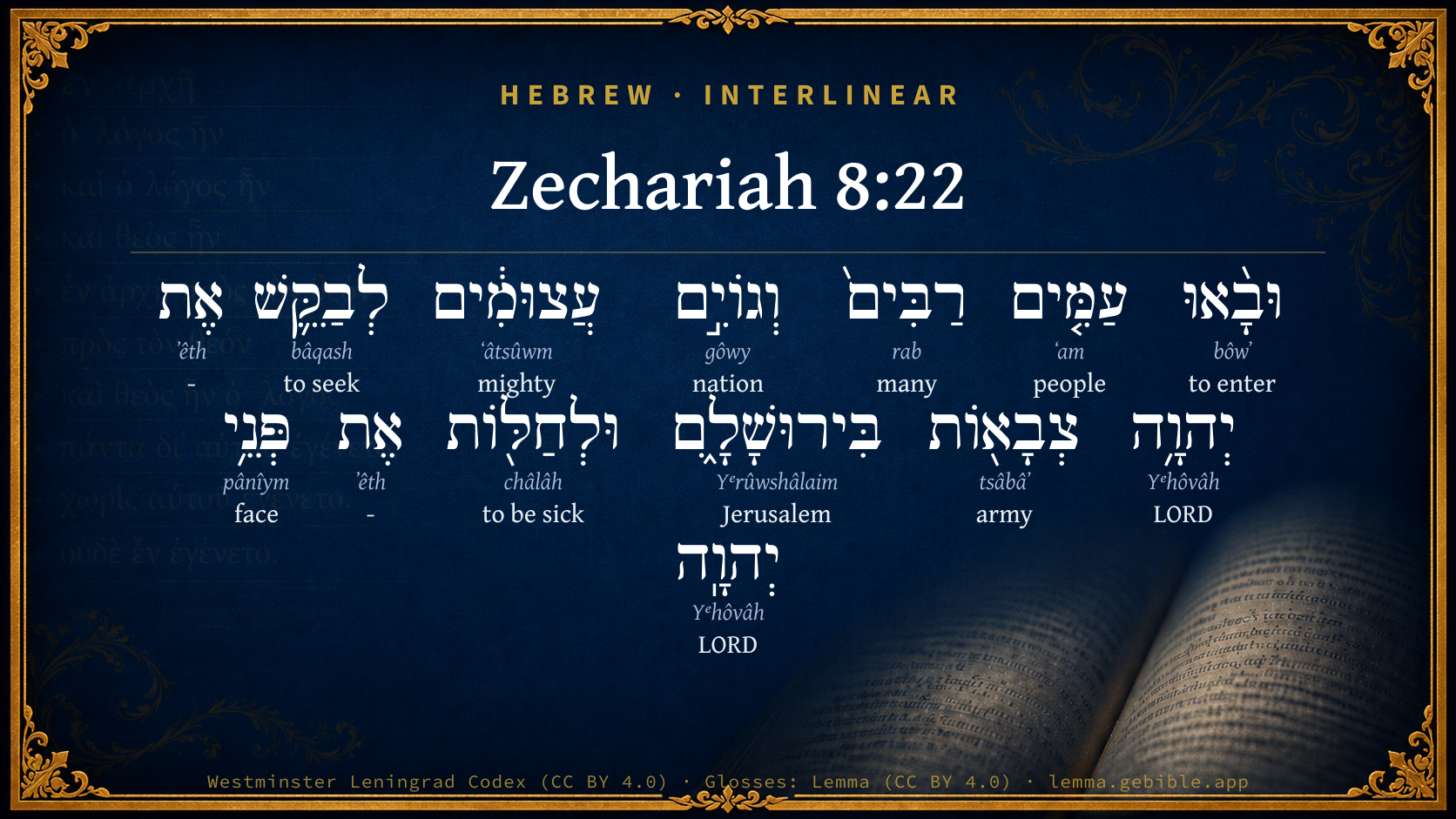
  1. וּבָ֨אוּ bôwʼ H935 “and · to enter” Conjunction + Verb, Qal, Perfect, 3rd Person, Common, Plural
  2. עַמִּ֤ים ʻam H5971 “peoples” Noun, Common, Masculine, Plural, Absolute
  3. רַבִּים֙ rab H7227 “many” Adjective, Adjective, Masculine, Plural, Absolute
  4. וְגוֹיִ֣ם gôwy H1471 “and · nations” Conjunction + Noun, Common, Masculine, Plural, Absolute
  5. לְבַקֵּ֛שׁ bâqash H1245 “to seek” Preposition + Verb, Piel, Infinitive Construct
  6. אֶת ʼêth H853 “-” Particle, Direct Object
  7. יְהוָ֥ה Yᵉhôvâh H3068 “LORD” Noun, Proper
  8. צְבָא֖וֹת tsâbâʼ H6635 “armies” Noun, Common, Both, Plural, Absolute
  9. בִּירוּשָׁלִָ֑ם Yᵉrûwshâlaim H3389 “in/at · Jerusalem” Preposition + Noun, Proper
  10. וּלְחַלּ֖וֹת châlâh H2470 “and · to be sick” Conjunction + Preposition + Verb, Piel, Infinitive Construct
  11. אֶת ʼêth H853 “-” Particle, Direct Object
  12. פְּנֵ֥י pânîym H6440 “face(s) of” Noun, Common, Both, Plural, Construct
  13. יְהוָֽה Yᵉhôvâh H3068 “LORD” Noun, Proper

About this verse

These counts appear in no published source. They are computed here, from the morphology-tagged text and Lemma’s own curated glosses. What Lemma adds →

14
words
12
distinct lemmas
Prophets
section

Shared distinctive vocabulary

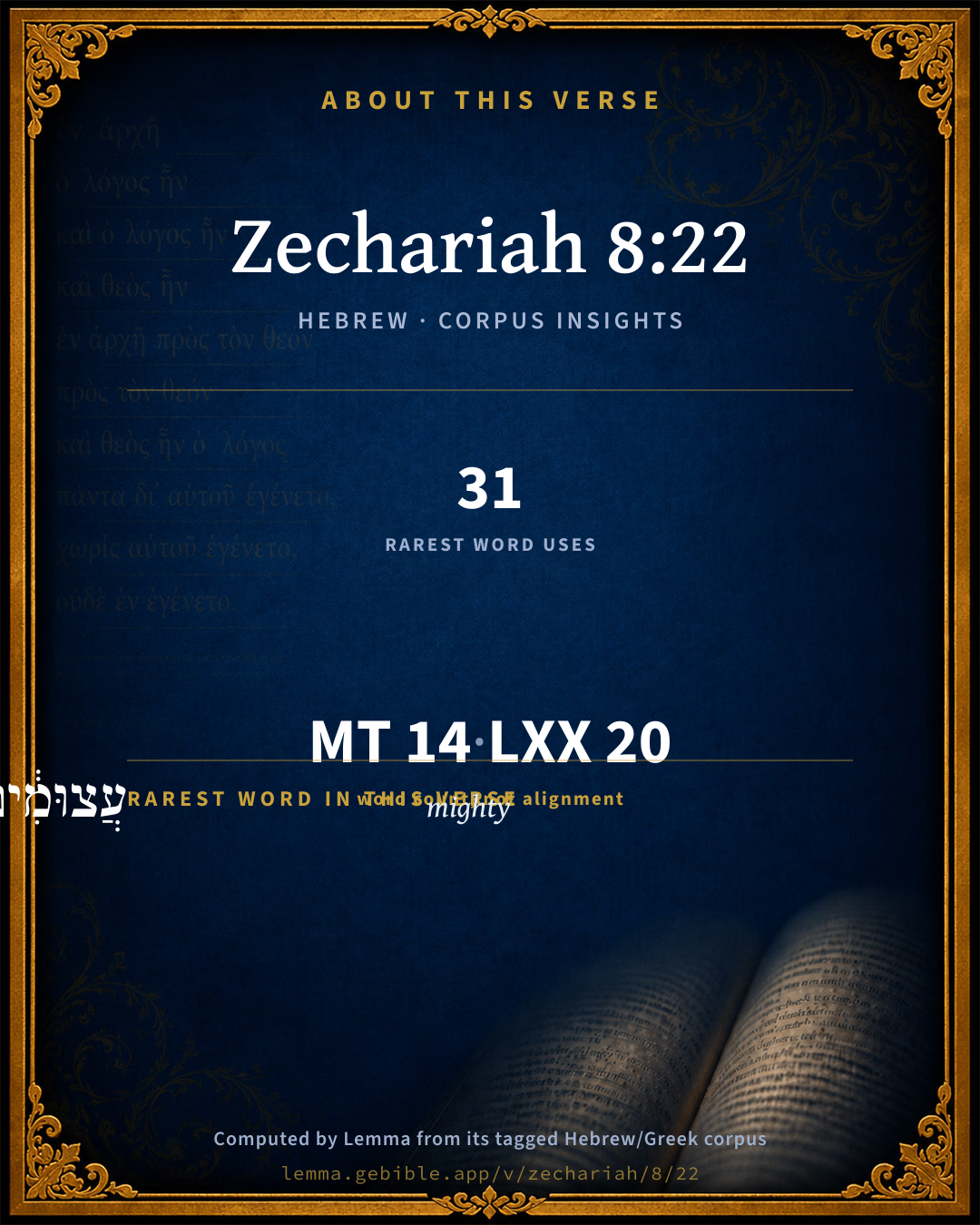
עֲצוּמִ֔ים mighty H6099 occurs in 31 verses of the Hebrew Bible. Also found in:

Grammatical profile

  • 3 verbs
  • 7 nouns
  • 2 adjectives
  • 2 particles

Verb forms

  • וּבָ֨אוּ Qal · Perfect
  • לְבַקֵּ֛שׁ Piel · Infinitive Construct
  • וּלְחַלּ֖וֹת Piel · Infinitive Construct

Repetition

A word recurs within this verse — often emphatic in Hebrew:

  • יְהוָ֥ה LORD H3068 ×2

Hebrew & Septuagint length

In English translation the verse runs 22 words from the Hebrew and 26 from the Septuagint (LXX English) — closely comparable.

A rough comparison of the two English renderings, which tokenize alike — not a word-level alignment.

Word counts can differ between the Hebrew and the Greek without any difference in meaning — e.g. the Hebrew direct-object marker אֵת has no separate Greek word, and Greek often adds the article ὁ.

In the original languages it is 14 Hebrew tokens and 20 Greek tokens — but the two are counted differently (Hebrew bundles its prefixes and suffixes into one token; the Greek is in lemma form), so that isn’t a like-for-like length.

Cross-references

11

Topical passages linked to Zechariah 8:22 in the Treasury of Scripture Knowledge — connected by theme and wording, ordered by reader-vote popularity; previews shown in the World English Bible.

  • Zechariah 8:21 and the inhabitants of one shall go to another, saying, 'Let us go speedily to entreat the favor of Yahweh, and to seek Yahweh of Hosts. I will go also.'
  • Isaiah 25:7 He will destroy in this mountain the surface of the covering that covers all peoples, and the veil that is spread over all nations.
  • Isaiah 60:3–22 Nations shall come to your light, and kings to the brightness of your rising.
  • Revelation 15:4 Who wouldn't fear you, Lord, And glorify your name? For you only are holy. For all the nations will come and worship before you. For your righteous acts have been revealed."
  • Revelation 21:24 The nations will walk in its light. The kings of the earth bring the glory and honor of the nations into it.
  • Isaiah 55:5 Behold, you shall call a nation that you don't know; and a nation that didn't know you shall run to you, because of Yahweh your God, and for the Holy One of Israel; for he has glorified you.
  • Galatians 3:8 The Scripture, foreseeing that God would justify the Gentiles by faith, preached the Gospel beforehand to Abraham, saying, "In you all the nations will be blessed."
  • Isaiah 66:23 It shall happen, that from one new moon to another, and from one Sabbath to another, shall all flesh come to worship before me, says Yahweh.
  • Jeremiah 4:2 and you shall swear, As Yahweh lives, in truth, in justice, and in righteousness; and the nations shall bless themselves in him, and in him shall they glory.
  • Micah 4:3 And he will judge between many peoples, And will decide concerning strong nations afar off. They will beat their swords into plowshares, And their spears into pruning hooks. Nation will not lift up sword against nation, Neither will they learn war any more.
  • Haggai 2:7 and I will shake all nations. The precious things of all nations will come, and I will fill this house with glory, says Yahweh of Hosts.

Cross-references courtesy of OpenBible.info (CC BY 4.0).

Hebrew and Greek witnesses Masoretic Hebrew ↔ Greek Septuagint

The same verse in the two great witnesses to the Old Testament, shown verse-for-verse.

These are two independent witnesses, not word-aligned to each other, and the Septuagint is shown in lemma (dictionary) form.

Hebrew Zechariah 8:22 Masoretic · Westminster Leningrad Codex

וּבָ֨אוּ עַמִּ֤ים רַבִּים֙ וְגוֹיִ֣ם עֲצוּמִ֔ים לְבַקֵּ֛שׁ אֶת יְהוָ֥ה צְבָא֖וֹת בִּירוּשָׁלִָ֑ם וּלְחַלּ֖וֹת אֶת פְּנֵ֥י יְהוָֽה

Yes, many peoples and strong nations will come to seek Yahweh of Hosts in Jerusalem, and to entreat the favor of Yahweh."

World English Bible · Public Domain

Greek LXX Zechariah 8:22 Septuagint · lemma form

καί ἥκω λαός πολύς καί ἔθνος πολύς ἐκζητέω ὁ πρόσωπον κύριος παντοκράτωρ ἐν ἰερουσαλήμ καί ὁ ἐκἱλάσκομαι ὁ πρόσωπον κύριος

And many peoples and many nations shall come to seek earnestly the face of the Lord Almighty in Jerusalem, and to obtain favor of the Lord.

LXX2012 (modern English Septuagint) · Public Domain

Hebrew: Westminster Leningrad Codex (CC BY 4.0). Greek: Septuagint (public domain); English from LXX2012 (modern English Septuagint) (Public Domain). How the Septuagint differs from the Hebrew →

Targum (Aramaic paraphrase)

1

The Targum is the ancient Jewish Aramaic paraphrase of the Hebrew Scriptures — an interpretive translation, not the Hebrew text itself. Onkelos (literal) and Pseudo-Jonathan (expansive) render the Torah, and Jonathan the Prophets. Coverage is partial: where no permissively-licensed English translation exists for a verse, only the Aramaic is shown. This is verse-level text, not a word-by-word alignment to the Hebrew.

  1. Targum Jonathan Prophets (Joshua–Malachi)
    וְיֵיתוּן עַמְמִין סַגִיאִין וּמַלְכִין רַבְרְבִין לְמִתְבַּע אוּלְפַן מִן קָדָם יְיָ צְבָאוֹת בִּירוּשְׁלֵם וּלְצַלָאָה קָדָם יְיָ:

    (no public-domain English translation for this verse)

    Targum Jonathan — Aramaic: “Mikraot Gedolot” (public domain). English: “Sefaria Community Translation” (CC0 1.0 (public-domain dedication)); “London "Chaldee Paraphrase," 1871” (public domain). Text via Sefaria.

Commentary

Notes on Zechariah 8:22 from classic Christian and Jewish commentators (each source and its license shown beneath its notes). The classic Christian expositions comment on the surrounding passage and are grouped to its opening verse, so a note may address several verses; the Jewish commentaries on the Tanakh (Rashi and others) are per-verse, so they appear only where the commentator wrote on this verse.

Lemma curates 59 commentaries, every one of them public domain or Creative Commons licensed, each selected and text-cleaned for this edition rather than reprinted as found. About our sources →

Trapp's Complete Commentary

John Trapp

Zec 8:22 Yea, many people and strong nations shall come to seek the LORD of hosts in Jerusalem, and to pray before the LORD.

Ver. 22. Yea, many people and strong nations, &c.] The most populous and potent people subdued by Christ (not by any army, nor by power, but by God’s Spirit of power, of love, and of a sound mind, 2Ti 1:7), shall send a lamb to the Lord of the whole earth, submit to the sceptre and laws of Christ’s kingdom, yield the obedience of faith, and be proselyted to the Church, Isa 16:1.

And to pray before the Lord] Heb. To entreat his face, which they behold in his ordinances, those visible signs of his presence. Popish pilgrims, though they are used hardly, and lose much of their estates, yet satisfy themselves in this, I have that which I came for, viz. the sight of a dumb idol. What, then, should not men do or suffer to see God in his ordinances?

John Trapp, A Commentary or Exposition upon All the Books of the Old and New Testament (1647–1656) — public domain. Text from a community e-Sword module.

Jamieson, Fausset & Brown

Robert Jamieson, A. R. Fausset & David Brown

many . . . strong nations . . . in Jerusalem--In contrast to the few and weak Jews now building the temple and city, then such shall be their influence that many and strong nations shall come to worship Jehovah their God in Jerusalem (Isa 60:3; Isa 66:23).

Jamieson, Fausset & Brown — Commentary Critical and Explanatory on the Whole Bible (1871) — public domain (CC PDM 1.0). Text via the HelloAO Bible API.

Adam Clarke's Commentary

Verse 22. And strong nations] This may refer to the conversion of the Mohammedan tribes; especially to those in the vicinity of Palestine. Perhaps even the Egyptians, inhabitants of Arabia Petraea, of Syria, &c.

Adam Clarke's Commentary on the Bible (1810–1826) — public domain. Text from a community e-Sword/MySword module.

John Calvin's Commentaries

But we must enquire also why he says, that the nations would come to seek God at Jerusalem, and there to call on him. The Jews foolishly imagine that God cannot be otherwise worshipped than by offering sacrifices still in the temple. But the Prophet had something very different in view, that the light of truth would arise from that city, which would diffuse itself far and wide: and this prophecy ought to be connected with that of Isaiah,

“A law shall go forth from Sion, and the word of Jehovah from Jerusalem.” (Isaiah 2:3.)

As then the doctrine of salvation which has filled the whole world flowed from that city, the Prophet says, that nations would come to Jerusalem, not that it would be necessary for them to assemble there, but because all were to seek there what could not be obtained elsewhere. Since then none could be accounted the children of God except they were brought up in that school and acknowledged that alone to be true religion which had its first habitation at Jerusalem, we hence see why the Prophet expressly mentions that city.

We must further bear in mind, that the temple was built for this end and purpose, — that the doctrine of salvation might continue there, and have there its seat until the coming of Christ; for then was fulfilled that prophecy in the hundred and tenth Psalm, “The scepter of thy power shall God send forth from Sion.” The Prophet here teaches us, that Christ would not be the king of one people only, whose power was to be confined to narrow limits, but that he would rule through the whole world, for God would extend his scepter to every quarter of the globe. As tell it behaved the Jews to have this end in view, the Prophet, in order to animate them that they might not fail in the middle of their work, says, that that place was sacred to God, so that salvation might thence be sought by the whole world, for all were to be the disciples of that Church who wished to be deemed the children of God.

But we ought carefully to notice what I have already referred to, the two things required in God’s worship — to seek him, and also to pray to him. For the superstitious, though they pretend great ardor in seeking God, yet amuse themselves with many delusions; for they hurry on presumptuously, and as it were at random, so that they seek not God, but leave him, and weary themselves without thought and without any judgment. As then the superstitious have no reason for what they do, they can not be said properly to seek God. But the faithful seek God, for they acknowledge that he is not to be worshipped according to the fancy of any one, but that there is a certain prescript and rule to be observed. To us then this is the beginning of religion — not to allow to ourselves liberty to attempt anything we please, but humbly and soberly to submit to God’s word; for when any one seeks and chooses an unfit teacher, he will not advance as he ought to do. But the Prophet shows, that all the godly succeed when they strive to be approved of God by confining themselves to his word, and by attempting nothing through their own promptings, but when they have such a discernment as not to blend, as it is said, profane with sacred things. The second chief thing is, to pray to God: and the Prophet thus reminds us why it is that God would have us especially to seek him. Nothing indeed results to his advantage and benefit from our efforts, but he would have us to seek him that we may learn to expect from him everything connected with our salvation. This seeking is also defined by the term prayer, and not useless is the word face, for though God is invisible, we yet ought not to wander with uncertainty, as it were through the air, when our purpose is to flee to him, but to go to him with full confidence. Unless then we are fully persuaded of what the Scripture teaches us — that God is ever nigh those who truly call on him, the door will be closed against our prayers, for God’s name will be profaned though we may express what we wish. As then the nearness of God ought to be impressed on our hearts when we prepare ourselves for prayer, the Scripture usually adopts this form, to entreat the face of God. But this is not to be understood of an ocular sight, but, on the contrary, of the conviction of the heart. Let us now proceed -

John Calvin's Commentaries (1540-1563) — public domain. Text from the Calvin Translation Society English edition (1840s-50s) via the Christian Classics Ethereal Library (ccel.org). Calvin's coverage is partial (roughly two-thirds of the Bible); uncommented books and verses are honest gaps, never fabricated. The 19th-century editor's footnotes and remarks are omitted so the notes are faithfully Calvin's own voice.

Haydock's Catholic Bible Commentary

Lord. Many were converted in the days of Esther, (viii. 17.) and the Pharisees were eager to make proselytes in all parts, when Christ preached, Matthew xxiii. 15., and Acts ii. 11. Yet we must go to the Church to see this fully accomplished. (Calmet)

George Leo Haydock (1774–1849), Haydock's Catholic Family Bible and Commentary, 1859 edition — public domain. Excludes Psalms (Douay-Rheims chapter numbering differs from Protestant) and Deuterocanonical books (Catholic canon only).

Matthew Poole's English Annotations

This verse is both confirmation and illustration to the former; there it was people, here it is many people, and mighty, or great; not the poor, and contemptible. and few, but people of a greater figure in the world. The gospel first spread itself through the Roman empire, and triumphed in Rome the lady of the world.

Strong nations submitted to the gospel.

Shall come to seek the Lord of hosts in Jerusalem; literally understood you have the firstfruits Of them mentioned in Act 2:9-11. Mystically, Jerusalem is the church of Christ, or the state of it in the times of the gospel, Psa 110:2; Isa 2:3.

To pray; to perform all gospel worship to the Lord.

Matthew Poole's English Annotations on the Holy Bible (1683–1685) — public domain. Text from a community e-Sword/MySword module.

The Pulpit Commentary

Many people (peoples) and strong nations. This explains ver. 20 more fully. The Jews were not actuated by the missionary spirit, yet even before Christ"s advent their religion had spread into all parts of the world, as we see from the catalogue of proselytes in Act_2:9-11. Intimations of the same fact are given in Ezr_6:21 Est_8:17. To seek the Lord of hosts in Jerusalem; i.e. to keep the solemn festivals observed there. (comp. Isa_2:2 Isa_66:20-23 Mic_4:1, and note there) The literal fulfilment of this prophecy is not to be looked for. It declares the future conversion of the Gentiles, and their being made one with Israel in the Church of Christ, "one fold under one Shepherd". (Joh_10:16)

The Pulpit Commentary (1880–1919), ed. H.D.M. Spence-Jones & Joseph S. Exell — public domain. Text from a community e-Sword module.

John Wesley's Explanatory Notes

In Jerusalem - Literally understood, you have the first fruits of them mentioned, Acts ii, 10-12. Mystically, Jerusalem is the church of Christ. To pray - To perform all gospel-worship.

John Wesley, Explanatory Notes Upon the Whole Bible (1754–1765) — public domain. Text via the GEBible commentary corpus.

Lesson kit

Teaching starters — assembled from the data on this page, not authored interpretation. Every prompt links to the verse data it draws on. Edit before teaching.

Zechariah, in the Prophets, opens this verse with 14 words (12 distinct Hebrew lemmas). Its most distinctive word is ʻâtsûwm (“mighty”). A historical commentator’s framing appears above. Read the whole chapter for the surrounding context.

Discussion questions

  1. What does “mighty” (ʻâtsûwm) contribute to the verse as a whole?
  2. How does Genesis 18:18, which shares the word «mighty», read alongside this verse?
  3. What does the repetition of “LORD” (2× in this one verse) do in this verse?
  4. These translations render this verse differently; the difference is in the English rendering, not the original. What questions does that raise?
  5. «וּבָ֨אוּ» is a Qal Perfect verb. How does that grammatical form shape the action described?
  6. Compare how Trapp's Complete Commentary and Jamieson, Fausset & Brown read this verse. Where do they agree or differ?

Things to notice

Reading settings

Reading text

Shown beneath each verse's original-language words.

Old Testament
Old Testament edition

Read the OT as the Masoretic Hebrew (MT) or the Greek Septuagint (LXX).

English shown for the Greek Septuagint (in the Hebrew ↔ Greek comparison).

Comparing translations? Open the Compare panel on any verse page to stack up to four side by side.