Daniel 11:34

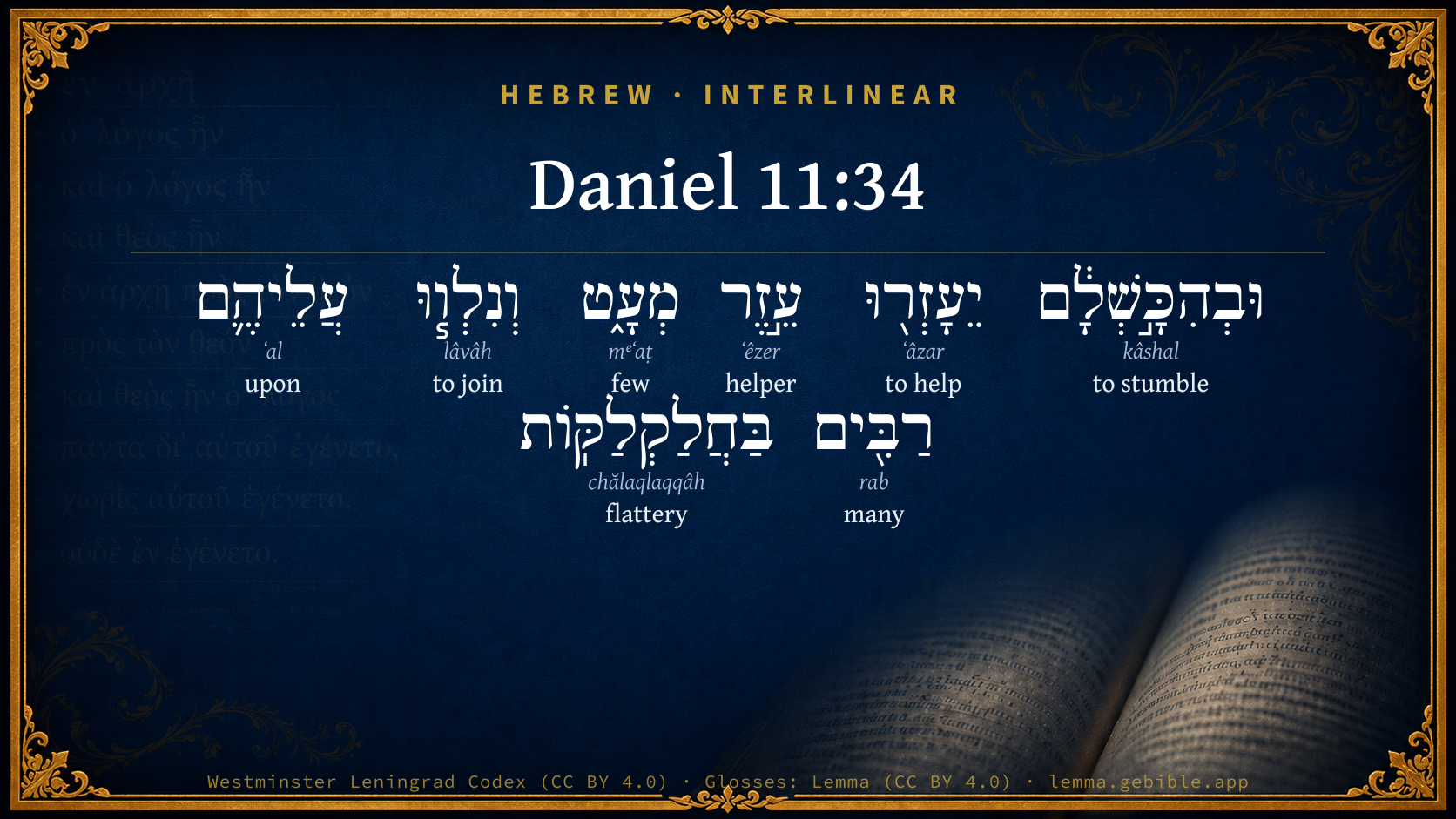
Hebrew (Westminster Leningrad Codex) Daniel 11:34 appears in the Hebrew Old Testament. The text above is from the Westminster Leningrad Codex. Each word links to its Strong’s number, a concise gloss, and parsing drawn from the Open Scriptures Hebrew Bible morphology. Click any word for its full Brown-Driver-Briggs (BDB) entry.
Download image
Cite this verse

Daniel 11:34 (World English Bible). Public Domain. Lemma interlinear Bible study tool, https://lemma.gebible.app/v/daniel/11/34.

Show BibTeX & RIS
BibTeX
RIS
English Translation
Now when they shall fall, they shall be helped with a little help; but many shall join themselves to them with flatteries.
World English Bible · Public Domain
Download a study sheet

One document with this verse’s original text, its word-by-word gloss line, the meaning frame, cross-references with their text, attributed commentary, and full source and license credits — printable, and it pastes into notes with its structure intact.

This verse Autodidact and up

Study sheet (.html) Plain text (.txt)

A passage Seminary Student

Up to 50 verses in one chapter. A passage sheet keeps up to 6 commentary sources and 12 cross-references per verse, in the order this page ranks them, and says so on the sheet whenever that leaves anything out. Ask for a single verse and you get the Autodidact verse sheet above.

Everything on this page stays free to read, with no account — the sheet is a download of what is already on screen, not access to it.

Want to remove ads? Support Godless Engineer
Compare translations 3

The same verse in 3 English versions, stacked beneath the original-language interlinear above. Click any original word for its lexicon entry.

Each is an independent rendering of the whole verse — the interlinear is not word-aligned to these translations.

Highlighted words mark where these versions differ — a whole-verse word diff, not a word-by-word alignment.

  • World English Bible Public Domain
    Now when they shall fall, they shall be helped with a little help; but many shall join themselves to them with flatteries.
  • King James Version Public Domain
    Now when they shall fall, they shall be holpen with a little help: but many shall cleave to them with flatteries.
  • unfoldingWord Literal Text CC BY-SA 4.0
    When they stumble, they will receive a little help. Many will join themselves with them in hypocrisy.

unfoldingWord Literal Text — © unfoldingWord, licensed CC BY-SA 4.0. Word-aligned USFM3 via Door43 (git.door43.org/unfoldingWord/en_ult).

Versions to compare (up to 4)

3 of 4 selected

Show all 18 translations

Every available English version of this verse, each an independent rendering of the whole verse.

  • World English Bible Public Domain
    Now when they shall fall, they shall be helped with a little help; but many shall join themselves to them with flatteries.
  • Berean Standard Bible Public Domain
    Now when they fall, they will be granted a little help, but many will join them insincerely.
  • Majority Standard Bible Public Domain
    Now when they fall, they will be granted a little help, but many will join them insincerely.
  • King James Version Public Domain
    Now when they shall fall, they shall be holpen with a little help: but many shall cleave to them with flatteries.
  • American Standard Version (1901) Public Domain
    Now when they shall fall, they shall be helped with a little help; but many shall join themselves unto them with flatteries.
  • Revised Version (1885) Public Domain
    Now when they shall fall, they shall be holpen with a little help: but many shall join themselves unto them with flatteries.
  • Geneva Bible (1599) Public Domain
    Nowe when they shall fall, they shall be holpen with a litle helpe: but many shall cleaue vnto them fainedly.
  • Douay-Rheims (1899) Public Domain
    And when they shall have fallen they shall be relieved with a small help: and many shall be joined to them deceitfully.
  • Young's Literal Translation Public Domain
    And in their stumbling, they are helped -- a little help, and joined to them have been many with flatteries.
  • Literal Standard Version CC BY-SA 4.0
    And in their stumbling, they are helped—a little help, and joined to them have been many with flatteries.
  • Unlocked Literal Bible CC BY-SA 4.0
    In their stumbling, they will be helped with a little help. In hypocrisy many will join themselves with them.
  • unfoldingWord Literal Text CC BY-SA 4.0
    When they stumble, they will receive a little help. Many will join themselves with them in hypocrisy.
  • Darby Bible Public Domain
    And when they fall, they shall be helped with a little help; but many shall cleave to them with flatteries.
  • World Messianic Bible Public Domain
    Now when they fall, they will be helped with a little help; but many will join themselves to them with flatteries.
  • Webster's Bible Public Domain
    Now when they shall fall, they shall be assisted with a little help: but many shall cleave to them with flatteries.
  • Free Bible Version CC BY-SA 4.0
    During this time of persecution they will receive a little help, and many who join them won't be sincere.
  • Bible in Basic English Public Domain
    Now at the time of their downfall they will have a little help, but numbers will be joined to them in the town, and in their separate heritages.
  • JPS Tanakh (1917) Public Domain
    Now when they shall stumble, they shall be helped with a little help; but many shall join themselves unto them with blandishments.

Literal Standard Version (2020), Covenant Press — licensed CC BY-SA 4.0. Text via the HelloAO Bible API (eBible.org). Unlocked Literal Bible (unfoldingWord) — licensed CC BY-SA 4.0. Text via the HelloAO Bible API (eBible.org). unfoldingWord Literal Text — © unfoldingWord, licensed CC BY-SA 4.0. Word-aligned USFM3 via Door43 (git.door43.org/unfoldingWord/en_ult). Free Bible Version, Dr. Jonathan Gallagher — licensed CC BY-SA 4.0. Text via the HelloAO Bible API (eBible.org).

Word by word

More ways to search: Search by grammar → Find every occurrence → Compare this word →

Practice this passage: Drill this verse → Learn its vocabulary →

בַּחֲלַקְלַקּֽוֹת
chălaqlaqqâh
H2519
“in/at · flatteries”
Preposition + Noun, Common, Feminine, Plural, Absolute
Part of Speech
Preposition + Noun
Type
Common
Gender
Feminine
Number
Plural
State
Absolute
Full BDB Definition

Origin: by reduplication from H2505

TWOT: 670f

flattery, slipperiness, fine promises, smoothness - slipperiness - fine promises
  1. וּבְהִכָּ֣שְׁלָ֔ם kâshal H3782 “and · in/at · to stumble · them” Conjunction + Preposition + Verb, Niphal, Infinitive Construct + Suffix, Personal, 3rd Person, Masculine, Plural
  2. יֵעָזְר֖וּ ʻâzar H5826 “to help” Verb, Niphal, Imperfect, 3rd Person, Masculine, Plural
  3. עֵ֣זֶר ʻêzer H5828 “helper” Noun, Common, Masculine, Singular, Absolute
  4. מְעָ֑ט mᵉʻaṭ H4592 “few” Noun, Common, Masculine, Singular, Absolute
  5. וְנִלְו֧וּ lâvâh H3867 “and · to join” Conjunction + Verb, Niphal, Sequential Perfect, 3rd Person, Common, Plural
  6. עֲלֵיהֶ֛ם ʻal H5921 “upon · them” Preposition + Suffix, Personal, 3rd Person, Masculine, Plural
  7. רַבִּ֖ים rab H7227 “many” Adjective, Adjective, Masculine, Plural, Absolute

About this verse

These counts appear in no published source. They are computed here, from the morphology-tagged text and Lemma’s own curated glosses. What Lemma adds →

8
words
8
distinct lemmas
Prophets
section

Notable vocabulary

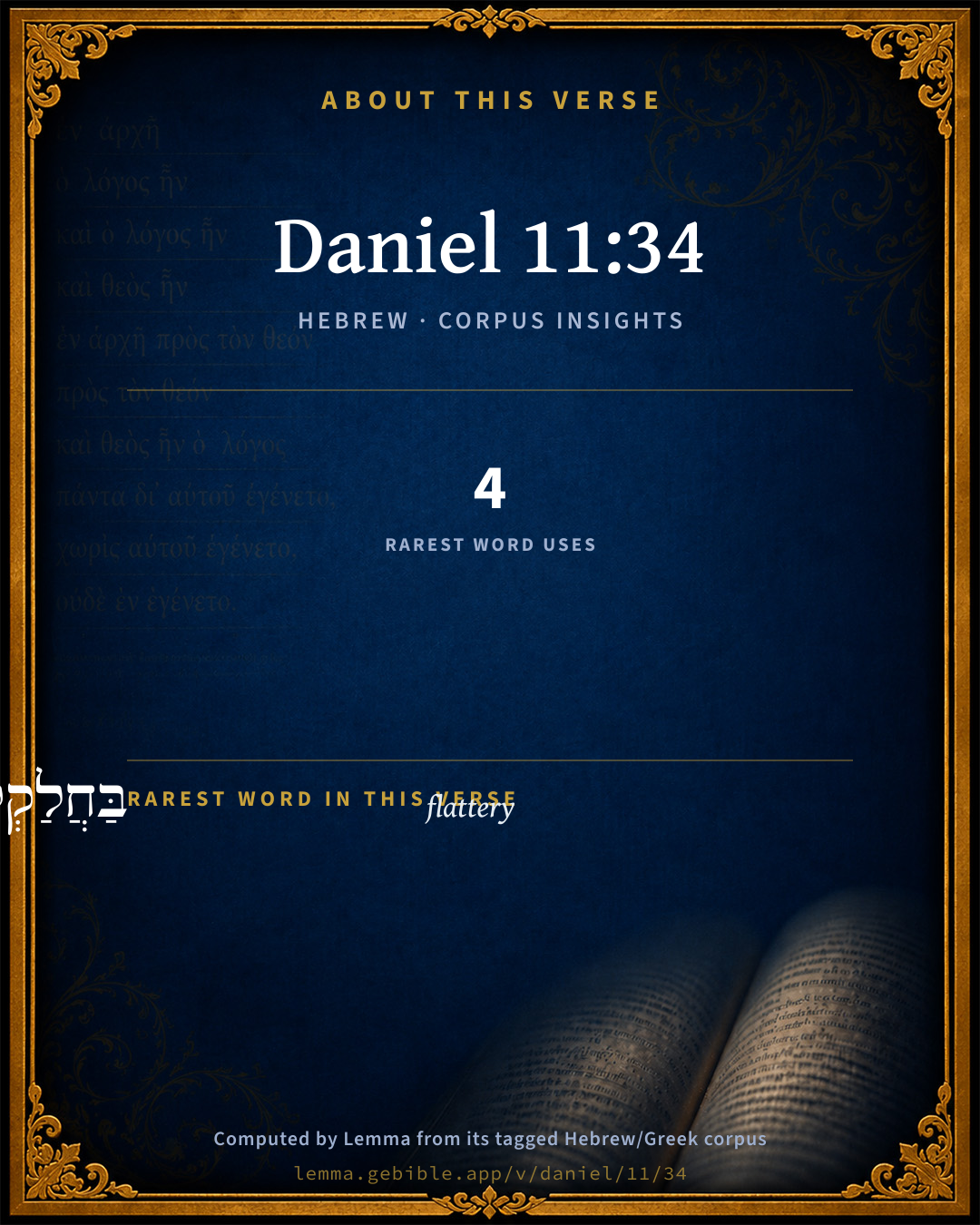
The rarest word here is בַּחֲלַקְלַקּֽוֹת flattery H2519 — appearing just 4 times in the whole Hebrew Bible.

Shared distinctive vocabulary

בַּחֲלַקְלַקּֽוֹת flattery H2519 occurs in 4 verses of the Hebrew Bible. Also found in:

Grammatical profile

  • 3 verbs
  • 3 nouns
  • 1 adjective
  • 1 preposition

Verb forms

  • וּבְהִכָּ֣שְׁלָ֔ם Niphal · Infinitive Construct
  • יֵעָזְר֖וּ Niphal · Imperfect
  • וְנִלְו֧וּ Niphal · Sequential Perfect

Hebrew & Septuagint length

In English translation the verse runs 22 words from the Hebrew and 22 from the Septuagint (LXX English) — the same length.

A rough comparison of the two English renderings, which tokenize alike — not a word-level alignment.

Word counts can differ between the Hebrew and the Greek without any difference in meaning — e.g. the Hebrew direct-object marker אֵת has no separate Greek word, and Greek often adds the article ὁ.

Cross-references

20

Topical passages linked to Daniel 11:34 in the Treasury of Scripture Knowledge — connected by theme and wording, ordered by reader-vote popularity; previews shown in the World English Bible.

  • Matthew 7:15 "Beware of false prophets, who come to you in sheep's clothing, but inwardly are ravening wolves.
  • Romans 16:18 For those who are such don't serve our Lord, Jesus Christ, but their own belly; and by their smooth and flattering speech, they deceive the hearts of the innocent.
  • Acts 20:29–30 For I know that after my departure, vicious wolves will enter in among you, not sparing the flock.
  • 1 John 4:1 Beloved, don't believe every spirit, but test the spirits, whether they are of God, because many false prophets have gone out into the world.
  • 2 Corinthians 11:13–15 For such men are false apostles, deceitful workers, masquerading as Christ's apostles.
  • Galatians 2:4 This was because of the false brothers secretly brought in, who stole in to spy out our liberty which we have in Christ Jesus, that they might bring us into bondage;
  • 1 Timothy 4:1–2 But the Spirit says expressly that in later times some will fall away from the faith, paying attention to seducing spirits and doctrines of demons,
  • 2 Timothy 3:1–7 But know this, that in the last days, grievous times will come.
  • 2 Timothy 4:3 For the time will come when they will not listen to the sound doctrine, but, having itching ears, will heap up for themselves teachers after their own lusts;
  • Titus 1:11 whose mouths must be stopped; men who overthrow whole houses, teaching things which they ought not, for dishonest gain's sake.
  • 2 Peter 2:1–3 But there also arose false prophets among the people, as among you also there will be false teachers, who will secretly bring in destructive heresies, denying even the Master who bought them, bringing on themselves swift destruction.
  • 2 Peter 2:18–19 For, uttering great swelling words of emptiness, they entice in the lusts of the flesh, by licentiousness, those who are indeed escaping from those who live in error;
  • 1 John 2:18–19 Little children, these are the end times, and as you heard that the Antichrist is coming, even now many antichrists have arisen. By this we know that it is the end times.
  • 1 John 4:5 They are of the world. Therefore they speak of the world, and the world hears them.
  • 2 John 1:7 For many deceivers have gone out into the world, those who don't confess that Jesus Christ came in the flesh. This is the deceiver and the Antichrist.
  • Jude 1:4 For there are certain men who crept in secretly, even those who were long ago written about for this condemnation: ungodly men, turning the grace of our God into lasciviousness, and denying our only Master, God, and Lord, Jesus Christ.
  • Revelation 2:20 But I have this against you, that you tolerate your woman, Jezebel, who calls herself a prophetess. She teaches and seduces my servants to commit sexual immorality, and to eat things sacrificed to idols.
  • Revelation 12:2–6 She was with child. She cried out in pain, laboring to give birth.
  • Revelation 12:13–13:4 When the dragon saw that he was thrown down to the earth, he persecuted the woman who gave birth to the male child.
  • Revelation 13:11–14 I saw another beast coming up out of the earth. He had two horns like a lamb, and he spoke like a dragon.

Cross-references courtesy of OpenBible.info (CC BY 4.0).

Hebrew and Greek witnesses Masoretic Hebrew ↔ Greek Septuagint

The same verse in the two great witnesses to the Old Testament, shown verse-for-verse.

These are two independent witnesses, not word-aligned to each other, and the Septuagint is shown in lemma (dictionary) form.

Hebrew Daniel 11:34 Masoretic · Westminster Leningrad Codex

וּבְהִכָּ֣שְׁלָ֔ם יֵעָזְר֖וּ עֵ֣זֶר מְעָ֑ט וְנִלְו֧וּ עֲלֵיהֶ֛ם רַבִּ֖ים בַּחֲלַקְלַקּֽוֹת

Now when they shall fall, they shall be helped with a little help; but many shall join themselves to them with flatteries.

World English Bible · Public Domain

Greek LXX Daniel 11:34 Septuagint · lemma form

καί ὅταν συντρίβω συνἄγω ἰσχύς βραχύς καί ἐπι συνἄγω ἐπί αὐτός πολύς ἐπί πόλις καί πολύς ὡς ἐν κληροδοσία

And when they are weak they shall be helped with a little help: but many shall attach themselves to them with treachery.

LXX2012 (modern English Septuagint) · Public Domain

On this verse, The Pulpit Commentary discusses the Septuagint’s reading. Read the note in Commentary ↓

Hebrew: Westminster Leningrad Codex (CC BY 4.0). Greek: Septuagint (public domain); English from LXX2012 (modern English Septuagint) (Public Domain). How the Septuagint differs from the Hebrew →

Commentary

Notes on Daniel 11:34 from classic Christian and Jewish commentators (each source and its license shown beneath its notes). The classic Christian expositions comment on the surrounding passage and are grouped to its opening verse, so a note may address several verses; the Jewish commentaries on the Tanakh (Rashi and others) are per-verse, so they appear only where the commentator wrote on this verse.

Lemma curates 59 commentaries, every one of them public domain or Creative Commons licensed, each selected and text-cleaned for this edition rather than reprinted as found. About our sources →

Trapp's Complete Commentary

John Trapp

Dan 11:34 Now when they shall fall, they shall be holpen with a little help: but many shall cleave to them with flatteries.

Ver. 34. They shall be holpen with a little help.] With the valiant Asmonians or Maccabees, who were but a handful, and yet did great exploits against the Antiochians; so did the Hussites in Bohemia against the Pontificians. But why were they helped with a little help? That, through weaker means, they might see God’s greater strength.

But many shall cleave to them with flatteries.] So did the false Samaritans. See on Dan 11:21. And so the Donatists went to the Goths, when the Arians prevailed. Hypocrites will not sail in a storm; something they will do for God, but little or nothing it is they will suffer.

John Trapp, A Commentary or Exposition upon All the Books of the Old and New Testament (1647–1656) — public domain. Text from a community e-Sword module.

Joseph Benson's Commentary

Dan 11:34. Now when they shall fall — When they shall lie quite overcome and oppressed with these great miseries; they shall be holpen with a little help — This was fulfilled by Mattathias and his five sons, who, in the height of their misery, stood up with most wonderful zeal and courage, to oppose these cruelties of Antiochus by force of arms; and several times overthrew, with great slaughter, Antiochus’s parties who were employed in harassing Judea. But many shall cleave to them with flatteries — That is, shall be pretended friends only. Such were Joseph and Azarias, who engaged in the common cause out of ambition and a desire of fame, 1Ma 5:56; 1Ma 5:62. Such were they who, after their death, were found with idols consecrated under their clothes, 2Ma 12:40. Such was Rhodocus, who disclosed their secrets to the enemy, chap. 2Ma 13:21.

Joseph Benson's Commentary on the Old and New Testaments (1811–1818) — public domain. Text from a community e-Sword module.

Tyndale Open Study Notes

Tyndale Open Resources

11:34 A little help came when the family of Mattathias and those around them, who were called Maccabees, instigated a national revolt which Antiochus, occupied elsewhere, could not put down. In 164 BC, three years after the Temple had been desecrated, the Maccabees recaptured Jerusalem, removed the sacrilegious object (the statue of Zeus), cleansed the altar, and restored the daily sacrifices (8:11-14, 26; 1 Maccabees 1:59). This event is commemorated at Hanukkah (see John 10:22).

Tyndale Open Study Notes — © Tyndale Open Resources, licensed CC BY-SA 4.0. Text via the HelloAO Bible API.

Geneva Bible (1599)

Geneva Bible translators

As God will not leave his Church destitute, yet will he not deliver it all at once, but so help, as they may still seem to fight under the cross, as he did in the time of the Maccabees, whereof he here prophesieth.

That is, there shall be even of this small number many hypocrites.

Geneva Bible (1599) marginal notes — public domain. Text via Bolls.life.

Jamieson, Fausset & Brown

Robert Jamieson, A. R. Fausset & David Brown

a little help--The liberty obtained by the Maccabean heroes for the Jews was of but short duration. They soon fell under the Romans and Herodians, and ever since every attempt to free them from Gentile rule has only aggravated their sad lot. The period of the world times (Gentile rule) is the period of depression of the theocracy, extending from the exile to the millennium [ROOS]. The more immediate reference seems to be, the forces of Mattathias and his five sons were originally few (1 Maccabees 2:1-5).

many shall cleave to them--as was the case under Judas Maccabeus, who was thus able successfully to resist Antiochus.

with flatteries--Those who had deserted the Jewish cause in persecution, now, when success attended the Jewish arms, joined the Maccabean standard, for example, Joseph, the son of Zecharias, Azarias, &c. (1 Maccabees 5:55-57; 2 Maccabees 12:40; 13:21). MAURER explains it, of those who through fear of the Maccabees' severity against apostates joined them, though ready, if it suited their purpose, to desert them (1 Maccabees 2:44; 3:58).

Jamieson, Fausset & Brown — Commentary Critical and Explanatory on the Whole Bible (1871) — public domain (CC PDM 1.0). Text via the HelloAO Bible API.

Adam Clarke's Commentary

Verse 34. Now when they shall fall] When the storm of the tenth persecution under Diocletian, which lasted ten years, fell upon them, they were sorely oppressed.

They shall be holpen with a little help] By Constantine; who, while he removed all persecution, and promoted the temporal prosperity of the Christian Church, yet added little to its spiritual perfection and strength. For many, now seeing the Christians in prosperity,-

Cleave to them with flatteries.] Became Christians BECAUSE the EMPEROR was such.

Adam Clarke's Commentary on the Bible (1810–1826) — public domain. Text from a community e-Sword/MySword module.

John Calvin's Commentaries

And when they shall fall, or shall have fallen, they shall be strengthened, or assisted, with a small help Without the slightest doubt, the angel here speaks of the Maccabees, by whose assistance the faithful were gathered together and completely separated from those apostates who had betrayed God’s temple and worship. He calls the help small, and truly it was so. For what could the Maccabees do to resist Antiochus? The powerful influence of this king is well known; and what was Judea when compared with Syria? The Jews indeed had destroyed their own power; we have already seen how they violated treaties, and corrupted the majority of their own people there was neither skill, nor plan, nor concert among them. The help, then, was small, which God sent them. But then the angel shews how God would afford succor to his people when in distress, and allow them some alleviation from the cruelty of the tyrant.

He adds next, Many shall join themselves to them by flatteries Even from this small number the angel cuts off the greater part, and informs them of the miserable condition of the Church, because very few should dare to oppose the madness of the tyrant, and out of these few many should be hypocrites The whole of this chapter must be interpreted of Antiochus, and yet doubtless God wishes to promote our improvement by these prophecies. They belong equally to us; for as God governs his Church in a variety of ways, so he always sustains it under its various crosses and trials.

Besides this, the old enemy the devil, who formerly opposed the Church, is equally troublesome to us. He assails us partly by enemies without and partly by enemies within. Such teaching as this was useful, not only to the ancients, but, to us also in the present day. First of all, the angel predicts the assistance to be received by the faithful as small. Let us learn, then, when God wishes to succor and to help us, — that he does not always exert the fullness of his power. He does not thunder from heaven and overthrow our enemies by the first stroke of his lightning; but he enables us to contend successfully with our cross, and thus we are far separated from the reprobate by our firmness in resistance. Again, from the second clause we must notice the absolute certainty of many hypocrites being found mingled with the souls of God, and when God purges his Church, but a small portion will remain sincere, just as in these days the very counterpart of this prophecy is exhibited before our eyes. The whole Papacy is called the Church of God; we are but few in number, and yet what a mixture exists even among us? How many in these days profess attachment to the Gospel, in whom there is nothing either solid or sincere! If God should search narrowly into small Churches, still among these few, some would be found deceivers. It never has been otherwise, or shall be different until the end of the world. Here, then, we are admonished to desire, as far as lies in our power, the purity of the Church, and to avoid all impurity, because, in desiring auxiliaries too eagerly on the pressure of any urgent necessity, we shall be certain to become sprinkled with many stains which may ultimately cover us with confusion. The angel doubtless here reproves a fault in the conduct of the Maccabees. Although God stirred them up to afford some consolation to his Church, their proceedings are not to be approved; for it does not follow that all their actions were praiseworthy because their cause was pious and holy. But I must defer this subject till to-morrow.

John Calvin's Commentaries (1540-1563) — public domain. Text from the Calvin Translation Society English edition (1840s-50s) via the Christian Classics Ethereal Library (ccel.org). Calvin's coverage is partial (roughly two-thirds of the Bible); uncommented books and verses are honest gaps, never fabricated. The 19th-century editor's footnotes and remarks are omitted so the notes are faithfully Calvin's own voice.

Ellicott's Commentary for English Readers

(34) Now when they shall fall.—Referring to those who suffer during this persecution, to whichever class they belong. (See last Note). These will not be entirely without help, but there will be some small assistance given them. It will be small, either compared with their present needs, or contrasted with the great help which will be given them when the tribulation attains its greatest severity. In the Maccabee persecutions help was given to the sufferers by Judas and his brethren (1Ma_3:11, &c., 1Ma_4:14, &c.). This prevented the faithful from disappearing entirely.

Many shall cleave. . . .—Dissimulation will cause some to declare themselves upon the side of “those that understand.” This is a feature which will be noticed in religious persecutions; according as one party or the other gains in power, as its prospects brighten, it gains fresh adherents. This held true in the days of Antiochus. (See 1Ma_6:21, &c., 9:23.)

A Bible Commentary for English Readers, edited by Charles John Ellicott (1878–1897) — public domain. Text from a community e-Sword module.

The Cambridge Bible for Schools and Colleges

gen. ed. J. J. S. Perowne

34. In the midst of their trials a ‘little help’ will arise, to assist them. The allusion is to the rising of the Maccabees. First of all, Mattathias, either alone or assisted only by his sons, resisted openly Antiochus’ demands, and slew one of the officers sent to enforce them (1Ma_2:15-28): then others gradually joined themselves to him, and carried the resistance further (ib. 1Ma_2:39-48): finally, after Mattathias’ death, his son Judas Maccabaeus carried on the struggle. His first victory was gained over Apollonius, who invaded Judah with a considerable army; and shortly afterwards, Seron, commander of the host of Syria, coming to avenge Apollonius’ defeat, was routed with the loss of 800 men, by Judas at the head of a ‘small company’ (Ἰούδας … ὀλιγοστός), 1Ma_3:10-24. After this, further successes were gained by Judas over Antiochus’ generals Lysias and Gorgias (ib. 1Ma_3:38 to 1Ma_4:35), the result of which was that, by the end of b.c. 165, the Jews recovered possession of Mount Zion, and the Temple was re-dedicated (ib. 1Ma_4:36-37). The occasion was celebrated by a festival, lasting eight days (1Ma_4:59), which was observed annually afterwards, and is referred to in Joh_10:22 (τὰ ἐγκαίνια).

but many shall join themselves (Isa_14:1; Isa_56:3) unto them with flatteries] or smooth sayings, i.e. plausible, but insincere, protestations of loyalty. In consequence of the severity shewn by Judas, and the leaders of the patriotic party, many joined them from mere terror, and were ready, if a favourable opportunity offered itself, to turn traitors. On the severity of Judas and the patriots towards the Hellenizing Jews, comp. allusions in 1Ma_2:44; 1Ma_3:5 a, 8, Dan_6:21-27, Dan_7:5-7; Dan_7:24 (where Judas, it is said, ‘took vengeance on the men that had deserted from him’), Dan_9:23.

The Cambridge Bible for Schools and Colleges (gen. ed. J. J. S. Perowne; Cambridge University Press, 1878–1918) — public domain. Text from a community e-Sword module.

John Gill's Exposition

Now when they shall fall, they shall be holpen with a little help,.... When the Jews shall be thus harassed and distressed by Antiochus and his armies, to the ruin of many, by the several sorts of punishments inflicted on them; they should be helped and eased a little by Mattathias, a priest of Modin, and his five sons, commonly called the Maccabees; Porphyry himself interprets this of Mattathias: the help and assistance which he and his sons gave to the Jews was but "little"; if we consider they were persons of a small figure, began with a handful of men, and could do but little, especially at first; and though great exploits were done by them, considering their number and strength, yet they were not able to restore the land to its former glory and liberty; nor did this help of theirs last long, but the enemy returned with great fierceness and cruelty, and sadly afflicted the people of the Jews. Cocceius understands this of the help the Christians had under Constantius Chlorus, and Constantine the great; and so does Sir Isaac Newton, who agrees with him in interpreting this and the preceding verse: he interprets "arms", in Dan 11:31, of the Romans, and so Jacchiades; and makes this to be the beginning of the fourth kingdom that should "stand", "after him"; that is, after Antiochus; so the particle, he observes, is used in Dan 11:8, and it must be owned this is the sense in which it is sometimes used, of which Noldius (l) has given instances: and this seems to agree with the thread of history, and introduces the Romans, who must have a place in this prophecy, in a very proper manner; and carries on the account of things, through the times of Christ, his apostles, the first ages of Christianity under persecution, until the rise of antichrist, Dan 11:36 and throws light upon the text in Mat 24:15, the language of which seems best to agree with Dan 11:31, and, if so, must respect something to be done, not in the times of Antiochus, but after the times of Christ.

But many shall cleave to them with flatteries; seeing Mattathias and his sons succeed, some of those, who had been apostates from their religion, or not heartily friends to it, joined them, but not sincerely; pretended to be on their side, and commended their bravery and courage; and being ambitious of honour and fame, took with them, in order to share the glory of their actions; such were Joseph the son of Zachariah, and Azarias, in the Apocrypha:

"56 Joseph the son of Zacharias, and Azarias, captains of the garrisons, heard of the valiant acts and warlike deeds which they had done. 57 Wherefore they said, Let us also get us a name, and go fight against the heathen that are round about us.'' (1 Maccabees 5)

and those under whose clothes were found idols, or what belonged to them, at Jamnia, when they were slain, in the Apocrypha:

"Now under the coats of everyone that was slain they found things consecrated to the idols of the Jamnites, which is forbidden the Jews by the law. Then every man saw that this was the cause wherefore they were slain.'' (2 Maccabees 12:40)

and Rhodocus, a soldier of the Jewish army, who betrayed their secrets, in the Apocrypha:

"But Rhodocus, who was in the Jews' host, disclosed the secrets to the enemies; therefore he was sought out, and when they had gotten him, they put him in prison.'' (2 Maccabees 13:21)

Cocceius applies this to antichrist and his followers pretending to be for Christ and his church, but were not.

(l) Concord. Part. Ebr. p. 557.

John Gill's Exposition of the Whole Bible (1746–1763) — public domain (CC PDM 1.0). Text via the HelloAO Bible API.

Albert Barnes' Notes on the Bible

Now when they shall fall, they shall be holpen with a little help - By small accessions to their forces. The armies of the Maccabees were never “very” numerous; but the idea here is, that when they should be persecuted, there would be accessions to their forces, so that they would be able to prosecute the war. At first the numbers were very few who took up arms, and undertook to defend the institutions of religion, but their numbers increased until they were finally victorious. Those who first banded together, when the calamities came upon the nation, were Mattathias and his few followers, and this is the little help that is here referred to. See 1 Macc. 2.

But many shall cleave to them - As was the case under Judas Maccabeus, when the forces were so far increased as to be able to contend successfully with Antiochus.

With flatteries - Perhaps with flattering hopes of spoil or honor; that is, that they would not unite sincerely with the defenders of the true religion, but would be actuated by prospect of plunder or reward. For the meaning of the word, see the notes at Dan 11:21. The sense here is not that Judas would flatter them, or would secure their cooperation by flatteries, but that this would be what they would propose to their own minds, and what would influence them. Compare 1 Macc. 5:55-57: “Now what time as Judas and Jonathan were in the land of Galaad, and Simon his brother in Galilee before Ptolemais, Joseph the son of Zacharias, and Azarias, captains of the garrisons, heard of the valiant acts and warlike deeds which they had done. Wherefore they said, Let us also get us a name, and go fight against the pagan round about us.” Compare 2 Macc. 12:40; 13:21. There can be no doubt that many might join them from these motives. Such an event would be likely to occur anywhere, when one was successful, and where there was a prospect of spoils or of fame in uniting with a victorious leader of an amy.

Albert Barnes' Notes on the Bible (1834–1885) — public domain. Text from a community e-Sword/MySword module.

Haydock's Catholic Bible Commentary

Help. The victories of the Machabees were miraculous. --- Deceitfully, like those who took the spoils of idols, and were slain. Hebrew may imply, "secretly." (Calmet)

George Leo Haydock (1774–1849), Haydock's Catholic Family Bible and Commentary, 1859 edition — public domain. Excludes Psalms (Douay-Rheims chapter numbering differs from Protestant) and Deuterocanonical books (Catholic canon only).

Matthew Poole's English Annotations

i.e. God in their affliction, when it is great, wherein he never leaves himself without witness, shall raise up some succour, to be witnesses to this truth, to vindicate his honour and save his people from utter destruction, viz. by the Maccabees. Read what Mattathias and his sons did at Modin, 1Mac 2, read the chapter, who would not be flattered out of their religion.

Matthew Poole's English Annotations on the Holy Bible (1683–1685) — public domain. Text from a community e-Sword/MySword module.

Whedon's Commentary on the Bible

Daniel D. Whedon

34. With a little help — At the beginning of the Maccabean uprising there were some surprising successes, but when the later defeats and severe sufferings came it was found that numbers who in the first flush of excitement had joined these heroes could not be depended on. (Compare 1Ma_6:21; 1Ma_6:27.)

Flatteries — Dissimulations. (Compare Dan_11:21.) Bevan translates, “treachery” or “guile” (Dan_11:21). The very Hebrew word used here sounds like the slippery and untrustworthy “clack-clack” of these pseudo-patriots. They could talk, but when it came to action, they would not even furnish “a little help.” The adherents who joined the army through policy, not principle, were too ready to make friends with either party which seemed at the time likely to win.

Daniel D. Whedon (gen. ed.), Commentary on the Old and New Testaments (1874–1909) — public domain. Text from a community e-Sword module.

The Pulpit Commentary

Now when they shall fall, they shall be holpen with a little help: but many shall cleave to them with flatteries. The Septuagint rendering is, "And when they are crushed many shall be gathered to them in (ejpi) the city, even many as in distribution by lot (klhrodosia)." This phrase is rendered by Paulus Tellensis (poolog pesa), "the division of the lots;" wrongly rendered by Bugati, in hereditate. The reading here is due to dropping of the reduplication in heltqluqoth. The Peshitta generally agrees with the Massoretic, only it renders the last clause, "Many shall add themselves to them in division, (palgootha)," which, however, Castelli renders in this one case as simulatio. When success crowned the arms of Judas and his brethren, many of the Sadducean party joined themselves to them, although formerly they belonged to the Hellenizers. This association rendered the Assidaeans dissatisfied, and resulted in disaster. Probably the reference is to nothing so far down history. When Judas began to be successful, many would join him, hoping, by a limited amount of treachery to Judas, to secure safety if the king ultimately prevailed, while at the same time, their presence with the Maccabees would save them from the vengeance of their own countrymen if Judas were successful and the Syrian yoke thrown off.

The Pulpit Commentary (1880–1919), ed. H.D.M. Spence-Jones & Joseph S. Exell — public domain. Text from a community e-Sword module.

Rashi

Rabbi Shlomo Yitzchaki (Rashi)

they will be helped with a little help Through bribes and the money that they will pay tribute to their enemies, they will be helped.

Rashi on the Tanakh — English translations: “The Judaica Press complete Tanach with Rashi, translated by A. J. Rosenberg” (CC BY 4.0); “Pentateuch with Rashi's commentary by M. Rosenbaum and A.M. Silbermann, 1929-1934” (public domain); “The Metsudah Tanach series, Lakewood, N.J” (CC BY 4.0); and “The Book of Joshua, Metsudah Publications, 1997” (CC BY 4.0). Text via Sefaria.

Lesson kit

Teaching starters — assembled from the data on this page, not authored interpretation. Every prompt links to the verse data it draws on. Edit before teaching.

Daniel, in the Prophets, opens this verse with 8 words (8 distinct Hebrew lemmas). Its most distinctive word is chălaqlaqqâh (“flattery”). A historical commentator’s framing appears above. Read the whole chapter for the surrounding context.

Discussion questions

  1. What does “flattery” (chălaqlaqqâh) contribute to the verse as a whole?
  2. Psalms 35:6 shares the word «flattery» with this verse. How do the two illuminate each other?
  3. The translations on this page render this verse differently — a whole-verse word diff, not a word-by-word alignment. What might account for the different wordings?
  4. The verb «וּבְהִכָּ֣שְׁלָ֔ם» is Niphal Infinitive Construct. How does its form color the action?
  5. Reading how Trapp's Complete Commentary and Joseph Benson's Commentary read this verse, where do the two commentators agree and where do they part?

Things to notice

Reading settings

Reading text

Shown beneath each verse's original-language words.

Old Testament
Old Testament edition

Read the OT as the Masoretic Hebrew (MT) or the Greek Septuagint (LXX).

English shown for the Greek Septuagint (in the Hebrew ↔ Greek comparison).

Comparing translations? Open the Compare panel on any verse page to stack up to four side by side.