
Zechariah 2:11

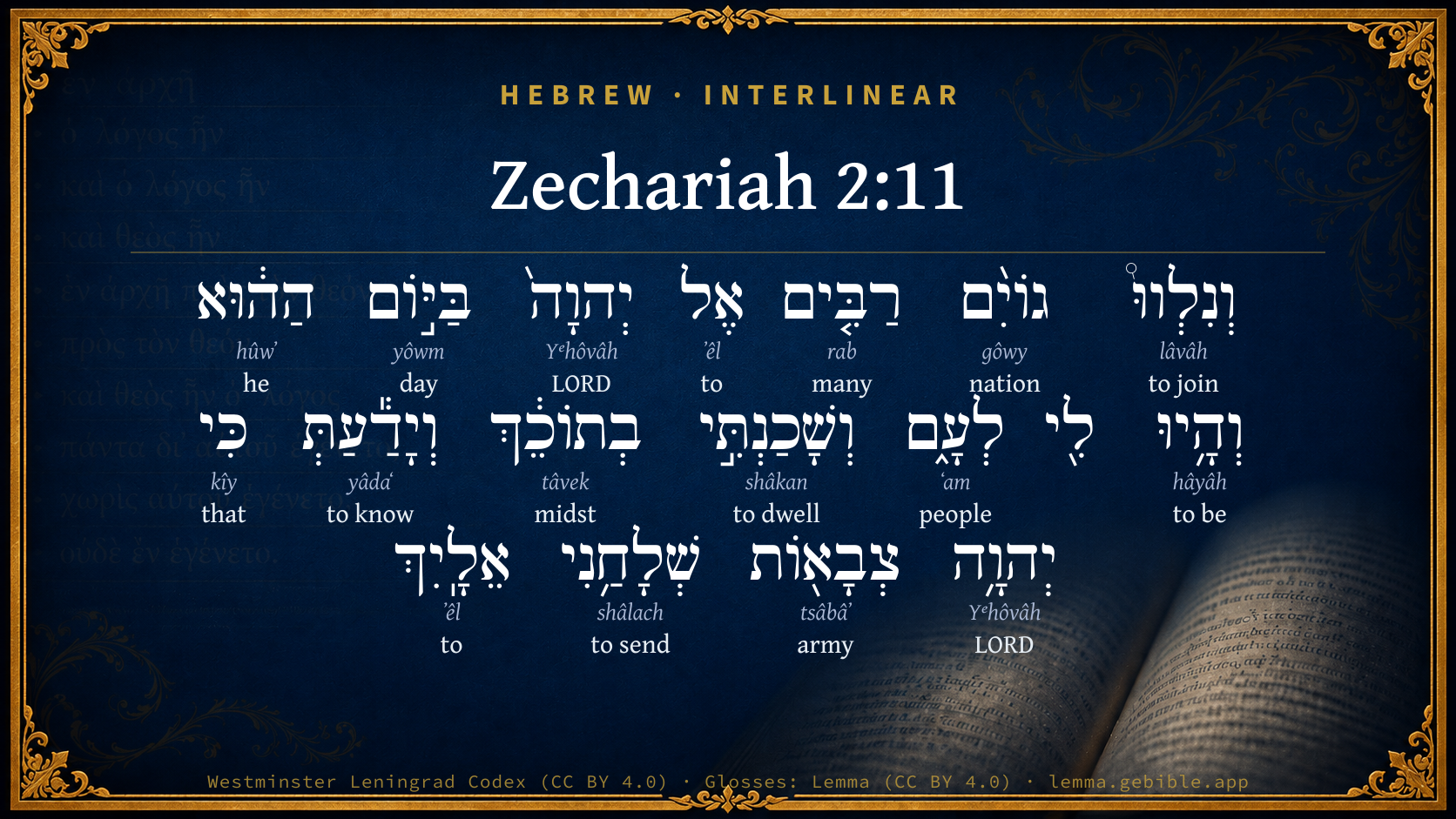
Hebrew (Westminster Leningrad Codex) Zechariah 2:11 appears in the Hebrew Old Testament. The text above is from the Westminster Leningrad Codex. Each word links to its Strong’s number, a concise gloss, and parsing drawn from the Open Scriptures Hebrew Bible morphology. Click any word for its full Brown-Driver-Briggs (BDB) entry.
Download image
Cite this verse

Zechariah 2:11 (World English Bible). Public Domain. Lemma interlinear Bible study tool, https://lemma.gebible.app/v/zechariah/2/11.

Show BibTeX & RIS
BibTeX
RIS
English Translation
Many nations shall join themselves to Yahweh in that day, and shall be my people; and I will dwell in the midst of you, and you shall know that Yahweh of Hosts has sent me to you.
World English Bible · Public Domain
Download a study sheet

One document with this verse’s original text, its word-by-word gloss line, the meaning frame, cross-references with their text, attributed commentary, and full source and license credits — printable, and it pastes into notes with its structure intact.

This verse Autodidact and up

Study sheet (.html) Plain text (.txt)

A passage Seminary Student

Up to 50 verses in one chapter. A passage sheet keeps up to 6 commentary sources and 12 cross-references per verse, in the order this page ranks them, and says so on the sheet whenever that leaves anything out. Ask for a single verse and you get the Autodidact verse sheet above.

Everything on this page stays free to read, with no account — the sheet is a download of what is already on screen, not access to it.

Want to remove ads? Support Godless Engineer
Compare translations 3

The same verse in 3 English versions, stacked beneath the original-language interlinear above. Click any original word for its lexicon entry.

Each is an independent rendering of the whole verse — the interlinear is not word-aligned to these translations.

Highlighted words mark where these versions differ — a whole-verse word diff, not a word-by-word alignment.

  • World English Bible Public Domain
    Many nations shall join themselves to Yahweh in that day, and shall be my people; and I will dwell in the midst of you, and you shall know that Yahweh of Hosts has sent me to you.
  • King James Version Public Domain
    And many nations shall be joined to the LORD in that day, and shall be my people: and I will dwell in the midst of thee, and thou shalt know that the LORD of hosts hath sent me unto thee.
  • unfoldingWord Literal Text CC BY-SA 4.0
    “And many nations will join themselves to Yahweh in that day, and they will be to me for a people, and I will dwell in your midst.” And you will know that Yahweh of Armies has sent me to you.

unfoldingWord Literal Text — © unfoldingWord, licensed CC BY-SA 4.0. Word-aligned USFM3 via Door43 (git.door43.org/unfoldingWord/en_ult).

Versions to compare (up to 4)

3 of 4 selected

Show all 18 translations

Every available English version of this verse, each an independent rendering of the whole verse.

  • World English Bible Public Domain
    Many nations shall join themselves to Yahweh in that day, and shall be my people; and I will dwell in the midst of you, and you shall know that Yahweh of Hosts has sent me to you.
  • Berean Standard Bible Public Domain
    “On that day many nations will join themselves to the LORD, and they will become My people. I will dwell among you, and you will know that the LORD of Hosts has sent Me to you.
  • Majority Standard Bible Public Domain
    “On that day many nations will join themselves to the LORD, and they will become My people. I will dwell among you, and you will know that the LORD of Hosts has sent Me to you.
  • King James Version Public Domain
    And many nations shall be joined to the LORD in that day, and shall be my people: and I will dwell in the midst of thee, and thou shalt know that the LORD of hosts hath sent me unto thee.
  • American Standard Version (1901) Public Domain
    And many nations shall join themselves to Jehovah in that day, and shall be my people; and I will dwell in the midst of thee, and thou shalt know that Jehovah of hosts has sent me unto thee.
  • Revised Version (1885) Public Domain
    And many nations shall join themselves to the LORD in that day, and shall be my people: and I will dwell in the midst of thee, and thou shalt know that the LORD of hosts hath sent me unto thee.
  • Geneva Bible (1599) Public Domain
    And many nations shall be ioyned to the Lord in that day, and shalbe my people: and I will dwell in the middes of thee, and thou shalt knowe that the Lord of hostes hath sent me vnto thee.
  • Douay-Rheims (1899) Public Domain
    And many nations shall be joined to the Lord in that day, and they shall be my people, and I will dwell in the midst of thee: and thou shalt know that the Lord of hosts hath sent me to thee.
  • Young's Literal Translation Public Domain
    And joined have been many nations unto Jehovah in that day, And they have been to Me for a people, And I have dwelt in thy midst, And thou hast known that Jehovah of Hosts hath sent me unto thee.
  • Literal Standard Version CC BY-SA 4.0
    And many nations have been joined to YHWH in that day, || And they have been to Me for a people, || And I have dwelt in your midst, || And you have known that YHWH of Hosts has sent Me to you.
  • Unlocked Literal Bible CC BY-SA 4.0
    Then great nations will join themselves to Yahweh in that day. He says, “Then you will become my people; for I will encamp in the midst of you,” and you will know that Yahweh of hosts has sent me to you.
  • unfoldingWord Literal Text CC BY-SA 4.0
    “And many nations will join themselves to Yahweh in that day, and they will be to me for a people, and I will dwell in your midst.” And you will know that Yahweh of Armies has sent me to you.
  • Darby Bible Public Domain
    And many nations shall join themselves to Jehovah in that day, and shall be unto me for a people; and I will dwell in the midst of thee, and thou shalt know that Jehovah of hosts hath sent me unto thee.
  • World Messianic Bible Public Domain
    Many nations shall join themselves to the LORD in that day, and shall be my people; and I will dwell among you, and you shall know that the LORD of Hosts has sent me to you.
  • Webster's Bible Public Domain
    \\2:7\\Deliver thyself, O Zion, that dwellest with the daughter of Babylon.
  • Free Bible Version CC BY-SA 4.0
    Many nations will become believers in Lord on that day, and they shall be my people. I will live among you, and you will know the Lord Almighty has sent me to you.
  • Bible in Basic English Public Domain
    Ho! Zion, go in flight from danger, you who are living with the daughter of Babylon.
  • JPS Tanakh (1917) Public Domain
    (2-15) And many nations shall join themselves to the LORD in that day, and shall be My people, and I will dwell in the midst of thee'; and thou shalt know that the LORD of hosts hath sent me unto thee.

Literal Standard Version (2020), Covenant Press — licensed CC BY-SA 4.0. Text via the HelloAO Bible API (eBible.org). Unlocked Literal Bible (unfoldingWord) — licensed CC BY-SA 4.0. Text via the HelloAO Bible API (eBible.org). unfoldingWord Literal Text — © unfoldingWord, licensed CC BY-SA 4.0. Word-aligned USFM3 via Door43 (git.door43.org/unfoldingWord/en_ult). Free Bible Version, Dr. Jonathan Gallagher — licensed CC BY-SA 4.0. Text via the HelloAO Bible API (eBible.org).

Word by word

More ways to search: Search by grammar → Find every occurrence → Compare this word →

Practice this passage: Drill this verse → Learn its vocabulary →

וְנִלְווּ֩
lâvâh
H3867
“and · to join”
Conjunction + Verb, Niphal, Sequential Perfect, 3rd Person, Common, Plural
Part of Speech
Conjunction + Verb
Stem
Niphal
Form
Sequential Perfect
Person
3rd Person
Gender
Common
Number
Plural
Full BDB Definition

Origin: a primitive root

TWOT: 1087 , 1088

to join, be joined - (Qal) to join, be joined, attend - (Niphal) to join oneself to, be joined unto - to borrow, lend - (Qal) to borrow - (Hiphil) to cause to borrow, lend to
  1. גוֹיִ֨ם gôwy H1471 “nations” Noun, Common, Masculine, Plural, Absolute
  2. רַבִּ֤ים rab H7227 “many” Adjective, Adjective, Masculine, Plural, Absolute
  3. אֶל ʼêl H413 “to” Preposition
  4. יְהוָה֙ Yᵉhôvâh H3068 “LORD” Noun, Proper
  5. בַּיּ֣וֹם yôwm H3117 “in/at the · day” Preposition, Determined + Noun, Common, Masculine, Singular, Absolute
  6. הַה֔וּא hûwʼ H1931 “the · he” Particle, Definite Article + Pronoun, Personal, 3rd Person, Masculine, Singular
  7. וְהָ֥יוּ hâyâh H1961 “and · to be” Conjunction + Verb, Qal, Sequential Perfect, 3rd Person, Common, Plural
  8. לְעָ֑ם ʻam H5971 “to/for · people” Preposition + Noun, Common, Masculine, Singular, Absolute
  9. וְשָׁכַנְתִּ֣י shâkan H7931 “and · to dwell” Conjunction + Verb, Qal, Sequential Perfect, 1st Person, Common, Singular
  10. בְתוֹכֵ֔ךְ tâvek H8432 “in/at · midst · your” Preposition + Noun, Common, Masculine, Singular, Construct + Suffix, Personal, 2nd Person, Feminine, Singular
  11. וְיָדַ֕עַתְּ yâdaʻ H3045 “and · to know” Conjunction + Verb, Qal, Sequential Perfect, 2nd Person, Feminine, Singular
  12. כִּי kîy H3588 “that” Conjunction
  13. יְהוָ֥ה Yᵉhôvâh H3068 “LORD” Noun, Proper
  14. צְבָא֖וֹת tsâbâʼ H6635 “armies” Noun, Common, Both, Plural, Absolute
  15. שְׁלָחַ֥נִי shâlach H7971 “to send · me” Verb, Qal, Perfect, 3rd Person, Masculine, Singular + Suffix, Personal, 1st Person, Common, Singular
  16. אֵלָֽיִךְ ʼêl H413 “to · you” Preposition + Suffix, Personal, 2nd Person, Feminine, Singular

About this verse

These counts appear in no published source. They are computed here, from the morphology-tagged text and Lemma’s own curated glosses. What Lemma adds →

18
words
15
distinct lemmas
Prophets
section

Shared distinctive vocabulary

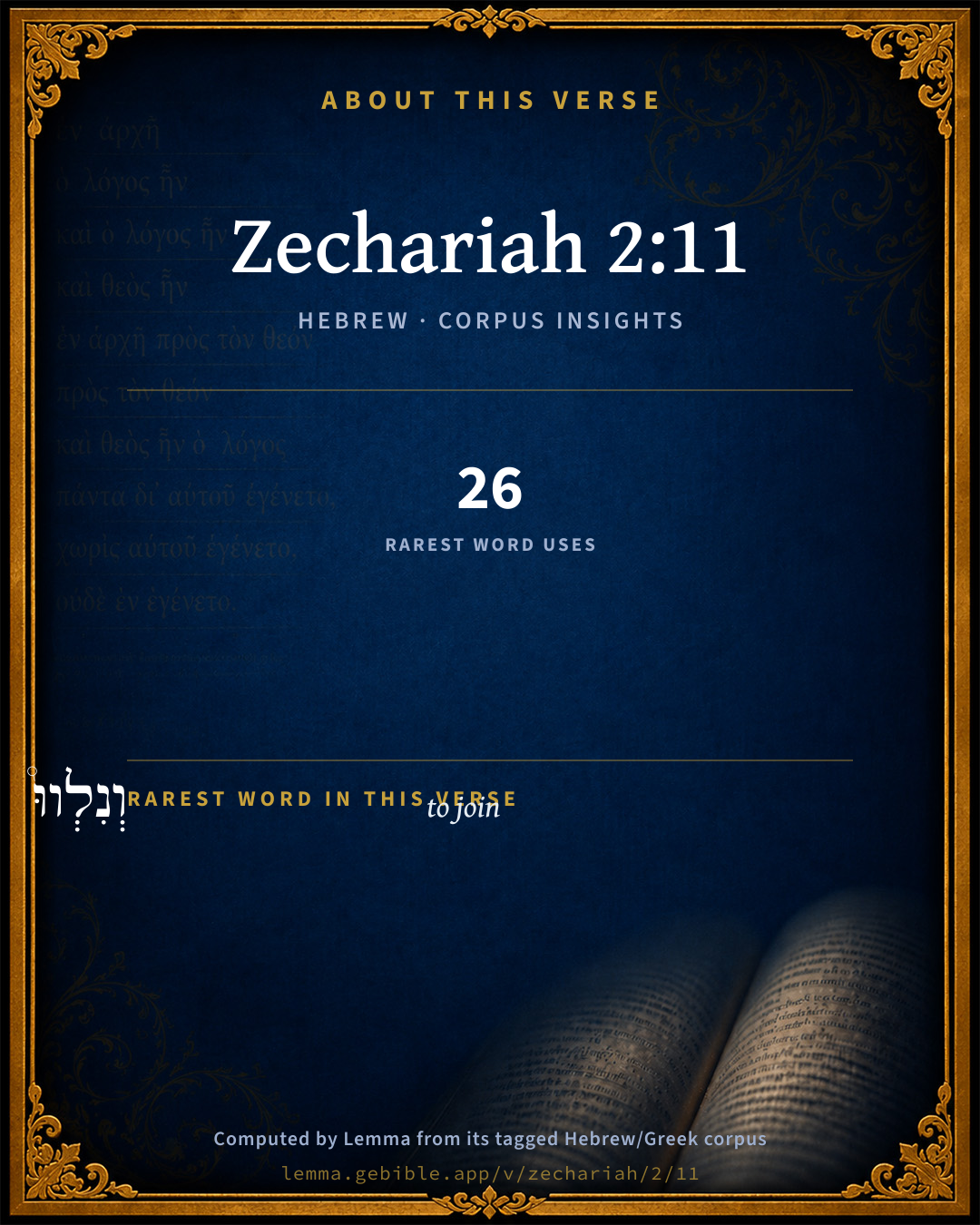
וְנִלְווּ֩ to join H3867 occurs in 22 verses of the Hebrew Bible. Also found in:

Grammatical profile

  • 5 verbs
  • 7 nouns
  • 1 adjective
  • 1 pronoun
  • 3 prepositions
  • 1 conjunction

Verb forms

  • וְנִלְווּ֩ Niphal · Sequential Perfect
  • וְהָ֥יוּ Qal · Sequential Perfect
  • וְשָׁכַנְתִּ֣י Qal · Sequential Perfect
  • וְיָדַ֕עַתְּ Qal · Sequential Perfect
  • שְׁלָחַ֥נִי Qal · Perfect

Repetition

Words recur within this verse — often emphatic in Hebrew:

  • יְהוָה֙ LORD H3068 ×2
  • אֶל to H413 ×2

Hebrew & Septuagint length

In English translation the verse runs 37 words from the Hebrew and 44 from the Septuagint (LXX English) — closely comparable.

A rough comparison of the two English renderings, which tokenize alike — not a word-level alignment.

Word counts can differ between the Hebrew and the Greek without any difference in meaning — e.g. the Hebrew direct-object marker אֵת has no separate Greek word, and Greek often adds the article ὁ.

Cross-references

28

Topical passages linked to Zechariah 2:11 in the Treasury of Scripture Knowledge — connected by theme and wording, ordered by reader-vote popularity; previews shown in the World English Bible.

  • Revelation 11:15 The seventh angel sounded, and great voices in heaven followed, saying, "The kingdom of the world has become the Kingdom of our Lord, and of his Christ. He will reign forever and ever!"
  • 1 Peter 2:9–10 But you are a chosen race, a royal priesthood, a holy nation, a people for God's own possession, that you may show forth the excellencies of him who called you out of darkness into his marvelous light:
  • Isaiah 45:14 Thus says Yahweh: "The labor of Egypt, and the merchandise of Ethiopia, and the Sabeans, men of stature, shall come over to you, and they shall be yours. They shall go after you. In chains they shall come over; and they shall fall down to you. They shall make supplication to you: 'Surely God is in you; and there is none else, there is no other god.
  • Zechariah 2:9–10 For, behold, I will shake my hand over them, and they will be a spoil to those who served them; and you will know that Yahweh of Hosts has sent me.
  • Luke 2:32 A light for revelation to the Gentiles, And the glory of your people Israel."
  • Acts 28:28 "Be it known therefore to you, that the salvation of God is sent to the Gentiles. They will also listen."
  • Isaiah 19:24–25 In that day shall Israel be the third with Egypt and with Assyria, a blessing in the midst of the earth;
  • Zechariah 8:20–23 Thus says Yahweh of Hosts: "Many peoples, and the inhabitants of many cities will yet come;
  • Psalms 22:27–30 All the ends of the earth shall remember and turn to Yahweh. All the relatives of the nations shall worship before you.
  • Psalms 68:29–31 Because of your temple at Jerusalem, Kings shall bring presents to you.
  • Psalms 72:8–11 He shall have dominion also from sea to sea, From the River to the ends of the earth.
  • Psalms 72:17 His name endures forever. His name continues as long as the sun. Men shall be blessed by him. All nations will call him blessed.
  • Isaiah 2:2–5 It shall happen in the latter days, that the mountain of Yahweh's house shall be established on the top of the mountains, And shall be raised above the hills; And all nations shall flow to it.
  • Isaiah 11:9–10 They shall not hurt nor destroy in all my holy mountain; for the earth shall be full of the knowledge of Yahweh, as the waters cover the sea.
  • Isaiah 42:1–4 Behold, my servant, whom I uphold; my chosen, in whom my soul delights: I have put my Spirit on him; he will bring forth justice to the Gentiles.
  • Isaiah 49:6–7 yes, he says, It is too light a thing that you should be my servant to raise up the tribes of Jacob, and to restore the preserved of Israel: I will also give you for a light to the Gentiles, that you may be my salvation to the end of the earth.
  • Isaiah 49:22–23 Thus says the Lord Yahweh, Behold, I will lift up my hand to the nations, and set up my ensign to the peoples; and they shall bring your sons in their bosom, and your daughters shall be carried on their shoulders.
  • Isaiah 52:10 Yahweh has made bare his holy arm in the eyes of all the nations; and all the ends of the earth have seen the salvation of our God.
  • Isaiah 60:3–7 Nations shall come to your light, and kings to the brightness of your rising.
  • Isaiah 66:19 I will set a sign among them, and I will send such as escape of them to the nations, to Tarshish, Pul, and Lud, who draw the bow, to Tubal and Javan, to the isles afar off, who have not heard my fame, neither have seen my glory; and they shall declare my glory among the nations.
  • Jeremiah 16:19 Yahweh, my strength, and my stronghold, and my refuge in the day of affliction, to you shall the nations come from the ends of the earth, and shall say, Our fathers have inherited nothing but lies, [even] vanity and things in which there is no profit.
  • Ezekiel 33:33 When this comes to pass, (behold, it comes), then shall they know that a prophet has been among them.
  • Zechariah 3:10 In that day,' says Yahweh of hosts, 'you will invite every man his neighbor under the vine and under the fig tree.'"
  • Malachi 1:11 For from the rising of the sun even to the going down of the same, my name is great among the nations, and in every place incense will be offered to my name, and a pure offering: for my name is great among the nations," says Yahweh of Hosts.
  • John 17:21 that they may all be one; even as you, Father, are in me, and I in you, that they also may be one in us; that the world may believe that you sent me.
  • Exodus 12:49 One law shall be to him who is born at home, and to the stranger who lives as a foreigner among you."
  • John 17:23 I in them, and you in me, that they may be perfected into one; that the world may know that you sent me, and loved them, even as you loved me.
  • John 17:25 Righteous Father, the world hasn't known you, but I knew you; and these knew that you sent me.

Cross-references courtesy of OpenBible.info (CC BY 4.0).

Hebrew and Greek witnesses Masoretic Hebrew ↔ Greek Septuagint

The same verse in the two great witnesses to the Old Testament, shown verse-for-verse.

These are two independent witnesses, not word-aligned to each other, and the Septuagint is shown in lemma (dictionary) form.

Hebrew Zechariah 2:11 Masoretic · Westminster Leningrad Codex

וְנִלְווּ֩ גוֹיִ֨ם רַבִּ֤ים אֶל יְהוָה֙ בַּיּ֣וֹם הַה֔וּא וְהָ֥יוּ לִ֖י לְעָ֑ם וְשָׁכַנְתִּ֣י בְתוֹכֵ֔ךְ וְיָדַ֕עַתְּ כִּי יְהוָ֥ה צְבָא֖וֹת שְׁלָחַ֥נִי אֵלָֽיִךְ

Many nations shall join themselves to Yahweh in that day, and shall be my people; and I will dwell in the midst of you, and you shall know that Yahweh of Hosts has sent me to you.

World English Bible · Public Domain

Greek LXX Zechariah 2:11 Septuagint · lemma form

εἰς σιων ἀνασώζω ὁ καταοἰκέω θυγάτηρ βαβυλών

And many nations shall flee for refuge to the Lord in that day, and they shall be for a people to him, and they shall dwell in the midst of you: and you shall know that the Lord Almighty has sent me to you.

LXX2012 (modern English Septuagint) · Public Domain

On this verse, The Pulpit Commentary discusses the Septuagint’s reading. Read the note in Commentary ↓

Hebrew: Westminster Leningrad Codex (CC BY 4.0). Greek: Septuagint (public domain); English from LXX2012 (modern English Septuagint) (Public Domain). How the Septuagint differs from the Hebrew →

Targum (Aramaic paraphrase)

1

The Targum is the ancient Jewish Aramaic paraphrase of the Hebrew Scriptures — an interpretive translation, not the Hebrew text itself. Onkelos (literal) and Pseudo-Jonathan (expansive) render the Torah, and Jonathan the Prophets. Coverage is partial: where no permissively-licensed English translation exists for a verse, only the Aramaic is shown. This is verse-level text, not a word-by-word alignment to the Hebrew.

  1. Targum Jonathan Prophets (Joshua–Malachi)
    אַכְלוּ לִכְנִשְׁתָּא דְצִיוֹן וַאֲמָרוּ לָהּ אִשְׁתֵּיזְבִי וֶאֱתָא דְיָתְבָא בִּמְדִינַת בָּבֶל:

    (no public-domain English translation for this verse)

    Targum Jonathan — Aramaic: “Mikraot Gedolot” (public domain). English: “Sefaria Community Translation” (CC0 1.0 (public-domain dedication)); “London "Chaldee Paraphrase," 1871” (public domain). Text via Sefaria.

Commentary

Notes on Zechariah 2:11 from classic Christian and Jewish commentators (each source and its license shown beneath its notes). The classic Christian expositions comment on the surrounding passage and are grouped to its opening verse, so a note may address several verses; the Jewish commentaries on the Tanakh (Rashi and others) are per-verse, so they appear only where the commentator wrote on this verse.

Lemma curates 59 commentaries, every one of them public domain or Creative Commons licensed, each selected and text-cleaned for this edition rather than reprinted as found. About our sources →

Trapp's Complete Commentary

John Trapp

Zec 2:11 And many nations shall be joined to the LORD in that day, and shall be my people: and I will dwell in the midst of thee, and thou shalt know that the LORD of hosts hath sent me unto thee.

Ver. 11. And many nations shall be joined to the Lord in that day] {See Trapp on "Zec 2:9"} And further observe; that albeit the thorough coming in of the Gentiles, for all nations with one consent to receive Christ, be put off till the Jews’ famous conversion; yet that nothing hindereth but that this, and such like places that speak of the same, may well serve to warrant the first inceptions of their calling. And so doth St James cite them, Act 15:16-17, out of Amo 9:11-12, and Paul, Rom 9:25-26, out of Hos 1:10.

And I will dwell in the midst of thee] {See Trapp on "Zec 2:10"}

And thou shalt know, &c.] {See Trapp on "Zec 2:9"}

John Trapp, A Commentary or Exposition upon All the Books of the Old and New Testament (1647–1656) — public domain. Text from a community e-Sword module.

The Pulpit Commentary

Many nations shall be joined (shall join themselves) to the Lord; " shall fly for refuge unto the Lord" (Septuagint). My people; unto me for a people; Septuagint, "shall be unto him for a people". (comp. Zec_8:20) No mere conversion of individuals among the heathen satisfies this promise. Whole nations shall become the Lord"s people. That title shall be shared with Israel by countless multitudes, (comp, Isa_2:2, 3 11:10 Mic_4:2 Zep_2:11) I will dwell, etc. The promise of ver. 10 is repeated for assurance" sake. The LXX has, "And they shall dwell in the midst of thee." Thou shalt know (as ver. 9).

The Pulpit Commentary (1880–1919), ed. H.D.M. Spence-Jones & Joseph S. Exell — public domain. Text from a community e-Sword module.

Jamieson, Fausset & Brown

Robert Jamieson, A. R. Fausset & David Brown

many nations . . . joined to the Lord in that day--The result of the Jews' exile in Babylon was that, at their subsequent return, through the diffusion of knowledge of their religion, many Gentiles became proselytes, worshipping in the court of the Gentiles (Kg1 8:41). Cyrus, Darius, Alexander, Ptolemy Philadelphus, Augustus, and Tiberius, paid respect to the temple by sending offerings [GROTIUS]. But all this is but a shadow of the future conversion of the Gentiles which shall result from Jehovah dwelling in Jerusalem (Psa 102:15-16; Phi 2:10-11).

sent me unto thee--"unto thee" is here added to the same formula (Zac 2:9). Zion first shall "know (generally) that Jehovah of hosts hath sent" Messiah, by the judgments inflicted by Him on her foes. Subsequently, she shall know experimentally the particular sending of Messiah unto her. Jehovah here says, "I will dwell," and then that JEHOVAH of hosts sent Him; therefore Jehovah the Sender and Jehovah the Sent must be One.

Jamieson, Fausset & Brown — Commentary Critical and Explanatory on the Whole Bible (1871) — public domain (CC PDM 1.0). Text via the HelloAO Bible API.

Adam Clarke's Commentary

Verse 11. Many nations shall be joined to the Lord] This most certainly belongs to the Christian church. No nation or people ever became converts to the Jewish religion, but whole nations have embraced the faith of our Lord Jesus Christ.

Adam Clarke's Commentary on the Bible (1810–1826) — public domain. Text from a community e-Sword/MySword module.

John Calvin's Commentaries

The Prophet describes here the voluntary surrender of the nations, who would so join themselves to the Church of God, as to disown their own name and to count themselves Jews: and this is what the Prophet borrowed from those who had predicted the same thing; but he confirms their testimony, that the Jews might know that the propagation of the Church had not been promised to them in vain by so many witnesses. That what is said here refers to the calling of the nations who would willingly surrender themselves to God, is quite evident; for it is said that they would be a people to God. This could not be, except the nations surrendered their own name, so as to become one body with the Jews. He then repeats what he had said, that God would dwell in the midst of Judea. Of this dwelling something was said yesterday; for as they had already begun to offer sacrifices in the temple, it follows that God was already dwelling among them. We must then necessarily come to another kind of dwelling, even that which God, who had before testified by many proofs that he was nigh the Jews, had at length accomplished through Christ; for Christ is really Emmanuel, and in him God is present with us in the fullness of his power, justice, goodness, and glory.

He at last adds, Thou shalt know that Jehovah of hosts has sent me to thee. Something has also been said on this sentence: the Prophet means, that it would be evident by what would really take place, that these things had not been in vain foretold, as the prophecy would be openly fulfilled before the eyes of all. Then shalt thou know, not by the assurance of faith, which is grounded on the word, but by actual experience. But he expresses more than before, for he says, “Thou shalt know that Jehovah of hosts has sent me to thee.” The particle אליך, alik, “to thee,” is not superfluous; for he said a little while before, that he was sent to the nations. As he now says, that he would be the guardian of the chosen people, he also declares that his mission was to them; and he gives to God the name of Jehovah of hosts, that the Jews might feel assured that there would be no difficulty sufficient to hinder or delay the word of God, as he possessed supreme power, so that he could easily execute whatever he had decreed. I will not repeat now what I said yesterday of Christ; but we ought nevertheless to remember this, that he who declares that he was sent, is often called Jehovah. It hence appears that one and the same divine eternal essence is in more persons than one. Let us go on -

John Calvin's Commentaries (1540-1563) — public domain. Text from the Calvin Translation Society English edition (1840s-50s) via the Christian Classics Ethereal Library (ccel.org). Calvin's coverage is partial (roughly two-thirds of the Bible); uncommented books and verses are honest gaps, never fabricated. The 19th-century editor's footnotes and remarks are omitted so the notes are faithfully Calvin's own voice.

Ellicott's Commentary for English Readers

(11) Many nations.—Comp. Zec_8:20-22. This prophecy, which is clothed in Old Testament imagery, was spiritually fulfilled by the gathering-in of the Gentiles to the Church of Christ.

And . . . . shall be joined.—LXX., καὶ καταφεύξονται, “and shall flee for refuge,” as in Jer_1:5 (Jer_27:5, LXX.).

My people.—Heb., to me for a people. LXX., αὐτῷ εἰς λαὸν, “to Him for a people.” Instead of “And I will dwell,” LXX., καὶ κατασκηνώσουσιν, “and they shall dwell.”

And thou . . . unto thee.—The pronouns are in the feminine, and refer to the “daughter of Zion” (Zec_2:10).

Sent me.—The person changes (comp. Zec_2:8). These words seem to imply an expectation of a near fulfilment of the prophecy, such as would prove to the people the truth of the prophet’s (or angel’s) mission. (Comp. Zec_4:9; Zec_6:15.) But when the promise was fulfilled in Christ, it was just “the city” that failed to perceive its fulfilment (Luk_19:44).

A Bible Commentary for English Readers, edited by Charles John Ellicott (1878–1897) — public domain. Text from a community e-Sword module.

The Cambridge Bible for Schools and Colleges

gen. ed. J. J. S. Perowne

11. be joined] join themselves. R. V.

The Cambridge Bible for Schools and Colleges (gen. ed. J. J. S. Perowne; Cambridge University Press, 1878–1918) — public domain. Text from a community e-Sword module.

John Gill's Exposition

And many nations shall be joined to the Lord in that day,.... The Gospel will be preached in all nations, and multitudes will be converted, and embrace and profess the Christian religion, and join themselves to the churches of Christ, which, in the New Testament, is expressed by being joined to the Lord, Act 5:13 see Jer 50:5,

and shall be my people; shall appear to be so, who before were not the people of God; did not profess themselves, and were not known to be, the people of God, though they secretly were in the counsel and covenant of God; but now, being called by grace, they become openly and manifestly his people, Pe1 2:10,

and I will dwell in the midst of thee; in the church, consisting of people of many nations, as well as of Jews:

and thou shall know that the Lord of hosts hath sent me unto thee; to the Jews, as well as to the Gentiles; See Gill on Zac 2:9.

John Gill's Exposition of the Whole Bible (1746–1763) — public domain (CC PDM 1.0). Text via the HelloAO Bible API.

Albert Barnes' Notes on the Bible

And many nations shall join themselves - cleaving to Him by a close union. Isaiah had so spoken of single proselytes Isa 56:3-6; Jeremiah had used the word of Israel’s self-exhortation after the return from Babylon; “going and weeping,” they shall go and seek the Lord their God, saying, “Come and let us join ourselves unto the Lord, in a perpetual covenant that shall not be forgotten” Jer 50:4-5. This Zechariah now predicts of “many nations.” The Jews were scarcely half-restored themselves, a mere handful. They had wrought no conversions among the pagan, yet prophecy continues its unbroken voice, “many nations shall join themselves unto the Lord.”

And shall be My people - Literally, “be to Me a people.” This is exactly the history of the Christian church, unity amid diversity; many nations still retaining their national existence, yet owned by God as one people and His own. The words are those in which God adopted Israel in Egypt; “I will take you to Me for a people, and I will be your God” Exo 6:7. This was the covenant with them, “that thou shouldest enter into covenant with the Lord thy God, that He may establish thee today for a people unto Himself, and that he may be unto thee a God” (Deu 29:12-13, add Lev 26:12; Deu 27:9; 1Sa 12:22; 2Sa 7:23-24; 2Ki 11:17; 1Ch 17:22; 2Ch 23:16; Jer 7:23; Jer 11:4). The contrary was the title of the pagan, “not a people; with whom God said, I will move Israel to jealousy” Deu 32:21. The closeness of union Jeremiah expresses; “As the girdle cleaveth to the loins of a man, so have I caused to cleave to Me the whole house of Israel and the whole house of Judah, saith the Lord, that they might be unto Me for a people and for a name and for a praise and for a glory” Jer 13:11. This was the object of the existence of Israel; to this it was to be restored Jer 24:7; Jer 30:22; Jer 31:1; Jer 32:38 by conversion Eze 11:20; Eze 14:11; Eze 36:28; Eze 37:23, Eze 37:27; Zec 8:8; to this special privilege of Israel “many nations” were to be admitted; yet not so as to be separate from Israel, for He adds, “and I will dwell in, the midst of thee,” Judah. God would dwell in His Church, formed of Israel and the Gentiles, yet so that the Gentiles should be grafted into Israel, becoming one with them.

Albert Barnes' Notes on the Bible (1834–1885) — public domain. Text from a community e-Sword/MySword module.

Haydock's Catholic Bible Commentary

Nations. We know of none who embrace the Jewish law. But both the old and the new world submits to Christ. --- Dwell. St. Michael represents the Messias. The latter preached and wrought miracles among the Jews, which rendered them inexcusable, John xv. 24. (Calmet)

George Leo Haydock (1774–1849), Haydock's Catholic Family Bible and Commentary, 1859 edition — public domain. Excludes Psalms (Douay-Rheims chapter numbering differs from Protestant) and Deuterocanonical books (Catholic canon only).

Matthew Poole's English Annotations

Many nations, and great, Heb; it implieth both multitudes and greatness of nations; or, heathen and Gentiles, as the word beareth.

Shall be joined to the Lord; become proselytes, inquire for, adhere to, and worship the God of Israel.

In that day; when God shall lift up his hand for his people against their enemies, as Est 8:17; when Christ shall be come in the flesh, and Shall take down the partition wall.

Shall be my people; covenant people, to love, fear, worship, and obey Christ.

I will dwell in the midst of thee: see Zec 2:10.

Thou shalt know: see Zec 2:9,

The Lord of hosts, the sovereign Lawgiver, and Almighty Ruler of heaven and earth, hath sent me, the Messiah, and Zechariah his servant, unto thee, Jew and Gentile.

Matthew Poole's English Annotations on the Holy Bible (1683–1685) — public domain. Text from a community e-Sword/MySword module.

John Wesley's Explanatory Notes

Shall be joined - Shall worship the God of Israel. In that day - When Christ shall come in the flesh, and take down the partition wall. Sent me - The Messiah.

John Wesley, Explanatory Notes Upon the Whole Bible (1754–1765) — public domain. Text via the GEBible commentary corpus.

Rashi

Rabbi Shlomo Yitzchaki (Rashi)

Ho, Zion! Flee This too is an expression of announcement: Assemble, O exile of Zion, and flee from the midst of Babylon.

Rashi on the Tanakh — English translations: “The Judaica Press complete Tanach with Rashi, translated by A. J. Rosenberg” (CC BY 4.0); “Pentateuch with Rashi's commentary by M. Rosenbaum and A.M. Silbermann, 1929-1934” (public domain); “The Metsudah Tanach series, Lakewood, N.J” (CC BY 4.0); and “The Book of Joshua, Metsudah Publications, 1997” (CC BY 4.0). Text via Sefaria.

Lesson kit

Teaching starters — assembled from the data on this page, not authored interpretation. Every prompt links to the verse data it draws on. Edit before teaching.

Zechariah, in the Prophets, opens this verse with 18 words (15 distinct Hebrew lemmas). Its most distinctive word is lâvâh (“to join”). A historical commentator’s framing appears above. Read the whole chapter for the surrounding context.

Discussion questions

  1. The word lâvâh carries the sense “to join.” How does it shape the verse?
  2. How does Genesis 29:34, which shares the word «to join», read alongside this verse?
  3. What does the repetition of “LORD” (2× in this one verse) do in this verse?
  4. These translations render this verse differently; the difference is in the English rendering, not the original. What questions does that raise?
  5. «וְנִלְווּ֩» is a Niphal Sequential Perfect verb. How does that grammatical form shape the action described?
  6. Compare how Trapp's Complete Commentary and The Pulpit Commentary read this verse. Where do they agree or differ?

Things to notice

Reading settings

Reading text

Shown beneath each verse's original-language words.

Old Testament
Old Testament edition

Read the OT as the Masoretic Hebrew (MT) or the Greek Septuagint (LXX).

English shown for the Greek Septuagint (in the Hebrew ↔ Greek comparison).

Comparing translations? Open the Compare panel on any verse page to stack up to four side by side.