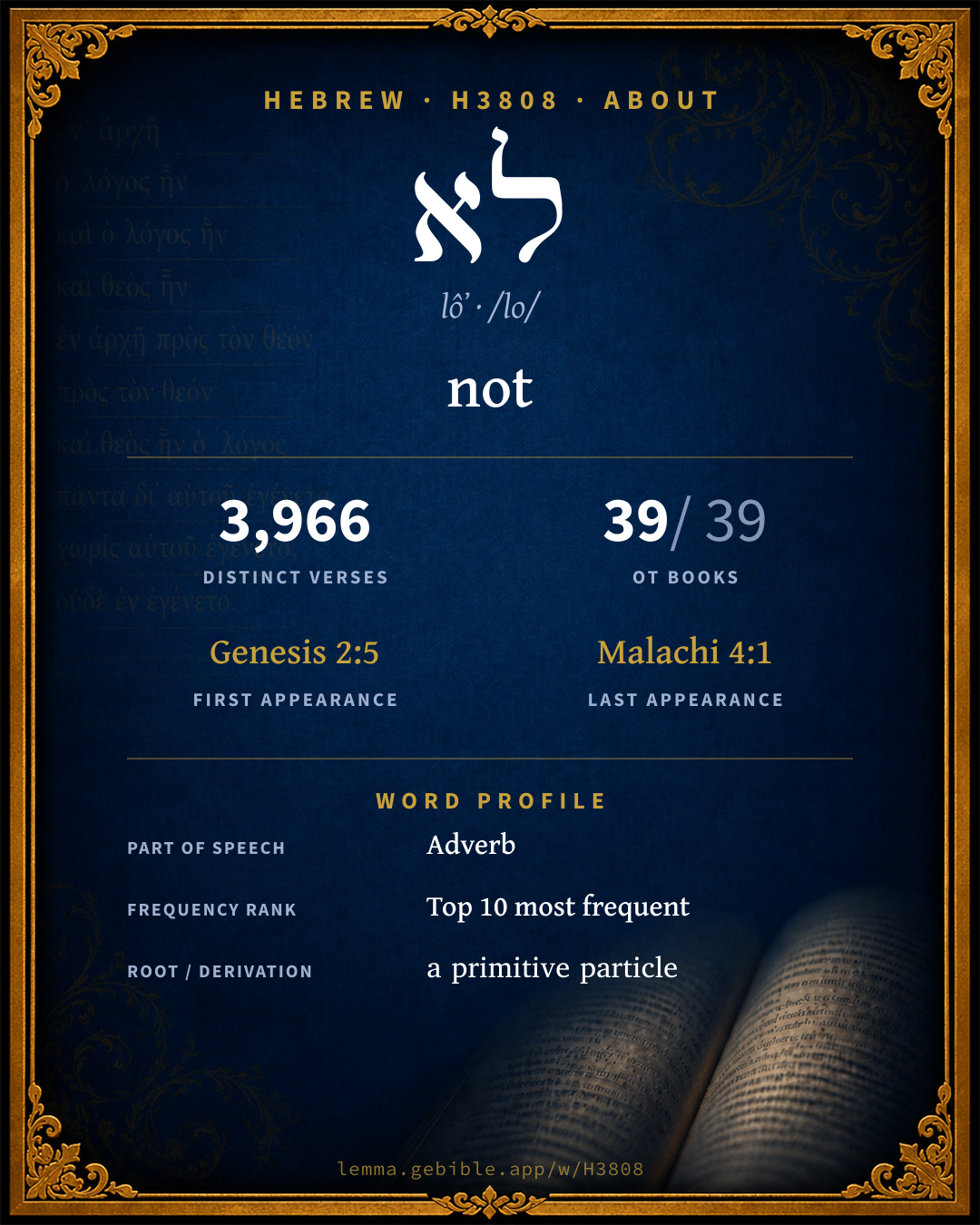
לֹא
not
‘not’ is one of 6 main senses fuller range ↓
Full lexicon entry — Brown-Driver-Briggs (BDB)
From Brown-Driver-Briggs (BDB)
Where this word appears
Grammar key — what these labels mean
Part of speech
- Particle
- A short function word — article, negation, interrogative, the sign of the direct object, and the like.
Noun type
- Proper
- A name of a specific person, place, or people (e.g. Abraham, Zion, Israel).
Every verse where H3808 appears in the Book of Hosea — 44 distinct verses. Click any verse to open its interlinear word-by-word view. Verse text shown in the World English Bible for context — . Each verse’s Hebrew form is shown with its reference; the English is not keyword-highlighted, since the data carries no word-level English alignment. Use “Compare translations” on any verse to read it across multiple English versions. This concordance covers the Hebrew Bible; Septuagint (Greek Old Testament) occurrences are not indexed here.
Hosea
- Hosea 1:6 לֹ֨א ptcl neg She conceived again, and bore a daughter. Then he said to him, "Call her name Lo-Ruhamah; for I will no longer have mercy on the house of Israel, that I should in any way pardon them.
- Hosea 1:7 וְ/לֹ֣א conj + ptcl neg But I will have mercy on the house of Judah, and will save them by Yahweh their God, and will not save them by bow, nor by sword, nor by battle, by horses, nor by horsemen."
- Hosea 1:9 לֹ֣א לֹֽא ptcl neg ptcl neg He said, "Call his name Lo-Ammi; for you are not my people, and I will not be yours.
- Hosea 1:10 לֹֽא וְ/לֹ֣א לֹֽא ptcl neg conj + ptcl neg ptcl neg Yet the number of the children of Israel will be as the sand of the sea, which can't be measured nor numbered; and it will come to pass that, in the place where it was said to them, 'You are not my people,' they will be called 'sons of the living God.'
- Hosea 2:2 לֹ֣א לֹ֣א ptcl neg ptcl neg Contend with your mother! Contend, for she is not my wife, Neither am I her husband; And let her put away her prostitution from her face, And her adulteries from between her breasts;
- Hosea 2:4 לֹ֣א ptcl neg Indeed, on her children I will have no mercy; For they are children of unfaithfulness;
- Hosea 2:6 לֹ֥א ptcl neg Therefore, behold, I will hedge up your way with thorns, And I will build a wall against her, That she can't find her way.
- Hosea 2:7 וְ/לֹֽא וְ/לֹ֣א conj + ptcl neg conj + ptcl neg She will follow after her lovers, But she won't overtake them; And she will seek them, But won't find them. Then she will say, 'I will go and return to my first husband; For then was it better with me than now.'
- Hosea 2:8 לֹ֣א ptcl neg For she did not know that I gave her the grain, the new wine, and the oil, And multiplied to her silver and gold, which they used for Baal.
- Hosea 2:10 לֹֽא ptcl neg Now I will uncover her lewdness in the sight of her lovers, And no one will deliver her out of my hand.
- Hosea 2:16 וְ/לֹֽא conj + ptcl neg It will be in that day," says Yahweh, "That you will call me 'my husband,' And no longer call me 'my master.'
- Hosea 2:17 וְ/לֹֽא conj + ptcl neg For I will take away the names of the Baals out of her mouth, And they will no more be mentioned by their name.
- Hosea 2:23 לֹ֣א לְ/לֹֽא ptcl neg prep + n Proper I will sow her to me in the earth; And I will have mercy on her who had not obtained mercy; And I will tell those who were not my people, 'You are my people;' And they will say, 'My God!'"
- Hosea 3:3 לֹ֣א וְ/לֹ֥א ptcl neg conj + ptcl neg I said to her, "You shall stay with me many days. You shall not play the prostitute, and you shall not be with any other man. I will also be so toward you."
- Hosea 4:10 וְ/לֹ֣א וְ/לֹ֣א conj + ptcl neg conj + ptcl neg They will eat, and not have enough. They will play the prostitute, and will not increase; Because they have abandoned giving to Yahweh.
- Hosea 4:14 לֹֽא לֹֽא ptcl neg ptcl neg I will not punish your daughters when they play the prostitute, Nor your brides when they commit adultery; Because the men consort with prostitutes, And they sacrifice with the shrine prostitutes; And the people that does not understand will come to ruin.
- Hosea 5:3 לֹֽא ptcl neg I know Ephraim, And Israel is not hidden from me; For now, Ephraim, you have played the prostitute. Israel is defiled.
- Hosea 5:4 לֹ֤א לֹ֥א ptcl neg ptcl neg Their deeds won't allow them to turn to their God; For the spirit of prostitution is within them, And they don't know Yahweh.
- Hosea 5:6 וְ/לֹ֣א conj + ptcl neg They will go with their flocks and with their herds to seek Yahweh; But they won't find him. He has withdrawn himself from them.
- Hosea 5:13 לֹ֤א וְ/לֹֽא ptcl neg conj + ptcl neg When Ephraim saw his sickness, And Judah his wound, Then Ephraim went to Assyria, And sent to king Jareb: But he is not able to heal you, Neither will he cure you of your wound.
- Hosea 6:6 וְ/לֹא conj + ptcl neg For I desire mercy, and not sacrifice; And the knowledge of God more than burnt offerings.
- Hosea 7:9 לֹ֣א לֹ֥א ptcl neg ptcl neg Strangers have devoured his strength, And he doesn't realize it. Indeed, gray hairs are here and there on him, And he doesn't realize it.
- Hosea 7:10 וְ/לֹֽא וְ/לֹ֥א conj + ptcl neg conj + ptcl neg The pride of Israel testifies to his face; Yet they haven't returned to Yahweh their God, Nor sought him, for all this.
- Hosea 7:14 וְ/לֹֽא conj + ptcl neg They haven't cried to me with their heart, But they howl on their beds. They assemble themselves for grain and new wine. They turn away from me.
- Hosea 7:16 לֹ֣א ptcl neg They return, but not to the Most High. They are like a faulty bow. Their princes will fall by the sword for the rage of their tongue. This will be their derision in the land of Egypt.
- Hosea 8:4 וְ/לֹ֣א וְ/לֹ֣א conj + ptcl neg conj + ptcl neg They have set up kings, but not by me. They have made princes, and I didn't approve. Of their silver and their gold they have made themselves idols, That they may be cut off.
- Hosea 8:5 לֹ֥א ptcl neg Let Samaria throw out his calf-idol! My anger burns against them! How long will it be before the are capable of purity?
- Hosea 8:6 וְ/לֹ֥א conj + ptcl neg For this is even from Israel! The workman made it, and it is no God; Indeed, the calf of Samaria shall be broken in pieces.
- Hosea 8:13 לֹ֣א ptcl neg As for the sacrifices of my offerings, they sacrifice flesh and eat it; But Yahweh doesn't accept them. Now he will remember their iniquity, And punish their sins. They will return to Egypt.
- Hosea 9:2 לֹ֣א ptcl neg The threshing floor and the winepress won't feed them, And the new wine will fail her.
- Hosea 9:3 לֹ֥א ptcl neg They won't dwell in Yahweh's land; But Ephraim will return to Egypt, And they will eat unclean food in Assyria.
- Hosea 9:4 לֹא וְ/לֹ֣א לֹ֥א ptcl neg conj + ptcl neg ptcl neg They won't pour out wine offerings to Yahweh, Neither will they be pleasing to him. Their sacrifices will be to them like the bread of mourners; All who eat of it will be polluted; For their bread will be for their appetite. It will not come into the house of Yahweh.
- Hosea 9:15 לֹ֤א ptcl neg "All their wickedness is in Gilgal; For there I hated them. Because of the wickedness of their deeds I will drive them out of my house! I will love them no more. All their princes are rebels.
- Hosea 9:17 לֹ֥א ptcl neg My God will cast them away, because they did not listen to him; And they will be wanderers among the nations.
- Hosea 10:3 לֹ֤א ptcl neg Surely now they will say, "We have no king; for we don't fear Yahweh; And the king, what can he do for us?"
- Hosea 10:9 לֹֽא ptcl neg "Israel, you have sinned from the days of Gibeah. There they remained. The battle against the children of iniquity doesn't overtake them in Gibeah.
- Hosea 11:3 וְ/לֹ֥א conj + ptcl neg Yet I taught Ephraim to walk. I took them by his arms; But they didn't know that I healed them.
- Hosea 11:5 לֹ֤א ptcl neg "They won't return into the land of Egypt; But the Assyrian will be their king, Because they refused to repent.
- Hosea 11:7 לֹ֥א ptcl neg My people are determined to turn from me. Though they call to the Most High, He certainly won't exalt them.
- Hosea 11:9 לֹ֤א לֹ֥א וְ/לֹא וְ/לֹ֥א ptcl neg ptcl neg conj + ptcl neg conj + ptcl neg I will not execute the fierceness of my anger. I will not return to destroy Ephraim: For I am God, and not man; the Holy One in the midst of you; And I will not come in wrath.
- Hosea 12:8 לֹ֥א ptcl neg Ephraim said, "Surely I have become rich, I have found myself wealth. In all my wealth they won't find in me any iniquity that is sin."
- Hosea 13:4 לֹ֣א ptcl neg "Yet I am Yahweh your God from the land of Egypt; And you will know no god but me, And besides me there is no savior.
- Hosea 13:13 לֹ֣א לֹֽא ptcl neg ptcl neg The sorrows of a travailing woman will come on him. He is an unwise son; For when it is time, he doesn't come to the opening of the womb.
- Hosea 14:3 לֹ֣א לֹ֣א וְ/לֹא ptcl neg ptcl neg conj + ptcl neg Assyria can't save us. We won't ride on horses; Neither will we say any more to the work of our hands, 'Our gods!' For in you the fatherless finds mercy."
About this entry
At a glance — auto-summarized from this page’s data, not written by a person. Every figure links to its source below. This summary describes the numbers; it doesn’t interpret them.
At its core, לא (lôʼ) means “not.” Where the King James Version says “not,” newer translations reach for “no” (Berean Standard Bible); the renderings breakdown has the detail. It appears 3,966 verses across 39 books of the Hebrew Bible, among its most common vocabulary. First canonically at Genesis 2:5, it enters the text early. Carrying more than one sense, it rewards its full sense range. Each statement above links to its evidence; the full detail follows below.
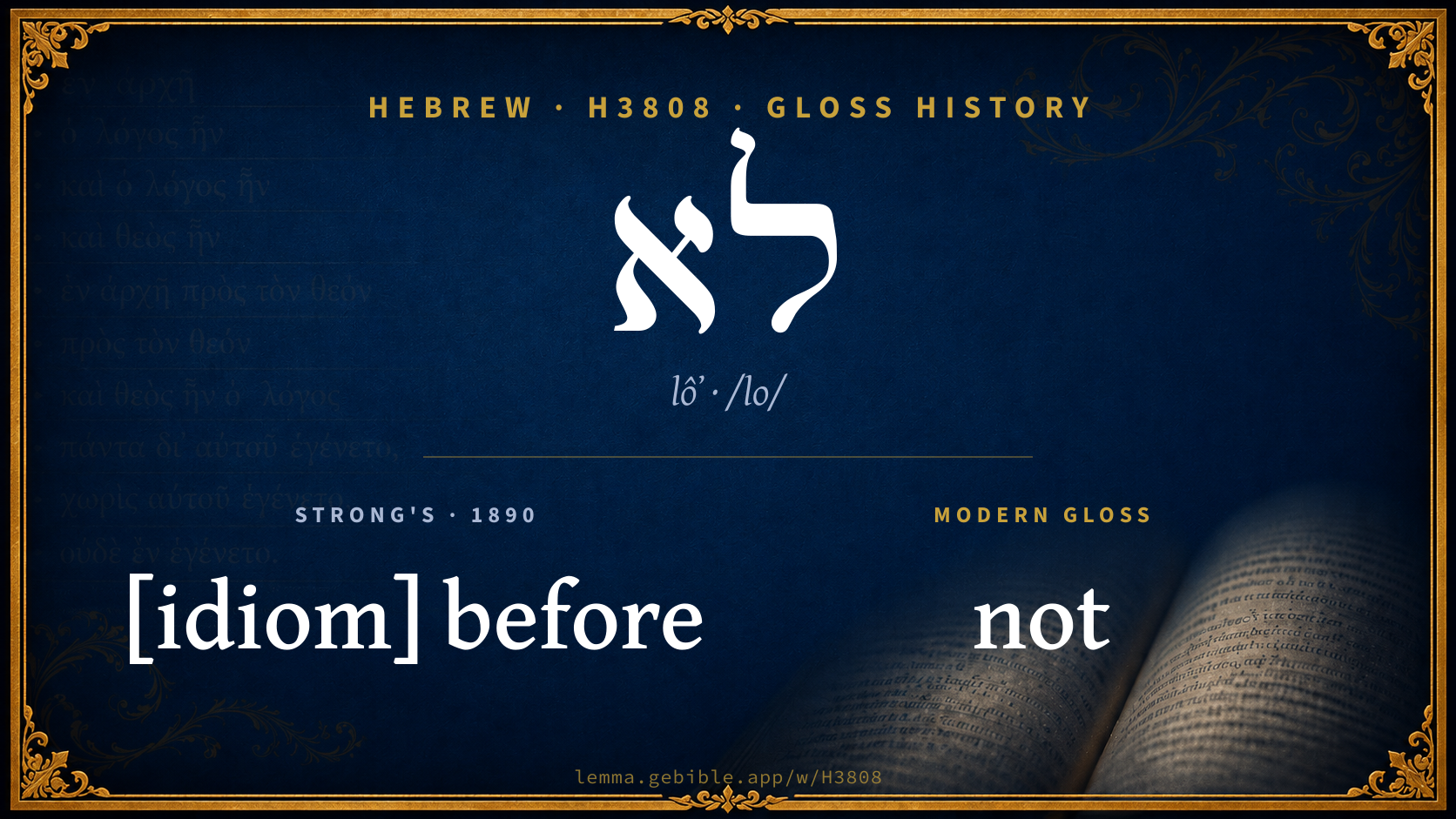
Gloss history
Strong's 1890 vs modern scholarship
About this word
Strong's H3808 catalogs a Hebrew word from the Hebrew Old Testament.
These counts are not copied from any lexicon or concordance. They are computed here, from the morphology-tagged Hebrew Old Testament. What Lemma adds →
- 3,966
- distinct verses
- The word appears in 3,966 distinct verses.
- 39 / 39
- OT books
- The word appears in 39 of 39 Old Testament books.
- #8
- by frequency
- Top 10 most frequent Hebrew words (rank 8 of 8,640 Hebrew words by occurrence).
View all 3,966 occurrences in the concordance →
Most concentrated in
- Jeremiah 361 verses 9%
- Deuteronomy 305 verses 8%
- Isaiah 275 verses 7%
By section of the Old Testament
By traditional corpus
Conventional, traditional groupings — biblical authorship is debated, so this is a traditional corpus grouping, not an authorship claim. Each share is this word’s portion of its verses in that division of the Hebrew canon. Each figure is a share of the word’s 3,966 distinct verses.
- Prophets (Nevi'im) 1,865 verses · 47%
- Torah (Pentateuch) 1,052 verses · 27%
- Writings (Ketuvim) 1,049 verses · 26%
How translations render this word
Counts come from each version’s own published word-to-Strong’s tagging or interlinear alignment — an approximate guide to how each version renders this word, not a word-level alignment the data otherwise carries. Because each total is that version’s own tagged count, the per-version totals vary from one another and need not match the appearance or distinct-verse counts above. These counts may also differ from a printed concordance because Lemma counts each distinctly tagged rendering and does not collapse phrase taggings into a single head-word total. This is a fixed set of word-tagged versions (KJV, ASV, BSB, ULT) and does not change with the reading translation you choose elsewhere. Each version’s license is shown beside its name below (and on Sources).
- King James Version: Not 5×, Except 3×, Without 3×
- American Standard Version: Not 5×, Before 3×, Except 3×
- Berean Standard Bible: No 378×, Not 369×, Will not 207×
- unfoldingWord Literal Text: Not 4,071×, And 807×, But 248×
King James Version Public Domain
Renders H3808 across 73 tagged occurrences — most commonly:
Plus other, less common renderings. Plus 42 renderings that appear only once — usually multi-word phrases or single function words the recovered tagging swept in, not distinct renderings. Not rendered by a distinct English word in 3 further occurrences.
American Standard Version Public Domain
Renders H3808 across 72 tagged occurrences — most commonly:
Plus 46 renderings that appear only once — usually multi-word phrases or single function words the recovered tagging swept in, not distinct renderings.
Berean Standard Bible Public Domain
Renders H3808 across 4,657 tagged occurrences — most commonly:
Plus other, less common renderings. Plus 377 renderings that appear only once — usually multi-word phrases or single function words the recovered tagging swept in, not distinct renderings. Not rendered by a distinct English word in 456 further occurrences.
unfoldingWord Literal Text CC BY-SA 4.0
Renders H3808 across 6,227 tagged occurrences — most commonly:
Plus other, less common renderings. Plus 138 renderings that appear only once — usually multi-word phrases or single function words the recovered tagging swept in, not distinct renderings.
17 senses and sub-senses in the full BDB
What do BDB’s symbols mean?
BDB uses these scholarly abbreviations:
| Symbol | Meaning |
|---|---|
| 𝔊 | the Septuagint (the ancient Greek translation, LXX) |
| 𝔙 | the Vulgate (the Latin translation) |
| 𝔖 | the Syriac version (the Peshitta) |
| 𝔗 | the Targum (the Aramaic translation) |
| ψ | the Psalms |
| √ | root (the underlying root or stem) |
| ‖ | parallel passage (a synonymous or contrasted parallel) |
| † | the dagger: every passage where the word occurs is cited |
The 17 senses and sub-senses the full Brown-Driver-Briggs lexicon distinguishes for this word, in lexicon order (not ranked by frequency), with BDB’s own verbatim wording and sub-sense lettering. Shown in Hebrew script with BDB’s own scholarly abbreviations. The condensed entry is in the Lexicon Entry tab. See also the Forms in the corpus table below.
- 1. in predication:
- a. with a verb; so most freq., and nearly always (a) with the finite tenses, whether pf. (Gn 2:5b; 4:5 etc.) or impf. (3:4; 8:21, 22 etc.); in short circumst. clauses, as Gn 44:4 לא הרחיקו, Is 40:20 לֹא יִמּוֹט, and with a final force 41:7 Ex 28:32 (v. Ges§ 156. 3 R. b, c Dr§ 162). Governing two closely connected verbs (Dr§115, לא) Ex 28:43 וְלֹא יִשְׂאוּ עָוֹן וָמֵתוּ, Lv 19:12, 29 b Dt 7:25, 26; 19:10; 22:1 al.; and two parallel clauses (Ges§ 152. 3) Is 23:4b ψ 9:19; 44:19 Jb 3:11 al. With the impf., especially with 2 ps., לֹא often expresses (not, like אַל, a deprecation, do not …, let not …, but) a prohibition, as Gn 2:17 לֹא תֹאכַל מִמֶּנּוּ thou shalt not eat of it, 3:1, 3 Ex 20:3 לֹא־יִהְיֶה לְךָ there shall not be to thee, etc., v 13 לא תגנב, etc. With the coh. and juss. moods (which are negatived regularly by אַל), it occurs only exceptionally (Ges§109. 1 b R. 1), Gn 24:8 1 S 14:36 2 S 17:12; 18:14 1 K 2:6 Ez 48:14. (b) with the inf. (which is negatived by בִּלְתִּי, q.v.), only once, in בְּלֹא (4 a), and with לְ, in the sense of cannot, or must not; †Ju 1:19 כי לא להורושׁ for it was not (possible) to dispossess, etc. Am 6:10 לא להזכיר בשׁם י׳, 1 Ch 5:1; 15:2 (Dr§ 202. 2); cf. Aramaic לָא Dan 6:9 Ezr 6:8. On its use with the ptcp., see b c. (c) לא always negatives properly the word immed. following: hence, in a verbal sentence, where this is not the verb, some special stress rests upon it, Gn 32:29 לֹא יַעֲקֹב יֵאָמֵר עוֹד וג׳ not Jacob shall thy name be called any more, but Israel, 45:8 לֹא אַתֶּם שְׁלַחְתֶּם אֹתִי Not ye (in our idiom: It is not ye who) have sent me hither, but God, Ex 16:8 1 S 8:7 כִּי לֹא אֹתְךָ מָאָסוּ כִּי אֹתִי וג׳, ψ 115:17; without a foll. correcting clause, Gn 38:9 Nu 16:29 לֹא י׳ שְׁלָחָנִי ׃ Not י׳ (but another) hath sent me, Dt 32:27 לֹא י׳ פָּעַל זֹאת, 1 Ch 17:4 Dt 8:9 Is 28:28 לא לנצח … not for ever (but only for a while) … (so 57:16 ψ 9:19; 49:20; 103:9; but Is 13:20 לא תשׁב לנצח is, will not be inhabited for ever), Is 43:22 Jb 13:16; 32:9; hence rhetorically, insinuating something very different, not named, 2 K 6:10 not once, and not twice (but repeatedly), Ezr 10:13 Je 4:11 a wind לֹא לְזָרוֹת וְלוֹא לְהָבַֽר׃ not to winnow, and not to cleanse (but to exterminate), Is 45:13; 48:1b Jos 24:12 Dn 11:20, 29 Jb 34:20 לֹא בְיָד (but by a Divine agency: cf. Dn 2:34; also Jb 20:26 אֵשׁ לֹא נֻפָּ֑ח fire not blown upon [but kindled from heaven], Lam 4:6; and אין Is 47:14). (d) standing alone: (a) אִם־לֹא if not, Gn 18:21 וְאִם־לֹא אֵדָֽעָה׃, 24:49; 42:16 Jb 9:24; 24:25; (β) הֲ … אִם־לֹא, or not, Gn 24:21 waiting to know הַהִצְלִיחַ י׳ דַּדְכּוֹ אִם־לֹא, 27:21; 37:32 Ex 16:4 Nu 11:23 Dt 8:2 Ju 2:22 (cf. אִם אַיִן, אַיִן 2 d β, δ). In answer to a question or request, to deny, or decline, Nay, No: Ju 12:5 ויאמר לא, Hg 2:12; לא אדני Gn 23:11; 42:10 1 S 1:15 +; often sq. כי, No: for … = No: but …, Gn 18:15 ויאמר לֹא כִּי צָחָ֑קְתְּ, 19:2 Jos 5:14; 24:21; 1 S 2:16 Qr (v. Dr), 10:19 (𝔊 MSS), 2 S 16:18; 24:24 1 K 3:22(×2) +; Jb 23:6 (strangely). (Cf., in deprecation, אַל.) (e) with an interrog. force, which however does not lie in לא as such, but (as in other cases) in the contrast with a preceding clause, or in the tone of voice (cf. וְ 1 f; Ew§ 324 a Ges§ 150. 1 Dr 1 S 11:12): Jon 4:11 אַתָּה חַסְתָּ … וַאֲנִי לֹא אָחוּס וג׳, Jb 2:10; 22:11; Ex 8:22; 2 K 5:26 Je 49:9 (‖ Ob 5 הֲלוֹא), Mal 2:15 La 3:38; and in passages, exeg. or text. doubtful (v. Comm.), 1 S 20:14 2 S 23:5 (but v. Bu), Ho 10:9 (Ew We), 11:5 (Ew), Jb 14:16b (but 𝔊 Ew Di תַעֲבֹר), La 1:12 (Ew Ke), 3:36 (Ke Bä). e.g. Genesis 2:5
- b. with adjs. and substs.: (a) Gn 2:18 לֹא טוֹב הֱיוֹת הָאָדָם לְבַדּוֹ not good is man’s being alone, Ex 18:17 + often (b) Ex 4:16 לֹא אִישׁ דְּבָרִים אָנֹכִי, Am 7:14 לא נביא אנכי, Nu 23:19 לֹא אִישׁ אֵל וִיכַזֵּב, Dt 17:15 (v. אשׁר 2 b) 20:20; 32:47 1 S 15:29 2 S 18:20 לֹא אִישׁ בְּשֹׂרָה אַתָּה הַיּוֹם, 21:2 1 K 22:33 2 K 6:19 לא זֹה הדרך, Mi 2:10 Is 27:11 Ho 8:6; והמה לא אלהים Je 2:11; 16:20 2 K 19:18; 1 K 19:11(×2) לֹא בָרַעַשׁ י׳, Dt 30:12, 13 Jb 15:9; 28:14 לֹא בִי הִיא (‖ אֵין עִמָּדִי), ψ 74:9 Je 5:10 לוא לי׳ המה, 10:16; Dt 32:21 בָּנִים לֹא אֵמוּן בָּם, Je 10:14 Hb 1:14 Jb 16:17; 38:26 מִדְבָּר לֹא אָדָם בּוֹ; 1 K 22:17 לֹא אֲדֹנִים לָאֵלֶּה, Je 49:31 ψ 22:3 וְלֹא דוּמִיָּה לִי, Jb 18:17, 19; 29:12 ולא עֹזֵר לו, 30:13; 33:9; Je 2:19 וְלֹא פַחְדָּתִי אֵלַיִךְ and (that) my terror reached not unto thee, Jb 21:9; abs. Gn 29:7 לֹא־עֵת הֵאָסֵף הַמִּקְנֶה (Hg 1:2), Nu 20:5 2 K 4:23 לא חדשׁ ולא שׁבת, Is 44:19 Je 5:12 ויאמרו לוא הוא, Jb 9:32; 22:16; 36:26 (?) 41:2; Pr 19:7 (si vera l.) מְרַדֵּף אֲמָרִים לֹא־הֵמָּה words which are not, which are nought. (c) with the ptcp. לֹא is rare, a finite vb. being usually preferred (Ex 34:7 וְנַקֵּה לֹא יְנַקֶּה: Ew§ 320 c Dr§ 162): 2 S 3:34 יָדֶיךָ לֹא אֲסֻרוֹת, Ez 4:14; 22:24 Dt 28:61 ψ 38:15 כְּאִישׁ אֲשֶׁר לֹא שֹׁמֵעַ who is not hearing, Jb 12:3; 13:2 לֹא נֹפֵל אָנֹכִי מִכֶּם, Zp 3:5 (very anom.); 1 K 10:21 לא is prob. textual error. In וְהוּא לֹא שֹׂנֵא לוֹ or לא שׂנא הוא לו, Dt 4:42; 19:4, 6 Jos 20:5 (cf. אֹיֵב Nu 35:23), שׂנֵא is best construed as a subst., he being a not-hater to him aforetime.—In most of the cases under b, c, אין could have been employed; but the negation by לֹא is more pointed and forcible. e.g. Genesis 2:18
- 2. Not in predication:
- a. coupled to an adj. to negative it, like the Gk. ἀ—, but usually by way of litotes: Ho 13:13 בן לא־חכם an unwise son, ψ 36:5 דֶּרֶךְ לֹא טוֹב a way not good, 43:1 גוי לא חסיד, Pr 16:29; 30:25, 26 Ez 20:25 2 Ch 30:17: Is 16:14 לוֹא כַבִּיר, cf. 10:7 לֹא מְעַט. e.g. Hosea 13:13
- b. with a ptcp. Je 2:2 ארץ לא זרועה, 18:15 (the finite verb is more common: see Is 62:12 עִיר לֹא נֶעֱזָ֫בָה (cf. 54:11), Je 6:8 אֶרֶץ לוֹא נוֹשָׁ֫בָה, 15:18; 22:6; 31:18 Zp 2:1). e.g. Jeremiah 2:2
- c. †Gn 15:13 בארץ לא להם, Je 5:19 Hab 1:6 מִשְׁכָּנוֹת לֹא־לוֹ, Pr 26:17 רִיב לֹא־לוֹ. e.g. Genesis 15:13
- d. with a subst., in poetry, forming a kind of compound, expressing pointedly its antithesis or negation (Germ. un- is sometimes used similarly): Dt 32:5 (?), 17, 21 a they made me jealous בְּלֹא אֵל with a not-God (with what in no respect deserved the name of God), v b בְּלֹא עָם i.e. with an unorganized horde, Am 6:13 הַשְּׂמֵחִים לְלֹא דָבָר i.e. at a thing wh. is not, an unreality (of their boasted strength), Is 10:15 כְּהָרִים מַטֶּה לֹא עֵץ like a rod’s lifting up what is no wood (but the agent wielding it), 31:8 חרב לא אישׁ, חרב לא אדם, 55:2 בלוא לחם for what is not bread, בלוא לשׂבעה for what is not for satiety, Je 5:7 וַיּשָּֽׁבְעוּ בְּלֹא אֱלֹהִים by not-goods, in late prose 2 Ch 13:9 כֹּהֵן לְלֹא אֱלֹהִים; ψ 44:13 תִּמְכֹּר עַמְּךָ בְּלֹא־הוֹן for no-value (i.e. cheaply), Pr 13:23 Jb 10:22 צלמות וְלֹא סְדָרִים darkness and disorder; so לֹא־עַמִּי Ho 1:9; 2:25: still more pregnantly Jb 26:2a מֶה־עָזַרְתָּ לְלֹא־כֹחַ (poet. for לאשׁר אין לו כח) the powerless, v 2b, 3a (Ew§ 286 g Ges§ 152. 1 n.), 39:16 הִקְשִׁיחַ בָּנֶיהָ לְלֹא לָהּ useth hardly her young ones (making them) into none of hers; and even Hb 2:6 הַמַּרְבֶּה לֹא־לוֹ what is not his own (cf. Jb 18:15 מִבְּלִי לוֹ). Cf. with a verb, and ellipse of אשׁר, Is 65:1 לְלֹא שָׁאָ֑לוּ to those who have not asked, v b Je 2:8 אַחֲרֵי לֹא יוֹעִילוּ, v 11b; also לֹא רֻחָ֫מָה Ho 1:6, 8; 2:25, and prob. Jb 31:31 לֹא נִשְׂבָּ֑ע (pf. in p.) one not satisfied. e.g. Deuteronomy 32:5
- e. in circ. clauses (Dr§ 164), poet. and rare: qualifying a subst., 2 S 23:4 בֹּקֶר לֹא עָבוֹת a morning without clouds, Job 12:24 בְּתֹהוּ לֹא דֶרֶךְ in a pathless waste, 38:26a; and a verb Jb 34:24 יָרֹעַ כַּבִּירִים לֹא חֵקֶר without inquiry, ψ 59:4 לא פשׁעי ולא חטאתי (cf. v 4 בלי עון), in late prose, twice, 1 Ch 2:30, 32 וימת לא בנים (אֵין and בְּלִי, q.v., are more usual in such cases). e.g. 2 Samuel 23:4
- 3. Once (according to many MSS), as a subst., Jb 6:21 כִּי־עַתָּה הֱיִיתֶם לֹא for now are ye become nothing, Hi De Kö (cf. Dn 4:32 (Aramaic) כְּלָה חֲשִׁיבִין; 𝔗 here הֲוֵיתוּן כְּלָא, and אַל Jb 24:25); but reading fluctuates (Orientals לֹא, Qr לו, Westerns, Baer (v. pp. 37, 56) לוֹ [‘now are ye become that,’ viz. the נַחַל אַכְזָב of v 15]; but even לוֹ yields a forced sense; and text is prob. wrong: Mich Ew Ol Sgf Bu כֵּן … לִי (𝔊 𝔖 also read לִי); Bö Di כִּי … לְאָ֑יִן. Cf. Köii. 1. 236 f. e.g. Job 6:21
- 4. With prefixes:—
- a. †בְּלֹא31 (chiefly poet. or late), according to the varying signif. of בְּ: (a) usually with not = without, Je 22:13 בונה ביתו בלא־צדק without justice (‖ בלא משׁפט; so Ez 22:29 Pr 16:8), Is 55:1, 1 Pr 19:2, Jb 8:11 הֲיִגְאֶה־גֹּמֶא בְּלֹא בִצָּה without mire (‖ בלי מים), 30:28 בְּלֹא חַמָּה (= not through the sun), La 1:6 וילכו בלא־כח, Nu 35:22 בְּלֹא אֵיבָה … בְּלֹא צְדִיָּה, v 23 (sq. inf.) בְּלֹא רְאוֹת, 2 Ch 21:20 Ec 10:11; ψ 17:1 תְּפִלָּתִי בְּלֹא שִׂפְתֵי מִרְמָה; used more freely in Chr, 1 Ch 12:18 בְּלֹא חָמָס בְּכַפָּֽי׃, v 34 בְּלֹא לֵב וָלֵב, 2 Ch 30:18 בְּלֹא כַכָּתוּב. With ellipse of rel., La 4:14 בְּלֹא יוּכְלוּ יִגְּעוּ without (that) men are able to touch, etc. (b) of time, in not, i.e. outside of, Lv 15:25 בלא עֶת־נִדָּתָתּ, before Jb 15:32 בלא־יומו, Ec 7:17 בְּלֹא עִתֶּךְ ׃. (c) where לֹא belongs to the foll. word, and is only accidentally preceded by ב (v. supr. 2 d), Dt 32:21(×2) Je 5:7 Pr 13:23 בלא משׁפט through injustice; with בְּ pretii, ψ 44:13 Is 55:2(×2) Je 2:11 בְּלוֹא יוֹעִיל for (that which) profiteth not. e.g. Jeremiah 22:13
- b. הֲלֹא nonne? Gn 4:7 + often Inviting, as it does, an affirmative answer, it is often used, (a) especially in conversation, for pointing to a fact in such a way as to arouse the interest of the person addressed, or to win his assent: Gn 13:9 Is not the whole land before thee? 19:20; 20:5; 27:36; 29:25 Ex 4:11 Who maketh dumb or deaf, etc.? Do not I? 33:16 Ju 4:6, 14; 8:2; 9:28, 38 1 S 9:20, 21; 15:17 etc.; with a vb. in 1 ps., Jos 1:9 הלא צויתיך, Ju 6:14 הלא שׁלחתיך, 1 S 20:30; 2 S 19:23 Ru 2:9: similarly in a poet. or rhet. style, Ju 5:30 הלא ימצאו יחלקו שׁלל, Is 8:19; 10:8, 9, 11; 28:25; 29:17; 40:21, 23; 42:24; 43:19 etc., Jb 4:6, 21; 7:1; 10:10, 20, etc. (β) it has a tendency to become little more than an affirm. particle, declaring with some rhetor. emph. what is, or might be, well known: Dt 3:11 הֲלֹה הִיא בְרַבַּת בְּנֵי עַמּוֹן, 11:30 1 S 21:12 הלוא זה דוד וג׳ (cf. 29:3, 5 2 S 11:3), 23:19; 26:1 2 S 15:35; it is thus nearly = הִנֵּה (𝔊 sometimes represents it by ἰδού, as Jos 1:9 Ju 6:14 Ru 2:9 2 S 15:35); so especially in the phrase of the compiler of K, And the rest of the acts of … הֲלֹא הֵם (הֵמָּה) כְּתוּבִים are they not written in, etc.? 1 K 11:41; 14:29 + often (with which there interchanges הִנָּם כְּתוּבִים 1 K 14:19 2 K 15:11; 15:26, 31, which is gen. used by the Chr, 2 Ch 16:11; 20:34, etc.), Jos 10:13 (cf. 2 S 1:18 הִנֵּה), 1 K 8:53 𝔊, Est 10:2; ψ 56:14 (strangely: contr. 116:8).—הֲלֹא הִנֵּה †Hb 2:13 2 Ch 25:26 (הִנָּם).—On Ju 14:15, see הֲ 1 end. e.g. Genesis 4:7
- c. †וָלֹ֕א and not = and if not, 2 S 13:26 2 K 5:17. Comp. וָיֵשׁ. e.g. 2 Samuel 13:26
- d. †כְּלוֹא Ob 16 והיו כלוא היו, poet. for כאשׁר, as though they had not been. e.g. Obadiah 1:16
- e. †לְלֹא without, lit. in the condition of no … 2 Ch 15:3 (comp. לְאֵין, also in Chr). Elsewhere לא belongs to the foll. word, Am 6:13 2 Ch 13:9 Is 65:1(×2) Jb 26:2, 3; 39:16 (v. supr. 2 d). e.g. 2 Chronicles 15:3
- —Fifteen times, according to Mas. (v. De ψ 100:3 FrMM 247 Str Prol. Cr. 84), לא is written by error for לוֹ, viz. Ex 21:8 Lv 11:21; 25:30 1 S 2:3 2 S 16:18 2 K 8:10 Is 9:2; 63:9 ψ 100:3; 139:16 Jb 13:15; 41:4 Pr 19:7; 26:2 Ezr 4:2 (always with Qr לוֹ). The passages must be considered each upon its own merits: in some לוֹ yields a preferable sense; but this is not the case in all. There is the same קרי (rightly) on Is 49:5 1 Ch 11:20; but these were not considered to rest upon equal authority, and are hence not reckoned with the fifteen.—In Ju 21:22 (v. GFM), 1 S 13:13; 20:14(×2), and in Jb 9:33 (לֹא יֵשׁ), read prob. לֻא for לֹא. e.g. Psalms 100:3
Senses from the full Brown-Driver-Briggs lexicon (Brown, Driver, Briggs; Oxford 1906 — public domain), digitized via Sefaria, supplemented by the OpenScriptures HebrewLexicon (CC BY 4.0). Full attribution on Sources.
Word origin
or לוֹא adv. not (Arabic لَا, Aramaic לָא, ܠܴܐ, Sab. לא, Assyrian lâ; not in Ethiopic: cf. Köii. 1. 236 Walker AJSL 1896, 237 ff.)—לוֹא, according to Mass. (FrMM 248), 35 times, besides בְּלוֹא 6 times, and הֲלוֹא, the orthogr. of which varies much (ib.p. 251), e.g. in S always הֲלוֹא, in Chr always הֲלֹא, on the whole הֲלוֹא 141 times, הֲלֹא 128 times; twice, according to Mass, written לו (Qr לֹא), 1 S 2:16; 20:2, once לה Dt 3:11 Kt:—not—denying objectively, like οὐ (not μὴ = אַל):—
— Brown-Driver-Briggs (Oxford 1906, public domain), digitized via Sefaria, supplemented by the OpenScriptures HebrewLexicon (CC BY 4.0). See Sources.
Origin: a primitive particle
Jastrow Dictionary
A second Hebrew/Aramaic lexicon for comparison, covering Aramaic and post-biblical (Talmudic, Targumic, Midrashic) usage that the biblical-Hebrew BDB does not. Matched by lemma rather than by Strong’s number, so a lemma may carry more than one Jastrow headword (shown separately below), and the entries cover usage well beyond the Bible.
לֹא
- v. לַאי) not, no. Ber. I, 1 לא קרינו וכ׳ we have omitted to recite &c. Ib. III, 4 לא … ולא וכ׳ neither before nor after. Nidd. 5ᵃ לא אין להן וכ׳, no; it means &c., v. לַאו; a. v. fr.—וְלֹא indeed not? Ḥull. 4ᵇ ולא והכתיב וכ׳ indeed not (is it so that the verb הֵסִית never refers to persuasion by speech)? Do we not read &c.?; a. v. fr.—(מִצְוַת) לֹא תַעֲשֶׂה a prohibitory law, opp. עֲשֵׂה, a positive command; v. לַאו. Kidd. I, 7. Macc. 14ᵇ bot.; a. v. fr.—בְּלֹא without. Ber. 35ᵃ bot. ב׳ ברכה without pronouncing a benediction; a. v. fr.—והוא שלא, v. הוּא.
לָא I
- Targ. Gen. II, 5; a. v. fr.—Pes. 10ᵇ מקמיה … אין בתר … לא before the time when it is forbidden, yes (he must search after leavened bread); after the time, no (he must not search). Ib. לא שנא there is no difference; a. v. fr.
לָא II
- (preced. wds.) particle, mote. Yoma 20ᵇ, v. חִרְגָּא. Midr. Till. to Ps. LXVIII, 3 כלא חשיבי they are like a mote.
לָא III
- La, abbrev. of אִילָא, הִילָא; v. Fr. M’bo, p. 75ᵇ.
A Dictionary of the Targumim, the Talmud Babli and Yerushalmi, and the Midrashic Literature (Marcus Jastrow; London, Luzac, 1903) — Public Domain. Digitized via Sefaria. Digitized via Sefaria. Full attribution on Sources.
Forms in the corpus
The 120 distinct written forms H3808 takes in the Hebrew Bible, most frequent first — each parse links to that state’s occurrences in the concordance. Hebrew forms include their vowel points and cantillation, so a single lemma takes many written forms.
| Form | Parsing | Example | Uses |
|---|---|---|---|
| לֹ֣א | Particle, Negative | Amos 1:3 | 824 |
| לֹא | Particle, Negative | Amos 2:14 | 725 |
| לֹֽא | Particle, Negative | Amos 4:7 | 674 |
| לֹ֥א | Particle, Negative | Amos 2:15 | 666 |
| וְ/לֹ֥א | Particle, Negative | Amos 1:9 | 416 |
| וְ/לֹֽא | Particle, Negative | Amos 3:10 | 353 |
| וְ/לֹ֣א | Particle, Negative | Amos 4:8 | 351 |
| וְ/לֹא | Particle, Negative | Amos 5:11 | 278 |
| לֹ֤א | Particle, Negative | Amos 7:16 | 195 |
| וְ/לֹ֤א | Particle, Negative | Daniel 1:19 | 90 |
| לֹ֖א | Particle, Negative | Amos 2:12 | 36 |
| הֲ/ל֣וֹא | Particle, Negative | Amos 6:13 | 32 |
| וְֽ/לֹא | Particle, Negative | Deuteronomy 1:29 | 32 |
| הֲ/לֹא | Particle, Negative | Amos 5:20 | 30 |
| לֹ֨א | Particle, Negative | Deuteronomy 22:2 | 28 |
| וְ/לֹ֖א | Particle, Negative | Deuteronomy 5:18 | 26 |
| לֹ֧א | Particle, Negative | Amos 3:7 | 22 |
| הֲ/לוֹא | Particle, Negative | Deuteronomy 32:6 | 18 |
| הֲ/לֹ֥א | Particle, Negative | Exodus 4:11 | 17 |
| הֲ/לֹ֣א | Particle, Negative | Ezekiel 26:15 | 16 |
| הֲ/ל֤וֹא | Particle, Negative | Ezekiel 13:7 | 15 |
| הֲ/לֽוֹא | Particle, Negative | Ezekiel 37:18 | 15 |
| לא | Particle, Negative | Exodus 21:8 | 15 |
| הֲ/לֹֽא | Particle, Negative | Ezekiel 24:19 | 14 |
| וְ/לֹ֨א | Particle, Negative | Amos 9:15 | 14 |
| הֲ/ל֥וֹא | Particle, Negative | Genesis 34:23 | 11 |
| הֲ/ל֨וֹא | Particle, Negative | 1 Samuel 9:21 | 11 |
| הֲ/לֹ֤א | Particle, Negative | Genesis 13:9 | 11 |
| בְּ/לֹ֣א | Particle, Negative | 2 Chronicles 21:20 | 10 |
| הֲ/לֹ֨א | Particle, Negative | Exodus 4:14 | 10 |
| וְ/לֹ֧א | Particle, Negative | Deuteronomy 16:16 | 10 |
| לֹא֩ | Particle, Negative | Ecclesiastes 9:11 | 9 |
| הֲ/ל֖וֹא | Particle, Negative | Exodus 33:16 | 8 |
| הֲ/ל֛וֹא | Particle, Negative | Ezekiel 18:23 | 8 |
| הֲ/ל֧וֹא | Particle, Negative | Genesis 31:15 | 8 |
| לֹ֕א | Particle, Negative | Genesis 24:49 | 8 |
| הֲ/לוֹא֙ | Particle, Negative | Ezekiel 13:12 | 7 |
| ל֥וֹא | Particle, Negative | Isaiah 16:14 | 7 |
| לֹ֗א | Particle, Negative | Ezekiel 5:11 | 7 |
| לֹ֚א | Particle, Negative | 1 Kings 22:31 | 7 |
| הֲ/ל֗וֹא | Particle, Negative | Ezekiel 24:25 | 6 |
| לֽוֹא | Particle, Negative | 1 Kings 22:18 | 6 |
| הֲ/לֹ֗א | Particle, Negative | Deuteronomy 31:17 | 5 |
| ו/לא | Particle, Negative | Ezra 4:2 | 5 |
| וְ/ל֥וֹא | Particle, Negative | Ezekiel 24:16 | 5 |
| ל֣וֹא | Particle, Negative | Jeremiah 3:3 | 5 |
| לְ/לֹ֣א | Particle, Negative | 2 Chronicles 15:3 | 4 |
| בְּ/לֹא | Particle, Negative | Deuteronomy 32:21 | 4 |
| הֲ/לוֹא֩ | Particle, Negative | Ezekiel 17:9 | 4 |
| לֹ֠א | Particle, Negative | Ezekiel 20:33 | 4 |
| לֹֽ֣א | Particle, Negative | Deuteronomy 5:8 | 4 |
| בְ/לֹא | Particle, Negative | Deuteronomy 32:21 | 3 |
| בְּ/לֹ֥א | Particle, Negative | Ecclesiastes 7:17 | 3 |
| הֲ/לֹא֙ | Particle, Negative | 1 Chronicles 21:3 | 3 |
| הֲֽ/לֹא | Particle, Negative | Job 22:12 | 3 |
| וְ/לֹא֙ | Particle, Negative | Deuteronomy 1:42 | 3 |
| לֹ֘א | Particle, Negative | Job 18:19 | 3 |
| לֹ֞א | Particle, Negative | Ezekiel 33:27 | 3 |
| לֹ֦א | Particle, Negative | 1 Kings 10:3 | 3 |
| לֹ֪א | Particle, Negative | Psalms 44:3 | 3 |
The 60 most common forms are shown; 60 rarer forms follow in the full concordance.
Same root — word family
Other BDB entries built from the same root as H3808, grouped by Strong’s listed origin. These share a root / origin per the lexicon — not necessarily a shared meaning. Each links to that word’s own entry.
Derived from this word
Proper names from this root
People and places named from this root — a name, not an additional meaning of the word.
- לא דבר Lôʼ Dᵉbar H3810 Lo-debar
- לא עמי Lôʼ ʻAmmîy H3818 Lo-ammi
- לא רחמה Lôʼ Ruchâmâh H3819 Lo-ruhamah
Compare all same-root words → Showing 4 of 5 — not the complete family. 3 of the same-root words are proper names (people or places). They share a root, not necessarily a meaning.
Septuagint verse parallels
Most of the 3,966 Hebrew verses this word occurs in also exist in the Greek Old Testament (Septuagint), so the same passages can be read in Greek by switching the Old Testament edition to the Septuagint.
Read these verses in the Septuagint
- Genesis 2:5
- Exodus 1:8
- Leviticus 1:17
- Numbers 1:47
- Deuteronomy 1:9
- Joshua 1:5
- Judges 1:19
- Ruth 2:8
- 1 Samuel 1:7
- 2 Samuel 1:10
- 1 Kings 1:1
- 2 Kings 1:4
This is a verse-level parallel only — the same verses exist in both the Hebrew and Greek Old Testaments. No word-level Hebrew↔Greek correspondence is claimed: the data carries no such alignment, so no Greek word is shown as this Hebrew word’s translation. Coverage is not total — the Septuagint omits the deuterocanon and renumbers the Psalms, so some Hebrew verses have no direct Greek parallel.