
Hosea 1:9

Hebrew (Westminster Leningrad Codex) Hosea 1:9 appears in the Hebrew Old Testament. The text above is from the Westminster Leningrad Codex. Each word links to its Strong’s number, a concise gloss, and parsing drawn from the Open Scriptures Hebrew Bible morphology. Click any word for its full Brown-Driver-Briggs (BDB) entry.
Download image
Cite this verse

Hosea 1:9 (World English Bible). Public Domain. Lemma interlinear Bible study tool, https://lemma.gebible.app/v/hosea/1/9.

Show BibTeX & RIS
BibTeX
RIS
English Translation
He said, "Call his name Lo-Ammi; for you are not my people, and I will not be yours.
World English Bible · Public Domain
Highlights
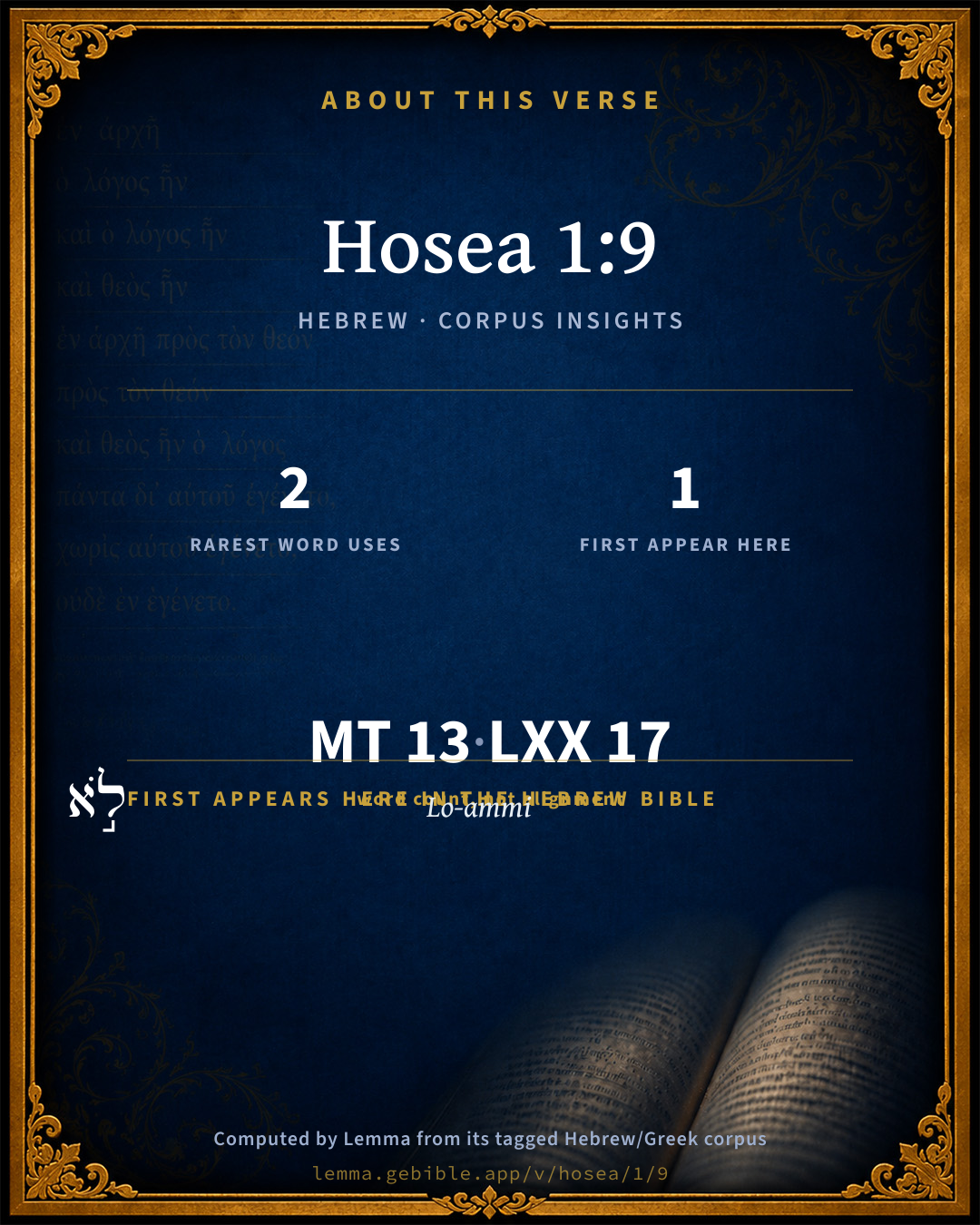
  • 1 first appearance in the Hebrew Bible
Full analysis ↓
Download a study sheet

One document with this verse’s original text, its word-by-word gloss line, the meaning frame, cross-references with their text, attributed commentary, and full source and license credits — printable, and it pastes into notes with its structure intact.

This verse Autodidact and up

Study sheet (.html) Plain text (.txt)

A passage Seminary Student

Up to 50 verses in one chapter. A passage sheet keeps up to 6 commentary sources and 12 cross-references per verse, in the order this page ranks them, and says so on the sheet whenever that leaves anything out. Ask for a single verse and you get the Autodidact verse sheet above.

Everything on this page stays free to read, with no account — the sheet is a download of what is already on screen, not access to it.

Want to remove ads? Support Godless Engineer
Compare translations 3

The same verse in 3 English versions, stacked beneath the original-language interlinear above. Click any original word for its lexicon entry.

Each is an independent rendering of the whole verse — the interlinear is not word-aligned to these translations.

Highlighted words mark where these versions differ — a whole-verse word diff, not a word-by-word alignment.

  • World English Bible Public Domain
    He said, "Call his name Lo-Ammi; for you are not my people, and I will not be yours.
  • King James Version Public Domain
    Then said God, Call his name Loammi: for ye are not my people, and I will not be your God.
  • unfoldingWord Literal Text CC BY-SA 4.0
    And he said, “Call his name Lo Ammi, for you not my people, and I not ‘I am’ for you.”

unfoldingWord Literal Text — © unfoldingWord, licensed CC BY-SA 4.0. Word-aligned USFM3 via Door43 (git.door43.org/unfoldingWord/en_ult).

Versions to compare (up to 4)

3 of 4 selected

Show all 18 translations

Every available English version of this verse, each an independent rendering of the whole verse.

  • World English Bible Public Domain
    He said, "Call his name Lo-Ammi; for you are not my people, and I will not be yours.
  • Berean Standard Bible Public Domain
    And the LORD said, “Name him Lo-ammi, for you are not My people, and I am not your God.
  • Majority Standard Bible Public Domain
    And the LORD said, “Name him Lo-ammi, for you are not My people, and I am not your God.
  • King James Version Public Domain
    Then said God, Call his name Loammi: for ye are not my people, and I will not be your God.
  • American Standard Version (1901) Public Domain
    And `Jehovah' said, Call his name Lo-ammi; for ye are not my people, and I will not be your `God'.
  • Revised Version (1885) Public Domain
    And the LORD said, Call his name Lo-ammi: for ye are not my people, and I will not be your God.
  • Geneva Bible (1599) Public Domain
    Then saide God, Call his name Lo-ammi: for yee are not my people: therefore will I not be yours.
  • Douay-Rheims (1899) Public Domain
    And he said: Call his name, Not my people: for you are not my people, and I will not be yours.
  • Young's Literal Translation Public Domain
    and He saith, `Call his name Lo-Ammi, for ye `are' not My people, and I am not for you;
  • Literal Standard Version CC BY-SA 4.0
    and He says, “Call his name Lo-Ammi [(Not My People)], for you [are] not My people, and I am not for you;
  • Unlocked Literal Bible CC BY-SA 4.0
    Then Yahweh said, “Call his name Lo-Ammi, for you are not my people, and I am not your God.
  • unfoldingWord Literal Text CC BY-SA 4.0
    And he said, “Call his name Lo Ammi, for you not my people, and I not ‘I am’ for you.”
  • Darby Bible Public Domain
    and he said, Call his name Lo-ammi; for ye are not my people, and I will not be for you.
  • World Messianic Bible Public Domain
    He said, “Call his name Lo-Ammi, for you are not my people, and I will not be yours.
  • Webster's Bible Public Domain
    Then said God, Call his name Lo-ammi: for ye are not my people, and I will not be your God.
  • Free Bible Version CC BY-SA 4.0
    The Lord told Hosea, “Call him Lo-ammi, because you are not my people and I am not your God.
  • Bible in Basic English Public Domain
    And the Lord said, Give him the name Lo-ammi; for you are not my people, and I will not be your God.
  • JPS Tanakh (1917) Public Domain
    And He said: 'Call his name Lo-ammi; for ye are not My people, and I will not be yours.'

Literal Standard Version (2020), Covenant Press — licensed CC BY-SA 4.0. Text via the HelloAO Bible API (eBible.org). Unlocked Literal Bible (unfoldingWord) — licensed CC BY-SA 4.0. Text via the HelloAO Bible API (eBible.org). unfoldingWord Literal Text — © unfoldingWord, licensed CC BY-SA 4.0. Word-aligned USFM3 via Door43 (git.door43.org/unfoldingWord/en_ult). Free Bible Version, Dr. Jonathan Gallagher — licensed CC BY-SA 4.0. Text via the HelloAO Bible API (eBible.org).

Word by word

More ways to search: Search by grammar → Find every occurrence → Compare this word →

Practice this passage: Drill this verse → Learn its vocabulary →

לֹ֣א
Lôʼ ʻAmmîy
H3818
“Lo-ammi”
Particle, Negative
Part of Speech
Particle
Type
Negative
Full BDB Definition

Origin: from H3808 and H5971 with pronominal suffix

TWOT: None

Lo-ammi = "not my people" - symbolic name given by the prophet Hosea to his second son by Gomer
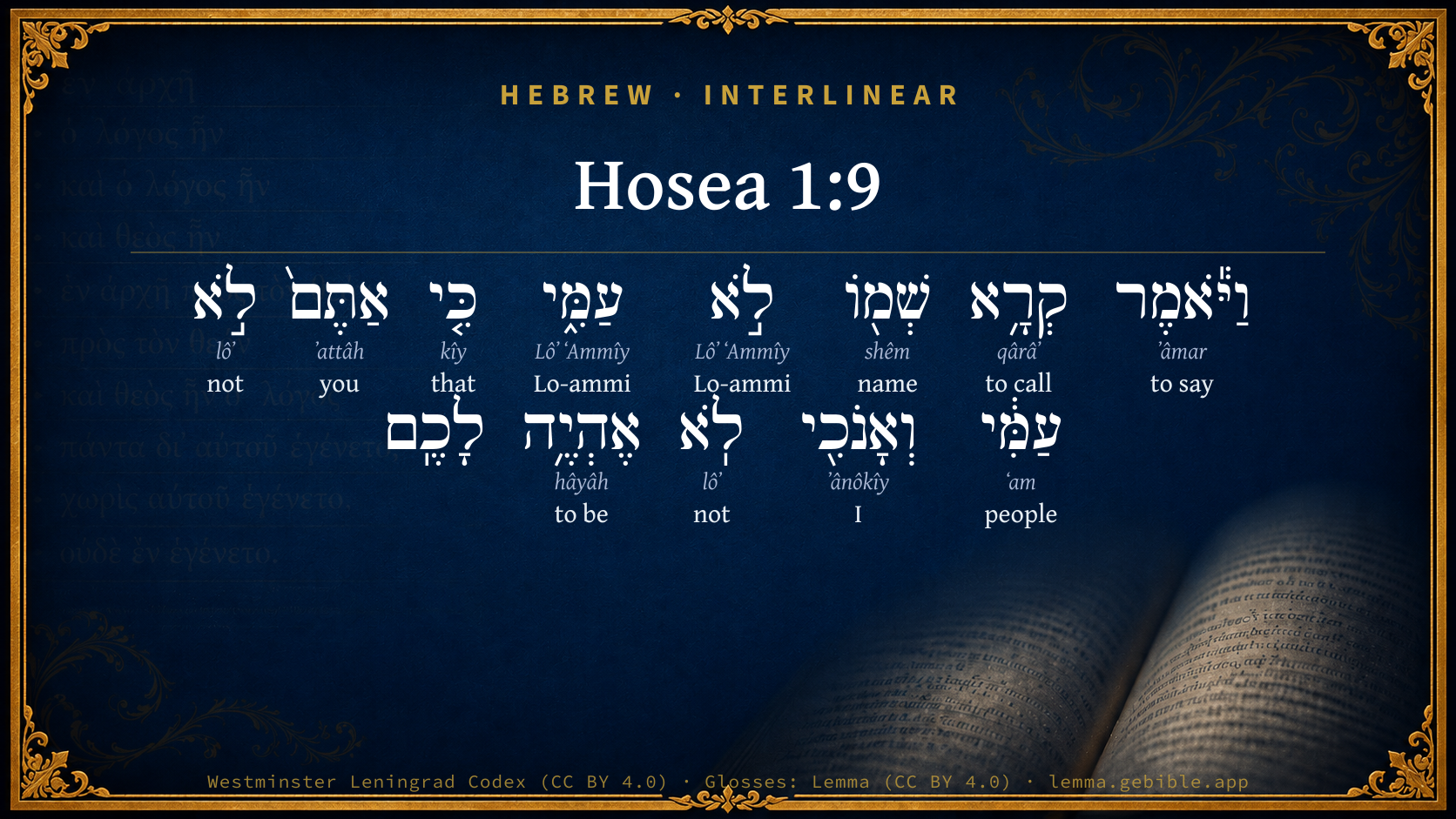
  1. וַיֹּ֕אמֶר ʼâmar H559 “and · to say” Conjunction + Verb, Qal, Sequential Imperfect, 3rd Person, Masculine, Singular
  2. קְרָ֥א qârâʼ H7121 “call” Verb, Qal, Imperative, 2nd Person, Masculine, Singular
  3. שְׁמ֖וֹ shêm H8034 “name · his” Noun, Common, Masculine, Singular, Construct + Suffix, Personal, 3rd Person, Masculine, Singular
  4. עַמִּ֑י Lôʼ ʻAmmîy H3818 “Lo-ammi” Noun, Proper
  5. כִּ֤י kîy H3588 “that” Conjunction
  6. אַתֶּם֙ ʼattâh H859 “you” Pronoun, Personal, 2nd Person, Masculine, Plural
  7. לֹ֣א lôʼ H3808 “not” Particle, Negative
  8. עַמִּ֔י ʻam H5971 “people · my” Noun, Common, Masculine, Singular, Construct + Suffix, Personal, 1st Person, Common, Singular
  9. וְאָנֹכִ֖י ʼânôkîy H595 “and · I” Conjunction + Pronoun, Personal, 1st Person, Common, Singular
  10. לֹֽא lôʼ H3808 “not” Particle, Negative
  11. אֶהְיֶ֥ה hâyâh H1961 “to be” Verb, Qal, Imperfect, 1st Person, Common, Singular

About this verse

These counts appear in no published source. They are computed here, from the morphology-tagged text and Lemma’s own curated glosses. What Lemma adds →

13
words
10
distinct lemmas
Prophets
section

Notable vocabulary

The rarest word here is לֹ֣א Lo-ammi H3818 — appearing just 2 times in the whole Hebrew Bible.

First appearance in Scripture

This word makes its first canonical appearance in the Hebrew Bible here:

Grammatical profile

  • 3 verbs
  • 3 nouns
  • 2 pronouns
  • 1 preposition
  • 1 conjunction
  • 3 particles

Verb forms

  • וַיֹּ֕אמֶר Qal · Sequential Imperfect
  • קְרָ֥א Qal · Imperative
  • אֶהְיֶ֥ה Qal · Imperfect

Repetition

Words recur within this verse — often emphatic in Hebrew:

  • לֹ֣א Lo-ammi H3818 ×2
  • לֹ֣א not H3808 ×2

Hebrew & Septuagint length

In English translation the verse runs 18 words from the Hebrew and 21 from the Septuagint (LXX English) — closely comparable.

A rough comparison of the two English renderings, which tokenize alike — not a word-level alignment.

Word counts can differ between the Hebrew and the Greek without any difference in meaning — e.g. the Hebrew direct-object marker אֵת has no separate Greek word, and Greek often adds the article ὁ.

In the original languages it is 13 Hebrew tokens and 17 Greek tokens — but the two are counted differently (Hebrew bundles its prefixes and suffixes into one token; the Greek is in lemma form), so that isn’t a like-for-like length.

Cross-references

1

Topical passages linked to Hosea 1:9 in the Treasury of Scripture Knowledge — connected by theme and wording, ordered by reader-vote popularity; previews shown in the World English Bible.

  • Jeremiah 15:1 Then said Yahweh to me, Though Moses and Samuel stood before me, yet my mind would not be toward this people: cast them out of my sight, and let them go forth.

Cross-references courtesy of OpenBible.info (CC BY 4.0).

Hebrew and Greek witnesses Masoretic Hebrew ↔ Greek Septuagint

The same verse in the two great witnesses to the Old Testament, shown verse-for-verse.

These are two independent witnesses, not word-aligned to each other, and the Septuagint is shown in lemma (dictionary) form.

Hebrew Hosea 1:9 Masoretic · Westminster Leningrad Codex

וַיֹּ֕אמֶר קְרָ֥א שְׁמ֖וֹ לֹ֣א עַמִּ֑י כִּ֤י אַתֶּם֙ לֹ֣א עַמִּ֔י וְאָנֹכִ֖י לֹֽא אֶהְיֶ֥ה לָכֶֽם

He said, "Call his name Lo-Ammi; for you are not my people, and I will not be yours.

World English Bible · Public Domain

Greek LXX Hosea 1:9 Septuagint · lemma form

καί εἶπον καλέω ὁ ὄνομα αὐτός οὐ διότι σύ οὐ λαός ἐγώ καί ἐγώ οὐ εἰμί σύ

And he said, Call his name, Not my people: for you⌃ are not my people, and I am not your God.

LXX2012 (modern English Septuagint) · Public Domain

Hebrew: Westminster Leningrad Codex (CC BY 4.0). Greek: Septuagint (public domain); English from LXX2012 (modern English Septuagint) (Public Domain). How the Septuagint differs from the Hebrew →

Targum (Aramaic paraphrase)

1

The Targum is the ancient Jewish Aramaic paraphrase of the Hebrew Scriptures — an interpretive translation, not the Hebrew text itself. Onkelos (literal) and Pseudo-Jonathan (expansive) render the Torah, and Jonathan the Prophets. Coverage is partial: where no permissively-licensed English translation exists for a verse, only the Aramaic is shown. This is verse-level text, not a word-by-word alignment to the Hebrew.

  1. Targum Jonathan Prophets (Joshua–Malachi)
    וַאֲמַר קְרֵי שׁוּמְהוֹן לָא עַמִי אֲרֵי אַתּוּן לָא עַמִי בִּדְלֵית אַתּוּן מְקַיְמִין פִּתְגְמֵי אוֹרַיְתִי וּמֵימְרִי לָא הֲוָה בְּסַעֲדֵ יכוֹן:

    (no public-domain English translation for this verse)

    Targum Jonathan — Aramaic: “Mikraot Gedolot” (public domain). English: “Sefaria Community Translation” (CC0 1.0 (public-domain dedication)); “London "Chaldee Paraphrase," 1871” (public domain). Text via Sefaria.

Commentary

Notes on Hosea 1:9 from classic Christian and Jewish commentators (each source and its license shown beneath its notes). The classic Christian expositions comment on the surrounding passage and are grouped to its opening verse, so a note may address several verses; the Jewish commentaries on the Tanakh (Rashi and others) are per-verse, so they appear only where the commentator wrote on this verse.

Lemma curates 59 commentaries, every one of them public domain or Creative Commons licensed, each selected and text-cleaned for this edition rather than reprinted as found. About our sources →

Trapp's Complete Commentary

John Trapp

Hos 1:9 Then said [God], Call his name Loammi: for ye [are] not my people, and I will not be your [God].

Ver. 9. Call his name Loammi] Nomen extremum et deploratum, saith Pareus, the last and most lamentable name of all, containing a most heavy, but spiritual, and therefore less sensible, punishment, viz. an utter abjection and abdication from the covenant, from grace, from God, from life eternal.

For ye are not my people] But, being totally cashiered, and discovenanted; "Are ye not as the children of the Ethiopians unto me, O children of Israel, saith the Lord? Have not I brought up Israel out of the land of Egypt, and the Philistines from Caphtor, and the Syrians from Kir?" Amo 9:7 : q.d. True it is, I have brought you up out of Egypt (and therein you greatly glory), but have I not done as much as all this for those profane nations here mentioned? with and among whom, hence forward I shall reckon you, for you are no people of mine, but discarded, and dispeopled. Till the covenant made with Abraham, all nations were suffered to walk in their own ways, Act 14:16, as fishes pass at liberty through the paths of the seas, Psa 8:8. One person was no more respected than another. But as soon as it was said, I will be thy God, and the God of thy seed after thee, the Church became as fish cast into a pond for peculiar use, and was divided from other nations no otherwise than light was from darkness in the first creation, or than Goshen was from Egypt in that wonderful separation. But here God seems to rescind his own act, to cast off the people of his purchase, and utterly to disown them; as once before he also did, when he fathered them upon Moses, saying, "Thy people, which thou hast brought out of Egypt," &c., Exo 32:7. But this (we must know) is no other than mutatio rei non Dei, effectus non affectus, facti non consilii, not a change of God’s will, but only of his works. "For hath God indeed cast away his people? God forbid. God hath not cast away his people, whom he foreknew," Rom 11:1-2. "Thus saith the Lord God, If heaven above can be measured, and the foundations of the earth searched out beneath, I will also cast off all the seed of Israel, for all that they have done, saith the Lord," Jer 31:37. And albeit (by an angry aposiopesis) he says here, "I will not be your God" (the word "God" is not in the original, ab irate omittitur, it is omited from anger, saith Mercer), yet to show that he is Baal Chemah, One that can rule his wrath, as Nah 1:2, he subjoineth here, Hos 1:10,

John Trapp, A Commentary or Exposition upon All the Books of the Old and New Testament (1647–1656) — public domain. Text from a community e-Sword module.

The Biblical Illustrator

Joseph S. Exell

Hos_1:9

Lo-ammi: ye are not My people, and I will not be your God.

Lo-ammi: the type of the third child

The last period of their sins ripening for Gods judgments, is represented under the type of the third child, called Lo-ammi, or not My people; pointing to the time of their utter captivity by Shalmaneser, whereby God made void the relation betwixt Him and that people, scattering them among the nations, and making them cease from being His Church and people. Whence learn--

1. Such is the long-suffering patience of God, especially toward the visible Church, that He is not only slow to anger, and to manifest the same by judgments; but even when He hath begun to strike, He yet waits patiently, to see what use they will make of present judgments, to prevent future and sadder strokes; and in particular it is very long ere the Lord come to unchurch a people that have been in covenant with Him.

2. However the Lords long-suffering patience be great and admirable, yet it will not always last towards a sinful people, especially after He hath begun to plead with them, but will at last come to a sad period.

3. Howbeit no limits ought to be set to the freedom and efficacy of the grace of God, who can and doth sanctify afflictions unto the Church, and make them a means to turn her, and cause her to cleave faster to Him: yet it doth ofttimes also prove too true, that when the Lord begins to contend with her, she proves so obstinate in sin, and so incorrigible and incessant in defection, that nothing ends it but her utter rejection, at least for a time.

4. The capstone of all judgment upon a people is their unchurching, and the cutting off the relations between God and them.

5. Whenever the Lord gives up with a people as to being their God, He will make it appear that the breach began on their side, and that they first voluntarily rejected Him, and chose that state and condition sinfully, to which, and the effects thereof, He gives them up judicially. (George Hutcheson.)

Lo-ammi

Ye are not My people. This is the final disowning of them. They had been before called Jezreelites, and then by the name of the daughter God testified that He was alienated from them; bat now the third name is still more grievous, Ye are not My people, for God here abolishes, in a manner, the covenant He made with the holy fathers, so that the people would cease to have any preeminence over the other nations. The Israelites were reduced to a condition in which they differed nothing from the profane Gentiles: and thus God wholly disinherited them. Let us hence learn, that those awfully mistake who are blind to their own vices, because God spares and indulges them. There is no reason for hypocrites to felicitate themselves in prosperity; they ought, on the contrary, to have regard to Gods judgment. But though these, as we see to be the case, heedlessly despise God, yet this passage reminds us carefully to beware lest we abuse the present favours of God. (John Calvin.)

The Biblical Illustrator, edited by Joseph S. Exell (c. 1880s–1900s) — public domain. Text from a community e-Sword module.

Tyndale Open Study Notes

Tyndale Open Resources

1:9 The name Lo-ammi carries the harshest judgment of all, because it seems to announce the end of Israel’s covenant relationship with the Lord. The cherished title my people—bestowed upon Israel when they lived obediently in covenant with the Lord their God (Lev 26:12; see also Exod 6:7)—was now withdrawn due to their blatant unfaithfulness. • I am not their God: The Hebrew behind this declaration can be translated I am not ‘I Am’ for you (cp. Exod 3:14). The third child’s name prophetically announces that the Israelites stand outside the covenant and are no longer privileged to call upon the I Am.

Tyndale Open Study Notes — © Tyndale Open Resources, licensed CC BY-SA 4.0. Text via the HelloAO Bible API.

Geneva Bible (1599)

Geneva Bible translators

That is, not my people.

Geneva Bible (1599) marginal notes — public domain. Text via Bolls.life.

Jamieson, Fausset & Brown

Robert Jamieson, A. R. Fausset & David Brown

Lo-Ammi--once "My people," but henceforth not so (Eze 16:8). The intervals between the marriage and the successive births of the three children, imply that three successive generations are intended. Jezreel, the first child, represents the dynasty of Jeroboam I and his successors, ending with Jehu's shedding the blood of Jeroboam's line in Jezreel; it was there that Jezebel was slain, in vengeance for Naboth's blood shed in the same Jezreel (Kg1 16:1; Kg2 9:21, Kg2 9:30). The scenes of Jezreel were to be enacted over again on Jehu's degenerate race. At Jezreel Assyria routed Israel [JEROME]. The child's name associates past sins, intermediate punishments, and final overthrow. Lo-ruhamah ("not pitied"), the second child, is a daughter, representing the effeminate period which followed the overthrow of the first dynasty, when Israel was at once abject and impious. Lo-Ammi ("not my people"), the third child, a son, represents the vigorous dynasty (Kg2 14:25) of Jeroboam II; but, as prosperity did not bring with it revived piety, they were still not God's people.

Jamieson, Fausset & Brown — Commentary Critical and Explanatory on the Whole Bible (1871) — public domain (CC PDM 1.0). Text via the HelloAO Bible API.

Adam Clarke's Commentary

Verse 9. Call his name Lo-ammi] לא עמי Lo-ammi, "Not my people;" for which the reason is immediately given:

Ye are not my people, and I will not be your God.] The word GOD is not added here by any of the ancient versions or MSS.; and yet the construction absolutely requires it, as Houbigant properly observes, who thinks the present reading לא אהיה לכם lo eheyeh lachem, "I will not be to you," a corruption of the word אלחיכם eloheychem, "your God." It is strange that no various reading occurs on this verse in any MS. yet discovered. In two of the oldest of mine there is a blank of half a line left after the last word; and so it is in the Masoretic Bibles, though the sense is not complete; for it is evidently continued in the following verse. Probably God refers to the words, Ex 3:14: אהיה אשר אהיה I am that I am. I am, אהיה eheyeh, - I shall be, hath sent me unto you. I will not be your eheyeh, i.e., I will not be your God.

Adam Clarke's Commentary on the Bible (1810–1826) — public domain. Text from a community e-Sword/MySword module.

John Calvin's Commentaries

The reason is added For ye are not my people, and I will not hereafter be your God. This, as I have said, is the final disowning of them. They had been before called Jezreelites, and then by the name of the daughter God testified that he was alienated from them; but now the third name is still more grievous, Ye are not my people; for God here abolishes, in a manner, the covenant he made with the holy fathers, so that the people would cease to have any preeminence over other nations. So then the Israelites were reduced to a condition in which they differed nothing from the profane Gentiles; and thus God wholly disinherited them. The Prophet, doubtless, was not well received, when he denied them to be God’s people, who had yet descended from Abraham according to the flesh, who had ever been so accounted, and who continued proudly to boast of their election.

But let us hence learn, that those awfully mistake who are blind to their own vices, because God spares and indulges them. For we must ever remember what I have said before, that the kingdom of Israel was then opulent; and yet the Prophet denies them, who flourished in strength, and power, and riches, to be God’s people. There is then no reason for hypocrites to felicitate themselves in prosperity; but they ought, on the contrary, to have regard to God’s judgement. But though these, as we see to be the case, heedlessly despise God, yet this passage reminds us carefully to beware lest we abuse the present favours of God. It follows —

John Calvin's Commentaries (1540-1563) — public domain. Text from the Calvin Translation Society English edition (1840s-50s) via the Christian Classics Ethereal Library (ccel.org). Calvin's coverage is partial (roughly two-thirds of the Bible); uncommented books and verses are honest gaps, never fabricated. The 19th-century editor's footnotes and remarks are omitted so the notes are faithfully Calvin's own voice.

Ellicott's Commentary for English Readers

(9) Closes the chapter in the Hebrew text. The episode above described is, in some particulars, the model for Ezekiel 16. Gomer’s child Lo ‘Ammi (not my people), is type of utter and final repudiation.

A Bible Commentary for English Readers, edited by Charles John Ellicott (1878–1897) — public domain. Text from a community e-Sword module.

John Gill's Exposition

Then said God, call his name Loammi,.... Which Aben Ezra interprets of the children of the ten tribes horn in captivity, who never returned; but it rather signifies the ten tribes themselves, who were carried captive and had this name given them for the reason following:

for ye are not my people; though he had chosen them to be his people above all people, and had distinguished them from others by various blessings and privileges; yet they did not behave as such to him; they did not serve, obey, and worship him, but the calves at Dan and Bethel; and therefore did not deserve the name of his people: hence he says,

and I will not be your or "yours" (a); that is, as we supply it, and so Aben Ezra, "your God"; will not behave toward you as such; will not take you under my care and protection, or continue you in your land, and in the enjoyment of the blessings of it; will not be your King, patron, and defender, but give you up into the hands of your enemies. This respects the captivity of the ten tribes by Shalmaneser, Kg2 17:6. The Targum is,

"for ye are not my people; because ye do not confirm the words of my law, my word shall not be your help.''

(a) "non ero vester", Pagninus; "nec ego sum futurus vester", Junius & Tremellius, Piscator.

John Gill's Exposition of the Whole Bible (1746–1763) — public domain (CC PDM 1.0). Text via the HelloAO Bible API.

Albert Barnes' Notes on the Bible

Call his name Lo-ammi - that is, “not My people.” The name of this third child expresses the last final degree of chastisement. As the “scattering by God” did not involve the being wholly “unpitied;” so neither did the being wholly “unpitied” for the time involve the being wholly rejected, so as to be no more His people. There were corresponding degrees in the actual history of the kingdom of Israel. God withdrew his protection by degrees. Under Jeroboam, in whose reign was this beginning of Hosea’s prophecy, the people was yet outwardly strong. This strength has been thought to be expressed by the sex of the oldest child, that he was a son. On this, followed extreme weakness, full of mutual massacre and horrible cruelty, first, in a long anarchy, then under Zechariah, Shallurn, Menahem, Pekahiah, Pekah, Hosea, within, and through the invasions of Pul, Tiglathpileser, Shalmaneser, kings of Assyria, from without. The sex of the daughter, “Lo Ruhamah, Unpitied,” corresponds with this increasing weakness, and breaking of the spirit. When she was weaned, i. e., when the people were deprived of all consolation and all the spiritual food whereby they had here to been supported, prophecy, teaching, promises, sacrifices, grace, favor, consolation, it became wholly “Lo-ammi, not My people.” As a distinct part of God’s people, it was cast off forever; and yet it became outwardly strong, as the Jews became powerful, and often were the persecutors of the Christians. The same is seen in individuals. God often first chastens them lightly, then more heavily, and brings them down in their iniquities; but if they still harden themselves, He withdraws both His chastisements and His grace, so that the sinner even prospers in this world, but, remaining finally impenitent, is cast off forever.

I will not be your God - Literally “I will not be to you,” or, “for you;” “for you,” by providence; “to you,” by love. The words say the more through their silence. They do not say what God will not be to those who had been His people. They do not say that He will not be their Defender, Nourisher, Saviour, Deliverer, Father, Hope, Refuge; and so they say that He will be none of these, which are all included in the English, “I will not be your God.” For, as God, He is these, and all things, to us. “I will not be to you.” God, by His love, vouchsafes to give all and to take all. He gives Himself wholly to His own, in order to make them wholly His. He makes an exchange with them. As God the Son, by His Incarnation, took the Manhood into God, so, by His Spirit dwelling in them, He makes men gods, “partakers of the Divine Nature” 2Pe 1:4. They, by His adoption, belong to Him; He, by His promise and gift, belongs to them.

He makes them His; He becomes their’s. This mutual exchange is so often expressed in Holy Scripture, to show how God loveth to give Himself to us, and to make us His; and that where the one is, there is the other; nor can the one be without the other. This was the original covenant with Israel: “I will be your God, and you shall be My people” Lev 26:12; Exo 6:7; and as such, it is often repeated in Jeremiah Jer 11:4-5; Jer 24:7; Jer 30:22; Jer 31:1, Jer 31:33; Jer 32:38 and Ezekiel Eze 11:20; Eze 14:11; Eze 36:28; Eze 37:23, Eze 37:27. Afterward, this is expressed still more affectionately. “I will be a Father unto you, and ye shall be My sons and daughters” 2Co 6:18. And in Christ the Son, God saith, “I will be his Father, and he shall be My son” 2Sa 7:14. God, who saith not this to any out of Christ, nor even to the holy Angels, (as it is written, “Unto which of the Angels said He at any time, I will be to him a Father, and he shall be to Me a son?” Heb 1:5), saith it to us in Christ. And so, in turn, the Church and each single soul which is His, saith, or rather He saith it in them Son 2:16, “My beloved is mine, and I am His,” and more boldly yet, I am my Beloved’s, and my Beloved is mine” Son 6:3. Whence also at the holy communion we say, “then we dwell in Christ and Christ in us; we are one with Christ, and Christ with us;” and we pray that “we may evermore dwell in Him, and He in us.”

Albert Barnes' Notes on the Bible (1834–1885) — public domain. Text from a community e-Sword/MySword module.

Haydock's Catholic Bible Commentary

Not my people. Lohammi. (Challoner) --- The kingdom of Israel seemed to be quite cast off; and in captivity it was hardly distinguished from other nations. Juda was preserved longer, and at all times was under the divine protection. Ezechiel, Daniel, &c., comforted the people in the worst of their afflictions. (Calmet)

George Leo Haydock (1774–1849), Haydock's Catholic Family Bible and Commentary, 1859 edition — public domain. Excludes Psalms (Douay-Rheims chapter numbering differs from Protestant) and Deuterocanonical books (Catholic canon only).

Matthew Poole's English Annotations

Then said God to the prophet, as before, Hos 1:4,6.

Call his name; the name of his new-born son, the sign or type of the ten tribes, who had rejected God, and would not be reclaimed.

Lo-ammi, Not my people; though once you were a peculiar people, you are so no more in my account, you are cast off as you deserved.

For ye; the whole house of apostate Israel, who first cast off the house of David and my temple, and at last rejected me, that I should not be your God.

Are not my people; though circumcised, . yet have you cast off my covenant, you neither worship me, nor come up to my temple, nor keep my law; Baal, the calves, and the idols of your neighbours are your gods; ye are their people: ye are neither mine as to the civil constitution, you made you kings, and I knew it not, Hos 8:4, without my leave or liking; nor as to church constitution are ye mine, for your whole worship is the politic contrivance of Jeroboam the son of Nebat. You have forgotten your Maker, and build temples, Hos 8:14; ye count the great things of my law strange things to you; I must count you strangers to me.

I will not be your God, to protect you against dangers and enemies, or to replenish you with blessings, the fruits of my wonted goodness, or to pity you when you do either want or smart, or to counsel you in difficulties, or to hear your cries, or pardon your sins, or accept an offering at your hand; as you have long and lang refused me, and I have tried all ways to prevent your final self-undoing obstinacy, so now I do for ever reject you, O house of Israel, and will be a God to you no more than to any of the heathen nations. This God executed when he gave them up into the hands of Shalmaneser, who sent them where none now can find them; they are lost to men, they know not where they are; they are lost to God, he loves not nor careth for them.

Matthew Poole's English Annotations on the Holy Bible (1683–1685) — public domain. Text from a community e-Sword/MySword module.

The Pulpit Commentary

Then said God, Call his name Lo-ammi: for ye are not my people, and I will not be your God. Here we have the climax of Israel"s fate. The prophet"s children, whether actual, visionary, or allegorical, symbolized step by step the sad gradation in Israel"s fast-coming calamity. The name Jezreel, whether taken to mean their being scattered by God or their suffering the sorrowful consequences of their multiplied delinquencies, m either ease denotes the first blow dealt to them by Divine providence. Bat from that it was possible by repentance to recover; and, though dispersed, they were not beyond the reach of the Divine compassion, nor beyond the power of the Divine arm to collect and bring together again. But Lo-ruhammah, Unpitied, or Uncompassionated, imports another and a still heavier blow; and, though dispersed far and near, and though left in the places of their dispersion without pity and without compassion, still there might be a good time coming in the near or in the distant future, when a favorable change in their circumstances would be brought about so that they would be both collected together, or comforted and compassionated. The name Lo-ammi, however, puts an end to hope, implying as it does a total rejection and an entire renunciation of the people of Israel on the part of the Almighty. The national covenant is annulled; God has cast off his people, who are thus left hopeless as helpless, because of their sinful and ungrateful departure from the Source of all mercy and the Fountain of all blessing. The expression of this is very touching: "Ye" says God, now addressing them directly and personally, "are not are no longer, my people; and I will not be yours." Such is the literal rendering of this now sad but once tender expression tender, unspeakably tender, as long as applicable; sad, inexpressibly sad, now that its enjoyment is forever gone.

Vers. 9, 10. Rejection and restoration.

Paradox is often the highest truth. Consistency is the idol of the logician. And not only is the course of the wise and good man now and again at variance with itself; God"s ways sometimes appear to us as returning upon themselves. Yet there is a moral unity and order observable, even when the "dealings" of the Divine King with his subjects seem inexplicable and at first sight irreconcilable.

I THE UTTER REJECTION OF ISRAEL FORETOLD. Stronger language of repudiation could not be used than that which is used here. Irene is completely disowned. "Ye are not my people, and I will not be your God." The adulterous spouse is divorced, cast out, and forgotten. The idolatrous nation is joined unto idols, and the aggrieved Husband of the adulteress pronounces the sentence, "Let her alone." In all this we discern the degradation into which sin plunges the ungodly. And we discern, too, the righteous rule of the Lord of all, who will not treat evil as good, and who will vindicate his Law.

II THE GLORIOUS RESTORATION AND PROSPERITY OF ISRAEL ASSURED. In startling contrast to the denunciation of ver. 9, is the gracious and generous promise of ver. 10.

1. Increase and prosperity are denoted by the common expression, "as the sand of the sea.

2. Favor is expressed in the assurance that those who had been disowned as the subjects of God shall yet be regarded as his sons. The very spot that had echoed with the thunder of wrath should resound with the language of fatherly complacency and affection.

III THE RECONCILIATION BETWEEN THE TWO DECLARATIONS. In several places in this prophecy similar paradox is met with; there is a strange and sudden reversal of tone and language.

1. The change is not in the principles of God"s government, but in the condition and character of God"s subjects. Repentance and renewal are undoubtedly presumed.

2. The two sides of religion are thus harmonized. The law threatens, the gospel promises; but both alike tend to the moral good of men and to the glory of God.

3. The reconciliation is supremely effected in the gospel of Jesus Christ; by him came grace and truth, and he made peace. T.

The Pulpit Commentary (1880–1919), ed. H.D.M. Spence-Jones & Joseph S. Exell — public domain. Text from a community e-Sword module.

John Wesley's Explanatory Notes

Loammi - That is, not my people. Tho' once you were a peculiar people, you are so no more; you are cast off as you deserved. I will not be your God - I will be a God to you, no more than to any of the Heathen nations. This God executed when he gave them up into the hands of Salmaneser, who sent them where none now can find them.

John Wesley, Explanatory Notes Upon the Whole Bible (1754–1765) — public domain. Text via the GEBible commentary corpus.

Scofield Reference Notes

C. I. Scofield

my people

"My people" is an expression used in the O.T. exclusively of Israel the nation. It is never used of the patriarchs, Abraham, Isaac, and Jacob. Mat 2:6.

The Scofield Reference Bible (1917 edition), notes by C. I. Scofield — public domain. Text from a community e-Sword module.

Lesson kit

Teaching starters — assembled from the data on this page, not authored interpretation. Every prompt links to the verse data it draws on. Edit before teaching.

Hosea, in the Prophets, opens this verse with 13 words (10 distinct Hebrew lemmas). Its most distinctive word is Lôʼ ʻAmmîy (“Lo-ammi”). A historical commentator’s framing appears above. Read the whole chapter for the surrounding context.

Discussion questions

  1. How does “Lo-ammi” (Lôʼ ʻAmmîy) shape what this verse is saying?
  2. The word “Lo-ammi” first appears here in Scripture. What is being introduced at this debut?
  3. Jeremiah 15:1 shares this passage’s theme. How do the two illuminate each other?
  4. “Lo-ammi” occurs 2× in this one verse. What is the effect of the repetition?
  5. These translations render this verse differently. What is at stake in choosing one wording over another?
  6. The verb «וַיֹּ֕אמֶר» is Qal Sequential Imperfect. How does its form color the action?
  7. Reading how Trapp's Complete Commentary and The Biblical Illustrator read this verse, where do the two commentators agree and where do they part?

Things to notice

Reading settings

Reading text

Shown beneath each verse's original-language words.

Old Testament
Old Testament edition

Read the OT as the Masoretic Hebrew (MT) or the Greek Septuagint (LXX).

English shown for the Greek Septuagint (in the Hebrew ↔ Greek comparison).

Comparing translations? Open the Compare panel on any verse page to stack up to four side by side.