Hosea 10:3

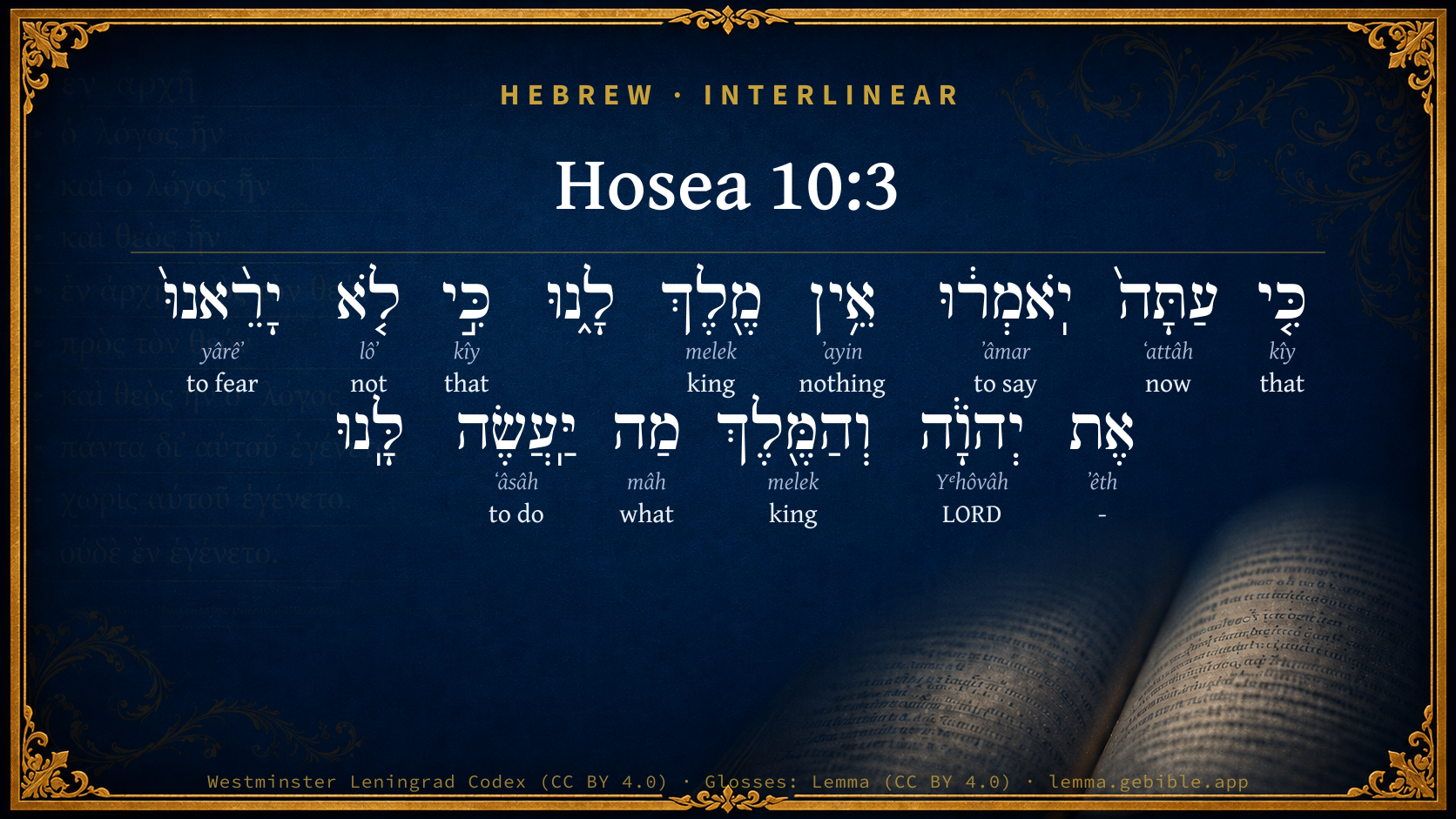
Hebrew (Westminster Leningrad Codex) Hosea 10:3 appears in the Hebrew Old Testament. The text above is from the Westminster Leningrad Codex. Each word links to its Strong’s number, a concise gloss, and parsing drawn from the Open Scriptures Hebrew Bible morphology. Click any word for its full Brown-Driver-Briggs (BDB) entry.
Download image
Cite this verse

Hosea 10:3 (World English Bible). Public Domain. Lemma interlinear Bible study tool, https://lemma.gebible.app/v/hosea/10/3.

Show BibTeX & RIS
BibTeX
RIS
English Translation
Surely now they will say, "We have no king; for we don't fear Yahweh; And the king, what can he do for us?"
World English Bible · Public Domain
Download a study sheet

One document with this verse’s original text, its word-by-word gloss line, the meaning frame, cross-references with their text, attributed commentary, and full source and license credits — printable, and it pastes into notes with its structure intact.

This verse Autodidact and up

Study sheet (.html) Plain text (.txt)

A passage Seminary Student

Up to 50 verses in one chapter. A passage sheet keeps up to 6 commentary sources and 12 cross-references per verse, in the order this page ranks them, and says so on the sheet whenever that leaves anything out. Ask for a single verse and you get the Autodidact verse sheet above.

Everything on this page stays free to read, with no account — the sheet is a download of what is already on screen, not access to it.

Want to remove ads? Support Godless Engineer
Compare translations 3

The same verse in 3 English versions, stacked beneath the original-language interlinear above. Click any original word for its lexicon entry.

Each is an independent rendering of the whole verse — the interlinear is not word-aligned to these translations.

Highlighted words mark where these versions differ — a whole-verse word diff, not a word-by-word alignment.

  • World English Bible Public Domain
    Surely now they will say, "We have no king; for we don't fear Yahweh; And the king, what can he do for us?"
  • King James Version Public Domain
    For now they shall say, We have no king, because we feared not the LORD; what then should a king do to us?
  • unfoldingWord Literal Text CC BY-SA 4.0
    For now they will say, “There is no king for us, for we did not fear Yahweh, and the king—what could he do for us?”

unfoldingWord Literal Text — © unfoldingWord, licensed CC BY-SA 4.0. Word-aligned USFM3 via Door43 (git.door43.org/unfoldingWord/en_ult).

Versions to compare (up to 4)

3 of 4 selected

Show all 18 translations

Every available English version of this verse, each an independent rendering of the whole verse.

  • World English Bible Public Domain
    Surely now they will say, "We have no king; for we don't fear Yahweh; And the king, what can he do for us?"
  • Berean Standard Bible Public Domain
    Surely now they will say, “We have no king, for we do not revere the LORD. What can a king do for us?”
  • Majority Standard Bible Public Domain
    Surely now they will say, “We have no king, for we do not revere the LORD. What can a king do for us?”
  • King James Version Public Domain
    For now they shall say, We have no king, because we feared not the LORD; what then should a king do to us?
  • American Standard Version (1901) Public Domain
    Surely now shall they say, We have no king; for we fear not Jehovah; and the king, what can he do for us?
  • Revised Version (1885) Public Domain
    Surely now shall they say, We have no king: for we fear not the LORD; and the king, what can he do for us?
  • Geneva Bible (1599) Public Domain
    For now they shall say, We haue no King because we feared not the Lord: and what should a King doe to vs?
  • Douay-Rheims (1899) Public Domain
    For now they shall say: We have no king: because we fear not the Lord: and what shall a king do to us?
  • Young's Literal Translation Public Domain
    For now they say: We have no king, Because we have not feared Jehovah, And the king -- what doth he for us?
  • Literal Standard Version CC BY-SA 4.0
    For now they say: We have no king, || Because we have not feared YHWH, || And the king—what does he do for us?
  • Unlocked Literal Bible CC BY-SA 4.0
    For then they will say, “We have no king, for we did not fear Yahweh, and a king—what could he do for us?”
  • unfoldingWord Literal Text CC BY-SA 4.0
    For now they will say, “There is no king for us, for we did not fear Yahweh, and the king—what could he do for us?”
  • Darby Bible Public Domain
    For now they will say, We have no king, for we feared not Jehovah; and a king, what can he do for us?
  • World Messianic Bible Public Domain
    Surely now they will say, “We have no king; for we don’t fear the LORD; and the king, what can he do for us?”
  • Webster's Bible Public Domain
    For now they shall say, We have no king, because we feared not the LORD; what then should a king do to us?
  • Free Bible Version CC BY-SA 4.0
    Then they will say, “We have no king, for we do not fear the Lord, and yet what would a king do for us?”
  • Bible in Basic English Public Domain
    Now, truly, they will say, We have no king, we have no fear of the Lord; and the king, what is he able to do for us?
  • JPS Tanakh (1917) Public Domain
    Surely now shall they say: 'We have no king; for we feared not the LORD; and the king, what can he do for us?'

Literal Standard Version (2020), Covenant Press — licensed CC BY-SA 4.0. Text via the HelloAO Bible API (eBible.org). Unlocked Literal Bible (unfoldingWord) — licensed CC BY-SA 4.0. Text via the HelloAO Bible API (eBible.org). unfoldingWord Literal Text — © unfoldingWord, licensed CC BY-SA 4.0. Word-aligned USFM3 via Door43 (git.door43.org/unfoldingWord/en_ult). Free Bible Version, Dr. Jonathan Gallagher — licensed CC BY-SA 4.0. Text via the HelloAO Bible API (eBible.org).

Word by word

More ways to search: Search by grammar → Find every occurrence → Compare this word →

Practice this passage: Drill this verse → Learn its vocabulary →

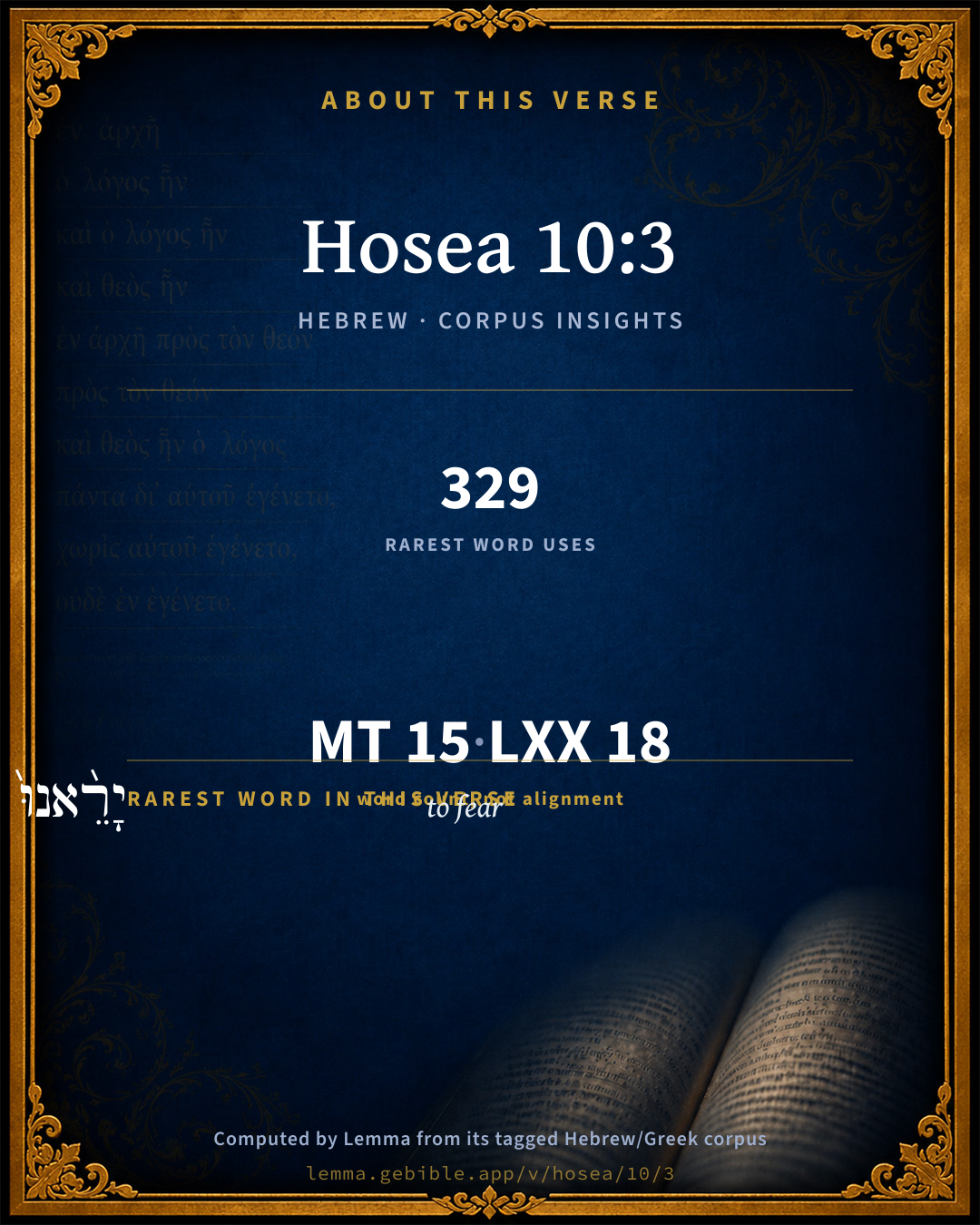
יָרֵ֨אנוּ֙
yârêʼ
H3372
“to fear”
Verb, Qal, Perfect, 1st Person, Common, Plural
Part of Speech
Verb
Stem
Qal
Form
Perfect
Person
1st Person
Gender
Common
Number
Plural
Full BDB Definition

Origin: a primitive root

TWOT: 907 , 908

to fear, revere, be afraid - (Qal) - to fear, be afraid - to stand in awe of, be awed - to fear, reverence, honour, respect - (Niphal) - to be fearful, be dreadful, be feared - to cause astonishment and awe, be held in awe - to inspire reverence or godly fear or awe - (Piel) to make afraid, terrify - (TWOT) to shoot, pour
  1. כִּ֤י kîy H3588 “that” Conjunction
  2. עַתָּה֙ ʻattâh H6258 “now” Adverb
  3. יֹֽאמְר֔וּ ʼâmar H559 “to say” Verb, Qal, Imperfect, 3rd Person, Masculine, Plural
  4. אֵ֥ין ʼayin H369 “nothing” Particle, Negative
  5. מֶ֖לֶךְ melek H4428 “king” Noun, Common, Masculine, Singular, Absolute
  6. כִּ֣י kîy H3588 “that” Conjunction
  7. לֹ֤א lôʼ H3808 “not” Particle, Negative
  8. אֶת ʼêth H853 “-” Particle, Direct Object
  9. יְהֹוָ֔ה Yᵉhôvâh H3068 “LORD” Noun, Proper
  10. וְהַמֶּ֖לֶךְ melek H4428 “and · the · king” Conjunction + Particle, Definite Article + Noun, Common, Masculine, Singular, Absolute
  11. מַה mâh H4100 “what” Particle, Interrogative
  12. יַּֽעֲשֶׂה ʻâsâh H6213 “to do” Verb, Qal, Imperfect, 3rd Person, Masculine, Singular

About this verse

These counts appear in no published source. They are computed here, from the morphology-tagged text and Lemma’s own curated glosses. What Lemma adds →

15
words
11
distinct lemmas
Prophets
section

Grammatical profile

  • 3 verbs
  • 3 nouns
  • 2 prepositions
  • 2 conjunctions
  • 1 adverb
  • 4 particles

Verb forms

  • יֹֽאמְר֔וּ Qal · Imperfect
  • יָרֵ֨אנוּ֙ Qal · Perfect
  • יַּֽעֲשֶׂה Qal · Imperfect

Repetition

Words recur within this verse — often emphatic in Hebrew:

  • מֶ֖לֶךְ king H4428 ×2
  • כִּ֤י that H3588 ×2

Hebrew & Septuagint length

In English translation the verse runs 23 words from the Hebrew and 15 from the Septuagint (LXX English) — the Septuagint runs noticeably shorter here. See the side-by-side →

A rough comparison of the two English renderings, which tokenize alike — not a word-level alignment.

Word counts can differ between the Hebrew and the Greek without any difference in meaning — e.g. the Hebrew direct-object marker אֵת has no separate Greek word, and Greek often adds the article ὁ.

In the original languages it is 15 Hebrew tokens and 18 Greek tokens — but the two are counted differently (Hebrew bundles its prefixes and suffixes into one token; the Greek is in lemma form), so that isn’t a like-for-like length.

Cross-references

8

Topical passages linked to Hosea 10:3 in the Treasury of Scripture Knowledge — connected by theme and wording, ordered by reader-vote popularity; previews shown in the World English Bible.

  • Hosea 10:15 So Bethel will do to you because of your great wickedness. At daybreak the king of Israel will be destroyed.
  • Hosea 10:7 Samaria and her king float away, Like a twig on the water.
  • Hosea 13:11 I have given you a king in my anger, And have taken him away in my wrath.
  • Genesis 49:10 The scepter will not depart from Judah, Nor the ruler's staff from between his feet, Until he comes to whom it belongs. To him will the obedience of the peoples be.
  • Hosea 3:4 For the children of Israel shall abide many days without king, and without prince, and without sacrifice, and without sacred stone, and without ephod or idols.
  • Micah 4:9 Now why do you cry out aloud? Is there no king in you? Has your counselor perished, That pains have taken hold of you as of a woman in travail?
  • John 19:15 They cried out, "Away with him! Away with him! Crucify him!" Pilate said to them, "Shall I crucify your King?" The chief priests answered, "We have no king but Caesar!"
  • Hosea 11:5 "They won't return into the land of Egypt; But the Assyrian will be their king, Because they refused to repent.

Cross-references courtesy of OpenBible.info (CC BY 4.0).

Hebrew and Greek witnesses Masoretic Hebrew ↔ Greek Septuagint

The same verse in the two great witnesses to the Old Testament, shown verse-for-verse.

Here the Septuagint runs noticeably shorter than the Hebrew — LXX2012 (modern English Septuagint) 15 words vs World English Bible 23. A rough length comparison of the two English translations, not a word-level alignment — read both below.

These are two independent witnesses, not word-aligned to each other, and the Septuagint is shown in lemma (dictionary) form.

Hebrew Hosea 10:3 Masoretic · Westminster Leningrad Codex

כִּ֤י עַתָּה֙ יֹֽאמְר֔וּ אֵ֥ין מֶ֖לֶךְ לָ֑נוּ כִּ֣י לֹ֤א יָרֵ֨אנוּ֙ אֶת יְהֹוָ֔ה וְהַמֶּ֖לֶךְ מַה יַּֽעֲשֶׂה לָּֽנוּ

Surely now they will say, "We have no king; for we don't fear Yahweh; And the king, what can he do for us?"

World English Bible · Public Domain

Greek LXX Hosea 10:3 Septuagint · lemma form

διότι νῦν εἶπον οὐ εἰμί βασιλεύς ἐγώ ὅτι οὐ φοβέω ὁ κύριος ὁ δέ βασιλεύς τίς ποιέω ἐγώ

Because now they shall say, We have no king, because we feared not the Lord:

LXX2012 (modern English Septuagint) · Public Domain

Hebrew: Westminster Leningrad Codex (CC BY 4.0). Greek: Septuagint (public domain); English from LXX2012 (modern English Septuagint) (Public Domain). How the Septuagint differs from the Hebrew →

Targum (Aramaic paraphrase)

1

The Targum is the ancient Jewish Aramaic paraphrase of the Hebrew Scriptures — an interpretive translation, not the Hebrew text itself. Onkelos (literal) and Pseudo-Jonathan (expansive) render the Torah, and Jonathan the Prophets. Coverage is partial: where no permissively-licensed English translation exists for a verse, only the Aramaic is shown. This is verse-level text, not a word-by-word alignment to the Hebrew.

  1. Targum Jonathan Prophets (Joshua–Malachi)
    אֲרֵי כְעַן יֵימְרוּן לֵית מַלְכָּא לָנָא אֲרֵי לָא דְחֵילְנָא מִן קֳדָם יְיָ וּמַלְכָּא מַה יַעְבֵּיד לָנָא:

    (no public-domain English translation for this verse)

    Targum Jonathan — Aramaic: “Mikraot Gedolot” (public domain). English: “Sefaria Community Translation” (CC0 1.0 (public-domain dedication)); “London "Chaldee Paraphrase," 1871” (public domain). Text via Sefaria.

Commentary

Notes on Hosea 10:3 from classic Christian and Jewish commentators (each source and its license shown beneath its notes). The classic Christian expositions comment on the surrounding passage and are grouped to its opening verse, so a note may address several verses; the Jewish commentaries on the Tanakh (Rashi and others) are per-verse, so they appear only where the commentator wrote on this verse.

Lemma curates 59 commentaries, every one of them public domain or Creative Commons licensed, each selected and text-cleaned for this edition rather than reprinted as found. About our sources →

Trapp's Complete Commentary

John Trapp

Hos 10:3 For now they shall say, We have no king, because we feared not the LORD; what then should a king do to us?

Ver. 3. For now they shall say, We have no king] sc. to do us good; he is no better to us now than a king of clouts: he cannot protect us, or deliver us out of the hand of our enemies. If we cry unto him, as she did, "Help, O king"; he must needs answer as there, "If the Lord do not help thee, whence shall I help thee?" 2Ki 6:26-27. Vain is the help of man now that God sets against us. Feared him we have not, and now help us he will not. Est ergo interrogatio negantium et desperantium, saith Rivet. This is the question not of penitentiaries (as Lyra thinketh) but of such as despair, and deny that help can be had either from God, whom they have slighted, or from their king, who is over matched; as Asa was by the Ethiopians, when he came forth against them with an army of five hundred thousand, but was encountered by an army of a thousand thousand, the largest, I think, that we read of in the Book of God, 2Ch 14:11, and was therefore fain to cry, "Help us, O Lord our God, for we rest in thee: and in thy name, not in our own strength, we go against this multitude."

Because we feared not the Lord] We trembled not at his word, as Hos 9:17, and now it hath taken hold of us, Zec 1:6; {See Trapp on "Zec 1:6"} By our profaneness we have enraged God against us; by our creature confidence we have made him our enemy; and now, all too late, we acknowledge our impiety, we bewail our folly; for what should a king do to us? what can he do for us, more than weep over us, as Xerxes did over his army? cry Alas Alas that great city Babylon, &c., as those kings, her paramours, Rev 18:9-10, wish they had never reigned; as Adrian, Felix si non imperitassesset. Once the cry of this people was, Nay, but we will have a king, and they had him; but no such great joy of him. After that again, they would have a king of their own choosing, Jeroboam, I mean; and he proved a singular mischief to them, as did likewise all his successors. They doted upon a king, and put their trust in princes; but they soon found that in them there was no help, Psa 146:3, that they could not rescue them out of the punishing hands of the King of kings, the living God.

John Trapp, A Commentary or Exposition upon All the Books of the Old and New Testament (1647–1656) — public domain. Text from a community e-Sword module.

Tyndale Open Study Notes

Tyndale Open Resources

10:3 We have no king: Some interpreters see these words as an acknowledgement, after the destruction of Israel, that they had been punished and the monarchy had come to an end because they didn’t fear the Lord. Others regard this as the Israelites’ arrogant rejection of the Lord’s kingship.

Tyndale Open Study Notes — © Tyndale Open Resources, licensed CC BY-SA 4.0. Text via the HelloAO Bible API.

Geneva Bible (1599)

Geneva Bible translators

The day shall come that God shall take away their king, and then they shall feel the fruit of their sins, and how they trusted in him in vain, 2 Kings 17:6, 7.

Geneva Bible (1599) marginal notes — public domain. Text via Bolls.life.

Jamieson, Fausset & Brown

Robert Jamieson, A. R. Fausset & David Brown

now, &c.--Soon they, deprived of their king, shall be reduced to say, We have no king (Hos 10:7, Hos 10:15), for Jehovah deprived us of him, because of our not fearing God. What then (seeing God is against us) should a king be able to do for us, if we had one? As they rejected the heavenly King, they were deprived of their earthly king.

Jamieson, Fausset & Brown — Commentary Critical and Explanatory on the Whole Bible (1871) — public domain (CC PDM 1.0). Text via the HelloAO Bible API.

Adam Clarke's Commentary

Verse 3. We have no king] We have rejected the King of kings; and had we any king, he would be of no service to us in this state, as he would be a captive like ourselves; nor could we have the approbation of God, as we now justly lie under his displeasure.

Adam Clarke's Commentary on the Bible (1810–1826) — public domain. Text from a community e-Sword/MySword module.

John Calvin's Commentaries

He explains more at large what he had briefly referred to, when he said, that the condemnation, which would discover their wickedness, was now near at hand. He now adds, that even they themselves would, of their own accord, say, that they were deservedly punished in being deprived of a king; nay, that a king would avail them nothing, because they had not feared Jehovah. There is always to be understood a contrast between the perverse boasting of the people and the feeling of God’s wrath, of which the Prophet now speaks. For as long as God spared the Israelites, they abused his forbearance and his kindness. They did not then think that there was any thing to be reprehended in their life; nay, we know how petulantly they contended with the Prophets: as soon as a severe word came out of the mouth of any Prophet, great contentions arose. “What! dost thou treat thus the people of God, and the elect race of Abraham?” Since, then, they so obstinately spurned every instruction, the Prophet says here, “The time shall come, when they shall say that they have no king, because they did not fear the Lord.” The meaning is, that as they did not profit by the word of the Lord, another kind of teaching was soon to be adopted; for the Lord would really show his wrath, and even force them to confess against their will what they now excused: for this confession of sin would have never been expressed, had not the Lord dealt severely with them. They shall therefore say, — when? even when they shall be taken to another school; for the Lord will not henceforth remonstrate with them in words, but will so strike them with his hand, that they will understand that they have to do with him.

But it must be observed, that the Prophet speaks not here of the repentance of the people, nor relates their words, but rather mentions the thing itself. Hypocrites either clamour against God when he visits their sins, or feignedly own that they are worthy of such punishments, and all the while the same perverseness remains within. But when the Prophet introduces them as speaking, he does not mean that they will say what he relates; but, as I have said already, he rather speaks of the thing itself. Hence They will say, that is, the event itself will declare, that they are deprived of a king, because they feared not Jehovah; yea, that though a king ruled over them, he would be useless. Though, then, the Israelites had never ceased to clamour against God, nor given over openly to vomit forth their blasphemies against him, yet this, which the Prophet says, would have been still true. How so? Because it was sufficient that they were in reality convicted, though God had not extorted from them this confession; yea, they were themselves made to feel that they were justly smitten by the hand of God, however they might obstinately deny this before men.

The Prophet shows here also, that profane men, while any hope on earth is set before them, proudly despise the hand of God, and grow torpid in their own security, as in their own dregs. While Israel saw their king in the midst of them, they thought themselves safe from every harm, and boldly despised all threatening. This, then, is what the Prophet meant. Still further, when the Lord takes away every thing that dazzles the eyes of profane and wicked men, they then begin to own how foolishly they had flattered themselves, and how much they had been deceived by Satan. This is what is meant by Hosea, when he says, that the Israelites shall be constrained to know that they had no king, because they feared not God: but this repentance would be too late, for it would be without advantage. It now follows —

John Calvin's Commentaries (1540-1563) — public domain. Text from the Calvin Translation Society English edition (1840s-50s) via the Christian Classics Ethereal Library (ccel.org). Calvin's coverage is partial (roughly two-thirds of the Bible); uncommented books and verses are honest gaps, never fabricated. The 19th-century editor's footnotes and remarks are omitted so the notes are faithfully Calvin's own voice.

Ellicott's Commentary for English Readers

(3) To us.—Better, as for a king, what will he do for us? The prophet having witnessed a succession of Israelite kings overthrown, and anarchy as its consequence, predicts yet another time of confusion and helplessness, a full vindication of the threatenings of the prophet Samuel. (Comp. 1Sa_8:19.)

A Bible Commentary for English Readers, edited by Charles John Ellicott (1878–1897) — public domain. Text from a community e-Sword module.

The Cambridge Bible for Schools and Colleges

gen. ed. J. J. S. Perowne

3. For now they shall say …] Rather, Yea then, &c. They shall come to perceive that the kings set up on their own authority (Hos_8:4) cannot help nor deliver them.

We have no king, &c.] i.e., none worthy of the name, for a king should be judge, counseller, general; hence, they continue, and the king [whom we have], what can he do for us?

The Cambridge Bible for Schools and Colleges (gen. ed. J. J. S. Perowne; Cambridge University Press, 1878–1918) — public domain. Text from a community e-Sword module.

John Gill's Exposition

For now they shall say, we have no king,.... This they would say, either when they had one; but by their conduct and behaviour said they had none; because they had no regard unto him, no affection for him, and reverence of him; but everyone did what was right in his own eyes: or during the interregnum, between the murder of Pekah, which was in the twentieth year of Jotham, and the settlement of Hoshea, which was in the twelfth of Ahaz; see Kg2 15:30; or when the land of Israel was invaded, and their king was shut up in prison, and Samaria besieged, so that it was as if they had no king; they had none to protect and defend them, to sally out at the head of them against the enemy, and fight their battles for them; or rather when the city was taken, the altars broke down, their images spoiled, and they and their king carried captive:

because we feared not the Lord: did not serve and worship him, but idols; and this sin, casting off the fear of the Lord, was the source and cause of all their troubles and sorrows; of the invasion of their land; of the besieging and taking their city, and having no king to rule over them, and protect them:

what then should a king do to us? if they had one, he could be of no service to them; for since they had offended God, the King of kings, and made him their enemy, what could an earthly king, a weak mortal man, do for them, or against him? it was now all over with them, and they could have no expectation of help and deliverance.

John Gill's Exposition of the Whole Bible (1746–1763) — public domain (CC PDM 1.0). Text via the HelloAO Bible API.

Albert Barnes' Notes on the Bible

For now they shall say, we have no king - These are the words of despair, not of repentance; of people terrified by the consciousness of guilt, but not coming forth out of its darkness; describing their condition, not confessing the iniquity which brought it on them. In sin, all Israel had asked for a king, when the Lord was their king; in sin, Ephraim had made Jeroboam king; in sin, their subsequent kings were made, without the counsel and advice of God; and now as the close of all, they reflect how fruitless it all was. They had a king, and yet, as it were, they had no king, since, God being angry with them, he had no strength to deliver them. And now, without love, the memory of their evil deeds crushes them beyond hope of remedy. They groan for their losses, their sufferings, their fears, but do not repent. Such is the remorse of the damned. All which they had is lost; and what availed it now, since, when they had it, they feared not God?

Albert Barnes' Notes on the Bible (1834–1885) — public domain. Text from a community e-Sword/MySword module.

Haydock's Catholic Bible Commentary

No king, in captivity; or they give this title to the golden calf. Manahem had destroyed one, so that they could not but see its vanity. The neighbouring nations looked upon their idols as their kings.

George Leo Haydock (1774–1849), Haydock's Catholic Family Bible and Commentary, 1859 edition — public domain. Excludes Psalms (Douay-Rheims chapter numbering differs from Protestant) and Deuterocanonical books (Catholic canon only).

Matthew Poole's English Annotations

For; surely. Now; ere long.

They shall say; see, and feel, and be convinced too of this truth. We have no king; either no king at all, as in an interregnum, or no such king as we expected and hoped: our dependence was much upon the wise, valiant, and successful conduct of our king; but he is either less wise and valiant, or less successful in his enterprises.

Because we feared not the Lord; worshipped not, kept not his law, depended not on God, therefore we have no king, or one next to none, not able to help us.

What then should a king do to us? and now if we had our king, were he as powerful, wise, and successful as Jeroboam the Second, yet it would be too late, the Assyrian power hath so far prevailed, and God is so far departed from us: kings are not able to save without the God of kings.

Matthew Poole's English Annotations on the Holy Bible (1683–1685) — public domain. Text from a community e-Sword/MySword module.

The Pulpit Commentary

For now they shall say, We have no king, because we feared not the Lord. In the day of their destruction Israel would be brought to see and even feel that the king appointed through their own self-will and fancied plenitude of power was unable to protect or help them, and that because they had rejected Jehovah and cast aside his fear. The point of time denoted by "now" is either when they see destruction before their eyes, or when Israel is already in captivity. Rashi explains it in the former sense: "When destruction shall come upon them, they shall say, "We have no king," that is, our king on whom we set our hopes when we said, "Our king shall go out before us and light our battles," affords us no help whatever." Kimchi explains similarly, but fixes the "now" in the time of the Captivity: "Now, when they shall be carried out of their land, they shall recognize and say, "We have no king;" the explanation is, as it" we had no king among us, for there is no strength in him to deliver us out of the hand of our enemies, as we thought when we asked for a king who should march at our head and fight our battles. God blessed be he! was our King, and we needed no king, and he it was that delivered us out of the hand of our enemies when we did his will." Aben Ezra and others understand it as the expression of a wild licorice on the part of Israel, recklessly giving vent to an anarchical and atheistic spirit: "As soon as their heart was divided they had no wish to have a king over them, and had no fear of Jehovah; therefore they had no fear, and every one did what was right in his own eyes." This exposition neglects the note of time, as also the causal particle that follows. They bethought themselves that, as they had not feared Jehovah, but neglected his Law, the king which they had demanded could do them no good. "What," they asked, "can the king do for us? He has no power to deliver us, since God is angry with us, for we have sinned against him?" Such is the confession of Israel in captivity. Pusey remarks in reference to this: "In sin, all Israel had asked for a king, when the Lord was their King; in sin, Ephraim had made Jeroboam king; in sin, their subsequent kings were made, without the counsel and advice of God; and now, as the close of all, they reflect how fruitless it all was."

The Pulpit Commentary (1880–1919), ed. H.D.M. Spence-Jones & Joseph S. Exell — public domain. Text from a community e-Sword module.

John Wesley's Explanatory Notes

Say - See and feel. No king - Either no king at all, or no such king as we expected. What then - For kings are not able to save without the God of kings.

John Wesley, Explanatory Notes Upon the Whole Bible (1754–1765) — public domain. Text via the GEBible commentary corpus.

unfoldingWord translationNotes

Door43 World Missions Community

General Information:

Hosea is speaking about Israel.

and a king—what could he do for us?

The people wills say that their kings could not have helped them. AT: "Even if we had a king now, he could not help us." (See: Rhetorical Question)

They speak empty words

Here "empty words" refers to lies. AT: "They speak lies" (See: Idiom)

So justice springs up like poisonous weeds in the furrows of a field

What they people called justice in their laws and legal decisions is spoken of as if it were a plant sprouting up. AT: "So their decisions are not just; instead, they are harmful" (See: Metaphor)

like poisonous weeds in the furrows of a field

Their lies and injustice spread throughout their nation and harm everyone like poisonous plants. (See: Simile)

translationWords

king

fear

Yahweh

word

covenant

oath

just

unfoldingWord translationNotes — © Distant Shores Media and the Door43 World Missions Community, licensed CC BY-SA 4.0. Source: git.door43.org/Door43/en_tn.

Rashi

Rabbi Shlomo Yitzchaki (Rashi)

For now when evil befalls them. they shall say, We have no king, Our king, upon whom we relied, saying, “He will go forth at our head and will wage our wars,” is of no avail to us.

Rashi on the Tanakh — English translations: “The Judaica Press complete Tanach with Rashi, translated by A. J. Rosenberg” (CC BY 4.0); “Pentateuch with Rashi's commentary by M. Rosenbaum and A.M. Silbermann, 1929-1934” (public domain); “The Metsudah Tanach series, Lakewood, N.J” (CC BY 4.0); and “The Book of Joshua, Metsudah Publications, 1997” (CC BY 4.0). Text via Sefaria.

Lesson kit

Teaching starters — assembled from the data on this page, not authored interpretation. Every prompt links to the verse data it draws on. Edit before teaching.

Hosea, in the Prophets, opens this verse with 15 words (11 distinct Hebrew lemmas). Its most distinctive word is yârêʼ (“to fear”). The Greek Septuagint runs shorter here. A historical commentator’s framing appears above. Read the whole chapter for the surrounding context.

Discussion questions

  1. What does “to fear” (yârêʼ) contribute to the verse as a whole?
  2. Hosea 10:15 shares this passage’s theme. How do the two illuminate each other?
  3. “king” occurs 2× in this one verse. What is the effect of the repetition?
  4. Compared with the Hebrew, the Septuagint runs shorter here. What questions does that raise?
  5. These translations render this verse differently. What is at stake in choosing one wording over another?
  6. The verb «יֹֽאמְר֔וּ» is Qal Imperfect. How does its form color the action?
  7. Reading how Trapp's Complete Commentary and Tyndale Open Study Notes read this verse, where do the two commentators agree and where do they part?

Things to notice

Reading settings

Reading text

Shown beneath each verse's original-language words.

Old Testament
Old Testament edition

Read the OT as the Masoretic Hebrew (MT) or the Greek Septuagint (LXX).

English shown for the Greek Septuagint (in the Hebrew ↔ Greek comparison).

Comparing translations? Open the Compare panel on any verse page to stack up to four side by side.