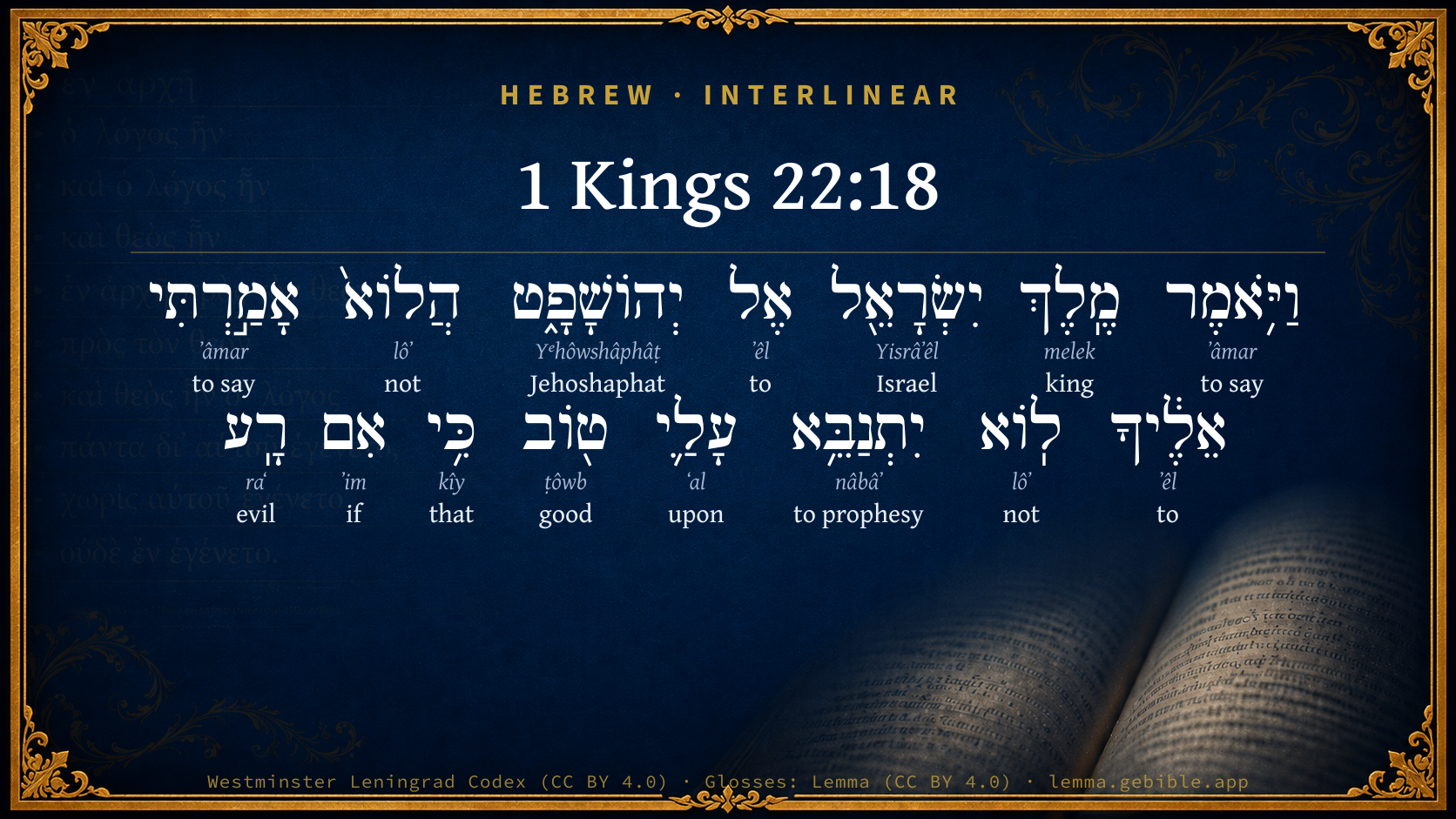
1 Kings 22:18

Hebrew (Westminster Leningrad Codex) 1 Kings 22:18 appears in the Hebrew Old Testament. The text above is from the Westminster Leningrad Codex. Each word links to its Strong’s number, a concise gloss, and parsing drawn from the Open Scriptures Hebrew Bible morphology. Click any word for its full Brown-Driver-Briggs (BDB) entry.
Download image
Cite this verse

1 Kings 22:18 (World English Bible). Public Domain. Lemma interlinear Bible study tool, https://lemma.gebible.app/v/1-kings/22/18.

Show BibTeX & RIS
BibTeX
RIS
English Translation
The king of Israel said to Jehoshaphat, Didn't I tell you that he would not prophesy good concerning me, but evil?
World English Bible · Public Domain
Download a study sheet

One document with this verse’s original text, its word-by-word gloss line, the meaning frame, cross-references with their text, attributed commentary, and full source and license credits — printable, and it pastes into notes with its structure intact.

This verse Autodidact and up

Study sheet (.html) Plain text (.txt)

A passage Seminary Student

Up to 50 verses in one chapter. A passage sheet keeps up to 6 commentary sources and 12 cross-references per verse, in the order this page ranks them, and says so on the sheet whenever that leaves anything out. Ask for a single verse and you get the Autodidact verse sheet above.

Everything on this page stays free to read, with no account — the sheet is a download of what is already on screen, not access to it.

Want to remove ads? Support Godless Engineer
Compare translations 3

The same verse in 3 English versions, stacked beneath the original-language interlinear above. Click any original word for its lexicon entry.

Each is an independent rendering of the whole verse — the interlinear is not word-aligned to these translations.

Highlighted words mark where these versions differ — a whole-verse word diff, not a word-by-word alignment.

  • World English Bible Public Domain
    The king of Israel said to Jehoshaphat, Didn't I tell you that he would not prophesy good concerning me, but evil?
  • King James Version Public Domain
    And the king of Israel said unto Jehoshaphat, Did I not tell thee that he would prophesy no good concerning me, but evil?
  • unfoldingWord Literal Text CC BY-SA 4.0
    And the king of Israel said to Jehoshaphat, “Did I not say to you, ‘He will not prophesy good about me, but rather evil’?”

unfoldingWord Literal Text — © unfoldingWord, licensed CC BY-SA 4.0. Word-aligned USFM3 via Door43 (git.door43.org/unfoldingWord/en_ult).

Versions to compare (up to 4)

3 of 4 selected

Show all 18 translations

Every available English version of this verse, each an independent rendering of the whole verse.

  • World English Bible Public Domain
    The king of Israel said to Jehoshaphat, Didn't I tell you that he would not prophesy good concerning me, but evil?
  • Berean Standard Bible Public Domain
    Then the king of Israel said to Jehoshaphat, “Did I not tell you that he never prophesies good for me, but only bad?”
  • Majority Standard Bible Public Domain
    Then the king of Israel said to Jehoshaphat, “Did I not tell you that he never prophesies good for me, but only bad?”
  • King James Version Public Domain
    And the king of Israel said unto Jehoshaphat, Did I not tell thee that he would prophesy no good concerning me, but evil?
  • American Standard Version (1901) Public Domain
    And the king of Israel said to Jehoshaphat, Did I not tell thee that he would not prophesy good concerning me, but evil?
  • Revised Version (1885) Public Domain
    And the king of Israel said to Jehoshaphat, Did I not tell thee that he would not prophesy good concerning me, but evil?
  • Geneva Bible (1599) Public Domain
    (And the King of Israel saide vnto Iehoshaphat, Did I not tell thee, that he would prophecie no good vnto me, but euill?)
  • Douay-Rheims (1899) Public Domain
    (Then the king of Israel said to Josaphat: Did I not tell thee, that he prophesieth no good to me, but always evil?)
  • Young's Literal Translation Public Domain
    And the king of Israel saith unto Jehoshaphat, `Have I not said unto thee, He doth not prophesy of me good, but evil?'
  • Literal Standard Version CC BY-SA 4.0
    And the king of Israel says to Jehoshaphat, “Have I not said to you, He does not prophesy of me good, but evil?”
  • Unlocked Literal Bible CC BY-SA 4.0
    So the king of Israel said to Jehoshaphat, “Did I not tell you that he would not prophesy good concerning me, but only disaster?”
  • unfoldingWord Literal Text CC BY-SA 4.0
    And the king of Israel said to Jehoshaphat, “Did I not say to you, ‘He will not prophesy good about me, but rather evil’?”
  • Darby Bible Public Domain
    And the king of Israel said to Jehoshaphat, Did I not tell thee that he prophesies no good concerning me, but evil?
  • World Messianic Bible Public Domain
    The king of Israel said to Jehoshaphat, “Didn’t I tell you that he would not prophesy good concerning me, but evil?”
  • Webster's Bible Public Domain
    And the king of Israel said to Jehoshaphat, Did I not tell thee that he would prophesy no good concerning me, but evil?
  • Free Bible Version CC BY-SA 4.0
    The king of Israel said to Jehoshaphat, “Didn't I tell you he never prophesies anything good for me, only bad?”
  • Bible in Basic English Public Domain
    And the king of Israel said to Jehoshaphat, Did I not say that he would not be a prophet of good but of evil?
  • JPS Tanakh (1917) Public Domain
    And the king of Israel said to Jehoshaphat: 'Did I not tell thee that he would not prophesy good concerning me, but evil?'

Literal Standard Version (2020), Covenant Press — licensed CC BY-SA 4.0. Text via the HelloAO Bible API (eBible.org). Unlocked Literal Bible (unfoldingWord) — licensed CC BY-SA 4.0. Text via the HelloAO Bible API (eBible.org). unfoldingWord Literal Text — © unfoldingWord, licensed CC BY-SA 4.0. Word-aligned USFM3 via Door43 (git.door43.org/unfoldingWord/en_ult). Free Bible Version, Dr. Jonathan Gallagher — licensed CC BY-SA 4.0. Text via the HelloAO Bible API (eBible.org).

Word by word

More ways to search: Search by grammar → Find every occurrence → Compare this word →

Practice this passage: Drill this verse → Learn its vocabulary →

יְהוֹשָׁפָ֑ט
Yᵉhôwshâphâṭ
H3092
“Jehoshaphat”
Noun, Proper
Part of Speech
Noun
Type
Proper
Full BDB Definition

Origin: from H3068 and H8199

TWOT: None

Jehoshaphat = "Jehovah has judged" - son of king Asa and himself king of Judah for 25 years; one of the best, most pious, and prosperous kings of Judah (noun proper masculine) - son of Nimshi and father of king Jehu of the northern kingdom of Israel (noun proper masculine) - son of Ahilud and chronicler under David and Solomon (noun proper masculine) - son of Paruah and one of the 12 commissary officers under Solomon (noun proper masculine) - a priest and trumpeter in the time of David (noun proper masculine) - symbolical name of a valley near Jerusalem which is the place of ultimate judgment; maybe the deep ravine which separates Jerusalem from the Mount of Olives through which the Kidron flowed (noun proper locative)
  1. וַיֹּ֥אמֶר ʼâmar H559 “and · to say” Conjunction + Verb, Qal, Sequential Imperfect, 3rd Person, Masculine, Singular
  2. מֶֽלֶךְ melek H4428 “king of” Noun, Common, Masculine, Singular, Construct
  3. יִשְׂרָאֵ֖ל Yisrâʼêl H3478 “Israel” Noun, Proper
  4. אֶל ʼêl H413 “to” Preposition
  5. הֲלוֹא֙ lôʼ H3808 “not” Particle, Interrogative + Particle, Negative
  6. אָמַ֣רְתִּי ʼâmar H559 “to say” Verb, Qal, Perfect, 1st Person, Common, Singular
  7. אֵלֶ֔יךָ ʼêl H413 “to · you” Preposition + Suffix, Personal, 2nd Person, Masculine, Singular
  8. לֽוֹא lôʼ H3808 “not” Particle, Negative
  9. יִתְנַבֵּ֥א nâbâʼ H5012 “to prophesy” Verb, Hithpael, Imperfect, 3rd Person, Masculine, Singular
  10. עָלַ֛י ʻal H5921 “upon · me” Preposition + Suffix, Personal, 1st Person, Common, Singular
  11. ט֖וֹב ṭôwb H2896 “good” Adjective, Adjective, Masculine, Singular, Absolute
  12. כִּ֥י kîy H3588 “that” Conjunction
  13. אִם ʼim H518 “if” Conjunction
  14. רָֽע raʻ H7451 “evil” Adjective, Adjective, Masculine, Singular, Absolute

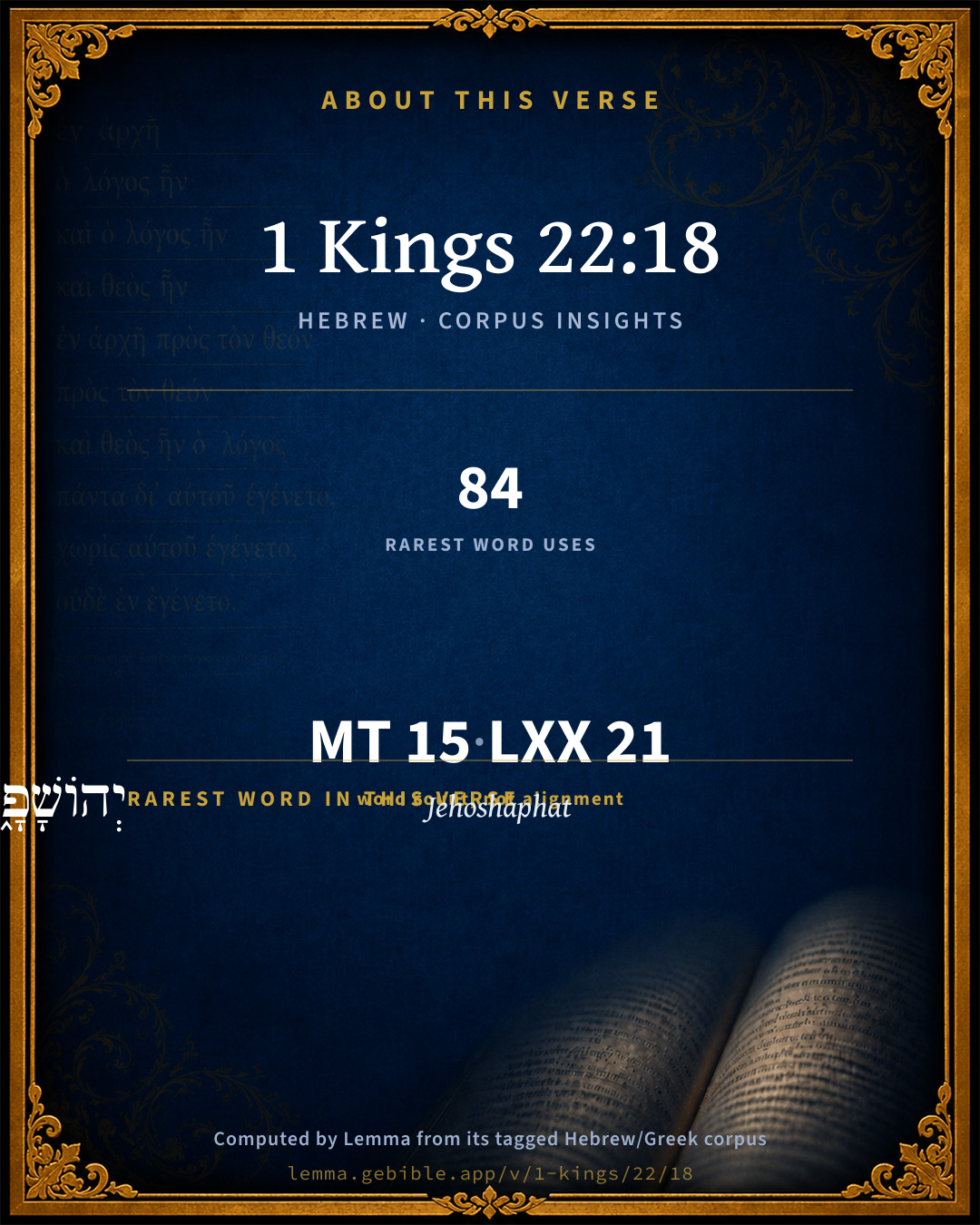
About this verse

These counts appear in no published source. They are computed here, from the morphology-tagged text and Lemma’s own curated glosses. What Lemma adds →

15
words
12
distinct lemmas
Historical
section

Grammatical profile

  • 3 verbs
  • 3 nouns
  • 2 adjectives
  • 3 prepositions
  • 2 conjunctions
  • 2 particles

Verb forms

  • וַיֹּ֥אמֶר Qal · Sequential Imperfect
  • אָמַ֣רְתִּי Qal · Perfect
  • יִתְנַבֵּ֥א Hithpael · Imperfect

Repetition

Words recur within this verse — often emphatic in Hebrew:

  • וַיֹּ֥אמֶר to say H559 ×2
  • אֶל to H413 ×2
  • הֲלוֹא֙ not H3808 ×2

Hebrew & Septuagint length

In English translation the verse runs 21 words from the Hebrew and 32 from the Septuagint (LXX English) — the Septuagint runs noticeably longer here. See the side-by-side →

A rough comparison of the two English renderings, which tokenize alike — not a word-level alignment.

Word counts can differ between the Hebrew and the Greek without any difference in meaning — e.g. the Hebrew direct-object marker אֵת has no separate Greek word, and Greek often adds the article ὁ.

In the original languages it is 15 Hebrew tokens and 21 Greek tokens — but the two are counted differently (Hebrew bundles its prefixes and suffixes into one token; the Greek is in lemma form), so that isn’t a like-for-like length.

Cross-references

5

Topical passages linked to 1 Kings 22:18 in the Treasury of Scripture Knowledge — connected by theme and wording, ordered by reader-vote popularity; previews shown in the World English Bible.

  • 1 Kings 22:8 The king of Israel said to Jehoshaphat, there is yet one man by whom we may inquire of Yahweh, Micaiah the son of Imlah: but I hate him; for he does not prophesy good concerning me, but evil. Jehoshaphat said, "Don't let the king say so."
  • Proverbs 10:24 What the wicked fear, will overtake them, But the desire of the righteous will be granted.
  • Proverbs 27:22 Though you grind a fool in a mortar with a pestle along with grain, Yet his foolishness will not be removed from him.
  • Proverbs 29:1 He who is often rebuked and stiffens his neck Will be destroyed suddenly, with no remedy.
  • Luke 11:45 One of the lawyers answered him, "Teacher, in saying this you insult us also."

Cross-references courtesy of OpenBible.info (CC BY 4.0).

Hebrew and Greek witnesses Masoretic Hebrew ↔ Greek Septuagint

The same verse in the two great witnesses to the Old Testament, shown verse-for-verse.

Here the Septuagint runs noticeably longer than the Hebrew — LXX2012 (modern English Septuagint) 32 words vs World English Bible 21. A rough length comparison of the two English translations, not a word-level alignment — read both below.

These are two independent witnesses, not word-aligned to each other, and the Septuagint is shown in lemma (dictionary) form.

Hebrew 1 Kings 22:18 Masoretic · Westminster Leningrad Codex

וַיֹּ֥אמֶר מֶֽלֶךְ יִשְׂרָאֵ֖ל אֶל יְהוֹשָׁפָ֑ט הֲלוֹא֙ אָמַ֣רְתִּי אֵלֶ֔יךָ לֽוֹא יִתְנַבֵּ֥א עָלַ֛י ט֖וֹב כִּ֥י אִם רָֽע

The king of Israel said to Jehoshaphat, Didn't I tell you that he would not prophesy good concerning me, but evil?

World English Bible · Public Domain

Greek LXX 1 Kings 22:18 Septuagint · lemma form

καί εἶπον βασιλεύς ἰσραήλ πρός ιωσαφατ βασιλεύς ιουδα οὐ εἶπον πρός σύ οὐ προφητεύω οὗτος ἐγώ καλός διότι ἀλλά ἤ κακός

And the king of Israel said to Josaphat king of Juda, Did I not say to you that this man does not prophesy good to me, for he speaks nothing but evil?

LXX2012 (modern English Septuagint) · Public Domain

Hebrew: Westminster Leningrad Codex (CC BY 4.0). Greek: Septuagint (public domain); English from LXX2012 (modern English Septuagint) (Public Domain). How the Septuagint differs from the Hebrew →

Targum (Aramaic paraphrase)

1

The Targum is the ancient Jewish Aramaic paraphrase of the Hebrew Scriptures — an interpretive translation, not the Hebrew text itself. Onkelos (literal) and Pseudo-Jonathan (expansive) render the Torah, and Jonathan the Prophets. Coverage is partial: where no permissively-licensed English translation exists for a verse, only the Aramaic is shown. This is verse-level text, not a word-by-word alignment to the Hebrew.

  1. Targum Jonathan Prophets (Joshua–Malachi)
    וַאֲמַר מַלְכָּא דְיִשְׂרָאֵל לִיהוֹשָׁפָט הֲלָא אֲמַרִית לָךְ דְלָא יִתְנַבֵּי עֲלֵי טַב אֱלָהִין בִּישׁ:

    (no public-domain English translation for this verse)

    Targum Jonathan — Aramaic: “Mikraot Gedolot” (public domain). English: “Sefaria Community Translation” (CC0 1.0 (public-domain dedication)); “London "Chaldee Paraphrase," 1871” (public domain). Text via Sefaria.

Commentary

Notes on 1 Kings 22:18 from classic Christian and Jewish commentators (each source and its license shown beneath its notes). The classic Christian expositions comment on the surrounding passage and are grouped to its opening verse, so a note may address several verses; the Jewish commentaries on the Tanakh (Rashi and others) are per-verse, so they appear only where the commentator wrote on this verse.

Lemma curates 59 commentaries, every one of them public domain or Creative Commons licensed, each selected and text-cleaned for this edition rather than reprinted as found. About our sources →

Trapp's Complete Commentary

John Trapp

1Ki 22:18 And the king of Israel said unto Jehoshaphat, Did I not tell thee that he would prophesy no good concerning me, but evil?

Ver. 18. Did I not tell thee? &c.] Hereby he would persuade Jehoshaphat - and perhaps did so persuade him - that Micaiah spake all out of ill-will, which never speaks well, and therefore was not much to be regarded.

John Trapp, A Commentary or Exposition upon All the Books of the Old and New Testament (1647–1656) — public domain. Text from a community e-Sword module.

Joseph Benson's Commentary

1Ki 22:18. The king of Israel said, Did not I tell thee, &c. — Now thou seest my words verified, and how this man shows his hatred by his malignant and treasonable prophecy, and how little regard is to be paid to his words. Which crafty insinuation seems to have had too great an influence on good Jehoshaphat, otherwise he would not have gone to the battle. That he would prophesy no good concerning me, but evil — Nay, but what evil was it to tell him what would be the event if he proceeded in his expedition, while it was in his own power whether he would proceed or not? The greatest kindness we can do to one that is walking in a dangerous way is to tell him of his danger.

Joseph Benson's Commentary on the Old and New Testaments (1811–1818) — public domain. Text from a community e-Sword module.

Jamieson, Fausset & Brown

Robert Jamieson, A. R. Fausset & David Brown

Did I not tell thee that he would prophesy no good concerning me, but evil?--Since Ahab was disposed to trace this unwelcome truth to personal enmity, Micaiah proceeded fearlessly to tell the incensed monarch in full detail what had been revealed to him. The Hebrew prophets, borrowing their symbolic pictures from earthly scenes, described God in heaven as a king in His kingdom. And as earthly princes do nothing of importance without asking the advice of their counsellors, God is represented as consulting about the fate of Ahab. This prophetic language must not be interpreted literally, and the command must be viewed as only a permission to the lying spirit (Rom 11:34) [CALMET].

Jamieson, Fausset & Brown — Commentary Critical and Explanatory on the Whole Bible (1871) — public domain (CC PDM 1.0). Text via the HelloAO Bible API.

The Cambridge Bible for Schools and Colleges

gen. ed. J. J. S. Perowne

18. that he would prophesy no good] R.V. (as in Chronicles) that he would not prophesy good. Of course Ahab was desirous of representing to Jehoshaphat that it was out of ill will that Micaiah spake always evil; and he appears to have weakened the effect of the prophet’s words in some way, or else, after such a solemn portending of disaster, Jehoshaphat would hardly have joined the expedition. It was perhaps with the consciousness of the effect which was being produced on the mind of the king of Judah, that Micaiah proceeds to unfold a further vision shewing how God was allowing Ahab to be led astray to his destruction.

The Cambridge Bible for Schools and Colleges (gen. ed. J. J. S. Perowne; Cambridge University Press, 1878–1918) — public domain. Text from a community e-Sword module.

John Gill's Exposition

And there came forth a spirit,.... Not from the heavenly host on the right hand or the left, for they are pure and holy spirits, and impeccable, and cannot lie or deceive; but the evil spirit, Satan, the father of lies, the old deceiver, who came forth from his own place and his own company:

and stood before the Lord presented himself before him, as Satan did, Job 1:6,

and said, l will persuade him; or prevail upon him; evil spirits love to be employed in doing harm to men, they go about seeking whom they may devour. This could not be the spirit of Naboth, as the Jews say (q), seeking revenge on Ahab; that was in a state of happiness, could not move from thence, and be capable of sinning.

(q) T. Bab. Sanhedrin, fol. 89. 1. & 102. 2. Targum in 2 Chron. xviii. 20.

John Gill's Exposition of the Whole Bible (1746–1763) — public domain (CC PDM 1.0). Text via the HelloAO Bible API.

Albert Barnes' Notes on the Bible

See 1Ki 22:8. Ahab implies that he believes Micaiah to have spoken out of pure malevolence, without any authority for his prediction from God. By implication he invites Jehoshaphat to disregard this pseudo-prophecy, and to put his trust in the unanimous declaration of the 400. Micaiah, therefore, proceeds to explain the contradiction between himself and the 400, by recounting another vision.

Albert Barnes' Notes on the Bible (1834–1885) — public domain. Text from a community e-Sword/MySword module.

Matthew Poole's English Annotations

Now thou seest my words verified, and this man showing his hatred by this malignant and treasonable prophecy, and how little heed is to be given to his words: which crafty insinuation seems to have had too great an influence upon good Jehoshaphat; otherwise he would never have gone to the battle.

Matthew Poole's English Annotations on the Holy Bible (1683–1685) — public domain. Text from a community e-Sword/MySword module.

The Pulpit Commentary

And the king of Israel said unto Jehoshaphat, Did I not tell thee that he would Heb. say to thee, He will, etc. prophesy no good concerning me but evil? It is clear that Ahab had understood perfectly the purport of Micaiah"s words. He now appeals to them as a proof of the latter"s malice.

The Pulpit Commentary (1880–1919), ed. H.D.M. Spence-Jones & Joseph S. Exell — public domain. Text from a community e-Sword module.

John Wesley's Explanatory Notes

Evil - Nay, but what evil was it, to tell him, what would be the event, if he proceeded in his expedition, while it was in his own power, whether he would proceed, or no? The greatest kindness we can do to one that is walking in a dangerous way, is to tell him of his danger.

John Wesley, Explanatory Notes Upon the Whole Bible (1754–1765) — public domain. Text via the GEBible commentary corpus.

unfoldingWord translationNotes

Door43 World Missions Community

Did I not tell you ... but only disaster?

Ahab asks this question to emphasize that he had spoken the truth about Micaiah. AT: "I told you ... but only disaster!" (See: Rhetorical Question)

fall at Ramoth Gilead

Ahab dying in battle is spoken of as if he will fall. AT: "die at Ramoth Gilead" (See: Metaphor and Euphemism)

One of them said ... and another one said

"One ... and another" refers to two or more angels in the heavenly host who were responding to Yahweh's question in the previous verse.

translationWords

Jehoshaphat

prophet

word of God

throne

heaven

right hand

Ahab

Ramoth

Gilead

unfoldingWord translationNotes — © Distant Shores Media and the Door43 World Missions Community, licensed CC BY-SA 4.0. Source: git.door43.org/Door43/en_tn.

Lesson kit

Teaching starters — assembled from the data on this page, not authored interpretation. Every prompt links to the verse data it draws on. Edit before teaching.

1 Kings, in the Historical, opens this verse with 15 words (12 distinct Hebrew lemmas). Its most distinctive word is Yᵉhôwshâphâṭ (“Jehoshaphat”). The Greek Septuagint runs longer here. A historical commentator’s framing appears above. Read the whole chapter for the surrounding context.

Discussion questions

  1. What does “Jehoshaphat” (Yᵉhôwshâphâṭ) contribute to the verse as a whole?
  2. 1 Kings 22:8 shares this passage’s theme. How do the two illuminate each other?
  3. “to say” occurs 2× in this one verse. What is the effect of the repetition?
  4. Compared with the Hebrew, the Septuagint runs longer here. What questions does that raise?
  5. These translations render this verse differently. What is at stake in choosing one wording over another?
  6. The verb «וַיֹּ֥אמֶר» is Qal Sequential Imperfect. How does its form color the action?
  7. Reading how Trapp's Complete Commentary and Joseph Benson's Commentary read this verse, where do the two commentators agree and where do they part?

Things to notice

Reading settings

Reading text

Shown beneath each verse's original-language words.

Old Testament
Old Testament edition

Read the OT as the Masoretic Hebrew (MT) or the Greek Septuagint (LXX).

English shown for the Greek Septuagint (in the Hebrew ↔ Greek comparison).

Comparing translations? Open the Compare panel on any verse page to stack up to four side by side.