Hosea 2:16

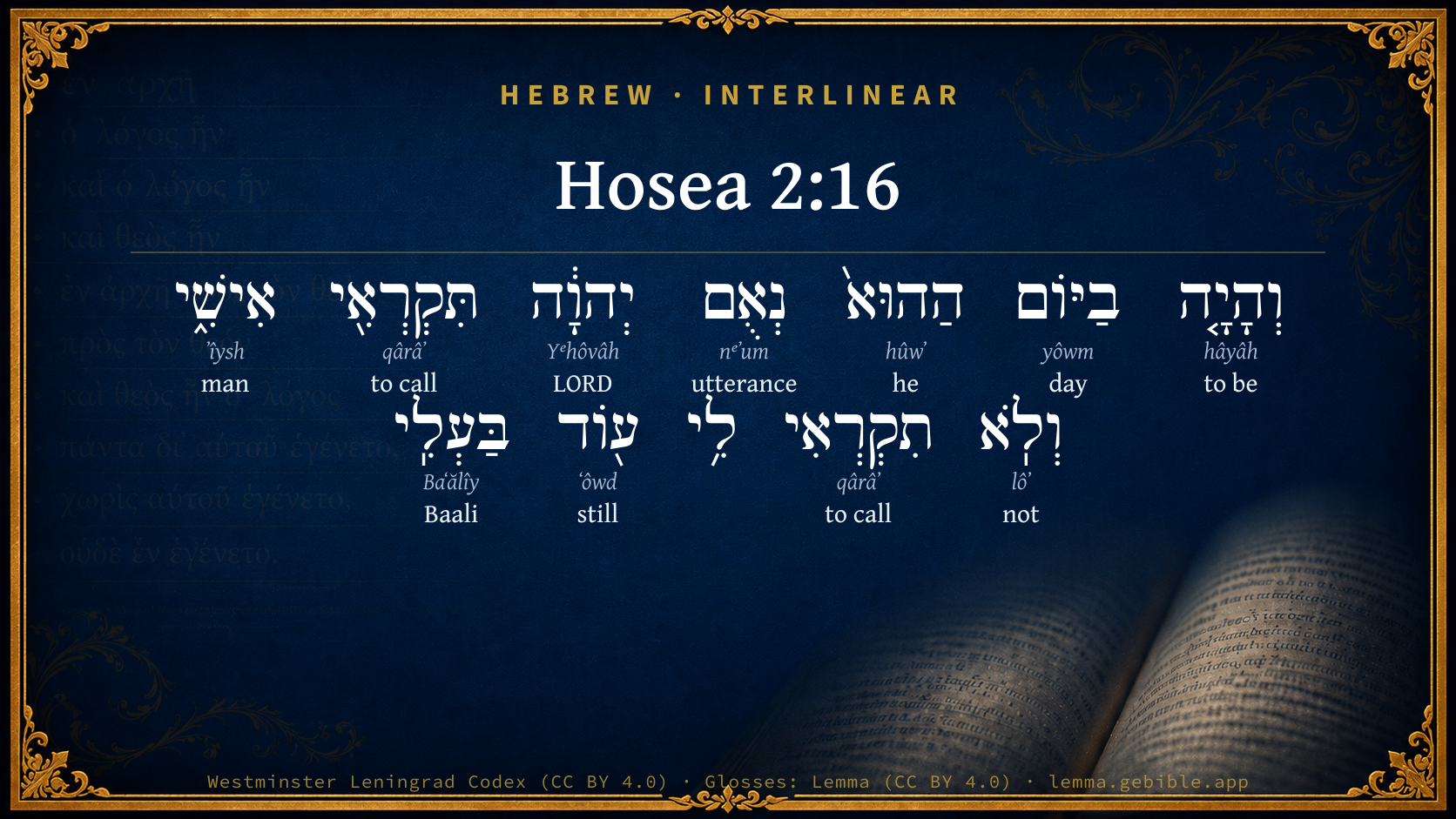
Hebrew (Westminster Leningrad Codex) Hosea 2:16 appears in the Hebrew Old Testament. The text above is from the Westminster Leningrad Codex. Each word links to its Strong’s number, a concise gloss, and parsing drawn from the Open Scriptures Hebrew Bible morphology. Click any word for its full Brown-Driver-Briggs (BDB) entry.
Download image
Cite this verse

Hosea 2:16 (World English Bible). Public Domain. Lemma interlinear Bible study tool, https://lemma.gebible.app/v/hosea/2/16.

Show BibTeX & RIS
BibTeX
RIS
English Translation
It will be in that day," says Yahweh, "That you will call me 'my husband,' And no longer call me 'my master.'
World English Bible · Public Domain
Highlights
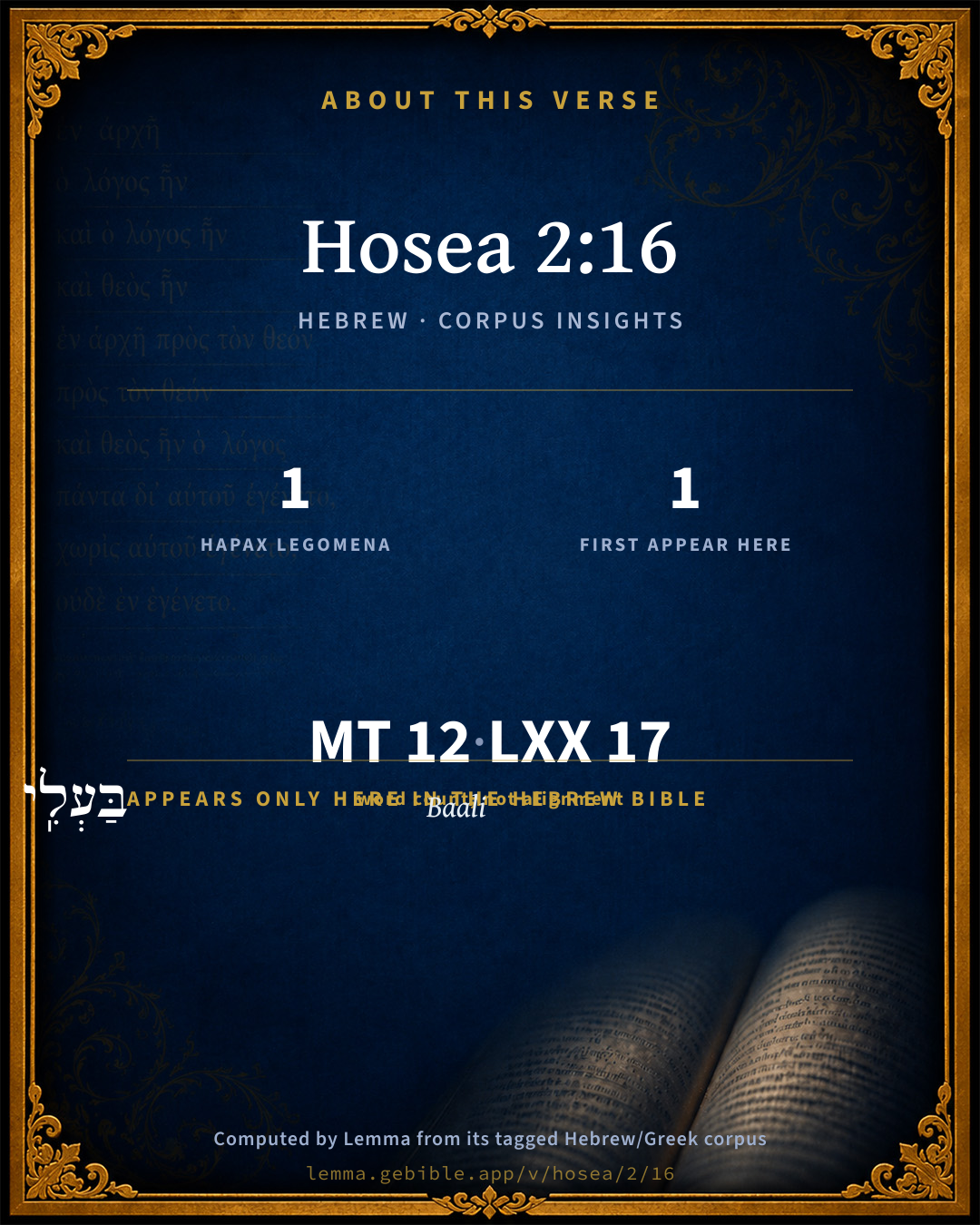
  • 1 hapax legomenon — only here in the Hebrew Bible
  • 1 first appearance in the Hebrew Bible
Full analysis ↓
Download a study sheet

One document with this verse’s original text, its word-by-word gloss line, the meaning frame, cross-references with their text, attributed commentary, and full source and license credits — printable, and it pastes into notes with its structure intact.

This verse Autodidact and up

Study sheet (.html) Plain text (.txt)

A passage Seminary Student

Up to 50 verses in one chapter. A passage sheet keeps up to 6 commentary sources and 12 cross-references per verse, in the order this page ranks them, and says so on the sheet whenever that leaves anything out. Ask for a single verse and you get the Autodidact verse sheet above.

Everything on this page stays free to read, with no account — the sheet is a download of what is already on screen, not access to it.

Want to remove ads? Support Godless Engineer
Compare translations 3

The same verse in 3 English versions, stacked beneath the original-language interlinear above. Click any original word for its lexicon entry.

Each is an independent rendering of the whole verse — the interlinear is not word-aligned to these translations.

Highlighted words mark where these versions differ — a whole-verse word diff, not a word-by-word alignment.

  • World English Bible Public Domain
    It will be in that day," says Yahweh, "That you will call me 'my husband,' And no longer call me 'my master.'
  • King James Version Public Domain
    And it shall be at that day, saith the LORD, that thou shalt call me Ishi; and shalt call me no more Baali.
  • unfoldingWord Literal Text CC BY-SA 4.0
    And it will be on that day—the declaration of Yahweh—you will call “My Husband,” and you will no longer call me “My Baal.”

unfoldingWord Literal Text — © unfoldingWord, licensed CC BY-SA 4.0. Word-aligned USFM3 via Door43 (git.door43.org/unfoldingWord/en_ult).

Versions to compare (up to 4)

3 of 4 selected

Show all 18 translations

Every available English version of this verse, each an independent rendering of the whole verse.

  • World English Bible Public Domain
    It will be in that day," says Yahweh, "That you will call me 'my husband,' And no longer call me 'my master.'
  • Berean Standard Bible Public Domain
    In that day,” declares the LORD, “you will call Me ‘my Husband,’ and no longer call Me ‘my Master.’
  • Majority Standard Bible Public Domain
    In that day,” declares the LORD, “you will call Me ‘my Husband,’ and no longer call Me ‘my Master.’
  • King James Version Public Domain
    And it shall be at that day, saith the LORD, that thou shalt call me Ishi; and shalt call me no more Baali.
  • American Standard Version (1901) Public Domain
    And it shall be at that day, saith Jehovah, that thou shalt call me Ishi, and shalt call me no more Baali.
  • Revised Version (1885) Public Domain
    And it shall be at that day, saith the LORD, that thou shalt call me Ishi; and shalt call me no more Baali.
  • Geneva Bible (1599) Public Domain
    And at that day, sayeth the Lord, thou shalt call me Ishi, and shalt call me no more Baali.
  • Douay-Rheims (1899) Public Domain
    And it shall be in that day, saith the Lord, That she shall call me: My husband, and she shall call me no more Baali.
  • Young's Literal Translation Public Domain
    And it hath come to pass, in that day, An affirmation of Jehovah, Thou dost call Me -- My husband, And dost not call Me any more -- My lord.
  • Literal Standard Version CC BY-SA 4.0
    And it has come to pass in that day,” || A declaration of YHWH, || “You call Me: My husband, || And do not call Me anymore: My lord.
  • Unlocked Literal Bible CC BY-SA 4.0
    “It will be in that day—this is Yahweh's declaration— that you will call me, 'My husband,' and you will no longer call me, 'My Baal.'
  • unfoldingWord Literal Text CC BY-SA 4.0
    And it will be on that day—the declaration of Yahweh—you will call “My Husband,” and you will no longer call me “My Baal.”
  • Darby Bible Public Domain
    And it shall be in that day, saith Jehovah, [that] thou shalt call me, My husband, and shalt call me no more, Baali;
  • World Messianic Bible Public Domain
    It will be in that day,” says the LORD, “that you will call me ‘my husband,’ and no longer call me ‘my master.’
  • Webster's Bible Public Domain
    And it shall be at that day, saith the LORD, that thou shalt call me Ishi; and shalt call me no more Baali.
  • Free Bible Version CC BY-SA 4.0
    Then on that day, says the Lord, you will call me ‘my husband’ and not ‘my Baal.’
  • Bible in Basic English Public Domain
    And in that day, says the Lord, you will say to me, Ishi; and you will never again give me the name of Baali;
  • JPS Tanakh (1917) Public Domain
    (2-18) And it shall be at that day, saith the LORD, that thou shalt call Me Ishi, and shalt call Me no more Baali.

Literal Standard Version (2020), Covenant Press — licensed CC BY-SA 4.0. Text via the HelloAO Bible API (eBible.org). Unlocked Literal Bible (unfoldingWord) — licensed CC BY-SA 4.0. Text via the HelloAO Bible API (eBible.org). unfoldingWord Literal Text — © unfoldingWord, licensed CC BY-SA 4.0. Word-aligned USFM3 via Door43 (git.door43.org/unfoldingWord/en_ult). Free Bible Version, Dr. Jonathan Gallagher — licensed CC BY-SA 4.0. Text via the HelloAO Bible API (eBible.org).

Word by word

More ways to search: Search by grammar → Find every occurrence → Compare this word →

Practice this passage: Drill this verse → Learn its vocabulary →

בַּעְלִֽי
Baʻălîy
H1180
“Baali · my”
Noun, Proper + Suffix, Personal, 1st Person, Common, Singular
Part of Speech
Noun
Type
Proper
Full BDB Definition

Origin: from H1167 with pron. suff.

TWOT: None

Baali = "my lord" - a deity in the northern kingdom, variation of the name 'Baal'
  1. וְהָיָ֤ה hâyâh H1961 “and · to be” Conjunction + Verb, Qal, Sequential Perfect, 3rd Person, Masculine, Singular
  2. בַיּוֹם yôwm H3117 “in/at the · day” Preposition, Determined + Noun, Common, Masculine, Singular, Absolute
  3. הַהוּא֙ hûwʼ H1931 “the · he” Particle, Definite Article + Pronoun, Personal, 3rd Person, Masculine, Singular
  4. נְאֻם nᵉʼum H5002 “utterance of” Noun, Common, Masculine, Singular, Construct
  5. יְהוָ֔ה Yᵉhôvâh H3068 “LORD” Noun, Proper
  6. תִּקְרְאִ֖י qârâʼ H7121 “to call” Verb, Qal, Imperfect, 2nd Person, Feminine, Singular
  7. אִישִׁ֑י ʼîysh H376 “man · my” Noun, Common, Masculine, Singular, Construct + Suffix, Personal, 1st Person, Common, Singular
  8. וְלֹֽא lôʼ H3808 “and · not” Conjunction + Particle, Negative
  9. תִקְרְאִי qârâʼ H7121 “to call” Verb, Qal, Imperfect, 2nd Person, Feminine, Singular
  10. ע֖וֹד ʻôwd H5750 “still” Adverb

About this verse

These counts appear in no published source. They are computed here, from the morphology-tagged text and Lemma’s own curated glosses. What Lemma adds →

12
words
10
distinct lemmas
Prophets
section

Notable vocabulary

1 hapax legomenon — a word that appears only here in the entire Hebrew Bible:

  • בַּעְלִֽי Baali H1180

First appearance in Scripture

This word makes its first canonical appearance in the Hebrew Bible here:

  • בַּעְלִֽי Baali H1180

Grammatical profile

  • 3 verbs
  • 5 nouns
  • 1 pronoun
  • 1 preposition
  • 1 adverb
  • 1 particle

Verb forms

  • וְהָיָ֤ה Qal · Sequential Perfect
  • תִּקְרְאִ֖י Qal · Imperfect
  • תִקְרְאִי Qal · Imperfect

Repetition

A word recurs within this verse — often emphatic in Hebrew:

  • תִּקְרְאִ֖י to call H7121 ×2

Hebrew & Septuagint length

In English translation the verse runs 22 words from the Hebrew and 26 from the Septuagint (LXX English) — closely comparable.

A rough comparison of the two English renderings, which tokenize alike — not a word-level alignment.

Word counts can differ between the Hebrew and the Greek without any difference in meaning — e.g. the Hebrew direct-object marker אֵת has no separate Greek word, and Greek often adds the article ὁ.

In the original languages it is 12 Hebrew tokens and 17 Greek tokens — but the two are counted differently (Hebrew bundles its prefixes and suffixes into one token; the Greek is in lemma form), so that isn’t a like-for-like length.

Cross-references

7

Topical passages linked to Hosea 2:16 in the Treasury of Scripture Knowledge — connected by theme and wording, ordered by reader-vote popularity; previews shown in the World English Bible.

  • Isaiah 54:5 For your Maker is your husband; Yahweh of Hosts is his name: and the Holy One of Israel is your Redeemer; the God of the whole earth shall he be called.
  • Hosea 2:7 She will follow after her lovers, But she won't overtake them; And she will seek them, But won't find them. Then she will say, 'I will go and return to my first husband; For then was it better with me than now.'
  • Jeremiah 3:14 Return, backsliding children, says Yahweh; for I am a husband to you: and I will take you one of a city, and two of a family, and I will bring you to Zion:
  • Revelation 19:7 Let us rejoice and be exceedingly glad, and let us give the glory to him. For the marriage of the Lamb has come, and his wife has made herself ready."
  • John 3:29 He who has the bride is the bridegroom; but the friend of the bridegroom, who stands and hears him, rejoices greatly because of the bridegroom's voice. This, my joy, therefore is made full.
  • 2 Corinthians 11:2 For I am jealous over you with a godly jealousy. For I married you to one husband, that I might present you as a pure virgin to Christ.
  • Ephesians 5:25–27 Husbands, love your wives, even as Christ also loved the assembly, and gave himself up for it;

Cross-references courtesy of OpenBible.info (CC BY 4.0).

Hebrew and Greek witnesses Masoretic Hebrew ↔ Greek Septuagint

The same verse in the two great witnesses to the Old Testament, shown verse-for-verse.

These are two independent witnesses, not word-aligned to each other, and the Septuagint is shown in lemma (dictionary) form.

Hebrew Hosea 2:16 Masoretic · Westminster Leningrad Codex

וְהָיָ֤ה בַיּוֹם הַהוּא֙ נְאֻם יְהוָ֔ה תִּקְרְאִ֖י אִישִׁ֑י וְלֹֽא תִקְרְאִי לִ֥י ע֖וֹד בַּעְלִֽי

It will be in that day," says Yahweh, "That you will call me 'my husband,' And no longer call me 'my master.'

World English Bible · Public Domain

Greek LXX Hosea 2:16 Septuagint · lemma form

διά οὗτος ἰδού ἐγώ πλανάω αὐτός καί τάσσω αὐτός εἰς ἔρημος καί λαλέω ἐπί ὁ καρδία αὐτός

And it shall come to pass in that day, says the Lord, that she shall call me, My husband, and shall no longer call me Baalim.

LXX2012 (modern English Septuagint) · Public Domain

Hebrew: Westminster Leningrad Codex (CC BY 4.0). Greek: Septuagint (public domain); English from LXX2012 (modern English Septuagint) (Public Domain). How the Septuagint differs from the Hebrew →

Targum (Aramaic paraphrase)

1

The Targum is the ancient Jewish Aramaic paraphrase of the Hebrew Scriptures — an interpretive translation, not the Hebrew text itself. Onkelos (literal) and Pseudo-Jonathan (expansive) render the Torah, and Jonathan the Prophets. Coverage is partial: where no permissively-licensed English translation exists for a verse, only the Aramaic is shown. This is verse-level text, not a word-by-word alignment to the Hebrew.

  1. Targum Jonathan Prophets (Joshua–Malachi)
    בְּכֵן הָא אֲנָא מְשַׁעְבַּד לָהּ לְאוֹרַיְתָא וְאַעְבֵּד לָהּ נִסִין וּגְבוּרָן כְּמָא דַעֲבָדֵית לָהּ בְּמַדְבְּרָא וּבְיַד עַבְדֵי נְבִיַיָא אֲמַלֵיל תַּנְחוּמִין עַל לִבְּהָא:

    (no public-domain English translation for this verse)

    Targum Jonathan — Aramaic: “Mikraot Gedolot” (public domain). English: “Sefaria Community Translation” (CC0 1.0 (public-domain dedication)); “London "Chaldee Paraphrase," 1871” (public domain). Text via Sefaria.

Commentary

Notes on Hosea 2:16 from classic Christian and Jewish commentators (each source and its license shown beneath its notes). The classic Christian expositions comment on the surrounding passage and are grouped to its opening verse, so a note may address several verses; the Jewish commentaries on the Tanakh (Rashi and others) are per-verse, so they appear only where the commentator wrote on this verse.

Lemma curates 59 commentaries, every one of them public domain or Creative Commons licensed, each selected and text-cleaned for this edition rather than reprinted as found. About our sources →

Trapp's Complete Commentary

John Trapp

Hos 2:16 And it shall be at that day, saith the LORD, [that] thou shalt call me Ishi; and shalt call me no more Baali.

Ver. 16. And it shall be in that day] A sweet promise of a thorough reformation, much like that Zec 13:2. God will turn to his people a pure language, that they may all call upon the name of the Lord to serve him with one shoulder, Zep 3:9, for which end he forms their speech for them, and tutors them here how to term him. Ishi they must call him, but not Baali, my husband, but not my lord: not that there was any hurt in the word, my Baal or Lord; but because it had been abused and given to idols, God would have none of it (so Tyrannus, fur sophista); or because it was grown among the better sort a name of contempt: like as for the same reason the word burden is rejected, Jer 23:36. Or lastly, lest the people, while they spoke of one thing, should think of another; and naming Baal, should be put in mind of an idol. This is Jerome’s reason. Some distinguish thus between the two words, that Ish is a name of love, Baal of fear (Lyra). Others observe that Ish signifieth an excellent man, and is therefore made choice of as every way better than Baal, or Lord (Oecolamp.). Augustus forbade men to call him Lord; and desired rather that more amiable name of Father of his country. It is wisdom, when we call upon God, to make choice of fit titles, not only such as he in his word hath warranted, but also such as may be suitable to our requests, and helpful to our faith in prayer; such as wherein we may see the thing prayed for coming towards us, as it were. This will notably excite devotion. Instances of it, see Psa 80:1 Act 1:24; Act 4:24-30 Note there and in the next verse, that there is no small danger in words and names. What a deal of mischief hath the word Huguenot done in France, and Puritan here. In 1572, Cardinal Allen at Rheims instructed his emissary seducers, sent over hither, to divide the people under the names of Protestant and Puritan: provoking them thereby to real and mutual both hate and contempt. His Rheimists in their annotations on 1Ti 1:20 warn their readers of using the words of heretics (so they call us), though they have no great hurt in them, and hold to their old terms of mass, penance, priest, &c. They call us innovators, but we may call them so bettor. The truth is, we may not teach nova, new truths nor yet nove novelties. Castalion cannot be excused in his Iana Genius Respublica for ecclesia and other affected novelties. Melancthon’s wish was that men would not only teach the same things, but in iisdem verbis, in iisdem syllabis, in the same words, yea, in the same syllables; for he that feigneth new words brings in new doctrines (it may be thought), as did Arminius. And yet it is not many years since here, among us, that he that would not be an Arminian was held no better than a practical Puritan. But let us keep our old words (said those veterans), and we shall easily keep our old faith. The devil doth sometimes speak the truth for his own ends. But was Winchester well advised when he made the Lord, and not to say our Lord, to be symbolum haereticorum, a note of a heretic. Or Dr Story, whose rule to know a heretic was this, they will say the Lord, and we praise God, and the living God. This was not Novum nomen, new name but Novum crimen, new fault, Gaius Caesar. Much like that of Pope Paul II, who pronounced them heretics that did not name the name academy either in earnest or in jest; and another pope made it heresy to hold that there were any in direct opposition to.

John Trapp, A Commentary or Exposition upon All the Books of the Old and New Testament (1647–1656) — public domain. Text from a community e-Sword module.

The Biblical Illustrator

Joseph S. Exell

Hos_2:16

And it shall be at that day, saith the Lord, that thou shalt call Me Ishi; and shalt call Me no more Baali.

Hoseas marriage figure

In looking at the allegory of Jehovahs marriage with mother Israel, or with the mother-land, we must begin by considering the current ideas which served to suggest such a conception. Alike in Israel, and among its heathen neighbours, the word Baal, that is Lord or Owner, was a common appellative of the national deity. Instead of the proper names compounded with Jehovah, which are common from the time of Elijah, we frequently find in Old Israel forms compounded with Baal which are certainly not heathenish. When we meet with a son of Saul named Ish-Baal, a grandson Meri-Baal, both names meaning Baals man, while David in like manner gives to one of his sons the name of Beeliada, Baal knoweth, we may be sure that Baal is here a title of the God of Israel. In Hoseas time the worshipping people still addressed Jehovah as Baali, my Lord, and the Baalim of whom he often speaks (Hos_2:13; Hos_13:1-2) are no other than the golden calves, the recognised symbols of Jehovah. Now, among the Semites, the husband is regarded as the lord or owner of his wife (1Pe_2:6), whom, in fact, according to early law, he purchases from her father for a price (Exo_21:8; Exo_22:17). The address Baali is used by the wife to her husband, as well as by the nation to its God, and so in an early stage of thought, when similarities of expression constantly form the basis of identifications of idea, it lay very near to think of the God as the husband of the worshipping nationality, or of the mother-land. It is not at all likely that this conception was in form original to Hosea, or even peculiar to Israel; such developed religious analogy as that which makes the national God not only father of the people, but husband of the land, their mother, has its familiar home in natural religions. In these religions we find similar conceptions, in which, however, as in the case of the fatherhood of the Deity, the idea is taken in a crass physical sense. Marriage of female worshippers with the godhead was a common notion among the Phenicians and Babylonians, and in the latter case was connected with immoral practices akin to those that defiled the sanctuaries of Israel in Hoseas days. It even seems possible to find some trace in Semitic heathenism of the idea of marriage of Baal with the land which he fertilises by sunshine and rain. Semitic deities are conceived as productive powers, and so form pairs of male and female principles. Heaven and earth are such a pair, as is well known from Greek mythology; and though Baal and Ashtoreth are more often represented as astral powers (Sun and Moon, Jupiter and Venus), it is certain that fertitising showers were one manifestation of Baals life-giving power. Even the Mohammedan Arabs retained the name of Baal (bal) for land watered by the rains of heaven. The land that brings forth fruit under these influences could not fail to be thought of as his spouse; and, in fact, we have an Arabic word (athary) which seems to show that the fertility produced by the rains of Baal was associated with the name of his wife Ashtoreth. If this is so, it follows that in point of form the marriage of Jehovah with Israel corresponded to a common Semitic conception, and we may well suppose that the corrupt mass of Israel interpreted it in reference to the fertility of the goodly land, watered by the dews of heaven (Deu_11:11), on principles that suggested no higher thoughts of God than were entertained by their heathen neighbours. (W. Robertson Smith, LL. D.)

Husband or lord: God translated by love or by fear

Albeit the names Baali and Ishi both signify my husband, though the first chiefly a husband under the notion of authority, and the second of love; and albeit Baali may be said of God, yet since it had been abused, and given to idols, He will have it no more used. Doctrine--

1. When the Lord delivereth, and is kind to His people, it is their duty to prove their thankfulness by embracing of Christ, and cleaving to Him and His pure service.

2. The Lord will be unto His people what a faithful husband is to his wife, and they are allowed to expect it, and in the faith thereof, to profess and avow Him, in the exercise of true religion. Thou shalt call Me Ishi, or avow Me for thy husband, as thou art warranted to do.

3. The Lord is so tender of the matter of His worship and service, that He will allow no mixture in it, nor halting between it and idolatry. (George Hutcheson.)

Our name for God

When the relations of husband and wife are simply outward and formal, and maintained only upon necessity of law, words of endearment do not come into use, and can only be insincere when they are used. The formal my lord suits the conditions. And the same thing is true when sin has broken off relations. The fear that separates makes such a name as Baali suffice. But when love keeps up gracious relations, words of endearment come naturally into use. Love in loving, and in using loving names, finds employ. Our relation to God is revealed by our name for Him. (R. Tuck, B. A.)

The Biblical Illustrator, edited by Joseph S. Exell (c. 1880s–1900s) — public domain. Text from a community e-Sword module.

Joseph Benson's Commentary

Hos 2:16-17. And at that day thou shalt call me Ishi, &c. — Ishi, my husband, is an appellation of love; Baali, my lord, of subjection and fear. God hath not given his people, whom he justifies, accepts, and betroths to himself in righteousness, the spirit of fear, but of power, and of love, and of a sound mind, 2Ti 1:7. As the words אישׁי, ishi, and בעלי, baali, in this verse, (both applicable to a husband, although in different views, the former signifying a husband simply, the latter a husband under the idea of a lord, or master,) are manifestly appellatives, and not proper names, they certainly ought to have been translated as appellatives; that is, the clause should have been rendered, Thou shalt call me my husband, thou shalt no more call me my lord, or master. Thus Houbigant, who adds, by way of explication, “because thou shalt love me, and serve me through affection, and not through fear.” For I will take away the names of Baalim — That is, Baals; out of her mouth — The Jews were forbidden to mention the names of the heathen idols, Exo 23:13; Jos 23:7; and therefore the name Baal, though capable of a good sense, as it signifies husband, or lord, must be avoided by them, because it was also the name of false gods, lest by using it they should be led into idolatry. And they shall be no more remembered — Or mentioned, as the Hebrew may be translated; by their name — “It is in vain,” says Bishop Horsley, “to look for a purity of religious worship, answerable to this prophecy, among the Jews returned from the Babylonian captivity. This part of the prophecy, with all the rest, will receive its accomplishment in the converted race in the latter days. It is said, indeed, that, after the return from Babylon, the Jews scrupulously avoided idolatry, and have continued untainted with it to this day. But, generally, as this is asserted by all commentators, one after another, it is not true. Among the restored Jews there was, indeed, no public idolatry, patronized by the government, as there had been in times before the captivity, particularly in the reign of Ahaz. But from the time of Antiochus Epiphanes to the last moments of the Jewish polity, there was a numerous and powerful faction, which in every thing affected the Greek manners; and this Hellenizing party were idolaters to a man. The Jews of the present times, as far as we are acquainted with them, seem indeed to be free from the charge of idolatry, properly so called. But of the present state of the ten tribes we have no certain knowledge; without which we cannot take upon us either to accuse or to acquit them.”

Joseph Benson's Commentary on the Old and New Testaments (1811–1818) — public domain. Text from a community e-Sword module.

Tyndale Open Study Notes

Tyndale Open Resources

2:16 that day: This seemingly unremarkable phrase is actually quite important in the prophets. It refers to the coming day of the Lord (see Joel 1:15; 2:1; Amos 5:18), when the Lord will act decisively in human history on behalf of his people. • ‘my husband’ instead of ‘my master’: In this coming day, Israel will enter into a new relationship with her God. No longer will Israel call God “master” (Hebrew ba‘al), which connotes subservience and was also the name of the chief Canaanite fertility god. Instead, she will address the Lord as “husband,” implying partnership and companionship (Gen 2:23-24).

Tyndale Open Study Notes — © Tyndale Open Resources, licensed CC BY-SA 4.0. Text via the HelloAO Bible API.

Geneva Bible (1599)

Geneva Bible translators

That is, my master: which name was applied to their idols.

That is, mine husband, knowing that I am joined to thee by an inviolable covenant.

Geneva Bible (1599) marginal notes — public domain. Text via Bolls.life.

Jamieson, Fausset & Brown

Robert Jamieson, A. R. Fausset & David Brown

Ishi . . . no more Baali--"my Husband . . . no more my Lord." Affection is the prominent idea in "Husband"; rule, in "Lord." The chief reason for the substitution of Husband for Lord appears in Hos 2:17; namely, Baali, the Hebrew for my Lord, had been perverted to express the images of Baal, whose name ought not to be taken on their lips (Exo 23:13; Zac 13:2).

Jamieson, Fausset & Brown — Commentary Critical and Explanatory on the Whole Bible (1871) — public domain (CC PDM 1.0). Text via the HelloAO Bible API.

Adam Clarke's Commentary

Verse 16. Thou shalt call me Ishi] That is, my man, or my husband; a title of love and affection; and not BAALI, my master, a title exciting fear and apprehension; which, howsoever good in itself, was now rendered improper to be applied to Jehovah, having been prostituted to false gods. This intimated that they should scrupulously avoid idolatry; and they had such a full proof of the inefficacy of their idolatrous worship that, after their captivity, they never more served idols.

Adam Clarke's Commentary on the Bible (1810–1826) — public domain. Text from a community e-Sword/MySword module.

John Calvin's Commentaries

The Prophet now expands his subject, and shows that when the people repented, the fruits of repentance would openly appear. One fruit he records, and that is, that they would then begin to worship God purely, all superstitions being abolished. It shall be, he says, in that day that thou shalt call me, My husband; and he mentions the word, husband, to show to the people, that after having been corrected, they would be mindful of the covenant which God had made with them; and in that covenant, as stated before, there was the condition of a mutual engagement.

We hence see what the Prophet means: he tells us that the people would then be no more given to superstitions as before, but on the contrary would be mindful of God’s covenant, and would continue sincere and true to their conjugal vow. Hence, thou shalt call me, My husband; that is, “Thou shalt know what I am to thee, that I am joined to thee by a sacred and inviolable marriage.” And thou shalt not call me, My Baal; that is, “Thou shalt not give me a false and heathenish name:” for the word, Baal, as I have said before, was everywhere in every one’s mouth. But the next verse must be added —

John Calvin's Commentaries (1540-1563) — public domain. Text from the Calvin Translation Society English edition (1840s-50s) via the Christian Classics Ethereal Library (ccel.org). Calvin's coverage is partial (roughly two-thirds of the Bible); uncommented books and verses are honest gaps, never fabricated. The 19th-century editor's footnotes and remarks are omitted so the notes are faithfully Calvin's own voice.

Ellicott's Commentary for English Readers

(16) Baali.—The husband of the bride was frequently called her “lord” (Isa_54:5; Exo_21:22; 2Sa_11:25; and Joe_1:8, in the Heb.). But such a name, as applied to Jehovah, was henceforth to be strictly avoided, on account of its idolatrous associations.

A Bible Commentary for English Readers, edited by Charles John Ellicott (1878–1897) — public domain. Text from a community e-Sword module.

The Cambridge Bible for Schools and Colleges

gen. ed. J. J. S. Perowne

16. thou shalt call me Ishi; and shalt call me no more Baali] The terms Ishi, ‘my husband’, and Baali, ‘my lord’, are properly speaking synonymous, so that, but for the association of Baal with a false religion, Jehovah as the Bridegroom of Israel might quite innocently be addressed as Baali. The occurrence of Baal in the proper names of families of patriots like Saul, David, Jonathan, Joash (the father of Jerubbaal), and indeed merely such a name as Bealiah, ‘Jehovah is Baal’ (1Ch_12:5), shew that Jehovah was actually so addressed in the earlier period of Israelitish history. The danger however to the religious purity of Israel was, as we have seen (on Hos_2:13), very great, and Hosea naturally refused to recognize in Jehovah-Baal the spiritual deity to whom his own allegiance was sworn. Our prophet was therefore the continuator of the work of Elijah. The Phœnicized Baal-cultus of Ahab was doubtless more corrupt than that which Hosea had to deal with, but the spiritual perceptions of Hosea were sharpened by a fuller training than that which the older prophet had enjoyed. It is remarkable, as an instance of the freedom with which a later prophet could allowably treat an earlier one (a freedom which reminds us of the treatment of the Law of Moses by our Lord), that Jeremiah actually uses the verb bâ‘al, ‘to be a lord or husband’, of Jehovah (Jer_31:22).

The Cambridge Bible for Schools and Colleges (gen. ed. J. J. S. Perowne; Cambridge University Press, 1878–1918) — public domain. Text from a community e-Sword module.

John Gill's Exposition

And in that day will I make a covenant for them with the beasts of the field,.... That is, so as to be at peace with them, as the Targum is; see Job 5:23, the sense is, the Lord here promises this unto them, and that it shall be as sure and firm, and to be as much depended upon, as if it was established and settled by covenant, and should be enjoyed as a covenant mercy and blessing; and the creatures should as strictly observe it, and answer to it, as if bound by covenant: and this should reach not only to the beasts of the field, the wild beasts of prey, "but the fowls of heaven"; as the locusts and others, as Kimchi observes, which should not eat up the fruits and increase of the earth: "and the creeping things of the ground": as serpents and scorpions, as the same writer suggests. Some think this was fulfilled in the first times of the Gospel, when the apostles took up serpents, and trod on scorpions, without any hurt; but then nothing was more common than for the Christians to be thrown to the lions, and devoured by beasts of prey. Others refer it to the last days, the times of the restitution of all things, when they suppose all creatures will be restored to their paradisiacal estate, and be in entire subjection to men. Rather the sense is, that whereas noisome beasts, and other things, were one of God's sore judgments, with which he threatened his people, when they sinned against him, now they should no more be hurt by them in a way of judgment; and, indeed, should cease from being among them, so that they should be in no fear of them any more; see Lev 26:22. Though the words may be understood figuratively and mystically, either of deliverance from all spiritual enemies by Christ, as sin, Satan, and the world, and all others; or of freedom from all wicked men, cruel and crafty ones, open and secret persecutors of the saints: persecution will cease at the time of the Jews' conversion; antichrist, and all the antichristian states, will be destroyed; the beast and false prophet will be taken and cast into the furnace of fire; the old serpent, the devil, will be bound, during the Millennium; and there will be none to hurt in God's holy mountain, neither in the spiritual nor personal reign of Christ.

And I will break the bow and the sword and the battle out of the earth; all the instruments of war shall be no more, these mentioned being put for all the rest; and there shall be no more battles fought after that at Armageddon; swords shall be beat into ploughshares, and spears into pruning hooks; there shall be no more wars, nor rumours of wars, but perfect external peace from all enemies on all sides, as well as spiritual and internal peace in the breast of the saints; and of both there shall be abundance, and without end, Psa 72:7,

and will make them to lie down safely; under the protection of the King Messiah, David their Prince, who shall be over them, and whom they shall own, acknowledge, and serve, and so dwell in the utmost safety and security, not fearing any enemy whatever; they may lie down on their couches at meals, or on their beds at night for rest, or as flocks of sheep in their folds and pastures, and none make them afraid; see Jer 23:5.

John Gill's Exposition of the Whole Bible (1746–1763) — public domain (CC PDM 1.0). Text via the HelloAO Bible API.

Albert Barnes' Notes on the Bible

And it shall be ... thou shall call Me Ishi - (my Husband) and shalt call Me no more Baali (my Baal, Lord). “Baal,” originally Lord, was a title sometimes given to the husband. “The lord of the woman,” “her lord,” “the heart of her lord,” stand for “the husband,” “her husband” (Exo 21:22; 2Sa 11:26; Pro 31:11, ...). God says, “so wholly do I hate the name of idols, that on account of the likeness of the word Baal, “my Lord,” I will not be so called even in a right meaning, lest, while she utter the one, she should think on the other, and calling Me her Husband, think on the idol.” Yet, withal, God says that He will put into her mouth the tenderer name of love, אישׁ 'ı̂ysh, literally, “my man.” In Christ, the returning soul, which would give herself wholly to God, however far she had wandered, should not call God so much her Lord, as her Husband. : “Every soul, although laden with sins, meshed in vices, snarcd by a captive in exile, imprisoned in the body, sticking fast in the mud, fixed in the mire, affixed to its earthly members, nailed down by cares, distracted by turmoils, narrowed by fears, prostrated by grief, wandering in errors, tossed by anxieties, restless through suspicions, in fine, a captive “in the land of the enemy, defiled with the dead, accounted with them who go down in the grave” (Baruch 3:10, 11), although she be thus condemned, in state thus desperate, yet she may perceive that in herself, from where she may not only respire to hope of pardon and of mercy, but from where she may dare to aspire to the nuptials of the Word, tremble not to enter into alliance with God, be not abashed to take on her the sweet yoke of love with the Lord of Angels. For what may she not safely dare with Him, with whose image she seeth herself stamped, and glorious with His likeness?

To this end God Himself, the Author of our being, willed that the ensign of our divine nobleness of birth should ever be maintained in the soul, that she may ever have that in herself from the Word, whereby she may ever be admonished, either to stand with the Word, or to return to Him, if she have been moved. Moved, not as though removing in space, or walking on foot, but moved (as a spiritual substance is moved) with its affections, yea, its defections, it goes away from itself, as it were, to a worse state, making itself unlike itself and degenerate from itself, through pravity of life and morals; which unlikeness, however, is the fault, not the destruction, of nature. Contrariwise, the return of the soul is its conversion to the Word, to be re-formed by Him, conformed to Him. Wherein? In love. For He saith, “be ye followers of me, as dear children, and walk in love, as Christ also hath loved us.” Such conformity marries the soul to the Word, when she, having a likeness to Him by nature, also maketh herself like to Him in will, loving as she is loved. Wherefore, if she loveth perfectly, she is married. What sweeter than this conformity? What more desirable than this love? For by it, not content with human guidance, thou approachest, by thyself, O soul, confidentially to the Word; to the Word thou constantly cleavest; of the Word thou familiarly inquirest, and consultest as to all things, as capacious in understanding as emboldened in longing. This is contract of marriage, truly spiritual and holy. Contract! I have said too little. It is embrace. For embrace it is, when to will the same and nill the same, maketh of twain, one spirit.”

Albert Barnes' Notes on the Bible (1834–1885) — public domain. Text from a community e-Sword/MySword module.

Haydock's Catholic Bible Commentary

My husband. In Hebrew Ishi. --- Baali: my lord. The meaning of this verse is: that, whereas, Ishi and Baali were used indifferently in those days by wives speaking to their husbands, the synagogue, whom God was pleased to consider as his spouse, should call him only Ishi, and abstain from the name of Baali, because of his affinity with the name of the idol Baal. (Challoner) --- The very name shall become obsolete. (Haydock)

George Leo Haydock (1774–1849), Haydock's Catholic Family Bible and Commentary, 1859 edition — public domain. Excludes Psalms (Douay-Rheims chapter numbering differs from Protestant) and Deuterocanonical books (Catholic canon only).

Matthew Poole's English Annotations

At that day; when through deep distresses I have prepared her to return, and she who was an adulteress repents, and renews her covenant of love and obedience, and in the day of my blessings on her.

Saith the Lord: this confirmeth and insureth the thing.

Thou, my repenting Israel,

shalt call me Ishi; both by words, affections, and obedience shall own me as thy loving, tender Husband, and delight to call me so.

And shalt call me no more Baali; though the word hath no ill in itself, yet it is so near to the name of the abominable idols, that I will no more be called Baali.

Matthew Poole's English Annotations on the Holy Bible (1683–1685) — public domain. Text from a community e-Sword/MySword module.

The Pulpit Commentary

Vers. 16, 17. In these verses a renewal of God"s covenant with Israel, under the figure of a marriage contract, is predicted. The name by which Israel shall address her beloved shall be henceforth Ishi, not Baali ; that is, a term of tender affection, not of stern authority.

(1) The title of "My Husband" will take the place of "My Lord." Some suppose that the latter title was the idol"s name, which, in the lips of Israel, had superseded that of the true God, the meaning being

(2) "Thou wilt no more call to me, My Baal." Nay, the names of Baals shall become so abhorrent to their better feelings, as well as hateful to Jehovah, that they shall pass away at once from their mouth and from their memory, never more to be mentioned and never more to be remembered. Rashi"s comment favors (1); thus: "Ye shall serve me out of love, and not out of fear; ishi denoting marriage and youthful love; baali, lordship and fear."

The Pulpit Commentary (1880–1919), ed. H.D.M. Spence-Jones & Joseph S. Exell — public domain. Text from a community e-Sword module.

John Wesley's Explanatory Notes

Thou shalt call - Both by words, affections, and obedience, shall own me as thy husband, and delight to call me so. Baali - That is, my Lord.

John Wesley, Explanatory Notes Upon the Whole Bible (1754–1765) — public domain. Text via the GEBible commentary corpus.

Keil & Delitzsch

C. F. Keil & F. Delitzsch

"And it comes to pass in that day, is the saying of Jehovah, thou wilt call, My husband; and thou wilt no more call to me, My Baal." The church will then enter once more into the right relation to its God. This thought is expressed thus, that the wife will no more call her husband Baal, but husband. Ba‛al is not to be taken as an appellative in the sense of master, as distinguished from 'ı̄sh, man, i.e., husband, for ba'al does not mean master or lord, but owner, possessor; and whenever it is applied to a husband in an appellative sense, it is used quite promiscuously with 'iish (e.g., Sa2 11:26; Gen 20:3). Moreover, the context in this instance, especially the Be‛âlı̄m in Hos 2:19, decidedly requires that Ba‛al should be taken as a proper name. Calling or naming is a designation of the nature or the true relation of a person or thing. The church calls God her husband, when she stands in the right relation to Him; when she acknowledges, reveres, and loves Him, as He has revealed Himself, i.e., as the only true God. On the other hand, she calls Him Baal, when she places the true God on the level of the Baals, either by worshipping other gods along with Jehovah, or by obliterating the essential distinction between Jehovah and the Baals, confounding together the worship of God and idolatrous worship, the Jehovah-religion and heathenism.

Keil & Delitzsch — Biblical Commentary on the Old Testament (1861–1891) — public domain (CC PDM 1.0). Text via the HelloAO Bible API. (Old Testament only.)

unfoldingWord translationNotes

Door43 World Missions Community

It will be in that day

This refers to the day when Israel chooses to worship only Yahweh.

this is Yahweh's declaration

Yahweh speaks of himself by name to express the certainty of what he is declaring. See how you translated this in Hosea 2:13. AT: "this is what Yahweh has declared" or "this is what I, Yahweh, have declared" (See: First, Second, or Third Person)

My husband

This means the people of Israel will love and be faithful to Yahweh just as a wife is to a husband. (See: Metaphor)

My Baal

"Baal" means "master" and also refers to the false god that the Canaanites worship. (See: Metaphor)

For I will remove the names of the Baals from her mouth

The Israelites will not speak the names of Baal and the idols again. The people are represented by their mouths. AT: "For I will cause you to not speak the names of the Baals" (See: Synecdoche)

translationWords

declare

Yahweh

call

Baal

name

unfoldingWord translationNotes — © Distant Shores Media and the Door43 World Missions Community, licensed CC BY-SA 4.0. Source: git.door43.org/Door43/en_tn.

Rashi

Rabbi Shlomo Yitzchaki (Rashi)

Therefore, behold I will allure her I will persuade her to be drawn after Me (losanjier in O.F., to flatter or cajole). Other editions read: atrayray in O.F. (attirerai). I will lure, attract. And what is the allurement? and lead her into the desert In exile, which is to her like a desert and a wasteland. And there she will lay up to her heart that it was better for her when she performed My will than when she rebelled against Me.

Rashi on the Tanakh — English translations: “The Judaica Press complete Tanach with Rashi, translated by A. J. Rosenberg” (CC BY 4.0); “Pentateuch with Rashi's commentary by M. Rosenbaum and A.M. Silbermann, 1929-1934” (public domain); “The Metsudah Tanach series, Lakewood, N.J” (CC BY 4.0); and “The Book of Joshua, Metsudah Publications, 1997” (CC BY 4.0). Text via Sefaria.

Lesson kit

Teaching starters — assembled from the data on this page, not authored interpretation. Every prompt links to the verse data it draws on. Edit before teaching.

Hosea, in the Prophets, opens this verse with 12 words (10 distinct Hebrew lemmas). Its most distinctive word is Baʻălîy (“Baali”). A historical commentator’s framing appears above. Read the whole chapter for the surrounding context.

Discussion questions

  1. How does “Baali” (Baʻălîy) shape what this verse is saying?
  2. 1 word here appears nowhere else in the Hebrew Bible. Why might the author reach for such rare wording?
  3. This is the first place “Baali” appears in Scripture (first appears here). What does its debut here establish?
  4. How does Isaiah 54:5, which shares this passage’s theme, read alongside this verse?
  5. What does the repetition of “to call” (2× in this one verse) do in this verse?
  6. The translations on this page render this verse differently — a whole-verse word diff, not a word-by-word alignment. What might account for the different wordings?
  7. «וְהָיָ֤ה» is a Qal Sequential Perfect verb. How does that grammatical form shape the action described?
  8. Compare how Trapp's Complete Commentary and The Biblical Illustrator read this verse. Where do they agree or differ?

Things to notice

  • 1 word in this verse appears nowhere else in the Hebrew Bible.
  • 1 word makes its first canonical appearance in Scripture here.
  • This verse counts 12 Hebrew ↔ 17 Greek words.
  • These translations choose different wording for 17 words in this verse.
  • “to call” occurs 2× in this single verse.

Reading settings

Reading text

Shown beneath each verse's original-language words.

Old Testament
Old Testament edition

Read the OT as the Masoretic Hebrew (MT) or the Greek Septuagint (LXX).

English shown for the Greek Septuagint (in the Hebrew ↔ Greek comparison).

Comparing translations? Open the Compare panel on any verse page to stack up to four side by side.