
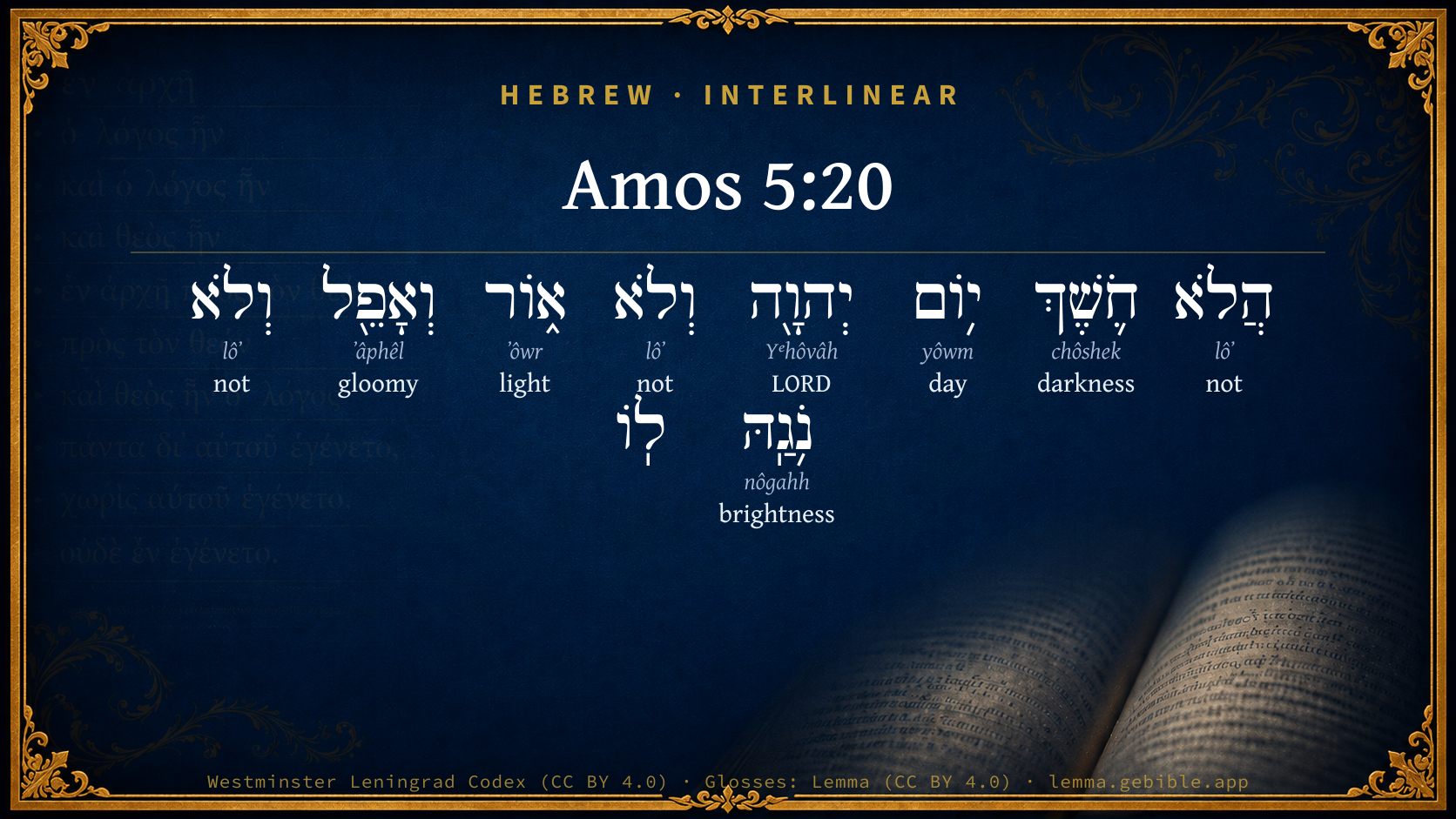
Amos 5:20

Hebrew (Westminster Leningrad Codex) Amos 5:20 appears in the Hebrew Old Testament. The text above is from the Westminster Leningrad Codex. Each word links to its Strong’s number, a concise gloss, and parsing drawn from the Open Scriptures Hebrew Bible morphology. Click any word for its full Brown-Driver-Briggs (BDB) entry.
Download image
Cite this verse

Amos 5:20 (World English Bible). Public Domain. Lemma interlinear Bible study tool, https://lemma.gebible.app/v/amos/5/20.

Show BibTeX & RIS
BibTeX
RIS
English Translation
Will the day of Yahweh not be darkness, and not light? Even very dark, and no brightness in it?
World English Bible · Public Domain
Highlights
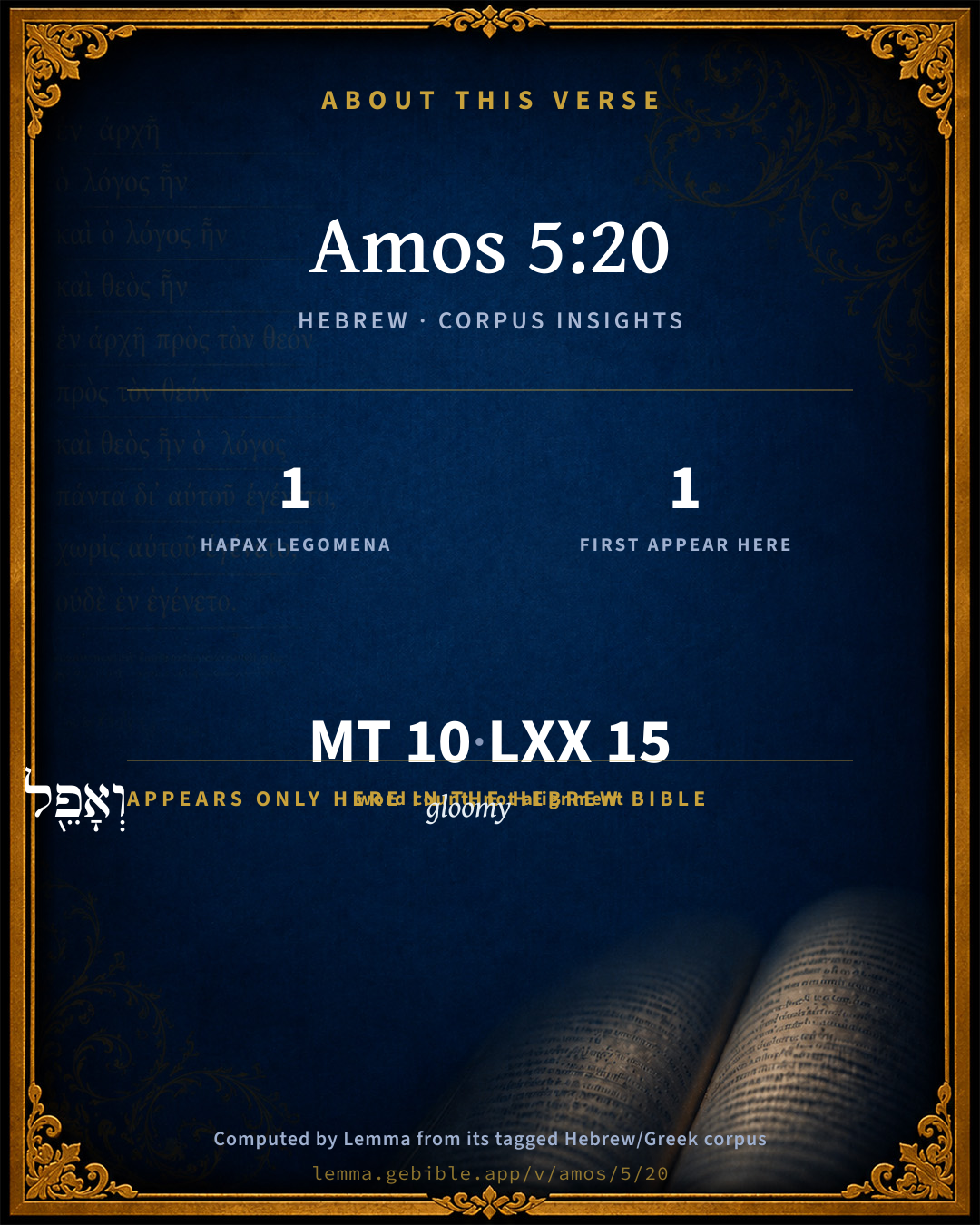
  • 1 hapax legomenon — only here in the Hebrew Bible
  • 1 first appearance in the Hebrew Bible
Full analysis ↓
Download a study sheet

One document with this verse’s original text, its word-by-word gloss line, the meaning frame, cross-references with their text, attributed commentary, and full source and license credits — printable, and it pastes into notes with its structure intact.

This verse Autodidact and up

Study sheet (.html) Plain text (.txt)

A passage Seminary Student

Up to 50 verses in one chapter. A passage sheet keeps up to 6 commentary sources and 12 cross-references per verse, in the order this page ranks them, and says so on the sheet whenever that leaves anything out. Ask for a single verse and you get the Autodidact verse sheet above.

Everything on this page stays free to read, with no account — the sheet is a download of what is already on screen, not access to it.

Want to remove ads? Support Godless Engineer
Compare translations 3

The same verse in 3 English versions, stacked beneath the original-language interlinear above. Click any original word for its lexicon entry.

Each is an independent rendering of the whole verse — the interlinear is not word-aligned to these translations.

Highlighted words mark where these versions differ — a whole-verse word diff, not a word-by-word alignment.

  • World English Bible Public Domain
    Will the day of Yahweh not be darkness, and not light? Even very dark, and no brightness in it?
  • King James Version Public Domain
    Shall not the day of the LORD be darkness, and not light? even very dark, and no brightness in it?
  • unfoldingWord Literal Text CC BY-SA 4.0
    Will not the day of Yahweh be darkness and not light? Gloom and no brightness?

unfoldingWord Literal Text — © unfoldingWord, licensed CC BY-SA 4.0. Word-aligned USFM3 via Door43 (git.door43.org/unfoldingWord/en_ult).

Versions to compare (up to 4)

3 of 4 selected

Show all 18 translations

Every available English version of this verse, each an independent rendering of the whole verse.

  • World English Bible Public Domain
    Will the day of Yahweh not be darkness, and not light? Even very dark, and no brightness in it?
  • Berean Standard Bible Public Domain
    Will not the Day of the LORD be darkness and not light, even gloom with no brightness in it?
  • Majority Standard Bible Public Domain
    Will not the Day of the LORD be darkness and not light, even gloom with no brightness in it?
  • King James Version Public Domain
    Shall not the day of the LORD be darkness, and not light? even very dark, and no brightness in it?
  • American Standard Version (1901) Public Domain
    Shall not the day of Jehovah be darkness, and not light? even very dark, and no brightness in it?
  • Revised Version (1885) Public Domain
    Shall not the day of the LORD be darkness, and not light? even very dark, and no brightness in it?
  • Geneva Bible (1599) Public Domain
    Shal not the day of the Lord be darkenes, and not light? euen darkenes and no light in it?
  • Douay-Rheims (1899) Public Domain
    Shall not the day of the Lord be darkness, and not light: and obscurity, and no brightness in it?
  • Young's Literal Translation Public Domain
    Is not the day of Jehovah darkness and not light, Even thick darkness that hath no brightness?
  • Literal Standard Version CC BY-SA 4.0
    Is not the Day of YHWH darkness and not light, || Even thick darkness that has no brightness?
  • Unlocked Literal Bible CC BY-SA 4.0
    Will not the day of Yahweh be darkness and not light? Gloom and no brightness?
  • unfoldingWord Literal Text CC BY-SA 4.0
    Will not the day of Yahweh be darkness and not light? Gloom and no brightness?
  • Darby Bible Public Domain
    Shall not the day of Jehovah be darkness, and not light? even very dark, and no brightness in it?
  • World Messianic Bible Public Domain
    Won’t the day of the LORD be darkness, and not light? Even very dark, and no brightness in it?
  • Webster's Bible Public Domain
    Shall not the day of the LORD be darkness, and not light? even very dark, and no brightness in it?
  • Free Bible Version CC BY-SA 4.0
    Isn't the day of the Lord darkness without light? Yes, pitch dark without a glimmer of light.
  • Bible in Basic English Public Domain
    Will not the day of the Lord be dark and not light? even very dark, with no light shining in it?
  • JPS Tanakh (1917) Public Domain
    Shall not the day of the LORD be darkness, and not light? Even very dark, and no brightness in it?

Literal Standard Version (2020), Covenant Press — licensed CC BY-SA 4.0. Text via the HelloAO Bible API (eBible.org). Unlocked Literal Bible (unfoldingWord) — licensed CC BY-SA 4.0. Text via the HelloAO Bible API (eBible.org). unfoldingWord Literal Text — © unfoldingWord, licensed CC BY-SA 4.0. Word-aligned USFM3 via Door43 (git.door43.org/unfoldingWord/en_ult). Free Bible Version, Dr. Jonathan Gallagher — licensed CC BY-SA 4.0. Text via the HelloAO Bible API (eBible.org).

Word by word

More ways to search: Search by grammar → Find every occurrence → Compare this word →

Practice this passage: Drill this verse → Learn its vocabulary →

About this verse

These counts appear in no published source. They are computed here, from the morphology-tagged text and Lemma’s own curated glosses. What Lemma adds →

10
words
7
distinct lemmas
Prophets
section

Notable vocabulary

1 hapax legomenon — a word that appears only here in the entire Hebrew Bible:

  • וְאָפֵ֖ל gloomy H651

First appearance in Scripture

This word makes its first canonical appearance in the Hebrew Bible here:

  • וְאָפֵ֖ל gloomy H651

Shared distinctive vocabulary

נֹ֥גַֽהּ brightness H5051 occurs in 19 verses of the Hebrew Bible. Also found in:

Grammatical profile

  • 5 nouns
  • 1 adjective
  • 1 preposition
  • 3 particles

Repetition

A word recurs within this verse — often emphatic in Hebrew:

  • הֲלֹא not H3808 ×3

Hebrew & Septuagint length

In English translation the verse runs 19 words from the Hebrew and 19 from the Septuagint (LXX English) — the same length.

A rough comparison of the two English renderings, which tokenize alike — not a word-level alignment.

Word counts can differ between the Hebrew and the Greek without any difference in meaning — e.g. the Hebrew direct-object marker אֵת has no separate Greek word, and Greek often adds the article ὁ.

In the original languages it is 10 Hebrew tokens and 15 Greek tokens — but the two are counted differently (Hebrew bundles its prefixes and suffixes into one token; the Greek is in lemma form), so that isn’t a like-for-like length.

Cross-references

9

Topical passages linked to Amos 5:20 in the Treasury of Scripture Knowledge — connected by theme and wording, ordered by reader-vote popularity; previews shown in the World English Bible.

  • Isaiah 13:10 For the stars of the sky and the constellations of it shall not give their light; the sun shall be darkened in its going forth, and the moon shall not cause its light to shine.
  • Ezekiel 34:12 As a shepherd seeks out his flock in the day that he is among his sheep that are scattered abroad, so will I seek out my sheep; and I will deliver them out of all places where they have been scattered in the cloudy and dark day.
  • Zephaniah 1:15 That day is a day of wrath, a day of distress and anguish, a day of trouble and ruin, a day of darkness and gloom, a day of clouds and blackness,
  • Job 10:21–22 Before I go where I shall not return from, To the land of darkness and of the shadow of death;
  • Job 3:4–6 Let that day be darkness; Don't let God from above seek for it, Neither let the light shine on it.
  • Nahum 1:8 But with an overflowing flood, he will make a full end of her place, and will pursue his enemies into darkness.
  • Matthew 22:13 Then the king said to the servants, 'Bind him hand and foot, take him away, and throw him into the outer darkness; there is where the weeping and grinding of teeth will be.'
  • Jude 1:13 wild waves of the sea, foaming out their own shame; wandering stars, for whom the blackness of darkness has been reserved forever.
  • Revelation 16:10 The fifth poured out his bowl on the throne of the beast, and his kingdom was darkened. They gnawed their tongues because of the pain,

Cross-references courtesy of OpenBible.info (CC BY 4.0).

Hebrew and Greek witnesses Masoretic Hebrew ↔ Greek Septuagint

The same verse in the two great witnesses to the Old Testament, shown verse-for-verse.

These are two independent witnesses, not word-aligned to each other, and the Septuagint is shown in lemma (dictionary) form.

Hebrew Amos 5:20 Masoretic · Westminster Leningrad Codex

הֲלֹא חֹ֛שֶׁךְ י֥וֹם יְהוָ֖ה וְלֹא א֑וֹר וְאָפֵ֖ל וְלֹא נֹ֥גַֽהּ לֽוֹ

Will the day of Yahweh not be darkness, and not light? Even very dark, and no brightness in it?

World English Bible · Public Domain

Greek LXX Amos 5:20 Septuagint · lemma form

οὐ σκότος ὁ ἡμέρα ὁ κύριος καί οὐ φῶς καί γνόφος οὐ ἔχω φέγγος αὐτός

Is not the day of the Lord darkness, and not light? and is not this day gloom without brightness?

LXX2012 (modern English Septuagint) · Public Domain

Hebrew: Westminster Leningrad Codex (CC BY 4.0). Greek: Septuagint (public domain); English from LXX2012 (modern English Septuagint) (Public Domain). How the Septuagint differs from the Hebrew →

Targum (Aramaic paraphrase)

1

The Targum is the ancient Jewish Aramaic paraphrase of the Hebrew Scriptures — an interpretive translation, not the Hebrew text itself. Onkelos (literal) and Pseudo-Jonathan (expansive) render the Torah, and Jonathan the Prophets. Coverage is partial: where no permissively-licensed English translation exists for a verse, only the Aramaic is shown. This is verse-level text, not a word-by-word alignment to the Hebrew.

  1. Targum Jonathan Prophets (Joshua–Malachi)
    הֲלָא חֲשׁוֹךְ יוֹמָא דְעָתִיד לְמֵיתֵי מִן קֳדָם יְיָ וְלָא נְהוֹר וּקְבַל וְלָא זֵהוֹר לֵיהּ:

    (no public-domain English translation for this verse)

    Targum Jonathan — Aramaic: “Mikraot Gedolot” (public domain). English: “Sefaria Community Translation” (CC0 1.0 (public-domain dedication)); “London "Chaldee Paraphrase," 1871” (public domain). Text via Sefaria.

Commentary

Notes on Amos 5:20 from classic Christian and Jewish commentators (each source and its license shown beneath its notes). The classic Christian expositions comment on the surrounding passage and are grouped to its opening verse, so a note may address several verses; the Jewish commentaries on the Tanakh (Rashi and others) are per-verse, so they appear only where the commentator wrote on this verse.

Lemma curates 59 commentaries, every one of them public domain or Creative Commons licensed, each selected and text-cleaned for this edition rather than reprinted as found. About our sources →

Trapp's Complete Commentary

John Trapp

Amo 5:20 [Shall] not the day of the LORD [be] darkness, and not light? even very dark, and no brightness in it?

Ver. 20. Shall not the day of the Lord be darkness, &c.] q.d. How say ye now; when thus beset with mischief on all hands, such as ye can neither avoid nor abide, must ye not needs subscribe to the truth of what I said, Amo 5:18, and do here again repeat (that you may the better observe it) with greater emphasis and earnestness? you shall not have the least glimmering of comfort, ease, direction, or good counsel. To what end, then, should you desire this dreadful day of the Lord? Are you in haste to be undone?

John Trapp, A Commentary or Exposition upon All the Books of the Old and New Testament (1647–1656) — public domain. Text from a community e-Sword module.

John Calvin's Commentaries

“You have no reason,” he says, “to hope for any light from the day of Jehovah.” Why? “For Jehovah will not come, except when armed; for, as ye conduct yourselves in a hostile manner towards him, he must necessarily take vengeance. He will, therefore, bring with him no light, except it may be to fulminate against you: but his appearance will be dreadful, even darkness and thick darkness; and then, when he ceases to pursue you in one way, he will assail you in another; and, when foreign enemies spare you, God will find means by which he may destroy you in your own land without the agency of men; for ye have already found what the sterility of the land is, and what pestilence is: the Lord then has all such modes of vengeance in his own hand. Think not, therefore, that there will be any alleviation to you, were the world to change a hundred times, and were the condition of the country wholly different.”

But the Prophet did not intend here to drive all those indiscriminately into despair, who were guilty of grievous offenses, but his design was to shake off from hypocrites their self-flatteries, that by such proofs they might be led to know that God would be ever like himself. If, then, they wished to return into favor with him, he shows that a change was needful: when they put off their perverse conduct, God would be instantly ready to give them pardon; but, if they proceeded in their vices and obstinate wickedness, and always continued in that hardness, in which they had hitherto indulged, he declares, that the day of Jehovah would be ever to them dark and gloomy, and that, though the Lord does not always use the same kind of rod, he yet has means innumerable, by which he can destroy a perverse nation, such as the Israelites then were.

John Calvin's Commentaries (1540-1563) — public domain. Text from the Calvin Translation Society English edition (1840s-50s) via the Christian Classics Ethereal Library (ccel.org). Calvin's coverage is partial (roughly two-thirds of the Bible); uncommented books and verses are honest gaps, never fabricated. The 19th-century editor's footnotes and remarks are omitted so the notes are faithfully Calvin's own voice.

Ellicott's Commentary for English Readers

(20) Darkness.—In the form of an interrogative, the condemnation contained in Amo_5:18 is emphatically reasserted. The term rendered “very dark” is that used to denote the gross Egyptian darkness that might be felt (Exo_10:22), the awful gloom, such as fell on Jerusalem at the Crucifixion, which is always accompanied by the sense of confusion, terror, and intolerable suspense. (Comp. the graphic metaphorical language of Isa_5:30.)

A Bible Commentary for English Readers, edited by Charles John Ellicott (1878–1897) — public domain. Text from a community e-Sword module.

The Cambridge Bible for Schools and Colleges

gen. ed. J. J. S. Perowne

20. An emphatic repetition of the thought of Amo_5:18, after the illustration of Amo_5:19.

The Cambridge Bible for Schools and Colleges (gen. ed. J. J. S. Perowne; Cambridge University Press, 1878–1918) — public domain. Text from a community e-Sword module.

John Gill's Exposition

Shall not the day of the Lord be darkness, and not light?.... The design of such a question is strongly to affirm, that, in this day of the Lord spoken of, there should be nothing but misery and distress, and no prosperity and happiness, at least to the wicked Israelites, or the unbelieving Jews:

even very dark, and no brightness in it? signifying that there should be no deliverance, nor the least glimmering view or hope of it; that the calamity should be so very great, and the destruction so entire, that there should be no mixture of mercy, nor the least appearance of relief.

John Gill's Exposition of the Whole Bible (1746–1763) — public domain (CC PDM 1.0). Text via the HelloAO Bible API.

Albert Barnes' Notes on the Bible

Shall not the Day of the Lord be darkness? - He had described that Day as a day of inevitable destruction, such its man’s own conscience and guilty fears anticipate, and then appeals to their own consciences, “is it not so, as I have said?” People’s consciences are truer than their intellect. However, they may employ the subtlety of their intellect to dull their conscience, they feel, in their heart of hearts, that there is a Judge, that guilt is punished, that they are guilty. The soul is a witness to its own deathlessness, its own accountableness, its own punishableness . Intellect carries the question out of itself into the region of surmising and disputings. Conscience is compelled to receive it back into its own court, and to give the sentence, which it would fain withhold. Like the god of the pagan fable, who changed himself into all sorts of forms, but when he was still held fast, gave at the last, the true answer, conscience shrinks back, twists, writhes, evades, turns away, but, in the end, it will answer truly, when it must. The prophet then, turns quick round upon the conscience, and says, “tell me, for you know.”

Albert Barnes' Notes on the Bible (1834–1885) — public domain. Text from a community e-Sword/MySword module.

Matthew Poole's English Annotations

All these things considered, ye secure, profane, and atheistical scoffers, speak yourselves, will not that day be as dark as I have described, and as little to your comfort?

Matthew Poole's English Annotations on the Holy Bible (1683–1685) — public domain. Text from a community e-Sword/MySword module.

The Pulpit Commentary

The character of the day of the Lord is enforced with reiterated earnestness (ver. 18) by an appeal to the conscience of e hearers. Do you not feel in your inmost hearts that in the case of such guilt as yours the Lord can visit but to punish?

The Pulpit Commentary (1880–1919), ed. H.D.M. Spence-Jones & Joseph S. Exell — public domain. Text from a community e-Sword module.

Lesson kit

Teaching starters — assembled from the data on this page, not authored interpretation. Every prompt links to the verse data it draws on. Edit before teaching.

Amos, in the Prophets, opens this verse with 10 words (7 distinct Hebrew lemmas). Its most distinctive word is ʼâphêl (“gloomy”). A historical commentator’s framing appears above. Read the whole chapter for the surrounding context.

Discussion questions

  1. The word ʼâphêl carries the sense “gloomy.” How does it shape the verse?
  2. 1 word here appears nowhere else in the Hebrew Bible. Why might the author reach for such rare wording?
  3. This is the first place “gloomy” appears in Scripture (first appears here). What does its debut here establish?
  4. How does 2 Samuel 22:13, which shares the word «brightness», read alongside this verse?
  5. What does the repetition of “not” (3× in this one verse) do in this verse?
  6. These translations render this verse differently. What is at stake in choosing one wording over another?
  7. Compare how Trapp's Complete Commentary and John Calvin's Commentaries read this verse. Where do they agree or differ?

Things to notice

  • 1 word in this verse appears nowhere else in the Hebrew Bible.
  • 1 word makes its first canonical appearance in Scripture here.
  • This verse counts 10 Hebrew ↔ 15 Greek words.
  • These translations choose different wording for 8 words in this verse.
  • “not” occurs 3× in this single verse.

Reading settings

Reading text

Shown beneath each verse's original-language words.

Old Testament
Old Testament edition

Read the OT as the Masoretic Hebrew (MT) or the Greek Septuagint (LXX).

English shown for the Greek Septuagint (in the Hebrew ↔ Greek comparison).

Comparing translations? Open the Compare panel on any verse page to stack up to four side by side.