Hosea 4:10

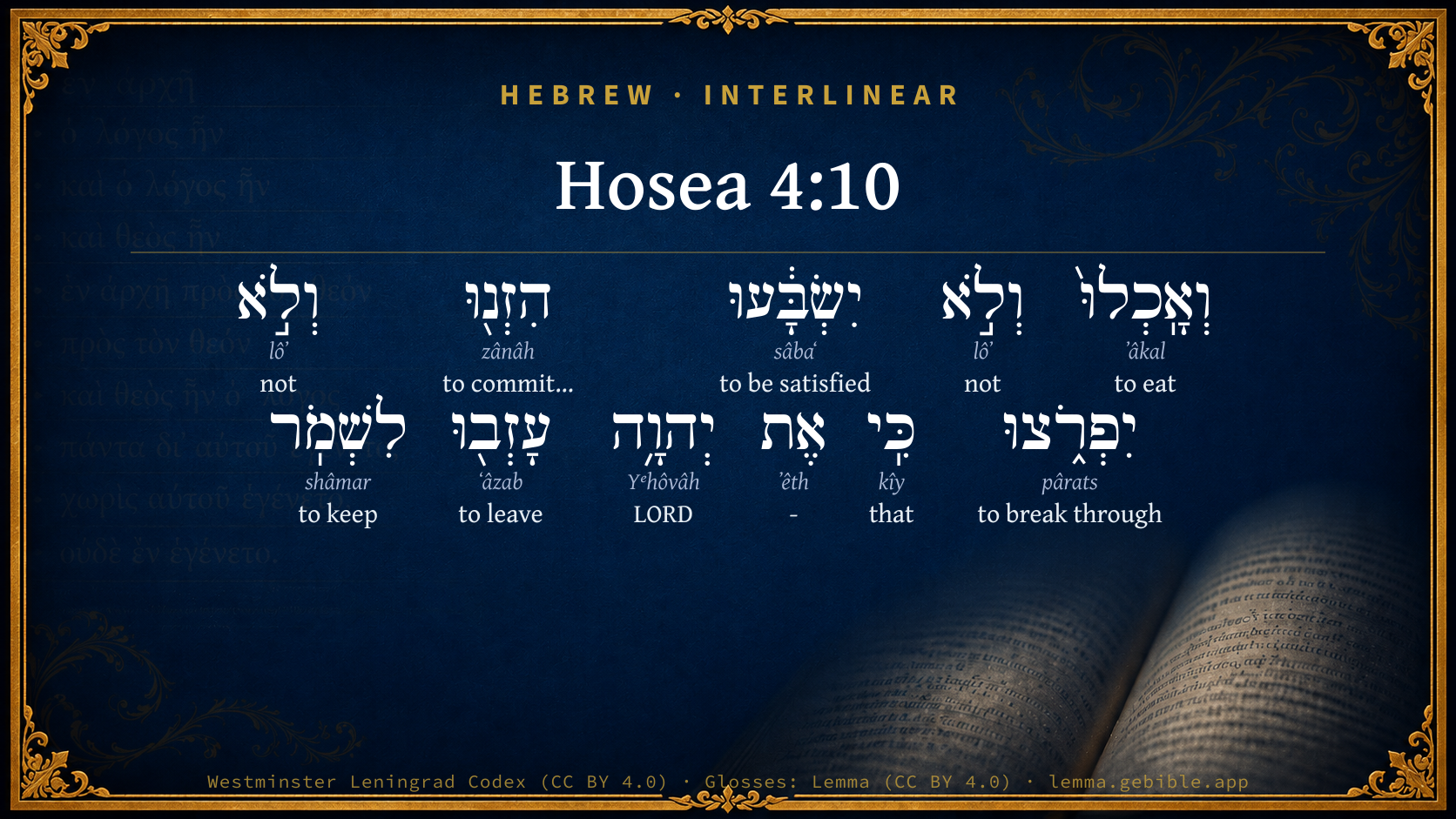
Hebrew (Westminster Leningrad Codex) Hosea 4:10 appears in the Hebrew Old Testament. The text above is from the Westminster Leningrad Codex. Each word links to its Strong’s number, a concise gloss, and parsing drawn from the Open Scriptures Hebrew Bible morphology. Click any word for its full Brown-Driver-Briggs (BDB) entry.
Download image
Cite this verse

Hosea 4:10 (World English Bible). Public Domain. Lemma interlinear Bible study tool, https://lemma.gebible.app/v/hosea/4/10.

Show BibTeX & RIS
BibTeX
RIS
English Translation
They will eat, and not have enough. They will play the prostitute, and will not increase; Because they have abandoned giving to Yahweh.
World English Bible · Public Domain
Download a study sheet

One document with this verse’s original text, its word-by-word gloss line, the meaning frame, cross-references with their text, attributed commentary, and full source and license credits — printable, and it pastes into notes with its structure intact.

This verse Autodidact and up

Study sheet (.html) Plain text (.txt)

A passage Seminary Student

Up to 50 verses in one chapter. A passage sheet keeps up to 6 commentary sources and 12 cross-references per verse, in the order this page ranks them, and says so on the sheet whenever that leaves anything out. Ask for a single verse and you get the Autodidact verse sheet above.

Everything on this page stays free to read, with no account — the sheet is a download of what is already on screen, not access to it.

Want to remove ads? Support Godless Engineer
Compare translations 3

The same verse in 3 English versions, stacked beneath the original-language interlinear above. Click any original word for its lexicon entry.

Each is an independent rendering of the whole verse — the interlinear is not word-aligned to these translations.

Highlighted words mark where these versions differ — a whole-verse word diff, not a word-by-word alignment.

  • World English Bible Public Domain
    They will eat, and not have enough. They will play the prostitute, and will not increase; Because they have abandoned giving to Yahweh.
  • King James Version Public Domain
    For they shall eat, and not have enough: they shall commit whoredom, and shall not increase: because they have left off to take heed to the LORD.
  • unfoldingWord Literal Text CC BY-SA 4.0
    And they will eat but not be full. They prostituted, but they will not increase, for they have forsaken to heed Yahweh.

unfoldingWord Literal Text — © unfoldingWord, licensed CC BY-SA 4.0. Word-aligned USFM3 via Door43 (git.door43.org/unfoldingWord/en_ult).

Versions to compare (up to 4)

3 of 4 selected

Show all 18 translations

Every available English version of this verse, each an independent rendering of the whole verse.

  • World English Bible Public Domain
    They will eat, and not have enough. They will play the prostitute, and will not increase; Because they have abandoned giving to Yahweh.
  • Berean Standard Bible Public Domain
    They will eat but not be satisfied; they will be promiscuous but not multiply. For they have stopped obeying the LORD.
  • Majority Standard Bible Public Domain
    They will eat but not be satisfied; they will be promiscuous but not multiply. For they have abandoned the LORD to give themselves
  • King James Version Public Domain
    For they shall eat, and not have enough: they shall commit whoredom, and shall not increase: because they have left off to take heed to the LORD.
  • American Standard Version (1901) Public Domain
    And they shall eat, and not have enough; they shall play the harlot, and shall not increase; because they have left off taking heed to Jehovah.
  • Revised Version (1885) Public Domain
    And they shall eat, and not have enough; they shall commit whoredom, and shall not increase: because they have left off to take heed to the LORD.
  • Geneva Bible (1599) Public Domain
    For they shall eate, and not haue ynough: they shall commit adulterie, and shall not increase, because they haue left off to take heede to ye Lord.
  • Douay-Rheims (1899) Public Domain
    And they shall eat and shall not be filled: they have committed fornication, and have not ceased: because they have forsaken the Lord in not observing his law.
  • Young's Literal Translation Public Domain
    And they have eaten, and are not satisfied, They have gone a-whoring, and increase not, For they have left off taking heed to Jehovah.
  • Literal Standard Version CC BY-SA 4.0
    And they have eaten, and are not satisfied, || They have gone whoring, and do not increase, || For they have left off taking heed to YHWH.
  • Unlocked Literal Bible CC BY-SA 4.0
    They will eat but not have enough; they will commit prostitution but not increase, because they have gone far away from Yahweh.
  • unfoldingWord Literal Text CC BY-SA 4.0
    And they will eat but not be full. They prostituted, but they will not increase, for they have forsaken to heed Yahweh.
  • Darby Bible Public Domain
    and they shall eat, and not have enough; they shall commit whoredom, and shall not increase: for they have left off taking heed to Jehovah.
  • World Messianic Bible Public Domain
    They will eat, and not have enough. They will play the prostitute, and will not increase; because they have abandoned listening to the LORD.
  • Webster's Bible Public Domain
    For they shall eat, and not have enough: they shall be guilty of lewdness, and shall not increase: because they have ceased to take heed to the LORD.
  • Free Bible Version CC BY-SA 4.0
    They will eat, but they will not be satisfied; they will engage in prostitution, but they will not prosper because they have given up on the Lord to go and prostitute themselves to other gods.
  • Bible in Basic English Public Domain
    They will have food, but they will not be full; they will be false to me, but they will not be increased, because they no longer give thought to the Lord.
  • JPS Tanakh (1917) Public Domain
    And they shall eat, and not have enough, they shall commit harlotry, and shall not increase; because they have left off to take heed to the LORD.

Literal Standard Version (2020), Covenant Press — licensed CC BY-SA 4.0. Text via the HelloAO Bible API (eBible.org). Unlocked Literal Bible (unfoldingWord) — licensed CC BY-SA 4.0. Text via the HelloAO Bible API (eBible.org). unfoldingWord Literal Text — © unfoldingWord, licensed CC BY-SA 4.0. Word-aligned USFM3 via Door43 (git.door43.org/unfoldingWord/en_ult). Free Bible Version, Dr. Jonathan Gallagher — licensed CC BY-SA 4.0. Text via the HelloAO Bible API (eBible.org).

Word by word

More ways to search: Search by grammar → Find every occurrence → Compare this word →

Practice this passage: Drill this verse → Learn its vocabulary →

יִפְרֹ֑צוּ
pârats
H6555
“to break through”
Verb, Qal, Imperfect, 3rd Person, Masculine, Plural
Part of Speech
Verb
Stem
Qal
Form
Imperfect
Person
3rd Person
Gender
Masculine
Number
Plural
Full BDB Definition

Origin: a primitive root

TWOT: 1826

to break through or down or over, burst, breach - (Qal) - to break or burst out (from womb or enclosure) - to break through or down, make a breach in - to break into - to break open - to break up, break in pieces - to break out (violently) upon - to break over (limits), increase - to use violence - to burst open - to spread, distribute - (Niphal) to be broken through - (Pual) to be broken down - (Hithpael) to break away
  1. וְאָֽכְלוּ֙ ʼâkal H398 “and · to eat” Conjunction + Verb, Qal, Sequential Perfect, 3rd Person, Common, Plural
  2. וְלֹ֣א lôʼ H3808 “and · not” Conjunction + Particle, Negative
  3. יִשְׂבָּ֔עוּ sâbaʻ H7646 “to be satisfied” Verb, Qal, Imperfect, 3rd Person, Masculine, Plural
  4. הִזְנ֖וּ zânâh H2181 “to commit fornication” Verb, Hiphil, Perfect, 3rd Person, Common, Plural
  5. וְלֹ֣א lôʼ H3808 “and · not” Conjunction + Particle, Negative
  6. כִּֽי kîy H3588 “that” Conjunction
  7. אֶת ʼêth H853 “-” Particle, Direct Object
  8. יְהוָ֥ה Yᵉhôvâh H3068 “LORD” Noun, Proper
  9. עָזְב֖וּ ʻâzab H5800 “to leave” Verb, Qal, Perfect, 3rd Person, Common, Plural
  10. לִשְׁמֹֽר shâmar H8104 “to keep” Preposition + Verb, Qal, Infinitive Construct

About this verse

These counts appear in no published source. They are computed here, from the morphology-tagged text and Lemma’s own curated glosses. What Lemma adds →

11
words
10
distinct lemmas
Prophets
section

Shared distinctive vocabulary

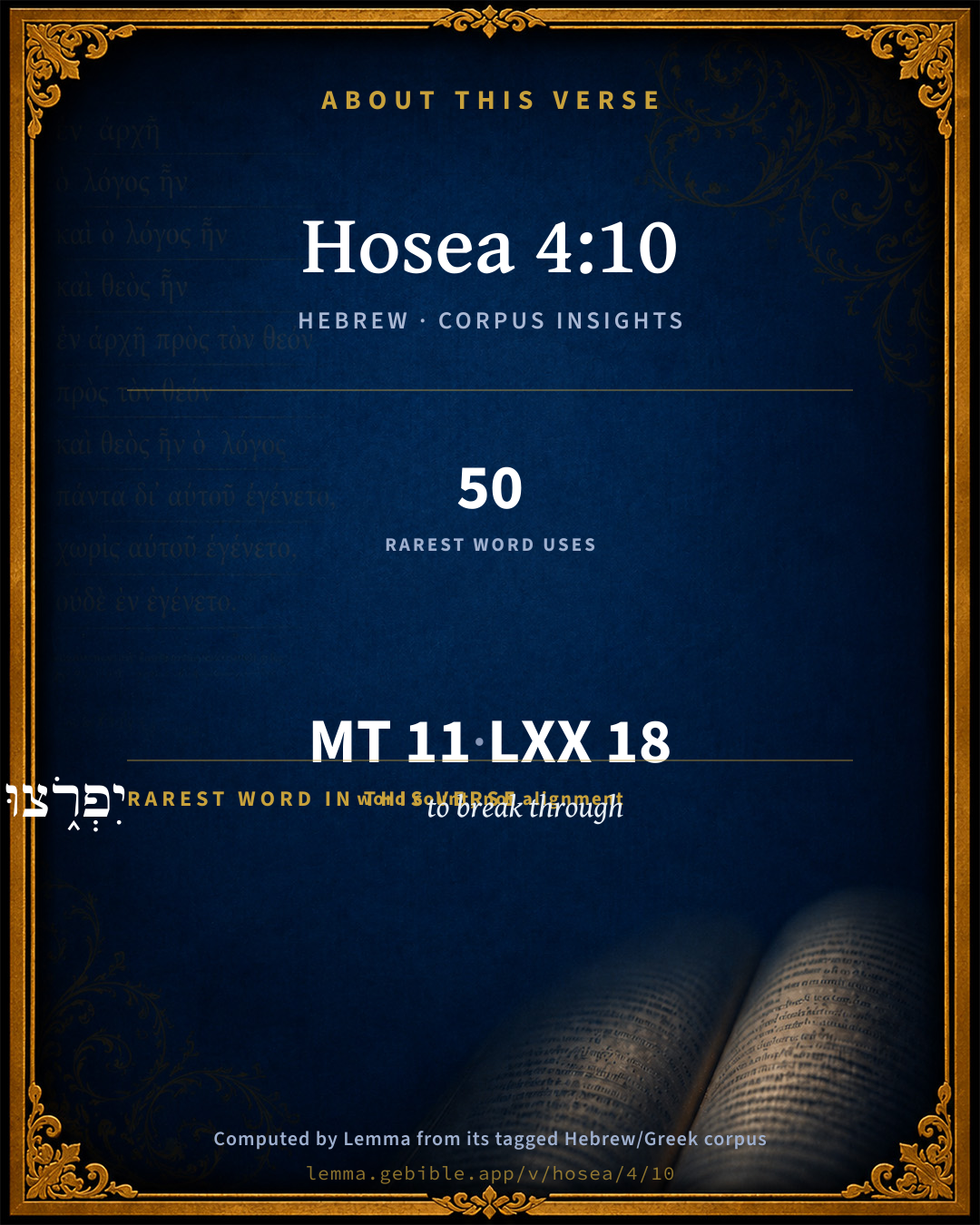
יִפְרֹ֑צוּ to break through H6555 occurs in 48 verses of the Hebrew Bible. Also found in:

Grammatical profile

  • 6 verbs
  • 1 noun
  • 1 conjunction
  • 3 particles

Verb forms

  • וְאָֽכְלוּ֙ Qal · Sequential Perfect
  • יִשְׂבָּ֔עוּ Qal · Imperfect
  • הִזְנ֖וּ Hiphil · Perfect
  • יִפְרֹ֑צוּ Qal · Imperfect
  • עָזְב֖וּ Qal · Perfect
  • לִשְׁמֹֽר Qal · Infinitive Construct

Repetition

A word recurs within this verse — often emphatic in Hebrew:

  • וְלֹ֣א not H3808 ×2

Hebrew & Septuagint length

In English translation the verse runs 23 words from the Hebrew and 30 from the Septuagint (LXX English) — closely comparable.

A rough comparison of the two English renderings, which tokenize alike — not a word-level alignment.

Word counts can differ between the Hebrew and the Greek without any difference in meaning — e.g. the Hebrew direct-object marker אֵת has no separate Greek word, and Greek often adds the article ὁ.

In the original languages it is 11 Hebrew tokens and 18 Greek tokens — but the two are counted differently (Hebrew bundles its prefixes and suffixes into one token; the Greek is in lemma form), so that isn’t a like-for-like length.

Cross-references

14

Topical passages linked to Hosea 4:10 in the Treasury of Scripture Knowledge — connected by theme and wording, ordered by reader-vote popularity; previews shown in the World English Bible.

  • Micah 6:14 You shall eat, but not be satisfied. Your humiliation will be in your midst. You will store up, but not save; And that which you save I will give up to the sword.
  • Leviticus 26:26 When I break your staff of bread, ten women shall bake your bread in one oven, and they shall deliver your bread again by weight: and you shall eat, and not be satisfied.
  • Haggai 1:6 You have sown much, and bring in little. You eat, but you don't have enough. You drink, but you aren't filled with drink. You clothe yourselves, but no one is warm, and he who earns wages earns wages to put them into a bag with holes in it."
  • Psalms 36:3 The words of his mouth are iniquity and deceit. He has ceased to be wise and to do good.
  • Psalms 125:5 But as for those who turn aside to their crooked ways, Yahweh will lead them away with the workers of iniquity. Peace be on Israel.
  • Proverbs 13:25 The righteous one eats to the satisfying of his soul, But the belly of the wicked goes hungry.
  • Zephaniah 1:6 those who have turned back from following Yahweh, and those who haven't sought Yahweh nor inquired after him.
  • 2 Chronicles 24:17 Now after the death of Jehoiada came the princes of Judah, and made obeisance to the king. Then the king listened to them.
  • Isaiah 65:13–16 Therefore thus says the Lord Yahweh, Behold, my servants shall eat, but you shall be hungry; behold, my servants shall drink, but you shall be thirsty; behold, my servants shall rejoice, but you shall be disappointed;
  • Ezekiel 18:24 But when the righteous turns away from his righteousness, and commits iniquity, and does according to all the abominations that the wicked man does, shall he live? None of his righteous deeds that he has done shall be remembered: in his trespass that he has trespassed, and in his sin that he has sinned, in them shall he die.
  • Hosea 4:14 I will not punish your daughters when they play the prostitute, Nor your brides when they commit adultery; Because the men consort with prostitutes, And they sacrifice with the shrine prostitutes; And the people that does not understand will come to ruin.
  • Hosea 9:11–17 As for Ephraim, their glory will fly away like a bird. There will be no birth, none with child, and no conception.
  • Malachi 2:1–3 "Now, you priests, this commandment is for you.
  • 2 Peter 2:20–22 For if, after they have escaped the defilement of the world through the knowledge of the Lord and Savior Jesus Christ, they are again entangled therein and overcome, the last state has become worse with them than the first.

Cross-references courtesy of OpenBible.info (CC BY 4.0).

Hebrew and Greek witnesses Masoretic Hebrew ↔ Greek Septuagint

The same verse in the two great witnesses to the Old Testament, shown verse-for-verse.

These are two independent witnesses, not word-aligned to each other, and the Septuagint is shown in lemma (dictionary) form.

Hebrew Hosea 4:10 Masoretic · Westminster Leningrad Codex

וְאָֽכְלוּ֙ וְלֹ֣א יִשְׂבָּ֔עוּ הִזְנ֖וּ וְלֹ֣א יִפְרֹ֑צוּ כִּֽי אֶת יְהוָ֥ה עָזְב֖וּ לִשְׁמֹֽר

They will eat, and not have enough. They will play the prostitute, and will not increase; Because they have abandoned giving to Yahweh.

World English Bible · Public Domain

Greek LXX Hosea 4:10 Septuagint · lemma form

καί ἐσθίω καί οὐ μή ἐνπίμπλημι πορνεύω καί οὐ μή καταεὐθύνω διότι ὁ κύριος ἐν καταλείπω ὁ φυλάσσω

And they shall eat, and shall not be satisfied: they have gone a-whoring, and shall by no means prosper: because they have left off to take heed to the Lord.

LXX2012 (modern English Septuagint) · Public Domain

On this verse, Haydock's Catholic Bible Commentary discusses the Septuagint’s reading. Read the note in Commentary ↓

Hebrew: Westminster Leningrad Codex (CC BY 4.0). Greek: Septuagint (public domain); English from LXX2012 (modern English Septuagint) (Public Domain). How the Septuagint differs from the Hebrew →

Targum (Aramaic paraphrase)

1

The Targum is the ancient Jewish Aramaic paraphrase of the Hebrew Scriptures — an interpretive translation, not the Hebrew text itself. Onkelos (literal) and Pseudo-Jonathan (expansive) render the Torah, and Jonathan the Prophets. Coverage is partial: where no permissively-licensed English translation exists for a verse, only the Aramaic is shown. This is verse-level text, not a word-by-word alignment to the Hebrew.

  1. Targum Jonathan Prophets (Joshua–Malachi)
    וְיֵכְלוּן וְלָא יִסְבְּעוּן יִסְבוּן נְשִׁין וְלָא יוֹלְדוּן בְּנִין אֲרֵי יַת פּוּלְחָנָא דַייָ שְׁבָקוּ וְלָא נְטָרוּ:

    (no public-domain English translation for this verse)

    Targum Jonathan — Aramaic: “Mikraot Gedolot” (public domain). English: “Sefaria Community Translation” (CC0 1.0 (public-domain dedication)); “London "Chaldee Paraphrase," 1871” (public domain). Text via Sefaria.

Commentary

Notes on Hosea 4:10 from classic Christian and Jewish commentators (each source and its license shown beneath its notes). The classic Christian expositions comment on the surrounding passage and are grouped to its opening verse, so a note may address several verses; the Jewish commentaries on the Tanakh (Rashi and others) are per-verse, so they appear only where the commentator wrote on this verse.

Lemma curates 59 commentaries, every one of them public domain or Creative Commons licensed, each selected and text-cleaned for this edition rather than reprinted as found. About our sources →

Trapp's Complete Commentary

John Trapp

Hos 4:10 For they shall eat, and not have enough: they shall commit whoredom, and shall not increase: because they have left off to take heed to the LORD.

Ver. 10. For they shall eat and not have enough] Only they shall be filled with their own ways, Pro 14:14, but that is but to feed upon the wind with Ephraim, Hos 12:1, which breedeth nothing but troublesome belching, or a dog-like appetite (as they call it), that cannot be satisfied (Bουλιμια, appetitus caninus desire of a dog). These greedy dogs, the priests, that did eat up the sins of God’s people, and thought to have fullly gorged themselves therewith, they met with that sore plague of unsatisfiableness for the present (a man may as soon fill a chest with wind as soul with wealth ( Non plus satiatur cor auro quam corpus aura, Aug.); see Ecc 5:10) {See Trapp on "Ecc 5:10"} and for the future they coveted an evil covetousness to themselves, for they got God’s curse along with their illgotten goods which will bring them to a morsel of bread they have not only sucked in the air, but pestilential air, that not only not fills them, but kills them too. {See Trapp on "Hag 1:6"}

They shall commit whoredom, and shall not increase] The Chaldee renders it, They shall take wives, but shall not beget sons. Sol et homo generant hominem, saith the philosopher; but unless God, the first agent, concur, that cannot be neither. Lo, "Children are an heritage of the Lord: and the fruit of the womb is his reward," saith David to his son Solomon, who found it true by experience, Psa 127:3, for by all his wives and concubines (no less than a thousand) he had but one son that we read of and he was none of the wisest; nothing like Edward VI, whom alone Henry VIII left (with his two sisters) to succeed him; though he had so many wives and concubines. Wantonness is a sin commonly punished with warn of posterity: especially when it is accompanied with obstinace in evil courses, as in Ahab who, to cross God’s threat of rooting out him and his posterity, took many wives; and so bestirred him, that he begat of them seventy sons, but with evil success; for they were all cut off in one day, 2Ki 10:7. Wicked men must not think to carry it against God; and to have their wills al disputo di Dio, as that profane pope said; and as that graceless Ahaziah, who sent a third captain, after that the former two had been consumed by fire; as if he would despitefully spit in the face of heaven, and wrestle a fall with the Almighty. Let no man expect to prosper in unlawful practices, to increase by whoredom, as these profane priests sought to do, that they might be full of children (anyhow): and leave the rest of their substance to their babes, Psa 17:14. But fertility is not from the means (right or wrong), but from the author (many a poor man hath a house full of children by one wife; while Solomon hath but one son by many houses full of wives), and Job could tell that whoredom is a fire that consumeth to destruction, and would root out all his increase, Job 31:12.

Because they have left off to take heed to the Lord] God is not bound to render a reason for his proceedings, yet doth it oft, as here, that he may be justified, and every mouth stopped. Their apostasy is here shown to be the cause of their calamity. There was a time when they took some heed to God and his ways: they kept close to him, and observed his commandments to do them (as the word here importeth), but now they had left off to be wise, and to do good, {Psa 36:3} until their iniquity was found to be hateful, and themselves altogether filthy, Psa 53:3, wicked doers against the covenant, Dan 11:30; Dan 11:32. Apostates cannot choose unto themselves a worse condition, 2Pe 2:20; 2Pe 2:22 Mat 12:43; Mat 12:45, let them look to it. Hath ever any waxed fierce against God and prospered? Job 9:4; even of late my people are risen up against me as an enemy, Mic 2:8, but what will they do in the end thereof?

John Trapp, A Commentary or Exposition upon All the Books of the Old and New Testament (1647–1656) — public domain. Text from a community e-Sword module.

The Preacher's Complete Homiletical Commentary

Joseph S. Exell (gen. ed.)

CRITICAL NOTES.—

Hos_4:10. Enough] Not be satisfied. Left off] keeping, observing Jehovah (Zec_11:11). All other means of increase failed. Polygamy against the law, and will bring the curse of God.

Hos_4:12. My people] Their wood, give keenness to the reproach. God’s people seek to be instructed by a staff, depend on wooden idols constantly and entirely! From under] his authority and subjection.

Hos_4:13. Tops] Thought to be near God and heaven (Deu_12:2). Shadow] screening from the heat of the sun, and filling the mind with certain awe. God delivers up to vile affections as a punishment for idolatry (Rom_1:26).

Hos_4:14.] God turns from the reckless nation as unworthy of being mentioned, and speaks in the third person. They] Husbands and fathers go aside to be alone with harlots. Sacrifice] Come to the altar with them instead of their own wives, “the climax of shameless licentiousness.” The young cannot be blamed, for the older are much worse. Hos_4:15-19 a warning to Judah not to partake of Israel’s guilt.

HOMILETICS

SINFUL INDULGENCES.—Hos_4:10-14

God will visit the priests for their presumptuous sins. Those who eat up greedily the sin of the people shall receive neither enjoyment nor sustenance. Insatiable desire is its own tormentor. Sonsual indulgence can never satisfy the cravings of the soul. “Ye eat, but ye have not enough; ye drink, but ye are not filled with drink.”

I. Sensual indulgences do not satisfy our wants. “For they shall eat and not have enough.” The food of the priests did not nourish their bodies, nor satisfy their greedy appetites. Sinful desires are never satisfied. The more they are gratified the more intensely do they crave, and cry, like the horse-leech, “Give, give.” Every indulgence creates the appetite. Men seek happiness in created good, and are wretched because they do not find it. God made man upright, with a healthy spiritual appetite, that sought its support and fruition in him. But deceived by sin, man sought out many inventions, prepared many idols, and substituted many pleasures for God, which cannot appease his hunger. The debaucheries of drunkenness, gluttony, and lust, are husks only fit for swine. The cares and toils of sin, the pursuit of wealth and honour, of fame and fashion, indicate the disease, but give no satisfaction to the soul. Even amid the surfeits of earth’s richest feasts men cry, “Who will show us any good?” Charles the Fifth, after a life spent in military pursuits and the active, energetic prosecution of ambitious designs, resigned his crown sated with its enjoyment. The poet Campbell, who sung in early youth “The Pleasures of Hope,” in the evening of life said to a circle of friends, “As for fame, it is a bubble that must soon burst. Earned for others, shared with others, it was sweet; but, at my age, to my own solitary experience, it is bitter. Left in my chamber alone with myself, is it wonderful my philosophy at times takes fright; that I rush into company; resort to that which blunts but heals no pang; and then, sick of the world, and dissatisfied with myself, shrink back into solitude?” They spend their lives and waste their substance in that which disappoints; “confessing all the time,” says a writer, “that they fail even when in form they succeed, and showing by their symptoms of disappointment and dissatisfaction that their objects, whether gained or lost, have no relation to their wants.” Nothing can satisfy the immortal soul that is not adapted to its nature and constitution. The enjoyment must be lasting and real, but the pleasures of sin are short-lived and only “for a season.” They gratify and excite, but never satisfy the mind. Our thirst dries up all earthly things, and our hunger craves for fuller joys than sensual indulgences. We must go out of ourselves, beyond the things of sense, and feed on God, the only good.

II. Sensual indulgences are pursued by unlawful means. “They shall commit whoredom and shall not increase.”

1. They are increased by sinful methods. Whoredom was not the way to increase their offspring. Children are a heritage from God. Polygamy is against the law of God and the welfare of humanity. The fruit of illicit intercourse God will turn to decay. Those who seek to increase in their families, to prosper in their business, and secure worldly wealth, by unlawful means, fight against God. Dishonest ways can never prosper. Nothing can succeed without God. He can desert the means or curse the issue. “Treasures of wickedness profit nothing (Pro_10:2); ill-gotten gains are a dangerous and uncertain possession (Pro_13:11; Pro_21:6); and the wages of unrighteousness will be the reward of those who follow ways of covetousness and sin.”

2. They are sought in forgetfulness of God. “They have left off to take heed to the Lord.” Once they regarded God’s authority and law, but now they take no heed at all. God is neither acknowledged in worship nor discerned in providence. They live in total forgetfulness and disregard. Men should “take heed,” look to God, “as the eyes of servants look unto the hands of their masters,” for support, direction, and duty. But when the eye is fixed on lower objects, and the heart centred on sinful pursuits, God is forgotten and forsaken. The lawless and hopeless ways of men spring from disregard to God and neglect of his word. When the eye ceases to watch God, they fall into error, wander amid the pomps, and vanities, and lusts of the world. “Show me what thou truly lovest,” says Fichte, “show me what thou seekest and strivest for with thy whole heart, when thou hopest to attain to true enjoyment, and thou hast hereby shown me thy life. What thou lovest is that thou livest. This very love is thy life, thy root, the seal, the central point of thy being.”

III. Sensual indulgences injure the spiritual nature. They were so attached to whoredom and wine that they seemed to have lost all sense of moral duty and religious obligation, and given themselves up to “work all manner of sin even with greediness.”

1. Sensual indulgences darken the understanding. They “take away the heart” from God their Benefactor. Sinful passions brutalize men, and “a brutish man knoweth not.” The unbelieving heart does not know nor understand God and his word. Men may parade their intellect, and boast of their gifts, but estrangement from God degrades their condition, and sinks them in the rank of being. If we have no sanctified principle within us, we look at God’s works, interpret God’s ways, and receive God’s blessing, just like the beasts of the field. We extract no useful and spiritual thoughts from them. We are content with the natural use, nay, we degrade the natural use of things. Vain imaginations darken the foolish heart (Rom_1:22). When the light and life of God have departed from the soul, when the wicked have cast out the knowledge of God, God will give “them over to a reprobate mind;” a mind void of judgment and perception, weakened in power to apprehend and approve of the truth and goodness of God (Rom_1:28). When once sinful indulgence darkens the mind, it becomes stupid, and its active powers are suffered to sleep in stupidity. Men could not preserve the truth and philosophy, could not retain the knowledge of God, without moral aid. Habits of sense and sin, of indulgence and passion, destroy the perception of the mind and blunt the understanding. Sensual life impairs and paralyzes the intuitive powers and bedims the judgment. What a sad picture to see the decay of knowledge, to see the moral sense extinguished in man, the king and lord, the minister and interpreter, of nature! It is melancholy to see the fair creation, which God pronounced good, poisoned and cursed by disease and death. But to make religion degenerate into idolatry, to pervert the moral instincts of our nature, and confound by evil habits and constant crimes the distinction between right and wrong, light and darkness, is sad beyond degree! “If the light that is in thee be darkness, how great is that darkness!”

2. Sensual indulgences deaden the affections. Man is a creature of appetites and instinctive desires, in common with the mere animal. If he were nothing more, he would be innocent in the abandonment of himself to their gratification. But they need controlling, lest his higher interests be endangered—his instincts and affections must be subordinated to a sense of duty and the love of God. If the sensuous predominate over the spiritual, and self-indulgence and self-gratification become the law of life, then his nobler feelings are crushed and his affections vitiated. “Fleshly lusts” war against the soul, the very centre and citadel of man’s nature. The “divers lusts and pleasures,” to which natural man is a slave, are dishonourable to the Christian and perilous to all. They disturb the peace of the soul by corroding care and by the tumult of passion—they darken its vision, and taint its powers with corruption—they threaten its life, and intercept its communication with God and spiritual influences. To be carnally-minded is death. In spiritual death men are “past feeling” and beyond the charms of life. The conscience is stifled, the heart hardened through the deceitfulness of sin, and they are left without moral sense, and shame, and hope.

3. Sensual indulgences debase the moral nature. Every created object expresses some thought, some quality of the Divine nature. The moral character of God was revealed in the moral nature of man. “God created man in his own image, in the image of God created he him,” in knowledge and true holiness. “Man,” says Clement, “is the most beautiful hymn to the praise of the Deity.” Divine properties in him were incarnated and humanized, and lodged in him were principles before at large. He was “crowned with glory and honour.” But he voluntarily broke away from God, deranged the harmony of his moral nature, disturbed the peace of the universe, and exposed himself to death. Sin has defaced God’s image, and man has lost his original righteousness. The understanding is blinded by ignorance and prejudice. The heart is alienated from God by wicked works. The affections are disordered, and the desires corrupted. Man is now subject to sense and a slave to sin. He defiles himself by the filthiness of the flesh, and deforms himself by sensual indulgence. Luxury and lusts bind the will and make him unable and indisposed to restore himself. He has become the sport and prey of his passions. There is a tendency to animalism, and an immortal being is compelled to ride on the back of lusts and “presumptuous sins.” There is a loss of the consciousness of God and a forgetfulness of the presence of God. The supernatural tie is broken, and man wanders into error and lives in earthly, sensual, and devilish sins. Any idol debases the moral nature, and changes the glory which distinguishes man “into the similitude of an ox” (Psa_106:20).

IV. Sensual indulgences are oftenconnected with superstition. “My people ask counsel at their stocks, and their staff declareth unto them.” It was a sad fall for the people of the living God to consult a heathen staff and say to mere wood, My father (Jer_2:27). But the descent is easy and gradual. There is a tendency in man to depart from God, to acquire and foster false ideas of God, even in the midst of the clearest indications of his existence and the tenderest reasons for clinging to him. Guilt, fear, and despair isolate the soul and turn it from God—make it drop, and cut it off as a plant from the light of the sun. Then we approach God in terror. We create gods of our own fancy, philosophy, and early prepossessions. “Fear made the gods,” says a heathen writer. It is certain that superstition, polytheism, and atheism are only the counterpart and exponent of the moral condition of nations. Our nature is religious, and the corrupt heart will produce gods like itself. The philosopher contemplates nature, rejects a personal God, and becomes a pantheist. The wicked wishes there to be no God; governed by his wishes, and led to believe against all moral evidence, he says there is no God, and becomes an atheist. The ignorant multitude, dreading God, become superstitious, and foster and express their religious feeling in figurative representations “made by art and man’s device.” Men associate their notions of Deity with the palpable realities by which they are surrounded, and in every light of heaven and every element of nature they behold the presence of a presiding power. The grove and the mountain, the valley and the stream, have been peopled with divinities. The pride of monarchs and the ambition of heroes, the veneration of priests and the licentiousness of people, have swelled the catalogue of gods. In Egypt and Assyria, in Greece and Rome, in their palmiest days, idolatry was supported by the deepest principles, the most violent passions, and the most obvious interest of legislator and prince, sculptor and poet. Originating in the depraved propensities of fallen nature, depending upon their activity for existence and sup port, it afforded a patron for every vice, a plea for every cruelty; it consecrated every lust and sanctioned every crime. Its terrible effects are written in the destruction of institutions, the corruption of morals, and the doom of nations. Modern civilization fares no better. If men do not consult blocks of wood and stone, they kneel before statues and pictures, endow human conceptions with the attributes of Divinity, and set the creature on the throne of the Creator. We have Ritualism and Romanism, priestcraft and priesthood, sacrifice and offering, with their deadly evils. The mind is filled with narrow conceptions, the eyes are habituated to artistic nullities, and the morals are polluted by gross caricatures and sensuous worship. In the bosom of the Christian Church untaught myriads are sinking into modern heathenism, and believe “the Godhead is like unto gold, or silver, or stone.” We have material idolatry and superstition in the present day. The gods of sensualism are represented by lovers of pleasure more than lovers of God—by those who seek enjoyment in the lust of the flesh, the lust of the eye, and the pride of life. The worshippers of the golden calf bow down to riches and worldly success. Devotees of literature and science deify Nature and turn her into a temple of adoration. Worldliness, idolatry, and superstition, in their most refined and plausible forms, vitiate our conceptions of God, lower the standard of morality, wounds society at its core, and spread dire results in families and nations. They have breathed pestilence in the ordinances of the Christian Church—corrupting their simplicity, polluting their sanctity, and tarnishing their glory. Though upheld by the traditions of antiquity, the suggestions of expediency, or the dictates of human authority, they entice, deceive, debase, and are rebellious against the authority, the absolute and sole right of God to claim our homage. “Thou shalt not make unto thee any graven image, or any likeness of anything that is in heaven above, or that is in the earth beneath.”

V. Sensual indulgences affect posterity. “Therefore the people that doth not understand shall fall.” Sin and suffering are inseparable. The moral order of the universe must dissolve and perish before a breach of God’s law can bring anything but evil and distress. Under the moral government of God, the consequences of an act do not pass away with the transgressor. We are taught to calculate upon remote results, impressed with our responsibility and aided in duty. The Jews were commanded to obey God—taught that obedience would secure, and disobedience would forfeit, their privileges to their posterity, and reminded that the principle of involving their children in the temporal condition of the fathers was a just and merciful provision. Religion appeals to the strongest instincts of our nature, guards its purity by enlisting the affection of parents for their offspring, and grafting on that affection a salutary fear of the visitations of God.

1. By the influence of example sensual indulgence affects posterity. “Therefore your daughters shall commit whoredom, and your spouses shall commit adultery.” Children naturally imitate, do as you do, not as you say, and “catch the infection” of parents. Hence a wise man speaks of his children as his “future state.” According to example, will this future be good or evil, a success or a failure. If parents drink and swear, neglect the house and forsake the service of God, will their children walk in any other way? If fathers and mothers are spendthrifts, pleasure-seekers, and indulgent in vice, their children will follow their steps, and God recompenses parents in their children. The child copies the foibles of the father and pleases him; he copies his vices and punishes him. Men may love their sins, but they will be alarmed when they see them in their posterity. Antipathies are imbibed, reproduced, and intensified. Lusts are bred and born, and bring forth death in the rising generation. In the French Revolution, the children amused themselves by killing birds and small animals with little guillotines. This was the natural result of what they had seen. Children live again the lives of their parents, act their deeds, and are rewarded or punished by their example. “God layeth up his iniquity for his children.”

2. By a natural law sensual indulgence affects posterity. Parents and children, the present and the future generation, are bound together not by accidental circumstances, but by organic unity. The existing generation is giving the impress of its character to the one that is to follow it. No man liveth unto himself. Every action in this life is the beginning of a chain of results, the end of which cannot be seen. As in the natural, so in the moral world, there is a “conservation of force.” Example is contagious. Men beneficially or perniciously influence others, raise them up or bring them down to their own standard of morality. Good and evil are diffusive, and seeds of conduct ripen and reappear in the life of others. “That which is born of evil begets evil,” says Ruskin, “and that which is born of valour and honour teaches valour and honour.” The sensualist and the sabbath-breaker, the drunkard and the glutton, are spreading “the savour of death unto death!” The wicked and licentious are influencing the morals of those around them. The health and happiness, the honour and the degradation, of posterity are in the power of the present. When children are “born thieves,” or “born liars,” their parents and progenitors are to blame. Drunkards beget drunkards; dishonesty and lusts are hereditary vices. Sensual and vicious parents beget sensual and vicious children. Diseased parents transmit weakened constitutions and diseased tendencies to their offspring. Thus “the evil that men do,” as well as the good they do, “lives after them.” The law of influence is a continuous, ever-increasing power, working consequences to the end of time. “Thou recompensest the iniquity of the fathers into the bosom of their children after them.”

HOMILETIC HINTS AND OUTLINES

Hos_4:10. Take heed to the Lord.

1. God the object of love, regard, and life.

2. When men do not take heed, disregard God, they fall into sin, wander into the vanities and lusts of the world.

3. Culpable neglect of God, persisted in, is lawless and hopeless, involves the loss of blessing, and ruin. “As the true cause of all men’s departure is their not serious minding of God, that they might observe and love him, so where this neglect is he cares not for external form and performance, and especially is he provoked when men make apostasy from better things to this temper, for it is challenged as the root of their miscarriage and God’s judgments, because they have left off,” &c. [Hutcheson].

Hos_4:11. The Triple Association. Whoredom, voluptuousness, and drunkenness—their influence upon individuals, families, and societies. “As it is God’s judgment on unfaithful ministers and people that they are given up to sensuality, so that will soon besot them and make them sapless in their doctrine and careless in their duty” [Hutcheson].

The Threefold Apostasy.

1. By whoredom, or illicit worship rendered to heathen gods by the chosen people. This worship was spiritual fornication, and by it their hearts were captivated, taken away from that exclusive trust and allegiance which they owed to God, their covenant King.

2. By yayin, wine—the type of sensual gratification—their hearts had been taken away from supreme affection to God, their Divine Redeemer and Benefactor.

3. By tirosh, the fruit of the vine—the type of natural earthly good—their hearts had been captivated from God, the infinite goodness and Fountain of spiritual joy. This was the apostasy of which the children of Abraham had been guilty; they went after strange gods instead of the true God; their best affections centred in sensual pleasures, instead of being fixed upon the Divine love; and their estimate of good was limited to earthly things (represented by tirosh, one of the most delicious of natural elements), instead of embracing him “from whom all blessings flow.” Or taking the ascending scale, their understanding was darkened, for they esteemed temporal good above the Giver of eternal good; their affections were sensualized, by being exclusively engaged with animal delights; and their spiritual nature was debased, by being prostrated before stupid idols [Temp. Commentary].

Hos_4:12. Idolatry does not consist merely in calling upon idols, but also in trust in our own righteousness, works, and service, in riches and human influence and power. And this, as it is the most common, is also the most harmful idolatry [Luther].

Idolatry never stands alone. All the sins of Israel were centred in it. By association even good was magnetized with evil, and confirmed it. In heathen nations it is connected with cruel and barbarous rites—in modern times, lasciviousness and intemperance, with all their attendant evils, follow in its train.

Hos_4:13-14. When men forsake God, mark the steps of degradation.

1. They worship sticks and stocks, inferior creatures.

2. They seek counsel and direction from them, and take any allusion for response.

3. They set up human ordinances for Divine, the creature for the Creator, and consecrate mountains and hills, groves and valleys, as temples of superstition.

4. They forsake God’s direction, go from under his providence and protection. God will not accept any but spiritual worship, and all who forsake him shall perish.

5. They bring ruin upon themselves. “The people that doth not understand shall fall,” and be confounded (Pro_10:8; Pro_10:10). “Ignorance which we might avoid or cure, if we would, is itself a sin. It cannot excuse sin. They shall, he says, fall or be cast headlong. Those who blind their eyes, so as not to see or understand God’s will, bring themselves to sudden ruin, which they hide from themselves, until they fall headlong in it” [Pusey].

The sins of the fathers descend very often to the children, both in the way of nature, that the children inherit strong temptations to their parents’ sin, and by way of example, that they greedily imitate, often exaggerate them. Wouldest thou not have children which thou wouldest wish unborn, reform thyself [Pusey].

ILLUSTRATIONS TO CHAPTER 4

Hos_4:10-11. Sin is a disease equally dangerous, whether it works secretly within, or breaks out into odious displays of vice. Yielding to immoral pleasure corrupts the mind; living to animal and trifling ones debases it; and both in their degree disqualify it for its genuine good, and consign it over to wretchedness [Wilson].

Hos_4:12-14. Idolatry is the adoption of a false god. Apostasy is the rejection of the true God. The idols of the heathen stood, so to speak, between heaven and earth, obscuring the vision of God, intercepting and appropriating the incense which should have ascended to the eternal throne. If we look upon the world as a musical instrument, well-tuned, and harmoniously struck, we ought not to worship the instrument, but the Being that makes the music.

The Preacher's Complete Homiletical Commentary (gen. ed. Joseph S. Exell; Funk & Wagnalls, c. 1892) — public domain (pre-1929). A full-Bible homiletical/sermon-outline anthology covering 65 of 66 books (2 John is absent from the source module). Text from a community e-Sword module.

Tyndale Open Study Notes

Tyndale Open Resources

4:10 God’s judgment matches the punishment to the crime. The Israelites worshiped Canaanite fertility deities with the expectation of bountiful crops and herds, but God’s judgment was that they would still be hungry and their religious prostitution would gain them nothing.

Tyndale Open Study Notes — © Tyndale Open Resources, licensed CC BY-SA 4.0. Text via the HelloAO Bible API.

Geneva Bible (1599)

Geneva Bible translators

Showing that their wickedness shall be punished on all sorts: for though they think by the multitude of wives to have many children, yet they shall be deceived of their hope.

Geneva Bible (1599) marginal notes — public domain. Text via Bolls.life.

Jamieson, Fausset & Brown

Robert Jamieson, A. R. Fausset & David Brown

eat, and not have enough--just retribution on those who "eat up (greedily) the sin of My people" (Hos 4:8; Mic 6:14; Hag 1:6).

whoredom, and . . . not increase--literally "break forth"; used of giving birth to children (Gen 28:14, Margin; compare Gen 38:29). Not only their wives, but their concubines, shall be barren. To be childless was considered a great calamity among the Jews.

Jamieson, Fausset & Brown — Commentary Critical and Explanatory on the Whole Bible (1871) — public domain (CC PDM 1.0). Text via the HelloAO Bible API.

Adam Clarke's Commentary

Verse 10. They shall eat, and not have enough] Whatever means they may use to satisfy or gratify themselves shall be ineffectual.

Adam Clarke's Commentary on the Bible (1810–1826) — public domain. Text from a community e-Sword/MySword module.

John Calvin's Commentaries

I now return to that passage of the Prophet, in which he says, They shall eat and shall not be satisfied, and again, They shall play the wanton and shall not increase; because Jehovah have they left off to attend to. The Prophet here again proclaims the judgment which was nigh the Israelites. And first, he says, They shall eat and shall not be satisfied; in which he alludes to the last verse. For the priests gaped for gain, and their only care was to satisfy their appetites. Since then their cupidity was insatiable, which was also the cause why they conceded sinful liberty to the people, he now says, They shall eat and shall not be satisfied. The Prophet intimates further by these words, that men are not sustained by plenty or abundance of provisions, but rather by the blessing of God: for a person may devour much, yet the quantity, however large, may not satisfy him; and this we find to be often the case as to a voracious appetite; for in such an instance, the staff of bread is broken, that is, the Lord takes away support from bread, so that much eating does not satisfy. And this is the Prophet’s meaning, when he says, They shall eat and shall not be satisfied The priests thought it a happy time with them, when they gathered great booty from every quarter; God on the contrary declares, that it would be empty and useless to them; for no satisfying effect would follow: however much they might greedily swallow up, they would not yet be satisfied.

He afterwards adds, They shall play the wanton and shall not increase; that is, “However much they might give the reins to promiscuous lusts, I will not yet suffer them to propagate: so far shall they be from increasing or generating an offspring by lawful marriages, that were they everywhere to indulge in illicit intercourse, they would still continue barren.” The Prophet here, in a word, testifies that the ungodly are deceived, when they think that they can obtain their wishes by wicked and unlawful means; for the Lord will frustrate their desires. The avaricious think, when they have much, that they are sufficiently defended against all want; and when penury presses on all others, they think themselves beyond the reach of danger. But the Lord derides this folly: “Gather, gather great heaps; but I will blow on your riches, that they may vanish, or at least yield you no advantage. So also strive to beget children; though one may marry ten wives, or everywhere play the wanton, he shall still remain childless.” Thus we see that a just punishment is inflicted on profane men, when they indulge their own lusts: they indeed promise to themselves a happy issue; but God, on the other hand, pronounces upon them his curse.

He then adds, They have left Jehovah to attend, that is that they may not attend or serve him. Here the Prophet points out the source and the chief cause of all evils, and that is, because the Israelites had forsaken the true God and his worship. Though they indeed retained the name of God, and were wont, even boldly, to set up this plea against the Prophets, that they were the children of Abraham, and the chosen of the supreme God, he yet says that they were apostates. How so? Because whosoever keeps faith with God, keeps himself also under the tuition of his word, and wanders not after his own inventions; but the Israelites indulged themselves in any thing they pleased. Since then it is certain that they had shaken off the yoke of the law, it is no wonder that the Prophet says, that they had departed from the Lord. But we ought to notice the confirmation of this truth, that no one can continue to keep faith with God, except he observes his word and remains under its tuition. Let us now proceed —

John Calvin's Commentaries (1540-1563) — public domain. Text from the Calvin Translation Society English edition (1840s-50s) via the Christian Classics Ethereal Library (ccel.org). Calvin's coverage is partial (roughly two-thirds of the Bible); uncommented books and verses are honest gaps, never fabricated. The 19th-century editor's footnotes and remarks are omitted so the notes are faithfully Calvin's own voice.

The Cambridge Bible for Schools and Colleges

gen. ed. J. J. S. Perowne

10. they shall eat …] Greed is punished retributively by insufficiency of food (Mic_6:14; Lev_26:26); whoredom by childlessness.

The Cambridge Bible for Schools and Colleges (gen. ed. J. J. S. Perowne; Cambridge University Press, 1878–1918) — public domain. Text from a community e-Sword module.

John Gill's Exposition

For they shall eat, and not have enough,.... Namely, the priests; for of them the words are continued, who ate of the sacrifices of the people, and of feasts made in honour of idols; and yet, either what they ate did not satisfy or nourish them, or else their appetites were still greedy after more of the same kind: or this may respect a famine, either at the siege of Samaria, or in their captivity; when they who had lived so voluptuously should have so little to eat, that it should not satisfy them: or though, as others, they eat to the honour of their idols, expecting to be blessed with plenty by them, they shall not have it:

they shall commit whoredom, and shall not increase; that is, their offspring; they shall not beget children, so the Targum, Jarchi, and Kimchi; or the children they beget shall quickly die; yea, though they commit whoredom in the idol's temple with that view, where the women prostituted themselves for that purpose:

because they have left off to take heed to the Lord; to his word, and worship, and ordinances, which they formerly had some regard unto, but now had relinquished: or, "the Lord they have forsaken", or "left off to observe" (y); his ways, his word, and worship. R. Saadiah connects this with the following words, they have forsaken the Lord to observe fornication and wine; but wrongly.

(y) "Jehovam desierunt observare", Junius & Tremellius, Piscator, Rivetus, Liveleus; "ad observandum", Schmidt; "reliquerunt observare", Cocceius; "deseruerunt observare", so some in Vatablus.

John Gill's Exposition of the Whole Bible (1746–1763) — public domain (CC PDM 1.0). Text via the HelloAO Bible API.

Albert Barnes' Notes on the Bible

For they shall eat, and not have enough - This is almost a proverbial saying of Holy Scripture, and, as such, has manifold applications. In the way of nature, it comes true in those, who, under God’s affictive Hand in famine or siege, “eat” what they have, but have “not enough,” and perish with hunger. It comes true in those, who, through bodily disease, are not nourished by their food. Yet not less true is it of those who, through their own insatiate desires, are never satisfied, but crave the more greedily, the more they have. Their sin of covetousness becomes their torment.

They shall commit whoredom and not increase - Literally, “they have committed whoredom.” The time spoken of is perhaps changed, because God would not speak of their future sin, as certain. There is naturally too a long interval between this sin and its possible fruit, which may be marked by this change of time. The sin was past, the effect was to be seen hereafter. They used all means, lawful and unlawful, to increase their offspring, but they failed, even because they used forbidden means. God’s curse rested upon those means. Single marriage, according to God’s law, “they twain shall be one flesh,” yields in a nation larger increase than polygamy. God turns illicit sexual intercourse to decay. His curse is upon it.

Because they have left off to take heed to the Lord - Literally, “to watch, observe, the Lord.” The eye of the soul should be upon God, watching and waiting to know all indications of His will, all guidings of His Eye. So the Psalmist says, “As the eyes of servants look unto the hand of their masters, and as the eyes of a maiden unto the hands of her mistress, even so our eyes wait upon the Lord our God, until He have mercy upon us” Psa 123:2. The Angels of God, great and glorious as they are, “do alway behold the Face of the Father” Mat 18:10, at once filled with His love, and wrapped in contemplation, and reading therein His will, to do it. The lawless and hopeless ways of Israel sprang from their neglecting to watch and observe God. For as soon as man ceases to watch God, he falls, of himself, into sin. The eye which is not fixed on God, is soon astray amid the vanities and pomps and lusts of the world. So it follows;

Albert Barnes' Notes on the Bible (1834–1885) — public domain. Text from a community e-Sword/MySword module.

Haydock's Catholic Bible Commentary

Ceased. Hebrew, "increased." They have no children living. (Calmet) --- Septuagint, "let them not succeed."

George Leo Haydock (1774–1849), Haydock's Catholic Family Bible and Commentary, 1859 edition — public domain. Excludes Psalms (Douay-Rheims chapter numbering differs from Protestant) and Deuterocanonical books (Catholic canon only).

Matthew Poole's English Annotations

For, or And, Heb. This is another part of their punishment, and it is better rendered as a particular part of their curse, than as a cause of that which was spoken in the former verse.

They shall eat, and not have enough: in Hos 4:8 they are said to eat up the sin of that people, i.e. by sinful courses they project for their livelihood; now comes the curse God will punish this sin with. He will withhold his blessing, they shall not be nourished, not satisfied, with what they eat. See Hag 1:6.

They shall commit whoredom, and shall not increase; though they multiply wives to relieve them under the curse of barrenness and want of children, or by fornication seek to multiply their offspring, though they do this which they ought not to do, they shall not hereby increase the number of their children; either the women shall not bear, or the children not live.

Because they have left off to take heed to the Lord; they have apostatized and turned from the true God, from his worship and law.

Matthew Poole's English Annotations on the Holy Bible (1683–1685) — public domain. Text from a community e-Sword/MySword module.

The Pulpit Commentary

For they shall eat, and not have enough: they shall commit whoredom, and shall not increase. This part of the verso states the punishment to be inflicted and the reward to be received; it is thus an expansion of the closing clause of the preceding verse, with an obvious allusion to the sin specified in the eighth verse. To eat and not be satisfied may occur in time of famine, or be the effect of disease or the consequence of insatiable craving. "Since," says Kimchi, "they eat in an unlawful manner, their food shall not be to them a blessing." This was one of the punishments threatened for violation of the Law, as we read in Lev_26:26, "When I have broken the staff of your bread, ten women shall bake your bread in one oven, and they shall deliver you your bread again by weight: and ye shall eat, and not be satisfied." Further, the multiplication of wives or concubines would not increase their posterity; Solomon long previously had been a notable exemplification of this. "So in their cohabitation with their women, since it is in a whorish manner, they shall not increase, for they shall not have children by them; or, if they have, they shall die from the birth." The Hiph. hiznu has rather the intensive sense of Qal than that of causing or encouraging whoredom. Because they have left off to take heed to the Lord. The verbal lishmor either

(1) has Jehovah for its object, as in the Authorized Version; or

(2) durko or darkair may be supplied, as is done by Kimchi and Aben Ezra. The former has, "To observe his ways, for they have no delight in him and in his ways; to observe his ways they have left off;" the latter has, "They have forsaken Jehovah, to observe his way or his Laws." But

(3) Kimchi informs us that "Saadiah Gaon of blessed memory has connected the word with the verse that comes after it; they have forsaken the Lord to observe whoredom and wine and new wine."

The Pulpit Commentary (1880–1919), ed. H.D.M. Spence-Jones & Joseph S. Exell — public domain. Text from a community e-Sword module.

John Wesley's Explanatory Notes

Not have enough - They shall not be nourished, nor satisfied with what they eat. Shall not increase - They shall not hereby increase the number of their children, either the women shall not bear, or the children shall not live.

John Wesley, Explanatory Notes Upon the Whole Bible (1754–1765) — public domain. Text via the GEBible commentary corpus.

Keil & Delitzsch

C. F. Keil & F. Delitzsch

"They will eat, and not be satisfied; they commit whoredom, and do not increase: for they have left off taking heed to Jehovah." The first clause, which still refers to the priests on account of the evident retrospect in ואכלוּ to יאכלוּ in Hos 4:8, is taken from the threat in Lev 26:16. The following word hiznū, to practise whoredom (with the meaning of the kal intensified as in Lev 26:18, not to seduce to whoredom), refers to the whole nation, and is to be taken in its literal sense, as the antithesis לא יפרצוּ requires. Pârats, to spread out, to increase in number, as in Exo 1:12 and Gen 28:14. In the last clause Lשׁמר belongs to Jehovah: they have given up keeping Jehovah, i.e., giving heed to Him (cf. Zac 11:11). This applies to the priests as well as to the people. Therefore God withdraws His blessing from both, so that those who eat are not satisfied, and those who commit whoredom do not increase.

Keil & Delitzsch — Biblical Commentary on the Old Testament (1861–1891) — public domain (CC PDM 1.0). Text via the HelloAO Bible API. (Old Testament only.)

unfoldingWord translationNotes

Door43 World Missions Community

General Information:

Yahweh is talking about Israel.

but not increase

"but not have children"

they have gone far away

The people have stopped worshiping and following God.

from Yahweh

Yahweh is speaking about himself in the third person. This can be stated in the first person. AT: "from me" (See: First, Second, or Third Person)

translationWords

prostitute

Yahweh

unfoldingWord translationNotes — © Distant Shores Media and the Door43 World Missions Community, licensed CC BY-SA 4.0. Source: git.door43.org/Door43/en_tn.

Rashi

Rabbi Shlomo Yitzchaki (Rashi)

shall not increase Shall not raise children.

Rashi on the Tanakh — English translations: “The Judaica Press complete Tanach with Rashi, translated by A. J. Rosenberg” (CC BY 4.0); “Pentateuch with Rashi's commentary by M. Rosenbaum and A.M. Silbermann, 1929-1934” (public domain); “The Metsudah Tanach series, Lakewood, N.J” (CC BY 4.0); and “The Book of Joshua, Metsudah Publications, 1997” (CC BY 4.0). Text via Sefaria.

Lesson kit

Teaching starters — assembled from the data on this page, not authored interpretation. Every prompt links to the verse data it draws on. Edit before teaching.

Hosea, in the Prophets, opens this verse with 11 words (10 distinct Hebrew lemmas). Its most distinctive word is pârats (“to break through”). A historical commentator’s framing appears above. Read the whole chapter for the surrounding context.

Discussion questions

  1. The word pârats carries the sense “to break through.” How does it shape the verse?
  2. How does Genesis 28:14, which shares the word «to break through», read alongside this verse?
  3. What does the repetition of “not” (2× in this one verse) do in this verse?
  4. These translations render this verse differently. What is at stake in choosing one wording over another?
  5. «וְאָֽכְלוּ֙» is a Qal Sequential Perfect verb. How does that grammatical form shape the action described?
  6. Compare how Trapp's Complete Commentary and The Preacher's Complete Homiletical Commentary read this verse. Where do they agree or differ?

Things to notice

Reading settings

Reading text

Shown beneath each verse's original-language words.

Old Testament
Old Testament edition

Read the OT as the Masoretic Hebrew (MT) or the Greek Septuagint (LXX).

English shown for the Greek Septuagint (in the Hebrew ↔ Greek comparison).

Comparing translations? Open the Compare panel on any verse page to stack up to four side by side.